名师测控,让学习更简单
Unit 3 Could you please clean your room?
单元知识清单 Section A
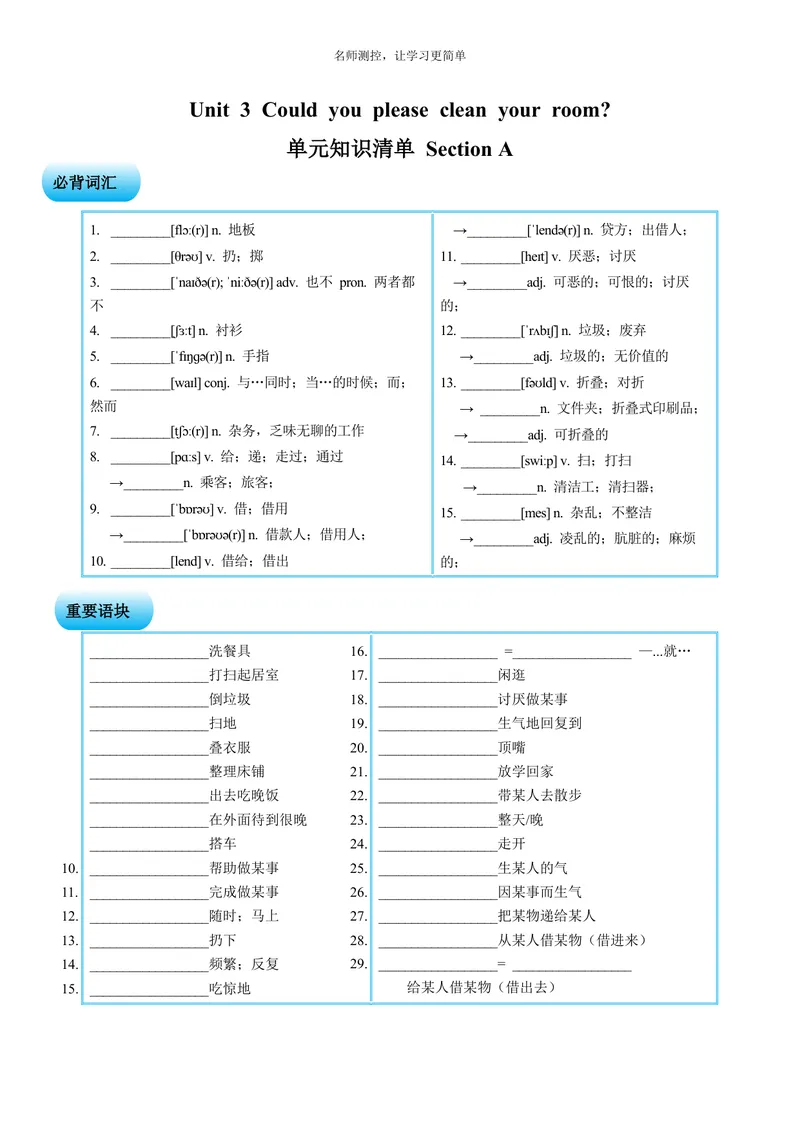
必背词汇
1. _________[flɔː(r)] n. 地板 →_________[ˈlendə(r)] n. 贷方;出借人;
2. _________[θrəʊ] v. 扔;掷 11. _________[heɪt] v. 厌恶;讨厌
3. _________[ˈnaɪðə(r); ˈniːðə(r)] adv. 也不 pron. 两者都 →_________adj. 可恶的;可恨的;讨厌
不 的;
4. _________[ʃɜːt] n. 衬衫 12. _________[ˈrʌbɪʃ] n. 垃圾;废弃
5. _________[ˈfɪŋɡə(r)] n. 手指 →_________adj. 垃圾的;无价值的
6. _________[waɪl] conj. 与…同时;当…的时候;而; 13. _________[fəʊld] v. 折叠;对折
然而 → _________n. 文件夹;折叠式印刷品;
7. _________[tʃɔː(r)] n. 杂务,乏味无聊的工作 →_________adj. 可折叠的
8. _________[pɑːs] v. 给;递;走过;通过 14. _________[swiːp] v. 扫;打扫
→_________n. 乘客;旅客; →_________n. 清洁工;清扫器;
9. _________[ˈbɒrəʊ] v. 借;借用 15. _________[mes] n. 杂乱;不整洁
→_________[ˈbɒrəʊə(r)] n. 借款人;借用人; →_________adj. 凌乱的;肮脏的;麻烦
10. _________[lend] v. 借给;借出 的;
重要语块
__________________洗餐具 16. __________________ =__________________ —...就…
__________________打扫起居室 17. __________________闲逛
__________________倒垃圾 18. __________________讨厌做某事
__________________扫地 19. __________________生气地回复到
__________________叠衣服 20. __________________顶嘴
__________________整理床铺 21. __________________放学回家
__________________出去吃晚饭 22. __________________带某人去散步
__________________在外面待到很晚 23. __________________整天/晚
__________________搭车 24. __________________走开
10. __________________帮助做某事 25. __________________生某人的气
11. __________________完成做某事 26. __________________因某事而生气
12. __________________随时;马上 27. __________________把某物递给某人
13. __________________扔下 28. __________________从某人借某物(借进来)
14. __________________频繁;反复 29. __________________= __________________
15. __________________吃惊地 给某人借某物(借出去)名师测控,让学习更简单
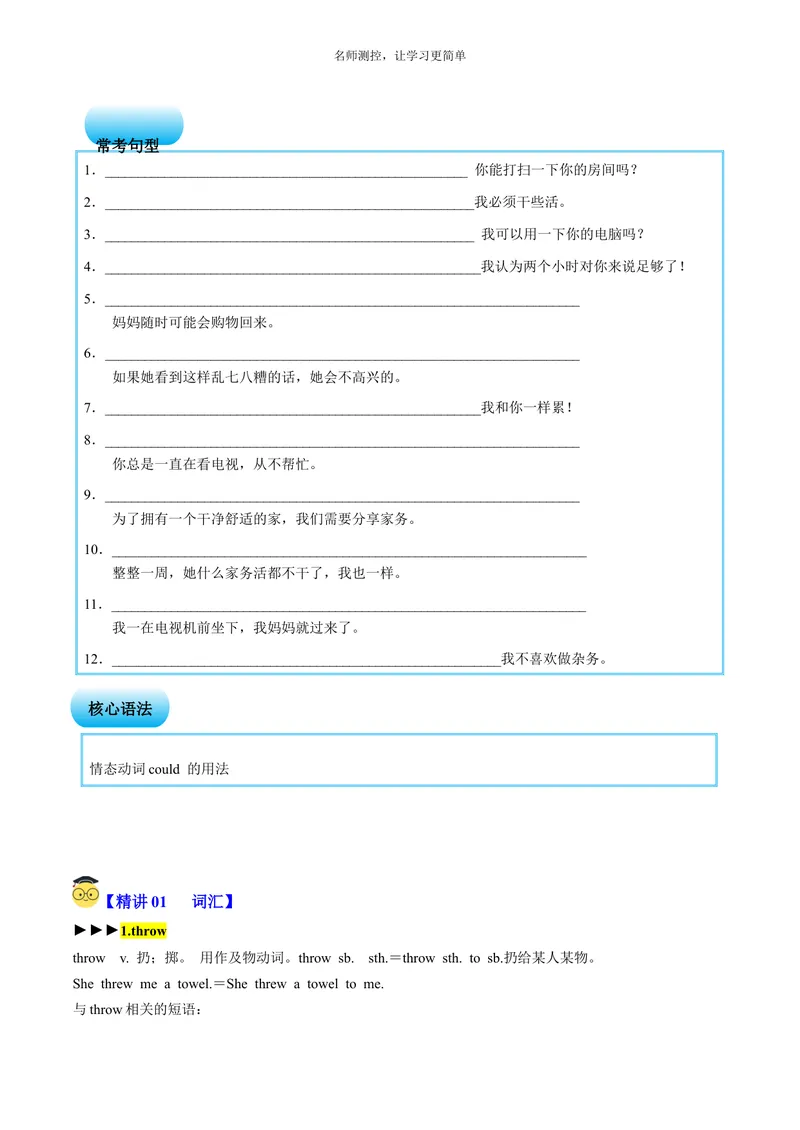
常考句型
1._______________________________________________________ 你能打扫一下你的房间吗?
2.________________________________________________________我必须干些活。
3.________________________________________________________ 我可以用一下你的电脑吗?
4._________________________________________________________我认为两个小时对你来说足够了!
5.________________________________________________________________________
妈妈随时可能会购物回来。
6.________________________________________________________________________
如果她看到这样乱七八糟的话,她会不高兴的。
7._________________________________________________________我和你一样累!
8.________________________________________________________________________
你总是一直在看电视,从不帮忙。
9.________________________________________________________________________
为了拥有一个干净舒适的家,我们需要分享家务。
10.________________________________________________________________________
整整一周,她什么家务活都不干了,我也一样。
11.________________________________________________________________________
我一在电视机前坐下,我妈妈就过来了。
12.___________________________________________________________我不喜欢做杂务。
核心语法
情态动词could 的用法
(北京)股份有限公司
【精讲01 词汇】
►►►1.throw
throw v. 扔;掷。 用作及物动词。throw sb. sth.=throw sth. to sb.扔给某人某物。
She threw me a towel.=She threw a towel to me.
与throw相关的短语:名师测控,让学习更简单
throw down 扔下;使倒下。 throw away 扔掉;丢弃
throw sth. at 向……扔某物(近) throw sth. to 投给……某物(远)
He threw down the book and went out.
She threw herself down in the bed and fell asleep.
(24-25八年级上·全国)
Look! Some kids ________ snow ________ each other.
A.throw; at B.threw; to C.are throwing; at D.are throwing; for
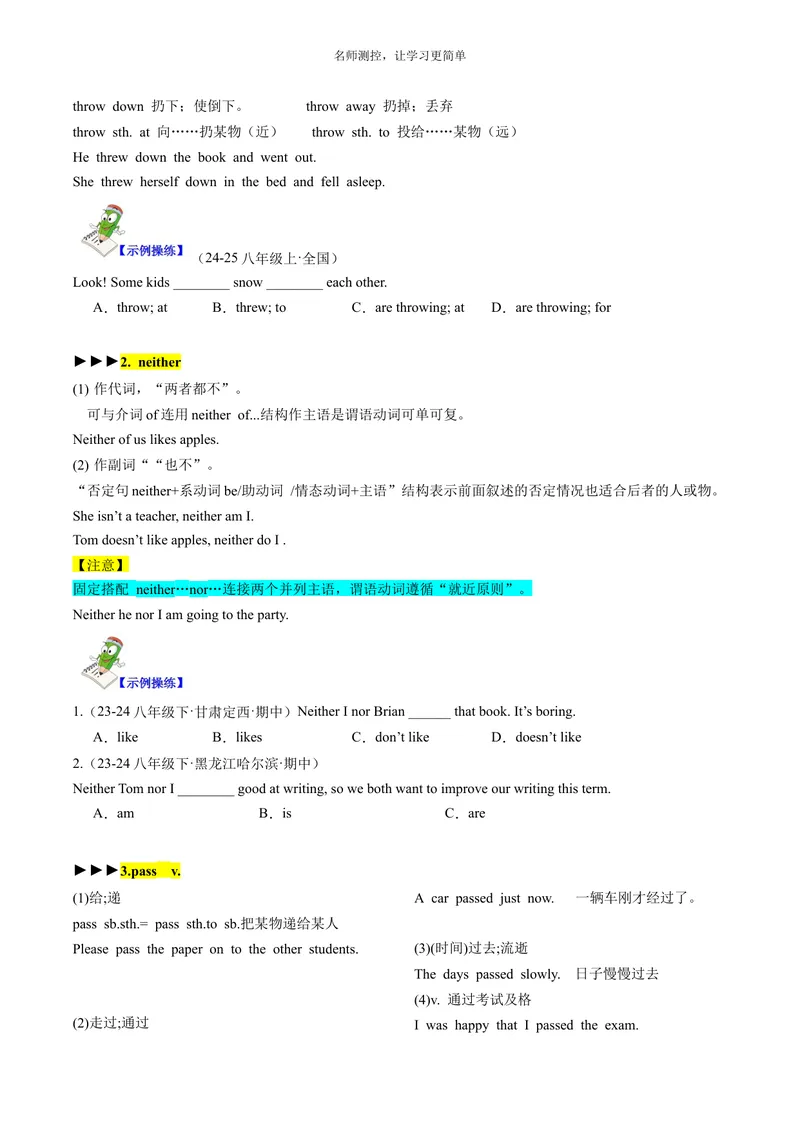
►►►2. neither
(1) 作代词,“两者都不”。
可与介词of连用neither of...结构作主语是谓语动词可单可复。
Neither of us likes apples.
(2) 作副词““也不”。
“否定句neither+系动词be/助动词 /情态动词+主语”结构表示前面叙述的否定情况也适合后者的人或物。
She isn’t a teacher, neither am I.
Tom doesn’t like apples, neither do I .
【注意】
固定搭配 neither…nor…连接两个并列主语,谓语动词遵循“就近原则”。
Neither he nor I am going to the party.
1.(23-24八年级下·甘肃定西·期中)Neither I nor Brian ______ that book. It’s boring.
A.like B.likes C.don’t like D.doesn’t like
2.(23-24八年级下·黑龙江哈尔滨·期中)
Neither Tom nor I ________ good at writing, so we both want to improve our writing this term.
A.am B.is C.are
►►►3.pass v.
(1)给;递 A car passed just now. 一辆车刚才经过了。
pass sb.sth.= pass sth.to sb.把某物递给某人
Please pass the paper on to the other students. (3)(时间)过去;流逝
The days passed slowly. 日子慢慢过去
(4)v. 通过考试及格
(2)走过;通过 I was happy that I passed the exam.名师测控,让学习更简单
(24-25八年级上·福建泉州·期中)
—I’d like to read the book over there. Could you pass ________, please?
—Certainly. Here you are.
A.me it B.it to me C.me for it
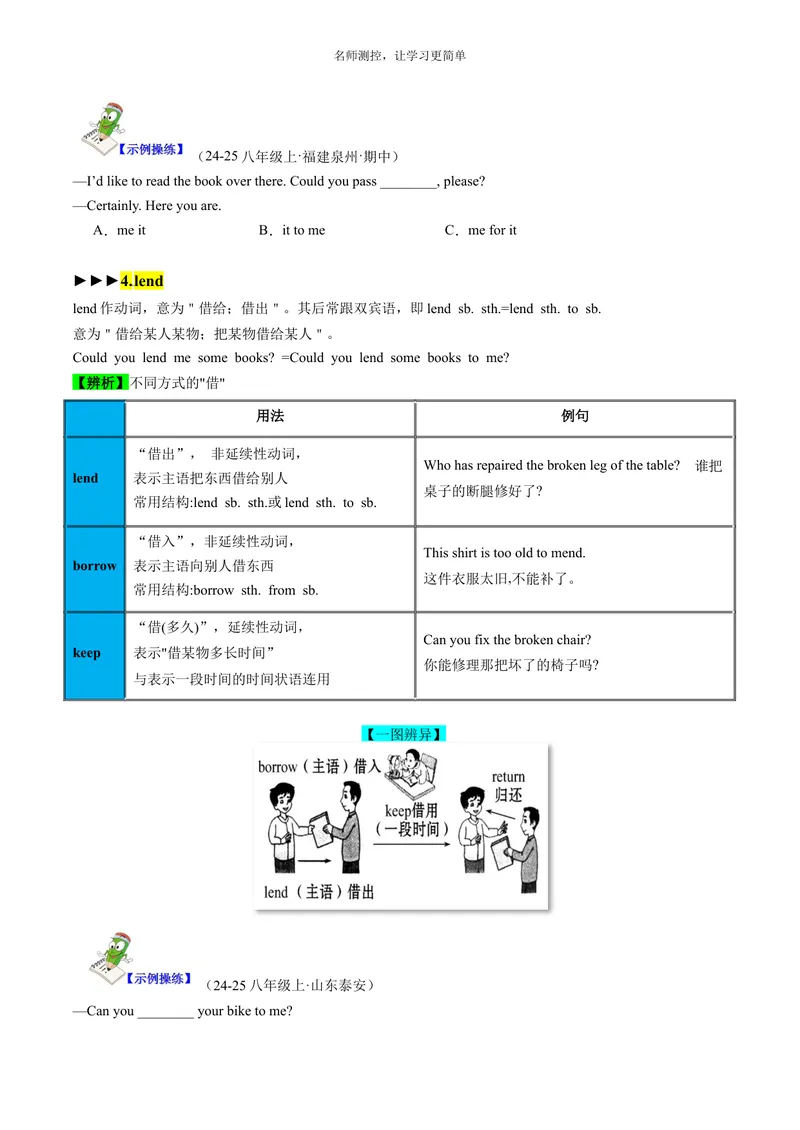
►►►4.lend
lend作动词,意为"借给;借出"。其后常跟双宾语,即lend sb. sth.=lend sth. to sb.
意为"借给某人某物;把某物借给某人"。
Could you lend me some books? =Could you lend some books to me?
【辨析】不同方式的"借"
用法 例句
“借出”, 非延续性动词,
Who has repaired the broken leg of the table? 谁把
lend 表示主语把东西借给别人
桌子的断腿修好了?
常用结构:lend sb. sth.或lend sth. to sb.
“借入”,非延续性动词,
This shirt is too old to mend.
borrow 表示主语向别人借东西
这件衣服太旧,不能补了。
常用结构:borrow sth. from sb.
“借(多久)”,延续性动词,
Can you fix the broken chair?
keep 表示"借某物多长时间”
你能修理那把坏了的椅子吗?
与表示一段时间的时间状语连用
【一图辨异】
(24-25八年级上·山东泰安)
—Can you ________ your bike to me?名师测控,让学习更简单
—With pleasure. But you mustn’t _________ it to others.
A.lend, borrow B.borrow, lend C.lend, lend
►►►5.hate
hate v. 厌恶;讨厌
(1) hate + n./pron,不喜欢/憎恨某人/某物
I hate rainy days.
(2) hate to do sth. 讨厌做某事, 表示某次具体行为或动作。
I hate to trouble her.
(3)hate doing sth.不愿意做某事 表示经常或习惯性行为或动作。
I hate him smoking.
(23-24七年级下·上海)
I hate ______ action films, because they are too tense.
A.seeing B.see C.saw D.watch
【精讲02 短语】
►►►1. the minute
the minute在此引导时间状语从句,意为“一……就……”,相当于as soon as。
the minute引导时间状语从句时,遵从“主将从现”。主句用一般将来时态,从句用一般现在时。
As soon as I sat down in front of the TV, my mom came over.
=The moment I sat down in front of the TV, my mom came over.
The minute you call me, I'll be there.
The minute I saw him, I knew something was wrong.
(23-24八年级下·四川)
Take it easy, I _______ to him the minute I _______ him tomorrow.
A.talk, will meet B.will talk, meet C.will talk, will meet
►►►2.as......as
as ... as 意为 “和……一样” ,表示同级的比较。
使用时要注意第一个as为副词,第二个as为连词。其基本结构为:as + adj./ adv. + as。
He works as hard as he can.名师测控,让学习更简单
Your pen writes as smoothly as mine.
The cake is as sweet as honey.
She doesn't sing as well as her sister.
1.(2023·辽宁大连·中考真题)Nowadays traveling by high-speed train is as ________ as traveling by air in
China.
A.popular B.more popular C.most popular D.the most popular
2.(2025·上海黄浦·一模)His joke was as ________ as a stand-up comedy show, and we all laughed.
A.fun B.funny C.funnier D.funniest
►►►3.in surprise
in surprise 惊讶地;吃惊地
常用于动词之后作方式状语,相当于with surprise。
surprise可作名词也可作动词,
常用短语还有:to one's surprise“令某人惊讶的是”。
He looked up in surprise when he heard the loud noise.
To my surprise, he passed the exam easily.
His success surprised everyone.
(23-24八年级下·贵州贵阳·期中)
________ our surprise, he finally got an A in his English exam.
A.With B.In C.To D.For
【精讲03 句子】
►►►1.Peter ,could you please take out the trash?
【句型剖析】
(1)此处情态动词could并非表示过去时态,而是表示委婉语气,后跟动词原形表达有礼貌地请求或请求
允许做某事。
Could you tell me how to get to the nearest bank? 你能告诉我怎么去最近的银行吗?
肯定回答:Sure./ Of course./ Certainly./No problem.
否定回答: Sorry , I can’t. (注意不能用could)
— Could I use your phone, please?
—Sure. 当然可以。名师测控,让学习更简单
(2)take out
take out意为"带出去;取出;拿出;除掉",是由"动词+副词"构成的动词短语,
名词作宾语时放在out前后都可以,代词作宾语时必须将其放在out前。
He took out a pen from his pocket and wrote down his phone number.
他从口袋里拿出一支笔,写下了他的电话号码。
My father took me out to dinner to celebrate my birthday.
我父亲带我出去吃晚餐庆祝我的生日。
1.(2024·新疆克孜勒苏·一模)Jenny finally got the job because she ________ speak English well.
A.might B.must C.could D.need
2.(24-25九年级上·福建福州·期末)—________ I have an ice cream, mom?
—You’d better not. You have a cold now.
A.Could B.Must C.Dare
3.—What a mess! The milk in the fridge has gone bad.
—Don't worry. I'll ______ the rubbish and buy some fresh milk right away.
A. take up B. take out C. take off D. take after
►►►2. I think two hours of TV is enough for you!
two hours of TV虽为复数,但却表达一种整体的观念。
当时间、长度、距离或其他可数名词表示一个完整的整体概念,作主语时,其后的谓语动词用其单数形式。
Two hours is enough to finish the work. 两个小时足够完成这项工作。
Five kilograms is too heavy for a suitcase. 五公斤对于一个行李箱来说太重了。
Ten kilometers is a long distance to walk. 十公里是一段很长的步行距离。
Five kilometers ______ a long way for an old man like him to walk alone.
A.are B. is C. were D. have been
【精讲04 语法】
►►►1.情态动词could 用法
一、概念
情态动词 "could" 是can的过去式,但它的用法并不局限于表示过去时态。
不能作谓语,没有人称和数的变化,后加动词原形。名师测控,让学习更简单
二、could的用法
1. 表示“过去的能力和可能性”
“could” 可用于一般过去时,表达过去具备的能力,即过去 “能” 或 “会” 做某事。
I could run faster when I was younger.我年轻时能跑得更快。
2. 用于委婉提出要求或请求(Ask for permission),比can更委婉;
常用于口语中向他人请求许可或提出请求。回答通常用 “Yes, you can.” 或 “No, you can't.” 。
Could I use your phone?我可以用一下你的电话吗?
Could you pass the salt?你能把盐递给我吗?
3.提出比较委婉的建议或劝告
“could” 可以用来提出比较委婉的建议或劝告,让语气更加温和。
You could try this new restaurant. The food there is delicious.你可以试试这家新餐厅,那里的食物很美味。
4.表示推测
“could” 可用来表示现在或将来的可能性,通常指理论上的可能性,其可能性比 “can” 稍弱。
She stayed up late last night.She could be very tired.她昨晚熬夜了,她肯定很累。
The weather forecast says it could rain this afternoon.天气预报说今天下午可能会下雨。
【辨析】could和can
1.(2023·辽宁抚顺·中考真题)The lovely boy ________ ride the bike at the age of six.
A.must B.could C.need D.should
2.(2023·四川达州·中考真题)—Jack, could you please help me take out the trash?
—Sorry, І ________, mom. I ________ my homework now.
A.couldn’t, am doing B.can’t, am doing C.can’t, do
3.(2023·江西抚州·一模)—There is someone knocking on the door. I wonder who it ________ be.
—It ________ be Frank. He phoned to tell me he would come to our home soon.
A.must; must B.could; must C.might; can’t D.might; mustn’t名师测控,让学习更简单
4.(2024·河北石家庄·一模)—Could you go to the bookshop with me?
—Sorry, I _________. I have to go home right after school.
A.may B.must C.can’t D.needn’t
5.(2023·辽宁沈阳·模拟预测)She kept on falling over because she ________ keep her balance.
A.might B.might not C.could D.could not