Unit 1 What’s the matter?
单元知识清单 Section A
必背词汇
1. stomach n.胃:腹部 9. passenger n.乘客;旅客
2. neck n.颈:脖子 10. headache n.头痛
3. throat n.咽喉;喉咙 11. stomachache n. 胃痛:腹痛
4. fever n.发烧 12. toothache n.牙痛
5. cough n. 咳嗽 13. hurt v.(使)疼痛;受伤--hurt (pt.)--hurt
6. break n.间歇;休息/v.打破 (pp.)
7. trouble n. 问题;苦恼 14. lie v .躺--lay(pt.)-- lain(pp.) --lying (现
8. sore adj .疼痛的,酸痛的 在分词)
15. advice n.建议--advise v.建议
重要语块
1. What’s the matter (with you)? 怎么了?出什么事 18. take breaks (away from…)休息(远离…)
了? = take a break = have a rest 休息
= What’s the trouble (with…)? 19. in the same way 以相同的方式
= What’s the problem (with…)? 20. without doing 没有做某事
= What’s wrong (with…)? 21. go along 沿着…走
2. have a cold 感冒 22. see sb. doing看见某人正在做
catch a cold 感冒 see sb. do 看见某人做某事(全过程)
3. have the flu 得了流感 23. next to 紧挨着
4. have a stomachache 肚子疼 24. shout for help 呼救
5. have a sore back 背疼 25. think twice 认真思考,权衡利弊
6. have a sore throat 嗓子疼 26. get off 下车 get on 上车
7. have a fever 发烧 27. have a heart problem 有心脏病
= have a temperature
28. take sb. to 带某人去…
8. have a cough 咳嗽
29. expect sb. to do 期待某人做某事
9. have a toothache 牙疼
30. to one’s surprise 令某人惊讶的是
10. have a headache 头疼
31. agree to do 同意做某事
11. lie down 躺下(lie – lay – lain)
32. thanks to… 多亏了
12. see a dentist 看牙医
33. in time 及时 on time 按时
13. get an X-ray 拍X光
34. save a life 拯救生命
14. take one’s temperature 量体温
35. right away 立刻
15. sound like + n. sound + adj.
36. get into trouble 陷入麻烦
16. on the weekend 在周末 = on weekends
17. need to do 需要做…
常考句型
1. 1.-What's the matter(with you)? (你)怎么了?
鸿鹄志-I have a stomachache. 我胃痛。
-You shouldn't eat so much next time. 你下次不应该吃这么多。
2. -What should I do? 我该怎么办?
-You should lie down and rest. 你应该躺下休息一下。
3. -Do you have a fever? 你发烧了吗?
-Yes,I do./No,I don't. 是的,我发烧了。/不,我没有发烧。
4. -Does he have a toothache? 他牙痛吗?
-Yes,he does. 是的,他牙痛。
-He should see a dentist and get an X-ray. 他应该看牙医并拍X光片。
5. -Should I put some medicine on it? 我应该敷药吗?
-Yes,you should./No, you shouldn't. 是的,你应该敷药。/不,你不应该敷药。
6. Thanks to Mr. Wang and the passengers, the man was saved by the doctors in time.
多亏了王先生和乘客们,医生及时挽救了老人的性命。
7. It's sad that many people don't want to help others because they don't want any trouble.
许多人因为不想有麻烦而不想帮助别人,这真令人难受。
8. If your head and neck still hurt tomorrow, then go to a doctor.
如果你的头和脖子明天仍然疼痛,那么就要去看医生了。
核心语法
1. 疾病的表达方法 2.建议的表达
2. 情态动词should 的用法 3.反身代词的用法
(北京)股份有限公司
【精讲01 词汇】
►►►1.enough
(1) 作adj.足够的,充分的 修饰名词时,可放在名词之前或之后
enough time
(2) 作 adv. “足够地, 十分,相当”修饰adj./adv,放在adj./adv 后
expensive enough
(3) 常用搭配be +adj. +enough to do sth. be strong enough to carry the box.
(24-25八年级·吉林·期末)What a heavy snow! All the drivers must drive their cars
_______.
A.careful enough B.enough careful C.carefully enough D.enough carefully
鸿鹄志【答案】C
【详解】句意:好大的一场雪啊!所有的司机都必须足够小心地开车。
考查副词和enough的用法。careful为形容词,意为“小心的”;carefully为副词,意为“小心地”;
enough为副词,意为“足够地”,用于修饰形容词或副词时,应放在其后。句子中需要副词来修饰动词
drive。故选C。
►►►2. need v 需要
常见用法:
need+名词(需要某物) / sb need to do sth.(某人需要做某事)
作实义动词
/sth need doing sth. = sth need to be done (某物需要被做)
意 为 “ 需
I need your help.
要”
Do you need to drink more water?(要借助助动词do/does/did)
need
My TV set needs repairing.
作情态动词
无人称和数的变化,后跟动词原形。needn't =don't have to 没有必要
意为“需
must 开头的一般疑问句,否定回答用needn't
要,必
Need I finish the work today? Yes, you need./ No, you needn't.
须”’
1.(23-24八年级·上海·期末)You ________ help us with our group task because we can manage it by
ourselves.
A.need B.don’t need C.needn’t to D.don’t need to
【答案】D
【详解】句意:你不需要帮助我们完成小组任务,因为我们可以自己完成。
考查动词的用法。need需要,实义动词或情态动词;don’t need不需要,用在句中需加to;needn’t to错误
表达;don’t need to不需要。根据“we can manage it by ourselves”可知,这里表示“不需要”帮助,排除选
项A和C,need作实义动词时否定句需借助助动词,don’t need to do sth.表示“不需要做某事”。故选D。
2.(23-24八年级·天津和平·期中)You________ angry with her, for she is very young.
A.need not to be B.don’t need to C.need not be D.need not
【答案】C
【详解】句意:你不需要对她生气,因为她还很年轻。
考查need的用法。need作为情态动词时,否定形式为need not (needn’t),后接动词原形,选项A形式错误;
need作为实义动词时,常用结构need to do sth,angry是形容词,前面需要系动词,构成系表结构,B选项
错误;选项D后面需要加系动词。故选C。
鸿鹄志►►►3. expect
(1) expect to do sth. 预计做某事
I expect to finish the work by Friday.
(2) expect sb. to do sth. 期待某人做某事 = look forward to doing sth 期待做某事
The teacher expects us to be on time for class.
(3)I expect so/not 我期待是这样/不是这样
—Do you think it will rain tomorrow?(你认为明天会下雨吗?)
—I expect so.(我想会的。)
(24-25八年级·云南大理·期末)My mom expects me ____ hard to make my dream come
true.
A.working B.to work C.worked D.work
【答案】B
【详解】句意:我妈妈期望我努力工作来使我的梦想成真。
考查非谓语动词。expect sb to do sth表示“期望某人做某事”,固定短语,空格处用动词不定式to work。
选B。
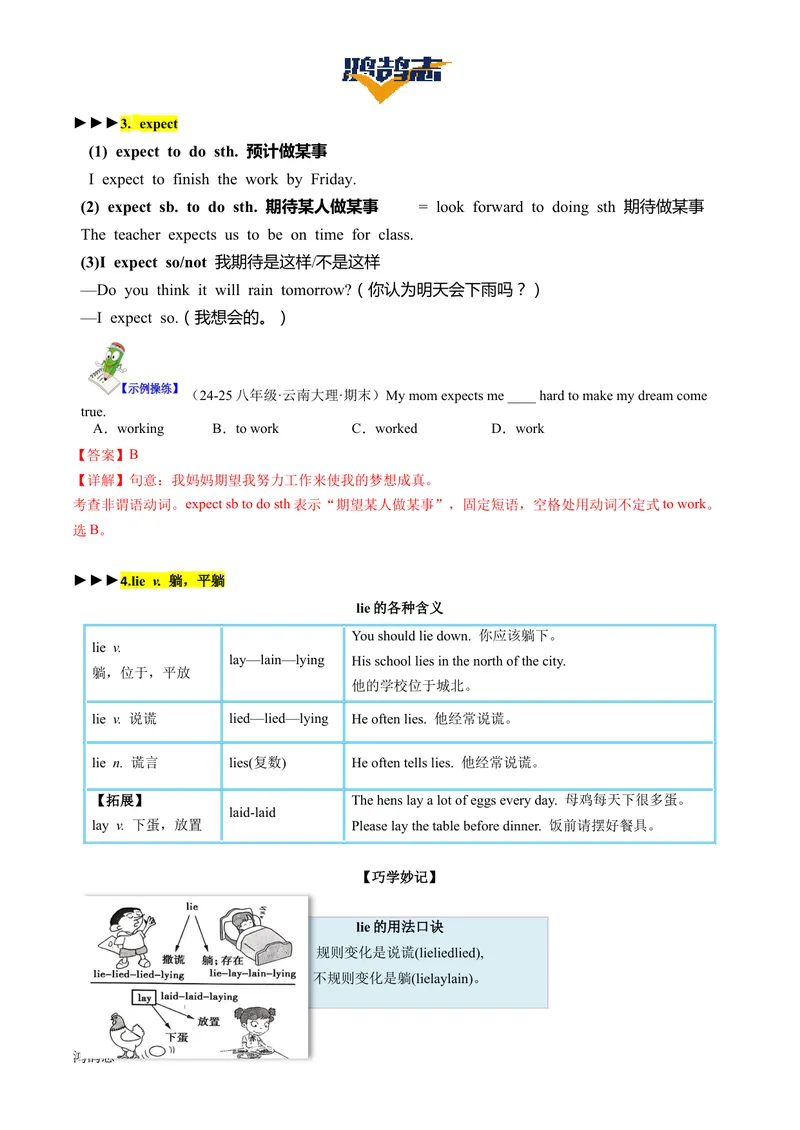
►►►4.lie v. 躺,平躺
lie的各种含义
You should lie down. 你应该躺下。
lie v.
lay—lain—lying His school lies in the north of the city.
躺,位于,平放
他的学校位于城北。
lie v. 说谎 lied—lied—lying He often lies. 他经常说谎。
lie n. 谎言 lies(复数) He often tells lies. 他经常说谎。
【拓展】 The hens lay a lot of eggs every day. 母鸡每天下很多蛋。
laid-laid
lay v. 下蛋,放置 Please lay the table before dinner. 饭前请摆好餐具。
【巧学妙记】
lie的用法口诀
规则变化是说谎(lieliedlied),
不规则变化是躺(lielaylain)。
鸿鹄志(23-24九年级·四川达州·期末)Look! There’s a cat ________ next to the little girl.
A.lie B.lay C.lying D.to lie
【答案】C
【详解】句意:看!女孩旁边躺着一只猫。
考查非谓语动词。lie躺;lay放置;lying现在分词,躺;to lie动词不定式。空处作后置定语,修饰the
cat,且the cat与横线部分之间为主动关系,故用现在分词形式。lie意为“躺”时,现在分词形式为
lying。故选C。
►►►5.without prep. 没有,缺乏
(1)without后接名词、代词宾格或v-ing作宾语,其反义词为with。
We got there without any trouble.
Can you finish your homework without him?
She left the room without saying a word.
(2)without用于否定句,还可以表示条件,意为"如果没有", 相当于if引导的否定条件句。
We couldn’t live without air.=We couldn’t live if there weren’t air.
(23-24八年级上·甘肃武威·期末)She left here quietly without ________ goodbye to us.
A.say B.says C.said D.saying
【答案】D
【详解】句意:她悄悄地离开了这里,没有跟我们道别。
考查非谓语。without“没有”,是介词,后跟动名词作宾语。故选D。
【精讲02 短语】
►►►1.too much
意为“太多”
too There is too much rain these days.
后接不可数名词,可放在动词之
much Watching TV too much is bad for your eyes.
后,
too 意为“太多,足够地”, There are too many things for me to do every day.
many 后接可数名词复数。
much 意为“太”,
too 修饰形容词或副词。 It's much too cold in winter.
鸿鹄志(24-25八年级·四川)Mary has ________ friends at school, so she is ________ happy.
A.too many; much too B.too much; much too C.too many; too much
【答案】A
【详解】句意:玛丽在学校有很多朋友,所以她非常高兴。
考查短语辨析。too many太多,修饰可数名词复数;too much太多,修饰不可数名词;much too太……,
修饰形容词、副词。根据第一空后“friends”是可数名词复数,要使用too many,第二空后“happy”是形容
词,要使用much too。故选A。
►►►2.see sb doing sth与see sb do sth
(1) see sb doing sth 看见某人正在做某事(看见动作正在进行)
I saw him playing the piano in the music room just now.
(2)see sb do sth 看见某人做某事(看见动作全过程或经常性的动作)
I saw him playing the piano in the music room just now.
【拓展】
v.+sb+doing/do的常见动词:一感(feel),二听(listen to,hear),四看(see,look at, watch, notice)
(24-25八年级·甘肃天水·期末)—Why did you stop in front of the classroom just now?
—I saw someone ________ there.
A.dances B.to dance C.dancing D.dance
【答案】C
【详解】句意:——你刚才为什么停在教室前面?——我看见有人在那儿跳舞。
考查非谓语动词。see sb do sth表示看到完整的动作;see sb doing sth表示看到某人正在进行的动作。根据
“Why did you stop in front of the classroom just now?”可知,强调看到有人正在那里跳舞,用现在分词作宾
语补足语,故选C。
►►►3.get off
意为"下车",其反义短语为get on"上车"。
►Excuse me, I have to get off at the next stop. 劳驾,我必须在下一站下车。
► He got off at Guangming Road. 他在光明路下车了。
► Don’t get on the No.8 bus. 不要上8路公交车
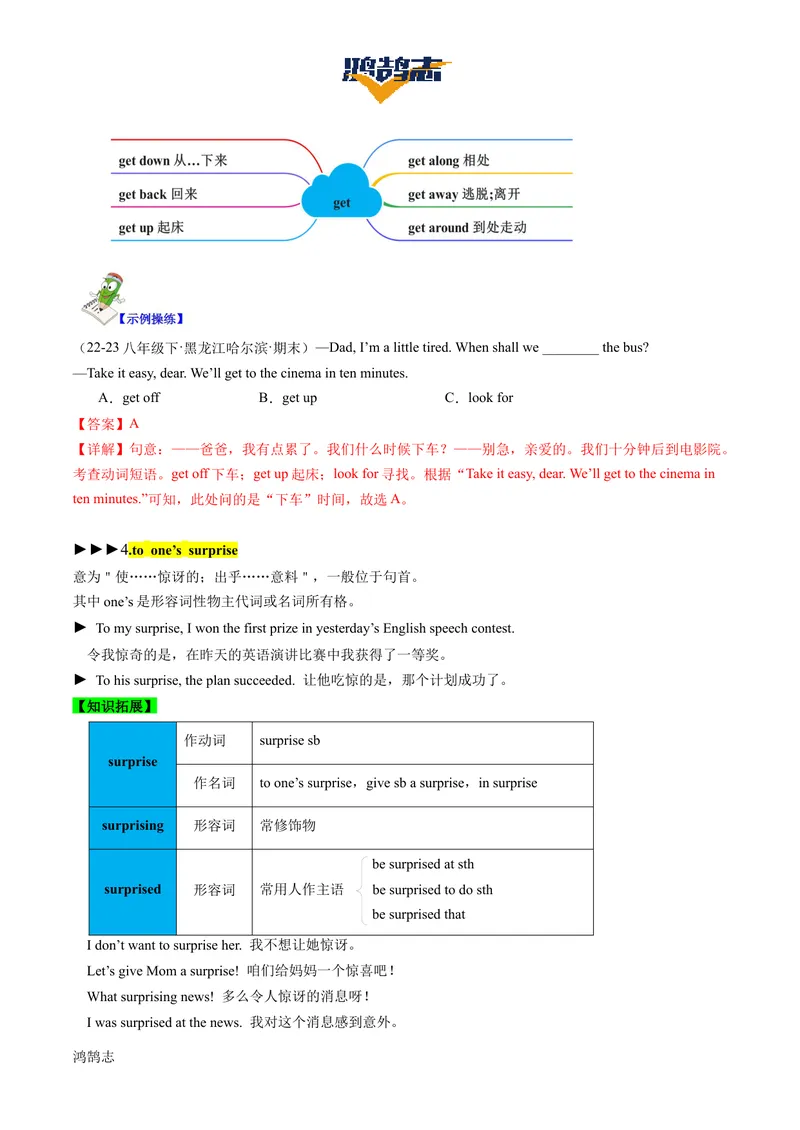
【拓展】 常见get构成的短语
鸿鹄志(22-23八年级下·黑龙江哈尔滨·期末)—Dad, I’m a little tired. When shall we ________ the bus?
—Take it easy, dear. We’ll get to the cinema in ten minutes.
A.get off B.get up C.look for
【答案】A
【详解】句意:——爸爸,我有点累了。我们什么时候下车?——别急,亲爱的。我们十分钟后到电影院。
考查动词短语。get off下车;get up起床;look for寻找。根据“Take it easy, dear. We’ll get to the cinema in
ten minutes.”可知,此处问的是“下车”时间,故选A。
►►►4.to one’s surprise
意为"使……惊讶的;出乎……意料",一般位于句首。
其中one’s是形容词性物主代词或名词所有格。
► To my surprise, I won the first prize in yesterday’s English speech contest.
令我惊奇的是,在昨天的英语演讲比赛中我获得了一等奖。
► To his surprise, the plan succeeded. 让他吃惊的是,那个计划成功了。
【知识拓展】
作动词 surprise sb
surprise
作名词 to one’s surprise,give sb a surprise,in surprise
surprising 形容词 常修饰物
be surprised at sth
surprised 形容词 常用人作主语 be surprised to do sth
be surprised that
I don’t want to surprise her. 我不想让她惊讶。
Let’s give Mom a surprise! 咱们给妈妈一个惊喜吧!
What surprising news! 多么令人惊讶的消息呀!
I was surprised at the news. 我对这个消息感到意外。
鸿鹄志1.(23-24八年级下·甘肃·期末)To ________ surprise, all the passengers agreed ________ with him.
A.he; go B.his; to go C.him; going D.him; go
【答案】B
【详解】句意:令他惊讶的是,所有的乘客都同意和他一起去。
考查物主代词和非谓语动词。to one’s surprise“令某人惊讶的是”;agree to do“同意做某事”,固定短语。
选B。
2.(24-25七年级·天津和平·期末)It’s a piece of ________ news and we are all ________ at it.
A.surprising; surprise B.surprising; surprised
C.surprised; surprising D.surprised; surprise
【答案】B
【详解】句意:这是一个令人惊讶的消息,我们都很惊讶。
考查形容词辨析和形容词的用法。surprising令人惊讶的,形容物;surprised吃惊的,形容人;surprise惊
讶,名词。第一个空修饰名词news,用surprising;第二个空作表语,形容人,用surprised。故选B。
►►►5.thanks to…多亏…,由于…
意为 “由于”、“多亏”
to表示感谢的对象 Thanks to his quick reaction, the accident
Thanks to
注意:to后不接动词原形 was not too serious.
thanks不可以改为thank you
意为“因……而感谢”
Thanks Thanks for helping me clean the classroom.
for强调为何而感谢,
for
其后可接名词或 v-ing
(22-23九年级·全国)We all ____ Mrs. Wang_____ her help. ______ her help, we have made great success.
A.thank; for; Thanks to B.thank; to; Thanks for C.thank; to; Thanks to
【答案】A
【详解】句意:我们都非常感谢王夫人的帮忙。幸亏有她的帮忙,我们已经取得了很大的成功。
考查动词短语和介词短语辨析。thank...for...因……而感谢……;thanks for因……而感谢;thanks to...幸
亏……。根据“We all... Mrs. Wang... her help.”可知,因王夫人的帮忙而表示感谢,用thank sb. for sth.“因某
事而感谢某人”;根据“...her help, we have made great success.”可知,表示幸亏有她的帮忙,用thanks
鸿鹄志to“幸亏”。故选A。
►►►6.in the same way以同样的方式
In the same way that plants need sunlight to grow, humans need a balanced diet to stay healthy.
就像植物需要阳光来生长一样,人类需要均衡的饮食来保持健康。
You should hold the knife and fork in the same way as I do.你应该像我这样拿刀叉。
【拓展】 常见way 构成的短语:
(24-25九年级·四川成都·期中)—I won the first prize in the English competition.
— Well done! ________ , what is your medal (奖牌) made of?
A.By the way B.Guess what C.Pardon
【答案】A
【详解】句意:——我在英语比赛中获得了一等奖。——做得好!顺便问一下,你的奖牌是什么做的?
考查介词短语。By the way顺便问一下;Guess what你猜怎么着;Pardon请再说一遍。根据语境,前一句
表示祝贺,后一句询问奖牌材质,适合用“By the way”引出附加问题。故选A。
【精讲03 句子】
►►►1. At 9: 00 a.m. yesterday, bus No. 26 was going along Zhonghua Road when the driver saw an old
man lying on the side of the road. 昨天上午九点, 二十六路公交车正沿着中华路行驶; 突然司机看到一位
老人躺在路边。
本句是复合句,是一个含有when引导的时间状语从句,句式结构如下:
At 9: 00 a.m. yesterday, [ bus No. 26 was going along Zhonghua Road] [when the driver saw an old man lying on
时间状语 主句 时间状语
the side of the road.]
鸿鹄志when引导时间状语从句,除常有"当……时"之意外,放在过去进行时构成的主句之后,还意为"就在
此/那时;突然",相当于at this/that time。
(24-25八年级·天津·期末)We were reading the new words of Module 11 ________ Miss
Du came into the classroom.
A.though B.when C.until D.if
【答案】B
【详解】句意:当杜老师走进教室时,我们正在读第十一单元的生词。
考查连词辨析。though虽然;when当……时候;until直到;if如果。根据“Miss Du came into the
classroom”可知,表示“杜老师进来时,我们正在读单词”,需要用when引导时间状语从句。故选B。
【精讲04 语法】
►►►1.疾病的表达方式
一、疾病的询问:
What’s the matter? 怎么啦?出什么事情了?
matter n.问题;事情,常用于句型What’s the matter(with sb. )中。
用来询问某人患了何种疾病或遇到了何种麻烦。
如: — What’s the matter with you? — I have a bad cold.
其他类似表达还有:
【注意】:
matter 和trouble 为名词,其前可加the 或形容词性物主代词,wrong 是adj. 不能加the。
二、疾病的表达:
have a/an + 疾病名词 “患……病”
类似的短语:
鸿鹄志have a fever 发烧 have a cold 患感冒
have a cough 咳嗽 catch a cold 患感冒
have a stomachache 患胃痛 have a toothache患牙痛
have a headache 患头痛 have a backache 患背痛
have a sore throat 患喉咙痛 have a sore back 患背痛
【拓展】 身体部位+ache(疼痛)构成新的复合词:
stomach+ache=stomachache head+ache=headache
tooth+ache=toothache back+ache=backache后背痛
(23-24八年级·天津和平·期末)What’s ________ with you?
A.the wrong B.trouble C.matter D.the matter
【答案】D
【详解】句意:你怎么了?
考查名词辨析。the wrong错事;trouble麻烦;matter问题,有关系;the matter问题。根据“What’s…with
you?”可知,此处是询问你怎么了?其英文表达为:What’ s the matter with you?或What’s the trouble with
you?或What’s wrong with you?故选D。
►►►2.表达建议的句型
提建议的句型
You should drink more warm water. (多喝热水)
You should lie down and take a break/rest. (躺下休息)
1.You should/could +v. You should take your temperature. (量体温)
You should take some medicine. (吃点药)
2.You’d better (not) +v.
/You are supposed to You’d better not stay up late. (你最好不要熬夜。)
+v.
3.What1about/How1about +
n./doing……? How about taking a walk after dinner? (晚饭后散步怎么样?)
4.Why don’t you +v.? Why not get more exercise to improve your health?
/Why not +v.? (为什么不通过多锻炼来改善健康呢?)
5.It’s best for you to +v. It’s best for you to rest for a few days until your fever
/It’s important for sb. to subsides.
+v. (你最好休息几天,直到退烧。)
It’s important for you to drink plenty of water every day.
(每天喝足够的水对你很重要。)
鸿鹄志(23-24八年级·广西·期末)—It’s such a fine day. What about going out for a picnic?
—________
A.Sounds great. B.Have fun. C.Good luck.
【答案】A
【详解】句意:——天气真好。出去野餐怎么样?——听起来不错。
考查情景交际。Sounds great听起来不错;Have fun玩得开心;Good luck祝你好运。根据“What about
going out for a picnic?”可知,此处应回复“听起来不错”。故选A。
►►►3.情态动词should 【教材原句】You shouldn't eat so much next time.你下次不应该吃这么多了。
一、概念:
should作情态动词,意为“应该”,表示劝告、建议或表示有责任(或义务)去做某事。可用于所有
人称,
其后跟动词原形,和动词原形一起构成谓语。
二、用法:
1.用于提出建议或劝告,意为“应该”。
She should drink more water .
2.用于表达义务或责任,意为“应该;应当”。
We should respect the old.
3.用于责备﹑命令或要求,语气比较强烈。
You shouldn’t shout at your mother.
4.用于征求对方的意见,意为“应该;应当”,常用于主语是第一人称的疑问句中。
What should we do now?
5.表示推测﹐意为“应该会;可能”。
I think they should be at home.
二、句式:
(1)肯定句: 主语+should+动词原形(+其他)。
You should make your bed.你应该自己铺床。
(2) 否定句:主语+should not/shouldn't+动词原形(+其他)。
You shouldn't throw the rubbish here and there.
你不应该到处扔垃圾。
(3)一般疑问句: Should+主语+动词原形(+其他)?
Should I take my temperature first?我应该先量体温吗?
(4)特殊疑问句:特殊疑问词+should+主语+动词原形(+其他)?
What should I do?我应该做什么?
鸿鹄志1.(23-24八年级下·安徽·期末)—Why don’t you get up a little earlier next time?
—________.
A.OK, I will B.Sorry, I don’t know C.Thank you D.That’s right
【答案】A
【详解】句意:——下次你为什么不早一点起床呢?——好的,我会的。
考查情景交际。OK, I will好的,我会的;Sorry, I don’t know对不起,我不知道;Thank you谢谢;That’s
righ那是对的。根据“Why don’t you get up a little earlier next time?”可知,空处应是对上文提议的回应,A
项表示采纳,符合语境,故选A。
2.(22-23八年级下·河南·期末)You ________ talk back to your parents. It’s not good.
A.need B.should C.needn’t D.shouldn’t
【答案】D
【详解】句意:你不应该和你父母顶嘴。这并不好。
考查动词词义辨析。need需要;should应该;needn’t不必;shouldn’t不应该。根据“It’s not good.”可知,
此句是说不应该和父母顶嘴,故选D。
3.(22-23八年级下·湖北武汉·期中)—Let’s set off early tomorrow. How about 5 am?
—We don’t have to get up so early. The roads ________ be less crowded on Saturday.
A.should B.can’t C.need D.would
【答案】A
【详解】句意:——我们明天早点出发吧。早上五点怎么样?——我们不必起得这么早。星期六的路上应
该不会那么拥挤。
考查动词辨析。should应该;can’t不能;need需要;would将会。根据“We don’t have to get up so early.
The roads...be less crowded on Saturday.”可知,星期六的路上应该不会很拥挤,所以没有必要起床起得那么
早。空处应是should,表肯定推测。故选A。
4.(23-24八年级下·云南文山·期末)We ________ plant more trees to make Wenshan a green city.
A.should B.may C.can’t D.shouldn’t
【答案】A
【详解】句意:我们应该种更多的树,让文山成为一个绿色的城市。
考查动词词义辨析。should应该;may也许;can’t不能;shouldn’t不应该。根据“to make Wenshan a green
city”可知,此处表示责任或义务。故选A。
►►►4.反身代词的用法
一、概念:
反身代词是一种表示反射或强调的代词。
反身代词与它所指代的名词或代词形成互指关系,两者在人称和数上应保持一致。
鸿鹄志The girl can dress herself.这个女孩能给自己穿衣服。
I enjoyed myself at the party.在聚会上,我玩得很开心。
二、构成:
反身代词由第一人称、第二人称的形容词性物主代词和第三人称代词的宾格加词尾-self或-selves构成。
人称 第一人称 第二人称 第三人称
himself他自己
单数 myself 我自己 yourself 你自己 herself她自己
itself它自己
复数 ourselves 我们自己 yourselves 你们自己 themselves 它们自己
三、用法:
句法作用 例句
(1)作动词的宾语:
He teaches himself English.他自学英语。
作宾语 Mrs. Black herself is a lawyer. 布莱克太太本人就是一名律师。
You had better ask the driver himself. 你最好问问司机本人。
(2)作介词的宾语:常和by构成固定短语,表示“独立地;单独地”。
The little girl went to school by herself.小女孩独自一人去上学了
作主语或宾语的同位语:
作同位语 I myself can finish my homework.
I can finish my homework myself.
Just be yourself. 做你自己最好了。
作表语 He is not himself today.他今天有点不太舒服。
1.(22-23八年级下·四川·期末)—I will have a singing competition tomorrow. I’m a bit nervous.
—Don’t worry. Believe in ________. You are good at it.
A.you B.yours C.yourself
【答案】C
【详解】句意:——明天我将有一场歌唱比赛。我有点紧张。——别担心。相信自己。你很擅长它。
考查代词辨析。you你,人称代词的主格或宾格;yours你的,名词性物主代词;yourself你自己,反身代
鸿鹄志词。根据“Don’t worry. Believe in…”可知,此处指别担心,相信自己,应用反身代词yourself“你自己”。
故选C。
2.(23-24八年级下·吉林·期末)—Who washes clothes for the little girl?
—Nobody. Just by ________.
A.himself B.herself C.themselves
【答案】B
【详解】句意:——谁给小女孩洗衣服?——没人给她洗。她是自己洗的。
考查反身代词辨析。himself他自己;herself她自己;themselves他(她/它)们自己。根据“the little girl”
可知,此空应填herself。故选B。
鸿鹄志