文档文本内容
Unit 4 Why don’t you talk to your parents?
单元知识清单 Section A
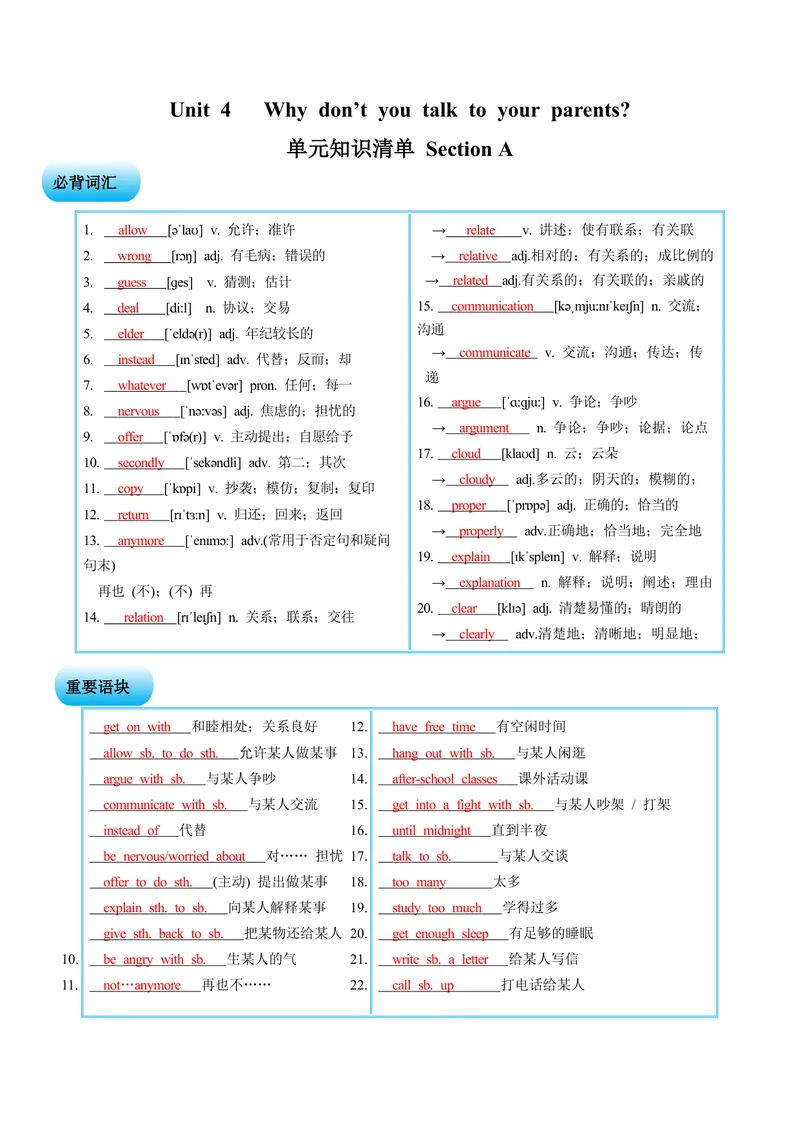
必背词汇
1. allow [əˈlaʊ] v. 允许;准许 → relate v. 讲述;使有联系;有关联
2. wrong [rɔŋ] adj. 有毛病;错误的 → relativ e adj.相对的;有关系的;成比例的
3. guess [ɡes] v. 猜测;估计 → relate d adj.有关系的;有关联的;亲戚的
4. deal [di:l] n. 协议;交易 15. communicatio n [kəˌmju:nɪˈkeɪʃn] n. 交流;
5. elder [ˈeldə(r)] adj. 年纪较长的 沟通
→ communicat e v. 交流;沟通;传达;传
6. instea d [ɪnˈsted] adv. 代替;反而;却
递
7. whateve r [wɒtˈevər] pron. 任何;每一
16. argu e [ˈɑ:ɡju:] v. 争论;争吵
8. nervou s [ˈnə:vəs] adj. 焦虑的;担忧的
→ argumen t n. 争论;争吵;论据;论点
9. offer [ˈɒfə(r)] v. 主动提出;自愿给予
17. cloud [klaʊd] n. 云;云朵
10. secondly [ˈsekəndli] adv. 第二;其次
→ cloud y adj.多云的;阴天的;模糊的;
11. copy [ˈkɒpi] v. 抄袭;模仿;复制;复印
18. prope r [ˈprɒpə] adj. 正确的;恰当的
12. retur n [rɪˈtɜ:n] v. 归还;回来;返回
→ properl y adv.正确地;恰当地;完全地
13. anymor e [ˈenɪmɔ:] adv.(常用于否定句和疑问
19. explain [ɪkˈspleɪn] v. 解释;说明
句末)
→ explanatio n n. 解释;说明;阐述;理由
再也 (不);(不) 再
20. clear [klɪə] adj. 清楚易懂的;晴朗的
14. relation [rɪˈleɪʃn] n. 关系;联系;交往
→ clearl y adv.清楚地;清晰地;明显地;
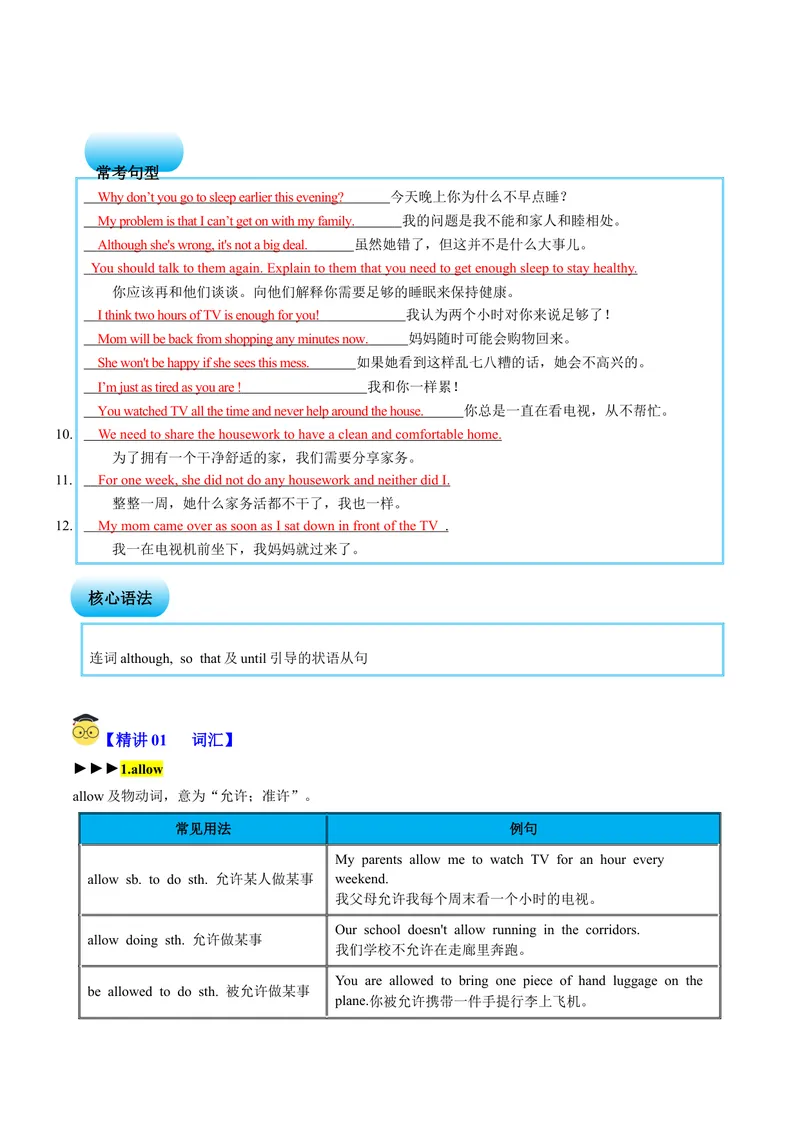
重要语块
ge t o n wit h 和睦相处;关系良好 12. hav e fre e tim e 有空闲时间
allow sb . t o d o sth . 允许某人做某事 13. han g ou t wit h sb . 与某人闲逛
argu e wit h sb . 与某人争吵 14. after-schoo l classe s 课外活动课
communicat e wit h sb . 与某人交流 15. ge t int o a figh t wit h sb . 与某人吵架 / 打架
instea d o f 代替 16. unti l midnigh t 直到半夜
b e nervous/worrie d abou t 对…… 担忧 17. tal k t o sb . 与某人交谈
offe r t o d o sth . (主动) 提出做某事 18. to o man y 太多
explai n sth . t o sb . 向某人解释某事 19. stud y to o muc h 学得过多
giv e sth . bac k t o sb . 把某物还给某人 20. ge t enoug h slee p 有足够的睡眠
10. b e angr y wit h sb . 生某人的气 21. writ e sb . a lette r 给某人写信
11. no t … anymor e 再也不…… 22. cal l sb . u p 打电话给某人常考句型
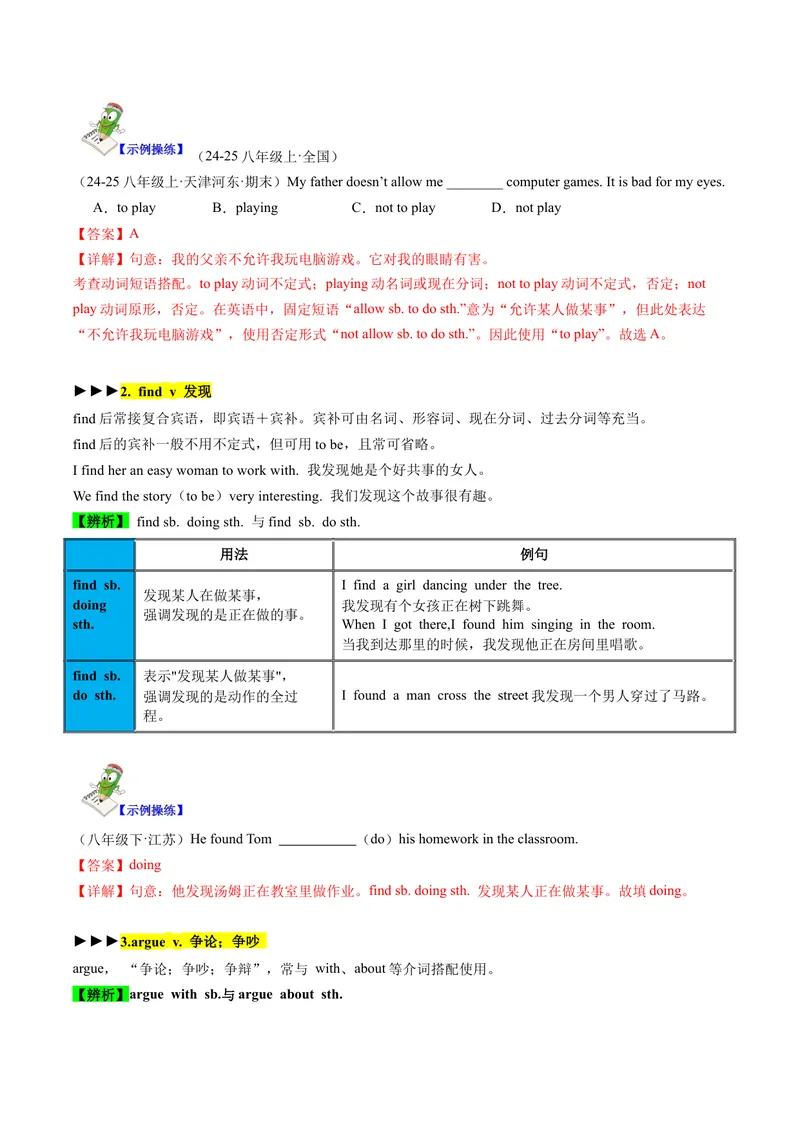
Why don’t you go to sleep earlier this evening? 今天晚上你为什么不早点睡?
My problem is that I can’t get on with my family . 我的问题是我不能和家人和睦相处。
Although she's wrong, it's not a big deal. 虽然她错了,但这并不是什么大事儿。
You should talk to them again. Explain to them that you need to get enough sleep to stay healthy .
你应该再和他们谈谈。向他们解释你需要足够的睡眠来保持健康。
I think two hours of TV is enough for you! 我认为两个小时对你来说足够了!
Mom will be back from shopping any minutes now . 妈妈随时可能会购物回来。
She won't be happy if she sees this mess. 如果她看到这样乱七八糟的话,她会不高兴的。
I’m just as tired as you are ! 我和你一样累!
You watched TV all the time and never help around the house . 你总是一直在看电视,从不帮忙。
10. We need to share the housework to have a clean and comfortable home .
为了拥有一个干净舒适的家,我们需要分享家务。
11. For one week, she did not do any housework and neither did I .
整整一周,她什么家务活都不干了,我也一样。
12. My mom came over as soon as I sat down in front of the TV .
我一在电视机前坐下,我妈妈就过来了。
核心语法
连词although, so that及until引导的状语从句
(北京)股份有限公司
【精讲01 词汇】
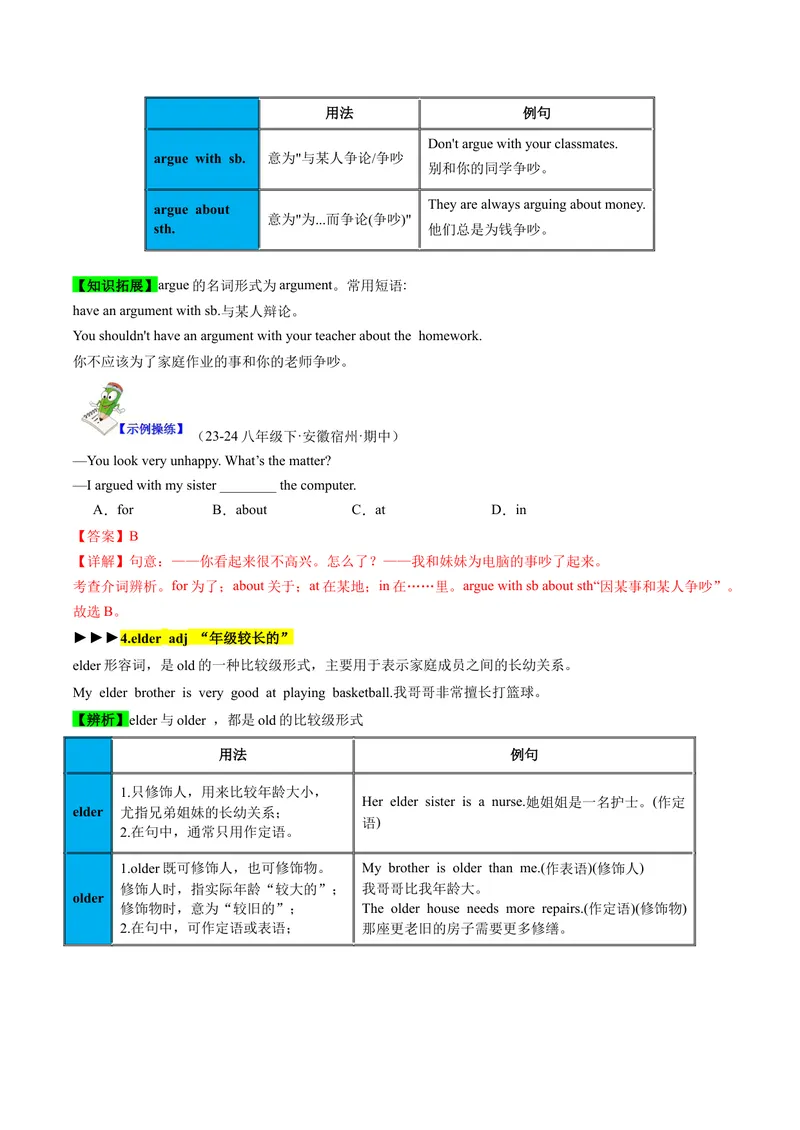
►►►1.allow
allow及物动词,意为“允许;准许”。
常见用法 例句
My parents allow me to watch TV for an hour every
allow sb. to do sth. 允许某人做某事 weekend.
我父母允许我每个周末看一个小时的电视。
Our school doesn't allow running in the corridors.
allow doing sth. 允许做某事
我们学校不允许在走廊里奔跑。
You are allowed to bring one piece of hand luggage on the
be allowed to do sth. 被允许做某事
plane.你被允许携带一件手提行李上飞机。(24-25八年级上·全国)
(24-25八年级上·天津河东·期末)My father doesn’t allow me ________ computer games. It is bad for my eyes.
A.to play B.playing C.not to play D.not play
【答案】A
【详解】句意:我的父亲不允许我玩电脑游戏。它对我的眼睛有害。
考查动词短语搭配。to play动词不定式;playing动名词或现在分词;not to play动词不定式,否定;not
play动词原形,否定。在英语中,固定短语“allow sb. to do sth.”意为“允许某人做某事”,但此处表达
“不允许我玩电脑游戏”,使用否定形式“not allow sb. to do sth.”。因此使用“to play”。故选A。
►►►2. find v 发现
find后常接复合宾语,即宾语+宾补。宾补可由名词、形容词、现在分词、过去分词等充当。
find后的宾补一般不用不定式,但可用to be,且常可省略。
I find her an easy woman to work with. 我发现她是个好共事的女人。
We find the story(to be)very interesting. 我们发现这个故事很有趣。
【辨析】 find sb. doing sth. 与find sb. do sth.
用法 例句
find sb. I find a girl dancing under the tree.
发现某人在做某事,
doing 我发现有个女孩正在树下跳舞。
强调发现的是正在做的事。
sth. When I got there,I found him singing in the room.
当我到达那里的时候,我发现他正在房间里唱歌。
find sb. 表示"发现某人做某事",
do sth. 强调发现的是动作的全过 I found a man cross the street我发现一个男人穿过了马路。
程。
(八年级下·江苏)He found Tom (do)his homework in the classroom.
【答案】doing
【详解】句意:他发现汤姆正在教室里做作业。find sb. doing sth. 发现某人正在做某事。故填doing。
►►►3.argue v. 争论;争吵
argue, “争论;争吵;争辩”,常与 with、about等介词搭配使用。
【辨析】argue with sb.与argue about sth.用法 例句
Don't argue with your classmates.
argue with sb. 意为"与某人争论/争吵
别和你的同学争吵。
argue about
They are always arguing about money.
意为"为...而争论(争吵)"
sth. 他们总是为钱争吵。
【知识拓展】argue的名词形式为argument。常用短语:
have an argument with sb.与某人辩论。
You shouldn't have an argument with your teacher about the homework.
你不应该为了家庭作业的事和你的老师争吵。
(23-24八年级下·安徽宿州·期中)
—You look very unhappy. What’s the matter?
—I argued with my sister ________ the computer.
A.for B.about C.at D.in
【答案】B
【详解】句意:——你看起来很不高兴。怎么了?——我和妹妹为电脑的事吵了起来。
考查介词辨析。for为了;about关于;at在某地;in在……里。argue with sb about sth“因某事和某人争吵”。
故选B。
►►►4.elder adj “年级较长的”
elder形容词,是old的一种比较级形式,主要用于表示家庭成员之间的长幼关系。
My elder brother is very good at playing basketball.我哥哥非常擅长打篮球。
【辨析】elder与older ,都是old的比较级形式
用法 例句
1.只修饰人,用来比较年龄大小,
Her elder sister is a nurse.她姐姐是一名护士。(作定
elder 尤指兄弟姐妹的长幼关系;
语)
2.在句中,通常只用作定语。
1.older既可修饰人,也可修饰物。 My brother is older than me.(作表语)(修饰人)
修饰人时,指实际年龄“较大的”; 我哥哥比我年龄大。
older
修饰物时,意为“较旧的”; The older house needs more repairs.(作定语)(修饰物)
2.在句中,可作定语或表语; 那座更老旧的房子需要更多修缮。(22-23八年级上·广东深圳·期中)
My sibling is three years ________than me. He is my________brother.
A.elder; elder B.older; elder C.older; older D.old; elder
【答案】B
【详解】句意:我兄弟比我大三岁。他是我的哥哥。
考查形容词用法。elder指年长的,常用于表示兄弟姊妹间的长幼关系;older更大的,用于比较。第一个
空用形容词比较级,表示年龄大,用older;第二个空指年长的哥哥,形容词作定语,用elder。故选B。
►►►5.instead
是副词,意为"代替,顶替,反而,却"。
I don’t like blue. Give me a red one instead. 我不喜欢蓝色。给我换个红的吧。
The TV program is boring, let’s play soccer instead. 这个电视节目很无聊,咱们还是踢足球吧。
【辨析】instead与instead of
用法 例句
He didn’t play basketball. He went swimming instead.
副词。意为“代替;反而;却”,
instead 用来修饰整个句子, He didn’t play basketball.Instead, He went swimming.
位于句末,也可位于句首 他去游泳了,而没有去打篮球。
instead
介词短语。意为“代替;而不
He went swimming instead of playing basketball.
是”,后面可以接名词、代词或者
of 他去游泳了,而没有去打篮球。
动词-ing
(23-24八年级下·黑龙江哈尔滨·期中)
—This football player hurt his legs just now. I want to join in the game _______.
—Thanks for joining in the game _______ him.
A.instead, instead B.instead of, instead C.instead, instead of
【答案】C
【详解】句意:——这个足球运动员刚才伤了腿。我想加入比赛。——谢谢你代替他参加比赛。
考查副词和介词短语。instead代替,常位于句尾或句首;instead of替代……,后面常跟名词或动名词。根
据“I want to join in the game”可知,此处在句尾应用副词instead;根据“joining in the game...him”可知,这
里指代替他参加比赛,应用介词短语instead of,故选C。
►►►6. whatever pron. 任何(事物);每样(事物)。Whatever happens, I won’t change my mind. 不管发生什么事,我都不会改变主意的。
whatever相当于no matter what,引导让步状语从句。
No matter what/Whatever you say, we’ll carry on the experiment.
不管你说什么,我们都要继续试验。
Whatever还可引导宾语从句。
Give them whatever they need. 他们需要什么就给他们什么。
【知识拓展】类似用法的词还有:
whoever = no matter who “无论谁”;whenever = no matter when “无论什么时候”;
wherever = no matter where “无论在哪儿”等。
Whatever/No matter what you say, I can’t agree with you. 无论你说什么,我都不会同意你的观点。
(2016·内蒙古包头·中考真题)
Dancing on the squares is quite popular among many women, the season.
A.whenever B.whatever
C.wherever D.whomever
【答案】B
【详解】句意“无论什么季节,在广场上跳舞在许多女人中十分受欢迎”。A.无论何时;B.无论什么;C.
无论哪里;D.无论谁。根据句意可知,表示“无论什么季节”,故选B。
►►►7. offer
作动词,意为"主动提出;自愿给予",常见结构为
offer to do sth."主动提出做某事";
My classmate offered to share his notes with me before the exam.
考试前,我的同学主动提出和我分享他的笔记。
【易混辨析】provide和offer的区别 均有"供给;供应"之意,区别主要在结构上。
用法 例句
offer sb. sth. You can offer him a piece of advice.
offer = offer sth. to sb. =You can offer a piece of advice to him .
"为某人提供某物" 你可以给他一条建议。
provide sb. with sth. Our library provides us with all kinds of interesting
= provide sth. for sb. books.
provide
“为某人提供某物” =Our library provides all kinds of interesting books for
us.我们的图书馆为我们提供各种各样有趣的书籍。
(24-25八年级上·全国)
My cousin offered ________ me at the airport last night. He planned ________ me around the city.
A.meeting; taking B.to meet; taking
C.meeting; to take D.to meet; to take
【答案】D
【详解】句意:我的表弟昨晚提出去机场接我。他打算带我游览这座城市。
考查非谓语动词。offer to do sth.意为“主动提出做某事”;plan to do sth.意为“计划做某事”,故选D。
►►►8. leave
leave (left, left ) 意为“遗留;落下”,
常用结构为“leave sth. + 介词短语(地点状语)”,表示“把某物遗忘在某处”。
I left my umbrella on the bus yesterday.我昨天把雨伞落在公交车上了。
【易混辨析】 leave与forget
用法 例句
I can't do my homework now. I left my
“遗留;落下”表示把什么东西落在什么地
homework in the classroom this morning.
leave 方了,侧重于说明地点。
我现在没法做作业。我今天早上把作业落在教室
leave sth. +地点状语 “把某物落在某地”
了。
“忘记” 表示忘记做什么事情,不强调
When you leave,don’t forget to turn off the
地点状语。
lights.
forget forget to do sth. “忘记做某事”(未做)
你离开的时候,别忘了关灯。
forget doing sth. “忘记做过某事”(已
做)
(23-24七年级下·上海)
(八年级下·全国)Don’t leave the tap (run); you shouldn’t waste water.
【答案】running
【详解】句意:不要让水龙头一直开着;你不应该浪费水。 leave sb/sth doing常用来表示“使某人或某物
一直做某事”,此处是指不要让水龙头一直开着,故填running。►►►9. afraid
形容词,意为“害怕,畏惧”,其常见用法如下:
用法 例句
be afraid of (doing) sth.
She is afraid of her strict father.她害怕她严厉的父亲。
害怕(做)某事/某物 He is afraid of making mistakes in public.他害怕在公众场合犯错。
be afraid to do sth.
Some students are afraid to ask questions in class.
害怕/不敢做某事 有些学生不敢在课堂上提问。
be afraid + that从句 I'm afraid (that) I can't come to your party this weekend.
恐怕……,that可省略 恐怕这个周末我不能参加你的聚会了。
(2025八年级下·全国)
Millie ________ travel by bus because she was afraid of ________ by plane.
A.is used to; travel B.used to; travelling
C.used to; travel D.is used to; travelling
【答案】B
【详解】句意:米莉过去常常坐公共汽车旅行,因为她害怕坐飞机。
考查时态及非谓语动词。根据“because she was…”可知,句子时态为一般过去时,used to do sth.“过去常常
做某事”;be afraid of“害怕”,后面可接名词、代词或动名词,所以B项正确。故选B。
【精讲02 短语】
►►►1. look through浏览,看一遍,翻阅
Look through this article and tell us what you think of it.
把这篇文章浏览一下,然后告诉我们你的看法。
Please look through your note to make sure that you are right.
请查看你的笔记以确保正确。
【知识拓展】look forward to盼望;期待
look at看
look out当心;小心
look
look for寻找
look around环视
look up仰视;查阅
(23-24八年级下·黑龙江佳木斯·期末)
— I feel bored ________ his endless talk.
— Here are some magazines for you to look ________.
A.of; after B.with; through C.for; at
【答案】B
【详解】句意:—— 我对他没完没了的谈话感到厌烦。—— 这里有一些杂志供你翻阅。
考查介词辨析。of……的;after在……之后;with和……一起;through通过;for为了;at在……点时;
第一空表达的是“对……感到厌烦”,英语表达为feel bored with,所以第一空用介词with;结合“Here
are some magazines for you”可知,第二空表达的是“浏览杂志”,look through“浏览”,故选B。
►►►2. big deal
big deal是英语中的一个固定搭配,表示 "重要的事情或状况",多用于非正式交流。
作否定用法时,常说It’s not a big deal.或It’s no big deal. 表示说话人并不认为某事有什么了不起。
--- I spilled coffee on my shirt.我把咖啡洒在衬衫上了。
--- No big deal. You can wash it.没什么大不了的。你可以把它洗干净。
【知识拓展】
deal还可作动词,意为"处理",deal with处理。提问时,常与how连用。
Why don’t you learn to deal with the problem by yourself?
你为什么不学着独自处理这个问题呢?
(22-23八年级下·安徽淮南·期末)
—There are a few mistakes in my article.
—________ It’s still an excellent one with beautiful language.
A.Let’s have a try! B.It’s not a big deal. C.No problem! D.Is that really so?
【答案】B
【详解】句意:——我的文章中有一些错误。——没什么大不了的。它仍然是一部语言优美的优秀作品。考查情景交际。Let’s have a try!我们试试吧;It’s not a big deal.没什么大不了的;No problem!没问题;Is that
really so?果真如此吗。根据“It’s still an excellent one with beautiful language.”可知,此处表示这篇文章仍是
好文章,所以空处应是鼓励和安慰对方有错误没什么大不了的。故选B。
【精讲03 句子】
►►►1. What’s wrong? 怎么了?
【句型剖析】
该句是口语中常用的句型,表示“怎么了?/哪儿不舒服?/出什么毛病了?”,用来询问“某人/某物怎么
了”。
相当于“What’s the matter ?”。后面可接with sb./sth.
—What’s wrong with your bike? 你的自行车怎么了?
—It needs repairing. 它需要修理了。
(23-24八年级上·湖南湘潭·期中)What’s wrong ________ John?
A.with B.to C.for D.on
【答案】A
【详解】句意:约翰怎么了?
考查介词辨析。with关于;to到;for为了;on在上面。“What’s wrong with...?”表示“……怎么了”,
固定句型,故选A。
►►►2. Why don’t you go to sleep earlier this evening? 今天晚上你为什么不早点睡呢?
【句型剖析】
“Why don’t you...?”表示“为何不……呢?”,常用来提出建议或征求对方的意见,
主语you后面跟动词原形,相当于“Why not do sth.?”。
Why don’t you join a club to make more friends?
=Why not join a club to make more friends?
为什么不加入一个俱乐部来结交更多朋友呢?
(22-23八年级下·湖南郴州·期末)Why don’t you ________ to sleep early?
A.goes B.go C.going
【答案】B
【详解】句意:你何不早点睡觉?考查固定句型。Why don’t you do sth.“你为什么不做某事呢?”,固定句型。故选B。
►►►3. You should explain that you don’t mind him watching TV all the time.
你应该说明你不介意他总是看电视。
(1)explain“解释,说明”。explain sth. to sb. 意为“向某人解释某事/某物”。
其名词形式为explanation(解释)。
The teacher explained the difficult math problem to the students patiently.
老师耐心地给学生们解释那道数学难题。
(2)mind sb. doing sth. 意为“介意某人做某事”。
Do you mind me opening the window? It's a bit stuffy here. 你介意我打开窗户吗?这里有点闷。
1.(八年级下·安徽·期中)_______is every teacher’s duty ________ things clearly to the students.
A.It; to explain B.That; to explain C.This; explain D.It; explain
【答案】A
【详解】句意:清楚地向学生解释事情是每个老师的职责。考查固定句型。本句是“It +系动词+表语+不
定式+其他”结构,it是形式主语,真正主语是后面的不定式。根据句意结构,可知选A。
2.(2025·上海宝山·一模)I wouldn’t mind ________ a roommate. We can help each other and save money as
well.
A.have B.had C.to have D.having
【答案】D
【详解】句意:我不介意有个室友。我们可以互相帮助,也可以省钱。
考查非谓语动词。mind doing sth.“介意做某事”,动名词作宾语。故选D。
【精讲04 语法】
►►►although, so that及until引导的状语从句
一、概念
在复合句里,承担状语功能的从句被称作状语从句,由从属连词引导。
注意:从属连词在从句中并不充当具体的句子成分,仅起到连接主句和从句的作用,就像一座桥梁。
在本单元,我们将把学习的重点聚焦于由 “until”“although” 和 “so that” 引导的状语从句。
二、although引导的状语从句
1. 用法
“although” 意为 “虽然;尽管”,引导让步状语从句,
用来表达一种与主句内容相反或相对的情况,强调主句内容不受从句内容的影响。
Although it was raining heavily, he still went to school on foot.虽然雨下得很大,但他仍然步行去上学。Although she is young, she knows a lot.虽然她年纪小,但她知道很多。
在一般情况下可以和though互换。但though比较口语化,而although较为正式。
Although/Though he is very old,he is still strong.虽然他年纪很大了,但他仍然很健壮。
【注意】
句中如果有although,though,则不能再用but.
2. 时态
从句时态根据实际情况而定,主句和从句时态可以不一致。
主从句都可以使用一般现在时 当主句和从句描述的是客观事实、经常发生的动作或普遍真理
时,
Although he works hard, he doesn't get good grades.虽然他学习很努力,但他成绩并不好。
Although she lives far from school, she is never late.虽然她住得离学校远,但她从不迟到。
主句一般现在时,从句一般过去时 当从句描述过去发生的事情,而主句是现在的情况或结论。
Although he made a mistake last time, he is still a reliable person.
虽然他上次犯了个错误,但他仍然是个可靠的人。
主句一般过去时,从句一般过去时 主从句都描述过去某个时间的情况。
Although it rained heavily yesterday, we still went to the park.虽然昨天下大雨了,但我们还是去了公园。
三、so that引导的状语从句
1. 用法
“so that” 意为 “以便;为了”,引导目的状语从句
从句中常含有情态动词如 “can”“could”“may”“might”“will”“would” 等;
He got up early so that he could catch the first bus.他早早起床以便能赶上第一班公交车。
She studies hard so that she can pass the exam.她努力学习以便能通过考试。
2. 时态
从句时态根据主句时态和表达目的时间来确定。
She studies hard so that she can pass the exam.她努力学习,以便能通过考试。(一般现在时)
He left early so that he could catch the train. 他早早离开,以便能赶上火车。(一般过去时)
I will save money so that I can buy a new car. 我会存钱,以便能买一辆新车。(一般将来时)
四、until引导的状语从句
1. 用法
“until” 表示 “直到…… 为止”,引导时间状语从句。在时间状语从句中,
若主句是肯定句,谓语动词通常是延续性动词,强调动作一直持续到 until 所表示的时间;
若主句是否定句,谓语动词通常是短暂性动词,构成 “not...until...” 结构,表示 “直到… 才…”。
I'll wait here until you come back.我会在这里一直等到你回来。(肯定句)
其中 “wait” 是延续性动词。
I didn't go to bed until I finished my homework.我直到完成作业才上床睡觉。(否定句)
其中“go to bed” 是短暂性动词。
2. 时态在时间状语从句中,遵循 “主将从现” 原则,
即如果主句是一般将来时,从句用一般现在时表示将来。
She won't leave until you arrive.直到你到达她才会离开。
1.(2023·上海·中考真题)The team completed the task ________ they had met with many difficulties.
A.until B.though C.unless D.because
【答案】B
【详解】句意:尽管他们遇到了许多困难,这个团队还是完成了任务。
考查连词辨析。until直到……为止;though尽管;unless除非;because因为。根据“the team completed the
task”和“they had met with many difficulties”可知应是though引导的让步状语从句,表示“尽管”。故选
B。
2.(2023·新疆·中考真题)________ the times keep changing, young people in China have shown the same
promise.
A.But B.Unless C.Although D.As soon as
【答案】C
【详解】句意:尽管时代在不断变化,但中国的年轻人表现出了同样的希望。
考查从属连词辨析。But但是;Unless除非;Although虽然;As soon as一……就。根据“...he times keep
changing, young people in China have shown the same promise.”可知,前后构成让步关系,用Although引导让
步状语从句。故选C。
3.(2023·江苏徐州·中考真题)Let’s take the simple steps today ________ we will save the world for our
grandsons and granddaughters tomorrow.
A.unless B.until C.so that D.though
【答案】C
【详解】句意:我们从今天开始采取一些措施吧,这样我们将会为我们的后代子孙拯救世界。
考查连词辨析。unless除非;until直到;so that以便;though尽管。分析句子可知,我们现在采取行动的
目的是为了我们的后代,故用so that引导目的状语从句。故选C。
4.(2024·四川泸州·中考真题)You will never truly understand your parents’ great love ______ you grow up.
A.until B.if C.since D.as
【答案】A
【详解】句意:直到你长大,你才会真正理解父母之爱有多伟大。
考查连词辨析。until直到;if如果;since既然;as随着。根据“You will never truly understand your parents’
great love…you grow up”可知,直到长大才会理解父母的爱,故选A。
5.(2023·甘肃武威·中考真题)Let’s wait ________ the rain stops.
A.so B.while C.since D.until【答案】D
【详解】句意:让我们等雨停。
考查连词辨析。so因此;while然而;since自从;until直到……。根据“Let’s wait … the rain stops.”可知,
此处指等着直到雨停,用until引导时间状语从句。故选D。
6.(2023·内蒙古·中考真题)Our teacher asks us to read newspapers every day ________ we can find out
what’s going on around the world.
A.so that B.even though C.in order to D.as soon as
【答案】A
【详解】句意:我们的老师让我们每天读报,这样我们就可以了解世界各地发生了什么。
考查连词辨析。so that以便于;even though即使;in order to为了;as soon as一……就。“Our teacher asks
us to read newspapers every day”的目的是“we can find out what’s going on around the world.”,且空后是从句,
用so that引导目的状语从句。故选A。