26湘少版 六上英语 单元范文写作指导
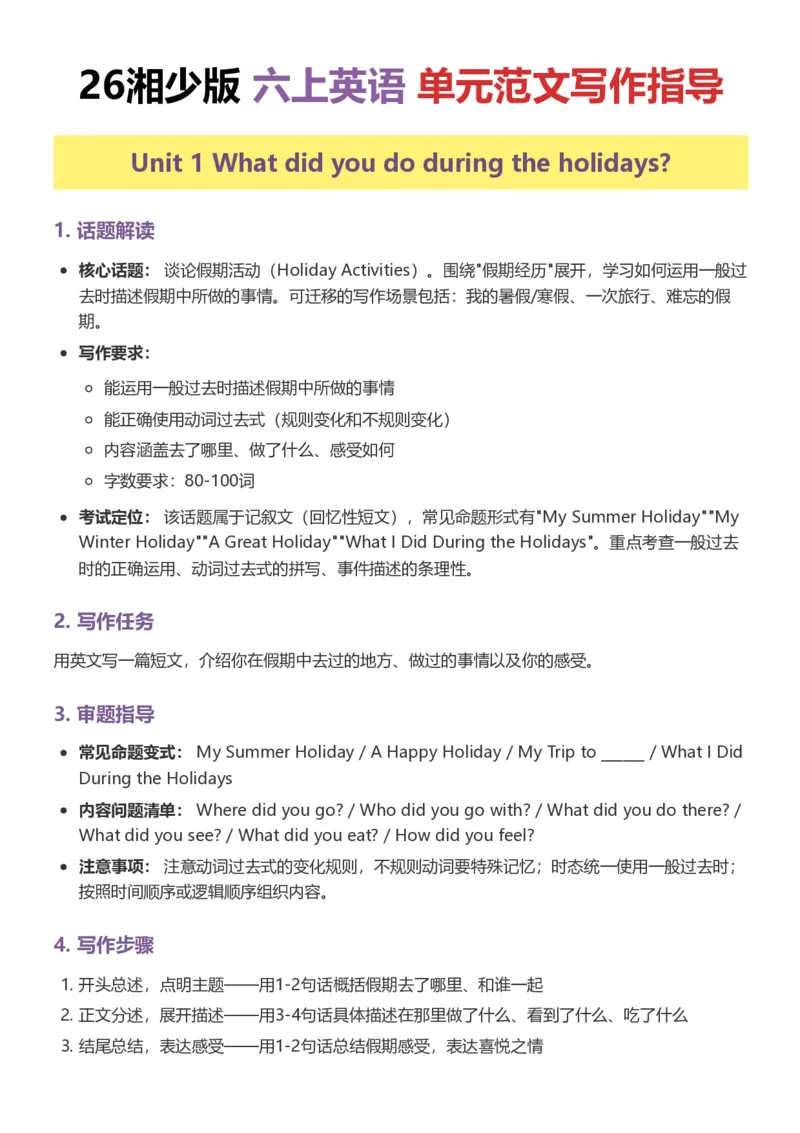
Unit 1 What did you do during the holidays?
1. 话题解读
核心话题: 谈论假期活动(Holiday Activities)。围绕"假期经历"展开,学习如何运用一般过
去时描述假期中所做的事情。可迁移的写作场景包括:我的暑假/寒假、一次旅行、难忘的假
期。
写作要求:
能运用一般过去时描述假期中所做的事情
能正确使用动词过去式(规则变化和不规则变化)
内容涵盖去了哪里、做了什么、感受如何
字数要求:80-100词
考试定位: 该话题属于记叙文(回忆性短文),常见命题形式有"My Summer Holiday""My
Winter Holiday""A Great Holiday""What I Did During the Holidays"。重点考查一般过去
时的正确运用、动词过去式的拼写、事件描述的条理性。
2. 写作任务
用英文写一篇短文,介绍你在假期中去过的地方、做过的事情以及你的感受。
3. 审题指导
常见命题变式: My Summer Holiday / A Happy Holiday / My Trip to ______ / What I Did
During the Holidays
内容问题清单: Where did you go? / Who did you go with? / What did you do there? /
What did you see? / What did you eat? / How did you feel?
注意事项: 注意动词过去式的变化规则,不规则动词要特殊记忆;时态统一使用一般过去时;
按照时间顺序或逻辑顺序组织内容。
4. 写作步骤
1. 开头总述,点明主题——用1-2句话概括假期去了哪里、和谁一起
2. 正文分述,展开描述——用3-4句话具体描述在那里做了什么、看到了什么、吃了什么
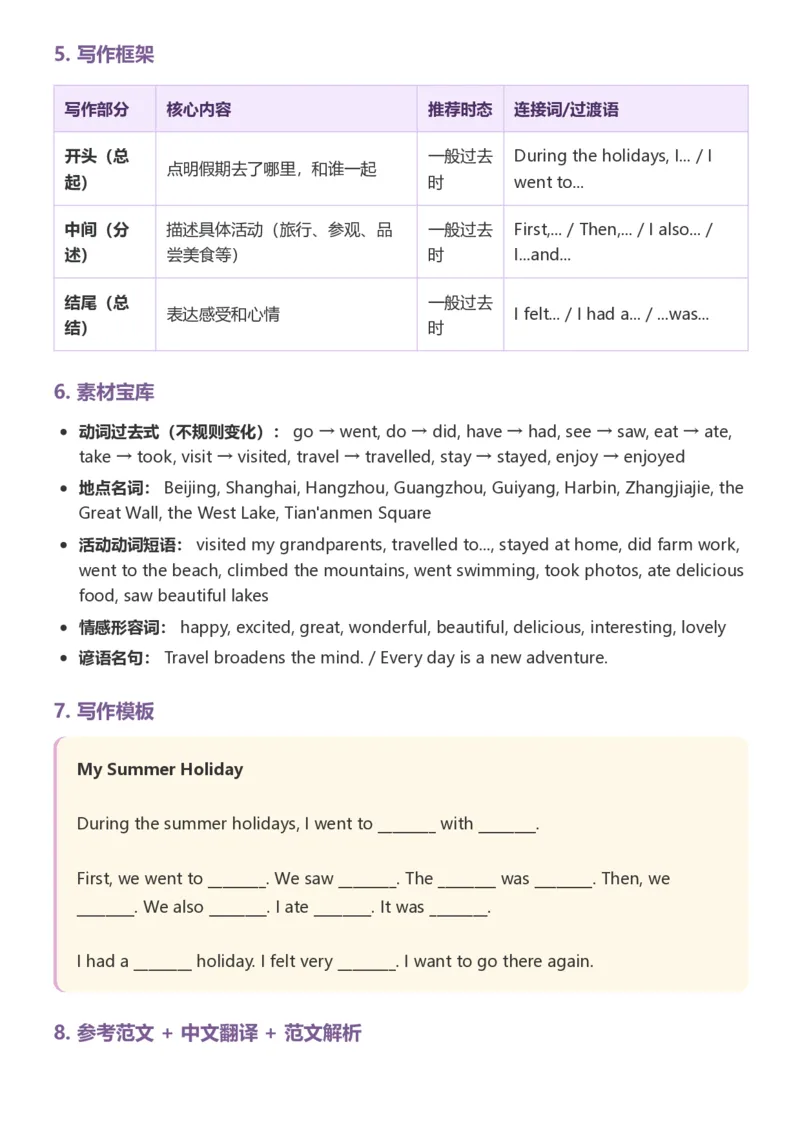
3. 结尾总结,表达感受——用1-2句话总结假期感受,表达喜悦之情5. 写作框架
写作部分 核心内容 推荐时态 连接词/过渡语
开头(总 一般过去 During the holidays, I... / I
点明假期去了哪里,和谁一起
起) 时 went to...
中间(分 描述具体活动(旅行、参观、品 一般过去 First,... / Then,... / I also... /
述) 尝美食等) 时 I...and...
结尾(总 一般过去
表达感受和心情 I felt... / I had a... / ...was...
结) 时
6. 素材宝库
动词过去式(不规则变化): go → went, do → did, have → had, see → saw, eat → ate,
take → took, visit → visited, travel → travelled, stay → stayed, enjoy → enjoyed
地点名词: Beijing, Shanghai, Hangzhou, Guangzhou, Guiyang, Harbin, Zhangjiajie, the
Great Wall, the West Lake, Tian'anmen Square
活动动词短语: visited my grandparents, travelled to..., stayed at home, did farm work,
went to the beach, climbed the mountains, went swimming, took photos, ate delicious
food, saw beautiful lakes
情感形容词: happy, excited, great, wonderful, beautiful, delicious, interesting, lovely
谚语名句: Travel broadens the mind. / Every day is a new adventure.
7. 写作模板
My Summer Holiday
During the summer holidays, I went to ________ with ________.
First, we went to ________. We saw ________. The ________ was ________. Then, we
________. We also ________. I ate ________. It was ________.
I had a ________ holiday. I felt very ________. I want to go there again.
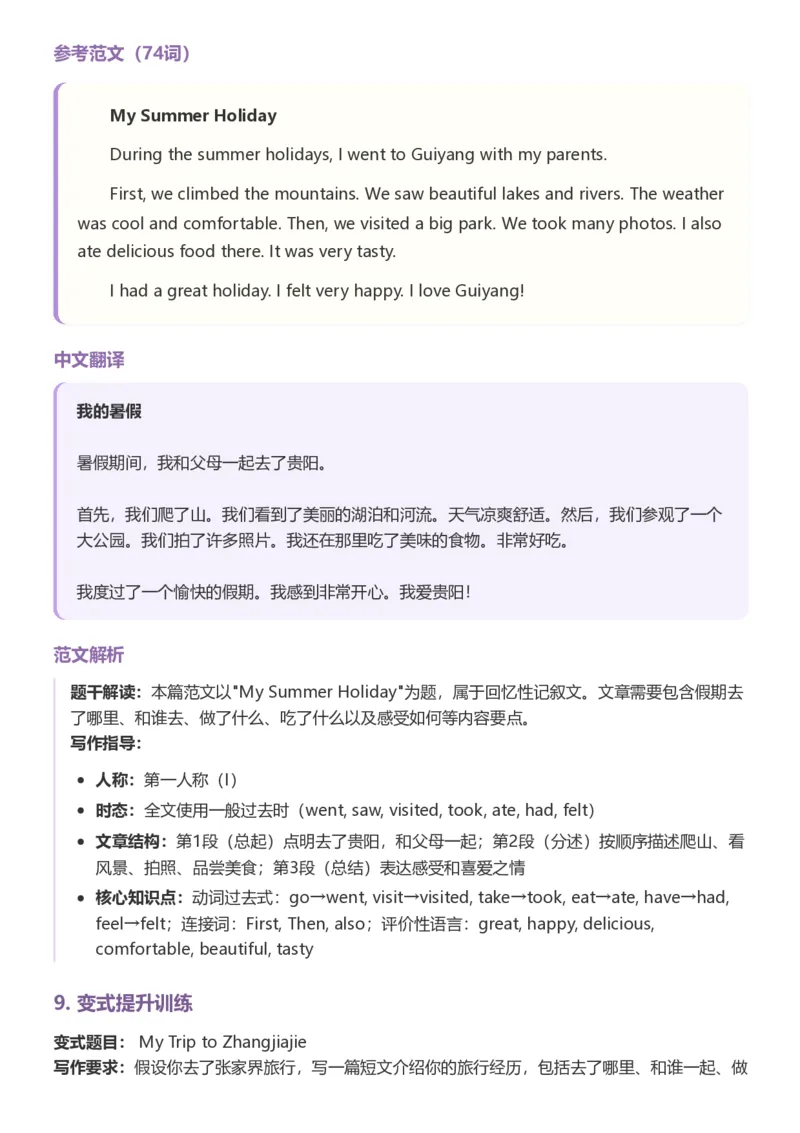
8. 参考范文 + 中文翻译 + 范文解析参考范文(74词)
My Summer Holiday
During the summer holidays, I went to Guiyang with my parents.
First, we climbed the mountains. We saw beautiful lakes and rivers. The weather
was cool and comfortable. Then, we visited a big park. We took many photos. I also
ate delicious food there. It was very tasty.
I had a great holiday. I felt very happy. I love Guiyang!
中文翻译
我的暑假
暑假期间,我和父母一起去了贵阳。
首先,我们爬了山。我们看到了美丽的湖泊和河流。天气凉爽舒适。然后,我们参观了一个
大公园。我们拍了许多照片。我还在那里吃了美味的食物。非常好吃。
我度过了一个愉快的假期。我感到非常开心。我爱贵阳!
范文解析
题干解读:本篇范文以"My Summer Holiday"为题,属于回忆性记叙文。文章需要包含假期去
了哪里、和谁去、做了什么、吃了什么以及感受如何等内容要点。
写作指导:
人称:第一人称(I)
时态:全文使用一般过去时(went, saw, visited, took, ate, had, felt)
文章结构:第1段(总起)点明去了贵阳,和父母一起;第2段(分述)按顺序描述爬山、看
风景、拍照、品尝美食;第3段(总结)表达感受和喜爱之情
核心知识点:动词过去式:go→went, visit→visited, take→took, eat→ate, have→had,
feel→felt;连接词:First, Then, also;评价性语言:great, happy, delicious,
comfortable, beautiful, tasty
9. 变式提升训练
变式题目: My Trip to Zhangjiajie
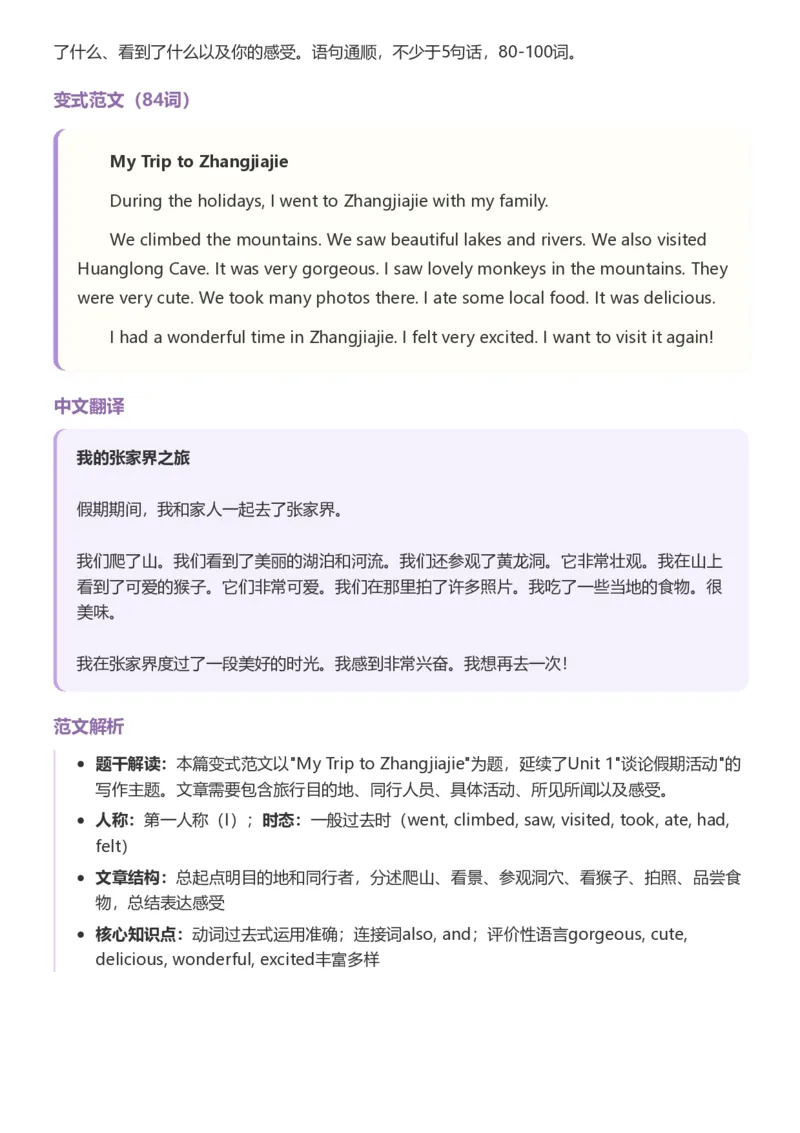
写作要求:假设你去了张家界旅行,写一篇短文介绍你的旅行经历,包括去了哪里、和谁一起、做了什么、看到了什么以及你的感受。语句通顺,不少于5句话,80-100词。
变式范文(84词)
My Trip to Zhangjiajie
During the holidays, I went to Zhangjiajie with my family.
We climbed the mountains. We saw beautiful lakes and rivers. We also visited
Huanglong Cave. It was very gorgeous. I saw lovely monkeys in the mountains. They
were very cute. We took many photos there. I ate some local food. It was delicious.
I had a wonderful time in Zhangjiajie. I felt very excited. I want to visit it again!
中文翻译
我的张家界之旅
假期期间,我和家人一起去了张家界。
我们爬了山。我们看到了美丽的湖泊和河流。我们还参观了黄龙洞。它非常壮观。我在山上
看到了可爱的猴子。它们非常可爱。我们在那里拍了许多照片。我吃了一些当地的食物。很
美味。
我在张家界度过了一段美好的时光。我感到非常兴奋。我想再去一次!
范文解析
题干解读:本篇变式范文以"My Trip to Zhangjiajie"为题,延续了Unit 1"谈论假期活动"的
写作主题。文章需要包含旅行目的地、同行人员、具体活动、所见所闻以及感受。
人称:第一人称(I);时态:一般过去时(went, climbed, saw, visited, took, ate, had,
felt)
文章结构:总起点明目的地和同行者,分述爬山、看景、参观洞穴、看猴子、拍照、品尝食
物,总结表达感受
核心知识点:动词过去式运用准确;连接词also, and;评价性语言gorgeous, cute,
delicious, wonderful, excited丰富多样26湘少版 六上英语 单元范文写作指导
Unit 2 Beibei always gets up early
1. 话题解读
核心话题: 日常作息与生活习惯(Daily Routines & Habits)。学习如何描述自己或他人的
日常作息,运用频率副词表达习惯。
写作要求:
能正确使用频率副词(always, often, sometimes, never)描述日常活动
能运用一般现在时(第三人称单数)描述他/她的日常作息
内容涵盖起床、上学、做作业、睡觉等日常活动
字数要求:80-100词
考试定位: 该话题属于说明文/描述文(介绍日常作息),常见命题形式有"My Day""Beibei's
Day""My Daily Life""A Good Student's Day"。重点考查频率副词的准确使用、一般现在时
第三人称单数动词变化、时间表达。
2. 写作任务
用英文写一篇短文,介绍你的一天日常活动,包括你在什么时间做什么事情,以及做这些事情的频
率。
3. 审题指导
常见命题变式: My Day / A Busy Day / My Daily Life / What I Do Every Day
内容问题清单: When do you get up? / When do you have breakfast? / How do you go
to school? / What do you do after school? / When do you do your homework? / When
do you go to bed? / How often do you do these things?
注意事项: 频率副词要放在实义动词前、be动词后;主语是第三人称单数时动词要加-s或-
es;注意时间表达法;内容按时间顺序排列。
4. 写作步骤
1. 开头总述,点明主题——用1-2句话说明这是关于谁的一天,总体评价
2. 正文分述,按时间顺序描述——用4-5句话按时间顺序介绍从早到晚的主要活动,适当使用频
率副词
3. 结尾总结,表达观点——用1-2句话总结这一天,或表达自己的感受5. 写作框架
推荐时
写作部分 核心内容 连接词/过渡语
态
开头(总 一般现 This is...day. / ...is
点明描述谁的一天,总体印象
起) 在时 a...student.
中间(分 按时间顺序描述日常活动(起床、上 一般现 At..., ... / Then, ... /
述) 学、做作业等) 在时 After..., ...
结尾(总 一般现
总结感受或习惯 ...is a...day. / I think...
结) 在时
6. 素材宝库
频率副词: always, often, sometimes, never
时间表达: at 7:00 a.m., in the morning, in the afternoon, in the evening, before dinner,
after breakfast, at night, on weekdays
日常活动动词短语: get up, go to school, have breakfast/lunch/dinner, do homework,
go to bed, take a walk, read a book, play chess, watch TV, go home, wave goodbye,
clean the room
谚语名句: Early to bed and early to rise makes a man healthy. / Good habits make a
good life.
7. 写作模板
My Day
This is my day. I always get up at ________.
I have breakfast at ________. Then I go to school ________. I ________ at school. After
school, I ________. I often ________ in the evening. Sometimes I ________. I never
________.
I have a ________ day. I think I have ________ habits.
8. 参考范文 + 中文翻译 + 范文解析参考范文(85词)
My Day
This is my day. I always get up at 7:00 a.m.
I have breakfast at 7:30. Then I go to school by bus. I study hard at school. After
school, I go home at 5:00 p.m. I often do my homework before dinner. Sometimes I
play chess with my father in the evening. I never watch TV on weekdays. I go to bed
at 9:00 p.m.
I have a busy day. I think I have good habits.
中文翻译
我的一天
这是我的一天。我总是在早上7点起床。
我7:30吃早餐。然后我坐公交车去上学。我在学校努力学习。放学后,我下午5点回家。我
经常在晚餐前做作业。有时我在晚上和爸爸下棋。我在工作日从不看电视。我9点上床睡
觉。
我度过了忙碌的一天。我觉得我有好习惯。
范文解析
人称:第一人称(I);时态:一般现在时(get up, have, go, study, do, play, watch, go
to bed)
结构:总起点明主题和起床时间;分述按时间顺序描述全天活动;总结评价习惯
核心知识点:频率副词always, often, sometimes, never各司其职;时间表达丰富(at 7:00
a.m., before dinner, on weekdays);动词短语搭配准确
9. 变式提升训练
变式题目: Beibei's Day
写作要求:假设你是Beibei,写一篇短文介绍你的一天。内容包括你什么时候起床、吃早餐、上
学、回家、做作业、读书、下棋等。语句通顺,不少于5句话,80-100词。
变式范文(88词)Beibei's Day
This is Beibei's day. She always gets up at 7:00 a.m.
She has breakfast with her family at 7:30. Then she waves goodbye to her
mother and goes to school. She is never late for school. She goes back home at 5:00
p.m. She often reads a book in the evening. Sometimes she plays chess with her
father. She never watches TV on weekdays. She goes to bed at 9:00 p.m.
Beibei has a busy day. She has good habits.
中文翻译
贝贝的一天
这是贝贝的一天。她总是在早上7点起床。
她7:30和家人一起吃早餐。然后她向妈妈挥手告别去上学。她上学从不迟到。她下午5点回
家。她经常在晚上读书。有时她和爸爸下棋。她在工作日从不看电视。她9点上床睡觉。
贝贝度过了忙碌的一天。她有好习惯。
范文解析
人称:第三人称单数(She);时态:一般现在时(gets up, has, waves, goes, is, goes
back, reads, plays, watches)
核心知识点:第三人称单数动词变化get→gets, have→has, wave→waves, go→goes,
read→reads, play→plays, watch→watches;频率副词运用准确;教材原文重现"waves
goodbye to her mother""is never late for school"
亮点:按时间顺序清晰描述,频率副词层次分明,贴近教材内容26湘少版 六上英语 单元范文写作指导
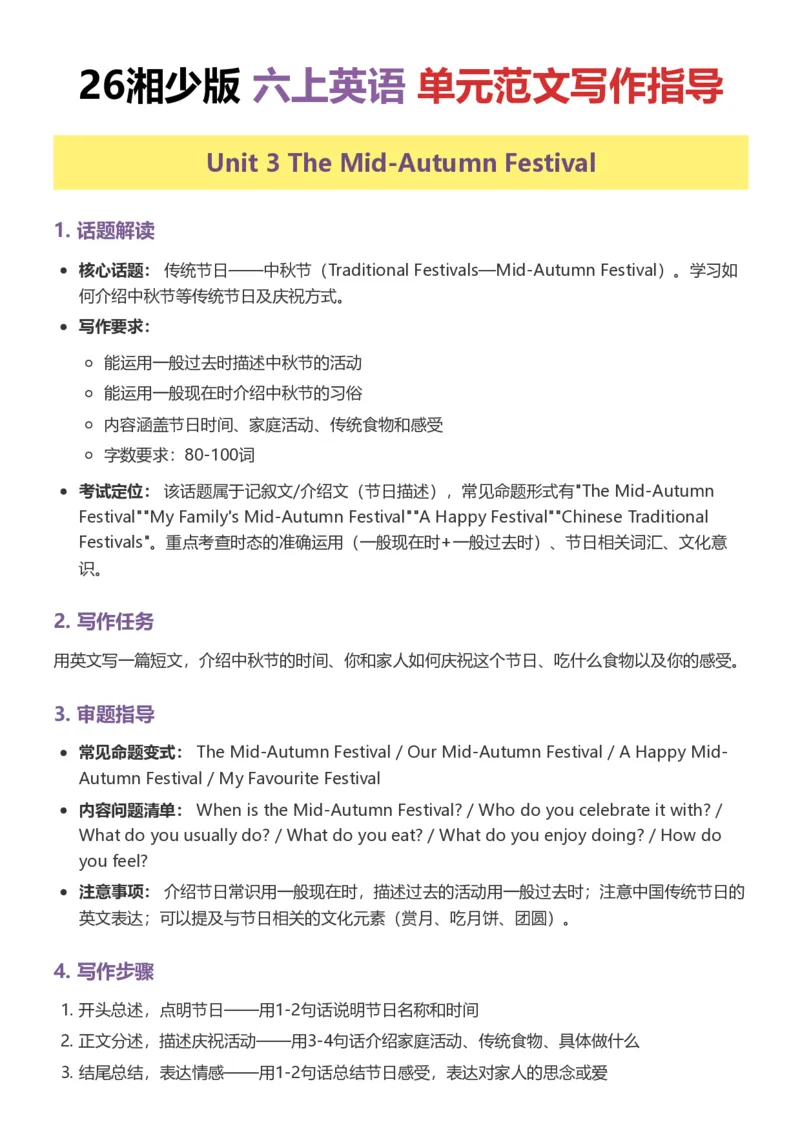
Unit 3 The Mid-Autumn Festival
1. 话题解读
核心话题: 传统节日——中秋节(Traditional Festivals—Mid-Autumn Festival)。学习如
何介绍中秋节等传统节日及庆祝方式。
写作要求:
能运用一般过去时描述中秋节的活动
能运用一般现在时介绍中秋节的习俗
内容涵盖节日时间、家庭活动、传统食物和感受
字数要求:80-100词
考试定位: 该话题属于记叙文/介绍文(节日描述),常见命题形式有"The Mid-Autumn
Festival""My Family's Mid-Autumn Festival""A Happy Festival""Chinese Traditional
Festivals"。重点考查时态的准确运用(一般现在时+一般过去时)、节日相关词汇、文化意
识。
2. 写作任务
用英文写一篇短文,介绍中秋节的时间、你和家人如何庆祝这个节日、吃什么食物以及你的感受。
3. 审题指导
常见命题变式: The Mid-Autumn Festival / Our Mid-Autumn Festival / A Happy Mid-
Autumn Festival / My Favourite Festival
内容问题清单: When is the Mid-Autumn Festival? / Who do you celebrate it with? /
What do you usually do? / What do you eat? / What do you enjoy doing? / How do
you feel?
注意事项: 介绍节日常识用一般现在时,描述过去的活动用一般过去时;注意中国传统节日的
英文表达;可以提及与节日相关的文化元素(赏月、吃月饼、团圆)。
4. 写作步骤
1. 开头总述,点明节日——用1-2句话说明节日名称和时间
2. 正文分述,描述庆祝活动——用3-4句话介绍家庭活动、传统食物、具体做什么
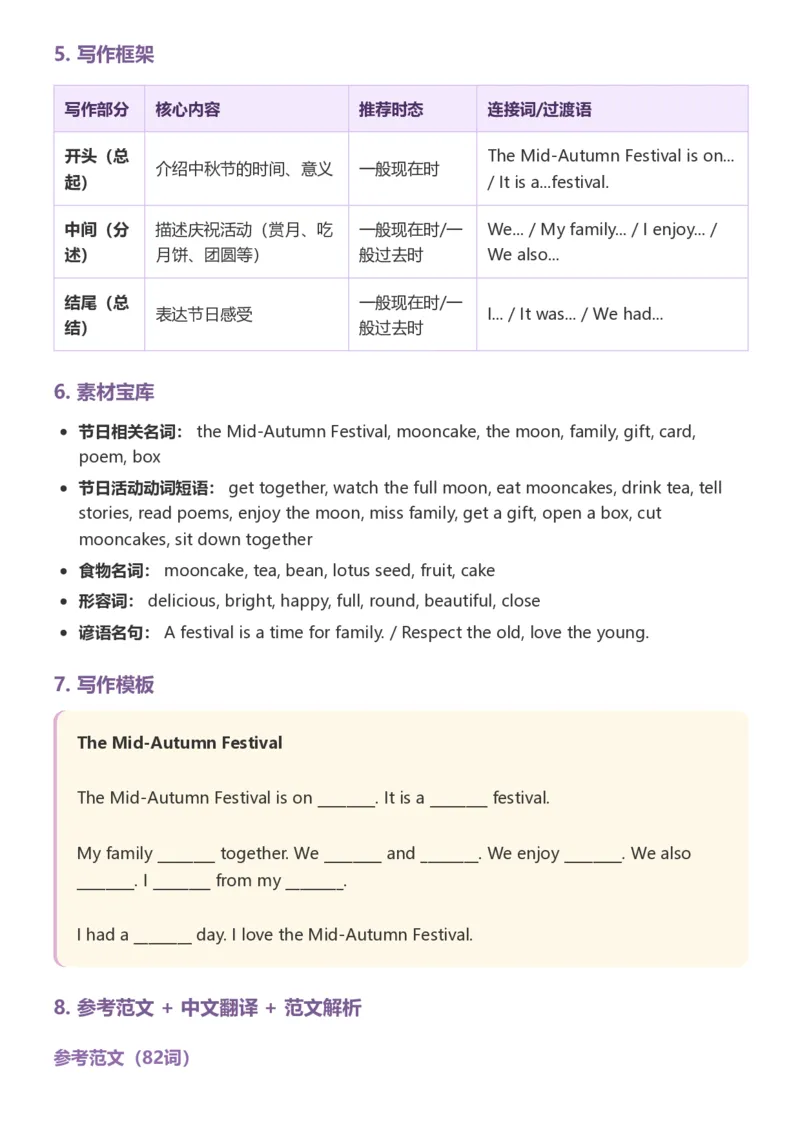
3. 结尾总结,表达情感——用1-2句话总结节日感受,表达对家人的思念或爱5. 写作框架
写作部分 核心内容 推荐时态 连接词/过渡语
开头(总 The Mid-Autumn Festival is on...
介绍中秋节的时间、意义 一般现在时
起) / It is a...festival.
中间(分 描述庆祝活动(赏月、吃 一般现在时/一 We... / My family... / I enjoy... /
述) 月饼、团圆等) 般过去时 We also...
结尾(总 一般现在时/一
表达节日感受 I... / It was... / We had...
结) 般过去时
6. 素材宝库
节日相关名词: the Mid-Autumn Festival, mooncake, the moon, family, gift, card,
poem, box
节日活动动词短语: get together, watch the full moon, eat mooncakes, drink tea, tell
stories, read poems, enjoy the moon, miss family, get a gift, open a box, cut
mooncakes, sit down together
食物名词: mooncake, tea, bean, lotus seed, fruit, cake
形容词: delicious, bright, happy, full, round, beautiful, close
谚语名句: A festival is a time for family. / Respect the old, love the young.
7. 写作模板
The Mid-Autumn Festival
The Mid-Autumn Festival is on ________. It is a ________ festival.
My family ________ together. We ________ and ________. We enjoy ________. We also
________. I ________ from my ________.
I had a ________ day. I love the Mid-Autumn Festival.
8. 参考范文 + 中文翻译 + 范文解析
参考范文(82词)The Mid-Autumn Festival
The Mid-Autumn Festival is on the 15th day of the 8th Chinese lunar month. It
is a happy festival for families.
My family gets together and watches the full moon. We enjoy eating delicious
mooncakes. We also drink tea and tell stories about the moon. I got a beautiful gift
from my uncle. We sat down together and had a big dinner.
I had a wonderful time. I love the Mid-Autumn Festival!
中文翻译
中秋节
中秋节在中国农历八月十五。它是一个家庭团聚的快乐节日。
我的家人聚在一起赏满月。我们喜欢吃美味的月饼。我们还喝茶、讲关于月亮的故事。我收
到了叔叔送给我的漂亮礼物。我们坐在一起吃了丰盛的晚餐。
我度过了一段美好的时光。我爱中秋节!
范文解析
人称:第一人称(I/We);时态:一般现在时(is, gets, watches, enjoy, drink, tell,
love)和一般过去时(got, sat, had)灵活切换
结构:总起介绍节日时间和性质;分述团聚、赏月、吃月饼、喝茶讲故事、收礼物、吃晚
餐;总结表达喜爱
核心知识点:节日表达"the Mid-Autumn Festival""Chinese lunar month";动词短语
gets together, watches the full moon, enjoy eating;动词过去式got, sat, had运用准确
9. 变式提升训练
变式题目: Our Mid-Autumn Festival
写作要求:回忆你与家人度过的一个中秋节,写一篇短文介绍你们是如何庆祝的,包括做了什么、
吃了什么以及你的感受。语句通顺,不少于5句话,80-100词。
变式范文(83词)
Our Mid-Autumn FestivalYesterday was the Mid-Autumn Festival. It was a happy day for my family.
We got together and had a big dinner. We enjoyed eating mooncakes and
drinking tea. My grandfather told us stories about the moon. We were very
interested in them. We also watched the bright full moon. The moon was big and
round. I got a gift from my aunt. I was very happy.
We had a wonderful evening. I love my family!
中文翻译
我们的中秋节
昨天是中秋节。对我们家来说,这是快乐的一天。
我们聚在一起吃了丰盛的晚餐。我们喜欢吃月饼和喝茶。爷爷给我们讲了关于月亮的故事。
我们非常感兴趣。我们还欣赏了明亮的满月。月亮又大又圆。我收到了阿姨送给我的礼物。
我非常开心。
我们度过了一个美好的夜晚。我爱我的家人!
范文解析
人称:第一人称(We/I);时态:全文一般过去时(was, got, had, enjoyed, told, were,
watched, loved)
亮点:教材原文重现"grandfather told us stories about the moon""we were very
interested in them";形容词bright, big, round生动描绘月亮
结构:以"Yesterday was..."开篇自然引出回忆,按活动顺序描述,结尾升华对家人的爱26湘少版 六上英语 单元范文写作指导
Unit 4 It will be sunny and cool tomorrow
1. 话题解读
核心话题: 天气预报与未来天气(Weather Forecast & Future Weather)。学习如何运用
一般将来时描述未来的天气情况及人们的应对活动。
写作要求:
能运用一般将来时(will)描述未来的天气情况
能运用There will be...句型描述天气变化
内容涵盖城市、日期、天气状况和人们的活动
字数要求:80-100词
考试定位: 该话题属于说明文/描述文(天气预报、天气描述),常见命题形式有"The
Weather Tomorrow""A Weather Report""What Will the Weather Be Like?""Weather in
Different Cities"。重点考查一般将来时的正确运用、天气词汇的积累、天气预报的表达方
式。
2. 写作任务
用英文写一篇短文,预报未来某一天不同城市的天气情况,并描述人们在这种天气下会做什么。
3. 审题指导
常见命题变式: Tomorrow's Weather / A Weather Report / Weather in Our City / What
Will the Weather Be Like Tomorrow?
内容问题清单: What will the weather be like? / What is the temperature? / What will
people do? / What should we do in this weather?
注意事项: will表示将来,后面接动词原形;There will be + 名词表示"将会有……";描述天
气的形容词:sunny, cloudy, rainy, windy, cold, cool, warm, hot;可以给出极端天气下的安
全建议。
4. 写作步骤
1. 开头总述,点明时间和地点——用1-2句话说明预报的是哪一天、哪个城市的天气
2. 正文分述,描述天气和活动——用3-4句话描述具体的天气状况、温度和人们在这样的天气下
会做什么3. 结尾总结,给出建议——用1-2句话总结天气特点或给出温馨提示
5. 写作框架
写作部分 核心内容 推荐时态 连接词/过渡语
开头(总 Tomorrow will be... / The weather
点明预报日期和城市 一般将来时
起) in...will be...
中间(分 描述天气状况、温 There will be... / People will... /
一般将来时
述) 度、人们的活动 Some people will...
结尾(总 一般将来时/一
总结或给出建议 ...will have fun. / We should...
结) 般现在时
6. 素材宝库
天气形容词: sunny, cloudy, rainy, windy, cold, cool, warm, hot
天气现象名词: rain, wind, storm, snow, light rain, heavy rain, strong wind
温度表达: temperature, 6°C to 10°C, degrees
活动动词短语: go to the park, go to the zoo, stay at home, go swimming, fly kites,
have fun, close the windows, park cars, wear warm coats, drink enough water
谚语名句: Every cloud has a silver lining. / Prepare for the worst.
7. 写作模板
Tomorrow's Weather
Tomorrow will be ________ in ________. The temperature will be ________.
Some people will ________. Children will ________. There will be ________. People will
________. They will ________.
Everyone will have a ________ day. Please remember to ________.
8. 参考范文 + 中文翻译 + 范文解析
参考范文(88词)Tomorrow's Weather
Tomorrow will be sunny and cool in Beijing. The temperature will be 6°C to
10°C.
Some people will go to the park. Children will go to the zoo with their parents.
There will be a big storm in Guangzhou. There will be a strong wind and heavy rain.
People will stay at home. They will close the windows and park their cars in safe
places.
Everyone will have a different day. Please remember to take care!
中文翻译
明天的天气
明天北京将晴朗凉爽。温度将是6到10摄氏度。
一些人会去公园。孩子们会和父母一起去动物园。广州将有一场大暴风雨。将有大风和暴
雨。人们会待在家里。他们会关好窗户,把车停在安全的地方。
每个人都会度过不同的一天。请记得照顾好自己!
范文解析
人称:第三人称(People, Children, Everyone);时态:一般将来时(will be, will go,
will stay, will close, will have)
结构:总起预报北京天气和温度;分述对比北京和广州的不同天气及人们的应对;总结温馨
提醒
核心知识点:will + 动词原形贯穿全文;There will be...句型(There will be a big
storm);温度表达6°C to 10°C;对比手法展现不同城市天气差异
9. 变式提升训练
变式题目: Weather in Our City
写作要求:写一篇短文介绍你所在城市未来的天气情况。内容包括天气状况、温度、人们会做什么
以及你的建议。语句通顺,不少于5句话,80-100词。
变式范文(81词)Weather in Our City
Tomorrow will be cold and windy in our city. The temperature will be 4°C to 8°C.
Many people will stay indoors. They will wear warm coats and scarves. Some
children will stay at home and read books. There will be no rain tomorrow. But it will
be very cold. We should drink enough water and keep warm.
Please remember to wear warm clothes. Take care!
中文翻译
我们城市的天气
明天我们城市将寒冷有风。温度将是4到8摄氏度。
许多人会待在室内。他们会穿保暖外套和围巾。一些孩子会待在家里看书。明天将没有雨。
但天气会很冷。我们应该喝足够的水并保暖。
请记得穿暖和的衣服。保重!
范文解析
人称:第一人称(Our)/第三人称(Many people, Some children, We);时态:一般将
来时(will be, will stay, will wear, will read)
亮点:情态动词should引入建议(We should drink enough water and keep warm);
But转折体现天气复杂性;结尾建议句型"Please remember to..."贴近生活
核心知识点:天气词汇cold, windy, no rain;服饰名词warm coats, scarves;建议表达实
用性强26湘少版 六上英语 单元范文写作指导
Unit 5 I will bring a bottle of orange juice
1. 话题解读
核心话题: 健康生活方式与野餐准备(Healthy Lifestyle & Picnic Preparation)。学习如何
运用一般将来时和量词短语描述野餐或郊游的计划与准备。
写作要求:
能运用一般将来时(will)描述将要带什么物品
能正确使用量词(a bottle of, three pots of, a few cans of, some)描述数量
内容涵盖野餐或郊游的计划、携带的物品和活动安排
字数要求:80-100词
考试定位: 该话题属于记叙文/计划说明文(活动计划),常见命题形式有"A Picnic
Plan""Our Family Picnic""What Will We Bring?""A Happy Outing"。重点考查一般将来时
的运用、量词短语的正确使用、计划类写作的组织能力。
2. 写作任务
用英文写一篇短文,介绍你与家人或朋友的一次野餐/郊游计划,包括你们将带什么物品、去哪里
以及做什么。
3. 审题指导
常见命题变式: Our Picnic / A Happy Picnic / What Will We Bring? / A Family Outing
内容问题清单: Where will you go? / When will you go? / Who will you go with? /
What will you bring? / What will you do there? / How will you feel?
注意事项: will表示将来计划,后接动词原形;量词短语的准确使用;可数名词与不可数名词
的区分(yogurt, juice, milk为不可数;candies, biscuits为可数)。
4. 写作步骤
1. 开头总述,点明计划——用1-2句话说明野餐/郊游的时间、地点和参与者
2. 正文分述,描述物品和活动——用3-4句话介绍携带的物品(用量词描述)以及计划进行的活
动
3. 结尾总结,表达期待——用1-2句话总结活动的美好预期5. 写作框架
推荐时
写作部分 核心内容 连接词/过渡语
态
开头(总 说明野餐/郊游的时间、地点、 一般将 We will... / Our family will... /
起) 参与者 来时 Tomorrow is...
中间(分 描述携带的物品(用量词)、计 一般将 I will bring... / My mother will...
述) 划进行的活动 来时 / We will...
结尾(总 一般将 We will have a good time. /
表达期待和感受
结) 来时 ...will be happy.
6. 素材宝库
量词短语(修饰不可数名词): a bottle of, a pot of, a glass of, a cup of, a bar of, a few
cans of, a box of, some, three pots of
物品名词: orange juice, yogurt, milk, cola, candy/candies, chocolate, biscuit/biscuits,
cake/cakes, fruit, water, bread
食物形容词: delicious, fresh, sweet, tasty
活动动词短语: have a picnic, play games, fly kites, swim, sing songs, take photos,
relax, enjoy the day
谚语名句: Sharing is caring. / The more, the merrier.
7. 写作模板
Our Picnic
Our family will have a picnic ________. We will go to ________.
My father will bring ________. My mother will bring ________. I will bring ________. My
sister will bring ________. We will ________. We will also ________.
We will have a ________ time. Everyone will ________.
8. 参考范文 + 中文翻译 + 范文解析参考范文(85词)
Our Picnic
Our family will have a picnic in the countryside this Sunday. We will go to a
beautiful park.
My father will bring a bottle of orange juice. My mother will bring three pots of
yogurt and some fruit. I will bring some biscuits and candies. My sister will bring a
few cans of cola. We will play games and fly kites together. We will also take many
photos.
We will have a great time. Everyone will be very happy!
中文翻译
我们的野餐
我们这个星期天要去乡下野餐。我们将去一个美丽的公园。
我爸爸会带一瓶橙汁。我妈妈会带三罐酸奶和一些水果。我会带一些饼干和糖果。我妹妹会
带几罐可乐。我们会一起做游戏和放风筝。我们还会拍很多照片。
我们会玩得很开心。每个人都会非常高兴!
范文解析
人称:第一人称(Our family, We, I, My father, My mother, My sister, Everyone);时
态:一般将来时(will have, will go, will bring, will play, will fly, will take, will be)
结构:总起说明野餐时间和地点;分述逐一介绍家人各自携带的物品(多种量词),描述活
动计划;总结表达期待
核心知识点:量词短语a bottle of, three pots of, some, a few cans of丰富多样;will + 动
词原形贯穿全文;连接词and, also自然衔接
9. 变式提升训练
变式题目: Our Family Outing
写作要求:假设你们全家计划进行一次郊游(outing)。写一篇短文介绍你们的计划,包括去哪
里、什么时候去、带什么物品以及做什么活动。语句通顺,不少于5句话,80-100词。
变式范文(82词)Our Family Outing
Our family will have an outing in the mountains next Saturday.
My father will bring a bottle of water and some sandwiches. My mother will
bring some fruit and cakes. I will bring a pot of yogurt and a few books. We will
enjoy the fresh air and beautiful mountains. We will play games and have a picnic.
We will also take many photos.
It will be a happy day. We will enjoy ourselves!
中文翻译
我们的家庭郊游
下周六我们全家要去山里郊游。
我爸爸会带一瓶水和一些三明治。我妈妈会带一些水果和蛋糕。我会带一罐酸奶和几本书。
我们将享受新鲜的空气和美丽的山景。我们会做游戏并野餐。我们还会拍很多照片。
那将是快乐的一天。我们会玩得很开心!
范文解析
人称:第一人称(Our family, We, I, My father, My mother);时态:一般将来时(will
have, will bring, will enjoy, will play, will take, will be, will enjoy)
亮点:教材词汇活用"outing""fresh air""enjoy ourselves";量词短语a bottle of, some, a
pot of, a few灵活运用;从物品准备到活动描述再到情感表达,层次分明
核心知识点:will + 动词原形;多种量词与名词搭配;形容词fresh, beautiful, happy贴切
生动