26湘少版六上英语30天单元同步训练
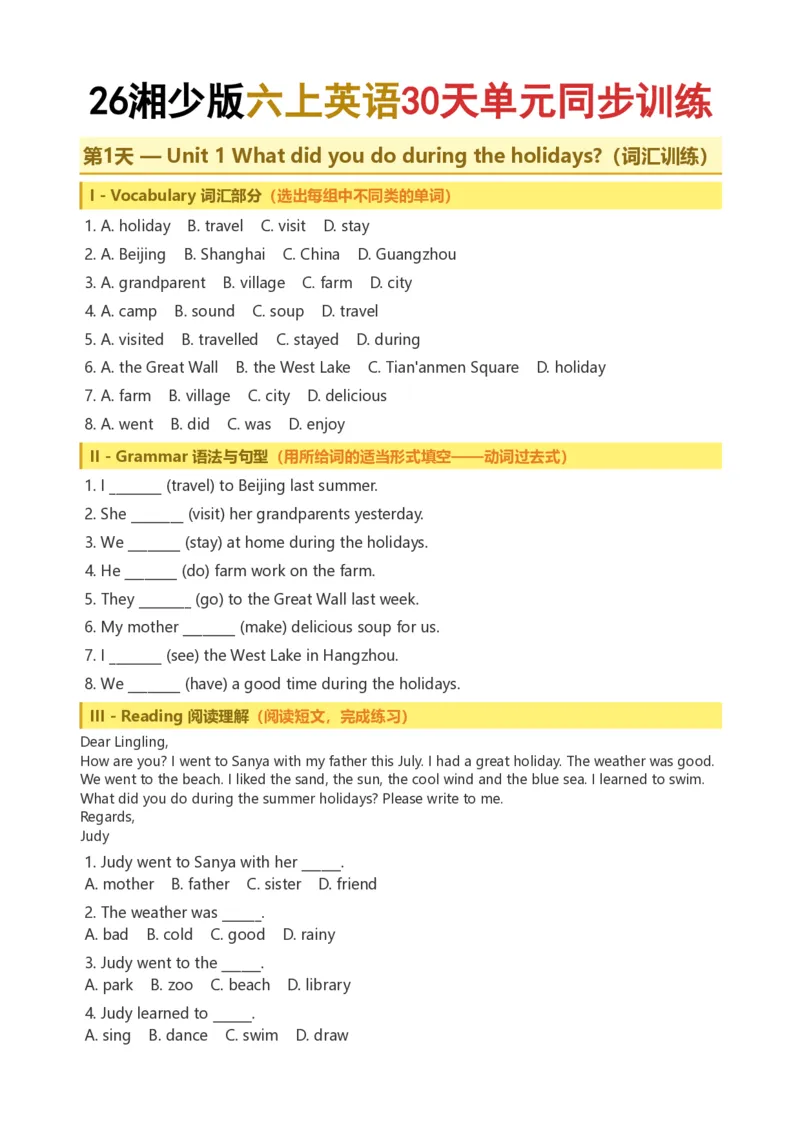
第1天 — Unit 1 What did you do during the holidays?(词汇训练)
I - Vocabulary 词汇部分(选出每组中不同类的单词)
1. A. holiday B. travel C. visit D. stay
2. A. Beijing B. Shanghai C. China D. Guangzhou
3. A. grandparent B. village C. farm D. city
4. A. camp B. sound C. soup D. travel
5. A. visited B. travelled C. stayed D. during
6. A. the Great Wall B. the West Lake C. Tian'anmen Square D. holiday
7. A. farm B. village C. city D. delicious
8. A. went B. did C. was D. enjoy
II - Grammar 语法与句型(用所给词的适当形式填空——动词过去式)
1. I ________ (travel) to Beijing last summer.
2. She ________ (visit) her grandparents yesterday.
3. We ________ (stay) at home during the holidays.
4. He ________ (do) farm work on the farm.
5. They ________ (go) to the Great Wall last week.
6. My mother ________ (make) delicious soup for us.
7. I ________ (see) the West Lake in Hangzhou.
8. We ________ (have) a good time during the holidays.
III - Reading 阅读理解(阅读短文,完成练习)
Dear Lingling,
How are you? I went to Sanya with my father this July. I had a great holiday. The weather was good.
We went to the beach. I liked the sand, the sun, the cool wind and the blue sea. I learned to swim.
What did you do during the summer holidays? Please write to me.
Regards,
Judy
1. Judy went to Sanya with her ______.
A. mother B. father C. sister D. friend
2. The weather was ______.
A. bad B. cold C. good D. rainy
3. Judy went to the ______.
A. park B. zoo C. beach D. library
4. Judy learned to ______.
A. sing B. dance C. swim D. draw5. Judy asked Lingling to ______ her.
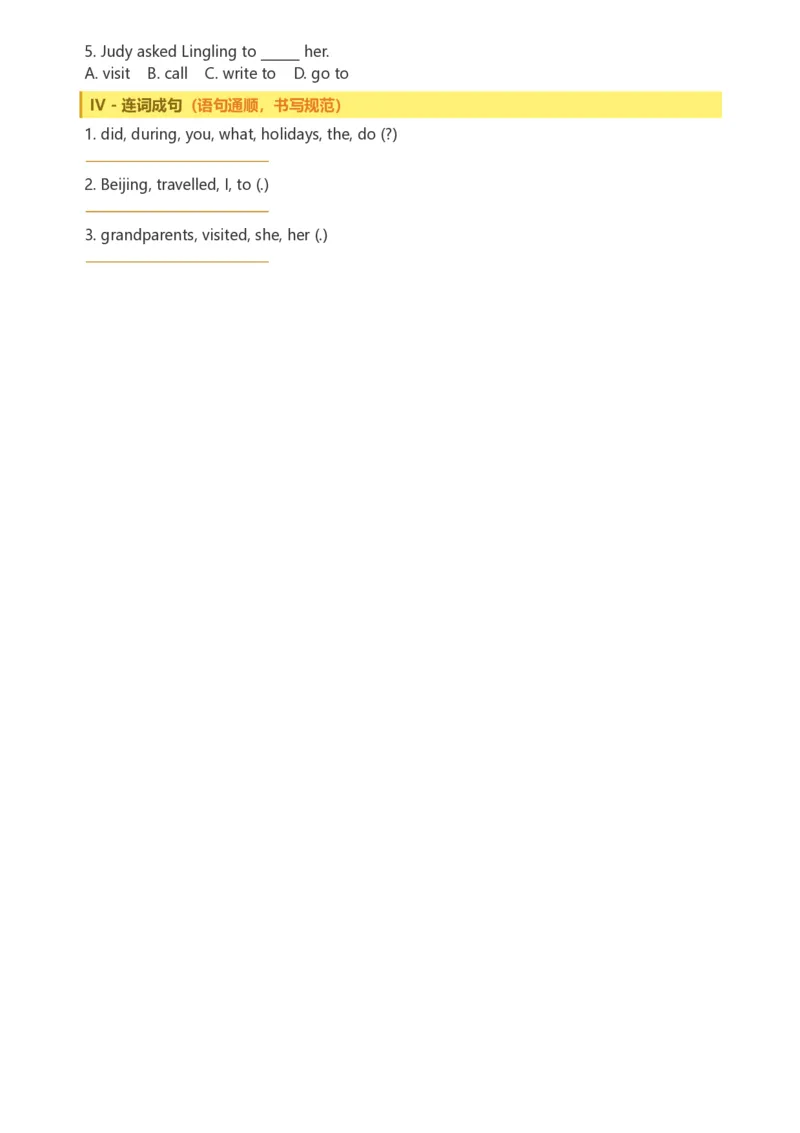
A. visit B. call C. write to D. go to
IV - 连词成句(语句通顺,书写规范)
1. did, during, you, what, holidays, the, do (?)
2. Beijing, travelled, I, to (.)
3. grandparents, visited, she, her (.)26湘少版六上英语30天单元同步训练
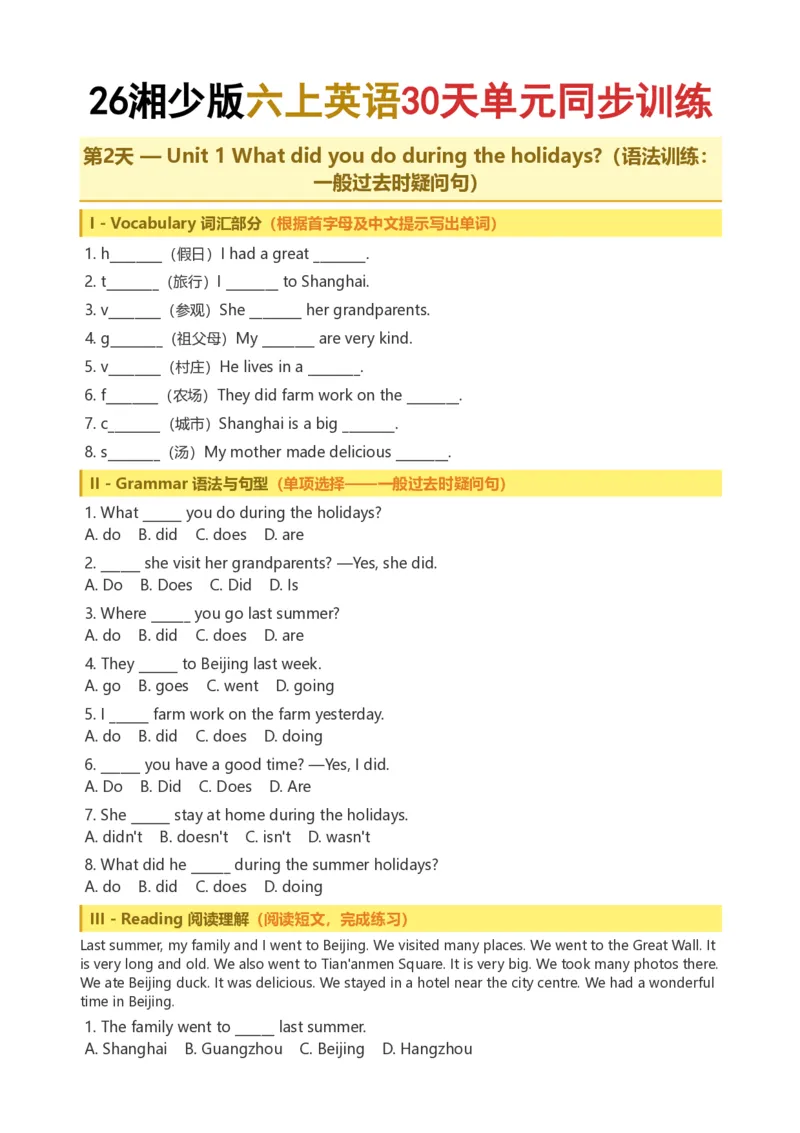
第2天 — Unit 1 What did you do during the holidays?(语法训练:
一般过去时疑问句)
I - Vocabulary 词汇部分(根据首字母及中文提示写出单词)
1. h________(假日)I had a great ________.
2. t________(旅行)I ________ to Shanghai.
3. v________(参观)She ________ her grandparents.
4. g________(祖父母)My ________ are very kind.
5. v________(村庄)He lives in a ________.
6. f________(农场)They did farm work on the ________.
7. c________(城市)Shanghai is a big ________.
8. s________(汤)My mother made delicious ________.
II - Grammar 语法与句型(单项选择——一般过去时疑问句)
1. What ______ you do during the holidays?
A. do B. did C. does D. are
2. ______ she visit her grandparents? —Yes, she did.
A. Do B. Does C. Did D. Is
3. Where ______ you go last summer?
A. do B. did C. does D. are
4. They ______ to Beijing last week.
A. go B. goes C. went D. going
5. I ______ farm work on the farm yesterday.
A. do B. did C. does D. doing
6. ______ you have a good time? —Yes, I did.
A. Do B. Did C. Does D. Are
7. She ______ stay at home during the holidays.
A. didn't B. doesn't C. isn't D. wasn't
8. What did he ______ during the summer holidays?
A. do B. did C. does D. doing
III - Reading 阅读理解(阅读短文,完成练习)
Last summer, my family and I went to Beijing. We visited many places. We went to the Great Wall. It
is very long and old. We also went to Tian'anmen Square. It is very big. We took many photos there.
We ate Beijing duck. It was delicious. We stayed in a hotel near the city centre. We had a wonderful
time in Beijing.
1. The family went to ______ last summer.
A. Shanghai B. Guangzhou C. Beijing D. Hangzhou2. They visited the ______.
A. West Lake B. Great Wall C. Yellow Mountain D. Summer Palace
3. Tian'anmen Square is very ______.
A. long B. old C. big D. tall
4. They ate ______.
A. dumplings B. Beijing duck C. noodles D. fish
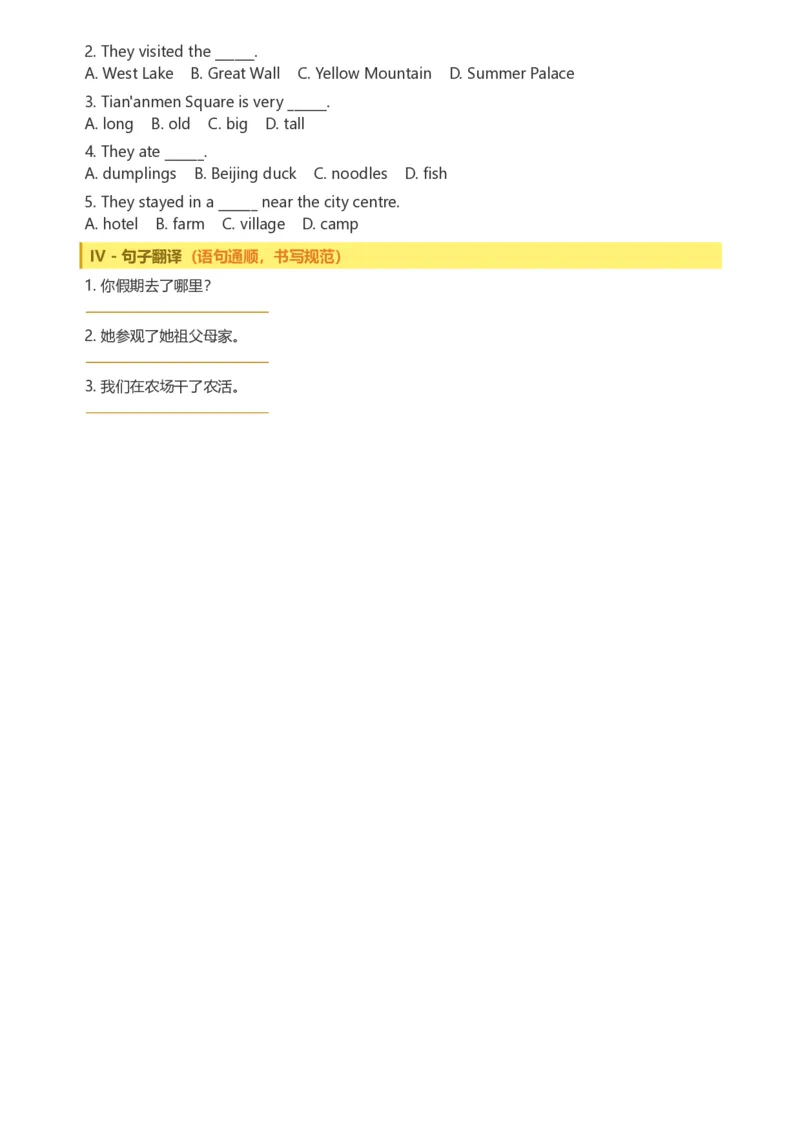
5. They stayed in a ______ near the city centre.
A. hotel B. farm C. village D. camp
IV - 句子翻译(语句通顺,书写规范)
1. 你假期去了哪里?
2. 她参观了她祖父母家。
3. 我们在农场干了农活。26湘少版六上英语30天单元同步训练
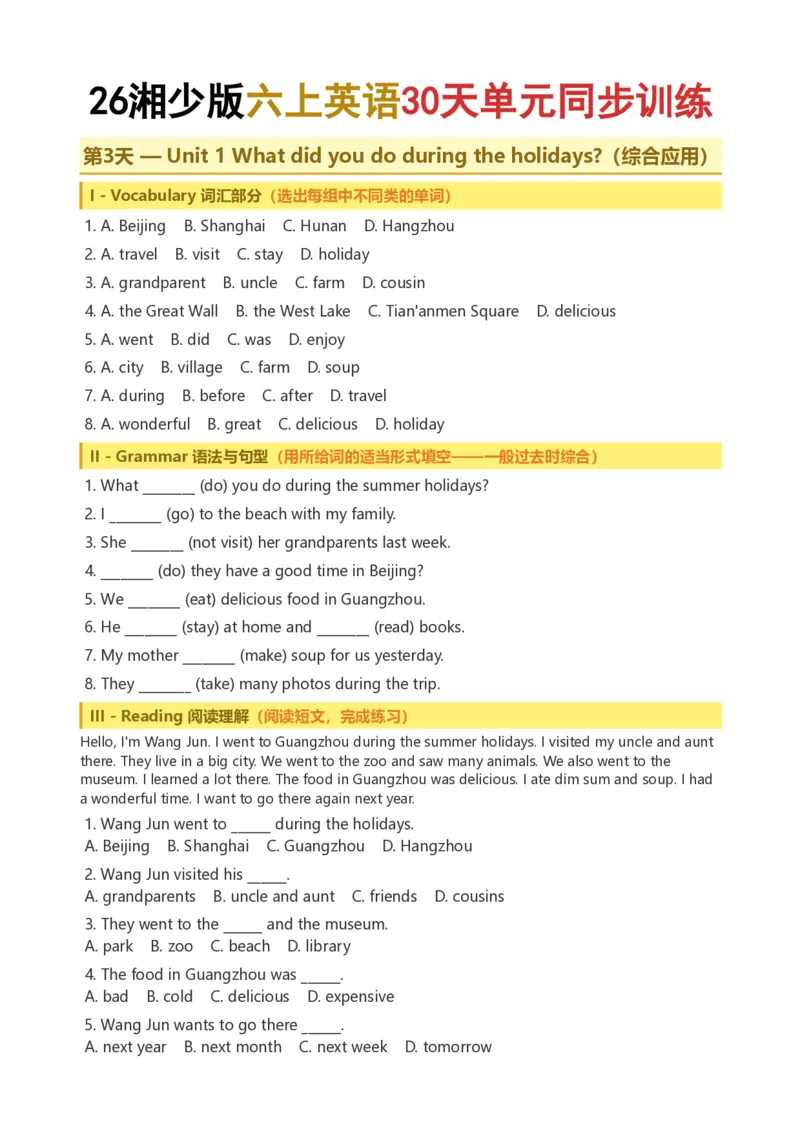
第3天 — Unit 1 What did you do during the holidays?(综合应用)
I - Vocabulary 词汇部分(选出每组中不同类的单词)
1. A. Beijing B. Shanghai C. Hunan D. Hangzhou
2. A. travel B. visit C. stay D. holiday
3. A. grandparent B. uncle C. farm D. cousin
4. A. the Great Wall B. the West Lake C. Tian'anmen Square D. delicious
5. A. went B. did C. was D. enjoy
6. A. city B. village C. farm D. soup
7. A. during B. before C. after D. travel
8. A. wonderful B. great C. delicious D. holiday
II - Grammar 语法与句型(用所给词的适当形式填空——一般过去时综合)
1. What ________ (do) you do during the summer holidays?
2. I ________ (go) to the beach with my family.
3. She ________ (not visit) her grandparents last week.
4. ________ (do) they have a good time in Beijing?
5. We ________ (eat) delicious food in Guangzhou.
6. He ________ (stay) at home and ________ (read) books.
7. My mother ________ (make) soup for us yesterday.
8. They ________ (take) many photos during the trip.
III - Reading 阅读理解(阅读短文,完成练习)
Hello, I'm Wang Jun. I went to Guangzhou during the summer holidays. I visited my uncle and aunt
there. They live in a big city. We went to the zoo and saw many animals. We also went to the
museum. I learned a lot there. The food in Guangzhou was delicious. I ate dim sum and soup. I had
a wonderful time. I want to go there again next year.
1. Wang Jun went to ______ during the holidays.
A. Beijing B. Shanghai C. Guangzhou D. Hangzhou
2. Wang Jun visited his ______.
A. grandparents B. uncle and aunt C. friends D. cousins
3. They went to the ______ and the museum.
A. park B. zoo C. beach D. library
4. The food in Guangzhou was ______.
A. bad B. cold C. delicious D. expensive
5. Wang Jun wants to go there ______.
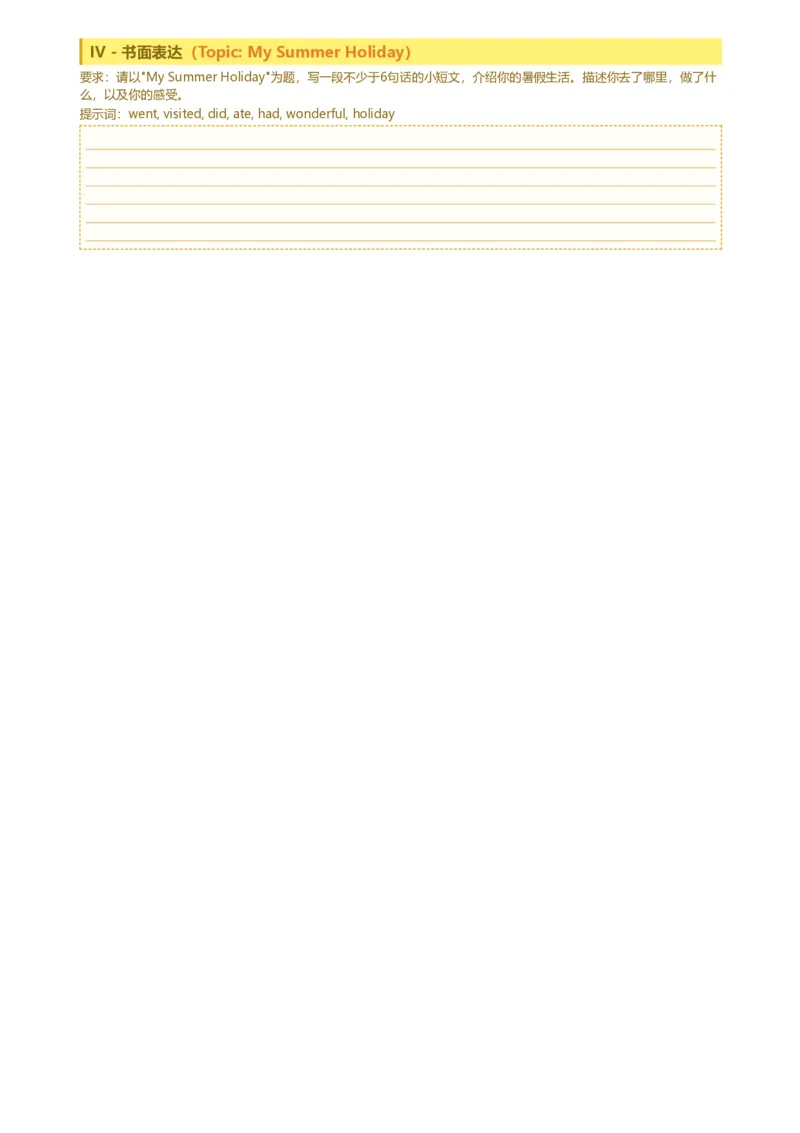
A. next year B. next month C. next week D. tomorrowIV - 书面表达(Topic: My Summer Holiday)
要求:请以"My Summer Holiday"为题,写一段不少于6句话的小短文,介绍你的暑假生活。描述你去了哪里,做了什
么,以及你的感受。
提示词:went, visited, did, ate, had, wonderful, holiday26湘少版六上英语30天单元同步训练
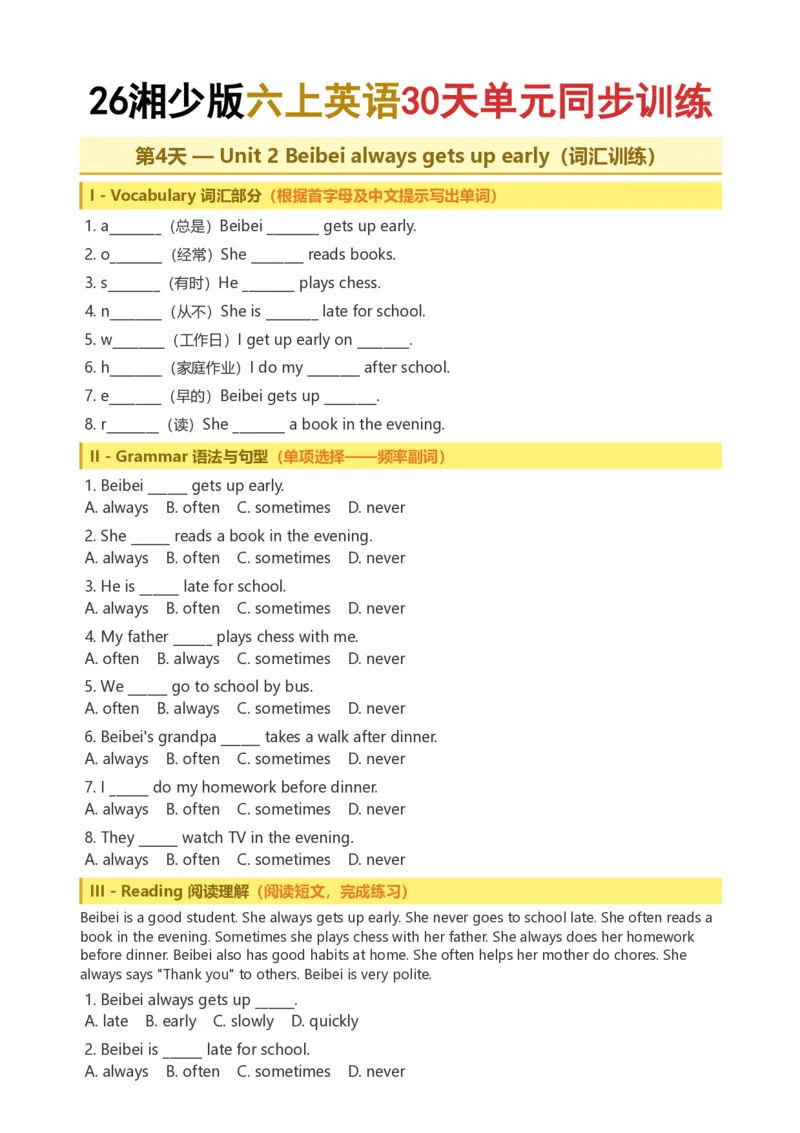
第4天 — Unit 2 Beibei always gets up early(词汇训练)
I - Vocabulary 词汇部分(根据首字母及中文提示写出单词)
1. a________(总是)Beibei ________ gets up early.
2. o________(经常)She ________ reads books.
3. s________(有时)He ________ plays chess.
4. n________(从不)She is ________ late for school.
5. w________(工作日)I get up early on ________.
6. h________(家庭作业)I do my ________ after school.
7. e________(早的)Beibei gets up ________.
8. r________(读)She ________ a book in the evening.
II - Grammar 语法与句型(单项选择——频率副词)
1. Beibei ______ gets up early.
A. always B. often C. sometimes D. never
2. She ______ reads a book in the evening.
A. always B. often C. sometimes D. never
3. He is ______ late for school.
A. always B. often C. sometimes D. never
4. My father ______ plays chess with me.
A. often B. always C. sometimes D. never
5. We ______ go to school by bus.
A. often B. always C. sometimes D. never
6. Beibei's grandpa ______ takes a walk after dinner.
A. always B. often C. sometimes D. never
7. I ______ do my homework before dinner.
A. always B. often C. sometimes D. never
8. They ______ watch TV in the evening.
A. always B. often C. sometimes D. never
III - Reading 阅读理解(阅读短文,完成练习)
Beibei is a good student. She always gets up early. She never goes to school late. She often reads a
book in the evening. Sometimes she plays chess with her father. She always does her homework
before dinner. Beibei also has good habits at home. She often helps her mother do chores. She
always says "Thank you" to others. Beibei is very polite.
1. Beibei always gets up ______.
A. late B. early C. slowly D. quickly
2. Beibei is ______ late for school.
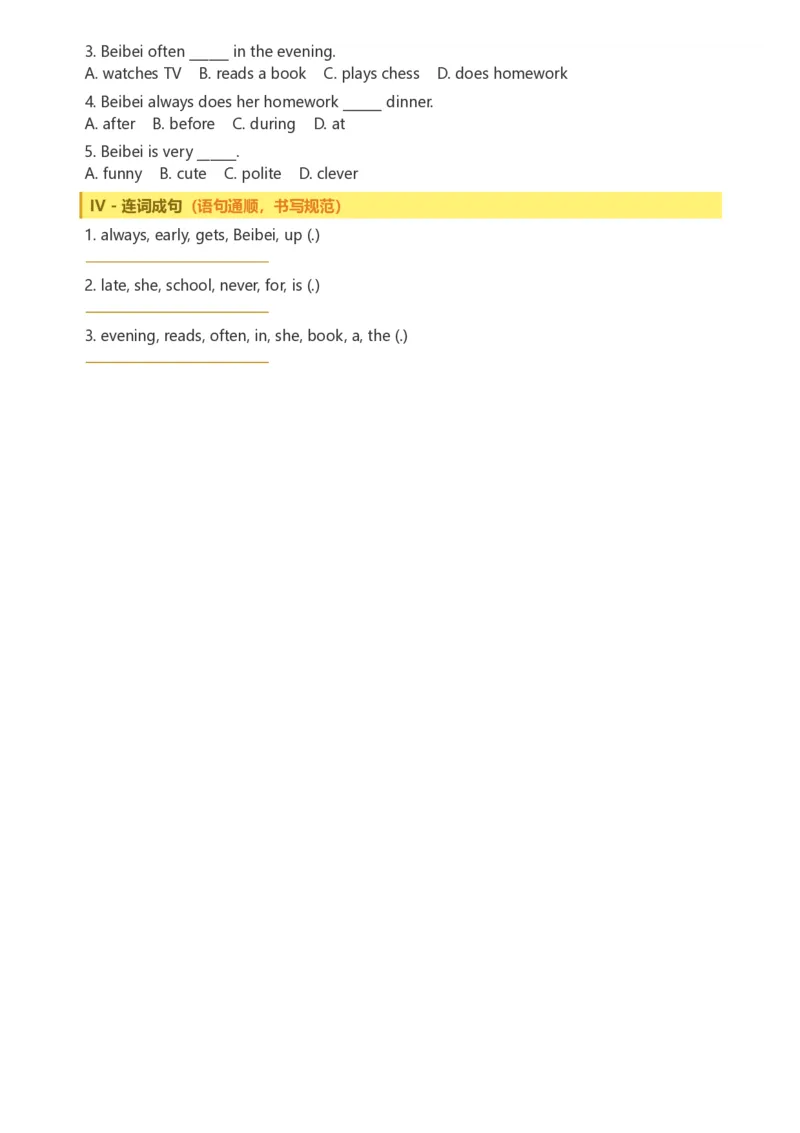
A. always B. often C. sometimes D. never3. Beibei often ______ in the evening.
A. watches TV B. reads a book C. plays chess D. does homework
4. Beibei always does her homework ______ dinner.
A. after B. before C. during D. at
5. Beibei is very ______.
A. funny B. cute C. polite D. clever
IV - 连词成句(语句通顺,书写规范)
1. always, early, gets, Beibei, up (.)
2. late, she, school, never, for, is (.)
3. evening, reads, often, in, she, book, a, the (.)26湘少版六上英语30天单元同步训练
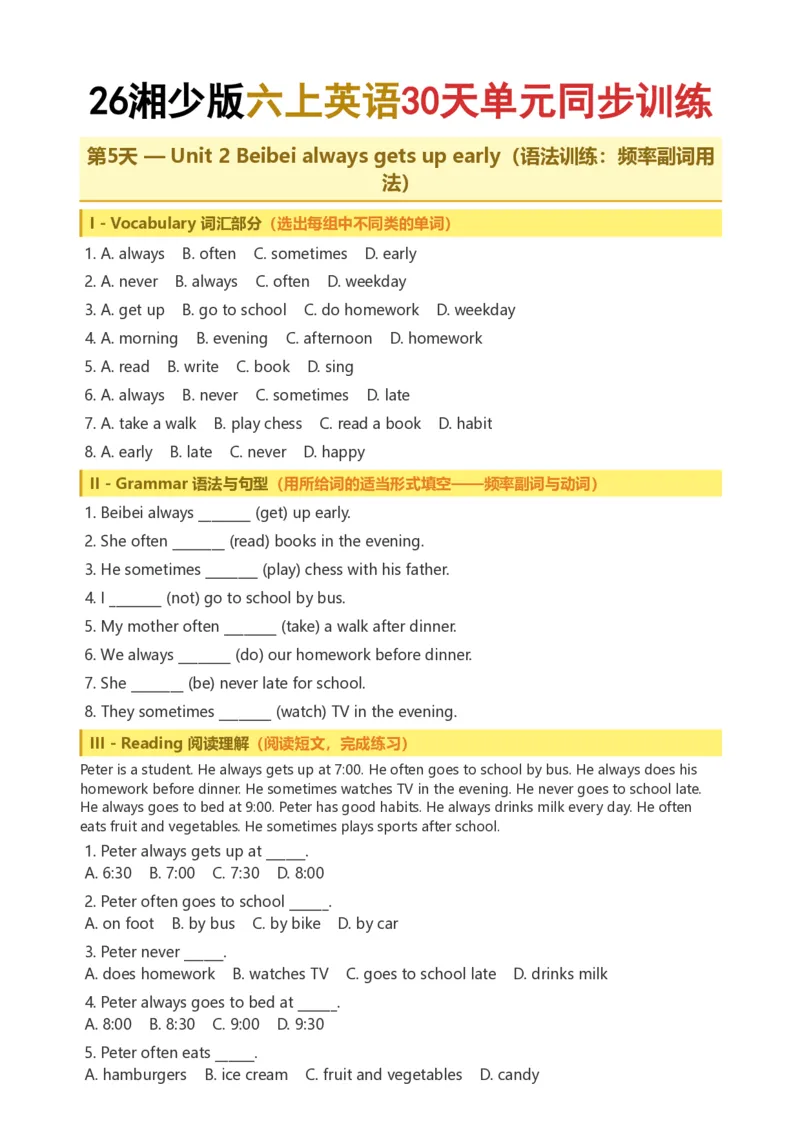
第5天 — Unit 2 Beibei always gets up early(语法训练:频率副词用
法)
I - Vocabulary 词汇部分(选出每组中不同类的单词)
1. A. always B. often C. sometimes D. early
2. A. never B. always C. often D. weekday
3. A. get up B. go to school C. do homework D. weekday
4. A. morning B. evening C. afternoon D. homework
5. A. read B. write C. book D. sing
6. A. always B. never C. sometimes D. late
7. A. take a walk B. play chess C. read a book D. habit
8. A. early B. late C. never D. happy
II - Grammar 语法与句型(用所给词的适当形式填空——频率副词与动词)
1. Beibei always ________ (get) up early.
2. She often ________ (read) books in the evening.
3. He sometimes ________ (play) chess with his father.
4. I ________ (not) go to school by bus.
5. My mother often ________ (take) a walk after dinner.
6. We always ________ (do) our homework before dinner.
7. She ________ (be) never late for school.
8. They sometimes ________ (watch) TV in the evening.
III - Reading 阅读理解(阅读短文,完成练习)
Peter is a student. He always gets up at 7:00. He often goes to school by bus. He always does his
homework before dinner. He sometimes watches TV in the evening. He never goes to school late.
He always goes to bed at 9:00. Peter has good habits. He always drinks milk every day. He often
eats fruit and vegetables. He sometimes plays sports after school.
1. Peter always gets up at ______.
A. 6:30 B. 7:00 C. 7:30 D. 8:00
2. Peter often goes to school ______.
A. on foot B. by bus C. by bike D. by car
3. Peter never ______.
A. does homework B. watches TV C. goes to school late D. drinks milk
4. Peter always goes to bed at ______.
A. 8:00 B. 8:30 C. 9:00 D. 9:30
5. Peter often eats ______.
A. hamburgers B. ice cream C. fruit and vegetables D. candyIV - 句子翻译(语句通顺,书写规范)
1. 贝贝总是早起。
2. 她上学从不迟到。
3. 我有时在晚上看电视。26湘少版六上英语30天单元同步训练
第6天 — Unit 2 Beibei always gets up early(综合应用)
I - Vocabulary 词汇部分(根据首字母及中文提示写出单词)
1. f________(频率)________ words help us talk about habits.
2. e________(早的)Beibei gets up ________.
3. w________(工作日)He gets up early on ________.
4. h________(家庭作业)I do my ________ after school.
5. c________(下棋)He sometimes plays ________.
6. h________(习惯)We should have good ________.
7. p________(有礼貌的)Beibei is very ________.
8. m________(牛奶)I drink ________ every day.
II - Grammar 语法与句型(单项选择——频率副词与动词时态)
1. My sister ______ gets up late on Sundays.
A. always B. often C. sometimes D. never
2. We ______ go to the park on weekends.
A. always B. often C. sometimes D. never
3. He ______ plays football after school.
A. always B. often C. sometimes D. never
4. They ______ eat junk food.
A. always B. often C. sometimes D. never
5. My father always ______ a walk after dinner.
A. take B. takes C. took D. taking
6. She often ______ her homework at 5:00.
A. do B. does C. did D. doing
7. We sometimes ______ TV in the evening.
A. watch B. watches C. watched D. watching
8. He ______ never late for school.
A. am B. is C. are D. be
III - Reading 阅读理解(阅读短文,完成练习)
Do you have good habits? Here are some questions for you. Do you often do sports? Do you drink
enough water every day? Do you always get enough sleep? Do you say "No" to junk food? Do you
often do chores at home? Do you usually say "Thank you" to others? Do you always smile? Ask
yourself and learn more about good habits. Have a try! Good habits help us to be healthy and
happy.
1. The passage asks us to think about our ______.
A. hobbies B. habits C. dreams D. plans2. We should drink ______ water every day.
A. enough B. some C. little D. no
3. We should say "______" to junk food.
A. Yes B. Please C. No D. OK
4. We should say "Thank you" to ______.
A. friends B. family C. others D. teachers
5. Good habits help us to be ______.
A. rich and famous B. tall and strong C. healthy and happy D. clever and beautiful
IV - 书面表达(Topic: My Good Habits)
要求:请以"My Good Habits"为题,写一段不少于6句话的小短文,介绍你的好习惯。描述你经常做什么,总是做什
么,从不做什么,以及这些习惯带来的好处。
提示词:always, often, sometimes, never, do homework, read, sports, healthy26湘少版六上英语30天单元同步训练
第7天 — Unit 3 The Mid-Autumn Festival(词汇训练)
I - Vocabulary 词汇部分(选出每组中不同类的单词)
1. A. mooncake B. dumpling C. rice D. festival
2. A. delicious B. bright C. happy D. moon
3. A. lotus B. bean C. seed D. enjoy
4. A. poem B. story C. book D. taste
5. A. open B. close C. box D. miss
6. A. moon B. star C. sun D. delicious
7. A. family B. friend C. soldier D. together
8. A. watch B. eat C. drink D. mooncake
II - Grammar 语法与句型(用所给词的适当形式填空——现在时与过去时综合)
1. I enjoy ________ (eat) mooncakes.
2. She ________ (watch) the moon last night.
3. We ________ (have) a big dinner yesterday.
4. They often ________ (drink) tea after dinner.
5. My grandpa ________ (tell) us a story about the moon.
6. She ________ (open) the box and saw a mooncake.
7. I ________ (miss) my uncle very much.
8. We ________ (celebrate) the festival with our family.
III - Reading 阅读理解(阅读短文,完成练习)
Yesterday was the Mid-Autumn Festival. My family all got together. My grandparents came from the
village. We had a big dinner at home. We ate delicious food like chicken, fish and vegetables. After
dinner, we sat down together and enjoyed mooncakes. The mooncakes were round and sweet. We
watched the full moon in the sky. It was bright and beautiful. My grandfather told us a story about
Chang'e. We all listened carefully. We had a wonderful time.
1. Yesterday was the ______.
A. Spring Festival B. Mid-Autumn Festival C. Double Ninth Festival D. Christmas
2. The family had a big ______ at home.
A. breakfast B. lunch C. dinner D. party
3. The mooncakes were ______.
A. salty B. round and sweet C. small and hard D. big and sour
4. The moon in the sky was ______.
A. bright and beautiful B. dark and cloudy C. small and dim D. warm and nice
5. Grandfather told a story about ______.
A. Chang'e B. Kong Rong C. Bian Que D. ChristmasIV - 连词成句(语句通顺,书写规范)
1. enjoy, I, mooncakes, eating (.)
2. watched, moon, we, the (.)
3. a, story, grandpa, told, us (.)26湘少版六上英语30天单元同步训练
第8天 — Unit 3 The Mid-Autumn Festival(语法训练:动词过去式及
节日表达)
I - Vocabulary 词汇部分(根据首字母及中文提示写出单词)
1. m________(月饼)I eat ________ on the Mid-Autumn Festival.
2. d________(美味的)The food is ________.
3. b________(明亮的)The moon is ________.
4. m________(想念)I ________ my family.
5. p________(诗歌)My grandpa wrote a ________.
6. b________(盒子)The gift is in the ________.
7. m________(错过)They ________ the festival together.
8. e________(享受)We ________ the festival.
II - Grammar 语法与句型(单项选择——节日表达与一般过去时)
1. The Mid-Autumn Festival is on the 15th day of the 8th ______ month.
A. English B. Chinese C. American D. Australian
2. We ______ mooncakes on the Mid-Autumn Festival.
A. eat B. ate C. eating D. to eat
3. My family ______ together last night.
A. get B. gets C. got D. getting
4. She ______ the box and saw a card.
A. open B. opens C. opened D. opening
5. We ______ the full moon in the sky.
A. watch B. watches C. watched D. watching
6. My uncle ______ a soldier.
A. am B. is C. are D. be
7. They ______ a wonderful time at the festival.
A. have B. has C. had D. having
8. I ______ you very much.
A. miss B. misses C. missed D. missing
III - Reading 阅读理解(阅读短文,完成练习)
The Mid-Autumn Festival is a traditional Chinese festival. It is on the 15th day of the 8th Chinese
lunar month. People celebrate it with their families. They get together and have a big dinner. They
eat mooncakes. They watch the full moon. Children like to listen to stories about the moon. Chang'e
is a famous story. People also send gifts to their relatives and friends. The festival brings families
together. Everyone is happy.1. The Mid-Autumn Festival is on the ______.
A. 15th day of the 8th Chinese lunar month B. 1st day of January
C. 25th of December D. 9th day of the 9th Chinese lunar month
2. People ______ with their families.
A. go to work B. celebrate C. travel D. shop
3. People eat ______ on the festival.
A. dumplings B. rice C. mooncakes D. noodles
4. Children like to listen to stories about the ______.
A. sun B. moon C. stars D. earth
5. The festival brings families ______.
A. apart B. together C. far away D. up
IV - 句子翻译(语句通顺,书写规范)
1. 中秋节在农历八月十五。
2. 我们吃了月饼并看了月亮。
3. 爷爷给我们讲了一个故事。26湘少版六上英语30天单元同步训练
第9天 — Unit 3 The Mid-Autumn Festival(综合应用)
I - Vocabulary 词汇部分(选出每组中不同类的单词)
1. A. mooncake B. dumpling C. rice D. Chinese
2. A. full B. bright C. round D. moon
3. A. watch B. eat C. enjoy D. festival
4. A. lotus B. bean C. seed D. soldier
5. A. open B. close C. box D. miss
6. A. family B. friend C. together D. uncle
7. A. poem B. story C. book D. taste
8. A. delicious B. wonderful C. beautiful D. festival
II - Grammar 语法与句型(用所给词的适当形式填空——节日与动词时态)
1. The Mid-Autumn Festival ________ (be) on the 15th day of the 8th Chinese lunar month.
2. My family ________ (get) together last night.
3. We ________ (enjoy) eating mooncakes every year.
4. She ________ (open) the gift and ________ (see) a card.
5. He ________ (be) a soldier and he ________ (work) in Xizang.
6. They ________ (watch) the moon and ________ (drink) tea.
7. I ________ (miss) my grandparents very much.
8. We ________ (have) a wonderful time at the festival.
III - Reading 阅读理解(阅读短文,完成练习)
Dear Dad, Mum and Family,
I can't go back home this Mid-Autumn Festival. I miss you so much. Everything is fine here. I am a
soldier and I need to stay on duty. We have mooncakes here too. They are delicious. I think of you
when I see the full moon. Wish you good health. Happy Mid-Autumn Festival!
Yours,
Guoqiang
1. This letter is from ______.
A. Dad B. Mum C. Guoqiang D. Family
2. Guoqiang can't go back home because he is a ______.
A. doctor B. teacher C. soldier D. worker
3. Guoqiang thinks of his family when he sees the ______.
A. sun B. full moon C. stars D. clouds
4. He wishes his family ______.
A. good health B. good luck C. happiness D. success5. The letter is about ______.
A. the Spring Festival B. the Mid-Autumn Festival C. Christmas D. the Double Ninth
Festival
IV - 书面表达(Topic: The Mid-Autumn Festival)
要求:请以"The Mid-Autumn Festival"为题,写一段不少于6句话的小短文,介绍中秋节。描述时间、活动、食物以及
你的感受。
提示词:Mid-Autumn Festival, mooncake, moon, family, together, story, enjoy26湘少版六上英语30天单元同步训练
第10天 — Unit 4 It will be sunny and cool tomorrow(词汇训练)
I - Vocabulary 词汇部分(根据首字母及中文提示写出单词)
1. w________(风)There will be a strong ________.
2. r________(雨)There will be heavy ________.
3. s________(暴风雨)There will be a ________ tomorrow.
4. h________(大量的)There will be ________ rain.
5. s________(安全的)Stay in a ________ place.
6. c________(凉爽的)It will be ________ tomorrow.
7. s________(阳光充足的)It will be ________ tomorrow.
8. c________(寒冷的)It will be ________ in winter.
II - Grammar 语法与句型(单项选择——将来时will)
1. It ______ be sunny and cool tomorrow.
A. will B. is C. are D. am
2. There ______ a big storm next Monday.
A. will B. will be C. is will D. are will
3. Students ______ go to school tomorrow.
A. will B. will not C. not will D. will no
4. What ______ people do in bad weather?
A. will B. does C. do D. are
5. We ______ stay at home if it rains.
A. will B. are C. do D. have
6. There ______ a strong wind and heavy rain.
A. will B. will be C. is will D. are will
7. They ______ go to the park next Sunday.
A. will B. will not C. not will D. will no
8. It ______ cold tomorrow.
A. will B. will be C. is will D. are will
III - Reading 阅读理解(阅读短文,完成练习)
Tomorrow is Saturday. It will be sunny and cool in Beijing. Some people will go to the park. Some
children will go to the zoo with their parents. Families will have fun. Next Monday, there will be a big
storm in Guangzhou. There will be a strong wind and heavy rain. No students will go to school. They
will stay at home. People will park their cars in safe places.
1. Tomorrow is ______.
A. Sunday B. Saturday C. Monday D. Friday
2. The weather in Beijing will be ______.
A. rainy B. snowy C. sunny and cool D. windy and cold3. Children will go to the ______ in Beijing.
A. zoo B. park C. museum D. library
4. There will be a storm in ______.
A. Beijing B. Shanghai C. Guangzhou D. Hangzhou
5. People will park their cars in ______ places.
A. high B. low C. safe D. big
IV - 连词成句(语句通顺,书写规范)
1. sunny, tomorrow, be, will, it (.)
2. a, there, storm, will, be, big (.)
3. home, will, stay, at, they (.)