26湘少版 四上英语 单元范文写作指导
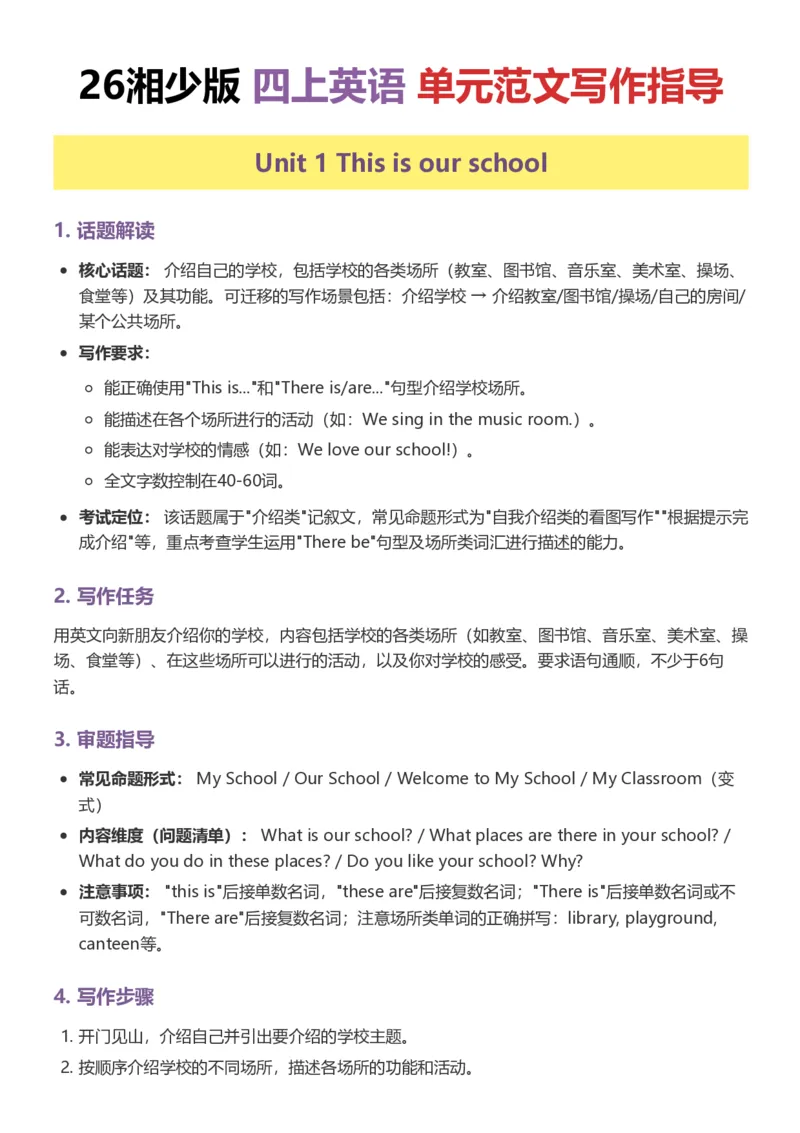
Unit 1 This is our school
1. 话题解读
核心话题: 介绍自己的学校,包括学校的各类场所(教室、图书馆、音乐室、美术室、操场、
食堂等)及其功能。可迁移的写作场景包括:介绍学校 → 介绍教室/图书馆/操场/自己的房间/
某个公共场所。
写作要求:
能正确使用"This is..."和"There is/are..."句型介绍学校场所。
能描述在各个场所进行的活动(如:We sing in the music room.)。
能表达对学校的情感(如:We love our school!)。
全文字数控制在40-60词。
考试定位: 该话题属于"介绍类"记叙文,常见命题形式为"自我介绍类的看图写作""根据提示完
成介绍"等,重点考查学生运用"There be"句型及场所类词汇进行描述的能力。
2. 写作任务
用英文向新朋友介绍你的学校,内容包括学校的各类场所(如教室、图书馆、音乐室、美术室、操
场、食堂等)、在这些场所可以进行的活动,以及你对学校的感受。要求语句通顺,不少于6句
话。
3. 审题指导
常见命题形式: My School / Our School / Welcome to My School / My Classroom(变
式)
内容维度(问题清单): What is our school? / What places are there in your school? /
What do you do in these places? / Do you like your school? Why?
注意事项: "this is"后接单数名词,"these are"后接复数名词;"There is"后接单数名词或不
可数名词,"There are"后接复数名词;注意场所类单词的正确拼写:library, playground,
canteen等。
4. 写作步骤
1. 开门见山,介绍自己并引出要介绍的学校主题。
2. 按顺序介绍学校的不同场所,描述各场所的功能和活动。3. 总结表达对学校的喜爱之情。
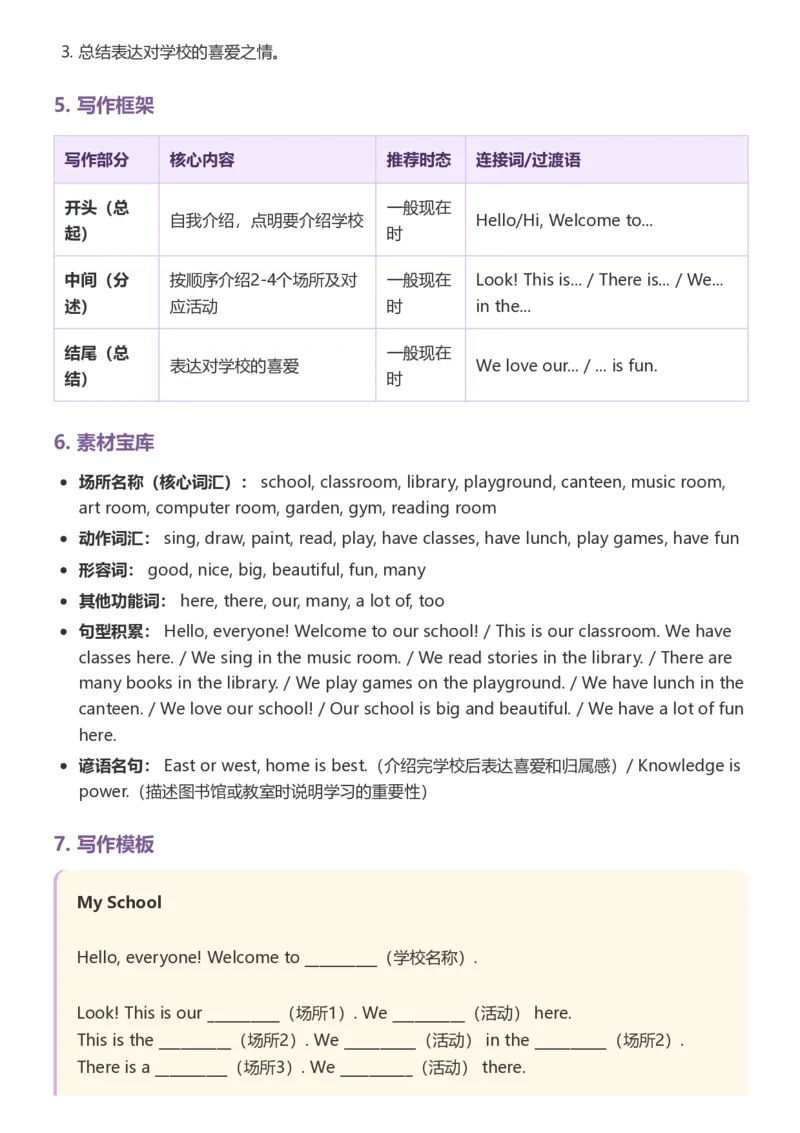
5. 写作框架
写作部分 核心内容 推荐时态 连接词/过渡语
开头(总 一般现在
自我介绍,点明要介绍学校 Hello/Hi, Welcome to...
起) 时
中间(分 按顺序介绍2-4个场所及对 一般现在 Look! This is... / There is... / We...
述) 应活动 时 in the...
结尾(总 一般现在
表达对学校的喜爱 We love our... / ... is fun.
结) 时
6. 素材宝库
场所名称(核心词汇): school, classroom, library, playground, canteen, music room,
art room, computer room, garden, gym, reading room
动作词汇: sing, draw, paint, read, play, have classes, have lunch, play games, have fun
形容词: good, nice, big, beautiful, fun, many
其他功能词: here, there, our, many, a lot of, too
句型积累: Hello, everyone! Welcome to our school! / This is our classroom. We have
classes here. / We sing in the music room. / We read stories in the library. / There are
many books in the library. / We play games on the playground. / We have lunch in the
canteen. / We love our school! / Our school is big and beautiful. / We have a lot of fun
here.
谚语名句: East or west, home is best.(介绍完学校后表达喜爱和归属感)/ Knowledge is
power.(描述图书馆或教室时说明学习的重要性)
7. 写作模板
My School
Hello, everyone! Welcome to __________(学校名称).
Look! This is our __________(场所1). We __________(活动) here.
This is the __________(场所2). We __________(活动) in the __________(场所2).
There is a __________(场所3). We __________(活动) there.We have a lot of __________(感受/评价).
We love our __________(总结)!
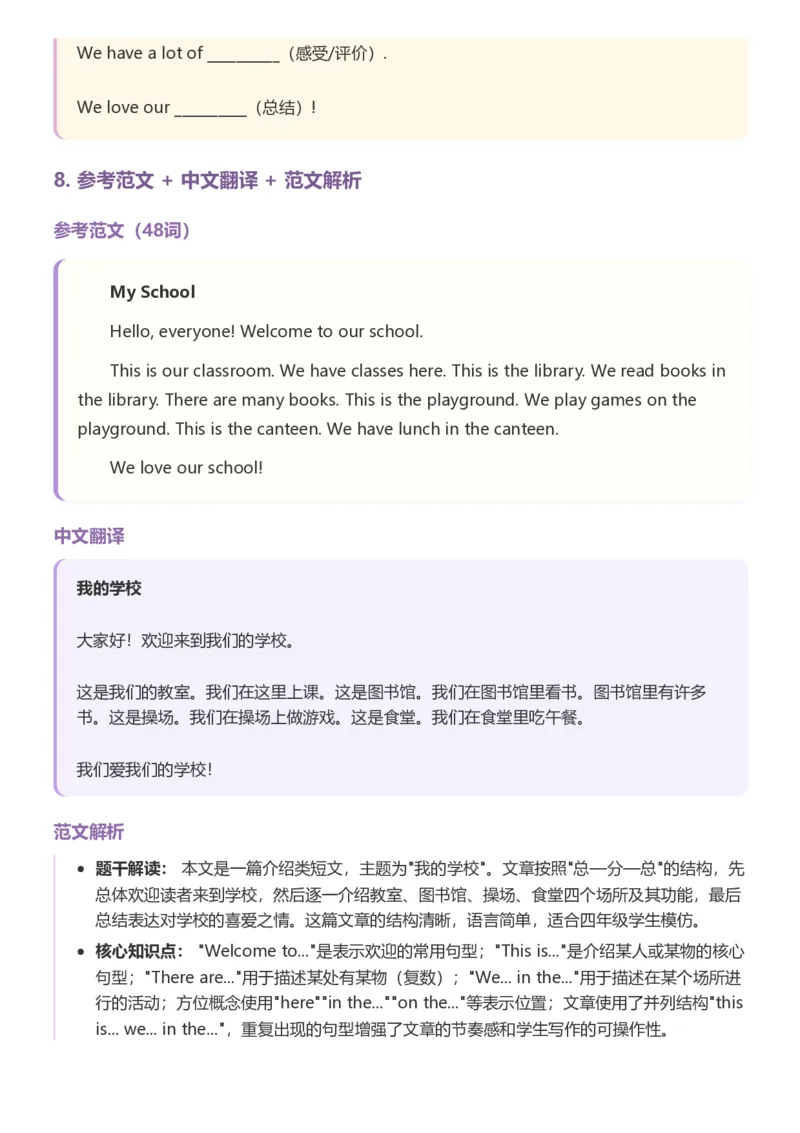
8. 参考范文 + 中文翻译 + 范文解析
参考范文(48词)
My School
Hello, everyone! Welcome to our school.
This is our classroom. We have classes here. This is the library. We read books in
the library. There are many books. This is the playground. We play games on the
playground. This is the canteen. We have lunch in the canteen.
We love our school!
中文翻译
我的学校
大家好!欢迎来到我们的学校。
这是我们的教室。我们在这里上课。这是图书馆。我们在图书馆里看书。图书馆里有许多
书。这是操场。我们在操场上做游戏。这是食堂。我们在食堂里吃午餐。
我们爱我们的学校!
范文解析
题干解读: 本文是一篇介绍类短文,主题为"我的学校"。文章按照"总—分—总"的结构,先
总体欢迎读者来到学校,然后逐一介绍教室、图书馆、操场、食堂四个场所及其功能,最后
总结表达对学校的喜爱之情。这篇文章的结构清晰,语言简单,适合四年级学生模仿。
核心知识点: "Welcome to..."是表示欢迎的常用句型;"This is..."是介绍某人或某物的核心
句型;"There are..."用于描述某处有某物(复数);"We... in the..."用于描述在某个场所进
行的活动;方位概念使用"here""in the...""on the..."等表示位置;文章使用了并列结构"this
is... we... in the...",重复出现的句型增强了文章的节奏感和学生写作的可操作性。9. 变式提升训练
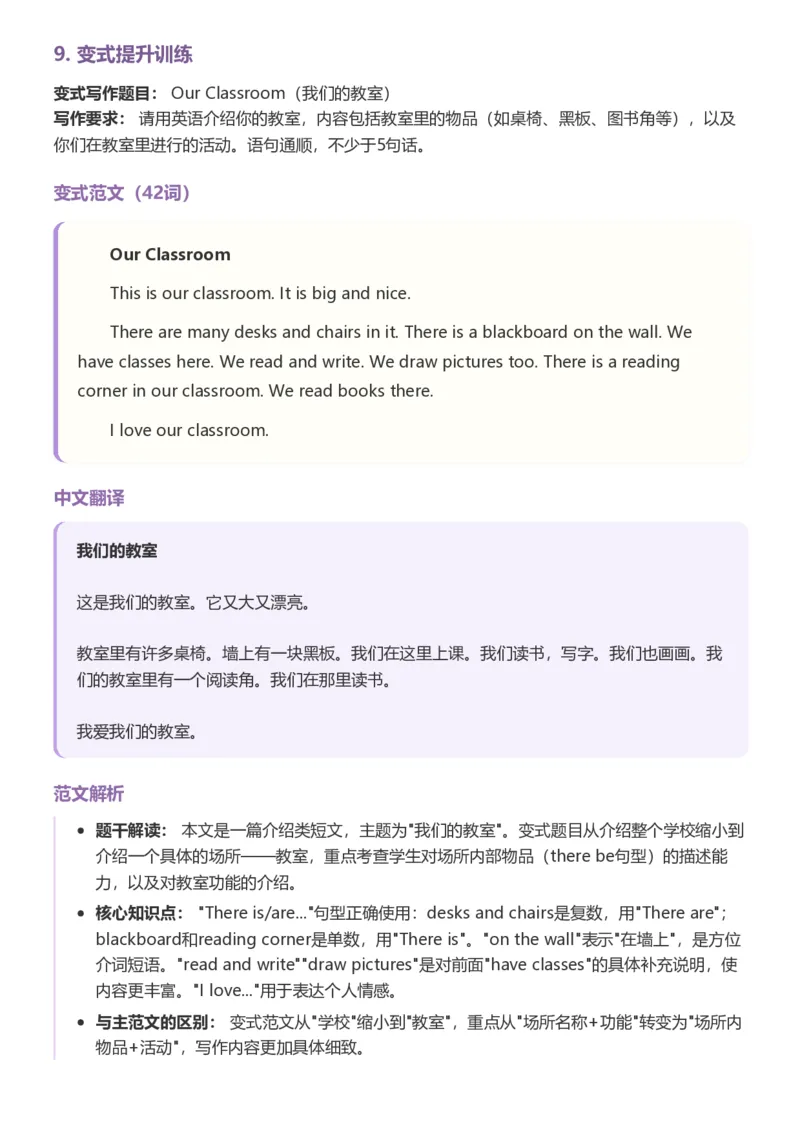
变式写作题目: Our Classroom(我们的教室)
写作要求: 请用英语介绍你的教室,内容包括教室里的物品(如桌椅、黑板、图书角等),以及
你们在教室里进行的活动。语句通顺,不少于5句话。
变式范文(42词)
Our Classroom
This is our classroom. It is big and nice.
There are many desks and chairs in it. There is a blackboard on the wall. We
have classes here. We read and write. We draw pictures too. There is a reading
corner in our classroom. We read books there.
I love our classroom.
中文翻译
我们的教室
这是我们的教室。它又大又漂亮。
教室里有许多桌椅。墙上有一块黑板。我们在这里上课。我们读书,写字。我们也画画。我
们的教室里有一个阅读角。我们在那里读书。
我爱我们的教室。
范文解析
题干解读: 本文是一篇介绍类短文,主题为"我们的教室"。变式题目从介绍整个学校缩小到
介绍一个具体的场所——教室,重点考查学生对场所内部物品(there be句型)的描述能
力,以及对教室功能的介绍。
核心知识点: "There is/are..."句型正确使用:desks and chairs是复数,用"There are";
blackboard和reading corner是单数,用"There is"。"on the wall"表示"在墙上",是方位
介词短语。"read and write""draw pictures"是对前面"have classes"的具体补充说明,使
内容更丰富。"I love..."用于表达个人情感。
与主范文的区别: 变式范文从"学校"缩小到"教室",重点从"场所名称+功能"转变为"场所内
物品+活动",写作内容更加具体细致。26湘少版 四上英语 单元范文写作指导
Unit 2 What time do you get up?
1. 话题解读
核心话题: 描述自己一天的日常作息时间安排,包括起床、吃早餐、上学、吃午餐、回家、吃
晚餐、上床睡觉等活动的时间。可迁移的写作场景包括:描述日常作息 → 描述周末安排/假期
的一天/某个特定日子的活动安排。
写作要求:
能正确使用"What time do you...?"和"I... at..."句型描述作息时间。
能按照时间顺序(从早到晚)组织写作内容。
能正确使用时间表达法(整点和半点)。
全文字数控制在40-60词。
考试定位: 该话题属于"描述类"记叙文,常见命题形式为"My Day""My Daily Routine"或看
图描述一天的活动,重点考查学生运用时间表达和日常活动短语进行叙述的能力。
2. 写作任务
用英文描述你一天的生活作息,按照时间顺序写出从起床到上床睡觉的主要活动及对应时间。要求
语句通顺,按时间顺序组织内容,不少于6句话。
3. 审题指导
常见命题形式: My Day / My Daily Routine / A Busy Day / My Weekend Morning(变
式)
内容维度(问题清单): What time do you get up? / What time do you have breakfast?
/ What time do you go to school? / What time do you have lunch? / What time do you
go home? / What time do you have dinner? / What time do you go to bed?
注意事项: 时间表达法:整点用"... o'clock",半点用"half past ...";"at"的用法:具体时间前
用介词"at"(如at 7:00);注意按时间先后顺序排列活动,使文章条理清楚。
4. 写作步骤
1. 总体说明要介绍自己的一天。
2. 按照从早到晚的时间顺序,逐一介绍各个时间点的活动。
3. 总结一天的活动,表达感受(如忙碌但充实)。5. 写作框架
推荐时
写作部分 核心内容 连接词/过渡语
态
开头(总 一般现 I'm... This is my day. / Let me tell
点明要介绍自己的一天
起) 在时 you about my day.
中间(分 按时间顺序介绍起床、三餐、上 一般现
I... at... / At... I... / After...
述) 学、回家、睡觉等活动 在时
结尾(总 一般现
总结一天,表达感受 This is my day. / I have a ... day.
结) 在时
6. 素材宝库
日常活动短语(核心词汇): get up, have breakfast, go to school, have lunch, go home,
have dinner, go to bed, have classes, play basketball, read books
时间表达: o'clock, half past, at, in the morning, in the afternoon, in the evening
形容词: early, busy, happy, good, nice
其他功能词: after, from... to..., never
句型积累: I'm ... This is my day. / Let me tell you about my day. / I get up at 7:00. / I
have breakfast at half past seven. / I go to school at 8:00. / I have lunch at 12:00. / I go
home at half past five. / I have dinner at 6:00. / I go to bed at 9:00. / I read books from
half past seven to eight. / This is my day. / I have a busy day. / I am happy every day.
谚语名句: Early to bed and early to rise makes a man healthy, wealthy and wise.(介绍
完作息后说明早睡早起的好处)/ Time is money.(说明要珍惜时间,按时作息)
7. 写作模板
My Day
I'm __________(名字). This is my day.
I __________(活动1) at __________(时间1).
I __________(活动2) at __________(时间2).
I __________(活动3) at __________(时间3).
I __________(活动4) in the afternoon.
I __________(活动5) at __________(时间4).I __________(活动6) at __________(时间5).
This is my __________(总结)day.
8. 参考范文 + 中文翻译 + 范文解析
参考范文(52词)
My Day
I'm Mingming. This is my day.
I get up at 7:00. I have breakfast at half past seven. I go to school at 8:00. I have
lunch at 12:00. I go home at half past five. I have dinner at 6:00. I read books from
half past seven to eight. I go to bed at 9:00.
This is my busy day.
中文翻译
我的一天
我是明明。这是我的一天。
我七点起床。我七点半吃早餐。我八点上学。我十二点吃午餐。我五点半回家。我六点吃晚
餐。我七点半到八点读书。我九点上床睡觉。
这是我忙碌的一天。
范文解析
题干解读: 本文是一篇描述类短文,主题为"我的一天"。文章按照从早到晚的时间顺序,依
次介绍了起床、早餐、上学、午餐、回家、晚餐、阅读、睡觉共8个时间节点,全面覆盖了
一天的主要作息活动。结尾用"busy"总结了一天的感受。
核心知识点: 时间表达法:整点用"at 7:00",半点用"at half past seven";"from...
to..."结构表示"从……到……",用于描述一段时间;介词"at"放在具体时间前面(at 7:00, at
half past seven);文章使用平行结构"I... at..."反复出现,形成节奏感,便于学生记忆和模
仿;结尾"This is my busy day"与开头"This is my day"首尾呼应,使文章结构完整。9. 变式提升训练
变式写作题目: My Morning(我的早晨)
写作要求: 用英语描述你今天早晨从起床到上学的活动及时间。要求按时间顺序写,语句通顺,
不少于5句话。
变式范文(43词)
My Morning
I get up at 7:00 in the morning. I have breakfast at half past seven. I have an
egg and some milk.
I go to school at 8:00. I am never late for school. I have classes in the morning. I
have lunch at 12:00.
I have a good morning.
中文翻译
我的早晨
我早上七点起床。我七点半吃早餐。我吃一个鸡蛋和一些牛奶。
我八点上学。我上学从不迟到。我上午有课。我十二点吃午餐。
我有一个美好的早晨。
范文解析
题干解读: 本文是一篇描述类短文,主题为"我的早晨"。变式题目从描述"一天"缩小到描
述"早晨"这一时间段,重点考查学生对部分时间段的聚焦描述能力,同时要求内容更加具体
(如早餐吃了什么)。
核心知识点: "in the morning"表示"在早上",用于限定时间段;"have an egg and
some milk"是"have breakfast"的具体化,使内容更丰富;"I am never late for school"表
达"我上学从不迟到","never"表示否定,"be late for"表示"迟到";"have classes"表示"上
课";结尾"I have a good morning"总结了整个早晨的感受。
与主范文的区别: 变式范文从"一整天"聚焦到"早晨"一个时间段,内容更加具体细致,强调
了早餐的具体食物和个人习惯(从不迟到),同时写作难度略有降低。26湘少版 四上英语 单元范文写作指导
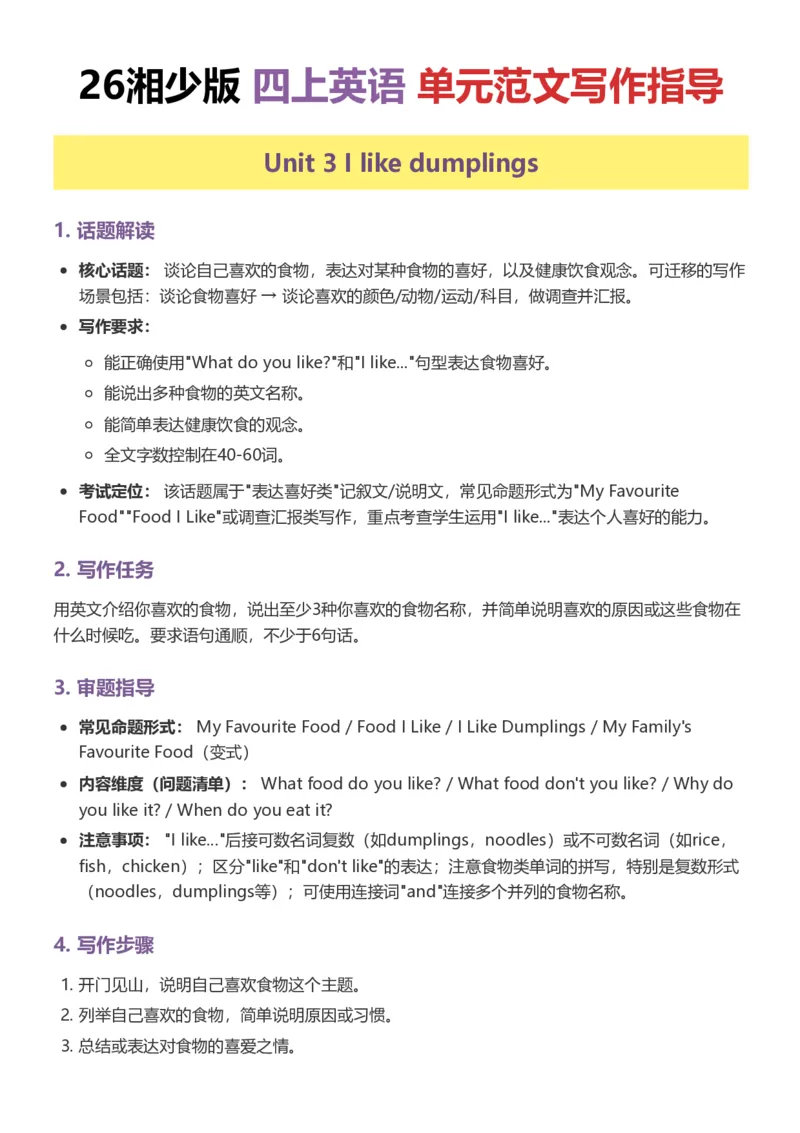
Unit 3 I like dumplings
1. 话题解读
核心话题: 谈论自己喜欢的食物,表达对某种食物的喜好,以及健康饮食观念。可迁移的写作
场景包括:谈论食物喜好 → 谈论喜欢的颜色/动物/运动/科目,做调查并汇报。
写作要求:
能正确使用"What do you like?"和"I like..."句型表达食物喜好。
能说出多种食物的英文名称。
能简单表达健康饮食的观念。
全文字数控制在40-60词。
考试定位: 该话题属于"表达喜好类"记叙文/说明文,常见命题形式为"My Favourite
Food""Food I Like"或调查汇报类写作,重点考查学生运用"I like..."表达个人喜好的能力。
2. 写作任务
用英文介绍你喜欢的食物,说出至少3种你喜欢的食物名称,并简单说明喜欢的原因或这些食物在
什么时候吃。要求语句通顺,不少于6句话。
3. 审题指导
常见命题形式: My Favourite Food / Food I Like / I Like Dumplings / My Family's
Favourite Food(变式)
内容维度(问题清单): What food do you like? / What food don't you like? / Why do
you like it? / When do you eat it?
注意事项: "I like..."后接可数名词复数(如dumplings,noodles)或不可数名词(如rice,
fish,chicken);区分"like"和"don't like"的表达;注意食物类单词的拼写,特别是复数形式
(noodles,dumplings等);可使用连接词"and"连接多个并列的食物名称。
4. 写作步骤
1. 开门见山,说明自己喜欢食物这个主题。
2. 列举自己喜欢的食物,简单说明原因或习惯。
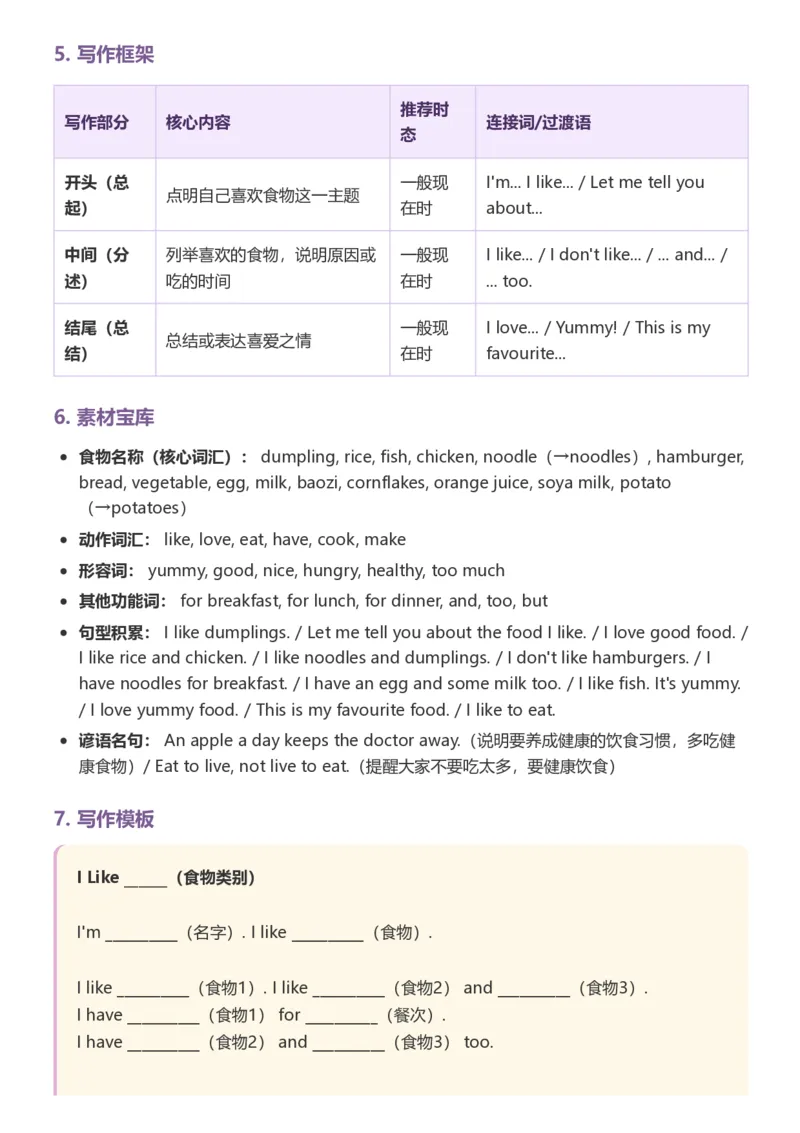
3. 总结或表达对食物的喜爱之情。5. 写作框架
推荐时
写作部分 核心内容 连接词/过渡语
态
开头(总 一般现 I'm... I like... / Let me tell you
点明自己喜欢食物这一主题
起) 在时 about...
中间(分 列举喜欢的食物,说明原因或 一般现 I like... / I don't like... / ... and... /
述) 吃的时间 在时 ... too.
结尾(总 一般现 I love... / Yummy! / This is my
总结或表达喜爱之情
结) 在时 favourite...
6. 素材宝库
食物名称(核心词汇): dumpling, rice, fish, chicken, noodle(→noodles), hamburger,
bread, vegetable, egg, milk, baozi, cornflakes, orange juice, soya milk, potato
(→potatoes)
动作词汇: like, love, eat, have, cook, make
形容词: yummy, good, nice, hungry, healthy, too much
其他功能词: for breakfast, for lunch, for dinner, and, too, but
句型积累: I like dumplings. / Let me tell you about the food I like. / I love good food. /
I like rice and chicken. / I like noodles and dumplings. / I don't like hamburgers. / I
have noodles for breakfast. / I have an egg and some milk too. / I like fish. It's yummy.
/ I love yummy food. / This is my favourite food. / I like to eat.
谚语名句: An apple a day keeps the doctor away.(说明要养成健康的饮食习惯,多吃健
康食物)/ Eat to live, not live to eat.(提醒大家不要吃太多,要健康饮食)
7. 写作模板
I Like ______(食物类别)
I'm __________(名字). I like __________(食物).
I like __________(食物1). I like __________(食物2) and __________(食物3).
I have __________(食物1) for __________(餐次).
I have __________(食物2) and __________(食物3) too.I love __________(总结)!
8. 参考范文 + 中文翻译 + 范文解析
参考范文(46词)
I Like Dumplings
I'm Anne. I like dumplings very much.
I like rice and chicken too. I have rice and chicken for lunch. I have dumplings
for dinner. I like noodles. I have noodles for breakfast. I have an egg and some milk
too.
I like yummy food!
中文翻译
我喜欢饺子
我是安妮。我非常喜欢饺子。
我也喜欢米饭和鸡肉。我午餐吃米饭和鸡肉。我晚餐吃饺子。我喜欢面条。我早餐吃面条。
我也吃一个鸡蛋和一些牛奶。
我喜欢美味的食物!
范文解析
题干解读: 本文是一篇表达喜好类短文,主题为"我喜欢饺子"。文章先点明自己最喜欢的食
物是饺子,然后列举了其他喜欢的食物(米饭、鸡肉、面条),并说明了不同餐次吃什么,
最后总结对美食的喜爱。
核心知识点: "like... very much"表示"非常喜欢",程度副词"very much"放在句
末;"too"表示"也",放在肯定句句末;"have... for breakfast/lunch/dinner"表示"早/午/晚
餐吃……";"and"和"too"的使用使句子之间有连接和递进关系;食物名称的复数使用:
dumplings,noodles(通常用复数形式)。
9. 变式提升训练变式写作题目: My Family's Favourite Food(我家人的最爱食物)
写作要求: 用英语介绍你的家人(如爸爸、妈妈、自己)各自喜欢的食物。要求语句通顺,不少
于5句话。
变式范文(48词)
My Family's Favourite Food
I'm Peter. I like dumplings. My mum likes noodles and vegetables. My dad likes
rice and chicken. He likes fish too.
I have dumplings for dinner. Mum has noodles for lunch. Dad has rice for lunch.
We all like good food. Yummy!
中文翻译
我家人的最爱食物
我是彼得。我喜欢饺子。我妈妈喜欢面条和蔬菜。我爸爸喜欢米饭和鸡肉。他也喜欢鱼肉。
我晚餐吃饺子。妈妈午餐吃面条。爸爸午餐吃米饭。
我们都喜欢美味的食物。真好吃!
范文解析
题干解读: 本文是一篇表达喜好类短文,主题为"我家人的最爱食物"。变式题目从"自己"拓
展到"家人",要求学生掌握第三人称单数的表达方式,同时涉及多个不同人物的喜好介绍。
核心知识点: 第三人称单数:"My mum likes..."(like加s),"My dad likes...";"He likes
fish too"——第三人称单数"he"后动词like要加s;"We all like..."——"all"放在实义动词之
前,表示"都";"Yummy!"是感叹词,表示"美味",在口语中常用,让文章更生动;可数名
词复数与不可数名词:dumplings/noodles(复数),rice/fish/chicken(不可数)。
与主范文的区别: 变式范文从个人角度扩展到家庭角度,引入了第三人称单数的语法知识
点,写作难度略有提升,同时考察了学生在不同人称下动词形式的变化。26湘少版 四上英语 单元范文写作指导
Unit 4 Look at the elephant
1. 话题解读
核心话题: 描述动物的外貌特征(大小、高矮、胖瘦等)和性格特点(有趣、可爱等),表达
对某种动物的喜爱。可迁移的写作场景包括:描述动物 → 描述宠物/动物园里的动物/野生动
物/制作动物卡片。
写作要求:
能使用"There is/are..."句型描述动物的存在。
能使用形容词(tall, strong, cute, funny, small, big等)描述动物特征。
能表达对动物的喜爱之情。
全文字数控制在40-60词。
考试定位: 该话题属于"描述类"记叙文,常见命题形式为"My Favourite Animal""Look at
the...""Animals in the Zoo"或看图描述动物,重点考查学生运用形容词描述动物特征的能
力。
2. 写作任务
用英文描述你最喜欢的一种或几种动物,说出它们的外貌特征(大小、高矮、颜色等)和性格特点
(有趣、可爱、强壮等),并表达你对它们的喜爱之情。要求语句通顺,不少于6句话。
3. 审题指导
常见命题形式: My Favourite Animal / Look at the Elephant / Animals in the Zoo / At
the Zoo(变式)
内容维度(问题清单): What animals are there? / What do they look like? / What are
they like? / Do you like them? Why?
注意事项: 注意形容词的正确使用和位置(形容词放在名词前面);注意"There is"和"There
are"的区别(单数/复数);注意动物名称的单复数形式(elephant→elephants,
monkey→monkeys等);可使用描述性格的形容词(funny, cute, strong, tall等)。
4. 写作步骤
1. 点明要介绍动物,或说明在哪里看到这些动物。
2. 具体描述动物的外貌特征和性格特点。3. 表达对动物的喜爱或感受。
5. 写作框架
写作部分 核心内容 推荐时态 连接词/过渡语
开头(总 一般现在 Look at... / I like... / There
点明要介绍动物
起) 时 is/are...
中间(分 描述动物的外貌和性格特 一般现在
There is a... / It's... / ... and ...
述) 征 时
结尾(总 一般现在
表达对动物的喜爱 I like... / I love... / ... is my friend.
结) 时
6. 素材宝库
动物名称(核心词汇): elephant, lion, tiger, panda, monkey, bear, kangaroo, bald
eagle, bulldog, rabbit, cat, dog, fish, bird
描述形容词: tall, strong, cute, funny, beautiful, big, small, old, cold, clever, happy, sad
动作词汇: look, see, help, live, eat, cry, jump, run, fly, swim
其他功能词: there, very, too, from, in, on
句型积累: Look at the elephant. / I like animals. / There is a funny monkey. / Let's go
to the zoo. / Look at the monkey. It's funny. / There is a small elephant. / There is a
cute bear. / The elephant is big and strong. / The monkey is tall. / It eats leaves. / It
lives in the trees. / I like animals very much. / I love the panda. / Animals are our
friends.
谚语名句: A dog is man's best friend.(描述自己喜爱的动物,说明动物是人类的朋友)/
Love me, love my dog.(表达对自己宠物的喜爱,爱屋及乌)
7. 写作模板
My Favourite Animal
I like __________(动物类别).
Look at the __________(动物名). It is __________(形容词1) and __________(形容词
2).
There is a __________(动物名). It is very __________(形容词).It lives in __________(地点). It eats __________(食物).
I love __________(动物名) very much!
8. 参考范文 + 中文翻译 + 范文解析
参考范文(48词)
My Favourite Animal
I like animals very much.
Look at the elephant. It is big and strong. There is a cute panda. It is black and
white. It lives in China. It eats bamboo. Look at the funny monkey. It is small. It can
jump high.
I love these animals. They are my friends.
中文翻译
我最喜欢的动物
我非常喜欢动物。
看这头大象。它又大又强壮。有一只可爱的大熊猫。它是黑白相间的。它生活在中国。它吃
竹子。看这只有趣的猴子。它很小。它能跳得很高。
我爱这些动物。它们是我的朋友。
范文解析
题干解读: 本文是一篇描述类短文,主题为"我最喜欢的动物"。文章先总述自己喜欢动物,
然后分别描述了大象、大熊猫和猴子三种动物的外貌特征和生活习性,最后总结表达对动物
的喜爱。
核心知识点: "Look at..."是祈使句,用于引起注意;"It is big and strong"——用and连接
两个并列的形容词;"It is black and white"——描述颜色特征;"It lives in
China"——"live in"表示"居住在",第三人称单数live加s;"It eats bamboo"——"eat"第三
人称单数加s;"can"表示能力,"jump high"表示跳得高;"They are my friends"——
用"friends"表达动物是人类的朋友。9. 变式提升训练
变式写作题目: At the Zoo(在动物园)
写作要求: 用英语描述你在动物园里看到的动物(至少3种),说出它们的外貌特征和你在看动物
时的感受。要求语句通顺,不少于5句话。
变式范文(46词)
At the Zoo
I go to the zoo with my dad. Look at the lion. It is big and strong. There is a tall
giraffe. It is very tall. Look at the monkey. It is funny. It can jump and run. There is a
bear. It is big and brown.
I have a good day at the zoo.
中文翻译
在动物园
我和爸爸去动物园。看这头狮子。它又大又强壮。有一只高高的长颈鹿。它非常高。看这只
猴子。它很有趣。它能跳能跑。有一头熊。它又大又棕色。
我在动物园度过了美好的一天。
范文解析
题干解读: 本文是一篇描述类短文,主题为"在动物园"。变式题目从"描述喜欢的动物"转变
为"描述在动物园看到的动物",场景从个人喜好拓展到外出活动的记叙,增加了地点和同行
人物等元素。
核心知识点: "go to the zoo"表示"去动物园","with my dad"表示"和爸爸一
起";"giraffe"(长颈鹿)是补充词汇,描述"tall"的特征非常贴切;"It can jump and
run"——用and连接两个并列的动作,表示"能跳能跑";"big and brown"——用and连接
颜色和大小形容词;"I have a good day at the zoo"——结尾总结一天的感受,使文章更
完整。
与主范文的区别: 变式范文增加了"地点"(at the zoo)和"人物"(with my dad)元素,
从单纯的动物描述升级为简单的事件记叙,写作内容丰富了一个层次。26湘少版 四上英语 单元范文写作指导
Unit 5 Can you play basketball?
1. 话题解读
核心话题: 谈论自己和他人的运动能力,询问和回答是否会做某项运动,表达自己擅长的运动
项目。可迁移的写作场景包括:谈论运动能力 → 谈论个人特长/调查小组成员的能力/介绍自己
喜欢的运动。
写作要求:
能正确使用"Can you...?"和"I can..."/"I can't..."句型询问和表达运动能力。
能说出常见运动项目的英文名称。
能简单描述自己在某项运动中的表现。
全文字数控制在40-60词。
考试定位: 该话题属于"能力描述类"记叙文,常见命题形式为"My Sports Ability""What Can
I Do?"或调查汇报类写作,重点考查学生运用情态动词"can"表达运动能力。
2. 写作任务
用英文介绍自己在体育方面的能力,说出你会做和不会做的运动项目,并简单描述你擅长或不擅长
某项运动的原因或表现。要求语句通顺,不少于6句话。
3. 审题指导
常见命题形式: My Sports Ability / What Can I Do? / I Can Play Basketball / My Friend
Can...(变式)
内容维度(问题清单): What sports can you play? / What sports can't you do? / Can
you do it well? / What sports do you like?
注意事项: "can"是情态动词,后面接动词原形(can play, can swim, can
run);"can't"是"cannot"的缩写形式,表示"不能/不会";"play+球类运动"时,球类名词前
不加"the"(play basketball, play football, play ping-pong);运动类动词的正确使用:
swim, run, jump等。
4. 写作步骤
1. 点明主题,介绍自己喜欢运动或说明要介绍自己的运动能力。
2. 列举自己会做的运动,用"I can..."说明;列举不会做的运动,用"I can't..."说明。3. 总结自己的运动能力,或表达对运动的喜爱。
5. 写作框架
写作部分 核心内容 推荐时态 连接词/过渡语
开头(总 点明要介绍自己的运动能 一般现在 I like... / Let me tell you about... / I
起) 力 时 can...
中间(分 列出会做的运动和不会做 一般现在 I can... / I can't... / I can... well. / ...
述) 的运动 时 and ...
结尾(总 一般现在
总结能力,表达情感 I'm happy. / I like sports.
结) 时
6. 素材宝库
运动项目(核心词汇): basketball, football, ping-pong, swim, run, jump, climb, skip,
play football, play basketball, play ping-pong
动作词汇: play, run, jump, swim, want, try, can, can't, do, clap, tap
形容词/副词: fast, high, far, well, hard, happy, funny, good
身体部位词汇: feet, hands, eyes, mouth
句型积累: I like sports. / Let me tell you about my sports. / I can play basketball. / I
can swim. / I can't play football. / Can you play ping-pong? / Yes, I can. / No, I can't. / I
can run fast. / I can jump high. / I can play it well. / I can do many sports. / I like sports
very much. / Sports are fun. / I am happy.
谚语名句: Practice makes perfect.(表达虽然自己现在还不会某项运动,但相信通过练习可
以做好)/ All work and no play makes Jack a dull boy.(说明运动的重要性,运动使人快乐
和健康)
7. 写作模板
My Sports Ability
I'm __________(名字). I __________(like/can) __________(运动).
I can __________(运动1). I can __________(运动2) too.
I can __________(运动3) well. I can __________(动作) fast/high.
I can't __________(运动4). But I want to __________(动作).I __________(感受).
8. 参考范文 + 中文翻译 + 范文解析
参考范文(48词)
My Sports Ability
I'm Peter. I like sports very much.
I can play basketball. I can play it well. I can swim too. I can run fast. I can jump
high. I can play ping-pong.
I can't play football. But I want to play it.
I love sports. Sports are fun!
中文翻译
我的运动能力
我是彼得。我非常喜欢运动。
我会打篮球。我打得很好。我也会游泳。我能跑得快。我能跳得高。我会打乒乓球。
我不会踢足球。但是我想踢。
我爱运动。运动很有趣!
范文解析
题干解读: 本文是一篇能力描述类短文,主题为"我的运动能力"。文章先总述自己喜欢运
动,然后列举了多项自己会做的运动(篮球、游泳、跑步、跳高、乒乓球),并说明了不会
做的运动(足球),最后总结对运动的喜爱。
核心知识点: "I can play basketball"——can后接动词原形play;"I can play it
well"——"well"是副词,修饰动词play,表示"打得好";"run fast""jump
high"——"fast"和"high"作副词修饰动词;"I can't play football"——can't表示"不
会";"But I want to play it"——"want to + 动词原形"表示"想要做某事","but"表示转
折;短句并列使用,节奏轻快,符合运动话题的活泼风格。9. 变式提升训练
变式写作题目: My Friend Can...(我的朋友会……)
写作要求: 用英语介绍你的一个好朋友的运动能力,说说他会做和不会做的运动,并表达你的感
受。要求语句通顺,不少于5句话。
变式范文(47词)
My Friend Can...
My friend is Mingming. He likes sports.
He can play basketball. He can play it well. He can run fast and jump high. He
can swim too.
But he can't play ping-pong. He wants to play it. I can play ping-pong. I can
help him.
We are happy.
中文翻译
我的朋友会……
我的朋友是明明。他喜欢运动。
他会打篮球。他打得很好。他能跑得快、跳得高。他也会游泳。
但是他不会打乒乓球。他想打乒乓球。我会打乒乓球。我可以帮助他。
我们很开心。
范文解析
题干解读: 本文是一篇能力描述类短文,主题为"我的朋友会……"。变式题目从"介绍自
己"转变为"介绍朋友",要求学生掌握第三人称单数的表达方式,同时涉及两人能力的对比和
互动。
核心知识点: "My friend is Mingming"——介绍朋友的姓名;"He likes sports"——第三
人称单数,like加s;"He can play basketball"——can后接动词原形,不受人称影响;"He
can run fast and jump high"——用and连接两个并列动作;"But"表示转折,引出不会的
运动;"I can play ping-pong. I can help him."——第一人称参与,体现朋友间的互
助;"We are happy"——以"快乐"结尾,呼应朋友间的友谊。与主范文的区别: 变式范文从第一人称切换为第三人称,引入了人称代词"he"和动词第三人
称单数的变化(likes),同时加入了"I can help him"的互动内容,体现了帮助他人的积极
价值观。