文档文本内容
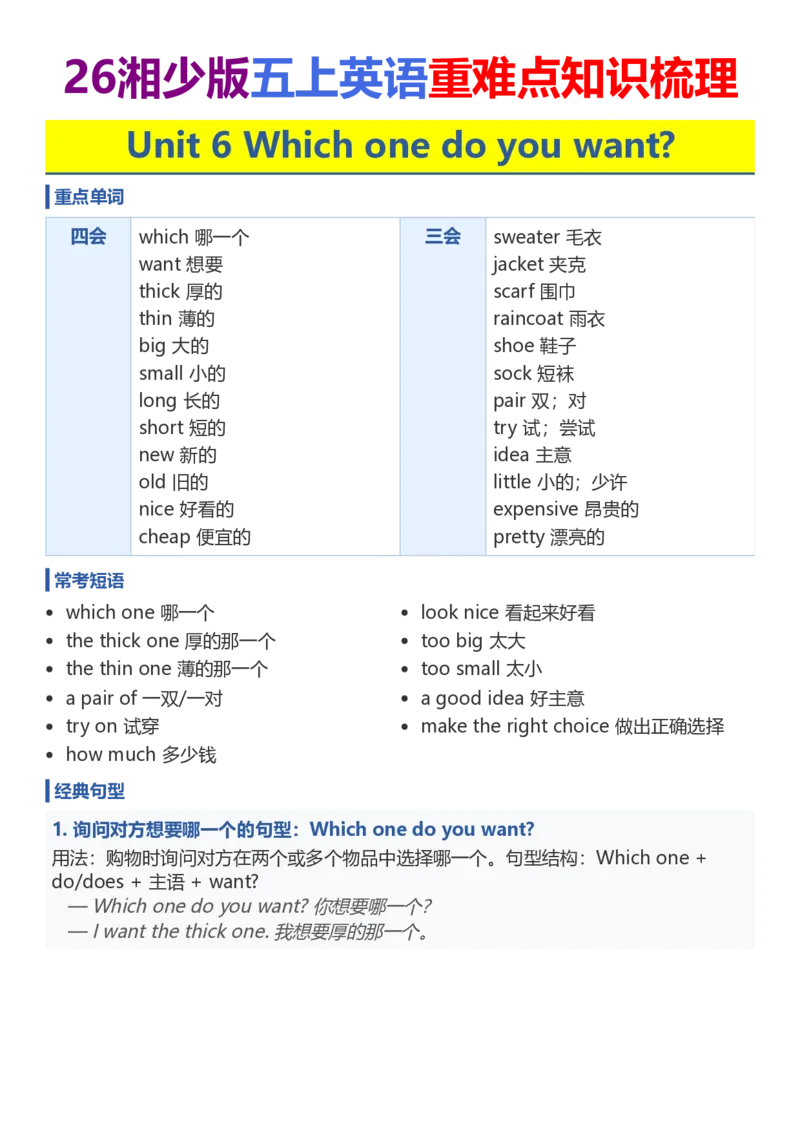
26湘少版五上英语重难点知识梳理
Unit 6 Which one do you want?
重点单词
四会 which 哪一个 三会 sweater 毛衣
want 想要 jacket 夹克
thick 厚的 scarf 围巾
thin 薄的 raincoat 雨衣
big 大的 shoe 鞋子
small 小的 sock 短袜
long 长的 pair 双;对
short 短的 try 试;尝试
new 新的 idea 主意
old 旧的 little 小的;少许
nice 好看的 expensive 昂贵的
cheap 便宜的 pretty 漂亮的
常考短语
which one 哪一个 look nice 看起来好看
the thick one 厚的那一个 too big 太大
the thin one 薄的那一个 too small 太小
a pair of 一双/一对 a good idea 好主意
try on 试穿 make the right choice 做出正确选择
how much 多少钱
经典句型
1. 询问对方想要哪一个的句型:Which one do you want?
用法:购物时询问对方在两个或多个物品中选择哪一个。句型结构:Which one +
do/does + 主语 + want?
— Which one do you want? 你想要哪一个?
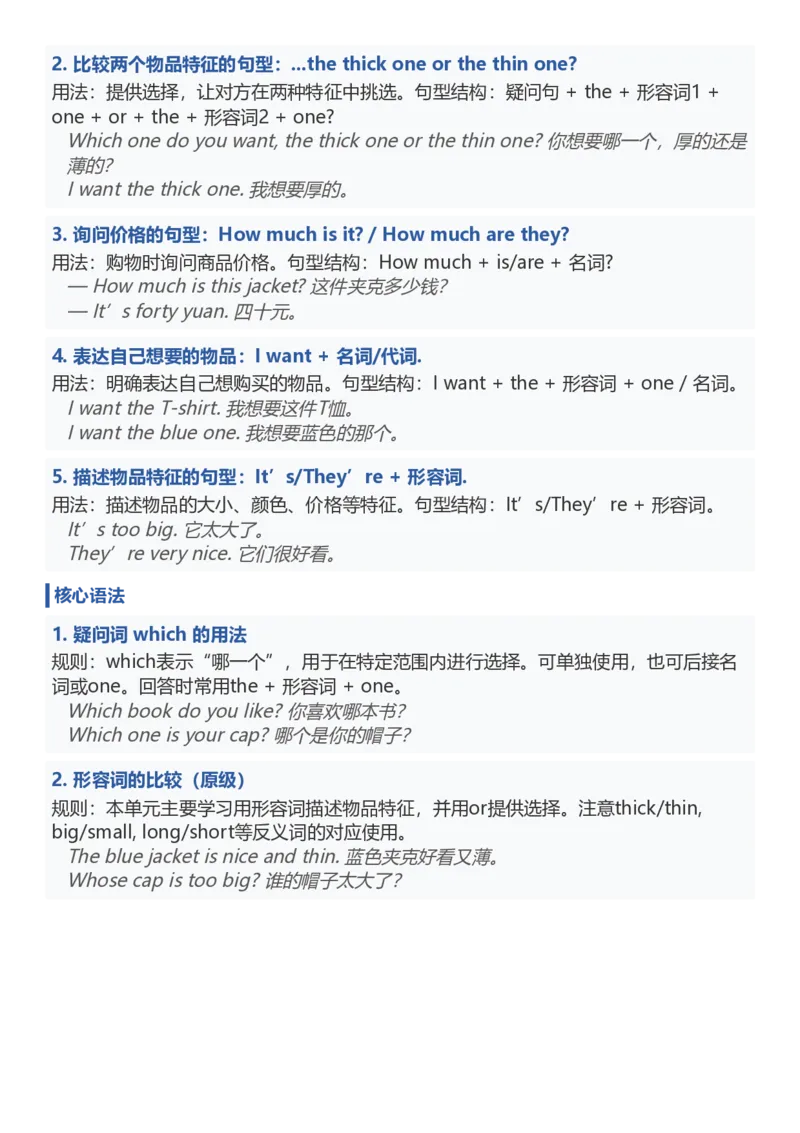
— I want the thick one. 我想要厚的那一个。2. 比较两个物品特征的句型:...the thick one or the thin one?
用法:提供选择,让对方在两种特征中挑选。句型结构:疑问句 + the + 形容词1 +
one + or + the + 形容词2 + one?
Which one do you want, the thick one or the thin one? 你想要哪一个,厚的还是
薄的?
I want the thick one. 我想要厚的。
3. 询问价格的句型:How much is it? / How much are they?
用法:购物时询问商品价格。句型结构:How much + is/are + 名词?
— How much is this jacket? 这件夹克多少钱?
— It’s forty yuan. 四十元。
4. 表达自己想要的物品:I want + 名词/代词.
用法:明确表达自己想购买的物品。句型结构:I want + the + 形容词 + one / 名词。
I want the T-shirt. 我想要这件T恤。
I want the blue one. 我想要蓝色的那个。
5. 描述物品特征的句型:It’s/They’re + 形容词.
用法:描述物品的大小、颜色、价格等特征。句型结构:It’s/They’re + 形容词。
It’s too big. 它太大了。
They’re very nice. 它们很好看。
核心语法
1. 疑问词 which 的用法
规则:which表示“哪一个”,用于在特定范围内进行选择。可单独使用,也可后接名
词或one。回答时常用the + 形容词 + one。
Which book do you like? 你喜欢哪本书?
Which one is your cap? 哪个是你的帽子?
2. 形容词的比较(原级)
规则:本单元主要学习用形容词描述物品特征,并用or提供选择。注意thick/thin,
big/small, long/short等反义词的对应使用。
The blue jacket is nice and thin. 蓝色夹克好看又薄。
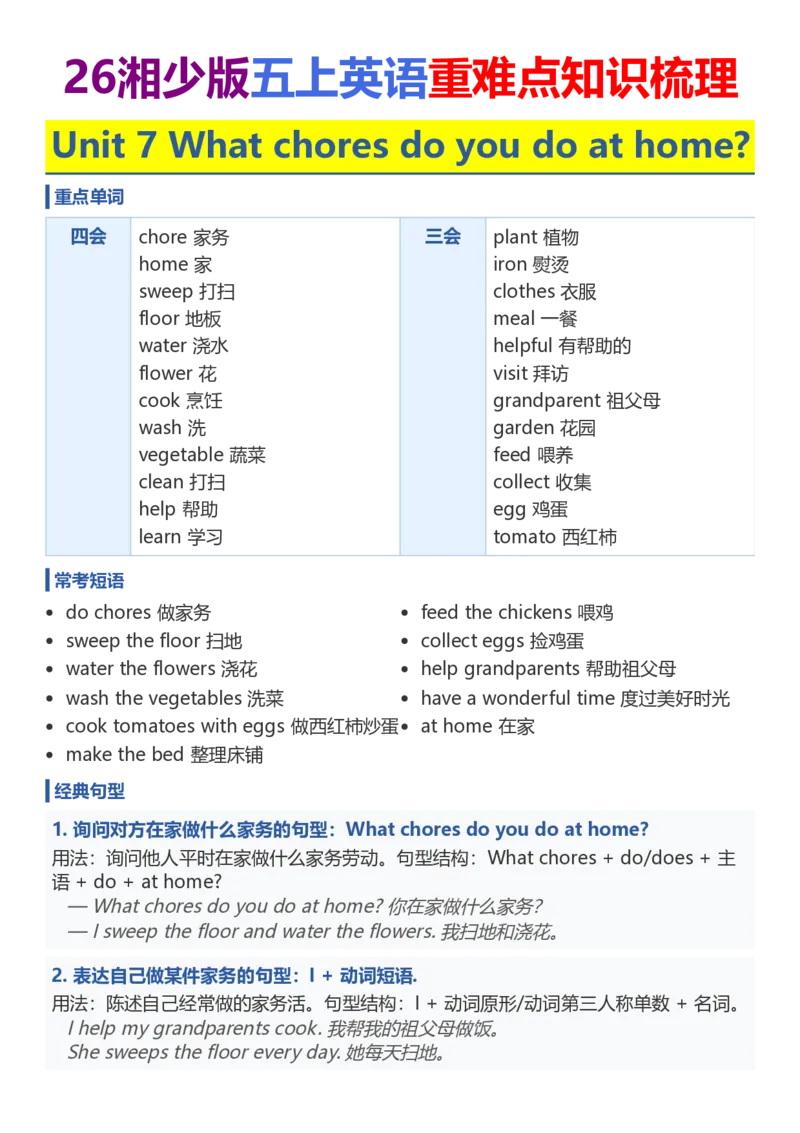
Whose cap is too big? 谁的帽子太大了?26湘少版五上英语重难点知识梳理
Unit 7 What chores do you do at home?
重点单词
四会 chore 家务 三会 plant 植物
home 家 iron 熨烫
sweep 打扫 clothes 衣服
floor 地板 meal 一餐
water 浇水 helpful 有帮助的
flower 花 visit 拜访
cook 烹饪 grandparent 祖父母
wash 洗 garden 花园
vegetable 蔬菜 feed 喂养
clean 打扫 collect 收集
help 帮助 egg 鸡蛋
learn 学习 tomato 西红柿
常考短语
do chores 做家务 feed the chickens 喂鸡
sweep the floor 扫地 collect eggs 捡鸡蛋
water the flowers 浇花 help grandparents 帮助祖父母
wash the vegetables 洗菜 have a wonderful time 度过美好时光
cook tomatoes with eggs 做西红柿炒蛋 at home 在家
make the bed 整理床铺
经典句型
1. 询问对方在家做什么家务的句型:What chores do you do at home?
用法:询问他人平时在家做什么家务劳动。句型结构:What chores + do/does + 主
语 + do + at home?
— What chores do you do at home? 你在家做什么家务?
— I sweep the floor and water the flowers. 我扫地和浇花。
2. 表达自己做某件家务的句型:I + 动词短语.
用法:陈述自己经常做的家务活。句型结构:I + 动词原形/动词第三人称单数 + 名词。
I help my grandparents cook. 我帮我的祖父母做饭。
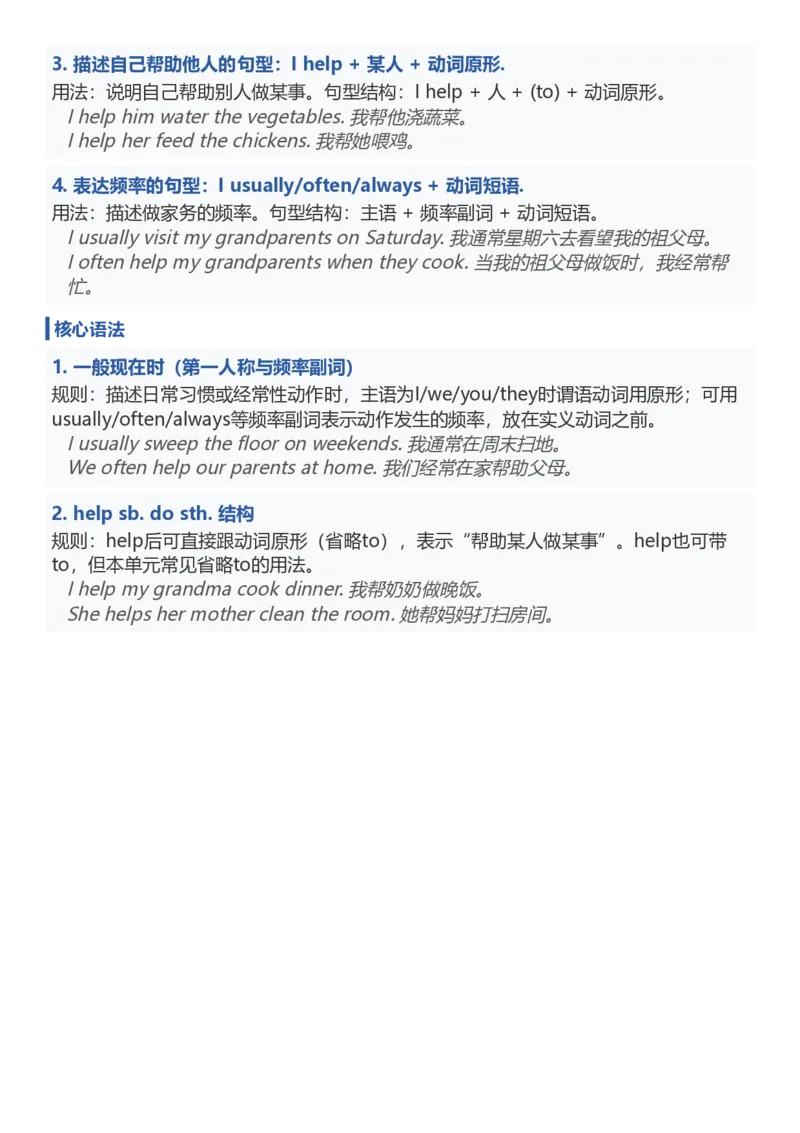
She sweeps the floor every day. 她每天扫地。3. 描述自己帮助他人的句型:I help + 某人 + 动词原形.
用法:说明自己帮助别人做某事。句型结构:I help + 人 + (to) + 动词原形。
I help him water the vegetables. 我帮他浇蔬菜。
I help her feed the chickens. 我帮她喂鸡。
4. 表达频率的句型:I usually/often/always + 动词短语.
用法:描述做家务的频率。句型结构:主语 + 频率副词 + 动词短语。
I usually visit my grandparents on Saturday. 我通常星期六去看望我的祖父母。
I often help my grandparents when they cook. 当我的祖父母做饭时,我经常帮
忙。
核心语法
1. 一般现在时(第一人称与频率副词)
规则:描述日常习惯或经常性动作时,主语为I/we/you/they时谓语动词用原形;可用
usually/often/always等频率副词表示动作发生的频率,放在实义动词之前。
I usually sweep the floor on weekends. 我通常在周末扫地。
We often help our parents at home. 我们经常在家帮助父母。
2. help sb. do sth. 结构
规则:help后可直接跟动词原形(省略to),表示“帮助某人做某事”。help也可带
to,但本单元常见省略to的用法。
I help my grandma cook dinner. 我帮奶奶做晚饭。
She helps her mother clean the room. 她帮妈妈打扫房间。26湘少版五上英语重难点知识梳理
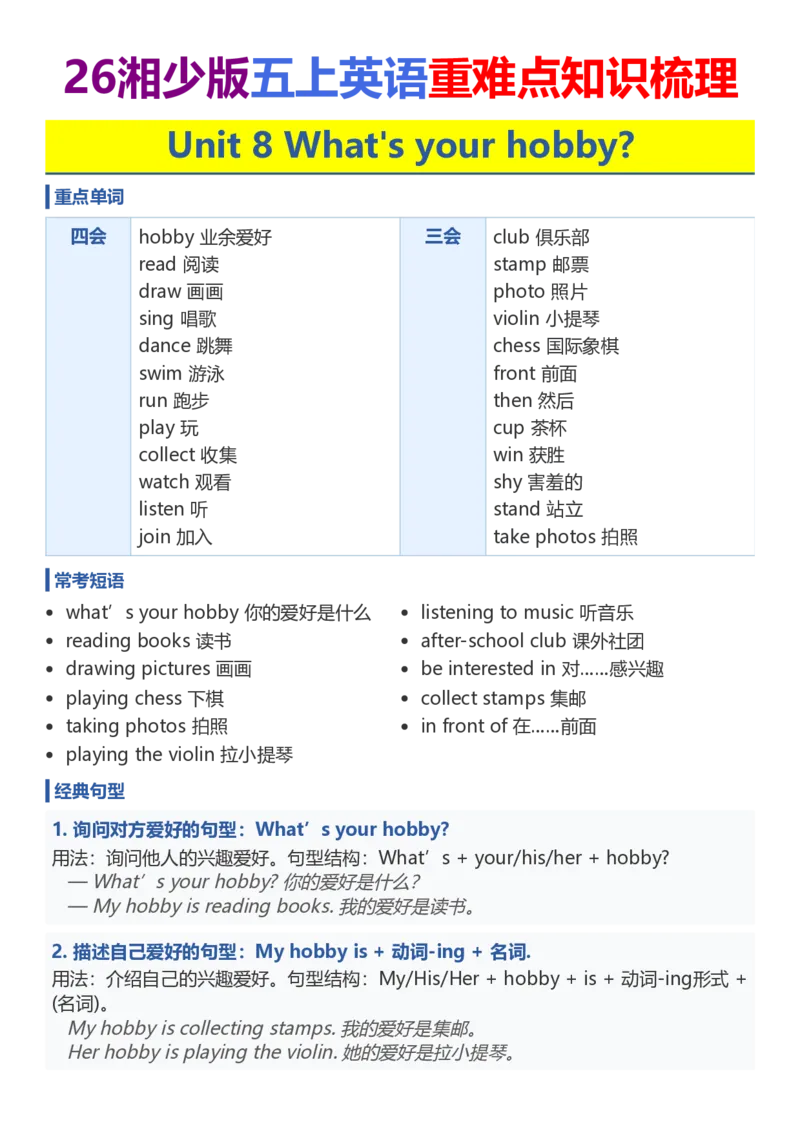
Unit 8 What's your hobby?
重点单词
四会 hobby 业余爱好 三会 club 俱乐部
read 阅读 stamp 邮票
draw 画画 photo 照片
sing 唱歌 violin 小提琴
dance 跳舞 chess 国际象棋
swim 游泳 front 前面
run 跑步 then 然后
play 玩 cup 茶杯
collect 收集 win 获胜
watch 观看 shy 害羞的
listen 听 stand 站立
join 加入 take photos 拍照
常考短语
what’s your hobby 你的爱好是什么 listening to music 听音乐
reading books 读书 after-school club 课外社团
drawing pictures 画画 be interested in 对……感兴趣
playing chess 下棋 collect stamps 集邮
taking photos 拍照 in front of 在……前面
playing the violin 拉小提琴
经典句型
1. 询问对方爱好的句型:What’s your hobby?
用法:询问他人的兴趣爱好。句型结构:What’s + your/his/her + hobby?
— What’s your hobby? 你的爱好是什么?
— My hobby is reading books. 我的爱好是读书。
2. 描述自己爱好的句型:My hobby is + 动词-ing + 名词.
用法:介绍自己的兴趣爱好。句型结构:My/His/Her + hobby + is + 动词-ing形式 +
(名词)。
My hobby is collecting stamps. 我的爱好是集邮。
Her hobby is playing the violin. 她的爱好是拉小提琴。3. 表达某人喜欢做某事的句型:He/She likes + 动词-ing.
用法:描述他人喜欢做的事情。句型结构:主语(三单) + likes + 动词-ing形式。
She likes dancing very much. 她非常喜欢跳舞。
He likes taking photos. 他喜欢拍照。
4. 邀请对方加入社团的句型:Join us! / Let’s join the club.
用法:邀请别人一起参加活动或社团。句型结构:Let’s + 动词原形 + 名词. / 动词原
形 + us!
Let’s join the after-school club. 我们一起加入课外社团吧。
Join us! 加入我们吧!
核心语法
1. 动名词(V-ing)作主语/表语
规则:动名词由“动词+ing”构成,具有名词性质。本单元中,动名词用作表语表示爱
好,如My hobby is reading. 也用作宾语,如like dancing。
My hobby is swimming. 我的爱好是游泳。
I like drawing pictures. 我喜欢画画。
2. 一般现在时第三人称单数(like/likes)
规则:主语为he/she/单个人名时,like变为likes。后接动词时,动词要用动名词形式
(V-ing)。
She likes collecting stamps. 她喜欢集邮。
He likes playing chess. 他喜欢下棋。26湘少版五上英语重难点知识梳理
Unit 9 I'm sorry
重点单词
四会 sorry 抱歉的 三会 loudly 大声地
happy 快乐的 noisy 嘈杂的
sad 伤心的 fun 乐趣
angry 生气的 luck 好运
excited 兴奋的 myself 我自己
proud 自豪的 break 打破
shy 害羞的 bring 带来
worried 担心的 miss 错过
tired 疲倦的 laugh 笑
bored 无聊的 cry 哭
feel 觉得;感到 storybook 故事书
noise 噪声 everyone 每个人
常考短语
feel happy 感到开心 listen to 听
feel sad 感到伤心 have fun 玩得开心
feel angry 感到生气 deal with bad feelings 处理坏情绪
feel excited 感到兴奋 a big storybook 一本大故事书
tell a story 讲故事 enjoy the story 享受故事
经典句型
1. 表达自己感受的句型:I’m + 情绪形容词. / I feel + 情绪形容词.
用法:向他人表达自己的情绪状态。句型结构:I’m / I feel + 形容词
(happy/sad/angry等)。
I’m happy. 我很开心。
I feel sad. 我感到难过。
2. 询问他人感受的句型:How do you feel?
用法:关心询问他人的情绪状况。句型结构:How + do/does + 主语 + feel?
— How do you feel? 你感觉怎么样?
— I feel excited. 我感到兴奋。3. 表达道歉的句型:I’m sorry.
用法:做错事或表达歉意时使用。句型结构:I’m sorry (for/that...)。
I’m sorry. I broke your cup. 对不起,我打破了你的杯子。
4. 描述某事让人产生某种情绪的句型:It makes me + 形容词.
用法:说明某件事导致自己产生某种情绪。句型结构:It/That + makes + me + 形容
词。
That story makes me happy. 那个故事让我开心。
The noise makes me angry. 噪音让我生气。
核心语法
1. 情绪形容词的用法
规则:情绪形容词(happy, sad, angry, excited等)常与be动词或feel连用,表示“某
人感到……”。注意介词搭配,如be angry with sb.。
She is excited about the party. 她对派对感到兴奋。
I feel sorry for him. 我为他感到抱歉。
2. make + 宾语 + 形容词 结构
规则:make在此结构中表示“使……变得”,后接宾语(通常为人)和形容词补足语,
表示“使某人感到……”。
The good news makes me happy. 好消息让我开心。
The loud noise makes him angry. 巨大的噪音让他生气。26湘少版五上英语重难点知识梳理
Unit 10 The Spring Festival
重点单词
四会 festival 节日 三会 Spring Festival 春节
spring 春天 lantern 灯笼
Chinese 中国的;中国人 couplet 对联
year 年 firecracker 鞭炮
new 新的 reunion 团聚
happy 快乐的 eve 前夕
clean 打扫 relative 亲戚
buy 买 red packet 红包
wear 穿 lion dance 舞狮
visit 拜访 delicious 美味的
eat 吃 busy 忙碌的
give 给 together 一起
常考短语
the Spring Festival 春节 put up Spring Festival couplets 贴春联
Chinese New Year 中国新年 light firecrackers 放鞭炮
on the eve of the Spring Festival 在除 watch lion dances 看舞狮
夕夜 get red packets 收红包
have a big meal 吃大餐 wear new clothes 穿新衣服
reunion dinner 团圆饭 wish a happy New Year 祝新年快乐
hang up red lanterns 挂红灯笼
经典句型
1. 介绍春节的句型:The Spring Festival is the biggest festival for Chinese
people.
用法:向他人介绍春节的重要性。句型结构:The Spring Festival + is + 描述 + for +
人。
The Spring Festival is the biggest festival for Chinese people around the world.
春节是全球华人最重要的节日。2. 描述春节前活动的句型:Before the festival, people + 动词短语.
用法:介绍春节前的准备工作。句型结构:Before the festival, people + 动词原形/三
单。
Before the festival, people clean their houses and go shopping. 节前,人们打扫
房子和购物。
3. 描述除夕活动的句型:On the eve of the Spring Festival, we have a big and
delicious meal together.
用法:介绍除夕夜的家庭活动。句型结构:On the eve of... + 主语 + have/eat/do...
On the eve of the Spring Festival, we have a big and delicious meal together.
除夕夜,我们一起吃一顿丰盛美味的晚餐。
4. 描述拜年习俗的句型:People wish each other a happy New Year.
用法:介绍人们互相拜年祝福。句型结构:People wish each other + 祝福语。
People wish each other a happy New Year. 人们互相祝新年快乐。
5. 表达节日快乐的祝福语:Happy New Year!
用法:春节或新年时向他人祝福。句型结构:Happy + 节日名词!
Happy New Year to you! 祝你新年快乐!
Happy Spring Festival! 春节快乐!
核心语法
1. 一般现在时(描述节日习俗)
规则:描述春节等传统节日的常规活动时,使用一般现在时,表示反复发生的习惯性动
作。主语为people/they/复数名词时动词用原形;主语为he/she/it时动词加-s。
People clean their houses before the Spring Festival. 人们在春节前打扫房子。
Children get red packets from their parents. 孩子们从父母那里得到红包。
2. 介词 on, before, during 的时间用法
规则:on 用于具体的某一天或某天的上午/下午/晚上(如on the eve of...);before
表示“在……之前”;during 表示“在……期间”。
On the first day of the New Year, people wear new clothes. 在新年的第一天,人
们穿新衣服。
Before the festival, people are very busy. 节前人们很忙。
During the Spring Festival, families get together. 春节期间,家人团聚。