试卷第1页,共21页
学科网(北京)股份有限公司
暑假收心卷01(新教材鲁教版)
英语
(考试时间:120 分钟
试卷满分:150 分)
注意事项:
1.本试卷分选择题和非选择题两部分。答卷前,考生务必将自己的姓名、准考证号填写在答题卡上。
2.回答选择题时,选出每小题答案后,用2B 铅笔把答题卡上对应题目的答案标号涂黑。如需改动,用橡
皮擦干净后,再选涂其他答案标号。写在本试卷上无效。
3.回答非选择题时,必须用黑色字迹的签字笔或者钢笔将答案写在答题卡相应位置上。写在本试卷上无
效。
4.测试范围:九年级全册Unit 1~Unit4(新教材鲁教版)
5.考试结束后,将本试卷和答题卡一并交回。
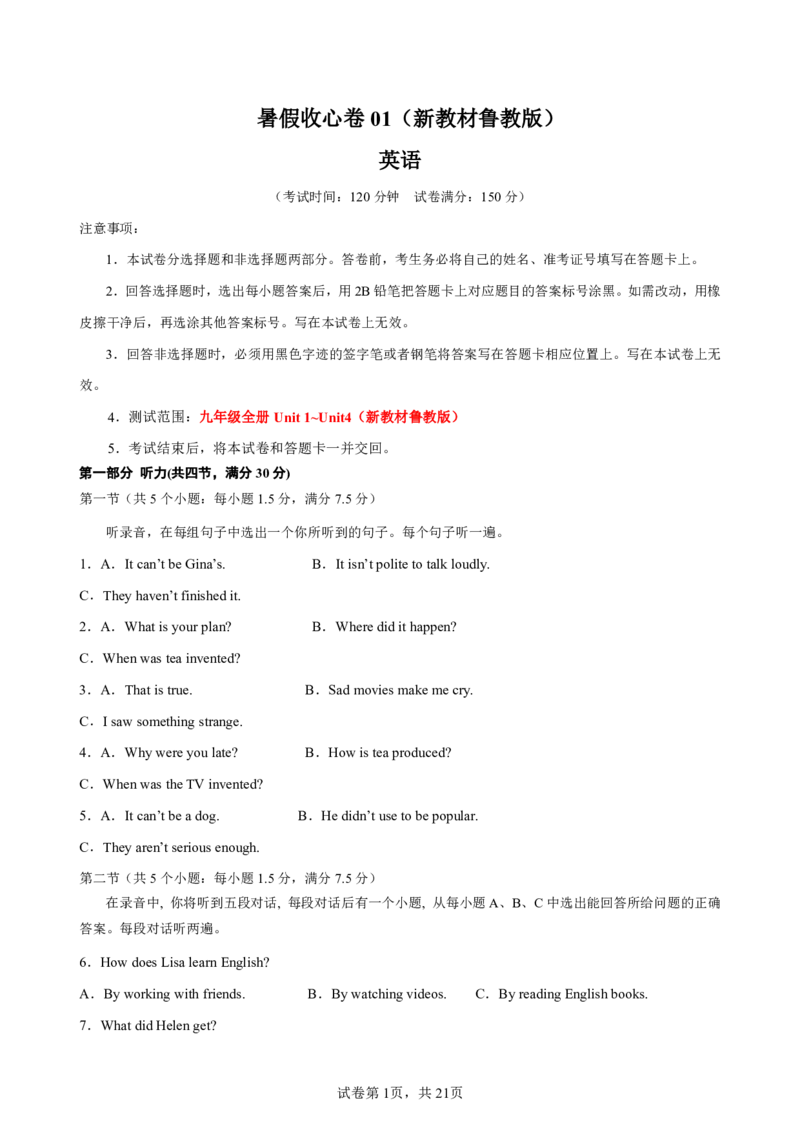
第一部分听力(共四节,满分30 分)
第一节(共5 个小题:每小题1.5 分,满分7.5 分)
听录音,在每组句子中选出一个你所听到的句子。每个句子听一遍。
1.A.It can’t be Gina’s.
B.It isn’t polite to talk loudly.
C.They haven’t finished it.
2.A.What is your plan?
B.Where did it happen?
C.When was tea invented?
3.A.That is true.
B.Sad movies make me cry.
C.I saw something strange.
4.A.Why were you late?
B.How is tea produced?
C.When was the TV invented?
5.A.It can’t be a dog.
B.He didn’t use to be popular.
C.They aren’t serious enough.
第二节(共5 个小题:每小题1.5 分,满分7.5 分)
在录音中, 你将听到五段对话, 每段对话后有一个小题, 从每小题A、B、C 中选出能回答所给问题的正确
答案。每段对话听两遍。
6.How does Lisa learn English?
A.By working with friends.
B.By watching videos.
C.By reading English books.
7.What did Helen get?
试卷第2页,共21页
学科网(北京)股份有限公司
A.A sweater.
B.A T-shirt.
C.A bike.
8.How did John get to school yesterday?
A.On foot.
B.By bike.
C.By bus.
9.Whose schoolbag is this?
A.It’s Tom’s.
B.It’s Mary’s.
C.It’s Tom’s sister’s.
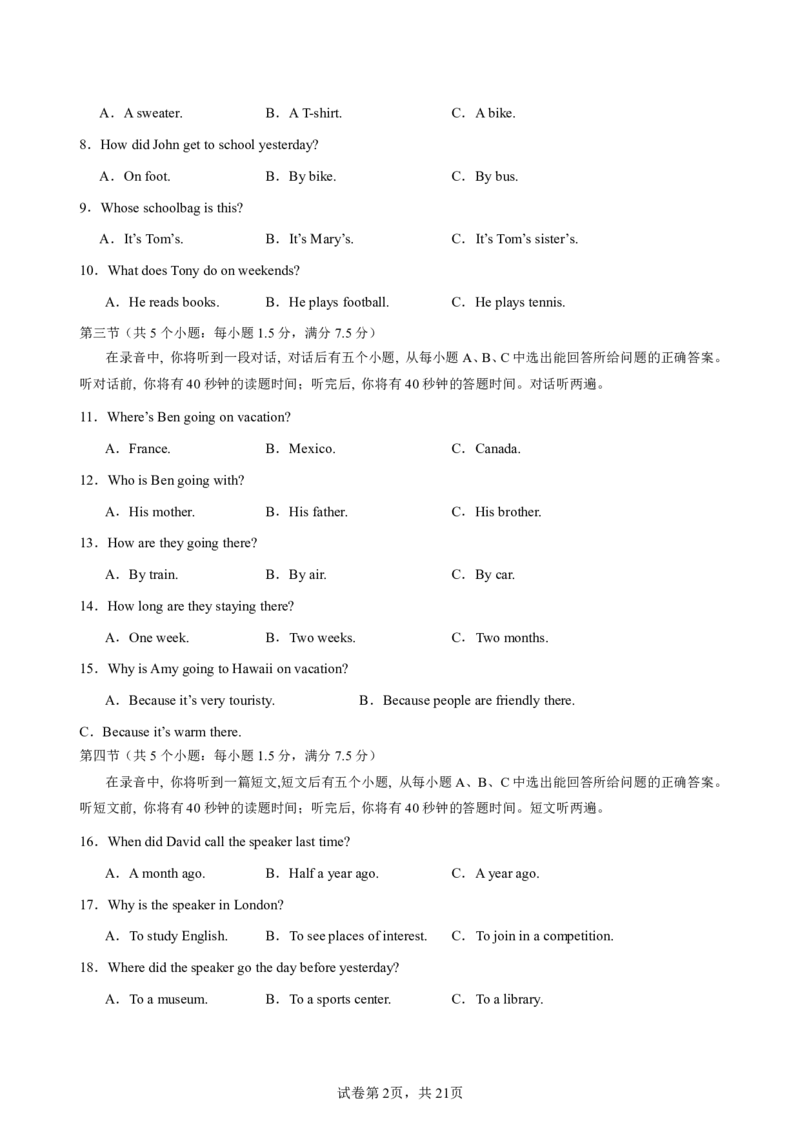
10.What does Tony do on weekends?
A.He reads books.
B.He plays football.
C.He plays tennis.
第三节(共5 个小题:每小题1.5 分,满分7.5 分)
在录音中, 你将听到一段对话, 对话后有五个小题, 从每小题A、B、C 中选出能回答所给问题的正确答案。
听对话前, 你将有40 秒钟的读题时间;听完后, 你将有40 秒钟的答题时间。对话听两遍。
11.Where’s Ben going on vacation?
A.France.
B.Mexico.
C.Canada.
12.Who is Ben going with?
A.His mother.
B.His father.
C.His brother.
13.How are they going there?
A.By train.
B.By air.
C.By car.
14.How long are they staying there?
A.One week.
B.Two weeks.
C.Two months.
15.Why is Amy going to Hawaii on vacation?
A.Because it’s very touristy.
B.Because people are friendly there.
C.Because it’s warm there.
第四节(共5 个小题:每小题1.5 分,满分7.5 分)
在录音中, 你将听到一篇短文,短文后有五个小题, 从每小题A、B、C 中选出能回答所给问题的正确答案。
听短文前, 你将有40 秒钟的读题时间;听完后, 你将有40 秒钟的答题时间。短文听两遍。
16.When did David call the speaker last time?
A.A month ago.
B.Half a year ago.
C.A year ago.
17.Why is the speaker in London?
A.To study English.
B.To see places of interest.
C.To join in a competition.
18.Where did the speaker go the day before yesterday?
A.To a museum.
B.To a sports center.
C.To a library.
试卷第3页,共21页
学科网(北京)股份有限公司
19.How much were the three T-shirts?
A.£10.
B.£20.
C.£30.
20.Which book will the speaker read?
A.Robinson Crusoe.
B.Alice in Wonderland.
C.Wild Country.
【听力答案】
1.B
2.C
3.B
4.C
5.A
6.C
7.A
8.C
9.C
10.B
11.A
12.C
13.A
14.B
15.C
16.B
17.A
18.A
19.B
20.C
第二部分阅读(共两节,满分50 分)
第一节阅读理解(共20 个小题:每小题2 分,满分40 分)
阅读下列短文,从每题所给的A、B、C、D 四个选项中选出最佳选项。
A
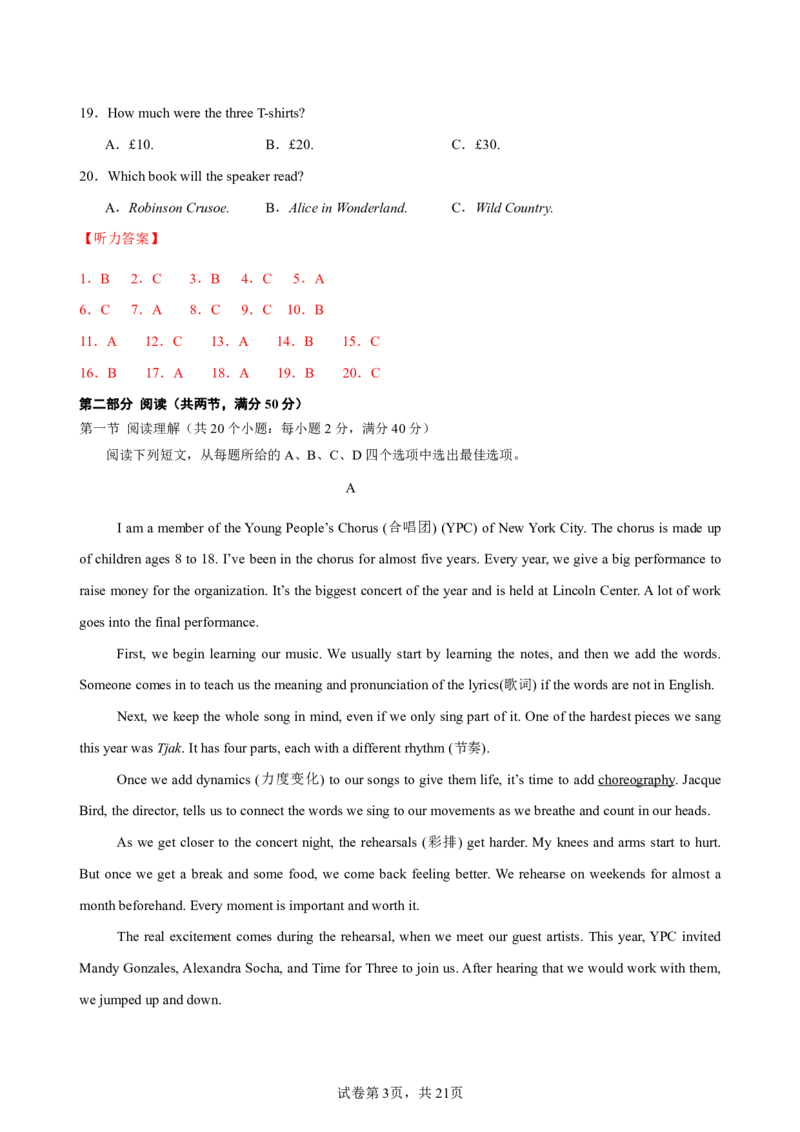
I am a member of the Young People’s Chorus (合唱团) (YPC) of New York City. The chorus is made up
of children ages 8 to 18. I’ve been in the chorus for almost five years. Every year, we give a big performance to
raise money for the organization. It’s the biggest concert of the year and is held at Lincoln Center. A lot of work
goes into the final performance.
First, we begin learning our music. We usually start by learning the notes, and then we add the words.
Someone comes in to teach us the meaning and pronunciation of the lyrics(歌词) if the words are not in English.
Next, we keep the whole song in mind, even if we only sing part of it. One of the hardest pieces we sang
this year was Tjak. It has four parts, each with a different rhythm (节奏).
Once we add dynamics (力度变化) to our songs to give them life, it’s time to add choreography. Jacque
Bird, the director, tells us to connect the words we sing to our movements as we breathe and count in our heads.
As we get closer to the concert night, the rehearsals (彩排) get harder. My knees and arms start to hurt.
But once we get a break and some food, we come back feeling better. We rehearse on weekends for almost a
month beforehand. Every moment is important and worth it.
The real excitement comes during the rehearsal, when we meet our guest artists. This year, YPC invited
Mandy Gonzales, Alexandra Socha, and Time for Three to join us. After hearing that we would work with them,
we jumped up and down.
试卷第4页,共21页
学科网(北京)股份有限公司
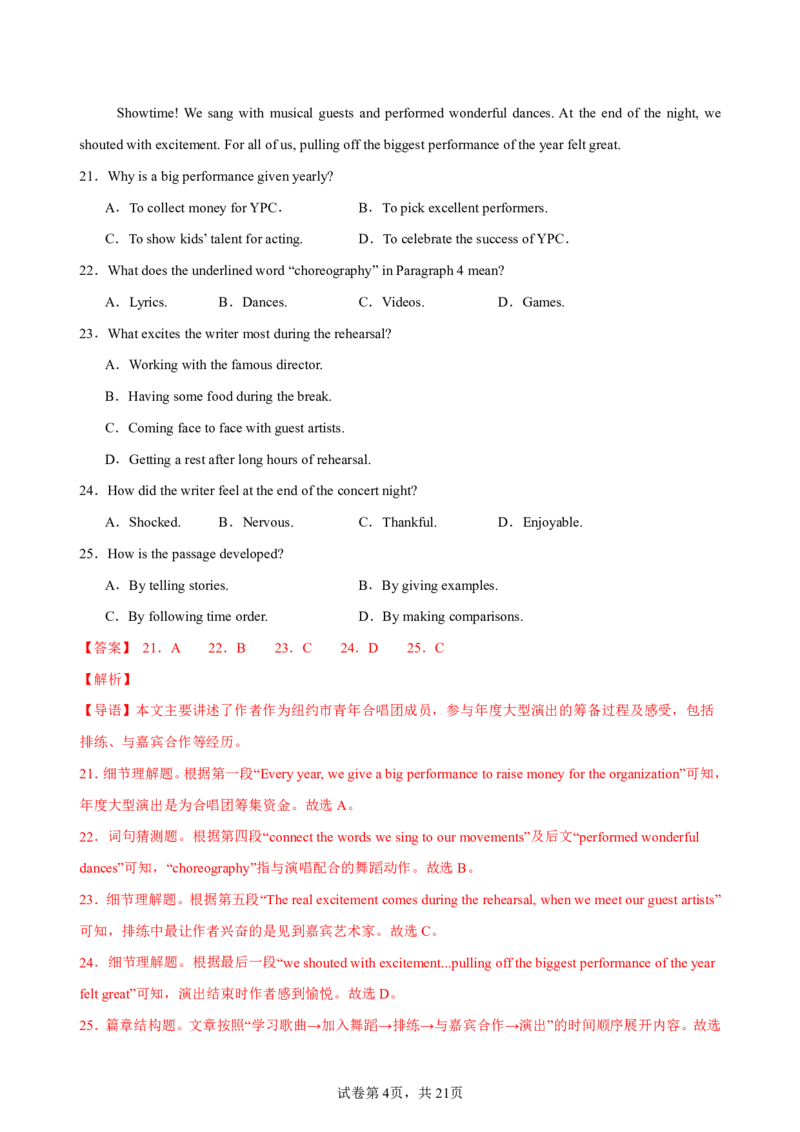
Showtime! We sang with musical guests and performed wonderful dances. At the end of the night, we
shouted with excitement. For all of us, pulling off the biggest performance of the year felt great.
21.Why is a big performance given yearly?
A.To collect money for YPC.
B.To pick excellent performers.
C.To show kids’ talent for acting.
D.To celebrate the success of YPC.
22.What does the underlined word “choreography” in Paragraph 4 mean?
A.Lyrics.
B.Dances.
C.Videos.
D.Games.
23.What excites the writer most during the rehearsal?
A.Working with the famous director.
B.Having some food during the break.
C.Coming face to face with guest artists.
D.Getting a rest after long hours of rehearsal.
24.How did the writer feel at the end of the concert night?
A.Shocked.
B.Nervous.
C.Thankful.
D.Enjoyable.
25.How is the passage developed?
A.By telling stories.
B.By giving examples.
C.By following time order.
D.By making comparisons.
【答案】21.A
22.B
23.C
24.D
25.C
【解析】
【导语】本文主要讲述了作者作为纽约市青年合唱团成员,参与年度大型演出的筹备过程及感受,包括
排练、与嘉宾合作等经历。
21.细节理解题。根据第一段“Every year, we give a big performance to raise money for the organization”可知,
年度大型演出是为合唱团筹集资金。故选A。
22.词句猜测题。根据第四段“connect the words we sing to our movements”及后文“performed wonderful
dances”可知,“choreography”指与演唱配合的舞蹈动作。故选B。
23.细节理解题。根据第五段“The real excitement comes during the rehearsal, when we meet our guest artists”
可知,排练中最让作者兴奋的是见到嘉宾艺术家。故选C。
24.细节理解题。根据最后一段“we shouted with excitement...pulling off the biggest performance of the year
felt great”可知,演出结束时作者感到愉悦。故选D。
25.篇章结构题。文章按照“学习歌曲→加入舞蹈→排练→与嘉宾合作→演出”的时间顺序展开内容。故选
试卷第5页,共21页
学科网(北京)股份有限公司
C。
B
Deng Jiaxian was born in Huaining, Anhui Province on June 25, 1924. He entered the Physics Department
of Southwest Associated University in 1941. After graduating in 1945, he taught in middle schools and later in
the Physics Department of Peking University. In 1948, he was admitted to (被获准进入) the Graduate School of
Purdue University in the United States and received a PhD in physics two years later.
Nine days after he got his doctoral degree, he stepped onto the ship back to China and started his creative
nuclear theoretical (理论的) research. Deng Jiaxian set up classes, giving lessons himself and organized people
to translate and study related foreign language materials. At the same time, he never gave up on his ideas
regarding the main direction of atomic bomb (原子弹) development. Following the successful test of the atomic
bomb, Deng and his team joined the research group led by Yu Min in 1965 and immediately started designing the
hydrogen bomb (氢弹).
Within no more than one year, the Deng-Yu Project was submitted (提交), which greatly accelerated
China’s hydrogen bomb development and realization. In nuclear experiments, Deng always stood in the front line
and never made his colleagues do the dangerous work for him. Unfortunately, he got radiation (辐射) sickness in
the early 1980s. However, although he was sick, he still continued to work.
Deng Jiaxian passed away on July 19, 1989. He is regarded as the “Founding Father of China’s A-Bomb
and H-Bomb.”
26.When did Deng Jiaxian receive a PhD in physics?
A.In 1941.
B.In 1945.
C.In 1950.
D.In 1948.
27.What did Deng Jiaxian do after he got his doctoral degree?
A.He went to Graduate School of Purdue University in the United States .
B.He gave up on his ideas regarding the main direction of atomic bomb development.
C.He stepped onto the ship back to China and started his creative nuclear theoretical research.
D.He taught in middle schools and later in the Physics Department of Peking University.
28.How do you like Deng Jiaxian?
A.He is brave.
B.He never gives up.
C.He is devoted to his country.
D.All of the above.
29.Which of the following is right?
试卷第6页,共21页
学科网(北京)股份有限公司
A.Deng Jiaxian was born in Shandong .
B.Deng Jiaxian was “the Father of the Play.”
C.Deng Jiaxian was admitted to the Graduate School of Purdue University in 1945.
D.Deng Jiaxian died on July 19, 1989.
30.Which is the structure of the passage? (①=Paragraph 1...)
A.
B.
C.
D.
【答案】26.C
27.C
28.D
29.D
30.C
【解析】
【导语】本文介绍了“两弹元勋”邓稼先的生平:从出生、求学经历,到回国投身核物理研究,最终为中国
原子弹、氢弹事业奉献一生的事迹。
26.细节理解题。根据“In 1948, he was admitted to (被获准进入) the Graduate School of Purdue University in
the United States and received a PhD in physics two years later.”可知,1948 年入学,两年后(1950 年)获得
博士学位。故选C。
27.细节理解题。根据“Nine days after he got his doctoral degree, he stepped onto the ship back to China and
started his creative nuclear theoretical research”可知,他获得博士学位后回国开展核理论研究。故选C。
28.推理判断题。文中提到他“回国奉献(爱国)”“坚持核研究方向(不放弃)”“核试验冲在一线(勇敢)”,
因此A、B、C 描述均符合,选“All of the above”。故选D。
29.细节理解题。根据“Deng Jiaxian passed away on July 19, 1989”可知,邓稼先于1989 年7 月19 日去世。
故选D。
30.篇章结构题。文章第①段总述邓稼先的重要性;第②段讲生平与求学;第③④段讲回国后的核研究
贡献;⑤段总结他的地位与离世。结构为“总—分—总”,对应选项C。故选C。
C
“Singing is the start of music. By singing, we make ourselves physically part of music and music part of us,”
writes composer Andrew Ford, host of The Music Show.
Songs have a powerful influence on us. Has anyone discovered the joy of singing in a choir(合唱团)? Mary
works as a busy teacher, and choir practice nights are simply her“sanity”.“There are nights when even I don't
试卷第7页,共21页
学科网(北京)股份有限公司
feel like going to choir but by the time we've finished, I'm glad I came,” said Mary.
Research says choiring is really good for you. By watching the health signs of members of a choir,Bjorn Vickoff
at Sweden University discovered the singers' hearts started to beat in step with their breathing. There seemed to
be a wave of air moving through the group, making them feel connected as one. Research has shown that
choiring has comforting influences similar to those that come from breathing exercises in yoga.
Singing also produces hormones and other happy chemicals, fighting against depression and loneliness. Singers
have been found to have lower levels of stress after choiring. And a later study also found that singing reduces
anxiety and that group singing can be especially good for the health of older adults.
At the New Orleans Jazz and Heritage Festival, choir after choir was put on stage by singers with no big names.
But this is real music to Tony Backhouse's ears. The choirmaster spent thirty years in Australia founding and
working with choral groups.“If I were asked to redesign the Australian educational system,I would start by
strongly suggesting that group singing become a central part of the daily activity. I believe it builds character and,
more than anything else, encourage a taste for cooperation with others,” said Tony.For him, the meaning of group
singing is“cooperation, rather than competition. Singing teaches us to listen, which is a great gift. In my
community choir, it's about creating something amazing together, and we really aim to make every rehearsal a
thing of joy and beauty.”
31. What does the underlined word“sanity”probably mean in Paragraph 1?
A. Peace.
B. Plan.
C. Duty.
D. Sadness.
32. What did Bjorn Vickoff find in his research on choir members?
A. Singers' practice makes hearts beat faster.
B. Singers' hearts beat in step with their breathing.
C. The singers control their breathing speed.
D. They have different heart rates.
33. Which of the following can we learn from the text?
A. It makes more chemicals.
B. It reduces the chemicals in our body.
C. It can help people feel less stressed.
D. It makes older adults happy forever.
34. What can we know from Tony Backhouse's words about group singing?
A. It is important for cooperation.
试卷第8页,共21页
学科网(北京)股份有限公司
B. It has become a part of education.
C. It is good for students' competition.
D. It is more popular with famous singers.
35. What is the main idea of the passage?
A. Why Andrew Ford loves singing.
B. How to make choir more joyful.
C. Different opinions about choirs.
D. Great advantages of group singing.
【答案】31.A
32.B
33.C
34.A
35.D
【解析】
【导语】本文讲述集体合唱可舒缓身心、排解压力,还能培养人的协作能力,拥有身心
与社交多重益处。
31. 句意:Mary 工作十分忙碌,合唱能抚平她的烦躁,带来内心安宁,sanity 此处等同于
peace(平静)。故为A。
32. 句意:文中写明Bjorn Vickoff 发现合唱者心跳与呼吸同步,对应选项B 原文原句。故
为B。
33. 句意:文章说明合唱能降低人体压力值,缓解焦虑,帮助人们减轻压力,C 表述符合
原文。故为C。
34. 句意:Tony 称合唱的核心是合作而非竞争,对培养协作能力十分重要,对应A 选项。
故为A。
35. 句意:全文从身心、社交、品格多方面讲述集体合唱的各类好处,主旨是合唱的诸多
益处。故为D。
D
In a lively martial arts (武术) club in Akpro—Misserete, Benin (贝宁), the sound of feet hitting the ground
and cries of “Hay-Hah!” fill the air. Damien Degbo, 53, teaches his students kung fu and tai chi there. For him,
Chinese martial arts are more than just exercise. They’re a way of life and a bridge between Benin and China.
At the age of 13, Degbo watched Chinese martial arts movies in Benin’s capital. He loved how these
试卷第9页,共21页
学科网(北京)股份有限公司
actors fought with beauty and power. That’s when his love of kung fu began.
Degbo joined a private kung fu club and later learnt Chinese at a culture center. In 2010, he started his
own club, Super Shaolin of Benin. In 2014, he got a chance to train at China’s Shaolin Temple. The training was
hard, but it taught him a lot about Chinese culture. He learnt how to practice calligraphy, tea preparation and
traditional Chinese medicine.
Now, Degbo’s club has more than 350 students. He teaches not only Chinese martial arts but also Chinese
culture. Chefif Deen, a student of the kung fu master, says kung fu has changed his life, helping him become
stronger and more self-controlled.
Degbo thinks of himself as someone who spreads Chinese culture. He wants to share with young people
Chinese good qualities ( 品质) like self-control and respect. As China and Benin get closer, more and more
people like Degbo will help build a stronger friendship between the two countries through kung fu.
36.What does Damien Degbo teach in his club?
A.Only kung fu.
B.Kung fu and tai chi.
C.Only Chinese culture.
D.Calligraphy and tea preparation.
37.When did Degbo start to love kung fu?
A.At the age of 53.
B.When he joined a private club.
C.After he went to China.
D.When he watched Chinese martial arts movies at 13.
38.What did Degbo learn in China's Shaolin Temple?
A.How to run a club.
B.Chinese culture and martial arts.
C.How to make movies.
D.Only traditional Chinese medicine.
39.What attitude (态度) does Chefif Deen have towards kung fu?
A.Thankful.
B.Unhappy.
C.Uninterested.
D.Angry.
40.What is the best title for this passage?
A.The History of Kung Fu.
B.The Life of a Shaolin Monk.
C.How to Learn Kung Fu and Tai Chi.
D.A Beninese Man Brings Chinese Culture to Benin.
【答案】36.B
37.D
38.B
39.A
40.D
【解析】
【导语】本文是一篇记叙文。文章主要讲述了一位来自贝宁(非洲国家)的武术爱好者Damien Degbo 如
试卷第10页,共21页
学科网(北京)股份有限公司
何热爱并学习中国武术,之后在自己的国家开设俱乐部传授武术和中国文化,从而促进两国文化交流的
故事。
36.细节理解题。根据“Damien Degbo, 53, teaches his students kung fu and tai chi there.”可知,他在俱乐部
里教授功夫和太极。故选B。
37.细节理解题。根据“At the age of 13, Degbo watched Chinese martial arts movies in Benin’s capital. He loved
how these actors fought with beauty and power. That’s when his love of kung fu began.”可知,他是在13 岁看电
影时爱上功夫的。故选D。
38.细节理解题。根据“In 2014, he got a chance to train at China’s Shaolin Temple. The training was hard, but it
taught him a lot about Chinese culture. He learnt how to practice calligraphy, tea preparation and traditional
Chinese medicine.”可知,他在少林寺不仅训练武术,还学习了多种中国文化。故选B。
39.推理判断题。根据“Chefif Deen, a student of the kung fu master, says kung fu has changed his life, helping
him become stronger and more self-controlled.”可以推断,功夫给他带来了积极的变化,因此他对功夫的态
度应该是感谢的、感激的。故选A。
40.最佳标题题。文章通篇围绕Damien Degbo 如何学习中国武术和文化,并回到祖国贝宁开设俱乐部进
行教学和传播,从而在两国间搭建桥梁这一核心事件展开。D 项“一位贝宁人将中国文化带到贝宁”准确概
括了文章主旨。故选D。
第二节阅读七选五(共5 个小题:每小题2 分,满分10 分)
阅读下面短文, 从短文后的选项中选出能填入空白处的最佳选项。选项中有两项为多余选项。
No matter whether it is during the holidays or at any time of the year, as long as we choose to
move, every step we take can bring good changes to our body and mind. So, choose the way
that fits you best! Move your way!
Have you ever thought about what really makes people achieve great things? Take Newton as
an example. He didn’t just care about the apple falling, he kept asking why it fell straight down.
41._________
After watching how people act in different areas for many years, I have realized something very
important. Two qualities, curiosity(好奇心) and dissatisfaction, set great achievers apart from
those who have no special performance. 42._________ you need both to be great.
Luckily, we don’t need to learn these qualities. We are born with them, and we just need to
bring them back. A great man from ancient China once said, “The great man is he who does not
试卷第11页,共21页
学科网(北京)股份有限公司
lose his child’s heart.” 43.________ We stop asking questions. We stop going against the usual
ways. We just follow what others do. So we must push ourselves to wake them up and keep
them active.
Then, how can you start? 44.________ A friend of mine couldn’t cook well. She was curious
about how to improve, so she started with simple dishes. Now she cooks for her family with
joy.
Another way to start is to answer the excuses you make for yourself. Do you think you have no
special ability or time? Many people without special abilities or with little time still manage to
get things done. Harriet Stowe, a mother of six, wrote parts of Uncle Tom’s Cabin while she
was cooking. 45.________ Remember that Thomas Costain published his first novel at 57, and
Grandma Moses showed her first pictures at 78.
No matter how you start, always remember that there is no better time to start than right now,
because you will never be more full of life than you are at this moment.
A. Do you ever worry that your age might hold you back?
B. You should always wait until you feel fully ready to begin.
C. Being naturally talented is the most important thing for success.
D. However, most of us do lose that childlike habit of asking “why”.
E. Pick something in a small way so that you won’t get disappointed.
F. I have never known an excellent man who didn’t have either of them.
G. Just like him, all the great people in history were curious and always asked in dissatisfaction.
【答案】41.G
42.F
43.D
44.E
45.A
【解析】
【导语】本文指出成功靠好奇心与求变之心,给出从小事起步、放下年龄顾虑等即刻行
动的可行方法。
41. 句意:前文举牛顿好奇苹果下落的例子,G 承接牛顿,说伟人都充满好奇、常怀不满。
故为G。
试卷第12页,共21页
学科网(北京)股份有限公司
42. 句意:前文说成功关键是好奇心与不满足,F 表示优秀的人两者必占其一,衔接通顺。
故为F。
43. 句意:后文写我们不再提问、盲从他人,D 转折说明我们丢掉了孩童爱问为什么的天
性。故为D。
44. 句意:本段讲开启行动的办法,后文从简单做菜入手,E 建议从小事做起避免失望。
故为E。
45. 句意:后文举高龄创作者事例,A 提出疑问:你是否担心年龄阻碍自己?贴合语境。
故为A。
第三部分语言运用(共三节,满分35 分)
第一节补全对话(共5 个小题:每小题1 分,满分5 分)
阅读下面对话,从每题所给的A、B、C、D 四个选项中, 选出一个最佳答案完成对话。
Li Jian: Hi, Uncle Yu. I saw you on the livestream (直播) yesterday! You were teaching dough
figurine (面塑) making. How did you feel?
Mr. Yu: 46 _________ But it was a wonderful try!
Li Jian: You were great! Over 20,000 people saw it and some even bought your artworks. 47
_________
Mr. Yu: About 300 pieces. They were sold out in just one hour.
Li Jian: Wow! That's fantastic. 48 _________
Mr. Yu: Yes, quite a few! And many people said they would come to our village to learn and
relax next holiday.
Li Jian: That's wonderful. You're not just shaping dough — you're keeping our culture alive.
Mr. Yu: I'm glad young people still care. I will have another livestream next Saturday. 49
__________
Li Jian: Of course! What can I do?
Mr. Yu: 50 __________
Li Jian: Cool! And I can also share short videos on TikTok.
试卷第13页,共21页
学科网(北京)股份有限公司
46.A. I got up very late.
B. It was a quiet village.
C. I was a bit nervous.
D. It was a great success.
47.A. How many did you sell?
B. Which piece was the best?
C. What tools did you need?
D. Who taught you to make them?
48.A. Have you finished all?
B. Did you get more fans?
C. Are you free tomorrow?
D. Should you arrive earlier?
49.A. What do you think of it?
B. Would you like to come?
C. Why not do it by yourself?
D. Can you understand me?
50.A. It takes time to learn.
B. I want to learn different cultures.
C. You know a lot about this.
D. You can answer online questions.
【答案】46.C
47.A
48.B
49.B
50.D
【解析】李健和于叔叔聊面塑直播,询问直播感受、销量与粉丝情况,于叔叔邀约李健
参与下次直播并安排线上答疑工作。
46.句意:后文but 表转折,说明直播过程紧张但体验很好,C 符合语境。故为C。
47.句意:答句回答售出300 件作品,问句询问卖出数量,选A。故为A。
48.句意:答句说不少人想来村里学习,对应询问是否涨粉,选B。故为B。
49.句意:答句Of course 答应邀约,问句是邀请对方参与直播,选B。故为B。
50.句意:对方询问能帮忙做什么,此处给出线上答疑的工作,选D。故为D。
第二节完形填空(共15 个小题:每小题1 分,满分15 分)
阅读下面短文, 从每题所给的A、B、C、D 四个选项中选出可以填入空白处的最佳选项。
Many people consider Albert Einstein a genius (天才). This story about him shows that he also had a great
sense of
51
.
Einstein often received invitations to explain his ideas at
52
universities. On these trips, his
driver Hans often said to him, “It’s a pleasure to
53
a genius like you, Dr Einstein.”
One evening, on their way to a university, Einstein said, “I’ m so tired. I wish I could avoid
54
试卷第14页,共21页
学科网(北京)股份有限公司
my speech tonight, Hans, but I don’t want to
55
my listeners down.”
“Mr. Einstein,” said Hans, his eyes shining with an idea. “I can give the speech for you
56
you
can trust me. I’ve listened to your speech so many times that I’ve
57
it by heart. No one knows
58
at this university, so they won’t find out. I promise I’ll do my best.”
Einstein agreed with Hans though he was a little worried. So, they
59
places. At the university,
Hans was led to the front of the hall. Einstein took a seat, listened to Hans give his speech
60
, and
joined in the applause (掌声) at the end.
However, before Hans left, a man shouted, “I’d like to ask you a question.” He then asked a question so
61
that Hans had no idea what he was talking about.
Einstein turned pale. “Oh no!” he thought. “Now we’re
62
trouble.” But Hans just laughed
and said, “That’s such an easy question that even my
63
can answer it. Hans, please...”
Einstein
64
and answered the question perfectly.
They left the university, with Einstein driving. A little later, Hans
65
to drive. “No,” replied
Einstein humorously. “It’s a pleasure to drive a genius like you, Hans.”
51.A.direction
B.humor
C.duty
D.pride
52.A.similar
B.few
C.same
D.different
53.A.take
B.help
C.drive
D.play
54.A.giving
B.talking
C.teaching
D.planning
55.A.take
B.let
C.put
D.look
56.A.because
B.unless
C.if
D.when
57.A.read
B.written
C.learned
D.taught
58.A.me
B.you
C.him
D.them
59.A.changed
B.shared
C.left
D.cleaned
60.A.carefully
B.sadly
C.worriedly
D.unhappily
61.A.interesting
B.boring
C.easy
D.difficult
62.A.of
B.under
C.in
D.on
63.A.teacher
B.student
C.friend
D.driver
64.A.stood up
B.sat down
C.pointed out
D.came out
65.A.refused
B.decided
C.offered
D.Wanted
【答案】51.B
52.D
53.C
54.A
55.B
56.C
57.C
58.B
试卷第15页,共21页
学科网(北京)股份有限公司
59.A
60.A
61.D
62.C
63.D
64.A
65.C
【解析】
【导语】本文主要讲述在一次演讲中,爱因斯坦的司机替他演讲,他们交换了身份,演
讲很成功。但是最后一个男人问了一个问题,司机答不出来,结果他机智地说:“这么简
单的问题就让我的司机来回答你吧”,最后完美地解决了这个问题。
51.句意:关于他的这个故事表明,他也极具幽默感。
direction 方向;humor 幽默;duty 责任;pride 骄傲。根据“replied Einstein humorously”可
知,爱因斯坦具有幽默感,故选B。
52.句意:爱因斯坦经常收到不同大学的邀请,去解释他的想法。
similar 相似的;few 很少;same 相同的;different 不同的。此空后接复数名词universities,
结合下文的描述可知,他经常被邀请去不同的大学进行演讲,故选D。
53.句意:能为您这样的天才司机驾车,我感到非常荣幸,爱因斯坦博士。
take 带走;help 帮助;drive 驾驶;play 玩耍。根据“On these trips, his driver Hans ”可知,
司机表达很荣幸为他开车,故选C。
54.句意:我真希望今晚能不用来做这个演讲。
giving 给;talking 谈话;teaching 教学;planning 计划。give a speech“演讲”,故选A。
55.句意:但我不想让我的听众失望。
take 带走;let 让;put 放;look 看。let…down“让……失望”,固定短语,故选B。
56.句意:如果你信任我,我可以代你演讲。
because 因为;unless 除非;if 如果;when 当……时。“you can trust me”是“I can give the speech
for you”的条件,用if 引导条件状语从句,故选C。
57.句意:我已经听了你的演讲很多次了,以至于已经把它背得滚瓜烂熟了。
read 阅读;written 写作;learned 背熟;taught 教授。根据“ I’ve listened to your speech so many
times”可知,已经听了太多次的演讲,所以背得滚瓜烂熟了,故选C。
58.句意:这所大学没人认识你。
试卷第16页,共21页
学科网(北京)股份有限公司
me 我;you 你;him 他;them 他们。这句话是对爱因斯坦说的,所以此处指“你”,故选B。
59.句意:所以,他们交换了位置。
changed 改变;shared 分享;left 离开;cleaned 清洁。根据“At the university, Hans was led to
the front of the hall. Einstein took a seat, listened to Hans give his speech ”可知,爱因斯坦同
意了司机的建议,所以此处指他们交换了位置,故选A。
60.句意:爱因斯坦坐了下来,认真聆听了汉斯的演讲。
carefully 认真地;sadly 悲伤地;worriedly 担忧地;unhappily 不开心地。根据“listened to Hans
give his speech ”及“and joined in the applause (掌声) at the end”可知,认真地听汉斯演讲,
故选A。
61.句意:随后他提出了一个极其难懂的问题,以至于汉斯完全不明白他在说什么。
interesting 有趣的;boring 无聊的;easy 简单的;difficult 困难的。根据“Hans had no idea what
he was talking about”可知,汉斯没有听懂这个人的问题,由此可知,这个问题对他来说是
难的,故选D。
62.句意:现在我们有麻烦了
of……的;under 在……之下;in 在……里面;on 在……上面。be in trouble“处于困难之
中”,故选C。
63.句意:这个问题如此简单,就连我的司机都能回答出来。
teacher 老师;student 学生;friend 朋友;driver 司机。根据“On these trips, his driver Hans”
可知,让司机来回答这个“简单”的问题,故选D。
64.句意:爱因斯坦站起来完美回答问题。
stood up 站起来;sat down 坐下;pointed out 指出;came out 出来。根据“Einstein took a seat”
可知,爱因斯坦之前是坐着的,现在站起来回答问题,故选A。
65.句意:过了一会儿,汉斯主动提出开车。
refused 拒绝;decided 决定;offered 主动提出;wanted 想要。根据“Hans … to drive”及“‘No,’
replied Einstein humorously.”可知,汉斯主动提出开车,被爱因斯坦拒绝了,故选C。
第三节阅读填空(共10 个小题:每小题1.5 分,满分15 分)
试卷第17页,共21页
学科网(北京)股份有限公司
阅读下面短文, 在空白处填入1 个适当的单词或括号内单词的正确形式。
Oracle bone script (甲骨文) is the oldest form of Chinese writing. AI is the latest technology we use
today. Now in Anyang, Henan Province, a team of engineers are using AI 66. ______ (research) this
ancient writing.
Li Bang, 33, is 67. ______ AI scientist who works at Anyang Normal University. He and his team
built a special online “library”. They put pictures of oracle bones and lots of ancient books into this
library. Then they 68. ______ (write) programs to help AI learn to study the shapes of characters and
find information about 69. ______ (they).
When people hope to deeply study an oracle bone character, it 70. ______ (show) to the computer
first so that AI can start its fast analysis. AI 71. ______ (find) similar characters and books that are
related to it in a few seconds. In the past, this common work took them a few hours 72. ______ even
a few days.
“AI is of great 73. ______ (important) for people who study oracle bones, but it can’t take their
place completely.” Li said. AI has a strong memory, but it isn’t good 74. ______ thinking things
through on its own. AI has helped a lot with searching for information about the characters. However,
it hardly tells us what the ancient characters 75. ______ (true) mean. So human thinking and
understanding are always necessary.
【答案】66.to research,67.an,68.wrote,69.them,70.is shown,71.will find,72.or,73.importance,
74.at,75.truly
【解析】
【导语】安阳科研团队借助AI 研究甲骨文,AI 检索效率大幅提升,但无法自主思辨,解读古
文字仍离不开人类。
句意:在河南安阳,一组工程师正利用人工智能研究这种古老文字。固定搭配use sth. to do sth.,
不定式作目的状语。
67.句意:33 岁的李邦是安阳师范学院的一名人工智能研究员。AI 发音以元音音素开头,单数
可数名词前用不定冠词an。
68.句意:随后他们编写程序,帮助人工智能学习字形并查找相关资料。前文built、put 均为过
试卷第18页,共21页
学科网(北京)股份有限公司
去式,并列谓语统一使用过去式。
69.句意:查找和这些文字相关的资料。介词后需用人称代词宾格,指代前文的甲骨文字。
70.句意:人们深入研究甲骨文字时,会先把文字录入电脑。文字是被展示给电脑,主语与动
词为被动关系,用一般现在时单数被动形式。
71.句意:人工智能几秒内就能找出相关字形与古籍。描述AI 接下来会完成的动作,使用一般
将来时。
72.句意:从前这项工作要耗费几小时甚至好几天。连接两种时长,表递进选择含义,用连词
or。
73.句意:人工智能对甲骨文研究者而言意义重大。固定结构be of great +名词,需将形容词变
为对应名词。
74.句意:AI 记忆力出众,却不擅长独立全面思考。固定短语be good at,表示“擅长”。
75.句意:但它几乎无法告知我们古文字真正的含义。修饰动词mean 要使用副词,true 变为副
词形式。
第四部分写作(共两节,满分35 分)
第一节情境运用(共5 个小题:每小题2 分,满分10 分)
根据所提供的图片, 用一个完整的句子提问或应答。
76.
A:_____________________________________________?
B: By Wright brothers.
77.
试卷第19页,共21页
学科网(北京)股份有限公司
A:__________________________________?
B: In 1886.
78.
A: What kind of music do you like?
B:___________________________________.
79.
A:Who is your favourite athlete?
B:__________________________________
80.
A:________________________________
B:In Los Angeles, the United States
【参考答案】
76. Who was the plane invented by?
77. When was the car invented?
78. I like music that I can dace to.
试卷第20页,共21页
学科网(北京)股份有限公司
79. My favorite athlete is Sun Yingsha.
80.Where will the 2028 Olympic Games be held?
第二节作文(满分25 分)
热爱是把钥匙,解锁成功之门,让梦想照进现实。正如一位名人说过,“The only way to do great work is to
love what you do.” 假定你是李华,学校英语专栏正在开展以“Love What We Do” 为主题的征文活动,请
你写一篇文章进行投稿。内容包括:
1. 谈谈你对“热爱能引领我们走向成功”这句话的理解;
2. 分享一次你在学习或生活中因热爱而坚持、最终取得进步的经历;
3. 你的感受或认识。
要求:
1. 词数100 左右。开头已给出,不计入总词数。
2. 结构清晰,内容完整,行文连贯。
3. 文中不得出现真实的姓名与校名。
参考词汇:passion n. 热爱
Love What We Do
Loving what we do is often considered the key to success.
__________________________________________________________________________________________
__________________________________________________________________________________________
__________________________________________________________________________________________
__________________________________________________________________________________________
__________________________________________________________________________________________
__________________________________________________________________________________________
__________________________________________________________________________________________
______________
【参考范文】
Love What We Do
Loving what we do is often considered the key to success. Passion gives us power to keep
going when we meet difficulties. Without love, it’s hard to stick to things for long.
I fell in love with English at first sight. At first, my pronunciation was poor and I failed many
试卷第21页,共21页
学科网(北京)股份有限公司
tests. But my love for English pushed me to keep practicing. I read English articles every
morning and watched English videos in my free time. Slowly, my grades improved a lot.
This experience teaches me that passion guides us forward. If we truly love what we do, we will
finally make progress and achieve our goals.
学科网(北京)股份有限公司
学科网(北京)股份有限公司
22 / 22