暑假收心卷02(新教材人教版)
(考试时间:90 分钟
试卷满分:100 分)
注意事项:
1.本试卷分第Ⅰ卷(选择题)和第Ⅱ卷(非选择题)两部分。答卷前,考生务必将自己的姓名、准考证
号填写在答题卡上。
2.回答第Ⅰ卷时,选出每小题答案后,用2B 铅笔把答题卡上对应题目的答案标号涂黑。如需改动,用
橡皮擦干净后,再选涂其他答案标号。写在本试卷上无效。
3.回答第Ⅱ卷时,将答案写在答题卡上。写在本试卷上无效。
4.测试范围:九年级上册Unit 1~Unit 4(新教材人教版)。
5. 难度系数:0.45。
6.考试结束后,将本试卷和答题卡一并交回。
第Ⅰ卷(选择题)
一、单项选择。(本题共15 小题,每小题1 分,共15 分)
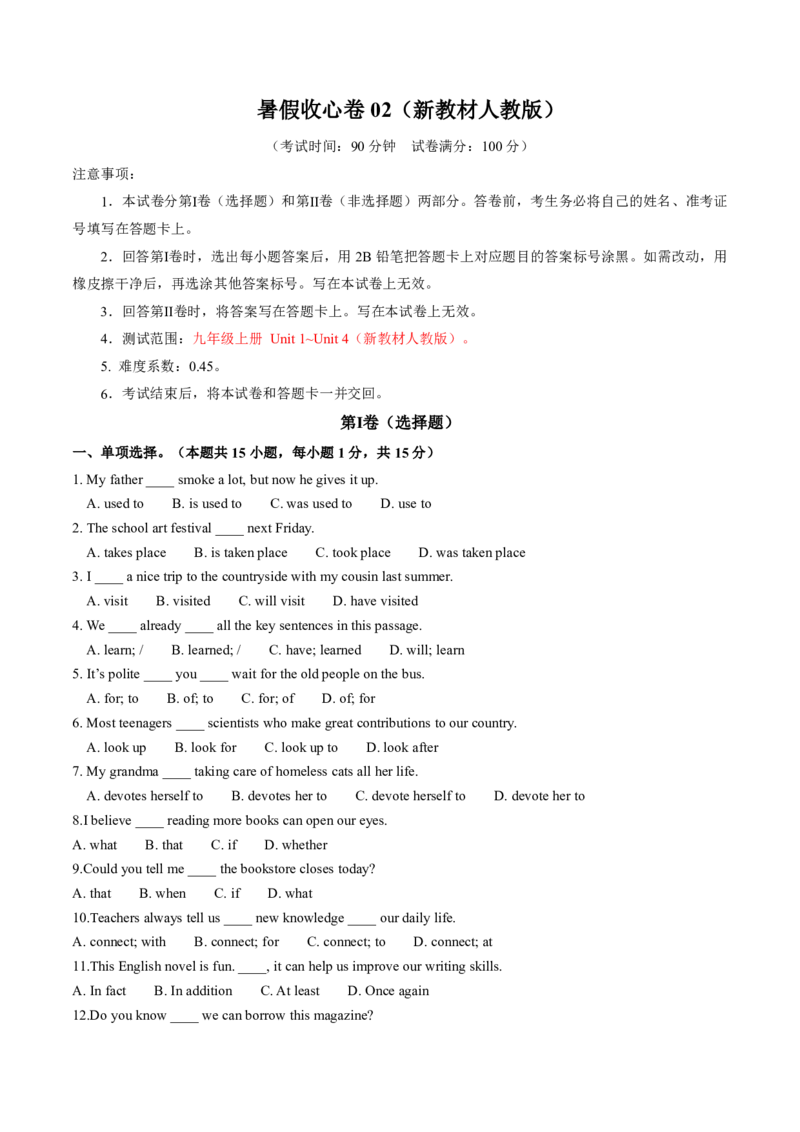
1. My father ____ smoke a lot, but now he gives it up.
A. used to
B. is used to
C. was used to
D. use to
2. The school art festival ____ next Friday.
A. takes place
B. is taken place
C. took place
D. was taken place
3. I ____ a nice trip to the countryside with my cousin last summer.
A. visit
B. visited
C. will visit
D. have visited
4. We ____ already ____ all the key sentences in this passage.
A. learn; /
B. learned; /
C. have; learned
D. will; learn
5. It’s polite ____ you ____ wait for the old people on the bus.
A. for; to
B. of; to
C. for; of
D. of; for
6. Most teenagers ____ scientists who make great contributions to our country.
A. look up
B. look for
C. look up to
D. look after
7. My grandma ____ taking care of homeless cats all her life.
A. devotes herself to
B. devotes her to
C. devote herself to
D. devote her to
8.I believe ____ reading more books can open our eyes.
A. what
B. that
C. if
D. whether
9.Could you tell me ____ the bookstore closes today?
A. that
B. when
C. if
D. what
10.Teachers always tell us ____ new knowledge ____ our daily life.
A. connect; with
B. connect; for
C. connect; to
D. connect; at
11.This English novel is fun. ____, it can help us improve our writing skills.
A. In fact
B. In addition
C. At least
D. Once again
12.Do you know ____ we can borrow this magazine?
A. that
B. if
C. where
D. what
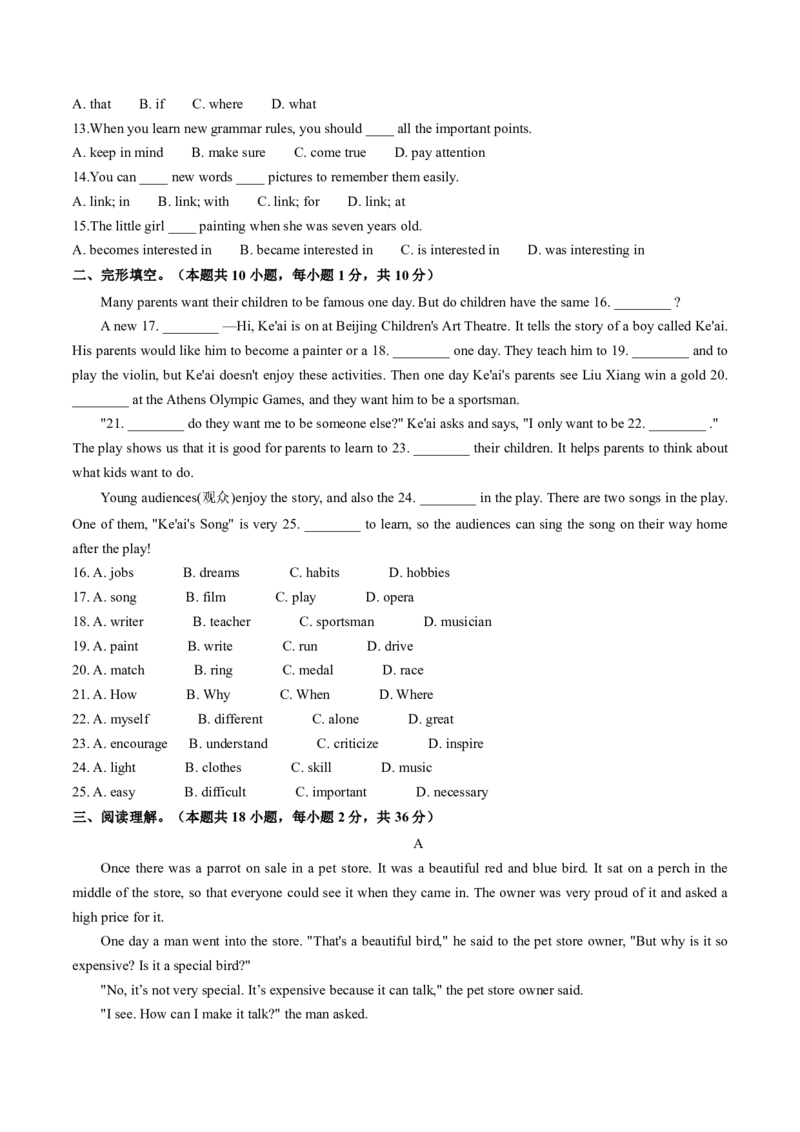
13.When you learn new grammar rules, you should ____ all the important points.
A. keep in mind
B. make sure
C. come true
D. pay attention
14.You can ____ new words ____ pictures to remember them easily.
A. link; in
B. link; with
C. link; for
D. link; at
15.The little girl ____ painting when she was seven years old.
A. becomes interested in
B. became interested in
C. is interested in
D. was interesting in
二、完形填空。(本题共10 小题,每小题1 分,共10 分)
Many parents want their children to be famous one day. But do children have the same 16. ________ ?
A new 17. ________ —Hi, Ke'ai is on at Beijing Children's Art Theatre. It tells the story of a boy called Ke'ai.
His parents would like him to become a painter or a 18. ________ one day. They teach him to 19. ________ and to
play the violin, but Ke'ai doesn't enjoy these activities. Then one day Ke'ai's parents see Liu Xiang win a gold 20.
________ at the Athens Olympic Games, and they want him to be a sportsman.
"21. ________ do they want me to be someone else?" Ke'ai asks and says, "I only want to be 22. ________ ."
The play shows us that it is good for parents to learn to 23. ________ their children. It helps parents to think about
what kids want to do.
Young audiences(观众)enjoy the story, and also the 24. ________ in the play. There are two songs in the play.
One of them, "Ke'ai's Song" is very 25. ________ to learn, so the audiences can sing the song on their way home
after the play!
16. A. jobs
B. dreams
C. habits
D. hobbies
17. A. song
B. film
C. play
D. opera
18. A. writer
B. teacher
C. sportsman
D. musician
19. A. paint
B. write
C. run
D. drive
20. A. match
B. ring
C. medal
D. race
21. A. How
B. Why
C. When
D. Where
22. A. myself
B. different
C. alone
D. great
23. A. encourage
B. understand
C. criticize
D. inspire
24. A. light
B. clothes
C. skill
D. music
25. A. easy
B. difficult
C. important
D. necessary
三、阅读理解。(本题共18 小题,每小题2 分,共36 分)
A
Once there was a parrot on sale in a pet store. It was a beautiful red and blue bird. It sat on a perch in the
middle of the store, so that everyone could see it when they came in. The owner was very proud of it and asked a
high price for it.
One day a man went into the store. "That's a beautiful bird," he said to the pet store owner, "But why is it so
expensive? Is it a special bird?"
"No, it’s not very special. It’s expensive because it can talk," the pet store owner said.
"I see. How can I make it talk?" the man asked.
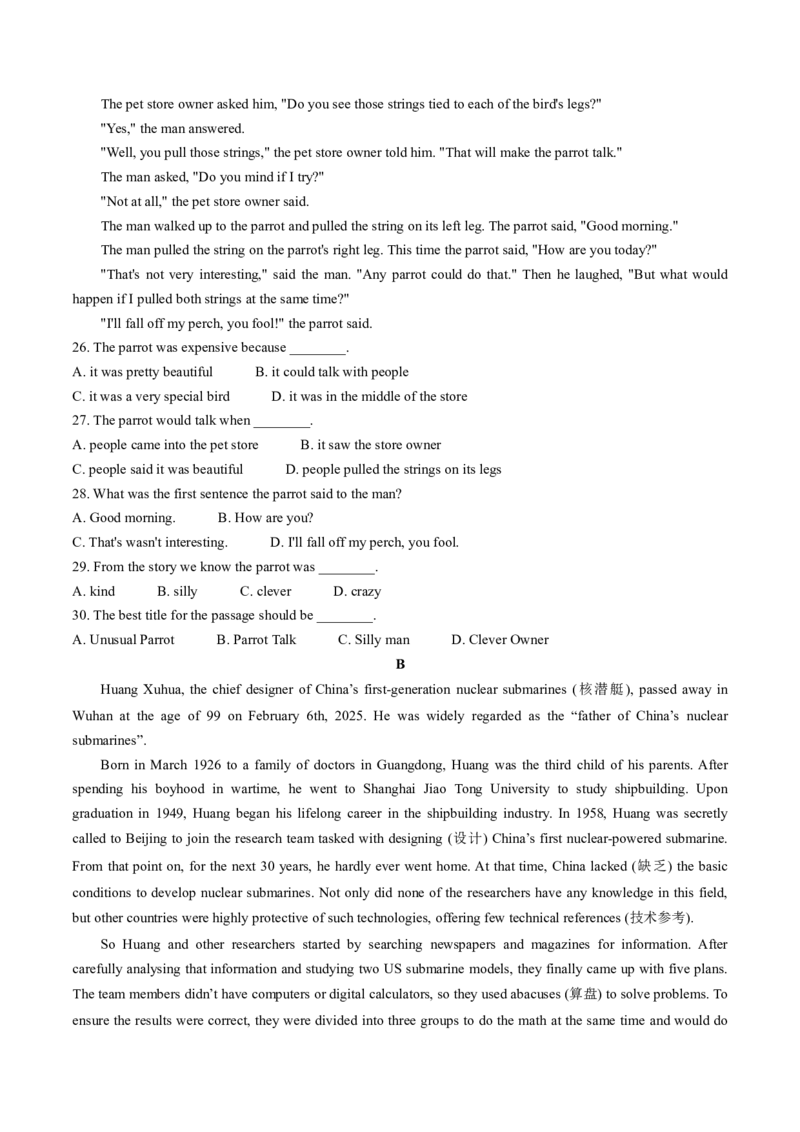
The pet store owner asked him, "Do you see those strings tied to each of the bird's legs?"
"Yes," the man answered.
"Well, you pull those strings," the pet store owner told him. "That will make the parrot talk."
The man asked, "Do you mind if I try?"
"Not at all," the pet store owner said.
The man walked up to the parrot and pulled the string on its left leg. The parrot said, "Good morning."
The man pulled the string on the parrot's right leg. This time the parrot said, "How are you today?"
"That's not very interesting," said the man. "Any parrot could do that." Then he laughed, "But what would
happen if I pulled both strings at the same time?"
"I'll fall off my perch, you fool!" the parrot said.
26. The parrot was expensive because ________.
A. it was pretty beautiful
B. it could talk with people
C. it was a very special bird
D. it was in the middle of the store
27. The parrot would talk when ________.
A. people came into the pet store
B. it saw the store owner
C. people said it was beautiful
D. people pulled the strings on its legs
28. What was the first sentence the parrot said to the man?
A. Good morning.
B. How are you?
C. That's wasn't interesting.
D. I'll fall off my perch, you fool.
29. From the story we know the parrot was ________.
A. kind
B. silly
C. clever
D. crazy
30. The best title for the passage should be ________.
A. Unusual Parrot
B. Parrot Talk
C. Silly man
D. Clever Owner
B
Huang Xuhua, the chief designer of China’s first-generation nuclear submarines (核潜艇), passed away in
Wuhan at the age of 99 on February 6th, 2025. He was widely regarded as the “father of China’s nuclear
submarines”.
Born in March 1926 to a family of doctors in Guangdong, Huang was the third child of his parents. After
spending his boyhood in wartime, he went to Shanghai Jiao Tong University to study shipbuilding. Upon
graduation in 1949, Huang began his lifelong career in the shipbuilding industry. In 1958, Huang was secretly
called to Beijing to join the research team tasked with designing (设计) China’s first nuclear-powered submarine.
From that point on, for the next 30 years, he hardly ever went home. At that time, China lacked (缺乏) the basic
conditions to develop nuclear submarines. Not only did none of the researchers have any knowledge in this field,
but other countries were highly protective of such technologies, offering few technical references (技术参考).
So Huang and other researchers started by searching newspapers and magazines for information. After
carefully analysing that information and studying two US submarine models, they finally came up with five plans.
The team members didn’t have computers or digital calculators, so they used abacuses (算盘) to solve problems. To
ensure the results were correct, they were divided into three groups to do the math at the same time and would do
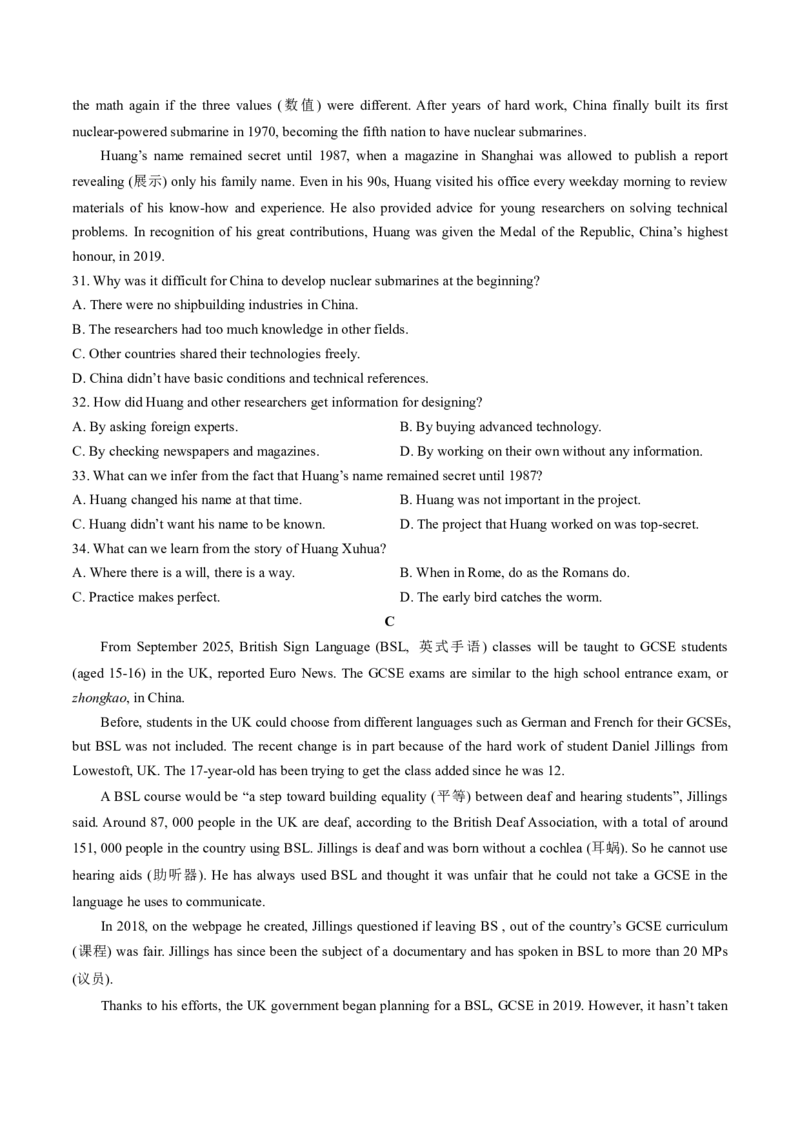
the math again if the three values (数值) were different. After years of hard work, China finally built its first
nuclear-powered submarine in 1970, becoming the fifth nation to have nuclear submarines.
Huang’s name remained secret until 1987, when a magazine in Shanghai was allowed to publish a report
revealing (展示) only his family name. Even in his 90s, Huang visited his office every weekday morning to review
materials of his know-how and experience. He also provided advice for young researchers on solving technical
problems. In recognition of his great contributions, Huang was given the Medal of the Republic, China’s highest
honour, in 2019.
31. Why was it difficult for China to develop nuclear submarines at the beginning?
A. There were no shipbuilding industries in China.
B. The researchers had too much knowledge in other fields.
C. Other countries shared their technologies freely.
D. China didn’t have basic conditions and technical references.
32. How did Huang and other researchers get information for designing?
A. By asking foreign experts.
B. By buying advanced technology.
C. By checking newspapers and magazines.
D. By working on their own without any information.
33. What can we infer from the fact that Huang’s name remained secret until 1987?
A. Huang changed his name at that time.
B. Huang was not important in the project.
C. Huang didn’t want his name to be known.
D. The project that Huang worked on was top-secret.
34. What can we learn from the story of Huang Xuhua?
A. Where there is a will, there is a way.
B. When in Rome, do as the Romans do.
C. Practice makes perfect.
D. The early bird catches the worm.
C
From September 2025, British Sign Language (BSL, 英式手语) classes will be taught to GCSE students
(aged 15-16) in the UK, reported Euro News. The GCSE exams are similar to the high school entrance exam, or
zhongkao, in China.
Before, students in the UK could choose from different languages such as German and French for their GCSEs,
but BSL was not included. The recent change is in part because of the hard work of student Daniel Jillings from
Lowestoft, UK. The 17-year-old has been trying to get the class added since he was 12.
A BSL course would be “a step toward building equality (平等) between deaf and hearing students”, Jillings
said. Around 87, 000 people in the UK are deaf, according to the British Deaf Association, with a total of around
151, 000 people in the country using BSL. Jillings is deaf and was born without a cochlea (耳蜗). So he cannot use
hearing aids (助听器). He has always used BSL and thought it was unfair that he could not take a GCSE in the
language he uses to communicate.
In 2018, on the webpage he created, Jillings questioned if leaving BS , out of the country’s GCSE curriculum
(课程) was fair. Jillings has since been the subject of a documentary and has spoken in BSL to more than 20 MPs
(议员).
Thanks to his efforts, the UK government began planning for a BSL, GCSE in 2019. However, it hasn’t taken
until now for the process to be completed. “I hope that a BSL GCSE will encourage children to learn to sign and
that families of deaf children can use BSL with them from a young age,” Jillings said.
35. What is GCSE?
A. A language.
B. An exam.
C. A city in the UK.
D. A subject of zhongkao.
36. How many years has Jillings been trying to get BSL added?
A. 5.
B. 7.
C. 12.
D. 17.
37. What can we know according to the text?
①There are 87, 000 people using BSL in the UK.
②Jillings was born to be deaf.
③Jillings started to use hearing aids in 2018.
④Jillings managed to add BSL to the GCSE finally.
A. ①②
B. ③④
C. ①③
D. ②④
38. Which of the following can be used to describe Jillings?
A. Rich and lucky.
B. Curious and diligent.
C. Brave and strong.
D. Patient and honest.
D
根据语篇内容,从下列选项中选出能填入文中空白处的最佳选项,选项中有一项为多余选项。
As the old saying goes, “Nothing can be achieved without norms (规范) or standards.” There are always rules
for people in different fields, especially for students. 39. ________
Be friendly to the people you are with.
Have you ever quarreled (争吵) with your teammates when your basketball team lost? 40. ________
Do more at school.
April is Bird-Loving Month in China. Is your school doing anything to celebrate? If possible, you should be
active in joining them. 41. ________ What’s more, you will sense the good feeling of working together with more
people.
Be open to new ideas.
Have you ever thought that people could live on the moon? Maybe you’ll discover Earth II someday. 42. ________
Everyone’s ideas are important. You should welcome them because new ideas make life better for everyone.
43. ________
If you have played computer games for two hours in your room, don’t tell your parents you have done your
homework. Telling a lie will lead you to the trouble of making up more stories to make your lies seem reasonable.
You will also find it difficult for your parents, friends or teachers to trust you.
A. Only by working together can you make your team stronger.
B. Some new rules are made to decide who the top students are.
C. You can learn more about animals and how to protect them.
D. Avoid keeping bad habits and start good ones.
E. Keep the habit of telling the truth.
F. Don’t look down on new ideas.
第Ⅱ卷(非选择题)
四、根据汉语或者用所给单词的正确形式填空。(本题共10 小题,每小题1 分,共10 分)
44.________ (化学) is an interesting subject.
45.Many great changes have taken place in the last two ________ (世纪).
46.Lots of terrible ________ (疾病) spread quickly last year.
47.Good food can help the kids’ physical ________ (grow).
48.There are hundreds of English ________ (learn) taking part in the competition.
49.The ________ (对话) in this movie is very warm.
50.Teachers should find different ________ (方法) for different students.
51.The second ________ (段落) of the article tells a true story.
52.The local ________ (政府) provides free books for poor students.
53.I was shocked because I hardly ________ (辨认出) my old friend.
五、语法填空。(本题共9 小题,每小题1 分,共9 分)
阅读下面材料,在空白处填入适当的内容(1 个单词)或括号内单词的正确形式。
Around the 15th United Nations Chinese Language Day, which fell on April 20, some foreign students of Xi’
an International Studies University practiced and ___54___ (enjoy) Chinese characters together with some Chinese
experts and teachers. It has been a tradition for some foreign Chinese ___55___ (speaker) and Chinese teachers to
get together to mark the special day. They enjoy ___56___ (share) their understanding and benefits of this
language.
Chinese famous writer Lu Xun once said that the beauty of Chinese characters lies in three ways: their
meanings educate the minds, their sounds please the ears, and their appearances please the eyes. Another writer Yu
Guangzhong also praised Chinese characters ___57___ (high).
The history of Chinese characters can date back over 3,000 years. ___58___ (improve) beauty and writing
efficiency (效率), different kinds of characters were developed, such as zhuanshu, lishu, caoshu, and kaishu. The
beauty of Chinese characters is still clear and popular today.
Many Chinese characters not only carry meanings but also have ___59___ (culture) significance ( 意义)
passed down through history. They are symbols of Chinese traditional culture. Through them, we can closely
connect the past, present, and future of our country.
According to ___60___ recent survey, more than 30 million people worldwide are learning Chinese. The
language is taught in over 190 countries and areas. As more people can speak their mother languages and Chinese,
the culture of Chinese characters is likely to be better understood and enjoyed worldwide.
十、书面表达。(共20 分)
61. 假如你是李华,请你写一篇短文,介绍近几年你老家农村发生的巨大变化,可从居住环境、交通、生活
方式等方面展开,抒发对家乡的热爱。
要求:
1. 条理清晰,语法规范;
2. 词数控制在100 词左右;
3. 不得出现真实姓名和学校;
____________________________________________________________________________________________