1
Unit 8 语法篇
__________________________________________________________________________________
__________________________________________________________________________________
熟练掌握本章重点语法知识。
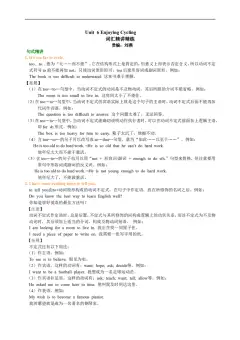
There be 句型:
1.there be 句型表示某事存在某人和某物,have、has 表示拥有或是某物的一部分
如:There are forty students in the classroom.
I have a younger sister.
2. there be 句型的一般疑问句时把be 动词提前,否定句在be 动词后面加not,肯定回答和否定回答
是要一致。
3. there be 句型中be 动词的变化是依据和它最靠近的那个名词而选择is 或are,即存在就近原则。
4.there be 句型中, some 用于肯定句,any 用于否定和疑问句,但当表示征询意见或建议时用some
而不能用any
1. There is a bookstore across from the school. (改为否定句)


    a bookstore across from the school.
2. There are some flowers on the tree. (改为一般疑问句)


    flowers on the tree?
3. Is there a baseball under the chair? (作出肯定回答)
Yes,


   .
4. Are there any trees around your house? (作出否定回答)
No,


   .
5.我们班有60 个学生.
2


    60 students in our class.
解析:
1. there be 句型的否定回答,故答案为There isn't
2. .there be 句型的一般疑问句,be 动词提前,并且some 用于肯定句,any 用于否定和疑问句,故答
案为:Are there any
3.肯定回答用. there is
4. 否定回答用 there aren't
5. 某地存在某物,因此为There are
基础演练
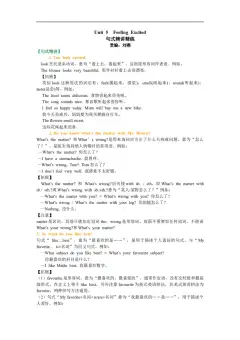
一、单项选择
 1. --- What's in the box? It's so heavy.
--- There

    lots of books in it.
A.
is
B.
are
C.
have
D.
be
2. There

    an apple and ten bananas in the basket. You can take any of them.
A.
are
B.
is
C.
has
D.
have
3. ---

    a small shop near your home?
--- Yes, there is.
A.
Is it
B.
Is there
C.
Is that
D.
Is this
4. --- Excuse me,

    is the nearest bookshop?
--- Go down the street.
A.
how
B.
what
C.
where
D.
who
5. --- Why are you standing, Alice?
--- I can't see the blackboard clearly. Two tall boys are sitting

    me.
A.
behind
B.
next to
C.
between
D.
in front of
巩固提高
二、按要求转换句型
6. There are some offices in the school building. (改为一般疑问句)


    offices in the school building?
7. There are some trees in front of my classroom. (改为否定句)
3


    trees in front of my classroom.
8. There is only one computer in the room. (对划线部分提问)


    there in the room?
9. The basketballs are under the bed. (对划线部分提问)


    the basketballs?
10. In front of the bank is the library, and behind the bank is the post office. (改为同义句)
The bank is

    the library

    the post office.
三、翻译(根据中文提示完成句子)
11. 在他的课桌上有一台电脑。
There


    his desk.
12. 在大楼前没有老师。


    teachers


    the building.
13. --- 教室里有些学生吗?--- 有
---


    students in the classroom?
--- Yes,


   .
14. 书店在你右边,银行旁边。
The bookstore is

    your

   ,

    the bank.
15. 在这幢楼后有一个花园。
There is a garden


    the building.
答案
一、单项选择
 1. B
 2. B
 3. B
 4. C
 5. D
二、按要求转换句型
 6. Are there any
 7. There aren't any
 8. How many computers are
 9. Where are
10. between and
三、翻译(根据中文提示完成句子)
11. is a computer on
12. There aren't any; in front of
13. Are there; any; there are
14. on, right, beside
15. at the back of
4
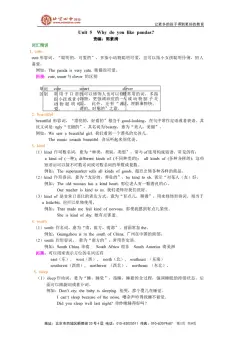
一、选词填空(句子选词填空)
is
are
 1. There

    a beautiful garden near here.
 2. There

    some juice in the glass.
 3. There

    some fruit stores on the street.
 4. There

    a supermarket and three banks in this neighborhood.
 5. There

    some books and a dictionary on the desk.
二、选词填空(短文选词填空)
enjoy
live
quiet
tired
small
dinner
across from
interesting
next to
take a walk
    Pine Street is a good place to 1

    in. It's  a very 2.

    street. It's 3.

the busy Center Street. If you are 4.

    after work, you can 5.

    the
city's quietness here. And there is a 6.

    park near here. In the morning or after 7.

, you can 8.

    in the park. 9.

    the park is a bookshop. There are many
10.

    books in the shop. So sometimes in the park, you can see many people enjoy their
books.
选词填空(句子选词填空)
 1. is
 2. is
 3. are
 4. is
 5. are
选词填空(短文选词填空)
1. live
2. quiet
3. next to
4. tired
5. enjoy
6. small
7. dinner
8. take a walk
5
9. across from
10. interesting
_________________________________________________________________________________
_________________________________________________________________________________
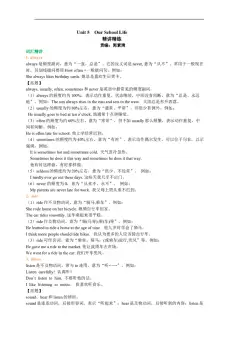
三、阅读理解(西城2014-2015 初一下期末试题)
A
    When you travel in a foreign country, it is very important to know the meanings of some gestures(手
势). Following the customs will help you.
Gestures
Meanings
Americans often touch their temples( 太阳穴) to say
somebody is clever. But this means one is silly to Chinese.
In America, people do this to say "OK", but it means
somebody will lose his or her job in Japan.
In China, the thumbs( 拇指)-up sign means good. But in
Australia and West Africa, it is a bad sign.
In America, waving one's hand means goodbye. But South
Americans will not leave when they see this; they will run
towards you.
26. How many gestures are mentioned(提到) in the passage?
A.
3.
B.
4.
C.
5.
D.
6.
27. In America, people usually wave their hand to say

   .
A.
goodbye
B.
hello
C.
one is silly
D.
one is clever
28. In Australia, people don't like the

    sign.
A.
thumbs-up
B.
hand-waving
6
C.
OK
D.
temple-touching
B
    It's March, 2050.
    Frank and Mary Smith wake up in their comfortable house and switch on the computer to watch news.
They used to (过去) read the Times, but changed to newspaper online in 2013.
    As they watch the computer, Frank and Mary take their usual weight control pills (减肥药), and ask
one of the robots to make coffee. Frank enters the study to have a meeting with his workmates around the
world. He works on a computer for several companies. This is his third job. He used to be in marketing and
then television.
    Mary also has a job. Both she and Frank used to have an office desk in London, but in 2014 they
decided to move to the seaside and work from home.
    Frank and Mary have one child, Louise. She also has her own workstation in the family home. She
goes to school only one day a week, mainly to play with other children. Classrooms disappeared in 2030
because there was no need for them. Louise, now thirteen, is studying Chinese. Now it has become as
important as English as a world language. Louise has many Chinese friends. They talk by computer.
29. Frank and Mary turn on

    to watch news.
A.
the computer
B.
the iPhone
C.
the video phone
D.
the TV
30. Frank and Mary decided to work from home

   .
A.
in 2050
B.
in 2030
C.
in 2014
D.
in 2013
31. Frank

    in London before 2014.
A.
had several jobs
B.
worked in the office
C.
worked and shopped at home
D.
took pills to lose weight
32. From the passage we know

   .
A.
Mary read news online before 2013
B.
Frank was in marketing and computer
C.
there were no classrooms in 2030
D.
children only needed to play in 2030
7
C
    Born in 1968 in the Dominican Republic, Sammy Sosa, the famous baseball player learned early the
importance of hard work. When Sosa was only seven, his father died, leaving the family terribly poor. He
worked hard to help support(支持) the family.
    Though busy working, he tried to find time to play baseball. At 14, Sosa got to play on a real baseball
team. He worked hard and showed great gift(天赋). At sixteen, the Texas Rangers noticed his gift and
asked him to play in the US.
    Sosa was not an overnight success (一夜成功). He still had a lot to learn. Though he could hit a
fastball for a home run, he also made more mistakes(错误). In 1989, the Rangers gave him up to the
Chicago White Sox. The White Sox were excited to have him. This helped Sosa get his confidence(信心)
back, and he began to play well again. But his success did not last. He was trying too hard and thinking too
much. He ended up making more mistakes. In 1992, the White Sox gave Sosa up to the Chicago Cubs.
    The Cubs believed he could become a great player. They helped him improve himself. By 1998, he
had become baseball's best all-around player. He was chosen the National League's Most Valuable Player
that year.
    On the playing field or off, Sosa is a hero(英雄) for the world. In 1997, he started the Sammy Sosa
Foundation to help people in need. When Hurricane Georges hit the Dominican Republic, Sosa sent food,
blankets, and other things there, with $700,000 to help his country. "I want to be known as a good person
more than a baseball player," Sosa said.
33. The Rangers gave him up to the Chicago White Sox when

   .
A.
he didn't make himself any better there
B.
he tried too hard and thought too much
C.
he didn't get his confidence back yet
D.
he made more mistakes in the field
34. The most important thing for Sammy Sosa is

   .
A.
to support his family
B.
to live in the United States
C.
to be a good person
D.
to be a valuable player
35. People chose him as the National League's Most Valuable Player because

   .
A.
he hit more home runs and became better
B.
he'd become baseball's best player in all areas
C.
he did many things to help people in need
8
D.
he was not only a good player but a great man
四、阅读与表达(问答式)
    After his best friend had cancer(癌症), five-year-old Vincent Butterfield decided that hours of playing
and telling jokes was not enough—he wanted to show his friend just how much he understood the hard
time his friend was going through.
    Vincent decided the only way was to shave(剃) his head in support of his best friend Zac Gossage who
lost his hair through chemotherapy(化疗).
    Zac was found last June having acute lymphoblastic leukemia (急性淋巴细胞白血病). He is
undergoing treatment (接受治疗) but still goes to UCE in Missouri every day because that's where he gets
to hang out (闲逛) with Vincent.
    When the little boy was asked why he shaved his hair off, he told us, "To make Zac feel that he's not
the only one without any hair." Vincent is also learning about cancer and raising money for his best friend
after learning how expensive his treatments are. He made more than 20 scarves and sold them, raising more
than $200 to give to Zac.
    When asked what friendship was, Vincent looked at his friend Zac and answered, "It's a beautiful
thing".
    Acute lymphoblastic leukemia is a fast-growing cancer. It is the most usual in children aged two to
five years old. Luckily, it is possible to treat and most of children who get it can get over it with good
treatment.
 根据短文内容,完成下列小题。
36. Was Vincent Butterfield 5 years old?
37. Why does Zac go to UCE in Missouri every day?
38. What does Vincent think of friendship?
39. How many scarves did Vincent make?
40. What did Vincent do for his friend after Zac had cancer?
三、阅读理解
26. B
27. A
28. A
29. A
30. C
31. B
32. C
33. D
34. C
35. B
四、阅读与表达(问答式)
36. Yes, he was. / Yes.
37. Because he wants to hang out with Vincent.
38. He thinks it's a beautiful thing.
39. More than 20.
9
40. He spent hours playing and telling jokes with him. / He made scarves to raise money for his treatment. /
He shaved his hair to show his understanding.
课程顾问签字:                        教学主管签字: