初中英语最全知识点
一、语法篇
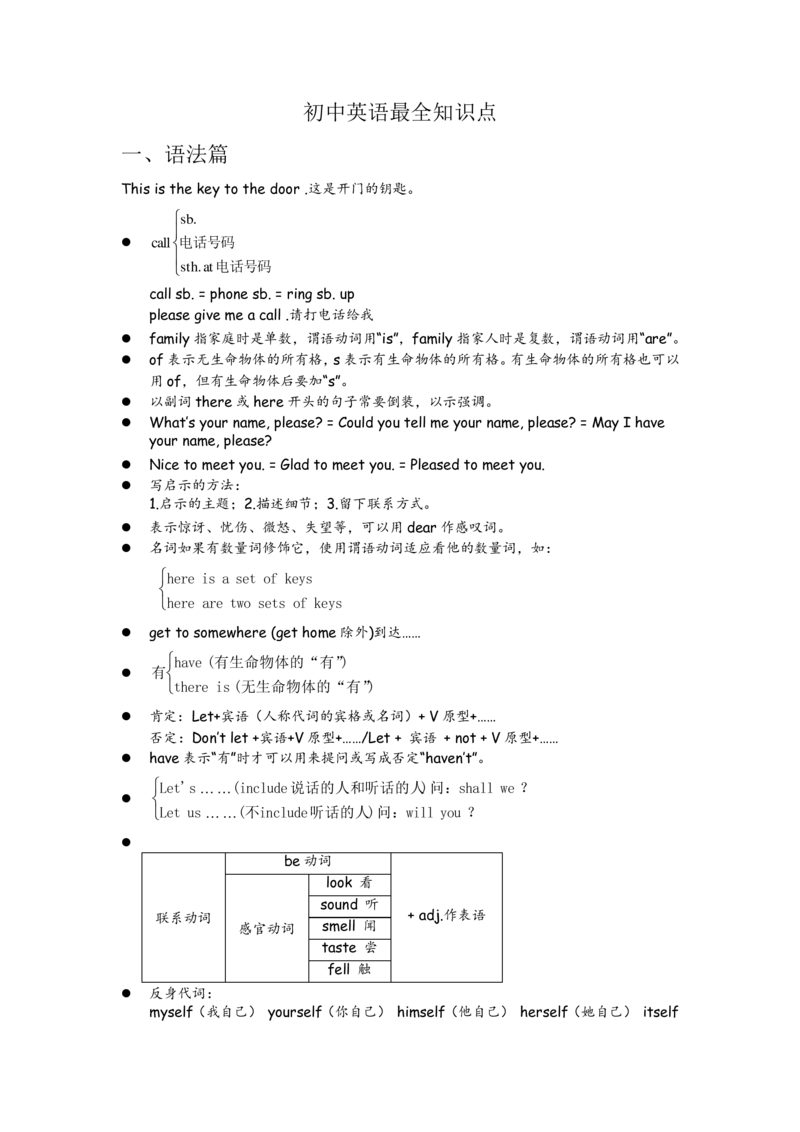
This is the key to the door .这是开门的钥匙。
电话号码
电话号码
at
.
sth
.
sb
call
call sb. = phone sb. = ring sb. up
please give me a call .请打电话给我
family 指家庭时是单数,谓语动词用“is”,family 指家人时是复数,谓语动词用“are”。
of 表示无生命物体的所有格,s 表示有生命物体的所有格。有生命物体的所有格也可以
用of,但有生命物体后要加“s”。
以副词there 或here 开头的句子常要倒装,以示强调。
What’s your name, please? = Could you tell me your name, please? = May I have
your name, please?
Nice to meet you. = Glad to meet you. = Pleased to meet you.
写启示的方法:
1.启示的主题;2.描述细节;3.留下联系方式。
表示惊讶、忧伤、微怒、失望等,可以用dear 作感叹词。
名词如果有数量词修饰它,使用谓语动词适应看他的数量词,如:
keys
of
sets
two
are
here
keys
of
set
a
is
here
get to somewhere (get home 除外)到达……
)
无生命物体的“有”
(
is
there
)
有生命物体的“有”
(
have
有
肯定:Let+宾语(人称代词的宾格或名词)+ V 原型+……
否定:Don’t let +宾语+V 原型+……/Let + 宾语 + not + V 原型+……
have 表示“有”时才可以用来提问或写成否定“haven’t”。
?
you
will
问:
)
听话的人
include
不
(
us
Let
?
we
shall
问:
)
说话的人和听话的人
(include
s
Let'
联系动词
be 动词
+ adj.作表语
感官动词
look 看
sound 听
smell 闻
taste 尝
fell 触
反身代词:
myself(我自己) yourself(你自己) himself(他自己) herself(她自己) itself
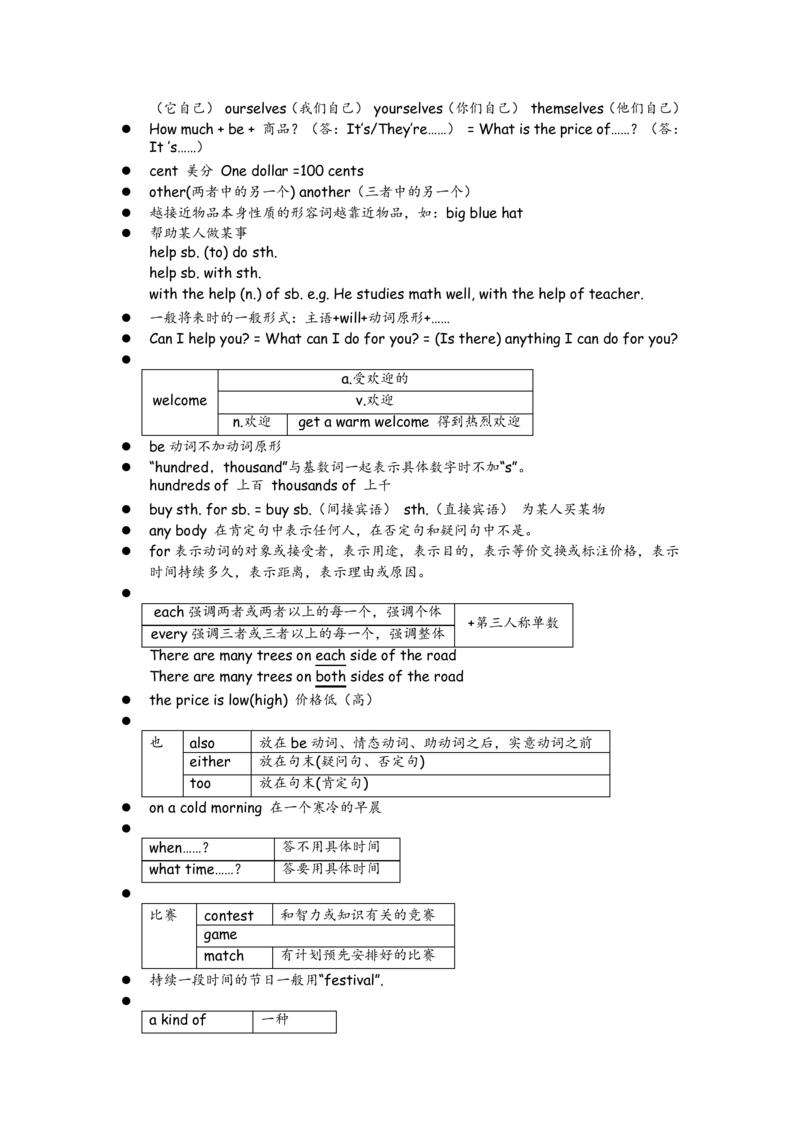
(它自己) ourselves(我们自己) yourselves(你们自己) themselves(他们自己)
How much + be + 商品?(答:It’s/They’re……) = What is the price of……?(答:
It ’s……)
cent 美分 One dollar =100 cents
other(两者中的另一个) another(三者中的另一个)
越接近物品本身性质的形容词越靠近物品,如:big blue hat
帮助某人做某事
help sb. (to) do sth.
help sb. with sth.
with the help (n.) of sb. e.g. He studies math well, with the help of teacher.
一般将来时的一般形式:主语+will+动词原形+……
Can I help you? = What can I do for you? = (Is there) anything I can do for you?
welcome
a.受欢迎的
v.欢迎
n.欢迎
get a warm welcome 得到热烈欢迎
be 动词不加动词原形
“hundred,thousand”与基数词一起表示具体数字时不加“s”。
hundreds of 上百 thousands of 上千
buy sth. for sb. = buy sb.(间接宾语) sth.(直接宾语) 为某人买某物
any body 在肯定句中表示任何人,在否定句和疑问句中不是。
for 表示动词的对象或接受者,表示用途,表示目的,表示等价交换或标注价格,表示
时间持续多久,表示距离,表示理由或原因。
each 强调两者或两者以上的每一个,强调个体
+第三人称单数
every 强调三者或三者以上的每一个,强调整体
There are many trees on each side of the road
There are many trees on both sides of the road
the price is low(high) 价格低(高)
也
also
放在be 动词、情态动词、助动词之后,实意动词之前
either
放在句末(疑问句、否定句)
too
放在句末(肯定句)
on a cold morning 在一个寒冷的早晨
when……?
答不用具体时间
what time……?
答要用具体时间
比赛
contest
和智力或知识有关的竞赛
game
match
有计划预先安排好的比赛
持续一段时间的节日一般用“festival”.
a kind of
一种
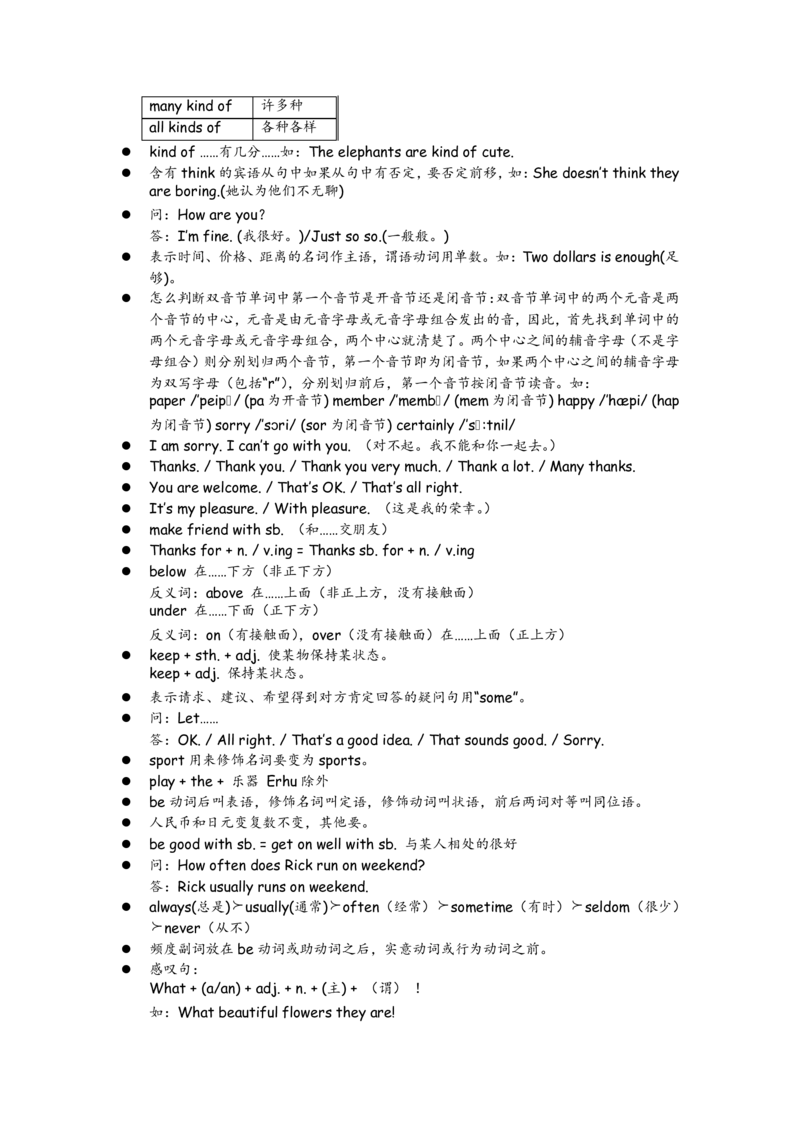
many kind of
许多种
all kinds of
各种各样
kind of ……有几分……如:The elephants are kind of cute.
含有think 的宾语从句中如果从句中有否定,要否定前移,如:She doesn’t think they
are boring.(她认为他们不无聊)
问:How are you?
答:I’m fine. (我很好。)/Just so so.(一般般。)
表示时间、价格、距离的名词作主语,谓语动词用单数。如:Two dollars is enough(足
够)。
怎么判断双音节单词中第一个音节是开音节还是闭音节:双音节单词中的两个元音是两
个音节的中心,元音是由元音字母或元音字母组合发出的音,因此,首先找到单词中的
两个元音字母或元音字母组合,两个中心就清楚了。两个中心之间的辅音字母(不是字
母组合)则分别划归两个音节,第一个音节即为闭音节,如果两个中心之间的辅音字母
为双写字母(包括“r”),分别划归前后,第一个音节按闭音节读音。如:
paper /’peipə/ (pa 为开音节) member /’membə/ (mem 为闭音节) happy /’hæpi/ (hap
为闭音节) sorry /’sɔri/ (sor 为闭音节) certainly /’sə:tnil/
I am sorry. I can’t go with you. (对不起。我不能和你一起去。)
Thanks. / Thank you. / Thank you very much. / Thank a lot. / Many thanks.
You are welcome. / That’s OK. / That’s all right.
It’s my pleasure. / With pleasure. (这是我的荣幸。)
make friend with sb. (和……交朋友)
Thanks for + n. / v.ing = Thanks sb. for + n. / v.ing
below 在……下方(非正下方)
反义词:above 在……上面(非正上方,没有接触面)
under 在……下面(正下方)
反义词:on(有接触面),over(没有接触面)在……上面(正上方)
keep + sth. + adj. 使某物保持某状态。
keep + adj. 保持某状态。
表示请求、建议、希望得到对方肯定回答的疑问句用“some”。
问:Let……
答:OK. / All right. / That’s a good idea. / That sounds good. / Sorry.
sport 用来修饰名词要变为sports。
play + the + 乐器 Erhu 除外
be 动词后叫表语,修饰名词叫定语,修饰动词叫状语,前后两词对等叫同位语。
人民币和日元变复数不变,其他要。
be good with sb. = get on well with sb. 与某人相处的很好
问:How often does Rick run on weekend?
答:Rick usually runs on weekend.
always(总是)usually(通常)often(经常)sometime(有时)seldom(很少)
never(从不)
频度副词放在be 动词或助动词之后,实意动词或行为动词之前。
感叹句:
What + (a/an) + adj. + n. + (主) + (谓) !
如:What beautiful flowers they are!
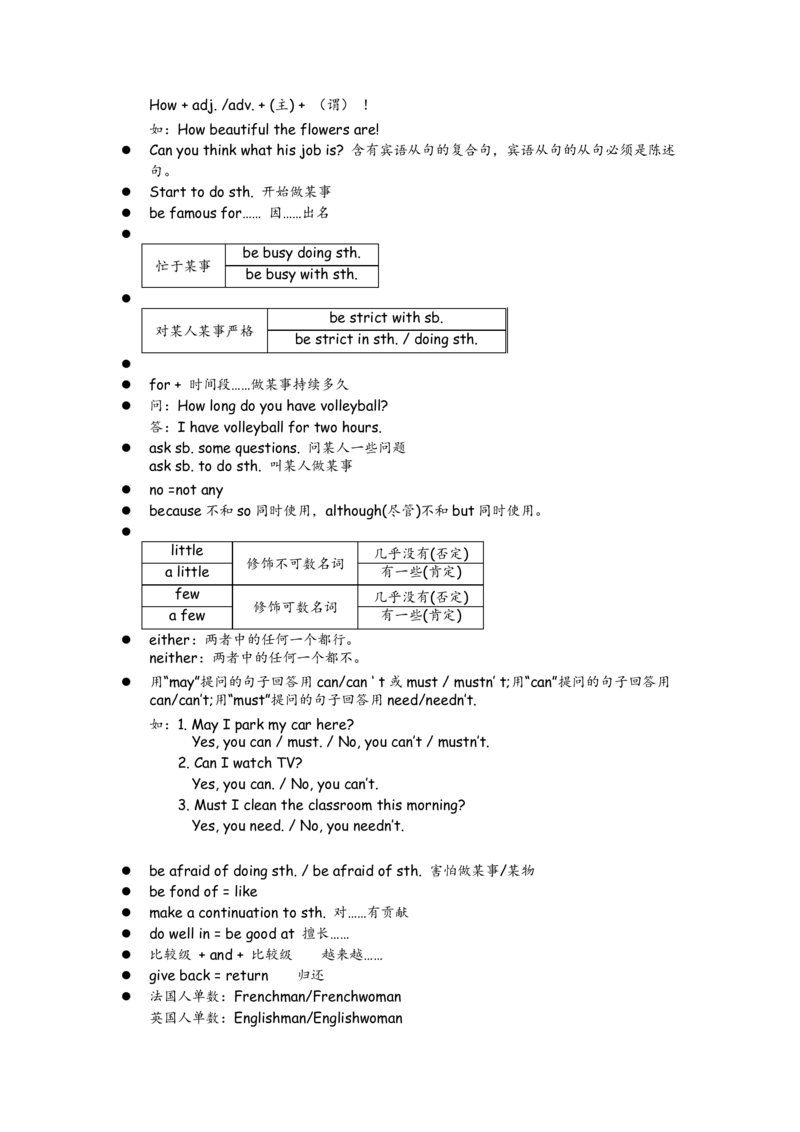
How + adj. /adv. + (主) + (谓) !
如:How beautiful the flowers are!
Can you think what his job is? 含有宾语从句的复合句,宾语从句的从句必须是陈述
句。
Start to do sth. 开始做某事
be famous for…… 因……出名
忙于某事
be busy doing sth.
be busy with sth.
对某人某事严格
be strict with sb.
be strict in sth. / doing sth.
for + 时间段……做某事持续多久
问:How long do you have volleyball?
答:I have volleyball for two hours.
ask sb. some questions. 问某人一些问题
ask sb. to do sth. 叫某人做某事
no =not any
because 不和so 同时使用,although(尽管)不和but 同时使用。
little
修饰不可数名词
几乎没有(否定)
a little
有一些(肯定)
few
修饰可数名词
几乎没有(否定)
a few
有一些(肯定)
either:两者中的任何一个都行。
neither:两者中的任何一个都不。
用“may”提问的句子回答用can/can ‘ t 或must / mustn’ t;用“can”提问的句子回答用
can/can’t;用“must”提问的句子回答用need/needn’t.
如:1. May I park my car here?
Yes, you can / must. / No, you can’t / mustn’t.
2. Can I watch TV?
Yes, you can. / No, you can’t.
3. Must I clean the classroom this morning?
Yes, you need. / No, you needn’t.
be afraid of doing sth. / be afraid of sth. 害怕做某事/某物
be fond of = like
make a continuation to sth. 对……有贡献
do well in = be good at 擅长……
比较级 + and + 比较级 越来越……
give back = return 归还
法国人单数:Frenchman/Frenchwoman
英国人单数:Englishman/Englishwoman
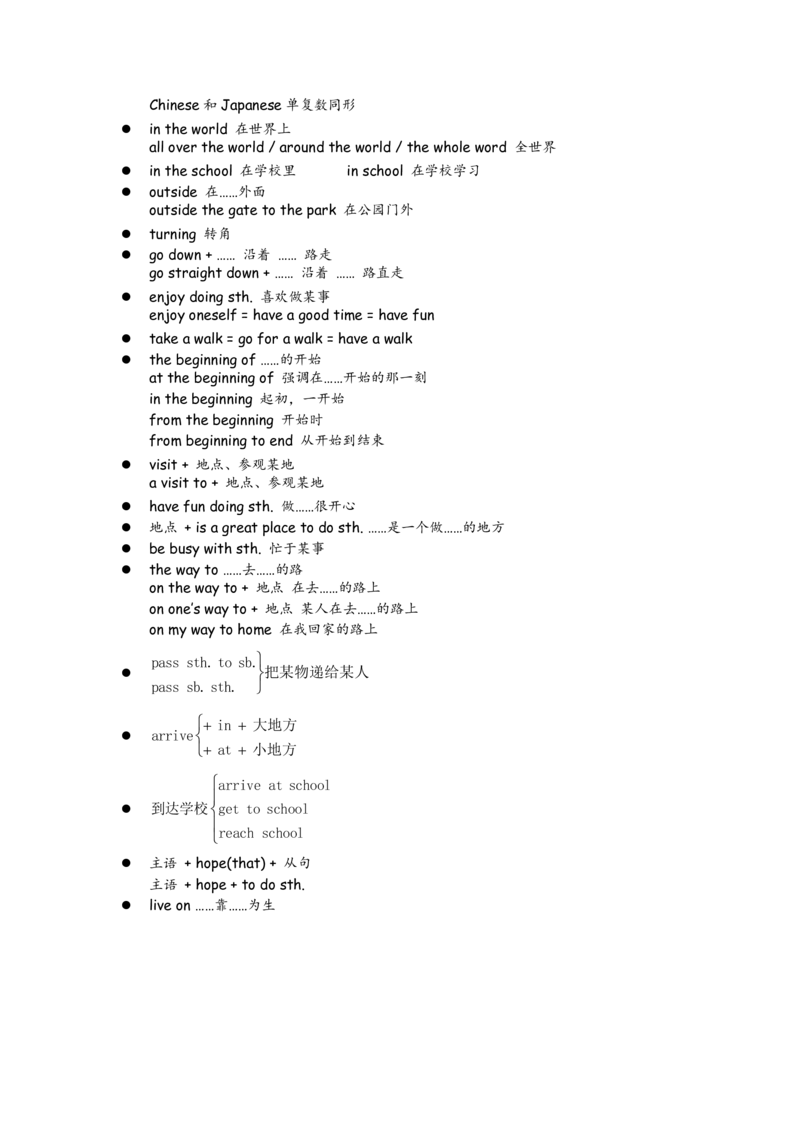
Chinese 和Japanese 单复数同形
in the world 在世界上
all over the world / around the world / the whole word 全世界
in the school 在学校里
in school 在学校学习
outside 在……外面
outside the gate to the park 在公园门外
turning 转角
go down + …… 沿着 …… 路走
go straight down + …… 沿着 …… 路直走
enjoy doing sth. 喜欢做某事
enjoy oneself = have a good time = have fun
take a walk = go for a walk = have a walk
the beginning of ……的开始
at the beginning of 强调在……开始的那一刻
in the beginning 起初,一开始
from the beginning 开始时
from beginning to end 从开始到结束
visit + 地点、参观某地
a visit to + 地点、参观某地
have fun doing sth. 做……很开心
地点 + is a great place to do sth. ……是一个做……的地方
be busy with sth. 忙于某事
the way to ……去……的路
on the way to + 地点 在去……的路上
on one’s way to + 地点 某人在去……的路上
on my way to home 在我回家的路上
把某物递给某人
sth.
sb.
pass
sb.
to
sth.
pass
小地方
at
大地方
in
arrive
school
reach
school
to
get
school
at
arrive
到达学校
主语 + hope(that) + 从句
主语 + hope + to do sth.
live on ……靠……为生
主语为人
主语为物(强调金钱)
时间、金钱
主语为人
时间、金钱
做某事要花某人多少
时间、金钱
主语为物
花费
pay
yuan.
3
me
costs
book
This
cost
sth.
doing
sth./(in)
on
spend
spend
sth.
do
.
to
sb.
It takes
take
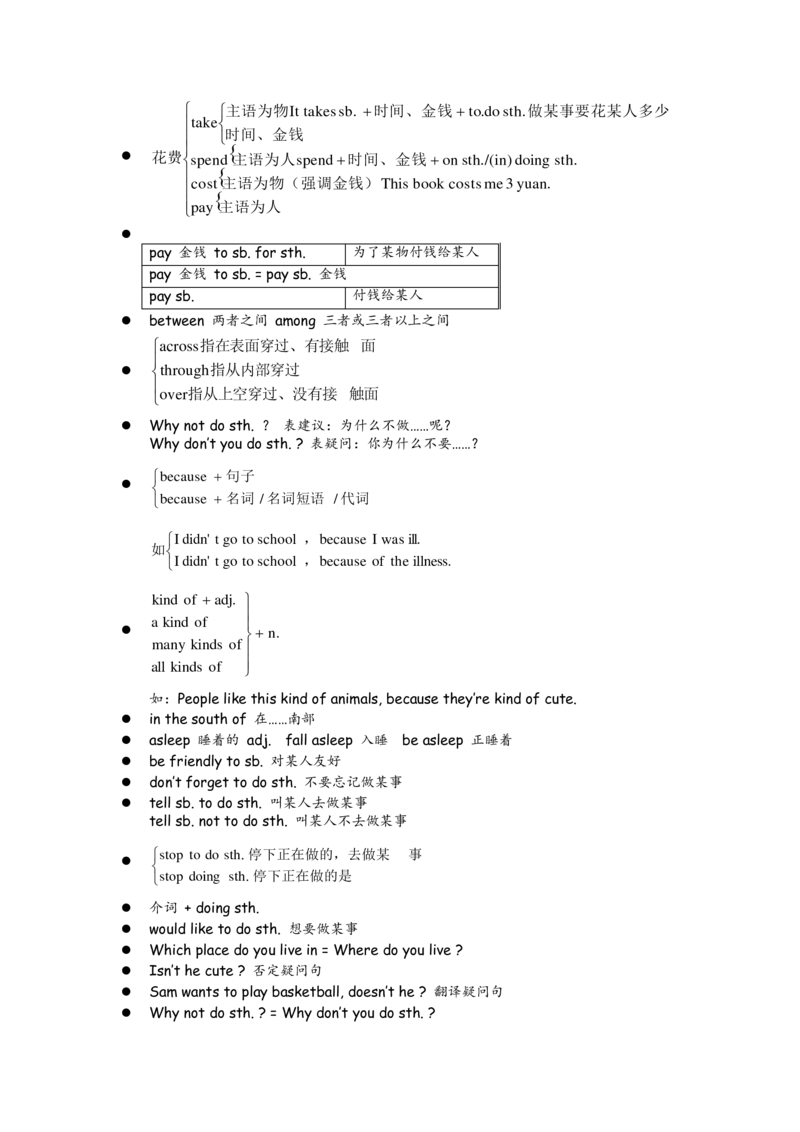
pay 金钱 to sb. for sth.
为了某物付钱给某人
pay 金钱 to sb. = pay sb. 金钱
pay sb.
付钱给某人
between 两者之间 among 三者或三者以上之间
触面
指从上空穿过、没有接
指从内部穿过
面
指在表面穿过、有接触
over
through
across
Why not do sth. ? 表建议:为什么不做……呢?
Why don’t you do sth. ? 表疑问:你为什么不要……?
代词
名词短语
名词
句子
/
/
because
because
illness.
the
of
because
school
to
go
t
didn'
I
ill.
was
I
because
school
to
go
t
didn'
I
,
,
如
.n
of
kinds
all
of
kinds
many
of
kind
a
adj.
of
kind
如:People like this kind of animals, because they’re kind of cute.
in the south of 在……南部
asleep 睡着的 adj. fall asleep 入睡 be asleep 正睡着
be friendly to sb. 对某人友好
don’t forget to do sth. 不要忘记做某事
tell sb. to do sth. 叫某人去做某事
tell sb. not to do sth. 叫某人不去做某事
停下正在做的是
事
停下正在做的,去做某
sth.
doing
stop
sth.
do
to
stop
介词 + doing sth.
would like to do sth. 想要做某事
Which place do you live in = Where do you live ?
Isn’t he cute ? 否定疑问句
Sam wants to play basketball, doesn’t he ? 翻译疑问句
Why not do sth. ? = Why don’t you do sth. ?
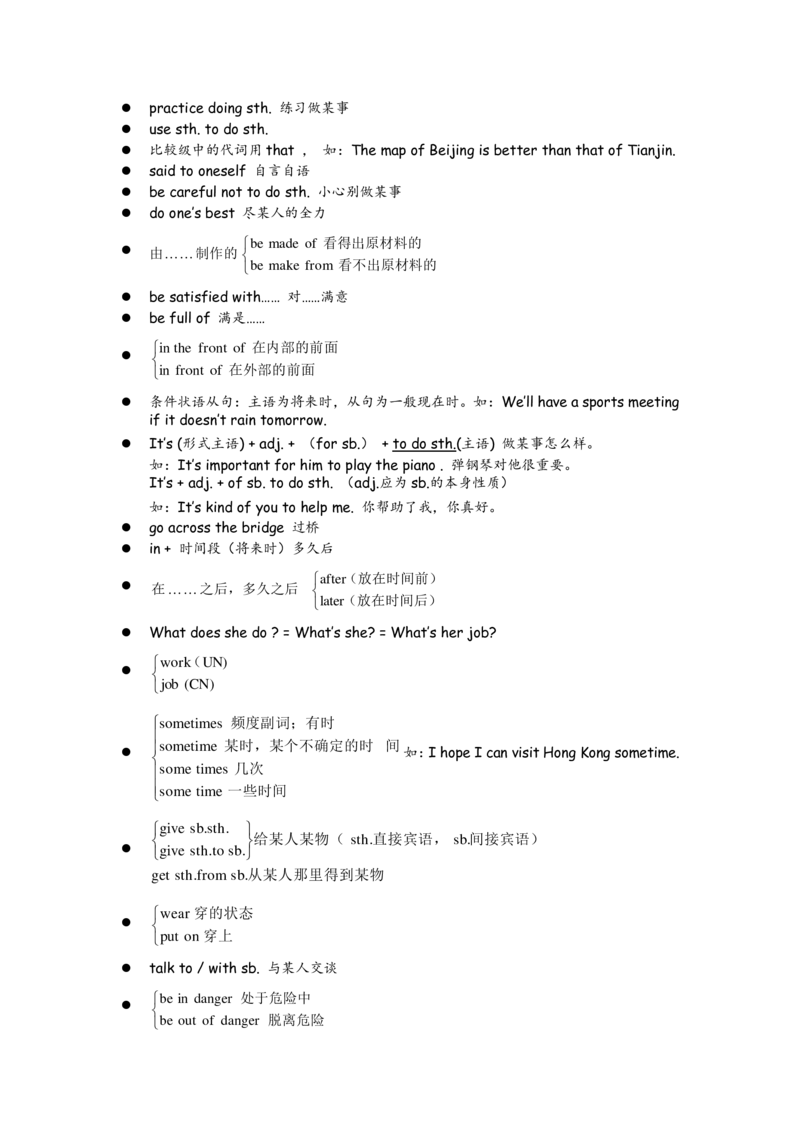
practice doing sth. 练习做某事
use sth. to do sth.
比较级中的代词用that , 如:The map of Beijing is better than that of Tianjin.
said to oneself 自言自语
be careful not to do sth. 小心别做某事
do one’s best 尽某人的全力
看不出原材料的
看得出原材料的
制作的
由
from
make
be
of
made
be
be satisfied with…… 对……满意
be full of 满是……
在外部的前面
在内部的前面
of
front
in
of
front
in the
条件状语从句:主语为将来时,从句为一般现在时。如:We’ll have a sports meeting
if it doesn’t rain tomorrow.
It’s (形式主语) + adj. + (for sb.) + to do sth.(主语) 做某事怎么样。
如:It’s important for him to play the piano . 弹钢琴对他很重要。
It’s + adj. + of sb. to do sth. (adj.应为sb.的本身性质)
如:It’s kind of you to help me. 你帮助了我,你真好。
go across the bridge 过桥
in + 时间段(将来时)多久后
(放在时间后)
(放在时间前)
之后,多久之后
在
later
after
What does she do ? = What’s she? = What’s her job?
(CN)
job
UN)
work (
一些时间
几次
间
某时,某个不确定的时
频度副词;有时
time
some
times
some
sometime
sometimes
如:I hope I can visit Hong Kong sometime.
从某人那里得到某物
间接宾语)
直接宾语,
给某人某物(
.
sb
from
.
sth
get
.
sb
.
sth
sb.
to
.
sth
give
.
sth
.
sb
give
穿上
穿的状态
on
put
wear
talk to / with sb. 与某人交谈
脱离危险
处于危险中
danger
of
out
be
danger
in
be
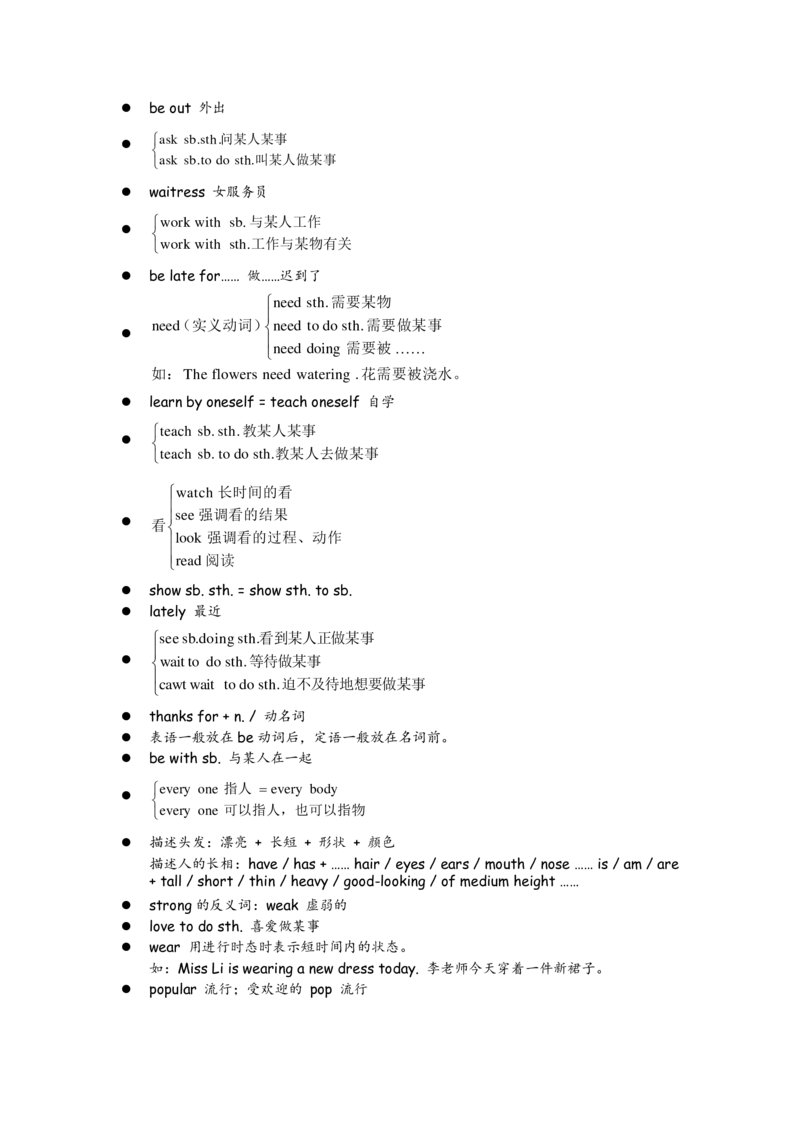
be out 外出
叫某人做某事
问某人某事
sth.
do
to
.
sb
ask
.
sth
.
sb
ask
waitress 女服务员
sth.
work with
sb.
work with
工作与某物有关
与某人工作
be late for…… 做……迟到了
花需要被浇水。
如:
需要被
需要做某事
需要某物
(实义动词)
.
watering
need
flowers
The
doing
need
sth.
do
to
need
sth.
need
need
learn by oneself = teach oneself 自学
sth.
do
to
sb.
teach
.
sth
sb.
teach
教某人去做某事
教某人某事
阅读
强调看的过程、动作
强调看的结果
长时间的看
看
read
look
see
watch
show sb. sth. = show sth. to sb.
lately 最近
迫不及待地想要做某事
等待做某事
看到某人正做某事
sth.
do
to
cawt wait
sth.
do
wait to
sth.
doing
.
sb
see
thanks for + n. / 动名词
表语一般放在be 动词后,定语一般放在名词前。
be with sb. 与某人在一起
可以指人,也可以指物
指人
one
every
body
every
one
every
描述头发:漂亮 + 长短 + 形状 + 颜色
描述人的长相:have / has + …… hair / eyes / ears / mouth / nose …… is / am / are
+ tall / short / thin / heavy / good-looking / of medium height ……
strong 的反义词:weak 虚弱的
love to do sth. 喜爱做某事
wear 用进行时态时表示短时间内的状态。
如:Miss Li is wearing a new dress today. 李老师今天穿着一件新裙子。
popular 流行;受欢迎的 pop 流行
漂亮;英俊
的
相貌不好看的;相貌丑
相貌平平
性或物)
外在美或内在美(指女
)
外在美(指男性或女性
handsome
looking
-
ugly
looking
-
ordinary
beautiful
looking
-
good
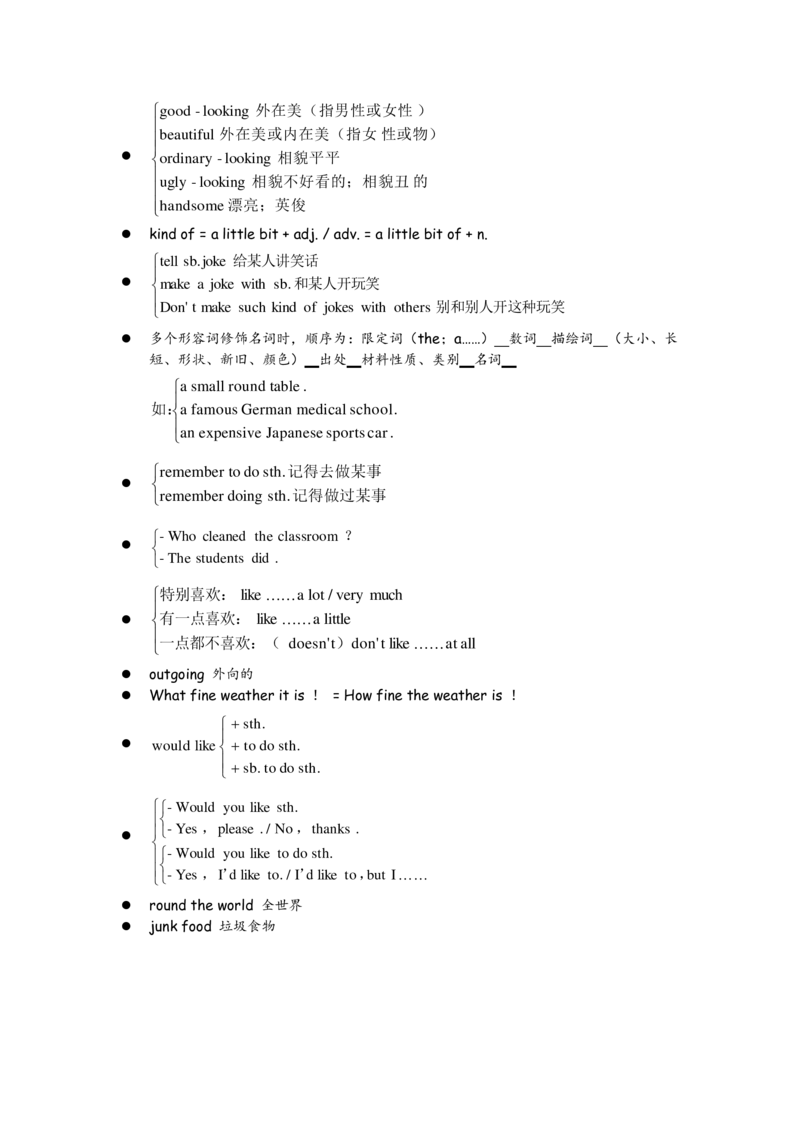
kind of = a little bit + adj. / adv. = a little bit of + n.
别和别人开这种玩笑
和某人开玩笑
给某人讲笑话
others
with
jokes
of
kind
such
make
t
Don'
sb.
with
joke
a
make
joke
.
sb
tell
多个形容词修饰名词时,顺序为:限定词(the;a……) 数词 描绘词 (大小、长
短、形状、新旧、颜色) 出处 材料性质、类别 名词
.
car
sports
Japanese
expensive
an
.
school
medical
German
famous
a
.
table
round
small
a
如:
记得做过某事
记得去做某事
sth.
doing
remember
sth.
do
o
remember t
.
did
students
The
-
classroom
the
cleaned
Who
-
?
all
at
like
t
don'
t
doesn'
little
a
like
much
lot / very
a
like
)
一点都不喜欢:(
有一点喜欢:
特别喜欢:
outgoing 外向的
What fine weather it is ! = How fine the weather is !
sth.
do
to
sb.
sth.
do
to
sth.
like
would
I
but
to
like
d
I
/
to.
like
d
I
Yes
-
sth.
do
to
like
you
Would
-
.
thanks
No
/
.
please
Yes
-
sth.
like
you
Would
-
,
’
’
,
,
,
round the world 全世界
junk food 垃圾食物
.
late
being
for
reasons
your
me
give
/
sth.
doing
for
reason
the
give
sth.
for
reason
the
give
sth.
do
reason to
a
make
如:
做某事的理由
给出某事
为做某事编一个理由
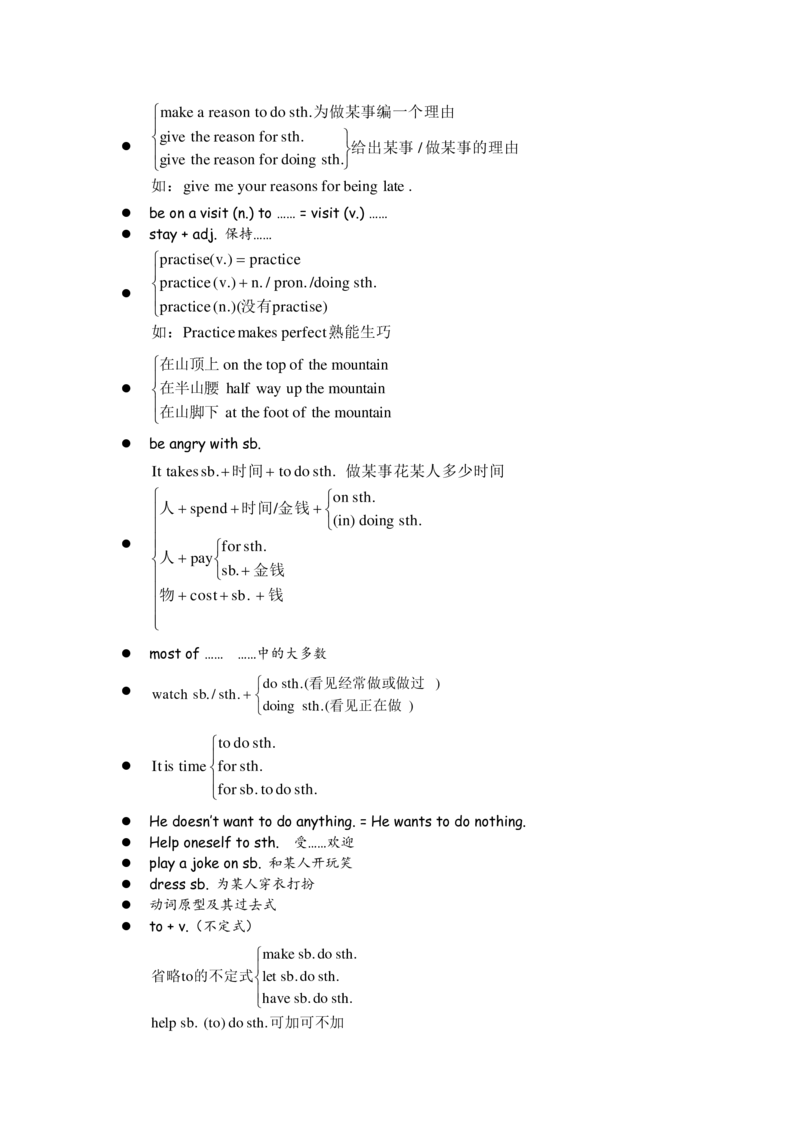
be on a visit (n.) to …… = visit (v.) ……
stay + adj. 保持……
熟能生巧
如:
没有
perfect
makes
Practice
practise)
(n.)(
practice
sth.
/doing
pron.
/
n.
.)
v
(
practice
practice
.)
v
(
practise
mountain
the
of
foot
at the
mountain
the
up
way
half
mountain
the
of
top
on the
在山脚下
在半山腰
在山顶上
be angry with sb.
钱
物
金钱
人
金钱
时间
人
做某事花某人多少时间
时间
sb.
cost
.
sb
sth.
for
pay
sth.
doing
(in)
sth.
on
/
spend
sth.
do
to
sb.
It takes
most of …… ……中的大多数
)
.(
sth
doing
)
.(
sth
do
.
sth
/.
sb
watch
看见正在做
看见经常做或做过
sth.
do
to
sb.
for
sth.
for
sth.
do
to
time
is
It
He doesn’t want to do anything. = He wants to do nothing.
Help oneself to sth. 受……欢迎
play a joke on sb. 和某人开玩笑
dress sb. 为某人穿衣打扮
动词原型及其过去式
to + v.(不定式)
可加可不加
的不定式
省略
sth.
do
(to)
sb.
help
sth.
do
sb.
have
sth.
do
sb.
let
sth.
do
sb.
make
to
another + n.(单)
|
|
名词
知识点总结
顾名思义,名词指的是表示事物名称的词,分为专有名词和普通名词。专有名
词包括人名、地名、时间名、报刊名、单位团地名等专有的名称,第一个字母大
写,例如Lily, China, Sunday, The Times, Class One 等。普通名词分为可数
和不可数名词。可数名词表示一个的时候用单数形式,即原形,如a box. 表示
一个以上用复数形式,如two boxes. 不可数名词一般没有复数形式,表示数量
时要借助于a piece of, a glass of, a cup of 等短语,如two pieces of paper.
另外,名词中还涉及到名词所有格问题。名词所有格表示名词之间的所有关
系。有两种表示形式:一种是's 所有格,常表示有生命的事物,如Ann's book;
另一种是of 所有格,常表示无生命的事物, 如the door of the room.。
注意:
1 . 可数名词复数的规则变化:一般情况下在词尾加 s.如map-maps 以字母
s,x ,ch ,sh 等结尾的名词加 es,如 bus-buses,watch-watches 以辅音字母+y
结尾的名词,先变y 为i,再加es.例词:country-countries 以 f/fe 一般变 f/fe
为v 加es,例词:leaf-leaves,thief-thieves以 o 结尾的名词加s 或es.对于
初中阶段,以 o 结尾的表示有生命的名词加es,如 tomato-tomatoes;以 o 结
尾的表示无生命的名词加s ,如zoo-zoos。
2 . 可数名词复数的不规则变化:常见的不规则变化名词有
man-men,woman-women,child-children,ox-oxengoose-geese,tooth-teeth,foo
t-feet,penny-pence,mouse-miceChinese-Chinese等。
3 . 以 s 结尾的名词复数,变所有格时在s 后加“' ”,不以s 结尾的名词复数,
在词尾加“'s”.
常见考法
对于名词的考察,通常是以单项选择或词语运用形式考查名词
词义及其用法,以及学生在具体语言环境中灵活运用名词的能力。
误区提醒
准确使用名词所有格,尤其是作定语,关键是判断出所有关系。
准确使用专有名词,记住月份,星期,国名,语言,著名景点
的名称,尤其注意首字母大写。
辨别并准确使用不可数名词 、可数名词及其复数。
表示不可数名词的量,要注意用哪个量词及量词的单复数。
典型例题1:The doctor saved three _____ lives
yesterday..
A.children's B. children' C. child D. child's
解析:本题考查名词复数及所有格的用法。题中three 决定了后面要用复数
children,而children 和lives 又构成所有关系“三个孩子的生命”,并且
children 不是以s 结尾的名词复数,所以用child 的复数所有格children's。
答案:A
典型例题2:-Would you like some
drinks,boys ? -Yes ,__________,
please.
A.some oranges B.two boxes of
oranges C. some cakes D.two
boxes of orange
解析:根据题意“你们想喝点饮料吗?”,选项应该为饮料,故排除C;而在作
为桔汁来讲的时候,是不可数名词,没有复数,故排除A 和B;
答案:D
总结升华:在做涉及到名词的习题时,要从名词的数,名词所用格等方面考虑全
面。
数词
知识点总结
数词分为基数词和序数词两种;
(一)基数词在英语中表示数目的词称为基数词。
1.基数词的构成
(1)1-20
one,two,three,four,five,six,seven,eight,nine,ten,eleven,twelve,thirte
en,fourteen,fifteen,
sixteen,seventeen,eighteen,nineteen,twenty
(2)21-99 先说“几十”,再说“几”,中间加连字符。
23→twenty-three,34→thirty-four,
(3)101—999 先说“几百”,再加and,再加末两位数或末位数;
586→five hundred and eighty-six,803→eight hundred and three
(4)l,000 以上,先从右往左数,每三位数加一个“,”,第一个“,”前为thousand.
第二个“,”前为million,第三个“,”前为billion,然后一节一节地表示。
9,785→nine thousand, seven hundred and eighty-five
6,260,309→six million two hundred and sixty thousand three
hundred and nine
750,000,000,000→seven hundred and fifty, billion
2.基数词的用法
(1)表示数量
Eg. 一 How many books would you like ?
一I would like two.
(2)表示号码
eg.My phone number is 6887789.
(3)表示时间
eg.I watch CCTV News at seven o ’clock every evening.
(4)表示“…十”的数词的复数可以表示人的岁数或年代。
eg. He is in his early thirties.他有三十来岁(31—34 岁):
This took place in the 1930s.这事发生在二十世纪三十年代;
(5)表具体数字时,hundred,thousand,million 用单数。
eg. There are six hundred students in our grade.
(6)表不确定的数字时,数词用复数。若带名词,再加of ,hundreds of(数
百,成百上千 的),thousands of(数干,成千上万的),millions of
(数百万)
eg 。 Hundreds of old people died of cold last winter.
(二)序数词在英语中表示顺序、次序的词称为序数词。
1.序数词的构成
(1)一般在基数词后加th, eg.four→fourth,thirteen→thirteenth,多位数
把个位变序数词。
基数词变为序数词的规则(口诀):
基变序,有规律,词尾加上 th;一、二、三特殊记,结尾t、d、d。
八减t,九减e,f要把ve替。ty把y改为i,记得th前有个e。
2.序数词的用法
(1.)the+序数词,表示“第几”
John lives on the fifteenth floor
(2).a\an+序数词,表达"再一,又一"
eg.We'll have to do it a second time.
(3)年月日的表达
年用基数词表示,日用序数词表示
(4)分数的表达
分子用基数词,分母用序数词。分子大于1,分母加-s。
(5)序数词也可以用作副词,
When did you first see him?
(6)基数词也能表示顺序,如书刊的页的数目,住所、房间、教室、电话号码
等等。
Page Eight, Room 304,Class Seven,
(7).倍数表示法
主语+谓语+倍数(或分数)+ as + adj. + as I have three times as many
as you.
我有你三倍那么多。
(8)在…世纪:
in the twenty-first century
常见考法
对于数词的考查,通常是以单项选择、词语运用或听力形式考查学
生在具体语言环境中灵活运用数词的能力。
误区提醒
1.在具体语境中正确使用序数词,并能正确书写序数词。
2.在听力中听辨数字和号码,要速记且准确。
3. hundreds of,thousands of,millions of 表示约数时的用法。
典型例题1:In _____,Mr.Li began to learn English.
A.his 1990 B. the 1990s C the 1990 D a
1990
解析:从题意中可判断出要表达时间,如果是1990 年,那么直接就是in 1990
就可以了, C 和D 排除掉,人是不可能有1990 岁的,排除A,B 表达的是“十
八世纪 九十年代”。
答案:B
典型例题2: September is _________(九) month of the year.
解析:这是一道填空题,考查序数词的拼写。序数词前加the, 故用the ninth.
连词
知识点总结
连词是一种连接词与词,短语与短语以及句与句的虚词, 它不
能独立担任句子成分而只起连接作用。连词主要可分为两类:并列连词和从属连
词。
一、并列连词用来连接平行的词、词组和分句。并列连词连接的双方是对等的。
常有的并列连词有and, both…and(两者都), neither…nor(既不……也
不……), not only…but also(不但…而且), as well as 等。但如果连接
的两部分意义不趋向一致,意义有转折的并列连词有:but(但是), however(然
而), while (而),only (只不过)。还有表示选择关系的并列连词,如:or,
either…or(或者…或者…), 再有的是连接双方,互为因果,或表示前因后果
的连词有:for(因为), so(所以), therefore (因此)等。
例句: She plays not only the piano, but (also) the guitar.
二、从属连词,在初中范围内常常考查引导状语从句、宾语从句的从属连词。其
中有时间状语从句,常用的连接词有:when, while, as, since, before, after,
once, as soon as, until, till 连接条件状语的连词有:if, unless, as long
as 等,而原因状语的连接词有because, since, as, now that ( 既然)。目的、
结果、方式、比较、地点等状语从句的连接词有:so that, so…that, such…
that, as…as, than, where… 它们在句子与文章中几乎无处不见。用来连接宾
语从句,如:that, if, whether。例句如下:
Tom will call me as soon as he gets to Shanghai.
The meeting didn't start until everyone was there.
I want to know if she is going to see a film.
常见考法
对于连词,主要以单项选择或完形填空的形式从意义和功能(重
点是意义)角度考查学生灵活运用连词的能力。在题中,要分清上下句之间的逻
辑关系是转折还是并列,或是选择,在从属连词中,会给出我们一个语境,让我
们判断该用哪个连词。
典型例题1: Betty didn't go to see the film yesterday ___ she was ill.
A.
because
B.
but C. until D. If
解析:本题通过语境考查从属连词的用法。只要明白语境,分清选项中四个连词
的用法,就能选出正确答案。“她生病了”是“Betty 昨天没有去看电影”的原
因,显然,应用表示因果关系的 because 。
答案:A
典型例题2:Nancy looked around, didn't see anybody.
A and B so C but
D because
解析:这是2007 年南通的中考题,本题考查并列连词的用法。题干的意思是
“向 四周看,但是她没有看到任何人”。四个选项中but 是“但是”的
意思。
答案: C
误区提醒
1、neither …nor(既不……也不……), not only…but also(不但…而且),
either…or(或者…或者…)连接主语,谓语动词要采用就近原则。例如:Neither
you nor he is to blame.(注意:谓语动词采用就近原则,与nor 后的词保持
一致。)
2、because 和 so,but 和though 不能同时用。在汉语中它们是一组关联词,
经常在一起出现,但在英语中,只能用其中一个。例如:Because he got up late,so
he didn't catch the bus.这句话就错了,我们要么去掉Because,要么去掉so。
副词
知识点总结
学完了形容词,副词学起来会更容易一些。一般认为形容词+ly
就变成了副词,如形容词quick 加上-ly 变成副词quickly。但是副词并不是那
么简单哟!副词是一种用来修饰动词,形容词,全句的词,说明时间,地点,程度,方
式等概念,一般放在行为在动词之前,be 动词、助动词之后。副词的种类有:
1.一般副词主要分为以下几种:
①.时间副词, 如: often, always, early, now
②.地点副词, 如: here, there, above, outside
③.方式副词, 如: hard, well, badly, fast, slowly
④.程度副词, 如: very, quite, much, still, almost
2.疑问副词(放在特殊疑问句的句首), 如: how, when, where,
why
3.关系副词(放在定语从句句首), 如: when, where, why
4.连接副词(放在名词从句句首), 如: how, when, where, why,
whether
一、副词在句中的作用: 副词修饰动词, 形容词, 名词, 副词
或全句, 在句中的作用如下
1.作状语:
You should always review your lessons.
He works hard. 他工作努力。
2.作表语: The class is over.
3.作定语: 副词作定语时置于被修饰词之后
The comrades here give us a lot of help.
4.作补语(包括宾语补足语和主语补足语):
I found all the lights on when I got home last night.
二、副 词 的 比 较 等 级:
副词和形容词一样,也有它的比较级和最高级形式,并且变化规则也是一
样的。
单音节副词的比较级是在副词后面加上 -er 构成的,最高级是
在副词后面加上 -est 构成的。例如:near nearer nearest
多音节副词(多以 -ly 结尾)的比较级是在副词的前面加上
-more 构成的。 最高级是在副词前面加上 -most 构成的. 例如;warmly
more warmly most warmly
有些副词的比较级和最高级形式是不规则的:
well-better - best little - less - least
much- more - most badly - worse - worst
far-farther(further)-farthest(furthest)
副词的比较级和最高级用法同形容词的比较级用法基本一样,
两者比较用比较级,三者或以上用最高级,但是副词最高级形式句中 the 可以
省略。例如:
Lucy gets up earlier than Lili. 露西比丽丽起床早。
He runs fastest in our class. 他在我们班跑地最快。
当然,形容词比较等级的各个特殊用法,也同样适用于副词。
比如“the + 比较级……,the + 比较级……”,表示“越……,越……”:He was
too tired that he ran more and more slowly.他太累了以至于跑的越来越慢。
常见考法
对于副词的考查,多以单选或词语运用的形式考查学生在具体
语境中灵活运用副词的能力,尤其是在各种比较句型中灵活运用副词。例如:
He walked (quiet) into the classroom.
解析:本题考查学生是否能熟练分辨形容词和副词的用法。“轻轻地走进”,副词
修饰动词,所以quiet 变为副词quietly,.我们要牢记“动+副”这种结构。
答案:quietly
误区提醒
象friendly , lovely 虽然以 ly 结尾,但实则是形容词,She
is friendly to me (她对我很友好。)可千万不要误认为是副词哟!. 另外,early
的比较等级为规则变化, early -earlier -earliest ,要记住啊!
例题:My mother often gets up (早)than me.
解析:很明显是两人对比,所以应用比较级,early 的比较等
级为规则变化,early -earlier 。
答案:earlier
代词
知识点总结
动词,就是表示动作和状态的词。根据其在句中的功能,动词
可分为四类,分别是:实义动词、系动词、助动词、情态动词。
一、实义动词
实义动词又叫行为动词,分成及物动词和不及物动词 。
1、及物动词是必须带宾语的动词,可分为如下两类。 1) 及物动词+宾语例:I
love my home. 我爱我家。 He bought an English dictionary. 他买了一本
英语词典。 2) 及物动词+间接宾语+直接宾语例:She taught us maths. 她
教我们数学。 My mother gave me a new pen. 母亲给了我一支新钢笔。提示:
常用的能接双宾语的及物动词有:give, teach, buy, lend, find, hand, leave,
sell, show, read, pay, make, offer, build, pass, bring, cook 等。
2、 不及物动词不及物动词不需要跟宾语,本身意义完整。例:She came last week.
她上周来的。 It is raining hard. 正下着大雨。 Class began at half past
seven. 7 点半开始上课。 What happened yesterday? 昨天发生了什么事?
3、同一动词有时可用作及物动词,有时可用作不及物动词。例如:She can dance
and sing. 她能唱歌又能跳舞。(sing 在此用作不及物动词。) She can
sing many English songs. 她能唱好多首英文歌曲。(sing 用作及物动词。)
二、系动词
系动词不能单独作谓语,后面必须跟表语构成合成式谓语。表
语通常由名词、形容词,或相当于名词或形容词的词或短语等充当,说明主语是什
么或怎么样。连系动词有 be, seem, look, become, get, grow, feel, appear,
remain, turn。
例如: The story sounds true. Those oranges taste
good.
三、助动词
协助主要动词构成谓语动词词组的词叫助动词。 助动词自身没
有词义,不可单独使用,只能在实义动词和系动词前构成谓语的时态、语态以及
否定式和疑问式。它没有对应的汉译,例如: He doesn't like English. 他不
喜欢英语。 (doesn't 是助动词,无词义;like 是主要动词,有词义) He is singing.
他在唱歌。(is 是助动词,无词义,构成现在进行时)
四、情态动词
情态动词是一种本身有一定的词义,表示说话人对有关行为或
事物的态度和看法,认为其可能、应该或必要等,不能单独作谓语,情态动词后
面加动词原形。情态动词无人称和数的变化, 情态动词后面跟的动词需用原形,
否定式构成是在情态动词后面加 "not"。常用的情态动词有 :
Can(could) (能,会) 如:I can swim. 我会游泳。
May(might) (可以) 如: You may go now. 你现在可以走了。
Must (必须) 如:You must do your homework. 你必须写作业。
Need (需要) 如:He needs our help. 他需要我们的帮助。
注意:1、情态动词表推测在肯定句中一般用must (一定),can, could(可能),
might /may(也许,或许)。否定句中用can’t / couldn’t(不可能)。例如:
It can’t be the headmaster. He has gone to America. 这不可能是校长,
他去美国了。
2、can 和could 表示允许的用法:表示现在的允许时,若是请求别人允许自己
做某事,两者均可用,但用could 语气更委婉;若是自己允许别人做某事,一
般只用 can,而不用 could。如: Can [Could] I come in? 我可以进来吗?
3、must 和have to 的用法 表示必须、必要。(must 表示主观多一些而have
to 则表示客观多一些)如: You must come in time. 你必须及时过
来。
回答must 引出的问句时,如果是否定的回答,不能用mustn't,而要用needn't
或don't have to。 — Must we hand in our exercise books today? —
Yes, you must. (No, you don’t have to.) —我们今天必须交上练习册
吗? —是的。(不,不必。)
4、need 表示“需要”或“必须”,作情态动词时,仅用于否定句或疑问句中,
后跟动词原形。Need 还常用作实义动词,有时态、人称和数的变化,后面通常
接名词、代词和带to 的不定式,
Do you need a dictionary? 你需要词典吗?
You needn't give it back before Friday. 你不必在星期五前还我。
常见考法
对于动词的考查,通常会在单选,词语运用和完形填空中出现。
除了考查时态和语态外,只要考查实义动词的固定短语,系动词和情态动词的灵
活运用。
典型例题:--Must I return the magazine to you right now,Sandy/
--No,you .you may keep it until next
Wednesday.
A. needn't B. can't C. must D. may
解析:本题考查情态动词must 构成的疑问句的回答方式。否定回答应该用
needn't 。
答案:A
误区提醒
汉语和英语的动词有较大差异,而学习者在学习是往往容易套
用汉语,从而混淆意思相近而用法不同的词或词组,也容易混淆词形相近而意思
不同的词或词组,例如look for 和find, listen 和 hear。所以我们在学习中
要认真分析不同的词或词组。
典型例题:They had to ___the 800--meter race because of the bad weather.
A put on B put off C get
on D get up
解析:本题考查四个动词短语的区别。put on “穿上,戴上”; put off“推迟”;
get on “上车”; get up“起床”。根据语境,应选put off。
答案:B
介词
知识点总结
介词是一种用来表示词词, 词与句之间的关系的词。在句中不
能单独作句字成分。介词后面一般有名词代词或相当于名词的其他词类,短语或
从句作它的宾语。介词和它的宾语构成介词词组,在句中作状语,表语,补语或
介词宾语。
一、表示时间的介词
时间介词有
in , on ,at , after , since ,
during,by,before,after,until 等,前三个介词用法有个口诀: at 午夜、点与
分,上午、下午、晚用in。
年、月、年月、季节、周,之前加上介词in。
将来时态多久后,这些情形亦用in。
日子、日期、年月日,星期之前要用on。
其余几组常见的时间介词辨析如下辨析如下:
1、时间介词in 与after 的用法辨析
介词 in + 一段时间用于一般将来时。如:We’ll go to school
in two weeks.
介词after + 一段时间用于一般过去时。如:My mother came
home after half an hour.
介词after + 时间点常用于一般将来时。如:We’ll go out
for a walk after supper.
2、时间介词for 与since 的用法辨析
介词for 表示一段时间如:I have been living here for 10
years.
介词since 表示从过去某一时间以来如:I have been living
here since 2000.
3、时间介词before 与by 的用法辨析
介词before 表示“在…之前”如:He won’t come back before
five .
介词by 表示“到…时为止,不迟于…”如:The work must be
finished by Friday.
4、时间介词during 与for 的用法辨析
当所指的时间起止分明时用介词during 如:He swims every day
during the summer.
如果一段时间不明确则用介词for 如:I haven’t seen her for
years.
5、时间介词till 与until 用法的异同
till 和until 用在肯定句中,均可表示“直到…为止”,如:I
will wait till(until)seven o'clock.
till 和until 用在否定句中,均可表示“在…以前”或“直到…
才”。
如:Tom didn't come back till(until)midnight.
till 多用于普通文体,而 until 则用于多种文体,并且在句子
开头时,用until 而不用till 如:Until he comes back,nothing can be done.
注意:在last, next, this, that, some, every 等词之前一
律不用介词。
二、表示方位的介词
常用的表示方位的介词用法及辨析如下:
1、方位介词on, over, above 的用法辨析
介词on 表示一物放在另一物上面,两者紧贴在一起,如:The
book is on the table.
介词over 表示一种垂直悬空的上下关系,即“在…上方”,如:
Is there any bridge over the river?
介词above 表示一般的“高于…”,“在…之上”,如:There was
an electric clock above his bed.
2、方位介词under 与below 的用法辨析
介词under 是over 的反义词即“在…下方”,如:They were seen
under the tree.
介词below 是above 的反义词即“低于…”,“在…之下”,如:
They live below us.
3、方位介词across,、through、over,、past 的用法辨析
介词across 着重于“从一头或一边到另一头或另一边”,强调
从表面穿过。
如:She went across the street to make some purchases.
介词through 着重于“穿越”,强调从一定的空间内穿过。
如:The sunlight was coming in through the window.
介词over 多表示从“上方越过”,如:He failed to go over the
mountain; he had to go round it.
介词past 表示从“面前经过”,如:Someone has just gone past
the window.
4、地点介词at 与in 的用法辨析
介词at 表示较小的地方,如家、村、乡村等,如:He lives at
a small village.
介词in 表示较大的地方,如大城市、国家、洲等,如:He lives
in Beijing.
5、表示东南西北的时候,地点介词in、on、to 的用法辨析
介词in 表示“包含”如:Beijing is in the north of China.
介词on 表示“紧邻”如:Canada lies on the north of the U.S.
介词to 表示“没接触”如:France lies to the south of England.
三、表示方式、手段、或工具的介词by,in,on,with.
1、by,in,on,表示交通方式。用by 时,交通工具前不用任何
词;用 in 和on 时,交通工具前用冠词或形容词性物主代词。例如by car=in a
car,by bike=on a bike.
2、表示手段或工具,with 后跟具体工具,如I write with a
pen;in 表示使用某种语言或墨水、颜色等原料,例如:in English.
四、介词的固定搭配
across from 在对面 look for 寻找 look after 照顾
get on with 与某人相处
agree with 同意(某人) arrive at(in) 到达 ask for 询
问 begin…with 从……开始 believe in 相信 break off 打
断 break out 爆发 bring down 降低 bring in 引进 bring up 教育,
培养 build up 建起 burn down 烧光 call back 回电话 call for 要
求约请 call on 拜访 访问 care for 喜欢 carry on 继续开
展 carry out 实行开展 check out 查明 结帐 come about 发生,
产生 come out 出来 come to 共计 达到 compare…with 与……比
较 compare to 比作 cut off 切断 date from 始于 depend on 依
靠 devote to 献于 die out 灭亡 divide up 分配 dream of 梦
想 fall off 下降 fall over 跌倒 feed on 以……为食 get down to
专心于 get through 通过
常见考法
对于介词的考察,通常是以单项选择或完形填空形式考查介词
用法,尤其是几个易混淆的代词。另外,介词与动词和形容词构成的固定搭配也
是常见的考试内容。
误区提醒
1、掌握介词固定搭配
2、准确把握介词及介词短语的基本意义和用法。
典型例题1:Peter usually gets up early the
morning.
A
in
B
on C at D of
解析;这是2008 年北京市的一道中考题,本题考查时间介词
的用法。“在早上”应为in the morning.
答案:A
典型例题2:-How do you usually go to school?
- my bike.
A By B In C On
解析; 虽然介词by 表示“乘坐”,但是它所接的名词前没有
限定词,即by bike.而本题中bike 前有限定词my,这时应用on.
答案:C
形容词
知识点总结
一、 形容词是用来描写或修饰名词或代词,说明人或事物的特征或性
质的, 形容词往往被译成“···的”。用法如下:
1.做定语。e.g. This is an old house.
2.做表语。e.g.I am sorry to hear that.
3.做宾语不足语。e.g.She made her mother angry.
4.形容词在句中的位置。 形容词做定语修饰名词时,放在名词前面。修饰
不定代词时要放在不定代词之后。
e.g.She is a clever girl.
I saw something white in the water.
5.某些形容词前加上定冠词the,可以代表一类人或东西,可以用作主语,
宾语等。做主语时当复数看待。
e.g.The old are well looked after.
We all love the beautiful.
二、 形容词的等级变化
在英语中形容词有原级,比较级和最高级之分。原级就是它们的原形,
比较级和最高级有规则变化和不规则变化。
(一)形容词的比较级和最高级变化
1.规则变化
单音节词和部分双音节词
(1) 一般在词尾加
er,est. hard---harder---hardest
great---greater---greatest
(2) 以字母
e
结尾的加
r,st. nice---nicer----nicest
able---abler----ablest
(3)重读闭音节中末尾只有一个辅音字母时,双写辅音字母,再加
er,est.
big---bigger---biggest (另外还有
fat , red ,
hot,wet,sad,mad ,thin )
(4) 以 -y 结尾,但 -y 前是辅音字母的形容词的比较级和最高级
是把 -y 去掉,加 上 -ier 和-est 构成. happy (原形) happier (比较级)
happiest (最高级)
(5)双音节和多音节形容词的比较级和最高级需用more 和 most
加在形容词前面来构成。
例
如
:
beautiful
(
原
级) difficult (原级)
more
beautiful
(
比
较
级) more difficult (比较级)
most
beautiful
(
最
高
级) most difficult (最高级)
2、 常用的不规则变化的形容词的比较级和最高级:
原级 比较级 最高级
good better best
many more most
much more most
bad worse worst
little less least
ill worse worst
far farther(further) farthest(furthest)
三、形容词比较等级的用法:
1、形容词的比较级用于两个人或事物的比较,其结构形式如下:
主语+谓语(系动词)+ 形容词比较级+than+ 对比成分。例如:Our teacher is
taller than we are. 我们老师的个子比我们的高。
比较级前面可以用even, still, yet , any, much, rather, a little, a lot,
by far 等修饰语用以加强语气或表示比较程度。
2、形容词最高级的用法: 形容词最高级用于两个以上的人和物进行
比较,形容词最高级 前必须加the,后面多用of……, in……短语表
示范围:其结构形式为:
主语+谓语(系动词)+the+形容词最高级+名词+表示范围的短语或从句。
She is the best student in her class. 她是班上最好的学生。
He is the tallest of the three boys. 他是三个男孩中最高的一个。
四、 有关比较等级的特殊句型及应注意的问题
1. “比较级 + and + 比较级”或“more and more / less and less + 原级”
结构表示“越来越……”的意思,与这类结构搭配的常用动词有grow, get,
become 等。
She felt herself becoming more and more nervous.她觉得自己越来越紧张。
it's getting colder and colder.天气越来越冷。
2. the + 比较级 + of the two + 名词。表示“两个中较···的一个'
Jane is the taller of the two children in our family. Jane 是我家两个
孩子中较高的。
3. “the + 比较级……,the + 比较级……”,表示“越……,越……”。
The more magazines you sell, the more money you will get.你卖的杂志越
多,你挣的钱就越多。
4.“...as + 形容词 + as...”或“...as + 形容词 + 名词 + as...”构成,
表示同等比较。
常见考法
对于形容词的考查,多以单选或词语运用的形式考查学生在具体语
境中灵活运用形容词的能力,尤其是在各种比较句型中灵活运用形容词。
例如: Which month is____, June, July or August?
A. hot B. hotter C. hottest D. the hottest
解析:三者及以上比较用最高级形式,形容词最高级前必须加the,所以应用the
hottest
误区提醒
在分辨比较等级时,对于易混淆形容词、副词,要谨慎对待。
典型例题:Don't just believe the ad.That kind of camera is it says.
A.as good as B.not so good as C.as well
as D.not as well as
解析:根据第二句的谓语动词be 可以确定空白处缺少表语。此处的表语应由形
容词充当,而 well 表示“好”是副词,因此排除 C 和D;根据第一句的意思我
们可以知道说话者的观点,故此排除A.
答案:B
冠词
知识点总结
说到冠词,大家一定会想到a 、an 和the,实际上,冠词就是
指这三兄弟。
1. 不定冠词的基本用法:(1)不定冠词有a 和an 两种:a 用
于辅音音素开头的词前,例如:a dog, an 用于元音音素开头的词前,例如:an
apple;(2)用来表示“—”的意思,但不强调数的观念,只说明名词为不特定
者。即不具体说明是何人何物。例如:She picked up a book and began to read.
(3)不定冠词含有“—”的意思,但数量观念没有one 强烈,在句子里边一般
可以不必译出,但若有“一个”的意思则译出,(4)一般用在可数名词单数前,
指人或事物的某一种类。例如:I am a nurse.(5)用在某些固定词组中,如
have a rest,a few,a lot 等。
2. 定冠词的用法:(1)特指某(些)人或某(些)事物。(2)
指双方都知道的人或事物,例如:Open the door,please. (3)指上文提到的人
或事物。(4)用在世界上独一无二的事物前。例如:The sun is bigger than the
moon.太阳比月亮大些。(5)用在序数词和形容词最高级前。例如:The first
island is the biggest of the three.第一个小岛是三个中最大的。(6)用在
形容词前表示一类人,the +形容词指的是一群人,是一种复数含义,所以其后
动词应用复数形式。例如:The old are sick.
3. 零冠词的用法 ,就是不用冠词的情况。
1) 国名,人名前通常不用定冠词:England, Mary;
2) 泛指的复数名词,表示一类人或事物时,可不用定冠词;
They are teachers. 他们是教师。
3) 抽象名词表示一般概念时,通常不加冠词;
Failure is the mother of success. 失败乃成功之母。
4) 物质名词表示一般概念时,通常不加冠词,当表示特定的意
思时,需要加定冠词;Man cannot live without water. 人离开水就无法生存。
5) 在季节、月份、节日、假日、日期、星期等表示时间的名词
之前,不加冠词;
We go to school from Monday to Friday. 我们从星期一到星
期五都上课。
6) 在三餐、球类运动和娱乐运动的名称前,不加冠词;如:have
breakfast, play chess
7) 当by 与火车等交通工具连用,表示一种方式时,中间无冠
词;by bus, by train;
8) 固定短语,如:go to hospital 去医院看病;at home, in
class,go to bed 等。
常见考法
根据对冠词部分全国各地中考试题的分析可知,冠词考查主要
在单项选择和完形填空题型之中。冠词主要考查的有:
1、 不定冠词、定冠词和零冠词的基本用法。
2、 冠词常见的习惯搭配用法。
3、 部分物质名词抽象名词具体化之后的冠词用法。
4、 冠词的位置
不定冠词a 用于辅音音素开头的单词前,an 用于元音音素开头的单词前。
典型例题1: ——Tina,could you please play____ piano for me while
I’m singing?
——With pleasure.
A. a B. an C. the D. /
解析:表示乐器的名词前应用定冠词the 。
答案: C
典型例题2: There is ____“h” in the word “hour”,but__
__“h” doesn’t make a sound.
A . a, a B. a, the C. the, an D. an, the
解析:这是一道很迷惑人的习题。第一个空很多学生认为“h”是一个辅音字母,
所以会填a,但是选择a 或an,看的是音素,即读音,而并不是字母本身,“h”
是一个辅音字母,但却是以元音音素开头,所以前面应用an;第二个空“h”第
二次出现,所以用定冠词 the 。
答案: D
误区提醒
不定冠词a 用于辅音音(而不是字母)开头的单词前,an 用于
元音音素(而不是字母)开头的单词前,例如上面典型例题2。
动名词
知识点总结
如果一个动词加上了ing 变成了名词,那么这个词称动名词。
由于动名词是由动词变化而来,它仍保留着动词的某些特征,具有动词的某些变
化形式,用以表达名词所不能表达的较为复杂的意念。动名词的名词特征表现在
它可在句子中当名词来用,作主语、宾语、表语、定语。它也可以被副词修饰或
者支配宾语。
一、动名词的作用
1、作主语
1)、 直接位于句首做主语。例如: Swimming is a good sport in summer.
2)、 用 it 作形式主语,把动名词(真实主语)置于句尾作后置主语。 动名
词做主语时,不太常用 it 作先行主语,多见于某些形容词及名词之后。例如:
It is no use telling him not to worry.
3)、动名词作主语与动词不定式作主语的比较:动词不定式和动名词都可以用作
主语。在意义上相近。但动名词多用来表示泛指或抽象动作,不定式多用来表示
特指或具体动作。比较: Smoking is not good for health. It is not
good for you to smoke so much.
2、作表语
动名词作表语时句子主语常是表示无生命的事物的名词或
what 引导的名词性从句。表语动名词与主语通常是对等的关系,表示主语的内
容,主语、表语可互换位置。
Your task is cleaning the windows. 你的任务就是擦窗户。(Cleaning the
windows is your task.)
What I hate most is being laughed at. 我最痛恨的就是被别人嘲笑。 (Being
laughed at is what I hate most.)
3、作定语
动名词作定语往往表示被修饰词的某种用途。如: a washing
machine=a machine for washing=a machine which is used for washing 。
4、作宾语
例:We are thinking of making a new plan for the next term. 我们正考虑
为下学期制定新的计划。
5、有些词后只能接动名词 ,不能跟不定式。 allow;avoid; celebrate;
consider;
discontinue;
dislike;
enjoy;
escape;
excuse;
explain; feel like; finish; forgive; can’t help; imagine; keep; it
means;mind; miss; practice; prevent;等
6、另外还有一些接-ing 形式的常用短语。 spend money/time; think of, give
up, put off, insist on, be good at, do well in, can't help, keep
on, feel like, be tired (afraid, capable, fond) of, look forward
to, be used to, devote oneself to, stick to, respond to, look forward to,
7、 有些词后面加不定式和动名词均可,例如:remember, forget, try, stop,
go on, stop,regret,, mean 后面均可用不定式和-ing 形式,但意义截然不容。
例: like doing sth 表经常性动作like to do sth 表习惯性动作;
stop doing sth,停止正在做的事情stop to do sth 停下来做另外一件事;
remember,forget,regret 的不定时结构指后于谓语动词的动作,动词的ing 形
式则先于谓语动词的动作 remember to do/doing: ①I remembered
to post the letters.(指未来/过去未来将要做的动作) ②I remembered
posting/having posted the letters. (我记得做过这个动作)
try to(努力)与try +–ing(试验): ①I tried not to go there.(我
设法不去那里)
②I tried doing it again.(我试着又干了一次);go on to do sth 继续做
某事(不是同一件事), go on doing sth 继续做某事(同一件事);
常见考法
对于动名词的考查,在单项和词语运用中出现的较多,常常考
到一些动名词的固定用法。
典型例题:Do you mind_________ me with my work.?
A.to
help B.help C.helping D.helped
解析:本题考查动名词的用法。Mind 后跟动名词,表示“介意做某事”,不可以
跟不定式。
答案:C
误区提醒
有些词后面加不定式和动名词均可,但意义截然不容,那几个
词以及两种句型的不同之处必须牢记在心,因为这是我们经常出错的地方。
典型例题:Don't forget _____ this book to John when you see him.
A. to return B. returning C. return D. to
returning
解析:本题考查forget 加不定式和动名词的区别。Forget to do 表示“忘记
曾经做过某事”,事情已经做过; forget doing 表示“忘记去做某事”,事情还
没做。根据语境“当你见到John 的时候,别忘记把这本书给他”,可知事情还
没做,应该用不定式。
答案:A
一般现在时
知识点总结
一般现在时表示现在经常反复发生的动作、存在的状态或习惯性的
动作的时态。
一、一般现在时用法如下:
1.表示现在的状态: e.g. He’s twelve. She’s at work.
2.表经常或习惯性的动作,常与表示频度的时间状语连用。: e.g. I get up at
6:30 every day.
He reads English every morning.
3.表主语具备的性格、能力和特征。 e.g. I don't like this book.
4.表示客观事实和普遍真理。The earth moves around the sun.
5. 在时间状语从句和条件状语从句中,常用一般现在时代替将来时。e.g. I'll
write to you as soon as I arrive there.
二、一般现在时构成::一般现在时用行为动词的原形,但第三人称单数作主语
时,动词要用第三人称单数形式。第三人称单数形式的变化规则是:1.一般的动
词词尾+S。2.以sh/ch/s/x 结尾的词+es.3.以辅音字母+Y 结尾的把Y 变成i,+es。
4.辅音字母+o 结尾的+es.
基本结构:
1.be 动词
肯定句: 主语+be(am,is,are)+其它。如: I am a boy.我是一个男孩。
否定句:主语+ be + not +其它。如:He is not a worker.他不是工人。
一般疑问句:Be +主语+其它。 如:-Are you a student? -Yes. I am. / No,
I'm not.
特殊疑问句:疑问词+一般疑问句。如:Where is my bike?
2.行为动词
1) 当主语为第一,二人称及复数时,助动词为do
肯定句:主语+动词原形(+其它)。如: We often play basketball after school.
否定句:主语+ don't+动词原形(+其它)。如:we don’t play basketball after
school.
一般疑问句:Do +主语+动词原形+其它?
如: Do you often play basketball after school l? Yes, we do. / No,
we don't.
特殊疑问句:疑问词+以do 开头的一般疑问句?
如: What do you often do after school ?
2) 当主语为第三人称单数时 , 助动词为does
肯定句:主语+动词三单式(+其它)。如: He swims well.
否定句:主语+ doesn’t+动词原形(+其它)。如:He doesn’t swim well..
一般:Does +主语+动词原形+其它。
如:Does he swim well ? Yes, he does. / No, he doesn't.
特殊疑问句:疑问词+以does 开头的一般疑问句?
如: How does your father go to work?
常见考法
对于一般现在时的考查,多以单选或词语运用的形式考查学生
在具体语境中灵活运用时态的能力。在考试中,会让选择be 动词,或判断用一
个动词的原型还是单三形式,或进行肯定句、否定句、疑问句之间的转换,或判
断用正确时态。这在初一阶段是一个重点。
典型例题:She will find him a kind man when she more about him.
A.
knows
B.
know
C.
will
know D. is going to know
解析:在时间、条件状语从句中,用一般现在时表将来时。She 是一个单
三人称,故用knows
答案:A。
误区提醒
当用动词第三人称单数单数时,一定要正确运用。
典型例题:Lucy (enjoy) music and she often sings songs.
解析:从often 可判断出本题表达的是经常性的事情,应该用一般现在时,主语
Lucy 是一 个人,为第三人称单数,所以enjoy 应变为单三形式,很多学生会
把enjoy 变成enjoies ,但实际上enjoy 不符合“辅音字母+Y 结尾”的条件,
所以它应变为enjoys.
答案:enjoys
现在完成时
知识点总结
现在完成时指的是过去发生并且已经完成的动作对现在造成影
响或后果,过去某一时间开始并一直持续到现在并且有可能还会持续的动作或状
态。
一、基本结构:主语+have/has+动词的过去分词
①肯定句:主语+have/has+动词的过去分词+宾语.
②否定句:主语+have/has+not+动词的过去分词)+宾语.
③一般疑问句:Have/Has+主语+动词的过去分词+宾语.
④特殊疑问句:特殊疑问词或词组+一般疑问句(have/has+主语+过去分词(V-ed)
+其他)
过去分词变化规则如下:
1 、规则动词:规则动词的过去分词的构成规则与规则动词的过去式的构成规则
相同。四点变化规则:
(
1)
一
般
动
词
,
在
词
尾
直
接
加
“
ed
” 。
work---worked---worked ,visit---visited---visited
(2)以“ e ”结尾的动词,只在词尾加“ d ”。 live---lived---lived ,
(3)以“辅音字母 + y ”结尾的动词,将 "y" 变为 "i" ,再加“ ed ”。
study---studied---studied ,cry---cried---cried
(4)重读闭音节结尾,末尾只有一个辅音字母,先双写该辅音字母,再加“ ed ”。
stop---stopped---stopped , drop---dropped--dropped
2 、 不规则动词变化需参看不规则动词表逐一熟记。例如; cut- cut-
cut,hit-- hit-- hit.
二、用法
1 、现在完成时用来表示过去发生或已经完成的动作对现在造成影响或后果。
也
就是说,动作或状态发生在过去但它的影响现在还存在,强调的是现在。
例如:I have already posted the photo.我已经把照片寄走了。强调post
对现在的影响“照片不在这里”。
2、现在完成时可以用来表示发生在过去某一时刻的,持续到现在的动作(用行为
动词表示)或状态(be 动词表示),常与for(+时间段),since(+时间点或过
去时的句子)连用.谓语动词必须是延续性动词。例如:He has lived here since
1978.自从1978 年以来,他一直住在这儿。(动作起始于1978 年,一直住到现在,
可能还要继续住下去。)
注意:for 和since 的用法。
①for+时段 为…时间
②since+过去一个时间点(译为:自从……以来)
③since+时段+ago
④since+从句(过去时)
⑤It is+时段+since+从句(过去时)
注:瞬间动词(buy,die,join,lose……)不能直接与for 或since 引导的时间
段连用。要改变成延续性动词。 变化如下: come/arrive/reach/get
to-----be in go out----be out finish----be over open----be
open die----be dead Buy---have Fall ill---be ill Come
back---be back
Put on ---be on/wear
Worry---be worried
Catch a cold---have a cold
三、现在完成时往往同表示不确定的过去时间状语连用,如already(肯定), yet
(否定,疑问), just, before, recently,still, lately,never 等.
例如:He has already finished the work..
常见考法
对于现在完成时的考查,多以单选、句型转换或词语运用的形式
考查学生在具体语境中灵活运用时态的能力。在考试中,会让大家判断是否该用
现在完成时,或者是考查“瞬间动词”不能与表示一段时间的状语连用”这一知
识点。
典型例题1:His father_____the party since 1978
A.joind B.has
joined C.was
in D.has been in
解析:本题考查学生对现在完成时的熟练掌握。 since 1978 表达“自从1978
年一直到现在”,表示这件事情从过去一直持续到现在,应该用现在完成时,而
且动词必须是延续性动词,AB 均为瞬间动词,不能与时间段连用,故排除;C
为一般过去时,也不行。
答案;D.
误区提醒
一般过去时和现在完成时的用法区别是我们要注意的地方。要
牢记:
一般过去时通常与表示过去的时间状语连用。如: yesterday, last week , two
years ago ,just now ,in 2002 等;而现在完成时则常与
just ,already ,ever ,never 等副词和 these days ,this week ,since ......,
for ...... 等表示一段时间的状语连用。现在完成时强调过去发生的动作对现
在的影响和结果,而一般过去时与现在没有联系,只是说明某个动作发生的时间
是在过去。
典型例题1: —______ you ___ your homework yet ?
—Yes . I _____ it a moment ago .
A.Did ; do ; finished B.Have ; done ;
finished C.Have ; done ; have finished
解析:本题考查一般过去时和现在完成时的用法区别。问句中的yet 表明应该用
现在完成时,而回答中的a moment ago 是一个表示过去的时间状语,应该
用一般过去时。
答案: B
一般过去时
知识点总结
一般过去时表示过去某个时间里发生的动作或状态;过去习惯
性、经常性的动作、行为;过去主语所具备的能力和性格。我们可以先记一下一
般过去时口诀:
一般过去时并不难,表示过去动作、状态记心间。
动词要用过去式,时间状语句末站。
否定句很简单,didn't 站在动词原形前,其它部分不要变。
一般疑问句也好变,did 放在句子前,主语、动原、其它部分
依次站。
特殊疑问句也简单,疑问词加一般疑问句记心间。
最后一条请注意,动词过去式要牢记。
一、基本结构
1. 肯定句形式:主语+动词过去式+其他
否定句形式:①was/were+not; ②在行为动词前加didn't,同时还原行为
动词
一般疑问句:①was/were 提到句首; ②Did+主语+do+其他?
例句She often came to help us in those days. I didn't know you were
so busy.
2. 行为动词的一般过去式。
A. 规则动词的变化规则:
1、直接加ed:work—— worked look ——looked play ——played,
2、.以e 结尾的单词,直接加d:live ——lived hope——hoped use——used,
3、以辅音字母+y结尾的,变y为i 加ed:study—— studied carry——carried
4、以元音字母+y 结尾的,直接加ed:enjoy ——enjoyed
5、 以重读闭音节结尾的,双写最后的辅音字母+ed: stop—— stopped
plan——planned
B. 规则动词过去式的发音:
在清辅音后读/t/,在元音和浊辅音后读/d/,在辅音/t/,/d/后读 /id/。
C. 不规则动词变化需参看不规则动词表逐一熟记。(一般和过去分词一起记忆)。
二、一般过去时的基本用法:
1. 通常表示过去发生的而现在已经结束的事件、动作或情况。
Eg. Sam phoned a moment ago.
I got up at eight this morning.
2. 还可以表示刚刚发生的事情而没说明时间。
Eg. Did the telephone ring?
Who left the door open?
3. 也可以表示过去的习惯性动作。
Eg. I smoked 40 cigarettes a day till I gave up.
4. 与一般过去时连用的时间状语:
yesterday, last week/Sunday/year, …ago, just now…
eg. I met Lily yesterday. I
went to Dalian last summer.
I was a good student 5 years ago. He had dinner just
now.
常见考法
对于一般过去时的考查,多以单选、句型转换或词语运用的形
式考查学生在具体语境中灵活运用时态的能力。在考试中,会让大家判断是否该
用一般过去时,或动词过去式的正确变化,或一般过去时的句型构成。
典型例题1:1. Xiao Lin went fishing this morning.(改为一般疑问句)
解析:这是一道句型转换题,考查到同学们对一般过去时的句型构成的掌握。一
般过去时的一般疑问句句型构成为:Did+主语+do+其他?,即句首加 Did,句中
过去式还原。
答案:Did Xiao Lin go fishing this morning?
误区提醒
有些句子,虽然没有表示过去确定时间的状语,但实际上是指过去发生
的动作或存在的状态的话,也要用过去时,这一点,我们中国学生往往出错,要
特别注意!
典型例题1:I didn''t know you (be)in Paris.
解析:题干意思是“我不知道你在巴黎”。因为在说话时,我已经知道你在巴黎
了。这句话指的是说话之前,所以只能用过去时表示。实际上,这句话暗指:But
now I know you are here.
答案:were
过去完成时
知识点总结
过去完成时①表示发生在过去的动作对过去晚些时候造成的影
响或结果②过去某一动作一直持续到过去晚些时候将来可能还要延续。
一、基本结构:主语+had+过去分词
①肯定句:主语+had+过去分词.
②否定句:主语+had+not+过去分词.
③一般疑问句:Had+主语+过去分词? 肯定回答:Yes,主语+had.
否定回答: No,主 语+had not .
④特殊疑问句:特殊疑问词或词组+一般疑问句(Had+主语+过
去分词)?
二、基本用法
1)表示在过去某一时刻或动作以前完成了的动作,也可以说过
去的时间关于过去的动作。即“过去的过去”。可以用by, before 等介词短语或
一个时间状语从句来表示,也可以用一个表示过去的动作来表示,还可能通过上
下文来表示。
例如:By nine o’clock last night, we had gotten 200 pictures from the
spaceship.到昨晚9 点钟,我们已经收到200 张飞船发来的图片。
2)表示由过去的某一时刻开始,一直延续到过去另一时间的动
作或状态,常和for, since 构成的时间状语连用。
例如:I had been at the bus stop for 20 minutes when a bus finally came.
当车来的时候,我在车站已等了20 分钟。 He said he had worked in that
factory since 1949.他说自从1949 年以来他就在那家工厂工作。
3)一般说来,各种时态都有特定的时间状语。与过去完成时连
用的时间状语有:
( 1 ) by + 过去的时间点。如:I had finished reading the
novel by nine o'clock last night.
( 2 ) by the end of + 过去的时间点。如:We had learned
over two thousand English words by the end of last term.
( 3 ) before + 过去的时间点。如:They had planted six
hundred trees before last Wednesday.
常见考法
对于过去完成时的考查,多以单选、词语运用的形式考查学生
在具体语境中灵活运用时态的能力。在考试中,一般会让大家判断是否该用过去
完成时。
典型例题1:We ____five English songs by the end of last
term.
A had learned B learned C have learned D will
have learned
解析:“到上学期为止,我们已经学了五首英文歌曲”,by+过去的时间点,表示
“过去的过去”,应用过去完成时。
答案:A
误区提醒
过去完成时表示“过去的过去”,是指过去某一动作之前已经发
生或完成的动作,即动作有先后关系,动作在前的用过去完成时,在后的用一般
过去时。这种用法常出现在状语从句和宾语从句中。
典型例题1:The meeting _____when Mr. Wang _____to school.
A has begun; get B has been on; get C had begun; got D had been
on; got
解析:题干的意思是“当王先生到达学校的时候,会议已经开始了”。表达两个
动作先后发生,“到达”是过去的,用一般过去时,“会议已经开始”在之前发生,
“过去的过去”,用过去完成时,排除 A 和 B。而had been on 表示会议应经进
行了多长时间,应和时间段连用,所以排除。
答案:C
一般将来时
知识点总结
顾名思义,一般将来时表示将来某一时刻的将要发生动作或状态,
或将来某一段时间内经常的动作或状态。常常和表示将来的时间状语连用,如:
tomorrow(明天), next week(下周), from now on(从现在开始);in the future
(将来)等。
一、基本结构及用法
1、will / shall + 动词原形
这种方法一般单纯地表示将来某个时间将要发生的动作或存在的状态。will 用
于各种人称will 常简略为 'll,并与主语连写在一起,如:I'll,he'll,;shall
只用于第一人称,在肯定句或否定句中表示将要或不会发生的事情或动作,在疑
问句中可以表示建议或征求对方意见。变否定句在will / shall 后加not,缩
略形式为 won't;变疑问句把will / shall 提到主语前。
例如 : I will / shall go to visit him next week. 下周我将去拜访他。
What time shall we go there tomorrow? 明天我们几点去那儿?
2、be going to 动词原形 (否定句、疑问句的变化体现在be 动词上)
1)表示计划、打算、准备做的事。
例如:We are going to put up a building here.我们打算在这里盖一座楼。
How are you going to spend your holidays?假期你准备怎样过?
2)表示即将发生或肯定要发生的事。
例如:I think it is going to snow. 我看要下雪了。
3、 用现在进行时表示
表示位置转移的动词(如:go, come, leave, start, arrive 等),可用现在进
行时表示将来时。如: Uncle Wang is coming. 王叔叔就要来了。
常见考法
对于一般将来时的考查,多以单选、句型转换或词语运用的形式考
查学生在具体语境中灵活运用时态的能力。在考试中,会让大家判断是否该用一
般将来时,以及如何正确使用。
典型例题1:He ________ her a beautiful hat on her next birthday.
A.
gives
B.
gave
C.
will
giving D. is going to give
解析:从 on her next birthday“在她下一个生日”可以看出本句说的是未来
的事,该用一般将来时,排除A 和B;而will 后应该加动词原形 ,所以排除C;
is going to give 恰好是一般将来时的正确使用。
答案:D
误区提醒
There be 结构的一般将来时,是我们容易失分的地方,我们要牢记
它的结构:
1、There will be
2、There is/are going to be
典型例题: There __________ a meeting tomorrow afternoon.
A. will be going to B. will have C. is going to
be D. is going to have
解析:本题考查的就是There be 结构的一般将来时。句首有There ,首先要考
虑There be 结构,排除有have 的选项;再根据There be 一般将来时结构判断
出正确答案。
答案:D
现在进行时
知识点总结
现在进行时,从字面上理解,就是“现在正在进行、发生的动
作”,表示动作发生的时间是“现在”,动作目前的状态是“正在进行中”。所谓
“正在进行中”,是指在谈到这件事的时候,这个动作还在进行中。至于它是什
么时候开始的,什么时候会停下来,不是我们关心的。所以“正在进行时”的事
件,可能发生几年了,也可能只有几分钟。仍在进行中这是“正在进行时”的关
键所在。它是一件持续进行的事情。
一、现在进行时的构成
现在进行时由"be+现在分词(v-ing)"构成。be 应为助动词,一定不要漏掉哟!
它应与主语的人称和数保持一致,即:I am/he/she/it 包括单数名词和不可数
名词用is,you/we/they 包括复数名词用are. 。现在分词变化规则如下:
1.动词后直接+ ing(例:sleep+ing sleeping)
2.去掉不发音的e+ing(例:bite-e+ing biting)
3.重读闭音节,且末尾只有1 个辅音字母,双写辅音字母+ing(例: sitting
sitting, beginning,getting,putting,running,stopping,cutting )
4.特殊变化:die-dying,lie-lying,tie-tying
句式构成如下:
肯定句式:主语+be( am, is, are)+现在分词+其它.
否定句式:主语+be(am, is, are) +not +现在分词+其它.
一般疑问句:Be(am, is, are) +主语+现在分词+其它? ,,
特殊疑问句:疑问词+be(am, is, are)+主语+现在分词+其它?
二、现在进行时的应用
A 表示现在( 指说话人说话时) 正在发生的事情。 例:We are waiting for
you.
B. 习惯进行:表示长期的或重复性的动作,说话时动作未必正在进行。 例:
Mr. Green is writing another novel.
(说话时并未在写,只处于写作的状态。) 例:She is learning piano under
Mr. Smith.
C.已经确定或安排好的将来活动。
I'm leaving for a trek in Nepal next week.(已经安排了) we're flying
to Paris tomorrow.(票已经拿到了)
在实际运用时,现在进行时常用以下几种情况:
(1)当句子中有now 时,常表示动作正在进行,这时要用现在进行时。如:
They are playing basketball now.现在他们正在打篮球。
(2)以look, listen 开头的句子,提示我们动作正进行,这时要用现在进行时。
如:
Listen!She is singing an English song.听,她正在唱英语歌。
(3)表示当前一段时间或现阶段正在进行的动作,且此时有this week, these
days 等时间状语,这时常用现在进行时。如:
We are making model planes these days.这些天我们在做飞机模型。
(4)描述图片中的人物的动作,也为了表达更生动。此时也常用现在进行时。如:
Look at the picture. The children are flying kites in the park.看这幅
图,那些孩子正在公园放风筝。
常见考法
对于现在进行时的考查,多以单选或词语运用的形式考查学生
在具体语境中灵活运用时态的能力。在考试中,会让大家判断是否该用现在进行
时,或填写现在分词,或进行句型转换。
典型例题1: Listen, who________(sing) in the music room?
解析:以 listen 开头,提示我们动作正进行,这时要用现在进行时。所以应用
is singing
典型例题2:The boys are visiting the history museum。(对划线部分提问)
解析:对动作提问用What,现在进行时,把are 提到主语前,加doing。
答案:What are the boys doing?
误区提醒
在口语中表示主语计划将要作的动作,用现在进行时表示将来
时,这类情况常与come 来,go 去, leave 离开,depart 离开,arrive 到达,
stay 逗留,start 开始等动词连用。所用的动词必须是动作而不是状态,主语必
须是人。
典型例题:They are (leave)for New York tomorrow.
解析:题意为“明天他们将要动身前往纽约”。虽然tomorrow 表示“明天”,表
达未来,但leave 要用现在进行时表示将来时,所以应用leaving 。
答案:leaving
过去进行时
知识点总结
从字面上理解,过去进行时指“过去的某一时间进行发生的动
作或事情”,这样的理解很正确!
一、结构
1. 过去进行时由“主语+was/were + 现在分词”构成 例
如: We were having supper when the phone rang. 我们正在吃晚饭时电话响
了。
2. 过去进行时的否定式由“was/were not +现在分词”构成
例如: This time yesterday Jack was not watching TV. He was repairing his
bike. 昨天这个时候,杰克不是在看电视,而是在修理自行车?
3. 过去进行时的疑问式由“was/were +主语+ 现在分词”构成
例如: Were you playing basketball at four yesterday afternoon? 昨天下
午四点你们在打篮球吗?
二、基本用法
1. 过去进行时的基本用法主要表示过去某一时间正在进行的
动作。
如:He fell asleep when he was reading. 他看书时睡着
了。
2、过去进行时表示感情色彩与现在进行时相似,过去进行时也
可表示满意、称赞、惊讶、厌恶等感情色彩,也通常与 always, forever,
continually 等副词连用。 如:They were always quarrelling. 他们老
是吵架。
3、常用的时间状语 this morning, the whole morning, all
day ,yesterday, from nine to ten last evening, when, while ,at that
time,.just now,a moment ago
常见考法
对于过去进行时的考查,多以单选、词语运用或完形填空的形
式考查学生在具体语境中灵活运用时态的能力。在考试中,会让大家判断是否该
用过去进行时。
典型例题1:Mary a dress when she cut her finger.
A. made B. is making C. was making D. makes
解析:割伤手指是已发生的事情,应用过去时。同 时,when 表时间的同时性,
表示“割伤手指”的时候"玛丽做衣服"的动作正在进行,它提供事情发生的背景,
因此用过去进行时。
答案C.
误区提醒
过去进行时与一般过去时的区分,可能是同学们头疼的地方。
大家可以记住以下四条;
1、一般过去时往往表示某一动作已经完成,而过去进行时却表
示动作在持续或未完成。(延续性动词) She wrote a letter to her friend
last night. 她昨晚给朋友写了封信。 (信写完了) She was writing a
letter to her friend last night. 她昨晚一直在给朋友写信。 (信不一定写
完)
2、一般过去时表示只做一次动作,而过去进行时却表示动作反
复地进行。(短暂性动词) She waved to me. 她朝我挥了挥手。
3、句中有a moment ago 之类的笼统的时间短语一般用一般过
去时。
4、句中有at this time last Sunday, from 8 to 9 yesterday
之类的具体的时间状语一般用过去进行时。
典型例题: I ______ (write) a letter at ten last night.
解析:所给的时间状语at ten last nigh“昨天晚上十点钟”是具体的过去的
某一时刻,所以应该用过去进行时。
答案:was writing
过去将来时
知识点总结
过去将来时表示从过去的某一时间来看将来要发生的动作或存
在的状态。
一、基本构成
同一般将来时,把系动词be 变为过去式,把will,shall 变为
过去式。句型如下:
肯定句:主语+be(was,were)going to+动词原形+其他
否定句:主语+be(was,were)not going to+动词原形+其他
疑问句:Be(Was,Were)+主语+going to+动词原形+其他
肯定句:主语+would(should)+动词原形+其他
否定句:主语+would(should)not+动词原形 +其他
疑问句:Would(Should)+主语+动词原形+其他
二、基本用法
1、表示从过去的某一时间来看将来要发生的动作或存在的状
态。过去将来时常用于宾语从句和间接引语中。
例句:I didn't know if he would come. 我不知道他是否会来。 (指过去
不知道。)
She told us that she would not go with us,if it rained. 她告诉我
们,如果下雨,她就不和我们一起去了。
2、过去将来时常可用来表示过去习惯性的动作。此时,不管
什么人称,一律用would。
Whenever he had time,he would do some reading. 他一有时间,总是看
书。
3、表示主管打算、计划要做的事情或根据过去的某种迹象做出
的推测,用was/were going to+动词原形表示 .
例句:Last Sunday we were going to visit the Great Wall, but it rained.
上星期天我们本想去游览长城的,但却下雨了。
常见考法
对于过去将来时的考查,多以单选、词语运用的形式考查学生
在具体语境中灵活运用时态的能力。在考试中,会让大家判断是否该用过去将来
时,以及如何正确使用。过去将来时多用于宾语从句中。
典型例题1:He said he some cakes for me.but now he hasn't come
bake yet.
A will buy B would buy C bought D
buy
解析:从后句中“现在他还没回来”可知是“他过去说他将要买蛋糕给我”,相
对于他说话时,买蛋糕是将要发生的事情,所以用 过去将来时would buy。
答案:B
误区提醒
过去将来时是一个较为简单的知识点,在初中阶段,要牢记住
它的构成以及用法“在宾语从句中,当主句是一般过去时,从句要表达将要发生
的事情时,用过去将来时”,在考试中这一点经常出现。
典型例题1:She told us she (see) a movie
with us if she was free.
解析:题干的意思是“她告诉我们,如果她有空,她将会和我
们一起看电影”,“看电影”还没发生,要用将来时,而主句told 是一般过去时,
宾语从句也要用过去时。所以用过去将来时。
答案:would see 或was going to see
主动语态和被动语态
知识点总结
语态表示主语和谓语的关系。语态有两种:主动语态和被动语
态。如果主语是动作的执行者,或者是说动作是由主语完成的,要用主动语态,
如:We speak Chinese in China.在中国我们说汉语;如果主语是动作的承受者,
或者是说动作不是由主语而是由其他人完成的,则用被动语态,如:Chinese is
spoken by us in China.在中国汉语被我们说。
一、主动语态改成被动语态方法。把主动语态改为被动语态非常简单,可以遵循
以下几个步骤:
1. 将主动语态的宾语作被动语态的主语;
2. 谓语动词变为“be+及物动词的过去分词”,并通过be 的变化来表达出不同的
时态;
3 主动语态的主语变为介词by 的宾语,组成介词短语放在被动结构中的谓语动
词之后。(有时by 的短语可以省略);
例:1. Bruce writes a letter every week. →A letter is written by Bruce
every week.
二、被动语态的用法:
1. 一般现在时的被动语态构成:is / am / are + 及物动词的过去分词 Our
classroom is cleaned everyday.
2. 一般过去时的被动语态构成:was / were + 及物动词的过去分词 A new
shop was built last year.
3. 现在完成时的被动语态构成:has / have + been + 及物动词的过去分词
This book has been translated into many languages.
4. 一般将来时的被动语态构成:
will+ be + 及物动词的过去分词 Many
more trees will be planted next year.
5. 含有情态动词的被动语态构成:情态动词+ be + 及物动词的过去分词
Young trees must be watered often.
6. 现在进行时的被动语态构成:am / is / are + being + 及物动词的过去分
词 Uncle Wang is mending my bike now.→ My bike is being repaired
by Tom now.
7. 不定式的被动语态:to + be + 及物动词的过去分词 There are two books
to be read. → There are twenty more trees to be planted.
三、使用被动语态应注意的几个问题:
1. 不及物动词无被动语态。 What will happen in 100 years. The
dinosaurs disappeared about 65 million years ago.
2. 有些动词用主动形式表示被动意义。This pen writes well. This new book
sells well.
3. 感官动词或使役动词使用省略to 的动词不定式,主动语态中不带to,但变
为被动语态时,须加上to。 例:make somebody do something→somebody+
be +made to do something see somebody do something→somebody +be
+seen to do something The boss made the little boy do heavy work.
→The little boy was made to do heavy work by the boss.
4. 如果是接双宾语的动词改为被动语态时,直接宾语(物)作主语,那么动词后
要用介词,这个介词是由与其搭配的动词决定。 He gave me a book.→A book
was given to me by him. He showed me a ticket.→A ticket was shown
to me by him.
5. 一些动词短语用于被动语态时,动词短语应当看作一个整体,而不能丢掉其
中的介词或副词。 We can’t laugh at him. →He can’t be laughed at
by us.
常见考法
对于语态考查,多以单选、词语运用的形式考查学生在具体语
境中灵活运用被动语态的能力。一般情况下,会综合考查时态和语态,这时,要
根据语境和动作发生的时间来确定时态,然后再确定语态。
典型例题:–Could you tell me whom the radio__________by? -Sorry, I have
no idea.
A invents B invented C is invented D was invented
解析:题干的意思是“你能告诉我收音机是谁发明的吗?”,发明收音机是过去
的事,所以用过去时,排除 A 和C;而radio 和invent 构成被动关系,应用被
动语态,排除B
答案:D
误区提醒
有些动词后跟不带to 的不定式作宾语补足语,但改为被动结构
后要加上“to”,这一点我们必须注意。
典型例题:The young man was often seen _____ by the lake.
A to draw B to drawing C draw D drew
解析:这是2007 年济南的中考题。“看到某人做某事”为see sb.do sth.。句
中动词原形是省略to 的不定式,在被动语态中要还原to。
答案:A
陈述句和疑问句
知识点总结
一、陈述句
陈述句是陈述一个事实或者说话人的看法的,陈述句分为肯定
句和否定句。陈述句句末用句号,朗读时用降调。
1、肯定句的基本结构为:主+谓 He went to London to pass his holiday.
2、否定句的表达方式
(1)主语+be+not+表语 He is not a teacher.
(2)主语+助动词/情态动词+not+谓语动词+其他 I don't think you are
right.
He hasn't yet paid the money. (他尚未付钱。)
(3)使用“not”以外的否定词:
(a)副词:never, seldom, hardly, little, neither 等 。She seldom
comes to see me. (她不常来看我。)
(b)形容词:no, few, little 等 He has few friends in Hong Kong.
(他在香港几乎没有朋友。)
(c)代词:nothing, nobody, none 等。 I found nobody about computer.
(在那栋房子里我没看到任何人。)
二、疑问句
疑问句的主要交际功能是提出问题,询问情况。分为一般疑问
句、选择疑问句、特殊疑问句和反意疑问句。
1、一般疑问句通常用来询问一件事情是否属实。答句通常是"yes 或no"。
句型一:Be +主语+ …? Are these books on the desk? 这些书在桌
子上吗?
句型二:Do / Does / Did + 主语 +谓语+…? Do you like English? 你
喜欢英语吗?
句型三:情态动词 + 主语 + 谓语 +…?
Must I finish my homework now? 我必须现在完成我的家庭作业
吗?
句型四:Have / Has + 主语 + 过去分词+…?
Have you heard from him? 你收到他的来信吗?
另外,还有以be 动词、助动词或情态动词的否定缩写形式开头
的一般疑问句,这种句子一般表示请求、惊讶和对事物的看法等,回答时所用的
yes 和no 表达的意思和汉语的习惯不同。例如; --Isn't he tall?难道他
不高吗?
-- Yes,he is.不,他很高。
2、特殊疑问句以疑问词开头,对句中某一成分提问的句子叫特殊疑问句。常用
的疑问词有:what 、who 、whose 、which、 when、 where、 how 、why 等。
例如:
who is singing in the room?
what class are you in﹖
3、选择疑问句提出两个或两个以上可能的答案供对方选择。选择疑问句的两种
或两种以上的情况用or 连接,不能用yes 或no 回答,而是就其选择内容直接
回答。这类疑问句有两种形式:
一种是:一般疑问句+or+被选择部分?, 这一类选择疑问句通
常都是在前一个供选择的答案用低升调,后一个用降调;如果有两个以上供选择
的答案,则在最后一个用降调,其余都用低升调。例如: Would you like a
gin,or a whisky,or a `beer? 你是要喝杜松子酒,还是威士忌酒,还
是啤酒?
另一种是:特殊疑问句+被选择部分(A)+or+被选择部分(B)?,
也是在语调上有所区别。例如: Which vase shall I use, the short one
or the tall one ?
4、反意疑问句又叫附加疑问句,是指当提问的人对前面所叙述的事实不敢肯定,
而需要向对方加以证实时所提出的问句。其结构为:前一部分是一个陈述句,后
一部分是一个简单的问句。完成后一部分简单问句时,要根据前面陈述句的动词
时态和人称来选择适当的助动词进行提问,前后两部分的人称和动词时态要保持
一致。如果前一部分用肯定式,后一部分一般用否定式;反之,前一部分为否定
式,后一部分要用肯定式,即“前肯定后否定,前否定后肯定”。 例如:They work
hard, don’t they?
She was ill yesterday, wasn’t she?
They haven't been in beijing for three years,have they?
.反义疑问句的回答用yes, no, 但是,当陈述部分是否定形式时,回答要按
事实。如:
They don’t work hard, do they? 他们不太努力工作,是吗?
Yes, they do. 不,他们工作努力。/No, they don’t. 对, 他们工作不努
力。
注意:
1)当陈述句的主语是everyone, everybody, someone, somebody 时,简短问句
中的主语通常用they。如果陈述句的主语是非人称的复合词,如everything,
something, anything, 则简短问句中相应的人称代词是单数的中性词it。后面
的疑问句应表示为:
I am a student, aren’t I
Everyone is in the classroom, aren’t they?
Everything begins to grow in spring, doesn’t it?
Nobody will go, will they?
2)当陈述部分是I think/believe/ expect/ suppose/imagine 加从句时,疑
问句应和从句的人称时态保持一致。 I think chickens can swim, can’
t they?
3)当陈述部分是祈使句时,一般情况下用will you 或 won't you。
Give me a hand,will you?
4)以Let's 开头的祈使句,疑问句必须用shall we;只有以Let usLet me 开头
的祈使句,问句才用will you。
5)There be 句型中,反义疑问部分必须为be 动词 + there.
6)当陈述部分有never,seldom, hardly,few,little,barely, nothing 等
否定词时,后面的疑问句则必须用肯定式。
常见考法
对于陈述句和疑问句的考查,常会以单选,完形填空或句子填
空的形式出现。考查知识点往往集中在反意疑问句的构成与回答、选择疑问句或
陈述句与疑问句的转换方面。
典型例题:I don't think he is bright, ?
A is he B isn't he C do I D don't I
解析:本题考查反意疑问句的构成。当陈述部分是I think 加从句时,疑问句
应和从句的人称时态保持一致。所以排除C 和D;主句部分don't 表明是否定句,
所以后面应用肯定形式。
答案:A
误区提醒
对于反意疑问句的回答,一定要根据事实来回答,尤其是“前
否定,后肯定”的反意疑问句的回答,更是我们容易出错的地方,一定要注意哦!
典型例题:——You've never seen dinosaur eggs, have you?
——_________. How I wish to visit the Dinosaur World.
A Yes, I have B No, I haven't C No, I have D Yes, I
haven't
解析:本题考查反意疑问句的回答。根据答语“我多么希望去参观恐龙世界”可
知他没去过恐龙世界,没见过恐龙蛋,根据“Yes+肯定事实”和“No+否定事实”
的原则,可以得出答案。
答案:B
感叹句和祈使句
知识点总结
一、感叹句
感叹句是用来表达喜、怒、哀、乐等强烈感情的一种句式。尽
管感叹句的表现形式多种多样,但主要的表现形式只有两种,即what 和how 引导
的感叹句。what 修饰名词,how 修饰形容词、副词或动词。
1、由感叹词what 引导的感叹句。 what 修饰名词或名词短
语,有以下两种形式:
1)What+a(an)+ (形容词)+单数可数名词+主语+谓语!或是:
What+名词词组+主语+谓语! 如: What a fine day it is!
2) What+(形容词)+可数名词复数或不可数名词+主语+谓语!
如: What kind women they are!
What nice music it is!
2、由How 引导的感叹句。 how 用来修饰形容词、副词或
动词。其结构是:How+形容词(副词)+主语+谓语! 例如:
How hard the workers are working!
How clever the girl is!
注意:当how 修饰动词时,动词不跟着感叹词提到主语之前。 How fast the
runner runs!
3、what 与how 引导的感叹句,一般情况下可以相互转换,转
换后意义不变。(具体见下)如: What an interesting story it is!==How
interesting the story is!
what a beautiful building it is!==How beautiful the
building is!
在口语中,感叹句的主语和谓语常常省略。如: What a nice
present!(省略it is) How disappointed!(省略she is 或其它可作本
句主、谓的词语)
二、祈使句
用于表达命令、请求、劝告、警告、禁止等的句子叫做祈使句,
祈使句通常省略主语,谓语动词用原形,句尾用感叹号或句号。
1、肯定结构:
1)动词原形(+宾语)+其它成分。如:Please have a seat here.
请这边坐。 有的祈使句在意思明确的情况下,动词可省略。如:This way,
please. = Go this way, please. 请这边走。
2)Be + 表语(名词或形容词)+其它成分。如:Be a good boy! 要
做一个好孩子!
3)Let + 宾语 + 动词原形 + 其它成分。如:Let me help you.
让我来帮你。
2、否定结构:
1)don't+动词原形+其他。如:Don't forget me! 不要忘记我!
Don't be late for school! 上学不要迟到!
2) Let + 宾语 + not + 动词原形 + 其它成分。如: Let him
not go. 别让他走。
3)有些可用no 开头,用来表示禁止性的祈使句。如:No smoking!
禁止吸烟!
常见考法
对于感叹句和祈使句的考查,常会出现在单选和完成句子中,
主要考察两种句子的用法和构成。
典型例题:You should not talk in class.(改写同义句)
in class.
解析:本题考查祈使句的用法。从题意“你不应该在课堂上说话”可知,这是建
议对方不要做某事的,应该用祈使句。
答案:Don't talk
误区提醒
感叹句中what 和how 的用法区别,是很多学生头疼的地方,
实际上区分它们并不难,只要记住:有形容词直接加名词的地方,或只有名次的
地方,用what,反之用how.
典型例题: ____ strange clothes he is wearing!
A. What a B. What C. How a
解析:题中strange clothes 是形容词直接加名词构成的名词短语,应该用what,
clothes 是不可数名词,不能加a。
答案:B
宾语从句
知识点总结
在句子中起宾语作用的从句叫做宾语从句。学习宾语从句要抓
住三要素:引导词、语序和时态。
一、.引导词
1.从句为陈述句,常选择引导词that,that 引导宾语从句无意义,不充当句子
成分常省略。例句:He told us (that) they would help us through the whole
work.
2.从句为一般疑问句,常选择引导词if 或whether,表示“是否”。在 whether …
or not 结构中不能用 if 替换。例句:I don’t know if there will be a bus
any more.
3. 从句为特殊疑问句,常选择what,when,where,which,who,how
等的疑问代词、
副词作引导词。 例句:He didn’t tell me when we should meet again.
二、判断时态情况:
1.主句是一般现在时,从句可以为各种时态。
2.主句是一般过去时,从句要用相应过去时态。
注意:从句描绘客观事实、真理、自然现象等,从句时态不受主句时态限制,仍
用一般现在时。
例句:He answered that he was listening to me.
Father told me that practice makes perfect .
三、宾语从句的语序要用陈述句语序
陈述句语序,就是主语在前,谓语动词在后。
错误: He is wondering when can he finish this difficult job.
正确: He is wondering when he can finish this difficult job.
注意:宾语从句的否定转移
主
句
的
谓
语
动
词
是
think,believe,imagine,suppose,consider,expect,fancy,guess
等,并且主句
的主语是第一人称而且为一般现在时,从句的否定词一般要转移到主句上来,其
反义疑问句一般与宾语从句一致. 例如; I don’t think he will come to my
party.而不能说成I think he won’t come to my party.
常见考法
对于宾语从句的考查,多以单选的形式考查学生灵活运用的能
力。一般情况下,常从引导词的选择、时态的一致性及从句的陈述语序方面考查。
典型例题:Please tell me ______ last year.
A.where does your sister work B where did
your sister work
C .where your sister works D where
your sister worked
解析:本题考查对宾语从句的掌握。宾语从句要用陈述语序,所以排除A 和 B;
last year 表示过去时 ,所以排除 C 。
答案:D
误区提醒
宾语从句的语序要用陈述句语序 ,但要注意当疑问词为主语
时,句式为:疑问词+谓语+其他 ,问句和陈述句语序一样。
典型例题:I didn't know ?
A. What wrong was with her B.what was wrong with her
C .what wrong is with her D.what is wrong with her
解析:主句是一般过去时,从句要用相应过去时态,所以排除C 和D;在what was
wrong with her 中,what 作主语,所以问句本身又是陈述句语序,不用变化。
答案: B
时间状语从句
知识点总结
在复合句中,由时间连接词引导的状语从句叫做时间状语从句。
时间状语从句通常由when, while, as,after,before,since,until 等词引导。
一、时间状语从句种类
1、引导的从句表示主从句的动作同时发生,或从句的动作在主
句之前。when 引导的从句的谓语动词可以是延续性的动词,又可以是瞬时动词。
例如:
When she came in, I stopped eating.她进来时,我停止吃饭。(瞬时动词)
When I lived in the countryside, I used to carry some water for him.
当我住在农村时,我常常为他担水。(延续性的动词)
We were about to leave when he came in.我们就要离开,就在那时他进来了。
2、While 引导的从句的谓语动作必须是延续性的,并强调主句
和从句的动作同时发生(或者相对应)。并且while 有时还可以表示对比。例如:
While my wife was reading the newspaper, I was watching TV. (was reading
是延续性的动词,was reading 和was watching 同时发生) I like playing
football while you like playing basketball.我喜欢踢足球,而你喜欢打篮
球。(对比)
3、As 表示“一边……一边”,as 引导的动作是延续性的动作,
一般用于主句和从句动作同时发生;as 也可以强调“一先一后。例如: We
always sing as we walk.我们总是边走边唱。(as 表示“一边……一边”) As
we was going out, it began to snow.当我们出门时,开始下雪了。(as 强调
句中两个动作紧接着先后发生,而不强调开始下雪的特定时间)
4、由before 和after 引导的时间状语从句,表示两个动作一
前一后发生。
例如:It will be four days before they come back. 他们要过四天才能回来。
After you think it over, please let me know what you decide.
你仔细考虑过以后,告诉我你是怎样决定的。
5、由till 或until 引导的时间状语从句。till 和until 一般
情况下两者可以互换,但是在强调句型中多用until。并且要注意的是:如果主
句中的谓语动词是瞬时动词时,必须用否定形式;如果主句中的谓语动词是延续
性动词时,用肯定或否定形式都可以,但表达的意思不同。till 不可以用在句
首,而until 可以放在句首。例如:
I didn't go to bed until(till) my father came back.直到我父亲回
来我才上床睡觉。
I worked until he came back.我工作到他回来为止。
6、由since 引导的时间状语从句表示“自从……以来”。
I have been in Beijing since you left. 自从你离开以来,我一直在北京了。
7、由as soon as 引导的时间状语从句表示“一……就”。例
如:
As soon as I reach Canada, I will ring you up. 我一到加拿大,就给你来
电话。
二、时态问题
在状语从句中,有“主将从现”的规定,即主句用一般将来时,
从句用一般现在时表示将来时。例句: I will call you as soon as I arrive
in Beijing. 我到北京就将给你打电话。(这是由as soon as 引导的时间状语从
句,从句中的谓语动词arrive 是一般现在时,表示一般将来时,决不可用will
arrive)
常见考法
对于时间状语从句的考查,多以单选和完形填空的形式,从连
词的意义角度让大家选择连词,或从时态的角度设题,考查学生灵活运用的能力。
典型例题:I'm sure he will jump up when he the good news.
A . know B will know C. knows D
knowing
解析:本题考查学生时间状语从句的时态问题。时间状语从句中,主句若是一般
将来时,从句应用一般现在时表示将来时。从句的主语是单三人称,所以排除 A 。
答案: C
误区提醒
When 既可以引导时间状语从句,也可以引导宾语从句,辨别它
在这两种从句中的时态是我们经常容易出错的地方。
典型例题:I don’t know when he next week. when he , please
let me know.
A. comes, comes B. will come, will come
C. will come, comes D. comes, will come
解析:第一句话“我不知道他下周什么时候来”,when 引导宾语从句 ,表示将
来时,就用一般将来时will come;第二句话“当他来的时候,请让我知道”,
when 引导时间状语从句,用一般现在时表示将来时,所以用 comes。
答案: C
结果状语从句
知识点总结
结果状语从句是补充说明主句中谓语动词发生的结果的,结果
状语从句常由so… that 或 such…that 引导。要掌握这两个句型,我们首先来
了解一下so 和 such 与其后的词的搭配规律。
1、such 是形容词,修饰名词或名词词组,such(+a/an)(+形容
词)+名词+that;例如:
such a good book, such nice girls
2、so 是副词,只能修饰形容词或副词,“so+形容词/副词
+that”。例如:
so nice, so slowly
一般情况下,such+a+形容词+名=so+形容词+a\an+名 例如:
so nice a flower = such a nice flower
表达“如此多/少”时,常用so ,so 与表示数量的形容词many,
few, much, little 连用,形成固定搭配。例如:so many people
so… that 和 such…that 都可译成“如此的···以至于···”,二者可以互换,
(当so 修饰副词的时候,二者往往不互换) 例句:
The boy is so young that he can't go to school.
He is such a young boy that he can't go to school
常见考法
对于结果状语从句的考查,多以单选和完形填空的形式,从连
词的意义角度让大家选择连词。
典型例题:His plan was such a good one ____ we all agreed to accept it.
A. so B. and C. that D. as
解析:题干的意思是“他的计划如此好以至于我们都同意接受它”,that 与前面
的such 呼应, 引导结果状语从句。
答案:A
误区提醒
结果状语从句中。除了要注意so… that 和 such…that 的区
别外,还要注意它们和too...to do(太···而不能····)和enough +形容词/
副词+to do(足够的···可以···)的转换。
典型例题:Ann is too young to go to school.(同义句转换)
Ann
is
go to school.
解析:原句的意思是“安太小了而不能去上学”。那也就是说“安是如此的小,
以至于她不能去上学”,根据所给出的空数,可以用so… that 句型.
答案:so young that she can't
原因状语从句
知识点总结
是用来说明引起主句这个结果的原因的从句,在初中阶段引导
原因状语从句的从属连词主要的有because, as, since,for 等。例如:
1.I didn’t go to school yesterday because I was ill. 我昨天没去上
学,因为我生病了。
2. Since everybody is here, let’s begin our meeting. 既然大家都来
了, 让我们开始开会吧.
3. As you are in poor health, you should not stay up late.
既然你
身体不好, 你就不该熬夜.
4.I asked her to stay to tea, for I had something to tell her.
我
请她留下来喝茶,因为我有事要告诉她.
原因状语从句应注意的问题
1、because , since , as , for, 辨析
1)because 语势最强,用来说明人所不知的原因,回答why 提出的问题。当原
因是显而易见的或已为人们所知,就用as 或 since。
I didn’t go, because I was afraid.
Since /As the weather is so bad, we have to delay our journey.
2)由because 引导的从句如果放在句末,且前面有逗 号,则可以用for 来代替。
但如果不是说明直接原因,而是多种情况加以推断,就只能用for。例:
He is absent today, becaus e / for he is ill. He must be ill,
for he is absent today.
3) as 和for 的区别:通常情况下,as 引导的从句在主句前,for 引导的从句
在主句后。例: As the weather is cold, I stay at home.(同义句) I
stay at home, for the weather is cold.
2、because 习惯上不与so 连用
汉语习惯上说“因为…所以…”,但英语习惯上却不能将 so 与because 连用:
正:Because it was raining, we stayed at home. / It was raining, so we
stayed at home.
误:Because it was raining, so we stayed at home. 因为下雨,所以我们
呆在家里。
3、because 从句与 because of 短语的转换
Because 引导的原因状语从句有时可与because of 短语转换,because of 后加
的原因可以为好或坏 ,但最正规的还是because。
He can’t come because he is ill. / He can’t come because of his illness.
他因病不能来。
I said nothing about it because his wife was there. / I said nothing about
it because of his wife’s being there. 因为他妻子在那儿,我对此事只字
未提。
常见考法
对于原因状语从句的考查,多以单选和完形填空的形式,从连
词的意义角度让大家选择连词。
典型例题:He found it increasingly difficult to read, ____ his eyesight
was beginning to fail.
A. and B. for C.
but D. or
解析: “his eyesight was beginning to fail”是“he found it increasingly
difficult to read”的原因, 因此本题应选用可以表示原因的连词for 引导原
因状语从句。
答案: B
误区提醒
除了because , since , as , for 这四个词的辨析外,对于
because 从句与 because of 短语的区分也是难点之一。Because 引导的原因状
语从句有时可与because of 短语转换,because of 后跟的是短语 ,because
后跟的是句子。
典型例题:He didn't go to work the heavy rain.
A .because B.because
of C.so D.since
解析:题干的意思是“ 由于那场大雨,他没有去上班”,the heavy rain.表示
原因,排除C; since 和because 表示原因,后面跟的是从句,也就是说必须
是一个完整的句子,本题中the heavy rain 没有主语和谓语,.只是一个短语,
所以排除A 和C;because of 表示“由于···”,后跟名词、代词或短语。
答案:B
条件状语从句
知识点总结
引导条件状语从句的连接词主要有:if(如果)、unless(除非)
或 as long as(只要)等。unless 在意思上等于if...not。
一、条件状语从句用法
1、引导条件状语从句最常用的连词是if,由if 引导的条件状
语从句表示在某种条件下某事很可能发生。如:
If you ask him, he will help you.如果你请他帮忙,他会帮
你的。
If you fail in the exam, you will let him down.如果你考
试不及格,你会让他失望的。
另外,if 从句还表示不可实现的条件或根本不可能存在的条件,
也就是一种虚拟的条件或假设,从句多用一般过去时或过去完成时。如: If
I were you, I would invite him to the party.如果我是你,我会邀请他参加
聚会。
2、unless = if...not. 除非,若不,除非在……的时候
例如:Let's go out for a walk unless you are too tired.
=If you are not too tired, let's go out for a walk.
Unless it rains, the game will be played.除非下雨,比
赛将照常进行。
3、so/as long as 只要
例句;You may borrow my book as long as you keep it clean.
只要你保持书的清 洁,你就可以把我的书借去。
So long as you’re happy, it doesn’t matter what you do. 只
要你高兴,你做什么都没有关系。
二、时态问题
在条件状语从句中,要注意“主将从现”的规定,即主句用一
般将来时,从句用一般现在时表示将来时。例句: I will come to see you if
I have time. 我有时间,我就来看你。
常见考法
对于条件状语从句的考查,多以单选和完形填空的形式,从时
态的角度设题,考查学生灵活运用的能力,或从连词的意义角度让大家选择连词。
典型例题:If he ___in half an hour,we ___wait for him.
A. won't come ,won't B.won't come ,don't
C.doesn't come ,won't D.will come ,don't
解析:本题考查条件状语从句“主将从现”的运用。题干的意
思是“如果他一小时后不来,我们将不会等他了”,从“in half an hour”,“一
小时后”可知本句说的是未来的事,那么if 引导的条件状语从句要用一般现在
时表示将来时,主句要用一般将来时。
答案:C
误区提醒
if 既可以引导条件状语从句,表示“如果”,也可以引导宾语
从句,表达“是否”。辨别它在这两种从句中的时态是我们经常容易出错的地方。
另外,if 和unless 的用法也需注意。
典型例题: ----I wonder if your wife to the party.
----If your wife _________, so will mine。.
A. will go, go B. will go, goes
C.goes, will go D. will go, will go
解析:第一句中if 表示“是否”,引导宾语从句,用将来时will
go;第二句“如果你的妻子去,我的妻子也去”,if 引导条件状语从句,用一般
现在时表示将来时。 your wife,单三人称主语,所以用goes 。
答案:B
目的状语从句
知识点总结
顾名思义,用来说明主句中谓语动词发生的目的的从句叫做目
的状语从句。 表示目的状语的从句可以由 that(以便),so that(以便), in
order that(为了;以便),Lest(免得;唯恐), for fear that(生怕;以免)
等词引导;目的状语从句的谓语常含有may, might, can, could, should, would
等情态动词。
例如:You must speak louder so that /in order that you can
be heard by all.
He wrote the name down for fear that(lest) he should forget
it.
Better take more clothes in case the weather is cold.
学习目的状语从句应注意以下两点:
(1)目的状语从句中常含有can,could,may,might,should 等
情态动词。 例如:
I got up early so that I could catch the first bus. 我起得很早,目的
是为了赶上头班公共汽车。
(2)在口语中so 可以引导目的状语从句。例如:
We'll sit nearer the front so we can hear better. 我们坐的靠前一点,
因此,我们听得清楚一点。
1、in order that 与in order to 的区别:
in order that+从句 in order to+动词原形 ( in order to 后
面加的那个不叫目的状语从句,叫目的状语) 例如:
He got up early in order to take the first bus.
= He got up early in order that he could take the first bus.
(他起床很早是为了赶上第一班 公共汽车)
目的状语从句的一个特点:由于目的都是未来的行为,所以从
句中一般用表示未来可能性时态,比如上面句中的could。当然还可以用
will,would,can,
等 。
2、so that既可引导目的状语从句,
也可以引导结果状语从句。
1)其引导结果状语从句时,
so that翻译为“以至于...”,经
常可以和so/such...that...
转换,且从句只能放在主句之后。
如:He got up late
so that he was late for school. = He got up so late that he was late for
school.
2)其引导目的状语从句时,从句只能放在主句之后,此时可以
和in order that 换用。如:He got up early so that he could take the first
bus. = He got up early in order that he could take the first bus.
常见考法
对于目的状语从句的考查,多以单选和完形填空的形式,从连
词的意义角度让大家选择连词。
典型例题:Ann listened carefully _____ she could discover what she needed.
A. such that B. in order that C. because D.
even though
解析:题干的意思是“为了能够发现自己需要的东西,安认真听讲”。很明显从
句表示的是目的。such that 本身是错误短语,because 表示原因,even though
是“尽管”的意思,不符合题意。
答案:B
误区提醒
如何区别目的状语从句中的so that 与结果状语从句中的so
that 的用法,这是我们需要注意的。目的状语从句的so that 是连着的,结果
状语从句是分开的,即so…that. so that是目的状语从句,是为了什么什么,
有目的的含义。而so…that 是结果状语从句,是“如此怎么怎么样结果是什么”。
仔细体会一下吧!
典型例题:I get up so early I can not be late
A. that B . so that C.such that D.in order
解析:题干的意思是“我起床如此早以便于我可以不迟到”。从句表示目的,首
先排除C,因为such that 本身是错误短语,在排除in order,因为它后面不能
跟句子;因为句子中有so,所以大家可能选A,如果选它,那句子的意思是“我
起床如此早结果我可以不迟到”,显然说不通,所以排除。
答案: B
方式和地点状语从句
知识点总结
一、方式状语从句
1、方式状语从句通常由as, (just) as…so…, as if, as
though 引导。
1)as, (just) as…so…引导的方式状语从句通常位于主句后,
但在(just) as…so…结构中位于句首,这时as 从句带有比喻的含义,意思是"
正如…","就像",多用于正式文体,例如:
Please do as what I told you. 请按照我告诉你的做。
As water is to fish, so air is to man. 我们离不开空气,犹如鱼儿离
不开水。
Just as we sweep our rooms, so we should sweep backward ideas from our
minds. 正如打扫房屋一样,我们也要扫除我们头脑中落后的东西。
2)as if, as though 两者的意义和用法相同,引出的状
语从句谓语多用虚拟语气,表示与事实相反,有时也用陈述语气,表示所说情况
是事实或实现的可能性较大。汉译常作"仿佛……似的","好像……似的",例如:
He looks as if (as though) he had been hit by lightning. 他那样子
就像被雷击了似的。(与事实相反,谓语用虚拟语气。)
It looks as if the weather may pick up very soon. 看来天气很快就会
好起来。(实现的可能性较大,谓语用陈述语气。)
说明:as if / as though 也可以引导一个分词短语、不定式短语或无动词短语,
例如:
He cleared his throat as if to say something. 他清了清嗓子,像要说
什么似的。
The waves dashed on the rocks as if in anger. 波涛冲击着岩石,好像
很愤怒。
2、其他的引导词
1)the way:Please pronounce the word the way I do.请照
我这样,读这个单词.
2)口语常用的like:He sit there smiling like it was his
birthday.他面带微笑坐在那儿,像是过生日似的. (这里用了虚拟语气,值得注
意的是be 动词用的was,而表示虚拟as if 引导的be 动词则只能是were。)
地点状语从句表示地点、 方位, 这类从句通常由where,wherever 引导。例如:
Where there is a will, there is a way. 有志者, 事竟成。
They will go where they are happy. 他们想到他们觉得快乐的地方去。
二、地点状语从句
1、地点状语从句类型
1)Where+地点从句。 此句型通常译成“哪里……哪里就……”
或“····的地方”。例如: Where there is no rain, farming is difficult
or impossible.在没有雨水的地方,耕作是困难的,或根本不可能的。
They were good persons. Where they went, they were warmly welcomed. 他
们都是好人。因此他们走到哪里都受到热烈欢迎。
You should have put the book where you found it. 你本来应该把书放回原
来的地方。 We must camp where we can get water. 我们必须在能
找到水的地方露营。
2)Anywhere/ wherever+地点从句,+主句。
anywhere 本身是个副词,但是,常可以引导从句,相当于连词,意思相似于
wherever, anywhere 引导的从句可位于主句之前,也可以位于主句之后。 而
wherever本身就是个连词,表示“在何处,无论何处”
。例如:
Wherever the sea is , you will find seamen.
有海就有海员。
2、地点状语从句与定语从句的区别
二者区别在于分句在句中作什么成分。作状语,则是状语从句;
作定语修饰名词,则是定语从句。 where 引导定语从句时,从句前应有一个表
示地点的名词作先行词;而状语从句前则无需先行词。 如:
Go back where you came from.(where 引导地点状语从句) 你从何处来到
何处去。 Go back to the village where you came from.(where 引导定
语从句,修饰village) 回到你来的那个村子里去。
3、地点状语从句的省略, 如: Fill in the blanks with articles
necessary.(necessary 前省略了where it is) 在需要的地方填上冠词。
常见考法
对于方式和地点状语从句的考查,多以单选和完形填空的形式,
从连词的意义角度让大家选择连词。
典型例题:She looks she is ill.
A as if B though C because D since
解析:as if 表示“好像”,though 表示“尽管”, because 表示“因为”,since
表示“既然”,从题干的意思“看上去她好象是生病了,确定答案为A。
答案:A
误区提醒
单纯考查地点状语从句在初中阶段考试中出现的并不多,这种
从句多是在完形填空和阅读短文中出现,以考查学生的理解能力。它和定语从句
的区别是容易出错的地方。
典型例题:1、You should let your children play _________ you can see them.
A. where B. when C. in
which D. that
解析:题干的意思是“你应该让你的孩子在你能看见的地方玩”,句中没有表示
地点的名词作先行词,所以不是定语从句。where 意为“在……的地方”,引导
地点状语从句。
答案:A
2、 Now he works in the factory _________ his father used to work.
A.
where
B.
when
C.
in
which D. that
解析:题干的意思是“现在他在他父亲过去工作的那家工厂工作”,句中有表示
地点的名词作先行词factory,所以where 引导定语从句,表示地点。
答案:A
让步和比较状语从句
知识点总结
一、让步状语从句
所谓让步,就是我们日常生活中“退一步说……”的意思,有一
种转折关系在里面。引导让步状语从句的连词主要有以下这些:though,
although,while, as; even if, even though; whether...or...; no matter+
疑问词,疑问词-ever,一般翻译为“尽管……”或“即使……”,“无论……”。
用法如下:
1、though, although 表示“虽然,纵然”之意。这两个连词意思大致相同,在
一般情况下可以互换使用。在口语中,though 较常使用,although 比though
正式,二者都可与yet, still 或never,the less 连用,但不能与but 连用。
例如:
Although/Though he is very old, (yet) he is quite strong. 他虽然年纪大
了,身体还很健壮。
值得注意的是,although 引导的让步状语从句位于主句之前的情况较多,though
引导的让步状语从句可位于主句之前或主句之后。
2、as,though 表示“虽然……但是”,“纵使……”之意。as 引导的让步状语从
句必须以部分倒装的形式出现,被倒装的部分可以是表语、状语或动词原形,
though 也可用于这样的结构中,但although不可以这样用。例如:
Hard as/ though he works, he makes little progress. (=Though he works hard,
he makes little progress.)尽管他学习很努力,但几乎没取得什么进步。
3、 even if, even though 表示“即使……”,“纵使……”之意,含有一种假
设。 这两个复合连词的意思基本相同。它们常互换使用,但意义有细微差别。
even if 引导的让步从句含有强烈的假定性,可用来表示与事实相反的假设,但
不能用来描述已经发生的事实。而even though 引导让步状语从句时,是以从句
的内容为先决条件的,即说话人肯定了从句的事实,表示已经发生了的事。例如:
We’ll make a trip even if/though the weather is bad. 即使天气不好,我
们也要作一次旅行。
4、whether...or...表示“不论是否……”,“不管是……还是……”之意。由这
一个复合连词引导的让步状语从句旨在说明正反两方面的可能性都不会影响主
句的意向或结果。例如:
You'll have to attend the ceremony whether you're free or busy. 不管你
忙不忙,都要参加这个典礼 。
5、“no matter+疑问词”或“疑问词-ever”的含义为“……都……;不管……
都……”它们引导的让步状语从句可以互换。例如:
No matter what happened, he would not mind. (=Whatever happened, he would
not mind.)无论发生了什么,他都不会介意的。
但“no matter+疑问词”结构只能引导让步状语从句,而“疑问词-ever”还可
以引导名词性从句。例如:Whatever (=No matter what) you say, I won’t believe
you. (Whatever 引导让步状语从句)无论你说什么,我都不会相信你。
I'll eat whatever (≠no matter what) you give me. (whatever 引导宾语从
句)你给我吃什么,我就吃什么。
二、比较状语从句
比较状语从句一般是指含有比较级的句子中由as 或than 引起
的从句。从某种角度上说,它也是一种方式状语从句,例如:
He moves more slowly than his sister does. 他行动起来比他妹妹慢。
He works as hard as his brother(does). 他学习和他哥哥一样努力。
常见考法
对于让步和比较状语从句的考查,多以单选和完形填空的形式,
从连词的意义角度让大家选择连词。
典型例题: it is very late now, the workers are still working in
the factory.
A Although B As C When D If
解析:本题考查让步状语从句的连词的用法。根据句意“尽管现在很晚了,工人
们仍然在工厂工作”,前后有转折关系,是让步状语从句。
误区提醒
用though/although, as 引导让步状语从句时,句中不能用but
表示转折语气。例如:
不能说:Though he looks weak, but he is healthy.
而要说:Though he looks weak, he is healthy.
或者说:He looks weak, but he is healthy.
典型例题:Though it rained heavily yesterday, he got to school
on time.
A but B / C and
解析:题干的意思是“尽管昨天下大雨了,他还是按时到达了学校”,前后是转
折关系,有同学可能会选A,但hough/although 和but 不能同时使用,所以选B。
答案:B
定语从句
知识点总结
要学定语从句,得知道什么是定语。定语是用来限定、修饰名
词或代词的。例如,a good book, good 就是定语。那么复合句中修饰名词或代
词的从句就叫做定语从句。定语从句由关系代词或关系副词引导,相当于形容词,
在句中作定语。被定语从句修饰的词叫先行词,定语从句一般放在先行词的后面。
引导定语从句的关联词称为关系词,关系词有关系代词和关系副词。关系代词有
that, which, who, whom, whose 等,绝对没有what;关系副词有where, when,
why,how 等。关系词放在先行词和定语从句之间,起连接作用,同时又作定语从
句的某个成分。
一、关系代词引导的定语从句
1、由who, whom, that,Whose 引导的从句
这些词代替的先行词是人的名词或代词,who 作主语指人,whom
作宾语指人,that 既可作主语又可作宾语(作宾语可以省略),可以指人也可以
指物。Whose 用来指人或物,只用作定语。
(1) Is he the man who/that wants to see you? 他是那个想见你的男人吗?
(who/that 在从句中作主语)
(2) He is the man whom/ that I saw yesterday. 他就是我昨天见的那个人。
(whom/that 在从句中作宾语)
(3) The man whom you spoke to just now is our English teacher 你刚刚说
话的那个男人是我们的英语老师
(4) he man whose son is a doctor is our professor. 那个儿子是医生的男
人是我们的教授。
2、由which, that 引导的从句
它们所代替的先行词是事物的名词或代词,在从句中可作主语、
宾语等,作宾语时可以省略,例如:
(1) Prosperity which / that had never been seen before appears in the
countryside. 农村出现了前所未有的繁荣。(which / that 在从句中作主语)
(2) The package (which / that) you are carrying is about to come unwrapped.
你拿那个包裹快要散开了。(which / that 在从句中作宾语)
注意: 代表物时多用which,但在下列情况中用that 而不用which:
a)先行词是anything, everything, nothing , none 等不定代词时;
b)先行词由every, any, all, some, no, little, few, much 等修饰时,这时
的that 常被省略;
c)先行词前有序数词或被形容词最高级修饰时;
d)先行词中既有人又有物时;
e)整个句中前面已有which,who,that 时;
f)当先行词为物并作表语时;
g)先行词为one 时;
h)先行词同时又被the only,the very,the same 修饰时;
二、关系副词引导的定语从句
1、when 指时间在定语从句中做时间状语也可做连接词用 I still remember
the day when I first came to the school.
2、where 指地点在定语从句中做地点状语 Shanghai is the city where I
was born.
3、why 指原因在定语从句中做原因状语 ,用在reason 后面。 Please tell
me the reason why you missed the plane.
常见考法
对于定语从句的考查,多以单选的形式考查学生灵活运用的能
力。一般情况下,常从关系词的意义和功能的角度考查,重点是that,which,who
引导的定语从句。
典型例题:You're the only person ______I've ever met ______could do it.
A. who B. whom C. whom D. who
解析:先行词person 后有两个定语从句,第一个从句省略了关系代词whom.因为,
whom 作从句中met 的宾语,可以省略.第二个从句who could do it.who 在从句
中作主语,不可省略.
答案:D
误区提醒
当表示时间或地点的名词作先行词时,要判断出它们在从句中
作状语还是主语或宾语。作状语时用关系副词,反之用关系代词。
典型例题:I can never forget the day _______ we worked together and the
day ______ we spent together.
A. when; which B. which; when C. what; that D. on which; when
解析:. 两个先行词the day 都是表示时间的名词,但第一个空白处要填的关系
词在从句中作状语,因此要用关系副词when. 第二个空白处要填的关系词在从
句中作动词spent 的宾语,因此要用关系代词which 或that 来引导定语从句.
答案:A
虚拟语气
知识点总结
虚拟,在汉语中表示一种假设的,不存在的情况,同样,英语
中虚拟语气是用来表示说话人的主观愿望或假想,而不表示客观存在的事实,所
说的是一个条件,不一定是事实,或与事实相反。虚拟语气通过谓语动词的特殊
形式来表示。在初中阶段,虚拟语气一般用于下列情况:
一、条件状语从句
1、与现在事实相反
若与现在事实相反,虚拟语气的条件从句的谓语用过去式(be 通常用were),主
句谓语用“should (would, could, might)+动词原形”。如:
If I were you, I would take an umbrella. 如果我是你,我会带把伞。(事实
上我不可能是你)
If I knew her number I could ring her up. 要是我知道她的电话号码,我就
可以给她打电话了。(事实上我不知道)
2、与过去事实相反
若与过去事实相反,从句:主语+had done , 主句:主语
+should/would/could/might+have done
,例如:
If I'd left sooner ,I'd have been on time. 要是我早点动身,我就准时到
了。(但我动身太迟了)
If I had got there earlier, I should/could have met her. 如果我
早到那儿,我就会见到她。 (事实:去晚了)
3、与将来事实相反
从句:①if+ 主语+were to do 主句:①主语
+should/would/could/might+do
②if+ 主语+did/were ②主语
+should/would/could/might+do
③
if+
主
语
+should+do
③
主
语
+should/would/could/might+do
例如:If he went,would you go too? 如果他去,你也去吗?(大概他不
会去)
If he should come here tomorrow, I would talk to him.
如果他明天来这儿的话,我就跟他谈谈。 (事实:来的可能性很小)
注意与说明:对于与将来事实相反的情形,请注意以下几点:
一是这里说的与将来事实相反,实为对将来情况的推测;
二是此用法中的条件从句谓语除用过去式外,有时也用“should+动词原形”(表
示可能性极小,常译为“万一”)或“were to+动词原形”(表示与将来事实相反
的假设);
三是当条件从句使用“should+动词原形”这样的谓语时,主句谓语除可用
“should (would, could, might)+动词原形”这样的虚拟语气外,也可用陈述
语气或祈使语气。如:
I should see him, I'll tell him. 万一我见到他,我就告诉他。
If it should rain tomorrow, don’t expect me. 万一明天下雨,就别等我了。
二、wish 后宾语从句
1、表示与现在事实相反的愿望,谓语动词用过去式 。例如:
I wish I had your brains. 我希望我有你那样的头脑。(事实:我根本比
不上你)
2、表示与过去事实相反的愿望,谓语动词:had+done 例如:
I wish I had knownthe truth of the matter. 我希望我那时就知
道这件事情的真相。(事实:那时还不知道)
3、表示将来难以实现的愿望,谓语动词:should/would(情态动词) + 动词原
形
I wish I should havea chance again. 我希望我还能有一次这样的
机会。(事实:很难再有这样的机会了)
常见考法
对于虚拟语气的考查,在单项和完形填空中出现的较多,在阅
读理解中,也常会出现虚拟语气的句子。我们掌握了虚拟语气的用法,会帮助我
们更好的理解短文。
典型例题:Mary is ill today. If she _____, she ____ absent from school.
A. were not ill, wouldn't be
B. had been ill, wouldn't have been
C. had been ill, should have been
D. hadn't been ill, could be
解析: 题干的意思是“ Mary 今天病了,如果她没生病,今天她就会去上学了”。
因为第一句说,Mary 今天病了,所以本题考查的是与现在情况相反的事情,因
之,主句用would、should、could+动词原型,从句用一般过去时。
答案:A
误区提醒
1、在学习虚拟语气的时候,要对过去、 现在、 将来的虚拟的做出正确的判断。
2、一定要记住,虚拟语气的条件从句的谓语用过去式,动词be 要用were。
典型例题:I ________ him the answer ________ possible, but I was so busy
then.
A. could tell, if it had been
B. must have told, were it
C. should have told, had it been
D. should have told, should it be
解析:先分开看此题,由于设空处在主句,所以先看主句,因为由主句看不出题
目所表达的具体时间,所以再看从句,此从句是由but 引导的转折句,所表达的
时态是一般过去时,意为“我那时很忙”,所以,主句发生的事情是与过去事情
相反的事情,因之,主句用could、should、would+动词原形,从句用过去完成
时。
答案:C
主谓一致
知识点总结
在英语中,句子中的谓语动词在人称和单、复数形式上必须和
主语保持一致,这就是我们通常说的“主谓一致”。这一点看似简单,但在实际
运用中却常常遇到麻烦。一般情况下,主谓之间的一致关系由以下三个原则的支
配: 语法一致原则、 意义一致原则和就近原则。
一、语法一致
主谓一致的原则是指主语和谓语从语法形式上取得一致:主语
是单数形式,谓语也采取单数形式;主语是复数形式,谓语亦采取复数形式.例如:
He often helps me learn English. (主语是单数形式,谓语也采取单数形
式) .
My friends often help me learn English. (主语是复数形式,谓语也采取
复数形式)
但主语和谓语从语法形式上取得一致的问题远不只上述的那么简单,有许多方面
的情况需要去具体地对待:
1、不定式,动名词,以及从句作主语时应看作单数,谓语动词用单数.
例如: Reading aloud is helpful to learn English.大声朗读对学习英语是有
帮助的。
What he said has been recorded . 他说的话已被录音了.
2、不定代词one, every, each, everybody, everyone, one of, no one, nothing,
nobody, someone, somebody, either, neither, many a 等作主语或是修饰主
语时应看作单数,谓语动词用单数.但none 作主语时,谓语动词既可用单数也可
用复数,这要取决于说话人的看法。
例如:Neither of my sisters likes sports .我的妹妹中没人喜欢运动.
Every boy and girl shows great interest in this book .每个男孩和女孩对
这本书都表现出很大的兴趣.
3、表示国家,机构,事件,作品等名称的专有名词作主语时应看作单数,谓语动词
用单数.
例如: One Thousand And One Nights tells people lots of interesting stories .
《一千零一夜》给人们讲了许多有趣的故事。
4、 a kind of, the number of 等与名词构成名词短语作主语时应看作单数,谓
语动词用单数.
例如: The number of workers in the factory is 400. 这个工厂里工人的
数量是400.
A kind of rose in the garden smells very pleasant.这座花园里有一种玫瑰
香气怡人.
5、由some, several, both, few, many, a number of 等词修饰主语,或是由
它们自身作主语时应看作复数,谓语动词用复数.另外,由and 连接两个主语时,
谓语一般用复数.
例如: On the seashore, some people are playing volleyball 海边,有些
人在打排球。
Both of us are fond of watching football games .我们俩都喜欢看足球赛.
A number of will-be graduates are voluntarily going to work in the West
of China. 许多即将毕业的学生打算自愿去中国西部工作.
6、有些表示数量的百分数,分数等后面加名词或代词作主语时,要根据这个名词
或代词来决定其谓语动词的单复数形式.如:a lot of, most of, any of, half of ,
three fifths of, eighty percent of, some of, none of, the rest of , all
of 等后接不可数名词,或是单数形式的名词作主语时应看作单数,谓语动词用单
数;但如果后接可数名词的复数形式作主语时应看作复数,谓语动词用复数.
例如: A lot of money in the shop was stolen yesterday. 昨天那家商店丢
失了许多钱.
A lot of students are from England in the school.那个学校里很多学生来
自英国。
二、意义一致
这一原则是指,从意义着眼来解决主谓一致问题.有时主语形式上为单数,
但意义上却是复数,那么谓语依意义也用复数形式;而有时主语形式上为复数,但
意义上却是单数,那么谓语依意义亦用单数形式.
1) 当主语后面接由but, except, besides ,as well as, as much as,
including,more than,no less than, rather than, together with 等引导的
词组时,其谓语动词的单复数形式通常由前面的词来决定。在这样的句子里,这些
词所引导的词组不影响主语自身的单,复数形式,它们在句子里其实是状语.
例如: The teacher, with all his students, is going to have a picnic this
weekend.老师打算这个周末与学生们一起去野炊.
The students, together with their teacher , are going to have a picnic
this weekend.学生们打算这个周末与他们的老师一起去野炊.
我们完全可以将上面句子中的那些词组都分别搬到句首或是放到句末去,因为它
们在句子里是状语: The students are going to have a picnic this weekend
together with their teacher.
2) 表示时间,金钱,距离,体积,重量,面积,数字等词语作主语时,,谓语动词常用
单数形式。如:
Eight hours of sleep is enough. 八小时的睡眠足够了。
Twenty years stands for a long period in one's life. 二十年在人的一生
里意味着一个很长的时期.
3) 形容词前加定冠词即"the + 形容词"作主语时,其意义若是指个人或是抽象
概念应看作单数,谓语动词用单数;指一类人则应该看作是复数,那么谓语动词也
应该用复数.
例如: The sick here are very well cared for. 这里的病人都被照顾得很好。
The true is to be distinguished from the false. 真实与虚假应加以区别。
4)由and 连接的两个单数名词作主语时,谓语动词一般根据语法一致的原则用
复数。
但如果在意义上指同一个人、同一件事或同一个概念时,谓语动词要用单数形式。
如:The writer and teacher is coming. 那位作家兼教师来了。(作家和教师
指同一个人)
The writer and the teacher are coming. 作家和老师来了。(作家和老师是两
个人)
5)集体名词作主语时,谓语动词的数取决于主语的意义:主语表示整体时视为单
数,谓语动词用单数;主语表示集体中的个体成员时视为复数,谓语动词用复数.
这类集体名词常见的有:army, class, club, crowd, family, government,
group, people, police, public, team 等.
例如: The family are all fond of football. 那一家人都喜欢足球.
The family is the tiniest cell of the society. 家庭是社会的最小的细胞.
6) 一些形式为复数, 意思为单数的名词, 如:trousers, pants,
shorts,glasses, 等作主语时,谓语动词用复数.
如:Her glasses are new. 她的眼镜是新的.
但当这类名词前有a pair of 修饰时,谓语动词应用单数.
如: This pair of trousers is made in Hangzhou.
三、就近原则
这一原则是指,谓语动词的人称和数常常与最近作主语的词
语保持一致.常出现在这类句子中的连词有:or, either… or …, neither…
nor … ,not only… but also …等.
例如: Either I or they are responsible for the result of the matter. 不
是我,就是他们要对那件事的结局负责任.
Neither his family nor he knows anything about it. 他全家人和他都
不知道那件事.
常见考法
对于主谓一致的考查,通常会以单选的形式出现,多是让我们
选择合适的谓语动词。
典型例题:The factory, including its machines and buildings, __________
burnt last night.
A. is B. are C. were D. was
解析:but, except, besides, with, together with, along with, including,
as well as, rather than, like 等词连接主语时,谓语动词和前面的主语保持
一致,本题中就是和The factory 保持一致。而这些词所引导的词组不影响主语
自身的单,复数形式,它们在句子里其实是状语.
答案:D
误区提醒
主谓一致这一知识点比较琐碎,在运用中常会因为考虑不全面而
出错,所以我们必须把每一种用法记住,灵活运用。尤其要注意就近原则、集体
名词和百分数,分数短语作主语的情况。
典型例题:Either Jane or Steven _____ watching TV now.
A. were B. is C. was D. are
解析:本题考查的是就近原则。either… or …, neither… nor … ,not only…
but also …连接两个主语时,谓语动词的人称和数常常与最近作主语的词语保
持一致。本题中就是和Steven 保持一致。有now.可知是现在进行时,排除A 和
C.
答案:B
完形填空
知识点总结
完形填空是中高考常见的一种题型,是中学生最为棘手的题型
之一。它既考查对语法,词汇,习语,句型,搭配等基础知识的综合运用能力,又考
查对短文的阅读理解能力。其中包括在具体的语境中灵活运用语言知识的能力,
根据试题内容进行正确的逻辑推理,综合判断和分析概括的能力。完形填空题的
两空之间一般相隔7—10 个词, 短文第一个句子一般不设填空题。完形填空考
查题型有:
1、上下文直接信息题。
2、词义辨析题。
3、词、句、意结合题。
4、语法知识和固定短语考查题。
5、行文逻辑和全文中心把握题。
解题方法技巧:
1、快速诵读全文,领会大意
完形填空题所给的是一篇意思完整的短文,所选的答案处在整段或
整篇文章之中。所以在做题前,必须先浏览全文,了解短文的大意,这是绝不可
省的一步。
每篇短文总有一定的主题思想,段落之间必然承上启下,前呼后应,
句与句之间 也一定紧密相连,形成一个整体。因此通读全文是要一气呵成,不
要中断思路,只要能了解短文的大意就可。某些细节不理解可以跳过。如果不影
响答题,可以置之不理。如果与答题有关,可到第二步填空时再琢磨解决。另外,
在阅读时要特别注意一篇文章的开头和结尾,因为它们能提供主要的信息,帮助
了解全文所描述的事件或文章的中心议题。
2、抓住结构、语意及逻辑三条线索,分析对比备选答案
在通读全文的基础上,根据句子结构是否正确、语意是否通顺、逻
辑是否合理对各备选答案应进行对比分析。分析时具体应注意以下几点:
(1) 当遇到一个需要填的词时,首先要考虑这个词在句子中的
成分是什么?词性是什么?
(2) 如果需要填的是名词,就要考虑名词的单复数和所有格
形式。
(3) 如果需要填的是形容词或副词,就应考虑是用原级或是
比较级,还是最高级。
(4) 如果需要填的是动词,则要考虑动词的时态,语态,人
称变化,语气以及非谓语动词(不定式和动词-ing 形式)的一般式,被动式和
完成式等。
(5) 如果需要填空的是介词,则要注意固定搭配的用法。
(6) 如果需要填的是冠词,则要注意是用不定冠词还是用定
冠词。
(7) 另外要注意一些固定句型的完整。
(8) 所选答案应该和上下文和结构上都吻合
(9) 局部服从整体,应 从短文的整体内容出发,
3、复查核对,决定取舍
通读全文,检查还原了的原文是否完整、合理。其方法是:把短文连
同所选答案细读一遍,凡读起来别扭或答案无确切把握的地方分别记下来,然后
将每个空白处与其相对应的四个答案逐一对照,务求一一过关,避免遗漏。若发
现原所选答案与复查时所选答案不同,不要急于涂改,待认真斟酌核实后,再决
定取舍。 另外,在平时的练习中,对每一篇完形填空均可重复作上几遍,通过
反复的练习,不但可以牢固地掌握所学基础知识,而且能够提高完形填空的应试
能力。
常见考法
误区提醒
Stone is all around us. Stone is usually very
hard, 1 it can also be soft. Stones have many uses.
In some 2 artists carve (雕刻) beautiful
things out of soft stones, because they can be shaped easily. In ancient
times, people carved 3 persons or animals out of soft stones,
which could be carried along with. While in some European countries,
statues (雕塑) are carved 4 hard stones and they do not
change easily. In summer, the hot sun 5 on these statues and
in winter the snow falls on them, but they 6 remain
beautiful.
Stone
is
strong
and
long-lasting.
So,
it
is 7 enough for buildings. A house built of stone does
not catch fire as easily as 8 made of wood. Some stones
are coloured, so they make the 9 look wonderful. People can
also get a fire with stones. Besides, some kinds of stones can be used
to 10 jewellery (珠宝). We’ve found stones are really
amazing.
1. A. and B. but C. or D. so
2. A. countries B. cities C. factories D. parks
3. A. young B. old C. small D. big
4. A. into B. of C. for D. from
5. A. shines B. drops C. puts D. fits
6. A. even B. still C. never D. often
7. A. good B. big C. long D. old
8. A. this B. none C. one D. it
9. A. stones B. buildings C. fire D. wood
10. A. find B. sell C. buy D. make
解析:
1、B 前后应是转折关系。句意是“石头通常非常硬,但是也可能很柔软。”
2、A 由第二段第三句“While in some European countries”可得出答案。
3、C 由“which could be carried along with”可知是个小物品。
4、D be carved from hard stones 是被动语态,固定搭配。
5、A 考查词的不同含义:shine “照耀”,drop“掉落”,put on“穿上”,fit
“合适”。句子中的主语是the hot sun,所以用shines。
6、B 考查词的不同含义。前句“风吹日晒”,but 表转折,故选still。
7、A 用排除法可得出答案。前句 Stone is strong and long-lasting 说的是
石头的质量好。
8、C 用one 代替a house。
9、B 根据上文所指的建筑物判断。
10、D 根据上下文意思可得出答案。make jewellery 制造珠宝。
阅读理解
知识点总结
阅读理解主要考查学生一下几个方面的阅读理解能力:
1、理解和把握文章主旨大意、段落大意和中心思想的能力。
2、理解和把握文章具体信息来获取有关信息能力,及根据上下文提供的语境推
测生词词义、句意,进而加深对文章的理解能力。
3、根据文章进行简单的数字推算和计算的能力。
4、既要理解词、短语、句子和文章的表层意思,更要理解其深层含义和抽象概
念的能力。
5、理解全篇的逻辑关系,根据已知信息进行合理的推理判断和预测新信息的能
力。
解题技巧:
1、顺序法:先读懂文章,然后按顺序答题。此方法适合内容较易于理解和记忆
飞文章。
2、颠倒法:先读试题再读文章,这样我们可以带着问题有的放矢的阅读文章并
迅速发现答案。
3、交叉法:先阅读一篇文章,把握中心大意后开始答题,对暂时确定不了的答
案,可再次回读文章的有关内容并对其进行分析、推敲后再确定。
4、排除法:对拿不准的答案,可先逐项排除自己有把握的错误选项,再将剩下
的答案进行比较、筛选,直到确定最佳答案。
5、要尊重原材料中的信息、观点,并在此基础上答题;不要凭想当然、主观臆
断答题,不要钻牛角尖。
6、在做任务型阅读回答问题时,要尽量简略回答,无关信息尽量删除。特殊疑
问句的回答基本是直接信息,在原文中能直接找到答案。
常见考法
误区提醒
【典型例题剖析】
My parents taught me not to waste food. My mom always found
ways to make leftovers (剩余食物) taste good. I went to Ilan to learn about
some of their special foods. As I was there, I learned about the food and
the history of the area. I learned that they don’t waste food, either,
and they use leftovers!
Many years ago, there was not enough food for everyone.
People learned to cook and eat almost everything. They had to think of
ways to make special dishes. One of these dishes is kao zha. It’s made
with leftovers like meat, soup, oil and fat. That might not sound very
good, but it does taste good. Today, kao zha is a special dish at big
banquets (宴会).
Another famous dish is called zao bing. It’s made with
fruit, meat and other things. I really liked it! But I didn’t want to
eat too much. It has a lot of fat in it.
I smelled something burning and I saw smoke, so I found
another special food of the Ilan area─duck meat. The duck meat is put
in a big oven (炉子) to cook it. Smoke keeps the meat fresh. I don’t usually
eat meat, but this duck meat was delicious! It tasted sweet.
Ilan is a great place with delicious food. I hope I can
come back again!
1. The writer learns from her parents __________.
A. not to eat leftovers B. to eat good food
C. not to waste food D. to make good food
2. She finds that people in Ilan __________.
A. always waste food B. don’t use leftovers
C. don’t have enough food D. can cook special food
3. Kao zha is a good dish that is made with __________.
A. fruit, meat and other things B. fresh and sweet duck meat
C. some different leftovers D. meat, soup and fruit
4. There are __________ kinds of special foods mentioned in the passage.
A. two B. three C. four D. five
5. From the passage, we know that __________.
A. there was not enough food in Ilan long ago
B. leftovers can’t be used to cook delicious food
C. zao bing is a famous dish without any fat in it
D. the writer is interested in very big banquets
解析:
1、C 这是一道细节理解题。根据第一段第一句“My parents taught me not to
waste food.”可得出答案。
2、D 细节理解题。根据二、三、四段可得出答案。A 与事实不符;B 项与第二段
意思相悖;C 项指现在,但文中说的是过去。
3、C 根据第二段第四、五句可得出答案。
4、B 细节理解题。三种食物是kao zha、zao bing、duck meat。
5、A 推理判断提。根据第二段第一句可得出答案。
书面表达
知识点总结
书面表达是一项能够充分考查学生语言综合运用能力的题型。
中考中的书面表达题,主要有“补全对话”、“连词成句”、“看图写话”、和“根
据提示的内容,完成某项写作”等形式,主要考查学生运用已学的语言基础知识
和已掌握的英语写作技能准确表达客观事实,阐述个人观点,进行思想交流的书
面表达能力。一般要求词数在60-80 之间。体裁以叙述、描述人物或事的记叙文
为主;有时会用应用文体的形式表达记叙的内容(包括日记、书信、便条,通知
书等);有时也会出现类似议论文的形式,例如提建议等。
为了提高书面表达水平,平时应加强阅读,应背诵一些句型、
段落、甚至短文。只要读得多,背得多,就能出口成章,下笔成文。此外,还要
了解英文写作方面的基础知识,掌握常用文体的写作方法。其实,用英文写信,
记日记等都是学生力所能及且行之有效的练习写作的好方法。
解题技巧:
一、细心审题,明确要求。
细读题目所提供的信息,明确要求,做到心中有数。要对所提供的信息
加以分析、整理,使之更加具体化、条理化,为开始动笔做好准备工作,还要搞
清题目的要求,以便根据不同的题材、体裁,写出不同格式,风格各异的文章,
此外,还要注意人称、时态、地点等信息,避免出错。
二、抓住重点,理顺要点。
根据题目所提供的信息,草拟提纲,分清各要点之间的内在联系,寻求逻
辑次序,分出层次,确定如何下手,使表达内容条理清楚,否则,语无伦次的文
章将不会被人接受,也不可能得到高分。
三、遣词造句,表达规范。
用词要适当,不可逐句把提示汉译英,亦不可生拼硬凑,不要硬拿英语
单词到中文句子里去对号,否则写出中文式英语,闹出笑话。一般来讲,写作时,
应尽量选出你有把握的词,尽量使用短句(简单句)。如果有的单词不会写,有
的思想不会用英语表达,你可以设法绕开,最好找一个同义词、同义句,或近义
词、词组短语来代替。在写书面表达的时候,在英语中一个意思能说好几个词语,
所以要选择高级词汇,这样到时候改卷老师也会觉得你的表达能力好英语底子
厚,就算一篇很平常的文章会多给2-3 分。要正确使用关联词,如 and,or,but,
so,because,since 等,以便行文自然流畅。除此之外,写作时还要注意时态、
语态的各种句式的交替作用,使文章显得得体,表达流畅。
四、连句成篇,修改润色。
将写好的句子连贯的组织起来。作文写完之后,应注意检查修改,修改
时先从全局修改。首先要检查主题是否明确,表达方式是否恰当,接下来检查所
写内容是否切题,该交待的内容是否交待了,最后检查所用时态、人称是否符合
要求,最后是否一致。
局部修改,也就是段落、句子水平上的修改。作局部修改时,要检查段
落是否完整,句子表达是否准确,语法、拼写、标点、移行、大小写等方面是否
有误。
另外,值得一提的是,考生修改时,一定要注意文章长短(词数)是否
达到了要求。为了便于辨认,修改好后,还要认真誊写一遍,英语誊写的基本要
点如下:
1. 四周应留空。
2. 标题应写在第一行的中央。文章与标题间空 2-3 行,除介词、连
词、冠词外,标题中每一个实词的第一个字母均应大写,但如果第一个单词是介
词,连词等,这个词的第一个字母仍应大写。
3. 段与段之间一般不空行,但每段第一行应缩进 4-5 个字母所占的
位置。
4. 书写工整、规范,卷面整洁,词间距要一致,尽量避免移行。
5.要删掉一个词时,用一条粗横线划掉,不要用括号括起来。
誊写完后,还应仔细校阅 1-2 遍。校阅要逐词逐句进行,注意检查
语法、拼写、标点、大小写等方面的错误。校阅是自检的最后一关,应严肃认真
的进行,尽可能地消灭一切差错,增强文章的效果。 经过以上工作,最后呈现
在评卷老师面前的应该是一份干干净净、整整齐齐、主题突出、语言流畅、用词
恰当的作文。
常见考法
误区提醒
外籍教师Richard 想了解一下你所在班级学生的到校方式。假
如你是李华,请以 “The way I go to school” 为题,写一篇英语短文,向
Richard介绍自己到校的方式。
提示:
(1) How do you go to school?
(2) Why do you prefer to go in that way
?
要求:
(1) 短文须包括所有提示内容,并围绕你所选择的某种交通方
式,写出二至三个理由,可适当发挥。
(2) 文中不得出现真实的人名、校名和地名。
(3) 词数:60~80 个。(短文开头已给出,不计入总词数)
The way I go to school
I
’
m
Li
Hua.
解析:这个题目与学生的生活实际相关密切,有话可说。两个提示是写作的关键
点,两个点how...?和why.....?都要写的充分,不可缺少。另外,这两个点还
给学生提供了一些发挥的空间,给学生选择自己有把握的语言进行表达留出了自
由的余地,因此,只要错误不多,得高分并不难。
One possible version:
The way I go to school
I’m Li Hua. I go to school on foot. I have several reasons for that.
First, my home is two kilometers away from school. It takes me about 20
minutes to get there. Second, walking to school is a kind of exercise.
It’s good for my health. Third, it’s pretty safe to walk to school because
there is a lot of traffic on the road at this time of day. So I prefer
going to school on foot. It’s really a good choice.
二、初中英语三年知识点总结、中考范例及训练题
初一年级(上)
【知识梳理】
I. 重点短语
1. Sit down 2. on duty 3. in English 4. have a seat 5. at home 6. look
like 7. look at 8. have a look 9. come on 10. at work 11. at school 12.
put on 13. look after 14. get up 15. go shopping
II. 重要句型
1. help sb. do sth. 2. What about…? 3. Let’s do sth. 4. It’s time to do sth.
5. It’s time for …6. What’s…? It is…/ It’s… 7. Where is…? It’s…. 8. How
old are you? I’m…. 9. What class are you in? I’m in….10. Welcome to…. 11.
What’s …plus…? It’s…. 12. I think… 13. Who’s this? This is…. 14. What
can you see? I can see…. 15. There is (are) …. 16. What colour is it (are they)?
It’s (They’re)… 17. Whose …is this? It’s…. 18. What time is it? It’s….
III. 交际用语
1. Good morning, Miss/Mr….
2. Hello! Hi!
3. Nice to meet you. Nice to meet you, too.
4. How are you? I’m fine, thank you/thanks. And you?
5. See you. See you later.
6. Thank you! You’re welcome.
7. Goodbye! Bye!
8. What’s your name? My name is ….
9. Here you are. This way, please.
10. Who’s on duty today?
11. Let’s do.
12. Let me see.
IV. 重要语法
1. 动词be 的用法;
2. 人称代词和物主代词的用法;
3. 名词的单复数和所有格的用法;
4. 冠词的基本用法;
5. There be 句型的用法。
【名师讲解】
1. in/on
在表示空间位置时,in 表示在某个空间的范围以内,on 表示在某一个物体的表面之上。
例如:
There is a bird in the tree. 树上有只鸟。
There is a picture on the wall. 墙上有张图。
2. this/that/these/those
(1)this 常常用来指在时间、地点上更接近讲话人的人和事,these 是this 的复数形式。
that 常常用来指在时间、地点上离讲话人更远一点的人和事,those 时that 的复数形
式。例如:
You look in this box and I’ll look in that one over there.你看看这个盒子,
我去看那边的那个盒子。
I want this car, not that car. 我想要这辆小汽车,不是那一辆。
Take these books to his room, please. 请把这些书拿到他房间去。
This is mine; that’s yours. 这个是我的,那个是你的。
These are apples; those are oranges. 这些是苹果,那些是橘子。
(2)在打电话的用语中,this 常常指的是我,that 常常指的是对方。例如:
This is Mary speaking. Who’s that? 我是玛丽。你是谁?
3. There be/ have
There be "有",其确切含意为"某处或某时存在某人或某物。"其结构是:There be + 某
人或某物 + 表示地点或时间的状语。There be 后面的名词实际上是主语,be 动词的形式
要和主语在数上保持一致,be 动词后面的名词是单数或不可数名词时用is,名词是复数时
用are。例如:
(1) There is a big bottle of coke on the table. 桌上有一大瓶子可乐。
(2) There is a doll in the box. 那个盒子里有个娃娃。
(3) There are many apples on the tree. 那树上有许多苹果。
总之,There be 结构强调的是一种客观存在的"有"。have 表示"拥有,占有,具有",
即:某人有某物(sb. have / has sth.)。主语一般是名词或代词,与主语是所属关系。例
如:
(4) I have two brothers and one sister.我有两个兄弟,一个姐姐。
(5) That house has four rooms.那所房子有四个房间。
4. look/ see/ watch
(1)look 表示“看、瞧”,着重指认真看,强调看的动作,表示有意识地注意看,但不
一定看到,以提醒对方注意。,如:
Look! The children are playing computer games. 瞧!孩子们在玩电脑游戏。
Look! What’s that over there? 看!那边那个是什么?
单独使用是不及物动词,如强调看某人/物,其后接介词at,才能带宾语,如:
He’s looking at me。他正在看着我。
(2)see 强调“看”的结果,着重的是look 这个动作的结果,意思是“看到”,see 是
及物动词,后面能直接跟宾语。如:
What can you see in the picture? 你能在图上看到什么?
Look at the blackboard. What did you see on it?看黑板!你看到了什么?
(3)watch“观看,注视”,侧重于场面,表示全神贯注地观看、观察或注视某事务的活
动,强调过程,常用于“看电视、看足球、看演出”等。如:
Yesterday we watched a football match on TV.昨天我们从电视上看了一场足球比
赛。
4. put on/ / in
put on 意为“穿上,戴上”。主要指“穿上”这一动作, 后面接表示服装、鞋帽的名
词。
in 是介词,表示“穿着”强调状态。在句中可以做定语、标语和状语。如:
It’s cold outside, put on your coat. 外面冷,穿上你的外衣。
He puts on his hat and goes out. 他戴上帽子,走了出去。
The woman in a white blouse is John’s mother.穿白色衬衣的那个妇女是John 的
妈妈。
5. house/ home/family
house :“房子”,指居住的建筑物; Home: “家”,指一个人同家人共同经常居住的
地方; Family: “家庭“,“家庭成员”。例如:
Please come to my house this afternoon. 今天下午请到我家来。
He is not at home. 他不在家。
My family all get up early. 我们全家都起得很早。
6. fine, nice, good, well
四者都可用作形容词表示"好"之意,但前三者既可作表语又可作定语,而后者仅用作表
语。主要区别在于:
(1) fine 指物时表示的是质量上的"精细",形容人时表示的是"身体健康",也
可以用来指"天气晴朗"。例如:
Your parents are very fine. 你父母身体很健康。
That's a fine machine. 那是一台很好的机器。
It's a fine day for a walk today. 今天是散步的好时候。
(2)nice 主要侧重于人或物的外表,有"美好","漂亮"的意思,也可用于问候或赞扬别
人。例如:
Lucy looks nice. 露西看上去很漂亮。
These coats are very nice. 那些裙子很好看。
Nice to meet you. 见到你很高兴。
It's very nice of you. 你真好。
(3)good 形容人时指"品德好",形容物时指"质量好",是表示人或物各方面都好的普通
用语。例如:
Her son is a good student. 她儿子是一个好学生。
The red car is very good. 那辆红色小汽车很好。
(4)well 只可用来形容人的"身体好",但不能作定语,它也能用作副词作状语,多放在
所修饰的动词之后。例如:
I'm very well, thanks. 我身体很好,谢谢。
My friends sing well. 我的朋友们歌唱得好。
【考点扫描】
中考考点在本单元主要集中在:
1. 动词be 的用法;
2. 人称代词和物主代词的用法;
3. 名词的单复数和所有格的用法;
4. 冠词的基本用法;
5. There be 句型的用法。
6. 本单元学过的词汇、短语和句型;
7. 本单元学过的日常交际用语。
考试形式可以是单项填空、完型填空、短文填空、完成句子。
【中考范例】
1. (2004 年北京市中考试题)
Mary, please show ________ your picture.
A. my B. mine C. I D. me
【解析】答案:D。该题考查的是人称代词和物主代词的用法。本题中动词show 后面跟
双宾语,空白处应填入人称代词的宾格me 作宾语。
2. (2004 年上海市徐汇区中考试题)
_________ orange on the desk is for you, Mike.
A. A B.An C. / D. The
【解析】答案:D。该题考查的是冠词的基本用法。因为是特指课桌上的那个橘子,所
以用定冠词the。
3. (2004 年哈尔滨市中考试题)
---What _______ the number of the girls in your class?
---About twenty.
A. is B. am C. are D. be
【解析】答案:A。该题考查的是动词be 的用法和主谓一致。the number 作主语,应
该是单数第三人称,动词be 变为is。
4. (2004 年陕西省中考试题)
There _______ a football match on TV this evening.
A. will have B. is going to be C. has D. is going to have
【解析】答案:B。该题考查的是There be…句型和动词have 用法区别。There be 句
型本身就表示“在某个地方存在某个人或物”,不能和动词have 混在一起用。
【满分演练】
一. 单项填空
1. ---What colour is the bike?
---It’s _______ orange.
A. an B. a C. / D. the
2. That isn’t her bag. It’s ________.
A. my B. I C. mine D. me
3. ---Oh, your kite is very nice.
---__________________.
A. That’s right B. No, it’s not nice C. Yes, it is D. Thank you
4. The woman is sixty, but she _______ young.
A. is B. sees C. looks D. watches
5. It’s time ________ lunch. Let’s go home.
A. to B. in C. for D. on
6. ---________ is your coat?
---The black one.
A. What B. Where C. Which D. How
7. ---________ is the toy?
---It’s on the bed.
A. Who B. Where C. What D. Whose
8. The shoes are too old. Put ________ over there.
A. it B. they C. their D. them
9. Excuse me. Can you _______ my watch, please?
A. look B. look like C. look after D. look at
10. Look _______ the blackboard and listen _______ the teacher.
A. / / B. at; to C. after; / D. on; after
11. ---Whose dress is this?
---It’s _________.
A. Lucy B. Lucy’s C. Jim D. Jim’s
12. The girl ______ the purple coat is his sister.
A. at B. in C. on D. with
13. There is a bird ______ the tree.
A. in B. on C. to D. of
14. There are many ________ in our school.
A. woman teachers B. woman teacher
C. women teacher D. women teachers
15. ---Is there a ball under the desk?
---______________________.
A. Yes, it is B. Yes, there’s
C. No, there isn’t D. No, there is
16. There _______ some books and a pencil on the desk.
A. am B. is C. are D. be
17. ---Let me help you.
---_______________.
A. You’re welcome B. Thanks very much
C. Don’t worry D. Yes, thanks
18. ______ old man is ______ English teacher.
A. The; an B. An; an C. The; the D. A; a
19. ---What _____ five plus six?
---It’s eleven.
A. am B. is C. are D. /
20. ---What ______ you see in the picture?
---I can see some flowers.
A. must B. can C. are D. do
二. 完形填空
This is a picture of Kat’s ____1____. What can we ____2_____ in the picture?
Look ____3____ it, please. The man ____4____ the black coat is Kate’s father, Mr.
Green. The ____5____ in the red sweater is Mrs. Green. They ____6____ young. The
baby is Kate. The little boy is Kate’s ____7_____, Jim. ___8____ the man behind
Mrs. Green? Oh, he’s ____9___ brother, Mr. Read. He ____10____ young, too.
1. A. families B. family C. parents D. brothers
2. A. look B. do C. see D.put
3. A. at B. after C. for D. up
4. A. on B. of C. in D. to
5. A. man B. girl C. women D. woman
6. A. are B. is C. look like D. looking
7. A. sister B. brother C. father D. aunt
8. A. What’s B. Where’s C. Who’s D. How is
9. A. his B. her C. our D. their
10. A. looks B. am C. look D. very
三. 在B 栏中找出A 栏英语句子的正确答语
(A) (B)
1. How are you? A. I am in Row 6.
2. Can you spell it, please? B. Fine, thank you.
3. How do you do? C. Yes, b-o-o-k, book.
4. What row are you in? D. It is ten.
5. What’s two plus eight? E. Nice to meet you, too.
6. Nice to meet you. F. I am 14.
7. How old are you? G. Wang Ping is.
8. Who’s not here? H. It’s here.
9. Where is the bag? I. It’s a book.
10. What is this in English? J. How do you do?
四. 完成对话:在对话后面的句子中选出正确的填入空白处
Jim: Excuse me, Ann. Whose black dog is this? Is it yours?
Ann: Let me have a look.________1_______. I think it’s Sam’s. My dog is brown.
Jim: Sam, look at the dog behind the tree.________2__________?
Sam: Sorry, it isn’t mine. My dog is black and white. I think it looks like Mary’
s.
Jim: _____________3______________?
Sam: She’s my friend. Look! She’s over there. Let’s go and ask her.
Jim: _______________4_______________.
Sam: Hi, Mary! Is that dog yours?
Mary: _______________5_______________.
Sam: It’s a lovely dog! Don’t lose it!
Mary: Yes, thank you.
A. Who’s Mary
B. OK, let’s go
C. Oh, no it’s not mine
D. Oh, yes. It’s mine
E. Is it yours
五. 用所给单词的适当形式填空
1. ________ (He) pen is in ______ (I) pencil-box.
2. ________ (You) shoes ________ (be) under the bed.
3. ________ (Who) new ruler is this?
4. ---Are these trousers _______ (you)?
---No, they aren’t ________ (we)
5. It’s time ________ (go) and play games.
6. This is my pen. Please give it to ________ (I).
7. I have two ________ (baby).
8. Look! That is a ________ (China) car.
9. It is __________ (my teacher) sweater.
10. Now her ________ ( parent) are in America.
六. 阅读理解
(A)
Bob was born in a big and rich family. His father is a university professor.
He teaches American history. His mother is a very capable woman. She is the manager
of a big company. She earns a lot of money, of course. Bob has two sisters and a
brother. His elder sister, Jenny, is fourteen. She studies in a middle school. His
younger sister, Ann, is ten. She studies in a private primary school. She has a very
good memory. She is clever. His younger brother, Dick, is only six. He has just
started going to school. Bob gets on well with his family. He is on good terms not
only with his parents, but also with his sisters and brother. (have a friendly
relationship with sb.) He is, in a word, an apple in their eyes.
根据短文的内容,判断下列句子的正误:正确地答“A”,错误的答“B”。
1. Bob was born in a small and rich family.
2. He has two brothers and a sister.
3. There are five people in his family.
4. Dick is only six. He studies in a private primary school.
5. “He is an apple in their eyes” means “They love him very much”.
(B)
Look at the clothes line in the twins' bedroom. There are some clothes on it.
You can see a green blouse and a yellow skirt. The trousers on the clothes line are
black. They are not new but clean. Are they Lily's clothes? No. I know they are Lucy's.
Lily's clothes are on a clothes tree near the window. Her trousers are brown, her
blouse is white and her skirt is blue. There is a new hat on the clothes tree, but
it's not Lily's, it's Lucy's. There is an old hat on Lucy's bed in the room, it's
Lily's. There are no clothes on the other bed, the bed is Lily's.
1. What can you see in the bedroom? I can see __________.
A. a clothes line B. a tree C. a bed
2. What colour are Lucy's trousers? They are ________.
A. green B. black C. brown
3. Where is Lucy's hat? It's on _________.
A. the clothes tree B. the clothes line C. lily's bed
4. How many beds are there in the room? ________.
A. only one B. three C. two
5. Are there any things on Lily's bed? ________.
A. Yes, there is a hat on it
B. No, there is not anything on it
C. Sorry, I don't know
(C)
It's a fine Sunday morning. Ann and her mother are in a big bus. There are many
people in it. Some of them come from America, and some come from England and Canada.
They are all their friends. They are going to the Great Wall.
There are two Chinese in the bus. One is woman. She is driving the bus. The other
is a young man. He speaks good English. He is now talking about the Great Wall. The
other people are all listening to him. They like the Great Wall. They want to see
it very much.
1. Ann and mother are going to the Great Wall __________.
A. by bike B. by car C. by plane D. by bus
2. There are __________.
A. only one Chinese in the bus B. only two Chinese in the bus
C. only two Chinese on the bike D. only one Chinese in the car
3. The driver is __________.
A. a man B. a woman C. a Canadian D. an American
4. The people __________.
A. are singing B. are talking C. are listening D. are looking at the wall
5. They __________.
A. can see the Great Wall B. can speak English very well.
C. want to talk with the man very much D. want to see the Great Wall very much
初一年级(下)
【知识梳理】
I. 重点短语
1. a bottle of
2. a little
3. a lot (of)
4. all day
5. be from
6. be over
7. come back
8. come from
9. do one’s homework
10. do the shopping
11. get down
12. get home
13. get to
14. get up
15. go shopping
16. have a drink of
17. have a look
18. have breakfast
19. have lunch
20. have supper
21. listen to
22. not…at all
23. put…away
24. take off
25. throw it like that
26. would like
27. in the middle of the day
28. in the morning / afternoon/ evening
29. on a farm
30. in a factory
II. 重要句型
1. Let sb. do sth.
2. Could sb. do sth.?
3. would like sth.
4. would like to do sth.
5. What about something to eat?
6. How do you spell …?
7. May I borrow…?
III. 交际用语
1. —Thanks very much!
—You're welcome.
2. Put it/them away.
3. What's wrong?
4. I think so.
I don't think so.
5. I want to take some books to the classroom.
6. Give me a bottle of orange juice, please.
Please give it / them back tomorrow. OK.
9. What's your favourite sport?
10. Don't worry.
11.I’m (not) good at basketball.
12. Do you want a go?
13. That's right./ That‘s all right./ All right.
14. Do you have a dictionary / any dictionaries?
Yes, I do. / No, I don’t.
15. We / They have some CDs.
We / They don’t have any CDs.
16. ---What day is it today / tomorrow?
---It’s Monday.
17. ---May I borrow your colour pens, please?
---Certainly. Here you are.
18. ---Where are you from?
---From Beijing.
19. What's your telephone number in New York?
20. ---Do you like hot dogs?
---Yes, I do. ( A little. / A lot. / Very much.)
---No, I don't. ( I don't like them at all.)
21. ---What does your mother like?
---She likes dumplings and vegetables very much.
22. ---When do you go to school every day?
---I go to school at 7:00 every day.
23. ---What time does he go to bed in the evening?
---He goes to bed at 10:00.
IV. 重要语法
1.人称代词的用法;
2. 祈使句;
3. 现在进行时的构成和用法;
4.动词have 的用法;
5.一般现在时构成和用法;
6.可数名词和不可数名词的构成和用法
【名师讲解】
1. That's right./ That‘s all right./ All right.
That’s right 意为“对的”,表示赞同对方的意见、看法或行为,肯定对方的答案或
判断。例如:
"I think we must help the old man.""我想我们应该帮助这位老人。"
"That's right."或 "You're right.""说得对"。
That’s all right.意为“不用谢”、“没关系”,用来回答对方的致谢或道歉。例如:
"Many thanks." "That's all right."
"Sorry. It's broken." "That's all right."
All right.意为“行了”、“可以”,表示同意对方的建议或要求。有时还可以表示“身体
很好”
"Please tell me about it." "请把此事告诉我。"
"All right.""好吧。"
Is your mother all right?你妈身体好吗
2. make/do
这两个词都可以解释为“做”,但含义却不同,不能混用。make 指做东西或制东西,do
指做一件具体的事。
Can you make a paper boat for me? 你能为我做个纸船吗?
He’s doing his homework now.他正在做他的作业。
3. say/speak/talk/tell
say:是最口语化的最普通的一个词,意为“说出”、“说道”,着重所说的话。如:
“I want to go there by bus” , he said . 他说,“我要坐汽车到那里去。”
Please say it in English .请用英语说。
speak : “说话”,着重开口发声,不着重所说的内容,一般用作不及物动词 (即后
面不能直接接宾语 ) 。如:
Can you speak about him? 你能不能说说他的情况?
I don’t like to speak like this. 我不喜欢这样说话。
speak 作及物动词解时,只能和某种语言等连用,表达在对话中恰当使用词汇的能力。
如:
She speaks English well.她英语说得好。
talk : 与 speak 意义相近,也着重说话的动作,而不着重所说的话,因此,一般
也只用作不及物动词, 不过,talk 暗示话是对某人说的,有较强的对话意味,着重指
连续地和别人谈话。如:
I would like to talk to him about it . 我想跟他谈那件事。
Old women like to talk with children.老年妇女喜欢和孩子们交谈。
tell : “告诉”,除较少情况外,一般后面总接双宾语。如:
He’s telling me a story.他在给我讲故事。
tell a lie 撒谎
tell sb. to do sth. /tell sb. not to do sth.
Miss Zhao often tells us to study hard.
4. do cooking/ do the cooking
do cooking 作“做饭”解,属泛指。do the cooking 特指某一顿饭或某一家人的饭。
cooking 为动名词,不能用作复数,但前面可用 some, much 修饰。从do some cooking 可
引出许多类似的短语:
do some washing 洗些衣服
do some shopping 买些东西
do some reading 读书
do some writing 写些东西
do some fishing 钓鱼
从以上短语可引申出另一类短语,不能用some, much 或定冠词。
go shopping 去买东西
go fishing 去钓鱼
go boating 去划船
go swimming 去游泳
5. like doing sth./ like to do sth.
like doing sth. 与like to do sth. 意思相同,但用法有区别。前者强调一般性的
爱好或者表示动作的习惯性和经常性;后来表示一次性和偶然性的动作。例如:
He likes playing football, but he doesn‘t like to play football with Li Ming.
他喜欢踢足球,但是他不喜欢和李明踢。
6. other/ others/ the other/ another
other 表其余的,别的,
Have you any other questions?你还有其他问题吗?
others 别的人,别的东西
In the room some people are American, the others are French.在屋子里一些人是
美国人,其他的是法国人。
the other 表另一个(二者之中)one…,the other…
One of my two brothers studies English, the other studies Chinese.
我两个哥哥中的一个学习英文,另一个学中文。
another 表三者以上的另一个,另一些
There is room for another few books on the shelf.书架上还可以放点书。
7. in the tree/ on the tree
in the tree 与 on the tree.译成中文均为"在树上"但英语中有区别。in the tree
表示某人、某事(不属于树本身生长出的别的东西)落在树上,表示树的枝、叶、花、果等
长在树上时,要使用on the tree.如:
There are some apples on the tree. 那棵树上有些苹果。
There is a bird in the tree. 那棵树上有只鸟。
8. some/ any
(1)some 和 any 既可修饰可数名词,也可修饰不可数名词。但有以下两点需要
注意。
some 常用于肯定句中,any 常用于否定句和疑问句中。如:
There is some water in the glass.
Is there any water in the glass?
There isn't any water in the glass.
(2)在说话者希望得到肯定答复的一般疑问句中,或在表示请求,邀请的疑问句中,我们
依然用some。如:
Would you like some tea?
9. tall/ high
(1)说人,动物,树木等有生命的东西,主要用tall,不用high,例如
a tall woman 一个高个子妇女
a tall horse 一个高大的马
(2)说一个不与地面接触的人和物的高时,要用high,而不用tall,比如人站在桌子上
时,飞机飞上天时,例如:
He is high up in the tree. 他高高地爬在树上。
The plane is so high in the sky. 飞机在空中这么高。
(3)指建筑物、山时要tall 或high 都可以,不过high 的程度比tall 高。
(4)high 可作副词,tall 不能。
(5)tall 的反义词为short, high 的反义词为low.
10. can/ could
(1) can 表示体力和脑力方面的能力,或根据客观条件能做某种动作的"能力
"。例如:
Can you ride a bike? 你会骑自行车吗?
What can I do for you? 要帮忙吗?
Can you make a cake?你会做蛋糕吗?
(2) can 用在否定句和疑问句中时有时表示说话人的"怀疑""猜测"或不肯定。例如:
Where can he be?他会在什么地方呢?
Can the news be true?这个消息会是真的吗?
It surely can't be six o'clock already?不可能已经六点钟了吧?
You can't be hungry so soon,Tom,you've just had lunch.汤姆,你不可能饿得
这么快,你刚吃过午饭。
What can he mean?他会是什么意思?
在日常会话中,can 可代替may 表示"允许",may 比较正式。例如:
You can come in any time.你随时都可以来。
--- Can I use your pen?我能用你的钢笔吗?
--- Of course,you can.当然可以。
You can have my seat,I'm going now.我要走了,你坐我的座位吧。
(3) could
could 是 can 的过去式,表示过去有过的能力和可能性(在否定和疑问句中)。例如:
The doctor said he could help him.(能力)医生说他能帮助他。
Lily could swim when she was four years old.(能力)
当丽丽四岁的时候她就会游泳。
At that time we thought the story could be true.(可能性)
那时我们以为所说的可能是真的。
could 可代替can 表示现在时间的动作,但语气较为婉转。例如:
Could I speak to John,please?我能和约翰说话吗?
Could you?在口语中表示请求对方做事。例如:
Could you wait half an hour?请你等半个小时好吗?
Could you please ring again at six?六点钟请你再打电话好吗?
(4) can 的形式
只有现在式can 和过去式could 两种形式。能表示一般现在和一般过去两种时态,有时也能
表示将来。所有其他时态(包括将来时)须用be able to 加动词不定式来表示。例如:
They have not been able to come to Beijing.
他们没有能到北京来。
11. look for/ find
look for 意为“寻找”,而find 意为“找到,发现”,前者强调“找”这一动作,并
不注重“找”的结果,而后者则强调“找”的结果。例如:
She can’t find her ruler. 她找不到她的尺子啦。
Tom is looking for his watch,but he can’t find it.汤姆正在寻找他的手表,
但没能找到。
12. be sleeping/ be asleep
be sleeping 表示动作,意思是“正在睡觉”;be asleep 表示状态,意思是“睡着了”。
如:
---What are the children doing in the room? 孩子们在房间里做什么?
---They are sleeping.他们正在睡觉。
The children are asleep now.现在孩子们睡着了。
13. often/ usually/sometimes
often 表示"经常",sometimes 表示"有时候",在表示发生频率上often 要高于usually,
usually 要高于sometimes。这三个词表示的是经常性,一般性的动作或情况,常与一般
现在时连用,常位于主要谓语动词的前面,其他谓语动词(be 动词,情态动词和助动词)
的后面,有时也可位于句尾。如果要加强语气,则放在句首。
We usually play basketball after school.我们通常放学后打篮球。
Sometimes I go to bed early.有时,我睡觉很早。
He often reads English in the morning.他经常在早晨读英语。
14. How much/ How many
how much 常用来询问某一商品的价格,常见句式是How much is / are…?
How much is the skirt? 这条裙子多少钱?
How much are the bananas? 这些香蕉多少钱?
how much 后加不可数名词,表示数量,意为“多少“,how many 后加可数名词的复数形
式。
How much meat do you want? 你要多少肉呀?
How many students are there in your class? 你们班有多少人?
15. be good for/ be good to/ be good at
be good for 表示"对……有好处",而be bad for 表示"对……有害";be good to 表
示"对……友好",而be bad to 表示"对……不好";be good at 表示"擅长,在……方面做
得好",而be bad at 表示"在……方面做得不好"。
Doing eye exercises is good for your eyes.做眼保健操对你的眼睛有好处。
Eating too much is bad for you health.吃的太多对你的身体有害。
Miss Li is good to all of us.李老师对我们所有的人都很友好。
The boss is bad to his workers.这个老板对他的工人不好。
Li Lei is good at drawing, but I'm bad at it.李雷擅长画画,但是我不擅长。
16. each/ every
each 和every 都有"每一个"的意思,但含义和用法不相同。each 从个体着眼,every
从整体着眼。each 可用于两者或两者以上,every 只用于三者或三者以上。
We each have a new book.
我们每人各有一本新书。
There are trees on each side of the street.
街的两旁有树。
He gets up early every morning.
每天早晨他都起得早。
each 可以用作形容词、副词和代词;every 只能用作形容词。
Each of them has his own duty.
他们各人有各人的义务。
They each want to do something different.
他们每个人都想做不同的事情。
17. 一般现在时/现在进行时
一般现在时表示经常性的或习惯性的动作或存在的状态,也表示说话者的能力,还有自
然现象;而现在进行时表示正在进行或发生的动作(构成方式为am/is /are/+doing)。
I do my homework in the evening.
我在晚上做作业。
I'm doing my homework now.
我现在正在做作业。
现在进行时常与now, these days, at the moment 或Look, listen 等词连用;而一
般现在时常与often, always, sometimes, usually, every day, in the morning, on
Mondays 等连用。
We often clean the classroom after school.
我们经常放学后打扫教室。
Look! They are cleaning the classroom .
看!他们正在打扫教室呢。
【考点扫描】
中考考点在本单元主要集中在:
1.动词一般现在时和现在进行时的用法,人称代词的用法,可数名词和不可数
名词的构成和用法。
2.本册书中常见的交际用语
3.本册书中一些重点的词组和短语
考试形式往往是单项填空、完形填空、短文改错和短文填空。
【中考范例】
1.(2004 年安徽省中考试题)
---Hurry up! We’re all waiting for you.
---I ________ for an important phone call. Go without me.
A. wait B. was waiting C. am waiting D. waited
【解析】答案:C。表示现在正在进行的动作,用现在进行时。
2. (2004 年长春市中考试题)
Could you help ____ with _______ English, please?
A. I, my B. me, me C. me, my D. my, I
【解析】答案:C。第一个空作宾语,应用人称代词的宾格me, 第二个空作定语,应用形
容词性物主代词my。
3.(2004 年长春市中考试题)
Dr. White can _______ French very well.
A. speak B. talk C. say D. tell
【解析】答案:A。说什麽语言常用动词speak。
4.(2004 年黄冈中考试题)
English is spoken by ______ people.
A. a lot B. much many C. a large number of D. a great deal of
【解析】答案:C。只有a large number of 能用来修饰复数可数名词people。
【满分演练】
一. 单项选择
1. There is some ______ on the plate.
A. cakes B. meat C. potato D. pears
2. Uncle Wang wants ______ the machine like a bike.
A. ride B. riding C. rides D. to ride
3. Tom usually goes to bed ________ ten o'clock in the evening.
A. at B. in C. on D. of
4. ______ picture books in class, please.
A. Not read B. No read C. Not reading D. Don't read
5. The box is too heavy. Let ________ help you to carry it.
A. we B. us C. ours D. our
6. Hurry up, ______ we'll be late for the meeting.
A. and B. but C. then D. or
7. People usually ______ "hello" to each other when they make a phone call.
A. say B. speak C. tell D. talk
8. Look! She ________ a kite for her son.
A. makes B. is making C. make D. making
9. These shoes are yours. Please ________.
A. put on them B. put on it C. put them on D. put it on
10. She often gets ______ very late.
A. home B. at home C. to home D. in home
11. I think the shop is closed ________ this time of day.
A. in B. on C. at D. for
12. I want ______ of meat, please.
A. half kilo B. a half kilo C. half a kilo D. a kilo half
13. --- Is this black ruler ________?
--- No. It's ________.
A. yours, his B. your, his C. yours, him D. you, he
14. ________ book on the desk is a useful(重要的)one.
A. A B. An C. The D. /
15. Grandma is ill. We have to take her to the ________.
A. farm B. post office C. hotel D. hospital
16. Liu Mei often helps her mother ________ housework.
A. does B. do C.doing D. to doing
17. We watch evening news on ________ at 7:00 in the evening.
A. CCTV B. CAAC C. WTO D. MTV
18. There ________ a box of apples on the desk.
A. are B. is C. has D. have
19. Would you like ________ with me?
A. go B. to go C. going D. goes
20. Sometimes his brother ________ TV after supper.
A. watch B. sees C. watches D. is watching
二. 填空
A. 根据句义和首字母写出所缺的单词
1. Kate's glass is empty. She wants a f______ one.
2. I think my father can help you m______ your broken bike.
3. I have two pencils. One is short, the other is l______.
4. Please open the w______. It's getting hot here.
5. Something is w______ with my bike. May I borrow yours?
B. 根据句意,用括号中所给词的适当形式填空
1. There are some ________ there, talking loudly. (woman)
2. This blouse isn't hers. It's ________. (my)
3. The people on the farm are very ________. (friend)
4. Do you know ________? (he)
5. Tom's uncle can drive cars. He is a good ________. (drive)
C. 选词并用其适当形式填空
work, close, look, have, teacher, pen, eat, China, play, climb
1. This is our ________ desk. Ours are over there.
2. Bill has three ________. One is new and the other two are old.
3. His uncle ________ very young but he is over forty.
4. Let's ________ basketball after class.
5. Look! The cats are ________ up the trees.
6. The shop isn't open. It's ________.
7. My brother ________ some new picture books.
8. In our classroom there is a large map of ________.
9. Mum, please give me something to ________. I'm very hungry.
10. Does Mr Green like ________ in this Chinese school?
三. 根据对话内容,从方框中选择恰当的句子完成对话
A. Please give it back soon.
B. It's over there
C. Certainly. When do you want it?
D. Thank you very much.
E. Black and red, and it's not very new.
A: Excuse me, Lin Tao!
B: Yes?
A: My bike is broken. Can I borrow yours?
B: __1____.
A: This afternoon.
B: OK. Here's the key.
A: ____2__. But where is it?
B: __3____.
A: What colour is it?
B: __4____.
A: I see. I think I can find it.
B: ___5___.
A: All right. See you!
四. 完型填空
These days men and women , young and old are ___1_____ the same kind of ___2____,
and a lot of ___3_____ have long hair(头发). We often can't ___4_____whether they
are boys or girls, men or women.
___5_____ old man often goes to walk in the park. He is sitting on a chair now.
A young person is ___6_____ ___7_____ him.
"Oh, goodness!" the old man says to the other one. "Do you ___8_____ that person
with long hair? Is it a boy or a girl?"
"A boy," says the other one. "He is my son." "Oh," says the old man, "Please
____9____ me. I don't know you are his ____10____." "I'm not his mother, I'm his
father," says the other one.
1. A. having B. wearing C. putting D. buying
2. A. clothes B. trees C. pictures D. Bags
3. A. we B. your C. them D. Theirs
4. A. talk B. teach C. say D tell
5. A. An B. A C. The D. /
6. A. running B. flying C. standing D. driving
7. A. on B. beside C. in D. At
8. A. see B. watch C. look D. Read
9. A. help B. excuse C. teach D. Ask
10. A. baby B. sister C. father D. Mother
五. 阅读理解
( A )
Mr Li teaches Chinese in the USA. He comes back to China every year. He gives
us a talk. He says," K Day in the USA is very interesting. All children like it very
much. It is on March 7th. When you go out on that day, you can see children running
with kites in the open air(露天). When you look up, you can see different kites in
the sky(天空). Some are big, and some are small. They are in different colours.
Every kite has a long string(长线). The children begin to run when they get the kites
up. Every child has a good time that day.
1. Mr Li is _______________. He works in the USA.
A. a worker B. an English teacher C. a doctor D. a Chinese teacher
2. Mr Li says something about _______________.
A. how to study English B. K Day in the USA
C. his work in the USA D. playing in the open air
3. March 7th is _________________.
A. Children's Day B. Teachers' Day C. K Day D. Tree planting Day(植树节)
4. Every kite has _____________________.
A. a short string B. a long string C. the same colour D. the same size(大小)
5. There are _______________ kites in the sky on that day.
A. all kinds of B. one kind of C. three kinds of D. three
( B )
Paula
Monday
Tuesday
Wednesday
Thursday
Friday
Get up
7:10 a.m.
7:10 a.m.
7:10 a.m.
7:10 a.m.
7:10 a.m.
morning
school
school
school
school
school
lunch
pizza
rice
rice
rice
rice
afternoon
Yo-yo
Table-tennis Table-tennis Table-tennis
football
evening
homework
homework
television
homework
clothes
Go to sleep
10:15 p.m.
10:15 p.m.
10:15 p.m.
10:15 p.m.
10:15 p.m.
根据表格内容选择最佳答案。
6. On _______________, Paula usually gets up at 7:10 am.
A. Thursdays B. Wednesdays C. weekdays D. weekends
7. Pizza is a kind of _________________.
A. drink B. fruit C. toy D. food
8. Paula's favourite sport is _________________.
A. volleyball B. table-tennis C. yo-yo D. football
9. On Wednesday evenings Paula usually ___________________.
A. watches TV B. does her homework
C. washes her clothes D. goes to see her friends
10. Which is wrong?
A. Paula goes to school from Monday to Friday.
B. Paula goes to bed after ten o'clock.
C. Paula has sports in the afternoon.
D. Paula usually has Pizza for lunch.
六. 根据中文提示和英文词语提示,写出意思连贯、符合逻辑的英文文段:(所有英文提示
语必须用上。
这位老人来自悉尼。他很热爱中国。他现在在北京教英语。他喜欢在北京工作。
1. this, man, come, Sydney
2. he, China, very much
3. now, teach, in Beijing
4. he, say, Beijing, big, beautiful, like, work, here
初二年级(上)
【知识梳理】
I. 重点短语
1. on time
2. best wishes
3. give a talk
4. for example
5. short for
6. a waste of time
7. go on a field trip
8. go fishing
9. I agree
10. next week
11. the day after tomorrow
12. have a picnic
13. have some problems doing sth.
14. go the wrong way
15. hurry up
16. get together
17. in the open air
18. on Mid-Autumn Day
19. come over
20. have to
21. get home
22. agree with
23. in the country
24. in town
25. all the same
26. in front of
27. on the left/right side
28. next to
29. up and down
30. keep healthy
31. grow up
32. at the same time
33. the day before yesterday
35. last Saturday
36. half an hour ago
37. a moment ago
38. just now
39. by the way
40. all the time
41. at first
II. 重要句型
1. have fun doing sth.
2. Why don’t you…?
3. We’re going to do sth.
4. start with sth.
5. Why not…?
6. Are you going to…?
7. be friendly to sb.
8. You’d better do sth.
9. ask sb. for sth.
10. say goodbye to sb.
11. Good luck(with sb)!
III. 交际用语
1.Welcome backto school!
2.Excuse me. I’m sorry I’m late, because the traffic is bad.
3.It doesn’t matter.
4.Happy Teachers’ Day !
5.That’s a good idea.
6.What are you going to do?
7.Where are we going ?
8.What are we going to do ?
9.I’m good at…
10.It’s not far from…
11. Are you free tomorrow evening?
12.Would you and Lily like to come over to my home for Mid-Autumn Festival?
13.I’m glad you can come.
14.Thanks for asking us.
15.How about another one?
16.May I have a taste?
17.Let me walk with you.
18.What do you have to do?
19.Do you live on a farm?
20.Which do you like better, the city or the country?
21.Which do you like best, dogs, cats or chickens?
22.Shall we go at ten? Good idea!
23.---Let’s make it half past one. ---OK.
24.---Why not come a little earlier? ---All right.
25.Excuse me. Where’s the nearest post office, please?
26.It’s over there on the right.
27.I’m sorry I don’t know.
28.You’d better…
29.Thank you all the same.
30.Which bus do I take?
31.Go along this road.
32.What day was it yesterday?
33.I’m sorry to hear that.
34.I hope you’re better now.
35.Why did you call me?
36.I called to tell…
IV. 重要语法
1.be going to 的用法;
2.形容词的比较级、最高级;
3.形容词和副词的比较
4.一般过去时
【名师讲解】
1. on the street / in the street
表示“在街上”时,on the street 和 in the street 都可以,在美国多用on the street,
在英国多用in the street. 例如:
We have a house in the street. 我们在街上有座房子。
I met him on the street. 我在街上遇见了他。
2. would like / like
would like 和 like 含义不同。like 意思是“喜欢”,“爱好”,而 would like 意
思是“想要”。试比较:
I like beer.=I’m fond of beer. 我喜欢喝啤酒。
I’d like a glass of beer= I want a glass of beer. 我想要一杯啤酒。
Do you like going to the cinema? 你喜欢看电影吗?
Would you like to go to the cinema tonight? 你今晚想去看电影吗?
3. another / the other
(1)another 通常用于三个或三个以上或不确定数量中的任意一个人或 物体。 例如:
May I have another apple, please? 请在给我一个苹果好吗?
This coat is too small for me. Please show me another 这件外套我穿太小,
请再给我拿一件看看。
(2)the other 通常指两者中的另一个。例如:
He has two rulers. One is short. The other is long. 他有两把尺子,一把短
的,另一把长的。
I have two brothers. One works in Xi’an . The other works in Beijing. 我
有两个兄弟,一个在西安工作,另一个在北京工作。
4. have to /must
(1)have to 和 must 都可以用来谈论义务,但用法略有不同。如果某人主观上觉得必须
去做而又想去时,常用must。如果谈论某种来自“外界”的义务,常用have to。例
如:
I must stop smoking. 我必须戒烟。(自己想戒烟)
They have to work for the boss.
他们不得不为那个老板工作。(条件逼得他们去工作)
(2)have to 可用于多种时态,must 只能用于一般现在时。例如:
I’ll have to get up early tomorrow morning.明天早晨我必须早早起床。
We had to work long hours every day in order to get more money.
为了多挣钱,我们不得不每天长时间地工作。
(3)用于否定句时,mustn’t 意思是“决不能”,“禁止”,而don’t have to 意思是“不
必”,相当于needn’t。例如:
You mustn’t be late again next time.下一次你决不能再迟到。
You don’t have to go there today. You can go there tomorrow.
你今天不必到那里去了。你可以明天去。
5. hear sb. or sth.doing sth. / herar sb. or sth. do sth.
hear sb. or sth.doing sth.意思是“听到某人或某物在做某事”,而hear sb. or sth.
do sth.意思是“听到某人或某物做过某事”。试比较:
I hear him singing an English song.听见他在唱英歌曲。
I heard him sing an English song.我听见他唱一首英文歌。
类似hear 这种用法的还有see, watch, listen, feel 等感官动词。
6. any /some
any 和some 都可以同不可数名词和可数名词的复数形式连用,但some 一般用在肯定句
中;any 用在疑问句和否定句中。试比较:
I want some money. 我想要点钱。
Have you any money? 你有钱吗?
I don’t have any money. 我一点钱也没有。
some 有时也用于疑问句,表示说话人期待一个肯定回答或鼓励人家说“是”。例如:
Would you like some more beer?请你再来点啤酒好吗?
Could I have some rice, please?请给我来点米饭好吗?
7. hear /listen to
listen to 和hear 都有“听”的意思,但含义有所不同。Listen to 强调“听”的动
作,hear 强调“听”的结果。例如:
Listen to me ,please! I’m going to tell you a story. 请听我说!我给你们讲个
故事。
Listen! Can you hear someone crying in the next room? 听!你能听见有人在隔壁
房间里哭吗?
I listened, but heard nothing.我听了听,但什么也听不见。
hear 后面如果接宾语从句,常常表示“听说”。例如:
I hear some foreign students will visit our school.我听说一些外国学生将要访
问我们学校。
I hear there is going to be a film in our school this evening.我听说今晚我们
学校要演一场电影。
8. Let’s… /Let us…
Let’s… 和Let us… 都表示“让我们……”, 如果us 包括听话人在内,其含义相同,
附带问句用shall we. 如果us 不包括听话人在内,其含义不同,Let us…的附带问句要用
will you。例如:
Let’s go shopping, shall we? 我们去购物好吗?
9. take/ bring/ carry /get
这四个动词都有“拿”和“带”的意思,但含义有所不同。take 意为“带走”,“拿走”,
bring 意为“带来”,“拿来”, get 表示“到别的地方把某人或某物带来或拿来”,carry 不
强调方向,带有负重的意思。试比较:
My parents often take me there on holidays.我父母常常带我到那里去度假。
I’m going to take you to Beijing.我准备带你去北京。
Bring me a cup of tea, please.请给我端杯茶来。
I’ll bring the book to you tomorrow.明天我把那本书给你带来。
The waiter carried the me to the table 服务员把肉送到桌上。
The monkey carried the bag on her back.猴子把那个包背在背上。
She went back to get her handbag.他折回去拿他的手提包。
Let me get the doctor.让我去请医生吧。
10. far away /faraway
(1)far away 是一个副词短语,意思是“很远”。例如:
Some are far away. Some are nearer.有些离得很远,有些离得近一些的。
The village is far away from here.那个村子离这儿很远。
(2)faraway 是一个形容词,意思是“遥远的”,可以在句中作定语。例如:
He lives in faraway mountain village.他住在一个遥远的小山村。
11. find / look for
find 和look for 都有“找”的意思,但含义不同。find 强调“找”的结果,而look
for 强调“找”的过程。请看下列例句:
He is looking for his bike.他在找他的自行车。
I’m looking for my watch, but can’t find it.我在找我的手表,但是找不到。
I hope you will soon find your lost ring.希望你尽快找到丢失的戒指。
另外,find 还有“发现”;“感到”等意思。例如:
I found a wallet in the desk.我在课桌里发现了一个钱包。
I find this book very interesting.我觉得这本书很有意思。
12. in front of /in the front of
In front of 表示在某物的前面,不在某物的范围内。In the front of 表示在某物的
前部,在某物的范围内。试比较:
My seat is in front of Mary’s.我的座位在玛丽座位的前面。
He is sitting in the front of the car with the driver.他和司机坐在小车的前部。
【考点扫描】
1. be going to 的用法;
2. 形容词的比较级、最高级;
3. 形容词和副词的比较
4. 一般过去时
5. 本单元学过的词汇、短语和句型;
6. 本单元学过的日常交际用语。
【中考范例】
1. (2004 年烟台市中考试题)
In the exam, the ________ you are, the ________ mistakes you’ll make.
A. carefully, little B. more carefully, fewest
C. more careful, fewer D. more careful, less
【解析】答案:C。该题考查的是形容词和副词的比较以及他们的比较等级的用法。第
一个空应填形容词careful 的比较级,因为它在句中作表语,第二个空应填few 的比较级,
因为它修饰的是复数可数名词。
2. (2004 年河北省中考试题)
Bob never does his homework _________ Mary. He makes lots of mistakes.
A. so careful B. as carefully as C. carefully D. as careful as
【解析】答案:B。该题考查的是形容词和副词的用法比较。该空应填副词,因为它修
饰的是动词does。该题用的是not as+副词+as 的结构,所以答案应是B。
3. (2004 年重庆市中考试题)
That day I saw some parents _________ at the back of the classroom, ________ to
the teacher.
A. sitting, listened B. sat, listened
C. sitting, listening D. sat, listening
【解析】答案:C。该题考查的是see sb. doing sth.的句型结构和分词作状语的用法。
第一个空stting 在句中作saw 的宾语补足语,第二个空listening 做伴随状语。
4. (2004 年杭州市中考试题)
You ________ open the door before the train gets into the station.
A. don’t have to B. mustn’t C. needn’t D. may not
【解析】答案:B。该题考查的是几个情态动词否定式的用法区别。don’t have to 和
needn’t 的意思都是“不必”,may not 的意思是“可以不”,只有mustn’t 表示“不许”,
“禁止”。
【满分演练】
一. 单项填空
1. Welcome back ________school.
A. in B. at C. to D. on
2. Miss Gao is our new Chinese teacher ________.
A. in this term B. this term
C. on this term D. that term
3. ---I’m sorry I’m late.
---_____________.
A. OK B. It doesn’t matter
C. All right D. Thank you
4. Li Mu and Jill are talking _________where they are going.
A. about B. to C. with D. for
5. There is very ______food in the house.
A. a few B. little C. a little D. few
6. You’d better take a raincoat ____you.
A. to B. with C. on D. for
7. The children are going to the Great Wall ______a field trip.
A. to B. with C. on D. for
8. I’m______hungry. May I have a mooncake?
A. a little B. little C. a few D. few
9. I’m still hungry. I’d like _________one.
A. other B. another C. an other D. the other
10.The moon looks ____than the sun, but in fact the sun is ______than the moon.
A. big; big B. bigger; bigger
C. small; small D. smaller; smaller
11. I can see them_____football on the playground.
A. play B. playing C. to play D. are playing
12. Ji Wei runs_________than I.
A. fast B. faster C. fastest D. the fastest
13. I think steamed bread is ____________ hamburger.
A. more delicious than B. most delicious than
C. more delicious to D. most delicious to
14. ---What are you going to do this afternoon?
----__________. I’m free.
A. To do my homework B. To clean my house
C. To do some shopping D. Nothing much
15. ---May I speak to Jack?
---____________. Who’s that?
A. I’m Jack B. That is Jack
C.This is Jack speaking D. I’m Jack speaking
16. ----Why not _________ and see the play?
---Good idea.
A.go B. going C. to go D. goes
17. It’s cold outside. Please keep the door_________.
A. close B. closing C. closes D. closed
18. My home is about two hundred metres_____our school.
A. from B. far from C. away D. to
19. There are some apple trees ________her house.
A. in the front of B. at the back of
C. in the middle of D. at the front of
20. Which floor do you ________?
A. live B. live on C. live at D. live in
二. 完形填空
The Xingqing Palace Park(兴庆宫公园)is __1___ park in Xi’an.__2__ Saturdays
or Sundays, children like ___3___ there __4___ their parents. There they can play
games. There is a lake and a hill in the park. Today is Sunday. Many children are
playing in the park. Look! Some children __5___ on the lake. They are good __6___
it. Is the boat ___7___ a chicken? No. It looks like a duck. Some boys are playing
__8___ football on the grass(草地)。A few boys __9___the hill over there. All the
children are having a good time. They think playing in the park is___10___ than having
classes at school.
1.A. bigger B. the biggest C. smaller D. the smaller
2.A. In B. On C. At D. With
3.A. walking B. going C. running D.flying
4.A. with B. for C. on D. in
5.A. is swimming B. is boating C. are running D. are boating
6.A. In B. with C. from D. at
7.A. look B. likes C. looks D. like
8.A. a B. / C. an D. the
9.A. are running B. are walking C. are climbing D. are jumping
10.A. little better B. much better C. many better D. the best
三. 阅读理解
(A)
Mark Twain is traveling to Dijon by train. He wants to sleep very much, so he
asks the conductor(服务员)to wake him up when the train gets to Dijon. The he goes
to sleep. Later, when wakes up, it is early the next morning and the train has got
to Paris. He knows at once that the conductor doesn’t wake him up at Dijon. He is
very angry. He runs up to the conductor and says, “Why didn’t you wake me up and
put me off the train at Dijon? I am very angry about it!”
The conductor smiles and looks at him, “Another American is more angry than
you. But you can’t see him now. I put him off the train at Dijon last night.”
根据短文内容,判断下列各句的正误:正确的答“A”,错误的答“B”。
1. Mark twain asks the conductor to wake him up in Paris.
2. The train got to Dijon at night.
3. Mark Twain was very angry with the conductor.
4. The conductor made a mistake(错误). He put another American off the train at
Dijon.
5. Mark Twain can’t see that American because the American doesn’t like him.
(B)
The worst tourist in the world is Nicholas Scotti of San Francisco . Once he
flew from the US to his home town in Italy to see someone at home. The plane made
a one-hour stop to get oil at Kennedy Airport of New York. As he thought he had arrived
home, Mr Scotti got off the plane. He thought he was in Rome .
When nobody was there to meet him, Mr Scotti thought maybe they were held up
by heavy traffic. While looking for their addresses, Mr Scotti found that the old
"Rome" had changed a lot. Many old buildings were replaced by high modern ones.
He also found that many people spoke English instead of Italian and that many
street signs were written in English.
Mr Scotti knew very little English, so he asked a policeman(in Italian) the way
to the bus station. He happened to meet a policeman who was also born in Italy and
answered him in the same language.
After twelve hours' traveling round on a bus, the driver handed him over to a
second policeman. He asked the policeman why the Rome police employed so many people
as policemen speaking English of Italian.
To get him on a plane back to San Francisco, He was sent to the airport in a
police car with sirens(警报) on. "Look," said Scotti to his interpreter , "I know
I'm in Italy. That's how they drive."
1. When Mr Scotti arrived at the airport, nobody met him because ____________.
A. he was in New York
B. he was in Rome
C. policemen could help him
D. he was in an Italian city
2. In what direction (方向) did the plane fly when Mr Scotti went to Italy from the
US?
A. To the east.
B. To the south.
C. To the west
D. To the north.
3. Why was Mr Scotti so sure that he was in Rome?
A. Because he traveled a lot.
B. Because he knew little about the US.
C. Because he knew little about Italy.
D. Because he didn't travel much.
4. At last Mr Scotti _________.
A. knew he did something wrong
B. still thought he was
C. knew he was wrong
D. knew he was home
5. Do you think many people do the same thing as Mr Scotti did?
A. Nobody but Mr Scotti made this kind of mistake.
B. Many people make this kind of mistake.
C. Few people make this kind of mistake.
D. 50% of people will make the same mistake.
(C)
My wife and I stayed in London for a few weeks last year. We went there in the
autumn. We think it is the best season to visit England. The weather is usually quite
good and there are not too many visitors in October.
We stayed in a small restaurant in the West End. We did most of our sightseeing
on foot. We went to look at all the places. We went shopping and spent too much money.
We liked going to the theatre . We don't have the chance to see such good plays (戏
剧) at home. A lot of people say English food is very bad. We didn't think so. Most
of the restaurants are French or Chinese, but we had some very good meals.
We enjoyed our holiday very much. We want to go there again this year. We are
going to take our umbrellas . I'm sure we'll need them sometimes.
1. “We went shopping and spent too much money” means _________.
A. they didn't enjoy shopping and spent too much money
B. prices were high in England
C. there were so many good things in the shops and they bought a lot
D. they liked to go shopping with lots of money
2. They didn't have the chance to see such good plays_________.
A. in their small restaurant B. in their home town
C. in France D. in England
3. You can get _______ in a restaurant.
A. meals B. clothes C. books D. cakes
4. I'm sure we'll need umbrellas sometimes because__________.
A. umbrellas can be very good presents for their friends in London
B. it often rains in London
C. the English people like to bring umbrellas with them
D. the English people protect (保护) themselves with umbrella
5. The two visitors came from________.
A. England B. France
C. America D. a country we don't know
四. 根据所给汉语完成下列英语句子
1. Yesterday afternoon Miss Li came here _________ (向你道歉).
2. I did everything ___________ (他要求我做的).
3. We saw the old scientist ____________ (在花园里散步) just now.
4. My grandpa has ___________ (好记忆). He can remember many things.
5. Do you know who _______ (发明了机器人)?
6. I find ____________ (记住这些单词很难).
7. I enjoy ____________ (吃大肉).
8. Don’t stand ___________ (一直). Please give me a hand.
9. Wang Zheng __________ (出身在)a worker’s family.
10. ________________ (祝你们好运), all the boys.
初二年级(中)
【知识梳理】
I. 重点短语
1. give a concert
2. fall down
3. go on
4. at the end of
5. go back
6. in ahurry
7. write down
8. come out
9. all the year round
10. later on
11. at times
12. ring sb. up
13. Happy New Year!
14. have a party
15. hold on
16. hear from
17. be ready
18. at the moment
19. take out
20.the same as
21. turn over
22. get-together
23. put on
24. take a seat
25. wait for
26. get lost
27. just then
28. first of all
29. go wrong
30. make a noise
31. get on
32. get off
33. stand in line
34. at the head of
35. laugh at
36. throw about
37. in fact
38. at midnight
39. enjoy oneself
40. have a headache
41. have a cough
42. fall asleep
43. again and again
44. look over
45. take exercise
II. 重要句型
1. be good for sth.
2. I think …
3. I hope…
4. I love…
5. I don’t like…
6. I’m sure…
7. forget to do sth.
8. take a message for sb.
9. give sb. the message
10. help yourself to sth.
11. be famous for sth.
12. on one’s way to…
13. make one’s way to…
14. quarrel with sb.
15. agree with sb.
16. stop sb. from doing sth.
III. 交际用语
1.What’s the weather like today?
2.It’s cold, but quite suuny.
3.How cold it is today!
4.Yes, but it’ll be warmer later on.
5.Shall we make a snowman?
6.Ok. Come on!
7.Happy New Year!
8.May I speak to Ann, please??
9.Hold on, please.
10.Thanks a lot for inviting me to your party.
11.Ok. But I’m afraid I may be a little late.
12.Can I take a message for you?
13.That’s OK. It doesn’t matter.
14.I’m very sorry, but I can’t come.
15.I’m sorry to hear that.
16.Happy birthday!
17.Would you like ...? Would you like to ...?
18.Do you think ...? Yes, I think so. / No, I don't think so.
19.Do you agree? Yes, I agree. / No, don't really agree. I really can't agree.
20.There are a few / a lot of ... / on it.
21.So do we.
22.I'm happy you like it.
23.Which is the way to ..., please?
24.Turn right/left at the ... crossing.
25.Go on until you reach ...
26.How can I get to ...? Go down/up/along this road.
27.What's the matter?
28.It'll take you half an hour to ...
29.We'd better catch a bus.
30.It may be in ... Ah, so it is
31.You must be more careful!
32.You mustn't cross the road now.
33.If you want to cross a street, you must wait for the green light.
34.Please stand in line.
35.You must wait for your turn.
36.If you don't go soon, you'll be late.
37.I don't feel very well.
38.My head hurts.
39.You mustn't eat anything until you see the doctor.
40.What's the trouble?
41.What's the matter with…?
42.She didn't feel like eating anything.
43.Nothing serious.
44.Have/get a pain in…
45.No problem.
46.Take this medicine three times a day.
IV. 重要语法
1. 一般过去时;
2. 反意疑问句的用法;
3. 一般将来时;
4. 感叹句;
5. 简单句的五种基本句型;
6. 情态动词can, may 和must, have to 的用法;
7. 时间状语从句和条件状语从句。
【名师讲解】
1. above/ over/ on
这三个介词都表示“在……之上”,但含义不同。on 指在某物的表面上,和某物接触;
above 指在某物的上方,不和某物接触,但也不一定在某物的正上方;over 指在某物的正上
方,不和某物接触。试比较:
There is a book on the desk.课桌上有一本书。
I raise my right hand above my head. 我把右手高举过头。
There is a stone bridge over the river. 河面上有座石桥。
2. forget to do sth./forget doing sth.
forget to do sth.意思是“忘记做某事”,实际上还没做;forget doing sth,意思是
“忘记做过某事”,实际上已经做过了。试比较:
I forgot to tell him the news.我忘记告诉他这条消息了。
I forgot telling him the news.我已经把这条消息告诉他了,我却忘了。
类似的词还有:remember, regret 等。
3. hope/wish
hope 和wish 在汉语中都有“希望”的意思,但其含义和用法有所不同。主要区别如
下:
(1)wish 可以用来表示不可实现的愿望;hope 只能用来表示可能实现的愿望。例如:
I wish I were 20 years younger.我但愿自己能年轻二十岁。
I hope you’ll be better soon. 我希望你能很快好起来。
I wish the weather wasn’t so cold. 但愿天气不这麽冷。
I hope he will come, too. 我希望他也能来。
(2)wish 可以接sb. to do sth. 的结构,而hope 不可以。例如:
Do you wish me to come back later? 你是否希望我再来?
4. be sure to do sth./ be sure of/about sb. or sth.
(1)be sure to do sth.可以用来表示说话人给对方提出要求,意思是“务必”,也可以
用来表示说话人做出的推断,意思是“一定”,“肯定”。例如:
Be sure to lock the door when you leave.你离开时务必把门锁好。
It’s a good film. You are sure to enjoy it.这是一部好电影,你肯定会喜欢的。
(2)be sure of/about sb.or sth. 可用来表示“某人对某事有把握”。例如:
I’m sure of his success.我相信他会成功。
I think it was three years ago, but I’m not sure about it.我想那是三年前的
事情,但我没有把握。
5. hear from/hear of
hear 意思是“听到”,从哪里听到要用from 来表示。例如:
I’ve heard from Xiao Wu that we’ll start out military training tomorrow.
我听小吴说,我们明天开始军训。
Listen to the tape and write out what you hear from Han Mei.
听录音,并写出你从韩梅那里听到的内容。
hear from 还有一个意思是“收到某人的来信”(=receive a letter from sb.)。例如:
I heard from my pen friend in the U.S.A. last month.
上个月我受到了美国笔友的来信。
I heard from her last week. 我上周接到了她的来信。
hear of 和和hear from 含义不同。hear of 意思是“听说”,“得知”(某事或某人的
存在),常用在疑问句和否定句里。例如:
Who is he? I’ve never heard of him.他是谁?我从来没有听说过他。
I never heard of such a thing! 这样的事我从来没有听说过。
6. It’s a pleasure./With pleasure.
It’s a pleasure 这句话常用作别人向你表示致谢时的答语,意思是“那是我乐意做
的”。例如:
---Thank you for helping me. 谢谢你地帮助。
---It’s a pleasure. 那是我乐意做的。
---Thanks a lot. Bye.非常感谢。 再见。
---It’s a pleasure. 那是我乐意做的。再见。
类似的话还有 “Not at all.” “You are welcome.” “That’s all right.”
With pleasure 也用作客气的答语,主要用在别人要你做某事,而你又非常愿意去做的
场合。例如:
---Will you please pass me the newspaper, please?
请你把报纸递给我好吗?
---With pleasure.
当然可以。
7. seem/look
(1)二者都可以作“看起来”讲,但seem 暗示凭借一些迹象作出的有根据的判断,这种
判断往往接近事实;look 着重强调由视觉得出的印象。两者都可跟(to be)+形容词和as if
从句。如:
He seems / looks (to be) very happy today. 他今天看起来很高兴。
It looks (seems) as if it it is going to rain. 好像要下雨了。
(2)但下列情况中只用seem 不用look:
1)后跟不定式to do 时。如:
He seems to know the answer. 他似乎知道答案。
2)在It seems that ...结构中。如:
It seems that he is happier now than yesterday.他像比昨天高兴些了。
8. be ready to do/be ready for/ get ready to do/get ready for
(1)be ready to do 和be ready for…表示“已作好…的准备”,强调状态
(2)get ready to do 和get ready for…表示“为…做准备”,强调行为。如:
I'm ready to do anything you want me to do. 我愿意/随时准备做一切做你要我
做的事。
I'm ready for any questions you may ask.我愿意/随时准备回答你可能问的问题。
He's getting ready to leave for Tokyo.他正准备动身去东京。
Let's get ready for the hard moment.我们为这一艰难时刻作好准备吧。
(3)be ready to do 通常可理解“乐于做某事”,即思想上总是有做某事的准备。be not
ready to do 表示
“不轻易做某事”。如:
He's usually not ready to listen to others.他通常不轻易听从别人。
9. at table/at the table
at table 在吃饭,at the table 在桌子旁边。例如:
The Greens are at table. 格林一家人在吃饭。
Mr. Black is sitting at the table and reading a book.布莱克先生坐在桌旁读书。
10. reach, arrive/get to
三者都有"到达"之意。reach 是及物动词,后直接加名词,get 和arrive 是不及物动词,
不能直接加名词,须借助于介词。get to 后加名词地点,若跟副词地点时,to 去掉;arrive
at +小地方,arrive in+大地方。如:
Lucy got to the zoo before 8 o'clock. 露西8 点前到了动物园。
When did your parents arrive in Shanghai? 你父母何时到上海的?
It was late when I got home. 我到家时天色已晚。
11. sick/ill
二者都是形容词。当“生病的,患病“之意时,ill 只作表语,不作定语;而sick 既
可作表语也可作定语。sick 有"呕吐,恶心"的意思,只能作表语,而ill 无此意。如:
Li Lei was ill last week. (只作表语)李磊上周生病了。
He's a sick man. (作定语)他是病人。不能说成:He's an ill man.
My grandfather was sick for a month last year. (作表语)我祖父去年病了一个
月。
12. in time/on time
in time 是"及时"的意思,on time 是"准时,按时"。如:
I didn't get to the bus stop in time. 我没有及时赶上汽车。
We'll finish our job on time. 我们要按时完成任务。
13. may be/maybe
It may be in your inside pocket. = Maybe it is in your inside pocket. 也许在
你里边的口袋里。第一句中may be 是情态动词+be 动词构成的谓语部分,意思是"也许是",
"可能是";第二句中的maybe 是副词,意思是"可能",常位于句首,不能位于句中,相当于
另一副词perhaps。再如:
Maybe you put it in that bag.也许你放在了那只包里。(不能说You maybe put it
in that bag.)
It may be a hat.那可能是顶帽子。(不能说It maybe a hat. 或It maybe is a hat.)
14. noise/ voice/ sound
noise 指嘈杂声,噪音大的吵杂声。voice 是指说话的声音,嗓音,嗓子。sound 是指
耳朵能够听到的声音、闹声等。它是表示声音之意的最普通的字。有时还用作科学上的声音。
例如:
Don't make so much noise! 别那么大声喧哗!
I didn't recognize John's voice on the telephone. 在电话里我听不出约翰的声
音。
He spoke in a low voice. 他低声说话。
We heard a strange sound. 我们听到了一种奇怪的声音。
Sound travels fast, but light travels faster. 声音传得快,但是光传得更快。
【考点扫描】
中考考点在本单元主要集中在:
1. 一般过去时;
2. 反意疑问句的用法;
3. 一般将来时;
4. 感叹句;
5. 简单句的五种基本句型;
6. 情态动词can, may 和must, have to 的用法;
7. 时间状语从句和条件状语从句;
8. 本单元学过的词汇、短语和句型;
9. 本单元学过的日常交际用语。
考试形式可以是单项填空、完型天空、短文填空和完成句子。
【中考范例】
1. (2004 年长沙市中考试题)
---Do you know if we will go to the cinema tomorrow?
---I think we’ll go if we ________ too much homework.
A. will have B. had C. won’t have D. don’t have
【解析】答案:D。该题考查的是条件状语从句的时态。在条件和时间状语从句里通常
用一般现在是表示将来的动作。
2. (2004 年佛山市中考试题)
You have been to Tibet, _________? I was told that the snow-covered mountains were
very beautiful.
A. have you B. haven’t you C. don’t you
【解析】答案:B。该题考查的是反意疑问句的构成。反意疑问句的前一部分是肯定句,
后一部分就应该是否定的疑问部分,而且要和前一部分保持时态上的一致。
3. (2004 年扬州市中考试题)
---Jacky, look at that Japanese sumoist(相扑手).
---Wow, ______________!
A. How a fat man B. What a fat man
C. How fat man D. What fat man
【解析】答案:B。该题考查的是感叹句的构成。这个感叹句省略了主谓部分,只保留
了感叹部分。如果以What 开头,就应该是What a fat man! 如果是How 开头,就应该是How
fat!
4. (2004 年福建省泉州市中考试题)
---Thanks for your help.
---__________________
A. It doesn’t matter B. Don’t thank me
C. You’re welcome D. That’s right
【解析】答案:C。该题考查的是日常交际用语。回答别人的道谢通常用“That’s all
right.”或”You’re welcome.”
【满分演练】
一. 选择填空
1. Don’t forget _________your book here tomorrow.
A. to take B. to bring C. taking D. bringing
2. Mrs Brown went to the cinema, ______she?
A. didn’t B. doesn’t C. wasn’t D. isn’t
3. It was half past four. Everything _______ready.
A. is B. was C. are D. were
4. ---Happy New Year!
---____________.
A. The same to you B. I’m glad to hear that
C. I’m very happy D. Thank you. It’s very kind of you.
5. I got up late yesterday. There _________no time to have breakfast.
A. has B. had C. was D. is
6. Thank you for ______me to your party.
A. invite B. inviting C. to invite D. invited
7. ---I’m sorry I took your pen by mistake yesterday.
---______________.
A. All right B. That’s right C. Right D. That’s all right
8. ---Thank you for showing me the way!
---________________.
A. The same to you B. It doesn’t matter
C. It’s a pleasure D. That’s right
9. ---Could I use your computer for a moment?
---_____________.
A. Sure B. Really C. Right D. It doesn’t matter
10. ---I just lost my bike.
---________________.
A. I wish you to buy a new one
B. You’d better buy a new one
C. I’m sorry to hear that
D. It’s always nice to ride a new one
二. 选择能代替句中划线部分的词语或短语
1.What’s the matter with your mother?
A.problem B. question C. message D. wrong
2.---Thank you very much.
---It’s a pleasure.
A. I’m very glad. B. That’s right.
C. It doesn’t matter D. Not at all
3.What is he doing at the moment?
A.now B. a moment ago C. late D later on
4.Did you have a good time at the party?
A.stay long B. sing and dance C. enjoy yourself D. eat enough
5.---May I speak to John, please?
---Certainly.
A.Sure. B. I think so. C. I’d love to D. That’s all right.
6.---Could I speak to Jim, please?
---Sorry,he isn’t in.
A.is at home B. is not at work C. is out D. is free
7.There is nothing but an old table in the room.
A. many B. some
C. any D. only
8.What’s the weather like?
A. When B. Where C. why D. How
9.Please let me look at your photo.
A.give me B. pass me C. bring me D. show me
10.Please ask him to ring me up when he comes back.
A. see B. help C. call D. thank
三. 完形填空
When I __1__ in London last year, it had one of the thickest fogs(雾) in years.
You could __2____ see your hand in __3___ of your face. When evening fell, it became
even __4___ . All traffic __5___ to a stop. I decided to walk.
A few minutes __6___ , I couldn’t find my__7___ . Then I saw a young man
and asked him to help me. He agreed. As I was following him __8__ the streets,
he told me, “I know this part of London quite well. And the thick fog ___9__ to
me. You see, I’m __10___ .”
1.A. is B. was C. am D. are
2. A. easily B. hard C. hardly D. even
3. A. front B. the front C. back D. the back
4. A. bad B. worse C. good D. better
5.A. began B. started C. went D came
6.A. late B. later C. early D. earlier
7.A. road B. way C. street D. home
8.A. along B. in C. through D. by
9.A. is not good B. does good
C. is nothing D. has something
10.A. strong B. week C. blind D. clever
四. 阅读理解
(A)
John was a very famous pianist. When he was a small boy, he once played at a
party at the home of a rich man. He was only eight years old. But he had played
for several years. At the party he played a famous piece by Beethoven (贝多
芬). He played wonderfully.
The famous piece has in it several very long rests. In each of these rests he
took his hands from the piano and waited. To him this was very exciting. But
it seemed that the mother of the rich man thought differently. Finally during
one of these rests she came over to him. She touched him on the head with a smile
and said, “My boy, why
don’t you play us what you know well?”
根据短文内容判断正误:正确的答“A”,错误的答“B”。
1.John once played the piano at a party when he was only a little boy.
2.John began to play the piano at the age of eight.
3.In each of the rests John took his hands from the piano because he felt tired.
4.The rich man’s mother did not think John played the piece well.
5.I n fact the mother of the rich man knew the piece well.
(B)
One day, we had an English class. The teacher saw a boy reading a picture book
and said, “Tom, what do you usually do after lunch?” Tom nervously(紧张地)got
up from his seat, but he did not know what to answer. He thought for some time
and then said, “Wait for supper.”
The teacher was displeased and just at that moment, he saw another boy asleep.
The teacher was getting a little angry now, but he was trying not to show it. Then
he asked, “And you, Joke?”
As Joke was asleep, of course, he could not hear what the teacher had said. His
deskmate(同桌) woke him up. Joke stood up quickly and answered in a loud voice,
“So do I”.
1.This story happened____________.
A. in the teacher’s office B. after lunch
C. in class D. a home
2.Tom’s answer made the teacher __________.
A. angry B. displeased C. surprising D. laughing
3.The teacher asked Joke ________.
A.what he wanted to do after class
B.what he did in class
C.the same question as he asked Tom
D.to help Tom
4.Joke’s answer meant that_______.
A.he knew what to do and what not to do after lunch
B.he did the same thing as Tom did
C.he read a picture-book
D.he did many things after lunch
5.From the above story we can see that ________.
A. Joke did not know what question the teacher had asked
B.Tom did well in his lessons
C.Joke was good at his lessons
D.Tom and Joke worked hard at their lessons
(C)
Mrs Black, the wife of a rich business man, invited some of her friends to have
lunch. She wanted to try a new way of cooking a fish, and she was very pleased with
herself when the dish was ready. As the dish was very hot, she put it near the open
window to cool for a few minutes. But, five minutes later, when she came back for
it,
she was shocked(震惊)to find the neighbour’s cat at the dish. She was in time to
stop
the car. That afternoon was successful and everyone enjoyed the dish very much.
They talked and laughed till four o’clock.
At the end of the afternoon, when she was alone again, Mrs Black felt tired and
happy. She was in a chair just near the window. She looked out of the window and
shocked to see the neighbour’s cat dead in her garden. Why, the fish dish must be
bad!
What would happen to her friends? She at once telephoned the family doctor for
advice. The doctor told her to telephone each of the visitors to meet him at the
hospital as soon as he could. Finally the danger was over. Once again Mrs Black was
alone in her chair in the sitting-room, still tired but no longer happy. Just then
the
telephone rang. It was her neighbour. “Oh, Mrs Black,” her neighbour cried, “My
cat
is dead. She was killed by someone in a car and put it in your garden.”
1.Mrs Black invited _______to lunch.
A. Mr Black’s friends B. her neighbour
C. her parents D. some of her friends
2.Why was Mrs Black not happy after she had a good party?
A.She was sad about the dead cat.
B.She found her fish dish was bad.
C.She never thought that she would have so much trouble.
D.She felt tired after she had a busy day.
3.Mrs Black________________________.
A.stopped the cat before it began to eat the fish
B.was too late to stop the cat in time
C.stopped the cat before it ate the fish up
D.stopped the cat but it was too late
4.Why was Mrs Black so shocked to see the cat dead in her garden?
A.She liked the cat very much.
B.She worried about her friends.
C.She was sure that her fish was bad.
D.She didn’t know how the cat died.
5.Finally________________.
A.Mrs Black found that all her friends were all right
B.a visitor told her that the cat was killed by someone in a car
C.Mrs Black felt happy as all her friends were safe
D.Mrs Black met all her friends at the hospital
五. 根据汉语句子的意思完成下列英语句子
1. 收音机里说今天晚些时候雨会停的。
The radio says the rain____ ____ ____ ____today.
2. 我不喜欢冬天,因为天气太冷了。
I don’t like winter, _____it’s ____ _____.
3. 西安位于中国的西北部。
Xi’an is ______the ______of China.
4. 多好吃的面包啊!
_____ _____ bread it is!
5. 明天白天温度将保持在零度以上。
The temperature will _____ ____ _____ in the daytime tomorrow.
六. 句型转换,使第二个句子和第一个句子的意思相近或相同
1.What a hot day today!
_____ _____ it is today!
2. Most of North and South China will have a cold wet day .
____ will be cold and wet _____ most of North and South China.
3. The radio says it will be cloudy sometimes.
The radio says it will be cloudy ____ ____.
4. The snow will be heavy in some places.
It _____ _____ _____ in some places.
5. Shall we go out for a walk?
_____ _____ going out for a walk?
初二英语(下)
【知识梳理】
I. 重点短语
1. on time
2. out of
3. all by oneself
4. lots of
5. no longer
6. get back
7. sooner or later
8. run away
9. eat up
10. take care of
11. turn off
12. turn on
13. after a while
14. make faces
15. teach oneself
16. fall off
17. play the piano
18. knock at
19. to one's surprise
20. look up
21. enjoy oneself
22. help yourself
23. tell a story / stories
24. leave....behind ……
25. come along
26. hold a sports meeting
27. be neck and neck
28. as ... as
29. not so / as ... as
30. do one's best
31. take part in
32. a moment late
33. Bad luck!
34. fall behind
35. high jump
36. long jump
37. relay race
38. well done!
39. take off
40. as usual
41. a pair of
42. at once
43. hurry off
44. come to oneself
45. after a while
46. knock on
47. take care of
48. at the moment
49. set off
50. here and there
51. on watch
52. look out
53. take one’s place
II. 重要句型
1. We’d better not do sth.
2. leave one. oneself
3. find one’s way to a place
4. stand on one’s head
5. make sb. Happy
6. catch up with sb.
7. pass on sth. to somebody
8. spend time doing sth.
9. go on doing sth.
10. get on well with sb.
11. be angry with sb.
12. be fed up with sth.
13. not…until…
14. make room for sb.
III. 交际用语
1. We’re all by ourselves.
2. I fell a little afraid.
3. Don’t be afraid.
4. Help!
5. Can’t you hear anything?
6. I can’t hear anything / anybody there.
7. Maybe it’s a tiger.
8. Let’s get it back before they eat the food.
9. Did she learn all by herself?
10. Could she swim when she was …years old?
11. She didn’t hurt herself.
12. He couldn’t buy himself many nice things.
13. Did he enjoy himself?
14. Help yourselves.
15. Bad luck!
16. Come on!
17. Well done! Congratulations (to…)!
18. It must be very interesting.
19. I don’t think you’ll like it.
20. It seems to be an interesting book.
21. I’m sure (that)… I’m not sure if… I’m not sure what to…
22. I hope so.
23. What was he/she drawing when…?
24. I’m sorry to trouble you.
25. Would you please…?
26. What were you doing at ten o’clock yesterday morning?
27. You look tired today.
28. You’d better go to bed early tonight, if you can.
29. How kind!
30. Let’s move the bag, or it may cause an accident.
31. It’s really nice of you.
32. Don’t mention it.
33. Don’t crowd around him.
IV. 重要语法
1. 不定代词/副词的运用;
2. 反身代词的用法;
3. 并列句;
4. 形容词和副词的比较等级;
5. 冠词的用法;
6. 动词的过去进行时;
【名师讲解】
1. bring/take
Bring 表示“带来、拿来”,指从别处朝说话人所在或将在的地方“带来、拿来”。而
take 则表示“拿去、带走”,它表示的方向与bring 相反,指从说话人所在地“拿走、带
走”。如:
Bring me the book, please. 把那本书给我拿来。
Take some food to the old man. 给那位老人带去些食物。
2. somebody/ anybody/nobody
一般说来,somebody 用于定句,anybody 用于否定句、疑问句和条件状语从句。例如:
Somebody came to see you when you were out. 你出来时有人来见你。
Does anybody live on this island? 有人在这岛上住吗?
I didn't see anybody there. 我在那儿谁也没看见。
Don't let anybody in. I'm too busy to see anybody. 别让任何人进来。我太忙,谁
也不想见。
There is nobody in the room. 房间里没人。
Nobody told me that you were ill, so I didn't know about it . 谁也没告诉我你
病了。所以我不知道。
3. listen, listen to, hear
这三个词意思都是“听”,但是它们的用法不完全相同。它们的区别在于:
(1)listen 只用于不及物动词,后面接人或人物做宾语,着重于“倾听”,指的是有意
识的动作,至于是否听到,并非强调的重点。如:
Listen! Someone is singing in the classroom. 听!有人在教室唱歌。
(2)listen to 为listen 的及物形式,后面一定要接人或物做宾语,这里的to 是介词。
如:
Do you like listening to light music?你喜欢听轻音乐吗?
(3)hear 可用作及物动词,也可用作不及物动词,意思是“听到、听见”,指用耳朵听
到了某个声音,表示无意识的动作,着重于听的能力和结果。如:
We hear with our ears.我们用耳朵听。
She listens but hears nothing.她听了听,但是什么也没有听见。
4. many/ much/ a few/ a little/ few/ little
(1)many 修饰可数名词,much 修饰不可数名词;都表示许多。例如:
He has many books.他有许多书。
He drank much milk.他喝了许多牛奶。
(2)a few 和a little 都表示"有一点儿",侧重于肯定,相当于"some",但a few 修
饰可数名词,a little 修饰不可数名词,例如:
He has a few friends in London.他在伦敦有一些朋友。
Would you like some coffee? Yes, just a little.喝点咖啡好吗?好的,只要一点。
(3)few 和little 表示"几乎没有",侧重否定。few 后接可数名词,little 后接不可数名
词。例如:
He is a strange man. He has few words.他是个怪人,他几乎不说什么话。
Hurry up, there is little time left.赶快,没什么时间了。
5. either/ neither/ both
either 可作形容词,一般指"两者中的任何一个"。有时也可表示"两个都……"的意思,
后跟名词的单数形式;neither: 指两者中没有一个,全否定;both: 指两者都,肯定。句
中可作主语、宾语和定语,both 后面应跟名词的复数形式。如:
Neither of the films is good.两部电影都不好。(没有一部是好的)
Either of the films is good. 两部电影都不错。(谓语动词用单数)
Both the teachers often answer the questions.这两个老师都常常解答问题。
6. take part in/join
take part in 参加某种活动; join 参加,加入某一政党或组织。例如:
Can you take part in my party.你能来参加我的派对吗?
We often take part in many school activities.我们经常参加学校里的一些活动。
He joined the party in 1963. 他1963 年入的党。
My little brother joined the army last year. 我小弟去年参的军。
7. quite/ rather/ very
(1)quite 表示程度“很,十分,完全地”,“相当”。如:
She is quite right.她对极了。
That's not quite what I want . 那并不完全是我所要的。
(2)rather 表示程度上的“相当”,比预想地程度要大,通常用在不喜欢的情况下。如:
It's rather cold today.今天的天气相当冷。
(3)very 表示程度“很,甚,极其,非常”,用于修饰形容词或副词,既可用在喜欢的情
况下,也可用于不喜欢的情况下。应注意“a very +形容词+可数名词的单数”结构中,
"a"应置于"very"之前,该结构相当“quite a/an +形容词+名词”的结构。如:
Two months is quite a long time. / a very long time. 两个月是一段很长的时间。
It's a very nice day / quite a nice day. 今天天气很好。
【考点扫描】
中考考点在本单元主要集中在:
1. 不定代词/副词的运用;
2. 反身代词的用法;
3. 并列句;
4. 形容词和副词的比较等级;
5. 冠词的用法;
6. 动词的过去进行时;
7. 本单元学过的词汇、短语和句型;
8. 本单元学过的日常交际用语。
考试形式可以是单项填空、完型填空、短文填空和完成句子。
【中考范例】
1. (2004 年江西省中考试题)
---I called you yesterday evening, but there was no answer.
---Oh, I am sorry I ___________ dinner at my friend’s home.
A. have B. had C. was having D. have had
【解析】答案:C。该提考查的是动词的时态。表示过去某一时刻正在进行的动作应用过
去进行时。
2. (2004 年北京市中考试题)
---Which is _________, the sun, the moon or the earth?
---Of course the moon is.
A. small B. smaller C. smallest D. the smallest
【解析】答案:D。该提考查的是形容词的比较等级。三者进行比较,其中最小的应用最
高级,而形容词最高级之前必须加顶冠词the。
3. (2004 年河北省中考试题)
Bob never does his homework _________ Mary. He makes lots of mistakes.
A. so careful as B. as carefully as C. carefully as D. as careful as
【解析】答案:B。该提考查的是形容词和副词的用法区别。空白处所缺的词是修饰动词
短语does his homework 的,应该用副词。另外,表示“某人做事不如某人细心”应用
“not as carefully as”这样的结构。
4. (2004 年吉林省中考试题)
---I like riding fast. It’s very exciting.
---Oh! You mustn’t do it like that, ________ it may have an accident.
A. and B. or C. so D. but
【解析】答案:B。该提考查的是连接并列句的并列连词的选择。And 通常连接两个意思
一致的并列句,so 连接两个有因果关系的并列句,but 连接两个有转折关系的并列句,or
相当于if not 意思是“否则”。
【满分演练】
一. 单项选择
1. Who jumps ________ in your class?
A. far B. farther C. farthest D. longer
2. ---I made the cake by ________. Help __________, Tom.
---Thanks, Jane.
A. ourselves; yourself B. myself; yourself
C. myself; yourselves D. ourselves; yourselves
3. There ________ a football game on TV this afternoon.
A. is going to have B. will be
C. is going to play D. will play
4. Wu Dong was _______ tired that he couldn't keep his eyes_________.
A. too, open B. so, closed C. too, closed D. so, open
5. Can you hear __________?
A. something B. anything C. nothing D. somebody
6. The students stop __________ when the teacher came in.
A. to talk B. talking C. talked D. talk
7. I told him ________ story.
A. the whole B. the all C. whole the D. all
8. Please _________ early tomorrow, mum.
A. wake up me B. wakes me up
C. wake me up D. will wake me up
9. He will go to the Great Wall if it __________ tomorrow.
A. won't rain B. doesn't rain C. don't rain D. isn't raining
10. Can you tell us _________?
A. where have you gone B. where you have gone
C. where have you been D. where you have been
11. Li Lei, sit down, please. I'll ________ you some tea.
A. take B. to bring C. get D. give
12. Don't forget to _________ your dictionary here tomorrow.
A. take B. bring C. carry D. borrow
13. He couldn't wash ________ when he was five years old.
A. his B. him C. himself D. herself
14. Why did you leave your daughter at home all by ________.
A. yourself B. himself C. herself D. myself
15. I bought my son a bike, _________ he like it a lot.
A. and B. but C. or D. at
16. _______ , Li Lei was far behind the others at first.
A. At the 800-metre race B. In the 800-metres race
C. In the 800-metre rece D. At the 800-metres race
17. My parents are teachers. They _________ teach English.
A. Both B. all C. both D. are
18. Kate is an __________ girl.
A. eight-year-old B. eight-years-old
C. six-year-old D. six-years-old
19. Who jumped _________ of all in the long jump?
A. longest B. longer C. farther D. farthest
20. The runner fell, but he quickly got up and _______.
A. went on running B. went on to run
C. went on run D. went on ran
二. 完型填空
Mr Smith left his car 1 his house one night, but when he came down the nest_2
to go to his office, he found the car 3 there. He called the police and told them
the 4 . And they said they must 5 him to find the car.
6 Mr Smith came home from his office that evening, the car was back again in its
usual (通常的) place 7 his house, He examined (检察) it carefully to see if (是
否) it was damaged (损坏), and found 8 theatre (剧院) tickets on one of the seats
(座位) and a letter, It said, “We feel very 9 . We took your car because we had
an mergency (急诊).”
Mr and Mrs Smith went to the theatre with the two tickets the next night and
10 themselves very much.
When they got home, they found thieves (贼) took away everything in their house.
1. A inside B. outside C. from D. under
2. A. evening B. morning C. afternoon D. night
3. A. wasn't B. was C. left D. went
4. A. wrong B. matter C. thing D. idea
5. A. made B. let C. help D. ask
6. A. If B. Because C. When D. Before
7. A. in the front of B. in front of
C. on the front of D. on front of
8. A. many B. no C. two D. one
9. A. sorry B. afraid C. happy D. sad
10. A. helped B. taught C. hurt D. enjoyed
三. 阅读理解
(A)
Do you live in a city? Do you know how cities begin? Long ago, the world had
only a few thousand people. These people moved from place to place. They moved over
the land, hunting (打猎) animals for food.
No one knows how or where these people learned about growing food. But when they
did, their lives (生活) changed. They didn't have to look for food any more. They
could stay in one place and grow it.
People began to live near one another. And so the first villages grew.
Many people came to work in the village. These villages grew very big.
When machines came along (出现), life in the villages changed again. Factories
were built (建立). More and more people lived near the factories. The cities grew
very big.
Today, some people are moving back to small towns. Can you tell why?
根据短文内容判断正误:正确的答“A”,错误的答“B”。
1. Long ago, a few people could stay in one place, hunting animals for food.
2. When these people learned to grow food, their lives changed.
3. Factories were built after the cities grew big.
4. Today, some people don't live to live in big cities.
5. Everyone knows how and where cities began.
(B)
Almost everyone likes dogs, and almost everyone likes to read stories about dogs.
I have a friend. He has a large police dog named Jack. Police dogs are very clever.
Every Sunday afternoon my friend takes Jack for a long walk in the park. Jack like
these long walks very much.
One Sunday afternoon a young man came to visit my friend. He stayed a long time.
He talked and talked. Soon it was time for my friend to take Jack for his walk. But
the visitor still stayed. Jack became very worried. He walked around the room several
times and then sat down in front of the visitor and looked at him. But the visitor
paid not attention. He went on talking. Finally Jack got angry. He went out of the
room and came back a few minutes later. He sat down again in front of the visitor,
but this time he took the visitor's cap in his mouth.
1. The young visitor stayed a long time, didn't he? __________.
A. Yes, he did
B. Yes, he didn't
C. No, He didn't
D. No, he did.
2. Jack became very worried because ____________.
A. he wanted to have something to eat
B. he wanted to play with him
C. he wanted to go out
D. he didn't know the young man
3. Jack sat down in front of the visitor because _____________.
A. he wanted to join the talk
B. he wanted the visitor to leave
C. he wanted the visitor to talk with him
D. he wanted to show the visitor how clever he was
4. The visitor went on talking and ________________.
A. he didn't like Jack
B. he paid no attention to Jack
C. he paid no attention to his cap
D. he didn't care that his cap was his cap was taken away by Jack
5. Jack went out of the room with nothing, but came back with ________ in his mouth.
A. something
B. nothing
C. the visitor's cap
D. the visitor's shoe
(C)
Mr White and his wife wanted to paint(油漆) the outside of their house. To save(节
省) money they wanted to do it themselves. On Saturday morning they bought some paint
and two brushes(刷子). They began that afternoon with the back ol the house. The
next Saturday Mr White went to a football match(比赛) but his wife painted the front
of the house. On Sunday they found they couldn't open any of the front windows. They
got them all open in the end. But they broke three of the seven. They were very dear
to mend. Next time when they want to save money they’ll certainly ask somebody to
do the work.
l. Mr White wanted to paint ___________________ .
A. the front of the house B. the back of the house
C. the front windows D. the outside of the house
2. They wanted to do the work themselves because_________________ .
A. the windows were very easy to break
B. the windows were very hard to open
C. nobody could do this work well
D. they didn't want to give more money
3. The work lasted for about ___________________.
A. two days B. less than a week
C. three days D. more than a week
4. They have to ask somebody to mend the ________________ windows.
A. three B. four C . five D. seven
5. Next time they will ask somebody to work for them because
A. they want to go to football matches
B. it is no longer an interesting thing for them
C. they have no more paint and brushes
D. they really want to save some money
四. 据句意,用方框中所给词或短语填空
A. catch up with F. a moment later
B. fell behind G. passing …on to
C. getting ready to H. At the same time
D. dropped I. neck and neck
E. On the first lap J. won
1._________________ the boys and the girls passed the ball to each other.
2.The teacher shouted to the runners_______________, “Come on! Come on!”
3.The Class 4 runner fell and ___________________the others.
4.The monkey is ___________the hat _____________the other small monkeys.
5.What are they doing ? They’re _______________do some cleaning.
6.The runner from Class 2 _____________his slick .Bad luck.
7.LingFeng and Jim were __________________at first.
8.____________________ the students ran very fast, but on the second lap they were
too tired to ran farther.
9.Look! The short girl from Class 3 is beginning to ______________the girls in front.
10.At last Class One ____________________the boys’ relay race.
五. 完成句子
1. 英语是我班最受欢迎的科目之一。
English is _____________ in our class.
2.请把这只盒子带到办公室去。
Please __________ to the office.
3.我们应该向雷锋同志学习。
We should _____________ comrade Lei Feng.
4.她正打算去看电影。
She _________ see a film.
5.莉莉于1987 年6 月29 日出生在上海。
Lily _______________.
6.见到你我很高兴。
I _________ to see you.
7.看上去她不舒服。
She seems __________sell.
8.他也喜欢开妹妹的玩笑。
He also likes to __________ his younger sister.
9.我很难算出这道题。
It is hard for me to _________ the problem.
10.你能确定他拿了第一名吗?
_______________ he got the first prize?
初三年级(上)
【知识梳理】
I. 重点短语
1. at the moment
2. used to
3. for a while
4. walk away with sth.
5. leave for some place
6. sooner or later
7. pay for
8. come up with an idea
9. think of
10. have a try
11. all over the world
12. be famous for
13. large numbers of
14. all the year round
15. no matter what
16. give up
17. for example
18. by the way
19. on business
20. so far
21. come true
22. set off
23. slow down
24. go on doing
25. wait for
26. be proud of
27. be afraid of
28. speak highly of
29. a year and a half
30. half a year
31. pick up
32. as soon as
33. keep… clean
34. take care of
35. cut down
36. make a contribution to
37. base on
38. make sure
39. take away
40. begin with
41. right now
42. as soon as possible
43. leave a message
44. all kinds of things
45. walk around
46. fall asleep
47. wake up
48. go on a trip
49. have a good time
50. take photos
51. come out
52. come on
53. have a family meeting
54. talk about
55. go for a holiday
56 go scuba diving
57. write down
58. by oneself
59. walk along
60. get a chance to do sth
61. have a wonderful time
62. book a room
63. have an accident
64. be interested in
65. use sth. to do sth.
66. make a TV show
67. be amazed at
68. take part in
69. feed on
70. get out of
II. 重要句型
1. Why don’t you do sth.?
2. make sb. Happy
3. borrow sth. from sb.
4. forget to do sth.
5. pay fro sth.
6. return sth. To sb.
7. learn sth. from sb.
8. be famous for sth.
9. No matter what…
10. be with sb.
11. go on doing sth.
12. speak highly of sb.
13. keep doing sth.
14. allow sb. To do sth.
15. encourage sb. to do sth. 16. It is said that…
III. 交际用语
1. --- Excuse me, have you got …?
--- Yes, I have. (Sorry, I haven’t.)
2. --- Why don’t you …?
--- Thanks, I will.
3. --- Thanks a lot. (Thank you very much.)
--- You are welcome.
4. --- Have you ever done…?
--- Yes, I have, once. (No, never.)
5. --- I’ve just done…
--- Really?
6. ---What’s …like ?
7. --- How long have you been…?
--- Since…
8. --- Have you ever been to…?
--- I’ve never been there. (None of us has./ Only …has. )
9. --- Would you like to have a try?
--- I don’t think I can…
10. --- What have you done since…?
11. --- How long have you been at this …?
--- For…
12. --- How long has she/ he worked there…?
--- She’s / He’s worked there for… / all her / his life.
13. --- I’m sorry he isn’t here right now.
14. --- May I help you?
15. --- That’s very kind of you.
16. ---Could we go scuba diving?
17. --- Could you tell us how long we’re going to be away?
18. --- Let’s try to find some information about it, OK?
19. --- Could you please tell me how to search the Internet?
20. --- Go straight along here.
21. ---Please go to Gate 12.
22. --- Please come this way.
23. --- Could you tell me what you think about Hainan Island?
24. --- That sounds really cool!
IV. 重要语法
1. 宾语从句
2. 现在完成时
3. 一般过去时与现在完成时的用法比较:
【名师讲解】
1. Maybe/ may be
(1) maybe 是副词,意思是“大概,也许”,常用作状语。
Maybe you put it in your bag.也许你把它放在包里了。
“Will he come tomorrow?”“Maybe not.” “他明天来吗?”“也许不”。
(2) may be 相当于是情态动词may 与be 动词搭配一起作谓语,意思是“也许是…,可能
是…”。
It may be 9:00 when they arrive.他们可能于九点到达。
The man may be a lawyer. 那人也许是律师。
2. borrow/ lend/ keep/ use
(1) borrow 表示的是从别人那里借来东西,即我们通常所说的“借进来”。
We often borrow books from our school library.我们经常从学校图书馆借书。
I borrowed this dictionary from my teacher. 我从老师那儿借来了这本字典。
borrow 是一个瞬间完成的动作,因此不能与时间段连用。
You can borrow my recorder for three days. ( 错误 )
I have borrowed this book for only one week. ( 错误 )
(2) lend 表示的是把自己的东西借给别人,即我们通常所说的“借出去”。
Thank you for lending me your bike.谢谢你把自行车借给我。
He often lends money to his brother.他经常借钱给他弟弟。
lend 与borrow 一样,也是一个瞬间完成的 动作,不能与一段时间连用。
(3) keep 的意思也是“借”,但一般是指借来后的保存或使用阶段,是一段持续的时间,
因此可以与时
间段连用。
You can keep my recorder for three days.我的录音机你可以借用三天。
I have kept this book for only one week.这本书我才刚借了一星期。
(4) use 也可以当“借用”讲,但它的本意是“用,使用”。
May I use your ruler? 我能借你的尺子用一下吗?
He had to use this public telephone.他不得不使用这部公用电话。
3. leave/ leave for
(1) leave 意思是“离开,留下”。
We left Shanghai two years ago.我们两年前离开了上海。
He left his cell phone in the taxi last week.他上周把手机落在出租车里了。
(2) leave for 意思是“前往”,表示要去的目的地。
We will leave for Tibet next month.我们将于下月去西藏。
The train is leaving for Moscow.这趟火车即将开往莫斯科。
4. since/ for
(1) since 用于完成时态,既能用作介词,也能用作连词,后常接时间点,意思是“自从”。
He has been a worker since he came into this city.
自从他来到这个城市,他就是工人了。
I have never seen him since we last met in Shanghai .
自从我们上次在上海见过之后,我再也没见过他。
since 作连词,还有“既然”的意思。
Since you are interested in it, just do it. 既然你对它感兴趣,那就做吧。
You can have fun now since you’ve finished your work.
既然你已经做完了功课,就开心玩会儿吧。
(2) for 用于完成时,用作介词,后常接一段时间,意思是“经过…”。
I have learned English for five years.我已经学了五年英语了。
They have waited for you for 30 minutes.他们已经等了你三十分钟了。
for 也可以用作连词,但意思是“因为”。
They missed the flight for they were late.他们由于完到了而误了航班。
He fell ill for many reasons.他由于多种原因病倒了。
5. neither/ either/ both
(1) neither 作代词是对两者都进行否定,意思为“两者都不”,作主语时谓语动词用单
数.
Neither of the boys is from England.这两个男孩都不是来自英国。
I know neither of them. 他们两个我都不认识。
neither 用作形容词,也修饰单数名词,意思与作代词时相同;用作连词时,一般与nor
搭配,表示 “既不…也不”。作主语时,谓语动词也遵循就近原则。
She neither ate nor drank yesterday. 她昨天既不吃也不喝。
Neither he nor we play football on Sundays. 他和我们星期天都不踢球。
(2) either 作代词时,是指两者中的任意一方,(两者之)每一个,故作主语时谓语动词用
单数.
Either of the books is new.这两本书任何一本都是新的.
She doesn’t like either of the films.这两部电影她都不喜欢.
either 作形容词, 用来修饰单数名词,意思与作介词时相同.
Either school is near my home. (这两所学校中的)任何一所学校都离我家很
近.
Either question is difficult.两个问题(中的任何一个)都难.
either 作连词时,一般与or 搭配,表示两者选其一,意思是“不是…就是”。作主语时,
谓语动词遵循就近原则。
Either he or I am right.不是他就是我是对的。
Either my sister or my parents are coming to see me.不是我姐姐就是我父母要来
看我。
(3) both 作代词时,指的是所涉及到的“两者都”, 故作主语时,谓语动词用复数形式。
I like both of the stories.这两个故事我都喜欢。
Both of my parents are teachers.我父母两人都是老师。
both 作形容词时,用来修饰两者,意思与作代词时相同.
Both his arms are hurt.他的两只胳膊都受伤了。
Both these students are good at English. 这两个学生都擅长英语。
both 用作连词时,多与and 搭配,表示“既…又, 不仅…而且”, 作主语时,谓语动词
仍用复数形式。
Both piano and violin are my bobbies.钢琴和小提琴都是我的爱好。
They study both history and physics. 他们既学历史,又学物理。
6. find/look for/ find out
(1) find 强调找的结果,意思是“找到”。此外还有“发现,发觉”的意思,后可接宾语
从句。
Jim couldn’t find his hat.吉姆找不着帽子了。
Have you found your lost keys? 你找到丢失的钥匙了吗?
He found the lights were on along the street.他发现沿街的灯都亮了
(2) look for 的意思为“寻找”,指的是找的动作而非结果。另外,还有“盼望,期待”
的意思。
She is looking for her son.她正在找她的儿子。
We’ve been looking for the car since early this morning.我们从今天一大早就
开始找这辆车了。
I look for the coming holiday.我期待着即将来临的假期。
(3) find out 含有经过观察、研究或探索而得知的意思,后常接较抽象的事物,意思是“找
出,发现,查明(真相)”等。
I can find out who took my money away.我能查出谁拿了我的钱。
Could you find out when the plane arrives? 你能设法知道飞机何时到吗?
7. forget to do/ forget doing
(1) forget to do 是指忘记去做某件事了,即该事还没有做。
Please don’t forget to call this afternoon.今天下午不要忘了给我打电话。
I forgot to take some small change with me.我身上忘了带零钱了。
(2) forget doing 是指忘记某件已经做过的事情,即该事已经做了,但被忘记了。
He forgot telling me his address.他忘了告诉过我地址了。
They forgot having been here before.他们忘了以前曾来过这儿。
8. stop doing/ stop to do
(1) stop doing 是指停止做某事,即doing 这个动作不再继续。
They stopped debating.他们停止了辩论。(不辩论了)
He had to stop driving as the traffic lights changed in to red. 由于交通灯
变成了红色,他不得不停车。
(2) stop to do 是指停下来开始做另一件事,即停止原先的事,开始做do 这个动作。
She stopped to have a rest.她停下来休息会儿。(开始休息)
They stopped to talk.他们停下来开始交谈。
9. except/ besides
(1) except 是指不包括后面所提人或物在内的“除了”,可以理解为“撇开…不谈”,
表示两部分的不同。
Everyone is excited except me.
除我以外的每个人都很激动。(他们激动,而我却不激动)
All the visitors are Japanese except him.
除他以外的所有游客都是日本人。(其他人是日本人,可他不是)
(2)besides 是包括后面所提人或物在内的“除了”,可以理解为“除之外…还、除之外…
又”,表示两部分
的相似性。
Twenty-five students went to the cinema besides him.
除他以外,还有25 个学生去看了电影。(他和另外25 人都去了)
We like biology besides English.
除了英语外,我们还喜欢生物。(生物和英语都喜欢)
besides 还可用作副词,意思是“此外;而且”,常用于句首或句尾。
He is a great thinker, and besides, he is a politician.
他是一名伟大的思想家,除此以外,他还是一位政治家。
They encouraged me, and they supported me with money, besides.
他们不仅鼓励我,而且与我以金钱上的支持。
10. keep doing/ keep on doing
(1) keep doing 指的是连续地、坚持不断地做某事,中间不间断。
It kept blowing for a whole day.刮了一整天风了。
The temperature keeps dropping.温度持续下降。
(2) keep on doing 是指反复坚持做某事,但动作之间略有间隔。
They have kept on writing to each other for many years.他们已经互相通信多
年了。
After drinking some water, he kept on talking.喝了一些水后,他坚持讲话。
11. seem/ look
(1) seem 一般着重于以客观迹象为依据,意思是“似乎、好象、看起来…”。
The baby seems to be happy.婴儿看上去似乎很高兴。
He seemed to be sorry for that.他似乎为那件事感到抱歉。
seem 能与to do 结构连用,而look 不能。
It seems to rain. 似乎要下雨了。
They seemed to have finished their work.他们似乎已经完成了工作。
在it 作形式主语的句型中只能用seem。
It seems that he is quite busy now.他现在看起来很忙。
It seems to us that there is nothing serious.在我看来没什么大不了的。
(2) look 用作“看起来;好像”时,常从物体的外观或样貌上来判断,是以视觉所接受
的印象为依据的。
The room looks clean.这间房看起来很干净。
The girl looks like her mother.那女孩看起来向她的妈妈。
12. such/ so
(1)such 常用作形容词,用来修饰名词。
Don’t be such a fool.别这么傻。
He is such a clever boy.他是如此聪明的一个男孩。
(2) so 是副词,用来修饰形容词或副词。
He is so kind! 他真好心!
Why did you come so late? 你为何回来得如此晚?
当名词前有many, much, few, little 等表示多、少时,应该用so。
He has so many friends.他有如此多的朋友。
Only so little time is left! 才剩这么一点儿时间!
13. either/ too/ also
(1)either 用作“也”时是副词,常用于否定句句尾。
She is not a Japanese, I’m not, either.她不是日本人,我也不是。
My sister doesn’t like this song, either.我妹妹也不喜欢这首歌。
(2)too 常用于肯定句或疑问句尾,表示“也”。
He likes China, too.他也喜欢中国。
Are you in Grade 3, too? 你也在三年级吗?
(3)also 也常用于肯定句或疑问句,但一般位于句中。
We are also students.我们也是学生。
He also went there on foot.他也是走着去的。
Did you also want to have a look? 你也想看看吗?
14. if/ whether
在下列情况下只能用whether 而非if:
(1)与or not 连用时,只能用whether.
We want to know whether you are ill or not. 我们想知道你是否生病了。
Please tell me whether or not you have finished your work.
请告诉我们你是否完成了工作。
(2)后接动词不定式时,只能用whether.
Adam didn’t know whether to go or stay.亚当不知道是走还是留。
He hasn’t decided whether to have dinner with me.他还没决定是否和我共进晚
餐。
(3)所引导的宾语从句放在主句之前时,只能用whether.
Whether it will rain or snow, we don’t mind. 我们不在乎将要刮风还是下雨。
Whether I won or lost, she didn’t want to know.我是赢是输她不想知道。
(4)引导主语从句或表语从句时,一般用whether.
The most important was whether they had gone.最重要的是他们是不是已经
走了。
Whether he will go with me is a secret.他是否会和我一起去还是个秘密。
if 能引导条件状语从句,表示“如果,假如”,而whether 没有此用法。
We’ll have a football match if it doesn’t rain tomorrow.如果明天不下雨,
我们
要进行足球赛。
I’ll tell him if I sees him.我看见他就告诉他。
If you’re in danger, please call 110.如果你遇到危险,请拨打110。
15. cost/ spend/ pay/ take
(1) cost 一般用某物来做主语,表示“(某物)值…、花费…”,既能指花费时
间也能指金钱。
The new bike costs me 300 yuan.这辆新自行车花了我三百元。
It will cost you a whole to read through this book.通读这本书将会花费你整整
一周时间。
cost 还可以用作名词,表示“成本、费用、价格、代价”等。
What’s the cost of this TV set? 这台电视机的成本是多少钱?
They succeeded at the cost of hard work.他们辛苦地工作换来的成功。
(2) spend 一般用某人来作主语,表示“(某人)花费…,付出…”,也能指时间或金钱,
指时间时常与 in 搭配,指金钱时常与on 或for 搭配。
We spent two days in repairing this machine.我们花了两天时间修理这台机器。
Mr. Lee spends $20 on books every month.李先生每月花二十美元在书上。
(3) pay 用作动词时,一般也以某人作主语,但一般指花钱、付款等,很少用来指花费时
间。常与for 搭配使用。
They paid 70 yuan for the tickets.他们花了七十元买票。
He was too poor to pay for his schooling.他穷得交不起学费。
pay 还可以用作名词,意思为“薪水、工资”等。
It’s hard for me to live with such low pay.我很难靠这么低的薪水生活下去。
(4)take 也指“花费(时间、金钱)”,但通常用某事、某物做主语,或用形式主语it.
How long will the meeting take? 会议要开多久?
It took me several hours to get there. 我花了几个小时才到那儿。
16. bad/ badly
这两个词的意思含有“坏、糟、严重”等意思,且它们有共同的比较级worse 和最高
级worst 。
(1) bad 是一个形容词,意思是“坏的,糟糕的,差的,严重的”。
I don’t think he is a bad person.我并不认为他是一个坏人。
I had a bad headache.我的头疼得很厉害。
(2)badly 是一个副词,意思是“不好地,差”,也可以表示程度,意为“严重地,非常,
极度”。
We need help badly.我们急需帮助。
His arm was badly hurt.他的胳膊严重受伤了。
17. interested/ interesting
(1) interested 是指“对…产生兴趣的,对…感兴趣的”,一般用人做主语,后常用介
词in.
He was interested in biology before.他以前对生物感兴趣。
I’m not interested in art.我对艺术不感兴趣。
(2)interesting 的意思是“有趣的”,指能够给人带来兴趣的某人或某事物。
He is an interesting old man.他是个有趣的老头。
The interesting story attracted me. 这个有趣的故事吸引了我。
18. dead/ die/ death/ dying
(1) dead 是形容词,意思为“死了的、无生命的”,表示状态,可以与一段时间连用。
The tree has been dead for ten years.这棵树死了有十年了。
The rabbits are all dead. 这些兔子都是死的。
(2) die 是动词,意思为“死、死亡”,是一个瞬间动词,不能与一段时间连用。
My grandpa died two years ago.我爷爷两年前去世了。
The old man died of cancer.老人死于癌症。
(3) death 是名词,意思为“死亡、去世”等。
The memorial hall was built one year after his death.
他死后一年,纪念馆建成了。
His death is a great loss to us.他的死是我们的巨大损失。
(4) dying 是die 的现在分词,用作形容词,意思是“垂死的、即将死去的”。
The doctors have saved the dying man.医生们救活了那个垂死的人。
The poor dog had no food, it was dying.可怜的狗没有食物,快要饿死了。
【考点扫描】
中考考点在本单元主要集中在:
1. 宾语从句的时态和语序;
2. 一般过去时和过去完成时的用法区别;
3. 本单元学过的词汇、短语和句型;
4. 本单元学习的日常交际用语。
考试形式可以是单项填空、完型填空、短文填空和完成句子。
【中考范例】
1. (2004 年北京市海淀区中考试题)
---Do you know ________________?
---Only ten months old.
A. when does Tiger Woods start golfing
B. when did Tiger Woods start golfing
C. when Tiger Woods starts golfing
D. when Tiger Woods started golfing
【解析】答案:D。该题考查的是宾语从句的时态和语序。这个宾语从句的时态应用一
般过去时,应为这里说的是过去的事情。语序应用陈述句的语序,所以正确答案是: when
Tiger Woods started golfing。
2. (2004 年北京市海淀区中考试题)
I’m interested in animals, so I _____________ every Saturday working in an
animal hospital.
A. pay B. get C. take D. spend
【解析】答案:D。该题考查的是pay, get, take 和spend 这四个动词的用法区别。只
有动词spend 可以用在sb. spends time doing sth. 这个句型里,所以正确答案影视spend。
3. (2004 年天津市中考试题)
Could I ________ your telephone? I have something important to tell my parents.
A. keep B. borrow C. use D. lend
【解析】答案:C。该题考查的是keep, borrow, use 和lend 四个动词的用法区别。keep
的真正含义是“保留”,borrow 的含义是“借入”,lend 的含义是“借出”,只有use 的含义
是“使用”。在这个句子里实际上是“使用”的意思,所以应选use。
4. (2004 年鄂州市中考试题)
---Hi, Ann. Where’s your brother? I need his help.
---He left home two weeks ago and ________away ever since.
A. is B. was C. has been D. had been
【解析】答案:C。该题考查的是动词时态的用法区别。一般现在时表示经常发生的动
作或现在所处的状态;一般过去时表示过去的动作或过去所处的状态;过去完成时表示过去
的动作或过去的时间以前发生的事情;现在完成时表示动作或状态从过去某一时间开始一直
延续到现在或刚刚结束。这里只能用现在完成时。
【满分演练】
一. 单项填空
1. Mr Green asked the children to _____the words in the dictionary.
A. look at B. look up C. look for D. look after
2. May I _____ your bike? Certainly, but you can't _____it to other.
A. lend, lend B. borrow, lend C. borrow, borrow D. lend, borrow
3. Mr Brown _____in China since 20 years ago.
A. worked B. works C. is working D. has worked
4. There______ be many trees here two years ago.
A. is B. are C. use to D. used to
5. Neither my brother nor I ____a doctor.
A.is B.am C.are D.be
6. ____of my parents ____ watching TY.
A.Both, likes B.Either, like C.Neither, like D.Neither, likes
7. I really don't know ____ next. Can you tell me ?
A.how to do B.what to do C.how will I do it D.what to do it
8. He has lived here ___ 1965.
A. since B. for C. in D. from
9. If you are tired, please stop ___ a rest.
A. having B. have C. to have D. has
10.She has never come to the farm before, _____ she?
A. has B. hasn't C. does D. doesn't
11. It is ____book that I have ____ it twice.
A.such an interesting…seen B.so an interesting…read
C.so interesting…looked D.such an interesting…read
12. The doctor was busy ____ on the boy at that time.
A.operate B.to operate C.operated D.operating
13. The policeman told the children _____play in the street.
A. didn't B. to not C. not to D. don't
14. Mother returned home _____earlier than Father that evening.
A. very B. too C. more D. much
15. I won't go to see the film tonight, because I ______ my ticket.
A. lost B. have lost C. will lose D. didn't lose
二. 完形填空
Children like to copy(模仿) what they hear. They copy their parents,their
friends and even the TV. This teaches them how to speak the language. Copying also
does good to students of a second ____1______. When you listen to foreigners speak
English,_____2_____ what they say as loudly as you can.
Children don’t practise grammar, but use the language to ____3_____ that
interests them. They don’t ____4_____ their vocabulary or poor grammar. They find
ways to ____5_____ themselves,and they do it successfully.
Students of English should also pay their attention to ______6______. Look for
chances to talk with people in English. If you can’t find a ____7____ to talk to,
talk with other students of English instead. _____8_____ an English discussion and
talk about music, movies or whatever _____9_____
you. Don’t worry about _____10___.
The objective(目标) is to earn how to communicate(交流) easily and comfortably.
Remember that you can communicate successfully even with a small vocabulary.
1. A. year B. grade C. language D. country
2. A. repeat B. hear C. believe D. remember
3. A. write letters B. keep diaries C. talk to people D. talk about things
4. A. look for B. complain about C. laugh at D. go over
5. A. enjoy B. help C. relax D. express
6. A. grammar B. vocabulary C. communication D. English
7. A. foreigner B. topic C. chance D. visitor
8. A. Start B. Build C. Use D. Make
9. A. understands B. interests C. improves D. allows
10. A. lessons B. exams C. wasting time D. making mistakes
三. 阅读理解
(A)
We can see walls everywhere in the world. But the Great Wall of China is the
biggest of all. The Chinese call it "The Ten-thousand-Li Great Wall". It is in fact
more than 6,000 kilometres long. It is 4-5 metres wide. In most places, five horses
or
ten men can walk side by side.
When you visit the Great Wall, you can't help wondering how the Chinese
people were able to build such a great wall thousands of years ago. Without any modern
machine, it was really very difficult to build it. They had to do all the work by
hand. It took millions of men hundreds of years to build it.
The Great Wall has a history of over two thousand years. The kings began to build
the first parts of it around two thousand seven hundred years ago. Then Qin Shihuang
had all the walls joined up. He thought that could keep the enemy out of the country.
Today the Great Wall has become a place of interest. Not only Chinese people
but also people from all over the world come to visit it.
1. The Great Wall is the biggest of all walls in _________.
A. China B. Europe C. the world D. Asia (亚洲)
2. How long is the Great Wall?
A. It's less than six hundred kilometres. B. It's over six million kilometres.
C. It's six thousand kilometres. D. It's more than six thousand kilometres.
3. It took _____ men ______ years to build the Great Wall.
A. millions; millions B. hundreds of; hundreds of
C. millions of; hundreds of D. hundreds of; millions of
4.The Great Wall was built ______________.
A. by people all over the world B. without any modern machines
C. with some other countries' help D. by all Chinese kings
5. Qin Shihuang thought the Great Wall could _________.
A. keep the enemy out of his country B. keep his body in it
C. be visited by all the people D. make his country beautiful
(B)
In 776 B.C. the first Olympic Games were held at the foot of Mount Olympus to
honor Greeks' chief god, Zeus(向希腊主要神祗宙斯献礼). The Greeks praised (注
重)physical fitness and strength in their education of youth. Therefore, running,
boxing, horse-racing, discus throwing and so on were held in each city and the winners
competed every four years at Mount Olympus. Winners were greatly honored by having
olive wreaths(橄榄枝花环)placed on their heads and having poems sung about their
deeds. Originally(起初)these were held as games of friendship, and any wars that
were going on were stopped to allow the games .
The Greeks regarded these games as so important that they counted time in
four-year cycles called "Olympiads" dating from 776 B.C.
1. Which of the following is NOT true?
A. The first Olympic Games were held to celebrate.
B. Winners were greatly honored by having olive wreaths placed on their heads.
C. Battles were stopped to let the games take place.
D. Poems were sung in the honor of winners.
2 Nearly how many years ago did these games start?
A. 776 years. B. 1250 years. C. 2278 years. D. 2760 years.
3. Which of the following matches was not mentioned in the passage ?
A. Discus throwing B. Boxing C. Skating D. Running
4. What conclusion can we reach about the ancient Greeks ?
A. They liked to fight.
B. They were very good at sports.
C. They liked a lot of ceremony (仪式).
D. They couldn't count, so that they used "Olympiads" for dates.
(C)
Over thirty thousand years ago people from northern Asia went to America. Today,
we call these people Indians.
The Indians went to America because the weather began to change. Northern Asia
became very cold. Everything froze. They had to move or die. How did the first Indians
go to America? They walked!
Later Columbus found the New World in 1492. At first, only a few Europeans
followed. They traveled to America in boats. For the next three hundred years, about
500,000 people went there. Then the number grew very quickly. From 1815 to 1915,
over thirty-two million Europeans left their countries and went to the United States.
The biggest groups were from Germany and Italy. These Europeans spoke many different
languages. Most of them took almost no money. They went to America so that they could
find a better life.
1. __________ went to America first.
A. People from northern Asia
B. People from Europe
C. People from Germany
D. Columbus
2. Why did the Indians go to America? Because ________.
A. northern Asia became very hot
B. northern Asia became very cold
C. they were interested in America
D. they liked traveling
3. The New World was ___________.
A. Italy B. northern Asia C. Germany D. America
4. The first Europeans went to America _______________.
A. by ship B. by bike C. by boat D. by train
5. These Europeans ______________.
A. didn't speak the same language
B. spoke English only
C. spoke German only
D. spoke both English and German
6. The Europeans went to America in order to _________.
A. find the New World
B. find a better life
C. build more boats
D. learn English
四. 补全对话: 给下面对话的空白处填上适当的词,使对话通顺,符合逻辑。
( Jim and Han Li are talking about the coming summer holiday.)
Ben: Hello, Han li, where are you going for your summer holiday?
Han Li: I'm ___1___ sure. I'm thinking ___2___ going to Guilin. What about you?
Ben: I'm going to Chongqing and Wuhan ___3___ my parents.
Han Li: ___4___ are you going there?
Ben: First we'll fly to Wuhan, and then go to Chongqing ___5___ ship.
Han Li: That's a good idea. I'm sure you'll enjoy it. Wish you a pleasant journey!
Ben: Thank you!
五. 完成句子: 根据汉语句子的意思,完成下列英语句子。
1. 你为什么把收音机开这么大声?
______ do you turn your radio so loud _____ ?
2. 整个会议将持续3 个小时。
The whole meeting will ______ ______ 3 hours.
3. 我们都喜欢跟那只小狗玩。
We all like ______ ______ with the dog.
4. 很抱歉,我没有带食物。
I'm sorry, I don't ______ any food ______ me.
5 .你的新录音机是什么样?
What ______ your new recorder ______ ?
6. 谢谢你告诉我这个消息。
Thank you ______ ______ me the news.
7. 昨晚他们直到十一点才停止谈话。
They ______ stop talking ______ 11 o'clock last night.
8. 这是一封露茜写给小帆的信。
This is a letter ______ Lucy ______ Xiaofan.
初三年级(中)
【知识梳理】
I. 重点短语
1. give up
2. try out
3. most of
4. not…any more
5. at the age of
6. at that time
7. send message by telegraph
8. graduate from
9. turn down
10. put up
11. at the top of
12. get together
13. from house to house
14. at the end of
15. on top of
16. as well
17. climb down
18. in a single night
19. even though
20. live on
21. once upon a time
22. according to
23. keep warm
24. on the other hand
25. on show
26. on display
27. in the future
28. look up
29. Tree Planting Day
30. just right
31. as often as possible
32. wash away
33. in this way
34. in a few years' time
35. point to
36. thanks to
37. more or less
38. so far
39. shut down
40. send up
41. put off
II. 重要句型
1.set one's mind to do sth.
2. put … together
3. stop…from…
4. keep…from…
5. be filled with sth.
6. give birth to
7. be covered with
8. be made of
9. fill…with…
10. match…with
11. be used for
12. have nothing to do with
13. come up with
14. no matter how…
15. keep sb./sth.warm
III. 交际用语
1. ---I'm trying to …
2. --- I'll …
3. --- Which of these would you like most to …?
4. --- What do you want to … ?
5. --- I want to…
6. --- I hope to …
7. --- I plan to…
8. --- I'm going to…
9. --- I'm so happy that …
10. --- I'm glad ….
11. --- me too.
12. --- What's this called in English?
13. --- What's it made of?
14. --- It's made of …
15. --- What's it used for?
16. --- It's used for …
17. --- English is widely used for business/ …
18. --- It is one of the world's most important languages as it is so widely used.
19. --- Where is / are … grown / produced / made ?
20. --- The (ground ) must be just right…
21. --- It's best to …
22. --- The hole should not be too deep.
23. --- The Great Green Wall is 7000 kilometres long, and between 400 and 1700
kilometres wide.
24. --- The more, the better.
25. --- More or less!
26. --- The (ground ) must be just right…
27. --- The hole should not be too deep.
28. 掌握以下常见标志:
ENTRANCE EXIT PUSH PULL NO SMOKING NO PARKING
FRAGILE THIS SIDE UP NO PHOTOS DANGER BUSINESS HOURS
PLAY STOP PAUSE ON OFF
IV. 重要语法
1. 动词被动语态的结构和用法;
2. 动词不定式的功能和用法。
【名师讲解】
1. be able to/ can
(1) 都能表示“能够,具备干某件事的能力”这个含义,此时可以互换。
Mr. Green is able to finish the work on time.
= Mr. Green can finish the work on time.
格林先生能够按时完成这项工作。
(2) be able to 可以用于各种时态,而can 为情态动词,多用于现在时,其过去式为could。
We are sure he will be able to be an artist when he grows up.
我们相信他长大后能够成为一名画家。
Miss Lin has been able to pay the car by herself.
林小姐已经能够自己负担那辆车了。
(4) Can 除了表示“能够,有能力做某事”以外,还有如下用法,而be able to 则没有。
表示请求,但语
气没有could 委婉
Can I have a look at this picture? 我能看看这张图片吗?
Can we leave school after 6:00 p.m. ?我们可以在下午6 点之后再离开学校吗?
表示可能性。
That man can’t be our new teacher. 那人不可能是我们的新老师。
The exam can’t be too difficult.考试不会太难。
2. bring/ take/carry/fetch
(1) bring 一般是指拿来,即从别处往说话人这里拿,翻译成“带来”。
He brought us some good news.他给我们带来了一些好消息。
Please don’t forget to bring your homework tomorrow.
明天请别忘了把家庭作业带来。
(2) take 一般是指从说话人这里往别处拿,翻译成“带走”。
Please take the umbrella with you. It’s going to rain.要下雨了,请把伞带上。
She took the dictionary away.她把字典拿走了。
(3) carry 不强调方向,表示“携带、背着、运送、搬扛”等意思。
They carried the boxes into the factory. 他们把箱子搬进了工厂。
A taxi carried them to the station. 出租车送他们到了车站
(4) fetch 表示的是“去取来、去拿来、去叫来”等意思,包含去和来两趟。
The waiter fetched them some apples.侍者为他们取来了一些苹果。
Mother fetched the doctor for her ill son.妈妈为生病的儿子请来了医生。
3. whole/ all
(1) whole 强调一个完整如一,互不分割的整体。
The whole country is suffering the war. 整个国家正遭遇战争。
I just want to know the whole story.我仅仅只想知道完整的故事。
whole 在句中的位置是放在所有格,冠词和指示代词的之后。
They will spend their whole holiday in Canada.
他们将到加拿大渡过整个假期。(所有格后)
She has finished writing the whole book. 她已经写完了整本书。(冠词后
whole 用来修饰可数名词(名词用单数)。
He ate the whole cake. 他把整个蛋糕都吃了。(强调整整一个蛋糕)
(2) all 强调由一个个部分组成的“全部”。
Miss Green knew all the students in the class.
格林小姐认识这个班上的所有人。(一个一个全认识)
all 在句中的位置是放在所有格,定冠词和指示代词的之前。
Jim finished all his homework in twenty minutes.
吉姆在20 分钟之内完成了所有的作业。(所有格前)
Of all the boys here, he sings best.在这里所有的男孩之中,他唱的最好。(定
冠词前)
The boy can answer all these questions.那个男孩能够回答所有的这些问题。(指
示代词前)
all 既能修饰可数名词(名词须用复数),又能修饰不可数名词。
All these five books are mine.这五本书都是我的。(修饰可数名词)
She was worried about her son all the time.她总在为她的儿子担心。(修饰不可
数名词)
4. fill/ full
(1) fill 常作动词,与with 连用,意思是“注满、装满”,也能表示“填空;补缺”的
意思。
He filled the box with chalk.他把粉笔装满了盒子。
The bucket is filled with water.水桶里装满了水。
(2) full 是形容词,翻译成“满的,装满的”,常与of 连用。此外还能表示“完全的”
和“吃饱的,过饱的”。
All the rooms are full of people.所有的房间都满人了。
The bus was full. He had to wait for the next one.这辆车人满了,他只有等下
一辆。
5. be made of/ be made from/ be made in/ be made into
(1) be made of 表示"由…制成", 一般指能够看出原材料,或发生的是物理变化。
This table cloth is made of paper.这张桌布是由纸做的。
This salad is made of apples and strawberries.这种沙拉是由苹果和草莓做的。
(2) be made from 也表示"由…制成",但一般指看不出原材料,或发生的是化学变化。
Bread is made from corn.面包是小麦做的。
The lifeboat is made from some special material.这个救生艇是由某种特殊材料
制成的。
(3) be made in 指的是产地,意思为"于…制造"。
The caps are made in Russia.这些帽子产于俄罗斯。
My mother likes to buy things which are made in China.
我妈妈喜欢买中国产的东西。
(4) be made into 的意思为"被制成为…"。
This piece of wood will be made into a small bench. 这块木头将要被制成一个
小凳。
The paper has been made into clothes for the doll. 纸被做成了洋娃娃的衣服。
6. none/ no one/ neither
(1) none 既能指人,又能指物,意思是"没有一个,无一",常用作代词,与of 连用。
None of us has heard of him before.我们没有一个人以前听说过他。
I like none of the coats. 那些外套我一件都不喜欢。
none 用作主语时,谓语动词用单复数皆可。
None of the answers is true.没有一个答案是正确的。
None of the rooms are mine.没有一间房子是我的。
(2) no one 只能用来指人,且不能与of 连用。
No one is absent.没有人缺席。
I knew no one there.那里我一个人也不认识。
no one 用作主语时,谓语动词只能用单数。
No one agrees with you. 没有人同意你的说法。
(3) neither 作代词是对两者都进行否定,意思为"两者都不",作主语时谓语动词用单数。
Neither of the boys is from England. 这两个男孩都不是来自英国。
I know neither of them.他们两个我都不认识。
7. found/ find
(1) find 的意思是"找到、发现",其过去式和过去分词都是found.
I can't find my glasses.我找不着我的眼镜了。
He found it boring to sit here alone.他发现独自坐在这里很没劲。
(2) found 是另外一个词,与find 并没有关系,意思是"成立、建设",常用作及物动词。
The People's Republic of China was founded in 1949.中华人民共和国成立于1949
年。
The school was founded by the local residents.这所学校是由当地居民修建的。
8. hear / hear of/ hear from
(1)hear 的意思是"听见;听说,得知",后面能接名词、代词或宾语从句。
We heard the news just a moment ago.我刚听说这个消息。
Can you hear me? 能听见我说话吗?
(2) hear of 的意思是"听说",一般指非直接的听见,而是听别人说的。后不能接宾语从
句。
I have never heard of her.我从未听说过她。
They heard of the film long time ago.他们很久以前就听说过这部电影。
(3) hear from 的意思是"收到来信",与"听"无关。
I often hear from him. 我经常收到他的来信。
He hasn't heard from his mother for a long time.他很久没有收到妈妈的信了
9. send/ send for
(1) send 意思是"送往,派遣",还有"发信,寄信"的意思。
The company sent him to study abroad.公司派他到国外学习去了。
Mr. Brown sent her children away.布郎夫人送走了孩子们。
(2) send for 意思是"召唤;派人去取;派人去拿",而非本人亲自去。
They have sent for a repairman.他们已经派人去请了一名修理工。
She sent for some flowers.她派了人去买花。
10. get to/ arrive/ reach
(1) arrive 后不能直接接地点,是一个不及物动词。若表示到达一个相对大的地点,用
arrive in ; 若表示相对小的地点,用arrive at .
The delegation will arrive in China at 5:00 p.m.代表团将于下午5:00 到达北京。
It was dark when they arrived at the railway station.当他们到达火车站的时候,
天已经黑了。
When did she arrive here last time? 她上次是什么时候到这儿的?(副词前省略介
词)
(2) reach 能直接接所到达的地点,是一个及物动词。
They reached London on Friday.他们星期五到达了伦敦。
The news only reached me yesterday.我于昨天才接到这个消息。
reach 还有"伸手去取,伸手触及,联络"等意思。
Can you reach that apple on the tree? 你能够到树上的哪个苹果吗?
He can always be reached on the phone.可随时打电话跟他联系。
(3) get 在表示"到达"时是不及物动词,应与to 搭配使用。
We often get to school on foot.我们经常步行到学校。
They got to the top of the hill at noon.他们于中午到达了山顶。
【考点扫描】
中考考点在本单元主要集中在:
1. 动词被动语态的结构和用法;
2. 动词不定式的功能和用法;
3. 本单元的词汇、短语和句型;
4. 本单元学过的交际用语。
考试形式可以是单项填空、完型填空、短文填空和完成句子。
【中考范例】
1. (2004 年北京市中考试题)
Aunt Li often asks her son ________ too much meat. It’s bad for his health.
A. don’t eat B. not to eat C. not eat D. to not eat
【解析】答案:B。该题考查的是动词不定式的构成和用法。这个句子的基本句型是ask
sb. not to do sth. 这里,not to eat 是不定式的否定式做宾语补足语。
2. (2004 年嘉兴市中考试题)
China is becoming stronger and stronger, so Chinese ________ in more American
schools now.
A. was taught B. is taught C. teaches D. taught
【解析】答案:B。该题考查的是动词的语态和时态。Chinese 是一种语言,只能被人
教,因此要用被动语态。又因为说的现在的情况,动词要用一般现在时。所以选B。
3. (2004 年河北省中考试题)
This painting ________ to a museum in New York in 1977.
A. sells B. sold C. was sold D. is sold
【解析】答案:C。该题考查的是动词的语态和时态。This painting 只能被卖,所以
用被动语态,又因为是1977 年卖的,所以用一般过去时。
4. (2004 年扬州市中考试题)
---If you ________ a new idea, please call me as soon as possible.
---Sure, I will.
A. keep up with B. catch up with C. feed up with D. come up with
【解析】答案:D。该题考查的是短语动词用法。本单元学习的短语动词come up with
a new idea 意思是想出新主意,正符合题意。
【满分演练】
一. 选择填空。
1. The boy is too hungry, he has already eaten an apple, but he asks for_______ one.
A. the other B. other C. another D. others
2. It’s going to rain. You’d better __________ there.
A. don’t go B. to not go C. not to go D. not go
3. He spent much time __________ the work.
A. at B. in C. on D. for
4. Mr Green would like to meet the headmaster _______ 8:00 ______ 9:00 tomorrow
morning.
A. from; to B. at; at C. between; and D. from; and
5. When _______ his uncle _________?
A. did; dead B. has; died C. did; die D. has; been dead
6. They ________ this city last week.
A. reached to B. got C. arrived D arrived in
7. The TV set doesn't ______ too much. I can afford it.
A. take B. spend C. cost D. pay
8. His father will be back from Beijing ________a month.
A. between B. after C. in D. for
9. He read nothing, _________he?
A. does B. doesn’t C. did D. didn’t
10. There’s _____ milk in the bottle, is there?
A. little B. few C. a little D. a few
11. Look, there is a map of China ______ the two windows.
A. between B. among C. about D. in
12. Two languages are very _____ used. One is English, Chinese is ______ one.
A. wide, another B. widely, the others C. wide, the other D. widely, the other
13. I was badly ill yesterday. That's ______ I didn't go to school.
A. why B. because C. as D. since
14. " Have a good time this weekend!" " ________."
A. That's OK B. Thanks. The same to you.
C. That's all right. D. Have a better time than me.
15. ______ of the money is yours.
A. None B. No one C. Neither D. Nothing
16. ______ of the apples are red.
A. One thirds B. First third C. Two third D. Two thirds
17. It's getting dark. You'd better ______ out alone.
A. don't go B. not to go C. not going D. not go
18. His home is ______ the northeast of China.
A. among B. in C. at D. to
19. All the old things were invented ______ ago.
A. hundreds of year B. hundreds of years
C. a hundreds of years D. a hundred of years
20. Jack likes to ______ others, but never writes to them.
A. hear of B. hear about C. hear from D. hear
二. 用括号内所给词的适当形式填空.
1. This job can _________ quite quickly. (do)
2. ________ you ________ your homework yet? (finish)
3. That pen isn't yours. It's _________ .(her)
4. Can you help __________ with my English?(I)
5. Lin Lin is the __________ in our class.(young)
6. Who is _____________, Mike or Jack ? (tall)
7. We live on the ___________floor. (twenty)
8. English _________ in many countries today. (speak)
9. I __________ born on July 2nd, 1989. ( be)
10. You’d better __________ here as soon as possible. (leave)
三. 完型填空
One day a poor farmer was taking a bag of wheat to town. Suddenly the bag 1__
from his horse onto the road. He did not know 2_ to do about it because it was
3__ heavy for him to lift by himself. He only hoped that someone would soon pass
by and 4__ him a hand.
Just at this moment a man 5__ a horse came up to him. But the farmer’s heart
6__ when he saw who he was. It was the __7___ man living nearby. The farmer had
hoped to ask another farmer or a poor man like him to come along and help him.
He couldn’t ask such a great man to help him. But to his 8__ , the great man got
off his horse as soon as he came nearer. He said to the farmer, “I see you 9_
help, friend. How good it is that I’m here just at the right time.” Then he took
one end of the bag, the farmer took the other, they together raised it and put
it on the horse.
“Sir,” asked the farmer, “how can I pay you?”
“It’s quite easy.” The great man replied with 10_ .
“Wherever you see anyone else in trouble, do the same for him.”
1. A. fall B. fell C. falling D. fallen
2. A. what B. how C. that D. it
3. A. very B. so C. quite D. too
4. A. lend B. ask C. borrow D. gave
5. A. riding B. ride C. rode D. rides
6. A. falls B. sinks C. sank D. rose
7. A. poor B. great C. good D. bad
8. A. surprised B. surprising
C. surprise D. surprises
9. A. needs B. need C. to need D. needed
10. A. smiles B. smile C. a smile D. an smile
四. 阅读理解
(A)
The war finally ended in 1945. During the next years, two great things
happened-my dad came home from the army, and I was born! I was the first child, but
I wasn't alone for long. In the next four years, my mother had three more boys.
It was great having a big family! The four of us were very close in age, so we played
together all the time. We liked the game “policemen and thieves” best. It was
exciting.
Everybody always wanted to be a thief. Of course, someone had to be the policeman,
and it was usually me.
Well, I have grown up now, but I still love the game. There is only one
thing
different. I'm a real policeman, Policeman Joe, so it's not a game any more.
判断下列句子是否符合短文内容。符合的用“A”表示;不符合的用“B”表示.
1. Joe's father was once a soldier.
2. During the war his father came back home.
3. Joe was the youngest child in the family.
4. He got on well with his brothers.
5. He always had to be the thief in the game.
(B)
Michael Jordan is the most famous basketball player in the world. He was born
in Brooklyn, New York. He didn’t like to talk to other people about himself. He
was very short. He didn’t play very well when he joined the basketball team in his
high school at first. But the next year things changed greatly for him as he grew
much taller.
Michael Jordan became famous when he joined the university basketball team in
North Carolina. Michael used his speed and strength(力量) to reach the basket again.
He played so well that people called him “Air Jordan”.
After college, Michael became a basketball team member in the Chicago Bulls.
The NBA was very surprised at this high-flying player. He was named “Rookie”(新
秀) of the year in 1985 and “Most Valuable(价值的) Player” in 1987. He once set
a record(创纪录) by getting 63 points in one game.
1. Jordan is a basketball superstar in ____________________.
A. England
B. America
C. Canada
D. Japan
2. When he joined the basketball team in his high school, he ___________ at first.
A. didn’t play very well
B. played very well
C. grew much taller
D. set a record
3. He began to become famous in __________________________.
A. the university basketball team
B. the NBA
C. his high school at first
D. the Chicago Bulls
4. He is often called “_________________”.
A. Rookie
B. the NBA
C. Air Jordan
D. Most Valuable Player
5. The NBA was very surprised at the superstar when __________________.
A. he was young
B. he joined the basketball in his high school
C. he joined the university basketball team
D. he joined the Chicago Bulls
(C)
The 29th Olympic Games will be held in our country in 2008. As a great many people
will visit our country, the government( 政府) will build new hotels, a large
stadium(体育馆), and a fine new swimming pool. They will also build new roads. The
games will be held just outside the capital and the whole area(地区) will be called
“Olympic City”. Workers will build a railway and some new roads by the end of 2005.
The fine modern buildings have been designed(设计) by the best designers.
The people, old and young, in the capital are getting ready for the Olympic Games
by learning English. We will be very glad to see the new buildings go up. We are
very excited and looking forward to the Olympic Games because they have never
been held in our country before.
1. Because of the 29th Olympic Games, _________________________.
A. a lot of new buildings have been finished
B. a large number of people visited our country
C. many new roads and a railway line have been built
D. a lot of new buildings have been planned
2. From the passage we know that the Olympic Games _______________.
A. have just been held in our country
B. will be held in our country for the first time
C. are held in our country every four years
D. were held in our country four years ago
3. The passage tells us that everyone in the capital ____________ for the Olympic
Games.
A. is busy building roads
B. is studying English
C. is designing buildings
D. is having sports and games
4. The whole area with hotels, stadiums, swimming pools is called ___________.
A. buildings
B. stadium
C. Olympic City
D. Olympic Games
5. “Go up” in the last passage means ______________.
A. 建起 B.上涨 C.增长 D.上升
五. 补全对话。
1.---How are you? ---I’m _______________.
2 .---Shall I call you Jim or James ? ---It doesn’t ___________.
3.---I didn’t win in the sports meeting. ---Bad __________.
4.---What does that word mean? ---______________ one?
5. ---I think foreign languages are more important than science.
---I really can’t _________ with you.
6. ---What were you doing at that time when your father came back yesterday?
---I was ___________ the floor.
7. ---Thank you for your help. ---That’s all ____________.
8. ---Have you found my ruler yet? ---I’m __________ I haven’t.
9. ---Is Bill as tall as Li Lei? ---No, he isn’t _________ tall as Li Lei.
10. ---Well _________. Congratulations. ---Thank you.
六. 句型转换。按要求填词完成句型转换。
(A)在下面各题B 句的每个空格里写上一个单词,使B 句的意思与A 句的相近。
1. A: My eyes started to fail at the age of seven.
B: My eyes started to fail when _________ _________ ________ _______ old.
2. A: He is so tired that he can’t do anything else.
B: He is _____________ tired ___________ do anything else.
3. A: We’ll remember Comrade Lei Feng for ever.
B: Comrade Lei Feng ________ _______ ______ by us for ever.
4. A: How expensive the car is!
B: ____________ ____________ expensive car it is!
5: A: We use computers in many ways.
B: Computers ____________ __________ in many ways.
(B)按照下面各题的汉语意思用英语完成句子,把答案写在横线上,词数不限。
1.明天我们要尽力打赢这场足球赛。’
Tomorrow we will __________________________ to win the football game.
2.教师走进来时,学生们停止了谈话。
When the teacher came in, the students ______________________________.
3.我们的国家变得越来越强大了。
Our country has become __________________________________________.
4.他的画将于明天在我们学校展出。
His picture __________________________________ at our school tomorrow.
5. 我花费了两个小时看完这本书。
It ________ me two hours _______ _______ reading the novels.
初三年级(下)
【知识梳理】
I. 重点短语
1. beg one's pardon 2. multiply …by…3. slow down 4. wear out 5. try on 6.
make a decision,
7. a place of interest 8. make a mistake 9. drop off 10. think about 11.
make up one's mind,
12. at all, 13. at least 14. by the time 15. carry on 16. never mind 17.
from now on 18. come down 19. hands up 20. before long, 21. no one, 22.
not…any longer
II. 重要句型
1. be busy doing sth.
2. prefer to do sth.
3. regard... as...
4. be pleased with sth./sb.
5. be angry with sb.
III. 交际用语
1. ---How much does… cost …?
2. ---It can cost as little as … yuan and as much as … yuan.
3. ---It costs ….
4. ---It's worth ….
5. ---I don't agree with ….
6. ---I wasn't sure whether….
7. ---I wonder if ….
8. ---What size …?
9. ---Have you got any other colour / size / kind?
10. ---Have you got anything cheaper?
11. ---How much are they?
12. ---How much does it cost?
13. ---How much is it?
14. ---That's a bit expensive.
15. ---Even though they're a little expensive, I'll take them.
16. ---I'll think about ….
17. ---I don't think I'll take ….
18. ---I like ….
19. ---I don't really like ….
20. ---Can I help you, girl?
21. ---Would you like me to look in the back?
22. ---We can find ….
23. ---Do you like being …?
24. ---Can I ask you some questions?
25. ---Sure.
26. ---It was great.
27. ---Wow!
28. ---Yeah!
29. ---Oh dear!
30. ---Hands up!
31. ---I’ll shoot anyone who moves.
32. ---There’s no need to thank me.
33. ---Can you remember anything else about him?
34. ---Come down, Polly!
35. ---There is a little traffic accident.
36. ---There's a big traffic jam.
37. ---Well, I'm sure he'll be here before long.
38. ---I'm beginning to get angry with him!
39.---Yes, we can't wait any longer. Let's go without him.
40. ---That's terrible!
41. ---That's a really bad excuse!
IV. 重要语法
1. 过去将来时
2. 过去完成时
3. 动词不定式
4. 定语从句
【名师讲解】
1. think/ think/about/ think of
(1) think 单独使用时表示"思考", 接that 宾语从句时意为"认为","觉得"。
I am thinking how to work out the problem.
I think she is a good student.
当宾语从句含有否定概念时,通常形式上否定think ,但意义上却是否定宾语从句。
I don't think he can come.
I don't think it will be windy.
(2)think about 可接一个名词,动词-ing 形式或由疑问词引导的不定式或宾语从句,意
思是"考虑……"。
I have thought about it for a long time.
Please think about how to tell her the bad news.
(3)think of 表示"认为", 一般用于疑问句中,与what 连用。
What do you think of the TV play? = How do you like the TV play?
2. big/ large/ great
上述形容词都表示"大",但侧重点及程度不同。
(1) big 指具体事物的大小,强调比正常形体的标准大,既可用在普通场合, 也可用在
正式场合。它可用来指人的身材高大或"长大了",还可表示"伟大","重要"之意。如:
Can you lift up this big stone?
On the last day I made a big decision.
(2) large 特别强调远远超过标准的大,指体积、面积、容积、数量之大。如:
A whale is a large animal.
A large crowd collected at the gate of the theatre.
(3) great 除了表示数量体积之大外,又指抽象的程度,意味着伟大性,重要性, 优越
性;常用于抽象
或无形的东西;用于有形的东西时,常带有"伟大","大得令人吃惊"等意思,含有一定的感
情色彩。如:
China is a great country with a long history.
He was one of the greatest scientists.
3. cost/ take/ spend/ pay
(1) cost 表示"花钱",花费,付出(只能用于钱、精力、生命等;主语必须是物。)
The book cost me five yuan.
(2) take 的主语是动词不定式, 通常用it 做形式主语。
It took me five yuan to buy the book..
(3) spend,在主动语句中主语是人
I spent five yuan on (for) the book.或I spent five yuan (in) buying the book.
(4) pay 的主语是人。
I paid five yuan for the book.
4. expensive/ high/ cheap/ low
这四个词在谈论到价格的高低时,要注意使用。expensive 与high 涉及到价格"高",
而cheap 与low 涉及到价格"低"。
(1) expensive 昂贵的,花钱多的。这个单词若谈到"价格高,货贵"时,其主语不能是价
格,必须是货物、物品本身。如:
This watch is expensive. 这只表很贵。
These glass-products are not expensive. 这些玻璃制品不是很值钱。
注意:cheap 表示"价廉","便宜的",其主语也不能是价格,必须是物品本身。如:
The cheap table was bought from him. 这张便宜的桌子是他卖给我们的。
This cloth doll is very cheap. 这只布娃娃很便宜。
(2)high 在表示价格时,含义是"高",low 在表示价格时,含义是"低",这两个词不能用
于物品本身,只
能用在价格上。如:
The price of this watch is very high. 这只表的价格太高了。
The price of this book is not low for me. 这本书的价格对我来说是不低。
下面我们试看几个句子的正误对照:
The price of this computer is expensive.
(宜改为:This computer is expensive. 或The price of this computer is high. )
The price of this pen is not cheap for him to buy.
(宜改为:This pen is not cheap for him to buy. 或 The price of this pen is not
low for him. )
5. alone/ lonely
lonely 与alone 的意思比较接近,但在使用时有所区别:
(1)lonely 用作形容词,意思是"孤单的;寂寞的"。可指心灵上的寂寞,也可指偏僻的
地点。在句中既可作表语,也可作定语。
(2)alone 可作形容词和副词,意思是"单独;独自",不指心理上寂寞的感觉。
She was taken to a lonely island, lived alone, but she never felt lonely.
她被带到一个荒岛上,自己居住,但她从不感到寂寞。
6. before long/ long before
(1)before long 作“不久以后”讲,切不要按字面译为“长时间以前”或“好久以前”。
如:
We hope to finish our experiment before long. 我们希望不久(以后)就把实验
做完。
(2)long before 作"很久以前"讲。原意为"……以前很久",故也可译为"老早"。long
before 跟before long
不同,前者在其后面可以接名词或一个从句;当上下文明确时,名词或从句还可以省略。
Before long 则没有上述搭配用法。
They began the test yesterday, but we had made experiment long before.
我们昨天开始做实验,但我们在那以前很久就已经做准备了。
7. as/ when/ while
(1)as 是连词,意思是"当……的时候,一面……一面",(强调同时,一般连续时间不长),
如:
As we were talking about Titanic, our teacher came in.
正当我们谈论"泰坦尼克号"这部电影时,教师进来了。
The students sing as they go along. 学生们边走边唱。
(2)When 和as 一样都是连词,注意它们的不同。如when"当……的时候"(一般表示动作
紧接着发生);
"那时"(等立连词,前有逗号分开)
I stayed till sunset, when it began to rain. 我一直呆到太阳下山,那时天开始下
雨了。
(3)while 是"当……时候;和……同时"(强调同时发生,一般连续时间较长)
While I was watching TV, he was reading. 当我在看电视的时候,他正在看书。
While there is life, there is hope. 有生命就有希望。
8. beat/win/ hit
(1)beat 是动词,意思是"连续地打; 打败; 敲打"。beat 后可接人或队名。意思是"击败
对手。"如:
I can beat you at swimming.
(2)win 意思是"赢得某个项目",后面常接"match, game"。如:
He won a game. 他胜一局。
We won a match. 我们比赛得胜。
(3)hit 意思是"击中"(有时可表示"打一下")。如:
The mother hit her child out of anger. 妈妈生气,打了她孩子一下。
9. keep doing/keep on doing
(1)keep doing 侧重表示"持续不停地做某事"或"持续某种状态"。如:
The girl kept crying all the time. 那个女孩一直在哭。
The baby kept sleeping about four hours. 这个婴儿连续睡了大约四个小时。
(2)keep on doing 表示"总不断做某事",不表示静止状态。不能与sitting, sleeping,
lying, standing 这类
词连用。如:
It kept on raining for seven days.
Don't keep on asking such silly questions.
10. get/ turn/ become
这三个词都可作系动词用,表示状态的变化,后跟表语,但三个词的用法稍有不同。get
强调情感、气候和环境的变化;turn 强调色彩的变化;而become 则强调职务、职称等的变
化。如:
The days are getting shorter and shorter in winter.冬天的白天越来越短。
She couldn't answer the question and her face turned red .她回答不出问题,
脸红了。
When did you become a teacher? - Ten years ago.你什么时候当的老师?十年前。
11. steal / rob
从意思上讲steal 表示偷窃的意思。而rob 表示抢劫的意思;从搭配上来讲,steal sth
from sb/sth ;而rob 则用rob sb/sth of sth; 例如:
He stole money from the rich to give it to the poor.
They robbed the bank of one million dollars.
12. see/look/watch/notice
在英语中,see,look,watch,notice 都有“看”的意思,要注意他们的区别。
see 意为“看到”,表示视觉器官有意识或无意识地看到物体,强调“看到”的结果。
look 意为“看”,表示有意识地观看,强调“看”的动作。
watch 意为“观看,注视”,指以较大的注意力观看。
notice 意为“看到,注意到”,指有意识的注意,含有从不注意到注意的变化的意义。
例如:
What can you see in the picture?在图画中你能看到什么?
Look! How happily they are playing!看!他们玩得多高兴啊!
He’s watched TV for over two hours.他看了两个多小时的电视。
He noticed a purse lying on the road.他注意到地上有个钱包。
13. Shoot/ shoot at
shoot 是及物动词,意思是“射中,射死”,宾语多为人或动物等。而shoot at 是一
个动词词组,意为“向……射击”,至于射中或射死与否不得而知。如:
The man shot five birds in the forest.那个人在森林里射死(中)了五只鸟。
The hunter shot at the bear.猎人朝熊射击了。
They shot at the she-wolf, but didn't shoot her.他们向那只母狼射击,但是
没有射中/死。
14. escape/ run away
(1)escape 作“逃跑”、“逃脱”或“逃避”讲时,往往会有成功之意。如:
The old man escaped death.那个老人死里逃生。
The thief escaped from prison.那个小偷越狱了。
(2)run away 作“逃跑”、“跑走”讲时,往往强调动作。如:
Don't let him run away. 别让他跑了。
口语中escape 和run away 可以互用。
15. so that..../ so... that....
(1) so that....为了,以便 。引导一个目的状语从句,从句中往往有情态动词。也可
引导一个结果状语从句。如:
I left at 5:00 so that I could catch the early bus.
Speak loudly, so that they can hear what you say.
He didn't study English so that he lost a chance to work in a foreign company.
(2) so... that....既可引导一个结果状语从句,也可引导一个目的状语从句。
如:The classroom was so noisy that I could hardly study.
I got up so early in the morning that I could catch the train.
【考点扫描】
中考考点在本单元主要集中在:
1. 过去将来时;
2. 过去完成时;
3. 动词不定式;
4. 定语从句;
5. 本单元学过的词汇、短语和句型;
6. 本单元学过的交际用语。
考试形式可以是单项填空、完型填空、短文填空和完成句子。
【中考范例】
1. (2004 年济宁市中考试题)
He wanted to know ______________.
A. whether he speaks at the meeting B. when the meeting would start
B. what he’s going to do at the meeting D. where would the meeting be held
【解析】答案:B。该题考查的是宾语从句的语序和时态。因为主句的时态是一般过去
时,所以从句应用过去将来时,这就排除了A 和B。宾语从句的时态应该是陈述句的语序,
所以只有B 是对的。
2. (2004 年烟台市中考试题)
---Why didn’t you go to the movie yesterday?
---Because I ___________ it before.
A. had watched B. have seen C. have watched D. had seen
【解析】答案:D。该题考查的是动词的搭配以及现在完成时和过去完成时的用法区别。
看电影习惯商用see a movie, 又因为说的昨天以前发生的事情,应该用过去完成时。只有
D 正确。
3. (2004 年重庆市中考试题)
---Did you win the football game?
---Bad luck. Our team __________ in the final one.
A. won B. beat C. was won D. was beaten
【解析】答案:D。该题考查的是动词搭配和动词的语态。动词win 通常和比赛一类的
词连用,不与人或队连用,因此可以排除A 和C。beat 是个及物动词,既然我们的运气不好,
就是输了,应该用被动语态。
4. (2004 年广州市中考试题)
---Who is the man ________ was talking to our English teacher?
---Oh! It’s Mr Baker, our maths teacher.
A. he B. that C. whom D. which
【解析】答案:B。该题考查的是引导定语从句关系代词的选择。由于先行词是人,可
以排除A 和D。而该词在定语从句中作主语,只有B 合适。
【满分演练】
一. 单项选择
1. Though he is ____________ seventy years old, he takes exercise every day.
A.past B.above C.on D.over
2. The sun rises ___________ and goes down ____________.
A.in the east, in the west B.in the west, in the east
C.to the east, to the west D.from the east, from the west
3. Which would you like, Madam, tea or coffee?
____________, thanks. I’d like a glass of water, please.
A.Either B.Both C.Neither D.OK
4. One of the boys is ________, all the other boys are _________.
A.English , China B.an English, Chinese
C.England , China D.English, Chinese
5. ---How soon will you finish the building?
--- __________________________.
A.In two months B.Two months
C.About two months D.After two months
6. They did ______________ their father told them.
A.like B.as C.about D.with
7. The fish smells ______________. You mustn’t eat it.
A.nicely B.heavily C.terrible D.terribly
8. Either you or he _______________ the team.
A.is in B.are on C.is on D.are in
9. He was made _____________ thirteen hours a day by his boss.
A.to work B.work C.is on D.are in
10. ___________ you work, ___________ you will do.
A.Harder, better B.The harder, the worse
C.Hardest, best D.The harder, the better
11. Mrs Hu asked Liu Fang and __________ to take part in the English meeting.
A.I B.my C.me D.mine
12. Tell the students _____________ their English books.
A.to take B.to carry C.to bring D.bring
13. It _____________ us two hours’ walk to get to our school.
A.take B.takes C.spend D.paid
14. My little sister is so tired, she can hardly walk, ____________?
A.does she B.can she C.doesn’t she D.can’t she
15. __________ Yellow River is the second longest river is our country.
A./ B.The C.An D.A
16. ---Do you want to _____ at the meeting.
---No, I have nothing to ______________.
A.say, speak B.tell, talk C.say, say D.speak, say
17.---You need something to drink, don’t you?
--- ________________________________.
A.Not at all B.I needn’t C.No, please D.Yes, please
18. She asked me _____ he could dance or sing.
A.if B.what C.whether D.that
19. ---Aren’t you Mary’s sister?
---_____________________ I’m her aunt.
A.Yes, I am B.No, I’m not C.Yes, I’m not D.No, I am
20. _____________, no man has travelled farther than the moon.
A.To now B.To far C.So far D.Till now
二. 用所给动词的适当形式填空
1. Class 3 won the football match and our class _____ by them. (beat)
2. By last Friday the students _____ (learn)all their new lessons.
3. He will be a worker after he _____ (finish) middle school.
4. I felt like ______ (have) a rest after lunch.
5. Is there another way of ______ (answer) the question?
6. I’ll tell him the news that our class ______ (win).
7. Jim made us ______ (agree) with him.
8. The teacher _____ (give) us a lesson when Tom walked into the room.
9. Someone saw him ______ (fall) off the horse just now.
10. Look! A group of policemen ______ (run) into that room.
三. 改写句子
1. None of the doctors knows about the matter.
_____ _____ know about the matter.
2. Tom is taller than John.
Jonh is not _____ _______ _____ Tom.
3. The jacket cost so little that he bought it.
The jacket _____ ______ _____ for him to buy.
4. Jim had a good journey home.
Jim ______ _____ very much ____ ____ _______ home.
5. I didn’t finish my work in time because my pen was broken.
The ____ pen stopped ______ _____ finishing my work in time.
四. 完形填空
Hundreds of years ago, life was 1 than 2 today. People didn’t have modern
machines. There 3 modern medicine, 4 .
Life today 5 new problems. One of the biggest is pollution (污染). Water
pollution has 6 our rivers and lakes dirty. It kills our fish and affects (影
响) our drinking water. Noise pollution makes us 7 louder and 8 . Air pollution
is the most serious kind of pollution. It affects 9 living thing in the world.
Cars, planes and factories all pollute (污染) our air every day. Sometimes the
pollution is so 10 that it is like a quilt (被状物)over a city. This kind of quilt
is called smog. (烟雾)
1. A.more hard B.more harder C.much harder D.much more harder
2. A.they are B.they were C.it was D.it is
3. A.were not B.was no C.were D.was
4. A.either B.too C.also D.neither
5. A.bring B.have C.have got D.has brought
6. A.made B.let C.taken D.changed
7. A.say B.talk C.tell D.spoke
8. A.feel happy more happily B.get angry much more easier
C.get angry much easier D.feel and more slowly
9. A.most B.all C.one D.every
10. A.thin B.thick C.hard D.light
五. 阅读理解
(A)
Since the beginning of time, man has invented many interesting things. Some of
these inventions, like numbers and the radio have certainly changed history.
Since 1946, one of the most important inventions has been the computer. It will
change all our lives.
The first computer was built at Harvard University(哈佛大学) in 1944. it was
as large as a room and quite difficult and slow to operate(运行). But since the
invention of the silicon chip(硅片), computer have become smaller, easier to use,
and faster to operate. Some computers are as small as television sets. Some computers
can be made smaller than a book. And computers are getting smaller all the time.
There are several reasons(原因) why computer is useful to us. First it can
store(储藏) very, very large amount(数量) of information(信息). Second, the
computer can operate very quickly. Third, modern computer can be built into other
kinds of machines, like radios, cars, and planes. They can do a lot of work for us.
Soon, almost everyone, either at home or at work, will use some kind of computer.
The lives of all of us will be changed by this invention.
判断下列句子是否符合短文内容。符合的用“A”表示;不符合的用“B”表示.
1. According to(根据)this passage, many inventions have changed history and
people’s life.
2. The first computer was built in the middle of the 19th century(世纪).
3. A modern computer can be made smaller than silicon chip.
4. The computer has been made much better since the invention of the silicon chip.
5. The computer is useful because it can store lots of information, it can operate
very
quickly and can be built into other machines.
(B)
Joe Biggs was a butcher (屠夫). His shop was in a village in one of the most
beautiful parts of southern England . He worked in it for many years while his father
was there. Then, when his father reached the age of 65, he stopped working in the
shop. Joe was alone in it, so he had to work harder.
Joe worked five and a half day a week. His shop shut at one o’clock on Thursday,
and it was shut the whole of Sunday. Saturdays were the busiest days.
Joe had a big refrigerator (冰箱)in his shop, but he tried not to buy too much
meat at a time.
One Thursday a woman came into the shop at five minutes to one. “I’m sorry I’
m very late,” she said, “but some people have just telephoned to say that they
are going to come to dinner tonight, and I need some more meat.”
Joe only had one piece of good meat in the shop. He had sold all the rest earlier
in the day. He took the piece out and said to the woman. “This is £7.15.”
“That piece is too small,” the woman answered. “Haven’t you got anything bigger?”
Joe went into the room behind his shop, opened the refrigerator, put the piece
of meat into it, took it out again and shut the door of the refrigerator with a lot
of noise. Then he brought the piece of meat back to the woman and said, “This piece
is bigger and more expensive. It’s £9.30.”
“Good,” the woman answered with a smile. “give me both of them, please.”
6. Joe worked alone in the shop ________.
A.on Saturdays B.on Thursdays
C.afer his father died D.after his father stopped working
7. Joe sold meat in his shop _______.
A.on Thursday afternoons B.on Sundays
C.on Fridays D.every day
8. One day a woman came to his shop ________.
A.at 1:55, Tuesday
B.at 1:05
C.to say sorry to him
D.because someone had suddenly telephoned her
9. Which of the following is true?
A.People bought all the meat from him.
B.The woman didn’t want the expensive piece of meat.
C.Joe brought the woman a different piece.
D.The woman wanted to buy the two pieces of meat together.
10.Joe only had one piece of good meat because ______.
A.Joe’s refrigerator had broken.
B.he tried not to buy too much meat at a time.
C.he knew that the meat would go bad (变质).
D.he had no money to buy more.
(C)
If you go into the forest with friends, stay with them always. If you don’
t, you may get lost. If you really get lost, this is what you should do. Sit down
and stay where you are. Don’t try to find your friends.Let them find you by staying
in one place.
There is another way to help your friends or other nearby people to find you.
Give them a signal by shouting or whistling (打口哨) three times. Stop. Then shout
or whistle three times. Any signal given three times is a call for help.
Keep up the shouting or whistling always three times together. When people hear
you, they will know that you are not just making noise for fun. They will let you
know that they have heard your signal. They will give two shouts, two whistles or
two gun shots (枪声). When someone gives a signal, it is an answer to a call for
help.
If you don’t think that you will get help before night comes, try to make a
little house — cover up the holes with branches(树枝) with lots of leaves. Make
yourself a soft bed with leaves and grass.
What should you do if you get hungry or need drinking water? You would have to
leave your little branch house to look for a river. Don’t just walk away. Pick off
small branches and drop them as you walk so that you can find your way back.
The most important thing to do when you are lost is — stay in one place.
11. If you got lost in the forest,you should _______.
A.stay where you are and give a signal three times
B.walk around the forest and shouted so that your friends might hear you
C.try to find your friends as soon as possible
D.try to get out of the forest and shouted for help
12. If you want to let people believe that you are not just making noise for fun
you should ________.
A.shout that you are lost
B.keep up the shouting or whistling
C.shout at the top of your voice
D.shout or whistle once in a while
13. When you hear _______ shouts or whistles or gun shots,you know that _______.
A.two; people will soon come to help you
B.three; some one is asking for help
C.three; people will soon come to help you
D.two; someone is asking for help
14. When you are lost in the forest, but you want to leave your place to get water,
you should ________.
A.just go to the river
B.find a bowl or a glass, and then go
C.make a fire so that you might make yourself some hot tea
D.leave marks (标志)as you go to the river so that you can find your way back
15. This story mainly (主要地)tells you _______.
A.that when someone gives a signal always three times, it is a call for help
B.What you should do if you get lost in the forest
C.that when any signal given twice means an answer to a call for help
D. What you should do if you get lost in the street
六. 书面表达
根据提示写一篇有关你今天活动的日记
要求:1、字数在60—80 个单词左右。
2、日期、天气状况等放在日记行文格式上。
3、今天是2005 年3 月3 日,星期六早晨6 点45 分起床,匆忙去上学,
学校停课。然后和几个同学去公园野餐,乘车回家。9 点睡觉。
初一年级(上)
【练习答案】
一. 1.C 2.C 3.D 4.C 5.C 6.C 7.B 8.D 9.C 10.B 11.B 12.B 13.A 14.D 15.C 16.C 17.D 18.A
19.B 20.B
二. 1.B 2.C 3.A 4.C 5.D 6.A 7.B 8.C 9.B 10.A
三. 1.B 2.C 3.J 4.A 5.D 6.E 7.F 8.G 9.H 10.I
四. 1.C 2.E 3.A 4.B 5.D
五. 1.His; my 2.Your; are 3.Whose 4.yours; ours 5.to go 6.me 7.babies 8.Chinese 9.my
teacher’s 10.parents
六. (A)1.B 2.B 3.B 4.B 5.A
(B)1. A 2 B 3 A 4 C 5 B
(C)1.D 2.B 3.B 4.C 5.D
初一年级(下)
【练习答案】
一. 1. B.2. D.3. A.4. D.5.B.6. D. 7. A.8. B.9.C.10.A. 11. C.12.C. 13. A. 14. C. 15.
D.16. B 17. A.18. B.19. B.20. C.
二. A.1. full 2. mend 3. Long 4. window 5. wrong
B. 1. women 2. mine 3. friendly 4. him 5. driver
C. 1. teacher's 2. pens 3. looks 4. play 5. climbing 6. closed 7. has 8. China
9. eat 10. working
三. 1.C 2.D 3.B 4.E 5.A
四. 1.B 2.A 3.C 4.D 5.A 6.C 7.B 8.A 9.B 10.D
五. 1.D 2.B 3.C 4.B 5.A 6.C 7.D. 8 B.9.A 10.D
六. This old man comes from Sydney. He likes China very much. Now, he is teaching
in Beijing. He says Beijing is big and beautiful, he likes working here.
初二年级(上)
【练习答案】
一. 1.B 2. A 3. B 4. A 5. C 6. B 7. D 8. C 9. A 10. C
二. I. 1. D 2. D 3. A 4. C 5. A 6. C 7. D 8. D 9. D 10. C
三. 1. B 2. C 3. A 4. B 5. D 6. B 7. B 8. C 9. C 10. C
四. (A) 1.A 2.B 3.B 4.A 5.B
(B) 1.C 2.B 3.C 4.B 5.A
(C) 1.D 2.C 3.A 4.B 5.A
五. 1. will stop later on 2. because, too cold 3. in, northwest 4.What delicious
5.stay above zero
六. 1. How hot 2. It, in 3. at times 4. will snow heavily 5.How about
初二年级(上)
【练习答案】
一. 1.C 2.B 3.B 4.A 5.B 6.B 7.D 8.A 9.B 10.B 11.B 12.B 13.A 14.D 15.C 16.A 17.D 18.A
19.B 20.B
二. 1. B 2. B 3. B 4. A 5. D 6. D 7. D 8. B 9. C 10. B
三. (A) 1. B 2.A 3.A 4. A 5. B
(B) 1. A 2. C 3. B 4. B 5. A
(C) 1.C 2.B 3.A 4.B 5.D
四. 1.to say sorry to you 2.he asked me to do 3.walking in the garden 4.a good memory
5.invented the robot 6.it difficult to remember these words 7.eating meat 8.all
the time 9.was born in 10. Good luck
初二英语(下)
【练习答案】
一. 1. C 2 B 3 B 4 D 5 B 6.B 7 A 8.C 9.B 10.D 11.C 12 B 13.C 14.C 15.A 16. C 17.
C 18. B 19. D 20. A
二. 1.B 2.B3.A 4.B 5.C 6.C 7.B 8.C 9.A 10.D
三. (A) 1. B 2.A 3.B 4.A 5.B
(B) . 1. A 2. C 3. B 4. B 5. C
(C) 1. D 2.D 3.D 4.A 5.D
四. 1.H 2.F 3.B 4.G 5.C 6.D 7.I 8.E 9.A 10.J
五. 1. one of the most popular subjects
2. take the box
3. learn from
4. is planning to
5. was born in Shanghai, on June 29, 1987.
6. am happy/pleased
7. not to be
8. play jokes on
9. work out
10. Are you sure
初三年级(上)
【练习答案】
一. 1.B 2.B 3D 4.D 5. B 6.D 7.B 8. A 9. C 10. A 11. D 12.D 13. C 14. D 15. B
二. 1.C 2.A 3.D 4.B 5.D 6.C 7.A 8.A 9.B 10.D
三. (A) 1. C 2. C 3. C 4. B 5. A
(B) 1. A 2. C 3. C 4. B
(C) 1. A 2. B 3. D 4. C 5. A 6. B
四. 1. not 2. about 3. with 4. How 5. by
五. 1. What, for 2. last for 3. playing with 4. take, with 5. is like 6. for telling
7. didn't, until 8. from, to
初三年级(中)
【练习答案】
一. 1.C 2.D 3.C 4.A 5.C 6.D 7.C 8.C 9.C 10.A 11. A 12. D 13. B 14. B 15. A 16. D
17. D 18. B 19. B 20.C
二. 1.be done 2.Have, finished 3.hers 4.me 5.youngest 6.taller 7.twentieth 8.is
spoken
9.was 10.leave
三. 1.B 2.A 3.D 4.A 5.A 6.C 7.B 8.C 9.B 10.C
四. (A) 1.A 2.B 3.B 4.A 5.B
(B) 1.B 2.A 3.A 4.C 5.D
(C) 1.D 2.B 3.B 4.C 5.A
五. 1.fine 2.matter 3.luck 4.Which 5.agree 6.sweeping 7.all right 8.sorry 9.so
10.done
六. (A) 1.I was seven years 2.too, to 3.will be remembered 4.What a 5. are used
(B) 1.do our best 2.stopped talking 3.stronger and stronger 4.will be on display
5.took, to finish
初三年级(下)
【练习答案】
一. 1.D 2.A 3.C 4.D 5.A 6.B 7.C 8.C 9.A 10.D 11.C 12.C 13.B 14.B 15.B 16.D 17.D 18.C
19.B 20.C
二.1. was beaten 2. had learnt/learned 3. finishes 4. having 5. answering 6. has/have
won 7. agree 8. was giving 9. fall 10. are running
三. 1.No doctors 2. so/as tall as 3. was cheap enough 4. enjoyed himself; when he
travelled 5.broken; me from
四. 1.C 2.D 3.B 4.A 5.D 6.A 7.B 8.C 9.D 10.B
五. 1.A 2.B 3.B 4.A 5.A 6.D 7.C 8.D 9.D 10.B 11.A 12.B 13.A 14.D 15.B
六. Saturday Mar3,2005 Sunny
Today is Saturday. I got up at 6:45 this morning. I had a quick breakfast and
then went to school in a hurry, but we don’t have classes on Saturday. Then I
telephoned some classmates and asked them to have a picnic. They were very pleased.
We got to the park and enjoyed ourselves. At about 5:00 in the afternoon, we went
home by bus. I was too tired, so I’ll go to bed at 9:00.
三、作文
一、英语书信的常见写作模板
开头部分:
How nice to hear from you again.
Let me tell you something about the activity.
I’m glad to have received your letter of Apr. 9th.
I’m pleased to hear that you’re coming to China for a visit.
I’m writing to thank you for your help during my stay in America.
结尾部分:
With best wishes.
I’m looking forward to your reply.
I’d appreciate it if you could reply earlier.
二、口头通知常见写作模板
呼语及开场白部分:
Ladies and gentlemen, May I have your attention, please? I have an announcement to make.
正文部分:
All the teachers and students are required to attend it.
Please take your notebooks and make notes.
Please listen carefully and we’ll have a discussion in groups.
Please come on time and don’t be late.
结束语部分:
Please come and join in it.
Everybody is welcome to attend it.
I hope you’ll have a nice time here.
That’s all. Thank you.
三、议论文模板
1.正反观点式议论文模板
导入:
第1 段:Recently we’ve had a discussion about whether we should... (导入话题)
Our opinions are divided on this topic.(观点有分歧)
正文:
第2 段:Most of the students are in favour of it.(正方观点)
Here are the reasons. First... Second... Finally...( 列出2~3 个赞成的理由)
第3 段:However, the others are strongly against it. (反方观点)
Their reasons are as follows. In the first place... What’s more... In addition...(列出2~3 个
反对的理由)
结论:
第4 段:Personally speaking, the advantages overweigh the disadvantages, for it will do us more
harm than good, so I support it. (个人观点) オ
2.“A 或者B”类议论文模板:
导入:
第1 段:Some people hold the opinion that A is superior to B in many ways. Others, however, argue
that B is much better. Personally, I would prefer A because I think A has more advantages.
正文:
第2 段:There are many reasons why I prefer A. The main reason is that ... Another reason is
that...(赞同A 的原因)
第3 段: Of course, B also has advantages to some extent... ( 列出1~2 个B 的优势)
结论:
第4 段: But if all these factors are considered, A is much better than B. From what has been
discussed above, we may finally draw the conclusion that ...( 得出结论) オ
3.观点论述类议论文模板:
导入:
第1 段:提出一种现象或某个决定作为议论的话题
As a student, I am strongly in favour of the decision. (亮明自己的观点是赞成还是反对)
The reasons for this may be listed as follows. (过渡句,承上启下)
正文:
第2 段:First of all... Secondly... Besides...(列出2~3 个赞成或反对的理由)
结论:
第3 段:In conclusion, I believe that... (照应第1 段,构成"总—分—总"结构)
4."How to"类议论文模板:
导入:
第1 段:提出一种现象或某种困难作为议论的话题
正文:
第2 段:Many ways can help to solve this serious problem, but the following may be most effective.
First of all... Another way to solve the problem is ... Finally...(列出2~3 个解决此类问题的办
法)
结论:
第3 段:These are not the best but the only two/ three measures we can take. But it should be
noted that we should take action to...( 强调解决此类问题的根本方法)
四、图表作文写作模板
The chart gives us an overall picture of the 图表主题. The first thing we notice is that 图表
最大特点 . This means that as (进一步说明).
We can see from the statistics given that 图表细节一 . After 动词-ing 细节一中的第一个变化, the
动词-ed+幅度+时间(紧跟着的变化) . The figures also tell us that 图表细节二 . In the column,
we can see that accounts for (进一步描述).
Judging from these figures, we can draw the conclusion that (结论). The reason for this, as far
as I am concerned is that ( 给出原因). / It is high time that we ( 发出倡议).
五、词汇
注:n 名词 v 动词 adj 形容词
adv 副词 prep 介词 conj 连词
phr.短语 num 数词 pron 代名词
第一册 1----833
1 what [hwɔt] pron 什么
2 is [iz] v 是
3 what's [hwɔts] what is 的缩写形式
4 your [juə] pron 你的,你们的
5 name [neim] n 名字
6 my [mai] pron 我的
7 I [ai] pron 我
8 am [æm] v 是
9 I'm [aim] I am 的缩写形式
10 in [in] prep 在...里(内,上)
11 row [rəu] n (一)排,(一)行
12 one [wʌn] num 一
13 number ['nʌmbə] n 数字,号码
14 two [tu:] num 二
15 too [tu:] adv 也
16 three [θri:] num 三
17 are [ɑ:] v 是
18 you [ju:] pron 你,你们
19 yes [jes] adv 是
20 four [fɔ:] num 四
21 five [faiv] num 五
22 no [nəu] adv & adj 不,不是
23 not [nɔt] adv 不
24 hi [hai] int 喂(问候或唤起注意)
25 class [klɑ:s] n (学校里的)班级,年级
26 grade [greid] n 年级
27 six [siks] num 六
28 seven ['sevn] num 七
29 eight [eit] num 八
30 nine [nain] num 九
31 ten [ten] num 十
32 zero ['ziərəu] num & n 零
33 plus [plʌs] prep 加,加上
34 it [it] pron 它
35 It's [its] it is 的缩写形式
36 how [hau] adv (指程度)多少,怎样
37 old [əuld] adj ...岁的,老的
38 eleven [i'levn] num 十一
39 twelve [twelv] num 十二
40 minus ['main əs] prep 减,减去
41 thirteen ['θə:ti:n] num 十三
42 fourteen ['fɔ:'ti:n] num 十四
43 fifteen ['fif'ti:n] num 十五
44 hello [hə'ləu] int 喂(问候或唤起注意)
45 please [pli:z] int 请
46 can [kæn] v.aux 能,可以,会
47 spell [spel] v 拼写
48 that [ðæt] pron 那,那个
49 secret ['si:krit] n 秘密
50 this [ðis] pron 这,这个
51 in [in] prep 用...(表达)
52 English ['iŋgliʃ] n & adj 英语,英国人
53 in English [in'iŋgliʃ] phr. 用英语(表达)
54 a [ei] art 一(个,件...)
55 clock [klɔk] n 钟
56 and [ænd] conj 和,又,而
57 pencil-box ['penslb ɔks] n 铅笔盒
58 an [æn] art 一(个;件.)
59 pencil ['pensl] n 铅笔
60 ruler ['ru:lə] n 尺子
61 pen [pen] n 钢笔
62 sharpener ['ʃɑ:pənə] n 卷笔刀
63 eraser [i'reisə] n 橡皮擦
64 room [ru:m] n 房间
65 book [buk] n 书
66 map [mæp] n 地图
67 desk [desk] n 书桌
68 cup [kʌp] n 杯子
69 bag [bæg] n 书包
70 computer[kəm'pju:tə]n 电脑电子计算机
71 mouse [maus]n 鼠,耗子,鼠标
72 bed [bed] n 床
73 keyboard ['ki:bɔ:d] n 键盘
74 isn't ['iznt] is not 的缩写形式
75 pear [pɛə] n 梨
76 cake [keik] n 蛋糕,饼,糕
77 banana [bə'nɑ:nə] n 香蕉
78 apple ['æpl] n 苹果
79 orange ['ɔ:rindʒ] n 橙子,橘子
80 egg [eg] n 蛋
81 bike [baik] n 自行车
82 bus [bʌs] n 公共汽车
83 car [kɑ:] n 汽车,小汽车
84 jeep [dʒi:p] n 吉普车
85 Chinese['tʃai'ni:z]adj 中国的,中国人的;n 中国人,汉语
n 中国人,汉语
86 Japanese[,dʒæpə'ni:z]adj 日本的,日本人
n 日本人,日语
87 look [luk] v 瞧,看
88 who [hu:] pron 谁
89 she [ʃi:] pron 她
90 he [hi:] pron 他
91 bird [bə:d] n 鸟
92 Its [its] pron 它的
93 do[du:]v.aux(构成否定句,疑问句的助动词)
94 don't [dəunt] do not 的缩写形式
95 know [nəu] v 知道,懂得
96 think [ θiŋk] v 想,认为
97 Mr=mister ['mist ə] n 先生(用于姓名前)
98 very ['veri] adv 很,非常
99 picture ['pikt ʃə] n 图画,照片
100 Mrs ['m ɪsɪz] n 夫人
101 boy [bɔi] n 男孩
102 girl [gə:l] n 女孩
103 woman ['wumən] n 妇女,女人
104 man [mæn] n 男人,人
105 cat [kæt] n 猫
106 his [hiz] pron 他的
107 teacher ['ti:tʃə] n 教师
108 her [hə:] pron 她的
109 everyone ['evriwʌn] pron 每人,人人
110 here [hiə] adv 这里,这儿
111 today [t ə'dei] adv & n 今天
112 at [æt] prep 在
113 school [sku:l] n 学校
114 at school phr. 在学校
115 sorry ['sɔri] adj 对不起,抱歉的
116 where [hwɛə] adv 在哪里
117 home [həum] n 家
118 at home phr. 在家
119 How are you? 你(身体)好吗?
120 fine [fain] adj ( 身体)好的
121 thanks [θæŋks] n 谢谢(只用复数)
122 OK adv (口语)好,对,不错,可以
123 thank [θæŋk] v 谢谢
124 goodbye [,gud'bai] int 再见,再会
125 bye [bai] int 再见
126 parrot ['pærət] n 鹦鹉
127 sister ['sistə] n 姐,妹
128 father ['fɑ:ðə] n 父亲
129 mother ['mʌðə] n 母亲
130 box [bɔks] n 盒子,箱子
131 excuse [iks'kju:z] v 原谅
132 me [mi:] pron 我
133 Here you are 给你
134 but [bʌt] conj 但是
135 these [ði:z] pron 这些
136 they [ðei] pron 他(她,它)们
137 good [gud] adj 好的
138 those [ðəuz] pron 那些
139 boat [bəut] n 船
140 hill [hil] n 小山
141 tree [tri:] n 树
142 their [ðɛə] pron 他们(她们,它们)的
143 much [m
ʌtʃ] adv 多,很,非常
144 very much phr. 很,非常
145 all [ɔ:l] adv 都,完全
146 right [rait] adv & adj 对的,正确的
147 all right phr. 好,行,不错
148 mum [mʌm] n (口语)妈妈
149 friend [frend] n 朋友
150 brother ['brʌðə] n 兄,弟
151 nice [nais] adj 令人愉快的
152 to [tu:] prep (表示方向)到,向 动词不定式符号
153 meet [mi:t] v 见面,会面,遇见
154 child [t ʃaild] n 小孩
155 children ['t ʃildrən] n child 的复数形式
156 welcome ['welkəm] v 欢迎
157 our ['auə] pron 我们的
158 come [kʌm] v 来
159 come in phr. 进来,进入
160 morning ['m ɔ:niŋ] n 早晨,上午
161 class [kl ɑ:s] n 同一个班的学生
162 on [ɔn] prep 在,在...上
163 duty ['dju:ti] n 职责,责任
164 on duty phr. 值日
165 we [wi:] pron 我们
166 aren't [ɑ:nt] are not 的缩写形式
167 have [hæv] v 有
168 new [nju:] adj 新的
169 student ['stju:dənt] n 学生
170 twin [twin] n 双胞胎之一
171 look [luk] v 看上去,显得
172 the [ðə] art 这(那)个,这(那)些
173 same [seim] adj 同样的,同一的
174 look the same phr. 看起来很像
175 America [ə'merikən]n & adj 美国人(的)
176 sit [sit] v 坐
177 down [daun] adv 向下
178 sit down phr. 坐下
179 over ['əuvə] adv 在那边,在另一边
180 there [ðɛə] adv 那里,那儿
181 over there phr. 在那边
182 after ['ɑ:ftə] prep 在...以后,在...后面
183 look after phr. 照顾,照看
184 Miss [mis]n 女士,小姐(对未婚妇女的称呼)
185 way [wei] n 路,道路
186 This way,please. 请走这边
187 put [put] v 放
188 coat [kəut] n 外套,上衣
189 them [ðem] pron 他(她,它)们
190 washroom ['wɔʃrum] n 盥洗室,厕所
191 let [let] v 让
192 us [ʌs] pron 我们
193 let's [lets] let us 的缩写形式
194 go [gəu] v 去
195 Let's go 我们一起去
196 classmate ['klɑ:smeit] n 同班同学
197 nice [nais] adj 好的,漂亮的
198 love [lʌv] v 爱,喜爱
199 No ['nʌmbə] n number 的缩写形式
200 middle ['midl] adj 中间的,中级的
201 middle school n 中学
202 well [wel] int 喔,那么,好吧
203 fax [fæks] n 传真
204 phone [fəun] n 电话,电话机
205 ID n 身份征
206 policeman [pə'li:smən] n 警察
207 ask [ɑ:sk] v 问
208 sir [sə:] n (用于尊称)先生,阁下
209 yes [jes]adv(用于疑问,征询等)什么,是吗
210 licence ['laisəns] n 执照,许可证
211 look at phr. 看,观看
212 dear [diə] int (表示惊讶等)哎呀
213 see [si:] v 看见,看到
214 I'll [ail] I will 的缩写形式
215 will [wil] v.aux 将,会,要
216 take [teik] v 拿到,带到
217 address [ ə'dres] n 地址
218 age [eid ʒ] n 年龄
219 glad [glæd] adj 高兴的,乐意的
220 why[hwai]int(表示惊讶,不耐烦,恼怒等) 嗨
221 forgot[fə'gɔt] v (forget 的过去时)忘记
222 now [nau] adv 现在
223 China ['tʃainə] n 中国
224 or [ɔ:] conj 或者,还是
225 work [wə:k] v & n 工作
226 goes [gəuz] go 的单数第三人称现在时
227 family ['fæmili] n 家,家庭
228 family tree n 家谱
229 grandmother ['grænd,mʌðə] n (外)祖母
230 grandma['grændmɑ:]n (口语)奶奶,外婆
231 grandfather ['grænd,fɑ:ðə] n (外)祖父
232 grandpa ['grændpɑ:] n (口语)爷爷,外公
233 dad [dæd] n (口语)爸爸,爹爹
234 wife [waif] n 妻子
235 husband ['hʌzbənd] n 丈夫
236 daughter ['dɔ:tə] n 女儿
237 son [sʌn] n 儿子
238 parent ['pɛərənt] n 父(母)亲
239 parents ['pɛərənts] n 父母亲,双亲
240 big [big] adj 大的
241 England ['iŋglənd] n 英格兰
242 aunt [ɑ:nt] n 姨母,舅母,姑母,伯母,婶母
243 uncle [' ʌŋkl] n 叔,伯,舅,姨父,姑父
244 afternoon ['ɑ:ftə'nu:n] n 下午,午后
245 do [du:] v 做,干,行动
246 How do you do ? 你好!
247 seat [si:t] n 座位
248 have a seat 坐下,就坐
249 like [laik] prep 像,跟...一样
250 look like phr. 看起来像
251 hat [hæt] n 帽子(一般指有边的帽子)
252 doctor ['dɔktə] n 医生
253 worker ['wə:kə] n 工人
254 guess [ges] v 猜
255 behind [bi'haind] prep 在...后面
256 chair[tʃɛə] n 椅子
257 ball [b
ɔ:l] n 球
258 under ['ʌndə] prep 在...下面
259 floor [flɔ:] n (室内)地,地板
260 can't [kænt] can not 的缩写形式
261 photo ['fəutəu] n 照片
262 wall [wɔ:l] n 墙
263 shoe [ʃu:] n 鞋
264 near [niə] prep 在...附近
265 door [dɔ:] n 门
266 of [ɔv] prep ...的
267 classroom ['klɑ:srum] n 教室
268 answer ['ɑ:nsə] v 回答
269 blackboard ['blækb ɔ:d] n 黑板
270 some [sʌm] pron 一些,若干
271 schoolbag ['sku:l,bæg] n 书包
272 flower ['flauə] n 花
273 find [faind] v 找到,发现
274 broom [bru:m] n 扫帚
275 window ['windəu] n 窗
276 raincoat ['reinkəut] n 雨衣
277 cap [kæp] n 便帽,军帽
278 football ['futbɔ:l] n 足球
279 table ['teibl] n 桌子
280 Hong Kong [ 'hɔŋ'kɔŋ ]n 香港
281 Macao [mə'kau] n 澳门
282 SAR n 特别行政区
283 there [ðɛə]表示存在,有..,作引导词
284 there's [ðɛəz] there is 的缩写形式
285 lock [lɔk] v& n 锁
286 many ['meni] adj 许多的,多的
287 thing [θiŋ] n 东西,事情
288 must [m ʌst] v.aux 必须,应当
289 open ['əupən] v 打开
290 get [get] v 得到,获得
291 help [help] v 帮助
292 purse [pə:s] n 钱包
293 money ['mʌni] n 钱,货币
294 worry ['w ʌri] v (使)担忧
295 Let me see 让我想想
296 fifty ['fifti] num 五十
297 colour ['k ʌlə] n 颜色
298 black [blæk] adj 黑色的
299 house [haus] n 房子
300 small [smɔ:l] adj 小的
301 playhouse ['pleihaus] n 儿童游戏房
302 like [laik] v 喜欢
303 play [plei] v 玩,打(球)
304 up [ʌp] adv 在上面,在高处,向上,起来
305 with [wið] prep 和
306 great [greit] adv ( 口语)好极了,很好
307 look [luk] n 瞧,看
308 have a look phr. 看一看
309 ping-pong [' piŋpɔŋ] n 乒乓球
310 how many phr. 多少
311 kite [kait] n 风筝
312 young [jʌŋ] adj 年轻的,幼小的
313 pioneer [,paiə'niə] n 先锋
314 Young Pioneer n 少先队员
315 men [men] n man 的缩写形式
316 women ['wimin] n woman 的复数形式
317 only ['əunli] adv 仅仅,只
318 work [wə:k] n 工作
319 at work phr. 在工作
320 sky [skai] n 天空
321 count [kaunt] v 数,点数
322 river ['riv ə] n 江,河
323 dog [dɔg] n 狗
324 light [lait] n 灯
325 any ['eni]adj(用于否定句,疑问句等)什么,任何
326 animal ['æniməl] n 动物
327 people ['pi:pl] n 人,人们
328 little ['litl] adj & adv 小的,一点儿,稍许
329 sheep [ ʃi:p] n 绵羊
330 come on ['k ʌm ɔn]phr. 来吧,跟着来,赶快
331 red [red] adj & n 红色(的)
332 colour ['kʌlə] n 颜色;v 给...着色
333 yellow ['jeləu] adj & n 黄色(的)
334 blue [blu:] adj & n 蓝色(的)
335 white [hwait] adj & n 白色(的)
336 green [gri:n] adj & n 绿色(的)
337 purple ['pə:pl] adj & n 紫色(的)
338 brown [braun] adj&n 棕色(的),褐色(的)
339 orange ['ɔ:rindʒ] adj & n 橙色(的)
340 grey [grei] adj & n 灰色(的),灰白(的)
341 sweater ['swetə] n 毛衣,厚运动衫
342 light [lait] adj 淡(浅)色的,轻的
343 want [w ɔnt] v 要,想要
344 which [hwit ʃ] pron & adj 哪一个,哪些
345 one [wʌn] pron 用来代替单数的人或物
346 clothes [kləuðz] n 衣服
347 line [lain] n 线,绳索
348 whose [hu:z] pron 谁的
349 blouse [blauz] n 女衬衫
350 dress [dres] n 女服,(统称)衣服
351 shirt [ʃə:t] n (男式)衬衫
352 trousers ['trauz əz] n 裤子
353 skirt [skə:t] n 女裙
354 dark [dɑ:k] adj 深(浓)色的,黑暗的
355 yours [juəz] pron 你的,你们的
356 mine [main] pron 我的
357 hers [hə:z] pron 她的
358 put on phr.穿上(衣服等),戴上(帽子等)
359 theirs [ðɛəz] pron
他们(她们,它们)的
360 ours ['au
əz] pron
我们的
361 glove [glʌv] n 手套
362 about [ə'baut] prep 关于,对于
363 What about...? phr. ( 询问消息,征求意 见)…怎么样?
364 beside [bi'said] prep 在...旁边
365 watch [wɔtʃ] n & v 手表、观看,注视
366 give [giv] v 给
367 time [taim] n 时间
368 about [ə'baut] adv 大约
369 thirty [' θə:ti] num 三十
370 get up ['get ʌp] phr. 起床
371 late [leit] adj & adv 迟的(地),晚的(地)
372 o'clock [ə'klɔk] …点钟
373 midnight ['midnait] n 午夜
374 noon [nu:n] n 中午,正午
375 past [p ɑ:st] prep ( 超)过,经过
376 half [h ɑ:f] n 半,一半
377 quarter ['kwɔ:tə] n 一刻钟,四分之一
378 for [fɔ:] prep 为,给
379 break [breik] n (课间)休息,中断
380 lunch [lʌntʃ] n 午餐
381 breakfast ['brekfəst] n 早餐
382 clean [kli:n] v 把...弄干净,擦干净
383 supper ['sʌpə] n 晚餐
384 have supper phr. 吃晚餐
385 TV n 电视,电视机
386 watch TV phr. 看电视
387 game [geim] n 游戏,运动
388 go home phr. 回家
389 p.m. 下午,午后
390 London ['l ʌndən] n 伦敦
391 Tokyo ['t əukiəu] n 东京
392 Sydney ['sidni] n 悉尼
393 hour [au ə] n 小时
394 a.m. 午前,上午
395 hundred ['hʌndrəd] num 百
396 yourself [juə'self] pron 你自己
397 bedroom ['bedrum] n 卧室
398 doll [d ɔl] n 玩具娃娃
399 else [els] adv & adj 别(的),其他(的)
400 sure [ʃuə]adv&adj 的确,一定 确信的,肯定的
401 between [bi'twi:n] prep 在(两者)之间
402 tall [tɔ:l] adj 高的
403 funny ['fʌni] adj 滑稽的,有趣的
404 favourite ['feivərit] adj 特别喜爱的
405 e-mail [i:'meil] n 电子邮件
406 speak [spi:k] v 讲,说
407 next ['nekst] adj 下一个
408 term [tə:m] n 学期
409 could [kud] v.aux (口语,表示许可或请求)可以,行
410 minute ['minit] n 分钟,一会儿
411 Tuesday ['tju:zdi] n 星期二
412 February ['febru əri] n 二月
413 eighteenth ['ei'ti:nθ] num 第十八
414 listen ['lisn] v 听
415 careful ['kɛəfəl] adj 小心的;仔细的
416 carefully ['k
ɛəfəli] adv
小心地;仔细地
417 draw [dr
ɔ:] v 画;绘制
418 has [hæz] v(动词have 的单数第三人称)有
419 face [feis] n 脸;面孔
420 eye [ai] n 眼睛
421 ear [iə] n 耳朵
422 leg [leg] n 腿
423 hand [hænd] n 手
424 long [lɔŋ] adj 长的
425 short [ʃɔ:t] adj 短的;矮的
426 mouth [mauθ] n 嘴
427 say [sei] v 说;讲
428 tick [tik] n (钟表等滴嗒的)声音
429 heavy ['hevi] adj 重的
430 empty ['empti] adj 空的
431 certainly ['s ə:tənli] adv 当然
432 full [ful] adj 满的
433 be full (of) phr. 充满....的
434 carry ['kæri] v 携带;搬运;运送
435 too [tu:] adv 太
436 so [səu] adv 这么;那么
437 listen to phr. 听
438 tape [teip] n 磁带
439 there [ðɛə] int 好啦(表示安慰)
440 all [ɔ:l] adj 整个;所有的
441 basket ['bɑ:skit] n 篮子
442 bottle ['b ɔtl] n 瓶
443 a bottle of phr. 一瓶...
444 juice [dʒu:s] n (水果;蔬菜;肉等的)汁;水汁
445 head [hed] n 头;头部
446 nose [nəuz] n 鼻子
447 hair [hɛə] n 头发
448 arm [ɑ:m] n 手臂;胳膊
449 foot [fut] n 脚(pl.feet)
450 wardrobe ['wɔ:drəub] n 衣柜
451 day [dei] n 日;天
452 from [frɔm] prep 从.....起
453 America [ə'merikən] n 美国
454 zoo [zu:] n 动物园
455 away [ə'wei] adv 离开
456 put away phr. 把.....什么收起来(放好)
457 out [aut] adv 在外
458 come out phr. 出来
459 sock [sɔk] n 短袜
460 other ['ʌðə] adj 别的;其他的
461 wrong [rɔ:ŋ] adj 不正确的;错误的
462 broken ['brəukən] adj 弄坏了的
463 so [səu] pron 这样;如此
464 catch [kæt ʃ] v 捉;抓住
465 get down phr. 下来;落下
466 him [him] pron 他(宾格)
467 right [rait] adv 正好;恰好;正确
468 goodness ['gudnis] n 善良;美德
469 plane [plein] n 飞机
470 with [wið] prep 对....;关于
471 mend [mend] v 修补;修理
472 knife [naif] n (pl.knives) 小刀
473 robot ['r əubɔt] n 机器人
474 body ['bɔdi] n 身体
475 broke [brəuk]v(动词break[breik]的过去时)折断;打破
476 lost [l ɔst] adj 丢失的;丢去的
477 tell [tel] v 告诉;讲述
478 round [raund] adj 球形的 ;圆的
479 mummy ['mʌmi] n (口语)妈妈
480 pleasure ['pleʒə] n 愉快;高兴
481 food [fu:d] n 食物
482 drink [dri ŋk] n & v 饮料 喝
483 hungry ['hʌŋgri] adj
饥饿的
484 thirsty ['
θə:sti] adj 口渴的
485 water ['wɔ:tə] n & v 水;浇水
486 eat [i:t] v 吃
487 rice [rais] n 米饭;大米
488 bread [bred] n 面包
489 meat [mi:t] n 肉
490 tea [ti:] n 茶
491 milk [milk] n 牛奶
492 glass [gl ɑ:s] n 玻璃杯
493 a glass of phr. 一(玻璃)杯
494 would like phr.想要(语气婉转地表示请求等)
495 something ['sʌmθiŋ]pro 某事(物)某东西
496 porridge ['pɔridʒ] n 粥;稀饭
497 fish [fiʃ] n 鱼
498 dumpling ['dʌmpliŋ] n 饺子
499 fruit [fru:t] n 水果
500 piece [pi:s] n 一张(片;张)
501 a piece of phr. 一片(一张、块)
502 hamburger ['hæmbə:gə] n 汉堡包
503 noodle ['nu:dl] n 面条
504 potato [pə'teitəu] n pl.potatoes 马铃薯;土豆
505 chips [tʃip] n (口语)炸士豆儿条
506 coke [kəuk] n (口语)可口可乐
507 coffee ['kɔfi] n 咖啡
508 madam ['mædəm] n 夫人;女士
509 dear [diə] adj 亲爱的;可爱的
510 ice [ais] n 冰
511 cream [kri:m] n 奶油;乳脂
512 ice cream n 冰淇淋
513 USA n 美国
514 different ['difərənt] adj 不同的
515 vegetable ['vedʒitəbl] n 蔬菜
516 sometimes ['sʌmtaimz] adv 有时
517 sport [spɔ:t] n 运动
518 come on phr. 来;过来
519 ouch [autʃ] int (突然感到病痛时发出的声音)啊呀
520 be good at phr. 在...方面(学得,做得)好; 善于
521 basketball ['bæskitb ɔ:l] n 蓝球
522 easy ['i:zi] adj 容易的
523 pass [pɑ:s] v 传递
524 try [trai] v 试(做);设法;努力
525 yo-yo ['jəujəu] n 溜溜球 (一种玩具)
526 go [gəu] n 尝试(做某事)
527 throw [θrəu] v 投,掷
528 hard [hɑ:d] adj 困难的
529 ride [raid] v 骑(自行车,马等)
530 swim [swim] v 游泳
531 skate [skeit] v 滑冰,溜冰
532 fly [flai] v 放(风筝,飞机模型等)
533 card [kɑ:d] n 纸牌,卡片
534 volleyball ['v ɔli,bɔ:l] n 排球
535 jump [dʒʌmp] v 跳
536 sing [siŋ] v 唱,唱歌
537 run [rʌn] v 跑
538 high [hai] adj & adv 高的(地)
539 then [ðen] adv 那么,然后
540 question ['kwest ʃən] n 问题
541 postal ['pəustəl] adj 邮政的
542 code [kəud] n 密码,符号
543 ski [ski:] v 滑雪
544 tennis ['tenis] n 网球(运动)
545 table tennis n 乒乓球
546 roller-skating ['rəuləskeitiŋ] n 滑旱冰
547 chess [tʃes] n 国际象棋
548 fan [fæn] n (口语,电影,运动等的)迷
549 player ['pleiə] n 比赛者,选手
550 team [ti:m] n 队,组
551 every ['evri] adj 每一,每个的
552 Friday ['fraidi] n 星期五
553 make [meik] v 做,制作
554 make the bed phr. 整理床铺
555 homework ['həumwə:k] n 家庭作业
556 do homework phr. 做作业
557 read [ri:d] n 读,阅读
558 write [rait] v 写
559 sleep [sli:p] v 睡,睡觉
560 look for ['luk f ər] phr. 寻找
561 cook [kuk] v & n 烹调,煮,烧 炊事员,厨师
562 talk [t ɔ:k] v 说话,谈话
563 talk with ['t ɔ:k wið]phr. 和....交谈
564 open ['əupən] n 打开
565 close [kləuz] v 关;闭
566 take photos phr. 照象
567 wear [w ɛə] v 穿
568 Sunday ['s
ʌndi] n 星期日
569 park [pɑ:k] n 公园
570 toy [tɔi] n 玩具;玩物
571 lake [leik] n 湖
572 clear [kliə] adj 清晰的;清楚的;明亮的
573 shop [ʃɔp] n 商店
574 closed [kləuzd] adj 关着的
575 day [dei] n 日,一天
576 Friday ['fraidi] n 星期五
577 early ['ə:li] adj & adv 早的(地)初期
578 supermarket ['sju:p ə,mɑ:kit] n 超级市场
579 Wednesday ['wenzdi] n 星期三
580 may [mei] v.aux 可以;可能;也许
581 borrow ['bɔrəu] v 借
582 from [frɔm] prep 从;从....起
583 Thursday ['θə:zdi] n 星期四
584 week [wi:k] n 周;星期
585 Monday ['mʌndei] n 星期一
586 Saturday ['sætədi] n 星期六
587 Sunday ['sʌndi] n 星期日
588 hey[hei]int 嘿;喂(唤起注意.表示惊讶或询问)
589 dictionary ['dik ʃəneri] n 字典;词典
590 back [bæk] adv 回(原处) ;向后
591 tomorrow [tə'mɔ:rəu]n&adv 明天;在明天
592 CD n 激光唱片(缩写词)
593 lot [lɔt] n 许多
594 a lot phr. 非常
595 give...a hand phr. 给予.....帮助
596 evening ['i:vniŋ] n 傍晚;晚上
597 from…to… phr. …从…到…
598 after class phr. 课后
599 help...with phr. 帮助(某人)做(某事)
600 model ['mɔdl] n 模型;模范 ;样式
601 park [pɑ:k] n 公园
602 rest [rest] n 休息
603 have a (good) rest phr. 休息
604 maths [mæθs] n (英式拼法)数学
605 math [mæθ] n (美式拼法)数学
606 all [ɔ:l] adv 全体;全部
607 hard [h ɑ:d] adv 努力
608 fun [fʌn] adj 有趣的;愉快的
609 yeah [jɛə] adv ( 口语)是的;嗯
610 take [teik] v
花费(时间)
611 straight [streit] adj 直的
612 use [ju:z] v 用;使用;应用
613 wheel [hwi:l] n 轮;机轮
614 into ['intu:] prep 到.....里;向内
615 music ['mju:zik] n 音乐;乐曲
616 boat [b əut] v 划船
617 lake [leik] n 湖
618 into ['intu:] prep 到...里,向内
619 worried ['wʌrid] adj 担心的,烦恼的
620 save [seiv] v 救,挽救,节省
621 ticket ['tikit] n 票,券
622 New York ['nju:leid] n 纽约
623 learn [lə:n] v 学,学习
624 learn...from phr. 向...学习
625 meeting ['mi:ti ŋ] n 会,会议
626 bring [briŋ] v 带来,拿来
627 foreign ['fɔrin] adj 外国的
628 difference ['difərəns] n 不同,差异
629 each [i:tʃ] adv & pron 各自,各个
630 each other pron 互相
631 talk about phr. 谈论,交谈
632 USA n 美国
633 Australia [ɔ:s'treiljə] n 澳大利亚
634 Canada ['kænədə] n 加拿大
635 UK n 联合王国
636 Japan [dʒə'pæn] n 日本
637 America [ə'merikə] n 美国
638 a little phr. 一点,少量
639 French [frentʃ] n 法语
640 great [greit] adj 伟大的,很大的,重要的
641 the Great Wall n 长城
642 hotel [həu'tel] n 旅馆,饭馆
643 building ['bildiŋ] n 建筑物
644 follow ['fɔləu] v 跟随
645 call [k ɔ:l] v&n 称呼,叫喊,打电话给 电话,通话
646 family name n 姓
647 first [fə:st] num & adv 第一,首先,最初
648 postcard ['pəust,kɑ:d] n 明信片
649 teach [ti:tʃ] v 教,教书
650 dinner ['din ə] n 正餐,晚餐
651 soon [su:n] adv 不久,一会儿
652 stay [stei] v 停留(在某处)
653 high school n 中学
654 Toronto [tə'rɔntəu] n 多伦多(加拿大港市)
655 schoolboy ['sku:lb ɔi] n (中小学的)男学生
656 country ['kʌntri] n 国家
657 make friends phr. 交朋友
658 France [frɑ:ns] n 法国
659 textbook ['tekstbuk] n 课本
660 Englishman ['iŋgliʃmən]n(pl.Englishmen)英国(男)人
661 Australian [ɔ:s'treiljən]adj 澳大利亚人
662 Canadian [kə'neidiən] n 加拿大人
663 city ['siti] n 城市
664 foreigner ['fɔ:rinə] n 外国人
665 visit ['vizit] v 访问,参观,拜访
666 word [wə:d] n 词,单词
667 well [wel] adv 好
668 why [hwai] adv 为什么
669 English-speaking adj 说英语的
670 letter ['letə] n 信
671 hot [hɔt] adj 热的,辣的
672 hot dog n 热狗(红肠面包)
673 not...at all phr. 一点也不
674 different ['difərənt] adj 不同的
675 kind [kaind] n 种,类
676 a kind of phr. 一种,一类
677 every ['evri] adj 每一的,每个的
678 meal [mi:l] n 一餐,一顿饭
679 noodle ['nu:dl] n 面条
680 vegetable ['vedʒitəbl] n 蔬菜
681 restaurant ['restərɔnt] n 饭馆
682 often ['ɔ:fən] adv 常常
683 potato [p ə'teitəu] n 马铃薯,土豆
684 well [wel] adj & adv 好,(身体)健康
685 why [hwai] adv 为什么
686 because [bi'kɔ:z] conj 因为
687 housework ['hauswə:k] n 家务劳动
688 machine [mə'ʃi:n] n 机器
689 again [ ə'gen] adv 又,再
690 make phone calls phr. 打电话
691 wash [w ɔʃ] v 洗,漱洗
692 dish [di
ʃ] n 一道菜,盘,碟
693 electronic [ilek'trɔnik] adj 电子的
694 mail [meil] n 邮政,邮递
695 smoke [sm əuk] v&n 吸烟,烟
696 fog [fɔg] n 雾
697 smog[smɔg]n 烟雾
698 dance [dɑ:ns] v 跳舞
699 living room n 起居室
700 dining room n 餐厅
701 driver ['draivə] n 司机,驾驶员
702 farmer ['f ɑ:mə] n 农民
703 soldier ['səuldʒə] n 士兵,战士
704 businessman ['biznismæn] n 商人
705 assistant [ə'sistənt] n 助手,助理
706 a shop assistant phr. 售货员,店员
707 nurse [nə:s] n 护士
708 postman ['pəustmən] n 邮递员
709 factory ['fæktəri] n 工厂
710 station ['steiʃən] n 车站,所,站
711 bus station n 公共汽车站
712 hospital ['hɔspitl] n 医院
713 farm [fɑ:m] n 农场
714 post [pəust] n 邮政,邮寄,邮件
715 office [' ɔ:fis] n 办公室
716 post office n 邮局
717 study ['stʌdi] v 学习,研究
718 party ['pɑ:ti] n 聚会
719 friendly ['frendli] adj 友好的
720 also ['ɔ:lsəu] adv 也
721 medicine ['medisin] n 内服药,医学
722 in the day phr. 在白天
723 at night phr. 在晚上,在夜里
724 make money phr. 赚钱
725 weekend ['wi:k'end] n 周末
726 job [dʒɔb] n 工作
727 writer ['raitə] n 作家,作者
728 cleaner ['kli:nə] n 清洁工
729 turn [tə:n] n (依次轮流的)顺序,轮流
730 grow [grəu] v 种植,生长
731 baker ['beik ə] n 面包师
732 artist ['ɑ:tist] n 画家,艺术家
733 hobby ['h ɔbi] n 业余爱好
734 be [bi:] v (am,is,are)是,成为
735 place [pleis] n 地点,地方
736 weekday ['wi:kdei] n 工作日,平日(除星期六,日以外)
737 when [hwen] adv 什么时候,何时
738 leave [li:v] v 离去,出发
739 begin [bi'gin] v 开始,着手
740 have sports phr. 进行体育活动
741 go to bed phr. 睡觉
742 usually ['ju:ʒuəli] adv 通常
743 right now phr. 立刻,马上
744 sometimes ['sʌmtaimz] adv 有时
745 take off phr. 脱衣服
746 after school phr. 放学后,下课后
747 get to phr. 到达
748 exercise ['eksəsaiz]n 锻炼,做操,练习
749 do morning exercises phr. 做早操
750 shopping ['ʃɔpiŋ] n 买东西
751 go shopping phr. ( 去)买东西
752 garden ['gɑ:dn] n 花(果,菜)园
753 be [bi:] v (am,is,are) 是,成为
754 over ['əuvə] adv 结束,完了
755 do (some) reading phr. 朗读,阅读
756 living-room n 起居室
757 playground ['pleigraund]n(学校的)操场
758 walk [wɔ:k] v 走,步行,散步
759 news [nju:z] n 新闻,消息
760 match [mæt ʃ] n 比赛,竞赛
761 quickly ['kwikli] adv 迅速
762 sun [sʌn] n 太阳
763 moon [mu:n] n 月亮
764 bridge [bridʒ] n 桥
765 train [trein] n 火车
766 ship [ʃip] n 船,轮船
767 on foot phr. 走路,步行
768 holiday ['h ɔlədi] n 假日,假期
769 year [ji ə] n 年
770 by [bai] prep 乘车(船等)
771 by plane phr. 乘飞机
772 by ship phr. 乘船
773 air [ɛə] n 天空,空气
774 by air phr. 乘飞机
775 sea [si:] n 海,海洋
776 by sea phr. 乘船
777 take time phr. 花费(时间)
778 how long phr. 多久
779 walk [wɔ:k] v 走,步行,散步
780 clean [kli:n] adj 干净的,清洁的
781 story ['stɔ:ri] n 故事
782 far [fɑ:] adj & adv 远
783 problem ['prɔbləm] n 问题,难题
784 earlier ['ə:liə] adj & adv ( early的比较级)更早的(地)
785 ill [il] adj 病的,不健康的
786 tear [tɛə] n ( 常用复数)眼泪,泪珠
787 chicken ['t
ʃikin] n 鸡,鸡肉
788 tofu ['təufu:] n 豆腐
789 fridge [fridʒ] n 电冰箱
790 list [list] n 清单,一览表,名单,目录
791 shopping list phr. 购物清单
792 buy [bai] v 买
793 kilo ['ki:ləu] n 千克,公斤
794 sell [sel] v 卖,售
795 how much phr. 多少,多少钱
796 cheap [tʃi:p] adj 便宜的
797 expensive [iks'pensiv] adj 昂贵的
798 tomato[tə'meitəu]n(pl.tomatoes)西红柿,蕃茄
799 onion ['ʌnjən] n 洋葱
800 carrot ['kærət] n 胡萝卜
801 pork [pɔ:k] n 猪肉
802 all day phr. 一整天,一天到晚
803 a lot of phr. 许多,很多
804 open ['əupən] adj 开着的
805 market ['mɑ:kit] n 市场,集市
806 dollar['d ɔlə]n 元(美,加拿大等国的货币单位)
807 cent [sent] n (货币)分
808 pound [paund] n 镑(重量单位)
809 health [helθ] n 健康,卫生
810 fast [fɑ:st] adj & adv 快的(地),迅速的(地)
811 of course phr. 当然,自然的事
812 travel ['trævl] v & n 旅行
813 safe [seif] adj 安全的,平安的
814 minibus ['mini,b ʌs] n 小型公共汽车
815 and so on phr. 等等
816 price [prais] n 价格,价钱
817 example [ig'zɑ:mpl] n 例子,榜样
818 for example phr. 例如
819 stand [stænd] v 站,立
820 field [fi:ld] n 地,田地
821 one day phr.( 过去或将来)有一天,某一天
822 job [dʒɔb] n 工作
823 bright [brait] adj 明亮的,灿烂的
824 foreign ['fɔrin] adj 外国的
825 sunglasses ['sʌnglɑ:siz] n 太阳镜
826 each [i:tʃ] pron 各自,各个
827 language ['læŋgwidʒ] n 语言
828 helpful ['helpfəl] adj 有帮助的,有益的
829 get on (a bus) phr. 上车
830 business ['biznis] n 商业,生意,事物
831 company ['kʌmpəni] n 公司
832 manager ['mænidʒə] n 经理,负责人
833 century ['sentʃuri] n 世纪,百年
第二册 834----1644
834 lesson ['lesn] n 课,功课
835 fun [fʌn] n 有趣
836 when [hwen] conj 当......时
837 traffic ['træfik] n 交通
838 bad [bæd] adj 坏的
839 matter ['mætə]v(否定句,疑问句)要紧,有关系
840 on time phr. 准时
841 September [sep'tembə] n 九月
842 happy ['hæpi] adj 快乐的,幸福的
843 best [best] adj &adv 最好的(地)
844 wish [wiʃ] n &v 祝愿,希望,想要
845 second ['sekənd] num &adj 第二(的)
846 idea [ai'diə] n 主意,想法,意见
847 last [lɑ:st] adj 最后的,刚过去的
848 given name phr. 名字
849 mean [mi:n] v 表示...的意思,意味着
850 meaning ['mi:niŋ] n 意思,意义,含义
851 important [im'p ɔ:tənt] adj 重要的,重大的
852 use [ju:z] v 用,使用,运用
853 Ms [mɪz]n 女士(用于婚姻状况不明的女名)
854 before [bi'fɔ:] prep &adv 在..之前,以前
855 never ['nevə] adv 从来,决不
856 just [dʒʌst] adv 刚刚,方才
857 third [θə:d] num &adj 第三的
858 afraid [ə'freid] adj 害怕的
859 live [liv] v 居住
860 sound [saund] n & v 声音,听起来
861 have to phr. 不得不,必须
862 time [taim] n 次数
863 more [mɔ:] adv 更,更加
864 not...any more phr. 不再
865 laugh [lɑ:f] v & n 笑,大笑,笑声
866 waste [weist] n & v 浪费,废弃物
867 a waste of time phr. 浪费(白费)时间
868 fifth [fifθ] num & adj 第五(的)
869 trip [trip] n & v 旅游,旅行
870 field trip phr. 野外旅游
871 hometown ['hom'taun] n 故乡,家乡
872 discuss [di'skʌs] v 讨论,议论
873 fish [fiʃ] v 钓鱼
874 fishing ['fiʃiŋ] n 钓鱼
875 go fishing phr. 去钓鱼
876 east [i:st] n & adj 东方(的),东部(的)
877 agree [ə'gri:] v 同意,赞成
878 boating ['bəutiŋ] n 划船
879 go boating phr. 去划船
880 maybe ['meibi] adv 也许,大概
881 mountain ['mauntin] n 山,高山
882 hike [haik] n & v 远足,徒步旅行
883 hiking [haikin] n 徒步旅行
884 go hiking phr. 去徒步旅行
885 picnic ['piknik] n 野餐
886 the day after tomorrow phr. 后天
887 top [tɔp] n 顶部
888 problem ['prɔbləm] n 问题,难题
889 quick [kwik] adj 快的,迅速的
890 quickly ['kwikli] adv 快地,迅速地
891 start [stɑ:t] v 开始,着手
892 trip [trip] over phr. (被...)绊倒
893 tired ['taiəd] adj 累,疲乏
894 hurry ['hʌri] v 赶快,慌忙
895 hurry up phr. 赶快
896 tie [tai] v 捆,(系,栓)紧
897 die [dai] v 死亡
898 city ['siti] n 城市
899 take [teik] v 花费(时间),消耗
900 eighth [eitθ] num 第八
901 salesgirl ['seilzg ə:l] n 女售货员
902 far [fɑ:] adj & adv 远的(地)
903 beautiful ['bju:t əfəl] adj 美丽的,漂亮的
904 together [tə'geðə] adv 一起
905 autumn ['ɔ:təm] n 秋天,秋季
906 festival ['festəvəl] n & adj 节日(的),喜庆(的)
907 ninth [nainθ] num &adj 第九(的)
908 free [fri:] adj 自由的,空闲的
909 mid-autumn n 中秋
910 mooncake n 月饼
911 nut [nʌt] n 坚果,坚果核
912 sweet [swi:t] adj 甜的,可爱的
913 inside [,in'said] prep 在...里面
914 store ['in'said] n ( 美)商店,大百货公司
915 come over phr. 过来,顺便来访
916 thanksgiving [,θæŋks'giviŋ] n 感谢,感恩
917 Thanksgiving=Thanksgiving Day phr. 感恩节
918 get together phr. 相聚
919 October [ ɔk'təubə] n. 十月
920 taste [teist] v 品尝,有...味道
921 pie [pai] n (用肉或水果做成的)馅饼
922 outside ['aut'said] prep & adv 在...外
923 in the open air phr.在户外,在野外
924 harvest ['hɑ:vist] n 收获
925 than [ðæn] conj 比....,比较....
926 another[ə'nʌðə]adj&conj 另一个(的),又一个(的)
927 delicious [di'li ʃəs] adj 美味的,可口的
928 better['betə]adj(goo 或well 的比较级)更好的
929 pumpkin ['pʌmpkin] n 南瓜
930 twelfth [twelfθ] num &adj 第十二(的)
931 turkey ['tə:ki] n 火鸡
932 celebrate ['selibreit] v 庆祝
933 wait [weit] v 等,等待
934 feed [fi:d] v 喂,饲养
935 cow [kau] n 母牛,乳牛
936 interesting ['int əristiŋ]adj 有趣的,有意思的
937 tractor ['træktə] n 拖拉机
938 taxi ['tæksi] n 出租汽车
939 slow [sləu] adj 慢的,缓慢的
940 slowly ['sləuli] adv 缓慢地
941 grow [grəu] v 种植,生长
942 wheat [hwi:t] n 小麦
943 country ['kʌntri] n 乡村,郊外
944 hear [hi ə] v 听见,听说
945 bleat [bli:t] v & n 羊叫(声)
946 agree with phr.同意...意见(想法)符合,一致
947 corn [kɔ:n] n (美)玉米,谷类庄稼
948 most[məust]adj&adv(many 或much 的最高级)最多的
949 summer ['sʌmə] n 夏天,夏季
950 winter ['wintə] n 冬天,冬季
951 stop [stɔp] v 停止,中止
952 pick [pik] v 采摘(花,果实)
953 exciting [ik'saitiŋ] adj 令人兴奋的
954 town [taun] n 城镇
955 star [stɑ:] n 星星,恒星
956 until [ ən'til] prep&pron 到...为止
957 till [til] prep&pron ( 直)到...为止
958 college ['k ɔlidʒ] n 学院,高等专科学校
959 farming ['f ɑ:miŋ] n 农业,务农
960 somebody ['s ʌmbədi] pron 某人,有人
961 nobody ['nəubɔdi] pron 没有人
962 shall [ʃæl] v (我,我们)将,会
963 zoo [zu:] n 动物园
964 nothing ['n ʌθiŋ] pron 没有什么,没有东西
965 dolphin ['dɔlfin] n 海豚
966 show [ʃəu] n&v 演出,展览 给...看,出示
967 gate [geit] n 大门
968 land [lænd] n 陆地,土地
969 just [d ʒʌst] adv 仅仅,只有
970 grass [gr ɑ:s] n 草,草地
971 dangerous ['deind ʒərəs] adj 危险的
972 panda ['pændə] n 熊猫
973 lion ['laiən] n 狮子
974 elephant ['elifənt] n 象
975 monkey ['mʌŋki] n 猴子
976 tiger ['taigə] n 老虎
977 deer [diə] (pl.deer) n 鹿
978 snake [sneik] n 蛇
979 rabbit ['ræbit] n 兔子
980 duck [dʌk] n 鸭
981 fox [fɔks] n 狐狸
982 horse [hɔ:s] n 马
983 bear [bɛə] n 熊
984 cage [keidʒ] n 笼(子),鸟笼
985 should [ʃud]v.aux (shall 的过去式)将,会,应该
986 forest ['fɔrist] n 森林
987 feel [fi:l] v 觉得,感到
988 if [if] conj 假如,如果
989 fall [f ɔ:l] v 落下,跌倒
990 climb [klaim] v 爬,攀登
991 finish ['fini ʃ] v 完成,结束
992 cinema ['sinim ə] n 电影院,电影
993 seafood ['sifu:d] n 海鲜,海产食品
994 twentieth ['twentii θ] num 第十二
995 baby ['beibi] n 婴儿,幼畜
996 back [bæk] n 背部,后面
997 place [pleis] n 地点,地方
998 twenty-first [,twenti'fə:st]num 第二十一
999 bank [bæŋk] n 银行
1000 theatre(theater['θiətə])['θiətə]n 剧场,戏院
1001 bookshop ['bukʃɔp] n 书店
1002 toilet ['tɔilit] n 厕所
1003 museum [mju:'zi əm] n 博物馆
1004 front [fr ʌnt] adj & n 前面(的),前部
1005 in front of phr. 在...前面
1006 left [left] n & adj 左(的),左边(的)
1007 right [rait] n & adj 右(的),右边(的)
1008 side [said] n 边,面
1009 on the left/right side phr. 在左(右)边
1010 all the same phr. 仍然,还是
1011 need [ni:d] v 需要,必需
1012 ask for phr. 请求,询问
1013 along [ ə'lɔŋ] prep 沿着,顺着 一起,一道
1014 road [r əud] n 道路,公路
1015 turn [t ə:n] v (使)转动,(使)翻动
1016 turning ['tə:niŋ] n 拐弯处
1017 metre ['mi:tə] n 公尺,米
1018 kilometre ['kilə,mi:tə] n 公里,千米
1019 had better (do) phr. 最好(做...)
1020 coin [kɔin] n 硬币
1021 keep [ki:p] v 保持,留住
1022 as [æz] conj 按照,如同
1023 moment ['m əumənt] n 片刻,瞬间
1024 tell [tel] v 告述,讲述,吩咐
1025 street [stri:t] n 街道
1026 next to ['nekst t ə] phr. 相邻,靠近
1027 around [ ə'raund] prep 在...周围环绕着
1028 lift [lift] n 电梯
1029 up and down phr. 上上下下,来来回回
1030 busy ['bizi] adj 忙的,繁忙的
1031 team [ti:m] n 队,组
1032 centre ['sɛntɚ] (center ['sentə]) n 中心
1033 popular ['pɔpjulə] adj 大众的,流行的
1034 soccer ['sɔkə] n 英式足球
1035 quite [kwait] adv 很,十分
1036 month [mʌnθ] n 月
1037 village ['vilidʒ] n 村庄,乡村
1038 strong [strɔŋ] adj 强壮的,坚强的
1039 was [wɔz] v be(am,is,are)的过去式
1040 yesterday ['jestədi] n & adv 昨天
1041 November [nəu'vembə] n 十一月
1042 ill [il] adj 病的
1043 hope [həup] v 希望
1044 composition [,kɔmpə'ziʃən]n 作文作品
1045 remember [ri'membə] v 记起,想起
1046 were [wə:] v 动词be(are)的过去式
1047 bit [bit] n 一点儿,小片
1048 a bit [ ə'bit] phr. 一点儿
1049 healthy ['helθi] adj 健康的,健壮的
1050 grow up ['grəu ʌp] phr. 成长,长大
1051 visit ['vizit] v 参观,访问,拜访
1052 ago [ə'gəu] adv 以前
1053 the day before yesterday phr. 前天
1054 enjoy [in'dʒɔi] v 喜欢,享受...乐趣
1055 world [w ə:ld] n 世界
1056 at the same time phr. 同时
1057 a moment ago phr. 刚才
1058 just now phr. 不久以前,刚才
1059 reply [ri'plai] n & v 答复,回答
1060 by the way phr. 顺便说,顺便问一下
1061 match [mætʃ] n 比赛,竞赛
1062 cold [kəuld] adj 冷的,寒冷的
1063 drive [draiv] v 驾驶
1064 plan [plæn] n 计划
1065 diary ['daiəri] n 日记
1066 make telephone calls phr. 打电话
1067 go out phr. 外出,到外面
1068 India ['indiə] n 印度
1069 went [went] v 动词go 的过去式
1070 rain [rein] v 下雨
1071 rained v 动词rain 的过去式
1072 memory ['meməri] n 记忆力,存储器
1073 pack [pæk] v 打包,打行李
1074 everything ['evri θiŋ] pron 每件事,每样东西,一切
1075 umbrella [ʌm'brelə] n 伞,雨伞
1076 dry [drai] adj 干的,干燥的
1077 newspaper ['nju:z,peipə] n 报纸
1078 paper ['peipə] n 纸,报纸
1079 morning paper n 晨报
1080 at breakfast phr. 早餐时
1081 say goodbye to phr. 告别,告辞
1082 useful ['ju:sf əl] adj 有用的,有益的
1083 scientist ['sai əntist] n 科学家
1084 invent [in'vent] v 发明,创造
1085 all the time [, ɔ:l ðə 'taim] phr.一直,始终,老是
1086 always ['ɔ:lweiz] adv 总是,一直,经常
1087 everywhere['evrihwɛə]adv 到处,无论哪里
1088 born [bɔ:n]v(动词bear 的过去分词)出生
1089 be born phr. 出生于
1090 May [mei] n 五月
1091 move [mu:v] v 移动,搬动,搬家
1092 understand [,ʌndə'stænd] v 懂得,理解
1093 so-so['səusəu]adj(口语)不好不坏的,马马虎虎
1094 at first phr. 起先,首先
1095 most [m əust] pron 大部分,大多数
1096 luck [lʌk] n 运气,好运
1097 April ['eipr əl] n 四月
1098 hate [heit] v 讨厌,不喜欢,憎恨
1099 fly [flai] v 飞,飞行,乘飞机旅行
1100 painting ['peinti ŋ] n 油画,水彩画
1101 airport ['ɛəpɔ:t] n 航空站,飞机场
1102 Swedish ['swi:diʃ] adj 瑞典的,瑞典人的
1103 rock [rɔk] n 摇动,摇滚乐
1104 band [bænd] n 乐队
1105 concert ['kɔnsət] n 音乐会,演奏会
1106 give a concert phr. 开音乐会
1107 tonight [tə'nait] adv & n 今晚
1108 singer ['siŋə] n 歌唱者,歌手
1109 journalist ['dʒə:nəlist] n 记者,新闻工作者
1110 famous ['feiməs] adj 有名的,著名的
1111 Sweden ['swi:dən] n 瑞典
1112 song [sɔŋ] n 歌,歌曲,歌谣
1113 more than phr. 多过,...以上,比....更
1114 thousand ['θauzənd] num 千
1115 accident ['æksidənt] n 事故,灾难
1116 careless ['kɛəlis] adj
粗心的,大意的
1117 fall down phr.
倒下,跌倒,从... 落下
1118 break [breik] v
折断,断裂,破碎
1119 go on phr.
继续
1120 someone ['s
ʌmwʌn] pron 某人,有人
1121 heart [hɑ:t] n 心(脏)
1122 past [pɑ:st] n & adj 过去(的)
1123 end [end] n & v 末端,终点,结束
1124 at the end of phr. 在...结尾,到...尽头
1125 happen ['hæpən] v (偶然)发生,碰巧
1126 part [pɑ:t] n 部分
1127 tourist ['tu:rist] n 旅游者,观光者
1128 go back phr. 回去
1129 in a hurry phr. 匆忙地
1130 grape [greip] n 葡萄
1131 science ['saiəns] n (自然)科学
1132 marry ['mæri] v 结婚
1133 get married phr. 结婚
1134 subject ['s ʌbdʒikt] n 题目,题材
1135 friendship ['frendʃip] n 友谊,友情
1136 anyone ['eniwʌn] pron 任何人
1137 date [deit] n 日期
1138 season ['si:zn] n 季节
1139 write down phr. 写下,记下
1140 January ['d ʒænjueri] n 一月
1141 March [mɑ:tʃ] n 三月
1142 June [dʒu:n] n 六月
1143 July [dʒu:'lai] n 七月
1144 August [ ɔ:'gʌst] n 八月
1145 December [di'semb ə] n 十二月
1146 spring [spriŋ] n 春天
1147 last [lɑ:st] v 持续,耐久
1148 weather ['weðə] n 天气
1149 warm [w ɔ:m] adj 暖和的,热情的
1150 come out['kʌm aut]phr. (花)开,发(芽),出来
1151 heavily ['hevili] adv 大量地,猛烈地,厉害地
1152 crop [krɔp] n 庄稼,收成
1153 really ['ri əli] adv 确实,真正地
1154 snow [snəu] n & v 雪,下雪
1155 snowman ['snəu,mæn] n 雪人
1156 all the year round phr. 一年到头
1157 true [tru:] adj 真的,真实的
1158 nearly ['niəli] adv 将近,几乎
1159 unlike ['ʌn'laik] prep 不像,和...不同
1160 opposite ['ɔpəzit] adj 对面的,相反的
1161 sunny ['sʌni] adj 晴朗的,阳光充足的
1162 cloud [klaud] n 云
1163 cloudy ['klaudi] adj 多云的,阴天的
1164 wet [wet] adj 湿的
1165 rainy ['reini] adj 多雨的,下雨的
1166 wind [waind] n 风
1167 windy ['windi] adj 有风的,风大的
1168 snowy [snəui] adj 多雪的,降雪的
1169 later ['leitə] adv 以后,后来
1170 later on phr. 后来,稍后
1171 ring [ri ŋ] v (钟,铃等)响,摇铃
1172 ring up phr. 打电话
1173 west [west] n & adj 西方、西部(的)
1174 strange [streind ʒ] adj 奇怪的,陌生的
1175 sunshine ['sʌnʃain] n 日光,阳光
1176 melon ['melən] n 瓜
1177 radio ['reidiəu] n 收音机
1178 report [ri'pɔ:t] n & v 报导,报告
1179 north [nɔ:θ] n & v 北方(的),北部(的)
1180 south [sauθ] n & v 南方(的),南部(的)
1181 at times phr. 有时,偶尔
1182 northeast ['nɔ:θ'i:st] n 东北,东北部
1183 temperature ['temprit ʃə] n 温度
1184 above [ə'bʌv] prep 在...上面
1185 daytime ['deitaim] n 白天
1186 below [bi'ləu] prep 在...下,低于
1187 northwest ['nɔ:θ'west] n 西北,西北部
1188 lift [lift] v (云,雾等)消散,(雨)停止
1189 worse [wə:s] adj & adv ( bad,ill的比较级)更坏,更差
1190 foggy ['fɔgi] adj 有雾,多雾的
1191 low [l əu] adj 低的,浅,矮的
1192 birthday ['b ə:θdei] n 生日
1193 invite [in'vait] v 邀请,招待
1194 film [film] n 影片,电影
1195 hold [h əuld] v 拿,握
1196 hold on ['həuld ɔn] phr. (打电话时)等一等,不挂断
1197 message ['mesidʒ] n 消息,信息
1198 take/leave a message phr. 捎/留口信
1199 ready ['redi] adj 准备好的,乐意的
1200 sandwich ['sændwitʃ] n 三明治,夹心面包片
1201 plate [pleit] n 盘子,碟子
1202 candle ['kændl] n 蜡烛
1203 doorbell ['dɔ:bel] n 门铃
1204 present ['preznt] n 礼物
1205 smile [smail] n & v 微笑
1206 telephone(phone [fəun]) ['telifəun] n 电话,电话机
1207 double ['dʌbl]n & adj 两倍(的),双倍(的)
1208 but [bʌt] prep 除了
1209 take out phr. 取出
1210 the same as phr. 和...相同
1211 word [wə:d] n 词,单词
1212 shout [ʃaut] v 呼喊,喊叫
1213 turn over ['tə:n ,əuvə] phr. 把...翻过来
1214 study ['stʌdi] n 书房
1215 less [les] adj&adv ( little 的比较级)较少的,较小的
1216 less than phr. 不到,少于
1217 be late for phr. 迟到
1218 beef [bi:f] n 牛肉
1219 help yourself to phr. 自取,随便吃
1220 Christmas ['krism əs] n 圣诞节
1221 during ['dju əriŋ] prep 在...的期间
1222 Spring Festival n 春节
1223 exam [ig'zæm] n (口语)考试
1224 get-together ['gettə,geðə] n 聚会
1225 put on phr. (戏剧等)上演,放(唱片等)
1226 play [plei] n 剧,戏剧
1227 shower ['ʃauə] n 降雨,骤雨
1228 showery ['ʃauəri] adj 降雨的,多阵雨的
1229 magical ['mædʒikəl] adj 魔法(似)的
1230 Rome [rəum] n 罗马(意大利首都)
1231 Berlin [bə:'lin] n 柏林
1232 Moscow ['m ɔskəu] n 莫斯科
1233 kitchen ['kitʃin] n 厨房
1234 cupboard ['kʌbəd] n 碗橱,小橱(柜)
1235 few [fju:] adj 少数的,不多的
1236 a few phr. 一些,几个
1237 salt [s ɔ:lt] n 盐
1238 sugar [' ʃugə] n 糖
1239 pepper ['pepə] n 胡椒
1240 oil [ɔil] n 油
1241 wine [wain] n 酒
1242 beer [biə] n 啤酒
1243 fork [fɔ:k] n 叉,餐叉
1244 spoon [spu:n] n 匙,调羹
1245 chopsticks ['t ʃɔpstiks] n (常用复数)筷子
1246 cabbage ['kæbid ʒ] n 卷心菜,洋白菜
1247 pea [pi:] n 豌豆
1248 butter ['bʌtə] n 黄油
1249 cheese [tʃi:z] n 乳酪
1250 soup [su:p] n 汤
1251 Italian [i'tæljən] n & adj 意大利人(的),意大利语(的)
1252 pizza ['pi:tsə] n (意大利)烤馅饼
1253 Indian ['indiən] n & adj 印度人(的),印第安人(的)
1254 kinds of phr. 各种各样的
1255 workplace ['wə:kpleis] n 工作场所
1256 seem [si:m] v 好像,似乎
1257 even ['i:vən] adv 甚至,更
1258 Italy ['it əli] n 意大利
1259 chocolate ['tʃɔkəlit] n 巧克力,巧克力糖
1260 ice [ais] n 冰
1261 make [meik] v 使...(发生)
1262 laugh [lɑ:f] v (大)笑,发笑
1263 both [bəuθ] adj & pron 两个(人....)都
1264 either ['i:ðə] adv (用于否定句中)也(不)
1265 either...or... [,i:ð ə'ɔ:]conj 或者...或者...
1266 anything ['eni,θiŋ] pron 任何事(物)
1267 neither ['ni:ðə,nai:ðə] adj & pron (两者)都不
1268 nor [nɔ:] conj 也不
1269 neither...nor.. conj 既不...也不...
1270 a bit (of) phr. 少量(的),一点
1271 without [wi'ðaut] prep 无,没有,不
1272 take a seat [,teik ə 'si:t] phr. 坐下,就坐
1273 take-away['teikə'wei]adj&n 可拿走的(熟食)
1274 waiter ['weitə] n 服务员
1275 madam ['mædəm] n 女士,夫人,小姐
1276 menu ['menju:] n ( 餐厅等的)菜单
1277 order ['ɔ:də] n&v 订购,点菜 订购单,定购,一份菜
1278 bill [bil] n 帐单,清单,纸币
1279 be famous for phr. 因...而有名的
1280 kind [kaind] adj 和蔼的,友好的
1281 lady ['leidi] n 女士,夫人
1282 ladies' room n ( 妇女)公共厕所
1283 tell [tel] v 说,告述,吩咐
1284 library ['laibr əri] n 图书馆
1285 cross [krɔ:s] n 十字形(物),十字记号 v 穿过,越过
1286 crossing ['krɔ:siŋ] n 十字路口,交叉点
1287 across [ə'krɔ:s] prep 穿过,横过
1288 miss [mis] v 错过
1289 church [tʃə:tʃ] n 教堂,教会
1290 cafe [kə'fei] n 小餐馆,咖啡厅
1291 video ['vidiəu] n 录像
1292 reach [ri:tʃ] v 到达,抵达,达到
1293 corner ['kɔ:nə] n 角落,(街道)拐角
1294 on one's way to phr. 在..的途中
1295 sick [sik] adj 患病的
1296 pocket ['pɔkit] n 衣袋
1297 still [stil] adv 仍旧,更
1298 weak [wi:k] adj 弱的,差的
1299 wait for phr. 等候
1300 cut [k ʌt] v 割,砍,切
1301 finger ['fiŋgə] n 手指
1302 geography [d ʒi'ɔgrəfi] n 地理(学)
1303 physics ['fiziks] n 物理(学)
1304 history ['histəri] n 历史(学)
1305 key [ki:] n 钥匙
1306 fix [fiks] v 修理,安装
1307 lab[læb](=laboratory[l ə'bɔrətəri])n 实验室
1308 suddenly ['sʌdnli] adv 突然地
1309 DVD n 光碟,影碟
1310 in time [in 'taim] phr. 及时
1311 make one's way to phr. 往..走去
1312 sign [sain] n 标记,符号,痕迹
1313 lost [l ɔst] adj 迷途的,丢失的
1314 be/get lost phr. 迷失(道路)
1315 just then phr. 正在那时
1316 first of all phr. 首先,第一
1317 main [mein] adj 主要的
1318 go wrong [,gəu 'rɔŋ] phr. 走错路
1319 hit [hit] v
打,击中,撞
1320 noise [n
ɔiz] n 嘈杂声,响声
1321 make a noise phr. 吵闹
1322 disturb [dis'tə:b] v 妨碍,打扰
1323 passenger ['pæsindʒə] n 乘客,旅客
1324 get on ['get ɔn] phr. 上(车)
1325 get off ['get ɔf] phr. 下来,从...下来
1326 push [puʃ] v 推,挤
1327 stand in line phr. 站(在)队(里)
1328 turn [tə:n] n (依次轮流的)顺序
1329 necessary['nesə,səri] adj 必需的,必要的
1330 waiting room n 等候室,候诊(车,机)室
1331 queue[kju:]n(按次序等待的人,车等的)队,行列
1332 jumper ['dʒʌmpə] n 跳跃者
1333 queue jumper n 不按次序排队的人
1334 patient ['peiʃənt] n 病人
1335 at the head of phr.在...的最前
1336 visitor ['vizitə] n 参观者,访问者
1337 live [liv] v 居住
1338 knee [ni:] n 膝盖
1339 hurt [hə:t] v 使受伤,痛
1340 laugh at ['lɑ:f ət] phr. 嘲笑
1341 mistake [mi'steik] n 错误
1342 quiet ['kwaiət] adj 安静的,平静的
1343 quietly ['kwaiətli] adv 安静地,平静地
1344 reading room n 阅览室
1345 alone [ə'ləun] adv 独自的,单独的
1346 plastic ['plæstik] n & adj 塑料(的)
1347 throw about['θrəu ə,baut] phr.乱丢,抛散
1348 change [tʃeindʒ] v 变化,变更,改变
1349 have a good time phr. 过得愉快
1350 fact [fækt] n 事实,实际
1351 in fact [in 'fækt] phr. 实际上
1352 at midnight phr. 在半夜
1353 arrive [ə'raiv] v 到达,抵达某地
1354 telephone ['telif əun] v 打电话给(某人)
1355 complain [kəm'plein] v 抱怨,发牢骚
1356 quarrel ['kwɔrəl] v 争吵
1357 quarrel with['kwɔrəl wið]phr.(和某人)吵架
1358 surprise [sə'praiz] n 惊奇,惊讶
1359 police [pə'li:s] n 警察(局)
1360 voice [vɔis] n 说话声,嗓音
1361 enjoy oneself[in'dʒɔi wʌn,self]phr.过得快乐,玩得痛快
1362 themselves [ðəm'selvz] pron 他们自己
1363 care [kɛə] v 介意,在乎,关心
1364 half-way adv 在途中,半路上
1365 trouble ['tr ʌbl] n 麻烦,烦恼
1366 headache ['hedeik] n 头痛
1367 have a headache phr. ( 患)头痛
1368 cough [k ɔf] v & n 咳嗽
1369 have a cough phr. ( 患)咳嗽
1370 terrible['ter əbl]adj 可怕的,感到极不舒服的
1371 serious ['siəriəs] adj 严重的,严肃
1372 pain [pein] n 疼痛,疼
1373 dream [dri:m] n & v梦,梦想 做梦,向往
1374 worst [wə:st] adj 最坏的,最恶劣的
1375 wake [weik] v ( 使)醒来
1376 wake up phr. 醒来,唤醒
1377 as soon as conj 一...就
1378 asleep [ ə'sli:p] adj 睡着的,熟睡的
1379 fall asleep phr. 睡觉,入睡
1380 plant [plɑ:nt] n & v 植物 种植
1381 storm [stɔ:m] n 暴风雨
1382 stop...from phr. 阻止...做
1383 difficult ['difikəlt] adj 困难的,难的
1384 pill [pil] n 药丸,药片
1385 awake [ ə'weik] adj 清醒的
1386 be awake phr. 醒着的
1387 relax [ri'læks] v 放松,轻松
1388 again and again phr. 再三地,一再地,反复地
1389 angry ['æŋgri] adj 发怒的,生气的
1390 hard [hɑ:d] adj 硬的
1391 smell [smel] v 闻,嗅,散发(气味)
1392 rich [ritʃ] adj 有钱的,富裕的,丰富的
1393 become [bi'kʌm] v 变得,变成,成为
1394 instead [in'sted] adv 代替,顶替
1395 instead of [in'sted əv] phr. 代替
1396 look over phr. ( 仔细)检查
1397 enough [i'n ʌf] adj 足够的,充分的
1398 take exercise phr. 做运动
1399 fat [fæt] adj 肥胖的
1400 thin [θin] adj 瘦的,薄的
1401 island ['ailənd] n 岛,岛状物
1402 farther ['fɑ:ðə] adj&adv (far 的比较级)较远,更远
1403 farthest ['fɑ:ðist]adj&adv(far 的最高级)最远
1404 somewhere ['sʌmhwɛə] adv 某处,在某处
1405 land [lænd] v 登陆,上岸,降落
1406 pull [pul] v 拉,拖,拔
1407 out of prep 从..向外,从..往外
1408 cool [ku:l] adj 凉快的
1409 anybody ['eni,bɔdi] pron 任何人
1410 ourselves [,auə'selvz] pron 我们自己
1411 all by oneself phr. 独立,单独
1412 perhaps [pə'hæps] adv 也许,可能
1413 happily ['hæpili] adv 高兴地,快乐地
1414 lots of phr. 许许多多的
1415 no longer phr. 不再
1416 missing ['misiŋ] adj 丢失的,失踪的
1417 cry [krai] v 哭,叫喊
1418 get back ['get bæk] phr. 回来,取回
1419 too...to phr. 太...而不能
1420 anywhere ['enihwɛə] adv 任何地方
1421 solve [sɔlv] v 解决,解答
1422 believe [bi'li:v] v 相信,认为
1423 everybody ['evribɔdi] pron 每人,人人
1424 sooner or later phr. 迟早
1425 drop [drɔp] n & v 滴,水滴 掉下,落下
1426 run away phr. 逃跑
1427 as [æz] conj 因为,由于
1428 eat up phr. 吃完,吃光
1429 bank [bæ ŋk] n (海,河,湖的)岸,堤
1430 circle ['sə:kl] n 圈子,圆
1431 yet [jet] adv ( 用于否定句)还(没)
1432 myself [mai'self] pron 我自己
1433 cousin ['kʌzn] n 堂(表)兄弟,堂(表)姐妹
1434 engineer [,endʒi'niə] n 工程师
1435 cancer ['kænsə] n 癌症
1436 care [k ɛə] n 小心,照料,保护
1437 take care of phr. 照顾,照料,注意
1438 sad [sæd] adj 难过的,悲哀的
1439 death [de θ] n 死,死亡
1440 page [peid ʒ] n (书的)页
1441 palace ['pælis] n 宫,宫殿
1442 the Summer Palace n 颐和园
1443 herself [h ə:'self] pron 她自己
1444 turn on['t ə:n ɔn]phr.打开(电灯,收音机,煤气,自来水)
1445 while [hwail] n 一会儿
1446 after a while phr. 过了一会儿
1447 turn off ['tə:n ɔf]phr.关(电灯,收音机,煤气,自来水等)
1448 any more phr. 再,更
1449 make faces phr. 做鬼脸,做苦脸
1450 whole [həul] adj 全部的
1451 wonderful ['wʌndəfəl] adj 极好的,精彩的
1452 have a cold phr. (患)感冒
1453 once [wʌns] adv 曾经,以前
1454 himself [him'self] pron 他自己
1455 tooth [tu:θ] n 牙齿
1456 kill [kil] v 杀死,弄死
1457 teach oneself phr. 自学
1458 fall off ['f ɔ:l ɔf] phr. (从...)掉下
1459 clever ['klevə] adj 聪明的,机灵的
1460 yourselves [jɔ:'sɛlvz] pron 你们自己
1461 find out ['faind aut] phr. 找出,查出
1462 piano [pi'ænəu] n 钢琴
1463 moonlight ['mu:n,lait] n & adj 月光(的)
1464 poor [puə] adj 贫穷的,可怜的
1465 afford [ə'fɔ:d]v 有足够的(钱/时间)做(某事)
1466 knock [nɔk] v 敲,击
1467 knock at phr. 敲(门,窗等)
1468 dim [dim] adj 微暗的,昏暗的
1469 pardon ['pɑ:dn] v 原谅(某人),宽恕
1470 to one's surprise phr. 令(某人)惊讶
1471 blind [blaind] adj 瞎的,盲的
1472 shine [ ʃain] v 照亮,发亮
1473 bright [brait] adj 明亮的,晴朗的
1474 brightly ['braitli] adv 明亮地,闪亮地
1475 through [θru:] prep 通过,穿过,经过
1476 look up ['luk ʌp] phr. 向上看,抬头看
1477 silently ['sailəntli] adv 寂静地,沉默地
1478 come along come along phr. 来,随同
1479 return [ri'tə:n] v 回来,归还
1480 cookie ['kuki] n 小甜饼
1481 leave...behind phr. 把...遗留在(留下)
1482 hold a sports meeting phr. 举行运动会
1483 race [reis] n 赛跑
1484 100-metre race phr. 100 米赛跑
1485 win [win] v 获胜,赢
1486 high jump n 跳高
1487 long jump n 跳远
1488 neck [nek] n 颈,脖子
1489 active ['æktiv] adj 积极的
1490 take an active part in phr. 积极参加
1491 relay [ri'lei] n 接力,赛跑
1492 starting/finishing line phr. 起点/终点线
1493 runner ['rʌnə] n 赛跑的人
1494 loud [laud] adj 大声的,响亮的
1495 loudly ['laudli] adv 大声地,高声地
1496 lap [læp] n (竞赛场的)一圈
1497 pass on ['pɑ:s ɔn] phr. 传递,转移到...
1498 stick [stik] n 棒,棍
1499 catch up with phr. 赶上
1500 neck and neck phr. (竞赛等)并驾齐驱
1501 as...as conj 与...一样
1502 a moment later phr. 片刻之后
1503 go on doing sth phr. 继续做(某事)
1504 fall behind phr. 落在...后面,输给别人
1505 winner ['winə] n 获胜者
1506 well done phr. 做得好
1507 congratulation[k ən,grætju'leiʃən] n (常用复数)祝贺,庆贺
1508 not as/so...as conj 与...不一样
1509 rather ['rɑ:ðə] adv 相当
1510 loudspeaker ['laud'spi:kə]n 扬声器,扩音器
1511 result [ri'zʌlt] n 结果
1512 dance [dɑ:ns] v 跳舞
1513 headmaster ['hed'mɑ:stə] n 校长
1514 take turns [,teik 'tə:nz] phr. 轮流
1515 do one's best phr. 尽最大努力,尽力
1516 person ['pə:sn] n 人
1517 speed [spi:d] n 迅速,速度
1518 thought [θɔ:t] n 思考,思想,想法
1519 technology [tek'n ɔlədʒi] n 技术,工艺学
1520 best-seller n 畅销货(书)
1521 interested ['int əristid] adj 感兴趣的
1522 be interested in phr. 对..感兴趣
1523 Washington ['wɔʃiŋtən] n 华盛顿
1524 future ['fju:tʃə] n 将来,未来
1525 in the future phr. 将来
1526 large [lɑ:dʒ] adj 大的,(数量)多的
1527 spend [spend] v 花(时间,钱),度过
1528 unusual [ʌn'ju:ʒuəl]adj 不寻常的,非凡的
1529 in the end phr. 最后
1530 work out phr. 算出,制定出
1531 software ['s ɔftwɛə] n ( 电脑)软件
1532 program(programme['pr
əugræm])
['prəugræm] n 程序,项目,节目
1533 university [,ju:ni'v ə:siti] n 综合性大学
1534 develop [di'veləp] v 发展,研制,开发
1535 BASIC ['beisik] n (电脑)初学者通用符号指令码
1536 microcomputer ['maikr əukəm'pju:tə] n 微型计算机
1537 Microsoft ['maikrəusɔft] n 微软公司
1538 tool [tu:l] n 工具
1539 personal ['pə:sənl] adj 私人的,个人的
1540 improve [im'pru:v] v 提高,改善
1541 golf [gɔlf] n 高尔夫球
1542 bridge [bridʒ] n 桥牌
1543 pleased [pli:zd] adj 高兴的,愉快的
1544 T-shirt ['ti:ʃə:t] n 短袖无领汗杉,T 恤(杉)
1545 disease [di'zi:z] n 疾病
1546 million ['miljən] n 百万,百万元
1547 decide [di'said] v 决定,决心
1548 billion ['biljən] n 十亿
1549 lucky ['lʌki] adj 幸运的,侥幸的
1550 unlucky [ʌn'lʌki] adj 不走运的,不幸的
1551 size [saiz] n 尺寸,大小
1552 almost [' ɔ:lməust] adv 几乎,差不多
1553 speaker ['spi:k ə] n 演讲者,说话者
1554 joke [dʒəuk] n 笑话,玩笑
1555 play a joke on phr. 戏弄人,对某人恶作剧
1556 lose [lu:z] v 丢失,失去,迷失(方向)
1557 hide [haid] v 躲藏
1558 conductor [kən'dʌktə]n(汽车,电车上的)售票员,列车员
1559 check [tʃek] v 检查,核对
1560 lie [lai] v 躺,平躺
1561 deaf [def] adj 聋的
1562 painter ['peintə] n 画家
1563 get on well with phr. 与...相处融洽
1564 neighbour ['neibə] n 邻居
1565 ever ['evə] adv 曾经
1566 upstairs ['ʌp'stɛəz] adj & adv (
在)楼上,(往)楼上
1567 take off phr. 脱下(衣,帽,鞋等)
1568 boot [bu:t] n 长统鞋
1569 downstairs [,daun'st ɛəz] adj & adv(在)楼下,(往)楼下
1570 bang [bæŋ] v 猛敲,猛撞,砰砰作响
1571 be angry with phr. 对(某人)发脾气
1572 usual ['ju: ʒuəl] adj 通常的,平常的
1573 as usual [ əz 'ju:ʒuəl] phr. 像平常一样
1574 sound [saund] n 声音
1575 PE n 体育
1576 chemistry ['kemistri] n 化学
1577 sweep [swi:p] v 扫,扫地
1578 choose [tʃu:z] v 选择,挑选
1579 truck [tr ʌk] n 卡车
1580 seller ['sel ə] n 卖者,售货员
1581 biology [bai'ɔlədʒi] n 生物(学)
1582 be fed up with phr. 厌倦
1583 knock on phr. 敲(门,窗等)
1584 refuse [ri'fju:z] v 拒绝
1585 politely [pə'laitli] adv 有礼貌地
1586 pair [pɛə] n 一对,一双
1587 a pair of phr. 一对,一双
1588 scissors ['siz əz] n (复数)剪刀
1589 racket ['rækit] n (网球,羽毛球等的)球拍
1590 motorbike['məutəbaik]n 摩托车或有发动机的自行车
1591 review [ri'vju:] v 复习(功课等)
1592 Russian ['rʌʃən] n&adj 俄国的,俄国人(的), 俄语(的)
1593 novel ['nɔvəl] n (长篇)小说
1594 wallet ['w ɔlit] n 钱夹,皮夹
1595 ground [graund] n 地面,土地
1596 cause [k ɔ:z] v 引起
1597 suddenly ['s ʌdnli] adv 突然地
1598 luckily ['lʌkili] adv 好运地,幸运地
1599 gatekeeper ['geit,ki:pə] n 看门人,门卫
1600 mention ['menʃən] v 提到,说起
1601 crow [krəu] v 拥挤
1602 imagine [i'mædʒin] v 设想,想像
1603 while [hwail] conj 当..时候,和..同时
1604 repair [ri'pɛə] v 修理,修补
1605 steer [sti ə] n & v 驾驶,掌舵
1606 steering wheel n 驾驶盘
1607 dive [daiv] v 潜入(水中),跳水
1608 diver ['daivə] n 潜入水中的人,潜水员
1609 at once phr. 立刻,马上
1610 mouth-to-mouth ['mauθtə'mauθ] adj(人工呼吸)口对口的
1611 breathe [bri:ð] v 呼吸
1612 come to oneself phr. 苏醒,恢复知觉
1613 rob [rɔb] v 抢劫
1614 hard-working adj 辛勤工作的,用功的
1615 art [ɑ:t] n 艺术,艺术品
1616 at the moment phr. 此刻
1617 Titanic [tai'tænik] n 泰坦尼克(船名)
1618 set [set] v 使开始,安置
1619 set off ['set ɔf] phr. 出发,动身,起初
1620 pleasant ['pleznt] adj 愉快的,快乐的
1621 iceberg ['aisbə:g] n 冰山
1622 here and there phr. 到处,处处
1623 on watch phr. 值班,守望
1624 look out phr. 留神,注意
1625 in front phr. 前方,正对面
1626 hole [həul] n 洞,孔,坑
1627 sink [siŋk] v 下沉,沉没
1628 life [laif] n 生命,生活
1629 lifeboat ['laifb əut] n 救生船(艇)
1630 make room for phr. 给..腾出地方
1631 take one's place phr.坐某人的座位,代替某人的职位
1632 thankful ['θæŋkfəl] adj 感激的,感谢的
1633 Boston ['bɔstən] n 波士顿(美国马萨诸塞州的首府)
1634 war [wɔ:] n 战争
1635 information [,infə'meiʃən] n 信息,情报
1636 noisy ['nɔizi] adj 喧闹的,嘈杂的
1637 penguin ['peŋgwin] n 企鹅
1638 pink [piŋk] adj 粉红色的,桃红色的
1639 shellfish ['ʃelfiʃ] n 贝类,甲壳虫
1640 lay [lei] v 下蛋,产蛋
1641 pretty ['priti] adj 漂亮的,美丽的
1642 toe [təu] n 脚趾
1643 rub [rʌb] v 磨,擦
1644 human ['hju:mən] n & adj 人(的),人类(的)
第三册 1645----2182
1645 CD player phr. 激光唱机
1646 several ['sevərəl] adj & pron 几个;若干
1647 shelf [ʃelf] (pl. shelves[ʃelvz]) n 架子;搁板
1648 already [ɔ:l'redi] adv 已经
1649 used to phr. 过去常常
1650 on [ɔn] prep 关于
1651 knowledge ['nɔlidʒ] n 知识;学问
1652 yard [jɑ:d] n 院子
1653 schoolyard ['sku:ljɑ:d] n 校园
1654 put (sth) down phr.把某物放下来
1655 step [step] n & v 脚步;走;踏入;踩
1656 librarian [lai'brɛəriən] n 图书管理员
1657 probably ['prɔbəbli] adv 很可能;大概
1658 pay (paid[peid] ,pay 的过去式和过去分词)[pei]v 付钱;支付
1659 pay for ['pei fə(r)] phr. 付钱;支付
1660 sadly ['sædli] adv 难过地;悲哀地
1661 come up with phr. 找到;提出(答案,办法)
1662 mark [mɑ:k] n 记号;标记;痕迹
1663 bookmark ['buk,mɑ:k] n 书签
1664 think of phr. 想起
1665 encourage [in'kʌridʒ] v 鼓励
1666 get…back phr. 退还;送 回去;取 回
1667 pick…up phr. 拾起;捡起
1668 once [wʌns] adv 一次
1669 abroad [ə'brɔ:d] adv 到国外;在国外
1670 copy ['kɔpi] v 抄写;
1671 as [æz] prep 作为
1672 screen [skri:n] n 屏幕
1673 spoil [sp ɔil](spoilt[sp ɔilt],spoil 的过去式与过去分词) v 糟蹋
1674 surf [sə:f] v 冲浪
1675 surfing ['sə:fiŋ] n 冲浪运动
1676 surfer ['sə:fə] n 冲浪者
1677 wave [weiv] n 浪;波浪
1678 beach [bi:tʃ] n 海(河、湖)滩
1679 have a try phr. 尝试;努力;射击
1680 twice [twais] adv 两次;两倍
1681 none [nʌn] pron 一个人也没有;没有任何东 西
1682 water-ski ['wɔ:təski:] v 做滑水运动
1683 canoe [kə'nu:] v 乘独木舟
1684 describe [di'skraib] v 描写;叙述
1685 all over phr. 遍及
1686 especially [is'peʃəli] adv 特别;尤其
1687 attract [ə'trækt] v 吸引
1688 large numbers of phr. 许多
1689 no matter phr. 不论
1690 so-called ['səu'kɔ:ld] adj 所谓的
1691 possible ['pɔsəbl] adj 可能的
1692 both…and… phr. ...和...都
1693 give up phr. 放弃
1694 since [sins] adv & conj 此后;自..以来
1695 ever since phr. 从那时起;此后一直
1696 part-time['pɑ:t'taim]adj&n 非全日工作的;业余 时间
1697 although [ ɔ:l'ðəu] conj 虽然;尽管
1698 fit [fit] adj & v 健康的;适合的;(使)适 合
1699 prize [praiz] n 奖品;奖赏
1700 competition [,kɔmpi'tiʃən] n 比赛;竞争
1701 event [i'vent] n 大事;事件
1702 Olympic [əu'limpik] adj 奥林匹克的
1703 the Olympic Games phr. 奥林匹克运动会
1704 such [sʌtʃ] adj 这样的
1705 fail [feil] v 失败;不及格
1706 practice['præktis]﹠practise['præktis]n&v 练习, 实践
1707 business ['biznis] n 商业;生意;事务
1708 so far phr. 到目前为止
1709 cross [krɔ:s] v 越过;穿过
1710 channel ['tʃænl] n 海峡;航道;频道;波段
1711 come true [,kʌm 'tru:] phr. 实现
1712 mainland ['meinlənd] n 大陆;本土
1713 slow [sləu] v 放慢;减速
1714 slow down phr. 减缓;减速
1715 journey ['dʒə:ni] n 旅程;旅行;路程
1716 among [ə'mʌŋ] prep 在……当中
1717 proud [praud] adj
自豪的;骄傲的
1718 be proud of phr. 以……自豪(兴奋)
1719 speak highly of phr. 称赞
1720 not only…but also phr. 不但……而且
1721 pride [praid] n 自豪;骄傲
1722 unless [ən'les] conj 除非;如果不
1723 shot [ʃɔt] n 尝试;努力;射击
1724 truth [tru:θ] n 真理,真相,事实
1725 pour [pɔ:] v 倒;灌;倾泻
1726 waste [weist] adj & n 废弃的;无用的;垃圾;废物
1727 dirty ['də:ti] adj 脏的
1728 be afraid of phr. 害怕
1729 member ['membə] n 成员
1730 join [d ʒɔin] v 加入;参加
1731 environment [in'vaiərənmənt] n 环境
1732 harm [hɑ:m] v 损害;伤害
1733 rubbish ['rʌbiʃ] n 垃圾;废物
1734 collect [kə'lekt] v 收集;搜集
1735 whenever [hwen'evə] conj&adv 无论什么时候;随时
1736 produce [prə'dju:s] v 产生;生产;制造
1737 wherever [hwɛər'evə] conj & adv 无论在(到)哪里;在任何地方
1738 neighbourhood ['neibəhud] n. 四邻;街坊;邻近
1739 litter ['litə] n & v 垃圾,废物;乱丢杂物
1740 onto ['ɔntu:] prep 在…上面;到…上面
1741 public ['pʌblik] adj 公共的;公众的
1742 spit(spat[spæt],spit 的过去式和过去分词)[spit] v 吐痰;吐唾沫
1743 cut down ['kʌt daun] phr. 砍倒
1744 protect [prə'tekt] v 保护
1745 tidy ['taidi] adj 整洁的;整齐的
1746 dustbin ['dʌstbin] n 垃圾箱
1747 recycle [ri:'saikl] v 再循环;回收再用
1748 contribution [,kɔntri'bju:ʃən] n 贡献
1749 make a contribution to phr. 贡献给;捐赠
1750 suppose [sə'pəuz] v 猜想
1751 riddle ['ridl] n 谜语
1752 do well in phr. 在……某方面干得好
1753 nearby ['niəbai] adv 附近
1754 headmaster ['hed'mɑ:stə] n (英)中小学校长
1755 mount [maunt] n …山;…峰
1756 as soon as possible phr. 尽可能早地;尽快
1757 except [ik'sept] prep 除…之外
1758 province ['prɔvins] n 省
1759 enjoyable [in'dʒɔiəbl] adj 愉快的;有趣的
1760 rush [rʌʃ] v 冲;奔跑
1761 rail [reil] n
轨道;铁路
1762 railway ['reilwei] n (英)铁路
1763 lively ['laivli] adj 热闹的;有生气的
1764 all kinds of phr. 各种各样的
1765 comfortable ['kʌmfətəbl] adj 舒适的;舒服的
1766 keep doing something phr. 一直做某事
1767 scenery ['si:nəri] n 风景;景色
1768 offer ['ɔ:fə] v & n 拿出;提供
1769 magazine [,mægə'zi:n] n 杂志
1770 practise ['præktis] v 实践;练习
1771 moving ['mu:viŋ] adj. 活动的;移动的;动的人
1772 click [klik] n & v 咔哒声;发出咔哒声
1773 pity ['piti] n 遗憾的事,可惜的事
1774 score [skɔ:] n & v (比赛)得分
1775 own [əun] adj 自己的
1776 least [li:st] adj 最小的;最少的
1777 kid [kid] n (口语)小伙子
1778 scuba ['skju:bə] n 水肺(潜水者用的水下呼吸器)
1779 Internet ['intə,net] n 因特网,互联网络
1780 search [sə:tʃ] v 搜查,搜索
1781 double ['dʌbl] adj & v 双重的,双倍的
1782 icon ['aikɔn] n 图象符号,图标
1783 type [taip] v (用打字机或电脑)打字
1784 press [pres] v 按,压
1785 enter ['entə] v 进入
1786 button ['bʌtn] n 按钮,纽扣
1787 capital ['kæpitl] n 首都
1788 population [,pɔpju'leiʃən] n 人口,人数
1789 ridge [ridʒ] n 山脉
1790 tomb [tu:m] n 坟墓
1791 whether ['hweðə] conj 是否
1792 edge [edʒ] n 边,边缘
1793 rim [rim] n 边,缘
1794 cool [ku:l] adj (俚语)了不起
1795 cost [kɔst] v 价钱为,花费(金钱、时间等)
1796 one-way ['wʌn,wei] adj 单程的,单行的
1797 flight [flait] n 航班,飞行
1798 book [buk] v 预定(戏票、车票等)
1799 round-trip['raund,trip]adj(车票等)来回的,往返的
1800 instruction [in'strʌkʃən] n 说明,须知
1801 straight [streit] adv 一直地
1802 go straight along phr. 沿着…一直往前走
1803 whom [hu:m] pron 谁,哪个人(who 的宾格)
1804 think about phr. 考虑
1805 chance [t ʃɑ:ns] n 机会
1806 coral ['k ɔrəl] n 珊瑚
1807 reef [ri:f] n 岩礁
1808 coral reef n 珊瑚礁
1809 sound [saund] v 听起来
1810 brochure [brəu'ʃjuə] n 小册子
1811 pool [pu:l] n 水池,水坑
1812 outdoor ['autdɔ:] adj 户外的,野外的
1813 badly ['bædli] adv 严重地,恶劣地
1814 allow [ə'lau] v 允许,准许
1815 deep [di:p] adj 深的
1816 explore [iks'plɔ:] v 探测,探险
1817 explorer [iks'plɔ:rə] n 探测者,探险者
1818 undersea ['ʌndə'si:] adj 海底的
1819 amaze [ə'meiz] v 使…大为惊讶,使惊
1820 be amazed at phr. 对…感到惊讶
1821 however [hau'evə] conj 然而,可是
1822 colourful ['kʌləfəl] adj 颜色艳丽的
1823 dead [ded] adj 死的
1824 society [sə'saiəti] n 社会
1825 since [sins] conj 由于,既然
1826 cover ['kʌvə] v 覆盖
1827 earth [ə:θ] n 陆地,大地,地球
1828 clean up ['kli:n ʌp] phr. 清除,收拾干净
1829 ocean ['əuʃən] n 海洋,大洋
1830 pollute [pə'lu:t] v 污染,弄脏
1831 group [gru:p] n 组,群,团队
1832 terrific [tə'rifik] adj (口语)很棒的,极好的
1833 as long as phr. 长达…
1834 sometime ['sʌmtaim] adv (未来的)某时
1835 deal [di:l] n (口语)协议,交易
1836 shark ['ʃɑ:k] n 鲨鱼
1837 on earth [ɔn 'ə:θ] phr. 在地球上
1838 alike [ə'laik] adj 相似的,相像的
1839 attack [ə'tæk] n & v 攻击,袭击
1840 Africa ['æfrikə] n 非洲
1841 South Africa n 南非
1842 watchtower ['w ɔtʃ'tauə] n 监视塔,瞭望塔
1843 warn [wɔ:n] v 警告,提醒
1844 appear [ə'piə] v 出现,露面
1845 able ['eibl] adj 有能力的,能干的
1846 be able to phr. 能,会
1847 neatly ['ni:tli] adv 整洁地
1848 own [əun] v 拥有,所有
1849 spirit ['spirit] n 精神
1850 inventor [in'vent ə] n 发明者,创造者
1851 try out ['trai aut] phr. 实验,尝试
1852 pupil ['pju:pl] n 小学生,学生
1853 build [bild] v 建立,建造,建设
1854 at the age of phr. 在…岁时
1855 print [print] v 印刷,印制
1856 track [træk] n (火车等的)轨道,跑道
1857 frighten ['fraitən] v 惊恐,吓唬
1858 frightened ['fraitnd] adj 受惊的,害怕的
1859 rush out ['rʌʃ aut] phr.
冲出去
1860 safety ['seifti] n
安全
1861 telegraph ['teligrɑf] n 电报
1862 invention [in'venʃən] n 发明,创造
1863 open up ['əupən ʌp] phr. 开设,开业,开放
1864 lifetime ['laiftaim] n 一生,终生
1865 graduate ['grædjueit] v 毕业
1866 turn down ['tə:n daun] phr. 关小,调低
1867 healthily ['helθili] adv 健康地
1868 clearly ['kliəli] adv 清楚地
1869 frustrate [frʌs'treit] v 使沮丧,使失败
1870 frustrated [frʌs'treitid] adj 感到灰心丧气的
1871 wonder ['wʌndə] v 惊奇,惊讶,(对...)感到怀疑
1872 worth [wə:θ] adj 有…的价值,值得
1873 confidence ['kɔnfidəns] n 信心,自信
1874 merry ['meri] adj 愉快的;欢乐的
1875 decorate ['dekəreit] v 装饰,修饰
1876 put up ['put ʌp] phr. 挂起,举起
1877 angel ['eindʒəl] n 天使,守护神
1878 circle ['sə:kl] v & n 环绕,绕行 圆,圈子
1879 eve [i:v] n (节日或重大事件发生的)前夕
1880 stocking ['stɔkiŋ] n 长统袜
1881 pet [pet] n 宠爱的动物
1882 as well [əz 'wel] adv 又,同样地
1883 kind-hearted adj 好心的
1884 chimney ['tʃimni] n 烟囱,烟筒
1885 single ['siŋgl] adj 单个的,只有一个的
1886 base [beis] v 以…作根据,基于
1887 base on phr. 以…(为)根据
1888 real ['ri:əl] adj 真正的,真实的
1889 Turkey ['tə:ki] n 土耳其
1890 shy [ʃai] adj 害羞的,腼腆的
1891 hang [hæŋ] v 吊着,悬挂
1892 fireplace ['faiəpleis] n 壁炉
1893 dry [drai] v 把…弄干,晒干
1894 though [ðəu] conj 虽然…,尽管…
1895 even though conj 即使…
1896 generosity [,dʒenə'rɔsiti] n 慷慨,豁达
1897 live on phr. 继续存在,继续活着
1898 relative ['relətiv] n 亲属,亲人
1899 greet [gri:t] v 问候,向(人)打招呼
1900 hug [hʌg] n 拥抱,紧抱
1901 western ['westən] adj 西方的,西部的
1902 traditional [trə'diʃənəl] adj 传统的,惯例的
1903 once upon a time phr. 从前,很早以前
1904 special ['speʃəl] adj 特别的,特殊的
1905 at last [ət 'lɑ:st] phr. 终于,最后
1906 owner ['əunə] n 拥有者,所有者
1907 barn [bɑ:n] n 谷仓,堆物房;马房,牛舍
1908 give birth to phr. 生(孩子)
1909 shepherd ['ʃepəd] n 牧羊人
1910 be made in phr. 在…生产或制造
1911 be made of phr. 由…组成,由…构成
1912 brush [brʌʃ] n 刷子,毛笔,画笔
1913 writing brush n 毛笔
1914 bamboo [bæm'bu:] n 竹子
1915 be used for phr. 用于
1916 pan [pæn] n 平底锅
1917 jacket ['d ʒækit] n 夹克衫
1918 metal ['metl] n 金属
1919 stamp [stæmp] n 邮票
1920 wool [wul] n 羊毛,绒线
1921 wood [wud] n 木头,木材
1922 lock [lɔk] n & v 锁;上锁
1923 store [stɔ:] v 储藏,存储
1924 widely ['waidli] adv 广泛地,广阔地
1925 Britain ['britən] n 英国,不列颠
1926 set [set] n 装置,设备
1927 a TV set phr. 一台电视
1928 Germany ['dʒə:məni] n 德国
1929 Frenchman ['frentʃmən] n 法国人
1930 traveller ['trævlə] n 旅行者
1931 cotton ['kɔtn] n 棉花
1932 silk [silk] n (蚕)丝
1933 camera ['kæmərə] n 照相机
1934 digital ['didʒitəl] adj 数字似的
1935 ordinary ['ɔ:dnri] adj 普通的,通常的
1936 aeroplane ['ɛərəplein] n
飞机
1937 satellite ['sæt
əlait] n
卫星
1938 rocket ['r
ɔkit] n 火箭
1939 on show [ ɔn 'ʃəu] phr. 展出
1940 dinosaur ['dain əsɔ:] n 恐龙
1941 display [di'splei] n 陈列
1942 on display [ ɔn dis'plei] phr. 陈列,展览
1943 natural ['næt ʃərəl] adj 自然界的,天然的
1944 guide [gaid] n & v 向导,导游者;指导,引导
1945 underground [' ʌndəgraund] adj 地下的
1946 fossil ['fɔsl] n 化石
1947 desert ['dezət] n 沙漠
1948 Gobi Desert n 戈壁沙漠
1949 human being n 人
1950 disappear [,disə'piə] v 消失
1951 disappearance [,disə'piərəns] n 消失
1952 discover [dis'kʌvə] v 发现,发觉
1953 feather ['feðə] n 羽毛
1954 found [faund] v 成立,建立
1955 entrance ['entrəns] n 入口,进口,入场
1956 exit ['eksit] n 出口
1957 fragile ['frædʒil] adj 易碎的
1958 park [pɑ:k] v (将车)停放
1959 parking ['pɑ:kiŋ] n 停车(处)
1960 danger ['deindʒə] n 危险
1961 pause [pɔ:z] v & n 中止,暂停
1962 teapot ['ti:pɔt] n 茶壶
1963 bowl [b əul] n 碗
1964 serve [sə:v] v 上(酒、菜等),开(饭);服务
1965 fill [fil] v 装满,填充
1966 be filled with phr. 用…充满
1967 object ['ɔbdʒikt] n 物体
1968 dig [dig] v 挖,掘
1969 make sure [,meik 'ʃuə(r)] phr.确保,确认,查明
1970 so that conj 以便,以致
1971 hear of phr. 听说
1972 run away ['rʌn ə,wei] phr.流失,逃跑,逃走
1973 drought [draut] n 旱灾,干旱
1974 drop [drɔp] n 滴,水滴
1975 soil [sɔil] n 土壤,土地
1976 directly [di'rektli] adv 直接地
1977 leaf [li:f] n 叶子,树木、草的叶子
1978 in this way phr. 用这种方法
1979 flood [flʌd] n & v 洪水,水灾;淹没,泛滥
1980 prevent [pri'vent] v 防止,阻止
1981 northern ['nɔ:ðən] adj 北部的,北方的
1982 wide [waid] adj 宽的
1983 blow(blew[blu:],blow 的过去式;blown[bləun],blow 的过去分词) [bləu] v 吹
1984 sand [sænd] n 沙,沙子
1985 towards [tə'wɔ:dz] prep 向,朝
1986 farmland ['fɑ:mlænd] n 农田
1987 point [pɔint] v 指,指向…
1988 point to ['pɔint tə] phr. 指向…
1989 far away phr. 很远,遥远
1990 thanks to ['θæŋks tə] phr. 由于,幸亏
1991 the more the better phr.越多越好
1992 correct [kə'rekt] adj 改正
1993 hand in phr. 交上来
1994 more or less phr. 多少有点,或多或少
1995 grand [grænd] adj 豪华的,庄重的,雄伟的
1996 hall [hɔ:l] n 大厅,会堂,会馆
1997 notice ['nəutis] n 通告,布告
1998 audience ['ɔ:diəns] n 听众
1999 slipper ['slipə] n (常用复数)拖鞋,便鞋
2000 height [hait] n 高度
2001 beeper ['bi:pə] n 袖珍无线电传呼机,电话呼叫机
2002 someday ['sʌmdei] adv (今后)有一天
2003 printer ['printə] n 打印机
2004 print [print] v 打印
2005 document ['dɔkjumənt] n 公文,文件
2006 connect [kə'nekt] v 连接,相连,联系
2007 modem ['məudem] n 调制解调器
2008 provide [prə'vaid] v 提供
2009 monitor ['mɔnitə] n 显示器
2010 point at phr. 指示,指向
2011 universe ['ju:nivə:s] n 宇宙
2012 man-made ['mænmeid] adj 人造的,人工的
2013 satellite ['sætəlait] n 卫星
2014 space [speis] n 空间,太空
2015 spaceship ['speisʃip] n 宇宙飞船
2016 send [send] v 送,寄,派(遣)
2017 send up phr. 发射,把…往上送
2018 receive [ri'si:v] v 接受,收到,得到
2019 shut [ʃʌt] v 关(门等)
2020 shut down ['ʃʌt daun] phr. 把…关上
2021 woolen ['wulin] adj 羊毛的,毛织的
2022 impossible [im'pɔsəbl] adj 不可能的
2023 mind [maind] n & v 思想,想法;关心,介意
2024 set one's mind to do phr. 一心想做…
2025 put off phr. 推迟,拖延
2026 worm ['put ɔf] n 虫,蠕虫
2027 activity [æk'tiviti] n 活动
2028 increase [in'kri:s] v 增加,增长
2029 if [if] conj 是否
2030 hour after hour phr. 一小时又一小时,连续地
2031 multiply ['mʌltiplai] v (将…)乘…
2032 multiply…by… phr. …乘以…
2033 challenge ['tʃælindʒ] n 挑战
2034 beginning [bi'giniŋ] n 开始,开端
2035 at the beginning of phr. …起初,开始
2036 square [skwɛə] n 平方,(方形的)广场
2037 hardly ['hɑ:dli] adv 几乎不
2038 more and more phr. 越来越…
2039 prefer [pri'fə:] v 宁愿(选择),更喜欢
2040 prefer to phr. 宁愿(选择),更喜欢
2041 rather than phr.宁可,是..而不是
2042 used [ju:st] adj 用过的,半旧的
2043 beg [beg] v 恳求,乞求
2044 beg one's pardon phr. 请原谅,对不起
2045 worth [wə:θ] adj 值得..的,有..的价值
2046 secondhand ['sek ənd'hænd] adj 二手的,用过的
2047 diagram ['daiəgræm] n 图表
2048 discussion [di'skʌʃən] n 讨论
2049 be busy doing phr. 忙于做…
2050 chart [tʃɑ:t] n 图表
2051 download ['daunləud] v 下载
2052 path [pɑ:θ] n 路线,去路
2053 Brazil [brə'zil] n 巴西
2054 excited [ik'saitid] adj 兴奋的,激动的
2055 be excited about phr. 对…感到兴奋
2056 leather ['leð ə] n 皮革
2057 wear out ['w ɛər aut] phr.
把…穿旧,磨坏
2058 yen [jen] n
元,日元
2059 try on ['trai
ɔn]phr. 试穿(衣服,鞋),试戴(帽子)
2060 online [,ɔn'lain] adj & adv 在线,上网
2061 ad [æd] n 广告
2062 Canon ['kænən] n 佳能(照相机牌名)
2063 shape [ʃeip] n 形状,外形
2064 decision [di'siʒən] n 决定
2065 make a decision phr. 作出决定
2066 screen [skri:n] n 屏幕
2067 form [f ɔ:m] n 表格
2068 credit ['kredit] n 信用
2069 credit card n 信用卡
2070 successfully [sək'sesfəli] adv 圆满地,顺利地,成功地
2071 interest ['intərist] n 兴趣
2072 a place of interest phr. 名胜
2073 forever [fə'revə] adv 永远,总是
2074 lend(lent[lent],lend 的过去式和过去分词) [lend] v 把…借给,借给
2075 go over ['gəu ,əuvə(r)] phr. 过一遍,仔细检查
2076 make a mistake [,meik ə mis 'teik] phr. 犯错误
2077 suit [su:t] n 一套衣服
2078 drop off ['drɔp ɔf] phr. 放下(某物),下车
2079 opera ['ɔpərə] n 歌剧
2080 Peking opera n 京剧
2081 the Great Hall of the people n 人民大会堂
2082 huge [hju:dʒ] adj 巨大的
2083 the Palace Museum n 故宫博物院
2084 rewarding [ri'wɔ:diŋ] adj 值得作的
2085 grateful ['greitfəl] adj 感激的,感谢的
2086 wag [wæg] v 摆动,摇动(尾巴等)
2087 tail [teil] n 尾巴,尾部
2088 lonely ['ləunli] adj 孤独的,寂寞的
2089 success [sək'ses] n 成就,成功
2090 Scotland ['skɔtlənd] n 苏格兰
2091 make up one's mind phr. 下决心
2092 vet [vet] n (口语)兽医
2093 mostly ['məustli] adv 主要地,大部分
2094 heal [hi:l] v 使(伤、病)痊愈
2095 pig [pig] n 猪
2096 education [,edjukeiʃn] n 教育,培养
2097 countryside ['kʌntri'said] n 乡下,农村
2098 treat [tri:t] v 治疗,对待
2099 before long [bi ,fɔ: 'lɔŋ] phr. 不久以后
2100 regard [ri'g
ɑ:d] v 看待,当作
2101 regard
… as phr.
把…当作,当作
2102 exactly [ig'zæktli] adv 准确地,严格地
2103 keep [ki:p] v 饲养,照顾
2104 experience [iks'piəriəns] n 经验,体验
2105 injection [in'dʒekʃən] n 注射,打针
2106 painful ['peinfəl] adj 疼痛的,痛苦的
2107 earthquake ['ə:θkweik] n 地震
2108 rock [rɔk] v 震动,摇动
2109 as if [əz 'if] conj 好像,似乎
2110 at sea [ət 'si:] phr. 在大海上
2111 story ['stɔ:ri] n (房屋的)层
2112 two-story n 两层
2113 grab [græb] v 抓取…,夺取
2114 crash [kræʃ] v 坠落,冲撞
2115 mobile ['məubil] adj 可移动的
2116 mobile phone n 可移动电话
2117 at all [ət 'ɔ:l] phr. (用否定句)一点也不
2118 least [li:st] n 最少,最小
2119 at least phr. 至少,起码
2120 beat [bi:t] v 打败,敲打
2121 goal [gəul] n (足球)球门,得分
2122 by the time phr. 到…的时候
2123 check-out ['tʃek,aut] n(购货时的)结帐台,收银台
2124 realize ['riəlaiz] v 察觉,领悟,了解
2125 train [trein] v 训练,培养
2126 training ['treiniŋ] n 训练,培养
2127 captain ['kæptin] n (足球队等)队长
2128 deserve [di'zə:v] v 应得,值得…
2129 confident ['kɔnfidənt] adj 有自信的,确信的
2130 striker ['straikə] n (足球)前锋
2131 midfield ['midfi:ld] n 中场
2132 midfield player n 中场球员
2133 excellent ['eksələnt] adj 极好的,优秀的
2134 shot [ʃɔt] n (球赛中)击,射门,投篮,发射
2135 nervous ['nə:vəs] adj 紧张不安的
2136 lazy ['leizi] adj 懒惰的
2137 carry on ['kæri ɔn] phr. 坚持下去,继续下去
2138 final ['fainl] adj 最后的
2139 amazing [ə'meiziŋ] adj 令人惊奇的
2140 be pleased with phr. 对…感到满意
2141 performance [pə'fɔ:məns] n 演出,成果,成绩
2142 teamwork ['ti:mwə:k] n 合作,协同工作
2143 baseball ['beis,bɔ:l] n 棒球
2144 never mind [,nevə 'maind] phr. 没关系
2145 boring ['bɔ:riŋ] adj 令人厌烦的
2146 spill(spilt[spilt],spill 的过去式和过去分词) [spil] v 溢出,溅出,洒出
2147 from now on [frəm 'nau ɔn] phr. 从现在起,今后
2148 rule [ru:l] n 规则,规定
2149 against [ə'genst] prep 与…对抗,对着
2150 expect [iks'pekt] v 期望,预期
2151 rough [rʌf] adj 粗鲁的,激烈的
2152 necklace ['neklis] n 项链
2153 steal(stole[stəul],steal 的过去式;stolen['stəulən]steal 的过去分词) [sti:l] v 偷,窃取
2154 hands up phr. 举手
2155 shoot(shot[ʃɔt],shoot 的过去式和过去分词)[ʃu:t] v 射击,射死
2156 detective [di'tektiv] n 侦探
2157 inspector [in'spektə] n 警官,监督员
2158 thief [θi:f] n 贼
2159 notice ['nəutis] v 注意,通知
2160 robber ['rɔbə] n 强盗,盗贼
2161 come down ['kʌm daun] phr. 下来,落
2162 escape [i'skeip] n & v 逃亡,逃走,逃避
2163 victim ['viktim] n 受害者,受骗者
2164 conversation [,kɔnvə'seiʃən] n 会话,谈话
2165 robbery ['rɔbəri] n 抢劫案,抢劫
2166 description [di'skripʃən] n 描述,描写
2167 excuse[ik'skju:s] n 借口,托词
2168 steep [sti:p] adj 陡峭的,险峻的
2169 British ['britiʃ] adj 英国人的
2170 misty ['misti] adj 有雾的,雾大的
2171 mist [mist] n 雾
2172 wonder ['wʌndə] v 惊奇,惊讶(对. . . . )感到怀
2173 club [klʌb] n 俱乐部,社团
2174 expert [ek'spə:t] n 专家,内行
2175 trap [træp] v 使…陷入困境,设陷阱捕捉
2176 tent [tent] n 帐篷
2177 freeze [fri:z] (froze [frəuz], frozen ['frəuzn]) v 结冰,凝结
2178 alive [ə'laiv] adj 活着的
2179 anytime ['enitaim] adv 在任何时候
2180 progress ['prəuɡres] v 进步,提高,前进
2181 self-respect ['selfri'spekt] n 自尊,自重
2182 essential [i'senʃəl] adj 本质的,主要的,必需的