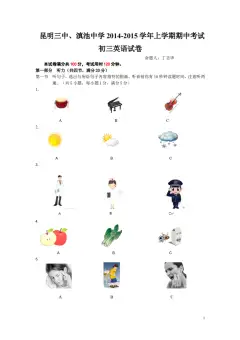
2014-2015 学年上学期期中学情调研
九年级英语试卷
时间:90 分钟 总分:100 分
听力部分(共20 分)
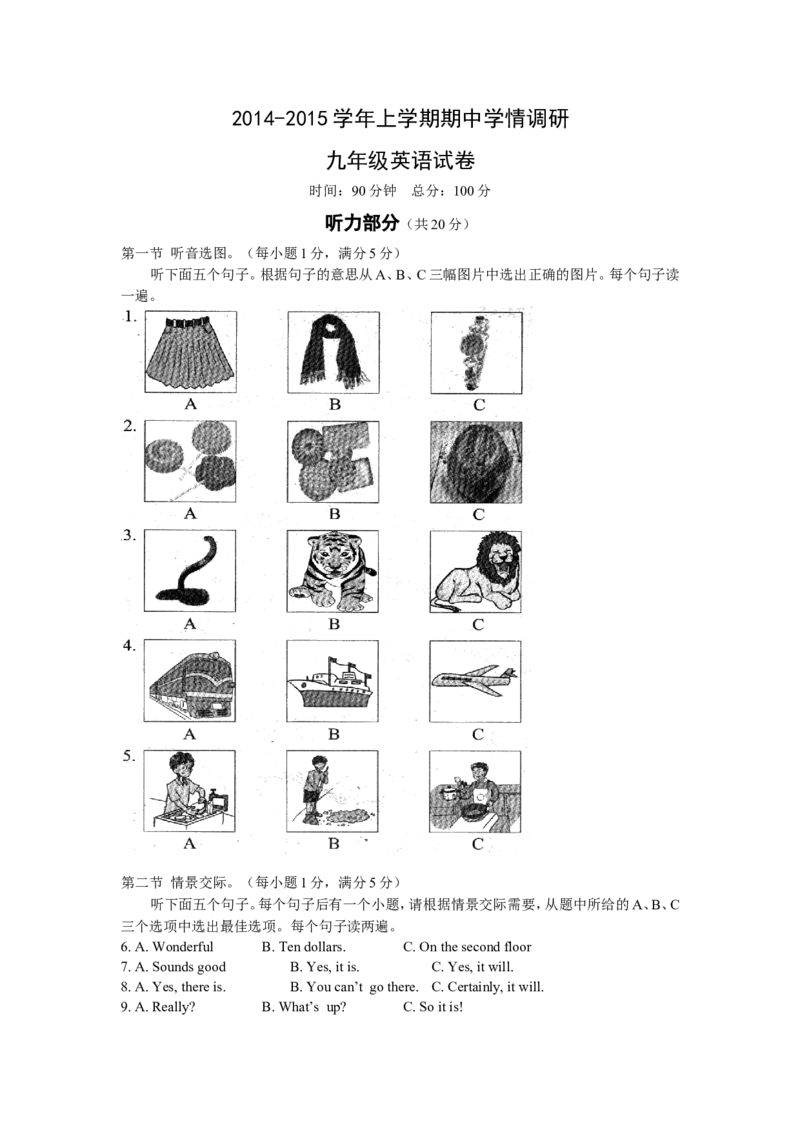
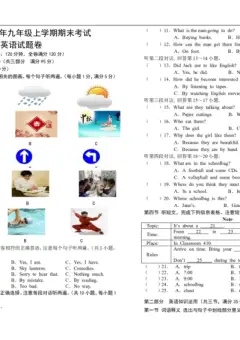
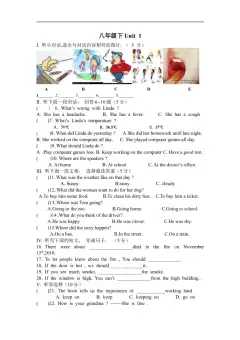
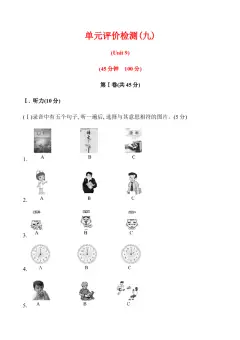
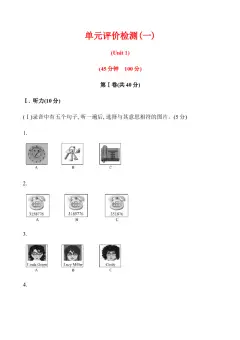
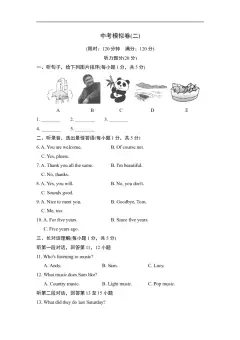
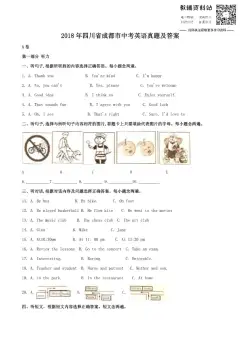
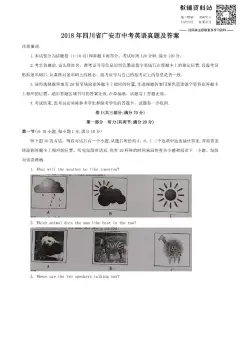
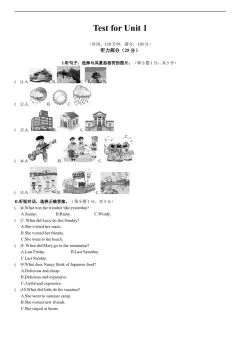
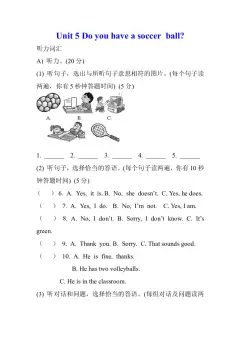
第一节 听音选图。(每小题1 分,满分5 分)
听下面五个句子。根据句子的意思从A、B、C 三幅图片中选出正确的图片。每个句子读
一遍。
第二节 情景交际。(每小题1 分,满分5 分)
听下面五个句子。每个句子后有一个小题,请根据情景交际需要,从题中所给的A、B、C
三个选项中选出最佳选项。每个句子读两遍。
6. A. Wonderful
B. Ten dollars.
C. On the second floor
7. A. Sounds good
B. Yes, it is.
C. Yes, it will.
8. A. Yes, there is.
B. You can’t go there. C. Certainly, it will.
9. A. Really?
B. What’s up?
C. So it is!
10. A. On Golden Road.
B. Take the No. 4 bus.
C. Ten minutes.
第三节 对话理解。(每小题1 分,满分5 分)
听下面五段对话。每段对话后有一个小题,从题中所给的A、B、C 三个选项中选出能回
答所提问题的最佳选项。每段对话读两遍。
11. When did the boy have the math test?
A. Last Friday
B. Last Thursday
C. Last Monday
12. What will the boy do in the afternoon?
A. Play basketball.
B. Visit his grandpa. C. Meet the girl.
13. How often does the girl read aloud to practice her pronunciation?
A. Sometimes.
B. Never.
C. Always.
14. Who often goes to amusement clubs with the boy?
A. His sister.
B. His classmate.
C. His brother.
15. What is the boy’s advice on how to improve English?
A. Reading English aloud.
B. Making some foreign friends. C. Joining an English club.
第四节 短文理解。(每小题1 分,满分5 分)
听下面一段短文,短文后有5 个小题,从题中所给的A、B、C 三个选项中选出能回答所提问
题的最佳选项。短文读三遍。
16. What is Li Jun?
A. A player.
B. A student.
C. A driver.
17. What club is Li Jun in?
A. Music club.
B. Chess club.
C. English club.
18. How many foreign students will come to Beijing?
A. 2.
B. 10.
C. 12.
19. Where will they live in Beijing?
A. They will live with local families. B. They will live in a hotel. C. They will live at school.
20. What will they do from Monday to Friday?
A. Practice their spoken Chinese. B. Go to Chinese classes. C. Go to some places of
interest.
笔试部分(共80 分)
一、单项选择(每小题1 分,共10 分)
21.—Excuse me, could you tell me how I can learn German well?
—_____ having conversations with Germans.
A. In B. With
C. By
D. At
22.—Do you know the man who is speaking in front of the crowds?
—The man is a successful businessman. So I ______ him for his success in business.
A. discover
B. disagree
C. admire
D. encourage
23. —I’ve _______ several kilos. Could you give some advice on how to lose weight?
—Eat less and do more sports.
A. put off
B. put away
C. put out
D. put on
24.—Tommy, you can let others never know what I have told you today.
—Don’t worry. I will keep the _________.
A. secret
B. memory
C. address
D. grade
25.—Jane, why are you so happy?
—The hen I keep for half a year ________an egg yesterday.
A. has laid
B. lay
C. lain
D. laid
26.—What a nice sweater! Did you buy it in a store?
—No, my mother made it by ________
A. her B. herself C. hers
D. himself
27. —Peter, is there anything else you want to know about China?
—Yes, I am still wondering___________.
A. how is Chinese paper cutting made
B. how was the Great Wall built in ancient times
C. why do the Chinese people eat Zongzi at Dragon Boat Festival
D. why the Chinese people like to play the dragon dance
28. When the lanterns are lit, they slowly rise into the air like small hot-air balloons for all to
see. They ________ as bright symbols of happiness and good wishes.
A. see
B. saw
C. are seen
D. are seeing
29.—I used to play tennis, but now I’m more interested in playing the piano. —
_______________.
A. I agree B. Good idea C. People sure change D. Don’t mention it.
30. When we need to get a book, it’s more polite to say,“______________”
A. Daisy, pass me the book quickly!
B. Daisy, give me a book!
C. Daisy, I wonder if you can pass me the book.
D. Daisy, could you please pass me the book?
二、完形填空(每小题1 分,共15 分 )
A
Easter is a happy time in western countries like the UK and the USA. After Christmas, it is the
most interesting holiday. It is begun as an important religious(宗教的) festival, but for the non-
religious it is
31
a special time. It is an official holiday, so most people visit their families
or friends during Easter.
The most important Easter tradition is giving each other Easter eggs, because eggs are the
symbol of new life. In the past people
32
paint chicken eggs, but today they give each
other chocolate eggs.
A fun game during the festival is that parents hide chocolate
33
in the garden, and
the children go out to look for them. They can eat what they find! It’s quite normal for children to
be
34
after Easter weekend as a result of eating too much chocolate.
The holiday is always on a Sunday
35
March 22nd and April 25th.
31. A. too
B. also
C. either
D. as well
32. A. got used to B. was used C. used to
D. was used to
33. A. eggs
B. candy
C. chicken D. apples
34. A. ugly
B. angry
C. sick
D. hungry
35. A. after
B. between C. among
D. from
B
For this month’s Young World magazine, I interviewed 19-year-old 36
pop star Candy
Wang. Candy told me that she used to be really shy and took up singing to deal with her
37
.
As she got better, she dared to sing in front of her class, and then for the whole school. Now she’s
not shy any more and
38
singing in front of crowds.
I asked Candy how life was different 39
she became famous. She explained that there are
many good things, like being able to travel and meet new people all the time. “I didn’t use to be
popular in school, but now I get tons of 40
everywhere I go.” However, too much attention can
also be a bad thing. “I always have to worry about how I appear to others and I have to be very
careful about what to say or do. And I don’t have much private time anymore. Hanging out with
friends is almost 41
for me now because there are always guards around me.”
What does Candy have to say to all those young people who want to become famous? “Well,”
she begins slowly, “you have to be prepared to 42
your normal life. You can never imagine
how
43
the road to success is. Many times I thought about giving up, 44
I fought on. You really
require a lot of talent and hard work to succeed. Only 45
people make it to the top.
36.A.Asia
B. Asian
C. America D. Africa
37.A.shyness
B. illness
C. sadness
D. happiness
38.A. refuses
B. dislikes
C. minds
D. loves
39.A. after
B. before
C. since D. until
40.A. money
B. chance
C. attention
D. introduction
41.A. possible
B. possibly
C. impossible
D. impossibly
42.A. give up
B. give in
C. give out
D. give away
43.A. exciting B. easy
C. important D. difficult
44.A. and
B. but
C. so
D. for
45.A.the number of
B. a large number of
C. a small number of
D. a number of
三、阅读理解(每小题2 分,共30 分)
A
Have you ever heard of Weifang, Shangdong Province? What is it known for? There is an
international kite festival every April in Weifang that is a modern city with many traditions.
People from all over the world compete in the kite flying. There are also competitions for the best
kites. The kites in the competition are all made by hand.
Most people have flown a kite. It makes people happy. It’s easy to make it. It’s
made of bamboo and paper. But not so many people know that kites were first made in
China thousands of years ago. The ancient Chinese made and flew kites even before they
could write.
A long time ago, the Chinese made kites to use in wars. They would fly these war
kites in the dark. The kites were fixed and they made strange sounds in wind. Men who
were at war against them would hear these sounds and run away. They thought those
strange sounds were made by gods in the sky.
The ancient Chinese also flew kites to bring good luck and to make their crops grow
rich and tall. Sometimes they tied long strings and hooks(钩子) to their kites. Then they
would fly the kites over water, letting the hooks hang down to catch fish.
The Chinese use sticks, string and paper for their kites. Some of these kites look like
animals or trees and others look like houses.
46. Chinese made and flew kites ___________.
A. two thousand years ago
B. before they could write
C. after they write
D. three thousand years ago
47. The main idea of the first paragraph is “____________”.
A. the city Weifang
B. the international kite festival
C. how to make a kite
D. how to fly a kite
48. In ancient China kites could be used for __________.
A. helping people fly
B. playing games
C. watering crops
D. catching fish
49. The ancient Chinese used kites in wars because the kites __________.
A. could bring good luck
B. looked like animals.
C. could make strange sounds and help them in a war.
D. could brought light in the dark for them.
50. _________ are used for making kites by the Chinese.
A. Paper and plastic
B. String and paper
C. Sticks, string and paper
D. String and hooks
B
I used to hate my mother because she worked a lot and didn’t spend much time with me.
Then one Friday morning I took part in a three-day self-help program for teenagers. Whether you
believe it or not, that weekend changed my life.
About 100 other teenagers were there. During the first two days I met a lot of great people. I
was glad because I made so many friends there.
On Sunday, the leader did an interesting exercise called “Chocolate or Toys”. He asked a girl
which she liked better, chocolate or toys. She chose chocolate. Then he asked her to choose again
between chocolate and chocolate. Of course, she didn’t have a choice.
This exercise told us that sometimes we don’t have a choice in life, and that sometimes we
have to accept something, rather than complaining(抱怨).
A girl stood up and started talking about her mom who was a drug addict (吸毒者)and how
much she hated her mother.
“I want a new mom,” she cried.
“Unluckily, you can’t have one,” the leader replied.
“You have to accept the mother that you have.”
This hit me hard. I realized that, for better or worse, my mom was my mom. I couldn’t
choose another mom, but I could try to make the best of the situation.
51. The writer used to hate his mother because ________.
A. she didn’t care for him.
B. she had no time to be with him
C. she was a drug addict.
D. she was too strict with him.
52. The self-help program for teenagers lasted ___________.
A. a week
B. two days
C. three days
D. only one day
53. The writer started to change his thinking ___________.
A. during the first two days of the program
B. after the exercise named “Chocolate or Toys”
C. as soon as he came to the program
D. after he left the program some time
54. From the end of the passage, we can know that ____________.
A. the writer used to love his mom for years
B. the writer’s mom is a very bad person
C. the writer’s mom loves her son very much
D. the writer will try to get along with his mother
55. What is the main idea of this passage?
A. Choices can be made as we like
B. Everyone should take part in a self-help program
C. Chocolate can influence one’s attitude toward things.
D. We should try to accept things instead of complaining about them.
C
What is the hottest English word of 2013? It’s “selfie”, according to Oxford dictionaries.
Selfie is a photo that one takes of oneself, according to the Oxford online dictionary. People
usually take selfies with a smartphone(智能手机) and send them to a social media website.
The word was first used in 2002. In the past 12 months, its frequency ( 出现频率) in the
English language has increased by 17,000 percent, said Oxford dictionaries. Now, almost
everybody knows it.
“Almost every day, I take a photo of myself at school, and save it in my Qzone (QQ 空间),”
said Huang Xu, 13, from Hunan. These photos record her happy and sad moments.
Pop stars also take a lot of selfies. Li Chunping, 14, from Harbin, is a big fan of Yang Mi.
“She has used many selfies to tell us what’s going on in her personal life,” said Li.
What makes people love selfies? Some people say it’s narcissism (自恋). “The rise of the
selfie is a perfect symbol for our narcissistic culture. We’re crying out: Look at me!” said US
psychiatrist(精神科医生) Carole Lieberman.
Young people are using selfies to make friends online, Jonathan Freedland wrote in The
Guardian. “The usual purpose of taking a selfie is to share online. They express a human need
to connect with others,” wrote Freedland.
Huang Xu agrees with that. “During summer vacation, my classmates and I shared many
selfies online. Hair or clothes were not our interests. Through these photos, we got to know each
other’s holidays and feelings,” said Huang Xu.
56. According to the story, a “selfie” is __________.
A. a person with a smartphone
B. a smartphone which can take photos
C. a photo taken by oneself
D. an English dictionary
57. When was the word “selfie” first used?
A.More than ten years ago
B. In 2013
C. When smartphones appeared
D. Nobody knows
58. We can tell from the story that __________.
A. only famous people enjoy taking selfies
B. all people love selfies because of narcissism
C. people love to share selfies online
D. US psychiatrist Carole Lieberman hates selfies
59. We put the sentence “ But some people don’t see it that way” at the beginning of
___________.
A. Paragraph 4
B. Paragraph 5
C. Paragraph 6
D.
Paragraph 7
60. What is the best title of this passage ?
A. Selfies and narcissism
B. Selfies and sharing
C. Selfies and smartphones D. Selfies, the hottest word in 2013
四、阅读填空(每小题1 分, 共5 分)
In class, your teachers will talk about topics that you are studying. The information
they provide will be important for you when you take tests. So you must take good notes
from what your teachers say.
Here are the three stages(阶段) of taking notes and what you should do during each
stage.
1. Before Class
Review your notes you have taken before you come to class. This will be good for
remembering what was covered. Get you ready to understand new information your
teacher will provide.
2. During Class
Keep your attention on what your teacher is saying and “the signal words” that tell
you, what your teacher is going to say and it is important to write in your notes.
Examples of signal words are “The most important point…” and “Remember that…”
Be sure to include the information that your teacher repeats or writes on the blackboard.
Write quickly so that you can include all the important information in your notes. Do this
by writing abbreviations(缩略词)such as med for medicine, using symbols such as % for
percent, and writing short sentences.
3. After Class
Rewrite your notes to make them more complete and accurate(准确的) by changing
abbreviations into whole words, symbols into words, and shortened sentences into longer
sentences. Use them to answer your questions. If necessary, ask your teacher for help.
Taking notes
Reasons
The information that is provided by the teachers about
61
topics is
useful for your tests, so it is necessary for you learn to take good
notes.
Stages
62
Class
Review the notes you have taken to remember
63
was covered.
Ready to understand new information.
During Class
Listen to your teacher carefully.
Be sure to include the important points.
Write them down
64
.
After Class
Make your notes more complete and accurate to
answer your questions.
Ask your
6 5
for help.
五、选词填空 (每空1 分,共10 分)
根据下面短文内容,从方框中选择适当的词并用其正确形式填空,使短文完整、通顺。
.
“Thank you” is widely
66
in a modern society. It is a very good manner. You
should say “Thank you”
67
others help you or say something kind to you. For example,
when someone
68
the door for you, when someone says you have done your work well,
when someone says you have
69
a nice shirt, or your city
70
very beautiful, you
should say “Thank you”. It is used not only between friends, but also between parents and
children,
71
and sisters, husbands and wives.
“Excuse me” is
72
short polite usage. We use it the same as “Thank you”. When you
first use is another bought open whenever talking brother without
hear someone says so behind you, you’ll get to know that somebody wants to walk past
73
touching you. It is not polite to interrupt(打断) others while they are
74
. If you want to
have a word with one of them, please say “Excuse me”
75
, and then begin to talk. You
should also do so when you want to cough or make any unpleasant noise before others. Let’s say
“Thank you” and “Excuse me” on the right situation.
2014 年秋季九年级半期学情调研
英语答题卷
题号
听力
部分
笔试部分
总分
总分人
一
二
三
四
五
六
得分
听力部分(20 分)
笔试部分(80 分)
一、单项选择:(每小题1 分,共10 分)
题号
21
22
23
24
25
26
27
28
29
30
答案
二、完形填空:(每小题1 分,共15 分)
题号
31
32
33
34
35
36
37
38
39
40
41
42
43
44
45
答案
三、阅读理解:(每小题2 分,共30 分)
题号
46
47
48
49
50
51
52
53
54
55
56
57
58
59
60
答案
四、阅读填空(每小题1 分,共5 分)
61. __________ 62. ___________ 63. _________ 64. ___________ 65.
___________
五、选词填空(每小题1 分,共10 分)
题号
1
2
3
4
5
6
7
8
9
10
答案
题号
11
12
13
14
15
16
17
18
19
20
答案
密 封 线 内 不 要 答 题
学校 班级 姓名 考号
66. __________ 67. ___________ 68. ___________ 69. __________ 70.
_____________
71. __________ 72. ___________ 73. ___________ 74. __________ 75.
_____________
六、书面表达:(10 分)
假如你是李明,将要去纽约进行一个短期的交流学习,在你去之前你想要了解一些信
息?
根据下面提示,向你即将要去学习的学校写一封咨询信。
The course you will study The time of the course
Where and what you can eat Where you will stay
What activities you can do Travel to the school Other
要求:1.书写工整,语言流畅,表达清楚;
2.文章开头结尾已给出,不计入总词数,不少于80 词。
Dear Sir,
My name is Li Ming. I’m from Sichuan China. I’ll be coming to your school for a short
study.
I’d
like
to
know
about___________________________________________________________
_______________________________________________________________________________
_______________________________________________________________________________
_______________________________________________________________________________
_______________________________________________________________________________
_______________________________________________________________________________
_______________________________________________________________________________
_______________________________________________________________________________
_______________________________________________________________________________
_______________________________________________________________________________
_______________________________________________________________________________
_______________________________________________________________________________
_______________________________________________________________________________
I’d like to thank you for your help and I’m looking forward to your reply.
Yours faithfully,
Li Ming
听力材料
第一节
1. The scarf used to be Jane’s favorite one, but she doesn’t like it now.
2. Having too much candy is bad for teeth.
3. I am terrified of seeing snakes in the forest.
4. My father often goes to Beijing on business by airplane.
5. Few students in our class are interested in cooking.
第二节
6. Do you know where I can buy some books?
7. Is this a good place to make a picnic?
8. Is there a zoo on this street?
9. How beautiful the new building is!
10. How can I get to the People’s Park?
第三节:
11.
M: I failed the math test last Friday.
W: Don’t be so upset. I believe that you can get good grades next time.
12.
W: Can you teach me to play tennis this afternoon?
M: Sorry, I need to visit my grandpa in the afternoon. How about this weekend?
13.
M: What about reading aloud to practice your pronunciation?
W: I do that sometimes. I think it is helpful. You can have a try.
14.
W: How do you make so many friends?
M: I often go to amusement clubs.
W: Do you go there with your classmates?
M: No, I go there with my brother.
15.
W: I am not good at English. Can you give me some advice?
M: The best way to improve your English is to join an English club.
W: Do you have time? Let’s go to an English club together.
M: Sounds good.
第四节
I’m Li Jun in Beijing No. 2 Middle School. I’m a member of the English club in our school.
This winter, we are going to invite ten foreign students and two foreign teachers for a trip in
Beijing. Now I’d like to tell you something about it.
We will let them live with local families so that they can have a chance to practice their
spoken Chinese. As for the activities, they can go to Chinese classes from Monday to Friday. On
weekends we’ll take them to some places of interest so that they can learn about the culture and
history of China. It will be a wonderful experience for all of us.
参考答案
听力部分
1-5 BAACC 6-10 CBACB 11-15 ABACC 16-20 BCBAB
单项选择:21-25 CCDAD 26-30 BDCCD
完形填空:31-35 BCACB 36-40 BADAC 41-45 CADBC
阅读理解:46-50 BBDCC 51-55 BCBDD 56-60 CACCB
阅读填空:
61.studying 62. Before 63. what 64. quickly 65.
teacher
选词填空:
66. used 67. whenever 68. opens 69. bought 70.
is
71. brothers 72.another 73. without 74.talking 75.
first
书面表达:1.
点明确,
句通
,表达清楚;
观
语
顺
2.
拼写
少,
法
少;
单词
错误
语
错误
3.
写工整,
范美
;
书
规
观
4.
数量符合要求,要点
。
单词
齐
参考范文:
Dear Sir,
My name is Li Ming. I’m from Sichuan China. I’ll be coming to your school for a
short study. I’d like to know about your school and the courses I can take.
First, I would like to find out exactly how long the course is and when it will begin. I
wonder if you could send me the course outline and some information about the
course fees.
Could you please also give me some information about how get to your school? In
addition, it would be interesting for me to know about the activities that students can
take part in and the places where they can hang out and have their meals after school.
I would like to thank you for your help and I’m looking forward to your reply.
Yours faithfully,
Li Ming