2026 年高考第二次模拟考试(广东专用)
高三英语
(考试时间:120 分钟  试卷满分:150 分)
注意事项:
1.答卷前,考生务必将自己的姓名、准考证号等填写在答题卡和试卷指定位置上。
2.回答选择题时,选出每小题答案后,用铅笔把答题卡上对应题目的答案标号涂黑。如需改动,用
橡皮擦干净后,再选涂其他答案标号。回答非选择题时,将答案写在答题卡上。写在本试卷上无效。
3.考试结束后,将本试卷和答题卡一并交回
第一部分 听力(略)
第二部分  阅读(共两节, 满分50 分)
第一节(共15 小题;每小题2.5 分, 满分37.5 分)
阅读下列短文, 从每题所给的A、B、C 和D 四个选项中选出最佳选项。
A
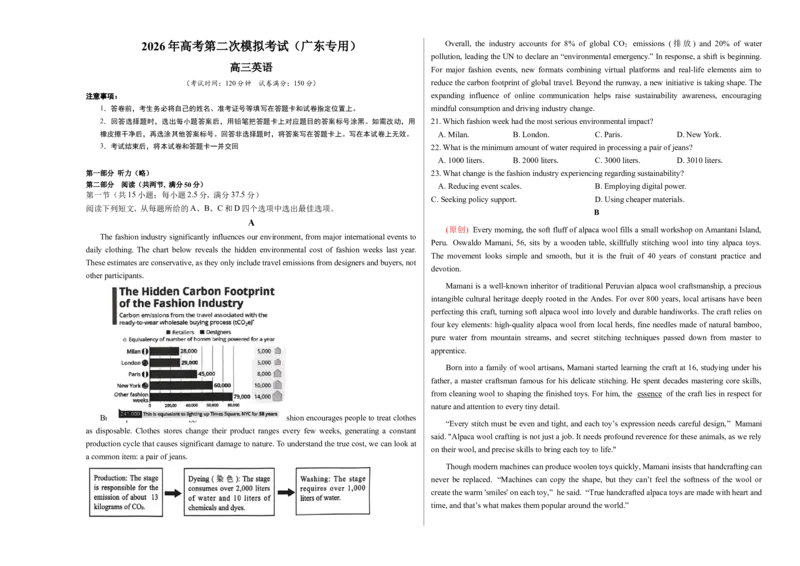
The fashion industry significantly influences our environment, from major international events to
daily clothing. The chart below reveals the hidden environmental cost of fashion weeks last year.
These estimates are conservative, as they only include travel emissions from designers and buyers, not
other participants.
But the problem is much bigger than these events. Fast fashion encourages people to treat clothes
as disposable. Clothes stores change their product ranges every few weeks, generating a constant
production cycle that causes significant damage to nature. To understand the true cost, we can look at
a common item: a pair of jeans.
Overall, the industry accounts for 8% of global CO2 emissions ( 排放) and 20% of water
pollution, leading the UN to declare an “environmental emergency.” In response, a shift is beginning.
For major fashion events, new formats combining virtual platforms and real-life elements aim to
reduce the carbon footprint of global travel. Beyond the runway, a new initiative is taking shape. The
expanding influence of online communication helps raise sustainability awareness, encouraging
mindful consumption and driving industry change.
21. Which fashion week had the most serious environmental impact?
A. Milan.
B. London.
C. Paris.
D. New York.
22. What is the minimum amount of water required in processing a pair of jeans?
A. 1000 liters.
B. 2000 liters.
C. 3000 liters.
D. 3010 liters.
23. What change is the fashion industry experiencing regarding sustainability?
A. Reducing event scales.
B. Employing digital power.
C. Seeking policy support.
D. Using cheaper materials.
B
(原创) Every morning, the soft fluff of alpaca wool fills a small workshop on Amantani Island,
Peru. Oswaldo Mamani, 56, sits by a wooden table, skillfully stitching wool into tiny alpaca toys.
The movement looks simple and smooth, but it is the fruit of 40 years of constant practice and
devotion.
Mamani is a well-known inheritor of traditional Peruvian alpaca wool craftsmanship, a precious
intangible cultural heritage deeply rooted in the Andes. For over 800 years, local artisans have been
perfecting this craft, turning soft alpaca wool into lovely and durable handiworks. The craft relies on
four key elements: high-quality alpaca wool from local herds, fine needles made of natural bamboo,
pure water from mountain streams, and secret stitching techniques passed down from master to
apprentice.
Born into a family of wool artisans, Mamani started learning the craft at 16, studying under his
father, a master craftsman famous for his delicate stitching. He spent decades mastering core skills,
from cleaning wool to shaping the finished toys. For him, the essence of the craft lies in respect for
nature and attention to every tiny detail.
“Every stitch must be even and tight, and each toy’s expression needs careful design,” Mamani
said. "Alpaca wool crafting is not just a job. It needs profound reverence for these animals, as we rely
on their wool, and precise skills to bring each toy to life."
Though modern machines can produce woolen toys quickly, Mamani insists that handcrafting can
never be replaced. “Machines can copy the shape, but they can’t feel the softness of the wool or
create the warm 'smiles' on each toy,” he said. “True handcrafted alpaca toys are made with heart and
time, and that’s what makes them popular around the world.”
24. What can we know about the traditional Peruvian alpaca wool craftsmanship?
A. It is a newly recognized cultural heritage.
B. It requires great effort and precision.
C. It is mainly passed down through schools.
D. It uses man-made materials instead of natural ones.
25. What does the underlined word “essence” in Paragraph 3 probably mean?
A. Value.
B. Standard.
C. Core.
D. History.
26. Which word can best describe Oswaldo Mamani?
A. Patient and devoted.
B. Creative and outgoing.
C. Brave and ambitious.
D. Humorous and hardworking.
27. What does Mamani’s story mainly convey?
A. Machines can copy, but never create with heart.
B. Tradition survives only through constant practice.
C. Quality matters more than speed.
D. True craftsmanship lies in the machines.
C
Robert Campbell, a 68-year-old retired teacher from Glasgow, has lived with type 2
diabetes (糖尿病) for a decade. Recently, worrying blurriness in his vision prompted him to
seek a screening for diabetic retinopathy — a diabetes-related eye disease that causes
blindness. Traditionally, he would have faced a long wait for a specialist appointment within
Scotland’s National Health Service.
His local clinic, however, was part of a new pilot program using an AI-powered platform
for eye disease called “RetinaScan AI”. The process was simple: a staff member took a
photograph of Robert’s retina (视网膜). Within minutes, the system provided an automated
assessment, detecting subtle signs of the disease with remarkable accuracy. This initiative effectively
skipped the traditional bottleneck, bringing expert-level screening directly to the community.
The technology is built on deep learning. The AI was trained on hundreds of thousands of retinal
images previously labeled by eye doctors. Through this process, it learned to identify critical
indicators of diabetic eye disease with a consistency unaffected by humantedness. Its primary role is
screening: efficiently identifying healthy patients and flagging those, like Robert, who require urgent
specialist care.
“Platforms like RetinaScan AI are game-changers,” explains Dr. Eleanor Reed, a consultant eye
doctor. “They don’t replace our expertise; they enhance it. By handling the massive initial screening
workload, they ensure that human specialists can focus their skills on complex diagnoses and
treatment planning, ultimately preventing preventable vision loss.”
The Glasgow pilot has already yielded promising results. In its first six months, the program
successfully screened over 5,000 patients, cutting average wait times for screening from 12 weeks to
just days. More importantly, it has accurately tagged hundreds of at risk individuals, like Robert, for
early intervention, demonstrating a meaningful impact on patient outcomes.
Robert Campbell’s story is just the first chapter. This pilot program paves the way for AI
technology to expand globally, reaching millions who need these vital screenings.
28. What problem did Robert Campbell face before the AI program was introduced?
A. He was found to have a rare diabetic eye disease.
B. He had to wait long for a specialist appointment.
C. His local clinic lacked the necessary equipment.
D. His eye disease was too advanced to be treated.
29. What is the main advantage of “RetinaScan AI” according to the text?
A. It replaces the need for human doctors.
B. It provides immediate treatment for patients.
C. It is cheaper than traditional screening methods.
D. It offers quick and accurate screening in communities.
30. Why does Dr Eleanor Reed call AI platforms “game-changers”?
A. They finally avoid vision loss.
B. They treat complex diseases.
C. They manage initial screenings.
D. They work without specialists.
31. What can be a suitable title for the text?
A. How is AI Transforming Eye Care?
B. Is AI the Doctor’s Newest Assistant?
C. What Could AI Contribute to Humans?
D. Can AI Systems See More Than Doctors?
D
For over two thousand years, scientists and philosophers have been puzzled by a simple question:
how can plants, without eyes, grow toward light? While animals use eyes to detect the direction of
light, plants seem to have no such organ. So how do they do it?
Early Greek thinkers believed plants could sense and react to their environment — almost like
animals. But Aristotle later argued that plants were passive, unable to perceive or respond to the world
around them. His view influenced Western thought for centuries.
However, a team of European researchers has now uncovered the secret. They focused on
Arabidopsis, a small weed commonly used in plant genetics. Using advanced imaging techniques such
as confocal microscopy, the scientists measured how light passes through the plant’s stem. Their
results, published in a recent study, showed that the air channels between the plant’s cells scatter the
light, bending it significantly as it travels through the tissue. Once researcher noted, “It’s like the plant
has thousands of tiny lenses.” This scattering creates subtle differences in light intensity across the
stem, allowing the plant to pinpoint the light’s direction accurately.
In other words, the plant doesn’t need eyes. Instead, it uses its entire body to sense light. This
clever mechanism lets seedlings “see” where the light is coming from and adjust their growth toward
it.
The findings not only solve an ancient mystery but also challenge Aristotle’s idea that plants are
passive. It turns out that plants have evolved a sophisticated way to perceive their environment —
without the need for complex organs like eyes. They are far more active and adaptive than we once
thought.
This research opens new questions for plant biologists. How are these air channels formed? How
exactly do plants process the light information? Understanding these mechanisms could help us learn
more about how plants interact with the world — and perhaps even inspire new technologies in light
sensing and robotics.
32. How does the author introduce the topic in the first paragraph?
A. By making a comparison.
B. By presenting a puzzle.
C. By stating a phenomenon.
D. By quoting a philosopher.
33. What is the key finding of the European researchers’ study?
A. Plant cells contain special proteins that respond to light.
B. Arabidopsis has a unique genetic structure for light sensing.
C. Light intensity varies significantly in different plant tissues.
D. Plants use air channels as tiny lenses to detect light direction.
34. What is the significance of the research findings?
A. They explain the formation of air channels.
B. They reveal plants’ passive growth pattern.
C. They challenge traditional views of plants.
D. They confirm Aristotle’s theory about plants.
35. What might be the future impact of this research?
A. Faster plant growth.
B. Better light sensors.
C. Stronger leaf formation.
D. More robot production.
第二节(共5 小题;每小题2.5 分, 满分12.5 分)
阅读下面短文, 从短文后的选项中选出可以填入空白处的最佳选项。选项中有两项为多余选项。
Want More Self-Control? The Secret Isn’t Willpower.
People tend to respect and even idolize strong-willed people — friends who hit up the gym five
times a week or colleagues who manage to stay focused in nearly every situation. But willpower
shouldn’t be confused with self-control. ____36____ , yet it may not be the most effective method.
Improving willpower boils down to just trying harder while self-control relies on strategic
methods. ____37____. Here are some options:
Create routines. Research reveals that people who are good at self-control tend to structure their
lives to avoid having to make draining decisions in the moment. ____38____
Monitor your progress. Enhancing self-control can be both easy and fast. ____39____ such as
using a journal, a calendar, or an audio recording. This process creates immediate feedback and a
sense of accomplishment, reinforcing your commitment.
Manage your environment. Energy vampires, the type of people who leave you feeling drained,
will deplete your ability to exert self-control. Likewise, people who support you and lift you up will
give you a greater capacity for self-control.
____40____. “Shifting focus from individual desires to collective needs fosters motivation for
self-control,” said Scott Haas, a clinical psychologist in Boston. This shift in focus reduces reliance on
finite mental resources.
Ultimately, self-control is less about fighting urges and more about skillfully managing your
environment and perspective, leading to lasting calm.
A. Build supportive networks.
B. Connect to a larger purpose.
C. Somehow, these routines automate positive responses.
D. The key is to keep notes on your actions toward a goal.
E. Multiple techniques maximize the effectiveness of self-control.
F. Willpower may help manage your emotions or fight strong desires.
G. For instance, scheduling fixed activities like running builds consistency.
第三部分 语言运用(共两节,满分30 分)
第一节(共15 小题,每小题1 分,满分15 分)
阅读下面短文, 从每题所给的A、B、C 和D 四个选项中选出可以填入空白处的最佳选项。
原创(改编自2025 年《Reader’s Digest》真实新闻)
On a rainy afternoon in Chicago, I stood trembling at the bus stop. My coat was too thin to keep
out the cold. I had missed the last bus home and had only $3 in my pocket, not nearly enough for a
taxi. My phone died, leaving me ___41___ and helpless, with no one to call for ___42___. I pulled
my coat tighter and watched the rain pour down, wondering how I would get through the night.
Just then, a woman in a red jacket pulled over. She rolled down the window, her smile warm and
kind. “You look like you need a ride,” she said gently. I hesitated, unwilling to accept help from a
___43___. She noticed my ___44___ and introduced herself softly, saying she lived nearby.
Her kindness ___45___ my fear completely. I got into her car, and she ___46___ me a hot cup
of coffee. She listened patiently without showing any ___47___. When we arrived, I offered her the
little money I had, but she refused. “Just ___48___ the favor when you get the chance,” she said.
Weeks later, I saw a homeless teen in the rain. I ___49___ over and gave him a warm meal and
cash. His eyes shone with hope. “I’ll pay it forward,” he said ___50___.
That moment made me realize a small act of kindness can create a powerful ripple. Over the year,
I have ___51___ many others to join in, and we’ve ___52___ countless lives. Clara’s simple act
turned my darkest moment into a ___53___ to spread hope.
Kindness is not about being rich; it is about being ___54___ to care. In the end, it is our small,
selfless acts of love and generosity that ___55___ the world and make it a better place for everyone.
41. A. lonely
B. nervous
C. lost
D. desperate
42. A. help
B. advice
C. attention
D. care
43. A. driver
B. neighbor
C. stranger
D. woman
44. A. confusion
B. regret
C. shock
D. hesitation
45. A. covered
B. removed
C. hid
D. calmed
46. A. showed
B. passed
C. handed
D. sent
47. A. judgment
B. surprise
C. pity
D. curiosity
48. A. recall
B. pass
C. accept
D. forget
49. A. walked
B. watched
C. turned
D. thought
50. A. weakly
B. firmly
C. quietly
D. secretly
51. A. encouraged
B. forced
C. persuaded
D. allowed
52. A. controlled
B. enriched
C. shaped
D. brightened
53. A. dream
B. moment
C. way
D. lesson
54. A. free
B. brave
C. willing
D. glad
55. A. make up
B. keep up
C. leave out
D. warm up
第二节(共10 小题;每小题1.5 分,满分15 分)
阅读下面短文,在空白处填入1 个适当的单词或括号内单词的正确形式。
( 原创) Chinese woodblock printing ( 木版水印), an ancient printing technique with a
history of over 1,000 years, is a precious treasure of Chinese culture. In 2009, the art of
woodblock printing ___56___ (include) in the UNESCO Intangible Cultural Heritage List.
First created for copying books, this skill later ___57___ (become) a unique form of art. The real
value of woodblock printing lies in its ___58___ (combine) of traditional skills and artistic beauty.
Different artists create works with different styles, ___59___ (show) their understanding of art and
life.
___60___ whole process includes carving the wooden board, mixing ink, and printing on paper.
Skilled printers can turn a simple board ___61___ a fine artwork with great patience.
Today, digital printing is more convenient and faster, ___62___ many craftsmen still insist on
traditional woodblock printing. Young artists learn the old skills ___63___ (keep) the tradition alive.
They also combine it with modern design, making the ancient art ___64___ (wide) recognized in the
world.
Woodblock printing, ___65___ carries the memory of Chinese civilization, is more than a
printing skill. It is a bridge that connects history with today.
第四部分 写作(共两节, 满分40 分)
第一节(满分15 分)
假定你是国际学校学生李华。学校打算举办一个国际文化展,现就开幕式活动或表演形式
向学生征求意见。请给负责此事的老师写一封邮件,内容包括:
1.你的建议;
2.说明理由。
注意:
1. 词数80 左右;
2. 可适当增加细节,以使行文连贯。
Dear Sir or Madam,
__________________________________________________________________________________
__________________________________________________________________________________
__________________________________________________________________________________
__________________________________________________________________________________
_____________________________________________________________________________
Yours,
Li Hua
第二节(满分25 分)
阅读下面材料,根据其内容和所给段落开头语续写两段,使之构成一篇完整的短文。
Three years ago, Clara was one of the most beloved children’s book illustrators in the city. Her
drawings of soft-eyed rabbits and sun-dappled forests had filled thousands of bedtime stories — until
a car crash shattered her right wrist. The nerve damage left her hand perpetually unsteady; she could
no longer sketch the fine, curved lines that had defined her work. She quit her studio, moved into her
sister’s cluttered secondhand shop, and buried every trace of her old art under boxes of dusty books.
She spoke to customers in monosyllables, her gaze fixed on the floor, as if hiding from the world that
had once celebrated her.
It was on a gray Tuesday that 14-year-old Jasper wandered in. His hoodie was too big, his
backpack bulging with tattered picture books, and he lingered by the shelf of children’s literature like
a shadow. “Do you have The Rabbit’s Oak?” he asked, his voice barely audible. Clara froze — that
was her first book, the one she’d stopped drawing mid-final chapter after the crash. She nodded,
pulling a frayed copy from the shelf.
Jasper’s fingers trembled as he opened it. Taped to the inside cover was a scrap of paper: a
crumpled drawing of a rabbit, done in his messy pencil strokes. “My mom used to read this to me,” he
said. “She left last year, and… these pictures feel like she’s still here.” Clara glanced at the drawing —
he’d copied her style, clumsy but earnest. For the first time in years, she felt a twinge of something
other than numbness.
A week later, Jasper returned, clutching the same book. Its final page was blank; she’d never
finished the illustration of the rabbit finding its home. “Can you draw the ending?” he asked. “I keep
imagining it, but… it’s not the same.” Clara stared at her right hand, which had started to shake at the
mention of drawing. “I can’t,” she said, her voice sharp. “I don’t do that anymore.” Jasper’s shoulders
slumped. He left the book on the counter and slipped out, his backpack dragging. Clara stared at the
blank page long after the shop closed, her unsteady fingers hovering over the spine.
注意:
1. 所续写短文的词数应为150 左右;
2. 续写部分分为两段,每段的开头语已为你写好;
Paragraph 1:
Clara stared at the half-empty page in the book, her right hand tightening around the pencil she
hadn’t held in years.


Paragraph 2:
However, Jasper didn’t show up at the shop for three days.