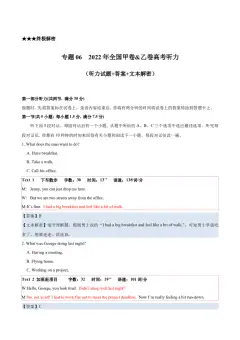
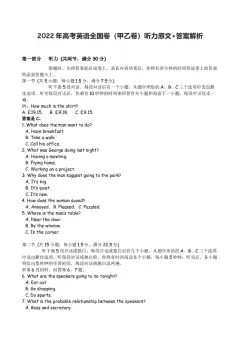
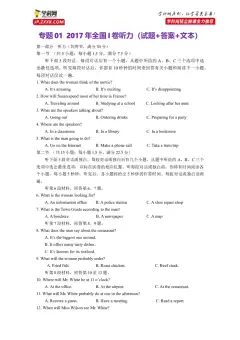
专题 02 2022 年全国甲乙卷英语听力
试题+答案+文本
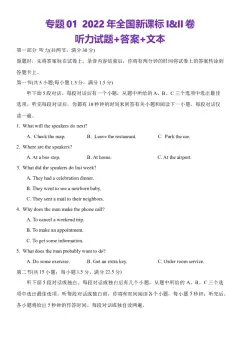
第一部分 听力(共两节,满分30分)
第一节(共5小题;每小题1.5分,满分7.5分)
听下面5段对话。每段对话后有一个小题,从题中所给的 A、B、C三个选项中选出最佳
选项。听完每段对话后,你都有10秒钟的时间来回答有关小题和阅读下一小题。每段对话仅
读一遍。
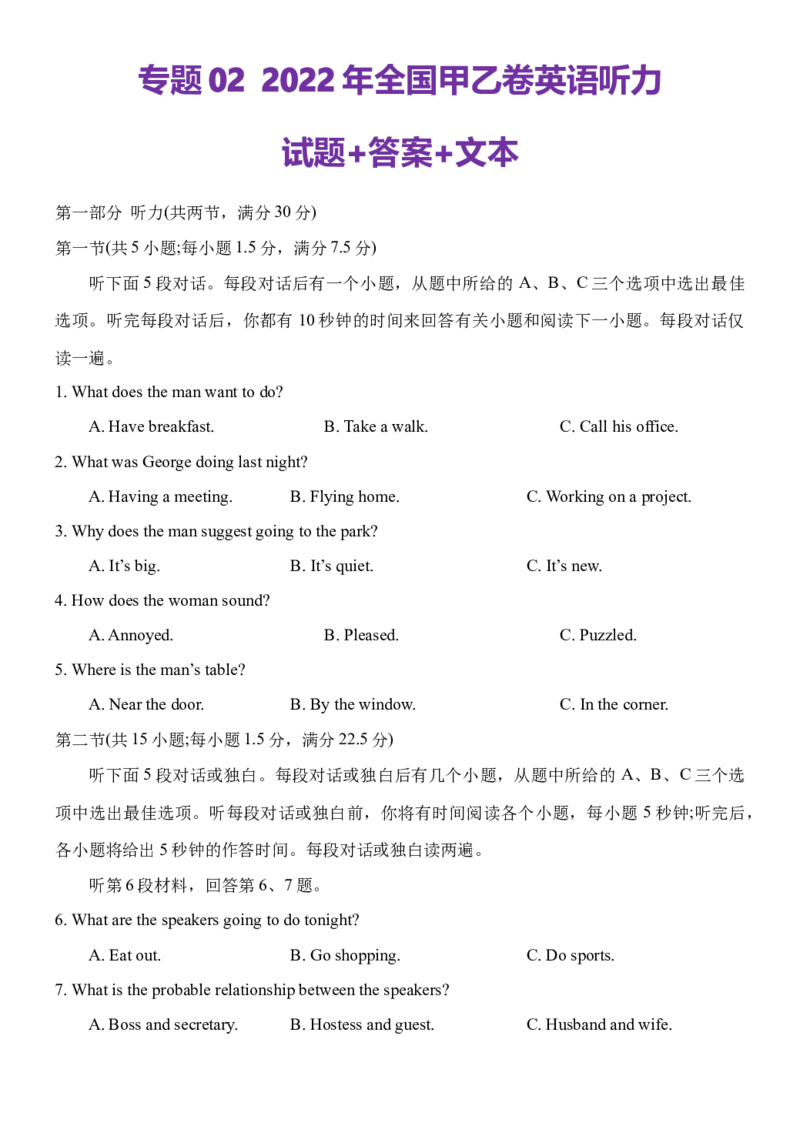
1. What does the man want to do?
A. Have breakfast. B. Take a walk. C. Call his office.
2. What was George doing last night?
A. Having a meeting. B. Flying home. C. Working on a project.
3. Why does the man suggest going to the park?
A. It’s big. B. It’s quiet. C. It’s new.
4. How does the woman sound?
A. Annoyed. B. Pleased. C. Puzzled.
5. Where is the man’s table?
A. Near the door. B. By the window. C. In the corner.
第二节(共15小题;每小题1.5分,满分22.5分)
听下面5段对话或独白。每段对话或独白后有几个小题,从题中所给的 A、B、C三个选
项中选出最佳选项。听每段对话或独白前,你将有时间阅读各个小题,每小题 5秒钟;听完后,
各小题将给出5秒钟的作答时间。每段对话或独白读两遍。
听第6段材料,回答第6、7题。
6. What are the speakers going to do tonight?
A. Eat out. B. Go shopping. C. Do sports.
7. What is the probable relationship between the speakers?
A. Boss and secretary. B. Hostess and guest. C. Husband and wife.听第7段材料,回答第8、9题。
8. Why does the woman think July is the best time to move?
A. Their business is slow. B. The weather is favorable. C. It’s easy to hire people.
9. How will they handle the moving?
A. Finish it all at once. B. Have the sales section go first. C. Do one department at a time.
听第8段材料,回答第10至12题。
10. What did Peter learn from his grandfather?
A. How to appreciate art works.
B. How to deal with artists.
C. How to run a museum.
11. What did Peter do in Chicago?
A. He studied at a college. B. He served in the army. C. He worked in a gallery.
12. Whose works did Peter like best?
A. Rembrandt’s. B. Botticelli’s. C. Rubens’.
听第9段材料,回答第13至16题。
13. Where does the conversation take place?
A. At a library. B. In a law firm. C. On a train.
14. By what time did John plan to finish his term paper?
A. March. B. August. C. October.
15. Why did John quit his part-time job?
A. He had to catch up with his study.
B. He was offered a better one.
C. He got tired of it.
16. What is Susan’s attitude to John’s problem?
A. Carefree. B. Understanding. C. Forgiving.
听第10段材料,回答第17至20题。
17. What did the speaker do before the year 2012?
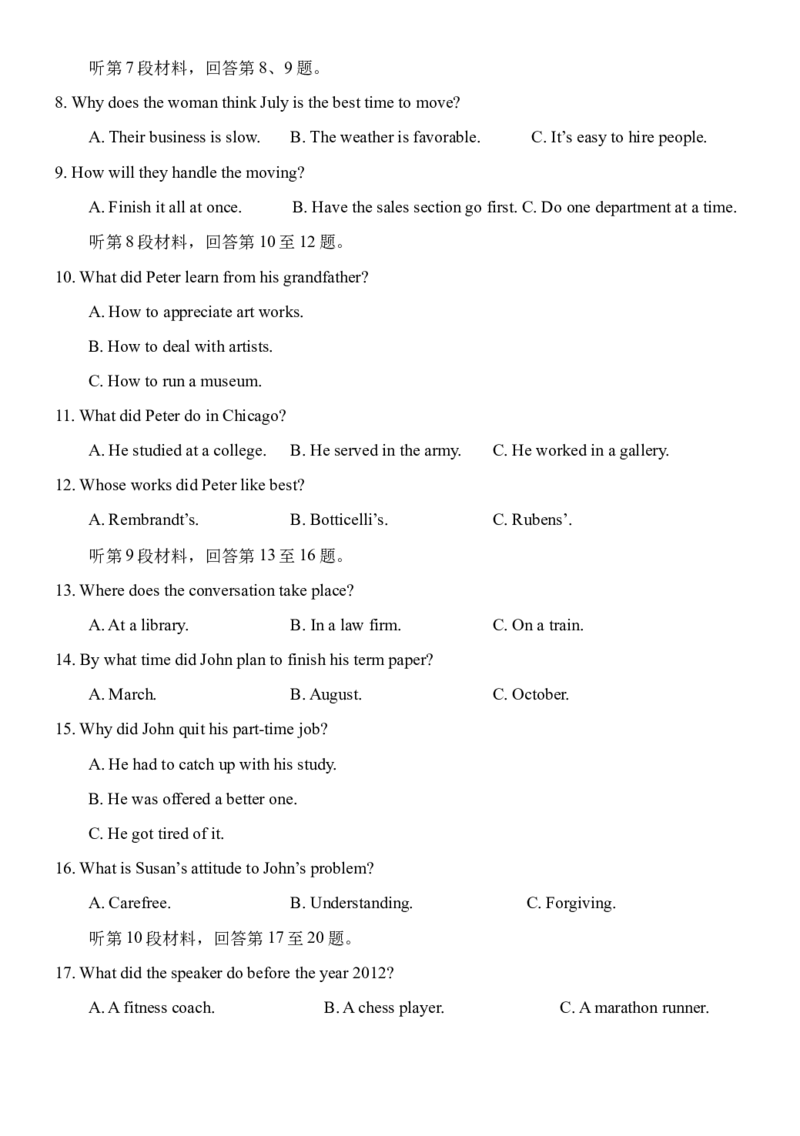
A. A fitness coach. B. A chess player. C. A marathon runner.18. Why was the 2016 Olympics important for the speaker?
A. He was motivated by Bolt.
B. He broke a world record.
C. He won fifth place.
19. Which is the hardest for the speaker?
A. Getting over an injury. B. Doing strength training. C. Representing Botswana.
20. What is the speaker mainly talking about?
A. His plan to go for the gold.
B. His experience on the track.
C. His love for his home country.
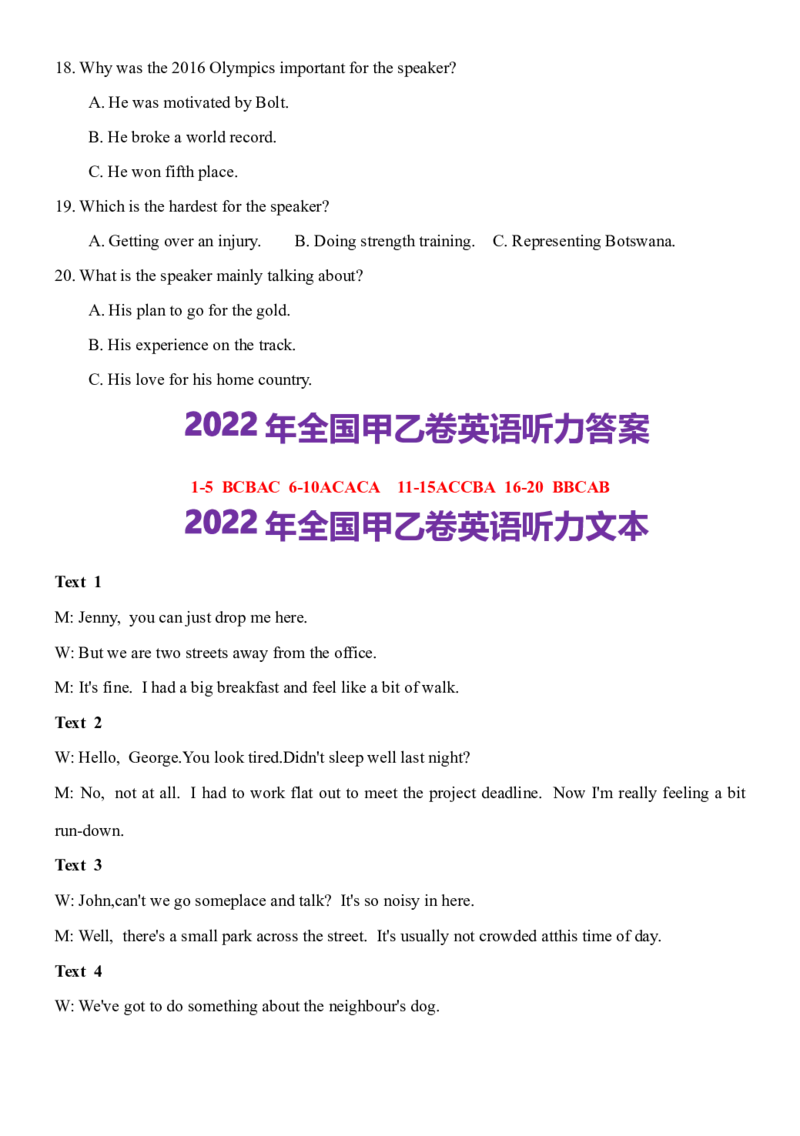
2022 年全国甲乙卷英语听力答案
1-5 BCBAC 6-10ACACA 11-15ACCBA 16-20 BBCAB
2022 年全国甲乙卷英语听力文本
Text 1
M: Jenny, you can just drop me here.
W: But we are two streets away from the office.
M: It's fine. I had a big breakfast and feel like a bit of walk.
Text 2
W: Hello, George.You look tired.Didn't sleep well last night?
M: No, not at all. I had to work flat out to meet the project deadline. Now I'm really feeling a bit
run-down.
Text 3
W: John,can't we go someplace and talk? It's so noisy in here.
M: Well, there's a small park across the street. It's usually not crowded atthis time of day.
Text 4
W: We've got to do something about the neighbour's dog.M: Why? Has he been into your flower garden again?
W: The flower garden, the garbage can, and yesterday he started digging holes in the yard.
Text 5
M: Hello, we have a reservation in the name of Mr Jones. Is there any table by the window?
W: Sorry, we've got this corner table for you. It's quiet here,not close to the door.
Text 6
W: Dave, don't forget, we're invited out to dinner tonight.
M: Oh,yeah. I almost forgot. What time?
W: Seven thirty. We should leave the house by six thirty. You know howbad the traffic is that time of
night.
M: It's informal, isn't it?
W: Yeah,you can wear your new sports jacket. The one I got you as ananniversary gift.
M: OK.Well, I've got to go. I'll try to get home a little earlier today.
W: Good.
Text 7
M: We need to decide exactly when we're going to move. Any suggestions?
W: I think July would be the best time. Our sales are always down thatmonth. We could move all the
office equipment at a weekend, doeverything at once.
M: I think a weekend's too short, maybe we should do it department bydepartment.
W: What do you mean?
M: Well, each week a different department would move. That way, therewould always be people
here to handle customer inquiries, phone calls and so on.
W: Mm, that's a good ideA.
Text 8
W: So Mr Peter Cells, I'd be curious to know what were the earlyconnections in your life that led you
into the art field.
M: My grandfather was an art dealer in Munich. They had a great museumin Munich. He took me tothe museum,and I responded very strongly towhat I saw on the walls there. I learned about art from
him.II learnedabout looking at art from him. I think that's what really got me started. Then many
years later, after I got out of the army,went to study art history at the University of Chicago.
W: Tell us more about your experiences of looking at art with yourgrandfather.
M: Well,we looked at the famous paintings by the great artists like Rembrandt, Botticelli and
Albrecht Duirer. Rubens'paintings weremy favorites. Yes, I remember these things. This was when
I was between 10 and 15. When I was 14, I was so anxious to see more artthat a friend of mine and I
bicycled across the Alps to see Venus. That was a big adventure.
Text 9
W: Hi John,haven't seen you for ages.
M: Hi Susan, fancy meeting you here on the train.
W: How is your college life?
M: What can I say? I've survived.
W: What happened?
M: Well, early last March, I started doing a part-time job in a law firm. Afew weeks before,I had
started writing my term paper. I thought I couldfinish it by August.
W: That was a pretty good idea, trying to have some work experience.
M: For the first three weeks, you know, I tried.I got up early and workedfor an hour on my paper
before going to work. But work was so fun, Imet tons of new people, and soon I couldn't find even a
minute for mypaper. So I had to quit my part-time job and finally finished my paper in October.
W: Well, it's never too late to mend. It's kind of hard to find a balance between what you have to do
and what you want to do.
M: Yeah, it's really important for me to balance study and work. And I think I should learn to
exercise some self-control.
Text 10
M: Being an athlete is very fun,painful and exciting. Every time I cometo the track, I feel like I'm out
of this place. This is Botswana National Stadium. This is where I train. When I saw Usain Boltrunning in 2012 London Olympics, I was amazed. Just watching him run got memotivated. I quit
being a chess player and started to run.I went to the 2016 Olympics and went to the finals at the age
of eighteen. And wow I finished fifth. It was a dream come true to me, but I still wanted more.
The training is super hard, but the hardest part for me is that Igot an injury, an injury which may take
me out for years. For a periodof time, as a young athlete, I didn't know what to do, lost focus, but
now I'm back on the track. I really want to be there at the Olympicsand do what I did before. Do
much, much greater. I don't care about the gold. I don't care about the silver. I want to do my best,
you know, take everything and show it to the world.