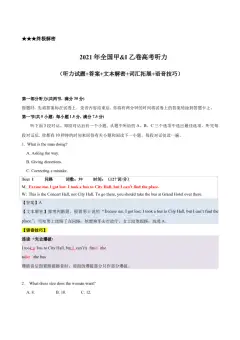
听力试题+答案+文本
专题 01 2021 年全国新课标 I&II 卷
第一部分 听力(共两节,满分30分)
第一节 (共5小题;每小题1.5分,满分7.5分)
听下面5段对话。每段对话后有一个小题,从题中所给的A、B、C三个选项中选出最佳选项。听完每
段对话后,你都有10秒钟的时间来回答有关小题和阅读下一小题。每段对话仅读一遍。
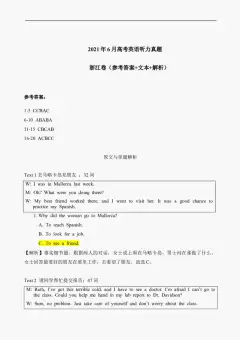
1. Why did the woman go to Mallorca?
A. To teach Spanish. B. To look for a job. C. To see a friend.
2. What does the man ask the woman to do?
A. Take him to hospital. B. Go to a class with him. C. Submit a report for him.
3. Who will look after the children?
A. Jennifer. B. Suzy. C. Marie.
4. What are the speakers going to do?
A. Drive home. B. Go shopping. C. Eat out.
5. What are the speakers talking about?
A. How to fry fish. B. How to make coffee. C. How to remove a bad smell.
第二节 (共15小题;每小题1.5分,满分22.5分)
听下面5段对话或独白。每段对话或独白后有几个小题,从题中所给的A、B、C三个选项中选出最佳
选项。听每段对话或独白前,你将有时间阅读各个小题,每小题5秒钟;听完后,各小题将给出5秒钟的
作答时间。每段对话或独白读两遍。
听第6段材料,回答第6、7题。
6. When does Gomez watch a football game on TV?
A. When he fails to get a ticket.
B. When the stadium is crowded.
C. When his friends are too busy.
7. How much did Gomez pay for the football game last time?
A. $20. B. $25. C. $50.
听第7段材料,回答第8至10题。
8. What did Alex do in the afternoon?
A. He had a walk. B. He went hunting. C. He planted trees.
9. What did Alex bring back?
A. Flowers. B. Leaves. C. Books.
10. What was Bob doing when Alex saw him?
A. Fishing. B. Taking pictures. C. Swimming.
听第8段材料,回答第11至13题。
11. What did David do on his most recent holiday?
A. He had a boat trip. B. He took a balloon flight. C. He climbed a mountain.
12. What is on David’s list?
A. Gifts he needed to buy. B. Things he wished to do. C. Dates he had to remember.
13. Where does the woman suggest David go for his next holiday?
A. Australia. B. California. C. The Amazon.
听第9段材料,回答第14至17题。14. Why did Sarah make the phone call?
A. To ask a favor. B. To pass on a message. C. To make an appointment.
15. Where is Sarah now?
A. In Brighton. B. At her home. C. At the Shelton Hotel.
16. What time is Michael leaving his place tomorrow morning?
A. At 7:40. B. At 8:00. C. At 8:20.
17. What is the probable relationship between John and Sarah?
A. Neighbors. B. Fellow workers. C. Husband and wife.
听第10段材料,回答第18至20题。
18. What do most people think is very important in spoken communication?
A. Pronunciation. B. Vocabulary. C. Grammar.
19. Why should you listen to experts according to the speaker?
A. To develop your reading fluency.
B. To improve your note-taking skills.
C. To find out your mispronunciations.
20. What is the speaker’s last suggestion?
A. Spell out the difficult words.
B. Check the words in a dictionary.
C. Practice reading the words aloud.
专题 01 2021 年全国新课标 I&II 卷答案
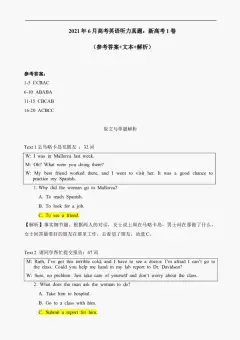
1—5 CCBAC 6—10 ABABA 11—15 CBCAB 16—20 ACBCC
专题 01 2021 年全国新课标 I&II 卷听力材料
Text 1
W: I was in Mallorca last week.
M: Oh, what were you doing there?
W: My best friend works there and I went to visit her. It was a good chance to practice my Spanish.
Text 2
M: Ruth, I’ve got this terrible cold and I have to see a doctor. I’m afraid I can’t go to the class. Could you help me
hand in my lab report to Dr. Davidson?
W: Sure, no problem. Just take care of yourself and don’t worry about the class.
Text 3
M: Marie, if no one takes care of your children while you are away, Jennifer and I will be glad to have them stay
with us.
W: That’s very kind of you. But they’ve already left for their grandma’s. You know, Suzy lives close by.
Text 4
M: Hurry up with your food, Sally. They say there’s a big storm coming. We’d better get home before that.
W: OK, I’m done. Let’s get back to the car. Could you carry these shopping bags?
Text 5
M: We deep-fried fish three days ago in the kitchen, but the unpleasant smell stays.
W: There is a method you can try. Every time you make coffee, dry the leftover coffee grounds and keep them in
small bowls, then place the bowls in the kitchen.
Text 6W: Are you a football fan, Gomez?
M: Yes, I go to the stadium whenever there’s a good game. (6)And if I can’t get a ticket, I watch the game on
TV. That way they are less exciting though.
W: Is the ticket expensive?
M: It depends. It usually costs about twenty to fifty dollars. (7)Last time I paid twenty five.
W: That’s not very expensive. Maybe we can go together sometime.
M: Great! It’ll be more fun to watch the game with a friend.
Text 7
W: You were out the whole afternoon, Alex, what did you do?
M: (8)I took a walk by myself.
W: You just kept walking and walking for four hours?
M: Actually it’s not so boring. Walking in the woods is a grand adventure. Your feet can take you to the most
amazing places.
W: What did you do in the woods?
M: I smell the flowers, looked at the birds. (9)And yeah, I picked many tree leaves. I will make bookmarks with
them. Look!
W: Are they beautiful!
M: (10)Then I met Bob at the lake. He was fishing while his kids were having a swim.
W: Did you talk to him?
M: No, I walked on and took a lot of pictures. There’s just so much out there to see.
Text 8
W: David, how was your holiday?
M: Great! (11)I climbed Mount Fuji. It was really beautiful. Now I can check one more thing of my list.
W: Your list?
M: Yes. (12)When I was twelve, I made a list of things I wanted to do someday.
W: That’s interesting. How many of the things on your list have you done so far?
M: Almost half. I have pictures. Would you like to see them?
W: Yes, sure.
M: Here I am on top of Mount Fuji. And here I am in a hot-air balloon.
W: When did you do that? I’ve always wanted to go up in a hot-air balloon.
M: It was two years ago, in August, in California.
W: What are your plans for the next holiday?
M: I am thinking of deep-sea diving in Australia. Do you have any other suggestions?
W: (13)You really ought to take a boat down the Amazon. You’ll see a lot of interesting animals and beautiful
trees. It is one of the best places I have been to.
M: OK. I will put it on my list.
Text 9
W: Hello, Michael.
M: Hi, Sarah.
W: Are you attending the conference tomorrow morning at the Shelton Hotel?
M: Yes. Are you?
W: Yeah. (15)But when I arrived home five minutes ago, I found that my car wouldn’t start. (17)And John is
in Brighton on business.
M: Do you know what’s wrong with the car?W: I’m not exactly sure. I think there’s a problem with the engine. Err... (14)I wonder if you could give me a ride
to the hotel tomorrow morning.
M: Sure. When shall I be at your place?
W: Well, what about 8 o’clock? (15)From my place to Shelton, we have to drive through the quarters, so we’d
better leave early to avoid the traffic.
M: OK, no problem. It takes twenty minutes to reach your place, (16)so I’ll set off at 7:40. By the way, do you
also need me to drive you home tomorrow afternoon?
W: No, (17)John will be back then, and he’ll get me home. Thank you, Michael.
M: That’s OK. See you tomorrow.
Text 10
W: Hello, everyone. Today I’ll talk about how to improve your pronunciation. Language researchers say
pronunciation and fluency are the biggest barriers followed by grammar in effective spoken English. (18)However,
most people don’t regard pronunciation as a very important part of communication skills. They’re more
focused on vocabulary. (19)One reason is that most people are not even aware of their mispronunciations. So
it’s important to first find out the words you mispronounce. You should listen to experts. By experts I mean
those who are less likely to make pronunciation mistakes. When listening to them, pay attention to words that
sound strange—strange, because you pronounce the same words differently. When you come across such words,
check a dictionary to confirm their exact pronunciations. You can also search for difficult-to-pronounce words and
names and make a list of them. (20)The last suggestion is to read aloud. Now you’ve got the correct
pronunciations of the words. It’s time to practice reading them every day.