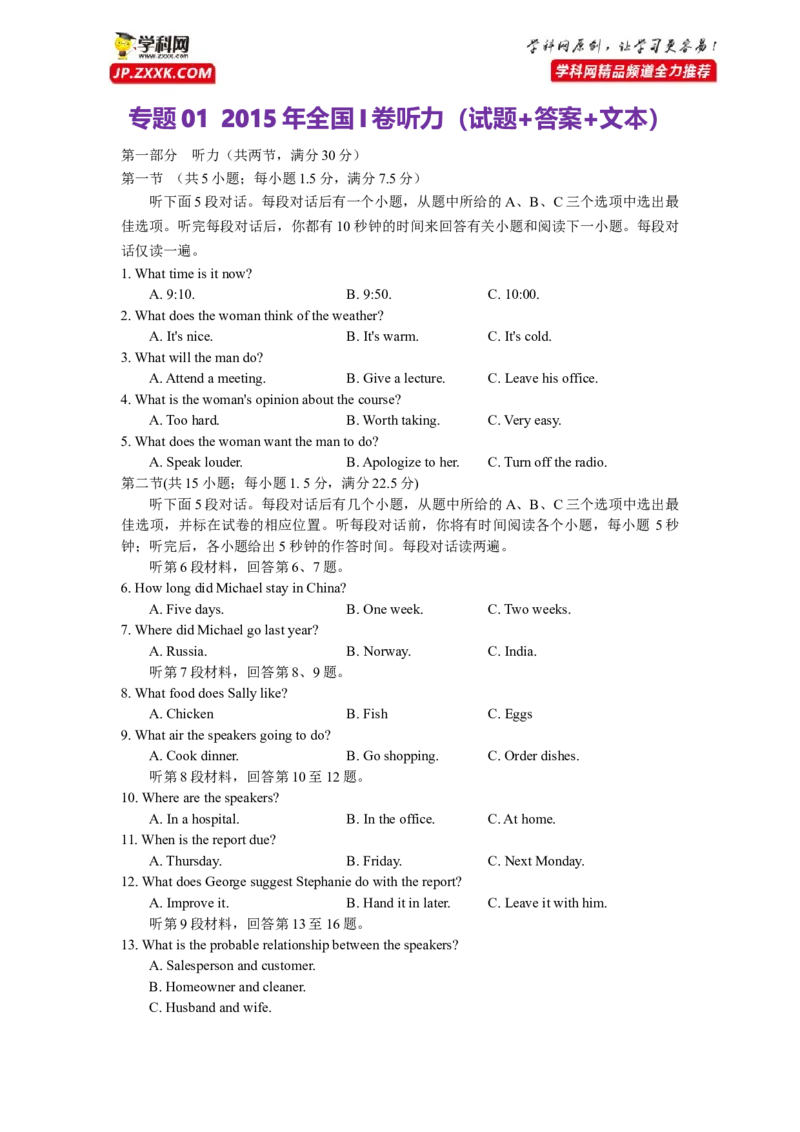
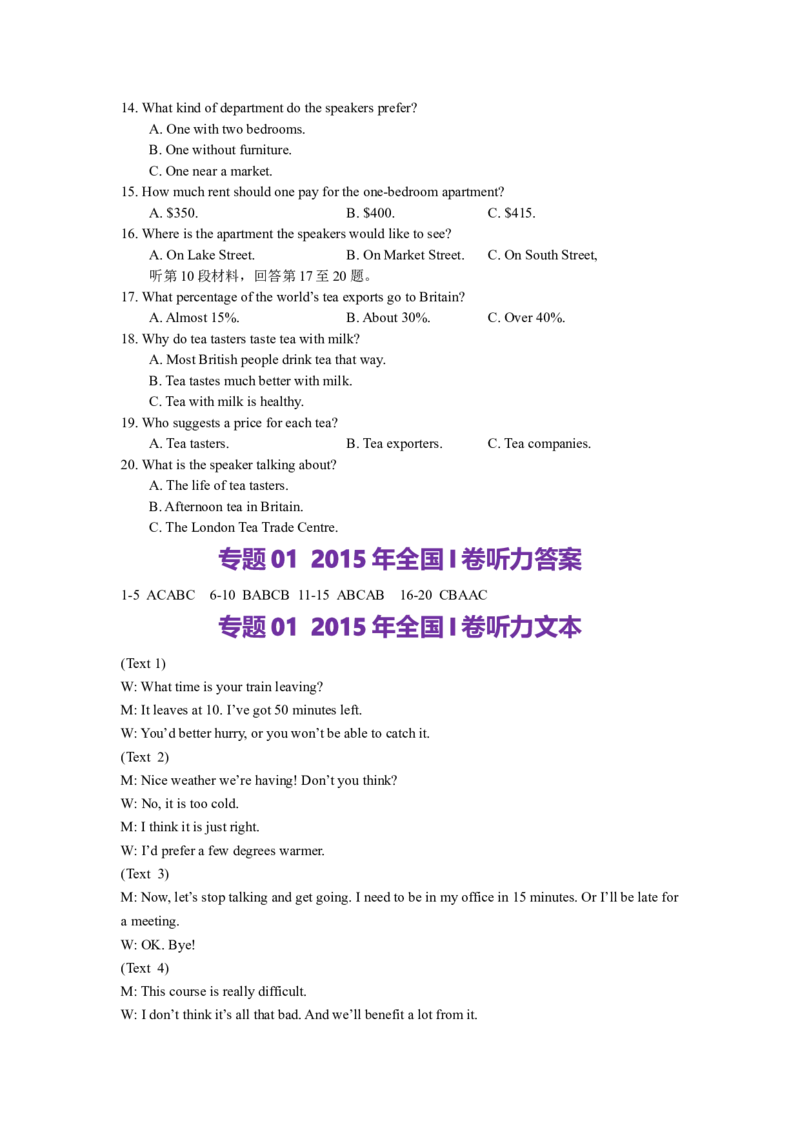
专题 01 2015 年全国 I 卷听力(试题+答案+文本)
第一部分 听力(共两节,满分30分)
第一节 (共5小题;每小题1.5分,满分7.5分)
听下面5段对话。每段对话后有一个小题,从题中所给的A、B、C三个选项中选出最
佳选项。听完每段对话后,你都有10秒钟的时间来回答有关小题和阅读下一小题。每段对
话仅读一遍。
1. What time is it now?
A. 9:10. B. 9:50. C. 10:00.
2. What does the woman think of the weather?
A. It's nice. B. It's warm. C. It's cold.
3. What will the man do?
A. Attend a meeting. B. Give a lecture. C. Leave his office.
4. What is the woman's opinion about the course?
A. Too hard. B. Worth taking. C. Very easy.
5. What does the woman want the man to do?
A. Speak louder. B. Apologize to her. C. Turn off the radio.
第二节(共15小题;每小题1. 5分,满分22.5分)
听下面5段对话。每段对话后有几个小题,从题中所给的A、B、C三个选项中选出最
佳选项,并标在试卷的相应位置。听每段对话前,你将有时间阅读各个小题,每小题 5秒
钟;听完后,各小题给出5秒钟的作答时间。每段对话读两遍。
听第6段材料,回答第6、7题。
6. How long did Michael stay in China?
A. Five days. B. One week. C. Two weeks.
7. Where did Michael go last year?
A. Russia. B. Norway. C. India.
听第7段材料,回答第8、9题。
8. What food does Sally like?
A. Chicken B. Fish C. Eggs
9. What air the speakers going to do?
A. Cook dinner. B. Go shopping. C. Order dishes.
听第8段材料,回答第10至12题。
10. Where are the speakers?
A. In a hospital. B. In the office. C. At home.
11. When is the report due?
A. Thursday. B. Friday. C. Next Monday.
12. What does George suggest Stephanie do with the report?
A. Improve it. B. Hand it in later. C. Leave it with him.
听第9段材料,回答第13至16题。
13. What is the probable relationship between the speakers?
A. Salesperson and customer.
B. Homeowner and cleaner.
C. Husband and wife.14. What kind of department do the speakers prefer?
A. One with two bedrooms.
B. One without furniture.
C. One near a market.
15. How much rent should one pay for the one-bedroom apartment?
A. $350. B. $400. C. $415.
16. Where is the apartment the speakers would like to see?
A. On Lake Street. B. On Market Street. C. On South Street,
听第10段材料,回答第17至20题。
17. What percentage of the world’s tea exports go to Britain?
A. Almost 15%. B. About 30%. C. Over 40%.
18. Why do tea tasters taste tea with milk?
A. Most British people drink tea that way.
B. Tea tastes much better with milk.
C. Tea with milk is healthy.
19. Who suggests a price for each tea?
A. Tea tasters. B. Tea exporters. C. Tea companies.
20. What is the speaker talking about?
A. The life of tea tasters.
B. Afternoon tea in Britain.
C. The London Tea Trade Centre.
专题 01 2015 年全国 I 卷听力答案
1-5 ACABC 6-10 BABCB 11-15 ABCAB 16-20 CBAAC
专题 01 2015 年全国 I 卷听力文本
(Text 1)
W: What time is your train leaving?
M: It leaves at 10. I’ve got 50 minutes left.
W: You’d better hurry, or you won’t be able to catch it.
(Text 2)
M: Nice weather we’re having! Don’t you think?
W: No, it is too cold.
M: I think it is just right.
W: I’d prefer a few degrees warmer.
(Text 3)
M: Now, let’s stop talking and get going. I need to be in my office in 15 minutes. Or I’ll be late for
a meeting.
W: OK. Bye!
(Text 4)
M: This course is really difficult.
W: I don’t think it’s all that bad. And we’ll benefit a lot from it.M: So you’re taking it, too.
W: That’s true.
(Text 5)
W: Could you turn that off? I can’t hear myself think!
M: What?
W: The radio.
M: Oh, sorry.
(Text 6)
W: Hi, Michael! I heard you just came back from a holiday?
M: Yes. I stayed for a week in China and 5 days in India.
W: You do travel a lot, don’t you? Last year, you went to Norway, right?
M: Well, I’ve been to quite some countries, but not yet to Norway. Last summer, I toured Russia
for two weeks.
(Text 7)
M: Sally, do you like seafood?
W: Yes, of course.
M: Is there anything you especially like?
W: Well, I really don’t know. I can never remember the name.
M: Ok. Is there any food you don’t eat?
W: Well, I don’t eat chicken, and I don’t like eggs, either. But I like all kinds of fish and vegetable.
M: Then, let’s look at the menu, and see what they’ve got for us.
(Text 8)
M: You look pale, Stephanie! What’s wrong?
W: I don’t feel good. I have a bad headache. In fact, I haven’t got much sleep this past week, and I
feel really tired.
M: Why don’t you go to see a doctor?
W: Yeah, I think I should. But I have a report to do tomorrow. Ms. Jenkins means it for the board
meeting next Monday.
M: Well, it’s Wednesday today. Why don’t you talk to Ms. Jenkins and ask if you can hand it in on
Friday morning?
W: Maybe I should try. I guess I just need a good sleep. Thanks, Gorge.
M: If you need any help for the report, just let me know.
(Text 9)
W: Anything interesting in the paper today, dear?
M: Well, yeah. There are a few here that might interest us. Here is one for just four hundred
dollars. It only has one bedroom, but it sounds nice, near Lake Street.
W: Yeah, let me see what the cheapest two-bedroom apartment is. Oh, here is one on Market
Street. It’s a real bargain. Only 350 dollars. But it doesn’t have any furniture.
M: Well, it costs a lot to buy all the furniture.
W: Oh, here is another one for just over four hundred dollars. This sounds very interesting. It’s onSouth Street. That’s a nice area!
M: Yes, it’s quiet. Did you say two bedrooms?
W: Yes, at 415 dollars.
M: Why don’t we go and have a look?
W: OK, I’ll give them a call.
(Text 10)
Look at this picture. It’s the London Tea Trade centre. As you can see, it is on the North Bank of
the River Thames. It is the center of an important industry in the everyday life of the British
people. Tea is the British national drink. Every man, woman and child over ten years of age, has
an average over four cups a day, or someone thousand five hundred cups annually. About 30
percent of the world’s export of tea makes its way to London. And Britain is by far the largest
importer of tea in the world.
Now in the second picture, you can see how tea is tasted in the Tea Trade Centre before it is sold.
Here, different types of tea are tasted by skilled tea-tasters before they are sold at each week’s tea
sale. It’s amazing to see them at work! Over a hundred kinds of tea are laid out in a line on a long
table. The tasters generally taste tea with milk, since that is how the majority of British people
drink their tea. The tasters move down the line with surprising speed, tasting from a spoon and
deciding what is a fair price for each tea.