绝密★考试结束前
2026 年高考第二次模拟考试
英语
(考试时间:120 分钟  试卷满分:150 分)
注意事项:
1.本试卷分第Ⅰ卷(选择题)和第Ⅱ卷(非选择题)两部分。答卷前,考生务必将自己的姓名、准
考证号填写在答题卡上。
2.回答第Ⅰ卷时,选出每小题答案后,用2B 铅笔把答题卡上对应题目的答案标号涂黑。如需改动,
用橡皮擦干净后,再选涂其他答案标号。写在本试卷上无效。
3.回答第Ⅱ卷时,将答案写在答题卡上。写在本试卷上无效。
4.考试结束后,将本试卷和答题卡一并交回。
第一部分 听力(共两节,满分 30 分)
做题时,请先将答案标在试卷上。录音内容结束后,你将有两分钟的时间将试卷上的答案转涂到答
题卡上。
第一节(共5 小题;每小题1.5 分,满分7.5 分)
听下面5 段对话。每段对话后有一个小题,从题中所给的A、B、C 三个选项中选出最佳选项。听完每段
对话后,你都有10 秒钟的时间来回答有关小题和阅读下一小题。每段对话读两遍。
1.Who might the woman turn to for help?
A.John.
B.Mike.
C.Lisa.
2.How does Emily sound now?
A.Relieved.
B.Surprised.
C.Sad.
3.What are the speakers mainly talking about?
A.Preparing for a math test.
B.Planning a weekend event.
C.Rescheduling a piano lesson.
4.What are the speakers doing?
A.Waiting for check-in.
B.Picking up their lost luggage.
C.Complaining about a delayed flight.
5.How much is the man’s rent for the first month?
A.$30.
B.$850.
C.$880.
第二节(共15 小题;每小题1.5 分,满分22.5 分)
听下面 5 段对话或独白。每段对话或独白后有几个小题,从题中所给的A、B、C 三个选项中选出最佳
选项,并标在试卷的相应位置。听每段对话或独白前,你将有时间阅读各个小题,每小题 5 秒钟;听完
后,各小题将给出 5 秒钟的作答时间。每段对话或独白读两遍。
听下面一段较长对话,回答以下小题。
6.What’s the man’s research paper about?
A.Psychology.
B.History.
C.Business.
7.What’s the probable relationship between the speakers?
A.Professor and student.
B.Writer and reader.
C.Librarian and borrower.
听下面一段对话,回答以下小题。
8.Where did David probably just come from?
A.A customer feedback meeting.
B.A packaging design discussion.
C.A product development workshop.
9.What problem does the product have?
A.Its price is too high to afford.
B.Its ingredient list is too tiny to read.
C.Its effects are too poor to be appealing.
听下面一段对话,回答以下小题。
10.What is the woman’s main challenge?
A.Lacking sufficient data for her essay.
B.Missing an important expert lecture.
C.Deleting the data she collected before.
11.How does the professor suggest contacting Dr. Martinez initially?
A.By calling her office telephone.
B.By sending an email to her assistant.
C.By visiting her in the Engineering Building.
12.What will Dr. Martinez do next Tuesday?
A.Have a presentation.
B.Write a recommendation.
C.Talk with Professor Clark.
听下面一段对话,回答以下小题。
13.What is unique to the Gold membership?
A.Gym equipment access.
B.Free medical treatment.
C.Weekly personal training.
14.What is required for an emergency leave?
A.A doctor’s statement.
B.A contract with the club.
C.A $15 administration fee.
15.What can one gain by buying a one-year membership?
A.A 10% discount.
B.Four guest passes.
C.An extra six-month membership.
16.Which membership do the majority prefer?
A.Gold.
B.Silver.
C.Bronze.
听下面一段独白,回答以下小题。
17.What might the speaker be?
A.An editor.
B.A gardener.
C.A teacher.
18.Which is a desirable label according to Miss Liu?
A.Rose, red, open grassland.
B.Rose, open grassland, red.
C.Open grassland, rose, red.
19.Where will students get the printed stickers?
A.In a print shop.
B.In the classroom.
C.At the garden gate.
20.What are allowed to be brought and used during the trip?
A.Glue sticks.
B.Phones.
C.Flowers.
第二部分  阅读(共两节,满分50 分)
第一节(共15 小题;每小题2.5 分,满分37.5 分)
阅读下列短文,从每题所给的A、B、C、D 四个选项中选出最佳选项。
A
The University of Science and Technology of China (USTC) research internship program provides the
opportunity for graduate students or 3rd/4th year undergraduate students to participate in research projects to gain
valuable experience on a variety of cutting-edge research at USTC.
Program Benefits
●Enhance research capability in state-of-the-art labs under the guidance of professors at USTC.
●Have a competitive edge in application for Master’s, Ph.D.and post-doctoral programs at USTC by developing
relationships with faculty and students.
●Apply for free Chinese language and culture class to learn basic Chinese language and explore unique Hui
culture.
Application Qualification
1. Good command of English.
2. Non-Chinese citizens with a foreign passport.
3. Currently enrolled full-time students in undergraduate Year 3/4, Master’s, or doctoral programs.
Cost
●Tuition: 2,100 RMB (≈304 USD) per month (undergraduate student or master student).
2,600 RMB (≈377 USD) per month (PhD student).
●Student dormitory: 500-1,000 RMB (≈73-146 USD) per month depending on room type and size.
●Insurance: 160 RMB (≈23 USD) per month.
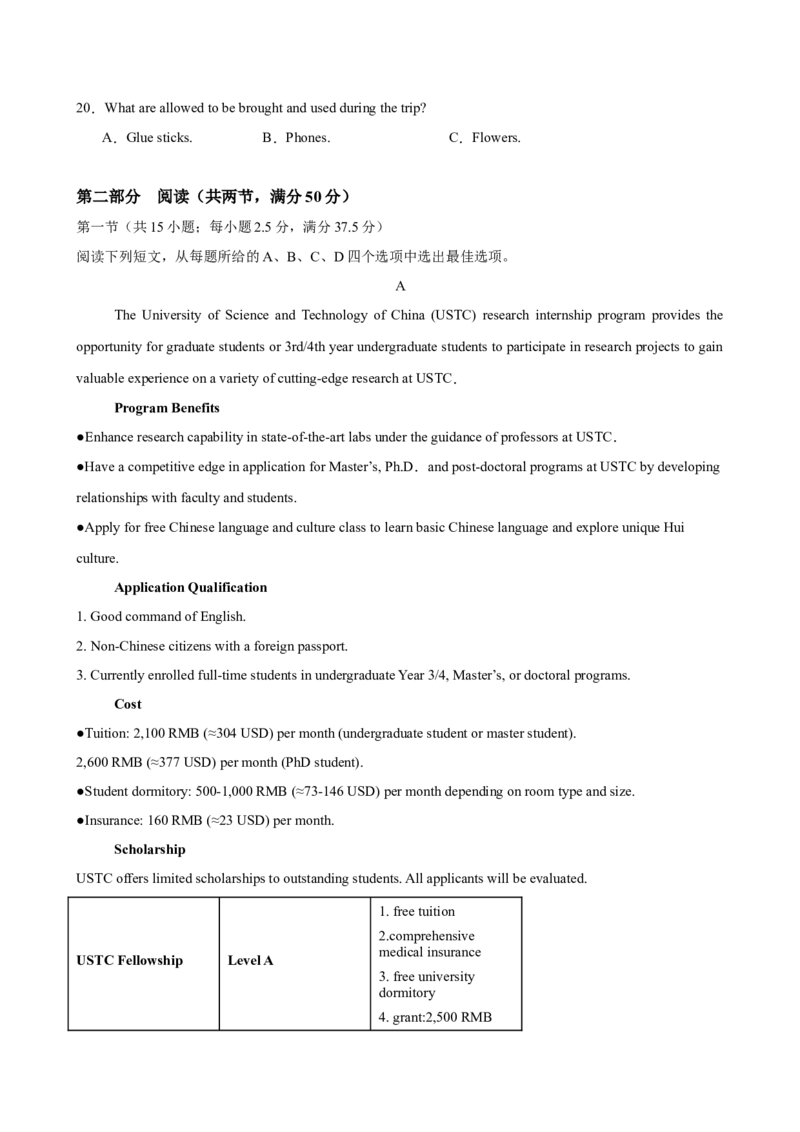
Scholarship
USTC offers limited scholarships to outstanding students. All applicants will be evaluated.
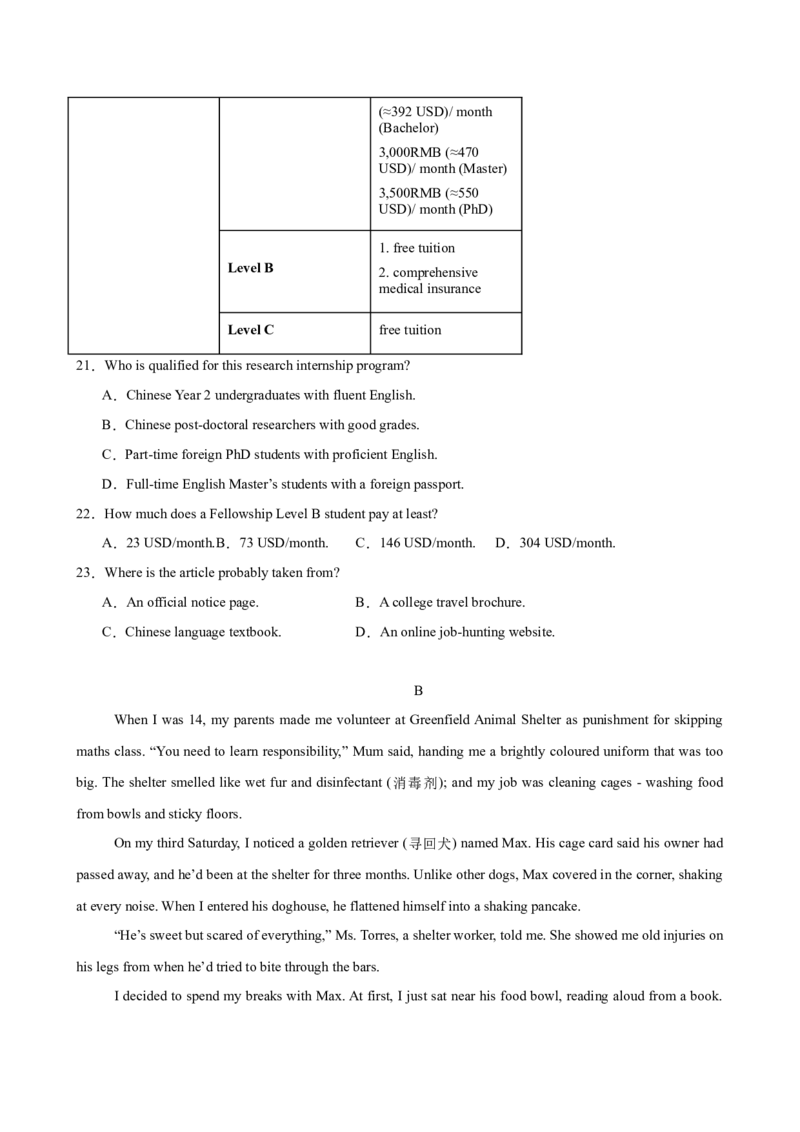
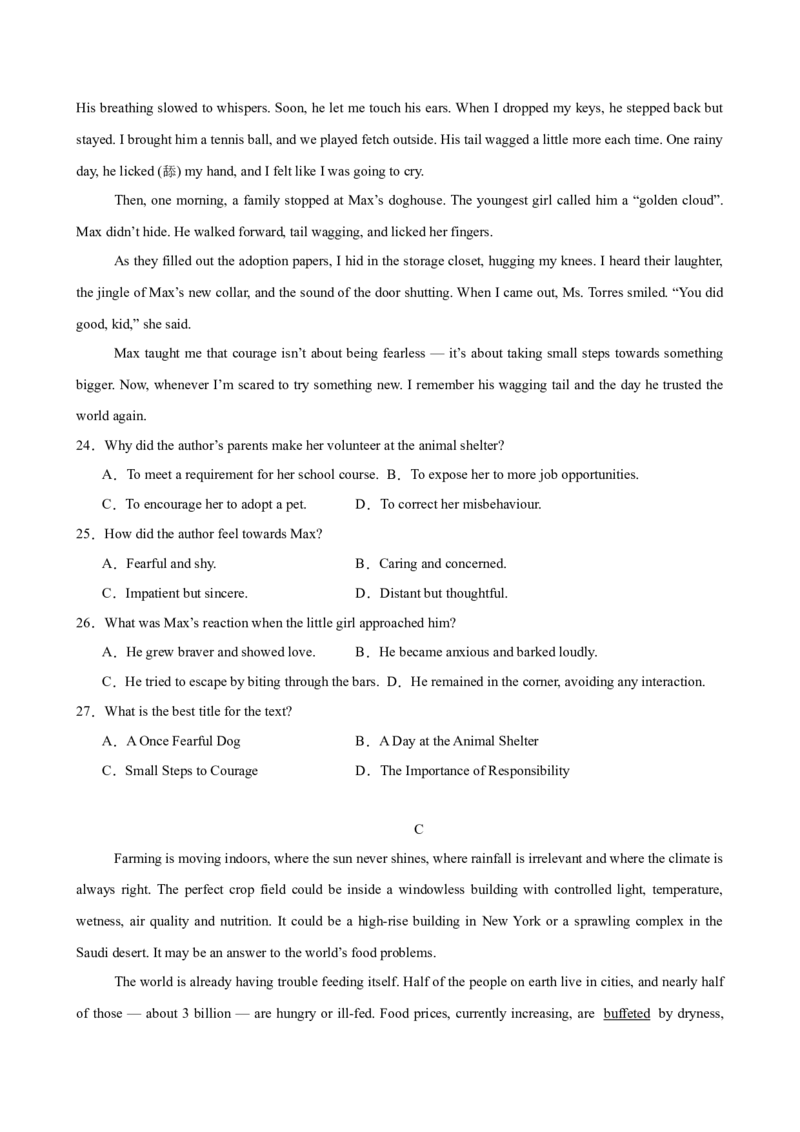
USTC Fellowship
Level A
1. free tuition
2.comprehensive
medical insurance
3. free university
dormitory
4. grant:2,500 RMB
(≈392 USD)/ month
(Bachelor)
3,000RMB (≈470
USD)/ month (Master)
3,500RMB (≈550
USD)/ month (PhD)
Level B
1. free tuition
2. comprehensive
medical insurance
Level C
free tuition
21.Who is qualified for this research internship program?
A.Chinese Year 2 undergraduates with fluent English.
B.Chinese post-doctoral researchers with good grades.
C.Part-time foreign PhD students with proficient English.
D.Full-time English Master’s students with a foreign passport.
22.How much does a Fellowship Level B student pay at least?
A.23 USD/month.B.73 USD/month.
C.146 USD/month.
D.304 USD/month.
23.Where is the article probably taken from?
A.An official notice page.
B.A college travel brochure.
C.Chinese language textbook.
D.An online job-hunting website.
B
When I was 14, my parents made me volunteer at Greenfield Animal Shelter as punishment for skipping
maths class. “You need to learn responsibility,” Mum said, handing me a brightly coloured uniform that was too
big. The shelter smelled like wet fur and disinfectant (消毒剂); and my job was cleaning cages - washing food
from bowls and sticky floors.
On my third Saturday, I noticed a golden retriever (寻回犬) named Max. His cage card said his owner had
passed away, and he’d been at the shelter for three months. Unlike other dogs, Max covered in the corner, shaking
at every noise. When I entered his doghouse, he flattened himself into a shaking pancake.
“He’s sweet but scared of everything,” Ms. Torres, a shelter worker, told me. She showed me old injuries on
his legs from when he’d tried to bite through the bars.
I decided to spend my breaks with Max. At first, I just sat near his food bowl, reading aloud from a book.
His breathing slowed to whispers. Soon, he let me touch his ears. When I dropped my keys, he stepped back but
stayed. I brought him a tennis ball, and we played fetch outside. His tail wagged a little more each time. One rainy
day, he licked (舔) my hand, and I felt like I was going to cry.
Then, one morning, a family stopped at Max’s doghouse. The youngest girl called him a “golden cloud”.
Max didn’t hide. He walked forward, tail wagging, and licked her fingers.
As they filled out the adoption papers, I hid in the storage closet, hugging my knees. I heard their laughter,
the jingle of Max’s new collar, and the sound of the door shutting. When I came out, Ms. Torres smiled. “You did
good, kid,” she said.
Max taught me that courage isn’t about being fearless — it’s about taking small steps towards something
bigger. Now, whenever I’m scared to try something new. I remember his wagging tail and the day he trusted the
world again.
24.Why did the author’s parents make her volunteer at the animal shelter?
A.To meet a requirement for her school course. B.To expose her to more job opportunities.
C.To encourage her to adopt a pet.
D.To correct her misbehaviour.
25.How did the author feel towards Max?
A.Fearful and shy.
B.Caring and concerned.
C.Impatient but sincere.
D.Distant but thoughtful.
26.What was Max’s reaction when the little girl approached him?
A.He grew braver and showed love.
B.He became anxious and barked loudly.
C.He tried to escape by biting through the bars. D.He remained in the corner, avoiding any interaction.
27.What is the best title for the text?
A.A Once Fearful Dog
B.A Day at the Animal Shelter
C.Small Steps to Courage
D.The Importance of Responsibility
C
Farming is moving indoors, where the sun never shines, where rainfall is irrelevant and where the climate is
always right. The perfect crop field could be inside a windowless building with controlled light, temperature,
wetness, air quality and nutrition. It could be a high-rise building in New York or a sprawling complex in the
Saudi desert. It may be an answer to the world’s food problems.
The world is already having trouble feeding itself. Half of the people on earth live in cities, and nearly half
of those — about 3 billion — are hungry or ill-fed. Food prices, currently increasing, are buffeted by dryness,
floods and the cost of energy required to plant, harvest and transport it. And prices will only get more unstable.
Climate change makes long-term crop planning uncertain. Farmers in many parts of the world are already using
water available to the last drop. And the world is getting more crowded: by mid-century, the global hungry
population will grow to 9 billion.
To feed such a large population, people may need to expand farmland at the expense of forests and
wilderness, or find ways to completely increase crop output.
Gertjan Meeuws has taken the concept of greenhouse-growing vegetables and house plants in enclosed and
controlled environments. In their research station, water flows into the pans when needed, and temperature is kept
constant. Lights go on and off, creating similar day and night according to the rhythm of the plants.
A building of 100 square meters and 14 layers of plants could provide a daily diet of 200 kilograms of fresh
fruit and vegetables for the entire population of Den Bosch, about 140,000 people. Their idea is not to grow foods
that require much space, like corn, or potatoes.
Here sunlight is not only unnecessary but can be harmful: Plants need only specific wavelengths of light to
grow. Their growth rate is three times faster than those under greenhouse conditions. They use about 90 percent
less water than outdoor agriculture. And city farming means producing food near consumers, so there’s no need to
transport it long distances.
28.What does Paragraph 2 mainly tell us?
A.Urbanization affects food prices.
B.Global food security is in trouble.
C.Farmers make the most of energy.
D.The world’s population is expanding.
29.The underlined word “buffeted” in Paragraph 2 means “________”.
A.Badly affected
B.Sharply reduced
C.Steadily raised
D.Well achieved
30.What can be inferred about Gertjan Meeuws’s farming?
A.Limited but efficient.
B.Scientific but ineffective.
C.Productive and economical.
D.Eco-friendly and manageable.
31.What is the text mainly about?
A.A great revolution in farming.
B.Advantages of indoor farming.
C.The development of indoor farming.
D.Sunless and rainless indoor farming.
D
Big restaurant businesses, such as McDonald’s, have introduced touch-screen checkout systems, while
others have applied tabletop tablets (平板电脑) for self-service. Besides, the use of app-based delivery services,
such as Uber Eats, has continued to grow. According to US reports, spending on third-party delivery has grown
three times for quick-service restaurants and nearly four times for full-service restaurants in the country.
A new study carried out by Dipayan Biswas and his graduate students compares the effects of ordering
from a digital screen to those of traditional methods, including printed menus. The team went over more than
23,000 orders from a number of restaurants. Each item was placed into one of three groups. Menu choices, such as
fried foods and desserts, were regarded as unhealthy, while items such as vegetables and fish were considered
healthy. Most soups, large salads and steaks smaller than six ounces were considered neutral.
The study showed that 61% of digital orders were unhealthy — more than 3% higher than non-digital
orders. The team also found that digital menus had a greater influence on what customers ordered for dinner, since
they were likely to be more tired and dependent on technology later in the day.
This situation is related to the Google effect. It suggests that the convenience of digital tools changes how
people store and get back information, such as depending on cell phones for contact numbers and GPS for
directions, leading to less brain effort in these tasks. This can result in more unplanned decisions, leading to more
unhealthy food choices and more spending. However, the study also found that customers who were expert in
technology might be less likely to suffer from the Google effect.
“Digital ordering forms encourage a more unplanned decision-making process with lower mental effort.
Restaurant managers aiming to market healthier food choices may benefit from offering non-digital ordering
methods. And some may be interested in marketing expensive food items during dinner hours through digital
ordering to drive sales. For customers, avoiding placing digital orders during evening hours may cut spending,”
Biswas said.
32.What does the first paragraph mainly show?
A.The popularity of self-service.
B.The rise of digital dining services.
C.The increase in everyday spending.
D.The growth of global food markets.
33.What was the primary research method applied in the study?
A.Reviewing actual order types.
B.Doing tests on food’s health value.
C.Making customer satisfaction surveys.
D.Having interviews with restaurant managers.
34.What does the Google effect suggest about digital tools?
A.They require a wide knowledge.
B.They offer too many confusing choices.
C.They allow users to follow personal habits.
D.They weaken the ability to make wise choices.
35.What are restaurants probably encouraged to do?
A.Match ordering methods to goals.
B.Develop user-friendly digital tools.
C.Offer more affordable dinner foods.
D.Focus on improving after-sales service.
第二节(共5 小题;每小题2.5 分,满分12.5 分)
阅读下面短文,从短文后的选项中选出可以填入空白处的最佳选项。选项中有两项为多余选项。
We’ve all had that annoying experience; another driver cuts you off in traffic, and suddenly, you feel angry
for the rest of your trip. A single event causes an emotional response in the brain, and it seems to last long.     36
A new study offers some clues by looking at how both mice and people react to a simple, annoying stimulus.
According to Dr. Karl Deisseroth, a psychiatrist at Stanford University, feeling angry at one thing, like a
bad driver, can make you more likely to get angry at something else, like a noisy child.     37
They decided on a gentle puff (a small amount) of air to the eye. It’s certainly annoying, but not painful.
They believed both humans and mice would react to it in a similar way. They were right.     38     After
several puffs, both started to squint (眯眼) in a defensive, lasting reaction. The scientists then studied the brain
activity linked to this experience. They discovered that the brain responds in two clear phases (阶段).
    39     This is when the brain areas that handle sensory information — what we see, hear, and feel —
become highly active for just an instant.
Right after, the second phase begins. In this phase, brain activity moves to other areas, including those
linked to emotions. This phase is longer and more lasting, like a musical note that is held.     40     With each
new puff of air, this lasting response became stronger. Dr. Deisseroth connects this directly to what emotion is: a
lasting state that changes how we feel and act.
A.But how does the brain identify this?
B.Each new puff made this second part stronger.
C.But how does this process happen inside our brains?
D.Both people and mice closed eyes when they felt the air puff.
E.The first phase is very quick, like a short, sharp musical note.
F.To understand this better, he and his team designed a lab experiment.
G.It’s this lasting brain activity that seems to create the ongoing emotional state.
第三部分  语言运用(共两节,满分30 分)
第一节  (共15 小题;每小题1 分,满分15 分)
阅读下面短文,从每题所给的A、B、C、D 四个选项中选出可以填入空白处的最佳选项。
His goal was to walk around the world. 27 years later, he’s about to finish.
In 1998, British     41     Karl Bushby looked down a road in Chile and set a(n)     42     goal:
walk all the way home to Hull, England — without using a single form of     43    . What he didn’t know
then was that it would stretch into a remarkable 27-year journey     44     continents, oceans, and history
itself.
Now, after walking 36,000 miles,     45     polar bears, swimming across seas, and navigating     46
visa setbacks, the 56-year-old ex-paratrooper (前伞兵) is     47     on the home stretch.
Bushby began his adventure in Chile, trekking (跋涉) north through South and North America, eventually
reaching Alaska. In 2006, he     48     one of the most dangerous legs of the journey: crossing the frozen
Bering Strait into Siberia.     49     with a gun to scare off polar bears and forced to     50     between
moving blocks of ice, he achieved what few people on Earth have ever done.
His     51     didn’t stop there. Bushby was held in Russia for entering incorrectly and banned for five
years. Sponsorships     52     during the 2008 financial crisis. The pandemic stopped his progress. Visa issues
left him     53     in Mexico for years. But he refused to quit.
Bushby walks an average of 30km a day and rests wherever he can find     54    . His mission has
outlasted five UK prime ministers, a global pandemic, and numerous wars — but his spirit remains as strong as it
was in 1998.
And the world is cheering him on as he enters the final chapter of one of the most     55     human
endurance journeys ever attempted.
41.A.historian
B.photographer
C.adventurer
D.journalist
42.A.realistic
B.daring
C.collective
D.demanding
43.A.transport
B.navigation
C.communication
D.equipment
44.A.connecting
B.including
C.covering
D.overcoming
45.A.hunting
B.feeding
C.threatening
D.surviving
46.A.scarce
B.minor
C.countless
D.occasional
47.A.consequently
B.randomly
C.unexpectedly
D.ultimately
48.A.attempted
B.sought
C.recognized
D.advocated
49.A.Loaded
B.Armed
C.Confronted
D.Provided
50.A.swap
B.leap
C.slip
D.march
51.A.challenges
B.achievements
C.inspirations
D.pursuits
52.A.used up
B.pulled down
C.backed down
D.dried up
53.A.isolated
B.settled
C.rooted
D.stuck
54.A.warmth
B.company
C.shelter
D.comfort
55.A.extraordinary B.conventional
C.universal
D.historical
第二节(共10 小题;每小题1. 5 分, 满分15 分)
阅读下面材料,在空白处填入适当的内容(1 个单词)或所给单词的正确形式。
On October 17, Dongluo Village in Jiangsu was honored with the legendary title of Best Tourism Village by
the United Nations World Tourism Organization (UNWTO). Since then, this recognition has highlighted     56
(it) success in rural construction.
The village has over 600 years of continuous development and cultural sustainability, which is an
ecological wonder,     57     (surround) by plants and the unique landscape is sculpted via the duotian
agricultural system. Here, not only the tradition is protected,     58     it flourishes. The steady sound of
wooden mallets (木槌) fills the old workshops, while the sweet perfume fills the air,     59     (create) a
timeless atmosphere. The village’s     60     (devote) to its heritage is meaningful. In its exhibition hall,
ancient farm tools that have passed down through generations deliver stories of local hard work. The village has
successfully discovered a path where ecological integrity and economic development support each other, offering
61     sustainable and hopeful model for other villages.
    62     (remarkable), with its living traditions and forward-looking vision, Dongluo stands     63
a masterpiece of the positive symbiosis between modern tourism and deep-rooted culture. By 2024, the village
64     (achieve) significant and widespread economic growth, bringing extraordinary benefits to its community
and actively inspiring neighboring regions to follow its innovative path towards a     65     (harmony) future.
第四部分 写作(共两节, 满分40 分)
第一节(满分15 分)
66.假定你是李华。你校英语广播站推出新栏目“Digital Well-being 2026”,倡导健康的数字生活方式,
现向学生征求首期话题。请给负责人Smith 写一封邮件,内容包括:
1.你推荐的话题;
2.推荐理由。
注意:1.写作词数应为80 左右;
2.请在答题卡的相应位置作答。
Dear Mr. Smith,
___________________________________________________________________________________________
___________________________________________________________________________________________
___________________________________________________________________________________________
___________________________________________________________________________________________
___________________________________________________________________________________________
___________________________________________________________________________________________
___________________________________________________________________________________________
_______________________________________________________________________________
Yours sincerely,
Li Hua
第二节(满分25 分)
67.阅读下面材料,根据其内容和所给段落开头语续写两段,使之构成一篇完整的短文。
The day our teacher put up the sign-up sheet for the school play, my stomach instantly tightened. While
others saw a chance to shine under the bright lights, I wandered aimlessly at the back, my palms growing damp.
The thought of standing onstage made my heart race in the worst way. I preferred staying backstage — quiet,
unseen, surrounded only by my scripts and notes.
Lily, the drama club president, noticed my hesitation. She was the kind of person who could light up a room
with her energy. During rehearsal (预演) one afternoon, she found me arranging props (道具) in the corner. “We
need someone for a small speaking role,” she said gently. “Would you be willing to give it a try?” I shook my
head, but Lily didn’t give up that easily.
The following week, she persuaded me to join a group reading. My hands trembled as I held the script.
When it was my turn to speak, my voice barely rose above a murmur. Some students snickered (偷笑), and my
face burned with shame. I wanted to escape, but Lily stopped me. “Let’s read it together,” she offered, reading the
lines with me. Slowly, other cast (演出人员) members joined in, offering tips and encouragement.
To my surprise, I started enjoying our rehearsals. The cast became like a second family — we supported
each other through forgotten lines and awkward movements. My initial fear gradually transformed into cautious
excitement.
As opening night approached, I found myself actually looking forward to it. I practiced my lines constantly,
even in front of my mirror at home. I couldn’t stop imagining the moment when the curtains would lift and the
stage lights would shine down. I was ready, but also a bit nervous. After all, I had prepared for such a long time.
注意:
1. 续写词数应为150 个左右;
2. 请按如下格式在答题卡的相应位置作答。
Paragraph 1: The night of the performance arrived at last.
___________________________________________________________________________________________
___________________________________________________________________________________________
___________________________________________________________________________________________
___________________________________________________________________________________________
___________________________________________________________________________________________
_
Paragraph 2: When the final curtain fell, I stood breathless in the spotlight.
___________________________________________________________________________________________
___________________________________________________________________________________________
___________________________________________________________________________________________
___________________________________________________________________________________________
___________________________________________________________________________________________
_