文档文本内容
专题 02 宾语从句
一、宾语从句概念
在句子中起宾语作用的从句称为宾语从句,常放在及物动词、心理状态的形容词、介词或“及物动词
+副词”类型的短语的后面。不管宾语从句的引导词是什么,从句一律用陈述语序,即“引导词+主语+谓
语(+其他.)”结构。
二、宾语从句的分类
宾语从句是名词性从句的一种。在主从复合句中充当宾语,位于及物动词、介词或复合谓语之后的从
句称为宾语从句。宾语从句分为三类:及物动词后的宾语从句,介词的宾语从句和形容词的宾语从句。
及物动词的宾语从句
I think that he is right.
She believes that honesty is the best policy.
He said that he would be late.
We know that the earth revolves around the sun
The teacher suggested [that we review chapter five.
介词的宾语从句
We talked about what happened yesterday.
It depends on whether the weather is good.
She learned a lot from what he said.
I know nothing except that he left early.
The plan is good in that it saves money.
形容词后面的宾语从句
I am sure that he will come.
She was afraid that she might fail the exam.
Are you aware that the meeting has been postponed?
We are glad that you could join us.
He was surprised that they agreed so quickly.
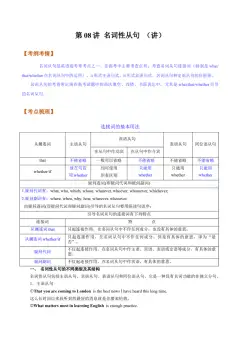
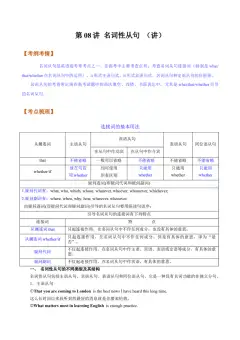
三、宾语从句的引导词
1).that
2).whether/if3)what, who, which, whose
4)when, where, why, how
That
1)连接主从 2) 不作成分 3) 没有任何意义 4)可以省略
He said (that) he was excited. 他说他很兴奋。
The child admitted that he stole the cookie. 那孩子承认他偷了饼干。
I know that patience has its limits. 我知道耐心是有限度的。
Whether/if
1) 连接主从 2)不作成分 3) 意为:是否
whether可省略为whether to do结构(if一般不这样)可与or not连用
The boss did not mention whether you were attending the party. 老板没有提到你是否参加聚会。
He seemed undecided whether to go or stay. 他似乎还没有决定去留。(可以省略为whether to do结构)
I asked him whether he had done it all himself or whether someone had helped him. 我问过他这都是他自己
做的还是有人帮他做的。
I wonder if I should wear a coat or not. 我不知道该不该穿外套。
What/who/which/whose
1) 连接主从 2)作成分 3) 意为:什么/谁/哪个/谁的包括whatever/whoever/whichever/whom等
Dad cannot remember what Mom wants for Christmas. 爸爸不记得妈妈想要什么圣诞礼物。
My dog will eat whatever food I give him. 我给狗吃什么,它就吃什么。
Did you notice who broke the window? 你注意到是谁打破了窗户吗?
My coworker hates whoever keeps leaving the photocopier on. 我的同事讨厌老是开着复印机的人。
I wanted to know which school it was you went to. 我想知道你就读的是哪所学校。Choose whichever brand you prefer. 挑选你喜欢的那个品牌
I wonder whose this is. 我不知道这是谁的。
You never know whom you may run into in an elevator! 你永远不知道在电梯里会遇到谁!
When/where/why/how
1) 连接主从 2)作成分 3) 意为:什么时候/哪里/为什么/怎样包括whenever/wherever等
I asked him when he'd be back to pick me up. 我问他什么时候回来接我
The old man knew where the treasure was kept. 老人知道宝藏藏在哪里。
Tell me why you did it. 告诉我你为什么这样做。
I'll show you how to load the software. 我给你演示一下如何装入这套软件
四、宾语从句的注意事项
1.否定前移
.在动词 think,believe,guess,suppose,be sure,be afraid 等词语之后的宾语从句,主句的否定式是从句
否定的转移,主句为第一人称,反意疑问句要依照宾语从句的人称、时态提问。
否定转移 本来否定从句 却把否定放在了主句上
I don’t think you are right, are you?
(不可能是 I don’t think you are right, do I?据叶斯柏森(Jesperson)说,I don’t think 之类只是起缓和语气
的作用,主要意思在从句上。)
2. 不能省略 that 的宾语从句
①句中有两个或两个以上的宾语从句时,紧跟动词的宾语从句可以省去 that,其余的宾语从句前的 that
一般都不能省去
本质:如果全省略 就会出现后面的句子到底是宾语从句还是并列句的混和歧义 为避免出现这种情况不能
全省
He said (that) the exhibition was excellent and that he wanted to visit it once more. 他说展览非常棒,他还想再
看一次。
We realize (that) hiking can be hard work and believe that hikers need all our help. 我们意识到徒步旅行是项艰
苦的活动,也相信徒步旅行者需要我们的全力帮助。②主句谓语和宾语从句之间有插入语或主句的状语时,宾语从句前的 that 不能省去。
本质:省略后导致后面句子变成并列句却没有连词的混乱
Just then I noticed, for the first time, that our minister was wearing his fine green coat and his black silk cap.
就在那时我才注意的我们的部长第一次穿上了他的绿色大衣,戴上了他的丝质黑色礼帽。
③在宾语从句中,that 之后紧接作主语或作定语的 that(或 this)时,that 不能省略。
本质:当第一个that省了 就会出现第二个that成为宾语从句引导词而后面从句没有主语的混乱 (名词性
从句中that只是引导作用 不做从句成分)
He thought that that would be a good chance for him to go to visit the world-famous scientist. 他认为那可能是他
拜访这位世界著名科学家的一次好机会。
④介词 except,but,in 等后的宾语从句不能省去 that
特列说明:that引导的宾语从句一般不可做介词宾语 但 except,but,in 属于特例
本质:介词后面常跟 名词 动名词及短语 宾语从句 那么没有 that 介词就和从句主语碰撞在一起而出现混
乱和歧义
His article is very good except that there are only a few unfit sentences. 他的文章非常好,除了几个不太适合的
句子。
3.只能用whether不能用if的情况:
①在介词后面:
I'm thinking of whether we should go fishing.
②在动词不定式前:
They asked me whether to go skating.
③当与or not连用,或提出两种选择时:I don't know whether he's free or not.
④放在句首时:
Whether this is true or not, I can't say.
五、宾语从句提升练
练习1:
1) 我认为你应该向老师寻求帮助。
2) 我们有理由相信,她跟受害人很熟。
3) 他坚称从没见过那女人。
4)我认为她没去过北京这事儿是真的。
练习2:
1) 我正在考虑是帮他还是让他自己做。2) 文化差异制约了国家之间是否能顺利沟通。
2) 他还没有决定是否要出国深造。
练习3:
1)孩子们很期待在这次冒险中将遭遇什么。
2) 学生们知道该如何完成这项任务。
1) 你知道今年的马拉松比赛谁拿了冠军吗?
2) 她总想着如何才能为孩子们做得更多。
练习4
1)我们应该注意老师课上说了什么。
2)和平爱好者认为核武器用于现代战争是不道德的。
3)现在大家都知道地球是圆的。
4) 你相信她说的吗?
5) 我们怀疑材料是否会在明天运到。
6) 老师问我们他的桌上是什么。
7) 他们确信能够做好那个工作。
8) 他命令我们立即出发。
六、宾语从句能力提升检测
①、单句语法填空
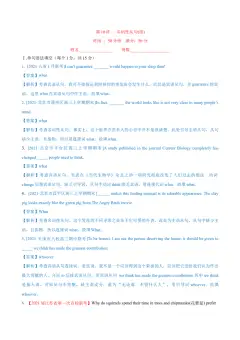
1.English learning websites provide a list of sources to show their information came from.
2.My dad read a brochure about holidaying in the countryside, so he decided to call and see we
could book a farmhouse.
3.I began my exercise slowly, with just five to ten minutes a day, which is what I recommend everyone
aims for at the start.
4.Judy needs to take a lot of time identifying the necklace is something made out of shells or not.
5.Jia once explained on her Weibo account: “The film is not related to weight loss and even has very little
connection with boxing. It tells a kind person finds herself and learns to love herself.”
6.One newly uploaded video showed she turned a woodshed into a woodland cloakroom (衣帽间), and
the other showcased her craft using the intangible cultural heritage Chinese lacquerware (漆器) techniques.
7.Over thousands of years, they began to depend less on could be hunted or gathered from the wild,
and more on animals they had raised and crops they had sown.
8.The gold medal will be awarded to wins the first place in the bicycle race.9.When I started running in my 30s,I realized running was a battle against myself, not about competition or
or not I was athletic.
10.We must make it clear to the public something should be done to stop pollution.
②、完成句子
11.As for computers, I will say (利远大于弊).
12. (我觉得这不公平) that I had to contribute my money.
13.He insisted that he anything.
他坚持说他从来没有偷过任何东西。
14. (考虑到) Yuan’s hybrids have made him quite wealthy, one might think he
would retire to a life of leisure.
15. (为了查明这些人发生了什么事), a working group will be set up.
③、翻译
16.Lily最终原谅了她的朋友,因为她意识到友谊比自尊心更珍贵。(Sb. did sth. because...)
17.这位建筑师通过数据库查看不同材料应用在建筑上的视觉效果。(search)
18.需要什么能进入下一轮面试? (qualify)
19.在法庭上,他坚持自己没犯抢劫罪。(guilty)
20.如果能找到任何适合你的学习方法,你的学习效率就可能明显提高。(whatever)
21.我认为你们的建议和他们的一样有价值。(as…as)
22.我们不能想当然地认为自然资源是取之不尽用之不竭的。(grant)
23.他脸上坚定的表情表明他对自己有足够的信心。
24.直到那时,我才意识到动物也知道如何表达它们的感激之情。
25.在道别时,他意识到它对他生命的深刻影响。