专题 01 细节题
策略分析
细节理解题依托文本信息与事实命题,命题人通过改写文章细节,考查考生对细节的精准理解能
力 。在高考阅读理解中占比高,约达总题量一半,考点可源于段落单句或综合信息,涉及时间、地
点、人物、事件、因果、方式,以及议论文里的例证、定义类细节,2026 年预计在应用文、说明文、
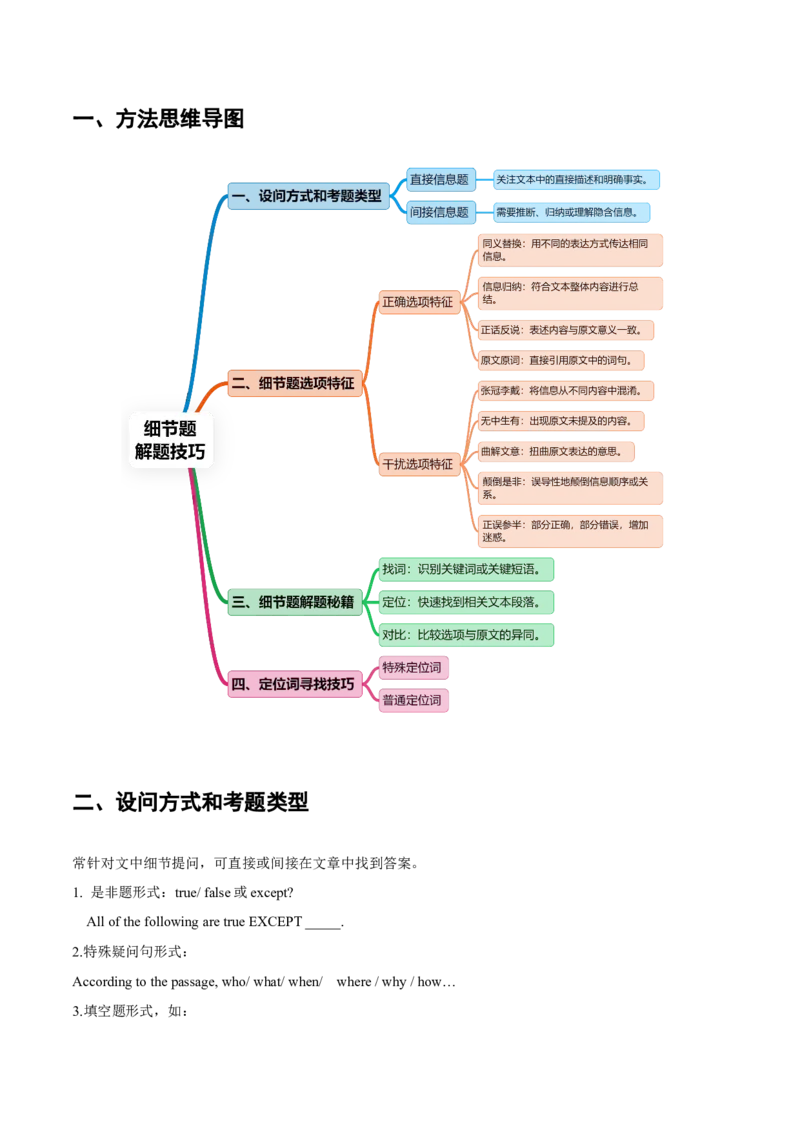
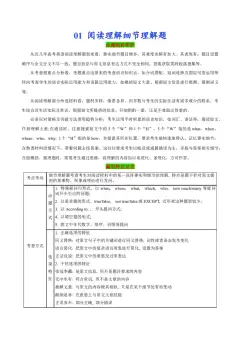
记叙文阅读里,会更侧重这类题考查。一、方法思维导图
二、设问方式和考题类型
常针对文中细节提问,可直接或间接在文章中找到答案。
1. 是非题形式:true/ false或except?
All of the following are true EXCEPT _____.
2.特殊疑问句形式:
According to the passage, who/ what/ when/ where / why / how…
3.填空题形式,如:To avoid attracting mountain lions, people are advised_____
(二)考题类型
1.高频考点:直接信息题;间接信息题。
2.底频考点:数字计算题;
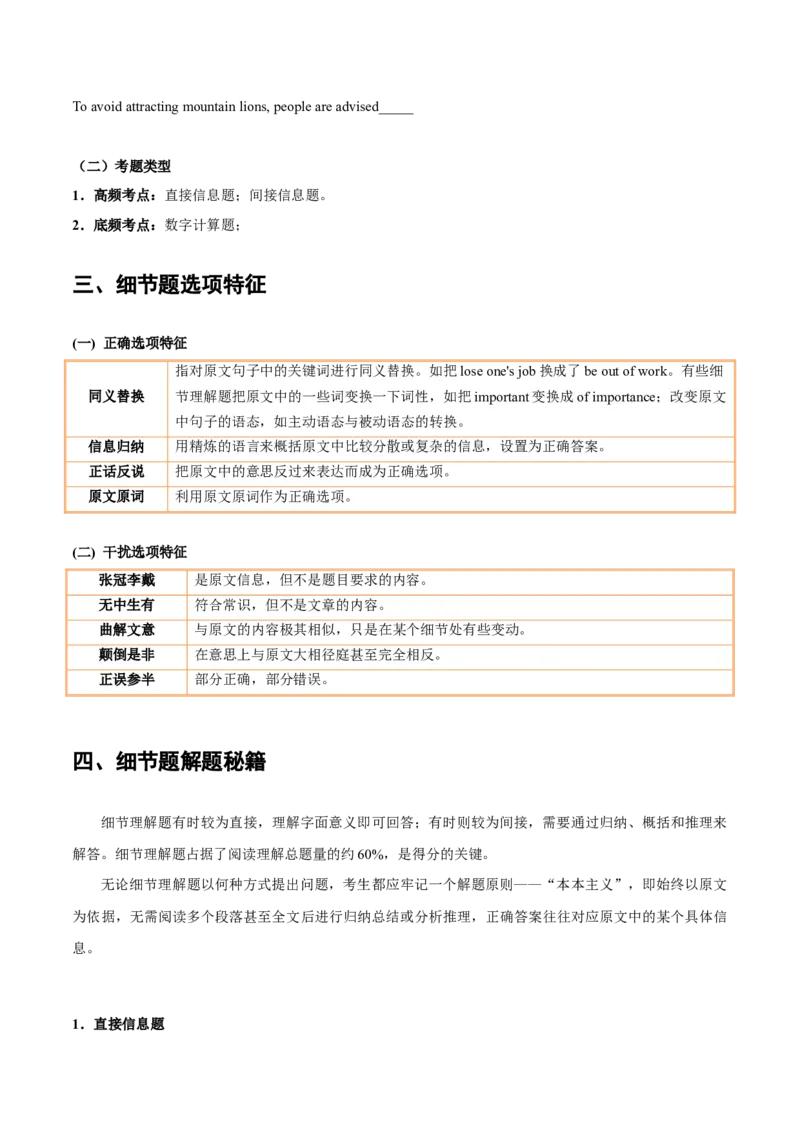
三、细节题选项特征
(一) 正确选项特征
指对原文句子中的关键词进行同义替换。如把lose one's job换成了be out of work。有些细
同义替换 节理解题把原文中的一些词变换一下词性,如把important变换成of importance;改变原文
中句子的语态,如主动语态与被动语态的转换。
信息归纳 用精炼的语言来概括原文中比较分散或复杂的信息,设置为正确答案。
正话反说 把原文中的意思反过来表达而成为正确选项。
原文原词 利用原文原词作为正确选项。
(二) 干扰选项特征
张冠李戴 是原文信息,但不是题目要求的内容。
无中生有 符合常识,但不是文章的内容。
曲解文意 与原文的内容极其相似,只是在某个细节处有些变动。
颠倒是非 在意思上与原文大相径庭甚至完全相反。
正误参半 部分正确,部分错误。
四、细节题解题秘籍
细节理解题有时较为直接,理解字面意义即可回答;有时则较为间接,需要通过归纳、概括和推理来
解答。细节理解题占据了阅读理解总题量的约60%,是得分的关键。
无论细节理解题以何种方式提出问题,考生都应牢记一个解题原则——“本本主义”,即始终以原文
为依据,无需阅读多个段落甚至全文后进行归纳总结或分析推理,正确答案往往对应原文中的某个具体信
息。
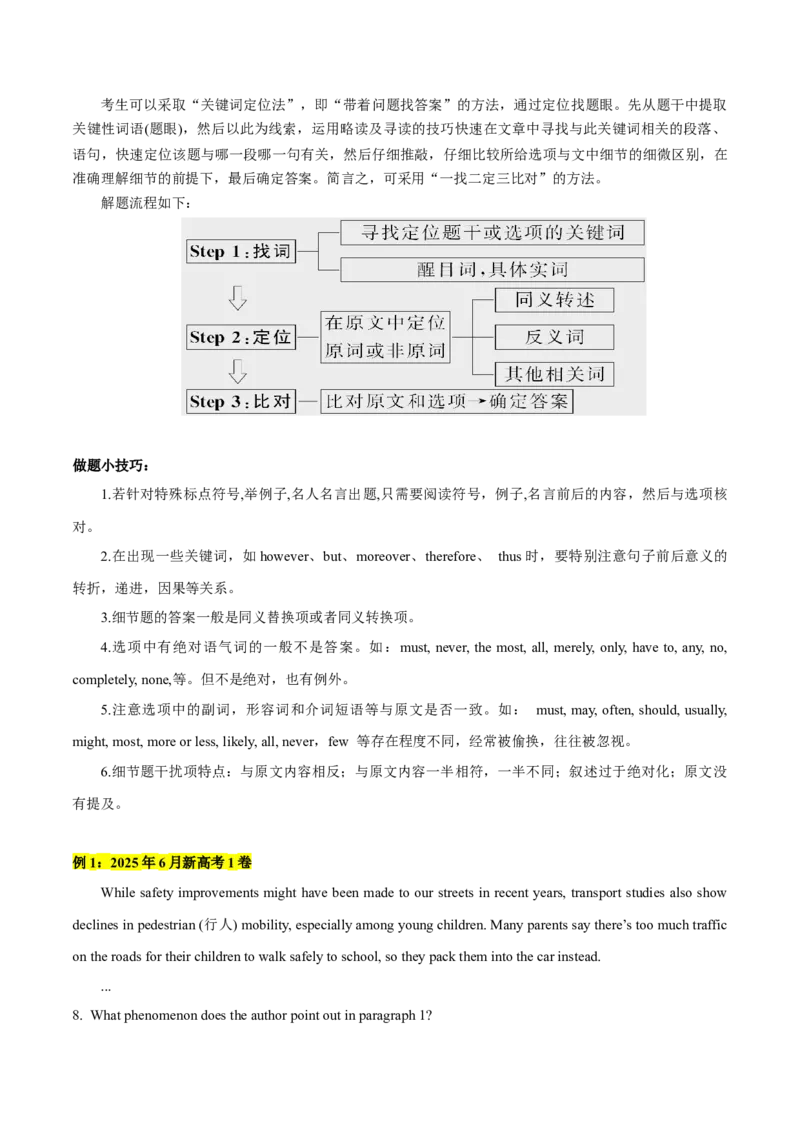
1.直接信息题考生可以采取“关键词定位法”,即“带着问题找答案”的方法,通过定位找题眼。先从题干中提取
关键性词语(题眼),然后以此为线索,运用略读及寻读的技巧快速在文章中寻找与此关键词相关的段落、
语句,快速定位该题与哪一段哪一句有关,然后仔细推敲,仔细比较所给选项与文中细节的细微区别,在
准确理解细节的前提下,最后确定答案。简言之,可采用“一找二定三比对”的方法。
解题流程如下:
做题小技巧:
1.若针对特殊标点符号,举例子,名人名言出题,只需要阅读符号,例子,名言前后的内容,然后与选项核
对。
2.在出现一些关键词,如however、but、moreover、therefore、 thus时,要特别注意句子前后意义的
转折,递进,因果等关系。
3.细节题的答案一般是同义替换项或者同义转换项。
4.选项中有绝对语气词的一般不是答案。如:must, never, the most, all, merely, only, have to, any, no,
completely, none,等。但不是绝对,也有例外。
5.注意选项中的副词,形容词和介词短语等与原文是否一致。如: must, may, often, should, usually,
might, most, more or less, likely, all, never,few 等存在程度不同,经常被偷换,往往被忽视。
6.细节题干扰项特点:与原文内容相反;与原文内容一半相符,一半不同;叙述过于绝对化;原文没
有提及。
例1:2025年6月新高考1卷
While safety improvements might have been made to our streets in recent years, transport studies also show
declines in pedestrian (行人) mobility, especially among young children. Many parents say there’s too much traffic
on the roads for their children to walk safely to school, so they pack them into the car instead.
...
8. What phenomenon does the author point out in paragraph 1?A. Cars often get stuck on the road. B. Traffic accidents occur frequently.
.
C People walk less and drive more. D. Pedestrians fail to follow the rules.
第一步:定信息区间
抓关键 题干中的关键词:paragraph 1, phenomenon(作者在第一段指出的现象)
锁信息 定位第一段内容:While safety improvements might have been made to our streets in recent
years, transport studies also show declines in pedestrian (行人) mobility, especially among young
children. Many parents say there’s too much traffic on the roads for their children to walk safely
to school, so they pack them into the car instead. (核心信息:行人流动性下降;家长因交通
问题,开车送孩子上学,而非让孩子步行。)
第二步:比对定答案
选项 选项意思 定位分析
A 汽车经常堵在路上 文中仅提“交通多(too much traffic)”,未说“堵车(get
stuck)”,曲解文意
B 交通事故频繁发生 第一段未涉及“交通事故”相关描述,无中生有
C 人们走路更少、开车 “行人流动性下降(declines in pedestrian mobility,对应‘走路
更多 少’)” + “家长开车送孩子(pack them into the car,对应‘开车
多’)”,同义替换
D 行人不遵守规则 第一段未提及“行人规则”,无中生有
分析:选 C。通过对比选项与第一段核心信息,“行人流动性下降”和“开车送孩子”共同指向“走
路少、开车多”的现象;其余选项或曲解文意,或无中生有,故为细节理解题,选C。
二.间接信息题
相比直接信息题,命题的隐蔽性更强,正确选项一般都会在原文基础上进行改造。此类题目需要考生
将题目信息与原文相关信息进行语义上的转换,有时还需要进一步的加工或整理。
例2:2025年新高考真题
While safety improvements might have been made to our streets in recent years, transport studies also show
declines in pedestrian (行人) mobility, especially among young children. Many parents say there’s too much traffic
on the roads for their children to walk safely to school, so they pack them into the car instead.Dutch authors Thalia Verkade and Marco te Brömmelstroet are bothered by facts like these. In their new book
Movement: How to Take Back Our Streets and Transform Our Lives, they call for a rethink of our streets and the
role they play in our lives.
Life on city streets started to change decades ago. Whole neighbourhoods were destroyed to make way for
new road networks and kids had to play elsewhere. Some communities fought back. Most famously, a Canadian
journalist who had moved her family to Manhattan in the early 1950s led a campaign to stop the destruction of her
local park. Describing her alarm at its proposed replacement with an expressway, Jane Jacobs called on her mayor
(市长) to champion “New York as a decent place to live, and not just rush through.” Similar campaigns occurred in
Australia in the late 1960s and 1970s as well.
...
9. What were the Canadian journalist and other campaigners trying to do?
A. Keep their cities livable. B. Promote cultural diversity.
C. Help the needy families. D. Make expressways accessible.
第一步:定信息区间
抓关键 题干中的关键词:Canadian journalist, other campaigners, trying to do
锁信息 定位:用 Canadian journalist, other campaigners 寻读,在文中找到信息源——Most
famously, a Canadian journalist who had moved her family to Manhattan in the early 1950s led
a campaign to stop the destruction of her local park. Describing her alarm at its proposed
replacement with an expressway, Jane Jacobs called on her mayor (市长) to champion “New
York as a decent place to live, and not just rush through.” Similar campaigns occurred in
Australia in the late 1960s and 1970s as well.
第二步:比对定答案
选项 选项意思 定位
A 保持他们的城市适宜居住 文中记者呼吁市长让纽约成为适宜居住的地方,类似运动也在
其他地方开展,是同义替换
B 促进文化多样性 文中未提及,无中生有
C 帮助贫困家庭 文中未提及,无中生有
D 让高速公路可通行 与文意相悖,运动是反对用高速公路取代公园,曲解文意分析:选A 。比对选项和信息句可知,加拿大记者及其他活动家开展运动,是为了阻止破坏当地公园,
呼吁让城市成为适宜居住的地方,选项A 是对文意的同义替换,故为细节理解题,选A 。
三.概括、归纳信息题
是指命题人用精炼的语言来概括原文中比较分散或复杂的信息,这是命题人设计细节理解题的正确选
项时经常使用的手段之一。考生首先应依据题干指向,找到文中相应的信息区间,然后尝试用自己的语言
去归纳总结文中的信息或事实,然后再看选项,挑选出和自己所归纳总结的信息最接近的选项作为正确答
案。
例3:2025年6月新高考2卷B篇
Kathy Ho teaches high school inside Lucile Packard Children’s Hospital Stanford (LPCH). “Sometimes I
don’t like saying that I’m a teacher,” says Ho. “People get in their minds an idea of what teachers do, but that’s not
really what it is here.”
“Here” is room 386, where each year, about 500 LPCH patients also become students. The hospital school is
free of parents, doctors, and medical procedures. It’s a place of learning. About half of Ho’s students stay for a
week or less; others are there for more than a year. Most of Ho’s students will recover, which means that preparing
them to return to school is an increasingly important component of care.
Still, in room 386, academics don’t come first. Physical health and mental health are the priority. “If you’re
scared about something and thinking only about that, there’s no way you’re going to be able to learn,” Ho says.
“I’m a coach, an adviser, and a comforter, and that’s what it means to be a hospital teacher.”
…
5. What is a characteristic of Ho’s job?
A. Prioritizing academics. B. Encouraging innovation.
C. Treating various diseases. D. Playing multiple roles.
第一步:定信息区间
抓关键 题干中的关键词:Ho’s job, characteristic(Ho工作的特点)
锁信息 定位文中内容:“Still, in room 386, academics don’t come first... I’m a coach, an adviser, and
a comforter, and that’s what it means to be a hospital teacher.” (核心信息:Ho的工作不优先
学术,而是兼任教练、顾问、安慰者等角色。)第二步:比对定答案
选项 选项意思 定位分析
A 优先考虑学术 原文明确“academics don’t come first”,与文意相悖
B 鼓励创新 文中未涉及“创新”相关表述,无中生有
C 治疗各种疾病 Ho是医院教师,并非医疗人员,不负责治病,概念混淆
D 扮演多重角色 对应“coach, an adviser, and a comforter”(教练、顾问、安慰者),是对
“多角色”的 同义替换
分析:选 D。通过归纳Ho对工作角色的描述(教练、顾问、安慰者),可提炼“多重角色”的特点;
其余选项或违背文意,或缺乏依据,故为概括归纳类细节题,选D。
四.正误判断题
是细节理解题中解题比较繁琐的题目,说其繁琐,因为其信息不像其他类题目那样集中在文章的某一
句或某一段,而是分散在文章的各个角落。对于这类题目,考生要静下心来,看清范围,确定方向,找到
每一个选项的对应信息后,谨慎排除,综合选优。
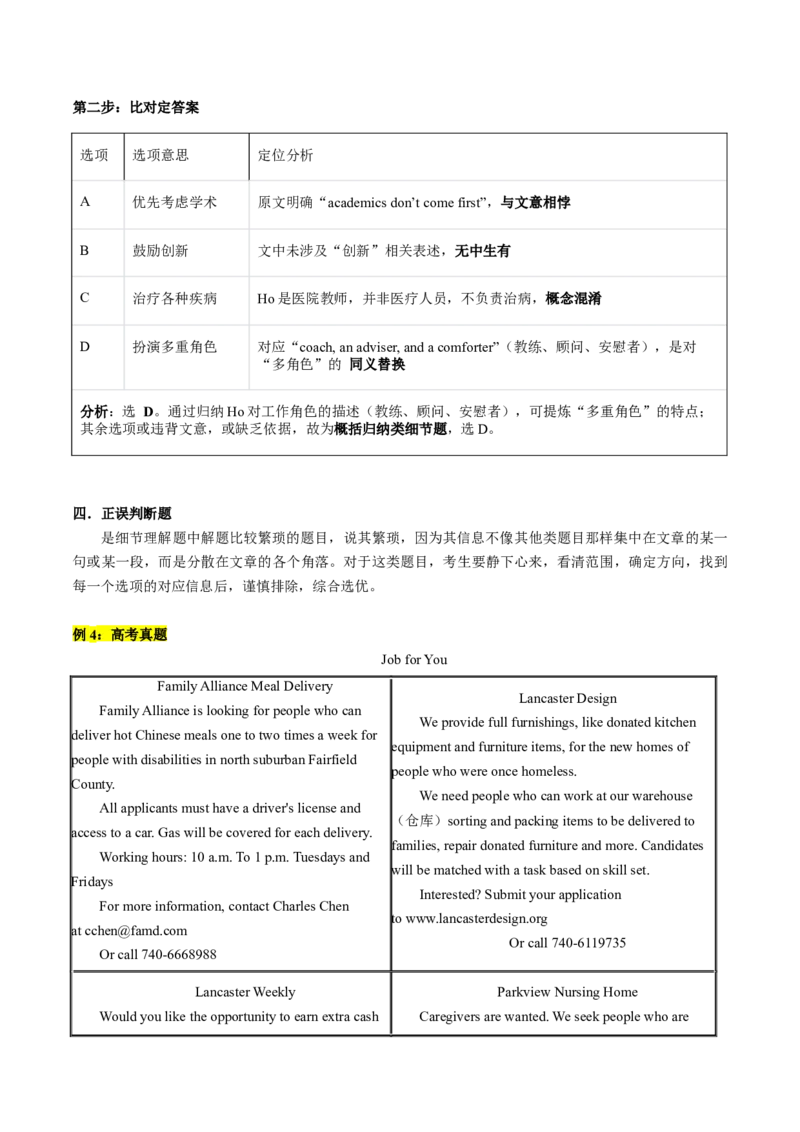
例4:高考真题
Job for You
Family Alliance Meal Delivery
Lancaster Design
Family Alliance is looking for people who can
We provide full furnishings, like donated kitchen
deliver hot Chinese meals one to two times a week for
equipment and furniture items, for the new homes of
people with disabilities in north suburban Fairfield
people who were once homeless.
County.
We need people who can work at our warehouse
All applicants must have a driver's license and
(仓库)sorting and packing items to be delivered to
access to a car. Gas will be covered for each delivery.
families, repair donated furniture and more. Candidates
Working hours: 10 a.m. To 1 p.m. Tuesdays and
will be matched with a task based on skill set.
Fridays
Interested? Submit your application
For more information, contact Charles Chen
to www.lancasterdesign.org
at cchen@famd.com
Or call 740-6119735
Or call 740-6668988
Lancaster Weekly Parkview Nursing Home
Would you like the opportunity to earn extra cash Caregivers are wanted. We seek people who areclose to home? If so we have a vacancy in our team patient and caring, and who have experience and interest
which would suit you. Both adults and youngsters aged in working with older adults.
13+ are required to deliver our newspaper. You may As part of the package, initial and follow-up
have to cover some distance. Bicycles are available if training sessions are provided and accommodation is
needed. available if required.
Working hours: 8 a.m. to 10 a.m. Saturdays For more details, visit us at Unit 3 Park
For more information View Lane
Call 740-6538360 Or contact Ellen White at 740-6968399
2.Which of the following is TRUE about the Lancaster Design job?
A.Applicants are expected to design furniture.
B.Work is arranged according to one's skill set.
C.It involves collecting furniture from homes.
D.It favors applicants who are homeless.
第一步:定信息区间
选项 选项关键词 信息区间
A Applicants, design furniture Lancaster Design 部分
B Work, arranged, skill set Lancaster Design 部分 “Candidates will be
matched with a task based on skill set.”
C Involves, collecting furniture from homes Lancaster Design 部分
D Favors, applicants who are homeless Lancaster Design 部分
第二步:逐一比对定答案
选项 选项意思 原文意思 定位
A 申请者需要设计家具。 文中提及提供家具等,未涉及设计家具相 无中生有
关内容
B 工作根据个人技能安 候选人将依据技能匹配任务 同义替换
排。C 涉及从家庭收集家具。 文中是整理、打包要送往家庭的物品等, 无中生有
未说从家庭收集
D 倾向于无家可归的申请 是为曾无家可归者的新家提供物品,并非 曲解文意
者。 倾向这类申请者
综上,答案为B 。
五、细节题定位词寻找技巧
(一)特殊定位词
特殊定位词具有独特性,在文中容易快速识别,常可作为优先选择的定位词。
人名:如“ In Save Money:Good Food,she visits a different home each week and with the help of chef Matt
Tebbutt offers top tips on how to reduce food waste” ,若题目涉及 Matt Tebbutt 相关内容,就可将“Matt
Tebbutt”作为定位词,快速在文中找到相关信息 。
地名:像“Cherry Blossom Bike Tour in Washington,D.C.” ,如果题目与这次骑行之旅或者华盛顿特区相
关,“Washington,D.C.”就能帮助定位。
数字(包括日期、时间、价格、数量等):例如“Duration:3 hours”(持续时间:3小时),若题目询问
该活动时长相关问题,“3 hours”就是明显的定位词 。
专有名词(首字母大写的特定名称,如组织名、机构名等):比如“Good Morning Britain”(《早安英
国》 ,一档节目),若题目围绕这个节目展开,它就是定位关键。
特殊符号中的内容:如引号、括号、破折号等符号内的信息 。比如“‘Save Money:Good Food’(《省
钱:美食》),书名在引号中,可用于定位 。
(二)普通定位词
当题目中没有特殊定位词时,可考虑以下普通定位词:
名词:是普通定位词的首选,因为名词通常表达具体的事物,具有较强的指向性。 例如题目问
“How does Matt Tebbutt help Susanna?” ,“Matt Tebbutt”和“Susanna”是人名可定位,“help”这个动作依
赖的对象是核心,所以“help”相关信息也是重点,而“help”的双方涉及的行为,像“cooking matters(烹
饪相关事宜)”这个名词短语也可作为定位词 。
动词:能体现动作和行为,也有助于定位。如上述例子中,“assists(协助)”“prepares(准备)”“buys(购买)”等动词,可帮助确定人物间的具体行为关系,辅助定位 。
(三)选择定位词的注意事项
避开高频词:文章中反复出现的高频词,不适合作为定位词,因为无法精准定位到某一处与题目相关
的内容。比如一篇介绍环保的文章,“environment(环境)”一词多次出现,就不宜作为定位词。
注意同义转换:题目中的定位词在文中可能会以同义词或近义词的形式出现。例如题目中用“purchase
(购买)” ,文中可能用“buy” ;题目中用“begin(开始)” ,文中可能用“start” 。所以平时要注重
积累同义词,提升词汇量,这样才能快速识别同义转换后的定位词 。
(四)定位词实战演练:
(1) 特殊定位词训练:2025年新高考真题
Does your soul die a little every time you throw away unused food? Mine does. Maybe that feeling comes
from growing up in South Africa, where the phrase “there are children starving in Africa” was more of an
uncomfortable reminder of fact than a prayer at dinner time.
Food waste is a growing concern in the restaurant, supermarket, and supply chain industries. From
technological solutions to educational campaigns, food producers and sellers are looking for ways to use more of
what we’re already growing. But last month, one popular New York City restaurant tried a different way: It
changed its menu to exclusively (专门) offer food that would otherwise be thrown away.
For two weeks in March, Greenwich Village’s Blue Hill restaurant was renamed wastED, and served items
like fried skate cartilage, a juice pulp burger, and a dumpster diver’s vegetable salad. Each dish was tailor-made to
raise awareness regarding food waste.
13. Why did Blue Hill carry out the experiment?
A. To customize dishes for guests. B. To make the public aware of food waste.
C. To test a food processing method. D. To improve the UK’s zero-waste systems.
(2)普通定位词训练:2025年新高考真题1卷
Microplastics have become a common source of pollution across the Earth — they have settled in the deep sea
and on the Himalayas, stuck inside volcanic rocks, filled the stomachs of seabirds and even fallen in fresh Antarctic
snow. They are even appearing inside humans.
Now, new research suggests that a simple, cheap measure may significantly reduce the level of microplasticsin water from your tap (水龙头): boiling and filtering (过滤) it. In a study published Wednesday in Environmental
Science & Technology Letters, researchers from China found that boiling tap water for just five minutes — then
filtering it after it cools — could remove at least 80 percent of its microplastics.
13. What determines the effectiveness of trapping microplastics in water?
A. The hardness of water. B. The length of cooling time.
C. The frequency of filtering. D. The type of plastic in water.
真题演练
1. 2025年6月新高考1卷
A
This energy transition (变革) is global, and the amount of renewable energy the world will need is “a little bit
mind-blowing,” says mechanical engineer Keith Wipke at the National Renewable Energy Laboratory. It’s
estimated that the global demand for electricity could more than double by 2050. Fortunately, analyses suggest that
renewables are up to the task. “We need to speed up the development of green energy, and it will all get used,” says
Wipke.
3. What does Wipke suggest regarding energy transition?
A. Limiting fuel consumption. B. Putting more effort into renewables.
C. Improving energy efficiency. D. Making electricity more affordable.
B
In my ninth-grade writing class last year, I met a cowboy who saved his town, a strict father who demanded
his son earn straight A’s, and a modern-day Juliet who died of heartbreak after her parents rejected the love of her
young life. More than once, I found myself wondering just how my students, who’d created these people, knew
their subjects so well.
But things were different for their first essay, which was about the question: “Why is writing important?” Most
of the essays filled less than one page, and few contained a sentence that could be interpreted as a thesis (论点)
statement. I was shocked. Then I realized that the problem was the question itself. They could have written pages
on the necessity of computers, but writing, in and of itself, simply didn’t strike them as important. This would have
to change.4. Who are the people mentioned at the beginning of paragraph 1?
A. Ninth graders. B. Students’ parents.
C. Modern writers. D. Fictional characters.
5. Why did the students perform poorly in writing their first essay?
A. They were not given enough time. B. They had a very limited vocabulary.
C. They misunderstood the question. D. They had little interest in the topic.
C
While safety improvements might have been made to our streets in recent years, transport studies also show
declines in pedestrian (行人) mobility, especially among young children. Many parents say there’s too much traffic
on the roads for their children to walk safely to school, so they pack them into the car instead.
Dutch authors Thalia Verkade and Marco te Brömmelstroet are bothered by facts like these. In their new book
Movement: How to Take Back Our Streets and Transform Our Lives, they call for a rethink of our streets and the
role they play in our lives.
Life on city streets started to change decades ago. Whole neighbourhoods were destroyed to make way for
new road networks and kids had to play elsewhere. Some communities fought back. Most famously, a Canadian
journalist who had moved her family to Manhattan in the early 1950s led a campaign to stop the destruction of her
local park. Describing her alarm at its proposed replacement with an expressway, Jane Jacobs called on her mayor
(市长) to champion “New York as a decent place to live, and not just rush through.” Similar campaigns occurred in
Australia in the late 1960s and 1970s as well.
...
8. What phenomenon does the author point out in paragraph 1?
A. Cars often get stuck on the road. B. Traffic accidents occur frequently.
.
C People walk less and drive more. D. Pedestrians fail to follow the rules.
9. What were the Canadian journalist and other campaigners trying to do?
A. Keep their cities livable. B. Promote cultural diversity.
C. Help the needy families. D. Make expressways accessible.
D
Microplastics have become a common source of pollution across the Earth — they have settled in the deep sea
and on the Himalayas, stuck inside volcanic rocks, filled the stomachs of seabirds and even fallen in fresh Antarcticsnow. They are even appearing inside humans.
Now, new research suggests that a simple, cheap measure may significantly reduce the level of microplastics
in water from your tap (水龙头): boiling and filtering (过滤) it. In a study published Wednesday in Environmental
Science & Technology Letters, researchers from China found that boiling tap water for just five minutes — then
filtering it after it cools — could remove at least 80 percent of its microplastics.
Crucially, this process relies on the water containing enough calcium carbonate (碳酸钙) to trap the plastics.
In the study, boiling hard water containing 300 milligrams of calcium carbonate led to an almost 90 percent drop in
plastics. But in samples with less than 60 milligrams of calcium carbonate, boiling reduced the level of plastics by
just 25 percent. Additionally, the research didn’t include all types of plastics. The team focused only on three
common types — polystyrene, polyethylene and polypropylene — and they didn’t study other chemicals previously
found in water such as vinyl chloride.
Still, the findings show a potential path forward for reducing microplastic exposure — a task that’s becoming
increasingly difficult. Even bottled water, scientists found earlier this year, contains 10 to 1,000 times more
microplastics than originally thought.
Scientists are still trying to determine how harmful microplastics are — but what they do know has raised
concerns. The new study suggests boiling tap water could be a tool to limit intake. “The way they demonstrated
how microplastics were trapped through the boiling process was nice,” Caroline Gauchotte-Lindsay, an
environmental engineer of the University of Glasgow in Scotland who was not involved in the research, tells New
Scientist. “We should be looking into upgrading drinking water treatment plants so they remove microplastics.”
13. What determines the effectiveness of trapping microplastics in water?
A. The hardness of water. B. The length of cooling time.
C. The frequency of filtering. D. The type of plastic in water.
15. What is Gauchotte-Lindsay’s suggestion about?
A. Choice of new research methods. B. Possible direction for further study.
C. Need to involve more researchers. D. Potential application of the findings.
2. 2025年6月新高考2卷B篇
Kathy Ho teaches high school inside Lucile Packard Children’s Hospital Stanford (LPCH). “Sometimes I
don’t like saying that I’m a teacher,” says Ho. “People get in their minds an idea of what teachers do, but that’s not
really what it is here.”“Here” is room 386, where each year, about 500 LPCH patients also become students. The hospital school is
free of parents, doctors, and medical procedures. It’s a place of learning. About half of Ho’s students stay for a
week or less; others are there for more than a year. Most of Ho’s students will recover, which means that preparing
them to return to school is an increasingly important component of care.
Still, in room 386, academics don’t come first. Physical health and mental health are the priority. “If you’re
scared about something and thinking only about that, there’s no way you’re going to be able to learn,” Ho says.
“I’m a coach, an adviser, and a comforter, and that’s what it means to be a hospital teacher.”
There are up to 30 students at any given time in Ho’s class. She generally works with their regular teachers to
get lessons and tests being used at their home schools. Some teachers don’t give the kids any assignments; they
express sympathy instead. “I feel like it is a disservice to the kids,” Ho says. “They think their teachers don’t care
about their schoolwork.”
Ho recognizes the psychological benefit of helping kids keep up with their peers (同龄人) outside the hospital.
“I actually think the medicine is only a small piece for some problems,” says Julie Good, director of pain
management services at LPCH. “It’s about problem-solving around what it means to have a full life. Those kids
have dreams. School can keep those dreams alive by giving kids a way to learn and grow.”
4. Who does Ho teach at LPCH?
A. Sick children. B. Young nurses. C. Medical students. D. Patients’ parents.
5. What is a characteristic of Ho’s job?
A. Prioritizing academics. B. Encouraging innovation.
C. Treating various diseases. D. Playing multiple roles.
7. How does the hospital school benefit the students according to Good?
A. It eases peer pressure. B. It helps them live in hope.
C. It frees them from aches. D. It entertains them with stories.
C
When Sonja Detrinidad opened her online shop selling houseplants, she didn’t have high hopes for it. But the
opposite happened: She was flooded, shipping out 1,200 orders in June of 2020 alone. In the past year, Detrinidad
sent out more than 70,000 plants. Her success is just one example of increased time at home leading to an explosion
in the houseplant industry.
“Plants are in fashion right now,” says Dr. Melinda Knuth, a researcher from the University of Florida.“People who live in plant-rich environments report a higher life satisfaction rating, ” she says. “Adding more nature
to our environment can change our mood and how we think.” Plants can improve our state of mind in a few ways
but the biggest is by decreasing our level of cortisol, the stress hormone (激素) in our body.
“Students who are around plants perform better academically than students who are in a classroom without
plants,” says Knuth. “This productivity also translates into the workplace for adults. Our study showed that there
was a 30% decrease in sick leave for people who were in plant-rich workplaces.”
If you’re among the groups of people who are enjoying the mental and physical health benefits of surrounding
yourself with plants, don’t beat yourself up if one (or a few!) doesn’t make it. “Doctors practice medicine and
lawyers practice law and you should allow yourself the practice it takes to sustain a plant. Tending to plants is an
exercise in patience and learning. Be invested in taking care of it, but if it dies, go get another one,” Detrinidad
says.
8. How was Detrinidad’s business when it started?
A. It faced tough competition. B. It suffered a great loss.
C. It got lots of financial support. D. It went surprisingly well.
9. What is one of Knuth’s findings about plants?
A. They appeal more to students. B. They purify the environment.
C. They raise the cortisol level. D. They enhance productivity.
D
Does your soul die a little every time you throw away unused food? Mine does. Maybe that feeling comes
from growing up in South Africa, where the phrase “there are children starving in Africa” was more of an
uncomfortable reminder of fact than a prayer at dinner time.
Food waste is a growing concern in the restaurant, supermarket, and supply chain industries. From
technological solutions to educational campaigns, food producers and sellers are looking for ways to use more of
what we’re already growing. But last month, one popular New York City restaurant tried a different way: It
changed its menu to exclusively (专门) offer food that would otherwise be thrown away.
For two weeks in March, Greenwich Village’s Blue Hill restaurant was renamed wastED, and served items
like fried skate cartilage, a juice pulp burger, and a dumpster diver’s vegetable salad. Each dish was tailor-made to
raise awareness regarding food waste.
A study by the Food Waste Alliance determined that the average restaurant generates 33 pounds of food wastefor every $1,000 in revenue (收入), and of that waste only 15.7% is donated or recycled. Up to 84.3% is simply
thrown out. Restaurants like Silo in the UK have experimented with zero-waste systems, but wastED took the
concept to its logical conclusion.
13. Why did Blue Hill carry out the experiment?
A. To customize dishes for guests. B. To make the public aware of food waste.
C. To test a food processing method. D. To improve the UK’s zero-waste systems.
3. 2025年6月北京卷
B
Throughout our Junior year, my classmates and I have been worried about what colleges will see when they
look at our whole life story reduced to a single 200-word essay. Will the golden word “success” form in their minds
when they review our achievements? Or will they see the big word “fail” in red? The shadow of this mysterious (神
秘的) institution steals away what success means to us.
My first step of redefining success began with course registrations. It is a well-known fact, especially in my
school, that Junior year is the time of packing many AP classes into the schedule. When asked why they chose so
many AP classes, my friends responded: “I don’t know.” They themselves don’t know why they are following the
crowd and longing for the pressures of academic difficulty. Therefore, they do not feel the satisfaction of being
academically challenged.
24. Throughout the Junior year, what was the author’s major concern?
A. Pressure from choosing AP classes. B. Performance in group interviews.
C. Competition with seniors. D. Recognition by colleges.
25. The author chose fewer AP classes because of _______.
A. her own understanding of success B. her desire for academic challenges
C. her strong urge to follow the crowd D. her dream of entering a top university
4. 2025.1 浙江卷B篇第2段
According to Charlotte Markey, a professor of psychology, food is one of the rare subjects where, as parents,
saying less is more. “There are so many things in parenting that are good to talk through, but I’m not convinced that
food is one of them,” she says. “It just creates some worries and insecurities in kids that aren’t necessarily healthy.”
25. Which of the following would Markey disapprove of?
A. Allowing kids to eat cookies occasionally.B. Offering various foods to kids at fixed times.
C. Explaining to kids the risks of taking snacks.
D. Talking with kids about school at mealtimes.
5. 2025.1 八省联考C篇第3-4段
Jacobs notes that the built form of a city is crucial to the life of an urban community, especially the sidewalks.
The streets in which people live should be a tight pattern of crossed sidewalks, which allow people to meet, talk,
and get to know one another. Such a complex but ultimately enriching set of encounters helps individuals know
their neighbours and neighbourhood better.
Diversity and mixed-use of space are also, for Jacobs, key elements of this urban form. The commercial,
business, and residential elements of a city should not be separated out but instead be side by side, to allow for
greater integration of people. There should also be a diversity of old and new buildings, and people's interactions
should determine how buildings get used and reused.
30. How does Jacobs suggest sidewalks be built?
A. Lined with plants. B. Painted with clear signs.
C. Tightly connected. D. Convenient for the old.
6.2024 新高考1卷C篇
Audio (音频) and video can feel more engaging than text, and so university teachers increasingly turn to these
technologies — say, assigning an online talk instead of an article by the same person. However, psychologists have
demonstrated that when adults read news stories, they remember more of the content than if they listen to or view
identical pieces.
Digital texts, audio and video all have educational roles, especially when providing resources not available in
print. However, for maximizing learning where mental focus and reflection are called for, educators shouldn’t
assume all media are the same, even when they contain identical words.
30. Why are audio and video increasingly used by university teachers?
A. They can hold students' attention. B. They are more convenient to prepare.
C. They help develop advanced skills. D. They are more informative than text.
7. 2024 新高考2卷D篇
Campbell’s point is to wake up those responsible for AI-the technology companies and world leaders-so theyare on the same page as all the experts currently developing it. She explains we are at a “tipping point” in history
and must act now to prevent an extinction-level event for humanity. We need to consider how we want our future
with AI to pan out. Such structured thinking, followed by global regulation, will enable us to achieve greatness
rather than our downfall.
AI will affect us all, and if you only read one book on the subject, this is it.
14. What does Campbell urge people to do regarding AI development?
A. Observe existing regulations on it.
B. Reconsider expert opinions about it.
C. Make joint efforts to keep it under control.
D. Learn from prior experience to slow it down.
8. 2024.6北京卷D篇
But other channels of creativity stayed open: I went on writing poems and stories. Still, I went to exhibitions
often. I continued my habitual drawing, which I now characterised as childish doodling (乱画). In my 30s, I made
painter friends and learned new ways of looking at art. However, I couldn’t let myself have a go at actually doing it.
Though these new friends were abstract painters using oil paints, or were printmakers or sculptors, I took oil
painting as the taboo (禁忌) high form I wasn’t allowed to practice.
25. In her 30s, the author _________.
A. avoided oil painting practice B. sought for a painting career
C. fancied abstract painting D. exhibited child paintings
押题演练
1.
The Evolution of Aerospace: Trends and Prospects
The aerospace industry is on the limit of a revolutionary era, driven by technological advancements,
sustainability goals, and evolving geopolitical dynamics. As we approach 2025, several key trends are set to
redefine this dynamic sector.
Artificial Intelligence (AI) and autonomous systems are becoming deeply embedded in aerospace and
defense. AI is enhancing air traffic control and flight management, optimizing (优先) light paths, and improvingfuel efficiency. Autonomous aircraft, including drones and eVTOLs (electric Vertical Takeoff and Landing
vehicles), are rapidly advancing. These innovations promise to revolutionize urban air mobility and military
operations.
The industry is also focusing an reducing its environmental impact. Electric and hybrid-electric aircraft are
being developed by companies like Airbus and Boeing. Sustainable Aviation Fuels (SAFs) and advanced materials
like carbon fiber composites (复合材料) are also gaining traction (拉力). These efforts aim to make air travel more
eco-friendly.
Space remains a critical domain (领域) for both commercial and defense interests. Private companies like
SpaceX and Blue Origin are driving the commercialization of space. By 2025, we can expect significant
advancements in space tourism, satellite launches, and lunar exploration. Governments are also increasing their
focus on space defense, developing anti-satellite weapons and missile defense systems.
Despite these advancements, the aerospace industry faces several challenges. Supply chain issues, workforce
shortages, and geopolitical tensions are major concerns. However, the industry is adapting through AI-driven
solutions, strategic partnerships and increased investment in cybersecurity.
By 2025, the aerospace industry will be shaped by the integration of AI, the commercialization of space, and
a growing emphasis on sustainability. These trends will create new opportunities and challenges, requiring
innovation and adaptability. As the industry navigates these changes, it will continue to play a crucial role in global
security, economic development, and technological progress.
1.How is AI being used in the aerospace industry?
A.To reduce the number of flights.
B.To optimize flight paths and improve fuel efficiency.
C.To replace human pilots completely.
D.To increase the cost of air travel.
2.Why is space defense becoming a top priority?
A.Decreasing interest in satellite communication.
B.Reduction in commercial space activities.
C.Declining investment in space exploration.
D.Growing reliance on space-based facilities and rising threats.
3.What challenges does the aerospace industry face?
A.Supply chain issues and workforce shortages.B.Decreasing demand for air travel.
C.Lack of technological innovation.
D.Reduced investment in cybersecurity.
4.What is the author’s attitude towards the future of the aerospace industry?
A.Skeptical. B.Pessimistic. C.Optimistic. D.Indifferent.
2.
Research led by the University of Leeds has found that children do better at primary school if their fathers
regularly spend time with them on interactive engagement (互动式参与) activities like reading, playing, telling
stories, drawing and singing.
Analyzing primary school test scores for five-and seven-year-olds, the researchers used a representative
sample of nearly 5,000 mother-father households in England. According to the research, dads who regularly drew,
played and read with their three-year-olds helped their children do better at school by age five. Dads being involved
at age five also helped improve scores in seven-year-olds’ Key Stage Assessments.
Dr Helen Norman, who led the research, said, “Mothers still tend to assume the primary carer role and
therefore tend to do the most childcare, but if fathers actively engage in childcare too, it significantly increases the
likelihood of children getting better grades in primary school. This is why encouraging and supporting fathers in
sharing childcare with the mother, from an early stage in the child's life, is critical. ”
Dads’ involvement impacted positively on their children’s school achievement regardless of the child's
gender, ethnicity, age in the school year and household income, according to the research. There were different
effects when moms and dads took part in the same activities - the data showed that moms had more of an impact on
young children's emotional and social behaviors than educational achievement.
The researchers recommend that dads spare as much time as they can to engage in interactive activities with
their children each week. For busy, working dads, even just ten minutes a day could potentially have educational
benefits. They also recommend that schools and early years education providers routinely take both parents' contact
details and develop strategies to engage fathers and keep a record of father-engagement.
Dr Jeremy Davies, who co-authored the report, said, “Our analysis has shown that fathers have an important,
direct impact on their children’s learning. We should be recognizing this and actively finding ways to support dads
in playing their part, rather than engaging only with mothers, or taking a gender-neutral approach. ”
1.How did the researchers conduct the study?A.By assessing parent-child relationships. B.By observing educational parent-child activities.
C.By classifying children's individual interests. D.By examining children’s academic performance.
2.What does Helen Norman try to tell us in Paragraph 3?
A.Shared childcare is highly beneficial. B.Education starts from the family.
C.Children need a sense of belonging. D.Father excels in educating children.
3.Which of the following do the researchers recommend?
A.Fathers reduce working hours. B.Schools involve fathers in children’s learning.
C.Mothers keep track of children's studies.D.Educators find ways to support mothers.
4.What is a suitable title for the text?
A.The Shift in Parents’ Roles in Childcare. B.The Impact of Fathers on Children’s Education.
C.Mom vs. Dad: Who Influences Kids More? D.Interactive Activities: How Do They Affect Kids’
Grades?
3.
The growing presence of space debris (碎片) in low Earth orbit (LEO)poses a significant threat to satellites
and other orbiting assets. Consequently, the concern about destructive collisions (碰撞) and the potential for debris
reentry to Earth’s atmosphere has intensified. Researchers are turning to artificial intelligence (AI) techniques to
address these challenges to enhance debris removal, collision prediction, and orbit management strategies.
One approach described in a paper presented at the 2nd near-Earth object (NEO) and Debris Detection
Conference earlier this year, involves using a “genetic” algorithm (算法) to monitor the motion of space debris.
Researchers aim to improve the capture and removal processes by focusing on slower-moving objects. Additionally,
neural networks are being developed to predict and reduce collisions in LEO. These networks are trained on
historical data to identify space debris Motion patterns and predict future paths, enabling effective collision-
avoidance movements for active space missions and orbiting satellites.
Historical statistics and predictive modeling have shown that the risk of such collisions is significantly
higher in LEO compared to medium Earth orbit (MEO). However, it is crucial to acknowledge the limitations of
AI-based approaches, as they assume that future conditions are similar to present ones, potentially ignoring critical
variables such as atmospheric density.
To address these limitations, constantly adding real-time information and updating is essential for improving
the adaptability of AI models. By incorporating new debris detections and orbital changes, algorithms can betteradapt to the ever-changing spatial environment. Balancing the use of AI with a comprehensive understanding of the
uncertainties and challenges in space debris management will be vital for ensuring the long-term sustainability of
LEO.
Overall, integrating AI into space debris monitoring, removal, and collision avoidance strategies holds
promise for safeguarding satellite operations and maintaining the charming beauty of photos from LEO. However,
it is essential to remain cautious of these technologies’ limitations and unknowns and continually improve and
update them with real-world data to enhance their effectiveness.
1.What is one of the concerns regarding space debris in LEO?
A.The cost of debris removal. B.The effect on space exploration.
C.The risk of disastrous collisions. D.The damage to the space environment.
2.How can neural networks help with space debris management?
A.By creating predictive models. B.By employing genetic algorithms.
C.By monitoring fast-moving objects. D.By speeding up the capture process.
3.What is crucial for dealing with the limitations of AI-based approaches?
A.Regularly testing its adaptability.
B.Continuously integrating live data.
C.Studying past and present space conditions.
D.Reducing uncertainties in debris management.
4.What is the author’s general attitude toward Al-based approaches?
A.Resistant. B.Skeptical. C.Dismissive. D.Favorable.
4.
Psychologists long believed happiness and meaning were keys to a good life. Recent research, however,
reveals a third dimension (维度): psychological richness. In his book Life in Three Dimensions, ShigehiroOishi
argues that significant life fulfillment requires embracing curiosity-driven exploration and transformative
experiences alongside happiness and meaning.
Oishi shares the story of a father and son. The father lived a stable life in a rural Japanese town, maintaining
family traditions for his entire life. His son pursued a different path — leaving his home, studying abroad, and
moving across continents. Although their lives highlight different priorities, both found elements of happiness and
meaning. Even so, does that mean they both live a full life?
Traditional psychology outlines two paths to achieve life fulfillment. The eudaimonic path values meaningthrough family, community, or professional dedications, while the hedonic path seeks happiness by enjoyable
careers, rewarding experiences, or leisure pursuits. Yet both paths contain pitfalls. Overemphasizing happiness
often breeds anxiety, as studies confirm lasting contentment stems from relationships, not achievements. Similarly,
being attached to great causes risks burnout. Therefore, either happiness or meaning alone fails to account for the
human need for a complete life.
Psychological richness emerges as the vital third dimension. It involves lives colored by novel experiences
that reshape perspectives — studying abroad, mastering complex skills, or overcoming difficulties. People who are
curious or social naturally enjoy this. Even those lacking these characters can cultivate it through small decisions,
creative hobbies, or minor risks like exploring unfamiliar neighborhoods. Even hard times can enhance
psychological richness when regarded as opportunities to grow.
As the son in the story, Oishi concludes that fulfillment lies not in choosing between happiness, meaning, or
richness but combining them together. A farmer’s steady life and a traveler’s exciting journey both matter.
Ultimately, the richest existence isn’t about perfection in any single dimension but the harmonious interplay of all
three.
1.What factor best explains the father-son difference?
A.Generation gap. B.Personal choices.
C.Educational status. D.Economic conditions.
2.What does the underlined word “pitfalls” probably mean in paragraph 3?
A.Costs. B.Features. C.Advantages. D.Reasons.
3.What can be learned from the book?
A.Personalities are difficult to change.
B.Psychological richness develops with age.
C.Traditional views should be abandoned.
D.Life satisfaction is shaped by multiple factors.
4.What is the recommended shelf category for the book?
A.Cultural Studies & Emotional Health. B.Personal Growth & Life Philosophy.
C.Global Experiences & Art Appreciation.D.Human Connection & Career Development.
5.
In an era when the average person checks their smartphone nearly 144 times a day, devoting oneself to alengthy novel or complex piece of literature has become a rarity. The digital revolution, while bringing easy access
to information, has degraded our capacity for deep reading.
Deep reading is more than just processing words on a page; it’s an experience that involves critical thinking,
empathy (共情) , and knowledge exploration. This form of reading allows individuals to engage with complex
ideas and connect emotionally with texts. Historically, deep reading has been instrumental in education and
personal development, cultivating a person capable of critical thought and innovation.
In a digital age, the way we consume information has dramatically changed. For instance, social media
platforms are designed to catch our attention through endless browsing and bite-sized content. This design can
weaken our patience for longer, more demanding texts. A study from Microsoft Corp. suggested that the human
attention span has decreased from 12 seconds in 2000 to about 8 seconds today, highlighting how digital media
affects our ability to concentrate.
In the digital landscape, attention has become what companies compete for, often employing strategies that
disturb our attention spans. Notices, advertisements, and big data-based content make it difficult for readers to find
the uninterrupted time necessary for deep reading.
Our brains are remarkably adaptable, and the way we process information can change with our habits.
Neuroscientists have found that regular Internet use can rewire neural pathways, favoring quick decision-making
and surface processing over deep thinking. Nicholas Carr argues that the Internet encourages rapid, distracted
sampling of small bits of information from many sources—a mode of thinking that is contrary to deep reading.
The decline in deep reading doesn’t just affect individual cognition ( 认知) ; it has broader societal
consequences. In education, students accustomed to surface-level reading may struggle with texts that require
analysis and critical thinking. This trend can lead to a workforce less prepared for jobs that demand deep
understanding and problem-solving skills.
Given the challenges, how can we preserve and promote deep reading in the digital age?
1.Why is deep reading important?
A.It promotes the use of social media. B.It boosts readers` innovative ability.
C.It allows for faster decision-making. D.It enables quick scanning of information.
2.How do the Internet and digital media affect deep reading?
A.They improve reading efficiency.
B.They increase access to diverse resources.
C.They contributes to divided attention habits.D.They provide new ideas for better understanding.
3.What message does the author mainly convey in para 5?
A.The human brain has a strong adaptability.
B.The internet has a positive impact on our brains.
C.The way we process information changes with our habits.
D.The internet disfavors deep reading despite its advantages.
4.What is expected to be talked about next?
A.Strategies to promote deep reading. B.The future application of digital media.
C.The benefits of digital reading materials. D.Historical examples of deep reading practices.
6.
In the early 1900s, when pursuing one of his many projects, the French chemist and inventor Edouard
Benedictus invented shatterproof (防碎的) glass by chance, although its importance wasnˈt recognized until issues
emerged within the car market.
Such moments of serendipity reveal the unpredictable nature of innovation. Yet, even in cases where chance
plays a role, as in Benedictusˈs story, the broader question remains: Are such discoveries truly born of luck, or were
they somehow “in the air,” waiting for the right person to seize them?
Some argue all the discoveries would have been made by other people. They believe if the time was ripe,
someone would have got there. Independently, Charles Darwin and Alfred R. Wallace(the latter 15 years behind
Darwin)arrived at the theory of evolution by natural selection, both counting on similar data. There existed slight
differences in the theory, but the coincidences of thought were astonishing. This phenomenon, which also exists in
biological evolution, is called convergence (趋同性): two non-closely related species develop similar functional
adaptations. This is an important clue that can help explain why this pattern also exists in scientific knowledge:
Different research teams face similar pressures to find solutions, driving them to pursue similar paths of inquiry.
If we analyze the steps that led to the result, we can see that there were in fact some accidental elements. Yet
is it really possible that all discoveries were “in the air”?
All scientists are learning from those giants who have gone before them, and there is objectively a
cumulative (积累的) element in science. Nevertheless, at some point and in the right circumstances, it was the
unknown scientists, not the giants, who managed to see a little farther. The mind of the giant was imprisoned by
prior knowledge, the framework of established habits, and established methods. The new, little-known scientist, onthe other hand, will in one way or another have been able to break free of the chains of established knowledge.
Therefore, it will be possible for them to imagine other worlds. This suggests that it will be innovators, with their
prepared minds, who have a better chance of making accidental discoveries, namely that are irregular and
unexpected.
1.In paragraph 2 “serendipity” refers to __________.
A.late recognition. B.accidental invention.
C.chemical innovation. D.emergence of problems.
2.The example of Darwin and Wallace is given to illustrate __________.
A.independent but similar solutions found by different people.
B.limited resources and technological difficulties in science.
C.the important role of similar data in scientific research.
D.fierce competition among scientists of different times.
3.What advantage might less-known scientists have over established researchers?
A.Access to advanced tools. B.Greater funding opportunities.
C.Stronger peer cooperation. D.Freedom from rigid mindsets.
4.Which statement best reflects the main idea of the passage?
A.All discoveries are sure results of technological progress.
B.Chance alone drives groundbreaking scientific achievements.
C.Traditional methods prevent innovation and should be abandoned.
D.Breakthroughs integrate accidental opportunities with prepared minds.