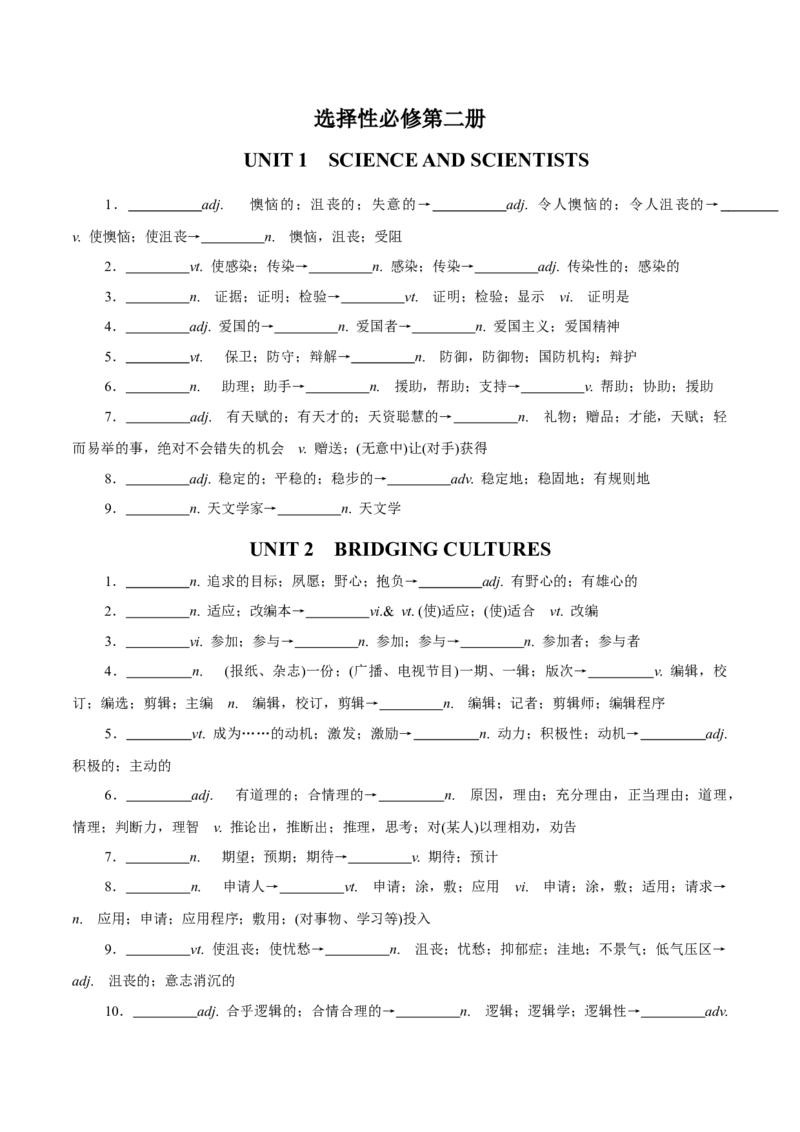
选择性必修第二册
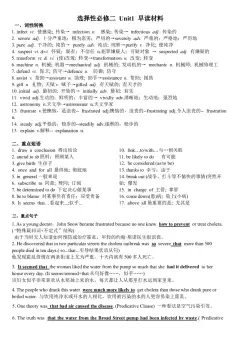
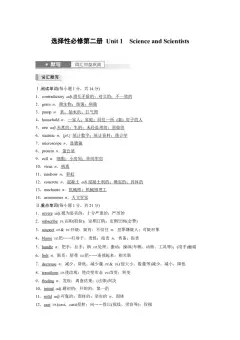
UNIT 1 SCIENCE AND SCIENTISTS
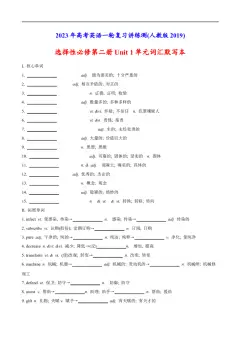
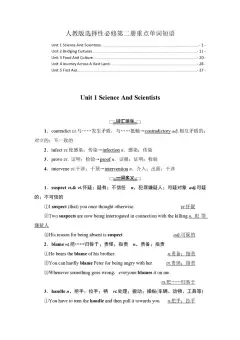
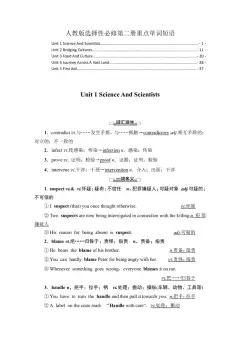
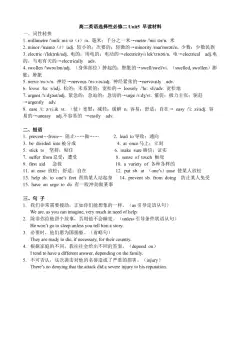
1. adj. 懊恼的;沮丧的;失意的→ adj. 令人懊恼的;令人沮丧的→
v. 使懊恼;使沮丧→ n. 懊恼,沮丧;受阻
2. vt. 使感染;传染→ n. 感染;传染→ adj. 传染性的;感染的
3. n. 证据;证明;检验→ vt. 证明;检验;显示 vi. 证明是
4. adj. 爱国的→ n. 爱国者→ n. 爱国主义;爱国精神
5. vt. 保卫;防守;辩解→ n. 防御,防御物;国防机构;辩护
6. n. 助理;助手→ n. 援助,帮助;支持→ v. 帮助;协助;援助
7. adj. 有天赋的;有天才的;天资聪慧的→ n. 礼物;赠品;才能,天赋;轻
而易举的事,绝对不会错失的机会 v. 赠送;(无意中)让(对手)获得
8. adj. 稳定的;平稳的;稳步的→ adv. 稳定地;稳固地;有规则地
9. n. 天文学家→ n. 天文学
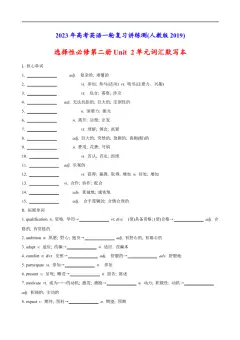
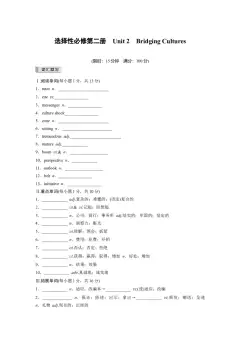
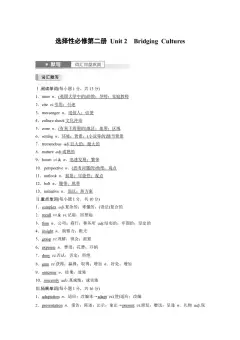
UNIT 2 BRIDGING CULTURES
1. n. 追求的目标;夙愿;野心;抱负→ adj. 有野心的;有雄心的
2. n. 适应;改编本→ vi.& vt. (使)适应;(使)适合 vt. 改编
3. vi. 参加;参与→ n. 参加;参与→ n. 参加者;参与者
4. n. (报纸、杂志)一份;(广播、电视节目)一期、一辑;版次→ v. 编辑,校
订;编选;剪辑;主编 n. 编辑,校订,剪辑→ n. 编辑;记者;剪辑师;编辑程序
5. vt. 成为……的动机;激发;激励→ n. 动力;积极性;动机→ adj.
积极的;主动的
6. adj. 有道理的;合情理的→ n. 原因,理由;充分理由,正当理由;道理,
情理;判断力,理智 v. 推论出,推断出;推理,思考;对(某人)以理相劝,劝告
7. n. 期望;预期;期待→ v. 期待;预计
8. n. 申请人→ vt. 申请;涂,敷;应用 vi. 申请;涂,敷;适用;请求→
n. 应用;申请;应用程序;敷用;(对事物、学习等)投入
9. vt. 使沮丧;使忧愁→ n. 沮丧;忧愁;抑郁症;洼地;不景气;低气压区→
adj. 沮丧的;意志消沉的
10. adj. 合乎逻辑的;合情合理的→ n. 逻辑;逻辑学;逻辑性→ adv.逻辑上;合乎逻辑
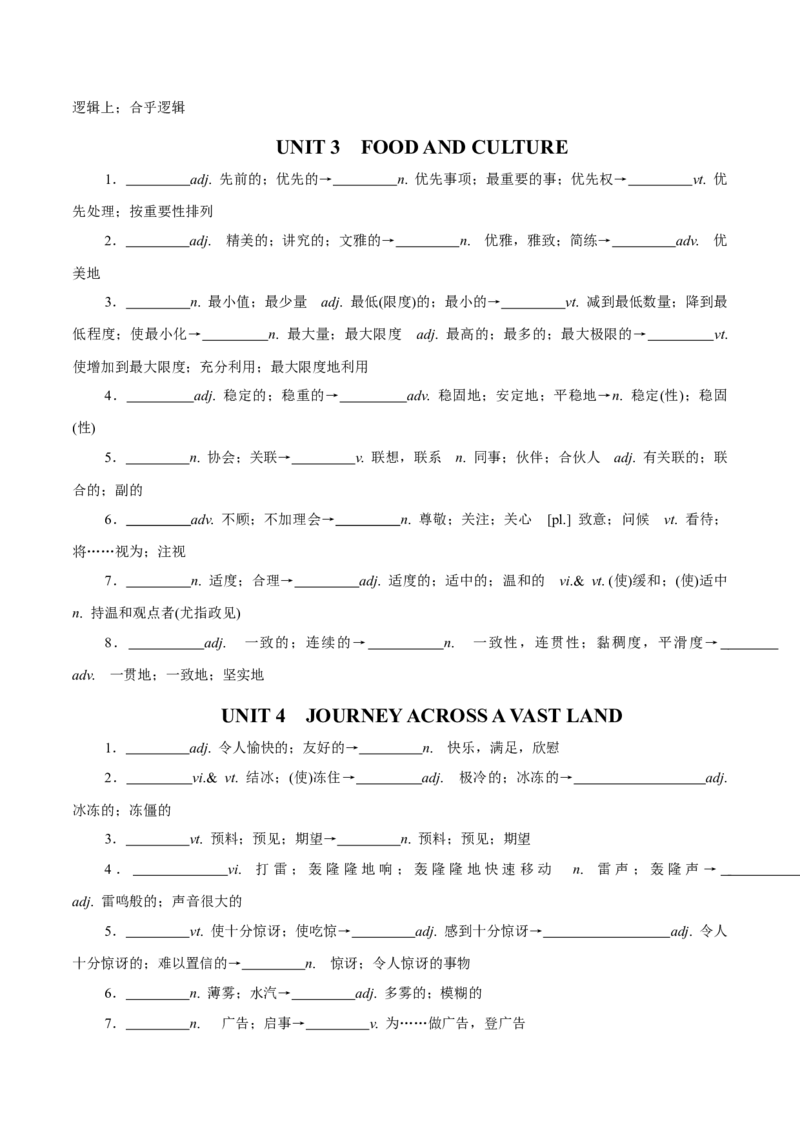
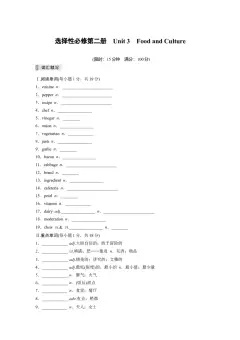
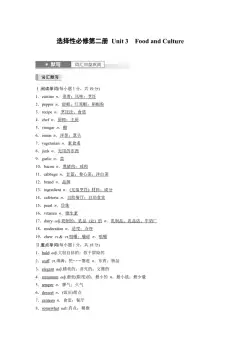
UNIT 3 FOOD AND CULTURE
1. adj. 先前的;优先的→ n. 优先事项;最重要的事;优先权→ vt. 优
先处理;按重要性排列
2. adj. 精美的;讲究的;文雅的→ n. 优雅,雅致;简练→ adv. 优
美地
3. n. 最小值;最少量 adj. 最低(限度)的;最小的→ vt. 减到最低数量;降到最
低程度;使最小化→ n. 最大量;最大限度 adj. 最高的;最多的;最大极限的→ vt.
使增加到最大限度;充分利用;最大限度地利用
4. adj. 稳定的;稳重的→ adv. 稳固地;安定地;平稳地→n. 稳定(性);稳固
(性)
5. n. 协会;关联→ v. 联想,联系 n. 同事;伙伴;合伙人 adj. 有关联的;联
合的;副的
6. adv. 不顾;不加理会→ n. 尊敬;关注;关心 [pl.] 致意;问候 vt. 看待;
将……视为;注视
7. n. 适度;合理→ adj. 适度的;适中的;温和的 vi.& vt. (使)缓和;(使)适中
n. 持温和观点者(尤指政见)
8. adj. 一致的;连续的→ n. 一致性,连贯性;黏稠度,平滑度→
adv. 一贯地;一致地;坚实地
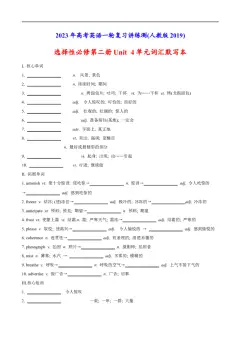
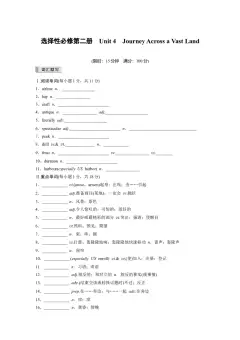
UNIT 4 JOURNEY ACROSS A VAST LAND
1. adj. 令人愉快的;友好的→ n. 快乐,满足,欣慰
2. vi.& vt. 结冰;(使)冻住→ adj. 极冷的;冰冻的→ adj.
冰冻的;冻僵的
3. vt. 预料;预见;期望→ n. 预料;预见;期望
4. vi. 打雷;轰隆隆地响;轰隆隆地快速移动 n. 雷声;轰隆声→
adj. 雷鸣般的;声音很大的
5. vt. 使十分惊讶;使吃惊→ adj. 感到十分惊讶→ adj. 令人
十分惊讶的;难以置信的→ n. 惊讶;令人惊讶的事物
6. n. 薄雾;水汽→ adj. 多雾的;模糊的
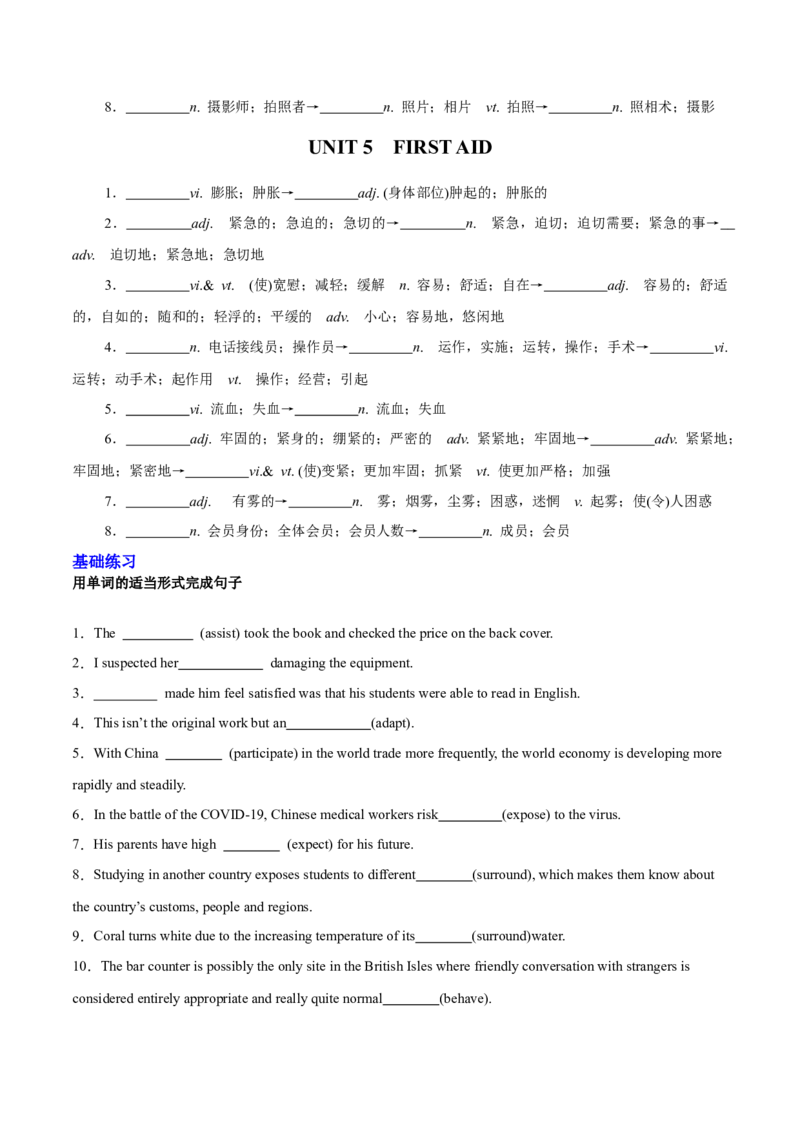
7. n. 广告;启事→ v. 为……做广告,登广告8. n. 摄影师;拍照者→ n. 照片;相片 vt. 拍照→ n. 照相术;摄影
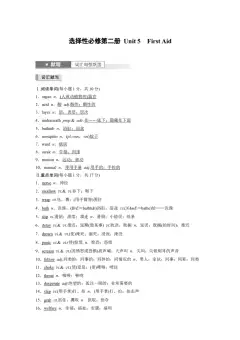
UNIT 5 FIRST AID
1. vi. 膨胀;肿胀→ adj. (身体部位)肿起的;肿胀的
2. adj. 紧急的;急迫的;急切的→ n. 紧急,迫切;迫切需要;紧急的事→
adv. 迫切地;紧急地;急切地
3. vi.& vt. (使)宽慰;减轻;缓解 n. 容易;舒适;自在→ adj. 容易的;舒适
的,自如的;随和的;轻浮的;平缓的 adv. 小心;容易地,悠闲地
4. n. 电话接线员;操作员→ n. 运作,实施;运转,操作;手术→ vi.
运转;动手术;起作用 vt. 操作;经营;引起
5. vi. 流血;失血→ n. 流血;失血
6. adj. 牢固的;紧身的;绷紧的;严密的 adv. 紧紧地;牢固地→ adv. 紧紧地;
牢固地;紧密地→ vi.& vt. (使)变紧;更加牢固;抓紧 vt. 使更加严格;加强
7. adj. 有雾的→ n. 雾;烟雾,尘雾;困惑,迷惘 v. 起雾;使(令)人困惑
8. n. 会员身份;全体会员;会员人数→ n. 成员;会员
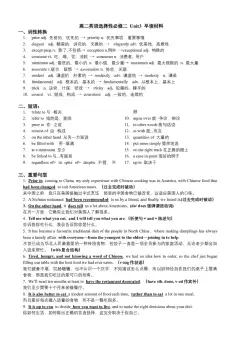
基础练习
用单词的适当形式完成句子
1.The (assist) took the book and checked the price on the back cover.
2.I suspected her damaging the equipment.
3. made him feel satisfied was that his students were able to read in English.
4.This isn’t the original work but an (adapt).
5.With China (participate) in the world trade more frequently, the world economy is developing more
rapidly and steadily.
6.In the battle of the COVID-19, Chinese medical workers risk (expose) to the virus.
7.His parents have high (expect) for his future.
8.Studying in another country exposes students to different (surround), which makes them know about
the country’s customs, people and regions.
9.Coral turns white due to the increasing temperature of its (surround)water.
10.The bar counter is possibly the only site in the British Isles where friendly conversation with strangers is
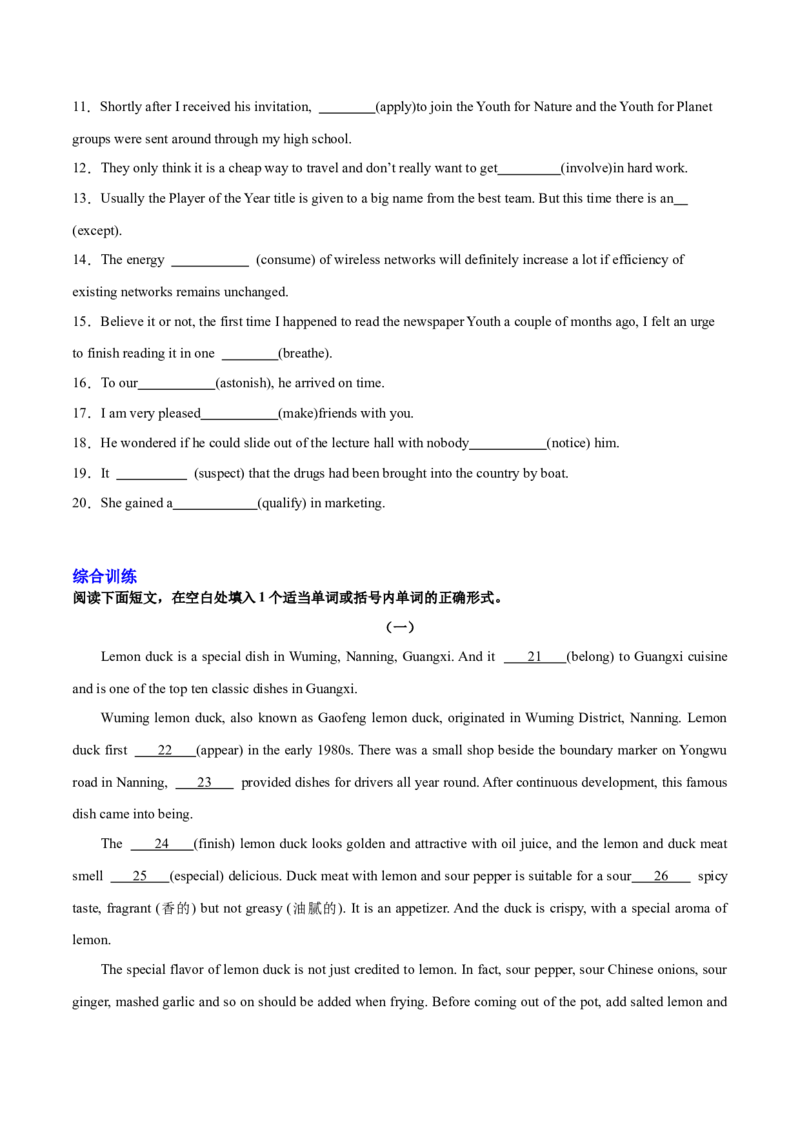
considered entirely appropriate and really quite normal (behave).11.Shortly after I received his invitation, (apply)to join the Youth for Nature and the Youth for Planet
groups were sent around through my high school.
12.They only think it is a cheap way to travel and don’t really want to get (involve)in hard work.
13.Usually the Player of the Year title is given to a big name from the best team. But this time there is an
(except).
14.The energy (consume) of wireless networks will definitely increase a lot if efficiency of
existing networks remains unchanged.
15.Believe it or not, the first time I happened to read the newspaper Youth a couple of months ago, I felt an urge
to finish reading it in one (breathe).
16.To our (astonish), he arrived on time.
17.I am very pleased (make)friends with you.
18.He wondered if he could slide out of the lecture hall with nobody (notice) him.
19.It (suspect) that the drugs had been brought into the country by boat.
20.She gained a (qualify) in marketing.
综合训练
阅读下面短文,在空白处填入1个适当单词或括号内单词的正确形式。
(一)
Lemon duck is a special dish in Wuming, Nanning, Guangxi. And it 21 (belong) to Guangxi cuisine
and is one of the top ten classic dishes in Guangxi.
Wuming lemon duck, also known as Gaofeng lemon duck, originated in Wuming District, Nanning. Lemon
duck first 22 (appear) in the early 1980s. There was a small shop beside the boundary marker on Yongwu
road in Nanning, 23 provided dishes for drivers all year round. After continuous development, this famous
dish came into being.
The 24 (finish) lemon duck looks golden and attractive with oil juice, and the lemon and duck meat
smell 25 (especial) delicious. Duck meat with lemon and sour pepper is suitable for a sour 26 spicy
taste, fragrant (香的) but not greasy (油腻的). It is an appetizer. And the duck is crispy, with a special aroma of
lemon.
The special flavor of lemon duck is not just credited to lemon. In fact, sour pepper, sour Chinese onions, sour
ginger, mashed garlic and so on should be added when frying. Before coming out of the pot, add salted lemon andpurple perilla (紫苏) 27 (leaf), and the salted lemon can only be put in after being seeded. Otherwise, it will
become bitter after 28 (cook) for a long time, and the fragrance will be lost.
The Gaofeng lemon duck was listed in the 29 (seven) batch of representative projects of intangible
cultural heritage in Nanning and it was rated 30 one of the top ten classic dishes in Guangxi as “Chinese
cuisine”.
(二)
Cloning is a technique scientists use to make genetic copies of living things. Genes, cells, 31
(tissue) and even whole animals can all be cloned.
Some clones already exist in nature. Single-celled organisms like bacteria make exact copies of themselves
each time they reproduce. In humans, identical twins are similar 32 clones.
Scientists also make clones in the lab. They often clone genes in order to study 33 better understand
them. To clone a gene, researchers take DNA from a living creature and insert it into 34 carrier. Every
time that carrier reproduces, a new copy of the gene will be made.
In 1996, Scottish scientists cloned the first animal, which is a sheep 35 (name) Dolly. Since then,
scientists 36 (clone) cows, cats, deer, horses and rabbits. They still have not cloned a human, though.
37 (part), this is because it is difficult to produce a viable (能成活的) clone. In each attempt, there can be
genetic mistakes that prevent the clone from 38 (survive). There 39 (be) also ethical concerns
about cloning a human being.
The cloning of animals has been used in a number of different applications. Livestock (家畜) like cows and
pigs have been cloned to produce more milk or meat. Clones can even “bring back” a beloved pet 40 has
died. Cloning might one day bring back extinct species like the woolly mammoth or giant panda.
(三)
Kunming, the capital of Yunnan province, is the economic and 41 (culture) center of southwest
China. It is linked by rail with all of China ’s major cities. Its rail link with Hanoi(河内) 42 (establish)
in1901.
Kunming ’s mild climate makes it 43 good place to visit any time of the year. 44 it can
be hot and humid in summer, it has cool, dry winters. The climate here is great for flowers, with more than 400
varieties 45 (plant) here. The camellia(山茶花) is the city ’s official flower. The city is also known for its
green parks, such as Cuihu (Green Lake) Park with its waterways and winding paths. Younger 46 (tourist)
may enjoy a visit to Daguan Park because of its food stalls.In addition to its own charms, Kunming serves 47 a base from which people can explore the culture of
ethnic groups in the area. The best known 48 (be)the Dai , Bai and Naxi. People can also visit the
Yunnan Stone Forest, which has been 49 (universal) known as “the first wonder of the world” since the
Ming Dynasty. The stone forest is located 120 km from Kunming, 50 (feature)impressive rock
formations.
(四)
UN Chinese Language Day is observed annually on April 20, celebrating the language’s contribution to the
world and 51 (encourage) more people to learn it.
April 20 marks the Guyu, Grain Rain in Chinese. The Guyu is the 52 (six) of the 24 solar terms in
the traditional lunar calendar, the day when farmers start sowing. Each year they will celebrate Guyu in memory of
the person: Cang Jie, 53 was believed to create Chinese characters.
Chinese 54 (allow) to be an official language of the United Nations in 1946. However, in the early
years, Chinese was not 55 (common) used in the work of the United Nations. The situation improved
56 the restoration (恢复) of the lawful rights of the PRC in the United Nations in 1971. And in 1973, the
General Assembly (联合国大会) included Chinese as 57 working language. Then more and more UN
offices and work members work with the Chinese language.
This year’s celebrations included lectures on Chinese culture, film screenings, panel discussions on education
and art 58 (exhibition). The event also provided an opportunity 59 (practise) Chinese
calligraphy, draw in the Chinese style, and play classical Chinese musical instruments.
Today, more and more diplomats and UN staff 60 (learn) Chinese and familiarizing themselves with
the Chinese culture.
(五)
Last year, I had the chance to study at a British secondary school as 61 exchange student. The
British school day 62 (common) begins around 9 a.m. and 63 (end) around 4 p.m. In year ten,
students usually have to learn nine subjects. The classes are different 64 those in China. Each teacher has
their own classroom and the students move around for every lesson. In most of my classes, there 65 (be)
only about 20 students.
I enjoyed most of the classes, but some of them were quite 66 (challenge). Learning in English was
a great challenge for me. Class discussion is very important in the UK. 67 I could not make a great
contribution because sometimes I wasn’t able to express 68 (I) clearly in English. There were lots of69 (choice) including bread and butter, chicken pie and puddings in the dining hall and after lunch, I often
played on the school’s huge sports field with Daniel and his friends. After school, there were many clubs to join.
Joining clubs was a great way 70 (meet) British students and make friends with them.
I am glad to have the opportunity to experience this different way of life.