衔接点26 句子还原快读巧解攻略(下)
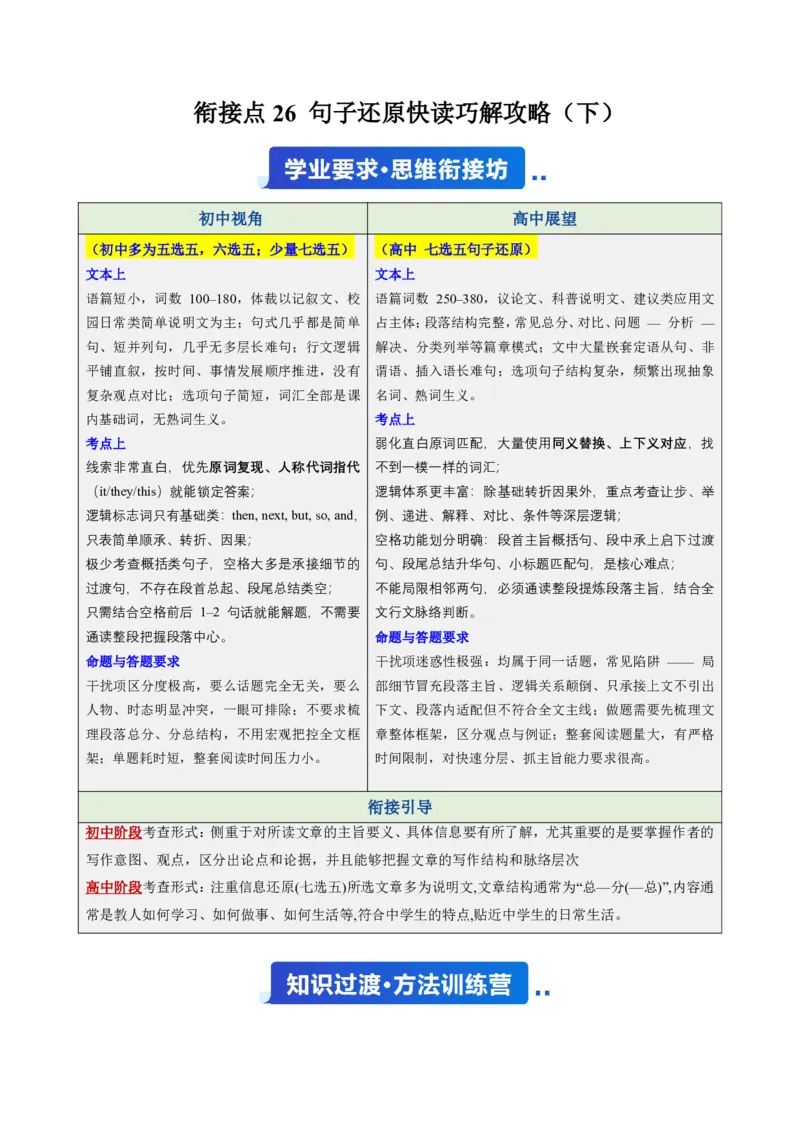
初中视角
高中展望
(初中多为五选五,六选五;少量七选五)
文本上
语篇短小,词数100–180,体裁以记叙文、校
园日常类简单说明文为主;句式几乎都是简单
句、短并列句,几乎无多层长难句;行文逻辑
平铺直叙,按时间、事情发展顺序推进,没有
复杂观点对比;选项句子简短,词汇全部是课
内基础词,无熟词生义。
考点上
线索非常直白,优先原词复现、人称代词指代
(it/they/this)就能锁定答案;
逻辑标志词只有基础类:then, next, but, so, and,
只表简单顺承、转折、因果;
极少考查概括类句子,空格大多是承接细节的
过渡句,不存在段首总起、段尾总结类空;
只需结合空格前后1–2 句话就能解题,不需要
通读整段把握段落中心。
命题与答题要求
干扰项区分度极高,要么话题完全无关,要么
人物、时态明显冲突,一眼可排除;不要求梳
理段落总分、分总结构,不用宏观把控全文框
架;单题耗时短,整套阅读时间压力小。
(高中七选五句子还原)
文本上
语篇词数250–380,议论文、科普说明文、建议类应用文
占主体;段落结构完整,常见总分、对比、问题— 分析—
解决、分类列举等篇章模式;文中大量嵌套定语从句、非
谓语、插入语长难句;选项句子结构复杂,频繁出现抽象
名词、熟词生义。
考点上
弱化直白原词匹配,大量使用同义替换、上下义对应,找
不到一模一样的词汇;
逻辑体系更丰富:除基础转折因果外,重点考查让步、举
例、递进、解释、对比、条件等深层逻辑;
空格功能划分明确:段首主旨概括句、段中承上启下过渡
句、段尾总结升华句、小标题匹配句,是核心难点;
不能局限相邻两句,必须通读整段提炼段落主旨,结合全
文行文脉络判断。
命题与答题要求
干扰项迷惑性极强:均属于同一话题,常见陷阱—— 局
部细节冒充段落主旨、逻辑关系颠倒、只承接上文不引出
下文、段落内适配但不符合全文主线;做题需要先梳理文
章整体框架,区分观点与例证;整套阅读题量大,有严格
时间限制,对快速分层、抓主旨能力要求很高。
衔接引导
初中阶段考查形式:侧重于对所读文章的主旨要义、具体信息要有所了解,尤其重要的是要掌握作者的
写作意图、观点,区分出论点和论据,并且能够把握文章的写作结构和脉络层次
高中阶段考查形式:注重信息还原(七选五)所选文章多为说明文,文章结构通常为“总—分(—总)”,内容通
常是教人如何学习、如何做事、如何生活等,符合中学生的特点,贴近中学生的日常生活。
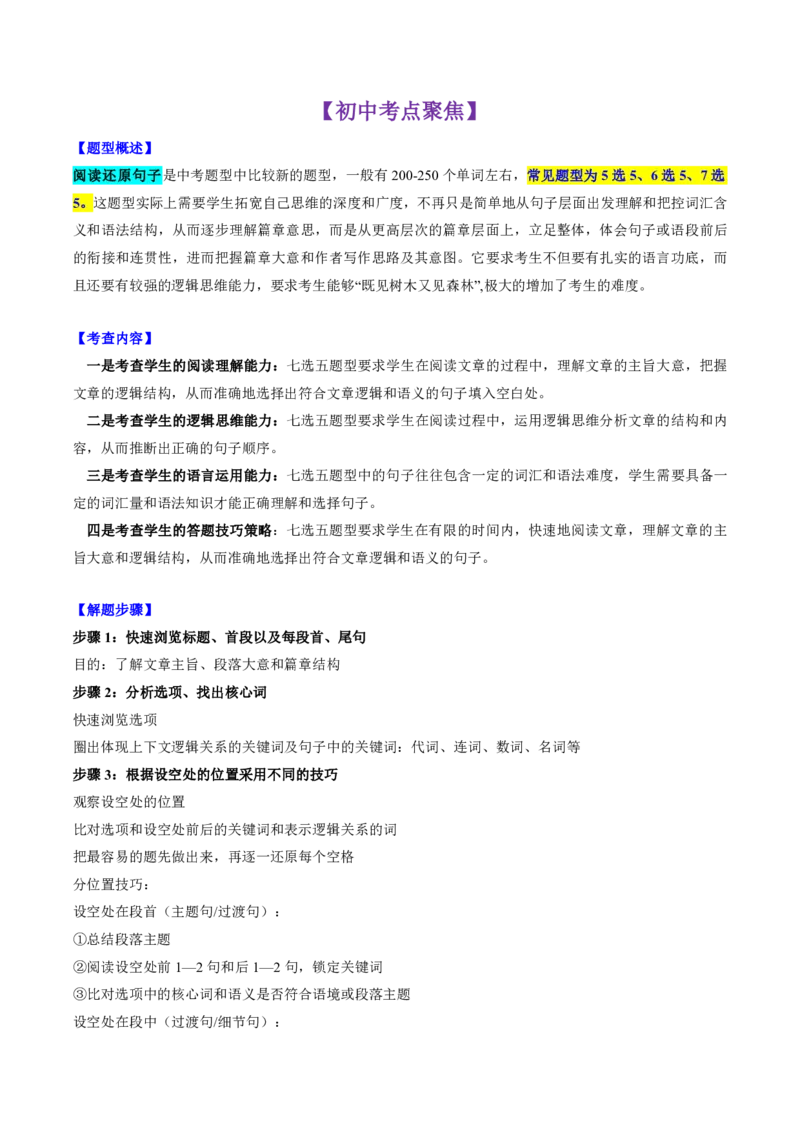
【初中考点聚焦】
【题型概述】
阅读还原句子是中考题型中比较新的题型,一般有200-250 个单词左右,常见题型为5 选5、6 选5、7 选
5。这题型实际上需要学生拓宽自己思维的深度和广度,不再只是简单地从句子层面出发理解和把控词汇含
义和语法结构,从而逐步理解篇章意思,而是从更高层次的篇章层面上,立足整体,体会句子或语段前后
的衔接和连贯性,进而把握篇章大意和作者写作思路及其意图。它要求考生不但要有扎实的语言功底,而
且还要有较强的逻辑思维能力,要求考生能够“既见树木又见森林”,极大的增加了考生的难度。
【考查内容】
一是考查学生的阅读理解能力:七选五题型要求学生在阅读文章的过程中,理解文章的主旨大意,把握
文章的逻辑结构,从而准确地选择出符合文章逻辑和语义的句子填入空白处。
二是考查学生的逻辑思维能力:七选五题型要求学生在阅读过程中,运用逻辑思维分析文章的结构和内
容,从而推断出正确的句子顺序。
三是考查学生的语言运用能力:七选五题型中的句子往往包含一定的词汇和语法难度,学生需要具备一
定的词汇量和语法知识才能正确理解和选择句子。
四是考查学生的答题技巧策略:七选五题型要求学生在有限的时间内,快速地阅读文章,理解文章的主
旨大意和逻辑结构,从而准确地选择出符合文章逻辑和语义的句子。
【解题步骤】
步骤1:快速浏览标题、首段以及每段首、尾句
目的:了解文章主旨、段落大意和篇章结构
步骤2:分析选项、找出核心词
快速浏览选项
圈出体现上下文逻辑关系的关键词及句子中的关键词:代词、连词、数词、名词等
步骤3:根据设空处的位置采用不同的技巧
观察设空处的位置
比对选项和设空处前后的关键词和表示逻辑关系的词
把最容易的题先做出来,再逐一还原每个空格
分位置技巧:
设空处在段首(主题句/过渡句):
①总结段落主题
②阅读设空处前1—2 句和后1—2 句,锁定关键词
③比对选项中的核心词和语义是否符合语境或段落主题
设空处在段中(过渡句/细节句):
①根据设空处前后的核心词、逻辑关系(并列、递进、因果、转折等)及段落主题判断出正确选项
设空处在段尾(细节句/过渡句/总结句):
①概括段落大意并比对选项
②阅读设空处附近内容,锁定关键词
③比对选项中的核心词和语义是否符合语境或段落大意
步骤4:验证答案
操作:将选项代入原文,复核还原后的文章在逻辑和内容上是否连贯、一致
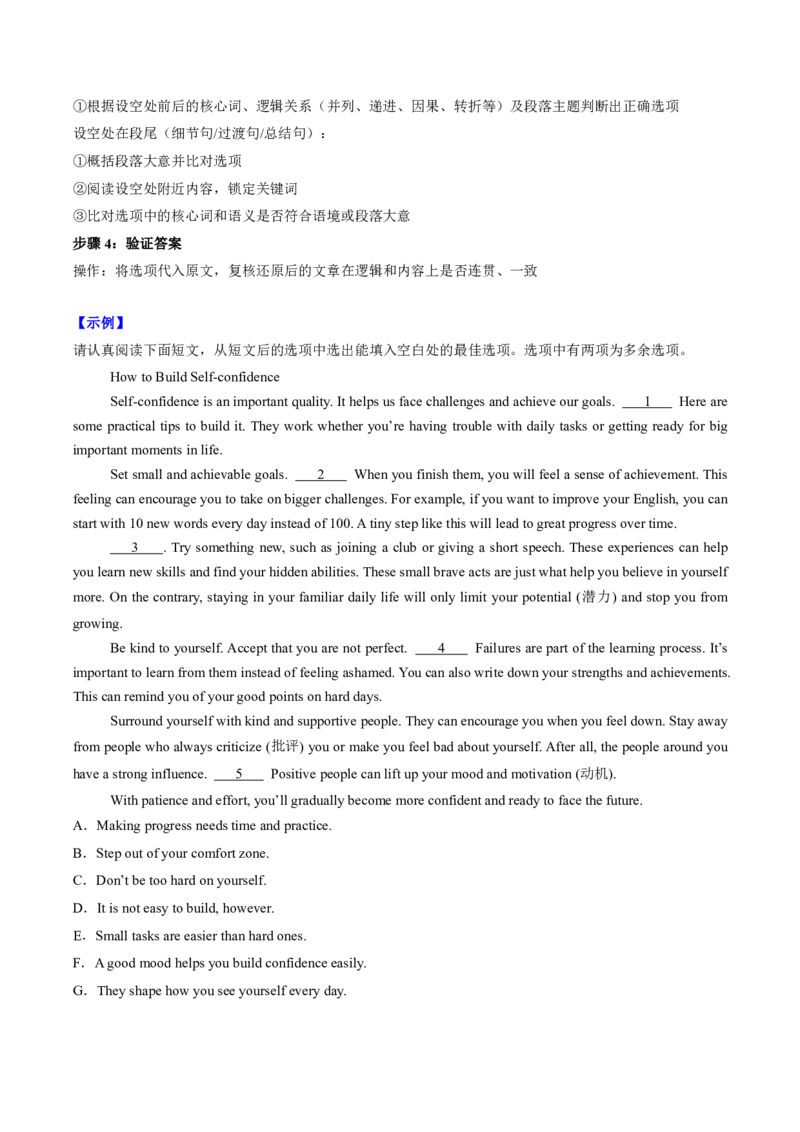
【示例】
请认真阅读下面短文,从短文后的选项中选出能填入空白处的最佳选项。选项中有两项为多余选项。
How to Build Self-confidence
Self-confidence is an important quality. It helps us face challenges and achieve our goals.
1
Here are
some practical tips to build it. They work whether you’re having trouble with daily tasks or getting ready for big
important moments in life.
Set small and achievable goals.
2
When you finish them, you will feel a sense of achievement. This
feeling can encourage you to take on bigger challenges. For example, if you want to improve your English, you can
start with 10 new words every day instead of 100. A tiny step like this will lead to great progress over time.
3
. Try something new, such as joining a club or giving a short speech. These experiences can help
you learn new skills and find your hidden abilities. These small brave acts are just what help you believe in yourself
more. On the contrary, staying in your familiar daily life will only limit your potential (潜力) and stop you from
growing.
Be kind to yourself. Accept that you are not perfect.
4
Failures are part of the learning process. It’s
important to learn from them instead of feeling ashamed. You can also write down your strengths and achievements.
This can remind you of your good points on hard days.
Surround yourself with kind and supportive people. They can encourage you when you feel down. Stay away
from people who always criticize (批评) you or make you feel bad about yourself. After all, the people around you
have a strong influence.
5
Positive people can lift up your mood and motivation (动机).
With patience and effort, you’ll gradually become more confident and ready to face the future.
A.Making progress needs time and practice.
B.Step out of your comfort zone.
C.Don’t be too hard on yourself.
D.It is not easy to build, however.
E.Small tasks are easier than hard ones.
F.A good mood helps you build confidence easily.
G.They shape how you see yourself every day.
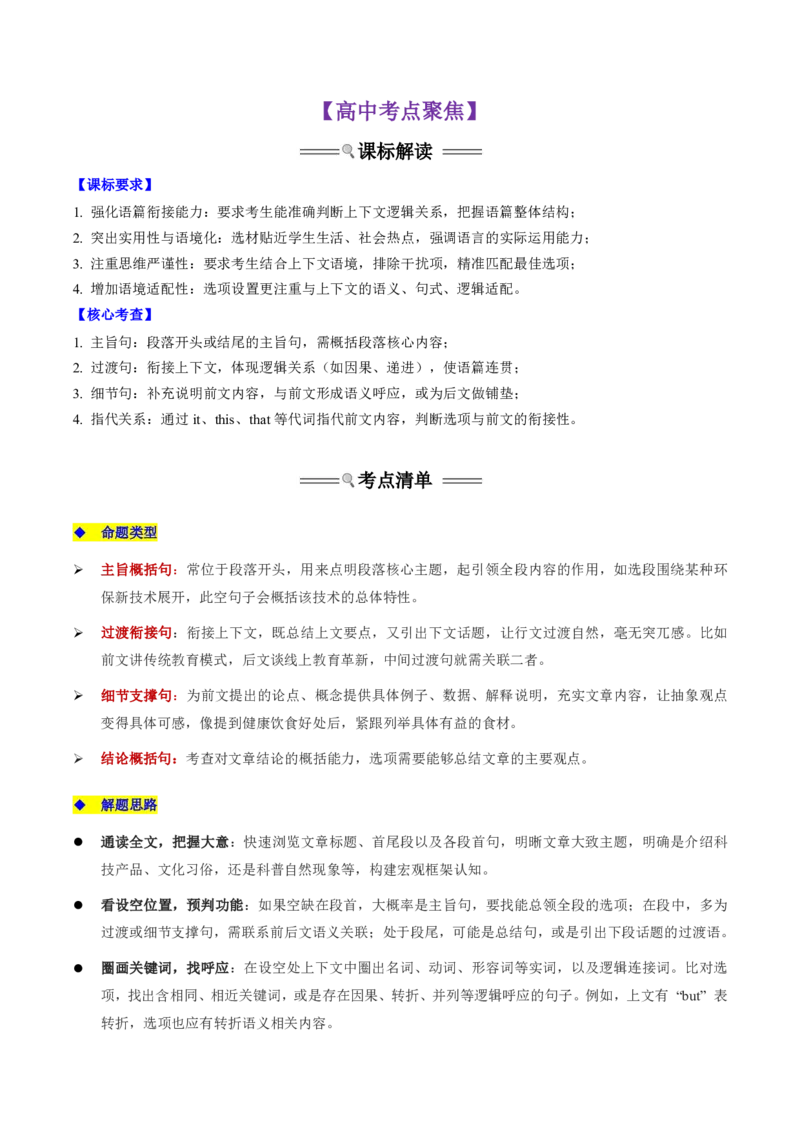
【高中考点聚焦】
课标解读
【课标要求】
1. 强化语篇衔接能力:要求考生能准确判断上下文逻辑关系,把握语篇整体结构;
2. 突出实用性与语境化:选材贴近学生生活、社会热点,强调语言的实际运用能力;
3. 注重思维严谨性:要求考生结合上下文语境,排除干扰项,精准匹配最佳选项;
4. 增加语境适配性:选项设置更注重与上下文的语义、句式、逻辑适配。
【核心考查】
1. 主旨句:段落开头或结尾的主旨句,需概括段落核心内容;
2. 过渡句:衔接上下文,体现逻辑关系(如因果、递进),使语篇连贯;
3. 细节句:补充说明前文内容,与前文形成语义呼应,或为后文做铺垫;
4. 指代关系:通过it、this、that 等代词指代前文内容,判断选项与前文的衔接性。
考点清单
命题类型
主旨概括句:常位于段落开头,用来点明段落核心主题,起引领全段内容的作用,如选段围绕某种环
保新技术展开,此空句子会概括该技术的总体特性。
过渡衔接句:衔接上下文,既总结上文要点,又引出下文话题,让行文过渡自然,毫无突兀感。比如
前文讲传统教育模式,后文谈线上教育革新,中间过渡句就需关联二者。
细节支撑句:为前文提出的论点、概念提供具体例子、数据、解释说明,充实文章内容,让抽象观点
变得具体可感,像提到健康饮食好处后,紧跟列举具体有益的食材。
结论概括句:考查对文章结论的概括能力,选项需要能够总结文章的主要观点。
解题思路
通读全文,把握大意:快速浏览文章标题、首尾段以及各段首句,明晰文章大致主题,明确是介绍科
技产品、文化习俗,还是科普自然现象等,构建宏观框架认知。
看设空位置,预判功能:如果空缺在段首,大概率是主旨句,要找能总领全段的选项;在段中,多为
过渡或细节支撑句,需联系前后文语义关联;处于段尾,可能是总结句,或是引出下段话题的过渡语。
圈画关键词,找呼应:在设空处上下文中圈出名词、动词、形容词等实词,以及逻辑连接词。比对选
项,找出含相同、相近关键词,或是存在因果、转折、并列等逻辑呼应的句子。例如,上文有“but” 表
转折,选项也应有转折语义相关内容。
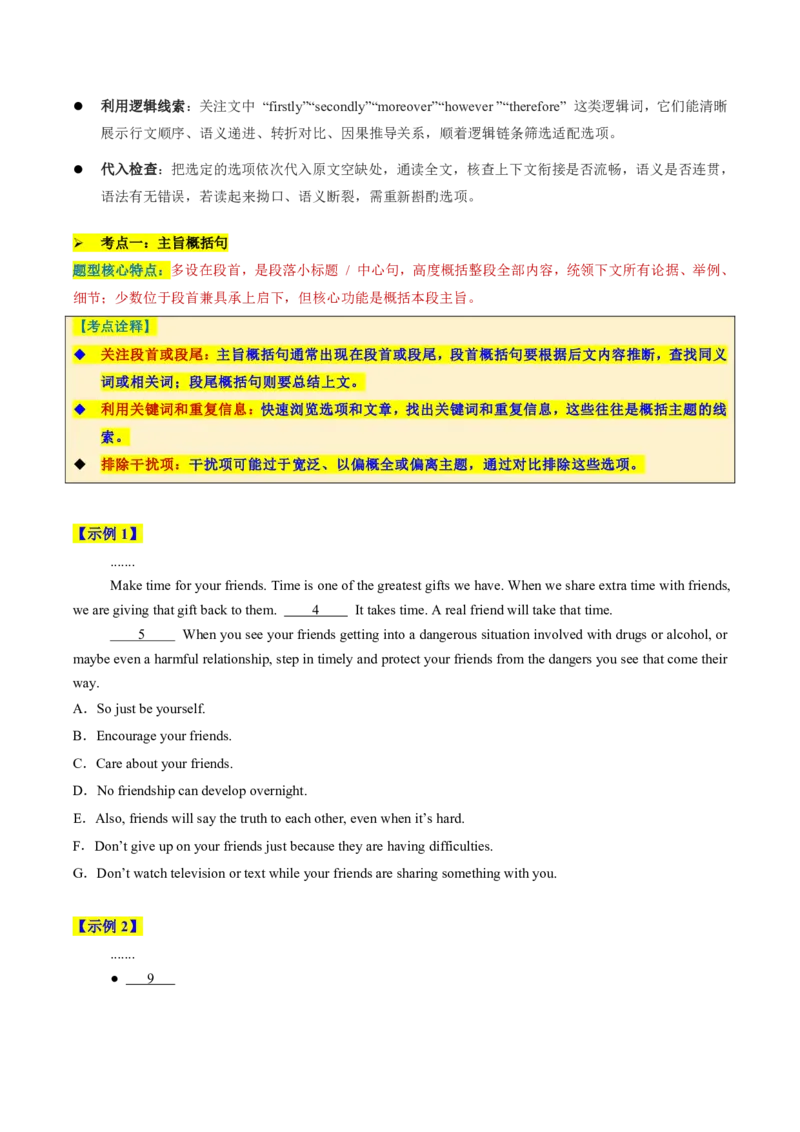
利用逻辑线索:关注文中“firstly”“secondly”“moreover”“however ”“therefore” 这类逻辑词,它们能清晰
展示行文顺序、语义递进、转折对比、因果推导关系,顺着逻辑链条筛选适配选项。
代入检查:把选定的选项依次代入原文空缺处,通读全文,核查上下文衔接是否流畅,语义是否连贯,
语法有无错误,若读起来拗口、语义断裂,需重新斟酌选项。
考点一:主旨概括句
题型核心特点:多设在段首,是段落小标题/ 中心句,高度概括整段全部内容,统领下文所有论据、举例、
细节;少数位于段首兼具承上启下,但核心功能是概括本段主旨。
【考点诠释】
关注段首或段尾:主旨概括句通常出现在段首或段尾,段首概括句要根据后文内容推断,查找同义
词或相关词;段尾概括句则要总结上文。
利用关键词和重复信息:快速浏览选项和文章,找出关键词和重复信息,这些往往是概括主题的线
索。
排除干扰项:干扰项可能过于宽泛、以偏概全或偏离主题,通过对比排除这些选项。
【示例1】
.......
Make time for your friends. Time is one of the greatest gifts we have. When we share extra time with friends,
we are giving that gift back to them.
4
It takes time. A real friend will take that time.
5
When you see your friends getting into a dangerous situation involved with drugs or alcohol, or
maybe even a harmful relationship, step in timely and protect your friends from the dangers you see that come their
way.
A.So just be yourself.
B.Encourage your friends.
C.Care about your friends.
D.No friendship can develop overnight.
E.Also, friends will say the truth to each other, even when it’s hard.
F.Don’t give up on your friends just because they are having difficulties.
G.Don’t watch television or text while your friends are sharing something with you.
【示例2】
.......
●
9
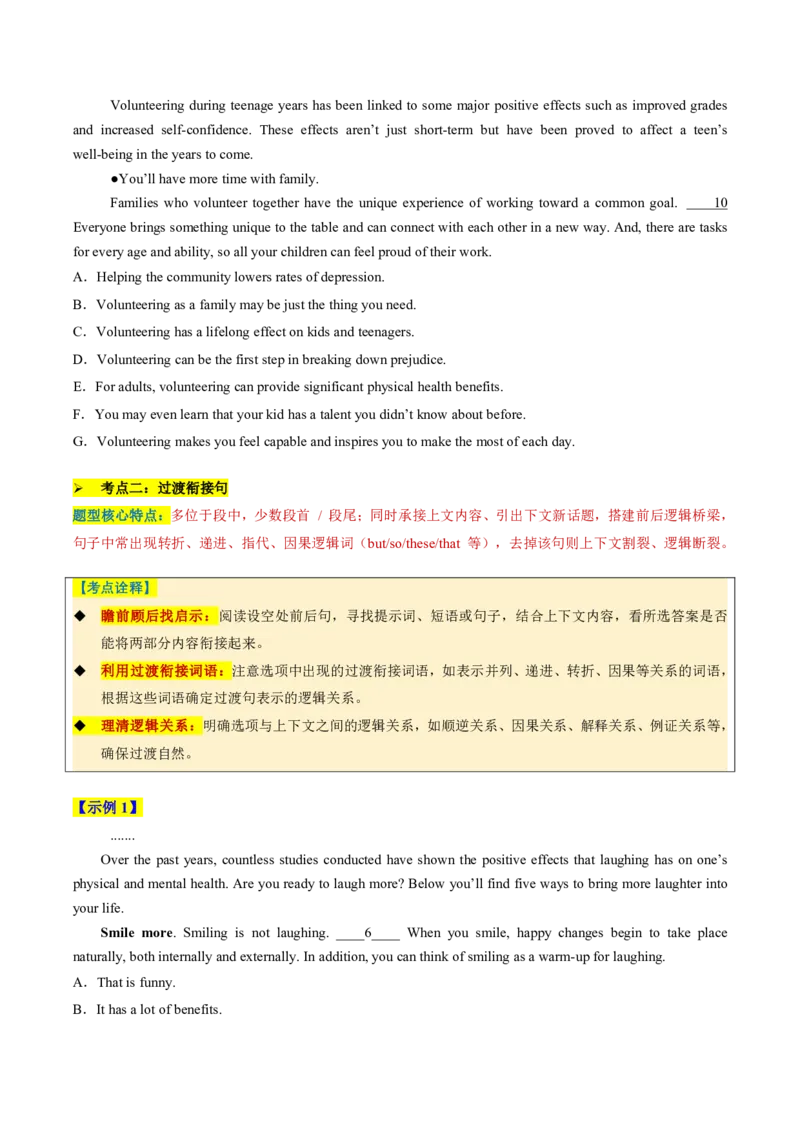
Volunteering during teenage years has been linked to some major positive effects such as improved grades
and increased self-confidence. These effects aren’t just short-term but have been proved to affect a teen’s
well-being in the years to come.
●You’ll have more time with family.
Families who volunteer together have the unique experience of working toward a common goal.
10
Everyone brings something unique to the table and can connect with each other in a new way. And, there are tasks
for every age and ability, so all your children can feel proud of their work.
A.Helping the community lowers rates of depression.
B.Volunteering as a family may be just the thing you need.
C.Volunteering has a lifelong effect on kids and teenagers.
D.Volunteering can be the first step in breaking down prejudice.
E.For adults, volunteering can provide significant physical health benefits.
F.You may even learn that your kid has a talent you didn’t know about before.
G.Volunteering makes you feel capable and inspires you to make the most of each day.
考点二:过渡衔接句
题型核心特点:多位于段中,少数段首/ 段尾;同时承接上文内容、引出下文新话题,搭建前后逻辑桥梁,
句子中常出现转折、递进、指代、因果逻辑词(but/so/these/that 等),去掉该句则上下文割裂、逻辑断裂。
【考点诠释】
瞻前顾后找启示:阅读设空处前后句,寻找提示词、短语或句子,结合上下文内容,看所选答案是否
能将两部分内容衔接起来。
利用过渡衔接词语:注意选项中出现的过渡衔接词语,如表示并列、递进、转折、因果等关系的词语,
根据这些词语确定过渡句表示的逻辑关系。
理清逻辑关系:明确选项与上下文之间的逻辑关系,如顺逆关系、因果关系、解释关系、例证关系等,
确保过渡自然。
【示例1】
.......
Over the past years, countless studies conducted have shown the positive effects that laughing has on one’s
physical and mental health. Are you ready to laugh more? Below you’ll find five ways to bring more laughter into
your life.
Smile more. Smiling is not laughing. ____6____ When you smile, happy changes begin to take place
naturally, both internally and externally. In addition, you can think of smiling as a warm-up for laughing.
A.That is funny.
B.It has a lot of benefits.
C.Follow funny people on Twitter.
D.Surround yourself with funny people.
E.These reminders can make us feel silly and childlike.
F.For better results, think of a funny moment from the past.
G.So our ability to find the humor in difficult situations can be limited.
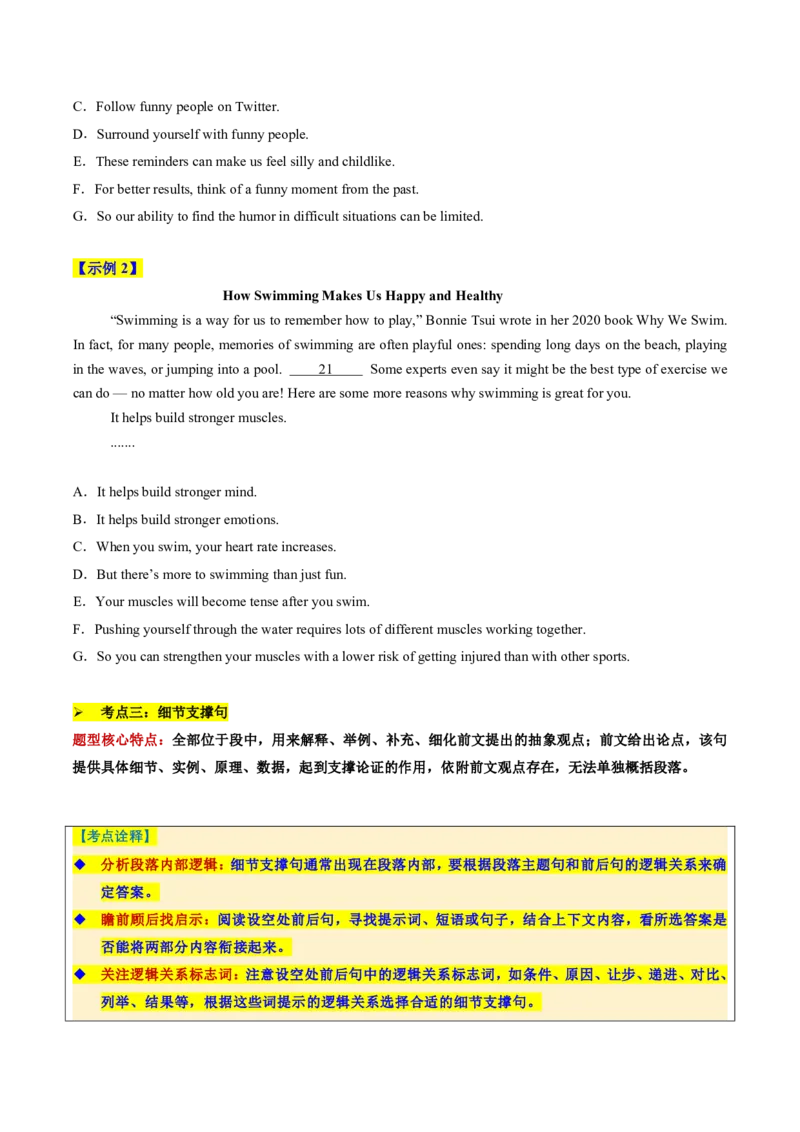
【示例2】
How Swimming Makes Us Happy and Healthy
“Swimming is a way for us to remember how to play,” Bonnie Tsui wrote in her 2020 book Why We Swim.
In fact, for many people, memories of swimming are often playful ones: spending long days on the beach, playing
in the waves, or jumping into a pool.
21
Some experts even say it might be the best type of exercise we
can do — no matter how old you are! Here are some more reasons why swimming is great for you.
It helps build stronger muscles.
.......
A.It helps build stronger mind.
B.It helps build stronger emotions.
C.When you swim, your heart rate increases.
D.But there’s more to swimming than just fun.
E.Your muscles will become tense after you swim.
F.Pushing yourself through the water requires lots of different muscles working together.
G.So you can strengthen your muscles with a lower risk of getting injured than with other sports.
考点三:细节支撑句
题型核心特点:全部位于段中,用来解释、举例、补充、细化前文提出的抽象观点;前文给出论点,该句
提供具体细节、实例、原理、数据,起到支撑论证的作用,依附前文观点存在,无法单独概括段落。
【考点诠释】
分析段落内部逻辑:细节支撑句通常出现在段落内部,要根据段落主题句和前后句的逻辑关系来确
定答案。
瞻前顾后找启示:阅读设空处前后句,寻找提示词、短语或句子,结合上下文内容,看所选答案是
否能将两部分内容衔接起来。
关注逻辑关系标志词:注意设空处前后句中的逻辑关系标志词,如条件、原因、让步、递进、对比、
列举、结果等,根据这些词提示的逻辑关系选择合适的细节支撑句。
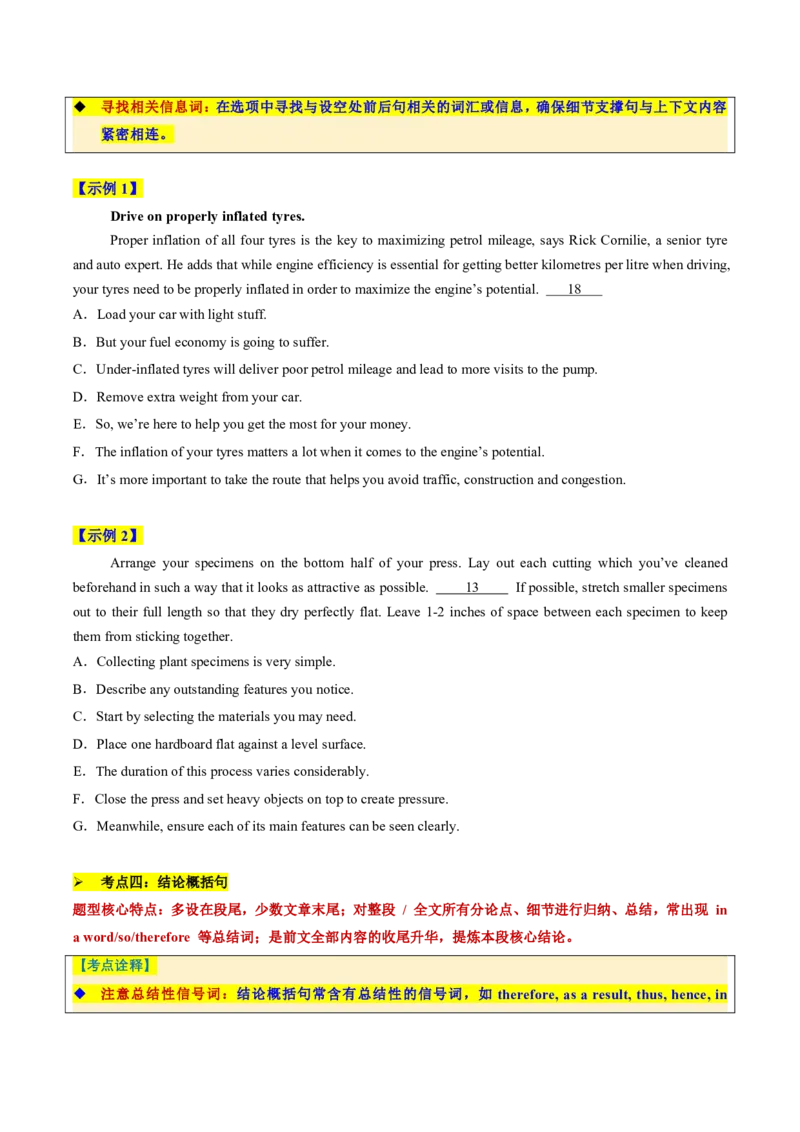
寻找相关信息词:在选项中寻找与设空处前后句相关的词汇或信息,确保细节支撑句与上下文内容
紧密相连。
【示例1】
Drive on properly inflated tyres.
Proper inflation of all four tyres is the key to maximizing petrol mileage, says Rick Cornilie, a senior tyre
and auto expert. He adds that while engine efficiency is essential for getting better kilometres per litre when driving,
your tyres need to be properly inflated in order to maximize the engine’s potential.
18
A.Load your car with light stuff.
B.But your fuel economy is going to suffer.
C.Under-inflated tyres will deliver poor petrol mileage and lead to more visits to the pump.
D.Remove extra weight from your car.
E.So, we’re here to help you get the most for your money.
F.The inflation of your tyres matters a lot when it comes to the engine’s potential.
G.It’s more important to take the route that helps you avoid traffic, construction and congestion.
【示例2】
Arrange your specimens on the bottom half of your press. Lay out each cutting which you’ve cleaned
beforehand in such a way that it looks as attractive as possible.
13
If possible, stretch smaller specimens
out to their full length so that they dry perfectly flat. Leave 1-2 inches of space between each specimen to keep
them from sticking together.
A.Collecting plant specimens is very simple.
B.Describe any outstanding features you notice.
C.Start by selecting the materials you may need.
D.Place one hardboard flat against a level surface.
E.The duration of this process varies considerably.
F.Close the press and set heavy objects on top to create pressure.
G.Meanwhile, ensure each of its main features can be seen clearly.
考点四:结论概括句
题型核心特点:多设在段尾,少数文章末尾;对整段/ 全文所有分论点、细节进行归纳、总结,常出现in
a word/so/therefore 等总结词;是前文全部内容的收尾升华,提炼本段核心结论。
【考点诠释】
注意总结性信号词:结论概括句常含有总结性的信号词,如therefore, as a result, thus, hence, in
short, to sum up, to conclude, in a word 等。
总结上文内容:根据上文的论述内容,选择能够总结或概括上文观点、信息的选项。
与主题句呼应:结论概括句要与文章或段落的主题句相呼应,确保文章结构完整、逻辑清晰。
【示例1】
......
As with many diets, it’s always wise to speak to your doctor or weight-loss professional before changing
your eating habits. And, at the end of the day, it could just come down to what lifestyle choice suits you.
5
If not, your health may suffer.
A.But what is intermittent fasting?
B.However, this diet isn’t for everyone.
C.Intermittent fasting has two main origins.
D.Let’s look at some of the possible benefits.
E.The idea of this is to reduce calories over a period.
F.In a word, you should avoid turning to intermittent fasting blindly.
G.You can eat normally on five days of a week and reduce calorie intake on the other two.
【示例2】
Share stories from the past. Do you remember one time in high school that you and your best friend wore
false hair and matching clothes around your neighborhood? Or, how about when your best friend sat on a painted
bench by accident? ____8____
A.That is funny.
B.It has a lot of benefits.
C.Follow funny people on Twitter.
D.Surround yourself with funny people.
E.These reminders can make us feel silly and childlike.
F.For better results, think of a funny moment from the past.
G.So our ability to find the humor in difficult situations can be limited.
(A)
.......
3
The shared passion for these high-risk activities creates a strong sense of community. Extreme
sports enthusiasts often gather at popular spots, exchange experiences, and support each other. They also share tips
on equipment, training methods, and safety measures. This tight-knit community not only provides a platform for
learning but also offers emotional support, making the extreme sports experience even more rewarding.
A.Participants can set their own goals and practice at their own pace.
B.They attract individuals who are eager to test their limits and seek new thrills.
C.Despite the risks, extreme sports also foster a unique sense of community.
D.These sports demand a combination of physical strength, and mental toughness.
E.When engaged in extreme sports, people always forget about their daily troubles.
F.The potential for injury is much higher compared to regular sports.
G.This can help conquer the physical challenge and push mental boundaries.
(B)
Basic first aid refers to the initial process of assessing and addressing the needs of someone who has been
injured or is in physiological distress due to choking, a heart attack, allergic reactions, drugs, or other medical
emergencies. Basic first aid allows you to quickly determine a person’s physical condition and the correct course of
treatment. You should always seek professional medical help as soon as you are able to.
36
Do not move the person.
38
- Moving someone with spinal cord damage may increase the
likelihood of paralysis or death. Wait for the ambulance to arrive to take over treatment of the person.
Never try to reset a broken or dislocated bone.
39
- Resetting a dislocation or broken bone runs a
strong risk of making things worse. Only doctors are qualified to do this.
It is dangerous to give aspirin to anyone under the age of 16, as it can cause potentially fatal damage to the
brain and liver before this age.
........
A.Never, ever put yourself in danger!
B.It could harm them even more, unless they are in immediate danger.
C.Do not touch someone who is being shocked by an electrical current.
D.Remember, this is first aid unless you are 110% sure of what you are doing.
E.They have higher levels of training and know how to handle these situations.
F.If approaching the victim will endanger your life, seek professional help immediately.
G.But be sure to be aware of the following things that can be the difference between life and death.
(C)
How to pack light for your international trip?
Packing light for an international trip not only saves money in extra luggage fees, but it’s also liberating,
allowing you to focus on what’s important — your trip. I mostly travel internationally, almost exclusively with just
a carry-on.
31
Here are four tips to keep in mind before you start packing for your international trip.
Plan outfits, instead of items. Thinking about what you’ll wear before you start packing is the solution to
overpacking.
32
Once you have a clear idea of it, it’s time to consider how to make the most of your
wardrobe without overpacking. Maybe plan to re-wear items like pants, shorts, jeans, dresses, and skirts as much as
possible.
........
Weigh your packed bags. Even if you’ve managed to fit everything in your bags, don’t skip this step. Some
airlines, especially for international flights, have weight limitations for carry-on luggage.
35
Place your
packed bag on the scale and make adjustments if needed. If your luggage is overweight, start by removing any non
- essential items.
A.Go easy on the tech.
B.Organize your travel necessities.
C.They help fit more items and keep belongings organized.
D.One mistake that travelers often make is packing too much underwear.
E.As a preventive measure, I aim for half a pound to a full pound below the limit.
F.It saves time at the airport and I needn’t worry about check-in luggage getting lost.
G.Start by checking your schedule and imagining your daily activities and special events.
(D)
......
Internet is a wealth of visual knowledge that goes a long way toward improving cooking skills. My husband
loves watching videos about cooking and will recreate entire meals from what he sees.
68
.
Read the Whole Recipe
It’s crucial to read an entire recipe from start to finish before you start cooking. This eliminates any potential
surprises that could derail your success and provides you with a chance to review the ingredients you have and
what could be substituted.
69
.
........
A.Few things can ruin a recipe faster than feeling rushed
B.It also gives you a better sense of the “underlying mechanics of what is happening”, which improves your
overall cooking skills
C.Figure out what you like to eat and focus on learning how to make that well
D.Recommended cooking times are just estimates, so rely on your own tests to confirm if a dish is finished
E.I use it when I need specialized knowledge, such as how to cut up a whole chicken into eight parts
F.The more you do it, the better you’ll get, so just keep cooking
G.So I compiled a list of thoughts and ideas on how to go about teaching oneself to cook
一、基础练习题
Many senior high students share the same goal: improving their English language skills.
1
Here’s a step-by-step approach (方法) that works for everyone.
Know about your purpose.
Start by figuring out why you want to improve your English skills. For struggling ones, it’s important to
master classroom dialogues to pass exams and build confidence. For top students, English fluency develops
academic excellence and prepares them for cross-cultural communication.
2
Involve yourself in real-life practice.
For struggling students this could mean practicing role-playing simple conversations with classmates.
3
. In spite of your current level, view these exercises as stepping stones to build confidence for broader
English use. Seek opportunities to apply your skills in real-world settings where English is used.
4
Take advantage of language-learning apps, online courses, and English-speaking communities to build daily
habits. Spend 10 minutes memorizing vocabulary with a learning app after breakfast. Take a 10-minute online
grammar course after lunch. Watch short English videos for 10 minutes after dinner to practice listening. Whatever
you choose to do, the key is to keep the habits you’ve formed.
Celebrate small wins.
Language learning takes time, so celebrate your progress! Treat yourself to a chocolate after remembering 10
new words, or share your achievements when you finish daily practice.
5
Each improvement, whether
it’s mastering a grammar rule or reaching your desired score, is a step toward success.
A.Fall into daily habits.
B.Improve online learning skills.
C.This builds confidence and keeps you going.
D.Follow these key steps to improve your reading skills.
E.Having a strong “why” keeps you going when challenges appear.
F.While learning English can be challenging, the right approach helps.
G.For top students, it could involve class debates or presentations in English.
Practical Ways to Support Younger Students
A teacher recently emailed me the following question: “With older students, you can guide them to
informational resources and they can learn independently.
6
?” This is a common and valuable question.
But answering this question begins with considering the following tips.
·
7
. Young children learn best when they can explore ideas in different ways, not just through
reading. While reading aloud is helpful, videos, images, and hands-on activities also give children the chance to
learn. For example, you could set up walks where children look at photos, listen to recordings or watch short videos
related to their questions.
·Bring in experts (专家) and plan field trips. Meeting experts and visiting places outside the classroom are
great ways to learn. Before a visit, have children think of questions to ask. During the visit, support their curiosity,
and afterward, discuss what they learned.
8
.
·Allow children to lead their own learning. Adults often follow their own interests, so we should let children
do the same.
9
. One way is to create a “Wonder Wall”, where children can write or tell you their questions.
Set aside time during the day to review these questions. This shows that their ideas matter.
·Encourage group work.
10
. When children work on the same topic or goal, learning together is
more enjoyable and effective (有效的). Teachers can help by allowing time for small group work while others are
working on independent tasks.
A.Why does it matter to them
B.Try different ways to explore ideas
C.Make the most of our school resources
D.Give children chances to learn alongside each other
E.These practices support thoughtful exploration of a topic
F.With my younger students, how can I guide them to study
G.Value children’s questions and let them explore what excites them
二、进阶练习题
Libraries are some of the most magical places on Earth. They provide a wealth of knowledge, open doors
into other worlds, and create opportunities for everyone. If you are new to using libraries, you might be surprised to
learn how much they can do for you.
11
Get a library card.
To take out anything from your local library, you first need a library card.
12
The library will
have rules about how many books you can borrow and for how long. When it’s time to return them, you can bring
them back or sometimes keep them a little longer. Visit your local library to apply for a card and ask the librarian
about the rules,
13
If you’re trying to find a book and can’t remember the exact title or the name of the author, a librarian can
help. Tell them the subjects that interest you, and they can make great suggestions.
14
They can show
you how to search online and find the correct information.
Enjoy scheduled events.
15
You can check the library’s website for a list of upcoming activities and sign up with your card.
These may include tween (8 到12 岁的少年) and teen book clubs, gaming clubs, art workshops, and fun classes
like chess, crafting, and coding (编程).
A.Get help from the librarians.
B.Go for more interesting books.
C.This helps you avoid getting fined.
D.Here are some tips on how to get started.
E.Librarians can also help with your school project research.
F.A lot of libraries hold various free activities for young people.
G.It gives you borrowing rights to check out books and other things.
How to Turn Failure into Fuel
Most people are terrified of failure. They see it as a sign of weakness or incompetence.
16
However, research in psychology and neuroscience (神经科学) suggests that failure can actually be one of your
greatest teachers-if you know how to respond to it correctly.
The first step is to separate your identity from your actions. Failing at something does not make you a failure.
17
This simple mental shift allows you to stay objective and avoid destructive self-criticism.
Second, adopt what experts call an “error-focused mindset.” Instead of ignoring or hiding your mistakes,
analyze them with curiosity. Ask yourself. What exactly went wrong? What could I do differently next time?
18
Without this reflection, repeated failure only leads to frustration, not progress.
Third, manage your emotional response. Failure often triggers shame or anxiety, which can shut down the
logical part of your brain.
19
Taking a few deep breaths, going for a short walk, or even just waiting 10
minutes before reacting can help you regain control.
Finally, remember that every expert was once a beginner. The difference lies in persistence.
20
So
the next time you fail, ask not “Why me?” but “What now?”
A.In fact, many successful people have failed more times than most of us have even tried.
B.It is simply an event, not a permanent label.
C.This explains why some students give up after one bad grade while others bounce back stronger.
D.A quick way to calm down is to use a simple “pause and breathe” technique.
E.Otherwise, you might repeat the same mistake without ever realizing it.
F.As a result, they avoid taking any real risks - which unexpectedly leads to a life of ordinariness.
G.Once you find the cause, you must also be willing to change your strategy.