《2026 浙江1 月卷英语真题完全解读与考后提升》
专题03 2026 浙江1 月卷阅读理解C 篇(识别消费者评论真伪)
(解读+技巧+变式) 原卷版
阅读理解关键词:说明文,人与社会,消费者虚假评价,

 AI
  生成网络评价认知,德智体美劳


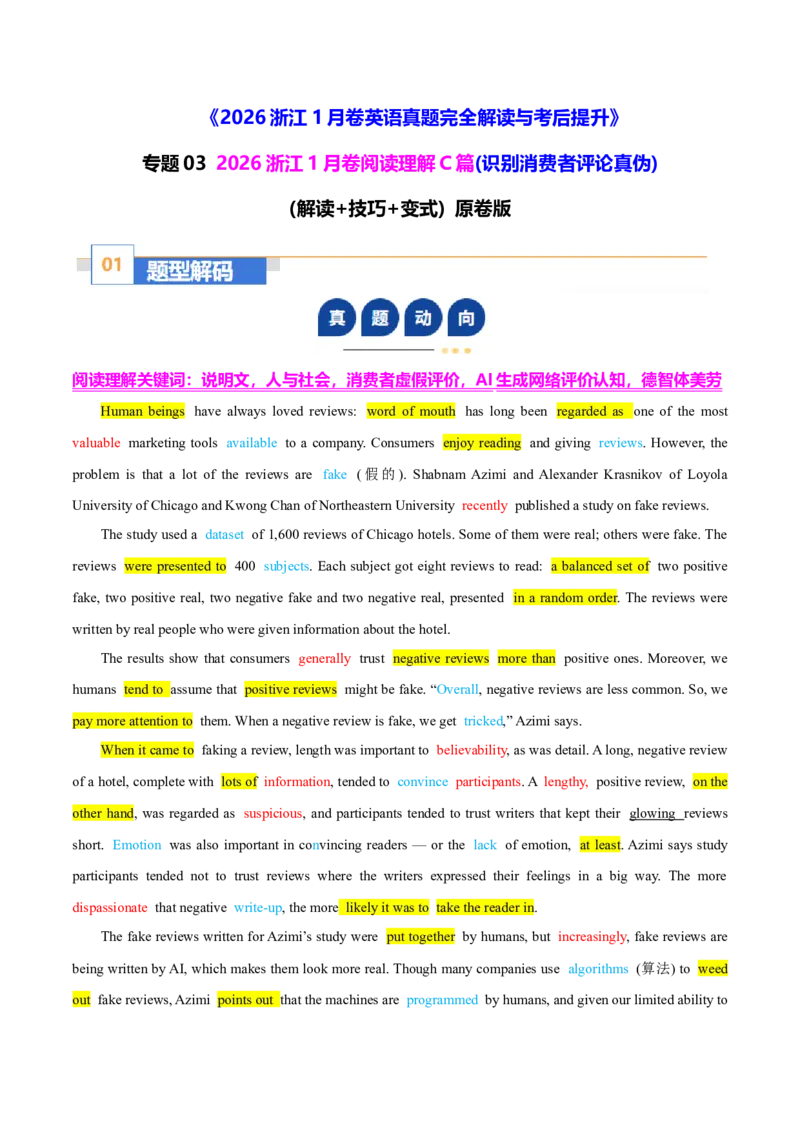
Human beings have always loved reviews: word of mouth has long been regarded as one of the most
valuable marketing tools available to a company. Consumers enjoy reading and giving reviews. However, the
problem is that a lot of the reviews are fake ( 假的). Shabnam Azimi and Alexander Krasnikov of Loyola
University of Chicago and Kwong Chan of Northeastern University recently published a study on fake reviews.
The study used a dataset of 1,600 reviews of Chicago hotels. Some of them were real; others were fake. The
reviews were presented to 400 subjects. Each subject got eight reviews to read: a balanced set of two positive
fake, two positive real, two negative fake and two negative real, presented in a random order. The reviews were
written by real people who were given information about the hotel.
The results show that consumers generally trust negative reviews more than positive ones. Moreover, we
humans tend to assume that positive reviews might be fake. “Overall, negative reviews are less common. So, we
pay more attention to them. When a negative review is fake, we get tricked,” Azimi says.
When it came to faking a review, length was important to believability, as was detail. A long, negative review
of a hotel, complete with lots of information, tended to convince participants. A lengthy, positive review, on the
other hand, was regarded as suspicious, and participants tended to trust writers that kept their glowing reviews
short. Emotion was also important in convincing readers — or the lack of emotion, at least. Azimi says study
participants tended not to trust reviews where the writers expressed their feelings in a big way. The more
dispassionate that negative write-up, the more likely it was to take the reader in.
The fake reviews written for Azimi’s study were put together by humans, but increasingly, fake reviews are
being written by AI, which makes them look more real. Though many companies use algorithms (算法) to weed
out fake reviews, Azimi points out that the machines are programmed by humans, and given our limited ability to
spot fake reviews, this isn’t a good sign.
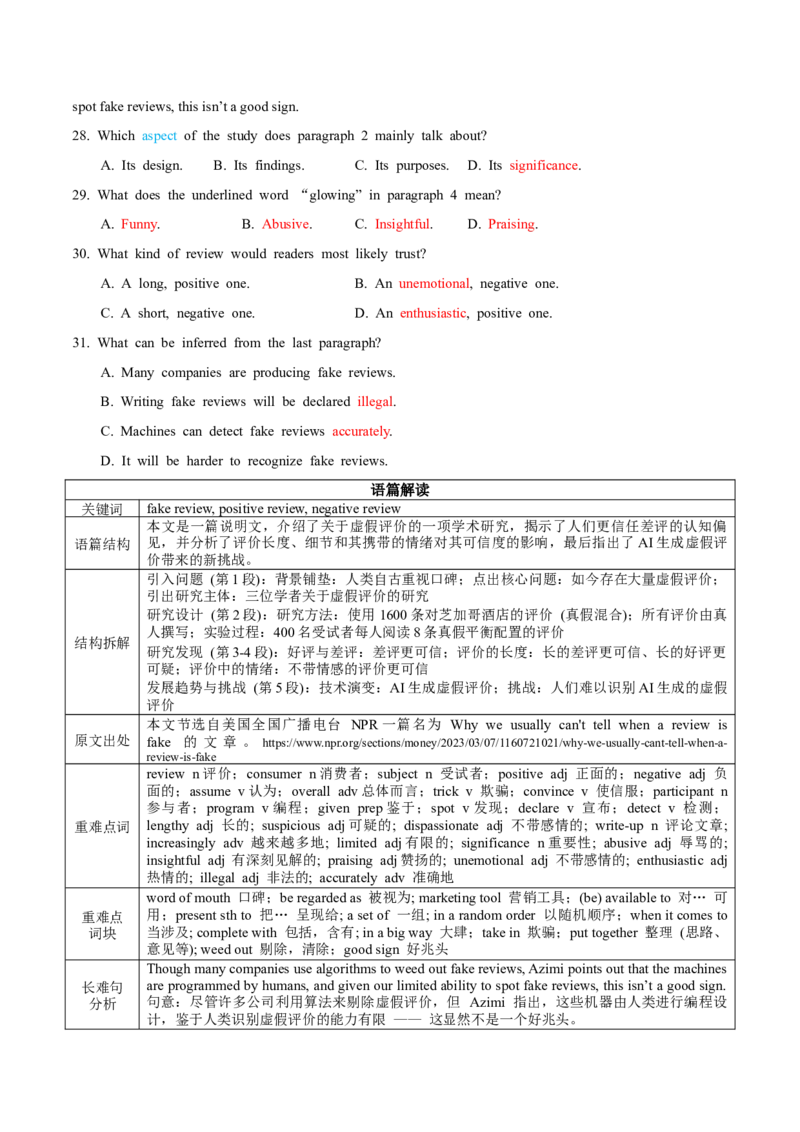
28. Which aspect of the study does paragraph 2 mainly talk about?
A. Its design.
B. Its findings.
C. Its purposes.
D. Its significance.
29. What does the underlined word “glowing” in paragraph 4 mean?
A. Funny.
B. Abusive.
C. Insightful.
D. Praising.
30. What kind of review would readers most likely trust?
A. A long, positive one.
B. An unemotional, negative one.
C. A short, negative one.
D. An enthusiastic, positive one.
31. What can be inferred from the last paragraph?
A. Many companies are producing fake reviews.
B. Writing fake reviews will be declared illegal.
C. Machines can detect fake reviews accurately.
D. It will be harder to recognize fake reviews.
语篇解读
关键词
fake review, positive review, negative review
语篇结构
本文是一篇说明文,介绍了关于虚假评价的一项学术研究,揭示了人们更信任差评的认知偏
见,并分析了评价长度、细节和其携带的情绪对其可信度的影响,最后指出了AI 生成虚假评
价带来的新挑战。
结构拆解
引入问题 (第1 段):背景铺垫:人类自古重视口碑;点出核心问题:如今存在大量虚假评价;
引出研究主体:三位学者关于虚假评价的研究
研究设计 (第2 段):研究方法:使用1600 条对芝加哥酒店的评价 (真假混合);所有评价由真
人撰写;实验过程:400 名受试者每人阅读8 条真假平衡配置的评价
研究发现 (第3-4 段):好评与差评:差评更可信;评价的长度:长的差评更可信、长的好评更
可疑;评价中的情绪:不带情感的评价更可信
发展趋势与挑战 (第5 段):技术演变:AI 生成虚假评价;挑战:人们难以识别AI 生成的虚假
评价
原文出处
本文节选自美国全国广播电台 NPR 一篇名为 Why we usually can't tell when a review is
fake 的文章。https://www.npr.org/sections/money/2023/03/07/1160721021/why-we-usually-cant-tell-when-a-
review-is-fake
重难点词
review n 评价;consumer n 消费者;subject n 受试者;positive adj 正面的;negative adj 负
面的;assume v 认为;overall adv 总体而言;trick v 欺骗;convince v 使信服;participant n
参与者;program v 编程;given prep 鉴于;spot v 发现;declare v 宣布;detect v 检测;
lengthy adj 长的; suspicious adj 可疑的; dispassionate adj 不带感情的; write-up n 评论文章;
increasingly adv 越来越多地; limited adj 有限的; significance n 重要性; abusive adj 辱骂的;
insightful adj 有深刻见解的; praising adj 赞扬的; unemotional adj 不带感情的; enthusiastic adj
热情的; illegal adj 非法的; accurately adv 准确地
重难点
词块
word of mouth 口碑;be regarded as 被视为; marketing tool 营销工具;(be) available to 对… 可
用;present sth to 把… 呈现给; a set of 一组; in a random order 以随机顺序;when it comes to
当涉及; complete with 包括,含有; in a big way 大肆;take in 欺骗;put together 整理 (思路、
意见等); weed out 剔除,清除;good sign 好兆头
长难句
分析
Though many companies use algorithms to weed out fake reviews, Azimi points out that the machines
are programmed by humans, and given our limited ability to spot fake reviews, this isn’t a good sign.
句意:尽管许多公司利用算法来剔除虚假评价,但 Azimi 指出,这些机器由人类进行编程设
计,鉴于人类识别虚假评价的能力有限 —— 这显然不是一个好兆头。
分析:本句中,Though 引导让步状语从句,主干为 Azimi points out, 而 that the machines are
programmed by humans … this isn’t a good sign 是points out 的宾语从句。
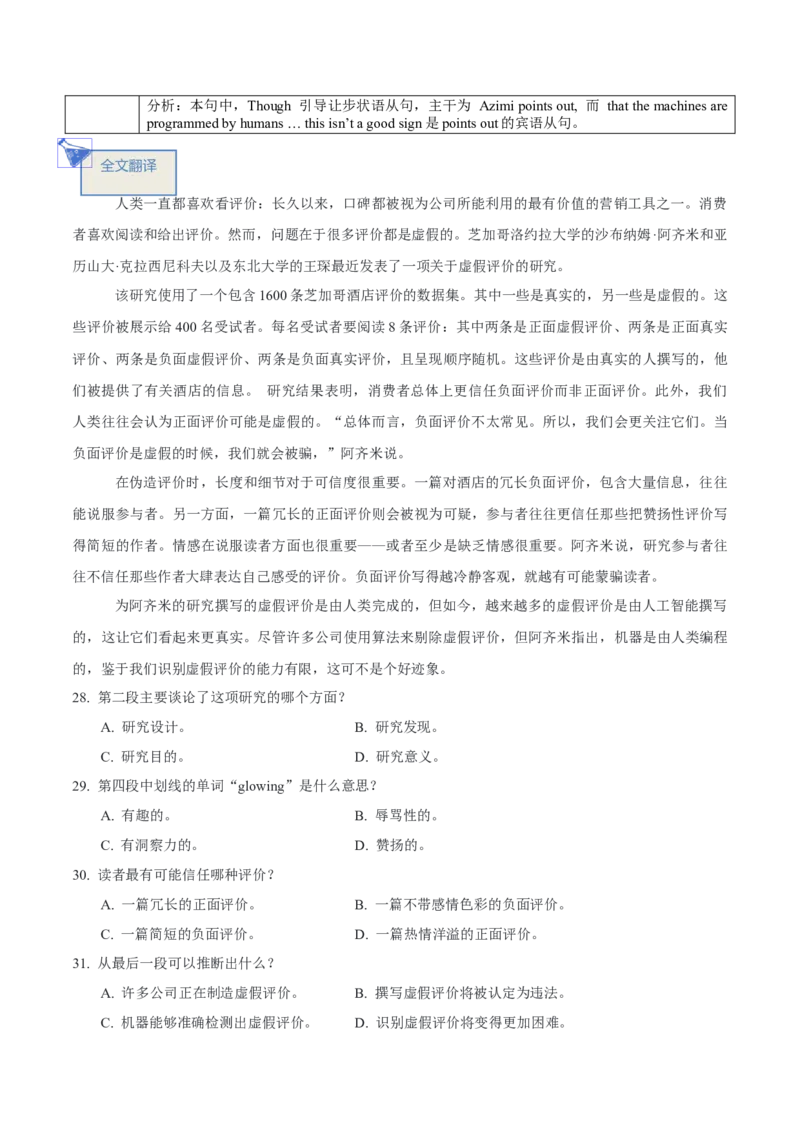
人类一直都喜欢看评价:长久以来,口碑都被视为公司所能利用的最有价值的营销工具之一。消费
者喜欢阅读和给出评价。然而,问题在于很多评价都是虚假的。芝加哥洛约拉大学的沙布纳姆·阿齐米和亚
历山大·克拉西尼科夫以及东北大学的王琛最近发表了一项关于虚假评价的研究。
该研究使用了一个包含1600 条芝加哥酒店评价的数据集。其中一些是真实的,另一些是虚假的。这
些评价被展示给400 名受试者。每名受试者要阅读8 条评价:其中两条是正面虚假评价、两条是正面真实
评价、两条是负面虚假评价、两条是负面真实评价,且呈现顺序随机。这些评价是由真实的人撰写的,他
们被提供了有关酒店的信息。 研究结果表明,消费者总体上更信任负面评价而非正面评价。此外,我们
人类往往会认为正面评价可能是虚假的。“总体而言,负面评价不太常见。所以,我们会更关注它们。当
负面评价是虚假的时候,我们就会被骗,”阿齐米说。
在伪造评价时,长度和细节对于可信度很重要。一篇对酒店的冗长负面评价,包含大量信息,往往
能说服参与者。另一方面,一篇冗长的正面评价则会被视为可疑,参与者往往更信任那些把赞扬性评价写
得简短的作者。情感在说服读者方面也很重要——或者至少是缺乏情感很重要。阿齐米说,研究参与者往
往不信任那些作者大肆表达自己感受的评价。负面评价写得越冷静客观,就越有可能蒙骗读者。
为阿齐米的研究撰写的虚假评价是由人类完成的,但如今,越来越多的虚假评价是由人工智能撰写
的,这让它们看起来更真实。尽管许多公司使用算法来剔除虚假评价,但阿齐米指出,机器是由人类编程
的,鉴于我们识别虚假评价的能力有限,这可不是个好迹象。
28. 第二段主要谈论了这项研究的哪个方面?
A. 研究设计。
B. 研究发现。
C. 研究目的。
D. 研究意义。
29. 第四段中划线的单词“glowing”是什么意思?
A. 有趣的。
B. 辱骂性的。
C. 有洞察力的。
D. 赞扬的。
30. 读者最有可能信任哪种评价?
A. 一篇冗长的正面评价。
B. 一篇不带感情色彩的负面评价。
C. 一篇简短的负面评价。
D. 一篇热情洋溢的正面评价。
31. 从最后一段可以推断出什么?
A. 许多公司正在制造虚假评价。
B. 撰写虚假评价将被认定为违法。
C. 机器能够准确检测出虚假评价。
D. 识别虚假评价将变得更加困难。
全文翻译
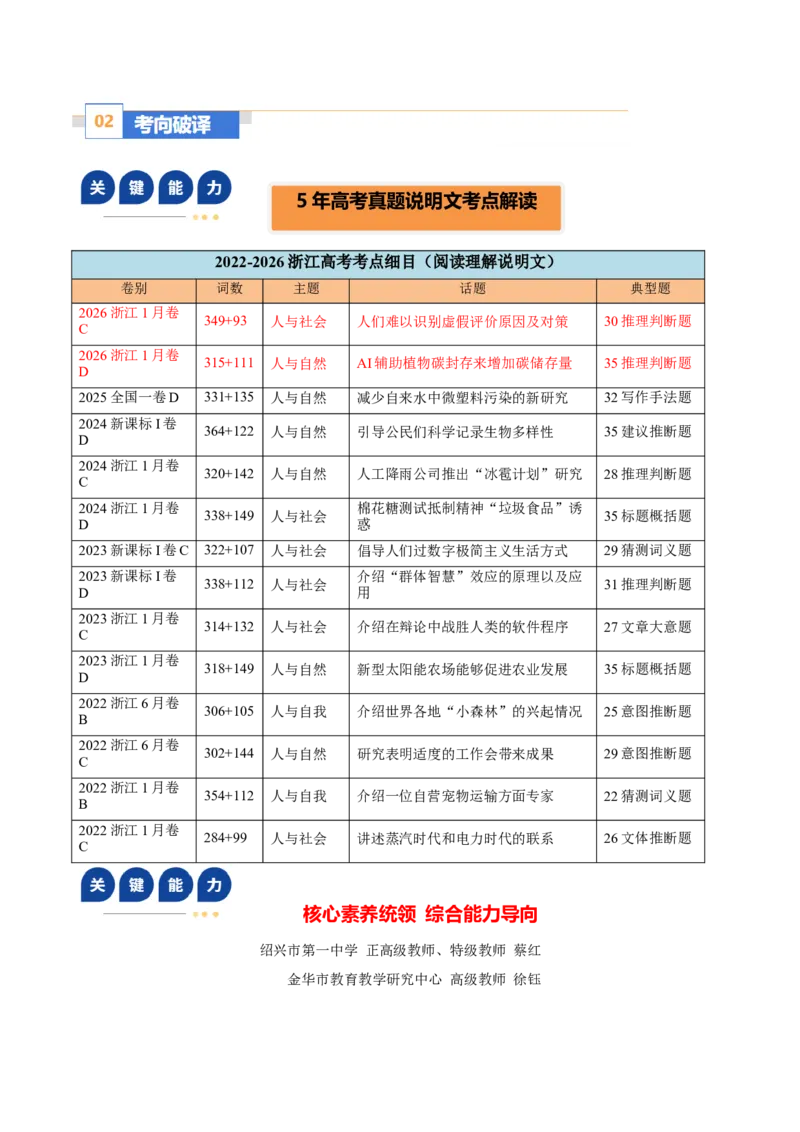
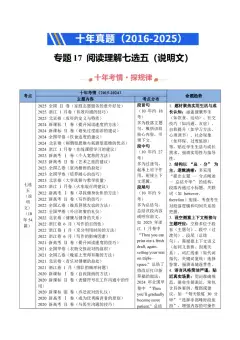
2022-2026 浙江高考考点细目(阅读理解说明文)
卷别
词数
主题
话题
典型题
2026 浙江1 月卷
C
349+93
人与社会
人们难以识别虚假评价原因及对策
30 推理判断题
2026 浙江1 月卷
D
315+111
人与自然
AI 辅助植物碳封存来增加碳储存量
35 推理判断题
2025 全国一卷D
331+135
人与自然
减少自来水中微塑料污染的新研究
32 写作手法题
2024 新课标I 卷
D
364+122
人与自然
引导公民们科学记录生物多样性
35 建议推断题
2024 浙江1 月卷
C
320+142
人与自然
人工降雨公司推出“冰雹计划”研究
28 推理判断题
2024 浙江1 月卷
D
338+149
人与社会
棉花糖测试抵制精神“垃圾食品”诱
惑
35 标题概括题
2023 新课标I 卷C
322+107
人与社会
倡导人们过数字极简主义生活方式
29 猜测词义题
2023 新课标I 卷
D
338+112
人与社会
介绍“群体智慧”效应的原理以及应
用
31 推理判断题
2023 浙江1 月卷
C
314+132
人与社会
介绍在辩论中战胜人类的软件程序
27 文章大意题
2023 浙江1 月卷
D
318+149
人与自然
新型太阳能农场能够促进农业发展
35 标题概括题
2022 浙江6 月卷
B
306+105
人与自我
介绍世界各地“小森林”的兴起情况
25 意图推断题
2022 浙江6 月卷
C
302+144
人与自然
研究表明适度的工作会带来成果
29 意图推断题
2022 浙江1 月卷
B
354+112
人与自我
介绍一位自营宠物运输方面专家
22 猜测词义题
2022 浙江1 月卷
C
284+99
人与社会
讲述蒸汽时代和电力时代的联系
26 文体推断题
       核心素养统领 综合能力导向
绍兴市第一中学 正高级教师、特级教师 蔡红
    金华市教育教学研究中心 高级教师 徐钰
5 年高考真题说明文考点解读
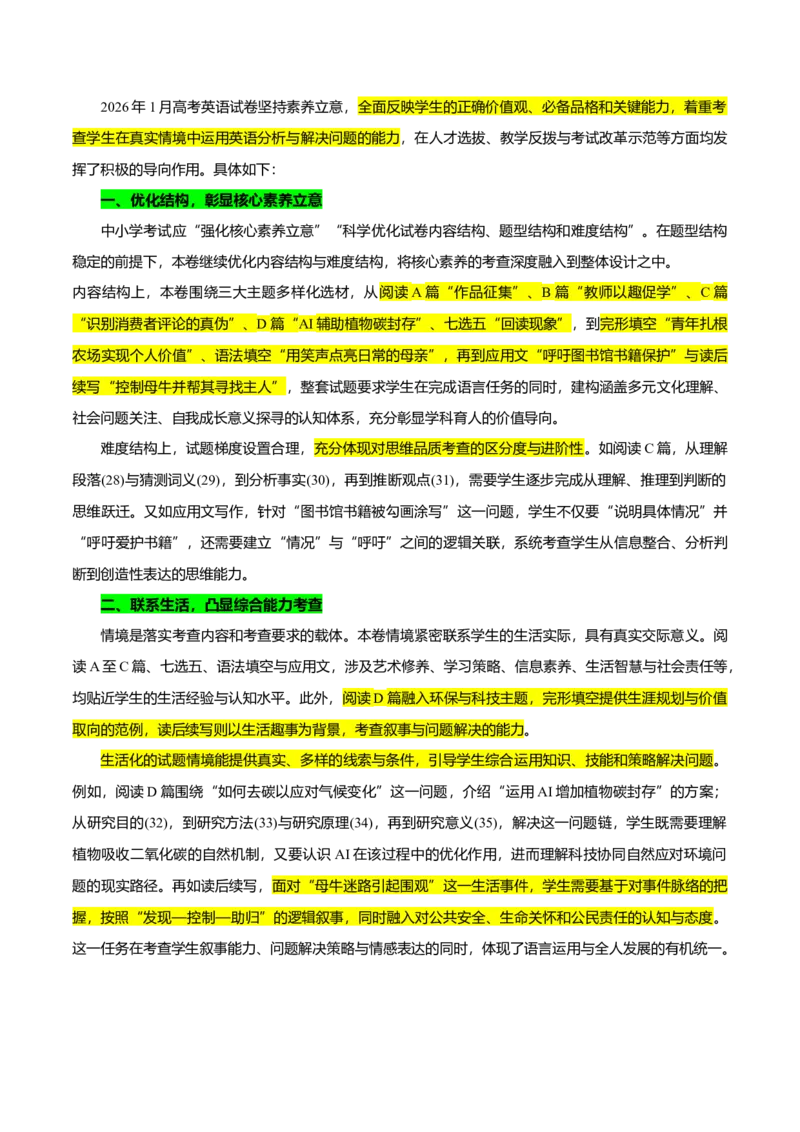
2026 年1 月高考英语试卷坚持素养立意,全面反映学生的正确价值观、必备品格和关键能力,着重考
查学生在真实情境中运用英语分析与解决问题的能力,在人才选拔、教学反拨与考试改革示范等方面均发
挥了积极的导向作用。具体如下:
一、优化结构,彰显核心素养立意
中小学考试应“强化核心素养立意”“科学优化试卷内容结构、题型结构和难度结构”。在题型结构
稳定的前提下,本卷继续优化内容结构与难度结构,将核心素养的考查深度融入到整体设计之中。
内容结构上,本卷围绕三大主题多样化选材,从阅读A 篇“作品征集”、B 篇“教师以趣促学”、C 篇
“识别消费者评论的真伪”、D 篇“AI 辅助植物碳封存”、七选五“回读现象”,到完形填空“青年扎根
农场实现个人价值”、语法填空“用笑声点亮日常的母亲”,再到应用文“呼吁图书馆书籍保护”与读后
续写“控制母牛并帮其寻找主人”,整套试题要求学生在完成语言任务的同时,建构涵盖多元文化理解、
社会问题关注、自我成长意义探寻的认知体系,充分彰显学科育人的价值导向。
难度结构上,试题梯度设置合理,充分体现对思维品质考查的区分度与进阶性。如阅读C 篇,从理解
段落(28)与猜测词义(29),到分析事实(30),再到推断观点(31),需要学生逐步完成从理解、推理到判断的
思维跃迁。又如应用文写作,针对“图书馆书籍被勾画涂写”这一问题,学生不仅要“说明具体情况”并
“呼吁爱护书籍”,还需要建立“情况”与“呼吁”之间的逻辑关联,系统考查学生从信息整合、分析判
断到创造性表达的思维能力。
二、联系生活,凸显综合能力考查
情境是落实考查内容和考查要求的载体。本卷情境紧密联系学生的生活实际,具有真实交际意义。阅
读A 至C 篇、七选五、语法填空与应用文,涉及艺术修养、学习策略、信息素养、生活智慧与社会责任等,
均贴近学生的生活经验与认知水平。此外,阅读D 篇融入环保与科技主题,完形填空提供生涯规划与价值
取向的范例,读后续写则以生活趣事为背景,考查叙事与问题解决的能力。
生活化的试题情境能提供真实、多样的线索与条件,引导学生综合运用知识、技能和策略解决问题。
例如,阅读D 篇围绕“如何去碳以应对气候变化”这一问题,介绍“运用AI 增加植物碳封存”的方案;
从研究目的(32),到研究方法(33)与研究原理(34),再到研究意义(35),解决这一问题链,学生既需要理解
植物吸收二氧化碳的自然机制,又要认识AI 在该过程中的优化作用,进而理解科技协同自然应对环境问
题的现实路径。再如读后续写,面对“母牛迷路引起围观”这一生活事件,学生需要基于对事件脉络的把
握,按照“发现—控制—助归”的逻辑叙事,同时融入对公共安全、生命关怀和公民责任的认知与态度。
这一任务在考查学生叙事能力、问题解决策略与情感表达的同时,体现了语言运用与全人发展的有机统一。
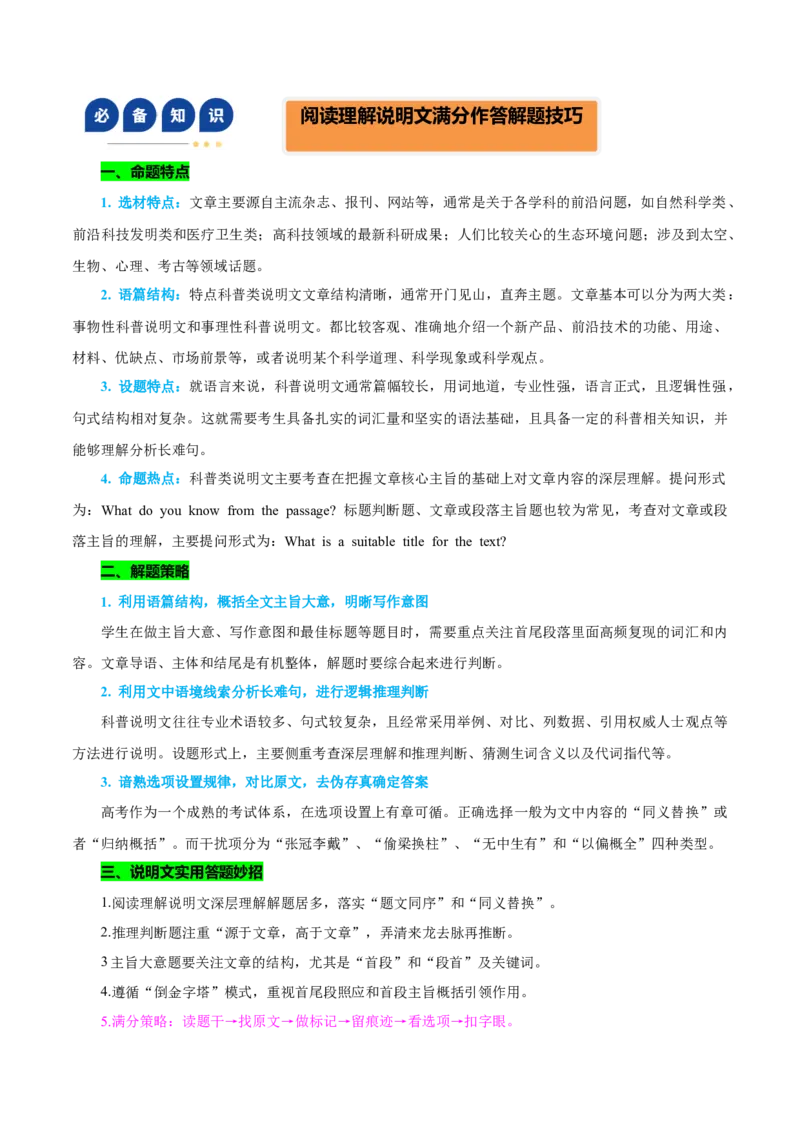
一、命题特点
1. 选材特点:文章主要源自主流杂志、报刊、网站等,通常是关于各学科的前沿问题,如自然科学类、
前沿科技发明类和医疗卫生类;高科技领域的最新科研成果;人们比较关心的生态环境问题;涉及到太空、
生物、心理、考古等领域话题。
2. 语篇结构:特点科普类说明文文章结构清晰,通常开门见山,直奔主题。文章基本可以分为两大类:
事物性科普说明文和事理性科普说明文。都比较客观、准确地介绍一个新产品、前沿技术的功能、用途、
材料、优缺点、市场前景等,或者说明某个科学道理、科学现象或科学观点。
3. 设题特点:就语言来说,科普说明文通常篇幅较长,用词地道,专业性强,语言正式,且逻辑性强,
句式结构相对复杂。这就需要考生具备扎实的词汇量和坚实的语法基础,且具备一定的科普相关知识,并
能够理解分析长难句。
4. 命题热点:科普类说明文主要考查在把握文章核心主旨的基础上对文章内容的深层理解。提问形式
为:What do you know from the passage? 标题判断题、文章或段落主旨题也较为常见,考查对文章或段
落主旨的理解,主要提问形式为:What is a suitable title for the text?
二、解题策略
1. 利用语篇结构,概括全文主旨大意,明晰写作意图
学生在做主旨大意、写作意图和最佳标题等题目时,需要重点关注首尾段落里面高频复现的词汇和内
容。文章导语、主体和结尾是有机整体,解题时要综合起来进行判断。
2. 利用文中语境线索分析长难句,进行逻辑推理判断
科普说明文往往专业术语较多、句式较复杂,且经常采用举例、对比、列数据、引用权威人士观点等
方法进行说明。设题形式上,主要侧重考查深层理解和推理判断、猜测生词含义以及代词指代等。
3. 谙熟选项设置规律,对比原文,去伪存真确定答案
高考作为一个成熟的考试体系,在选项设置上有章可循。正确选择一般为文中内容的“同义替换”或
者“归纳概括”。而干扰项分为“张冠李戴”、“偷梁换柱”、“无中生有”和“以偏概全”四种类型。
三、说明文实用答题妙招
1.阅读理解说明文深层理解解题居多,落实“题文同序”和“同义替换”。
2.推理判断题注重“源于文章,高于文章”,弄清来龙去脉再推断。
3 主旨大意题要关注文章的结构,尤其是“首段”和“段首”及关键词。
4.遵循“倒金字塔”模式,重视首尾段照应和首段主旨概括引领作用。
5.满分策略:读题干→找原文→做标记→留痕迹→看选项→扣字眼。
阅读理解说明文满分作答解题技巧
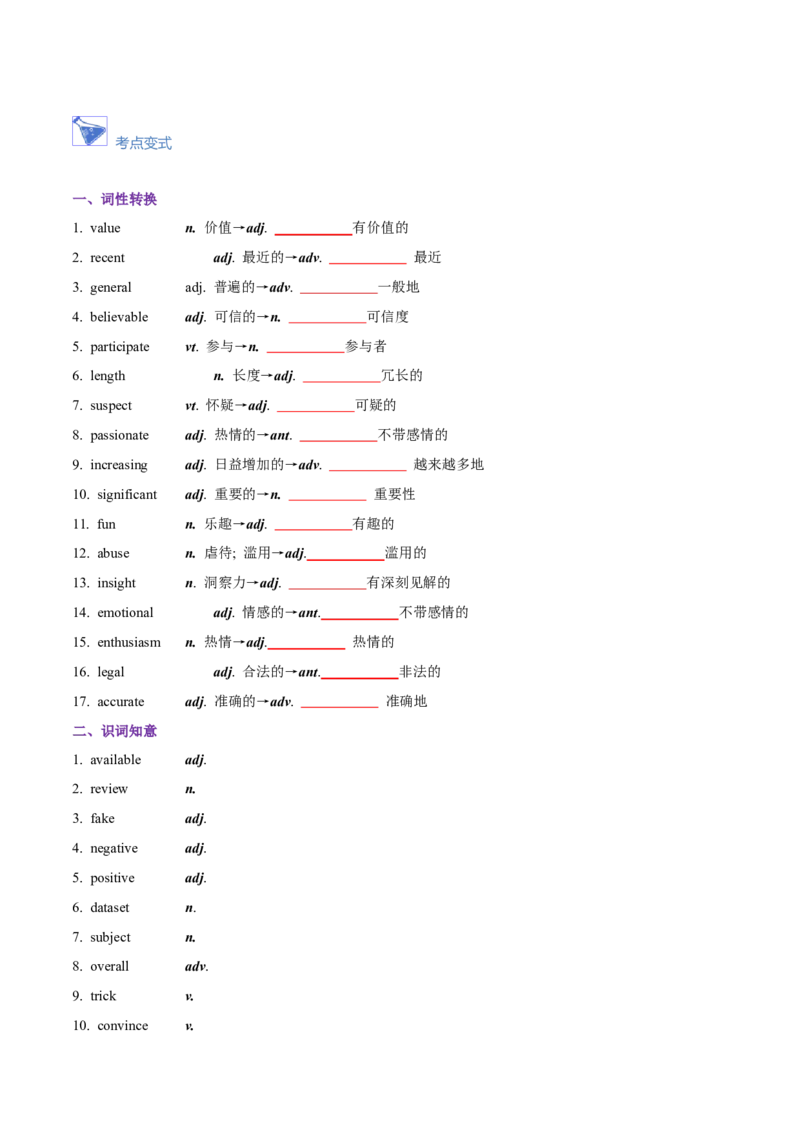
一、词性转换
1. value
n. 价值→adj.            有价值的
2. recent
adj. 最近的→adv.             最近
3. general
adj. 普遍的→adv.            一般地
4. believable
adj. 可信的→n.            可信度
5. participate
vt. 参与→n.            参与者
6. length
n. 长度→adj.            冗长的
7. suspect
vt. 怀疑→adj.            可疑的
8. passionate
adj. 热情的→ant.            不带感情的
9. increasing
adj. 日益增加的→adv.             越来越多地
10. significant
adj. 重要的→n.             重要性
11. fun
n. 乐趣→adj.            有趣的
12. abuse
n. 虐待; 滥用→adj.           滥用的
13. insight
n. 洞察力→adj.            有深刻见解的
14. emotional
adj. 情感的→ant.           不带感情的
15. enthusiasm
n. 热情→adj.            热情的
16. legal
adj. 合法的→ant.           非法的
17. accurate
adj. 准确的→adv.             准确地
二、识词知意
1. available
adj.
2. review
n.
3. fake
adj.
4. negative
adj.
5. positive
adj.
6. dataset
n.
7. subject
n.
8. overall
adv.
9. trick
v.
10. convince
v.
考点变式
11. emotion
n.
12. lack
n.
13. write-up
n.
14. algorithm
n.
15. programme
v.
16. aspect
n.
17. detect
v.
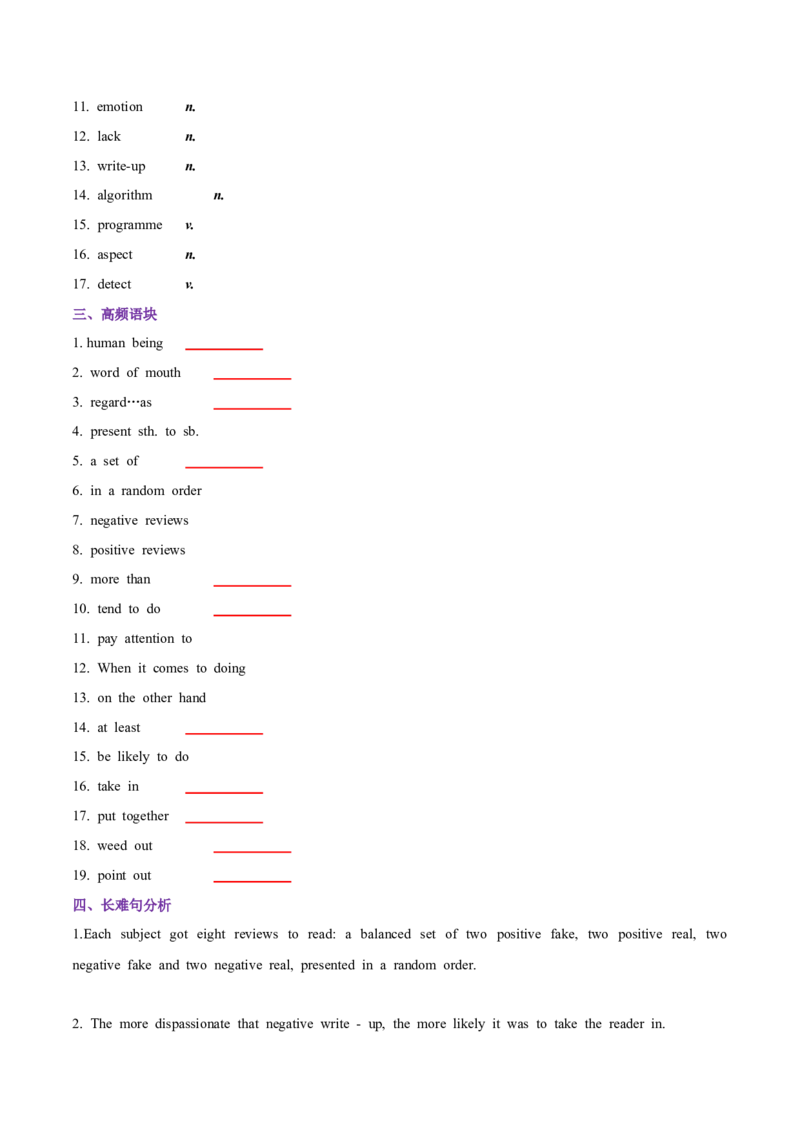
三、高频语块
1. human being

2. word of mouth

3. regard…as

4. present sth. to sb.
5. a set of

6. in a random order
7. negative reviews
8. positive reviews
9. more than

10. tend to do

11. pay attention to
12. When it comes to doing
13. on the other hand
14. at least

15. be likely to do
16. take in

17. put together
18. weed out

19. point out

四、长难句分析
1.Each subject got eight reviews to read: a balanced set of two positive fake, two positive real, two
negative fake and two negative real, presented in a random order.
2. The more dispassionate that negative write - up, the more likely it was to take the reader in.
五、知识拓展
1. 虚假评论现状:如今虚假评论在电商、旅游等多个行业泛滥成灾。据相关调查,在一些热门电商平台上,
部分商品的虚假评论比例甚至能达到30%。许多商家为提高商品销量和排名,不惜花钱购买虚假好评,而
一些竞争对手也会恶意发布虚假差评来诋毁对手。
2. AI 生成虚假评论的影响:随着AI 技术的发展,生成的虚假评论越来越逼真,使得识别难度大幅增加。
比如,AI 可以模拟不同人的语言风格、语气和表达习惯来撰写评论,甚至能根据不同产品的特点生成更具
针对性的内容。这不仅误导了消费者的购买决策,也对市场的公平竞争环境造成了严重破坏。
3.平台打击虚假评论措施:各大电商平台和在线旅游平台都在不断加强对虚假评论的打击力度。例如,亚
马逊采用先进的算法模型来监测和识别虚假评论,一旦发现会立即删除相关评论,并对违规商家进行处罚。
一些平台还建立了用户举报机制,鼓励消费者对疑似虚假评论进行举报。
4.相关法律规定:为了规范市场秩序,保护消费者权益,许多国家和地区都出台了相关法律法规来打击虚
假评论行为。在美国,联邦贸易委员会(FTC)明确规定,商家不得发布虚假或误导性的评论,否则将面
临巨额罚款。在中国,《中华人民共和国反不正当竞争法》也对虚假宣传和虚假评论等不正当竞争行为作
出了明确的处罚规定。
01【2025 浙江1 月卷】
A novel design approach to gardening has been gaining in popularity worldwide. Referred to as matrix
planting, this approach aims for nature to do a lot more of the heavy lifting in the garden, and even some of the
designing. Eschewing fertilizers (化肥) and power tools, it’s based on an elegantly simple principle: to garden
more like nature does.
The concept was born when German city planners sought to plant large areas of parkland after World War II in
a reproducible way that would need minimal maintenance. Planners created planting mixes that could be used
modularly (模块化). In a matrix garden, plants with similar cultural needs are grouped so that they will grow
典例引领
together above and below ground, forming a cooperative ecosystem that conserves water and discourages weeds.
Dutch plantsman and designer Piet Oudolf’s gardens popularized this style, adding artistic flavors to the
planting mixes while playing with color and form, including four-season interest and serving the needs of wildlife.
Beautiful year-round, they invite you to enjoy the smallest detail, from the sound of grasses in the gentle wind to
the sculpture of odd-looking seed heads.
It takes a lot of thought to look this natural. While matrix gardens appear wild, they are carefully planned, with
cultural needs the first consideration. Led by the concept of “right plant, right place,” they match plants that enjoy
the same soil, sun and weather conditions, and arrange them according to their patterns of growth.
The benefits are substantial for both gardener and planet. With human inputs dramatically reduced, the
garden’s ecology can develop well. Established matrix gardens should not need the life support we give most
gardens: fertilizer, dividing, regular watering. Compared to traditional garden plots, they increase carbon
absorption, reduce storm water runoff and boost habitat and biodiversity significantly.
28. What does the underlined word “Eschewing” in the first paragraph mean?
A. Running out of.
B. Keeping away from.
C. Putting up with.
D. Taking advantage of.
29. Why was the idea of matrix planting introduced?
A. To control weeds in large gardens.
B. To bring in foreign species of plants.
C. To conserve soil and water resources.
D. To develop low-maintenance parkland.
30. Which of the following best describes Piet Oudolf’s gardens?
A. Traditional.
B. Odd-looking.
C. Tasteful.
D. Well-protected.
31. Which of the following can be a suitable title for the text?
A. The future of gardening is WILD
B. Nature treats all lives as EQUALS
C. Matrix gardens need more CARE
D. Old garden plots work WONDERS
02【2024 浙江1 月卷】
On September 7, 1991, the costliest hailstorm (花暴) in Canadian history hit Calgary’s southern suburbs. As a
result, since 1996 a group of insurance companies have spent about $2million per year on the Alberta Hail
Suppression Project. Airplanes seed threatening storm cells with a chemical to make small ice crystals fall as rain
before they can grow into dangerous hailstones. But farmers in east-central Alberta — downwind of the hail project
flights — worry that precious moisture (水分) is being stolen from their thirsty land by the cloud seeding.
Norman Stienwand, who farms in that area, has been addressing public meetings on this issue for years
“Basically, the provincial government is letting the insurance companies protect the Calgary-Edmonton urban area
from hail,” Mr. Stienwan d says, “but they’re increasing drought risk as far east as Saskatchewan.”
The Alberta hail project is managed by Terry Krauss, a cloud physicist who works for Weather Modification
Inc. of Fargo, North Dakota. “We affect only a very small percentage of the total moisture in the air, so we cannot
be cousing drought.” Dr. Krauss says. “In fact, we may be helping increase the moisture downwind by creating
wetter ground.”
One doubter about the safety of cloud seeding is Chuck Doswell, a research scientist who just retired from the
University of Oklahoma. “In 1999, I personally saw significant tornadoes (龙卷风) form from a seeded storm cell
in Kansas,” Dr. Doswell says. “Does cloud seeding create killer storms or reduce moisture downwind? No one
really knows, of course, but the seeding goes on.”
Given the degree of doubt, Mr. Stienwand suggests, “it would be wise to stop cloud seeding.” In practice,
doubt has had the opposite effect. Due to the lack of scientific proof concerning their impacts, no one has succeeded
in winning a lawsuit against cloud-seeding companies. Hence, private climate engineering can proceed in relative
legal safety.
28. What does the project aim to do?
A. Conserve moisture in the soil.
B. Prevent the formation of hailstones.
C. Forecast disastrous hailstorms.
D. Investigate chemical use in farming.
29. Who are opposed to the project?
A. Farmers in east-central Alberta.
B. Managers of insurance companies.
C. Provincial government officials.
D. Residents of Calgary and Edmonton
30. Why does Dr. Doswell mention the tornadoes he saw in 1999?
A. To compare different kinds of seeding methods.
B. To illustrate the development of big hailstorms.
C. To indicate a possible danger of cloud seeding.
D. To show the link between storms and moisture.
31. What can we infer from the last paragraph?
A. Scientific studies have proved Stienwand right.
B. Private climate engineering is illegal in Canada.
C. The doubt about cloud seeding has disappeared.
D. Cloud-seeding companies will continue to exist.
03【2023 浙江1 月卷】
The Stanford marshmallow (棉花糖) test was originally conducted by psychologist Walter Mischel in the late
1960s. Children aged four to six at a nursery school were placed in a room. A single sugary treat, selected by the
child, was placed on a table. Each child was told if they waited for 15 minutes before eating the treat, they would be
given a second treat. Then they were left alone in the room. Follow-up studies with the children later in life showed
a connect ion between an ability to wait long enough to obtain a second treat and various forms of success.
As adults we face a version of the marshmallow test every day. We’ re not tempted (诱惑) by sugary treats, but
by our computers, phones, and tablets — all the devices that connect us to the global delivery system for various
types of information that do to us what marshmallows do to preschoolers.
We are tempted by sugary treats because our ancestors lived in a calorie-poor world, and our brains developed
a response mechanism to these treats that reflected their value — a feeling of reward and satisfaction. But as we’ve
reshaped the world around us, dramatically reducing the cost and effort involved in obtaining calories, we still have
the same brains we had thousands of years ago, and this mismatch is at the heart of why so many of us struggle to
resist tempting foods that we know we shouldn’t eat.
A similar process is at work in our response to information. Our formative environment as a species was
information-poor, so our brains developed a mechanism that prized new information. But global connectivity has
greatly changed our information environment. We are now ceaselessly bombarded (轰炸) with new information.
Therefore, just as we need to be more thoughtful about our caloric consumption, we also need to be more
thoughtful about our information consumption, resisting the temptation of the mental “junk food” in order to
manage our time most effectively.
32. What did the children need to do to get a second treat in Mischel’s test?
A. Take an examination alone.
B. Show respect for the researchers.
C. Share their treats with others.
D. Delay eating for fifteen minutes.
33. According to paragraph 3, there is a mismatch between ___________.
A. the calorie-poor world and our good appetites
B. the shortage of sugar and our nutritional needs
C. the rich food supply and our unchanged brains
D. the tempting foods and our efforts to keep fit
34. What does the author suggest readers do?
A. Absorb new information readily.
B. Be selective information consumers.
C. Use diverse information sources.
D. Protect the information environment.
35. Which of the following is the best title for the text?
A. Eat Less, Read More
B. The Bitter Truth about Early Humans
C. The Later, the Better
D. The Marshmallow Test for Grownups
变式一、社会评论类说明文3 篇
01(2024·山东菏泽·一模)As people hold different views on almost anything, we live in a judgmental
world where people are quick to point out the faults and imperfections of others, yet seem unaware of their own.
Some misguided souls believe they have a duty to help you to be a better person by telling you what a failure you
really are first and then offering suggestions as to how you can improve.
So what is the possible solution to criticism?
If you are the one forcing others to feel ashamed of themselves, STOP. Make a conscious decision rather
than focus on the negative aspect of a person’s performance or attitudes. You are more likely to offer helpful
suggestions from the beginning. If you are on the receiving end of criticism, the “OK” response is a perfect
solution. When someone comments negatively on a task you are doing or a personality issue of yours, a natural
response is to defend and attack. However, this approach is rarely effective as it puts both parties on the defensive.
Instead, simply reply with “OK”. This brief one-word response acknowledges the other person’s comment without
agreeing with it or feeling necessary to engage in a debate about it.
It is important to remain emotionally attached to what the other person is saying, to listen without feeling, to
be an objective observer. In fact, there is much that one can learn from a negative review. You can ask yourself: Did
I make a mistake? Could I have done better? Did I give 100% of myself to the task at hand? If so, how can I
improve myself? As for chronic(习惯性的) criticizers: It is important to set strict boundary with them. Remove
yourself from their presence when necessary.
In any case, one can learn to be “OK” with criticism and not allow it to negatively impact your life or
relationship with the other party.
1.What may the author think of people who prefer to judge others?
A.Warm-hearted.
B.Self-centered.
C.Talkative.
D.Responsible.
变式演练
2.What does a person probably convey by saying “OK” according to paragraph 3?
A.He thinks the suggestions are helpful.
B.He defenses himself with the response.
C.He agrees with the comments completely.
D.He wants to avoid unnecessary arguments.
3.What is the key to making an objective observer according to paragraph 4?
A.Having debates.
B.Accepting criticism.
C.Keeping calm.
D.Avoiding criticizers.
4.What is the purpose of the text?
A.To make a judgment on others.
B.To explain some social behavior.
C.To call for action against attack.
D.To give advice on facing criticism.
02(25-26 高二上·江西·月考)The Internet is filled with fake (虚假的) reviews, and the rise of generative
AI tools like ChatGPT has made the problem even more serious. According to watchdog organizations and
researchers, these tools allow fraudsters to produce false reviews quickly and in large volumes. Although writing or
selling fake reviews is illegal in the U.S., the practice remains common, especially during holiday seasons when
shoppers rely heavily on reviews.
Fake reviews appear across many industries, including e-commerce, restaurants, medical care, and home
services. Since mid-2023, AI-produced reviews have become widespread across various platforms. One tech
company reported that nearly 14% of reviews in certain service sectors are likely fake, with millions being partly or
fully AI-produced. Some apps even use AI reviews to trick users into downloading harmful software. The Federal
Trade Commission has even taken legal action against companies offering AI tools that help create fake content.
Major platforms like Amazon and Yelp are also affected. AI-created reviews often rise to the top because they are
detailed and seem trustworthy. Some users post AI-written reviews to earn special status, like Yelp’s “Elite” badge,
which makes their accounts appear more reliable.
Companies are taking action. Amazon and Trustpilot allow AI-assisted reviews only if they reflect real
experiences. Yelp requires users to write their own reviews. Many platforms use algorithms ( 算法) and
investigative teams to spot and remove fake content. Industry groups are also working together to improve
screening systems and share best practices.
It’s important to note that not all AI-produced reviews are fake. Some people use AI to help say what they
really think, especially non-native English speakers. Experts suggest that platforms should focus on stopping bad
actors rather than preventing proper uses of AI.
To spot fake AI reviews, consumers should watch for overly emotional language, repetitive terms, and
nonspecific phrases. AI-written texts are often longer, highly structured, and contain overused expressions like
“game-changer”. Although it’s becoming harder to tell them apart from human-written reviews, being aware of
these signs can help consumers make more informed decisions.
1.What does the underlined word “fraudsters” in paragraph 1 probably mean?
A.Real review writers.
B.Fake review creators.
C.Platform operators.
D.Review researchers.
2.How do many platforms manage user reviews according to the text?
A.By removing bad reviews.
B.By keeping all of them.
C.By checking them carefully.
D.By encouraging more AI reviews.
3.Why do non-native English speakers use AI to produce reviews?
A.To improve their writing skills.
B.To express their opinions better.
C.To make their accounts reliable.
D.To avoid writing detailed reviews.
4.What can be inferred from the text?
A.All AI reviews cheat consumers.
B.Offering users fake AI tools is lawful.
C.Fake reviews are legal during U.S. holidays.
D.Stopping fake reviews entirely is difficult.
03 (24-25 高二下·四川广元·期末)This February, ecologist Poisot was surprised when he read through
the peer reviews (同行评议) of a manuscript (原稿) he had submitted for publication. One of the referee reports
seemed to have been written with, or perhaps entirely by, artificial intelligence (AI). It contained a strong indication
that the text was created by large language models (LLMs).
AI is increasingly being used in the peer review process of scientific papers, which involves experts
evaluation to ensure they meet quality standards before they are published. This trend raises both interest and
concerns among researchers and publishers.
AI systems are already transforming peer review. They are now being used to check errors in the text, data,
code and references of manuscripts, to guide reviewers toward more-constructive feedback, and to polish their
manuscripts. Some new websites even offer entire AI-created review s with one click, claiming to assess a paper’s
quality and originality. One study of peer-review reports in 2024 found that between 7% and 17% of these reports
showed evidence of changes beyond spell-checking or minor updates to the text by LLMs.
However, there are concerns about the reliability of AI in understanding complex scientific concepts and
making accurate judgments. Critics argue that AI might not fully grasp the slight difference of scientific research
and could lead to misleading conclusions. There is also a fear that AI could replace human reviewers, who can
provide more insightful feedback.
Despite these concerns, many researchers believe AI can be a useful tool. It can help speed up the review
process and reduce the workload on reviewers. AI can also identify potential issues that might be overlooked by
human reviewers, allowing human reviewers to focus on more complex aspects of the review.
1.Why does the author mention Poisot’s experience in paragraph 1?
A.To present an argument.
B.To introduce the topic.
C.To criticize the overuse of AI.
D.To compare various AI tools.
2.What is AI currently used for in peer review?
A.Checking errors of manuscripts.
B.Replacing human reviewers.
C.Guiding detailed steps for study.
D.Assessing the peer reviews.
3.What’s the author’s attitude to AI in peer review?
A.Subjective.
B.Objective.
C.Approving.
D.Critical.
4.Which would be the best title for the passage?
A.Will AI Take over Peer Review?
B.Is AI Review Faster and Cheaper?
C.Can AI Understand Complex Concept?
D.Do Scientists Fully Rely on AI Review?
变式二、段落大意类说明文3 篇
01(25-26 高三上·湖南长沙·月考)It is widely acknowledged that crows are highly intelligent with
cognitive abilities similar to those of 5-to 7-year-old children. Past research shows that they can count to four and
distinguish human voices and faces, and some species can even create tools for future use. Lately, a special study
has expanded this list further, revealing that crows can recognize basic geometric features, such as side lengths,
parallel lines, and right angles, and tell apart shapes like stars, crescents, squares, and irregular four-sided figures.
With the purpose of testing the crows’ geometric skills, scientists showed two crows six shapes on a digital
screen and trained them to peck (啄) at the outlier—the shape that looked different from the rest. When the birds
chose correctly, they were rewarded with a tasty snack. At first, the researchers made the outlier obvious, such as
one flower among five crescents. As the birds got used to the task, the shapes became more similar including
squares and irregular four- sided figures. Despite the increasing difficulty, the crows continued to identify the
outlier correctly.
The shape recognition ability of crows remains a topic of interest for researchers. They suspect this ability
may help them with navigation as they fly around. The birds may have also developed this ability to help them
search for food or identify other individual crows — including potential mates — based on their facial features.
“All these abilities, at the end of the day, from a biological point of view, have evolved because they provide a
survival advantage or a reproductive advantage,” says study senior author Andreas Nieder, a neurophysiologist at
the University of Tübingen in Germany.
In the future, researchers hope to explore which areas of the birds’ brains are responsible for their
exceptional ability in geometry. Birds don’t have a cerebral cortex (大脑皮层)—at least, not in the same way that
humans do. But for us, that part of the brain is responsible for thinking and other complex functions. Crows still
have these abilities, so the researchers assume there must be something else going on inside their heads.
“Obviously, evolution found two different ways of giving rise to behaviorally flexible animals,” Nieder says.
1.What does the recent study reveal about crows?
A.They can draw simple figures with tools.
B.They can distinguish between basic shapes in geometry.
C.They can do easy math calculations.
D.They can recognize human voices and faces.
2.How did the researchers increase the difficulty of the shape- recognition task?
A.By shortening the time for the crows to respond.
B.By presenting more familiar shapes on the screen.
C.By showing the figures with different colors.
D.By enhancing the similarity among the shapes.
3.What is paragraph 3 mainly about?
A.The role of crows’ geometric potential in navigation.
B.Reasons for crows to evolve shape identification abilities.
C.Survival benefits of crows’ cognitive talents.
D.The advantages of crows’ food-searching skills over other birds.
4.What is the follow-up step for future study?
A.Investigating crows’ brain areas related to geometric skills.
B.Comparing the cerebral cortex of humans and crows.
C.Exploring other complex functions of crows’ brains.
D.Studying the causes of crows’ flexible behaviors.
02(25-26 高三上·江苏苏州·月考)Driverless taxis have turned from science fiction into daily reality in
San Francisco and Shenzhen. Between April and June, Waymo completed 2.2 million autonomous trips in
California — five times more than in 2024. Baidu delivered the same number across 16 Chinese cities, doubling its
previous figures. These figures show a big change in city transport, promising safer roads and less traffic.
But this future is limited to a few places. In most Western countries, rules block self-driving taxi services.
This creates a sharp split between cities that welcome innovation and those stuck with old transport systems.
The rules create two main problems. First, they slow down technical progress. American companies must get
permission from the National Highway Traffic Safety Administration to build cars without pedals or steering
wheels — parts humans don’t need when AI drives. The NHTSA also limits each company to only 2,500 such cars
per year, blocking the large-scale rollout. Second, local laws directly stop robotaxi services. New York’s Taxi
Commission bans autonomous vehicles from paid services. Boston lawmakers want a human safety operator in
every car. In Europe, only a few countries allow testing.
These cautious policies come from two fears: robotaxi might crash into people or cars and take away drivers’
jobs. Neither reason stands up to closer inspection.
On safety, early data tells a different story. A study shows Waymo produces 88% fewer property- damage
claims and 92% fewer injury claims than human drivers. While other companies need to prove similar results and
testing remains limited to simpler cities, the numbers clearly point to safer roads. The job-loss argument also fails.
While driver replacement worries are politically powerful — causing officials to set strict safety standards under
protest pressure — the public interest must come first. In San Francisco, robotaxis mainly replace private cars, not
traditional taxis. Demand for human-driven cabs has stayed steady as they remain more available during busy
times, showing the two services complement rather than replace each other.
Even with smart regulation, profit challenges remain. Each Waymo car costs $150,000 with its sensors and
software. Mapping and testing may be too expensive for small European cities. Still, removing regulatory barriers
would let companies expand, improve technology, and cut costs — benefiting consumers who want safer city
transport.
5.What can be inferred from the data in paragraph 1?
A.Baidu serves more cities than Waymo.
B.Robotaxi technology is enjoying vigorous growth.
C.Robotaxis dominate urban transport in the US and China.
D.Waymo’s annual growth rate is five times that of Baidu’s.
6.What is paragraph 3 mainly about?
A.Background details on robotaxi services. B.Future trends in transportation regulation.
C.Specific obstacles from relevant regulations.
D.Comparisons of different robotaxi companies.
7.What does the underlined word “complement” in paragraph 5 mean?
A.supplement.
B.Resemble.
C.Conflict.
D.Substitute.
8.What is the author’s attitude towards the development of robotaxi services?
A.Favorable.
B.Critical.
C.Doubtful.
D.Unbiased.
03(25-26 高三上·广东·月考)A dog acting aggressively (攻击性地)at the park and a student dealing with
low mood while doing well in school may seem unrelated, but new research says they could share similar genetic
roots. Scientists studied over 1,000 golden retrievers, a kind of dog, and found that many genes influencing dog
behavior also shape human personality, intelligence, and emotional health. Published in a leading science journal,
this finding challenges simple ideas about what drives behavior in both species.
Golden retrievers that did well in training had special versions of genes called ROMO1 and ADGRL2. In
humans, ROMO1 is linked to intelligence and how well people learn and think, while ADGRL2 is linked to
emotional sensitivity and getting annoyed easily. This means trainable dogs might be smarter and more emotionally
aware, not just more willing to follow orders. This matters for programs that train service dogs. Many rely heavily
on food rewards to shape behavior. But if trainability is really about problem-solving ability, programs might be
better off selecting dogs based on cognitive (认知)tests rather than just how eagerly they go after treats.
The strongest genetic similarities were in fear-related behaviors. Dogs afraid of loud noises, strangers, or
other dogs had variants ( 变体)in genes like ACC3 and PRDX1. In humans, these genes are tied to anxiety,
depression, and mood changes. This shows a dog hiding during a thunderstorm might feel something close to
human anxiety. Owners of such dogs may need more than just training — changing their environment to reduce
stress or even medication in serious cases could help.
Of course, genes don’t determine everything. Training, early life experiences, and environment still play big
roles. The research relied on owner-reported questionnaires rather than direct observation of dog behavior, which
introduces subjectivity in how owners perceive their pets. Environmental factors like training methods, household
dynamics, and life experiences varied widely and could influence behavior. The study included only golden
retrievers aged 3 to 7 years, so results may not apply to other dogs.
9.What did scientists find about dogs and humans?
A.They shape their actions by training.
B.Their origins in intelligence are identical.
C.They don’t have the same emotional genes.
D.Their behaviors have similar genetic roots.
10.What characteristics do trainable dogs have?
A.They lack fear in training.
B.They are desperate for treats.
C.They have sharp emotional perception. D.They are unwilling to follow orders.
11.How should owners treat their fearful dogs?
A.Punish their fearful behaviors.
B.Increase their treat rewards.
C.Adjust their living environment.
D.Focus mainly on training.
12.What is the last paragraph mainly about?
A.Major limitations of the study.
B.Suggestions for studies on humans.
C.Explanations of the research method.
D.Possible reasons for the study findings.