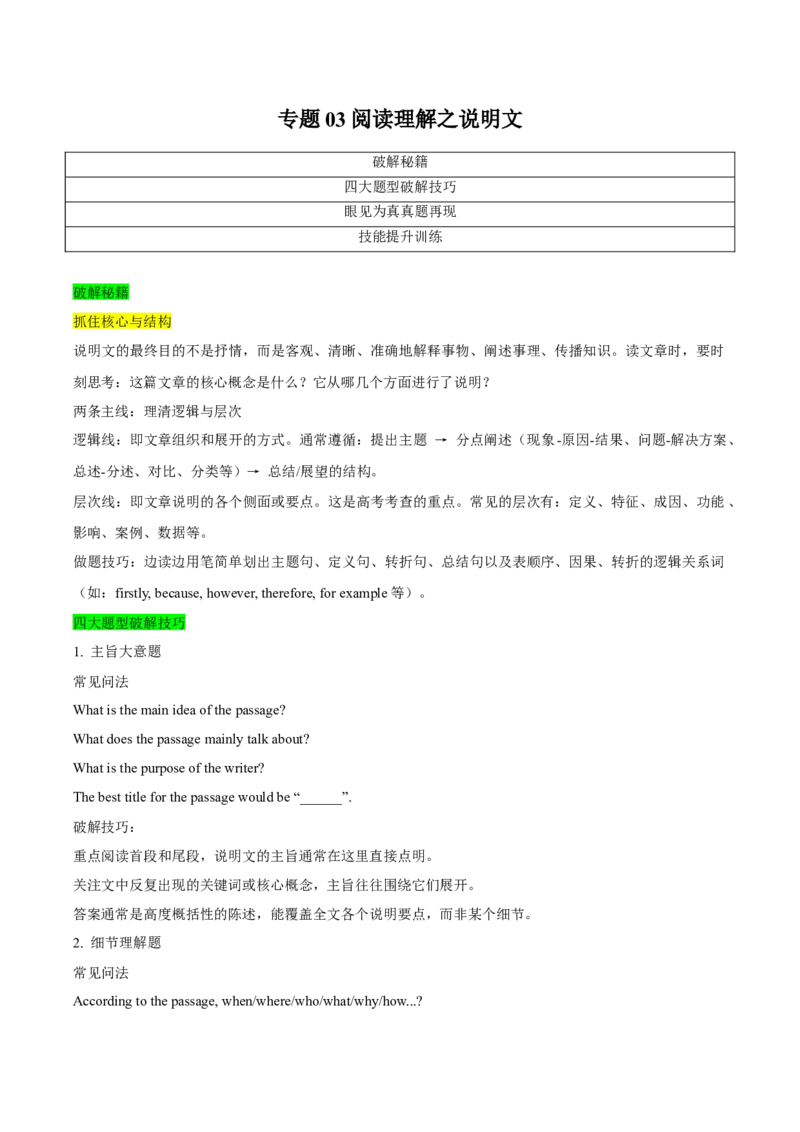
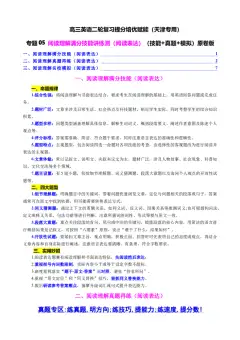
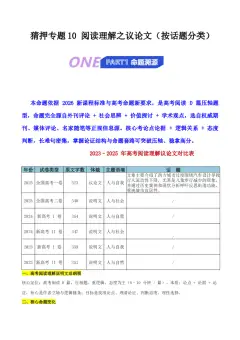
专题03 阅读理解之说明文
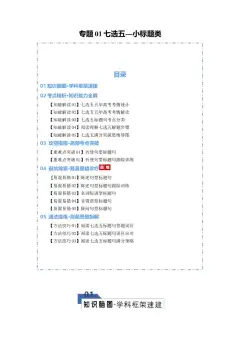
破解秘籍
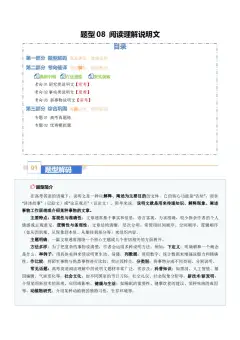
四大题型破解技巧
眼见为真真题再现
技能提升训练
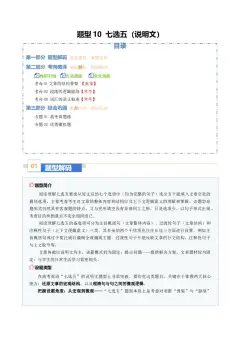
破解秘籍
抓住核心与结构
说明文的最终目的不是抒情,而是客观、清晰、准确地解释事物、阐述事理、传播知识。读文章时,要时
刻思考:这篇文章的核心概念是什么?它从哪几个方面进行了说明?
两条主线:理清逻辑与层次
逻辑线:即文章组织和展开的方式。通常遵循:提出主题 → 分点阐述(现象-原因-结果、问题-解决方案、
总述-分述、对比、分类等)→ 总结/展望的结构。
层次线:即文章说明的各个侧面或要点。这是高考考查的重点。常见的层次有:定义、特征、成因、功能、
影响、案例、数据等。
做题技巧:边读边用笔简单划出主题句、定义句、转折句、总结句以及表顺序、因果、转折的逻辑关系词
(如:firstly, because, however, therefore, for example 等)。
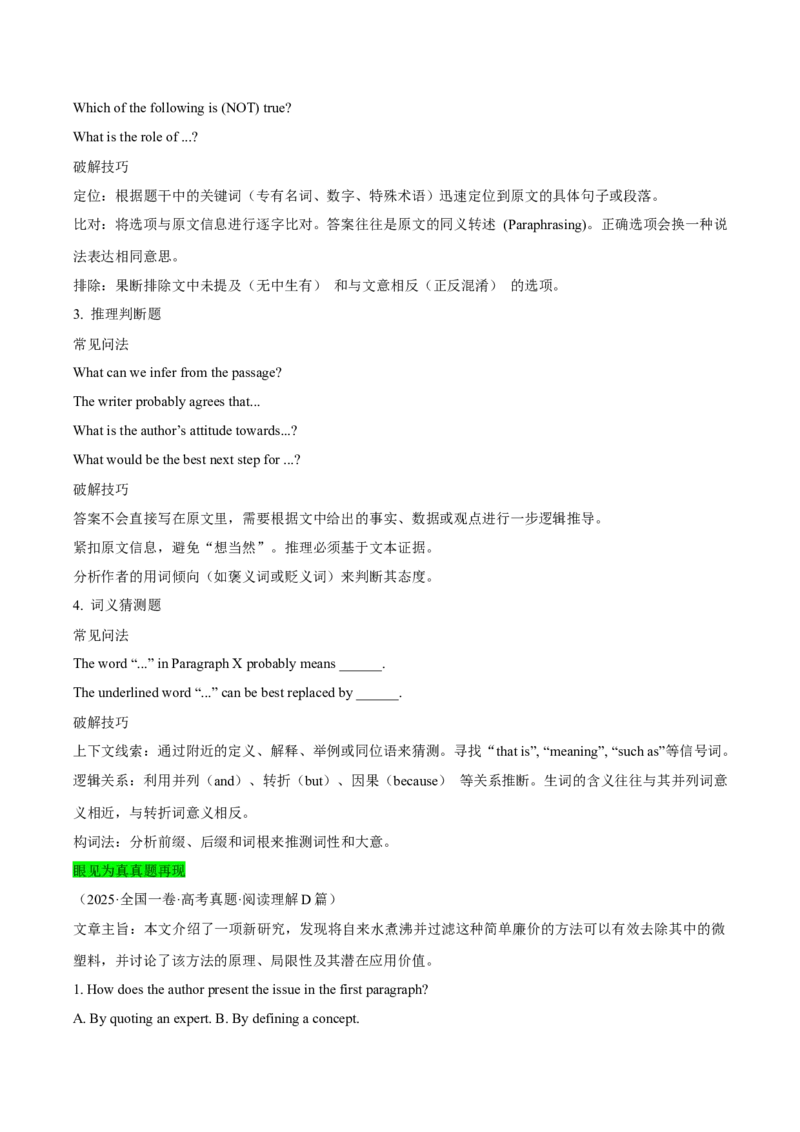
四大题型破解技巧
1. 主旨大意题
常见问法
What is the main idea of the passage?
What does the passage mainly talk about?
What is the purpose of the writer?
The best title for the passage would be “______”.
破解技巧:
重点阅读首段和尾段,说明文的主旨通常在这里直接点明。
关注文中反复出现的关键词或核心概念,主旨往往围绕它们展开。
答案通常是高度概括性的陈述,能覆盖全文各个说明要点,而非某个细节。
2. 细节理解题
常见问法
According to the passage, when/where/who/what/why/how...?
Which of the following is (NOT) true?
What is the role of ...?
破解技巧
定位:根据题干中的关键词(专有名词、数字、特殊术语)迅速定位到原文的具体句子或段落。
比对:将选项与原文信息进行逐字比对。答案往往是原文的同义转述 (Paraphrasing)。正确选项会换一种说
法表达相同意思。
排除:果断排除文中未提及(无中生有) 和与文意相反(正反混淆) 的选项。
3. 推理判断题
常见问法
What can we infer from the passage?
The writer probably agrees that...
What is the author’s attitude towards...?
What would be the best next step for ...?
破解技巧
答案不会直接写在原文里,需要根据文中给出的事实、数据或观点进行一步逻辑推导。
紧扣原文信息,避免“想当然”。推理必须基于文本证据。
分析作者的用词倾向(如褒义词或贬义词)来判断其态度。
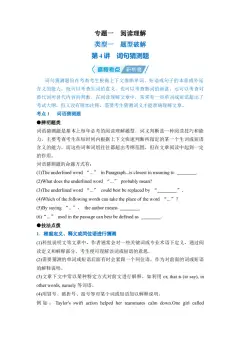
4. 词义猜测题
常见问法
The word “...” in Paragraph X probably means ______.
The underlined word “...” can be best replaced by ______.
破解技巧
上下文线索:通过附近的定义、解释、举例或同位语来猜测。寻找“that is”, “meaning”, “such as”等信号词。
逻辑关系:利用并列(and)、转折(but)、因果(because) 等关系推断。生词的含义往往与其并列词意
义相近,与转折词意义相反。
构词法:分析前缀、后缀和词根来推测词性和大意。
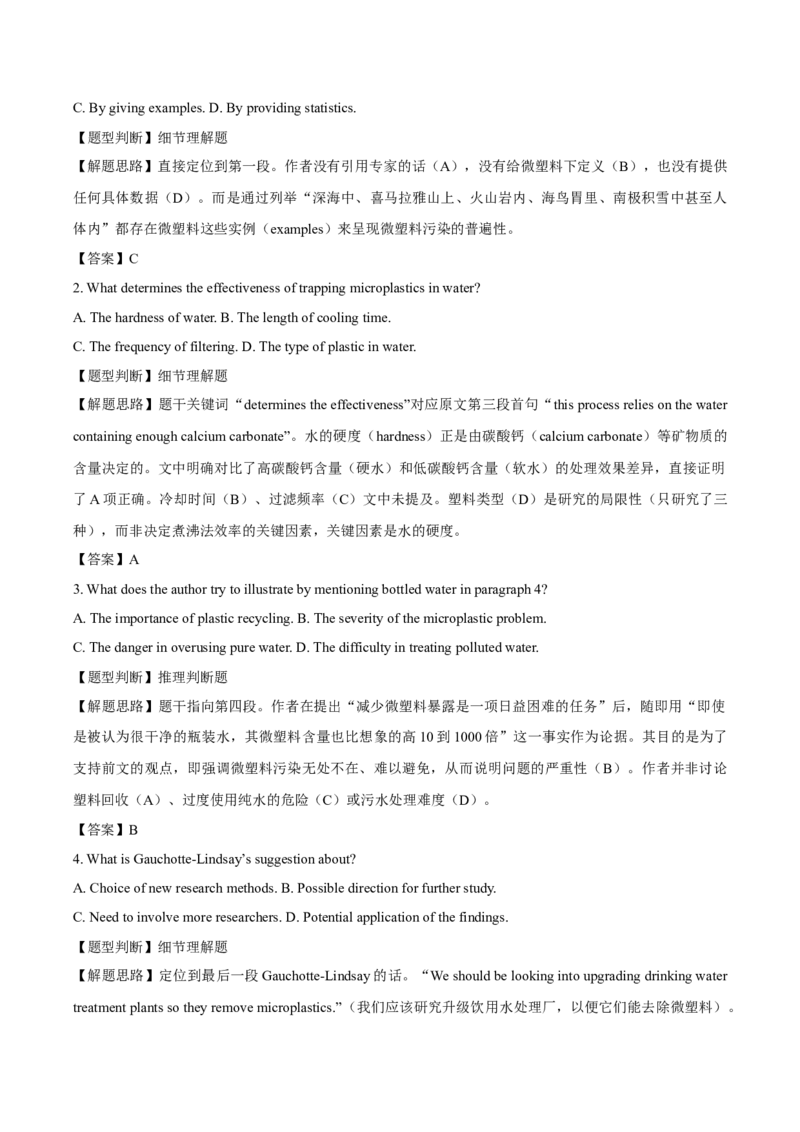
眼见为真真题再现
(2025·全国一卷·高考真题·阅读理解D 篇)
文章主旨:本文介绍了一项新研究,发现将自来水煮沸并过滤这种简单廉价的方法可以有效去除其中的微
塑料,并讨论了该方法的原理、局限性及其潜在应用价值。
1. How does the author present the issue in the first paragraph?
A. By quoting an expert. B. By defining a concept.
C. By giving examples. D. By providing statistics.
【题型判断】细节理解题
【解题思路】直接定位到第一段。作者没有引用专家的话(A),没有给微塑料下定义(B),也没有提供
任何具体数据(D)。而是通过列举“深海中、喜马拉雅山上、火山岩内、海鸟胃里、南极积雪中甚至人
体内”都存在微塑料这些实例(examples)来呈现微塑料污染的普遍性。
【答案】C
2. What determines the effectiveness of trapping microplastics in water?
A. The hardness of water. B. The length of cooling time.
C. The frequency of filtering. D. The type of plastic in water.
【题型判断】细节理解题
【解题思路】题干关键词“determines the effectiveness”对应原文第三段首句“this process relies on the water
containing enough calcium carbonate”。水的硬度(hardness)正是由碳酸钙(calcium carbonate)等矿物质的
含量决定的。文中明确对比了高碳酸钙含量(硬水)和低碳酸钙含量(软水)的处理效果差异,直接证明
了A 项正确。冷却时间(B)、过滤频率(C)文中未提及。塑料类型(D)是研究的局限性(只研究了三
种),而非决定煮沸法效率的关键因素,关键因素是水的硬度。
【答案】A
3. What does the author try to illustrate by mentioning bottled water in paragraph 4?
A. The importance of plastic recycling. B. The severity of the microplastic problem.
C. The danger in overusing pure water. D. The difficulty in treating polluted water.
【题型判断】推理判断题
【解题思路】题干指向第四段。作者在提出“减少微塑料暴露是一项日益困难的任务”后,随即用“即使
是被认为很干净的瓶装水,其微塑料含量也比想象的高10 到1000 倍”这一事实作为论据。其目的是为了
支持前文的观点,即强调微塑料污染无处不在、难以避免,从而说明问题的严重性(B)。作者并非讨论
塑料回收(A)、过度使用纯水的危险(C)或污水处理难度(D)。
【答案】B
4. What is Gauchotte-Lindsay’s suggestion about?
A. Choice of new research methods. B. Possible direction for further study.
C. Need to involve more researchers. D. Potential application of the findings.
【题型判断】细节理解题
【解题思路】定位到最后一段Gauchotte-Lindsay 的话。“We should be looking into upgrading drinking water
treatment plants so they remove microplastics.”(我们应该研究升级饮用水处理厂,以便它们能去除微塑料)。
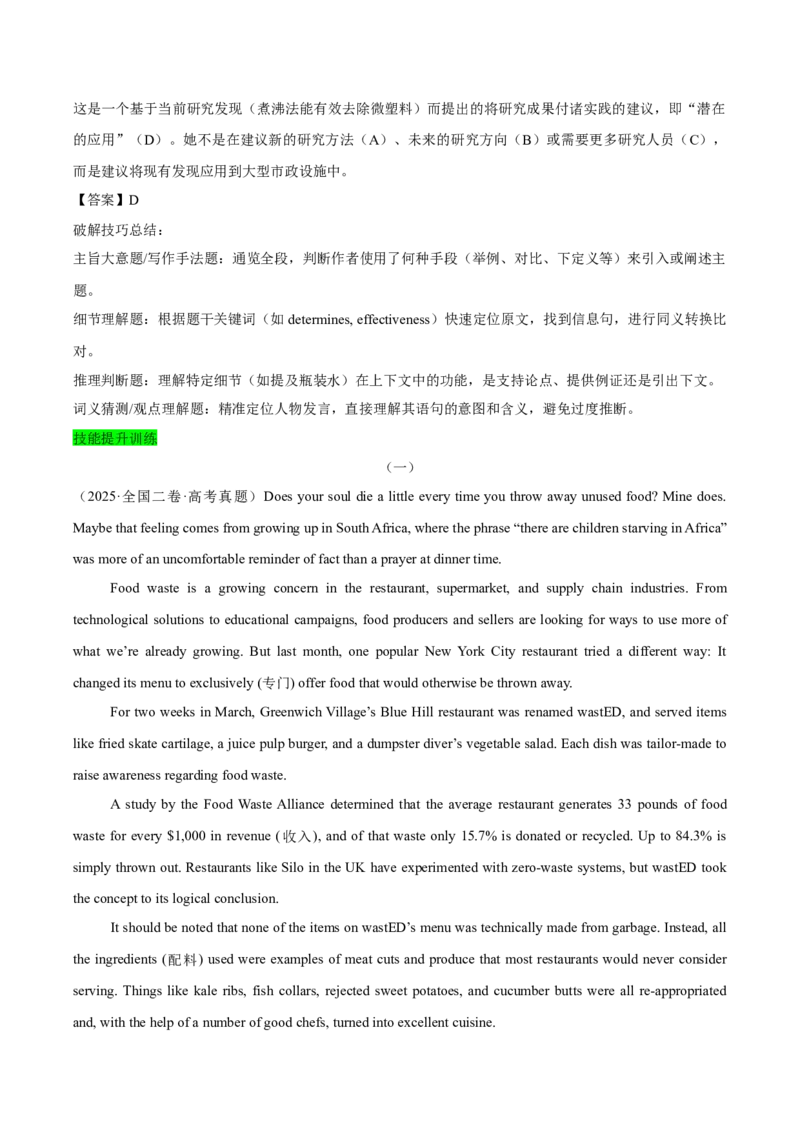
这是一个基于当前研究发现(煮沸法能有效去除微塑料)而提出的将研究成果付诸实践的建议,即“潜在
的应用”(D)。她不是在建议新的研究方法(A)、未来的研究方向(B)或需要更多研究人员(C),
而是建议将现有发现应用到大型市政设施中。
【答案】D
破解技巧总结:
主旨大意题/写作手法题:通览全段,判断作者使用了何种手段(举例、对比、下定义等)来引入或阐述主
题。
细节理解题:根据题干关键词(如determines, effectiveness)快速定位原文,找到信息句,进行同义转换比
对。
推理判断题:理解特定细节(如提及瓶装水)在上下文中的功能,是支持论点、提供例证还是引出下文。
词义猜测/观点理解题:精准定位人物发言,直接理解其语句的意图和含义,避免过度推断。
技能提升训练
(一)
(2025·全国二卷·高考真题)Does your soul die a little every time you throw away unused food? Mine does.
Maybe that feeling comes from growing up in South Africa, where the phrase “there are children starving in Africa”
was more of an uncomfortable reminder of fact than a prayer at dinner time.
Food waste is a growing concern in the restaurant, supermarket, and supply chain industries. From
technological solutions to educational campaigns, food producers and sellers are looking for ways to use more of
what we’re already growing. But last month, one popular New York City restaurant tried a different way: It
changed its menu to exclusively (专门) offer food that would otherwise be thrown away.
For two weeks in March, Greenwich Village’s Blue Hill restaurant was renamed wastED, and served items
like fried skate cartilage, a juice pulp burger, and a dumpster diver’s vegetable salad. Each dish was tailor-made to
raise awareness regarding food waste.
A study by the Food Waste Alliance determined that the average restaurant generates 33 pounds of food
waste for every $1,000 in revenue (收入), and of that waste only 15.7% is donated or recycled. Up to 84.3% is
simply thrown out. Restaurants like Silo in the UK have experimented with zero-waste systems, but wastED took
the concept to its logical conclusion.
It should be noted that none of the items on wastED’s menu was technically made from garbage. Instead, all
the ingredients (配料) used were examples of meat cuts and produce that most restaurants would never consider
serving. Things like kale ribs, fish collars, rejected sweet potatoes, and cucumber butts were all re-appropriated
and, with the help of a number of good chefs, turned into excellent cuisine.
Though wastED received enthusiastic reviews, it was designed from the start as a short-lived experiment;
Blue Hill has since returned to its regular menu. Nevertheless, it serves as a reminder that there are many ways to
address problems of sustainability, and that you can make an amazing meal out of almost anything.
1.What can be inferred about the author’s early life?
A.He witnessed food shortage.
B.He enjoyed the local cuisine.
C.He donated food to Africans.
D.He helped to cook at home.
2.Why did Blue Hill carry out the experiment?
A.To customize dishes for guests.
B.To make the public aware of food waste.
C.To test a food processing method.
D.To improve the UK’s zero-waste systems.
3.What is paragraph 5 mainly about?
A.Why the ingredients were used.
B.Which dishes were best liked.
C.What the dishes were made of.
D.Where the ingredients were bought.
4.What can we learn about wastED?
A.It has ended as planned.
B.It is creating new jobs.
C.It has regained popularity.
D.It is criticized by top chefs.
(二)
(2025·北京·高考真题)The call to “know yourself” has been there since ancient times, but our sense of self
doesn’t always match what others perceive. Considering the stories we tell about ourselves can help us to change
our minds for better.
For many years, psychologists saw identity as a combination of someone’s values, beliefs, goals and social
roles. Then, in the 1980s, Bob Johnson created the life story model of identity, in which he proposes that, as we go
through life, these core features are built in with our memories to create a personal story through which we
understand our lives.
Our life story is something that starts coming together in our teenage years, when we begin to organise our
lives into chapters around key events or life changes, and begin to see ourselves as both the central character and, to
a varying extent, the story’s author. People with more consistent stories tend to have a stronger sense of identity,
and they feel their life has more meaning, direction and sense of purpose. Such people show greater overall life
satisfaction, too.
Johnson has also investigated the link between well-being and certain story themes. He discovered that
whether someone describes having had some control over events in their past is an important predictor of a person’s
mental health. Another key theme involves finding some kind of positive meaning after stressful events. “People
could talk about gaining knowledge or personal growth,” says Johnson. His research shows that this is often
missing for people with mental health conditions. The good news is that there is evidence we can learn to change
our own story.
Lisa Green, another researcher, sounds a few notes of caution (谨慎). For instance, hearing about the power
of redemptive (拯救性的) stories, many people may feel forced to find a positive angle on horrible events. She says
that Western culture already pushes people to look for the silver lining behind every cloud.
If you want to turn over a new leaf, though, one top tip is that it helps to choose a significant date that signals
the start of a new “chapter”. Contrary to popular doubt, resolutions made on I January are more effective for this
reason. So, whether your goal is saving money or getting fit, there is no better time to become the author of our
own destiny (命运).
5.What can be inferred about personal stories?
A.They are unrelated to health.
B.Consistent ones lead to stress.
C.They are relevant to happiness.
D.Thematic ones hold back change.
6.What can we learn from this passage?
A.Talking about gains from failure is negative.
B.New Year resolutions are well received.
C.The West tends to overvalue optimism.
D.Social roles fail to be highlighted.
7.What does the author mainly do in this passage?
A.Clarify a goal.
B.Analyse an event.
C.Make a comparison.
D.Illustrate an approach.
8.What is the passage mainly about?
A.How self-identity works.
B.How story-tellers are made.
C.How personal stories raise doubts.
D.How timing affects personal identity.
(三)
(2025·全国二卷·高考真题)When Sonja Detrinidad opened her online shop selling houseplants, she didn’t have
high hopes for it. But the opposite happened: She was flooded, shipping out 1,200 orders in June of 2020 alone. In
the past year, Detrinidad sent out more than 70,000 plants. Her success is just one example of increased time at
home leading to an explosion in the houseplant industry.
“Plants are in fashion right now,” says Dr. Melinda Knuth, a researcher from the University of Florida.
“People who live in plant-rich environments report a higher life satisfaction rating, ” she says. “Adding more nature
to our environment can change our mood and how we think.” Plants can improve our state of mind in a few ways
but the biggest is by decreasing our level of cortisol, the stress hormone (激素) in our body.
“Students who are around plants perform better academically than students who are in a classroom without
plants,” says Knuth. “This productivity also translates into the workplace for adults. Our study showed that there
was a 30% decrease in sick leave for people who were in plant-rich workplaces.”
If you’re among the groups of people who are enjoying the mental and physical health benefits of
surrounding yourself with plants, don’t beat yourself up if one (or a few!) doesn’t make it. “Doctors practice
medicine and lawyers practice law and you should allow yourself the practice it takes to sustain a plant. Tending to
plants is an exercise in patience and learning. Be invested in taking care of it, but if it dies, go get another one,”
Detrinidad says.
9.How was Detrinidad’s business when it started?
A.It faced tough competition.
B.It suffered a great loss.
C.It got lots of financial support.
D.It went surprisingly well.
10.What is one of Knuth’s findings about plants?
A.They appeal more to students.
B.They purify the environment.
C.They raise the cortisol level.
D.They enhance productivity.
11.What does Detrinidad try to explain by mentioning doctors and lawyers?
A.The necessity of social skills.
B.The meaning of sustainability.
C.The importance of repeated efforts.
D.The value of professional opinions.
12.What can be a suitable title for the text?
A.Time to Replace Houseplants
B.Plants Boost Your Mood
C.Tips on Choosing Houseplants
D.Plants Brighten Your Home
(四)
(2025·浙江·高考真题)As new technologies take on increasingly humanlike qualities, there’s been a push to
make them genderless. “People are stereotyping (形成刻板印象) their gendered objects in very traditional ways,”
says Ashley Martin, a Stanford associate professor of organizational behavior. Removing gender from the picture
altogether seems like a simple way to fix this. Yet as Martin has found in her work, gender is one of the
fundamental ways people form connections with objects, particularly those designed with human characteristics.
In her study, Martin asked participants to rate their attachment to male, female, and genderless versions of a
digital voice assistant and a self-driving car known as “Miuu.” It was found that gender increased users’ feelings of
attachment to these devices and their interest in purchasing them. For example, participants said they would be less
likely to buy a genderless voice assistant than versions with male or female voices.
While gendering a product may be good marketing, it may also strengthen outdated or harmful ideas about
power and identity. The stereotypes commonly associated with men, such as competitiveness and dominance, are
more valued than those associated with women. These qualities, in turn, are mapped onto products that have been
assigned a gender.
Martin’s study also found that creating a genderless object was difficult. For instance, if an object’s name
was meant to sound genderless, like Miuu, participants would still assign a gender to it — they would assume Miuu
was a “he” or “she.”
Martin sees a silver lining, however: She believes that anthropomorphism (拟人化) “provides an opportunity
to change stereotypes.” When women are put into positions of leadership like running companies, it reduces
negative stereotypes about women. Similarly, anthropomorphized products could be created to take on stereotype-
inconsistent roles — a male robot that assists with nursing or a female robot that helps do calculations, for instance.
13.What is the purpose of making new technologies genderless?
A.To reduce stereotypes.
B.To meet public demand.
C.To cut production costs.
D.To encourage competition.
14.What were the participants probably asked to do in the study?
A.Design a product.
B.Respond to a survey.
C.Work as assistants.
D.Take a language test.
15.Why is it difficult to create genderless objects?
A.They cannot be mass-produced.
B.Naming them is a challenging task.
C.People assume they are unreliable.
D.Gender is rooted in people’s mind.
16.What does the last paragraph mainly talk about?
A.The quality of genderless products.
B.The upside of gendering a product.
C.The meaning of anthropomorphism.
D.The stereotypes of men and women.
(五)
(2025·广西南宁·模拟预测)As DeepSeek, the latest AI phenomenon, thunders into public awareness, social
media platforms are being transformed into creative classrooms where just about everything imaginable is taught
by using the software—from designing wedding invitations to using Photoshop, teaching math and telling fortunes.
One is on social media platform Xiaohongshu, also known as RedNote. Titled Learning to Use DeepSeek in
One Minute, it received more than 11,000 likes in just 10 days. Among the tutorials ( 教程),one released by
Tsinghua University’s Metaverse (元宇宙) Culture Laboratory team—DeepSeek from Beginner to Mastery 2025—
stands out. The 104-page document, which covers theory and practical skills, is a detailed instruction for mastering
DeepSeek and applying its full potential. It’s designed both for beginners and advanced users.
The guide provides strategies for creating requirements that enhance AI performance. It also includes case
studies illustrating how to apply DeepSeek to meet various needs. Team leader Shen Yang, a professor at Tsinghua
University’s School of Journalism and Communication and its College of AI, said human-computer dialogue is
essential for progress.
“Even though AI’s capacity to understand human intentions has improved significantly, humans still need to
clearly express their needs,” he said. “The combination of open-source software and inclusive applications is
meaningful.” By providing free tutorials, for example, the team can deliver the power of AI to everyone, allowing
each person to use and master it, rather than being dominated by it.
A social media influencer using the name Zhinan Shanhe posted a four-episode video tutorial of DeepSeek
on Douyin and Xiaohongshu. The videos have been popular, gaining hundreds of thousands of likes. The 30-year-
old man from Shanghai works in the AI industry and he has mastered many AI tools. “Before DeepSeek, I mostly
used foreign AI models, which are not so user-friendly for Chinese people,” he said. “But the capabilities of
DeepSeek are charming. It is powerful and also completely free, which is a blessing for its users.”
17.What can be inferred in paragraph 1 about DeepSeek?
A.It is widely implemented in many aspects.
B.It can predict the future precisely.
C.It is used to teach nearly all imaginative topics.
D.It is transformed into creative classrooms.
18.What can we learn from Shen Yang’s statements when using AI?
A.Users are blessed with the free software.B.Clear instructions from human are necessary.
C.AI does better in reasoning than humans.D.AI can fully understand human intentions.
19.What is the target of the free tutorials provided by Tsinghua University’s team?
A.To advance AI capabilities.
B.To increase the popularity of DeepSeek.
C.To help people better understand AI theory.
D.To promote and cultivate mass AI mastery.
20.What is the best title for the passage?
A.AI: A New Revolution in the Digital World
B.DeepSeek: Reforming Social Media and AI Learning
C.Tutorials: Fundamental Keys to Mastering DeepSeek
D.Social Media: The Platform for AI Education and Promotion
(六)
(2025·广西南宁·模拟预测)Does an apple a day keep diseases away? There has never been a clear answer
agreeable to the whole medical profession. However, recent research may finally provide some insights.
A team of nine researchers based at Tianjin University of Traditional Chinese Medicine in China gathered
more than 200 apple-related medical studies from the past decades. They painstakingly dug into these studies and
ultimately published their reviews in Food Science and Nutrition. This comprehensive study shows the width of
medical reports addressing a wide range of health questions, winding up with a thought-provoking ( 引人深思的)
statement: “In conclusion, the effects of apples and apple derivatives (衍生物), like apple juice, on disease risk
reduction are both challenging and encouraging.”
Apples appeal to diverse audiences, ranging from scientists to anyone with a genuine taste for apples. They
offer both tantalization and mystery, even — perhaps especially — to scientists studying the complexities of the
human brain. A research team in Belgium makes a connection to apples while discussing how “activities of daily
living are difficult to perform in a lab or clinic”. This idea briefs the challenge of translating everyday experiences
into scientific inquiry. Moreover, a specific Japanese study explains the complexities involved in apple-centric
research. The study presents a photograph with the words, “A subject, lying in an MRI ( 功能性磁共振成像)
environment, performs a mock-peeling (模拟削皮) task while observing his hands, an apple, and a plastic knife
model through a mirror.”
Though these studies reveal significant difficulties, they do not stop progress. “Chewing yellow apples,” an
Iranian study published in 2021 suggests, “was discovered to be a more effective method in reducing dental
diseases than chewing red apples or using toothbrushes.” This finding not only underlines the potential health
benefits of apples but also invites further exploration into how various types of apples might contribute to overall
well-being. The quest to answer whether an apple a day keeps diseases away continues, with each study adding
another layer to our understanding of this beloved fruit.
21.How did the researchers at Tianjin University of Traditional Chinese Medicine conduct their study?
A.By gathering a wide variety of apples.
B.By carrying out apple-related experiments.
C.By analyzing previous apple-centric studies. D.By addressing health problems with apples.
22.What does the underlined word “tantalization” in paragraph 3 probably mean?
A.Annoyance.
B.Confusion.
C.Appeal.
D.Nutrition.
23.Which concept is highlighted in paragraph 3?
A.The challenge of apple-related research.
B.The connection between apples and the human brain.
C.The health benefits of apples confirmed by MRI technology.
D.The complexities of how apples affect the human brain medically.
24.What viewpoint does the writer hold regarding the apple-related studies?
A.They are innovative and practical.
B.They are low-efficient but engaging.
C.They are significant and comprehensive.D.They are challenging but hold great potential.
(七)
(2025·广西南宁·一模)With their stiff leaves and large flowers, bromeliads can add drama to a plant stand or
window sill. Though they are not the flashiest of houseplants, some pollution scientists are ready to give them
credit. Their new data show these plants are experts at cleaning the air.
Paints, furniture, photocopiers and printers, cleaning supplies and dry-cleaned clothes can all release volatile
organic chemicals, or VOCs. Chronic VOC exposure poses serious health risks, from dizziness and asthma to
potential organ damage and cancer. But certain types of greenery can suck the pollutants up, which keeps them
safely away from us. Chemist Vadoud Niri’s found that a single bromeliad can remove at least 80 percent of six
different VOCs from the air inside a 76-liter container. His team tested five houseplants against eight VOCs,
finding bromeliads outperformed others. Only two VOCs, dichloromethane and trichloromethane were ignored by
all plants.
Plants absorb VOCs from the air, explains medicinal chemist Webe Kadima. Those gases enter through tiny
openings in plant leaves and stems. Once inside, the plant’s enzymes ( 酶) break down the VOCs into smaller,
harmless chemicals.
Of course, a house, or even a bedroom, is much bigger than the container Niri and his team used. But their
work suggests people might breathe easier if they can figure out what type and how many plants it takes to clean
the air in a room. This is important because indoor air usually has three to five times greater concentrations of
VOCs than outdoor air.
Niri says he plans to test how many houseplants it takes to clean the air in an average-size room. After that,
he will repeat the experiment in a nail salon. With bottles of nail polish and remover, the air in those salons tends to
have high levels of VOCs, he notes.
While special air filtering machines might do the same job as green plants, they cost a lot more, Niri says.
And they are nowhere near as pretty as a bromeliad, especially one in bloom.
25.What is one of Niri’s findings about bromeliads?
A.They beat machines in air cleaning.
B.They lead in VOCs removal during tests.
C.They absorb most pollutants in a room. D.They break down VOCs through enzymes.
26.What does Webe Kadima try to explain in paragraph 3?
A.The necessity to solve air pollution.
B.The pollutant removal process of plants.
C.The medical value of plants’ enzymes.
D.The absorption capability of different plants.
27.What will be the focus of Niri’s research?
A.Designing cheap air-filtering device.
B.Researching blooming bromeliads.
C.Repeating the tests in various salons.
D.Testing plant performance in larger space.
28.What can be a suitable title for the text?
A.Plants: Efficient VOCs Remover
B.Enzyme: Air Pollution Solution
C.Bromeliads: Nature’s Air Purifier
D.Nail Salons: Indoor VOCs Producer
(八)
(2025·浙江·一模)Ecotourism has become an increasingly popular way for travelers to explore the world while
minimizing their environmental impact. Unlike traditional tourism, which often focuses on luxury accommodations
and crowded attractions, ecotourism emphasizes responsible travel to natural areas that conserves the environment
and improves the well-being of local communities.
The core principles of ecotourism include minimizing environmental damage, respecting local cultures, and
supporting conservation efforts. Travelers engaging in ecotourism activities typically visit protected areas such as
national parks, wildlife reserves, or remote communities. They participate in activities like bird watching, hiking, or
learning about traditional crafts from local residents. These experiences not only allow travelers to connect with
nature but also contribute to the preservation of fragile ecosystems.
One successful example of ecotourism is the Galapagos Islands in Ecuador. Faced with threats from over-
tourism in the 20th century, the government implemented strict regulations to protect the unique wildlife and
landscapes. Today, visitors to the Galapagos must follow designated routes, be accompanied by certified guides,
and pay a conservation fee that funds environmental protection projects. This approach has helped maintain the
islands’ biodiversity while providing income for local communities through tourism.
Another example is Costa Rica, often regarded as a leader in ecotourism. The country has transformed its
natural resources into a sustainable tourism industry, with over 25% of its land protected in national parks and
reserves. Tourists can explore rainforests, observe sea turtles nesting, or stay in eco-lodges that use renewable
energy and support local farmers. This model has not only preserved Costa Rica’s natural beauty but also reduced
poverty in rural areas by creating jobs in tourism.
However, ecotourism is not without challenges. Some destinations market themselves as “eco-friendly”
without implementing meaningful conservation measures, a practice known as “greenwashing.” Travelers must be
cautious and research companies before booking to ensure their tourism dollars support genuine environmental and
community initiatives.
Additionally, even well-managed ecotourism can have negative impacts if visitor numbers exceed the
carrying capacity of an area, leading to habitat disturbance or increased waste.
To practice responsible ecotourism, experts recommend choosing small-scale, locally owned
accommodations, participating in guided tours led by local experts, and following the “leave no trace” principle by
taking all trash with you and avoiding damage to plants and wildlife. By making informed choices, travelers can
enjoy meaningful experiences while helping to protect the planet for future generations.
29.What is the main difference between ecotourism and traditional tourism?
A.Ecotourism focuses on luxury accommodations.
B.Ecotourism emphasizes responsible travel and environmental conservation.
C.Traditional tourism only visits natural areas.
D.Traditional tourism requires following strict regulations.
30.Why does the author mention the Galapagos Islands?
A.To show the negative effects of over-tourism.
B.To introduce a popular luxury travel destination.
C.To provide a successful example of ecotourism.
D.To explain how to get certified as an ecotourism guide.
31.What does the word “greenwashing” in Paragraph 5 probably mean?
A.Making false claims about being environmentally friendly.
B.Using green colors in tourism advertisements.
C.Planting trees to offset carbon emissions from travel.
D.Implementing strict environmental protection measures.
32.What is recommended for responsible ecotourism according to the text?
A.Choosing large international hotel chains.
B.Exploring natural areas without a guide.
C.Leaving trash in designated areas.
D.Selecting locally owned accommodations.