ZJ1 202
3
READING
ZJ
1
浙江1 月首考阅读理解
A
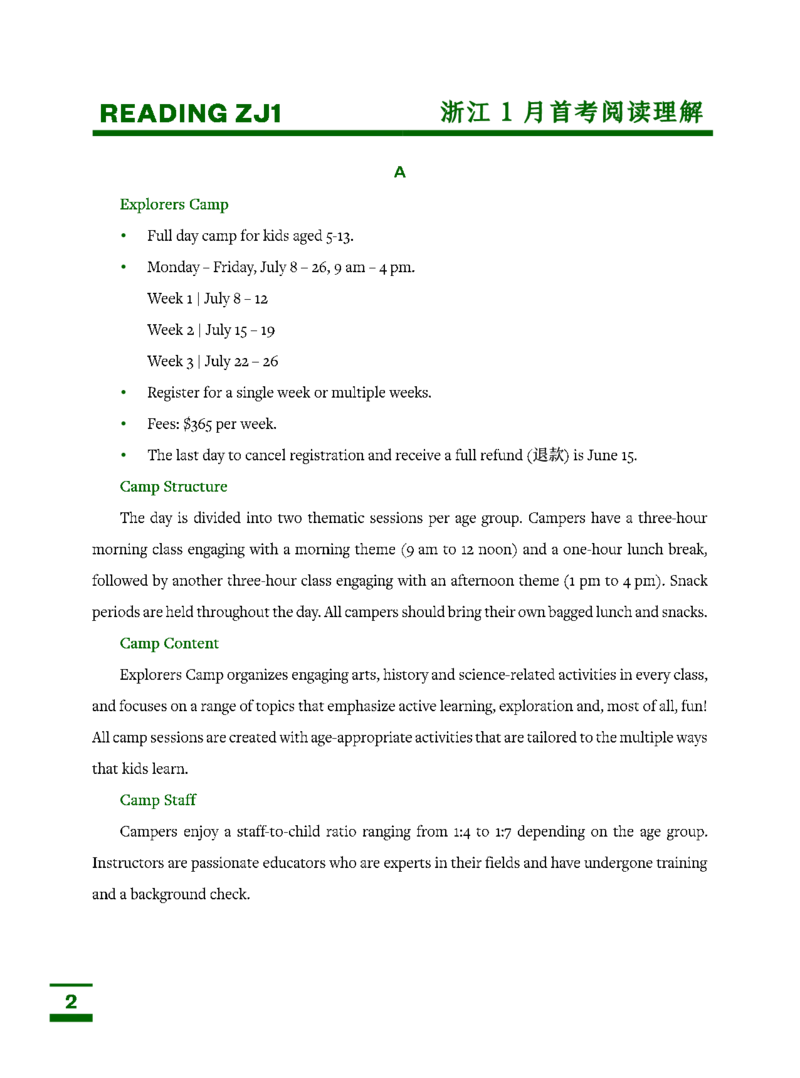
Explorers Camp
Full day camp for kids aged 5
- 13.
Monday
– Friday, July 8
– 26, 9
am
– 4 pm.
Week 1 | July 8
– 12
Week 2 | July 15
– 19
Week 3 | July 22
– 26
Register for a single week or multiple weeks.
Fees: $365 per week.
The last day to cancel registration and receive a full refund
( 退款) is June 15.
Camp StructureThe day is divided into two thematic sessions per age group. Campers have a three
- hour
morning class engaging with a morning theme (9
am to 1
2 noon) and a one
-hour lunch break,
followed by another three
-hour class engaging with an afternoon theme
(1 pm to 4
pm). Snack
periods are held throughout the day. All campers should bring their own bagged lunch and snacks. Camp ContentExplorers Camp organizes engaging arts, history and science
-related activities in every class,
and focuses on a range of topics that emphasize active learning, exploration and, most of all, fun! All camp sessions are created with age
-appropriate activities
that are tailored to the multiple ways
that kids learn. Camp StaffCampers enjoy a staff
- to
-child ratio ranging from 1:4 to 1:7 depending on the age group.
Instructors are passionate educators who are experts in their fields and have undergone training
an d a background check.
21. On which of the following dates can you cancel your registration with a full refund?A. June 12. B. June 22. C. July 19.
D. July 26.
22. How are campers divided into different groups?A. By gender. B. By nationality. C. By interest.
D. By age.
23. How many hours of class will you have altogether if you register for a single week? A. 15. B. 21. C. 30.
D. 42.
B
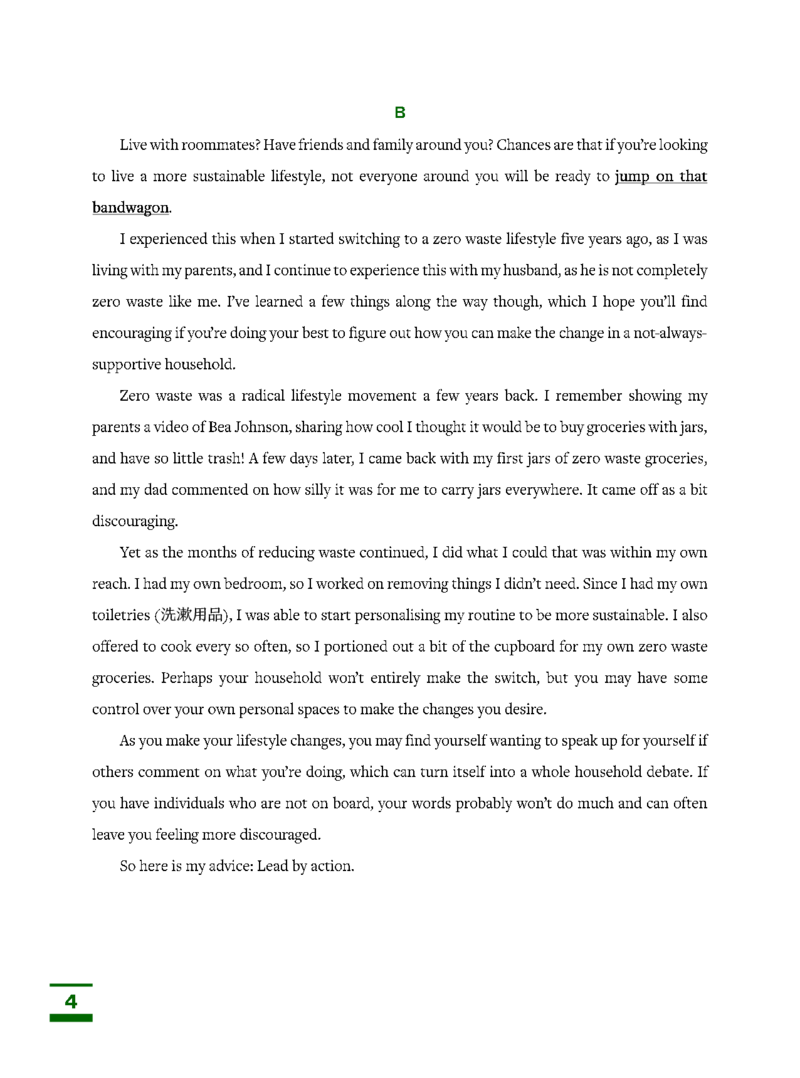
Live with roommates? Have
friends and family around you? Chances are that if you
’re looking
to live a more sustainable lifestyle, not everyone around you will be ready to
jump on that
bandwagon
.I experienced this when I started switching to a zero waste lifestyle five years ago, a
s I was
living with my parents, and I continue to experience this with my husband, as he is not completely zero waste like me. I
’ve learned a few things along the way though, which I hope you
’ll find
encouraging if you
’re doing your best to figure out how
you can make the change in a not
- always
-
supportive household. Zero waste was a radical lifestyle movement a few years back. I remember showing my parents a video of Bea Johnson, sharing how cool I thought it would be to buy groceries with jars,
and have s o little trash! A few days later, I came back with my first jars of zero waste groceries, and my dad commented on how silly it was for me to carry jars everywhere. It came off as a bit discouraging. Yet as the months of reducing waste continued, I did what
I could that was within my own
reach. I had my own bedroom, so I worked on removing things I didn
’t need. Since I had my own
toiletries
( 洗漱用品), I was able to start personalising my routine to be more
sustainable. I also
offered to cook every so often, so
I portioned out a bit of the cupboard for my own zero waste
groceries. Perhaps your household won
’t entirely make the switch, but you may have some
control over your own personal spaces to make the changes you desire. As you make your lifestyle changes, yo
u may find yourself wanting to speak up for yourself if
others comment on what you
’re doing, which can turn itself into a whole household debate. If
you have individuals who are not on board, your words probably won
’t do much and can often
leave you feelin
g more discouraged.
So here is my advice: Lead by action.
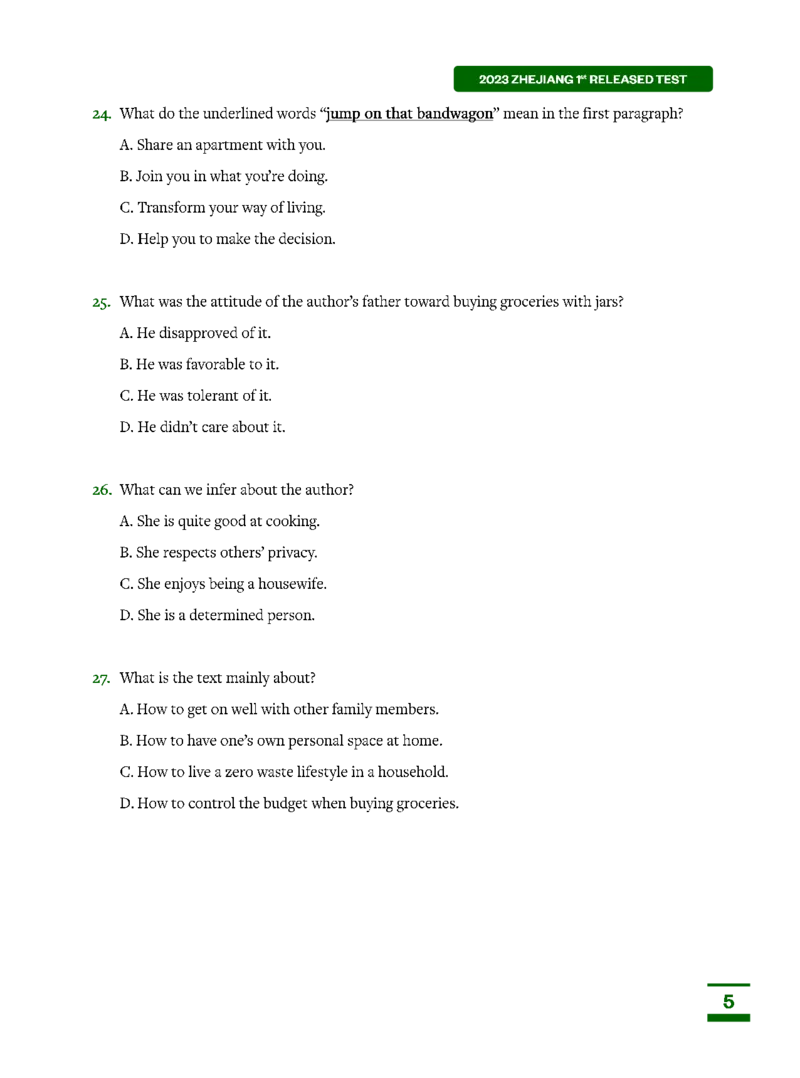
24. What do the underlined words “
jump on that bandwagon
” mean in the first paragraph?
A. Share an apartment with you. B. Join you in what you
’re doing.
C. Transform your way of living. D. Help you to make the decision.
25. What was the attitude of the author
’s father toward buying groceries with jars?
A. He disapproved of it. B. He was favorable to it.C. He was tolerant of it.
D. He didn
’t care about it.
26. What can we infer about the author?A. She is quite good at cooking. B. She respects others
’ privacy.
C. She enjoys being a housewife. D. She is a determined person.
27. What is the text mainly about?
A. How to get on well with other family members.
B. How to have one
’s own personal space at home.
C. How to live a zero waste lifestyle in a household.
D. How to control the budget when buying groceries.
C
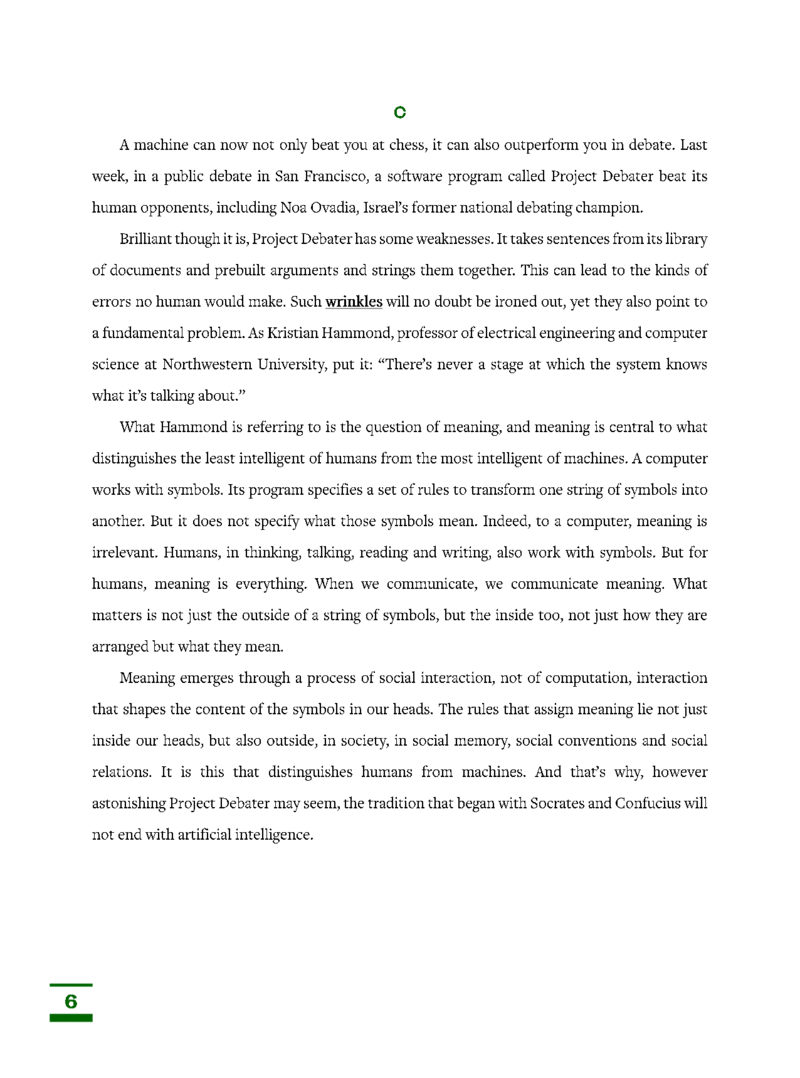
A machine can now not only beat you at chess, it can also outperform you in debate. Last week, in a public debate in San Francisco, a software program called Project Debater beat its human opponents, including Noa Ovadia, Israel
’s former national debating
champion.
Brilliant though it is, Project Debater has some weaknesses. It takes sentences from its library of documents and prebuilt arguments and strings them together. This can lead to the kinds of errors no human would make. Such
wrinkles
will no doubt
be ironed out, yet they also point to
a fundamental problem. As Kristian Hammond, professor of electrical engineering and computer science at Northwestern University, put it: “There
’s never a stage at which the system knows
what it
’s talking about.”
What H ammond is referring to is the question of meaning, and meaning is central to what distinguishes the least intelligent of humans from the most intelligent of machines. A computer works with symbols. Its program specifies a set of rules to transform one stri
ng of symbols into
another. But it does not specify what those symbols mean. Indeed, to a computer, meaning is irrelevant. Humans, in thinking, talking, reading and writing, also work with symbols. But for humans, meaning is everything. When we communicate
, we communicate meaning. What
matters is not just the outside of a string of symbols, but the inside too, not just how they are arranged but what they mean. Meaning emerges through a process of social interaction, not of computation, interaction
that shap es the content of the symbols in our heads. The rules that assign meaning lie not just inside our heads, but also outside, in society, in social memory, social conventions and social relations. It is this that distinguishes humans from machines. And that
’ s why, however
astonishing Project Debater may seem, the tradition that began with Socrates and Confucius will not end with artificial intelligence.
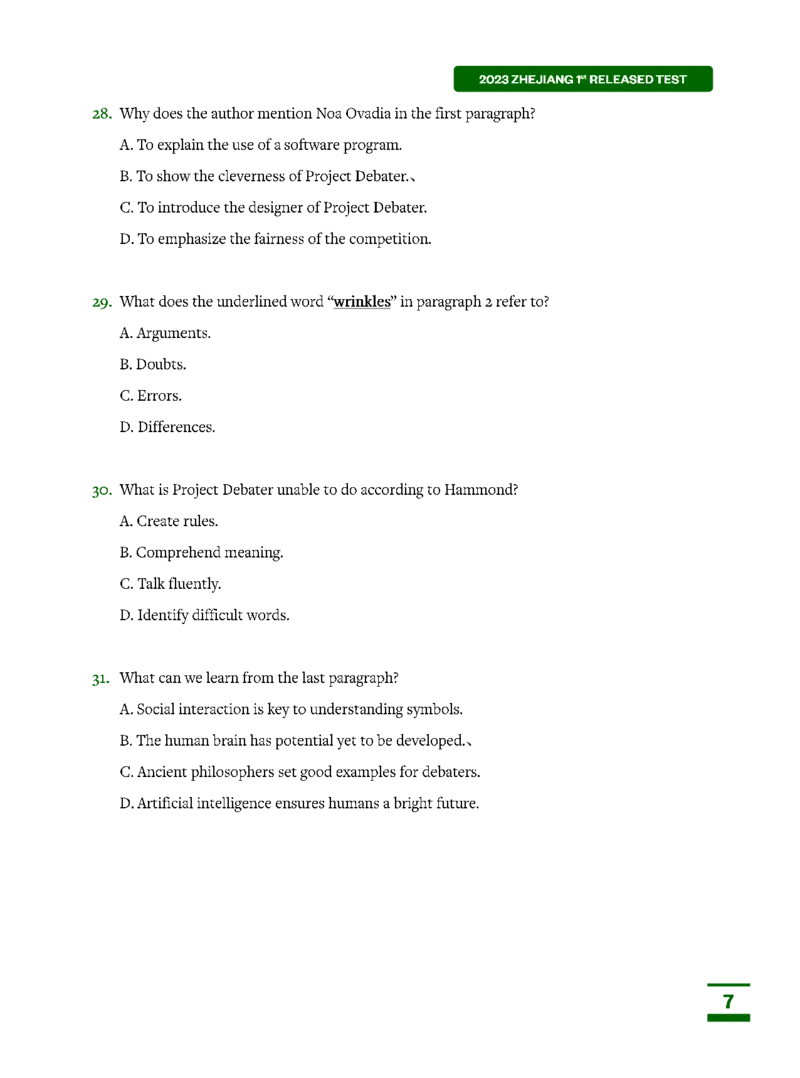
28. Why does the author mention Noa Ovadia in the first paragraph?
A. To explain the use of a
software program.
B. To show the cleverness of Project Debater.
、
C. To introduce the designer of Project Debater.
D. To emphasize the fairness of the competition.
29. What does the underlined word “
wrinkles
” in paragraph 2 refer to?
A. Arguments.
B. Do
ubts. C. Errors. D. Differences.
30. What is Project Debater unable to do according to Hammond?A. Create rules. B. Comprehend meaning.C. Talk fluently. D. Identify difficult words.
31. What can we learn from the last par
agraph?
A. Social interaction is key to understanding symbols.
B. The human brain has potential yet to be developed.
、
C. Ancient philosophers set good examples for debaters.
D. Artificial intelligence ensures humans a bright future.
D
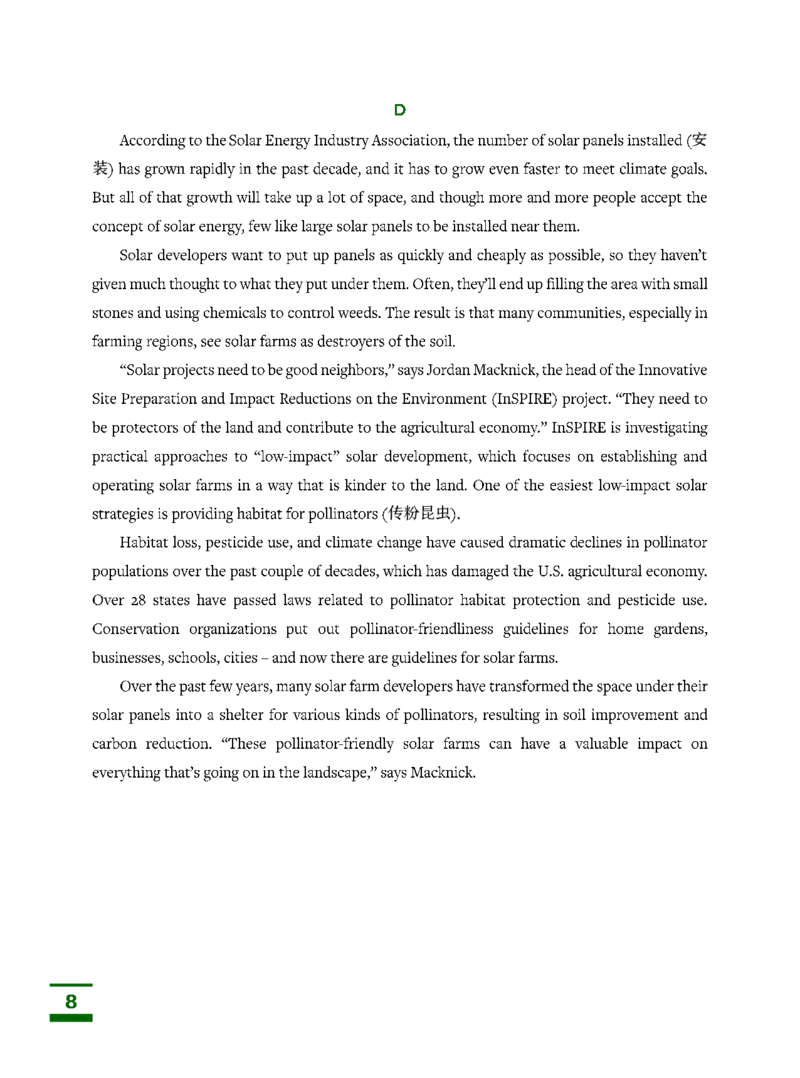
According to the
Solar Energy Industry Association, the number of solar panels installed (
安
装) has grown rapidly in the past decade, and it has to grow even faster to meet climate goals. But all of that growth will take up a lot of space, and though more a
nd more people acc
ept the
concept of solar energy, few like large solar panels to be installed near them. Solar developers want to put up panels as quickly and cheaply as possible, so they haven
’ t
given much thought to what they put under them. Often, they
’ll end up filling
the area with small
stones and using chemicals to control weeds. The result is that many communities, especially in farming regions, see solar farms as destroyers of the soil.
“Solar projects need to be good neighbors,” says Jordan Macknick, the head of t
he Innovative
Site Preparation and Impact Reductions on the Environment
(InSPIRE) project. “They need to
be protectors of the land and contribute to the agricultural economy.” InSPIRE is investigating practical approaches to “low
-impact” solar development,
which focuses on establishing and
operating solar farms in a way that is kinder to the land. One of the easiest low
-impact solar
strategies is providing habitat for pollinators
( 传粉昆虫).
Habitat loss, pesticide use, and climate change have caused dramatic d
eclines in pollinator
populations over the past couple of decades, which has damaged the U.S. agricultural economy. Over 28 states have passed laws related to pollinator habitat protection and pesticide use. Conservation organizations
put out pollinator
- friendliness guidelines for home gardens,
businesses, schools, cities
–and now there are guidelines for solar farms.
Over the past few years, many solar farm developers have transformed the space under their solar panels into a shelter for various kinds of
pollinators, resulting in soil improvement and
carbon reduction. “These pollinator
-friendly solar farms can have a valuable impact on
everything that
’s going on in the landscape,” says Macknick.
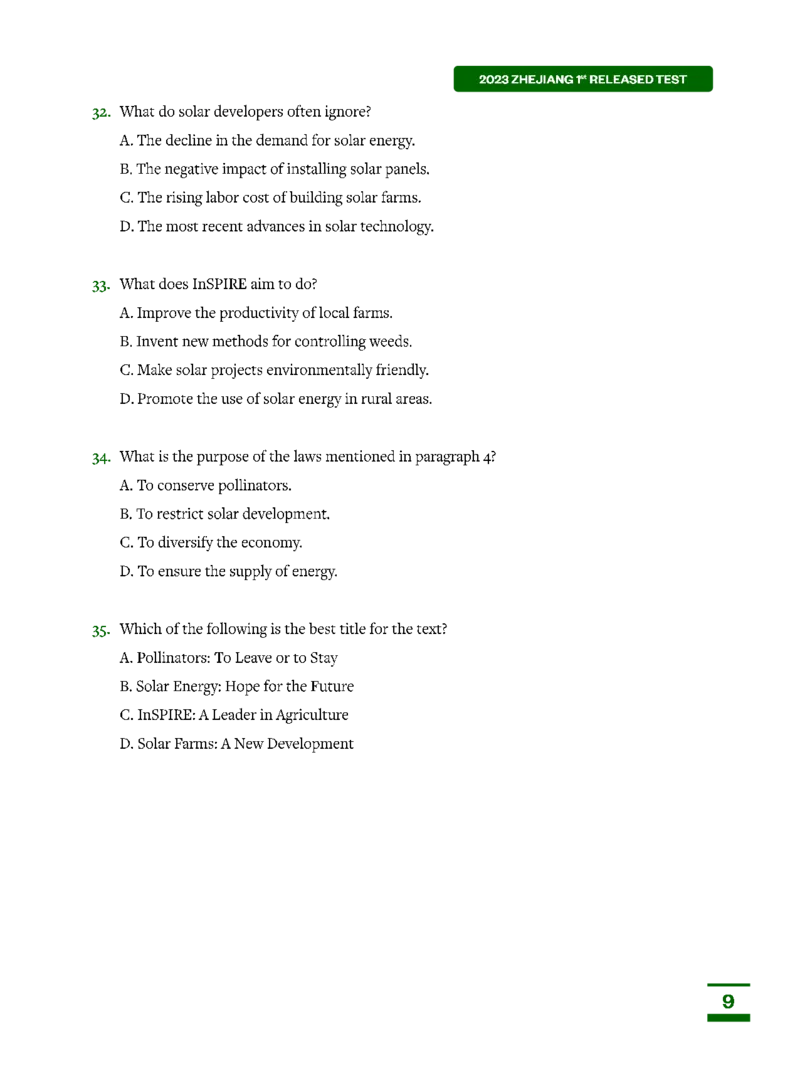
32. What do solar developers often ignore?
A. The decline i
n the demand for solar energy.
B. The negative impact of installing solar panels.
C. The rising labor cost of building solar farms.
D. The most recent advances in solar technology.
33. What does InSPIRE aim to do?
A. Improve the productivity of local farm
s.
B. Invent new methods for controlling weeds.
C. Make solar projects environmentally friendly.
D. Promote the use of solar energy in rural areas.
34. What is the purpose of the laws mentioned in paragraph 4?A. To conserve pollinators. B. To restrict solar development.C. To diversify the economy. D. To ensure the supply of energy.
35. Which of the following is the best title for the text?A. Pollinators: To Leave or to Stay B. Solar Energy: Hope for the FutureC. InSPIRE: A Leader in Agriculture D. Solar Farms: A New Development
COMPLETION
ZJ1
浙江1 月首考七选五
With gas prices rising and airport security lines snaking longer than
ever, why not book your
next domestic vacation on a train? Compared to other alternatives, it
’s comfortable and relaxing.
Here is some advice on how to make a trip by rail as pleasant as possible. Plan ahead.
Most long
-distance trains, especially the sleep
ing car accommodations, sell out
very quickly.
(36)
____
______ But no matter when you travel, it
’s a good idea to make your
reservations at least 90 days in advance. Use a travel agent.
Consider turning your travel plan over to a travel agent and
letting him
double
-check all the details, make suggestions, and then handle the actual reservations. A good one can sometimes find you discounted tickets.
(3 7 ) ____
______
Then you won
’t have to walk
through several cars on a moving train three times a day
for your meals
Bring a blanket.
When you
’re riding on trains, you won
’t be provided with a blanket for free,
even if your trip is an overnight one.
(3 8 ) ____
______ In the summer in particular, the air
conditioning can make them quite cold. Arrive early.
Mo st trains operate just once a day and some run only three times a week, so
missing yours can be a disaster.
(3 9 ) ____
______ Note: The times listed on the schedules are
departure times, not arrival times.
Have fun.
( 40
) ____
______
Read a book, knit, do a cr
ossword puzzle, or simply watch the
world unfold outside the window. To calculate your speed as you do, divide 3,600 (the number of seconds in an hour) by the number of seconds it takes you to travel one mile (the distance between two mileposts). If it tak
es the train 53 seconds to travel one mile, you
’re going 67.92 mph.
A. Train trips aren
’t for impatient types.
B.
You
’ll have views from both sides of the train.
C. The temperature on rail cars is often hard to control.
D.
That
’ s particularly true during busy summer months.
E. You might have to wait longer than 24 hours to catch the next one.
F. Chances are the cost will be a lot less than the cost of one bedroom.
G. He may also book you in a sleeping car that
’s right next to the d
iner.
CLOZE
ZJ1
浙江1 月首考完形填空
The sun was beginning to sink as I set off into the Harenna Forest. I was on my
way to
( 4 1 )
________
a unique honey harvest. Here, in south
-east Ethiopia, hand
-carved beehives (
蜂箱) are
placed in the
( 4 2 ) ________ . Reaching them to get the honey is difficult
– and often
( 4 3 ) ________
.
I ( 4 4 ) ________ beekeeper Ziyad over a wide stretch of grassland before entering a thick jungle.
Ziyad began preparations. He
( 45
) ________
handfuls of damp tree leaves, wrapped them
with
string, and
( 4 6 ) ________
the bunch to create a torch(
火把). Then, with one end of a rope tied to
his waist and the other end around the trunk of a tree, Ziya
d began
( 4 7 ) ________
. He stopped
every few minutes to move the
( 4 8 ) ________
higher up the
tree trunk.
( 49
) ________
, Ziyad got
close to the hive which was around 20 metres above the ground. Sitting on a branch, he
( 50
)
________ towards it and blew smoke from his torch into a tiny hole in the hive. Suddenly, Ziyad
let out a sharp cry. Within sec
onds, he
’ d ( 51 ) ________
the trunk and was back on the ground. It
was too
( 52
) ________ to collect the honey. A cool summer had delayed
( 53
) ________
. Baby bees
were still in the honeycombs
( 蜂巢). The adult bees were
( 54
) ________
and kept attacking as
Ziya d escaped from the tree. He had to wait f
or the right
( 55
) ________
to go back up.
4 1 .
A . share
B . collect
C . celebrate
D . witness
4 2 .
A . courtyards
B . fields
C . treetops
D . caves
4 3 .
A . urgent
B . dangerous
C . expensive
D . pointless
4 4 .
A . searched
B . recognised
C . followed
D . invited
4 5 .
A . gathered
B . cleaned
C . dropped
D . checked
4 6 .
A . shook
B . lit
C . measured
D . decorated
4 7 .
A . jumping
B . talking
C . testing
D . climbing
4 8 .
A . hives
B . leaves
C . rope
D . honey
4 9 .
A . Finally
B . Surprisingly
C . Naturally
D . Immediately
5 0.
A . backed
B . dived
C . shouted
D . inched
51.
A . cut
off
B . gone
up
C . slid
down
D . held
onto
5 2.
A . high
B . early
C . fast
D . close
5 3.
A . hatching
B . training
C . sowing
D . trading
5 4.
A . curious
B . hungry
C . bored
D . angry
5 5.
A . moment
B . equipment
C . person
D . order
GRAMMAR
ZJ1
浙江1 月首考语法填空
During China
’s dynastic period, emperors planned the city of Beijing
( 56 ) ___
__ ___ arranged
the residential areas according to social classes. The term
“hutong”,
( 57 ) ___
__ ___ (original)
meaning “water well” in Mongolian, appeared first during the Yuan Dynasty. In the Ming Dynasty, the center was the Forbidden City,
( 58 ) ___
__ ___ (surround) in
concentric
( 同心的) circles by the Inner City and Outer
City. Citizens of higher social classes
( 59 ) ___
__ ___ (permit) to live closer to the center of the circles. The large siheyuan of th
ese high
-
ranking officials and wealthy businessmen often
( 60 ) ___
__ ___ (feature)
beautifully carved and
painted roof beams a
nd pillars
( 柱子). The hutongs they formed were orderly, lined by
( 61 )
___
__ ___ (space) homes and walled gardens. Farther from the center lived the commoners and laborers. Their siheyuan were far smaller in scale and
( 62 ) ___
__ ___ (simple) in design and
deco ration, and the hutongs were narrower. Hutongs represent an important cultural element of the city of Beijing. Thanks to Beijing
’ s
long history
( 63 ) ___
__ ___ capital of China, almost every hutong has its stories, and some are
even associated with
historic
( 64 ) ___
__ ___ (event). In contrast to the court life and upper
- class
culture represented by the Forbidden City, the Summer Palace, and the Temple of Heaven, the hutongs reflect
( 65 ) ___
__ ___ culture of grassroots Beijingers.
ANSWER
KEY
答案
READING
阅读理解
A
2 1. A
2 2. D
2 3. C
B
2 4. B
2 5. A
2 6. D
2 7. C
C
2 8. B
2 9. C
3 0. B
3 1. A
D
3 2. B
3 3. C
3 4. A
3 5. D
COMPLETION
七选五
3 6. D
3 7. G
3 8. C
3 9. E
4 0. A
CLOZE
完形填空
4 1. D
4 2. C
4 3. B
4 4. C
4 5. A
4 6. B
4 7. D
4 8. C
4 9. A
5 0. D
5 1. C
5 2. B
5 3. A
5 4. D
5 5. A
GRAMMAR
语法填空
5 6. and
5 7. originally
5 8. surrounded
5 9. were permitted
6 0. featured
6 1. spacious
6 2. simpler
/more simple
6 3. as
6 4. events
6 5. the
WRITING
ZJ1
浙江1 月首考应用文写作
上周末你参加了校学生会组织的“认识我们身边的植物”活动。请为校英文报写篇报道,
内容包括:
1.
活动的过程;
2.
收获与感想。
Sample Writing
范文Getting to Know the Plants Around Us
( 版本一) Last Sunday witnessed an activity with the theme of
“ Getting to
K now the Plants
a round Us
”, which involved all students in
Senior One.
At 8:00 a.m., we assembled at the City Botanic Garden. Then, we set about finding whatever plants that grew there and googling for their specific information, ranging from the plants’ favorite humidity, temperature and fertilization to the timi
ng of their sprout, flowering and
fruition. Warmly embraced by students, this activity really enriched our knowledge in plants which we took little notice in our hustling life. Also, everyone felt reinvigorated by getting close to nature and greenery.
( 版本二) A meaningful activity called
“ Getting to
K now the Plants
a round Us
” was organized
by the Students
’Union in our campus last weekend, which would raise our awareness of passion
for plants and an appreciation of nature. As scheduled, the event was
held in the City Botanic Garden with a brief beginning lecture
by a local botanist on the plant ecosystem.
Then, we went on observing the Garden and leaning
more knowledge of the plants, such as the varieties of plants, the incredible medical functions
and the role of plants in maintaining the balance of our ecosystem.The event was a valuable and enriching experience, which stimulated our passion for promoting environmental protection.
Continuation
ZJ
1
浙江1 月首考续写
I was invited to a cookout on an old
friend
’s farm in western Washington. I parked my car
outside the farm and walked past a milking house which had apparently not been used in many years. A noise at a window caught my attention, so I entered it. It was a
hummingbird (
蜂鸟),
desperately trying
to escape. She was covered in spider
- webs
( 蛛网) and was barely able to move
her wings. She ceased her struggle the instant I picked her up. With the bird in my cupped hand, I looked around to see how she had gotten in. The broken window glass was the likely
answer. I stuffed a piece of cloth into the hole and took her outside,
closing the door securely behind me. When I opened my hand, the bird did not fly away; she sat looking at me with her bright eyes. I removed the sticky spider
-webs that covered her he
ad and wings. Still, she made no attempt to
fly. Perhaps she had been struggling against the window too long and was too tired? Or too thirsty? As I carried her up the blackberry
-lined path toward my car where I kept a water bottle, she
began to move. I st
opped, and she soon took wing but did not immediately fly away.
Hovering
( 悬停), she approached within six inches of my face. For a very long moment, this
tiny creature looked into my eyes, turning her head from side to side. Then she flew quickly out
of sig
ht.During the cookout, I told my hosts about the hummingbird incident. They promised to fix the window. As I was departing, my friends walked me to my car. I was standing by the car when a hummingbird flew to the center of our group and began hovering. Sh
e turned from person to
person until she came to me. She again looked directly into my eyes, then let out a squeaking call and was gone. For a moment, all were speechless. Then someone said, “She must have come to
say good
- bye.”
Sample Writing
范文
( 版本一) A few weeks later, I visited the farm again.
The same dilapidated house, the same
gigantic spider web, the same green blackberry path.
“Will the hummingbird be the same? Will
this lovely and humanistic creature be trapped in the web again? Not likely, si
nce the hole in the
window had been fixed.
”These questions and thoughts popped into my head like strands of
spider thread. With smell of roasted food wafting in the air, my friends and I chatted and laughed merrily around the picnic table. It seemed the h
ummingbird was temporarily thrown to the back
of my mind. Soon, the sun began to set and it was time for home. I was about to leave when the hummingbird appeared.
It perched on a small twig just an
inch before me and studied me with the same sparkling and pleasant eyes. In an ecstasy of delight, I held out my fingers for it to rest and we communicated with our half
-human, half
-bird language.
My teary friends were al
l deeply struck by the profound bond between a little bird and her saver.
Were there magic power existing in this world, it must be the universal love that surpassed beyond any species, as was the case with my sacred hummingbird and me.
( 版本二) A few weeks
later, I went to the farm again.
When I walked past the milking house,
I cast an unconscious glance at it. Then mixed feelings came over me. Maybe another little creature was trapped? Or maybe I would meet “her” again? Whatever the reason, every nerve in my body was screaming at me to step inside for a closer look. But nothing happened. “Forget it, it was just a bird,” I let out a deep sigh and made my way out. I was just about to leave when the hummingbird appeared.
There she was, flapping her
wings and approaching me. A cry of joy escaped my throat. “Hey, old girl! How is everything going?” I called softly. Then she landed in my cupped hands and stared into my eyes. I stroked her feathers gently. Moments later,
she uttered a squeaking call, spread her wi
ngs and flew into
the sky. The memory she left with me will remain, reminding me that there are things in nature that exist outside the laws and understanding of man.