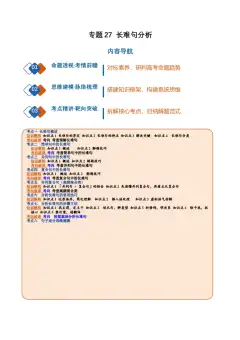
清单 08 阅读理解之词句猜测题
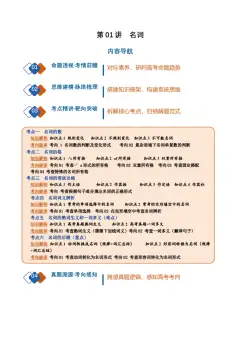
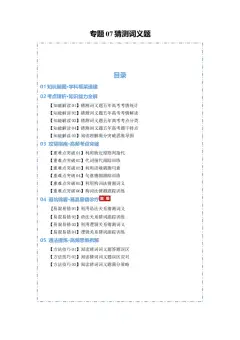
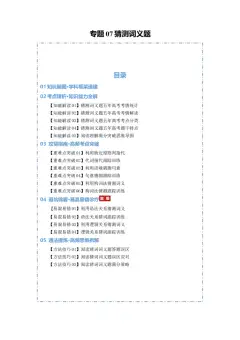
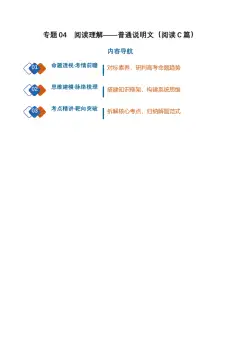
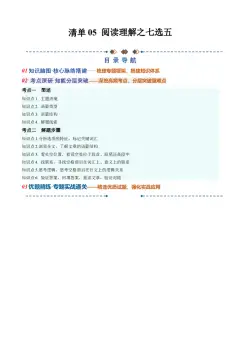
目 录 导 航
01知识脑图·核心脉络搭建——梳理专题框架,搭建知识体系
02 考点深研·知能分层突破——深挖高频考点,分层突破重难点
考点一 词义猜测题
知识点1. 设问形式;
知识点2. 设题特点;
知识点3. 解题技巧;
考点二 代词指代题
知识点1. 设问形式;
知识点2. 设题特点;
知识点3. 解题技巧;
考点三 句意猜测题
知识点1. 设问形式;
知识点2. 设题特点;
知识点3. 解题技巧;
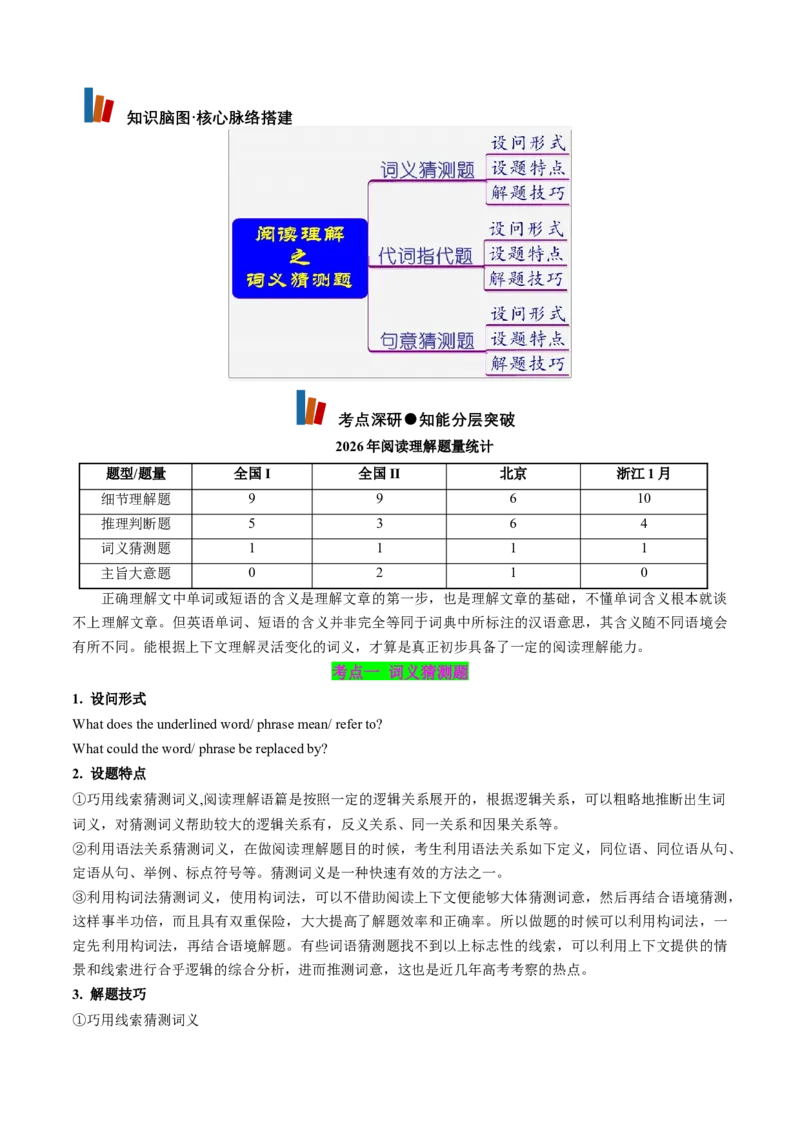
03优题精练·专题实战通关——精选优质试题,强化实战应用知识脑图·核心脉络搭建
考点深研●知能分层突破
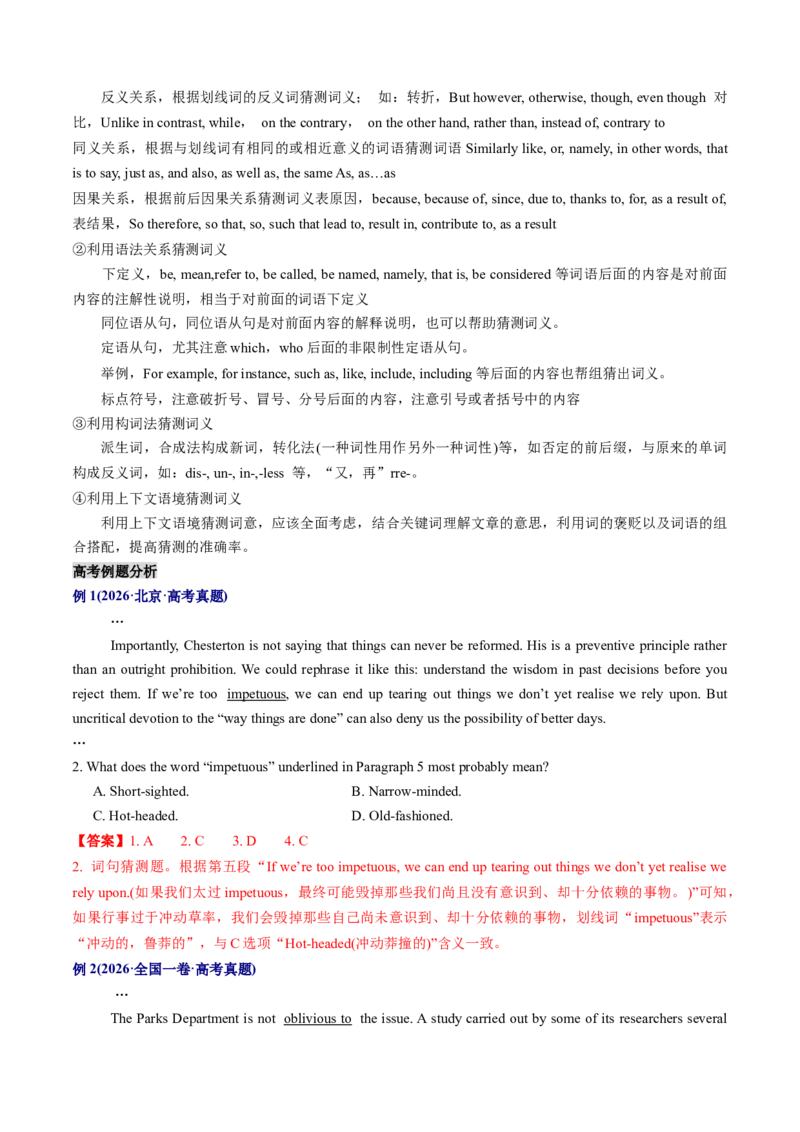
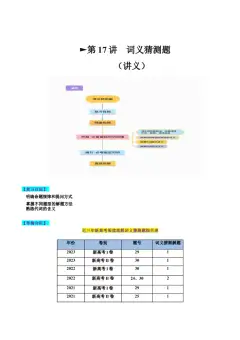
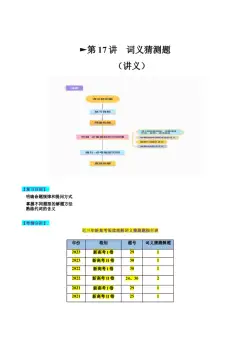
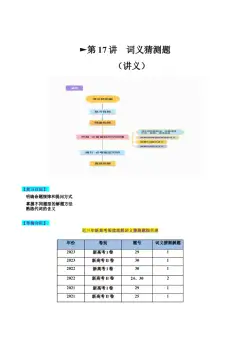
2026年阅读理解题量统计
题型/题量 全国I 全国II 北京 浙江1月
细节理解题 9 9 6 10
推理判断题 5 3 6 4
词义猜测题 1 1 1 1
主旨大意题 0 2 1 0
正确理解文中单词或短语的含义是理解文章的第一步,也是理解文章的基础,不懂单词含义根本就谈
不上理解文章。但英语单词、短语的含义并非完全等同于词典中所标注的汉语意思,其含义随不同语境会
有所不同。能根据上下文理解灵活变化的词义,才算是真正初步具备了一定的阅读理解能力。
考点一 词义猜测题
1. 设问形式
What does the underlined word/ phrase mean/ refer to?
What could the word/ phrase be replaced by?
2. 设题特点
①巧用线索猜测词义,阅读理解语篇是按照一定的逻辑关系展开的,根据逻辑关系,可以粗略地推断出生词
词义,对猜测词义帮助较大的逻辑关系有,反义关系、同一关系和因果关系等。
②利用语法关系猜测词义,在做阅读理解题目的时候,考生利用语法关系如下定义,同位语、同位语从句、
定语从句、举例、标点符号等。猜测词义是一种快速有效的方法之一。
③利用构词法猜测词义,使用构词法,可以不借助阅读上下文便能够大体猜测词意,然后再结合语境猜测,
这样事半功倍,而且具有双重保险,大大提高了解题效率和正确率。所以做题的时候可以利用构词法,一
定先利用构词法,再结合语境解题。有些词语猜测题找不到以上标志性的线索,可以利用上下文提供的情
景和线索进行合乎逻辑的综合分析,进而推测词意,这也是近几年高考考察的热点。
3. 解题技巧
①巧用线索猜测词义反义关系,根据划线词的反义词猜测词义; 如:转折,But however, otherwise, though, even though 对
比,Unlike in contrast, while, on the contrary, on the other hand, rather than, instead of, contrary to
同义关系,根据与划线词有相同的或相近意义的词语猜测词语Similarly like, or, namely, in other words, that
is to say, just as, and also, as well as, the same As, as…as
因果关系,根据前后因果关系猜测词义表原因,because, because of, since, due to, thanks to, for, as a result of,
表结果,So therefore, so that, so, such that lead to, result in, contribute to, as a result
②利用语法关系猜测词义
下定义,be, mean,refer to, be called, be named, namely, that is, be considered 等词语后面的内容是对前面
内容的注解性说明,相当于对前面的词语下定义
同位语从句,同位语从句是对前面内容的解释说明,也可以帮助猜测词义。
定语从句,尤其注意which,who后面的非限制性定语从句。
举例,For example, for instance, such as, like, include, including等后面的内容也帮组猜出词义。
标点符号,注意破折号、冒号、分号后面的内容,注意引号或者括号中的内容
③利用构词法猜测词义
派生词,合成法构成新词,转化法(一种词性用作另外一种词性)等,如否定的前后缀,与原来的单词
构成反义词,如:dis-, un-, in-,-less 等,“又,再”rre-。
④利用上下文语境猜测词义
利用上下文语境猜测词意,应该全面考虑,结合关键词理解文章的意思,利用词的褒贬以及词语的组
合搭配,提高猜测的准确率。
高考例题分析
例1(2026·北京·高考真题)
…
Importantly, Chesterton is not saying that things can never be reformed. His is a preventive principle rather
than an outright prohibition. We could rephrase it like this: understand the wisdom in past decisions before you
reject them. If we’re too impetuous, we can end up tearing out things we don’t yet realise we rely upon. But
uncritical devotion to the “way things are done” can also deny us the possibility of better days.
…
2. What does the word “impetuous” underlined in Paragraph 5 most probably mean?
A. Short-sighted. B. Narrow-minded.
C. Hot-headed. D. Old-fashioned.
【答案】1. A 2. C 3. D 4. C
2. 词句猜测题。根据第五段“If we’re too impetuous, we can end up tearing out things we don’t yet realise we
rely upon.(如果我们太过impetuous,最终可能毁掉那些我们尚且没有意识到、却十分依赖的事物。)”可知,
如果行事过于冲动草率,我们会毁掉那些自己尚未意识到、却十分依赖的事物,划线词“impetuous”表示
“冲动的,鲁莽的”,与C选项“Hot-headed(冲动莽撞的)”含义一致。
例2(2026·全国一卷·高考真题)
…
The Parks Department is not oblivious to the issue. A study carried out by some of its researchers severalyears ago concluded that city trees did release isoprene. “We didn’t make a big deal of that,” said Novem Auyeung,
a Parks Department senior scientist. She said trees should not be viewed as the enemy. “We could plant any trees
we want to, if we just rethink our car-centric lifestyle,” she said.
“We’re not going to go cutting down any big old oaks,” and neither will the department completely stop
planting new ones, said Auyeung. “You have to think about what you would lose if you do that.” Oaks are keystone
species, she pointed out, providing food and habitat for native insects, birds and other animals.
12. What does the underlined phrase “oblivious to” in paragraph 5 mean?
A. Honest about. B. Unaware of. C. Related to. D. Optimistic about.
【答案】12. B
12. 词句猜测题。根据划线短语后文“A study carried out by some of its researchers several years ago
concluded that city trees did release isoprene. (几年前,该局的一些研究人员进行的一项研究得出结论,城市
树木确实会释放异戊二烯。)”可知,公园部门并非没有意识到城市树木会释放异戊二烯这个问题。从而推
知,画划线短语“oblivious to”意为“未觉察、不注意”,与B项“Unaware of”意思一致。
考点二 代词指代题
1. 设问形式
What does the underlined word/ phrase “this/ that/ they/it”mean/ refer to?
What could the word/ phrase “this/ that/ they”be replaced by?
2. 设题特点
代词指代题,常出现在人物或事物变换多、动作转换频繁的语境当中。我们应该根据语境判断人称代
词、不定代词和指示代词,有时也会考察定语从句当中关系代词的指代内容
3. 解题技巧
熟悉代词含义,利用就近原则,从代词所在句的前一句或者前几句中找出所指代内容,替换划线代词,
然后核实句意是否合理,前后内容是否一致,从而确定最终答案。
高考例题分析
例3(2025·上海·高考真题)
…
In Schleicher’s experience, German schools had not been as exceptional as German educators seemed to
think. As a boy, he’d felt bored much of the time and earned ordinary grades. But, as a teenager, several teachers
had encouraged his fascination with science and numbers, and his grades had improved. In high school, he’d won a
national science prize, which meant he was more or less guaranteed a well-paying job in a private company after
college. That was exactly what he’d planned to do, until he stepped into Postlethwaite’s lecture.
At the end of class, the professor asked Schleicher to stay behind. He could tell that there was something
different about this young man.
“Would you like to help me with this research?”
Schleicher stared back at him, shocked. “I know nothing about education.”
“Oh, that doesn’t matter,” Postlethwaite said, smiling.
After that, the two men began to team up, eventually creating the first international reading test, a test thatmeasured reading ability globally.
16. What does the word “That” (para.5) probably refer to?
A. Obtaining a decent job.
B. Winning a national prize.
C. Joining heated discussions.
D. Designing a reading test.
【答案】16. A
16. 词句猜测题。根据第五段“In high school, he’d won a national science prize, which meant he was more or
less guaranteed a well-paying job in a private company after college. That was exactly what he’d planned to do,
until he stepped into Postlethwaite’s lecture. (高中时,他获得了全国科学奖,这意味着他大学毕业后或多或少
能在一家私营公司找到一份高薪工作。这正是他原本的计划,直到他走进了 Postlethwaite的课堂。)”可知,
That指代上文提到的“在一家私营公司找到一份高薪工作”,即获得一份体面的工作。故选A项。
考点三 句意猜测题
1. 设问形式
What does the underlined sentence mean/ refer to?
2. 设题特点
句意猜测题一般出现在前后文有解释的有特殊含义的语句或者。高度概括句子当中要求考生用合适的
句子解释这一语句。或者这一语句的某一个部分,锁定语句前后,寻找意义吻合是解题的关键.
3. 解题技巧
第一个定位,返回原文定位划线句。
第二个寻找。寻找划线句前后的信息句。
第三个分析,细读和划线句有意义关联的信息句,合理推断划线句的句意。第 4个比对,归纳总结,仔细
比对选项,确定答案
高考例题分析
例4(2014·上海·高考真题)
…
Chimpanzees, or chimps, can also be sneaky. After a fight, the losing chimp will give its hand to the other.
When the winning chimp puts out its hand, too, the chimps are friendly again. But an animal expert once saw a
losing chimp take the winner’s hand and start fighting again.
Chimps are sneaky in other ways, too. When chimps find food that they love, such as bananas, it is natural
for them to cry out. Then other chimps come running. But some clever chimps learn to cry very softly when they
find food. That way, other chimps don't hear them, and they don't need to share their food.
As children, many of us learn the saying “You can’t fool Mother Nature.” But maybe you can't trust her,
either.
19. By “Chimpanzees, or chimps, can also be sneaky” (paragraph 5), the author means______.
A. chimps are ready to attack others B. chimps are sometimes dishonest
C. chimps are jealous of the winners D. chimps can be selfish too【答案】19. B
19. 词句猜测题。根据第五段“After a fight, the losing chimp will give its hand to the other. When the winning
chimp puts out its hand, too, the chimps are friendly again. But an animal expert once saw a losing chimp take the
winner’s hand and start fighting again.(一场战斗之后,失败的黑猩猩会向另一只伸出手。当获胜的黑猩猩也
伸出手时,黑猩猩们又变得友好起来。但一位动物专家曾看到一只失败的黑猩猩握住获胜者的手,然后又
开始战斗。)”可知,黑猩猩会通过看似友好的行为来欺骗对方,所以“Chimpanzees, or chimps, can also be
sneaky”这句话的意思是黑猩猩有时是不诚实的。故选B项。
优题精练●专题实战通关
Passage 1
(2025-2026 学年河南名校高三下学期开学英语试题)Have you ever wondered how clouds form? This
super fun and simple experiment will help you see the physical changes that happen as clouds form within the
atmosphere.
Supplies needed
●A glass jar with a lid(盖子)
●1 cup of boiling water
●Blue food coloring(optional)
●Aerosol hairspray(发胶喷雾)
●3 — 5 cubes of ice
Instructions
1. Pour 1 cup of boiling water into the glass jar. You can use food coloring to make the water blue before
pouring it into the jar. This is not required, but it does help distinguish the cloud from the water. Plus, it makes the
water look like the sky.
2. Quickly spray hairspray into the jar.
3. Cap the jar immediately. This step must be performed quickly, so have the cover handy.
4. Place 3 — 5 pieces of ice on top of the lid of the jar.
5. Now it’s time to observe what happens. As time passes, you will see a cloud begin to form.
How the science experiment works
In our experiment, the warm water in the jar causes the air inside the jar to heat up. When this happens, some
of the water evaporates into the air. Then the warm, moist air rises from the surface of the water to the top of the jar.
Once it reaches the top of the jar, the warm, moist air begins to cool down because of the ice on the lid of the jar.
The water vapor(蒸气) in the cooling air then condenses(凝结) onto the particles of hairspray, forming a cloud in
the jar.
1. What is the use of blue food coloring?
A. To keep the water warm for longer. B. To tell the cloud apart from the water.
C. To speed up the formation of clouds. D. To make the ice melt more slowly.
2. What do we do next after spraying hairspray?
A. Add blue food coloring. B. Put ice on the lid.C. Cover the jar with its lid. D. Watch the jar carefully.
3. What helps form a cloud in the jar?
A. Cold ice turns directly into water vapor.
B. The lid stops the warm air from escaping.
C. Water vapor condenses on hairspray particles.
D. Boiling water cools down soon in the open air.
Passage 2
(2025-2026学年河南名校高三下学期开学英语试题)As children grow, their understanding of science and
being a scientist changes. Adults’ words are critical to keep them engaged in discovery. Kids are naturally curious
and love exploring. “What’s that in your hand? Is it a ball? Will it roll down this hill?” they might ask. This is
science in action: observing, testing, seeing results and asking questions.
But over time, kids often lose interest in science. To praise a child, many adults often say “You’re a good
scientist” The language cues(提示), focusing on science as an identity rather than the actions people do, partly
cause this. However, there are some steps to keep the curiosity alive. A study found 4-year-old girls insisted longer
when told “Let’s do science” instead of “Let's be scientists.”
One possibility is that children may associate scientists with men. If they don’t share that identity, they might
disengage from an activity designed “for scientists.” Besides, children may think being a scientist needs special
intellectual abilities, which they believe only certain groups have.
Perhaps now you are thinking, “Great, I will just focus on doing science and the actions in the scientific
process” And this will probably work for kids, even as they grow from childhood to teens and early adulthood.
But it’s also true that during the teens, your kids are actively trying and finally forming their own identities.
Unlike its demotivating effects on young children, identity-focused language may help teens stay interested in
science. One study found if you told middle schoolers to think about being a “scientist” or “doctor” someday,
they’d do more homework and probably get higher grades. That might be because if teens see themselves as
scientists, they’ll be willing to work to become who they want to be.
How these two versions of subtle language cues might work together has yet to be investigated; perhaps this
research could be done by your future scientist.
4. How does the author present the issue in the first paragraph?
A. By listing statistics. B. By quoting an expert.
C. By giving an example. D. By making comparisons.
5. What does the underlined word “this” refer to in paragraph 2?
A. The insistence of 4-year-old girls. B. The loss of scientific curiosity.
C. The adoption of necessary measures. D. The use of action-focused phrases.
6. How does the identity-focused language benefit teens according to the study?
A. It enhances peer connection. B. It increases academic stress.
C. It reduces work productivity. D. It promotes study performance.
7. What will the follow-up study focus on?
A. The design of scientific activities. B. The difficulty in keeping curiosity alive.C. The influence of action-focused language. D. The interaction between two language cues.
Passage 3
(2025-2026学年山东省莱西市第一中学高三下学期 4月月考英语试题)Will artificial intelligence (AI)
replace my job? This is a question that many people think about these days. At present, the application of AI
robotics in professional fields, as well as ChatGPT’s abilities to write essays, solve complex problems and more,
have heightened moral concerns.
Some people see AI as the ultimate cure for society’s most fundamental problems, while others fear that AI
will overtake human intelligence. These two views are based on the assumption that AI is better and smarter than
humanity and may ultimately replace human decision-making. But given the fact that technology is the product of
human civilization, the challenge from AI is something we have created for ourselves as we keep pushing our own
boundaries. In other words, AI’s progress, functions and future direction are all determined by the human brain.
Before AI becomes a threat to humanity, the international community should reach an agreement on the role
it is to play. More importantly, related laws and regulations must ensure that AI will benefit society and prevent it
from threatening human life. Robots, for example, are believed to develop emotional intelligence sometime, which
enables them to recognize, understand and express emotions in a way that is similar to humans, but we must avoid
AI copying human emotions. Without legal restrictions, AI may become a social disaster.
The AI-driven new industrial revolution is irreversible. This, like previous ones, which introduced changes
that had been unimaginable before, will certainly affect human employment. But it always turned out humanity was
able to adapt to each industrial revolution and create new forms of employment. Therefore, it’s unnecessary to
worry AI will replace our jobs. While technology advances at a rapid pace, what we need to do is to welcome the
AI era rather than block its unfolding for fear of the unknown.
8. What does the author imply about AI’s future?
A. It will be too complex to control.
B. It depends on human innovation.
C. It will be regulated more strictly.
D. It may outperform the human brain.
9. How can we prevent AI’s potential threat?
A. By stirring emotions. B. By blocking functions.
C. By setting restrictions. D. By changing regulations.
10. What does the underlined word “irreversible” in the last paragraph mean?
A. Undesirable. B. Unavoidable.
C. Unpredictable. D. Unbelievable.
11. What does the writer suggest readers do with the coming of the AI era?
A. Deal with it positively. B. Accept it passively.
C. Respond to it randomly. D. Defend it unconditionally.
Passage 4
(2025-2026学年山东省莱西市第一中学高三下学期大联考(一)Christmas stockings may contain moresurprises than usual this year, as children open presents that can talk back. Toymakers in China have declared 2025
the year of artificial intelligence(AI) and are producing robots and teddies that can teach, play and tell stories.
In work and play, AI is reshaping childhood. It promises every child the kind of upbringing previously
available only to the rich, with private tutors, personalized courses and tailored entertainment. A childhood fit for a
king could become universal. Technology is creating new forms of fun, too. Hollywood may dismiss AI videos as
low-quality stuff, but young people are consuming them and making their own.
There are well-publicized risks in letting children loose on an evolving technology. Yet childhood may be
disrupted most radically by things that AI does when it is behaving as intended. The technology quickly learns what
its master likes — and shows more of it. Social-media feeds have already created echo chambers(回声室) where
people see only views they agree with. Not only does this destroy serendipity. A favorites-only diet means a child
need never learn to tolerate something unfamiliar.
One-sided relationships with chatbots present a similar risk. AI companions that never criticize, nor share
feelings of their own, are a poor preparation for dealing with imperfect humans. Yes-bots threaten to create children
not used to taking turns, who grow up into colleagues unable to compromise and partners unfamiliar with the give-
and-take required in a relationship.
It is a future filled with opportunities and hidden traps. AI shows undeniable potential to improve education
and enrich entertainment. It may one day let every child live like royalty. But as real kings often discover, a
specially designed upbringing can also be a lonely and atomized one. The truly privileged may be those whose
parents and teachers know when to turn it off.
12. What can we infer from paragraph 2 about AI?
A. It makes entertainment more exciting and diverse.
B. It opens access to high-quality nurturing for all.
C. It aims to make all children’s experiences luxurious.
D. It challenges the standards of traditional industries.
13. What does the underlined word “serendipity” in paragraph 3 mean?
A. Surprise. B. Treasure. C. Motivation. D. Tradition.
14. What is the main danger of “Yes-bots” in paragraph 4?
A. They give children inaccurate information. B. They leave children without key social skills.
C. They lower children’s interest in real social life. D. They cost too much for average families.
15. Which would be the best title for the passage?
A. A Personalized tutor: AI’s Educational Promise. B. AI Revolution: Technology’s Total Transformation.
C. Talking Toys: Risks in AI Companionship. D. Reshaped Childhood: Promise and Risk of AI.
Passage 5
(2025-2026 学年河北衡水中学高三年级小学期期末综合素质评价)Nicotinamide mononucleotide
(NMN) , a natural compound found in foods like broccoli and avocado, has emerged as a promising anti-aging
supplement (补充物质). As people age, their levels of nicotinamide adenine dinucleotide (NAD⁺) decline. Since
NMN helps boost NAD⁺ production, scientists believe it could slow age-related decline.
The current global aging crisis urges studies in this field. With the population over 65 expected to double by2050, age-related diseases such as Alzheimer’s, Parkinson’s diseases and diabetes have gone up, leading to heavy
global socioeconomic and medical burden. Therefore, age management medical practices have been mushrooming
in the world for recommending nutritional supplements. And NMN serves as a direct boost to NAD⁺, a vital
molecule(分子) that fuels cells with energy and repairs DNA damage.
Many studies have been done to explore NMN’s anti-aging effects in various cells and tissues, most of which
were done in animal models. For example, according to Fu and Zhang, on an experiment of using NMN in
preparation of anti-aging health-care products or drugs on aged mice, it was found that the NMN administration
could extend the life span of mice by 29%. Fang investigated that the hearing loss happened to mice could be
prevented by improving cochlear(耳蜗) health and restoring outer hair cell loss. Wang also indicated that the use of
NMN contributed to the restoration of learning and cognition in rats.
However, most evidence comes from lab studies, and human trials remain limited. Also, in terms of intake,
early small-scale studies suggest NMN is safe in doses up to 500 mg per day, but experts caution that unregulated
high doses (such as 1, 000 mg capsules) could be risky.
Alarmingly, despite the lack of comprehensive human data, NMN supplements are already widely marketed.
Dr. Jun Lu, a leading researcher, warns: “Nature perfected these systems over millions of years — lab-made
versions still can’t fully copy them.” While NMN holds promise, more research is needed to confirm its safety and
effectiveness in humans.
16. Why are scientists interested in NMN?
A. Because it is a natural compound found in common foods.
B. Because it is the only effective anti-aging supplement available.
C. Because it may contribute to slowing aging by boosting NAD⁺ levels.
D. Because it has been proven to cure Alzheimer’s and Parkinson’s diseases.
17. The underlined word “administration” in Paragraph 3 most likely means _________.
A. government B. interruption
C. injection D. accommodation
18. Which of the following words best describes the effectiveness of NMN on humans?
A. Revolutionary. B. Promising.
C. Invasive. D. Unproven.
19. What is the best title for the passage?
A. Animal Studies Prove NMN’s Anti-Aging Effects
B. NMN’s Potential and Risks: A Scientific Perspective
C. How NMN Supplements Are Dominating the Market
D. NMN: The Miracle Anti-Aging Solution Finally Found
Passage 6
(2025-2026学年河北衡水市桃城区河北衡水中学度高三年级下学期综合素质评价三英语学科试题)In
an age when smartphones deliver constant updates and social media fuels endless comparison, Generation Z (born
between 1997-2012) is leading a cultural movement which is opposite the current trend in the fast-paced digital
world: slow living. This philosophy, which emphasizes purpose over speed and quality over quantity, is gainingpopularity as young people rebel(反叛) against the burnout culture that affected millennials (born between 1981-
1996). Recent data from the Pew Research Center reveals that 58% of Gen Z surveyed actively limit their social
media usage, while 43% have deleted at least one app to reduce digital stress.
The shift goes beyond digital habits. A 2024 report by McKinsey Company highlights that 72% of Gen Z
consumers prefer sustainable brands, even at higher price points, reflecting a rejection of fast fashion and
unplanned consumption. Secondhand store shopping has increased by 35% among them since 2022, according to
research firm GlobalData. Psychologists owe this to “climate anxiety” and a desire for being real. “Gen Z sees slow
living as both self-care and activism(行动主义),” explains Dr. Hannah Lee, a behavioral scientist at UCLA.
“They’re shaping lifestyles in line with their values-not just following trends.”
However, critics argue that the movement’s ideals are easier to adopt for those in good financial situation. A
study in The Journal of Social Economics notes that low-income Gen Z individuals are 40%less likely to
participate in slow living practices like eating organic food or keeping only what they truly need, mainly because
they have less money to spend. “Simplifying your life is a privilege when you’re working three odd jobs(零工),”
comments sociologist Dr. Carlos Mendez. This difference has caused debates about whether slow living
unintentionally excludes(排除在外) disadvantaged groups.
The trend is reshaping industries. Tech companies now market “focus mode” apps that block distractions,
while fashion brands promote “quiet luxury” — plain-looking but high-quality designs. Even workplaces are
adapting, with 20%of U.S. firms trialing four-day workweeks in 2024, according to Harvard Business Review. Yet
questions remain: Is this a lasting cultural shift or a temporary rebellion? As Dr. Lee observes, “Gen Z isn’t
rejecting progress; they’re redefining what ‘better’ means.”
20. How does Dr. Hannah Lee see Gen Z’s choice of slow living?
A. They blindly follow influential trends.
B. They say no to modern digital technology.
C. They care more about cost than the environment.
D. They view it as a way to express personal values.
21. What can be inferred about the movement from paragraph 3?
A. It contributes to a waste of resources. B. Not all income groups can be involved.
C. Gen Z’s environmental concerns are ignored. D. It appeals for universal adoption of the trend.
22. The underlined phrase “quiet luxury” in paragraph 4 refers to ________.
A. advanced digital devices B. simple, well-made products
C. affordable fast-fashion items D. expensive, eye-catching designs
23. What is the best title for the text?
A. Why Gen Z Show Preference for an Easier Life. B. The Upcoming End of Digital Technology.
C. How Secondhand Shopping Became Popular. D. The Rise of Slow Living among Young People.
Passage 7
(2026年江苏徐州市5月考前模拟预测高三年级试题)Woodpeckers(啄木鸟) operate at an extreme level,
boring through solid wood with forces more than 30 times their own weight and drilling up to 13 times a second.
How do they never miss a beat while head banging so hard?It turns out that the birds tense up their entire body to smash through wood, letting out short, explosive
grunts with each strike, report Brown University biologist Nicholas Antonson and his colleagues in the Journal of
Experimental Biology. “Woodpeckers really are nature’s hammer in a sense,” Antonson says.
To study how the birds tap, the researchers first humanely captured eight wild Downy Woodpeckers and
carefully inserted electrodes into their muscles in the laboratory. The electrodes fed into a tiny, fitted backpack that
recorded electrical signals from contracting muscles as the birds pecked. They also checked whether the
woodpeckers held their breath during exertion(用力) (like weight lifters tend to do) or exhaled(呼气) (like tennis
players) while striking the wood by examining airflow through the birds’ air sacs — small, balloon-like structures
that help them breathe in and out. By matching these measurements with high-speed videos, the scientists tracked
the woodpeckers’ taps down to every four milliseconds.
Instead of using a single muscle to control the action, woodpeckers activated “every muscle from the head to
the tail,” Antonson says. The birds used their powerful hip flexors to push forward, clenched their tail and abs (腹
肌) to prepare for the strike, and stiffened the back of their head and neck on contact — similar to the way you
might stiffen the back of your wrist when you hammer a nail. They then engaged a different set of hip and neck
muscles to draw back.
The birds also perfectly paired their pecks with sharp exhalations “as another means of stabilizing their core
muscles and powering through those strikes,” Antonson explains. “To be able to breathe out 13 times per second
and inhale on the order of 40 milliseconds is really impressive.” Songbirds, which aren’t closely related to
woodpeckers, are the only other birds known to so precisely time their breaths, which they do as they sing.
“Pecking is a full-body exercise,” says University of Alabama biologist Nicole Ackermans, who studies brain
damage in woodpeckers and head-butting sheep. Coordinating “micro breaths” with muscle clenching and creating
“this hammerlike structure in their whole body is such a unique approach,” she adds.
24. What does the question in the first paragraph mean?
A. How do woodpeckers avoid injury while pecking?
B. Why do woodpeckers peck faster than other birds?
C. What makes woodpeckers stronger than other animals?
D. How much weight can woodpeckers carry while pecking?
25. Why did the researchers insert electrodes into the woodpeckers’ muscles?
A. To test their reaction to electrical signals. B. To record muscle activity during pecking.
C. To measure their heart rate while pecking.D. To examine the structure of their muscles.
26. What does the underlined word “clenched” in paragraph 4 most likely mean?
A. Tightened. B. Relaxed. C. Stretched. D. Lifted.
27. Which of the following is the most suitable title for the passage?
A. Woodpeckers: Smart Tool Users
B. Woodpeckers: Nature’s Hammers
C. Woodpeckers: Amazing Strength
D. Woodpeckers: Powerful Muscle Controller
Passage 8(2026届江苏省南通市海安高级中学 5月高三年级阶段性学情测试)In India, when an elephant ruins
crops or a tiger attacks livestock(牲畜), the result can be destructive for families. It can also destroy the bonds
between humans and nature that are crucial for protecting wildlife. That’s why conservation biologist Krithi
Karanth has spent years developing new strategies to help people live alongside dangerous animals.
As CEO of the Bengaluru-based Centre for Wildlife Studies, Karanth is faced with a dilemma: that India,
crowded with 1.4 billion people, is also a habitat for wildlife. It is home to approximately half of Asia’s elephants
and roughly three-quarters of the planet’s wild tigers. Conserving those species, she says, requires not just saving
habitat but also winning hearts and minds.
One program has been launched for users to request government compensation(赔偿金) when wildlife
damages crops, livestock, or property. It’s called Wild Seve. With a simple free call, victims summon(召唤) the
program’s staff to document losses, make claims and track cases until they’re finished. Wild Seve has helped over
17,000 families, which reduced the likelihood of hunting as revenge.
But mitigating bad outcomes isn’t enough. To help prevent them, Karanth has designed a curriculum, Wild
Shaale, for schoolkids living near wildlife reserves, to inspire curiosity about and respect for animals. Through
games, storytelling, and art, the program introduces students to the wildlife living near their communities, exploring
why conflicts occur and how to respond safely. Wild Shaale is now taught in some 1,600 schools across India.
“Krithi has sparked hope across India,” says National Geographic Society CEO Jill Tiefenthaler. “By
combining science, education, and community partnership, she is redefining how people coexist with nature.” Next,
Karanth wants to apply her ideas outside India, cultivating international conservationist, or even just neighbors.
“Making people at least tolerate the occurrence of a large animal,” she says, “is a massive victory.”
28. What are Karanth’s new strategies aimed at?
A. Safeguarding wildlife habitats. B. Raising conservational awareness.
C. Conducting biological research. D. Realizing human-nature harmony.
29. What can we learn about Wild Seve?
A. It charges users for services. B. It bans people from hunting.
C. It helps victims claim damages. D. It trains staffs to protect crops.
30. What does the underlined word “mitigating” in Paragraph 5 probably mean?
A. Avoiding. B. Reducing. C. Hiding. D. Ignoring.
31. According to the last paragraph, what will Karanth probably do next?
A. More large animals could appear in India.
B. Neighbors have tolerance for conservation.
C. Community education could be improved.
D. Her ideas will be promoted internationally.
Passage 9
(2025-2026学年江苏省常州中学,南通中学,启东中学等校高三下学期期初调研英语试题)Normally I
pass my morning commute(通勤) absorbed in a book, headphones on. I miss a lot of what’s going on around me,
but my reading hours are so limited and my “Books Read in2025” list is so embarrassingly short that I give up
presence to get a couple of chapters in.On a recent day, however, I kept my book in my bag and made a game of looking at the people around me
and imagining what their voices sound like. This game isn’t really fun, as games go, but it keeps me occupied,
noticing, engaged with the world rather than ignoring it.
In his poem “Everything Is Waiting for You,” David Whyte addresses the fundamental error of assuming
separateness from everything and everyone else. “As if life/were a progressive and cunning crime/with no witness
to the tiny hidden transgressions(越界).” He advises the reader to become alert. “You must note/the way the soap
dish enables you, or the window latch grants you freedom.” The ordinary items around us are animate in his
reading of the world. And not only that—— they’re likely to look on us favorably, to enable us, free us.
My retreat(躲避) into books while on the train is only partly about getting reading done. It’s also about
shutting out distraction, because I think that whatever is happening around me is disturbing, at the very least
extraneous to my central purpose, which is getting from A to B.
Sitting and just being in space with strangers, instead of retreating into a book or a phone, sometimes
requires a mental shift. Who and what else is here? What if these noise-canceling headphones are keeping me from
hearing the actually quite charming voices of the people beside me? If I want to feel more connected to other
people, then what’s protective isn’t always productive.
Or, as Whyte instructs, “Put down the weight of your aloneness and ease into the /conversation.”
32. Why does the author usually bury herself in a book during her commute?
A. To catch up on reading. B. To improve her public image.
C. To observe strangers secretly. D. To make the commute feel shorter.
33. What does David Whyte seem to think of the world in his poem?
A. A test that challenges us.
B. A presence that supports us.
C. A stage where we perform alone.
D. A place where we make mistakes.
34. What does the underlined word “extraneous” in Paragraph 4 mean?
A. Irrelevant. B. Dangerous. C. Unusual. D. Essential.
35. What does the author encourage readers to do?
A. Keep to yourself and avoid small talk.
B. Escape into books and block out noise.
C. Listen to inner thoughts and reflect on them.
D. Put down the headphones and tune in to others.
Passage 10
Once living in our backyards, many pets — for better and for worse — have now become spoiled “fur
babies”, enjoying constant attention, special treatment, and comforts once reserved for human babies. Many see this
as harmless fun, but the increasing tendency to treat pets as “children” can have severe health and welfare
consequences for the animals involved.
The pet-to-fur-baby evolution can be attributed to many things, including overemphasis on the human-
animal bond, ignorance of animals’ biological needs, irresistible consumerism and showing off. The principalcauses and outcomes of fur babyism have intensified and spread globally. Evidence for this is inescapable and goes
beyond the availability of clothes for birthdays, festivals and so on. Strollers, jewellery, nappies, nail polish,
birthday cakes and shoes are now available for the modern fur baby, as are “gold standard” veterinary(兽医的)
treatments.
The adverse health effects of fur babyism are well documented. Take strollers for dogs: while potentially
useful for animals with disabilities, their overuse in other dogs can lead to weakening of muscles, joint damage and
obesity. Restricting the fur baby’s movement limits its natural ability to explore, mark territory and interact with
environmental features, such as others of its species, leading to fear and anxiety.
Given these potential health and welfare risks, one would expect veterinary experts to take a leading role in
opposing the “fur baby” phenomenon. Oddly, attitudes among veterinarians vary widely — some criticize the trend
while others support it and even profit from it. The latter is troubling because over-treatment may further harm
animal welfare without necessarily improving health. Owners’ love for their pets is understandable, but must be
balanced by prioritizing the animals’ interests. What is far less acceptable is the vet who cashes in on an owner’s
misguided love for their pet to conduct unnecessary, painful and expensive tests and procedures on an animal that
cannot give its permission.
All caregivers should reflect on the suffering that may arise when animals are treated inappropriately: that is,
as children rather than dogs or cats. And vets chasing the fur baby trend should know better.
36. Which example best illustrates fur babyism?
A. Training pets to follow basic commands.
B. Taking pets to the vet only when they are ill.
C. Celebrating pets’ birthday with a special treat.
D. Providing pets with daily food and clean water.
37. What does the underlined word “adverse” in Paragraph 3 mean?
A. Lasting. B. Negative. C. Surprising. D. Significant.
38. Why do some vets support the “fur baby” trend?
A. They value the bond with animals. B. They profit from the pet-spoiling craze.
C. They show concern for animal welfare. D. They think pets should be treated as kids.
39. What might the author agree with?
A. All veterinary treatments are unnecessary for fur babies.
B. The fur baby trend will soon disappear with vets’ opposition.
C. People’s love for pets should be based on animals’ real needs.
D. Pet-owner relationship should be weakened to avoid fur babyism.