清单 05 阅读理解之七选五
目 录 导 航
01知识脑图·核心脉络搭建——梳理专题框架,搭建知识体系
02 考点深研·知能分层突破——深挖高频考点,分层突破重难点
考点一 简述
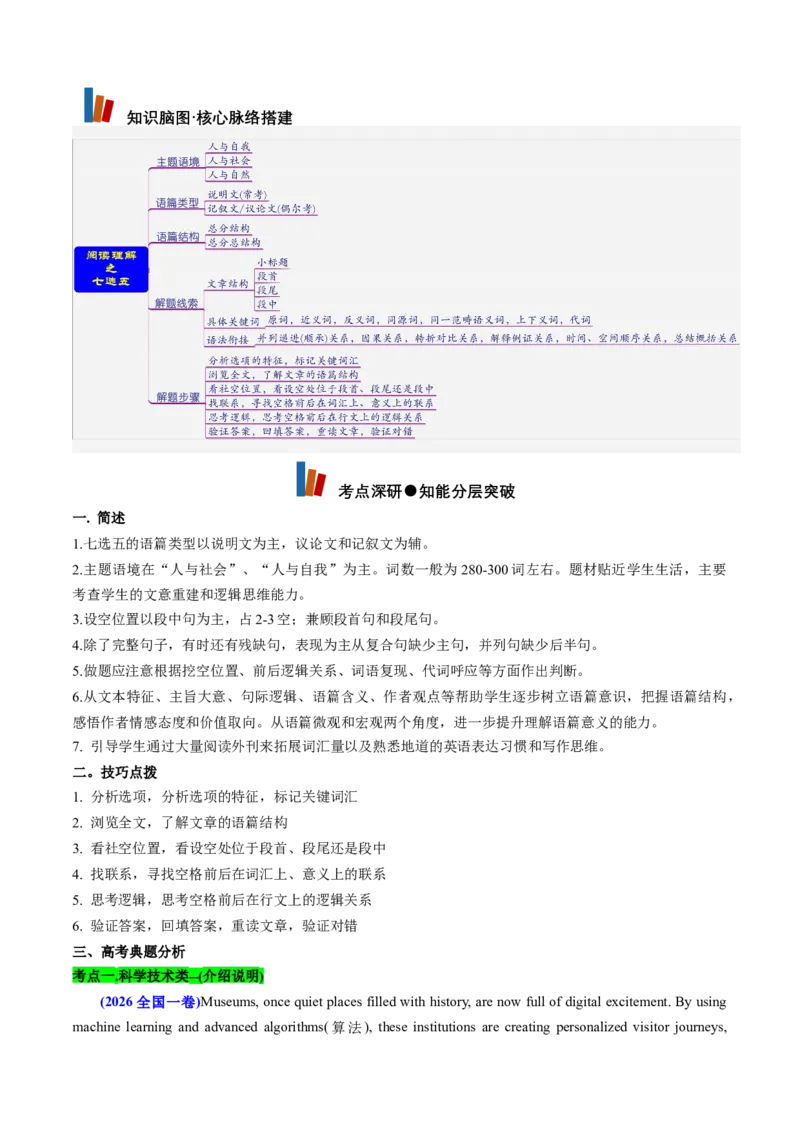
知识点1. 主题语境
知识点2. 语篇类型
知识点3. 语篇结构
知识点4. 解题线索
考点二 解题步骤
知识点1.分析选项的特征,标记关键词汇
知识点2.浏览全文,了解文章的语篇结构
知识点3. 看社空位置,看设空处位于段首、段尾还是段中
知识点4. 找联系,寻找空格前后在词汇上、意义上的联系
知识点5.思考逻辑,思考空格前后在行文上的逻辑关系
知识点6. 验证答案,回填答案,重读文章,验证对错
03优题精练·专题实战通关——精选优质试题,强化实战应用知识脑图·核心脉络搭建
考点深研●知能分层突破
一. 简述
1.七选五的语篇类型以说明文为主,议论文和记叙文为辅。
2.主题语境在“人与社会”、“人与自我”为主。词数一般为280-300词左右。题材贴近学生生活,主要
考查学生的文意重建和逻辑思维能力。
3.设空位置以段中句为主,占2-3空;兼顾段首句和段尾句。
4.除了完整句子,有时还有残缺句,表现为主从复合句缺少主句,并列句缺少后半句。
5.做题应注意根据挖空位置、前后逻辑关系、词语复现、代词呼应等方面作出判断。
6.从文本特征、主旨大意、句际逻辑、语篇含义、作者观点等帮助学生逐步树立语篇意识,把握语篇结构,
感悟作者情感态度和价值取向。从语篇微观和宏观两个角度,进一步提升理解语篇意义的能力。
7. 引导学生通过大量阅读外刊来拓展词汇量以及熟悉地道的英语表达习惯和写作思维。
二。技巧点拨
1. 分析选项,分析选项的特征,标记关键词汇
2. 浏览全文,了解文章的语篇结构
3. 看社空位置,看设空处位于段首、段尾还是段中
4. 找联系,寻找空格前后在词汇上、意义上的联系
5. 思考逻辑,思考空格前后在行文上的逻辑关系
6. 验证答案,回填答案,重读文章,验证对错
三、高考典题分析
考点一.科学技术类--(介绍说明)
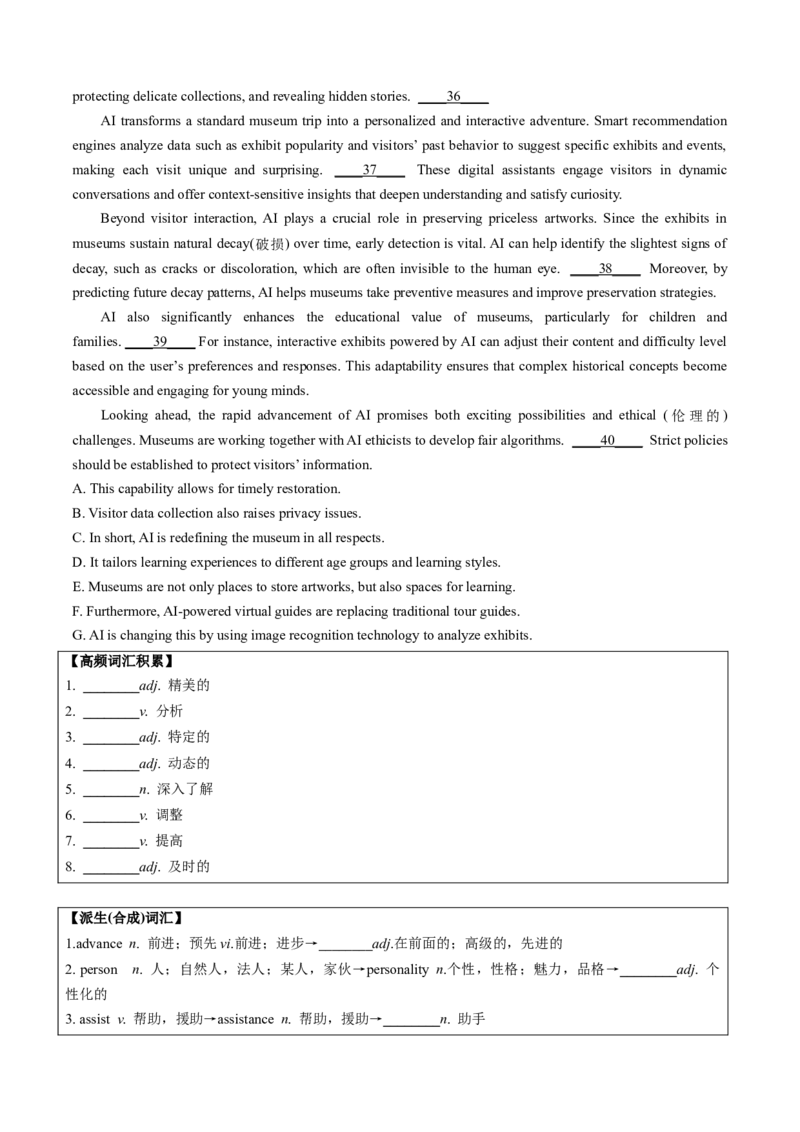
(2026全国一卷)Museums, once quiet places filled with history, are now full of digital excitement. By using
machine learning and advanced algorithms(算法), these institutions are creating personalized visitor journeys,protecting delicate collections, and revealing hidden stories. ____36____
AI transforms a standard museum trip into a personalized and interactive adventure. Smart recommendation
engines analyze data such as exhibit popularity and visitors’ past behavior to suggest specific exhibits and events,
making each visit unique and surprising. ____37____ These digital assistants engage visitors in dynamic
conversations and offer context-sensitive insights that deepen understanding and satisfy curiosity.
Beyond visitor interaction, AI plays a crucial role in preserving priceless artworks. Since the exhibits in
museums sustain natural decay(破损) over time, early detection is vital. AI can help identify the slightest signs of
decay, such as cracks or discoloration, which are often invisible to the human eye. ____38____ Moreover, by
predicting future decay patterns, AI helps museums take preventive measures and improve preservation strategies.
AI also significantly enhances the educational value of museums, particularly for children and
families. ____39____ For instance, interactive exhibits powered by AI can adjust their content and difficulty level
based on the user’s preferences and responses. This adaptability ensures that complex historical concepts become
accessible and engaging for young minds.
Looking ahead, the rapid advancement of AI promises both exciting possibilities and ethical (伦理的)
challenges. Museums are working together with AI ethicists to develop fair algorithms. ____40____ Strict policies
should be established to protect visitors’ information.
A. This capability allows for timely restoration.
B. Visitor data collection also raises privacy issues.
C. In short, AI is redefining the museum in all respects.
D. It tailors learning experiences to different age groups and learning styles.
E. Museums are not only places to store artworks, but also spaces for learning.
F. Furthermore, AI-powered virtual guides are replacing traditional tour guides.
G. AI is changing this by using image recognition technology to analyze exhibits.
【高频词汇积累】
1. ________adj. 精美的
2. ________v. 分析
3. ________adj. 特定的
4. ________adj. 动态的
5. ________n. 深入了解
6. ________v. 调整
7. ________v. 提高
8. ________adj. 及时的
【派生(合成)词汇】
1.advance n. 前进;预先vi.前进;进步→________adj.在前面的;高级的,先进的
2. person n. 人;自然人,法人;某人,家伙→personality n.个性,性格;魅力,品格→________adj. 个
性化的
3. assist v. 帮助,援助→assistance n. 帮助,援助→________n. 助手4. deep adj. 深的→________v. 加深
5. price n. 价格→________adj. 极珍贵的
6. color n. 颜色→________n. 变色
7. visible adj. 看得见的→________adj. 看不见的
8. adapt vi. & vt. (使)适应;改编→adaptation n. 适应→________n. 适应能力
9. restore v. 恢复(某种情况或感受);使复原,使复位;修复→________n. 修复
10. capable adj. 有能力的→________n. 能力
11. curious adj. 好奇的→________n. 好奇心
12. private adj. 私有的→________n. 隐私
【熟词生义】
1.engage v. ________
2.satisfy v. ________
3.power v. ________
【高频短语】
1. ________________在......关键作用
2. ________________总之,简言之
【长难句分析】
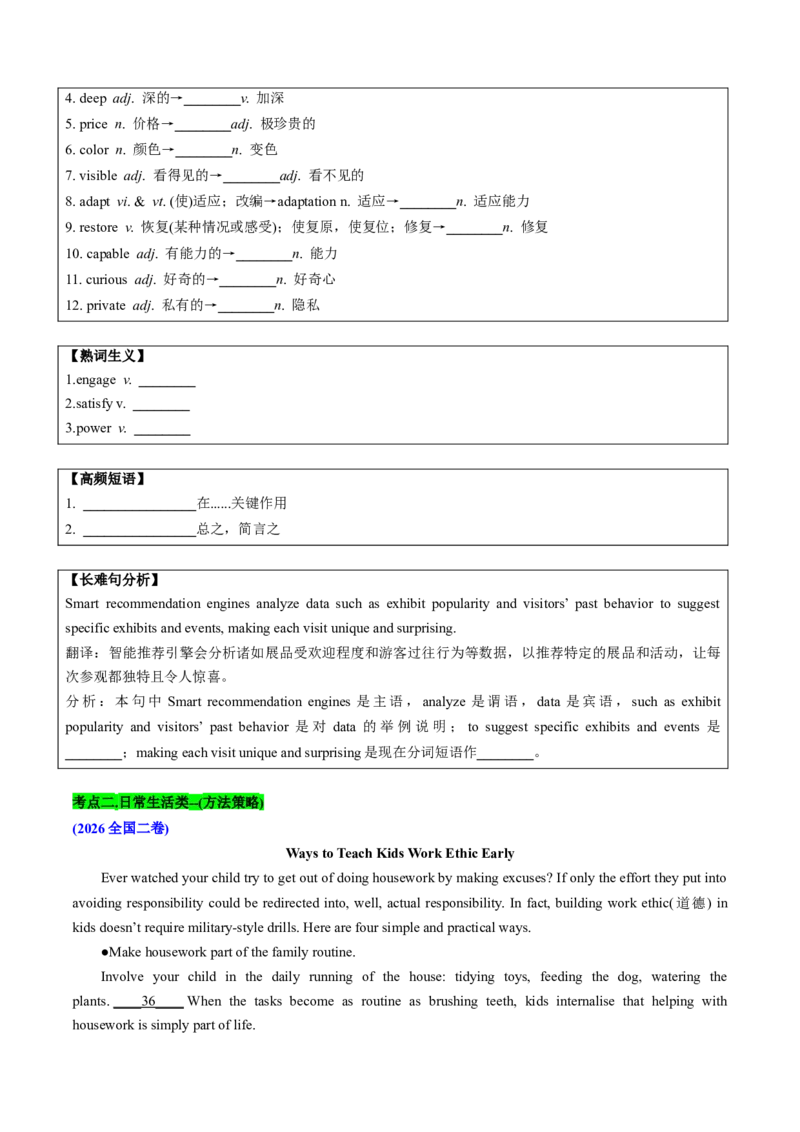
Smart recommendation engines analyze data such as exhibit popularity and visitors’ past behavior to suggest
specific exhibits and events, making each visit unique and surprising.
翻译:智能推荐引擎会分析诸如展品受欢迎程度和游客过往行为等数据,以推荐特定的展品和活动,让每
次参观都独特且令人惊喜。
分析:本句中 Smart recommendation engines 是主语,analyze 是谓语,data 是宾语,such as exhibit
popularity and visitors’ past behavior 是对 data 的举例说明;to suggest specific exhibits and events 是
________;making each visit unique and surprising是现在分词短语作________。
考点二.日常生活类--(方法策略)
(2026全国二卷)
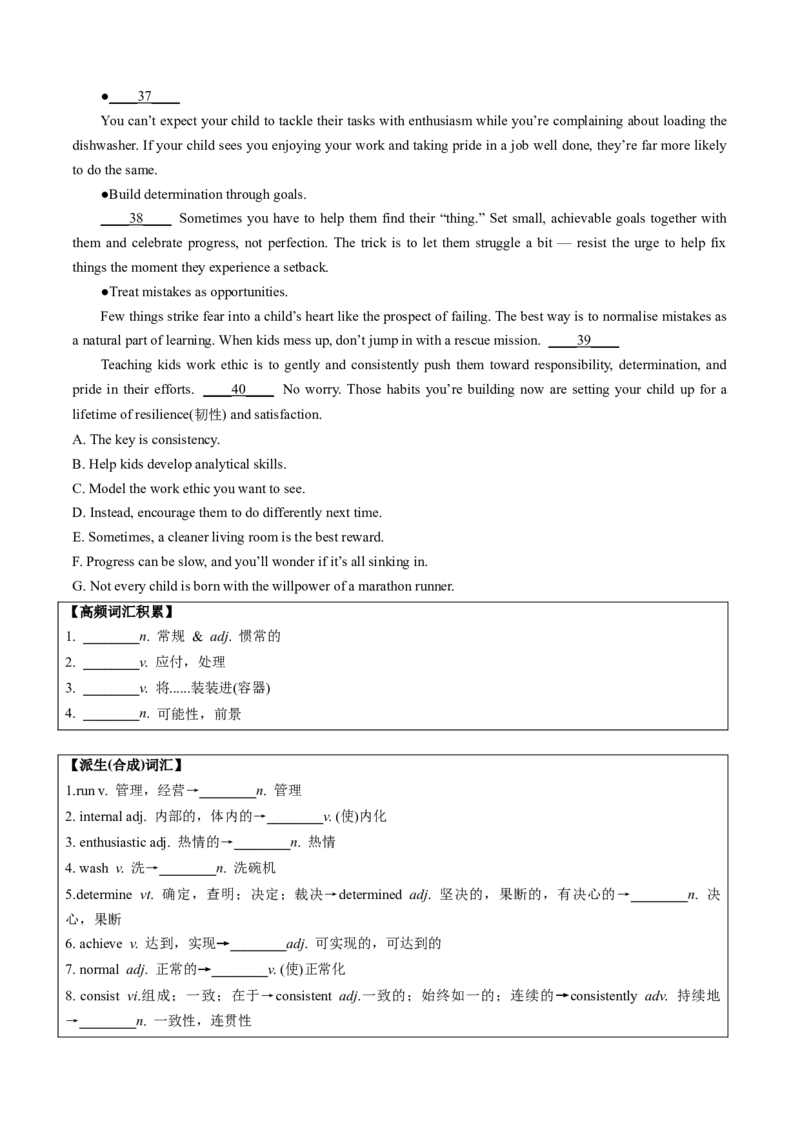
Ways to Teach Kids Work Ethic Early
Ever watched your child try to get out of doing housework by making excuses? If only the effort they put into
avoiding responsibility could be redirected into, well, actual responsibility. In fact, building work ethic(道德) in
kids doesn’t require military-style drills. Here are four simple and practical ways.
●Make housework part of the family routine.
Involve your child in the daily running of the house: tidying toys, feeding the dog, watering the
plants. ____36____ When the tasks become as routine as brushing teeth, kids internalise that helping with
housework is simply part of life.●____37____
You can’t expect your child to tackle their tasks with enthusiasm while you’re complaining about loading the
dishwasher. If your child sees you enjoying your work and taking pride in a job well done, they’re far more likely
to do the same.
●Build determination through goals.
____38____ Sometimes you have to help them find their “thing.” Set small, achievable goals together with
them and celebrate progress, not perfection. The trick is to let them struggle a bit — resist the urge to help fix
things the moment they experience a setback.
●Treat mistakes as opportunities.
Few things strike fear into a child’s heart like the prospect of failing. The best way is to normalise mistakes as
a natural part of learning. When kids mess up, don’t jump in with a rescue mission. ____39____
Teaching kids work ethic is to gently and consistently push them toward responsibility, determination, and
pride in their efforts. ____40____ No worry. Those habits you’re building now are setting your child up for a
lifetime of resilience(韧性) and satisfaction.
A. The key is consistency.
B. Help kids develop analytical skills.
C. Model the work ethic you want to see.
D. Instead, encourage them to do differently next time.
E. Sometimes, a cleaner living room is the best reward.
F. Progress can be slow, and you’ll wonder if it’s all sinking in.
G. Not every child is born with the willpower of a marathon runner.
【高频词汇积累】
1. ________n. 常规 & adj. 惯常的
2. ________v. 应付,处理
3. ________v. 将......装装进(容器)
4. ________n. 可能性,前景
【派生(合成)词汇】
1.run v. 管理,经营→________n. 管理
2. internal adj. 内部的,体内的→________v. (使)内化
3. enthusiastic adj. 热情的→________n. 热情
4. wash v. 洗→________n. 洗碗机
5.determine vt. 确定,查明;决定;裁决→determined adj. 坚决的,果断的,有决心的→________n. 决
心,果断
6. achieve v. 达到,实现→________adj. 可实现的,可达到的
7. normal adj. 正常的→________v. (使)正常化
8. consist vi.组成;一致;在于→consistent adj.一致的;始终如一的;连续的→consistently adv. 持续地
→________n. 一致性,连贯性9. set+ back= setback n. ________
10. will+ power =willpower n. ________
【熟词生义】
1.drill n. ________
2.trick n. ________
3.model v. ________
【高频短语】
1. get out of doing sth. ________________
2. put sth. into doing sth. ________________
3. redirect ... into…________________
4. involve sb. in sth. ________________
5. complain about sth. ________________
6. take pride in________________
7. be far more likely to do sth. ________________
8. resist the urge to do sth. ________________
9. the moment________________
10. strike fear into sb.'s heart________________
11. mess up________________
12. jump in________________
13. set sb. up for________________
14. sink in________________
优题精练●专题实战通关
考点一 方法策略(说明文)
Passage 1
(2025-2026学年河北衡水中学高三年级小学期期末综合素质评价)Shyness is a feeling of discomfort you
may have in social settings, preventing you from reaching personal or social goals. Are you a shy person? Does the
thought of having a conversation with a stranger make your stomach turn? 1 Just like any undesirable
characteristics, you can tackle shyness with the right tools.
2 Socially anxious individuals frequently have negative thoughts running through their heads. “I
look awkward,” “No one is talking to me,” or “I am going to look like a fool,” are all these thoughts. As you can
probably tell, these thoughts are all negative and will only serve to keep you feeling shy and self-conscious. You
can break the habit of negative thoughts by becoming aware of when you are falling victim to them and by
challenging their logic.
Be approachable. Would you approach somebody with a bitter expression on their face or with their head
down on their desk? Not likely. Our body language can allow others to make assumptions about us before we evenspeak. 3 Sit leaning(倾斜) forward in the direction of the person you are talking to, keep your legs and
arms open, and maintain a relaxed posture.
Give sincere compliments(赞扬). No need to be over the top. Some of the greatest conversations started
with “I like your shirt. Did you get it at that store?” 4 What’s more, you are guaranteed to walk away
with a smile because complimenting others makes you feel good too.
Take small steps. Try to make progress in small, easily broken down, and identifiable steps. This gives you
something new to learn every time, and you can proudly keep track of progress. Keep doing things like having
conversations with new people and seeking out opportunities to connect with others. 5
A. Adjust your mindset.
B. Focus your attention outward.
C. Feelings like these are common and are easy to overcome with practice.
D. Open body language sends a message to others that you are willing to interact.
E. Celebrate small wins, whether it is giving a few compliments or not.
F. They give others a positive impression of you because you made them feel good.
G. Your body language determines how people perceive you and how you perform.
Passage 2
(2026届江苏省苏州市高三5月考前学情自测英语试题)In the digital era, many people find it increasingly
difficult to stay focused on a single task. We are constantly interrupted by alerts and the urge to check our phones.
This phenomenon is often described as “fragmented attention”, where our minds jump from one thing to another
without deep engagement. 6
To tackle this, the concept of “Deep Work” has gained popularity. It refers to the ability to focus without
interruption on a mentally demanding task. 7 It allows you to master complicated information and
produce better results in less time. However, achieving this state requires more than just willpower.
8 Just as athletes train their bodies, you must train your brain to resist distractions(分心). Start by
scheduling specific “deep work” sessions in your calendar. During these times, turn off all notifications and move
your phone to another room.
Another effective strategy is “mono-tasking”. Many people believe they are good at multitasking, but
research shows that our brains aren’t wired for it. 9 When you switch between tasks, “attention residue”
occurs, meaning part of your focus remains on the previous task.
Finally, embrace boredom. 10 Instead of reaching for your phone during every free moment, let
your mind wander. This strengthens your “focus muscle” and makes it easier to engage in deep work when you
actually need to.
A. Such interrupted work patterns leave us mentally exhausted yet unproductive.
B. Constant multitasking actually reshapes the brain in the long term.
C. This focused mental state is a highly valuable skill in today’s workplace.
D. The real secret lies in cutting off all human contact in your spare time.
E. In reality, we are merely shifting our focus rapidly rather than dividing it equally.
F. People nowadays heavily rely on digital devices for entertainment.G. Training focus is more about environment control than self-discipline.
Passage 3
(2026 届湖北十堰市郧阳中学高三最后一次模拟考试英语试题)Which is more beneficial to English
learning, paper or electronic dictionaries? 11 Instead of taking sides blindly, learners should apply them
properly based on different learning stages and practical needs.
Paper dictionaries feature exploratory learning. When turning pages, you will unavoidably encounter new
words, phrases and typical sentences. 12 They also help deepen memory, as paper layout and physical
use strengthen long-term word recall. Besides, they offer complete collocation and style information without digital
distractions.
13 They allow instant word lookup without breaking your reading train of thought. Most are
equipped with audio pronunciation, personalized word lists and spaced repetition systems to facilitate efficient
vocabulary review. Top-grade ones are even connected to massive language corpora(语料库), revealing how certain
words are employed in real-life contexts.
Wise use of dictionaries lies in matching tools with learning tasks. For primary school students, paper
dictionaries serve as a good helper to develop basic dictionary-searching skills. 14 Senior high school
learners may rely mainly on electronic dictionaries for efficiency, while keeping a paper one at hand to check
confusing word usages in depth. College students can combine both, with electronic tools for quick inquiry and
paper ones for accurate writing.
Some universal rules should be followed to make the most of dictionaries: try to guess word meanings before
looking them up; turn to English explanations rather than Chinese versions; attach greater importance to example
sentences than simple definitions. By sticking to these good habits, you can achieve a perfect balance between
depth and efficiency. 15 All in all, dictionaries are merely learning tools. The ultimate goal is to cultivate
independent thinking and the ability to use words flexibly in diverse contexts.
A. But they have obvious drawbacks as well.
B. Such a heated debate has persisted for years.
C. Electronic dictionaries represent efficient learning.
D. This unintended exposure boosts vocabulary expansion.
E. Daily reading is the ideal occasion for us to consult dictionaries.
F. Also, you’d better review newly learned words at regular intervals.
G. Middle school students can use both fully for respective learning purposes.
Passage 4
(2026届河南驻马店经济开发区高级中学高三第二学期5月质量检测)Being a camp counselor(辅导员)
is an exciting and important job! You help campers have a lot of fun, learn new things, and feel safe. To be great at
it, you need the right skills and a positive attitude. These five tips will show you how to lead, listen, and create
amazing memories for everyone at camp!
Be enthusiastic in every activity. 16 Show enthusiasm to motivate the group, whether it’s an
exciting outdoor activity or a quieter indoor craft session. Even during activities that can seem less exciting, likerainy-day games, your enthusiasm can transform the experience.
Listen actively to your campers. Being a good listener is one of the most important features of a great camp
counselor. 17 When they share their thoughts or feelings, give them your full attention, and respond
thoughtfully. This builds trust and shows you care about them.
Be open to trying new things. Campers often look up to their counselors as role models. 18 Be
willing to try new activities, even if they’re outside your usual interests. Whether it’s attempting a climbing wall or
joining a dance-off, your willingness inspires your campers to do the same.
19 Campers often come up with creative ideas or suggestions for activities. Instead of dismissing
these ideas, take them seriously. Even when an idea doesn’t work out perfectly, the camper will feel valued
knowing their input matters.
Use positive language. The way you communicate with campers matters. Instead of focusing on what they
mustn’t do, guide them with positive instructions. For example, instead of saying, “Don’t run,” say, “Please walk.”
20
A. Encourage camper ideas.
B. Always be patient when resolving conflicts.
C. Campers want to feel heard and understood.
D. By doing so, your instructions are easier to remember.
E. This slight change makes them more likely to cooperate.
F. Your energy and excitement set the tone for your campers.
G. To encourage them to step out of their comfort zones, you need to do the same.
Passage 5
(2026届甘肃省武威市凉州区联考高三模拟预测英语试题)
Tips for Reading Effectively
Reading is a lifelong skill that everyone needs in study and daily life, but many people never learn to read
efficiently. They often spend plenty of time on reading yet gain little useful information. 21 Here are
several practical and easy methods to help you improve your reading skills.
Preview before reading. Spending one or two minutes previewing the article before reading is a good habit.
22 Look at headings, subheadings, pictures, charts and the first sentence of each paragraph. This simple
operation helps you get a general idea of the whole passage and know what the text is mainly about.
Adjust your reading speed flexibly. There is no need to read every single word slowly. Slow down for
difficult and key parts that need deep understanding; skim quickly for trivial details and main ideas. 23
Take notes while reading. It is helpful to write down key points, core information or your own questions
during reading. 24 It can help you focus your attention and sort out the text logic clearly.
Review regularly after reading. Go over what you’ve read within 24 hours to deepen your memory and
understand the content better. 25 Only reading with clear purposes can bring you real progress.
A. It’s a waste of time to read without a purpose.
B. Many students read word by word, which is slow.
C. Previewing takes only a few minutes but saves time later.D. Good readers know when to speed up or slow down.
E. You can also underline important information and key sentences.
F. Reading is one of the best ways to gain knowledge.
G. Without effective strategies, reading can be slow and tiring.
考点二 介绍说明(说明文)
Passage 1
(2026 届江苏省南通市海安高级中学 5 月高三年级阶段性学情测试英语试题)In everyday
communication, we exchange not only logical information but also emotions, attitudes and inner states. Since
human beings are emotional creatures, our decisions, whether significant or trivial, are often driven more by
emotions than by pure reason. Therefore, to express strong emotions clearly, we tend to use words like very, so and
truly in daily language. 1
Verbal intensifiers(强化词) are special function words that enhance the meaning, especially the emotional
meaning of the words they are attached to. 2 According to Buzarov (1998), intensification is a stable and
vital feature of informal language. Words such as awfully, deeply, tremendously, and truly help speakers strengthen
emotional impact and influence listeners’ psychological perception.
3 In English, we often say “I am deeply grateful” or “He is dead tired.” Other languages also have
similar words: очень in Russian, sehr in German, très in French. Some new intensifiers are even created by
combining words, like fantabulous from fantastic and fabulous.
To make the most of intensifiers, we should use them with a clear purpose. Do not use them mindlessly. 4
Connect them with your genuine attitude and focus on conveying precise emotions. This way, appropriate use of
intensifiers will make our words more powerful and sincere.
Intensifiers, like any other linguistic tool, work best in the right context. 5 However, overusing
them without necessity will only weaken their expressive effect and make our words sound empty. Mastering them
wisely helps us become more proficient and persuasive communicators.
A. Proper use is a smart linguistic choice.
B. These function words have great expressive value.
C. You’d better use them to express real ideas and emotions.
D. Using intensifiers at will influences emotional expression.
E. Intensifiers are used to simplify the meaning of other words.
F. This is why verbal intensifiers have emerged in languages worldwide.
G. They are commonly employed across languages and take on diverse forms.
Passage 2
(2026 届湖北省黄冈市黄冈中学高三英语标准考试题)We all experience moments like this: a friend
doesn’t reply to your message, or someone walks right past you without noticing. Most people move on quickly, but
for those who are sensitive to rejection, these small moments feel heavy. 6 .
Rejection sensitivity means often expecting others to reject you, even when there is no real sign of it. People
who think this way pay too much attention to others’ words, tone, or silence. A late reply can feel like “They don’tlike me,” and a serious face may seem like “They’re upset with me.” Because of this fear, they try to protect
themselves by avoiding eye contact, keeping quiet, or pulling away. 7 — sometimes creating the very
rejection they were afraid of. The good news is that gentle, intentional habits can help.
Challenge your first reaction. Feelings are not facts. When your mind jumps to the worst explanation, pause
and ask: What else could this mean? 8 . Try writing down at least two neutral(中性的) possibilities before
accepting the negative one. This simple practice helps calm emotional overreaction.
Express your needs openly. People with rejection sensitivity often hide their feelings, hoping others will
understand without being told. 9 . Try speaking clearly and kindly: “When I didn’t hear back, I felt a bit
unsure. Could we talk later?” Honest communication builds trust and reduces unnecessary worry.
10 . If someone reaches out to you, offer a small sign of openness — a smile, a short reply, or a
simple “thank you.” These small gestures show that you welcome connection. Over time, they help soften the habit
of pulling away.
A. Pursue stronger bonds with others
B. But silence easily causes confusion
C. Respond warmly when others show care
D. They are always searching for ways to relieve their anxiety
E. Sadly, this distance can make them seem cold or unfriendly
F. They may immediately assume something is wrong with them
G. Perhaps the other person is busy, stressed, or simply distracted
Passage 3
(2026届湖南长沙市知源中学高三全真模拟适应性考试)In the digital age, academic research leans heavily
on online resources, yet sifting through the vast data to find credible, relevant info can be tough. Here are some
balanced guides.
Define your research question clearly. A focused, specific question — say, narrowing “technology and
education” to “mobile apps and high school math scores” — keeps you from wandering into irrelevance.
____11____ This clarity saves time on materials that don’t serve your thesis.
Pick the right tools. General engines like Google work for basics, but academic databases (Google Scholar,
JSTOR) are better for scholarly work. ____12____ Unlike general sites, which mix in blogs and non-academic
content, these databases prioritize peer-reviewed, expert-vetted papers — critical for building strong arguments.
Use precise keywords. Broad terms flood results; break your question into specific concepts. ____13____
For “social media’s impact on teens’ mental health,” combine “social media,” “mental health,” and “adolescents”
with “AND” to narrow things down.
Evaluate sources carefully. Check authors’ expertise (are they field experts?) and publication dates —
____14____ In fast-moving fields like tech or medicine, older sources might miss recent findings. Also, follow
citations(引用) in sources to find related studies.
Take organized notes as you gather info. ____15____ Jot down key points and source details (authors,
dates, titles) to make referencing easier later. Tools like Goodnotes help keep notes neat.
Cross-verify critical info across sources. A key fact or argument needs support from several reputable worksto strengthen your paper’s validity (有效性) and show thorough research.
A. Using same-meaning or related terms can also expand your search results.
B. Avoid relying on one source for important information.
C. Take time to understand the boundary of your research before diving in.
D. They are designed to separate out non-academic content and prioritize quality.
E. Make sure to record not just the information but also the source details.
F. Narrowing down your focus early on will save you a lot of time later.
G. Older sources may not reflect the latest developments in your field.
Passage 4
(2025-2026学年福建厦门市同安实验中学高三下学期第四次月考)In Jingdezhen, known as China’s capital
of porcelain, a quiet change is taking place. The city now offers visitors more than just finished porcelain products.
___16___
The experience follows a clear process guided by skilled artisans. Visitors first roll the clay to remove the air
inside and make it soft. Then, at a turntable, they shape the material with their hands and cups, bowls or small vases
slowly take form. ___17___ After shaping, they add colors or words to the work, which is then fired in a kiln(瓷
窑). Days later, it is mailed to their home, bringing a pleasant surprise.
This kind of experience differs greatly from buying a finished product. A store product may be perfect. It
offers little emotional connection, though. ___18___ Every small imperfection — an uneven edge or a fingerprint
— tells a story. The waiting time adds meaning. When the package finally arrives, opening it feels like meeting an
old friend. Pride and joy come from the whole-hearted dedication.
___19___ During the process, local artisans share knowledge of traditional techniques. Ancient skills become
real and touchable. Visitors learn about the seventy-two steps of porcelain making, gaining a deep insight into this
time-honored Chinese craft.
Today, pottery workshops have grown into a popular highlight of Jingdezhen’s cultural tourism. ___20___
More importantly, they connect visitors to tradition in a meaningful way.
A. The process takes patience and focus.
B. It invites them to create their own china.
C. It also integrates tradition into technology.
D. That’s because it never bears your own touch.
E. They meet people’s desire for hands-on experiences.
F. But a self-made piece is heavy with unique memories.
G. The experience helps build a living link to cultural roots.
Passage 5
(2026届浙江宁波市镇海中学高三下学期模拟预测英语试题)
Chasing colors
When you grow too familiar with the city you live in, it’s easy to overlook the scenery during your daily
walks. But what if your next footstep came with a small twist — following a specific color as your guide?This idea, known as a “color walk”, has recently gained popularity on social media both in China and abroad.
____21____
As the trend spreads, many netizens have begun sharing photos online, while some cities have released color-
walk guides for residents.
____22____ In Shenzhen, Guangdong province, for example, those searching for pink might find
bougainvillea in Shenzhen International Garden and Flower Expo Park, or trumpet-shaped flowers along parks and
roads. ____23____
But beyond the colors themselves, this simple activity may also lead to unexpected discoveries. ____24____
“After a whole day of color walking, the world felt brand new,” one netizen wrote on Sina Weibo. “Places I used to
overlook suddenly seemed worth noticing — a yellow bicycle under a tree, or a yellow taxi parked behind a
house.”
____25____ Sometimes, all it takes is a single color to turn an ordinary walk into a small act of rediscovery.
A. Participants choose a single color and challenge themselves to spot objects, buildings, and scenery in that hue
along the way.
B. In Yichang, Hubei province, nearly 40,000 square meters of rapeseed blossoms form a bright yellow sea beneath
the blue sky.
C. Many find that this focused observation brings back a sense of freshness to familiar routes.
D. This practice turns an ordinary walk into a more engaging and mindful experience.
E. It encourages people to see their surroundings from a different angle.
F. City governments are also using this trend to promote local tourism.
G. The idea was first introduced by an artist in the United States.
考点三 其他文体(记叙文+议论文)
Passage 1
(2026年江苏徐州市5月考前模拟预测高三年级试题英语试卷)
My Quiet Green Escape in the City
I had driven past a local park in Melbourne many times without stopping. Then one morning in 2022, I was
stuck in heavy traffic and saw soft mist rising from the trees in the early sunlight. The peaceful view instantly lifted
my mood and eased my stress about the busy day ahead. At that moment, I decided to pause and visit the park at
least once a week during my commute. 1 .
The very next day, I left the busy road, parked my car and walked into the quiet green space. I passed a large
sports field where dogs run around and small birds fly low over the grass. Further inside, there is a calm pond home
to ducks and slow-moving turtles. 2 . It creates a quiet natural corner hidden from the noisy city.
When I reach my favourite quiet spot deep in the park, all traffic noise and work worries completely
disappear. I stand under a tall old eucalyptus tree surrounded by young small trees. 3 . I have visited so
many times, and I have found every season brings different natural smells to this special place.
I once flew over green countryside in a hot-air balloon and heard bees buzzing around flowering treetops.
4 — with sweet honey smells from falling eucalyptus flowers and fresh sharp citrus scents from young plants.
In summer, strong natural oil from the trees fills the air, a gentle reminder of local bushfire risks. Autumn bringsfresh earthy mushroom smells, and winter rain falling through leaves smells soft and sweet.
5 . I saw small beautiful gardens even beside busy railways when I travelled abroad. No one can fully
explain why green nature calms our minds, but it is the true colour of life and growth. Grey concrete city areas
cannot nourish our hearts. I truly advise everyone to find a small wild green place nearby, change your daily route a
little, and spend a few quiet minutes breathing peacefully in nature.
A. In spring, my park feels just the same
B. I have kept this promise to myself ever since
C. Natural green spaces comfort people everywhere
D. The beautiful ponds and lands deeply touched me
E. The park view eases tiredness emotion from work
F. Around it, wild plants grow freely with no human disturbance
G. I close my eyes, take slow deep breaths and always feel calm and relaxed
Passage 2
(2026年浙江宁波市镇海中学 5月高三高考模拟英语试题)I have always loved to travel and experience
new things and for many years my travels were one big checklist with flights from city to city, “must-do lists” and
pins on Google maps. 6 Maybe it started after the pandemic, when we were all forced to learn to
appreciate the little things in everyday life. Or maybe I have always had some slow travel tendencies in me.
7 Not rushing with a pre-determined plan, but taking the time to get to know the area. Having time
to wander casually along towards the little handwritten sign and not just visiting popular scenic spots. What I
discovered when I started to slow down, was that I SAW more. I found small family vineyards that no guidebook or
influencer would ever discover. I had time to talk to the people I met, and I took the time to sit down at a small cafe
that no one would ever recommend. 8
One thing I have also discovered, as a result of my slower travel, is that I very rarely book my trips far in
advance these days. A good example is this summer’s road trip, where the route and final destination in France
were decided two days before departure. There was no must-do list to check off, there were no map pins that
needed to be visited. 9 What we managed to do, we managed to do. What we didn’t manage to do, we’ll
do next time. It’s always possible to go back to a destination that you don’t feel finished with — one of the reasons
why I’ve visited Australia six times and will probably never feel finished with that country.
Another aspect that is important for the future of travel is sustainability. Staying longer in one place lowers
carbon emissions, helps boost local economy and lets you enjoy authentic local life. You also have more time to
walk and cycle instead of driving. Fewer transports, fewer international chains, fewer travel days. 10 Is
slow travel perhaps also a counter-reaction to flight shame, environmental anxiety and consumerism?
A. It is wise to make full preparations before setting off.
B. It feels good for both the environment and your wallet.
C. Yet gradually I changed my way of travelling unconsciously.
D. I used to attach great importance to taking beautiful travel photos.
E. For me, slow travel is about getting to know a place a little more thoroughly.
F. I experienced more, felt more and became more focused on the present moment.G. Every day on site I found a few new places that I wanted to visit and experience.
Passage 3
(2026届湖北黄冈市黄梅县育才高级中学高三考前模拟预测英语试题)I used to wake up and check my
phone. Before my feet hit the floor, I was already deep in the day’s chaos: headlines, comments, breaking news
alerts. Doomscrolling(刷屏成瘾) had become my morning routine. 11 I started each day tense and
anxious. So I gave myself a quiet dare: no phone in the morning, for five straight weekdays.
Naturally, breaking the habit wasn’t easy. The first morning, I reached for my phone automatically. I stopped
myself and picked up a book instead. It felt odd, like trying to enjoy coffee without caffeine (咖啡因). But after a
few pages, I found myself actually relaxed — not the emptiness of a scroll, but something steadier. 12
That had never happened before.
Encouraged by the quiet start, I explored other ways. The next day I tried a cold shower. I wanted something
that would force me fully awake. The shock factor was incredibly effective. 13 On Wednesday, I went for
a run. I hated every step at first. But I came back awake, warm and proud. That feeling powered me through the
day.
14 On Thursday, I journaled. No audience, just thoughts on paper. It felt honest, if not particularly
exciting. On Friday, I reread an old letter and let the memories surface. It was quiet, uneventful and grounding.
By the end of the week, the urge to check my phone had weakened. 15 Those phone-free
mornings proved a quieter start was possible: no noise or half-truths. It’s not about perfection, but freedom from the
scroll and the misinformation it feeds into our minds.
A. But lately, I noticed the weight it carried.
B. This left my mind surprisingly clear afterward.
C. I even finished a chapter before checking the time.
D. That meant I stopped grabbing my phone on waking.
E. It made me realize how popular phones are nowadays.
F. Some mornings I spent more time reflecting than moving.
G. It revealed the link between my phone use and daily anxiety.
Passage 4
(2026届浙江宁波市镇海中学高三模拟预测11英语试题)
Small Talk: More Than Just Chit-Chat
People often complain about small talk, describing it as “painful” or “dishonest”. 16 However, this
common opinion fails to recognize the true value of small talk in our daily interactions.
As a matter of fact, small talk serves as an essential social “safety zone”. 17 According to etiquette
expert Lizzie Post, discussing light topics like hobbies or recent events establishes initial harmony. This foundation
makes it easier to transition to more substantial conversations later, whether in a work setting or a new friendship.
Some argue that small talk is boring, but this often reflects poor communication skills rather than a flaw in
the activity itself. Effective small talk requires genuine engagement. 18 This means putting away your
phone, making eye contact, and actively turning into the other person’s reactions. If they lean in and smile at atopic, you can explore it further; if they glance away or give short answers, politely shift to a new topic or invite
them to share their own perspective.
19 During a two-hour flight, I began with simple talk about travel plans with my seatmate. Gradually,
both of us felt more comfortable opening up to each other. This casual start eventually led to a meaningful
discussion about life changes and personal growth. We reached this depth precisely because we started with
accessible, low-pressure topics.
Small talk isn’t about being superficial — it’s a practical social tool that facilitates human connection. 20
In fact, it smooths our daily social encounters and opens doors to deeper conversations that might never occur
otherwise. Without these simple, everyday exchanges, our social interactions would feel much more awkward and
less satisfying.
A. Its value, however, is often overlooked.
B. It demands full presence and careful observation of the other person.
C. They generally claim it lacks depth and avoids meaningful topics.
D. Consider this real-life example from my own experience.
E. Good small talk depends on more than just the words you say.
F. Without proper skills, small talk can feel shallow and forced.
G. It creates a comfortable atmosphere before deep conversations begin.
Passage 5
(2025-2026学年浙江宁波市镇海中学高三上学期模拟预测)Psychologists and researchers have reached an
agreement: personal growth is not about avoiding pain, but about continuous struggle and transformation. 21
Many people mistakenly view life as a smooth journey, a belief that gradually weakens their courage and inner
strength. Yet the moment we start facing, accepting, and growing from hardships, we rediscover the true strength of
the human spirit.
Many people today feel stuck in life, especially when confronting setbacks, failures, or emotional pressure.
22 They escape from challenges, avoid difficulties, and give up easily without self-reflection. Modern
psychology shows that genuine maturity only occurs when people connect painful experiences with their own
thinking, thereby developing new inner strength. A recent study of more than 15,000 people across different age
groups found that those who consistently faced difficulties bravely and grew through pain achieved significantly
better long-term mental health. 23
The true source of this inner strength lies in what psychologists call “dark resilience”. It breaks through the
limitations of a comfortable life, transforming passive avoidance into active growth. 24 Instead of merely
running from pain, wise people constantly ask themselves: “Why did this happen? What can I learn? How can I
become stronger?” — transforming struggle into strength. This mindset helps them rebuild their world, discover
new rules of life, and cultivate their own unique inner power. In a complex and uncertain world, the ability to grow
from pain is far more valuable than the pursuit of simple happiness.
25 Once you take this step, you will not only become more mature, but also shape a strong, brave and
resilient mind for life. The future belongs not to those who avoid pain most skillfully, but to those who grow and
transform through it bravely.A. Embrace pain as your teacher, and cultivate your inner dark resilience.
B. They believe that happiness means a life free from any trouble or difficulty.
C. This shows that avoiding pain brings only short-term comfort but long-term weakness.
D. This pattern of growth through struggle reveals the very essence of real inner strength.
E. They feel anxious and depressed, yet fail to recognize that pain is a natural part of growth.
F. This view, however, is often overlooked by those who expect life to be easy and comfortable.
G. It teaches people to see difficulties not as punishments but as opportunities to grow stronger.
Passage 6
(2026 届江西三九校联考高三联合质量检测英语试题) When Lila moved to her grandmother’s old
neighborhood for the summer, she immediately noticed one thing: a dull, gray wall at the street corner. Having
studied studio art for three years, she felt the empty space was wasting its potential. What if it could become
something that tied the whole community together? She carried the idea around for a week before taking the first
step. 261 At first, she worried that local people would show little interest. She printed simple posters and
stuck them around the block, inviting anyone to share their ideas for the wall. 27 To her surprise, replies
poured in within three days. Retired teachers wrote about local history, and kids sent in drawings of cats and birds
they saw every day.
The painting work started on a sunny Saturday morning. People of all ages showed up with paintbrushes in
their hands. Elderly residents sat on folding chairs, telling stories of the neighborhood 50 years ago while younger
people turned their memories into pictures. 28 Bright flowers, historic shop fronts and playful animals
slowly covered the once-gray surface.
When the mural was finished, the street corner became a totally different place. Passers-by would slow down
to look at the pictures, and many stopped to take photos. 29 Strangers who had never spoken before
started chatting about the stories behind the painting. The wall, once just a forgotten part of the street, became a
shared treasure.
Lila learned a big lesson from the project. Art does not only belong in expensive galleries. It can live on a
street corner and touch ordinary people’s daily lives. 30
A. Each person added their own small touch to the work.
B. She won a big prize for the community art project.
C. Neighbors began to connect with each other more.
D. She expected only a few replies at most.
E. The local government paid for all the painting materials.
F. That is the true power of public art in ordinary life.
G. She decided to ask the community for ideas first.