专题10 词根词缀词汇→ 【 暴力速记·词根书】(专项训练)
目  录
单词·拼写演练...............................................................................................................................................................1
基础·阅读演练...............................................................................................................................................................5
拔高·阅读演练.............................................................................................................................................................24
真题·阅读演练.............................................................................................................................................................45
 单词·拼写演练
01 题目:写出单词 sustainable 的中文含义
答题区:________________________
02 题目:中文词义“创新的;革新的”,写出对应英文单词
答题区:________________________
03 题目:写出单词 preservation 的中文含义
答题区:________________________
04 题目:中文词义“普及;人气”,写出对应英文单词
答题区:________________________
05 题目:写出单词 harmonious 的中文含义
答题区:________________________
06 题目:中文词义(名词)毅力;坚韧不拔,写出对应英文单词
答题区:________________________
07 题目:写出单词 disapproving 的中文含义
答题区:________________________
08 题目:中文词义“不可或缺的;必不可少的”,写出对应英文单词
答题区:________________________
09 题目:写出单词 irrational 的中文含义
答题区:________________________
10 题目:中文词义(名词)发展;进展,写出对应英文单词
答题区:________________________
11 题目:写出单词 unreliable 的中文含义
答题区:________________________
12 题目:中文词义“可接受的;合格的”,写出对应英文单词
答题区:________________________
13 题目:写出单词 regret 的中文含义(动词/名词)
答题区:________________________
14 题目:中文词义(名词)邀请,请写出对应英文单词
答题区:________________________
15 题目:写出单词 significant 的中文含义
答题区:________________________
16 题目:中文词义“持久的;长久的”,写出对应英文单词
答题区:________________________
17 题目:写出单词 contaminated 的中文含义
答题区:________________________
18 题目:中文词义(名词)资源,写出对应英文单词(复数常用)
答题区:________________________
19 题目:写出单词 traditional 的中文含义
答题区:________________________
20 题目:中文词义“包容;宽容(名词)”,写出对应英文单词
答题区:________________________
21 题目:写出单词 invisible 的中文含义
答题区:________________________
22 题目:中文词义(动词)区分;分离,写出对应英文单词
答题区:________________________
23 题目:写出单词 economical 的中文含义
答题区:________________________
24 题目:中文词义(名词)平衡,写出对应英文单词
答题区:________________________
25 题目:写出单词 misjudge 的中文含义
答题区:________________________
26 题目:中文词义“可再生的”,写出对应英文单词
答题区:________________________
27 题目:写出单词 accomplishment 的中文含义
答题区:________________________
28 题目:中文词义(形容词)消极的;负面的,写出对应英文单词
答题区:________________________
29 题目:写出单词 illogical 的中文含义
答题区:________________________
30 题目:中文词义(名词)沟通;交流,写出对应英文单词
答题区:________________________
 基础·阅读演练
(2026·四川雅安·一模)Things to Do at the Jersey Shore This Fall
When the calendar flips from August to September, people who live along the Jersey Shore delight in what
they call “local summer”. While not every day is warm enough for leisurely relaxing in a beach chair, there is no
better time to enjoy a walk along an uncrowded beach.
Here are some great ways to enjoy fall at the Shore.
Flock to Cape May to Go Birding
Each October, for the fall migration, birds and birders fly in from all over North America to the town that
National Geographic calls one of the world’s top 10 bird-watching destinations. Join the faithful at the Cape May
Hawkwatch to recognize different species, particularly during the Cape May Fall Festival, which runs October 16-19
and features talks, trips and more events.
Watch Whales Migrate Off the Coast
As the water cools, humpback whales breach (跃出水面) and flap their tails off the Jersey Shore as they
head south to the Caribbean. Through November, regular whale-watch cruises for tourists are offered by Cape
May Whale Watch Center.
Bring the Kids to Storybook Land
Perhaps because it’s a throwback (怀旧风格的事物) to an earlier era or Storybook Land knows how to
throw a party, families gather on this amusement park for the Fall Into Fun Festival, featuring hayrides, a pumpkin
patch and a maze. The one-price admission also includes unlimited rides for younger children, along with
storybook attractions.
Climb a Lighthouse
With the restored Barnegat Lighthouse reopened, there’s no better time than fall to visit lighthouses,
enricularly October 18-19 for the Lighthouse Challenge, which encourages people to visit 11 lighthouses, four
lifesaving stations, and one museum in two days.
1.What can we learn about the Cape May Fall Festival?
A.It lasts for a whole week.
B.It offers various activities.
C.It is held at a whale-watch center.
D.It promotes different wildlife study.
2.Which is probably the best choice for family gatherings?
A.Storybook Land.
B.Barnegat Lighthouse.
C.Cape May Hawkwatch.
D.Cape May Whale Watch Center.
3.Who is the passage intended for?
A.Locals seeking for leisure shore activities.
B.Scientists researching whale migration routes.
C.Visitors enjoying a walk on a beach in peak season.
D.Travelers wanting to witness lighthouse restoration.
(2026·河北·模拟预测)TEEN SUMMER ART WORKSHOPSDESCRIPTION
We’re so pleased to offer specially-tailored art workshops as a unique feature for young artists to develop their
artistic knowledge and skills in FIVE different workshops! Choose one, or take all five — and learn skills for a
lifetime! Each workshop is a separate class, so students are welcome to join as many as they like. Under the
guidance of our instructor Hayley Mayne, students will explore diverse subjects and painting techniques in a way
that suits their own interests. We are excited to offer the following courses: Colorful Portraits, Water Reflections,
Portraits with Feelings, Shiny, Reflective, and Wild Animal Painting.REQUIREMENTS
Due to the nature of this art-improving program (middle/ advanced), we suggest each student have at least two
years of previous experience at CCAS (after-school program), or one year of high school art, in order to make sure
they have basic knowledge of art materials, as well as a basic understanding of art elements and principles. Class
size is limited and designed to help meet the needs of each student.WHAT TO BRING
Please bring a snack, lunch, water bottle and sketchbook (can be purchased upon registration for $15), and all
other art supplies are provided.2026 DATES & THEMES
Workshop
Date
Theme
1
June 12
Vivid Faces; Colorful Portraits and Expression
2
June 19
Liquid Light and Reflections
3
July 10
Shine and Shadow; Painting the Reflective
4
July 17
Into the Wild; Dynamic Animal Painting
5
July 24
Mood and Movement; Abstract Emotion in Color
6
July 31
City Perspective Drawing
Sessions are on Friday from 10 a.m. to 2:30 p.m. — $125/ Day
REGISTER NOW
4.What makes the art workshops stand out?
A.Professional tutors.
B.Personalized choices.
C.Five separate art classes.
D.Useful lifelong skills.
5.What are the students advised to do before signing up?
A.Join small-sized art classes.
B.Submit a portrait work.
C.Gain related art experience.
D.Prepare basic art materials.
6.When is suitable for a student fond of animal portraits?
A.June 12.
B.June 19.
C.July 17.
D.July 24.
(2026·河北沧州·三模)News podcasts give listeners a detailed insight into the news, all on their own time
schedule. We’ve rounded up our top picks below to help you get stuck in.Your Daily Drive
Available in most of the English-speaking world, “Your Daily Drive” is perfect for the relatively casual news fan who
wants an overview of current affairs with their tunes. In other words, it’s basically a breakfast and/or drive time
radio show. The news content is pulled together from The Wall Street Journal, NPR, PRI and local news partners,
while the songs are based on your listening habits — your own personalised radio show!Today, Explained
“Today, Explained” is Vox’s daily news explainer podcast. Hosts Sean Rameswaram and Noel King will guide you
through the most important stories of the day. It is worth noting that it is a deeper analysis of the day’s news,
picking up and more thoroughly exploring the stories behind the stories.World Story of the Day
If you want to broaden your news diet a bit but you don’t have the time to be listening to long international
feature shows, “World Story of the Day” is perfect, a sub-ten-minute daily news hit that brings a story from around
the globe, generally — but not always — with a focus on what’s making international headlines.The Globalist
     If you’re looking for a serious international daily global news program to start your day, then “The Globalist” is
a pretty solid recommendation. It offers a broad and informed overview of the day’s global news, including a
review of Europeˈs front pages. Itˈs a relatively conventional 60-minute news show that you can listen to live at 7
am GMT/8 am CET, but all episodes are available for download globally.
7.What can we learn about Your Daily Drive?
A.It focuses on local news.
B.It combines news with music.
C.It is available all over the world.
D.It presents news stories in a serious way.
8.What do World Story of the Day and The Globalist have in common?
A.Their programs last 60 minutes.
B.They centre on European news.
C.Their programs can be downloaded.
D.They deliver news from around the world.
9.Which news podcast has a deep look at the day’s news?
A.Your Daily Drive.
B.Today, Explained.
C.World Story of the Day.
D.The Globalist.
(2026·浙江杭州·三模)The Grand Canal Cultural Heritage Digital Museum
Welcome to the Grand Canal Cultural Heritage Digital Museum, a premier institution dedicated to preserving and
showcasing the history of China’s UNESCO World Heritage site, the Grand Canal. Opened in June 2021 in
Yangzhou, the museum combines cutting-edge technology with rich historical narratives to bring the canal’s story
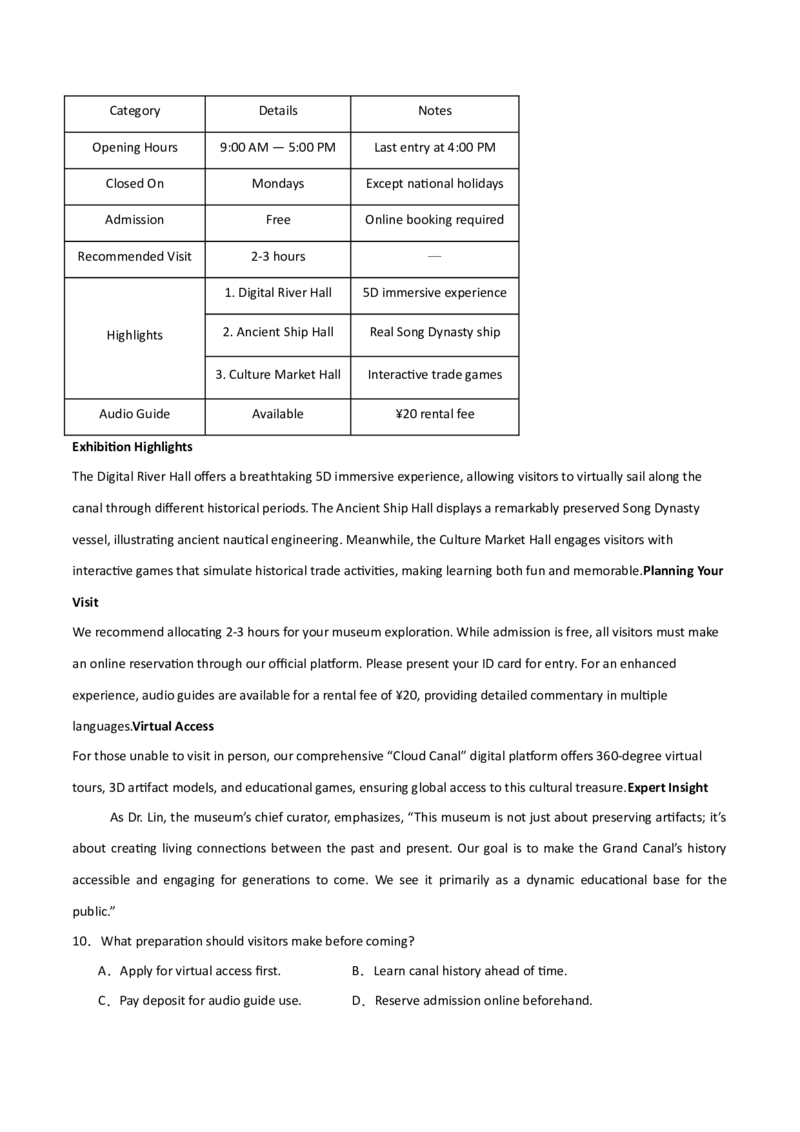
to life.Visitor Guide at a Glance
Category
Details
Notes
Opening Hours
9:00 AM — 5:00 PM
Last entry at 4:00 PM
Closed On
Mondays
Except national holidays
Admission
Free
Online booking required
Recommended Visit
2-3 hours
—
Highlights
1. Digital River Hall
5D immersive experience
2. Ancient Ship Hall
Real Song Dynasty ship
3. Culture Market Hall
Interactive trade games
Audio Guide
Available
¥20 rental fee
Exhibition Highlights
The Digital River Hall offers a breathtaking 5D immersive experience, allowing visitors to virtually sail along the
canal through different historical periods. The Ancient Ship Hall displays a remarkably preserved Song Dynasty
vessel, illustrating ancient nautical engineering. Meanwhile, the Culture Market Hall engages visitors with
interactive games that simulate historical trade activities, making learning both fun and memorable.Planning Your
Visit
We recommend allocating 2-3 hours for your museum exploration. While admission is free, all visitors must make
an online reservation through our official platform. Please present your ID card for entry. For an enhanced
experience, audio guides are available for a rental fee of ¥20, providing detailed commentary in multiple
languages.Virtual Access
For those unable to visit in person, our comprehensive “Cloud Canal” digital platform offers 360-degree virtual
tours, 3D artifact models, and educational games, ensuring global access to this cultural treasure.Expert Insight
As Dr. Lin, the museum’s chief curator, emphasizes, “This museum is not just about preserving artifacts; it’s
about creating living connections between the past and present. Our goal is to make the Grand Canal’s history
accessible and engaging for generations to come. We see it primarily as a dynamic educational base for the
public.”
10.What preparation should visitors make before coming?
A.Apply for virtual access first.
B.Learn canal history ahead of time.
C.Pay deposit for audio guide use.
D.Reserve admission online beforehand.
11.What can visitors do in the Culture Market Hall?
A.Rent an audio guide.
B.Participate in simulated trade games.
C.Experience a 5D virtual sail.
D.See a real Song Dynasty ship.
12.What does Dr. Lin suggest regarding the museum?
A.Preserving rare historical artifacts.
B.Making the canal history well-known.
C.Being a living classroom for the public.
D.Building links between different nations.
(2026·陕西榆林·模拟预测)Philosophy NowDigital Magazine
Annual Subscription    Monthly Subscription    Current Issue
● $21.99 per year, $3.66 per issue
● Delivered Bimonthly, 6 issues/ year
● Try it FREE for 14 Days
All first-time subscribers receive a FREE 14-day trial. If you cancel your subscription before the end of the 14 days,
you will not be charged. If you do not cancel the subscription, deliveries will continue and your default payment
method will be charged automatically at the subscription rate. For monthly subscriptions, your subscription will
automatically renew each month unless you choose to cancel. For annual subscriptions, your subscription will
automatically renew at the end of the term unless you choose to cancel.Subscription Benefits
● 14-Day Free Trial for all first-time subscribers
● New issues automatically downloaded the morning they are availableOverview
Philosophy Now is a lively magazine for everyone interested in ideas. It isn’t afraid to handle all the major
questions of life, the universe and everything. Published every two months, it tries to convince readers that
philosophy can be exciting, worthwhile and comprehensible.
Philosophy Now contains articles and features on all aspects of philosophy, as well as book reviews, film
reviews, news and the occasional short story. It attracts contributions by well-known thinkers, and regular
columnists include Prof Raymond Tallis, Prof Joel Marks, Dr Tim Madigan and a philosophy of science column
written by Prof Massimo Pigliuci. Since its launch in 1991, Philosophy Now has grown to become the most widely
read philosophy magazine in the English language.
13.What is a benefit for first-time subscribers?
A.Free printed copies.
B.A 14-day free trial.
C.Free delivery for a year.
D.Half the subscription price.
14.How often is Philosophy Now published?
A.Monthly.
B.Weekly.
C.Bimonthly.
D.Quarterly.
15.What is one goal of Philosophy Now?
A.To hire review writers.
B.To publish academic papers.
C.To train philosophy teachers.
D.To make philosophy understandable.
二、完形填空
(2026·天津北辰·二模)Arriving at the mountaintop observatory (天文台), I was bursting with     16
. I was about to     17     my junior year of studying astrophysics (天体物理学), with plans to apply for a
Ph.D.in the field.     18    , the excitement didn’t last. Here, always staring at a computer screen and
pressing a combination of buttons to control the telescope alone for several days, I     19     this wasn’t what I
had imagined. I had     20     being an astronomer under the influence of my father. But after my experience
at the observatory, a question     21     in my mind: Does such life really     22     me?
After returning to college and considering much about my future, I still wanted to     23     more about
the natural world. I thought it would be better to do research involving multiple disciplines and requiring
cooperation. After all, I disliked the feeling of     24     studying astrophysics. Thinking about my potential new
field, I felt excited as well as     25     about how my adviser would respond. I submitted an outline, and to my
relief, it got the     26     of my adviser and he guided me patiently. However, I had extremely limited time to
27     a new research project. Anyhow, I accepted the     28    .
In my new research project, being able to shape and control interesting, physical phenomena     29

me in a way astronomy did not. Besides, I could     30     my communication skills by working with high school
physics students and tutoring in a college physics room. I     31     these experiences. They provided me with
a(n)     32     to be both a scientist and a communicator, and speaking to enthusiastic students gave me the
extra     33     I needed to return to my research. What’s more, I got a real change out of these experiences.
Completing my Ph.D., I knew I wanted to find work letting me both     34     science and draw more
people to the field. Learning more about myself, I’ve realized that remaining open to new possibilities can be
35    . Now, in addition to conducting research, I lecture at universities, run a summer school, and work with
educators.
16.A.depression
B.contentment
C.astonishment
D.excitement
17.A.describe
B.accomplish
C.subscribe
D.imitate
18.A.However
B.Therefore
C.Otherwise
D.Still
19.A.recognized
B.overcame
C.informed
D.realized
20.A.appreciated
B.anticipated
C.declined
D.regretted
21.A.aroused
B.rose
C.arose
D.raised
22.A.comfort
B.evaluate
C.annoy
D.suit
23.A.explore
B.transform
C.wonder
D.ranged
24.A.closeness
B.passion
C.loneliness
D.urgency
25.A.sorrowful
B.amazed
C.proud
D.anxious
26.A.punishment
B.criticism
C.approval
D.envy
27.A.score
B.replace
C.advertise
D.design
28.A.invitation
B.challenge
C.guidance
D.suggestion
29.A.stimulated
B.worried
C.puzzled
D.reminded
30.A.highlight
B.predict
C.enhance
D.dominate
31.A.gave away
B.added up
C.turned to
D.benefited from
32.A.promise
B.opportunity
C.dilemma
D.decision
33.A.description
B.pressure
C.motivation
D.trouble
34.A.make up
B.contribute to
C.escape from
D.turn in
35.A.rewarding
B.controversial
C.stressful
D.demanding
(2026·陕西榆林·二模)On Thanksgiving, Jordan Gullotta felt depressed and went to The Gentle Barn to
seek comfort and a sense of peace. The Gentle Barn is a shelter in Tennessee for     36     or abused animals,
where visitors can brush friendly cows or kiss lovely lambs. On that day, Gullotta hugged the latest     37    , a
brown-feathered turkey.
“In just a few minutes, the bird     38     its eyes and slept in my arms,” said Gullotta. “It gave me great
comfort and a sense of     39    , too.”
Ellie Lak, founder of the farm, said that the idea to include turkeys     40     her just a few weeks before
Thanksgiving when a newly-arrived turkey     41     her around the farm while she was doing chores. “When I
sat down and     42     it to come into my arms, I found that was what the turkey wanted,” Lak explained.
“Since the world has started to     43     that dogs, cats, and horses have a therapeutic (治疗) value to
human beings, I asked myself, ‘Why not turkeys?’”
At first, Lak     44     to add turkeys to the program because they had been considered silly and
unaffectionate. But it turned out that they were actually extremely     45     and could give people comfort.
“Now, they are stars here,” Lak laughed. “Many visitors think     46     turkeys is a good way to
celebrate.”
The Tennessee farm has been running animal-based therapeutic programs for years. All the animals are
47     from poor living conditions or abuses, and several of them still have injuries or are at an age that requires
special     48    .
“We give them     49    , and then when they’re ready, we partner with them to     50     people,”
Lak added.
36.A.frightened
B.abandoned
C.selected
D.endangered
37.A.adaption
B.device
C.model
D.addition
38.A.closed
B.hurt
C.washed
D.covered
39.A.pride
B.loss
C.peace
D.achievement
40.A.referred to
B.searched for
C.occurred to
D.preferred to
41.A.followed
B.attacked
C.pushed
D.carried
42.A.banned
B.forced
C.persuaded
D.encouraged
43.A.ensure
B.recognize
C.debate
D.hope
44.A.hesitated
B.wanted
C.refused
D.tried
45.A.troublesome
B.intelligent
C.sick
D.generous
46.A.eating
B.ordering
C.petting
D.hunting
47.A.kept
B.rescued
C.chosen
D.made
48.A.care
B.gifts
C.drinks
D.training
49.A.honor
B.opportunity
C.shelter
D.wisdom
50.A.greet
B.hug
C.avoid
D.heal
(2026·云南·模拟预测)Kathleen Freeman was watering her flowers when she heard a terrifying bang
followed by a scream from her son Jack. That was a voice filled with     51     she had never heard from her
son before.     52     Jack’s sound, she was shocked to find him at the bottom of a well positioned between
their house and the neighbour’s. He     53     on broken concrete in a few inches of water. Kathleen kept
54     him closely while screaming for help.
Her     55     reached Juliana, who was watching a movie next door. Juliana     56     out and,
seeing Jack trapped, immediately assessed the     57     situation. She called the emergency services, briefly
explained the situation, and then handed the phone to Kathleen to provide additional details about Jack.
Without     58    , Juliana quickly grabbed a nearby 12-foot ladder and rushed to help. With her
father’s help, she     59     lowered it into the well, avoiding Jack. Together, they encouraged the     60

boy, who was wet through and trembling all over, until he     61     safely out. First responders soon arrived
and Jack — slightly injured — was taken to the hospital for further     62    .
Kathleen credited Juliana’s     63     and quick thinking for saving her son. The local fire department has
since     64     the well opening with a metal plate to prevent future accidents.
The Foundation for a Better Life believed that Juliana was a hero. Her clear-headed     65     and
willingness to help brought calm to a frightening moment and ensured a happy ending.
51.A.grief
B.fear
C.despair
D.shock
52.A.Recognizing
B.Hearing
C.Raising
D.Following
53.A.floated
B.hung
C.wandered
D.stood
54.A.watching
B.comforting
C.questioning
D.ignoring
55.A.sighs
B.cries
C.steps
D.whispers
56.A.rushed
B.came
C.broke
D.helped
57.A.positional
B.serious
C.strange
D.complex
58.A.rest
B.doubt
C.permission
D.delay
59.A.intentionally
B.casually
C.carefully
D.gradually
60.A.excited
B.frightened
C.disappointed
D.embarrassed
61.A.reached
B.walked
C.climbed
D.exposed
62.A.checkup
B.rescue
C.surgery
D.observation
63.A.quietness
B.tiredness
C.tenderness
D.calmness
64.A.removed
B.filled
C.cleaned
D.secured
65.A.treatment
B.action
C.idea
D.plan
三、语法填空
(2026·北京顺义·二模)阅读下列短文,根据短文内容填空。在未给提示词的空白处仅填写1 个恰当的单词,
在给出提示词的空白处用括号内所给词的正确形式填空。
Mollie Ray, a comic artist and author, devotes herself to championing young comic creators. She wants to
reach young people     66     might not otherwise have access to the arts and give them a voice through
comics. For Mollie, comics     67     (consider) a beautiful art form,     68     (encourage) people to read
for pleasure — that’s why they deserve to be taken seriously. Her advice to young people is to keep practicing and
put time into     69     makes them happy.
(2026·北京西城·二模)阅读下列短文,根据短文内容或括号内所给词的恰当形式填空。
The “burnt toast theory” means bad things happen for a reason — they make way for something better
70     (come). I wasn’t a believer in this theory until 2013, when I     71     (fire) and had a tough job
search. A friend helped me score an interview for a company. Unfortunately, I didn’t get that job. I was really
upset, and it felt like an even     72     (big) setback. However, months later, that company had a major crisis.
By then, I     73     (find) my dream job already. I’ve since applied this theory to my own life and work.
拔高·阅读演练
(2026·辽宁·模拟预测)For several years now, the countryside has no longer functioned merely as a
picturesque counterpoint (对比物) to the city but has become an active laboratory for new relationships between
the landscape and people. Trace of Land is one of the examples.
Designers reinterpret the hay bale (干草捆) as spatial equipment that unfolds across the fields of Val Badia
in the Italian Dolomites. Presented as part of the international open-air art event — SMACH 2026, the project
transforms an agricultural object into a canopy-like ( 类顶篷的) structure that follows the landscape, offering
places for shade, rest, and gatherings.
The land art equipment is a continuous path made of unfolded hay bales. It moves with the outline of the
Alpine landscape. Removed from its functional role in farming, the ha y bale becomes both sculptural and
architectural, drawing attention to the relationship between human labor, tools, and the land.
Often seen as typical parts of farm life, hay bales are in fact products of industrialized processes, stored and
transported by machinery. In Trace of Land, this industrial form is loosened and reshaped, creating a structure that
switches between lying on the ground and lifting lightly to form shaded passages. The result is a temporary canopy
that strikes a balance between agricultural efficiency and the natural setting. In line with the theme of SMACH
2026, hay bales represent the reciprocal relationship between humans and the land, enhancing the dialog
between people and the environment.
Visitors are invited to walk along and beneath the structure, using box-shaped bales arranged as seating to
pause and reflect. As time passes, the hay will naturally break down, returning to the soil and completing a cycle
of use and renewal.
1.What role is given to the ha y bale in the project?
A.A farming tool.
B.A storage device.
C.A relaxation zone.
D.A cultural platform.
2.What does the underlined word “reciprocal” in paragraph 4 mean?
A.Formal.
B.Casual.
C.Mutual.
D.Distant.
3.What can we learn about the ha y bale structure from the text?
A.It is a permanent architectural work for farming.
B.It combines artistic value with practical functions.
C.It aims to promote modern industrialized farming.
D.It is designed to replace traditional agricultural tools.
4.Which column of a website might the text be taken from?
A.Redesigning the countryside.
B.Advocating farming techniques.
C.Remodeling urban landscape.
D.Talking with agriculturalists.
(2026·安徽·模拟预测)A lot of people tend to focus on how many hours of sleep they’re getting but
ignore the quality of their sleep, which can be even more important than sleep time.
“    5    . They affect both the type of sleep and the quality of sleep that we’re getting. They are our
sleep pressure and circadian (昼夜节律的) rhythms,” said Cunningham, an assistant professor of psychology at
Harvard Medical School.
Sleep pressure builds up the longer you’re awake and decreases while you’re asleep.     6    . To get a
good night’s worth of sleep, you just get into bed when you’ve built up a lot of sleep pressure.
Your circadian rhythm is your body’s internal clock.     7    . Although the pattern that your body
follows is guided by your brain, external factors, such as light, can affect your circadian rhythm.
For higher sleep quality, sleep pressure and your circadian rhythm should be working together.     8    .
This disturbance ultimately lowers your sleep quality.
“One way to improve sleep quality is to wake up at the same time every day, as it can be a little bit more
impactful than going to bed at the same time every day.     9    ,” Cunningham said.
Once you have a general sleep schedule or routine, then your body will naturally start to seek out its
optimal sleep time.
A.Don’t let the term fool you, though
B.Two distinct things in our body govern our sleep
C.It’s better to engage in some low-arousing activities
D.You’re concerned about the amount of sleep you’re getting
E.An irregular sleep schedule or sudden changes can disrupt your sleep
F.Forcing yourself to go to bed when you aren’t yet sleepy isn’t always a good idea
G.It’s what causes you to start feeling tired after being awake for an extended period
(2026·重庆·模拟预测)The first half of 2025 saw recalls (召回) of products as diverse as peanut butter
crackers, chocolate, pet food, baby teething sticks, eye drops, waffles ... the list goes on and on. So how do you
know when something you use or eat might pose a risk? Here are key things to know about different types of
recalls.
Food
The Food and Drug Administration (FDA) regulates about three-quarters of the U.S. food supply —
everything except most meat and certain fish and egg products, which are regulated by the U.S. Department of
Agriculture (USDA).
The two main reasons for food recalls are labeling errors and potential pollution. Labeling errors deal with
ingredients that might cause a serious allergic reaction — such as eggs, peanuts or shellfish — but aren’t listed on
the package. Other recalls are because of possible pollution with bacteria or viruses that can cause food poisoning
or other illness.
Links to recalls from the FDA and the USDA are available at Food Safety.gov. Clothing, Toys and Furniture
The U.S. Consumer Product Safety Commission (CPSC) enforces the safety standards of products such as
clothing, furniture, toys and recreational equipment.
The CPSC ensures that children’s clothing doesn’t go against flammability ( 可燃性) standards, toys don’t
present choking danger, and furniture isn’t in danger of falling over.
CPSC.gov has a Recalls & Product Safety Warnings page that provides updates in these categories. Medical,
Personal Care and Pet Products
The FDA is also in charge of recalls involving cosmetics, pet foods, medications (for people and pets),
vaccines and medical devices.
For most recalls, consumers are urged to stop eating that food or using that product immediately.
FDA.gov has a Recalls, Market Withdrawals & Safety Alerts page with recalls of drugs, medical devices,
cosmetics, tobacco products and more, in addition to foods.
10.Which may lead to the recall of a pack of potato chips?
A.Poor packaging.
B.Incorrect weight.
C.False advertising.
D.Undeclared ingredients.
11.If there is a risk in a child’s toy, which can buyers most likely turn to?
A.FDA.gov.
B.USDA.gov.
C.CPSC.gov.
D.Food Safety.gov.
12.What is the purpose of the text?
A.To describe.
B.To persuade.
C.To criticize.
D.To inform.
(2026·四川成都·模拟预测)Psychologists and researchers have reached an agreement: personal growth
is not about avoiding pain, but about continuous struggle and transformation.    13    Many people mistakenly
view life as a smooth journey, a belief that gradually weakens their courage and inner strength. Yet the moment
we start facing, accepting, and growing from hardships, we rediscover the true strength of the human spirit.
Many people today feel stuck in life, especially when confronting setbacks, failures, or emotional pressure.
14    They escape from challenges, avoid difficulties, and give up easily without self-reflection. Modern
psychology shows that genuine maturity only occurs when people connect painful experiences with their own
thinking, thereby developing new inner strength. A recent study of more than 15,000 people across different age
groups found that those who consistently faced difficulties bravely and grew through pain achieved significantly
better long-term mental health.    15
The true source of this inner strength lies in what psychologists call “dark resilience”. It breaks through the
limitations of a comfortable life, transforming passive avoidance into active growth.    16    Instead of merely
running from pain, wise people constantly ask themselves: “Why did this happen? What can I learn? How can I
become stronger?” — transforming struggle into strength. This mindset helps them rebuild their world, discover
new rules of life, and cultivate their own unique inner power. In a complex and uncertain world, the ability to grow
from pain is far more valuable than the pursuit of simple happiness.
   17    Once you take this step, you will not only become more mature, but also shape a strong, brave
and resilient mind for life. The future belongs not to those who avoid pain most skillfully, but to those who grow
and transform through it bravely.
A.Embrace pain as your teacher, and cultivate your inner dark resilience.
B.They believe that happiness means a life free from any trouble or difficulty.
C.This shows that avoiding pain brings only short-term comfort but long-term weakness.
D.This pattern of growth through struggle reveals the very essence of real inner strength.
E.They feel anxious and depressed, yet fail to recognize that pain is a natural part of growth.
F.This view, however, is often overlooked by those who expect life to be easy and comfortable.
G.It teaches people to see difficulties not as punishments but as opportunities to grow stronger.
(2026·重庆·模拟预测)I have a favorite footballer: Chris Bush, a defender for Boreham Wood, a National
League team in Hertfordshire. Yet for most of my life, I wasn’t into football — the “beautiful game” never held my
attention.
This lifelong disinterest took root back in my primary school days. While my classmates enjoyed playing
keepie-uppie on the playground and happily traded colorful football cards with one another, I preferred staying
alone and reading quiet books. In PE lessons, I was put in defense, chatting with friends and pretending to care
about the ball, mastering the art of imitating fans’ reactions without understanding the rules. When I was in my
twenties, my strong distaste for football gradually became a fixed part of my personal identity. I would purposely
skip the sports sections in newspapers, avoid watching big matches on TV, and fear awkward conversations about
different teams and football seasons, which often created distance and closed off many chances to build
friendships.
Everything completely changed when I became a father. Unwilling to let my two little sons miss out on this
important social bond shared by most people around us, I decided to take them to watch our local team, Boreham
Wood, play at Meadow Park Stadium. To my great surprise, I was deeply touched by the warm, lively environment
around me, and the match experience was surprisingly affordable for ordinary families. Surrounded by crowds of
joyful families and devoted lifelong fans, I unexpectedly found myself genuinely cheering loudly for every goal and
groaning disappointed at all the missed chances.
My elder son Harvey soon fell deeply in love with this exciting game, and we have returned to the stadium
to watch matches together many times since then. After one thrilling match, we even had the chance to meet
Chris Bush in person, who kindly high five Harvey and patiently posed for a lovely photo with us. For the first time
in my life, I had a real and confident answer to the question “Who do you support?” — and football, once a
terrible source of loneliness for me, has finally become a precious joy I happily share with my whole family.
18.What can we learn about the author in his childhood?
A.He faked interest in football.
B.He mastered the rules of football.
C.He often collected football cards.
D.He avoided talking about football.
19.Why did the author take his sons to the stadium?
A.To let them acquire skills.
B.To enjoy family activities.
C.To meet his favorite player.
D.To help them fit in socially.
20.What impressed the author most at the stadium?
A.Aggressive fans.
B.Positive atmosphere.
C.Excellent players.
D.Overpriced tickets.
21.What is the best title for the text?
A.Childhood Memories: My Dislike of Football.
B.Dad and Sons: A Family Bonding Story.
C.Hater to Fan: A Dad’s Football Journey.
D.Chris Bush: A Local Football Legend.

二、完形填空
(2026·广东·模拟预测)Looking back, I spent years struggling against the inevitability of becoming my
mother. In high school, the     22     from friends that I was “just like her” was a hurtful accusation. I’d     23
a sort of hate montage (回忆片段): Mom shouting in my face or     24     me with organizing my messy desk.
Viewing her as a source of     25    , I promised never to follow in her footsteps.
However, going away to college helped me realize that everything I once held against her was actually done
out of an intense     26     for me. My parents     27     packed me off to Scotland, respecting my desires
and     28     enough to let me go.
Far from home, I realized I wasn’t calling my mother because I had to, but because I     29     to.
Beyond being practical and caring, she was surprisingly     30    . I even began to     31     how her work
ethic had ensured my college fund.
Now, as I work to become a writer, I     32     more and more of my mother in me. We share the same
voice, a similar sense of humor, and a pressing need for self-improvement.
Looking at her life full of     33    , I’ve come to believe that if I turn out just like her, I will be truly     34
. True growth is not about     35     family traits (特质), but learning to     36     the hidden love they
house.
22.A.advice
B.response
C.request
D.comment
23.A.experience
B.imagine
C.dismiss
D.analyze
24.A.encouraging
B.assisting
C.bothering
D.interrupting
25.A.power
B.guilt
C.trouble
D.comfort
26.A.respect
B.love
C.sympathy
D.curiosity
27.A.unhesitatingly B.deliberately
C.impatiently
D.cruelly
28.A.privacy
B.independence
C.creativity
D.dedication
29.A.promised
B.agreed
C.happened
D.wanted
30.A.fun
B.confident
C.honest
D.modest
31.A.explain
B.prove
C.examine
D.appreciate
32.A.deny
B.miss
C.see
D.ignore
33.A.success
B.adventures
C.possibilities
D.freedom
34.A.regretful
B.lucky
C.brave
D.ashamed
35.A.approving of
B.escaping from
C.holding onto
D.laughing at
36.A.share
B.convey
C.define
D.treasure
(2026·四川德阳·模拟预测)With tools in his hands, Zhou Wenjun starts his daily patrol (巡逻) along the
Simatai part of the Great Wall.
Every morning in Beijing’ s Miyun District, the local     37     climbs the steep mountain, checks for
possible structural dangers and clears away rubbish and plants. He has kept this     38     for more than ten
years.
Built in the early years of the Ming Dynasty, the Simatai part is     39    steep. Some slopes are over 70
degrees,     40     patrollers to climb on all fours. “Every brick here is     41    ,” Zhou says. While
walking, he     42     loose bricks in the woods and puts them together beside the wall for future repair work.
Some bricks have words on them dating back to 1577, which record the soldiers and workers who built the wall
nearly 450 years ago.
Over the past 14 years, Zhou has walked about 10,000 kilometers along the Great Wall. His     43

consists of a 10-kilogram backpack filled with water, snacks, trash bags, a measuring tape, and a first-aid kit. His
main     44     is to protect the site, but he also     45     tourists when they are in trouble and keeps an
eye on behaviors that could cause damage to the site.
For these years, Zhou has     46     his protection initiatives to the digital world. He runs a live-
streaming account with over 70,000     47    , sharing the history and culture of the Great Wall. By     48
the defense system and the daily life of ancient soldiers online, he has become well-known as a knowledgeable
“farmer broadcaster” of the Great Wall.
Besides Zhou, the protection team at Simatai currently consists of 22 members, most of whom are local
villagers like him. They are part of more than 380 Great Wall protectors in Beijing. For Zhou, protecting the Great
Wall has become a way of     49    , rather than a job.     50     the work is physically tiring, he continues
to     51     his patrols to ensure that more people understand the importance of preserving this global
heritage site.
37.A.officer
B.villager
C.soldier
D.teacher
38.A.routine
B.adventure
C.strategy
D.contribution
39.A.slightly
B.relatively
C.terribly
D.hardly
40.A.persuading
B.encouraging
C.requiring
D.allowing
41.A.valuable
B.accessible
C.useful
D.fantastic
42.A.fixes
B.leaves
C.throws
D.collects
43.A.arrangement
B.package
C.system
D.equipment
44.A.benefit
B.assignment
C.direction
D.process
45.A.looks for
B.turns to
C.helps out
D.cheers up
46.A.adapted
B.applied
C.exported
D.extended
47.A.subscribers
B.actors
C.donors
D.influencers
48.A.memorizing
B.explaining
C.repairing
D.recognizing
49.A.standard
B.prize
C.life
D.income
50.A.Since
B.While
C.Once
D.Unless
51.A.design
B.picture
C.track
D.cover
(2026·四川成都·模拟预测)I was a college student then, on my way to student teaching at a high school
in an extremely old car. To call it weak would be a    52    . It had failed me many times before, and my dad
spent hours attempting to mend it.     53    , it burned oil, backfired, and ate up oil. It suffered flat tires so
frequently that I had a jack (千斤顶), a crowbar, and a (n)     54     in my trunk ready to go. It was all I could
55     on my budget, so I prayed every trip that it would     56     enough to reach my destination.
On the highway, I     57     a car over on the opposite side. An elderly lady stood helplessly beside it,
clearly at a loss what to do. I knew I risked being late for my teaching duty, but I decided to turn back and     58
. Before I arrived, however, two pickup trucks had already stopped. One man was     59     up the vehicle,
while another stayed with the lady, holding her hand as if he were her own grandson. I     60    , pulled up,
and asked if I could be of any assistance. The lady smiled and politely declined, saying “No, thanks, dear. These
wonderful gentlemen are     61     it.” I waved, drove on to another exit to turn back onto my lane and
noticed that there was a smile on my face and a     62     in my heart. It felt good knowing there were still so
many good people out there.
    63     this reminds me that: Faith is not what we declare, but what we do. Love is not what we feel,
but how we     64    . May all of our days be filled with     65     of kindness. May you always serve as a
66     person and a wonderful child of the world.
52.A.joke
B.fantasy
C.understatement
D.illusion
53.A.Furthermore
B.Hence
C.Namely
D.Still
54.A.device
B.spare
C.tool
D.accessory
55.A.endure
B.repair
C.afford
D.own
56.A.stand
B.last
C.wait
D.stay
57.A.watched
B.overlooked
C.spotted
D.observed
58.A.assist
B.observe
C.serve
D.comfort
59.A.bringing
B.pushing
C.jacking
D.lifting
60.A.accelerated
B.slowed
C.stopped
D.hesitated
61.A.making
B.handling
C.seizing
D.witnessing
62.A.warmth
B.pride
C.relief
D.contentment
63.A.Setting off
B.Reflecting on
C.Bringing about
D.Working out
64.A.pray
B.behave
C.reply
D.perceive
65.A.regulations
B.forms
C.signs
D.acts
66.A.considerable
B.humble
C.courageous
D.empathetic
三、语法填空
(2026·重庆·模拟预测)阅读下面短文, 在空白处填入1 个适当的单词或括号内单词的正确形式。
E-commerce platforms help generate sparkling opportunities abroad for Chinese cultural crystal ( 水晶)
industry.
While diamonds symbolize status and jade whispers of ancient heritage, it is the crystals from a small
county in China     67     are now shining for fans worldwide.     68     (obtain) largely from Donghai
county in Jiangsu province, these pieces are cherished not merely as decorations, but as carriers of culture,
craftsmanship and contemporary creativity.
Their     69     (universe) appeal originates from a unique integration of the harmonizing principles of
Chinese Fengshui with Western crystal healing practices. Amethyst (紫水晶), for instance, is believed to calm the
mind in both traditions, while citrine (黄水晶), prized for its golden color,     70     (think) to attract wealth
and prosperity. This cross-cultural faith     71     their “emotional value” is transforming Chinese crystal
jewelry into sought-after personal lucky charms worldwide.
“The crystal balls and sculpted items such as dragon heads enjoy tremendous     72     (popular)
among European customers, while Asian customers prefer brilliant crystal products,” said Xiang Haifeng,     73
company specializes in overseas livestream sales.
In every delicate carving     74     (be) the unique charms of traditional Chinese craftsmanship. “We
preserve the soul of hand-carving while     75     (explore) new paths,” said Chen Xuhui, an inheritor of
Donghai crystal carving, a national intangible cultural heritage listed in 2021. For him, technology will not replace
human skill; rather, it will serve as     76     extension of the art, opening up new possibilities for the
traditional handcraft.
(2026·安徽·模拟预测)阅读下面短文,在空白处填入1 个适当的单词或括号内单词的正确形式。
On April 4, the first day of the Qingming holidays, 26-year-old Sun Yiheng traveled from Northeast China’s
Jilin Province to a tea garden in Huzhou, East China’s Zhejiang Province,     77     (experience) firsthand the
traditional art of tea picking.
For 68 yuan, she joined a hands-on workshop that included plucking (拔) tender leaves, pan-frying them,
sipping tea,     78     taking home her own creation.
“I grew up in the north,     79     tea gardens are virtually non-existent. I’ve never had the chance to
pick tea myself, so there was always this natural     80     (curious),” Sun said.
For Sun, tea has long been an essential part of daily life in China, which made her eager to understand its
journey from leaf to cup. Visiting during spring, a season that     81     (associate) with renewal, also offers a
chance to feel nature’s vitality (生命力) up close.
Sun is not alone. On China’s lifestyle-sharing platforms, posts about tea garden visits and tea culture
experiences across the country are     82     (increasing) common. Many have shared photos of their trips,
during which they not only picked tea leaves but also took part in     83     (activity) such as tea frying.
“The popularity of tea-picking experiences reflects a     84     (grow) desire among young Chinese to
step into tradition     85     a more tangible (实际的) way,” said Zhu Yi, an associate professor at China
Agricultural University in Beijing. “Beyond the photos and videos, they are engaging with Chinese history through
projects     86     (design) for hands-on learning,” he added.
真题·阅读演练
(2026·全国一卷·高考真题)Museums, once quiet places filled with history, are now full of digital
excitement. By using machine learning and advanced algorithms ( 算法), these institutions are creating
personalized visitor journeys, protecting delicate collections, and revealing hidden stories.     1
AI transforms a standard museum trip into a personalized and interactive adventure. Smart
recommendation engines analyze data such as exhibit popularity and visitors’ past behavior to suggest specific
exhibits and events, making each visit unique and surprising.     2     These digital assistants engage visitors in
dynamic conversations and offer context-sensitive insights that deepen understanding and satisfy curiosity.
Beyond visitor interaction, AI plays a crucial role in preserving priceless artworks. Since the exhibits in
museums sustain natural decay (破损) over time, early detection is vital. AI can help identify the slightest signs of
decay, such as cracks or discoloration, which are often invisible to the human eye.     3     Moreover, by
predicting future decay patterns, AI helps museums take preventive measures and improve preservation
strategies.
AI also significantly enhances the educational value of museums, particularly for children and families.     4
For instance, interactive exhibits powered by AI can adjust their content and difficulty level based on the user’s
preferences and responses. This adaptability ensures that complex historical concepts become accessible and
engaging for young minds.
Looking ahead, the rapid advancement of AI promises both exciting possibilities and ethical ( 伦理的)
challenges. Museums are working together with AI ethicists to develop fair algorithms.     5     Strict policies
should be established to protect visitors’ information.
A.This capability allows for timely restoration.
B.Visitor data collection also raises privacy issues.
C.In short, AI is redefining the museum in all respects.
D.It tailors learning experiences to different age groups and learning styles.
E.Museums are not only places to store artworks, but also spaces for learning.
F.Furthermore, AI-powered virtual guides are replacing traditional tour guides.
G.AI is changing this by using image recognition technology to analyze exhibits.
(2026·全国一卷·高考真题)In line with longstanding initiatives to expand its green spaces, New York City
is planting tens of thousands of trees each year. They provide shade, lower surface temperatures, absorb a
surprising amount of airborne carbon, remove tiny pollutants, and provide wildlife habitat along with just plain
beauty.
Something could go wrong, though, according to a new study. Oaks and sweetgums, which currently
account for a majority of the city’s trees, produce huge amounts of a chemical substance called isoprene.
Harmless by itself, isoprene interacts rapidly with polluting nitrogen oxides released by vehicles, buildings and
industry to form ground-level ozone (臭氧) — a major factor in many breathing problems.
The research, carried out by scientists at the Columbia Climate School and other institutions, found that if
the city maintains past species patterns in new plantings, isoprene production in Manhattan in coming decades
will go up by about 140%, and resulting summer ozone levels as much as 30%.
“We’re all for planting more trees. They bring so many good things,” said study coauthor Róisín Commane.
“But if we’re not careful, we could make air quality worse.”
The Parks Department is not oblivious to the issue. A study carried out by some of its researchers several
years ago concluded that city trees did release isoprene. “We didn’t make a big deal of that,” said Novem
Auyeung, a Parks Department senior scientist. She said trees should not be viewed as the enemy. “We could plant
any trees we want to, if we just rethink our car-centric lifestyle,” she said.
“We’re not going to go cutting down any big old oaks,” and neither will the department completely stop
planting new ones, said Auyeung. “You have to think about what you would lose if you do that.” Oaks are keystone
species, she pointed out, providing food and habitat for native insects, birds and other animals.
6.What does the new study imply regarding oaks and sweetgums?
A.They affect the growth of other trees.
B.They absorb less carbon than expected.
C.They harm people’s health indirectly.
D.They raise the local temperature slowly.
7.Which of the following may Commane suggest based on their study?
A.Cutting down the isoprene-producing trees.
B.Suspending tree-planting for a few decades.
C.Changing the species of trees in new plantings.
D.Removing isoprene released by existing trees.
8.What does the underlined phrase “oblivious to” in paragraph 5 mean?
A.Honest about.
B.Unaware of.
C.Related to.
D.Optimistic about.
9.What would Auyeung probably advocate?
A.Reducing car use in daily life.
B.Providing animals with new habitats.
C.Controlling population growth.
D.Doing more research on the problem.
(2026·全国一卷·高考真题)Not long ago, my fifth-grade son Kevin asked me about the meaning of a
word in a novel. “Look it up,” I responded. “But my screen time is off,” he said. I looked pointedly at the bookshelf
that held at least three dictionaries, and Kevin sighed (叹气) dramatically. “Can’t you just use your phone?” he
asked. Suddenly it occurred to me that he did not even know how to use a dictionary.
I took down one of the dictionaries, and we read it together for a few minutes before I handed it to him. It
took him a few tries to find the word in question. While going through the pages, he kept saying, wide-eyed: “How
can there be this many words?” After a while, he looked at me and asked, “Do you know all these words, Mom?” I
smiled. “I definitely do not know all these words,” I said. “But that’s why this is one of my favorite books.”
I had my first dictionary as a gift for my 13th birthday. I decided that I wanted to learn as many words as I
could and started marking every entry I looked up with a pencil to measure my progress. I continued to make
these pencil marks for years, and when I went off to college, I packed that dictionary in my suitcase.
Kevin wanted to see the dictionary. I felt a small pain in my chest. The dictionary was stolen at the end of
my freshman year of college. “That’s so sad,” he said, “but you still know all those words, even without the book.”
I realized that this was true. I still made it through the next three years of college, even without the book. And it
wasn’t, ultimately, the dictionary that got me there — not really.
Now I understand that although my son may be learning differently, he is still learning. It’s not about the
words themselves or how we learn them, but the wanting to know them, the curiosity and the appetite.
10.What does Kevin usually do to get the meaning of a word?
A.Use electronic devices.
B.Consult a paper dictionary.
C.Guess from the context.
D.Turn to his English teacher.
11.How did Kevin feel while looking up the word in the dictionary?
A.Annoyed.
B.Disappointed.
C.Encouraged.
D.Astonished.
12.What can we learn about the author’s first dictionary?
A.It helped her through college.
B.It was given to Kevin as a gift.
C.It bore witness to her efforts.
D.It was a valuable limited edition.
13.What has the author come to realize about learning?
A.It is never too late to start.
B.Motivation is what really matters.
C.Children need role models.
D.Dictionaries are still a useful tool.
(2026·全国二卷·高考真题)The Barcelona subway pulls into the station, the doors slide open and
passengers pour out to go about their daily business. Little do they know that as they do so, a burst of energy is
sent up to street level to help charge an electric car.
Barcelona has put together a package of clean energy technologies to help public transportation go greener,
while also doing its part to tackle climate change and aid Europe’s difficult shift to the privately owned electric
vehicle market.
Sixteen stations of Barcelona’s subway system are part of its new MetroCharge project, whereby the energy
from the underground trains’ brakes (刹车) is used to power the trains and the stations themselves, while the
remainder is sent snaking through cables ( 电缆) to the surface to power plug-in stations for privately owned
vehicles.
Bernardo Espinoza, an engineer who takes the subway every day, owns an electric car. “I am pleasantly
surprised, because I am always looking for where to plug it in,” Espinoza said before catching the subway in a
working-class area of southern Barcelona. “And if it is from energy from the trains’ brakes, then even better.”
Regenerative brakes have been in trains for decades and are also used in some cars. They consist of an
electric motor which collects energy used in the braking action that would be lost as heat by conventional brakes.
That energy can be immediately used to accelerate (加速) the vehicle or, in the case of the Barcelona subway
system, sent along cables to supply electricity for the station or for electric car chargers.
Alvaro Luna, a professor of electrical engineering, said that the system is innovative in so far as it allows for
recycled energy to be redirected to specific local uses — in this case powering electric cars parked nearby. That, he
said, boosts efficiency.
14.Why does Barcelona launch the MetroCharge project?
A.To fuel the city’s economy.
B.To enhance passengers’ experience.
C.To promote green transportation.
D.To raise the quality of electric cars.
15.What is Espinoza’s concern?
A.How to cut his travel expenses.
B.Where to get a parking space.
C.How to avoid rush-hour traffic.
D.Where to find a charging point.
16.What aspect of regenerative brakes is discussed in paragraph 5?
A.Their operating conditions.
B.Their conventional standard.
C.Their potential risks.
D.Their working mechanism.
17.What did Luna say about the system?
A.It uses reclaimed energy creatively.
B.It improves workers’ efficiency.
C.It prioritizes the safety of trains.
D.It generates jobs for the locals.
(2026·全国二卷·高考真题)Ways to Teach Kids Work Ethic Early
Ever watched your child try to get out of doing housework by making excuses? If only the effort they put
into avoiding responsibility could be redirected into, well, actual responsibility. In fact, building work ethic (道德)
in kids doesn’t require military-style drills. Here are four simple and practical ways.
● Make housework part of the family routine.
Involve your child in the daily running of the house: tidying toys, feeding the dog, watering the plants.     18
When the tasks become as routine as brushing teeth, kids internalise that helping with housework is simply part of
life.
●     19
You can’t expect your child to tackle their tasks with enthusiasm while you’re complaining about loading the
dishwasher. If your child sees you enjoying your work and taking pride in a job well done, they’re far more likely to
do the same.
● Build determination through goals.
    20     Sometimes you have to help them find their “thing.” Set small, achievable goals together with
them and celebrate progress, not perfection. The trick is to let them struggle a bit — resist the urge to help fix
things the moment they experience a setback.
● Treat mistakes as opportunities.
Few things strike fear into a child’s heart like the prospect of failing. The best way is to normalise mistakes
as a natural part of learning. When kids mess up, don’t jump in with a rescue mission.     21
Teaching kids work ethic is to gently and consistently push them toward responsibility, determination, and
pride in their efforts.     22     No worry. Those habits you’re building now are setting your child up for a
lifetime of resilience (韧性) and satisfaction.
A.The key is consistency.
B.Help kids develop analytical skills.
C.Model the work ethic you want to see.
D.Instead, encourage them to do differently next time.
E.Sometimes, a cleaner living room is the best reward.
F.Progress can be slow, and you’ll wonder if it’s all sinking in.
G.Not every child is born with the willpower of a marathon runner.
二、完形填空
(2026·全国一卷·高考真题)I grew up in a little town in northeast Ohio. The     23     of how little
people knew about Ohio came quickly after I went to school in central Pennsylvania. Though I lived     24

three and a half hours away, most of my classmates thought of Ohio as a whole different world. “Do you have to
fly home? Do you live on a farm?” The     25     were never-ending. I was a     26     in their eyes.
As I grow older, I’m more and more     27     for my small town roots. Sure, my friends and I loved to
28     about how bored we were in the middle of nowhere;     29    , as I finish up my junior year of
college, I’m convinced that it took     30     our small town to realize how much we actually loved it and what
exactly we loved about it.
The pace of life is slow and people     31     connecting to each other. You do more than just talk to
your neighbors — in a lot of cases, they’re truly an     32     of your family. Much of this     33     centers
around being outside and knowing the ins and outs of the town; being present and mindful of your     34     is
a critical part of the culture.
As I move through my college years, I     35     the visits to my little hometown. I am grateful for the
36     that I had growing up and know that wherever my next adventure takes me, I can     37     my small
town roots to lead me in the right direction.
23.A.fantasy
B.prejudice
C.realization
D.expectation
24.A.only
B.indeed
C.still
D.even
25.A.tests
B.questions
C.games
D.debates
26.A.success
B.victim
C.novelty
D.problem
27.A.thankful
B.hopeful
C.suitable
D.reliable
28.A.dream
B.lie
C.hear
D.complain
29.A.therefore
B.however
C.instead
D.otherwise
30.A.touring
B.changing
C.leaving
D.protecting
31.A.value
B.admit
C.fear
D.remember
32.A.advantage
B.example
C.honor
D.extension
33.A.lifestyle
B.landscape
C.procedure
D.personality
34.A.findings
B.surroundings
C.belongings
D.greetings
35.A.give up
B.put off
C.face up to
D.look forward to
36.A.confidence
B.reputation
C.experience
D.opportunity
37.A.inspire
B.trust
C.remind
D.challenge
(2026·全国二卷·高考真题)I never thought I could be a writer. I didn’t come from a family connected to
the     38     world, which I perceived as a major     39    . After my undergraduate degree, convinced
that writing wasn’t for me, I     40     to study teaching.
Then came an afternoon that     41     everything. I was teaching poetry, encouraging students to write
about their     42    . And then, at the end of the lesson, one child asked me a question: “Have you always
wanted to be a     43    , Miss?” I explained that when I was his age, I actually wanted to be a writer, but I
didn’t think I quite had what it     44    . The boy replied with a     45     look, “Well, you are telling us to
live our dreams when you haven’t even done it yourself. Have you even     46    ?”
I was struck speechless — he was     47    . Who was I to     48     them on bravery and risk when I
had never taken myself for my own     49     seriously?
On the basis of that     50    , I applied to go back to university and study creative writing. There were
times when I found myself wondering if I should pack it all in, but the boy’s words kept ringing in my ears: I knew I
needed nothing else to succeed but a bit of     51     and hard work. I     52     to find a way out of my
shame and into a pattern of work that I loved.
38.A.medical
B.artistic
C.scientific
D.literary
39.A.subject
B.problem
C.event
D.breakthrough
40.A.stepped aside B.got up
C.went off
D.turned back
41.A.changed
B.ruined
C.revealed
D.interrupted
42.A.hobbies
B.families
C.dreams
D.lessons
43.A.writer
B.teacher
C.reporter
D.publisher
44.A.kept
B.left
C.held
D.took
45.A.satisfied
B.guilty
C.grateful
D.disapproving
46.A.tried
B.noticed
C.asked
D.waited
47.A.rude
B.right
C.shy
D.silent
48.A.examine
B.congratulate
C.lecture
D.consult
49.A.values
B.imagination
C.inspiration
D.desires
50.A.cooperation
B.conversation
C.administration
D.explanation
51.A.self-belief
B.know-how
C.brainstorming
D.teamwork
52.A.remembered
B.agreed
C.managed
D.hesitated
(2026· 浙江· 高考真题)Ursula has always called the beautiful small town of Beaverton her home.
Although she’d had childhood     53     of exploring the world and studied international business with a desire
to pursue a     54     in Toronto, finding a job proved more     55     than she’d expected.
“I decided that if nobody was going to     56     me, I would just create a job for myself,” says Ursula.
She was born and raised on a large family farm, so the     57     of an agriculture tourism business came
naturally to her and began to     58    .
“I     59     the plan to my family, and asked if they could rent me a small 10 acres (英亩). They     60
at first, unwilling to take a risk, but I finally     61     to get the green light,” she says.
Four years later, those beautiful 10 acres of fields had turned into 20 acres filled with over 400,000
sunflowers. “    62    , I had little confidence in the beginning,” says Ursula, "but the Sunflower Farm rose to
fame and has become one of the most sought-after     63     in the province.”
While many visitors have never been to a farm at all,     64     a sunflower farm, the unique setting
allows them to     65     the city for a while, breathe in the fresh air, gain a newfound     66     for
agriculture, and maybe even     67     with their farming roots and what they may have taken for granted for
too long.
53.A.stories
B.needs
C.habits
D.dreams
54.A.career
B.degree
C.hobby
D.project
55.A.practical
B.important
C.difficult
D.dangerous
56.A.invite
B.notice
C.hire
D.cover
57.A.issue
B.idea
C.truth
D.founder
58.A.gain ground
B.take root
C.work wonders
D.raise concerns
59.A.proposed
B.adapted
C.preferred
D.proved
60.A.apologized
B.refused
C.panicked
D.regretted
61.A.pretended
B.returned
C.promised
D.managed
62.A.Supposedly
B.Admittedly
C.Similarly
D.Consequently
63.A.occupations
B.solutions
C.institutions
D.destinations
64.A.let alone
B.except for
C.such as
D.regardless of
65.A.miss
B.leave
C.seize
D.tour
66.A.demand
B.support
C.appreciation
D.excuse
67.A.deal
B.part
C.compete
D.reconnect
三、语法填空
(2026·全国一卷·高考真题)阅读下面短文,在空白处填入1 个适当的单词或括号内单词的正确形式。
Daji, or big open-air fairs, typically take place on specific dates of the lunar calendar, for example, on dates
with five or seven as the last digit. It is also common for them     68     (hold) during traditional Chinese
holidays such as the Spring Festival and the Mid-Autumn Festival, as well as other local festivals. The exact dates
and     69     (frequent) of daji vary from region to region.
Daji originated from the ancient folk custom of trading goods, which dates back to     70     Han
Dynasty. As transportation and communication     71     (be) underdeveloped at that time, it was very difficult
for households to obtain daily     72     (necessity). As a solution, people gathered at specific locations on set
days to trade their surplus (剩余的) items     73     what they needed.
In addition to being venues for buying and selling, daji are occasions for socializing and entertainment.
People from near and far crowd into these markets on daji days.     74     (draw) by the aroma (香味) of
street food, they line up in front of stands     75     serve steaming dumplings and hot noodle soup. While
eating and enjoying street performances, they chat with each other and share stories of their daily lives. Before
76     (head) home, they fill their shopping bags with fresh fruit and vegetables from local farmers, at prices
significantly     77     (cheap) than those found in supermarkets.
(2026·全国二卷·高考真题)阅读下面短文,在空白处填入1 个适当的单词或括号内单词的正确形式。
My first time doing tai chi
For the first 15 minutes of my tai chi (太极) class, we remain     78     (entire) in one spot to warm up.
Angela, a tai chi     79     (instruct) with twenty-eight years of experience, says that a successful hour of tai chi
is an hour with no negative thoughts. “Your mind     80     body go together. That’s all that matters.”
Although not a morning person, I begin my lesson with Angela and about twenty others at a Sydney
community centre courtyard at 7 am. “Put your     81     (foot) parallel (平行), and use your dan tian to hold
up your body,” she says.
In tai chi, the dan tian is your qi core and qi in Chinese means life force. Now, I     82     (suppose)
to feel the weight on my legs and sink my dan tian.
We move on to tai chi positions, of     83     there are forty-two in the style that Angela teaches. Today,
we will only be doing the first nine. The movements have     84     (describe) names like “holding the bowl”
and “grabbing the bird’s tail.”
During most of the class, we follow Angela and concentrate on making tiny, isolated ( 单独) movements.
Then, Angela gets us to try the nine movements on our own. I keep my eyes     85     a woman to my right
and try to copy her movements, but unfortunately I soon lose focus.
At the end of the lesson, I feel wide awake, despite it still     86     (be) early at 8 am. It’s time for my
dan tian     87     (meet) another life force: coffee.