 夜雨聆风
夜雨聆风


过度依赖 AI,正在悄悄偷走你的自信
点击蓝字 关注我们
AI 已经成为我们工作生活的标配,可你有没有发现:越依赖它代劳,越觉得自己不会思考、不敢判断?最新研究戳破了真相:AI 本身不可怕,被动使用才是偷走自信的元凶。今天这篇文章,带你看清 AI 如何影响我们的思维与底气,并学会把 AI 变成「思维教练」,而不是「大脑替身」。
导图速览
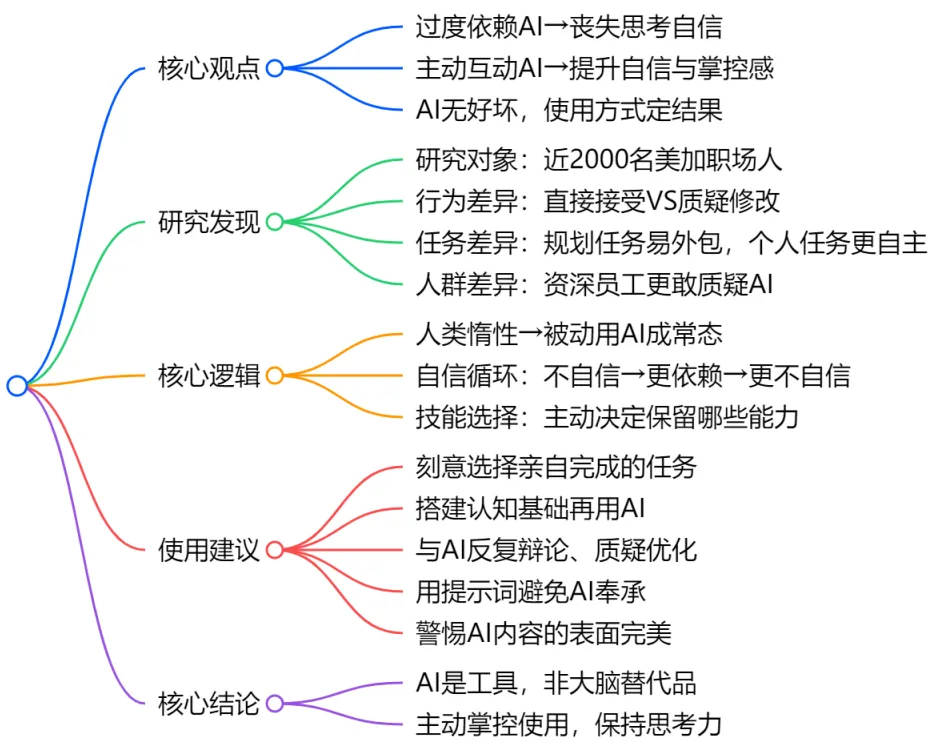
Letting AI Do Your Work Erodes Your Confidence
过度依赖AI正在偷走你的自信
As AI becomes a daily work tool, the real risk may not be losing our intelligence — but losing confidence in our own thinking.
随着AI成为日常工作的工具,真正的风险可能不是失去我们的智力,而是失去对我们自己思考能力的信心。
New research suggests the difference comes down to how actively we engage with the technology.
新研究表明,差异取决于我们如何积极地与这项技术互动。
In a study of nearly 2,000 working adults, researchers found that people who relied heavily on AI — especially those who accepted its answers without much modification — were more likely to say tools like ChatGPT, Claude, and Gemini were “doing the thinking” for them.
在一项近2000名职场成年人的研究中,研究人员发现,那些严重依赖AI的人——尤其是那些不加修改就接受AI答案的人——更倾向于认为ChatGPT、Claude和Gemini等工具是在”替他们思考”。
Those same participants also reported lower confidence in their own reasoning and a weaker sense of ownership over their ideas.
这些参与者也报告说,他们对自己的推理能力信心更低,对自己的观点缺乏归属感。
But that pattern wasn’t inevitable. Participants who pushed back — editing, questioning, or rejecting AI-generated suggestions — reported the opposite: greater confidence and a stronger sense that the final output was truly theirs.
但这种模式并非不可避免。那些提出质疑的人——编辑、提问或拒绝AI生成的建议的人——报告了相反的结果:更高的信心,以及更强的最终产出真正属于自己的感觉。
The findings suggest AI isn’t inherently undermining our abilities. Instead, it may be subtly reshaping how we experience our own thinking.
研究结果表明,AI并非本质上在削弱我们的能力。相反,它可能在微妙地重塑我们如何体验自己的思考过程。
“Generative AI can lead to cognitive decline or cognitive evolution — it depends on your interaction style,” says study author Sarah Baldeo.
研究作者Sarah Baldeo说:”生成式AI可以导致认知衰退或认知进化——这取决于你的互动方式。”
“When we look at brain activity contingent on how people choose to use the tool, we can see increases or decreases. It really doesn’t have to do with the tool itself.”
“当我们观察大脑活动与人们选择使用工具方式的关系时,可以看到能力的增加或减少。这真的与工具本身无关。”
That distinction — between engaging with AI thoughtfully or deferring to it — may be what ultimately determines whether the technology helps or hinders us at work.
这种区别——深思熟虑地与AI互动还是顺从AI——可能是最终决定这项技术是帮助还是阻碍我们工作的关键。
The study followed 1,923 adults in the U.S. and Canada as they used AI tools to complete a series of simulated workplace tasks — ranging from drafting a salary negotiation plan to interpreting ambiguous data.
这项研究追踪了美国和加拿大的1923名成年人,让他们使用AI工具完成一系列模拟工作任务——从起草薪资谈判计划到解读模糊数据。
What stood out most was the range of behaviors. Some participants accepted the first response they got, moving on as soon as the AI produced something usable. Others slowed down — editing, pushing back, and reworking the answer until it reflected their own thinking.
最引人注目的是行为的差异。有些参与者在AI给出首个回复后就接受它,一旦AI生成了可用的东西就继续进行。其他人则放慢脚步——编辑、质疑、反复修改答案,直到它反映出自己的想法。
Those choices, the study found, were closely linked to how confident people felt in their reasoning.
研究发现,这些选择与人们对自己推理能力的信心密切相关。
People were most likely to outsource their thinking entirely during planning and sequencing tasks — the kind of open-ended, multi-step work that defines a lot of professional life.
人们在计划和排序任务中最有可能完全外包他们的思考——这类开放性、多步骤的工作定义了大部分职业生活。
But when tasks turned personal or introspective, something changed. Asked to reflect on their own experiences or evaluate their own character, participants were far more likely to push back on what the AI produced. When the subject was themselves, they trusted themselves.
但当任务变得个人化或内省时,情况发生了变化。当被要求反思自己的经历或评价自己的性格时,参与者更有可能质疑AI生成的内容。当对象是他们自己时,他们相信自己。
“If the AI solves a problem for you, you don’t think and you don’t learn,” says Ethan Mollick, an associate professor at the Wharton School.
沃顿商学院副教授Ethan Mollick说:”如果AI替你解决问题,你不会思考,也学不到东西。”
“But the reverse is also true. If you make AI act like a tutor and push people, you get improved outcomes.”
“但反过来也是如此。如果你让AI像一个导师一样推动人们,你会得到更好的结果。”
Baldeo sees this as partly a self-confidence loop: People who already feel uncertain about their abilities are more likely to defer to AI — and deferring, in turn, deepens that uncertainty.
Baldeo将这视为一种自我信心的循环:那些对自己的能力已经感到不确定的人更容易依赖AI——而依赖AI反过来又会加深这种不确定性。
“Human beings who have a higher sense of self-confidence will have a greater likelihood of using AI in a cognitively healthy way,” she says.
她说:”自我认同感较高的人更有可能以认知健康的方式使用AI。”
“The inverse is also true. If you’re already experiencing an unstable sense of self, using AI is actually not well-advised for you.”
“反过来也是如此。如果你已经正在经历一种不稳定的自我认同感,使用AI实际上并不建议你这样做。”
For workers trying to strike that balance, the takeaway isn’t to avoid AI — it’s to use it more deliberately.
对于试图达到这种平衡的工作者来说,关键不是避免使用AI,而是更有意识地使用它。
The key, Mollick says, is being intentional about which tasks you actually want to do yourself — and resisting the reflex to hand everything off just because you can.
Mollick说,关键是有意识地选择你真正想要自己完成的任务——并且抵制那种仅仅因为你可以就把所有事情都交出去的本能反应。
“It might be worth being less efficient for practice,” he says, comparing it to exercise: “There are a lot easier ways to move weights up and down than with your own hands, but we do it because we want to maintain muscle.”
他将AI使用比作锻炼:”为了练习,降低一点效率可能是值得的。把杠铃上下移动有很多比用手更简单的方式,但我们这样做是因为想保持肌肉。”
Baldeo encourages users to build what she calls “cognitive scaffolding” — a baseline understanding of a task before outsourcing it — and to actively engage with AI by questioning and refining its responses.
Baldeo鼓励用户建立她所谓的”认知脚手架”——在将任务外包之前,先对任务有基本的理解——并且通过质疑和完善AI的回复来积极地与AI互动。
She also suggests a specific prompt to counteract AI’s tendency toward flattery. Preface queries with this language, she advises: “Respond based on third-party verifiable information. Do not attempt to flatter me or build an emotional bond.”
她还建议了一个具体的提示语来对抗AI的讨好倾向。她建议在查询前加上这样的话:”基于第三方可验证的信息作答。不要试图讨好我或建立情感联系。”
What matters most, Mollick adds, is staying intentional: “AI doesn’t have agency over what we’re doing right now. It’s not taking over our lives. We’re deciding when we want to let the AI do something, and when we don’t. Being conscious about that decision will turn out to matter.”
Mollick补充说,最重要的是保持有意识:”AI对我们现在正在做的事情没有主导权。它没有在接管我们的生活。我们在决定什么时候想让AI做某件事,什么时候不想。对这个决定保持清醒将会证明是重要的。”
词汇短语
生词难词
-
erode /ɪˈrəʊd/v. 侵蚀;削弱
-
inevitable /ɪnˈevɪtəbl/adj. 不可避免的
-
undermine /ˌʌndəˈmaɪn/v. 逐渐削弱
-
contingent /kənˈtɪndʒənt/adj. 依情况而定的
-
ambiguous /æmˈbɪɡjuəs/adj. 模糊不清的
-
counterpart /ˈkaʊntəpɑːt/n. 职位相当的人;对应方
-
cede /siːd/v. 放弃;让与
-
conscious /ˈkɒnʃəs/adj. 有意识的;刻意的
-
scaffolding /ˈskæfəldɪŋ/n. 支架;基础构架
-
counteract /ˌkaʊntərˈækt/v. 抵消;对抗
-
flattery /ˈflætəri/n. 奉承;恭维
-
polished /ˈpɒlɪʃt/adj. 精致的;完美的
-
misleading /ˌmɪsˈliːdɪŋ/adj. 误导性的
-
agency /ˈeɪdʒənsi/n. 能动性;自主权
固定搭配
-
erode confidence 削弱自信
-
rely heavily on 过度依赖
-
without much modification 几乎不修改
-
sense of ownership 归属感;掌控感
-
cognitive decline/evolution 认知退化 / 进化
-
contingent on 取决于
-
range of behaviors 行为差异
-
push back on 反驳;质疑
-
sense of self-confidence 自信心
-
strike a balance 取得平衡
-
hand off 移交;外包
-
keep … in the loop 让…… 参与其中
-
take into account 考虑到
-
be taken in by 被…… 迷惑
经典句式
1.句型1: …may not be doing X — but doing Y
The real risk may not be losing our intelligence — but losing confidence in our own thinking.
仿写练习:
1. 成功不在于你认识多少人,而在于有多少人真正了解你。
2. 教育的意义不在于灌输知识,而在于激发好奇心。
2.句型2: …isn’t inherently … Instead, it may be …
AI isn’t inherently undermining our abilities. Instead, it may be subtly reshaping how we experience our own thinking.
仿写练习:
1. 技术不是本质上让人们变得孤立,而是在改变人们连接的方式。
2. 阅读不是为了记住信息,而是在重塑我们的思维方式。
3.句型3: … lead to … or … — it depends on …
Generative AI can lead to cognitive decline or cognitive evolution — it depends on your interaction style.
仿写练习:
1. 社交媒体可以导致心理健康问题或心理成长——这取决于你如何使用它。
2. 失败可以导致挫折感或个人成长——这取决于你如何面对它。
句型4: The inverse is also true.
The inverse is also true. If you’re already experiencing an unstable sense of self, using AI is actually not well-advised for you.
仿写练习:
1. 过度运动会导致伤害,但完全不运动也有害健康。反过来也是如此。
2. 大量阅读可以开阔视野,但不加选择地阅读也会误导人。反过来也是如此。
写作素材
主题1: AI与学习
✨ 高级表达积累:
• “If AI solves a problem for you, you don’t think and you don’t learn.”
• “The key is being intentional about which tasks you actually want to do yourself.”
• “It might be worth being less efficient for practice.”
• AI isn’t inherently undermining our abilities.
写作话题:
Should students be allowed to use AI tools like ChatGPT for homework? What are the pros and cons?
主题2: 自律与成长
✨ 高级表达积累:
• “Humans are naturally designed to be lazy and take as little effort as possible.”
• “Part of this is about deciding what things you want to maintain.”
• “If you want to maintain a skill, you’re going to have to consciously de
• Questioning and refining keep your thinking in the loop.cide to do that.”
写作话题:
How can young people develop self-discipline in the age of instant gratification?
主题3: 科技与人性
✨ 高级表达积累:
• “AI doesn’t have agency over what we’re doing right now.”
• “We’re deciding when we want to let the AI do something, and when we don’t.”
• “Being conscious about that decision will turn out to matter.”
写作话题:
What skills should humans develop to remain valuable in the AI era?
结束语
AI 是工具,不是大脑的替代品。真正的高手,从不把思考外包。从今天起,多质疑、多修改、多亲自下场,你的思维力和自信心,会在一次次主动思考中重新长出来。
真正的问题从来不在于工具,而在于我们如何使用它。希望这篇文章能让你在下次打开AI对话框时,多一分主动思考,少一分被动接受。毕竟,你最宝贵的资产,从来都是那颗会思考的大脑。
你对这篇文章有什么想法?欢迎在评论区分享你的AI使用心得!如果觉得有用,别忘了转发给身边的朋友~
END