ARTICLE · 1170039
小学新课标英语二级考试复习总结(四)
孩子,你慢慢来(新四年级) 369298356
孩子,你慢慢来(新三年级) 488438402
九、some,any的用法
some用于肯定句;any用于否定句和一般疑问句。请注意看例句后扩号中说明的用法。例:There is some water in the glass. (肯定句)
There are some flowers in the garden. (肯定句)
There aren’t any lamps in the study.(否定句)
Are there any maps on the wall?(一般疑问句)
Would you like some orange juice? (希望得到肯定回答)
Do you want to take any photos at the party? (一般疑问句)

十、动词不定式
1、to加动词原形构成一种非谓语形式,在这里不是介词,无词义。如:I want to make a New Year card. 我想制作一张新年贺卡。 Would you like to have a picnic with us? 你愿意和我们一起去野餐吗?2、to保留原来动词的一些特征,它可以带自己的宾语和状语等。如:To get there faster, you can take bus No.5. 想快一点到那儿,你可以坐5路车。3、to前有时带疑问词what, when, where, which, why, how等。如:He’s asking Yang Ling how to get there. 他正在问杨玲怎样到达那里。总而言之,一定要记住:to后面用动词原形。
十一、动名词
其实就是动词的“现在分词”。它既有“名词性质”(可作主语),又具有动词性质(可带宾语)。如:Please keep quiet in the reading room. 还有我们的一些课题:Asking the way中是“名词性质”;My hobby is collecting stamps.中是“动词性质”,带了宾语stamps.
1、remember(记住)后面跟动名词,表示“记得做过某事”;跟to+动词原形,表示“记得要去做某事”。如:
I remember posting the letter today. 我记得今天把信寄走了。Please remember to post the letter today. 请记住今天要把信寄走。
2、forget(忘记)后面跟动名词,表示“忘记做过某事(实际做过)”;跟to+动词原形,表示“忘记去做某事(实际没做)”。如:I forget doing homework this morning. 我忘记今天早上做过作业了。I forget to do homework this morning. 我忘记今天早上做作业了。
3、stop(停止)后面跟动名词,表示“停止做某事”;跟to+动词原形,表示“停止正在做的事,而去做别的事”。如:Stop smoking, please. 请不要吸烟。We are tired. Let’s stop to have a rest. 我们累了,让我们停下来休息一下。
4、like(喜欢)后面跟动名词,表示一个人的爱好和习惯,意思是“喜欢干某事”;跟to+动词原形,常用于would like to do something,表示“某人想要、愿意干某事”。如: I like taking a walk after supper every day. 我喜欢每天晚饭后去散步。 I would like to have some chips. 我想要吃些薯条。

十二、时间和日期的表达
1、有两种时间表达法:A)直接读写数词。如:9:15 nine fifteen 10:30 ten thirty 11:45 eleven forty-five
7:05 seven o five 2:25 two twenty-five 5:55 five fifty-five
B)借助past和to来表达。past一般用于30分钟以内(含30分钟)的时间表达;to一般用于超过30分钟的时间表达。一刻钟可以用a quarter表示,半小时可以用half表示。
如:9:15 a quarter past nine 10:30 half past ten 11:45 a quarter to twelve 7:05 five past seven 2:25 twenty-five past two 5:55 five to six注意:询问时间可用句型“What’s the time?”或者“What time is it?”。2、日期的表达:the+序数词+of+月份。如:the third of June六月三日注意:询问日期可用句型“What date is it today?”或者“What’s the date today?”。

十三、名词所有格
1、有生命的名词所有格:A)单数后加“ ’s ”,如:Su Hai’s twin sister苏海的双胞胎妹妹 Jim’s family吉姆的一家B)以“ s ”结尾的复数名词,只需加“ ’ ”,如:Teachers’ Day教师节 the twins’ parentsC)不以“ s ”结尾的复数名词,则仍需加“ ’s ”,如:Children’s Day儿童节注意:表示两人或几人共有的物品,只需在最后一人名后加“ ’s ”,如:Ben and Jim’s book
2、无生命的名词所有格,一般与“ of ”构成短语。如:a photo of his family 他家的一张照片 the colour of her skirt 她的短裙的颜色

十四、句子的种类
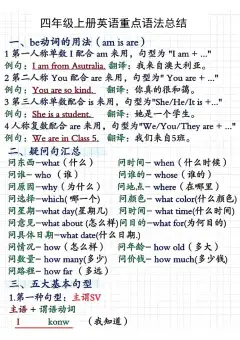
类别 | 例句 | 用法 | 标点 | |
陈述句 | 肯定 | This is a bag. I like spring. | 描述一件事情或者说明说话人的看法 | . |
类别 | 例句 | 用法 | 标点 | |
陈述句 | 否定 | I can’t see a bag over there. I don't know. | 描述一件事情或者说明说话人的看法 | . |
疑 问 句 | 一般 | Are you a student? Do you like puppets? Can you speak English? | 用于提出问题 | ? |
特殊 | when什么时间;who谁;whose谁的;where在哪里;which哪一个;why为什么;what什么;what time什么时间;what colour什么颜色;what about……怎么样;what day星期几;what date什么日期;what for为何目的;how怎样;how old多大岁数;how many数量多少;how much多少钱;how about……怎么样;how far多远 | |||
选择 | Is your friend a boy or a girl? | |||
反意 | It’s a fine day, isn’t it? | |||
祁使句 | 肯定 | Put it here. | 表示命令、建议或请求 | .或! |
否定 | Don’t look at the noticeboard. | |||
感叹句 | How smart the scarf is! What a smart scarf! How smart the scarves are! What smart scarves! | 表示惊讶、喜悦、赞美、厌恶或愤怒等强烈感情 | ? |

十五、时态
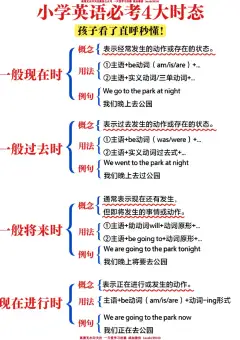
1、一般现在时A、当谓语是be动词时,构成为:主语+be动词( am, is, are )+其他。如:I am a student.B、当谓语是行为动词时,构成有两种:(1)主语(非第三人称单数)+动词原形+其他。如:We often watch TV at the weekends.(2)主语(第三人称单数)+动词第三人称单数形式+其他。
如:Jim usually goes to the park on Sundays.C、句型变换:肯定句否定句一般疑问句及回答They watch TV at six everyday. They don’t watch TV at six everyday.
---Do they watch TV at six everyday. ---Yes, they do. / No, they don’t.She watches TV at six everyday. She doesn’t watch TV at six everyday.
---Does she watch TV at six everyday.---Yes, she does. / No, she doesn’t.
肯定句 | 否定句 | 一般疑问句及回答 |
They watch TV at six everyday. | They don’t watch TV at six everyday. | ---Do they watch TV at six everyday. ---Yes, they do. / No, they don’t. |
She watches TV at six everyday. | She doesn’t watch TV at six everyday. | ---Does she watch TV at six everyday. ---Yes, she does. / No, she doesn’t. |
2、现在进行时A、构成形式:主语+be动词+动词的ing形式+其他。B、判断依据:句中往往有now、look、listen等词。注意:千万不要忘了一定得有be动词。C、句型变换
3、一般过去时A、构成形式:主语+动词的过去式+其他。注意:没有be动词的否定句和疑问句中,用didn’t否定和用did提问后,动词一定要用原形。
B、判断依据:(1)be动词是was、were;(2)动词加ed;(3)有表示过去的时间状语,现在学过的常用的表示过去的时间状语有:just now,a moment,yesterday,
last week,last night,last weekend,last year,last month,three days ago,two weeks ago,five years ago…
C、句型变换:
肯定句 | 否定句 | 一般疑问句及回答 |
I was a teacher five years ago. | I wasn’t a teacher five years ago. | ---Were you a teacher five years ago? ---Yes, I was. / No, I wasn’t. |
They played many games yesterday. | They didn’t play many games yesterday. | Did they play many games yesterday? Yes, they did. / No, they didn’t. |
4、一般将来时
A、构成形式:(1)主语+be going to+动词原形+其他。(2)主语+will+动词原形+其他。B、判断依据:一个句子中既有be动词,又有going、to和动词,且动词用的是原形,句中
往往有tomorrow、soon、next week等词。C、句型变换:
肯定句 | 否定句 | 一般疑问句及回答 |
She is going to have a picnic tomorrow. | She isn’t going to have a picnic tomorrow. | ---Is she going to have a picnic tomorrow? ---Yes, she is. / No, she isn’t. |
They are going to visit their grandparents next Sunday. | They aren’t going to visit their grandparents next Sunday. | --Are they going to visit their grand parents next Sunday? ---Yes, they are. / No, they aren’t. |
注意:---Where are you going? ---We’re going to Beijing. 问句中不要用到to。

(二级资料结束)
本文为原创作品,未经许可不得转载。
备注
寒假、春季高效阅读与作文班(4年级、3年级)、英语(新概念1、3L、新课标英语等级考试冲刺班)、数学(奥数、课内)火热报名中……
可直接公众号回复报名,留下您的电话,小编稍后会与您联系!