9 月调研测试答案+听力原文(英语) 第1 页  共8 页
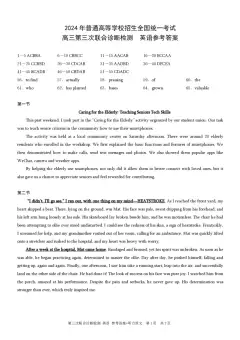
2026 年普通高等学校招生全国统一考试
 9 月调研测试  英语参考答案

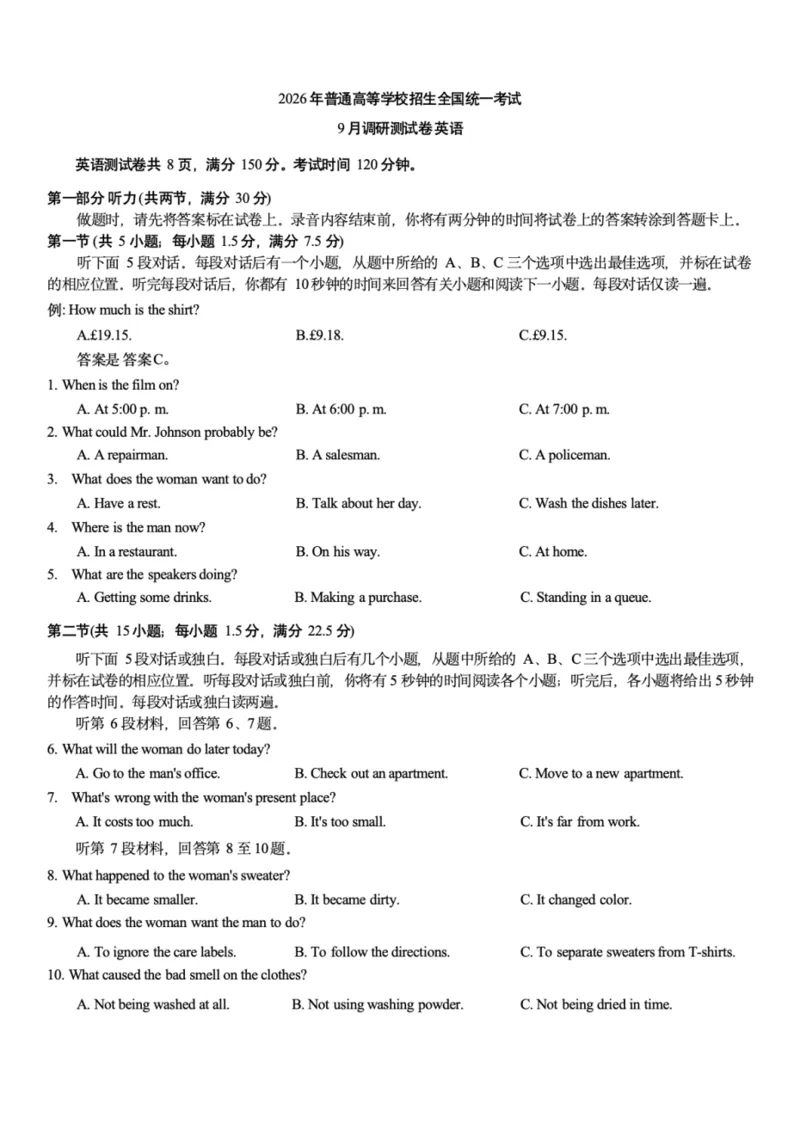
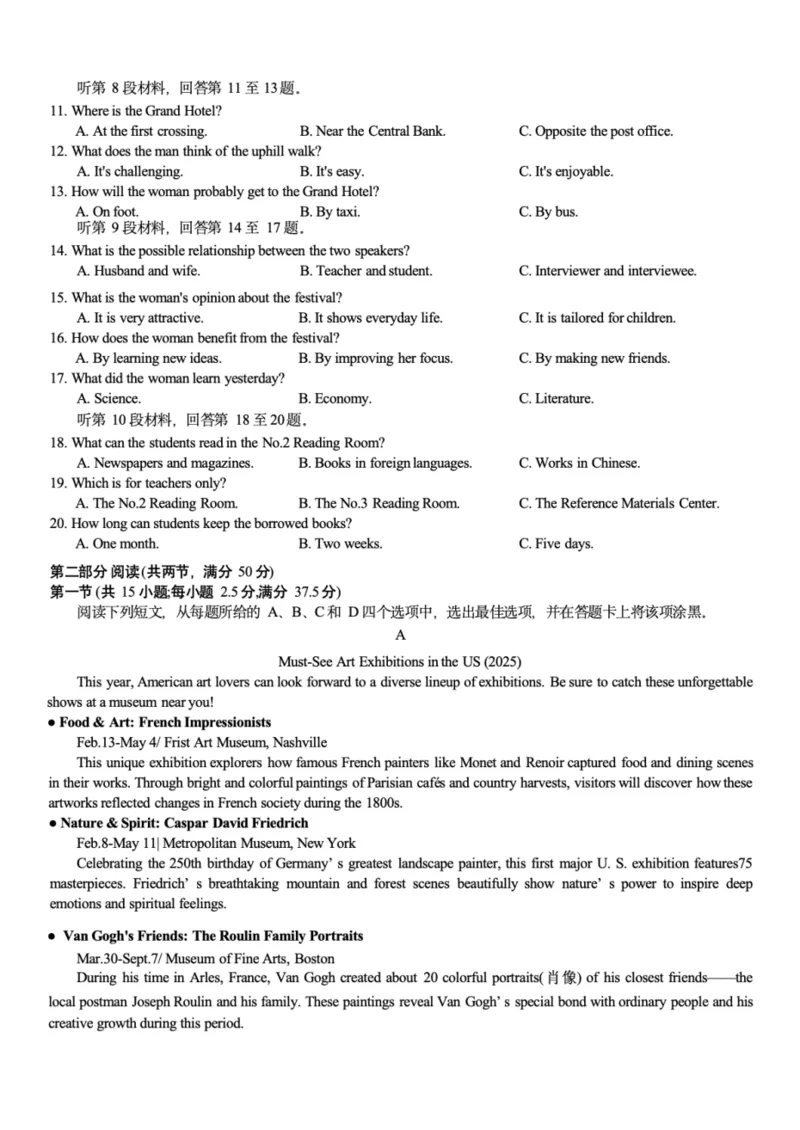
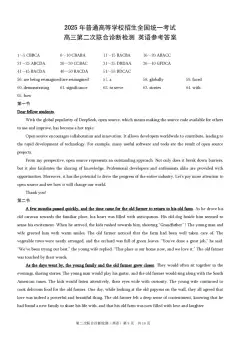
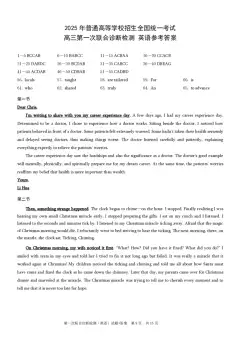
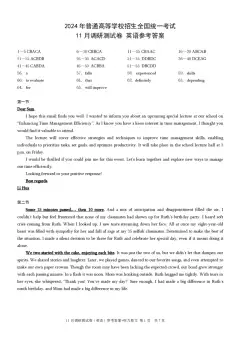
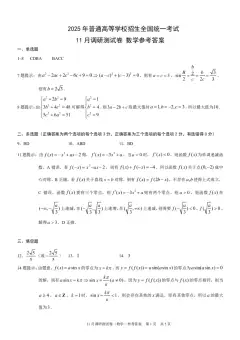
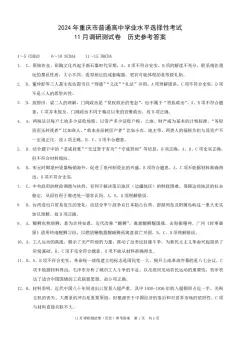
1~5 BAABC
6~10 BCABB
11~15 CABCA
16~20 ACBCA
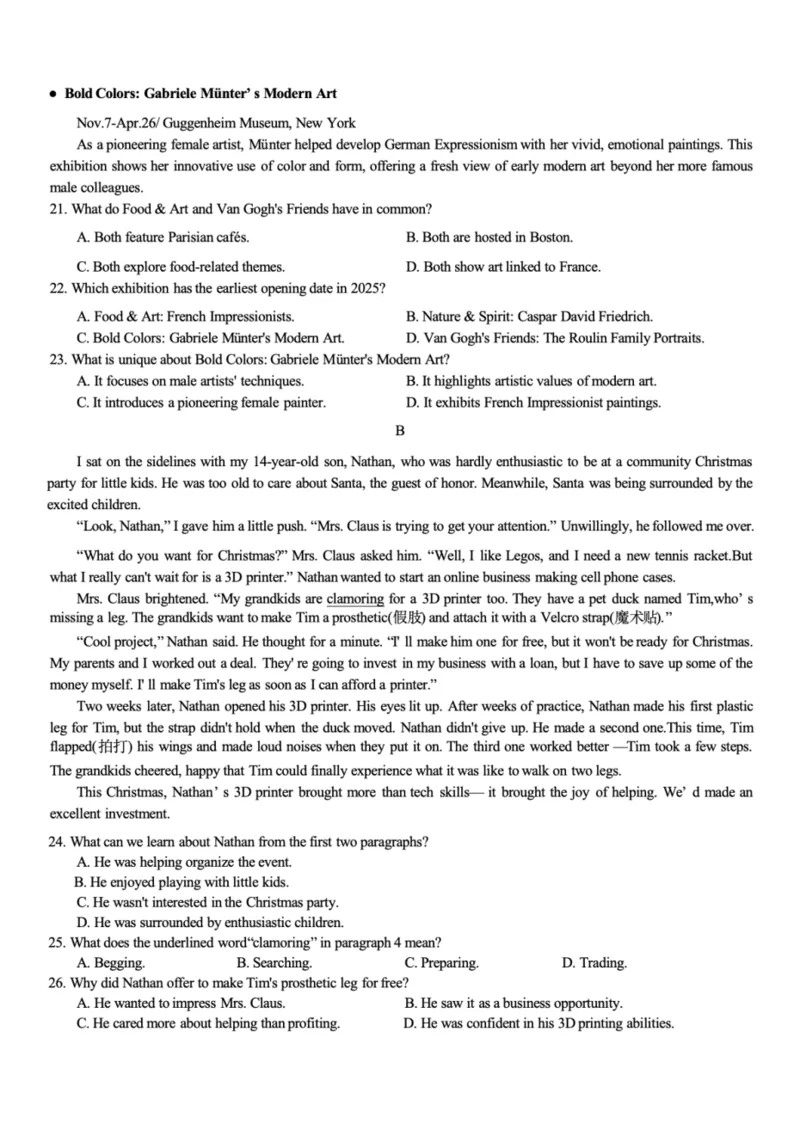
21~25 DBCCA
26~30 CDBAC
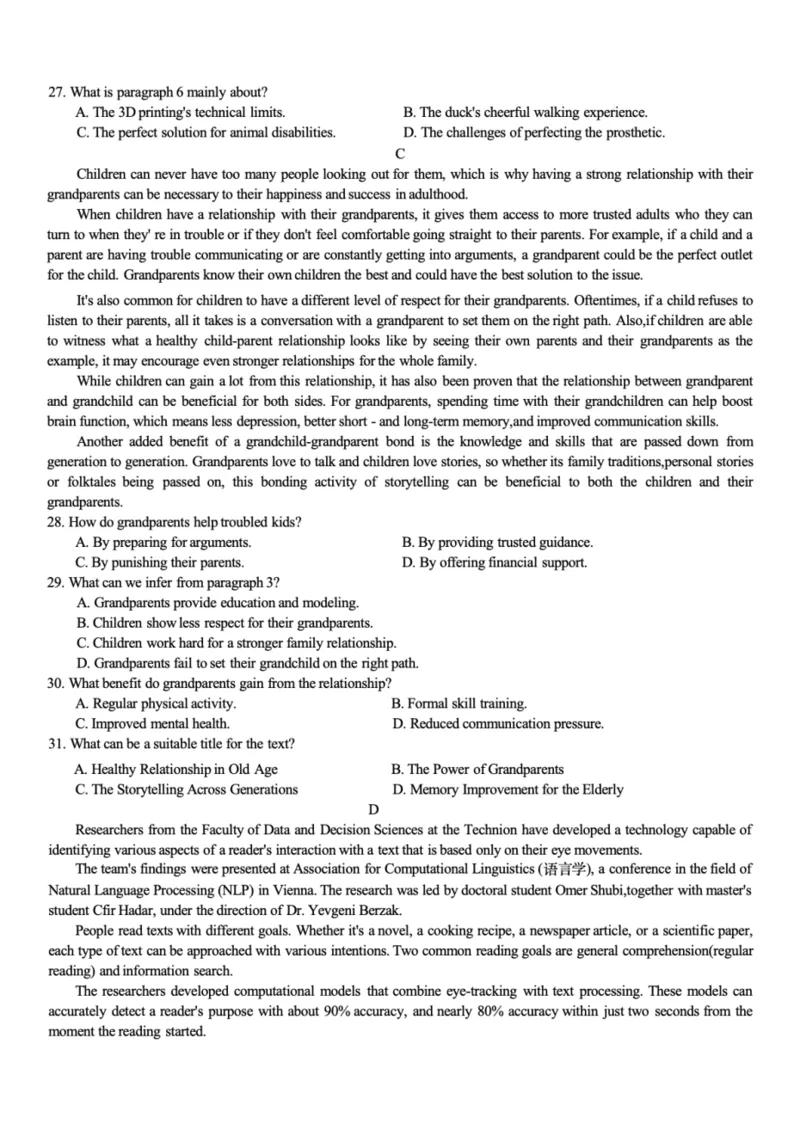
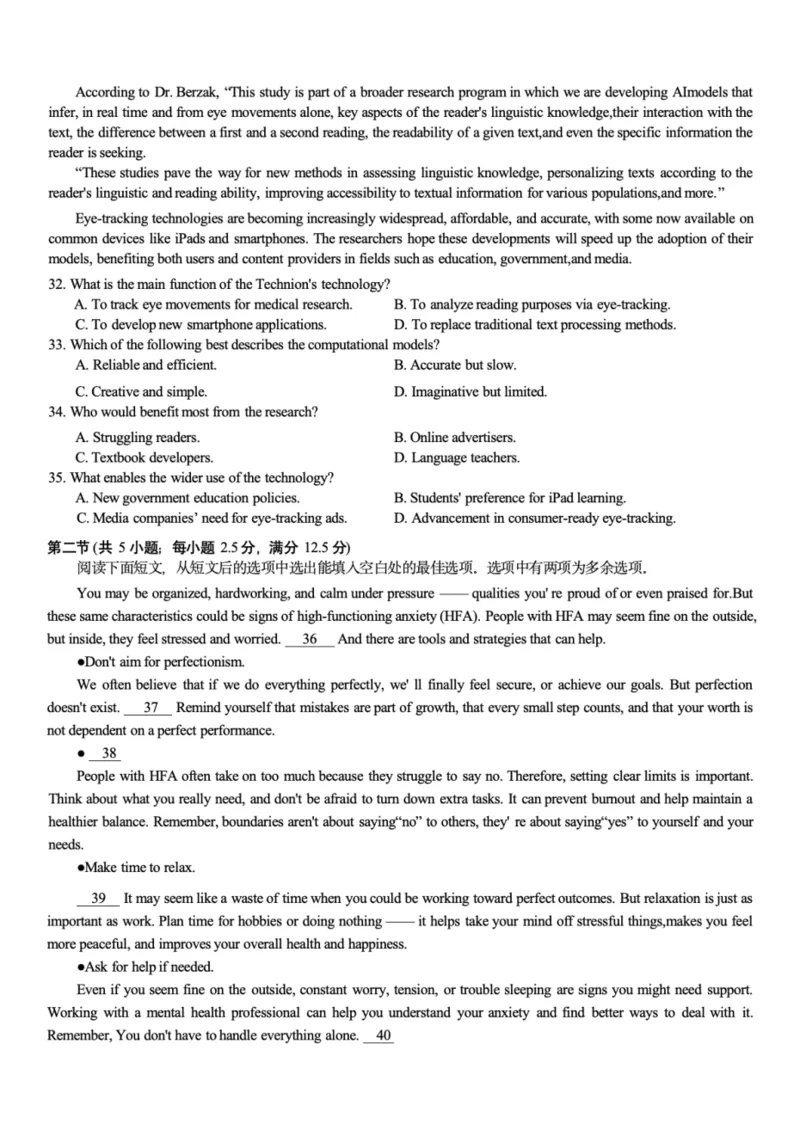
31~35 BBAAD
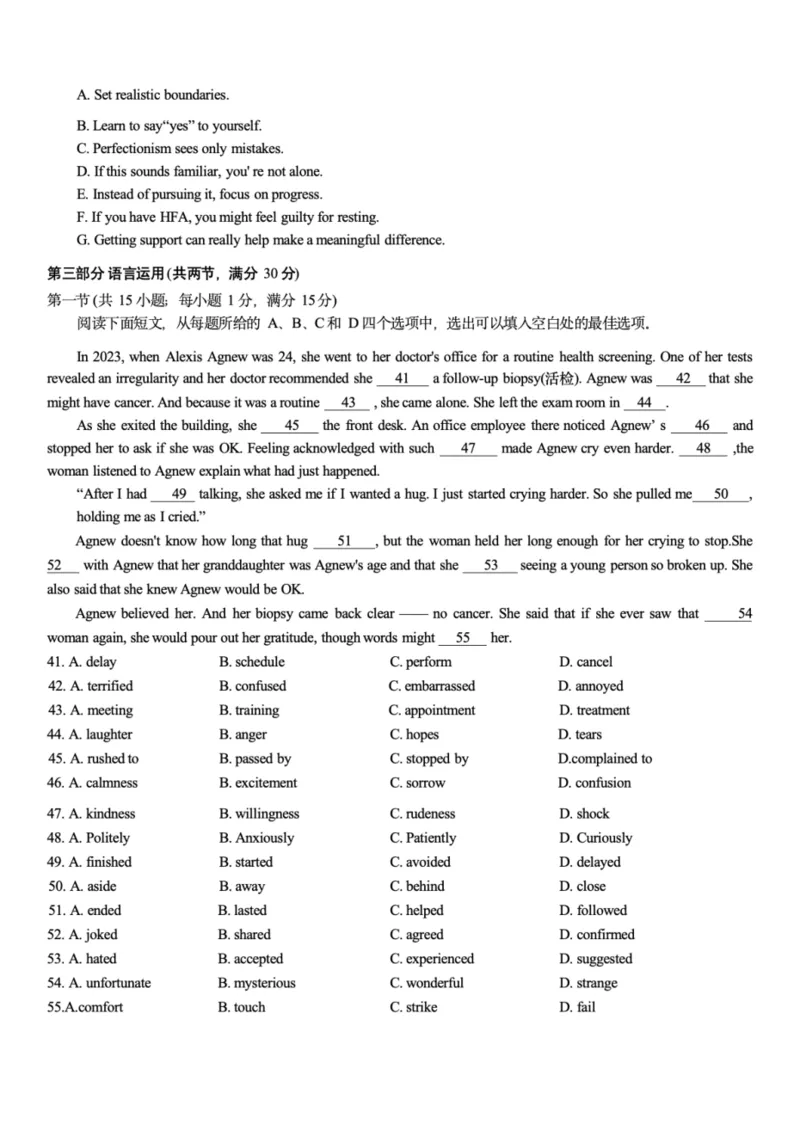
36~40 DEAFG
41~45 BACDB
46~50 CACAD
51~55 BBACD
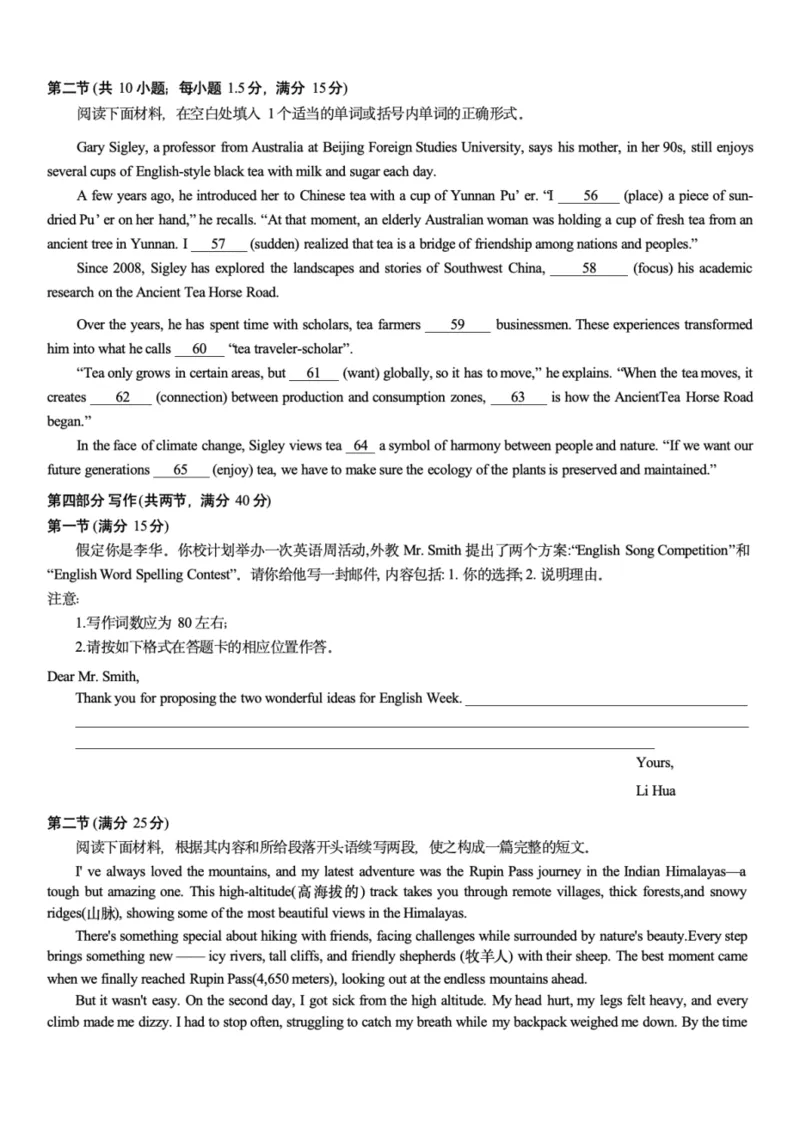
56. placed
57. suddenly
58. focusing
59. and
 60. a
61. is wanted
62. connections
63. which
64. as
 65. to enjoy
第一节
Dear Mr. Smith,
Thank you for proposing the two wonderful ideas for English Week. I would recommend the English Song
Competition for the following reasons:
First, singing English songs is a fun way to improve pronunciation and vocabulary naturally. Many students
enjoy music, so participation would be high. Second, this activity allows creative performances — solo, duets, or
even group acts — making it more engaging than a traditional contest. Lastly, we can invite judges to give feedback
on both language skills and stage presence, adding educational value.
I’m sure this event will be both fun and educational for everyone. Looking forward to hearing your thoughts.
Yours,
Li Hua
第二节
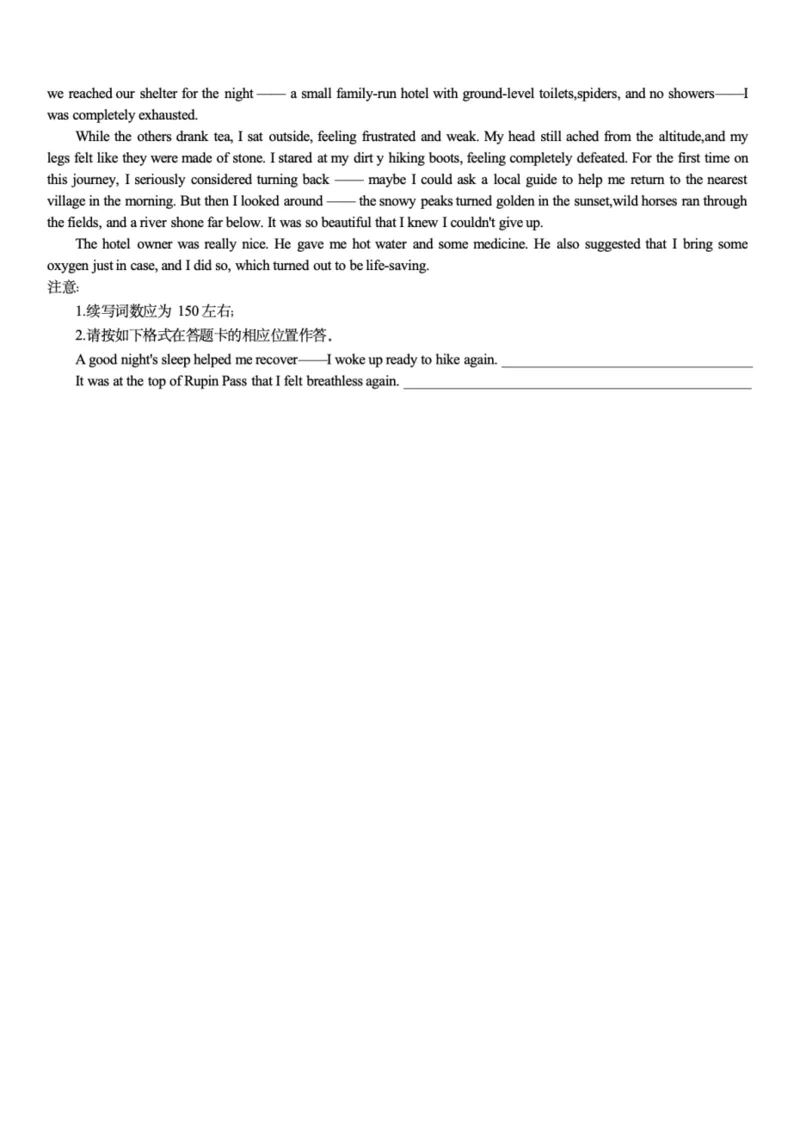
A good night’s sleep helped me recover — I woke up ready to hike again. With the oxygen tank in my
backpack, I felt more confident. The track was steep, but my friends encouraged me, and the medicine kept my
headache away. Step by step, we climbed higher, passing icy streams and rocky paths. The scenery grew even more
amazing, with wildflowers blooming beside the snow. By midday, I realized I was stronger than I’d thought. The
kindness of the hotel owner and my determination pushed me forward.
It was at the top of Rupin Pass that I felt breathless again. But this time, it wasn’t from sickness — it was from
wonder. The endless Himalayas spread before us, shining in the sunlight. I sat on a rock, smiling as tears filled my
eyes. The struggle had been worth it. My friends cheered, and we took photos to remember the moment. As we
started our way down, I knew this adventure had taught me a valuable lesson: not giving up brings the greatest
rewards.


{#{QQABSQI95wIQghQACR66RwG4CkuQkJISJYoGQVCYqAQDSQNAFAA=}#}


9 月调研测试答案+听力原文(英语) 第2 页  共8 页
答案详解
第二部分
阅读理解
第一节
A 篇
【语篇解读】本文为应用文。文章主要介绍了2025 年美国四个值得一看的艺术展览,分别聚焦法国印象派、
德国浪漫主义风景画、梵高肖像画和德国表现主义女性艺术家作品。
21.D 事实细节题。根据Food & Art 部分的描述,该展览展示法国印象派画家的作品“French painters like Monet
and Renoir”,而Van Gogh’s Friends 部分提到梵高在法国阿尔勒创作的肖像画“his time in Arles, France”,
因此两个展览均与法国相关,故选D。
22.B 推理判断题。对比各展览的开幕日期:Nature & Spirit(2 月8 日)、Food & Art(2 月13 日)、Van Gogh’s

  Friends(3 月30 日)、Bold Colors(11 月7 日),其中Nature & Spirit 的开幕日期最早,故选B。
23.C 推理判断题。根据Bold Colors 部分的描述,该展览聚焦德国表现主义先驱女性艺术家加布里埃尔· 蒙特
“a pioneering female artist”,并展示她对色彩与形式的创新运用,因此其独特之处在于介绍一位先驱女
性画家,故选C。
 B 篇
【语篇解读】本文为记叙文。文章讲述了14 岁的Nathan 在社区圣诞派对上结识Mrs. Claus 后,利用3D 打
印技术为她的孙子的残疾鸭子制作假肢的故事,展现了技术与善意的结合。
24.C 事实细节题。根据第一段描述,14 岁的Nathan 对儿童圣诞派对毫无热情(hardly enthusiastic),觉得年纪
太大不关心圣诞老人(too old to care about Santa),可见他对派对不感兴趣,故选C。
25.A 词义猜测题。根据前文Nathan 迫不及待想要3D 打印机(really can’t wait for)的急切心情,与第四段Mrs.

  Claus 的孙子们“too(也)”表现出同样的强烈渴望,可推断clamoring for 与can’t wait for 语义呼应,均表
达迫切请求,故选A(Begging)(恳求)。
26.C 推理判断题。根据第五段Nathan 提出免费制作假肢(I’ll make him one for free),以及结尾处强调“帮助的
快乐(brought the joy of helping)”可知,他更看重帮助他人而非盈利,故选C。
27.D 段落主旨题。第六段详细描述了Nathan 三次改进假肢的过程:第一次魔术贴不牢(strap didn’t hold),第

  二次鸭子不适(made loud noises),第三次才成功(worked better),主要展现完善假肢过程中遇到的挑战,

  故选D。
C 篇
【语篇解读】本文为说明文。文章阐述了祖孙关系的多重益处,包括为儿童提供情感支持、行为引导,同时
也能促进祖父母的认知健康和文化传承。
28.B 事实细节题。根据第二段描述,祖父母为孩子提供可信赖的成人支持(more trusted adults who they can turn

  to),并能帮助解决亲子沟通问题(could have the best solution to the issue),可见他们主要通过提供可信指
导来帮助孩子,故选B。
29.A 推理判断题。第三段指出祖父母既能通过谈话引导孩子(conversation to set them on the right path),又通
过示范健康亲子关系(witness what a healthy child-parent relationship looks like)发挥作用,综合体现教育
{#{QQABSQI95wIQghQACR66RwG4CkuQkJISJYoGQVCYqAQDSQNAFAA=}#}


9 月调研测试答案+听力原文(英语) 第3 页  共8 页
示范功能,故选A。
30.C 事实细节题。根据第四段明确说明,祖父母通过陪伴孙辈可提升脑功能(boost brain function)、改善记忆

  和减少抑郁(less depression, better memory),这些均属于心理健康范畴,故选C。
31.B 主旨大意题。全文围绕祖父母在情感支持(trusted adults)、行为矫正(set them on the right path)、和文化传
承(passed down)等多方面的积极影响展开,The Power of Grandparents 最能全面概括这一主旨,故选B。
D 篇
【语篇解读】本文为科技类说明文。文章介绍了以色列理工学院开发的一项基于眼动追踪的阅读分析技术,
该技术能通过读者眼球运动识别其阅读目的,并展望了其在教育、媒体等领域的应用前景。
32.B 事实细节题。根据第一段明确指出该技术能通过眼球运动识别读者与文本互动的各个方面(identifying
various aspects of a reader’s interaction...based only on their eye movements),结合第四段具体说明可检测
阅读目的(detect a reader’s purpose),故选B。
33.A 推理判断题。根据第四段描述,该计算模型能在阅读开始后两秒内达到近80%准确率(nearly 80% accuracy

  within just two seconds),最终准确率约90%,体现其既可靠又高效的特点,故选A。B 选项“slow”与
原文事实相反,C 和D 选项都引入了原文完全没有提及的正面特征simple 或负面特征limited。
34.A 推理判断题。根据第六段明确说明该技术可用于“improving accessibility to textual information for various

   populations(提升不同人群获取文本信息的便利性)”,结合末段强调技术普及将惠及用户(benefiting
both users),最直接受益的应是有阅读困难的群体,而非特定职业人群,故选A。虽然D(语言教师)
确实能运用该技术,但文章更强调技术对普通读者(尤其是需要帮助的群体)的直接帮助。
35.D 事实细节题。根据末段指出眼动追踪技术日益普及且价格亲民(increasingly widespread, affordable),并
已应用于iPad 等常见设备,这种技术进步推动了该模型的广泛应用(accelerate the adoption),故选D,
即消费者可直接使用的(consumer-ready)眼动追踪技术的进步。
第二节  七选五
【语篇解读】本文为说明文。文章介绍了高功能焦虑症(HFA)的特征,并提供了应对策略,包括放弃完美
主义、设定界限、放松休息和寻求帮助等建议。
36.D  设空处位于首段中间。前文描述HFA 患者表面正常但内心焦虑的特征,后文提到“有工具和策略可以
帮助”。D(如果这听起来很熟悉,你并不孤单)既承接前文对HFA 的描述,又自然过渡到解决方案,
符合逻辑。
37.E  设空处位于段落中间。前文指出“完美不存在”,后文建议“提醒自己错误是成长的一部分”。E(与其
追求完美,不如关注进步)直接回应前文对完美主义的批判,并引出后文的积极建议,形成连贯论述。
38.A  设空处为段落标题。本段主要内容是“学会拒绝额外任务”和“设定清晰界限”,A(设定现实的界限)
准确概括段落主旨,且与后文boundaries 形成关键词呼应。
39.F  设空处位于段落开头。后文讨论“放松的重要性”及“放松时的愧疚感”,F(如果你有HFA,可能会对
休息感到愧疚)既点明HFA 患者的典型心理,又自然引出后文对放松价值的论述。
40.G  设空处位于文章结尾。前文强调“寻求专业帮助”的重要性,后文以“你不需要独自应对一切”作结。
G(获得支持确实能带来有意义的改变)既总结前文建议,又强化文章结尾的鼓励语气,符合段落收束
{#{QQABSQI95wIQghQACR66RwG4CkuQkJISJYoGQVCYqAQDSQNAFAA=}#}


9 月调研测试答案+听力原文(英语) 第4 页  共8 页
功能。
第三部分  英语知识运用
第一节 完形填空
【语篇解读】本文为记叙文。文章讲述了24 岁的Alexis Agnew 在常规体检后因可能患癌而情绪崩溃,一位
办公室员工给予她温暖拥抱和安慰的故事,展现了陌生人的善意如何带来心灵慰藉。
41.B 动词辨析题。根据前文“检测异常”和医生建议,应选择表示“安排”后续活检的动词。B (schedule) 意
为“安排”,符合医疗流程;A (delay 延迟)、C (perform 执行,主语应为医生)、D (cancel 取消) 均不符
合语境。
42.A 形容词辨析题。后文提到“可能患癌”,自然引发恐惧。A (terrified) 表示“恐惧的”,正确;B (confused
困惑的)、C (embarrassed 尴尬的)、D (annoyed 恼怒的) 均不符合癌症可能带来的情绪反应。
43.C 名词辨析题。前文提及“常规健康筛查”,此处应指常规医疗预约。C (appointment) 表示“预约”,准确;
A (meeting 会议)、B (training 训练)、D (treatment 治疗) 均与routine 描述的常规检查性质不符。
44.D 名词辨析题。根据后文“哭得更厉害(cry even harder)”可推断离开时情绪崩溃。D (tears) 表示“流泪”,
正确;A (laughter 大笑)、B (anger 愤怒)、C (hopes 希望) 均与悲伤情绪矛盾。
45.B 动词短语题。根据场景,Agnew 应是从前台经过。B (passed by) 表示“经过”,符合逻辑;A (rushed to 冲
去)、C (stopped by 顺道拜访)、D (complained to 抱怨) 均与“离开建筑”的语境不符。
46.C 名词辨析题。前文描述Agnew 流泪离开,员工注意到她的悲伤。C (sorrow) 表示“悲伤”,准确;A (calmness

  平静)、B (excitement 兴奋)、D (confusion 困惑) 均无法与崩溃情绪对应。
47.A 名词辨析题。员工主动询问体现善意。A (kindness) 表示“善意”,正确;B (willingness 意愿)、C (rudeness
粗鲁)、D (shock 震惊) 均不符合帮助行为。
48.C 副词辨析题。员工倾听Agnew 倾诉需要耐心。C (Patiently) 表示“耐心地”,符合支持性互动;A (Politely
礼貌地)、B (Anxiously 焦虑地)、D (Curiously 好奇地) 均未准确描述安慰者的态度。
49.A 动词辨析题。根据后文“她问我是否要拥抱”,应选择表示"说完"的动词。A (finished) 表示“完成”,正
确;B (started 开始)、C (avoided 避免)、D (delayed 延迟) 均不符合对话逻辑。
50.D 副词辨析题。给予拥抱需要拉近距离。D (close) 表示“靠近”,准确;A (aside 到一边)、B (away 离开)、
C (behind 在后面) 均与拥抱动作矛盾。
51.B 动词辨析题。描述拥抱持续时间。B (lasted) 表示“持续”,正确;A (ended 结束)、C (helped 帮助)、D (followed

  跟随) 均不符合how long 的提问指向。
52.B 动词辨析题。员工分享个人经历来安慰。B (shared) 表示“分享”,准确;A (joked 开玩笑)、C (agreed 同
意)、D (confirmed 确认) 均不符合讲述孙女故事的语境。
53.A 动词辨析题。员工表达看到年轻人痛苦的感受。A (hated) 表示“不愿看到”,符合关怀心理;B (accepted
接受)、C (experienced 经历)、D (suggested 建议) 均无法准确体现共情。
54.C 形容词辨析题。Agnew 对给予帮助者应持积极评价。C (wonderful) 表示“极好的”,正确;A (unfortunate
不幸的)、B (mysterious 神秘的)、D (strange 奇怪的) 均不符合感恩语境。
{#{QQABSQI95wIQghQACR66RwG4CkuQkJISJYoGQVCYqAQDSQNAFAA=}#}


9 月调研测试答案+听力原文(英语) 第5 页  共8 页
55.D 动词辨析题。根据though 转折,应选择表示“不足以表达”的动词。D (fail) 表示“未能”,符合“言语
无法尽诉感激”的常见表达;A (comfort 安慰)、B (touch 触动)、C (strike 打击) 均不符合语义逻辑。
第二节  短文填空
【语篇解读】本文为记叙文。文章讲述了澳大利亚学者Gary Sigley 通过研究茶马古道,探索茶文化作为连
接不同民族友谊桥梁的故事,并强调茶在人与自然和谐中的象征意义。
56.placed
考查动词时态。根据recalls 可知叙述过去事件,且该句前后的谓语动词都是过去时,所以此

处需用一般过去时placed,描述“放置”普洱茶的动作。
57.suddenly
考查副词。修饰动词realized 需用副词形式suddenly,表示“突然意识到”。
58.focusing
考查非谓语动词。主语Sigley 与focus 是主动关系,且表示伴随状态,用现在分词focusing。
59.and
考查连词。连接并列名词scholars, tea farmers 和businessmen,用并列连词and。
60.a
考查冠词。泛指“一位茶旅学者”,用不定冠词a 修饰tea traveler-scholar。
61.is wanted
考查动词时态和语态。主语tea 与want 是被动关系,且陈述客观事实用一般现在时is wanted。
62.connections  考查名词复数。create 后接可数名词复数connections,表示“创造多种联系”。
63.which
 考查关系代词。引导非限制性定语从句修饰前文整个句子,用which 指代“茶创造联系”这
一现象。
64.as
考查介词。固定搭配view...as...“将…….视为”,填as 表示“将茶看作和谐的象征”。
65.to enjoy
考查非谓语动词。固定搭配want sb. to do sth.“希望某人做某事”,用不定式to enjoy。


{#{QQABSQI95wIQghQACR66RwG4CkuQkJISJYoGQVCYqAQDSQNAFAA=}#}


9 月调研测试答案+听力原文(英语) 第6 页  共8 页


2026 年普通高等学校招生全国统一考试
9 月调研测试卷 英语听力原文
一、听力部分(该部分分为第一第二两节)
做题时,请先将答案标在试卷上。录音内容结束前,你将有两分钟的时间将试卷上的答案转涂到答题卡上。
请听听力部分第一节
第一节
听下面5 段对话。每段对话后有一个小题,从题中所给的A、B、C 三个选项中选出最佳选项,并标在试卷
的相应位置。听完每段对话后,你都有10 秒钟的时间来回答有关小题和阅读下一小题。每段对话仅读一遍。
例如:现在你有5 秒钟的时间看试卷上的例题。你将听到以下内容:
M: Excuse me.Can you tell me how much the shirt is?
W: Yes, it’s nine fifteen.
请看选项:
How much is the shirt?
A.£19.15.


B.£9.18.


C.£9.15.
衬衫的价格为9 磅15 便士,所以你选择C 项,并在试卷上将其标出。现在,你有5 秒钟的时间阅读第1 小
题的有关内容。(停5 秒)
Text 1
M: Would you like to watch the movie on deep-sea creatures?
W: Sounds good. Is it showing at 7 pm?
M: No. One hour earlier than that on Channel 5.(停10 秒)
Text 2
W: What’s going on with the car?
M: The front tire has no air, the seat needs lifting, and the engine isn’t working properly.
W: Maybe we should call Mr. Johnson. He’ll put it right.(停10 秒)
Text 3
M: Jessie, would you mind washing the dishes tonight? I’m exhausted.
W: Why don’t we just use the dishwasher? I just want to relax after a really bad day.(停10 秒)
Text 4
M: Hi, Maggie. I’m heading over now, but the snow is slowing down traffic.
W: No problem, David. Take your time. We’ll hold dinner until you arrive.(停10 秒)
Text 5
M: Sorry to bother you — could you help me with something?
W: Of course! What do you need?
{#{QQABSQI95wIQghQACR66RwG4CkuQkJISJYoGQVCYqAQDSQNAFAA=}#}


9 月调研测试答案+听力原文(英语) 第7 页  共8 页
M: Would you save my place for me? I just need to grab a drink.
W: Alright, but be quick, the line’s moving fast. You’ll lose your place if you’re slow.(停5 秒)
第一节到此结束。
第二节
听下面5 段对话或独白。每段对话或独白后有几个小题,从题中所给的A、B、C 三个选项中选出最佳选项,
并标在试卷的相应位置。听每段对话或独白前,你将有5 秒钟的时间阅读各个小题;听完后,各小题将给出5
秒钟的作答时间。每段对话或独白读两遍。
听第6 段材料,回答第6 和7 两个小题。现在,你有10 秒钟的时间阅读这两个小题。(停10 秒)
Text 6
W: I’m looking at a new apartment this afternoon. Want to come see it with me?
M: What’s the problem with your present place? It’s pretty big and the rent’s cheap.
W: It’s just kind of far from my office. I’m going around 2:30 — you can come if you want.
M: Okay, I’ll pick you up at your office after lunch and we’ll take my car.(停10 秒)
听第7 段材料,回答第8 至10 三个小题。现在,你有15 秒钟的时间阅读这三个小题。(停15 秒)
Text 7
W: Oh no! My favorite wool sweater is ruined!
M: Oops, my fault. I thought machine washing would be fine.
W: Absolutely not! Wool gets smaller. Didn’t you check the label? It clearly says “dry-clean only”.
M: I really messed up. I’ll pay attention next time.
W: And look at this — my white T-shirt turned pink! You must separate lights and darks.
M: Ugh, you’re totally right. Why can’t I remember this?
W: Sweetheart, just read the care labels before you do the laundry, okay?
M: Got it. From now on, I’ll wash everything correctly. No more mistakes!
W: Eww. These clothes still smell bad, too. Did you add washing powder?
M: Promise you won’t get mad? I... might’ve skipped that part.(停15 秒)
听第8 段材料,回答第11 至13 三个小题。现在,你有15 秒钟的时间阅读这三个小题。(停15 秒)
Text 8
W: Excuse me, sorry to interrupt — could you tell me how to get to the Grand Hotel?
M: Let me think. Go straight down this road, turn left at the first crossing. Continue until you see the Central Bank,
then turn right. At the next traffic light, turn left — the hotel will be on your right.
W: Perfect! Any noticeable buildings around it?
M: Definitely. It’s directly opposite the post office — you’ll spot it easily.
W: That helps! How long would the walk take?
M: Honestly? A solid 30-minute uphill hike. You’d need to be super strong to manage that walk!
W: That’s too slow — I’m pressed for time. Any buses?
M: Technically yes, but with two transfers. A taxi would save you 20 minutes.
{#{QQABSQI95wIQghQACR66RwG4CkuQkJISJYoGQVCYqAQDSQNAFAA=}#}


9 月调研测试答案+听力原文(英语) 第8 页  共8 页
W: Faster is better. Thanks a lot!(停15 秒)
听第9 段材料,回答第14 至17 四个小题。现在,你有20 秒钟的时间阅读这四个小题。(停20 秒)
Text 9
M: Hi, I’m gathering feedback about the festival. Could I ask you a few quick questions?
W: Sure, no problem.
M: Is this your first time attending the Cambridge festival?
W: No, I come every year!
M: What do you enjoy about it?
W: It’s really interesting. There’s something for all ages. I love discovering people’s new ideas on important topics.
We rarely have time for that in everyday life, but the festival provides it.
M: What specific topics interest you? Do you focus on one subject?
W: Not at all — I attend several events. Today I participated in gravity-themed educational games. It was a science
activity. Yesterday I heard an English literature talk. Tomorrow I’ll attend a lecture about the global economy.
M: Thanks for sharing your thoughts.(停20 秒)
听第10 段材料,回答第18 至20 三个小题。现在,你有15 秒钟的时间阅读这三个小题。(停15 秒)
Text 10
W: Good afternoon, everyone. For those of you visiting our library for the first time as new students, allow me
to briefly explain our available services. The library contains four reading rooms. Located on the ground floor is the
No. 1 Reading Room, housing newspapers and magazines. On the second floor, on the left as you go up the stairs,
you’ll find the No. 2 Reading Room containing foreign language materials.
Directly above on the third floor sits the No. 4 Reading Room, for works in Chinese. Also on the second floor is
the No. 3 Reading Room, reserved only for the use of teachers and graduate students. Additionally, the third floor
features a Reference Materials Center accessible to teaching staff only.
Each student receives five library cards for borrowing books and one for magazines. Please note that of the five
book cards, only one may be used to borrow historical works. Books can be kept for a month and magazines for two
weeks. (停15 秒)
现在,你有两分钟的时间将试卷上的答案转涂到答题卡上。(停2 分钟)
听力部分到此结束。


{#{QQABSQI95wIQghQACR66RwG4CkuQkJISJYoGQVCYqAQDSQNAFAA=}#}