月 大学英六级考试真题(一)
2021 年 6
I
Part Writing (30
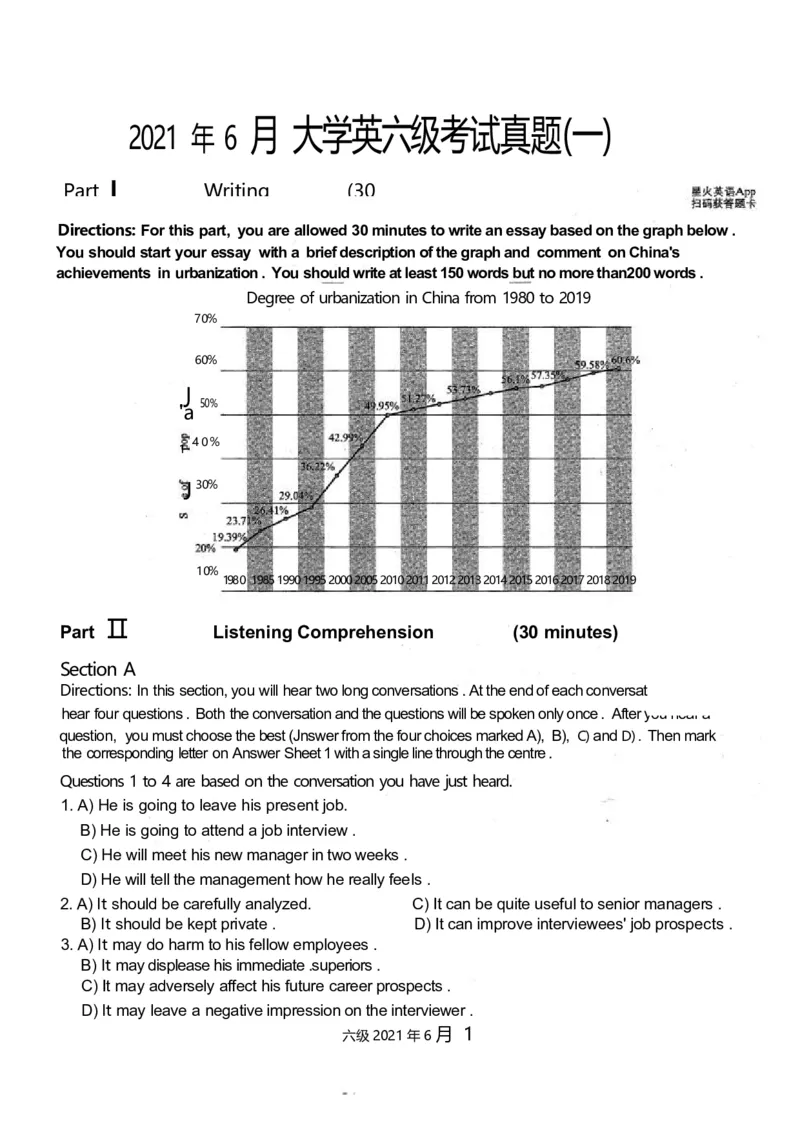
Directions: For this part, you are allowed 30 minutes to write an essay based on the graph below .
You should start your essay with a brief description of the graph and comment on China's
achievements in urbanization . You should write at least 150 words but no more than200 words .
Degree of urbanization in China from 1980 to 2019
70%
60%
.J
50%
'a
40%
1
J30%
10%
1980 1985 1990 1995 2000 2005 2010 2011 2012 2013 2014 2015 2016 2017 2018 2019
Ⅱ
Part Listening Comprehension (30 minutes)
Section A
Directions: In this section, you will hear two long conversations . At the end of each conversation, you will
hear four questions . Both the conversation and the questions will be spoken only once . After you hear a
question, you must choose the best (Jnswer from the four choices marked A), B), C) and D) . Then mark
the corresponding letter on Answer Sheet 1 with a single line through the centre .
Questions 1 to 4 are based on the conversation you have just heard.
1. A) He is going to leave his present job.
B) He is going to attend a job interview .
C) He will meet his new manager in two weeks .
D) He will tell the management how he really feels .
2. A) It should be carefully analyzed. C) It can be quite useful to senior managers .
B) It should be kept private . D) It can improve interviewees' job prospects .
3. A) It may do harm to his fellow employees .
B) It may displease his immediate .superiors .
C) It may adversely affect his future career prospects .
D) It may leave a negative impression on the interviewer .
六级 2021 年 6 月 14. A) Pour out his frustrations on a rate-your-employer website .
B) Network with his close friends to find a better employer .
C) Do some practice for the exit interview .
D) Prepare a comprehensive exit report .
Questions 5 to 8 are based on the conversation you have just heard.
5. A) Her career as a botanist . C) Her month-long expedition .
B) Her latest documentary . D) Her unsuccessful journey .
6. A) She was caught in a hurricane . C) She suffered from water shortage .
B) She had to live like a vegetarian . D) She had to endure many hardships .
7. A) They could no longer bear the humidity . C) A flood was approaching .
B) They had no more food in the canoe . D) A hurricane was coming.
8. A) It was memorable . C) It was fruitful.
B) It was unbearable. D) It was uneventful.
Section B
Directions: In this section, you will hear two passages . At the end of each passage , you will hear three
or four questions . Both the passage and the questions will be spoken only once . After you hear a question ,
you must choose the best answer from the four choices marked A) , B) , C) and D) . Then mark
the
corresponding letter on Answer Sheet 1 with a single line through the centre .
Questions 9 to 11 are based on the passage you have just heard.
9. A) It ensures the accuracy of their arguments . C) It hurts laymen's dignity and self-esteem .
B) It diminishes laymen's interest in science. D) It makes their expressions more explicit.
10. A) They will see the complexity of science . C) They tend to disbelieve the actual science .
B) They feel great respect towards scientists . D) They can learn to communicate with scientists.
11. A) Explain all the jargon terms . C) Find appropriate topics .
B) Do away with jargon terms . D) Stimulate their interest .
Questions 12 to 15 are based on the passage you have just heard.
12. A) There were oil deposits below a local gassy hill.
B) The erupting gas might endanger local children .
C) There was oiHeakage along the Gulf Coast .
D) The local gassy hill might start a huge fire .
13. A) The massive gas underground . C) Their lack of suitable tools .
B) Their lack of the needed skill. D) The sand under the hill .
14. A) It was not as effective as he claimed . C) It gave birth to the oil drilling industry .
B) It rendered many oil workers jobless . D) It was not popularized until years later .
15. A) It ruined the state's cotton and beef industries. C) It resulted in an oil surplus all over the world .
B) It totally destroyed the state's rural landscape. D) It radically transformed the state's economy .
Section C
Directions: In this section , you will hear three recordings of lectures or talks followed by three or four
questions . The recordings will be played only once . After you hear a question , you must choose the
best answer from the four choices marked A), B), C) and D). Then mark the corresponding letter on
Answer Sheet 1 with a single line through the centre .
Questions 16 to 18 are based on the recording you have just heard.
16. A) Insufficient motivation . C) Unsuitable jobs .
B) Tough regulations . D) Bad managers .
17. A) Ineffective training . C) Overburdening of managers .
B) Toxic company culture . D) Lack of regular evaluation .
月
六级 2021 6 218. A) It was based only on the perspective of employees.
B) It provided meaningful clues to solving the problem.
C) It was conducted from frontline managers' point of view.
D) It collected feedback from both employers and employees.
Questions 19 to 21 are based on the recording you have just heard.
19. A) It is expanding at an accelerating speed. C) It is yielding an unprecedented profit.
B) It is bringing prosperity to the region. D) It is seeing an automation revolution.
20. A) It creates a lot of new jobs.
B) It exhausts res<;mrces sooner.
C) It causes conflicts between employers and employees.
D) It calls for the retraining of unskilled mining workers.
21. A) They will wait to see its effect. C) They accept it with reservations.
B) They welcome it with open arms. D) They are strongly opposed to it.
Questions 22 to 25 are based on the recording you have just heard.
22. A) They have experienced a gradual decline since the year of 2017.
B) Their annual death rate is about twice that of the global average.
C) They kill more people than any infectious disease.
D) Their cost to the nation's economy is incalculable.
23. A) They are not as reliable as claimed.
B) They rise and fall from year to year.
C) They don't reflect the changes in individual countries.
D) They show a difference between rich and poor nations.
24. A) Many of them are investing heavily in infrastructure.
B) Many of them have seen a decline in road-death rates.
C) Many of them are following the example set by Thailand.
D) Many of them have increasing numbers of cars on the road.
25. A) Foster better driving behavior. C) Provide better training for drivers.
B) Abolish all outdated traffic rules. D) Impose heavier penalties on speeding.
Part Ⅲ Reading Comprehension ( 40 minutes)
Section A
Directions: In this section, there is a passage with ten blanks . You are required to select one word for each blank
from a list of choices given in a word bank following the passage . Read the passage through carefully before
making your choices . Each choice in the bank is identified by a letter . Please mark the corresponding
letter for each item on Answer Sheet 2 with a single line through the centre . You may not use any of the
words in the bank more than once .
A new study has drawn a bleak picture of cultural inclusiveness reflected in the children's
literature available in Australia. Dr . Helen Adam from Edith Cowan University's School of Education
26 the cultural diversity of children's books. She examined the books 27 in the kindergarten
rooms of four day-'care centers in Western Australia. Just 18 percent of 2,413 books in the total
collection contained any 28 of nonwhite people. Minority cultures were often featured in
stereotypical or tokenistic ways, for example, by 29 Asian culture with chopsticks and traditional
dress. Characters that did represent a
minority culture usually had 30 roles in the books. The main characters were mostly Caucasian.
This causes concern as it can lead to an impression that whiteness is of greater value.
Dr . Adam said children formed impressions about 'difference' and identity from a very young
age. Evidence has shown they develop own-race . 31 from as young as three months of age. The
books we
/、级 2021 6 月 3share with young children can be a valuable opportunity to develop children's understanding of
themselves and others. Books can also allow children to see diversity. They discover both similarities
and differences between themselves and others. This can help develop understanding, acceptance and
of diversity. Census data has shown Australians come from more than 200 countries.
They speak over 300 languages at home. Additionally, Australians belong to more than 100 different
religious groups. They also work in more than 1, OOO different occupations. "Australia is a
multicultural society. The current
33 promotion of white middle-class ideas and lifestyles risks 34 children from minority groups.
This can give white middle-class children a sense of 35 or privilege," Dr. Adam said.
A) alienating F) investigated K)' secondary
B) appreciation G) overwhelming L) superiority
C) bias H) portraying M) temperament
D) fraud I) representation N) tentative
E) housed · J) safeguarded 0) threshold
Section B
Directions: In this section, you are going to read a passage with ten statements attached to it . Each
statement contains information given in one of the paragraphs . Identify the paragraph from which the
information is derived . You may choose a paragraph more than once . Each paragraph is marked with a letter .
Answer the questions by marking the corresponding letter on Answer Sheet 2 .
How Marconi Gave Us the Wireless World
A) A hundred years before iconic figures like Bill Gates and Steve Jobs permeated our lives, an Irish
Italian inventor laid the foundation of the communication explosion of the 21st century.
Guglielmo Marconi was arguably the first truly global figure in modern communication. Not only
was he the first to communicate globally, he was the first to think globally about communication.
Marconi may not have been the greatest inventor of his time, but more than anyone else, he
brought about a fundamental shift in the way we communicate.
B) Today's globally networked media and conimunication system has its origins in the 19th century,
when, for the first time, messages were sent electronically across great distances. The
telegraph, the -telephone, and radio were the obvious predecessors of the-Internet, -iPotls, and-
mobile phones. What made the link from then to now was the development of wireless
communication. Marconi was the first to develop and perfect this system, using the recently-
discovered "air waves" that make up the electromagnetic spectrum.
C) Between 1896, when he applied for his first patent in England at the age of 22, and his death in
Italy in 1937, Marconi was at the center of every major innovation in electronic communication.
He was also a skilled and sophisticated organizer, an entrepreneurial innovator, who mastered
the use of corporate strategy, media relations, government lobbying, international diplomacy,
patents, and prosecution. Marconi was really interested in only one thing: the extension of mobile,
personal, long distance communication to the ends of the earth (and beyond, if we can believe some
reports) . Some like to refer to him as a genius, but if there was any genius to Marconi it was this
vision.
D) In 1901 he succeeded in signaling across the Atlantic, from the west coast of England to
Newfoundland in the USA, despite the claims of science that it could not be done. In 1924 he
convinced the British government to encircle the world with a chain of wireless stations using the
latest technology that he had devised, shortwave radio. There are some who say Marconi lost
his edge when commercial broadcasting came along; he didn't see that radio could or should be
used to frivolous (::JGJMJ(ID) ends. In one of his last public speeches, a radio broadcast to the
United States in March 1937, he deplored that broadcasting had become a one-way means of
communication and foresaw it moving in another
六级 2021 年 6 月 4direction, toward communication as a means of exchange. That was visionary genius.
E) Marconi's career was devoted to making wireless communication happen cheaply, efficiently,
smoothly, and with an elegance that would appear to be intuitive and uncomplicated to the user-
user friendly, if you will. There is a direct connection from Marconi to today's social media,
search engines, and program streaming that can best be summed up by an admittedly
provocative exclamation: the 20th century did not exist. In a sense, Marconi's vision jumped from
his time to our own.
F) Marconi invented the idea of global communication-or, more straightforwardly, globally
networked, mobile, wireless communication. Initially, this was wireless Morse code telegraphy ( 电
报通讯) , the principal communication technology of his day. Marconi was the first to develop a
practical method for wireless telegraphy using radio waves. He borrowed technical details from
many sources, but what set him apart was a self-confident vision of the power of communication
technology on the one hand, and, on the other, of the steps that needed to be taken to
consolidate his own position as a player in that field. Tracing Marconi's lifeline leads us into the
story of modern communication itself. There were other important figures, but Marconi towered
over them all in reach, power, and influence, as well as in the grip he had on the popular
imagination of his time. Marconi was quite simply the central figure in the emergence of a modern
understanding of communication.
G) In his lifetime, Marconi foresaw the development of television and the fax machine, GPS, radar,
and the portable hand-held telephone. Two months before he died, newspapers were reporting that
he was working on a "death ray," and that he had "killed a rat with an intricate device at a
distance of three feet." By then, anything Marconi said or did was newsworthy. Stock prices rose or
sank according to his pronouncements. If Marconi said he thought it might rain, there was
likely to be a run on umbrellas.
H) Marconi's biography is also a story about choices and the motivations behind them. At one
level, Marconi could be fiercely autonomous and independent of the constraints of his own social
class. On another scale, he was a perpetual outsider. Wherever he went, he was never "of" the
group; he .was always the "other," considered foreign in Britain, British in Italy, and "not
American" in the United States. At the same time, he also suffered tremendously from a need for
acceptance that drove, and sometimes stained, every one of his relationships.
I) Marconi placed a permanent stamp on the way we live. He was the first person to imagine a
practical application for the wireless spectrum, and to develop it successfully into a global
communication system-in both terms of the word; that is, worldwide and all-inclusive. He was able
to do this because of a combination of factors-most important, timing and opportunity-but the
single-mindedness and determination with which he carried out his self-imposed mission was
fundamentally character-based; millions of Marconi's contemporaries had the same class, gender,
race, and colonial privilege as he, but only a handful did anything with it. Marconi needed to achieve
the goal that was set in his mind as an adolescent; by the time he reached adulthood, he
understood, intuitively, that in order to have an impact he had to both develop an independent
economic base and align himself with political power. Disciplined, uncritical loyalty to political power
became his compass. for the choices he had to make.
J) At the same time, Marconi was uncompromisingly independent intellectually. Shortly after
Marconi's death, the nuclear physicist Enrico Fermi-soon to be the developer of the Manhattan
Project-wrote that Marconi proved that theory and experimentation were complementary
features of progress. "Experience can rarely, unless guided by a theoretical concept, arrive at
results of any great significance...on the other hand, an excessive ·trust in theoretical conviction
would have prevented Marconi from persisting in experiments which were destined t0 bring
about a revolution in the technique of radio-communications." In other words, Marconi had
the advantage of not being burdened by preconceived assumptions.
六级 2021 6 月 5K) The most controversial aspect of Marconi's life-and the reason why there has been no
satisfying biography of Marconi until now-was his uncritical embrace of Benito Mussolini . At first
this was not problematic for him . But as the regressive ( fftliJH1g) nature of Mussolini's ·regime
became clear, he began to suffer a crisis of conscience . However, after a lifetime of moving within
the circles of power, he was unable to break with authority, and served Mussolini faithfully ( as
president of Italy's national research council and royal academy, as well as a member of the Fascist
Grand Council) until the day he died-conveniently-in 1937, shortly before he would have had to
take a stand in the conflict that consumed a world that he had, in part, created .
36. Marconi was central to our present-day understanding of communication .
37. As an adult, Marconi had an intuition that he had to be loyal to politicians in order to be influential .
38. Marconi disapproved of the use of wireless communication for commercial broadcasting .
39. Marconi's example demonstrates that theoretical concepts and experiments complement each other
in making progress in science and technology .
40. Marconi's real interest lay in the development of worldwide wireless communication:
41. Marconi spent his whole life making wireless communication simple to use .
42. Because of his long-time connection with people in power, Marconi was unable to cut himself off
from the fascist regime in Italy.
43. In his later years, Marconi exerted a tremendous influence on all aspects of people's life .
44. What connected the 19th century and our present time was the development of
wireless communication .
45. Despite his autonomy, Marconi felt alienated and suffered from a lack of acceptance .
Section C
Directions: There are 2 passages in this section . Each passage is followed by some questions or
unfinished statements . For each of them there are four choices marked A), B), C) and D) . You should
decide on the
best choice and mark the corresponding letter on Answer Sheet 2 with a single line through the
centre . Passage One
Questions 46 to 50 are based on the following passage.
Humans are fascinated by the source of their failings and virtues . This preoccupation inevitably leads
to an old debate: whether nature or nurture moulds us more . A revolution in genetics has poised this as a
modern political question about the character of our society: personalities are hard-wired into our genes'
what can governments do to help us? It feels morally questionable, yet claims of genetic selection
by intelligence are making headlines .
This is down to"hereditarian" (遗传论的) science and a recent paper claimed "differences in
exam performance between pupils attending selective and non-selective schools mirror the genetic
differences between them" . With such an assertion, the work was predictably greeted by a lot of absurd
claims about "genetics determining academic success" . What the research revealed was the rather less
surprising result: the educational benefits of selective schools largely disappear once pupils' inborn
ability and socio economic background were taken into account . It is a glimpse of the blindingly
obvious-and there's nothing to back strongly either a hereditary or environmental argument.
Yet the paper does say children are "unintentionally genetically selected " by the school system .
Central to hereditarian science is a tall claim: that identifiable variations in genetic sequences can
predict an individual's aptness to learn, reason and solve problems . This is problematic on many levels.
A teacher could not seriously tell a parent their child has a low genetic tendency to study when
external factors clearly exist . Unlike-minded academics say the inheritability of human traits is
scientifically unsound . At best there is a weak statistical association and not a causal link between
DNA and intelligence . Yet sophisticated statistics are used to create an intimidatory atmosphere of
scientific certainty.
While there's an undoubted genetic basis to individual difference, it is wrong to think that socially
六级 2021 6 月 6defined groups can be genetically accounted for . The fixation on genes as destiny is surely false too .
Medical predictability can rarely be based on DNA alone; the environment matters too . Something
as complex as intellect is likely to be affected by many factors beyond genes . If hereditarians want to
advance their cause it will require more balanced interpretation and not just acts. of advocacy .
Genetic selection is a way of exerting influence over others, "the ultimate collective control of
human destinies," as writer H . G . Wells put it. Knowledge becomes power and power requires a
sense of responsibility . In understanding cognitive ability, we must not elevate discrimination to a
science; allowing people to climb the ladder of life only as far as their cells might suggest . This will
need a more sceptical eye on the science . As technology progresses, we all have a duty to make sure
that we shape a future that we would want to find ourselves in.
46. What did a recent research paper claim?
A) The type of school students attend makes a difference to their future .
B) Genetic differences between students are far greater than supposed .
C) The advantages of selective schools are too obvious to ignore .
D) Students' academic performance is determined by their genes .
47. What does the author think of the recent research?
A) Its result was questionable. C) Its influence was rather negligible .
B) Its implication was positive . D) Its conclusions were enlightening .
48. What does the author say about the relationship between DNA and intelligence?
A) It is one of scientific certainty . C) It is subject to interpretation of statistics .
B) It is not one of cause and effect . D) It is not fully examined by gene scientists.
49. What do hereditarians need to do to make their claims convincing?
A) Take all relevant factors into account in interpreting their data .
B) Conduct their research using more sophisticated technology .
C) Gather gene data from people of all social classes .
D) Cooperate with social scientists in their research .
50. What does the author warn against in the passage?
A) Exaggerating the power of technology in shaping the world .
B) Losing sight of professional ethics in conducting research .
C) Misunderstanding the findings of human cognition research .
D) Promoting discrimination in the name of science .
Passage Two
Questions 51 to SS are based on the following passage.
Nicola Sturgeon's speech last Tuesday setting out the Scottish government's legislative programme
for the year ahead confirmed what was already pretty clear . Scottish councils are set to be the first in
the UK with the power to levy charges on visitors, with Edinburgh likely to lead the way .
Tourist taxes are not new . The Himayalan kingdom of Bhutan has a longstanding policy of
charging visitors a daily fee . France's tax on overnight stays was introduced to assist thermal spa (温
泉) towns to develop, and around half of French local authorities use it today .
But such levies are on the rise . Moves by Barcelona and Venice to deal with the phenomenon
of "over-tourism" through the use of charges have recently gained prominence . Japan and Greece are
among the countries to have recently introduced tourist taxes .
That the UK lags behind is due to our weak, by international standards, local government, as well
as the opposition to taxes and regulation of our aggressively pro-market ruling party . Some UK cities
have lobbied without success for the power to levy a charge on visitors. Such levies are no universal
remedy as the amounts raised would be tiny compared with what has been taken away by central
government since
2010. Still, it is to be hoped that the Scottish government's bold move will prompt others to act . There
is 六级 2021 6 月 7no reason why visitors to the UK, or domestic tourists on holiday in hotspots such as Cornwall, should
be exempt from taxation-particularly when vital local services including waste collection, park
maintenance and arts and culture spending are under unprecedented strain .
On the contrary, compelling tourists to make a financial contribution to the places they visit beyond
their personal consumption should be part of a wider cultural shift . Westerners with disposable incomes
have often behaved as if they have a right to go wherever they choose with little regard for the
consequences . Just as the environmental harm caused by aviation and other transport must come under
far greater scrutiny, the social cost of tourism must also be confronted . This includes the impact of short-
term lets on housing costs and quality of life for residents . Several European capitals, including
Paris and Berlin, are leading a campaign for tougher regulation by the European Union . It also includes
the impact of overcrowding, litter and the kinds of behaviour associated with noisy parties .
There is no "one size fits all" solution to this problem . The existence of new revenue streams for
some but not all councils is complicated, and businesses are often opposed, fearing higher costs will
make them uncompetitive . But those places that want them must be given the chance to make tourist
taxes work .
51. What do we learn from Nicola Sturgeon's speech?
A) The UK is set to adjust its policy on taxation .
B) Tourists will have to pay a tax to visit Scotland .
C) The UK will take new measures to boost tourism .
D) Edinburgh contributes most to Scotland's tourism .
52. How come the UK has been slow in imposing the tourist tax?
A) Its government wants to attract more tourists .
B) The tax is unlikely to add much to its revenue .
C) Its ruling party is opposed to taxes and regulation.
D) It takes time for local governments to reach consensus .
53. Both international and domestic visitors in the UK should pay tourist tax so as to ____
A) elevate its tourism to international standards
B) improve the welfare of its maintenance workers
C) promote its cultural exchange with other nations
D) ease its financial burden of providing local services
54, What does the author sa-y about Western tourists?
A) They don't seem to care about the social cost of tourism .
B) They don't seem to mind paying for additional services .
C) They deem travel an important part of their life .
D) They subject the effects of tourism to scrutiny .
55. What are UK people's opinions about the levy of tourist tax?
A) Supportive . B) Skeptical . C) Divided . D) Unclear .
Part Ⅳ Translation ( 30 minutes)
Directions: For this part, you are allowed 30 minutes to translate a passage from Chinese into English .
You
should write your answer on Answer Sheet 2 .
海南是仅次于台湾的中国第二大岛,是位于中国最南端的省份o 海南岛,风景秀丽,气候宜人,阳光充足,气候多样,温泉密布,海水清澈
貞大部分海滩几乎全年都是游泳和日光浴的理想场所,因而被誉为中国的四季花园和度假胜地 ,每年都吸引了大批中外游客o
海南1988年建省以来,旅游业, 服务业,高新技术产 业飞速发展, 是中国唯一的省级经济特区,在中央政府和全国人民的
大力支持下,海南将建成中国最大的自由贸易试验区o
六级 2021 6 月 8