Unit 4 The Wonders of Nature
课时 4 Section B 1a-1d & Reading plus 分层作业
核心知识速记 01 基础达标 02 能力提升 03 拓展培优 0 4 思维进阶
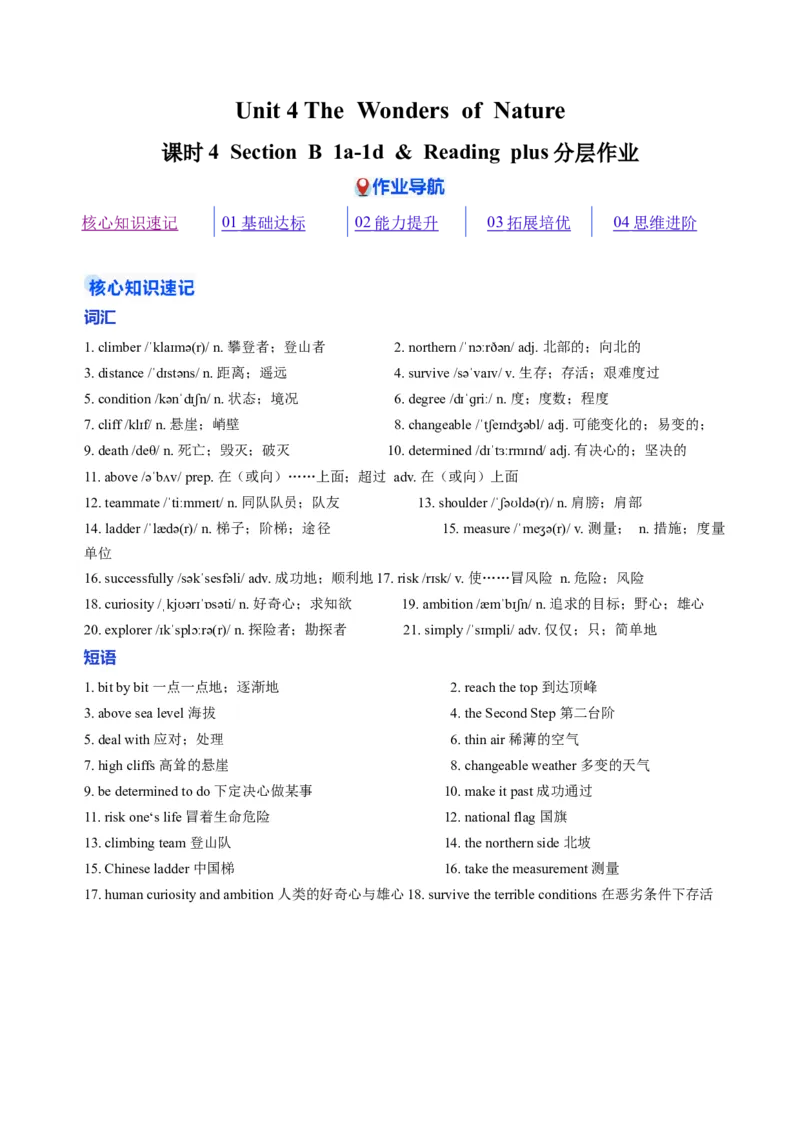
词汇
1. climber /ˈklaɪmə(r)/ n. 攀登者;登山者 2. northern /ˈnɔːrðən/ adj. 北部的;向北的
3. distance /ˈdɪstəns/ n. 距离;遥远 4. survive /səˈvaɪv/ v. 生存;存活;艰难度过
5. condition /kənˈdɪʃn/ n. 状态;境况 6. degree /dɪˈɡriː/ n. 度;度数;程度
7. cliff /klɪf/ n. 悬崖;峭壁 8. changeable /ˈtʃeɪndʒəbl/ adj. 可能变化的;易变的;
9. death /deθ/ n. 死亡;毁灭;破灭 10. determined /dɪˈtɜːrmɪnd/ adj. 有决心的;坚决的
11. above /əˈbʌv/ prep. 在(或向)……上面;超过 adv. 在(或向)上面
12. teammate /ˈtiːmmeɪt/ n. 同队队员;队友 13. shoulder /ˈʃəʊldə(r)/ n. 肩膀;肩部
14. ladder /ˈlædə(r)/ n. 梯子;阶梯;途径 15. measure /ˈmeʒə(r)/ v. 测量; n. 措施;度量
单位
16. successfully /səkˈsesfəli/ adv. 成功地;顺利地17. risk /rɪsk/ v. 使……冒风险 n. 危险;风险
18. curiosity /ˌkjʊərɪˈɒsəti/ n. 好奇心;求知欲 19. ambition /æmˈbɪʃn/ n. 追求的目标;野心;雄心
20. explorer /ɪkˈsplɔːrə(r)/ n. 探险者;勘探者 21. simply /ˈsɪmpli/ adv. 仅仅;只;简单地
短语
1. bit by bit 一点一点地;逐渐地 2. reach the top 到达顶峰
3. above sea level 海拔 4. the Second Step 第二台阶
5. deal with 应对;处理 6. thin air 稀薄的空气
7. high cliffs 高耸的悬崖 8. changeable weather 多变的天气
9. be determined to do 下定决心做某事 10. make it past 成功通过
11. risk one‘s life 冒着生命危险 12. national flag 国旗
13. climbing team 登山队 14. the northern side 北坡
15. Chinese ladder 中国梯 16. take the measurement 测量
17. human curiosity and ambition 人类的好奇心与雄心18. survive the terrible conditions 在恶劣条件下存活句型
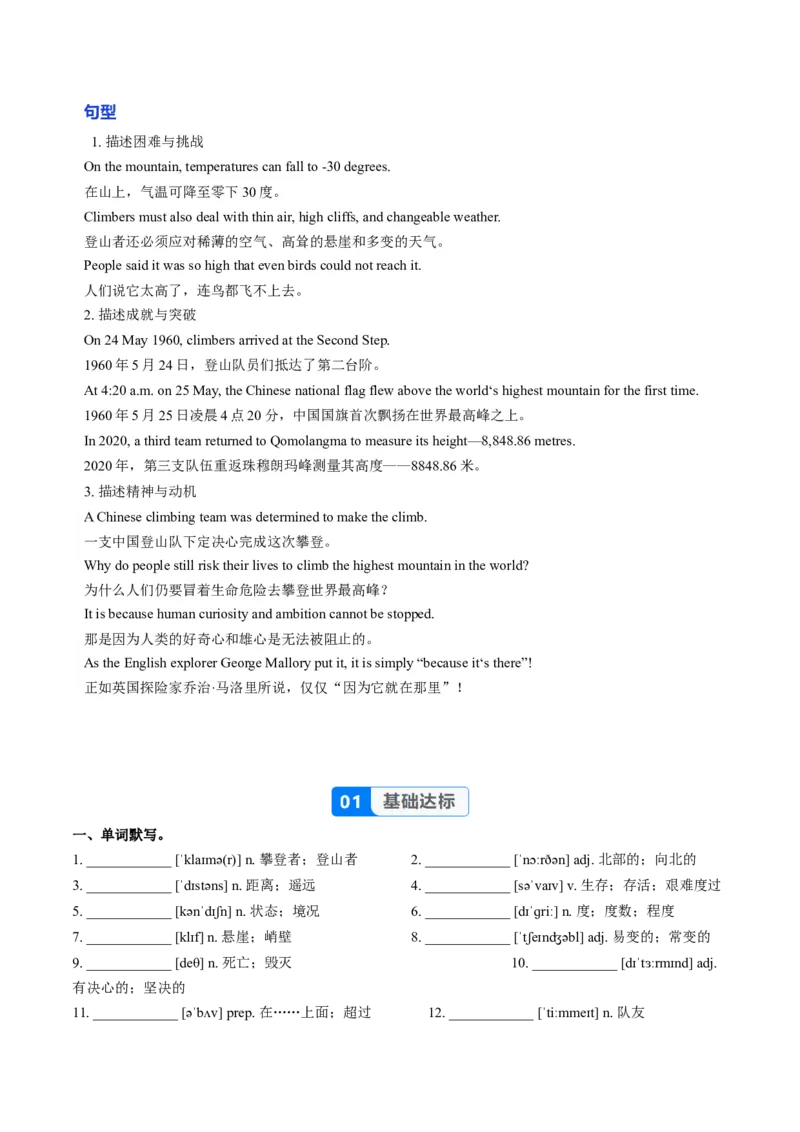
1. 描述困难与挑战
On the mountain, temperatures can fall to -30 degrees.
在山上,气温可降至零下30度。
Climbers must also deal with thin air, high cliffs, and changeable weather.
登山者还必须应对稀薄的空气、高耸的悬崖和多变的天气。
People said it was so high that even birds could not reach it.
人们说它太高了,连鸟都飞不上去。
2. 描述成就与突破
On 24 May 1960, climbers arrived at the Second Step.
1960年5月24日,登山队员们抵达了第二台阶。
At 4:20 a.m. on 25 May, the Chinese national flag flew above the world‘s highest mountain for the first time.
1960年5月25日凌晨4点20分,中国国旗首次飘扬在世界最高峰之上。
In 2020, a third team returned to Qomolangma to measure its height—8,848.86 metres.
2020年,第三支队伍重返珠穆朗玛峰测量其高度——8848.86米。
3. 描述精神与动机
A Chinese climbing team was determined to make the climb.
一支中国登山队下定决心完成这次攀登。
Why do people still risk their lives to climb the highest mountain in the world?
为什么人们仍要冒着生命危险去攀登世界最高峰?
It is because human curiosity and ambition cannot be stopped.
那是因为人类的好奇心和雄心是无法被阻止的。
As the English explorer George Mallory put it, it is simply “because it‘s there”!
正如英国探险家乔治·马洛里所说,仅仅“因为它就在那里”!
一、单词默写。
1. ____________ [ˈklaɪmə(r)] n. 攀登者;登山者 2. ____________ [ˈnɔːrðən] adj. 北部的;向北的
3. ____________ [ˈdɪstəns] n. 距离;遥远 4. ____________ [səˈvaɪv] v. 生存;存活;艰难度过
5. ____________ [kənˈdɪʃn] n. 状态;境况 6. ____________ [dɪˈɡriː] n. 度;度数;程度
7. ____________ [klɪf] n. 悬崖;峭壁 8. ____________ [ˈtʃeɪndʒəbl] adj. 易变的;常变的
9. ____________ [deθ] n. 死亡;毁灭 10. ____________ [dɪˈtɜːrmɪnd] adj.
有决心的;坚决的
11. ____________ [əˈbʌv] prep. 在……上面;超过 12. ____________ [ˈtiːmmeɪt] n. 队友13. ____________ [ˈʃəʊldə(r)] n. 肩膀 14. ____________ [ˈlædə(r)] n. 梯子;阶梯
15. ____________ [ˈmeʒə(r)] v. 测量 16. ____________ [səkˈsesfəli] adv. 成功地
17. ____________ [rɪsk] v. 冒风险 n. 危险 18. ____________ [ˌkjʊərɪˈɒsəti] n. 好奇心
19. ____________ [æmˈbɪʃn] n. 雄心;野心 20. ____________ [ɪkˈsplɔːrə(r)] n. 探险者
21. ____________ [ˈsɪmpli] adv. 仅仅;简单地
二、词组默写。
1. 一点一点地;逐渐地 ____________________ 2. 到达顶峰 ____________________
3. 海拔 ____________________ 4. 第二台阶 ____________________
5. 应对;处理 ____________________ 6. 稀薄的空气 ____________________
7. 高耸的悬崖 ____________________ 8. 多变的天气 ____________________
9. 下定决心做某事 ____________________ 10. 成功通过 ____________________
11. 冒着生命危险 ____________________ 12. 国旗 ____________________
13. 登山队 ____________________ 14. 北坡 ____________________
15. 中国梯 ____________________ 16. 测量 ____________________
17. 人类的好奇心与雄心 ____________________ 18. 在恶劣条件下存活 ____________________
三、根据要求完成句子
1. 在山上,气温可降至零下30度。
On the mountain, temperatures can ____________ to -30 degrees.
2. 登山者还必须应对稀薄的空气、高耸的悬崖和多变的天气。
Climbers must also ____________ ____________ thin air, high cliffs, and changeable weather.
3. 人们说它太高了,连鸟都飞不上去。
People said it was ____________ high ____________ even birds could not reach it.
4. 一支中国登山队下定决心完成这次攀登。
A Chinese climbing team was ____________ ____________ make the climb.
5. 1960年5月25日凌晨4点20分,中国国旗首次飘扬在世界最高峰之上。
At 4:20 a.m. on 25 May, the Chinese national flag flew ____________ the world’s highest mountain for the first
time.
6. 2020年,第三支队伍重返珠穆朗玛峰测量其高度——8848.86米。
In 2020, a third team returned to Qomolangma to ____________ its height—8,848.86 metres.
7. 为什么人们仍要冒着生命危险去攀登世界最高峰?
Why do people still ____________ their ____________ to climb the highest mountain in the world?
8. 那是因为人类的好奇心和雄心是无法被阻止的。
It is because human ____________ and ____________ cannot be stopped.
9. 正如英国探险家乔治·马洛里所说,仅仅“因为它就在那里”!
As the English ____________ George Mallory ____________ it, it is simply “because it‘s there”!
10. 直到2007年,几乎所有的北坡登山者都使用这把“中国梯”更快地登顶。____________ 2007, almost all climbers from the northern side used this “Chinese Ladder” to reach the top
much faster.
四、请根据所给的首字母写出单词,使句子意思完整正确。
1. Mount Qomolangma is the highest mountain on Earth, but only the best c______ can reach its top.
2. On the northern s______ of the mountain, the way to the top was once called the “Death Road”.
3. The Second Step is 8,600 metres a______ sea level. It was very difficult to climb.
4. In 1960, Liu Lianman allowed his t______ to step on his shoulders to get past the cliff.
5. Climbers must s______ very cold temperatures, thin air and changeable weather.
6. In 1975, a Chinese team brought a l______ to the Second Step to help climbers.
7. In 2020, Chinese climbers returned to m______ the exact height of Qomolangma.
8. People risk their lives to climb mountains because human c______ and ambition never stop.
五 、同义句转换。
1. The Second Step was so high that even birds could not reach it.
→ The Second Step was ______ high ______ birds to reach.
2. Liu Lianman allowed his teammates to step on his shoulders.
→ Liu Lianman ______ his teammates step on his shoulders.
3. People said the way was the “Death Road”.
→ It ______ ______ that the way was the “Death Road”.
4. In 2020, a third team went back to Qomolangma to measure its height.
→ In 2020, a third team ______ ______ Qomolangma to measure its height.
5. Why do people still risk their lives to climb the highest mountain?
→ Why do people still climb the highest mountain ______ ______ ______ their lives?
六 、用括号内所给词的适当形式填空。
1. Only the best climbers can reach the top if they ______ (survive) the terrible conditions first.
2. The weather on the mountain is ______ (change). It can be sunny one minute and stormy the next.
3. The Chinese team was ______ (determine) to reach the top of Qomolangma.
4. Liu Lianman ______ (allow) his teammates to step on his shoulders in 1960.
5. Bit by bit, the climbers pulled ______ (they) up and made it past the Second Step.
6. The “Chinese Ladder” helped climbers reach the top much ______ (fast).
7. Human ______ (curious) and ambition cannot be stopped.
8. George Mallory ______ (simple) said, “Because it’s there.”
七、选词填空。
请从方框内选择适当的词并用其正确形式填空,使文章完整连贯。注意每空一词,每词仅用一次,有两词
为多余项。
wonder, beautiful, visit, amazing, but, can, explore, learn, peaceful, nature, discover, theirMy name is Lily. I love 1 more than anything. Every weekend, I try to 2 different natural sites near
my home. Last week, I went to a forest with my dad. It was a 3 place, with tall trees and small rivers.
We found a small cave, which was an unexpected 4 . Inside, we could 5 strange rock shapes that
looked like animals. My dad told me these rocks were formed over thousands of years. I felt so excited to see such
a magical place.
I used to think natural wonders were only faraway places, 6 now I know there are amazing things right
around us. I 7 also learn a lot from these trips, like how plants grow without much water.
Next month, I plan to 8 a famous waterfall with my classmates. I’m sure it will be an 9 experience. I
hope everyone takes time to enjoy the beauty of nature and 10 more about the world around us.
八、阅读下面短文,从短文后的选项中选出可以填入空白处的最佳选项。
The undersea world is very beautiful. Now more and more people want to dive in the water to find the secret
there. Scuba diving (水肺潜水) is a new sport today. 1____
You will find many strange animals in the sea. 2 __ Many sea animals give out light in the dark and some
have sharp teeth.
During the day, there is enough light. Here, under the sea, everything is blue and green. When fish swim
nearby, you can catch them with your hands. When you have bottles of air on your back, you can stay in deep water
for a long time. 3 And you must be very careful when you dive in deep water.
The deep sea is not an easy place to live in. It’s cold, and it’s dark, too. 4 About 3,000 feet, there is
no light at all. It is very dark in the sea. Many fishes have no eyes. Some have big eyes. A few have eyes on one
side.
5 Animals eat! They must find food to eat. Many animals eat plants. However, some animals eat
meat. This means these sea animals have two big jobs.
They need to find animals as food, and they have to try not to become other animals’ meal.
A.Some are as large as a school bus.
B.It can take you into a wonderful undersea world.
C.Besides the cold and the darkness, deep-sea animals face a third danger—other animals.
D.However, you can’t dive too deep.
E.The deeper it is, the less sunlight there is.
九、阅读理解。
(A)
As winter temperatures drop, you can find some amazing natural landscapes. Take a look at the three
examples below!Dead plants or animals can give off methane gas. When the plants or
animals are covered with frozen water, the gas becomes ice bubbles. As the
temperature drops, the bubbles freeze deeper. This makes beautiful columns
of gas. The gas will get out when the ice melts in spring. When that
happens, the water smells bad.
Heavy snow can be compressed into ice. What do you get when
geothermal hot springs melt a long channel under the ice? An ice cave! The
ice inside has different thicknesses. It looks colourful in the sunlight. But
don’t stay there for too long—the ice cave can fall down.
When the air temperature falls faster than the water temperature, the
dripping water can turn into icicles. A set of huge icicles is like a frozen
waterfall. Icicles can be very sharp. You should be careful whenever you get
close to them.
1.When can the three amazing natural landscapes happen?
A.In spring. B.In summer. C.In autumn. D.In winter.
2.The underlined word “melts” means “ ” in English.
A.turns into ice B.turns into water C.becomes thicker D.becomes harder
3.What can you see when geothermal hot springs melt a long channel under the ice?
A.Beautiful columns of gas. B.A waterfall. C.A colourful ice cave.
D.The dripping water.
4.Why can’t you get close to icicles according to the material?
A.Because they are sharp. B.Because they are thick. C.Because they are
long.
D.Because they are cold.
5.Where can we probably read the material?
A.In a newspaper.B.In a diary. C.In a novel. D.In an ad.
(B)
Our planet has many amazing places, and one of them is Vinicunca in Peru. Known as the Rainbow Mountain,
it is famous for its bright lines of red, yellow, green, and purple. It is part of the Andes Mountains (安第斯山脉),
the longest mountain chain (山脉) on earth. At 5,200 meters tall, it is even taller than other famous mountains. Did
you know the Andes grow about 1 centimeter higher every year? Visitors say Rainbow Mountain feels like stepping
into a magical world!The colorful lines come from different rocks under the ground. For example, iron (铁) in the rocks turns red
when it meets air, and a yellow material called sulfur (硫磺) makes the bright yellow lines. Over thousands of
years, wind and rain slowly washed away dirt and ice, showing these colorful parts. Scientists say it’s like nature is
an artist! The colors also change with the weather—they look bright in sunlight and softer on cloudy days.
Before 2015, Rainbow Mountain was covered in ice. When the ice turned into water because of warmer
weather, the colors became perceptible. Now, many travelers visit it every year. But too many people walking here
can harm the mountain. To protect it, local villagers control the number of visitors and ask everyone to follow
simple rules, like taking rubbish home.
Rainbow Mountain reminds us that earth’s wonders are both beautiful and easily harmed. Saving these places
helps plants, animals, and people who live close by. Everyone can help! If we treat nature kindly, we protect the
mountain. Helping local guides means villagers can protect their home better, and telling friends about Rainbow
Mountain teaches others to care too. Even small steps today can keep this colorful wonder safe for tomorrow.
1.What can we know about the Rainbow Mountain?
A.It has three bright colorful lines.
B.It is the highest mountain chain on earth.
C.It becomes about 1 centimeter lower each year.
D.It is part of the Andes and over 5,000 meters tall.
2.What’s the main idea of Paragraph 2?
A.The reasons for Rainbow Mountain’s colors.
B.Which colors look bright in different weather.
C.The importance of protecting Rainbow Mountain.
D.How scientists study the rocks on Rainbow Mountain.
3.What does the underlined word “perceptible” in Paragraph 3 mean?
A.Natural. B.Disappearing. C.Noticeable. D.Dark.
4.What’s the main theme of the passage?
A.Science. B.Nature. C.Travel. D.Culture.
5.What’s the writer’s purpose of writing the passage?
A.To explain how weather harms mountains.
B.To describe the reasons for rock colors in nature.
C.To encourage people to visit Rainbow Mountain.
D.To introduce a natural place and call for its protection.
十、任务型阅读。
根据短文内容,用符合语义及语法规则的词填空,每空一词。
In 1986, a large iceberg (冰山) called A23a broke off from an ice shelf (冰架) in Antarctica (南极洲). There
was a research station on the shelf, and it was taken to the sea. Thankfully, no one was working there at the time.
As it moved, the iceberg broke into three smaller pieces. One of those pieces was A23a. It was about 74
kilometers long and 59 kilometers wide. That’s more than three times the size of New York City. This made it thelargest iceberg in the world. While the other two pieces floated (漂浮) away, A23a was on the ocean floor. It stayed
there for more than 30 years.
In 2020, scientists noticed some movement in A23a. At the end of 2023, the iceberg suddenly began moving
faster and kept going north. Now it’s floating in the open ocean.
It’s not common to see an iceberg of this size on the move, so scientists are closely watching it. It’s now
moving towards South Georgia Island (南乔治亚岛). If it comes too close to the shore (海岸), it might cause a big
problem. Millions of animals on the island may not be able to get food in the ocean.
1.There was a on the ice shelf and it was taken to the sea in 1986.
2.The largest iceberg in the world was about kilometers long and kilometers wide.
3.A23a stayed on the for more than 30 years.
4.At the end of 2023, A23a suddenly began and kept going north.
5.It might stop millions of animals on the island from in the ocean if A23a comes too close to the
shore.
十一、完形填空。
The Duku Highway is surrounded 1 high mountains and wide grasslands. If you drive on this road, you
will 2 amazing snow-covered mountain tops and green fields.
One of the best 3 along the Duku Highway is the Kuqa Grand Canyon. This is a really big canyon with
red cliffs. Besides, you must visit the Danxia Landform (丹霞地貌). It is 4 by the long-term erosion (侵蚀) of
rocks by flowing water 5 wind. The rocks are bright red, orange, and yellow, and they 6 a rainbow.
That’s why it is called “ 7 Danxia”. The Duku Highway is really a great place for people who love 8 .
However, when you enjoy the view, do remember those soldiers who 9 the road for 10 years, and 168 of them
lost their 10 for it. Therefore, this road is also called the “Road of Heroes”.
1.A.on B.with C.for D.of
2.A.hear B.feel C.smell D.see
3.A.events B.ideas C.changes D.places
4.A.showed B.described C.formed D.designed
5.A.and B.but C.or D.on
6.A.look at B.look like C.look after D.look for
7.A.ugly B.poor C.boring D.colourful
8.A.danger B.population C.nature D.cloth
9.A.chose B.built C.designed D.discovered
10.A.lives B.home C.money D.health
The Mountain That Teaches
Part 1: Read and ExploreMountain climbing is not just about reaching the top. For many climbers, the mountain is a great teacher. It
teaches patience, courage, and humility.
In 2018, a 13-year-old boy named Jordan climbed Mount Kilimanjaro with his father. It was not easy. At the
beginning, he felt excited and ran fast. But soon, he felt tired and dizzy. The air was thin, and his head hurt. He
wanted to give up.
His father said, “The mountain is not in a hurry. Why are you?” Jordan slowed down. He took smaller steps.
He rested more. He drank water and looked at the stars at night. He began to enjoy the climb, not just the goal.
On the fifth day, he reached the summit. He did not shout or cry. He just sat quietly and watched the sunrise.
Later, he said, “The mountain taught me that sometimes, going slower takes you farther.”
Many climbers say the same thing. Nature does not give shortcuts. It does not care how fast you are or how
famous you want to be. It only respects those who respect it. The real prize is not the view from the top—it is what
you learn on the way.
Task 1: Factual Understanding
Answer the following questions in complete sentences.
1. How old was Jordan when he climbed Mount Kilimanjaro?
__________________________________________________.
2. What problems did Jordan have at the beginning of the climb?
__________________________________________________.
3. What did Jordan’s father say to him?
__________________________________________________.
4. When did Jordan reach the summit?
__________________________________________________.
5. What did Jordan say the mountain taught him?
__________________________________________________.
Task 2: Inferential Thinking
Read the statements below. Write T (True), F (False), or NG (Not Given). Then correct the false statements.
1. Jordan climbed Mount Qomolangma with his father.
Correction: ____________________________________________________
2. Jordan wanted to give up because he felt tired and dizzy.
Correction: ____________________________________________________
3. Jordan’s father had climbed Kilimanjaro many times before.
Correction: ____________________________________________________
4. Jordan reached the summit on the fifth day.
Correction: ____________________________________________________
5. Jordan cried when he saw the sunrise.
Correction: ____________________________________________________
6. The mountain only respects those who respect it.
Correction: ____________________________________________________Task 3: Connection to Life
Nature is a great teacher. Think about a time when you learned something important from nature—not from a book
or a teacher, but from a mountain, a river, a tree, an animal, or even the weather.
Write a short paragraph (60–80 words) to answer the questions below:
(写一段60–80词的短文,回答下列问题。)
· What did you experience in nature?
· What did it teach you?
· How did it change the way you think or act?
____________________________________________________________________________________________
____________________________________________________________________________________________
____________________________________________________________________________________________
____________________________________________________________________________________________.