Unit 4 The Wonders of Nature
课时 7 Section B Project 4a-4c 分层作业
核心知识速记 01 基础达标 02 能力提升 03 拓展培优 0 4 思维进阶
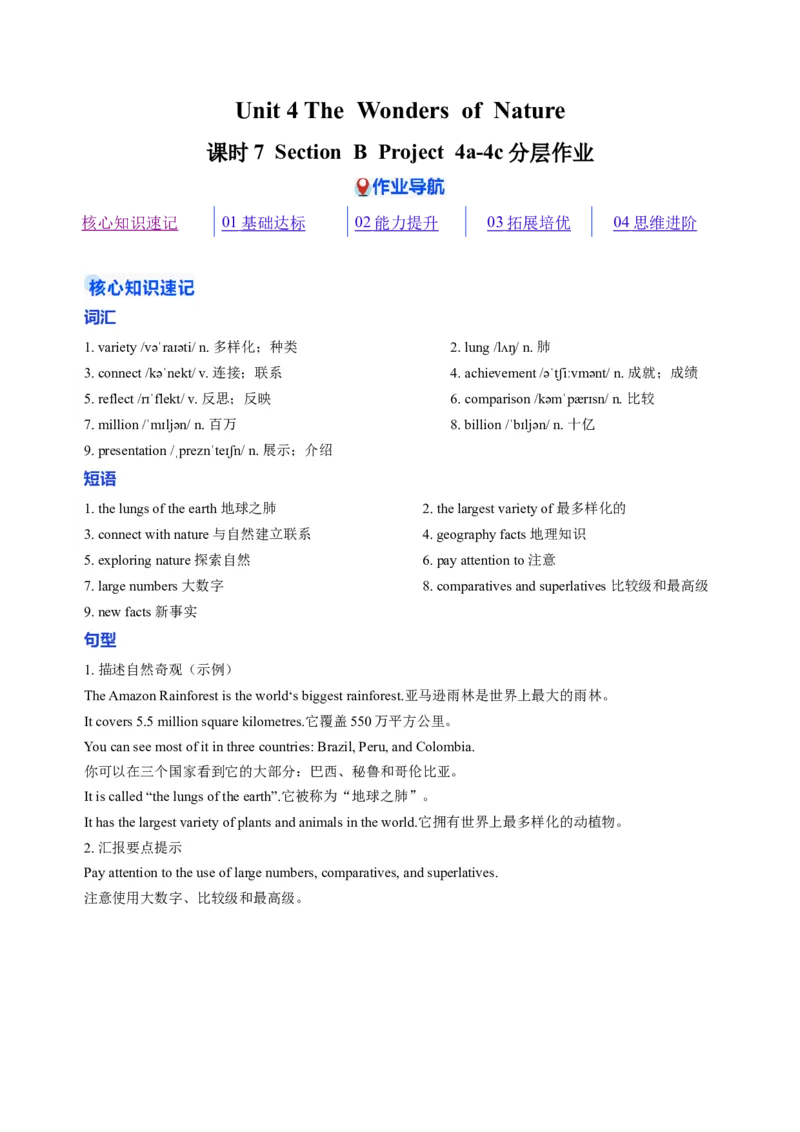
词汇
1. variety /vəˈraɪəti/ n. 多样化;种类 2. lung /lʌŋ/ n. 肺
3. connect /kəˈnekt/ v. 连接;联系 4. achievement /əˈtʃiːvmənt/ n. 成就;成绩
5. reflect /rɪˈflekt/ v. 反思;反映 6. comparison /kəmˈpærɪsn/ n. 比较
7. million /ˈmɪljən/ n. 百万 8. billion /ˈbɪljən/ n. 十亿
9. presentation /ˌpreznˈteɪʃn/ n. 展示;介绍
短语
1. the lungs of the earth 地球之肺 2. the largest variety of 最多样化的
3. connect with nature 与自然建立联系 4. geography facts 地理知识
5. exploring nature 探索自然 6. pay attention to 注意
7. large numbers 大数字 8. comparatives and superlatives 比较级和最高级
9. new facts 新事实
句型
1. 描述自然奇观(示例)
The Amazon Rainforest is the world‘s biggest rainforest.亚马逊雨林是世界上最大的雨林。
It covers 5.5 million square kilometres.它覆盖550万平方公里。
You can see most of it in three countries: Brazil, Peru, and Colombia.
你可以在三个国家看到它的大部分:巴西、秘鲁和哥伦比亚。
It is called “the lungs of the earth”.它被称为“地球之肺”。
It has the largest variety of plants and animals in the world.它拥有世界上最多样化的动植物。
2. 汇报要点提示
Pay attention to the use of large numbers, comparatives, and superlatives.
注意使用大数字、比较级和最高级。3. 反思问题(Reflecting)
What new facts about natural wonders have you learnt?你学到了关于自然奇观的哪些新事实?
Can you make comparisons when talking about natural wonders?谈论自然奇观时,你能进行比较吗?
Can you use large numbers to give some geography facts?你能使用大数字来介绍一些地理知识吗?
Can you explain how and why people connect with nature?
你能解释人们如何以及为什么与自然建立联系吗?
What are some achievements that people have made while exploring nature?人们在探索自然时取得了哪些成
就?
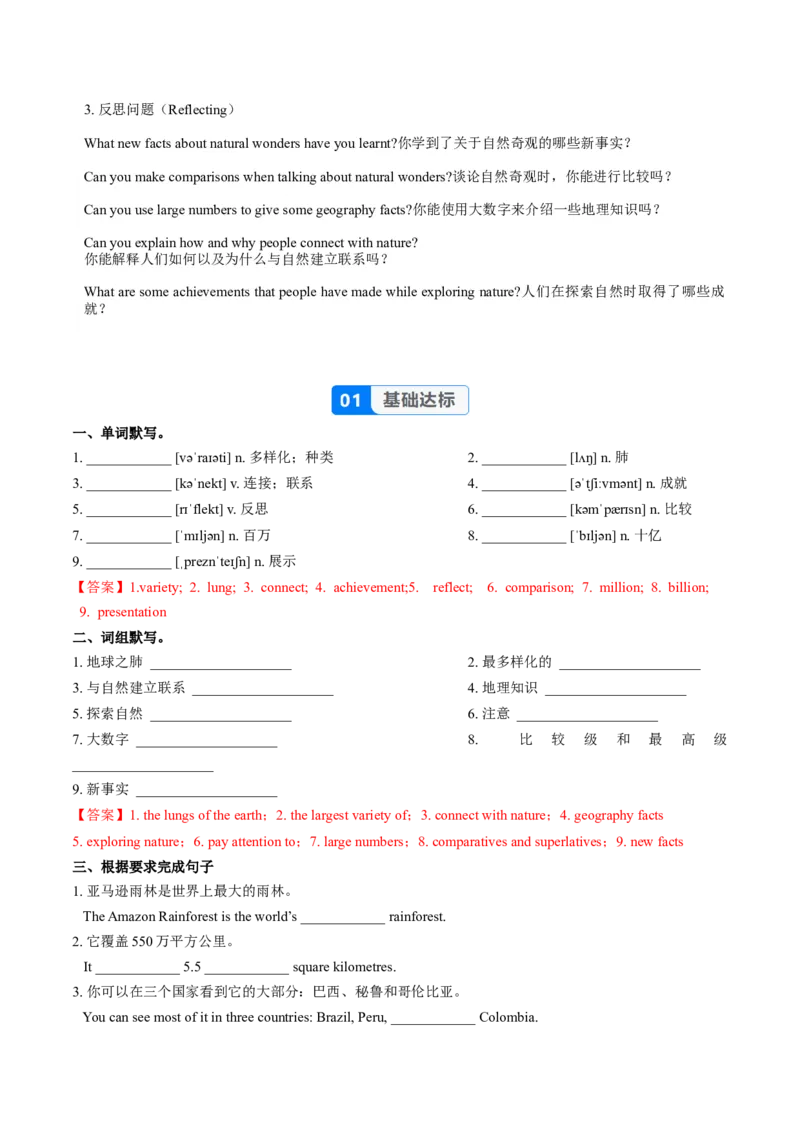
一、单词默写。
1. ____________ [vəˈraɪəti] n. 多样化;种类 2. ____________ [lʌŋ] n. 肺
3. ____________ [kəˈnekt] v. 连接;联系 4. ____________ [əˈtʃiːvmənt] n. 成就
5. ____________ [rɪˈflekt] v. 反思 6. ____________ [kəmˈpærɪsn] n. 比较
7. ____________ [ˈmɪljən] n. 百万 8. ____________ [ˈbɪljən] n. 十亿
9. ____________ [ˌpreznˈteɪʃn] n. 展示
【答案】1.variety; 2. lung; 3. connect; 4. achievement;5. reflect; 6. comparison; 7. million; 8. billion;
9. presentation
二、词组默写。
1. 地球之肺 ____________________ 2. 最多样化的 ____________________
3. 与自然建立联系 ____________________ 4. 地理知识 ____________________
5. 探索自然 ____________________ 6. 注意 ____________________
7. 大数字 ____________________ 8. 比 较 级 和 最 高 级
____________________
9. 新事实 ____________________
【答案】1. the lungs of the earth;2. the largest variety of;3. connect with nature;4. geography facts
5. exploring nature;6. pay attention to;7. large numbers;8. comparatives and superlatives;9. new facts
三、根据要求完成句子
1. 亚马逊雨林是世界上最大的雨林。
The Amazon Rainforest is the world’s ____________ rainforest.
2. 它覆盖550万平方公里。
It ____________ 5.5 ____________ square kilometres.
3. 你可以在三个国家看到它的大部分:巴西、秘鲁和哥伦比亚。
You can see most of it in three countries: Brazil, Peru, ____________ Colombia.4. 它被称为“地球之肺”。
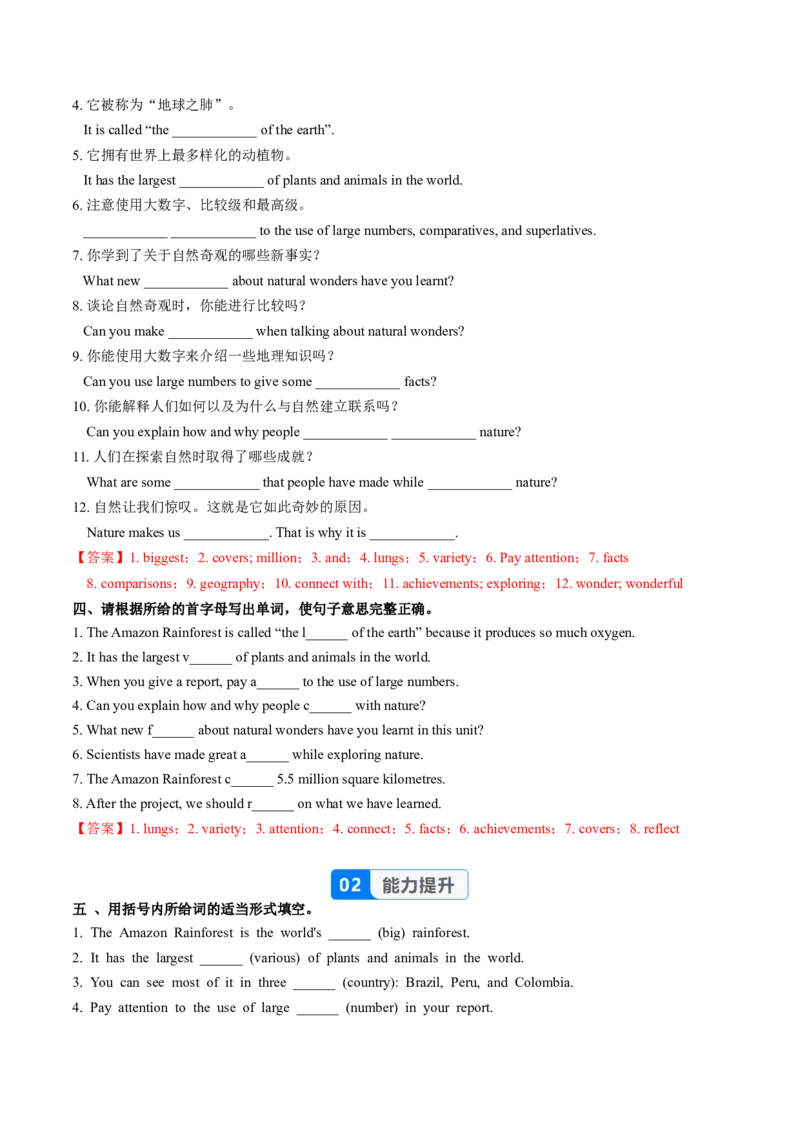
It is called “the ____________ of the earth”.
5. 它拥有世界上最多样化的动植物。
It has the largest ____________ of plants and animals in the world.
6. 注意使用大数字、比较级和最高级。
____________ ____________ to the use of large numbers, comparatives, and superlatives.
7. 你学到了关于自然奇观的哪些新事实?
What new ____________ about natural wonders have you learnt?
8. 谈论自然奇观时,你能进行比较吗?
Can you make ____________ when talking about natural wonders?
9. 你能使用大数字来介绍一些地理知识吗?
Can you use large numbers to give some ____________ facts?
10. 你能解释人们如何以及为什么与自然建立联系吗?
Can you explain how and why people ____________ ____________ nature?
11. 人们在探索自然时取得了哪些成就?
What are some ____________ that people have made while ____________ nature?
12. 自然让我们惊叹。这就是它如此奇妙的原因。
Nature makes us ____________. That is why it is ____________.
【答案】1. biggest;2. covers; million;3. and;4. lungs;5. variety;6. Pay attention;7. facts
8. comparisons;9. geography;10. connect with;11. achievements; exploring;12. wonder; wonderful
四、请根据所给的首字母写出单词,使句子意思完整正确。
1. The Amazon Rainforest is called “the l______ of the earth” because it produces so much oxygen.
2. It has the largest v______ of plants and animals in the world.
3. When you give a report, pay a______ to the use of large numbers.
4. Can you explain how and why people c______ with nature?
5. What new f______ about natural wonders have you learnt in this unit?
6. Scientists have made great a______ while exploring nature.
7. The Amazon Rainforest c______ 5.5 million square kilometres.
8. After the project, we should r______ on what we have learned.
【答案】1. lungs;2. variety;3. attention;4. connect;5. facts;6. achievements;7. covers;8. reflect
五 、用括号内所给词的适当形式填空。
1. The Amazon Rainforest is the world's ______ (big) rainforest.
2. It has the largest ______ (various) of plants and animals in the world.
3. You can see most of it in three ______ (country): Brazil, Peru, and Colombia.
4. Pay attention to the use of large ______ (number) in your report.5. Can you make ______ (compare) when talking about natural wonders?
6. What are some ______ (achieve) that people have made while exploring nature?
7. Nature makes us ______ (wonderful). That is why it is wonderful.
8. It ______ (call) "the lungs of the earth" because it produces oxygen.
【答案】1. biggest;2. variety;3. countries;4. numbers;5. comparisons;6. achievements;7. wonder
8. is called
六、选词填空。
protect research spread prepare collect finish present learn encourage advocate
Our class started a “Protect Local Wetland” project last month. The goal was to 1 people’s awareness of
natural protection. First, we divided into groups and 2 our tasks. Some groups were responsible for 3 the
wetland’s ecosystem, while others 4 protection leaflets and posters.
I was in charge of interviewing a local environmentalist. He told me about the wetland’s importance and the
threats it faces. His words 5 me a lot. We spent three weeks 6 all the materials and practicing our
presentation. By the time the project deadline came, we had 7 the report and the activity plan.
Last week, we 8 our project to the school. We also collected signatures from students to support wetland
9 . Everyone agreed that this project helped us 10 more about nature and our responsibility to protect it.
【答案】
1.advocate 2.prepared 3.researching 4.spread 5.encouraged 6.collecting 7.finished 8.
presented 9.protection 10.learn
【解析】
【导语】本文主要介绍了我们班开展了 “保护本地湿地” 项目,通过分组调研、准备材料、收集签名等
一系列活动完成了项目并向学校进行展示,让大家对自然与环保责任有了更深的了解。
1.句意:我们班上个月启动了一个“保护本地湿地”的项目。目标是提倡人们的自然保护意识。根据
“The goal was to…people’s awareness of natural protection.”和备选词汇可知,此处表示提倡环保意识,“to”
后接动词原形,应用advocate。故填advocate。
2.句意:首先,我们分成小组,准备我们的任务。根据“First, we divided into groups and…our tasks.”以及
备选词汇可知,此处表示准备任务,应用动词prepare;又因句子时态为一般过去时,故填prepared。
3.句意:一些小组负责研究湿地的生态系统,而另一些小组传播保护传单和海报。根据“Some groups
were responsible for…the wetland’s ecosystem”以及备选词汇可知,此处表示研究湿地生态系统,“be
responsible for”后接动名词,故填researching。
4.句意:一些小组负责研究湿地的生态系统,而另一些小组传播保护传单和海报。根据“while others…
protection leaflets and posters.”和备选词汇可知,此处表示传播传单海报,句子时态为一般过去时,应用
spread的过去式spread。故填spread。
5.句意:他的话鼓励了我很多。根据“His words…me a lot.”以及备选词汇可知,此处表示他的话鼓励了
我,句子时态为一般过去时,故填encouraged。
6.句意:我们花了三周时间收集所有材料并练习我们的展示。根据“We spent three weeks…all the
materials and practicing our presentation.”以及备选词汇可知,“spend time doing sth.”是固定搭配,此处表示收集材料,故填collecting。
7.句意:到项目截止日期时,我们已经完成了报告和活动计划。根据“By the time the project deadline
came, we had…the report and the activity plan.”以及备选词汇可知,“had+过去分词”是过去完成时结构,此
处表示完成报告,故填finished。
8.句意:上周,我们向学校展示了我们的项目。根据“Last week, we…our project to the school.”以及备选
词汇可知,句子时态为一般过去时,此处表示展示项目,故填presented。
9.句意:我们还从学生那里收集签名来支持湿地保护。根据“We also collected signatures from students to
support wetland…”和备选词汇可知,此处表示支持湿地保护,“wetland protection”是固定搭配,应用
protect的名词形式protection。故填protection。
10.句意:每个人都同意这个项目帮助我们了解更多关于自然和我们保护它的责任。根据“Everyone
agreed that this project helped us…more about nature and our responsibility to protect it.”以及备选词汇可知,
“help sb. do sth.”是固定搭配,此处表示了解更多,故填learn。
七、阅读下面短文,从短文后的选项中选出可以填入空白处的最佳选项。
What do you do when you see litter (垃圾) on the beach? You pick it up, of course. 11 The programme is
called Washed Ashore and its goal is to let people know the effects (影响) of litter in the ocean.
Pozzi started Washed Ashore when she noticed plastic on beaches. Sunlight breaks plastic down (分解) into
pieces. These small pieces of plastic enter the food chain (食物链). 12 Pozzi always loved the ocean and the
animals in it, and she wanted to do something to help them.
One of the sculptures (雕塑) is a turtle. 13 Another sculpture, called Fish Bite Fish, is made out of little
bits of plastic.
Pozzi doesn’t get all the litter by herself. When people find litter on beaches, they drop it off at a certain place.
14 Everything used for the sculptures is found on the beach, except for the framework (框架) and the materials
(材料) used to connect (连接) the litter together.
Who does Pozzi believe can save sea animals? “Kids can do many things,” she said. “ 15 I really believe
it.”
A.The turtle’s head is an old can lid.
B.Then she and her volunteers begin to turn the waste into art.
C.Sea animals eat them and end up dying.
D.They are the ones that can make things happen.
E.But Pozzi uses the litter to make huge sculptures of ocean animals.
【答案】1.E 2.C 3.A 4.B 5.D
【解析】
【导语】本文讲述了Pozzi发起的名为“Washed Ashore”的项目,该项目旨在让人们了解海洋垃圾的影响。
1.根据“What do you do when you see litter (垃圾) on the beach? You pick it up, of course.”可知,人们通常会捡起垃圾,但后文提到Pozzi用垃圾制作雕塑,选项E“但Pozzi用这些垃圾制作大型海洋动物雕塑”符合
语境。故选E。
2.根据“These small pieces of plastic enter the food chain (食物链)”可知,塑料碎片进入食物链,选项C“海
洋动物吃掉它们后最终死亡”符合语境。故选C。
3.根据“One of the sculptures (雕塑) is a turtle. ”可知,这里提到海龟雕塑,选项A“海龟的头是一个旧罐头
盖”符合语境。故选A。
4.根据“When people find litter on beaches, they drop it off at a certain place.”可知,当人们在海滩上发现垃
圾时,他们会把垃圾扔到某个地方,选项B“然后她和志愿者们开始将废物变成艺术品”符合语境。故选
B。
5.根据“Kids can do many things”可知,这里强调孩子的作用,选项D“他们才是能让事情发生的人”符合
语境。故选D。
八、阅读理解。
(A)
It was a day in 2014. Xu Yitang went to an aquarium (水族馆) in Beijing with friends. At that time, he had no
idea that this trip would make a difference in his life.
Xu saw some coral (珊瑚) in the aquarium. He lost himself in the beauty of it. After that day, he became
interested in the natural wonder. He started visiting experienced people to learn how to grow coral. He also learned
online. Later, he started to grow coral at home.
Xu was a college student then. He studied Peking Opera (京剧). He thought he would probably take on a job
about Peking Opera after finishing college. But as he learned more about coral, he knew that it is very important.
Coral reefs (珊瑚礁) are home to many sea animals. However, they are in great need of protection (保 护). Xu
wanted to help and he did so. After finishing college, he took a job protecting the coral in Hainan.
Each day, Xu spends hours staying in the sea water to study the beautiful coral. Sometimes, he has to work late
at night in the sea. It is very difficult and dangerous. Although his work is hard, he enjoys it. When he is free, he
likes to share beautiful coral photos and videos online. He wants more people to take action to protect the coral and
the sea.
1.What can we know about Xu?
A.He studied Peking Opera before.
B.He got his first job in Beijing.
C.He learned coral protection at college.
D.He saw some coral in the aquarium in Beijing with friends in 2024.
2.The last paragraph is mainly about ________.
A.Xu’s advice B.Xu’s dream C.Xu’s work D.Xu’s hobby
3.What’s the best title for the passage?
A.Be careful with your actions B.Protect the beauty in the sea
C.Don’t be afraid of differences D.A trip to an aquarium
【答案】1.A 2.C 3.B【解析】
【导语】本文是一篇记叙文,主要讲述了徐一唐从对珊瑚产生兴趣到投身珊瑚保护工作的故事。
1.细节理解题。根据“Xu was a college student then. He studied Peking Opera.”可知,徐一唐曾学习京剧。
故选A。
2.主旨大意题。根据“Each day, Xu spends hours staying in the sea water to study the beautiful coral.”以及他
分享珊瑚照片的行为可知,本段主要介绍徐一唐的日常工作内容。故选C。
3.最佳标题题。通读全文可知,全文围绕徐一唐从接触珊瑚到投身保护工作的故事展开,强调保护珊瑚
的重要性。故选B。
(B)
Saihanba is one of China’s largest forests. It lies in the north of Hebei Province. Saihanba means “beautiful
and high mountains”.
Around the 10th century, the rulers of the Liao Dynasty made it a royal (皇家的) hunting place because it was
home to beautiful forests, green grasslands, clear lakes and different kinds of wild animals. Emperor Kangxi of the
Qing Dynasty liked Saihanba so much that he made hunting there a royal festival. The royal festival finally stopped
in the 19th century for lack of money and the place had to be open to the public. After that, the cutting down of
trees and wildfires changed green Saihanba into grey deserts. By the 1950s, the beauty of Saihanba had completely
disappeared (消失) with only one tree left. The tree is now famous as the “Tree of Honour”.
On seeing the tree, Chinese scientists made up their minds and dreamed of restoring Saihanba. In February
1962, the plans were made and more than 120 foresters joined 242 local people in Saihanba to begin rebuilding it.
Over the next 55 years, those first treeplanters fought against many difficulties to plant trees. After they died, their
children and relatives followed them and went on with their hard work of planting trees.
Today, the scientists’ dream has come true and there is beautiful grassland and flowers again around the “Tree
of Honour”. Chinese people successfully changed Saihanba in the past halfcentury.
1.What’s the right order of the events in Paragraph 2?
①Saihanba became a royal hunting place.
②Saihanba was a desert and its beauty disappeared.
③Saihanba wasn’t closed to the public any more.
④Saihanba turned into the place for royal hunting festivals.
A.①③②④ B.①③④②
C.①④③② D.①④②③
2.What does the underlined word “restoring” in Paragraph 3 probably mean?
A.Looking around. B.Bringing back.
C.Arriving at. D.Travelling to.
3.According to Paragraph 4, how does the writer feel about Chinese people?
A.Proud. B.Worried. C.Surprised. D.Nervous.
4.What is the best title of this passage?
A.Saihanba: Past and PresentB.The Largest Forest in China
C.The Disappearing Saihanba
D.The “Tree of Honour” in Saihanba
【答案】1.C 2.B 3.A 4.A
【解析】
【导语】本文是一篇记叙文,介绍了塞罕坝从辽代皇家猎场到生态遭破坏,再到几代人历经 55年植树造
林、成功恢复美丽森林的变迁历程,展现了中国人重建生态的决心与成就。
1.细节理解题。根据“Around the 10th century, the rulers of the Liao Dynasty made it a royal hunting
place”“Emperor Kangxi…made hunting there a royal festival”“The royal festival finally stopped…the place had to
be open to the public”“By the 1950s, the beauty of Saihanba had completely disappeared”可知,事件顺序为①成
为皇家猎场→④成为皇家狩猎节举办地→③对公众开放→②变成荒漠、美景消失,故选C。
2.词句猜测题。根据前文“the beauty of Saihanba had completely disappeared”和后文“begin rebuilding it”可
知,科学家看到仅剩的树后,决心重建塞罕坝,让它恢复原貌,“restoring”意为“恢复”,与“Bringing
back”同义,故选B.。
3.观点态度题。根据“Today, the scientists’ dream has come true”“Chinese people successfully changed
Saihanba in the past halfcentury”中的“successfully”可知,作者对中国人改造塞罕坝的成就持自豪的态度,
故选A。
4.最佳标题题。全文以时间为线,依次介绍了塞罕坝过去的皇家猎场风貌、沦为荒漠的过程,以及如今
恢复秀美风光的现状,核心围绕塞罕坝的过去和现在展开,故选A。
九、任务型阅读。
根据短文内容在文章后表格中的空白处填入一个最恰当的词,每空一词。
In recent years, China has tried its best to protect the environment and achieved great results. These
achievements include many areas. Let’s take a closer look at some of these successes.
Leading in Renewable Energy
China is now the world’s largest producer of solar and wind energy. By building huge solar farms and wind
turbines (涡轮机), the country offers clean power to millions of homes. For example, in 2022, China’s solar power
production reached over 390 million kilowatts (千瓦), becoming the top in the world. This helps cut coal use and
air pollution.
Greener Lands and Forests
China has planted billions of trees to keep soil in place and fight against desertification (沙漠化). The Great
Green Wall project, set up in 1978, has built forests covering over 46 million hectares—an area larger than
Germany! The government has also returned over 28 million hectares of farmland to forests or grasslands since
1999, which is good for biodiversity (生物多样性) protection.
Clearer Skies in Cities
Air pollution used to be a serious problem in cities like Beijing. However, some laws have made air quality
better. Beijing’s average PM2.5 level dropped by about 63% between 2013 and 2021. Many cities now have more
blue sky days than before.Promoting Green Transport
In 2023, over 60% of the world’s electric vehicles (EVs) (电动汽车) were made in China. China leads the
world in EV production and sales. Cities like Shenzhen have already used electric buses and taxis completely
instead of oil ones, lowering carbon emissions (排放) and noise pollution.
China’s environmental achievements show that progress is possible when people and government work
together. As students, we can also make a difference by saving energy, recycling, and reusing. After all, protecting
the Earth is everyone’s duty!
China’s Journey to a Greener Future
Introduction China has done a good job in 1 environment in recent years.
◆As the largest producer of solar ang wind
energy in the world, China 2 clean power
Leading in Renewable
for millions of home.
Energy
◆China’s huge energy production is 3 in
cutting coal use and air pollution.
◆China 4 a project, called Great Green
Wall to build a large area of forests.
Greener Lands and Forests
◆Chinese government has also 5 farmland
to forests or grasslands since 1999.
Achievement
s
◆Cities like Beijing used to 6 serious air
pollution.
Clearer Skies in Cities
◆People in many cities can see blue sky days
more 7 than before.
◆China leads the world in electric vehicle
production as well as 8 .
Promoting Green Transport ◆Shenzhen, as an example, has completely
9 using oil buses and taxis to lower
pollution.
Everyone should take action to make a difference by following three Rs: 10
Conclusion
, reusing and recycling.
【答案】
1.protecting 2.provides 3.helpful 4.started 5.returned 6.have 7.often 8.sales 9.stopped
10.reducing
【解析】
【导语】本文主要讲的是中国在环境保护方面取得的成就,包括可再生能源、绿化工程、空气治理和绿色交通等方面的进展,并呼吁每个人参与环保行动。
1.根据“China has tried its best to protect the environment and achieved great results”可知中国在环境保护方
面取得了巨大成就,介词in后跟动名词protecting。故填protecting。
2.根据“the country offers clean power to millions of homes”可知中国为数百万人提供清洁能源,provide sth
for sb“给某人提供某物”,句子时态为一般现在时,主语是第三人称单数,动词用三单形式。故填
provides。
3.根据“This helps cut coal use and air pollution”可知中国的巨大能源生产有助于减少煤炭使用和空气污
染。helpful“有帮助的”,形容词作表语,故填helpful。
4.根据“The Great Green Wall project, set up in 1978”可知中国启动了一个名为“绿色长城”的项目。
start“启动”,时态是一般过去时,动词用过去式,故填started。
5.根据“The government has also returned over 28 million hectares of farmland to forests or grasslands since
1999”可知政府将农田恢复为森林或草地。结合“has”可知,本句是现在完成时,动词用过去分词
returned。故填returned。
6.根据“Air pollution used to be a serious problem in cities like Beijing”可知像北京这样的城市过去有严重的
空气污染。have表示“有”,used to do sth“过去常常做某事”。故填have。
7.根据“Many cities now have more blue sky days than before”可知许多城市现在比以前有更多的蓝天日,
即人们看到蓝天日更频繁。often表示“频繁地”,符合语境。故填often。
8.根据“China leads the world in EV production and sales”可知中国在电动汽车生产和销售方面领先世界。
故填sales。
9.根据“Cities like Shenzhen have already used electric buses and taxis completely instead of oil ones, lowering
carbon emissions (排放) and noise pollution.”可知深圳已经完全停止使用燃油公交车和出租车,应用动词
stop,结合“has”可知,本句是现在完成时,动词用过去分词。故填stopped。
10.根据“we can also make a difference by saving energy, recycling, and reusing”可知我们也可以通过节约能
源、回收和再利用来改变世界,所以三个R原则是:reducing,recycling和reusing。故填reducing。
十、完形填空。
Last month, our school organized a trip to Green Mountain National Park to learn about natural wonders. All
students 1 to join in this exciting activity.
On the way, our teacher 2 us about the park’s history. She said it was home to many 3 plants and
animals, and there was a famous cave hidden in the mountain. When we arrived, we 4 a guide who took us
around the park.
First, we visited the cave. It was dark inside, 5 we used flashlights to see the beautiful rock shapes. The
guide told us these rocks 6 over millions of years. Then, we walked to a lake at the foot of the mountain. The
water was so 7 that we could see the fish swimming clearly.
In the afternoon, we had a talk about protecting natural wonders. We learned that some of them are in danger
because of pollution. We decided to 8 a poster to tell more people to care for nature. Before leaving, we 9
some rubbish we found around the lake.
This trip taught me that natural wonders are precious. We should 10 them for future generations.1.A.invited B.were invited C.invite D.inviting
2.A.told B.spoke C.said D.talked
3.A.rare B.common C.ugly D.fast
4.A.met B.made C.became D.got
5.A.but B.so C.or D.because
6.A.form B.formed C.are formed D.were formed
7.A.dirty B.clear C.warm D.cold
8.A.put up B.give up C.make up D.set up
9.A.picked up B.looked up C.turned up D.took up
10.A.harm B.destroy C.protect D.ignore
【答案】
1.B 2.A 3.A 4.A 5.B 6.D 7.B 8.A 9.A 10.C
【解析】
【导语】本文讲述了一次学校组织的自然公园旅行,学生们参观了洞穴和湖泊,学习了自然奇观知识,并
决定采取行动保护自然。
1.句意:所有学生都被邀请参加这次令人兴奋的活动。
invited邀请,过去式/过去分词;were invited被邀请,一般过去时被动;invite邀请,动词原形;inviting邀
请,动名词/现在分词。根据“All students...to join in this exciting activity.”可知,所有学生都“被邀请”参
加这次令人兴奋的活动。主语All students和invite是被动关系;根据前文“Last month”可知,此处使用一
般过去时的被动was/were+V-ed;主语All students是复数,所以使用were,invite的过去分词是invited。故
选B。
2.句意:在路上,我们的老师告诉了我们关于这个公园的历史。
told告诉;spoke说;said说;talked谈论。tell (过去式told) sb. about sth.是固定搭配,意为“告诉某人关于
某事”。故选A。
3.句意:她说这里是许多稀有动植物的家,山里还藏着一个著名的洞穴。
rare稀有的;common常见的;ugly丑陋的;fast快的。根据“it was home to many...plants and animals”可知,
它是许多“稀有的”动植物的家。故选A。
4.句意:当我们到达时,我们遇到了一位带领我们游览公园的导游。
met遇见;made构成;became变成;got得到。根据“When we arrived, we...a guide who took us around the
park.”可知,当我们到达时,我们“遇见了”一位带领我们游览公园的导游。故选A。
5.句意:里面很暗,所以我们用手电筒来看那些漂亮的岩石形状。
but但是;so所以;or或者;because因为。根据“It was dark inside,...we used flashlights to see the beautiful
rock shapes.”可知,因为里面很黑,“所以”使用手电筒照明。故选B。
6.句意:导游告诉我们这些岩石是经过数百万年形成的。
form形成,动词原形;formed形成,过去式/过去分词;are formed被形成,一般现在时被动;were formed
被形成,一般过去时被动。根据“The guide told us these rocks...over millions of years.”可知,导游告诉我们
这些岩石是经过数百万年“形成”的。主语these rocks和form是被动关系;根据前文“told”可知,此处使用一般过去时的被动was/were+V-ed;主语these rocks是复数,所以使用were,form的过去分词是
formed。故选D。
7.句意:湖水是如此的清澈,以至于我们能清楚地看到鱼在游动。
dirty脏的;clear清澈的;warm温暖的;cold寒冷的。根据“The water was so...that we could see the fish
swimming clearly.”可知,湖水是如此的“清澈”,以至于我们能清楚地看到鱼在游动。故选B。
8.句意:我们决定张贴一张海报,告诉更多人关爱自然。
put up张贴;give up放弃;make up编造;set up建立。根据“We decided to...a poster to tell more people to
care for nature.”可知,我们决定“张贴”一张海报,告诉更多人关爱自然。故选A。
9.句意:离开前,我们捡起了在湖边发现的一些垃圾。
picked up捡起;looked up查阅;turned up出现;took up开始从事。根据“Before leaving, we...some rubbish
we found around the lake.”可知,离开前,我们“捡起了”在湖边发现的一些垃圾。故选A。
10.句意:我们应该为后代保护它们。
harm伤害;destroy破坏;protect保护;ignore忽视。根据“We should...them for future generations.”可知,
我们应该为后代“保护”它们。故选C。
Kids Who Care: Saving Nature One Step at a Time
Part 1: Read and Explore
When we think of explorers, we often imagine adults climbing mountains or diving deep into the ocean. But
today, many young people are also exploring nature—and protecting it.
Meet Leo, a 13-year-old boy from Brazil. He lives near the Amazon Rainforest. Last year, he noticed that
more and more trees were disappearing. He felt sad and worried. He decided to act. With the help of his teacher,
Leo started a small group called "Amazon Kids." Every Saturday, Leo and his friends go to the forest to pick up
rubbish and plant new trees. They also make posters to teach people in their town why the rainforest is important.
In just one year, their group has planted over 500 trees. They have also cleaned up three kilometers of
riverbanks. Leo says, "The Amazon is called 'the lungs of the earth.' If we lose it, we lose our future. We are young,
but we can still make a difference."
Far away in Australia, 14-year-old Mia is doing her part too. She loves the Great Barrier Reef. When she
learned that coral bleaching was killing the reef, she wanted to help. Mia started an online campaign called "Reef
Heroes." She shares photos and videos of the reef on social media. She also teaches people how to use reef-safe
sunscreen and why it matters.
Mia's campaign has reached over 10,000 people. Some of her followers have started their own beach cleanup
groups. "You don't need to be a scientist to protect nature," Mia says. "You just need to care."
Both Leo and Mia believe that small actions can lead to big changes. They prove that age is not a barrier—
anyone can be an explorer and a protector of our planet.
Task 1: Multiple ChoiceTask 1: Understanding Facts
Answer the following questions in complete sentences.
1. Where does Leo live, and what natural wonder is near his home?
_________________________________________________________.
2. What did Leo notice that made him worried?
_________________________________________________________.
3. How many trees has Leo's group planted in one year?
_________________________________________________________.
4. What problem is the Great Barrier Reef facing according to Mia?
_________________________________________________________.
5. What is the name of Mia's online campaign, and what does she do?
_________________________________________________________.
Task 2: Language Focus & Critical Thinking
Part A: Find the words in the passage that match these meanings.
1. ______________: people who travel to discover new places (paragraph 1)
2. ______________: to take action because of a feeling (paragraph 2)
3. ______________: a group of people working together (paragraph 2)
4. ______________: a planned series of actions to achieve a goal (paragraph 4)
Part B: Answer the questions with your own ideas.
1. Leo says, "We are young, but we can still make a difference." Do you agree? Why or why not?
_________________________________________________________.
2. Both Leo and Mia use social media or posters to teach others. Why is teaching others important for protecting
nature?
_________________________________________________________.
Task 3: Connection to Life — Be a Young Explorer
Leo and Mia started with small actions and made a big difference. Now it's your turn to think about what YOU
can do.Write a short paragraph (60-80 words) to answer the questions below:
· What is a natural place near you or that you love? (It could be a park, a river, a lake, a forest, or even a garden.)
· What problem does this place face? (For example: rubbish, pollution, trees being cut down, etc.)
· What is ONE small action you and your classmates could take to help protect this place?
____________________________________________________________________________________________
____________________________________________________________________________________________
____________________________________________________________________________________________
____________________________________________________________________________________________
____________________________________________________________________________________________
____________________________________________________________________________________________
____________________________________________________________________________________________
____________________________________________________________________________________________【参考答案】
Task 1:
1. Leo lives in Brazil, near the Amazon Rainforest.
2. He noticed that more and more trees were disappearing.
3. They have planted over 500 trees.
4. The Great Barrier Reef is facing coral bleaching.
5. Her campaign is called "Reef Heroes." She shares photos and videos on social media and teaches people about
reef-safe sunscreen.
Task 2: A. 1. explorers; 2. act; 3. group; 4. campaign
B. 1. Yes, I agree. Even young people can help by picking up rubbish or telling others about nature. Small
actions matter.
2. Teaching others is important because one person can only do so much. When more people know and care,
more people will help.
Task 3: Connection to Life
Near my school, there is a small river. It used to be clean, but now there is plastic rubbish along the banks. Fish and
birds are losing their home. My classmates and I could start a "Clean-Up Saturday" once a month. We could also
put up signs to tell people not to throw rubbish into the river. Small actions can bring the river back to life.
(我们学校附近有一条小河。它曾经很清澈,但现在岸边有塑料垃圾。鱼和鸟儿正在失去家园。我和同学
们可以每个月组织一次"周六清洁日"。我们还可以立起告示牌,告诉人们不要往河里扔垃圾。小小的行动
能让河流重获生机。)