Unit 1 Time to Relax
课时 2 Section A (2a-3d) 分层作业
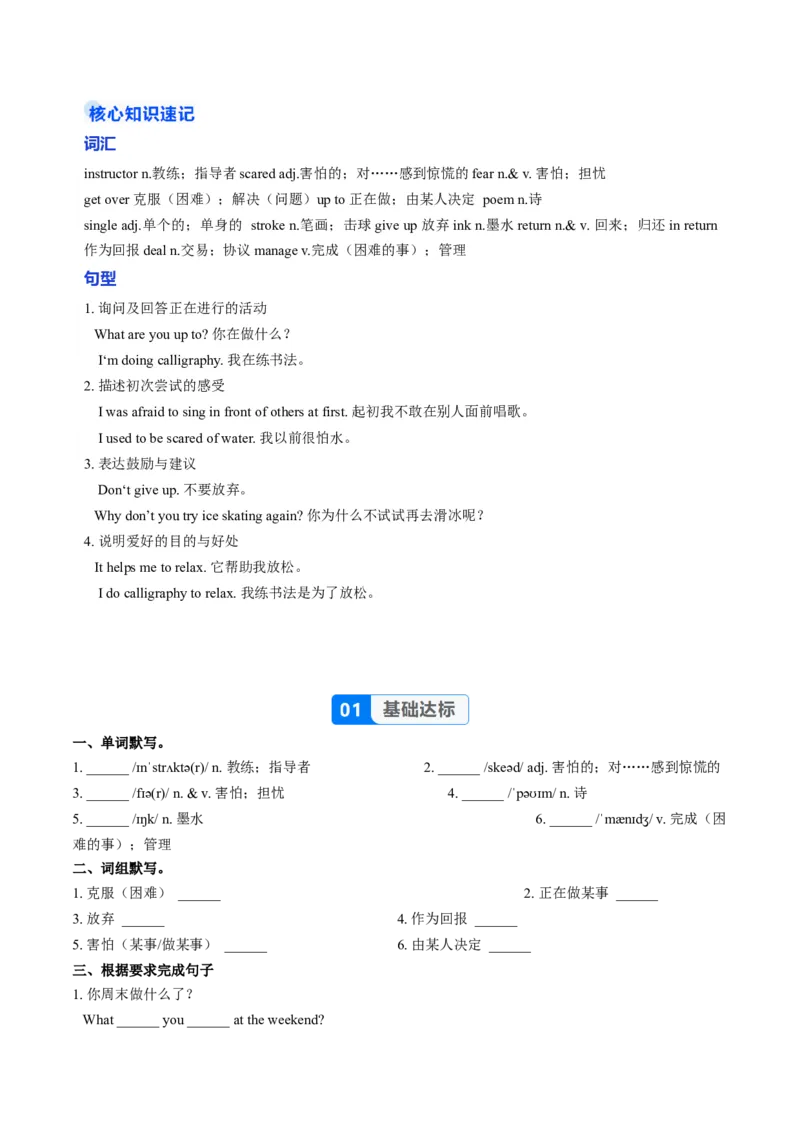
核心知识速记 01 基础达标 02 能力提升 03 拓展培优 0 4 思维进阶词汇
instructor n.教练;指导者scared adj.害怕的;对……感到惊慌的fear n.& v. 害怕;担忧
get over 克服(困难);解决(问题)up to 正在做;由某人决定 poem n.诗
single adj.单个的;单身的 stroke n.笔画;击球give up 放弃ink n.墨水return n.& v. 回来;归还in return
作为回报deal n.交易;协议manage v.完成(困难的事);管理
句型
1. 询问及回答正在进行的活动
What are you up to? 你在做什么?
I‘m doing calligraphy. 我在练书法。
2. 描述初次尝试的感受
I was afraid to sing in front of others at first. 起初我不敢在别人面前唱歌。
I used to be scared of water. 我以前很怕水。
3. 表达鼓励与建议
Don‘t give up. 不要放弃。
Why don’t you try ice skating again? 你为什么不试试再去滑冰呢?
4. 说明爱好的目的与好处
It helps me to relax. 它帮助我放松。
I do calligraphy to relax. 我练书法是为了放松。
一、单词默写。
1. ______ /ɪnˈstrʌktə(r)/ n. 教练;指导者 2. ______ /skeəd/ adj. 害怕的;对……感到惊慌的
3. ______ /fɪə(r)/ n. & v. 害怕;担忧 4. ______ /ˈpəʊɪm/ n. 诗
5. ______ /ɪŋk/ n. 墨水 6. ______ /ˈmænɪdʒ/ v. 完成(困
难的事);管理
二、词组默写。
1. 克服(困难) ______ 2. 正在做某事 ______
3. 放弃 ______ 4. 作为回报 ______
5. 害怕(某事/做某事) ______ 6. 由某人决定 ______
三、根据要求完成句子
1. 你周末做什么了?
What ______ you ______ at the weekend?2. 我以前很怕水,但现在我喜欢游泳。
I ______ be scared ______ water, but now I enjoy swimming.
3. 教练鼓励我不要轻易放弃。
The instructor encouraged me ______ ______ up so easily.
4. 书法能让我放松。
Calligraphy helps me ______ ______.
5. 我们可以互相教学。
We can ______ ______ ______.
四、请根据所给的首字母写出单词,使句子意思完整正确。
1. I want to be a swimming i______ when I grow up.
2. Don’t be s______ of trying new things. Everyone starts as a beginner.
3. Her biggest f______ is speaking in front of many people.
4. It’s not easy to g______ o______ your fear, but you’ll feel proud after you do.
5. —What are you u______ t______?
—I’m writing a p______ for the school magazine.
6. When learning calligraphy, you must practice every single s______ carefully.
7. Don’t g______ u______ easily. Keep trying and you’ll improve.
8. If you teach me English, I can help you with math i______ r______.
五 、单项选择。
1. —______ do you do in your free time?
—I like painting and playing the flute.
A. What B. Why C. How D. When
2. Emma’s ______ told her to get back up every time she fell.
A. instructor B. poem C. ink D. return
3. I used to be ______ of water, but now I enjoy swimming.
A. happy B. scared C. proud D. tired
4. Fu Xing started swimming to ______ her fear of water.
A. give up B. get over C. look for D. think about
5. —What are you up ______?
—Just doing some calligraphy.
A. for B. with C. to D. at
6. Don’t ______ even if it’s difficult at first.
A. give up B. get over C. look up D. turn on
7. She wrote a beautiful ______ for her mother’s birthday.
A. deal B. ink C. poem D. stroke
8. —I can teach you to play the guitar.
—Great! I can teach you to draw ______ return.
A. at B. in C. for D. with9. It’s a ______! Let’s help each other with our hobbies.
A. fear B. deal C. stroke D. single
10. With practice, you can ______ to do it well.
A. manage B. scare C. return D. ink
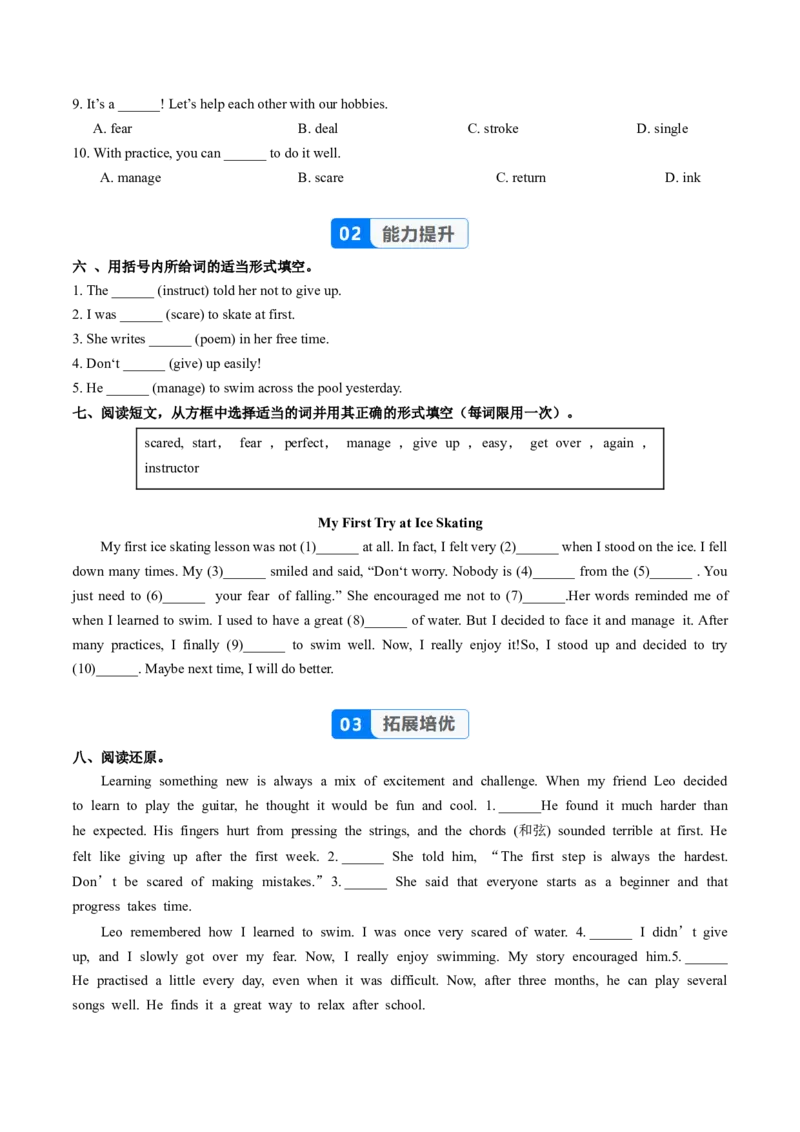
六 、用括号内所给词的适当形式填空。
1. The ______ (instruct) told her not to give up.
2. I was ______ (scare) to skate at first.
3. She writes ______ (poem) in her free time.
4. Don‘t ______ (give) up easily!
5. He ______ (manage) to swim across the pool yesterday.
七、阅读短文,从方框中选择适当的词并用其正确的形式填空(每词限用一次)。
scared, start, fear ,perfect, manage ,give up ,easy, get over ,again ,
instructor
My First Try at Ice Skating
My first ice skating lesson was not (1)______ at all. In fact, I felt very (2)______ when I stood on the ice. I fell
down many times. My (3)______ smiled and said, “Don‘t worry. Nobody is (4)______ from the (5)______ . You
just need to (6)______ your fear of falling.” She encouraged me not to (7)______.Her words reminded me of
when I learned to swim. I used to have a great (8)______ of water. But I decided to face it and manage it. After
many practices, I finally (9)______ to swim well. Now, I really enjoy it!So, I stood up and decided to try
(10)______. Maybe next time, I will do better.
八、阅读还原。
Learning something new is always a mix of excitement and challenge. When my friend Leo decided
to learn to play the guitar, he thought it would be fun and cool. 1. ______He found it much harder than
he expected. His fingers hurt from pressing the strings, and the chords (和弦) sounded terrible at first. He
felt like giving up after the first week. 2. ______ She told him, “The first step is always the hardest.
Don’t be scared of making mistakes.”3. ______ She said that everyone starts as a beginner and that
progress takes time.
Leo remembered how I learned to swim. I was once very scared of water. 4. ______ I didn’t give
up, and I slowly got over my fear. Now, I really enjoy swimming. My story encouraged him.5. ______
He practised a little every day, even when it was difficult. Now, after three months, he can play several
songs well. He finds it a great way to relax after school.A. But I started swimming to face my fear.
B.His instructor noticed this and talked to him.
C.So he decided to try ice skating again next week.
D.However, the reality (现实) was quite different.
E.He also encouraged Leo not to give up so easily.
F.After that talk, Leo decided to keep trying.
九、阅读理解。
Zhang Wei and his cousin Anna were spending the summer holiday together. One afternoon, Anna found a box
of calligraphy materials in Zhang Wei’s room. “What’s this?” she asked curiously.“That’s my calligraphy set,”
Zhang Wei said. “My grandfather taught me. At first, I thought it was boring and my strokes were all shaky (颤抖
的). I even spilled (洒出) ink everywhere.”“So why did you keep doing it?” Anna asked.“Grandpa said the beauty
is in the practice itself, not just the perfect result. He told me not to give up. Now, I do it to relax. The smell of ink
and the sound of the brush on paper calm me down,” Zhang Wei explained with a smile. “It’s not about being
perfect from the start.”Inspired, Anna wanted to try. Zhang Wei showed her how to hold the brush and make basic
strokes. Anna’s first character looked like a black cloud. She laughed, “It’s awful!”
“But it’s your first try!” Zhang Wei encouraged her. “Remember, nobody is perfect at the beginning. Do you
want to learn a simple poem? I can teach you.”Anna agreed. She found that although it was difficult to control the
brush, focusing on each stroke was a peaceful experience. She decided to practice more. “Maybe,” she thought, “I
can find my own way to relax, just like Zhang Wei.”
1. What did Anna find in Zhang Wei’s room?
A. A box of guitar picks. B. A box of calligraphy materials.
C. A book of English poems. D. A set of ice skating tools.
2. How did Zhang Wei feel about calligraphy at first?
A. He felt excited and confident. B. He thought it was relaxing and fun.
C. He found it boring and difficult. D. He believed he was perfect at it.
3. Who encouraged Zhang Wei not to give up calligraphy?
A. His father. B. His instructor.
C. His grandfather. D. His cousin Anna.
4. What does Zhang Wei think is important when practicing calligraphy?
A. Finishing quickly. B. Using expensive ink.
C. The practice itself, not just the perfect result. D. Writing only famous poems.
5. What did Anna probably learn from this experience?
A. Calligraphy is too difficult for foreigners. B. It’s important to be perfect from the start.
C. A hobby can be a way to relax and enjoy the process. D. Only old people enjoy traditional activities like
calligraphy.
十、完形填空。
Last winter, I decided to try ice skating. All my friends said it was fun, and they looked so beautiful gliding
(滑行) on the ice. I thought it would be 1.My first lesson came. As soon as I stepped onto the ice, my legs began to shake. I felt extremely 2. I held onto
the side wall tightly. My instructor, Ms. Li, skated over to me. “It’s OK to be nervous,” she said kindly. “Just try to
take small steps.”
I tried, but I fell down almost immediately. I fell down many times that hour. My body hurt all over. I was so
frustrated (沮丧的) that I wanted to 3 right then.
After the lesson, Ms. Li talked to me. “Everyone falls at the beginning,” she said. “The important thing is to 4
getting up. Don’t let the 5 of falling stop you.” Her words were simple but strong.
Her advice 6 me of my mother. She learned to ride a bike at the age of forty. She fell many times too, but she
never 7. She said she wanted to 8 her fear of looking silly. And she did it!
Hearing that, I decided to be brave like my mother. I wouldn’t let my fear control me. I needed to 9 it. The
next week, I went back to the ice rink (溜冰场). I still fell, but each time, I remembered Ms. Li’s and my mother’s
words. I got back up and tried again.
Now, I can skate slowly but without holding the wall. It’s not perfect, but I’m proud. I finally 10 to get over
my fear of ice skating. This experience taught me that the greatest challenge is often in our own mind.
1. A. difficult B. easy C. scary D. important
2. A. scared B. excited C. happy D. bored
3. A. give up B. get over C. go out D. sit down
4. A. finish B. enjoy C. keep D. practise
5. A. fun B. pain C. fear D. hope
6. A. told B. reminded C. warned D. asked
7. A. managed B. fell C. gave up D. laughed
8. A. forget B. remember C. get over D. talk about
9. A. find B. show C. manage D. understand
10. A. failed B. forgot C. decided D. managed
Beyond the First Step: The True Joy of Hobbies
Part 1: Read and Explore
People often start new hobbies because they seem exciting. But the real test comes with the first few tries. Li
Hua loved watching others play basketball smoothly. For the new term, he joined the school basketball club.
At the first training, things were not easy. He couldn’t dribble (运球) the ball well, and he missed every shot.
He felt scared to try again in front of his teammates. “Maybe basketball is not for me,” he thought sadly.
His friend, Zhang Wei, noticed this. Zhang Wei was learning English songs last year. “I know how you feel,”
Zhang Wei said. “My voice sounded strange at first, and I was afraid to sing alone. But our music teacher told me,
‘Nobody is perfect from the start. The key is not to give up.’”
His friend’s words encouraged Li Hua. He remembered his goal: to have fun and get stronger, not to be the
best player overnight. He decided to get over his shyness. He started practising basic skills for 20 minutes afterschool each day, focusing on getting a little better each time.
Slowly, he improved. He could dribble without looking down. He scored his first basket. When his team
cheered for him, he felt a great sense of achievement. Now, Li Hua not only enjoys playing but also helps new
members in the club. He found that sharing his “first step” story makes starting easier for others. His hobby taught
him that the hardest part is often the beginning, but the joy after overcoming it is real.
Part 2: Skills Challenge
Task 1: Critical Thinking(根据文章内容回答下列问题 )
1. What were the two main difficulties Li Hua faced in his first basketball training? (列出李华在第一次篮球训练
中遇到的两个主要困难)
____________________________________________________________________________________________
____________________________________________________________________________________________
2.What did Zhang Wei’s music teacher say? How did these words finally help Li Hua? (张伟的音乐老师说了什
么?这些话最终如何帮助了李华?)
____________________________________________________________________________________
Task 2: Complete the chart below(根据文章内容,梳理李华学习篮球的心路历程,完成表格。)
Stage(阶段) Feeling/Problem Action/Change(行动或改变
Thought basketball
The start 1. __________
looked exciting.
2.______and felt
The First Try Thought about quitting
scared_
Felt sad abd
Getting Help 3. __________by his friend Zhangwei
discouraged
Had the problem Decided to get over it. Practised basics after
Keeping On
of shyness school.
Could dribble and score. Felt a great sense
The Result 4._________
of achievement.
Enjoys playing
A New Goal Also 5.________new club members.
now.
Task 3: Creative Project
你的班级想发起一个“Hobby Start-up Support”活动,帮助同学们勇敢地开始一项新爱好并坚持下去。
请设计你的支持计划,需包含:
· 计划名称 (The name of your plan)
· 2个简单的支持行动 (Two simple support actions,可从文章或生活中获得灵感)
· 1个有趣的集体活动 (One fun group activity,让有经验的同学带领新手体验第一步)
· 用语简要说明Our support plan is called “ ______ ”.We will take two simple actions to help:
1. We will ______.
2. We will ______.
Also, we will have a fun group activity:
We plan to ______.