Unit 2 Stay Healthy
课时 6 Section B 3a-3c 分层作业
核心知识速记 01 基础达标 02 能力提升 03 拓展培优 0 4 思维进阶
词汇
tight /taɪt/ adj. 疼痛的;憋气的;紧的 peanut /ˈpiːnʌt/ n. 花生
nervously /ˈnɜːvəsli/ adv. 紧张不安地 allergic /əˈlɜːdʒɪk/ adj. 过敏的
ingredient /ɪnˈɡriːdiənt/ n. 成分;配料 promise /ˈprɒmɪs/ v. 承诺;保证
forget /fəˈɡet/ v. (forgot, forgotten) 忘记 hospital /ˈhɒspɪtl/ n. 医院
medicine /ˈmedsn/ n. 药;医学 advice /ədˈvaɪs/ n. 建议;忠告
句型
一、描述症状与感觉 (Describing Symptoms & Feelings)
1. His face felt warm, and his throat felt tight. 他的脸感觉发热,喉咙发紧。
2. I started to feel strange. 我开始感觉不对劲。
3. I'm allergic to peanuts! 我对花生过敏!
二、询问情况与信息 (Asking for Information)
1. What's the matter? 怎么了?
2. What happened just now? 刚才发生了什么?
3. Do you know what you are allergic to? 你知道你对什么过敏吗?
4. When did you start to feel sick? 你什么时候开始感觉不舒服的?
5. How much salad did you eat? 你吃了多少沙拉?
三、给予建议与承诺 (Giving Advice & Making Promises)
1. You should check the ingredients of anything you eat or drink. 你应该检查你吃喝的任何东西的成分。
2. I'll take better care of myself from now on. 从现在起我会更好地照顾自己。一、单词默写。
1. ______ /taɪt/ adj. 疼痛的;紧的 2. ______ /ˈpiːnʌt/ n. 花生
3. ______ /ˈnɜːvəsli/ adv. 紧张不安地 4. ______ /əˈlɜːdʒɪk/ adj. 过敏的
5. ______ /ɪnˈɡriːdiənt/ n. 成分;配料 6. ______ /ˈprɒmɪs/ v. 承诺;保证
7. ______ /ˈhɒspɪtl/ n. 医院 8. ______ /ˈmedsn/ n. 药;医学
9. ______ /ədˈvaɪs/ n. 建议;忠告 10. ______ /ˈækʃn/ n. 行动;行为
二、词组默写。
1. 感到奇怪 ______ 2. 对……过敏 ______
3. 立即行动 ______ 4. 立即;马上 ______
5. 从现在起 ______ 6. 更好地照顾自己 ______
7. 检查成分 ______ 8. 点餐 ______
9. 感觉好多了 ______ 10. 永远不会忘记 ______
三、根据要求完成句子
1. 他的脸开始发热,喉咙发紧。
His face started to ______ ______ and his throat ______ ______.
2. 我对坚果过敏。
I ______ ______ ______ nuts.
3. 他的朋友们立即采取了行动。
His friends ______ ______ ______ at once.
4. 医生马上给了他一些药。
The doctor gave him some medicine ______ ______.
5. 从现在起,我会更小心。
______ ______ ______, I'll be more careful.
6. 你应该检查食物标签上的成分。
You ______ ______ the ______ on the food label.
7. 这是一个他永远不会忘记的日子。
It was a day he ______ ______ ______.
四、请根据所给的首字母写出单词,使句子意思完整正确。
1. If you feel your chest getting t______ and find it hard to breathe, you might be having an allergic reaction.
2. After eating some seafood, Lily asked w______, “Does this contain shrimp? My skin feels itchy.”
3. People who are a______ to pollen often sneeze a lot in spring.
4. When she saw her friend having difficulty breathing, Emma took a______ immediately and called for an
ambulance.
5. The doctor prescribed some special m______ to control his severe allergy symptoms.
6. Always read the i______ list on packaged food to make sure it's safe for you.7. He made a serious p______ to always carry his allergy information card with him.
8. If you have a food allergy, you must learn to take good care of y______.
五 、单项选择。
1. After eating the new dish, Tom felt his lips starting to swell and his breathing became ______.
A. easy B. normal C. tight D. clear
2. “______ with you? You don't look well,” the teacher asked with concern.
A. What's happening B. What's the matter
C. How are you doing D. Are you feeling good
3. Before trying any new skincare product, it's wise to check its ______ to avoid skin reactions.
A. price B. brand C. ingredients D. advertisement
4. Some people are ______ to bee stings and need immediate medical attention if stung.
A. sensitive B. allergic C. painful D. harmful
5. Realizing her friend was having an allergic reaction, Sarah responded ______ and used the epinephrine pen.
A. nervously B. slowly C. immediately D. carelessly
6. The most important ______ from the allergy specialist was: “Always be prepared.”
A. promise B. question C. advice D. story
7. If you have a known allergy, you ______ always inform the restaurant staff before ordering.
A. could B. might C. shouldn't D. should
8. “I ______ always ask about nuts in desserts after my last experience,” she said determinedly.
A. will B. won't C. would D. wouldn't
六 、用括号内所给词的适当形式填空。
1. She felt ______ (terrible) after accidentally eating food containing sesame seeds.
2. He explained his condition ______ (nervous) to the waiter, worried about cross-contamination.
3. ______ (have) a food allergy means you must be extra careful about what you eat.
4. They left the park immediately after ______ (realize) the air was full of pollen.
5. Her doctor recommended a new type of ______ (medicine) for her seasonal allergies.
6. She decided ______ (start) reading every food label carefully.
7. It's crucial for parents ______ (teach) their children about their allergies.
8. He promised his mother ______ (carry) his emergency medication at all times.
七、选词填空。
阅读下面的短文,根据短文内容,从下面方框内所给11个动词中选择10个意义相符的词,必要时进行词
形变化(可添加助动词或者情态动词),填入空白处。
think, look, stay, tell, hurt, ring, buy, stop, see, catch, wa
tch
It was Sunday afternoon. My brother and I were alone at home because my parents went for a party. I wasdoing my homework while my younger brother 1 TV . Suddenly, the doorbell 2 . Ding-Ding! My little
brother thought that it was our parents, so he opened the door quickly.
A tall man wearing a black coat stood outside. He said that he came to sell books and asked if our parents were
at home.
Without 3 , my brother said, “No”. Then the man asked if we would like 4 some story books. I
refused him. When I wanted to close the door, he suddenly pushed the door very hard and came into our house. He
took out a knife and said, “If you move, I 5 you.” Then he ordered me to tie up my brother’s hands with a rope.
I tied up his hands in a special way so my brother could untie (解开) himself easily. The man then tied my hands up
and locked both of us in the kitchen.
Soon, he went upstairs 6 for money. “Brother, 7 calm. Untie the rope on your own and then help me
untie mine. ” I said. He did a very good job. Then we got out of the house through the kitchen window and went to
the nearest shop to call the police.
Soon the police came to our house and 8 the man. By that time, my parents had come home. We told
them the whole story. “Don’t open the door for strangers. I 9 you many times before. ” Although my mother
said angrily, she was glad that we were not hurt. She also told me that I 10 my brother from opening the door
to strangers. I learned a lesson on safety.
八、阅读下面短文,从短文后的选项中选出可以填入空白处的最佳选项。
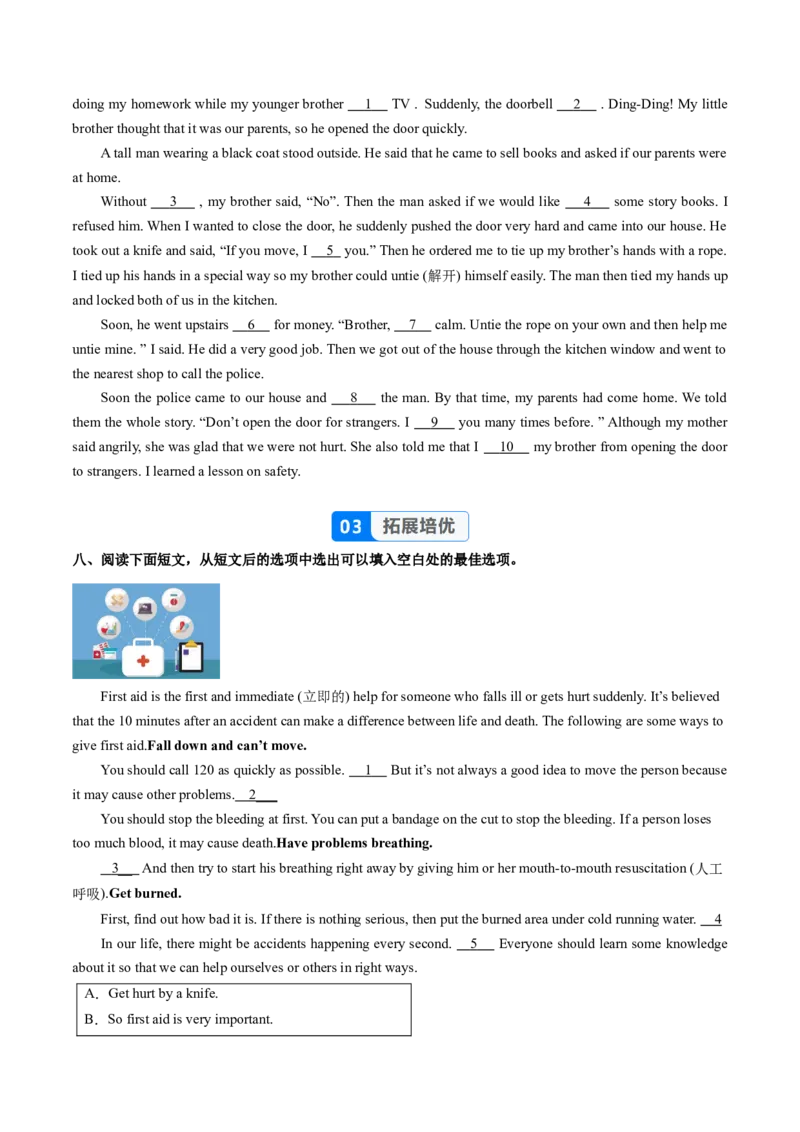
First aid is the first and immediate (立即的) help for someone who falls ill or gets hurt suddenly. It’s believed
that the 10 minutes after an accident can make a difference between life and death. The following are some ways to
give first aid.Fall down and can’t move.
You should call 120 as quickly as possible. 1 But it’s not always a good idea to move the person because
it may cause other problems. 2___
You should stop the bleeding at first. You can put a bandage on the cut to stop the bleeding. If a person loses
too much blood, it may cause death.Have problems breathing.
3__ And then try to start his breathing right away by giving him or her mouth-to-mouth resuscitation (人工
呼吸).Get burned.
First, find out how bad it is. If there is nothing serious, then put the burned area under cold running water. 4
In our life, there might be accidents happening every second. 5 Everyone should learn some knowledge
about it so that we can help ourselves or others in right ways.
A.Get hurt by a knife.
B.So first aid is very important.C.Then he or she can be sent to the hospital in time.
D.But if it’s serious, the person needs to be sent to the
hospital at once.
E.Check if there is anything in his or her mouth, nose
or throat at once.
九、配对阅读。
左栏是五个不同自然灾害场景的描述,右栏是七种应对措施,其中两项为干扰项。请为不同的情景选择合
适的措施,并将答题卡上对应题目所选的选项涂黑。
A.Move to the second floor right away. Take
1 Books fell off the shelves. The necessary things like food, water and a flashlight.
lights were shaking too. I was very B.You need to run sideways to get away from the
scared and couldn’t stand still. snow! Cover your mouth with your hands to create
2 Heavy rain kept falling. Water an air pocket if you are buried (掩埋).
rushed into our house and quickly C. If the fire inside is out of control, you must
covered the first floor of our house. open the windows to let in some air. This can also
3 The rain beat against the help put out the fire. Remember to shout for help.
windows. Strong winds blew down the D.You should hide under a strong table quickly.
trees. The noise sounded like a train Cover your head with both arms. You must stay
passing. there until the shaking fully stops.
4 The wild fire came quickly E. To stop smoke getting in, you should put wet
towards our street. Thick smoke filled cloth into the door gaps (缝隙). Cover your nose
the air. I could feel the heat even and mouth with wet cloth.
indoors. F. Do not stay in the car! You should open the door
5 Suddenly, I heard a loud noise to get out of it before the water gets in.
behind me I started running, but snow G. Put pieces of wood over the windows so that the
balls kept rolling down. wind won’t break them open. When the storm
comes, remember to stay away from windows
十、阅读理解。
Good morning, everyone. I’m glad to give the speech. It is useful to have some first aid knowledge in life.
When someone is injured, you should always give help as soon as possible. The following first aid ways can make
a difference between life and death.
At first, check the situation. Are there things that might put you in danger? Are there cars, fire or other
dangerous things? Do not put yourself into a situation where you may be injured.
Then, call for help. If you can’t help a lot, find professional people to help right away. They know how to work
out these situations. If you think someone is seriously injured, call professional people for help. If you are the only
person there, try to keep the person alive before calling for help. Do not leave the person alone for a long time.Finally, care for the injured person. Try to be reassuring (令人安心的), and let the person know that help is on
the way and that everything will be all right.
1.When would you need professional help according to Paragraph 3?
A.You find someone is seriously injured.
B.You are in a dangerous place.
C.You can help just by yourself.
D.You are the only person there.
2.What can we learn from the passage?
A.We should let the injured person know nothing.
B.The professional helpers can work out some situations better.
C.We need to keep ourselves active first when we help the injured.
D.If we are the only person with the injured, we should call for help right away.
3.The speaker is probably a ________.
A.doctor B.policeman C.driver D.Teacher
十一、完形填空。
It was a sunny Saturday. Kelly was walking to school for her exam. She was late, so she looked at her phone
while 1 . Suddenly, a car hit her and 2 her to the ground. The driver’s face was white with fear. “Are you
all right?” he cried out. But Kelly couldn’t speak. She was 3 from shock and her arm was 4 . “Don’t
worry. I know first 5 ! I’ll call for help too!” the driver said.
Soon, Kelly was in the hospital. The doctor 6 her carefully. An 7 showed that her right arm was
broken. “You’re lucky that your 8 wasn’t worse,” said the doctor. “You 9 (should) be more careful.”
“You’re right,” Kelly said. “I 10 (not look) at my phone while crossing the road next time.” This accident
taught her an important 11 about safety. Our health is 12 our hands. We must know how to 13
ourselves. 14 we are not careful, we can easily get 15 .
1.A.crossing the road B.cooking dinner C.doing homework D.watching TV
2.A.put B.threw C.took D.sent
3.A.enjoying B.suffering C.coming D.hearing
4.A.bleeding B.smiling C.cleaning D.working
5.A.aid B.food C.water D.time
6.A.saw B.checked C.helped D.left
7.A.X-ray B.photo C.picture D.map
8.A.injury B.happiness C.phone D.exam
9.A.could B.would C.should D.might
10.A.don’t look B.didn’t look C.won’t look D.am not looking
11.A.lesson B.book C.game D.song
12.A.on B.in C.at D.under
13.A.look for B.look at C.look after D.look like14.A.Because B.If C.Although D.So
15.A.hurt B.happy C.rich D.famous
The Camping Trip Dilemma
Part 1: Read and Explore
During a school camping trip, Li Wei found himself facing a tough situation. His friend, Alex, had
accidentally cut his hand deeply while trying to open a can. The cut was bleeding heavily, and Alex was in a lot of
pain. The camp was far from the nearest town, and it would take time to get professional medical help.
Li Wei remembered the first aid principles he’d learned. His first thought was to wash the cut with water from
the nearby stream. However, he then recalled a crucial detail from his safety course: for deep cuts, especially with
potential contaminants, washing with untreated water might introduce infection. He needed to avoid making things
worse.
Instead, he applied direct pressure on the wound with a clean cloth to stop the bleeding. He kept the injured
hand raised above Alex’s heart level. He then carefully cleaned around—but not directly in—the deep wound with
a sterile wipe from the first aid kit. He covered it with a clean bandage.
While doing this, another student, Maya, suggested using a traditional herbal leaf she found, claiming it
would stop the bleeding faster. Li Wei felt unsure. He knew that for serious injuries, using unknown plants could be
risky and harmful.
He decided to stick with the basic first aid he was sure about and focus on getting Alex to a doctor. He asked
a teacher to call for help immediately. At the clinic, the doctor confirmed that Li Wei’s actions—applying pressure,
elevating the hand, and avoiding unclean water or unknown plants—were correct and had prevented further
complications.
This experience taught Li Wei that in emergencies, sometimes the simplest, most certain knowledge is the
most powerful. Good intentions need to be guided by correct information.
Task 1:Skills Challenge
情景反应题 (Scenario Response)
你正在爬山,同伴小明的脚踝严重扭伤,他无法行走。周围没有手机信号。请根据所学知识,列出你应该
做的三件事和应该避免做的两件事。
What three things should you do, and what two things should you avoid?
Should Do:
1._______________________________________________________
2. _______________________________________________________
3._______________________________________________________
Should Avoid:
1._______________________________________________________
2._______________________________________________________
Task 2: 信息推断与改错 (Inference & Error Correction)阅读以下一段关于处理轻微烫伤的“建议”,其中包含两处错误。请找出并改正。
Read the following “advice” for treating a minor burn. It contains two mistakes. Find and correct them.
“If you get a minor burn from hot water, first put butter or oil on it to soothe the skin. Then, pop any blisters
that appear to clean them. Finally, wrap it tightly with a plastic bag to keep it dry.”
错误 1 (Mistake 1): _____________________应改为 (should be changed to): ____________________________.
错误 2 (Mistake 2): _____________________应改为 (should be changed to):____________________________.
Task 3: 逻辑排序与理由阐述 (Logic Sequencing & Reasoning)
将下列处理食物中毒疑似症状的步骤按逻辑顺序排列(1-4),并为第一步和最后一步简要说明理由。
Put the steps for dealing with suspected food poisoning in logical order (1-4), and briefly explain the reason for the
FIRST and LAST step.
___ Stop eating the suspected food immediately.
___ Drink small amounts of water or oral rehydration solution to prevent dehydration.
___ Go to see a doctor or call for medical advice, especially if symptoms are severe (vomiting, high fever).
___ Rest and monitor your symptoms (like stomachache or nausea).
理由 (Reasons):
· 第一步 (First Step) 的理由: __________________________________
· 最后一步 (Last Step) 的理由: __________________________________
Task 4: 观点论述题 (Opinion & Argument)
有人认为:“学习急救知识是医生和护士的事,中学生没必要学。” 请用英文写2-3句话反驳这个观点,
并陈述中学生学习基础急救知识的至少两个重要性。
Some people think: “Learning first aid is for doctors and nurses. Middle school students don’t need to learn it.”
Please write 2-3 sentences in English to argue against this view, and state at least TWO importances of learning
basic first aid for middle school students.
你的论述 (Your Argument):
____________________________________________________________________________________________
____________________________________________________________________________________________.
重要性 (Importances):
1.___________________________________________________________________________________________
2.___________________________________________________________________________________________
.