Unit 4 The Wonders of Nature
课时 5 Section B Vocabulary in use 2a-2c 分层作业
核心知识速记 01 基础达标 02 能力提升 03 拓展培优 0 4 思维进阶
词汇
1. risky /ˈrɪski/ adj. 有危险(或风险)的 2. southern /ˈsʌðən/ adj. 南部的;向南的
3. located /ləʊˈkeɪtɪd/ adj. 位于;坐落在 4. freshwater /ˈfreʃwɔːtə(r)/ adj. 淡水的;淡水中生长的
5. type /taɪp/ n. 类型;种类 6. attract /əˈtrækt/ v. 吸引;招引;引起(反应)
7. curious /ˈkjʊəriəs/ adj. 好奇的;求知欲强的 8. traveller /ˈtrævələ(r)/ n. 旅行者;游客
9. natural /ˈnætʃrəl/ adj. 自然的;天然的;天生的 10. environment /ɪnˈvaɪrənmənt/ n. 环境
11. below /bɪˈləʊ/ prep. & adv. 在……下面;低于 12. common /ˈkɒmən/ adj. 常见的;普通的
13. low /ləʊ/ adj. 低的;矮的 14. dead /ded/ adj. 死的;失去生命的
15. safe /seɪf/ adj. 安全的 16. living /ˈlɪvɪŋ/ adj. 活的;活着的
17. heavy /ˈhevi/ adj. 重的
短语
1. match...with... 将……与……配对 2. on the left 在左边
3. on the right 在右边 4. be located in 位于;坐落在
5. reach the bottom 到达底部 6. cover...square kilometres 占地……平方公里
7. types of animals 动物种类 8. attract travellers 吸引游客
9. curious visitors 好奇的访客 10. a great natural wonder 伟大的自然奇观
11. freshwater lake 淡水湖 12. most of the year 一年中的大部分时间
13. how far 多远 14. how large 多大
15. how heavy 多重 16. how often 多久一次
17. how long 多长;多长时间 18. how high 多高
19. how deep 多深 20. how low 多低
21. how fast 多快
22. how soon 多久以后反义词配对:
1.below--- above 2.common--- unusual
3.low--- high 4.dead--- living
5.top ---bottom
6.northern ---southern
7.risky--- safe 8.survive--- die
句型:
1. 询问与描述事实(how + 形容词)
How far is it from your home to school?从你家到学校有多远?
How large is your country?你的国家有多大?
How heavy is a blue whale?蓝鲸有多重?
How often do you exercise?你多久锻炼一次?
How long is the Yangtze River?长江有多长?
How high is Mount Qomolangma?珠穆朗玛峰有多高?
How deep is Lake Baikal?贝加尔湖有多深?
How low can the temperature fall?气温能降到多低?
How fast can a cheetah run?猎豹能跑多快?
How soon will you come back?你多久以后回来?
2. 描述地理位置与特征
Lake Baikal is located in Siberia, Russia.贝加尔湖位于俄罗斯的西伯利亚。
It is the deepest freshwater lake in the world.它是世界上最深的淡水湖。
Its surface covers 31,500 square kilometres.它的水面面积达31,500平方公里。
It is larger than most other lakes.它比大多数其他湖泊都大。
Over 1,200 different types of animals can survive in this environment.
超过1,200种不同的动物能够在这种环境中生存。
Today, the lake still attracts many curious travellers.
如今,这个湖泊仍然吸引着许多好奇的旅行者。
It is a great natural wonder!
它是一个伟大的自然奇观!
一、单词默写。
1. ____________ [ˈrɪski] adj. 有危险(或风险)的 2. ____________ [ˈsʌðən] adj. 南部的;向南的
3. ____________ [ləʊˈkeɪtɪd] adj. 位于;坐落在 4. ____________ [ˈfreʃwɔːtə(r)] adj. 淡水的5. ____________ [taɪp] n. 类型;种类 6. ____________ [əˈtrækt] v. 吸引
7. ____________ [ˈkjʊəriəs] adj. 好奇的 8. ____________ [ˈtrævələ(r)] n. 旅行者;游客
9. ____________ [ˈnætʃrəl] adj. 自然的;天然的 10. ____________ [ɪnˈvaɪrənmənt] n. 环境
11. ____________ [bɪˈləʊ] prep. & adv. 在……下面 12. ____________ [ˈkɒmən] adj. 常见的
13. ____________ [ləʊ] adj. 低的 14. ____________ [ded] adj. 死的
15. ____________ [seɪf] adj. 安全的 16. ____________ [ˈlɪvɪŋ] adj. 活的
17. ____________ [ˈhevi] adj. 重的
【答案】1.risky; 2. southern; 3. located;4. freshwater;5. type;6. attract; 7.curious;8. traveller;9.
natural;
10.environment; 11.below; 12.common; 13. low; 14. dead; 15. safe;16. living; ;17. heavy;
二、词组默写。
1. 将……与……配对 ____________________ 2. 在左边 ____________________
3. 在右边 ____________________ 4. 位于;坐落在 ____________________
5. 到达底部 ____________________ 6. 占地……平方公里 ____________________
7. 动物种类 ____________________ 8. 吸引游客 ____________________
9. 好奇的访客 ____________________ 10. 伟大的自然奇观 ____________________
11. 淡水湖 ____________________ 12. 一年中的大部分时间 ____________________
13. 多远 ____________________ 14. 多大 ____________________
15. 多重 ____________________ 16. 多久一次 ____________________
17. 多长;多长时间 ____________________ 18. 多高 ____________________
19. 多深 ____________________ 20. 多低 ____________________
21. 多快 ____________________ 22. 多久以后 ____________________
【答案】1. match...with...;2. on the left;3. on the right;4. be located in;5. reach the bottom;
6. cover...square kilometres;7. types of animals;8. attract travellers;9. curious visitors
10. a great natural wonder;11. freshwater lake;12. most of the year;13. how far;14. how large;
15. how heavy;16. how often;17. how long;18. how high;19. how deep;20. how low;21. how
fast
22. how soon
三、根据要求完成句子
1. 从你家到学校有多远?
____________ ____________ is it from your home to school?
2. 你的国家有多大?
____________ ____________ is your country?
3. 蓝鲸有多重?
____________ ____________ is a blue whale?
4. 你多久锻炼一次?
____________ ____________ do you exercise?5. 长江有多长?
____________ ____________ is the Yangtze River?
6. 珠穆朗玛峰有多高?
____________ ____________ is Mount Qomolangma?
7. 贝加尔湖有多深?
____________ ____________ is Lake Baikal?
8. 猎豹能跑多快?
____________ ____________ can a cheetah run?
9. 你多久以后回来?
____________ ____________ will you come back?
10. 贝加尔湖位于俄罗斯的西伯利亚。
Lake Baikal is ____________ in Siberia, Russia.
11. 它是世界上最深的淡水湖。
It is the ____________ freshwater lake in the world.
12. 它的水面面积达31,500平方公里。
Its ____________ covers 31,500 square kilometres.
13. 超过1,200种不同的动物能够在这种环境中生存。
Over 1,200 different ____________ of animals can ____________ in this environment.
14. 如今,这个湖泊仍然吸引着许多好奇的旅行者。
Today, the lake still ____________ many curious ____________.
15. 它是一个伟大的自然奇观!
It is a great natural ____________!
【答案】1. How far;2. How large;3. How heavy;4. How often;5. How long;6. How high
7. How deep;8. How fast;9. How soon;10. located;11. deepest;12. surface;13. types; survive
14. attracts; travellers;15. wonder
四、请根据所给的首字母写出单词,使句子意思完整正确。
1. Lake Baikal is l______ in Siberia, Russia. It is one of the world’s most famous lakes.
2. It is the d______ freshwater lake in the world. You must dive 1,620 metres to reach the bottom.
3. Its s______ covers 31,500 square kilometres. That is bigger than the country of Belgium!
4. Over 1,200 different t______ of animals can survive in this cold environment.
5. The lake still a______ many curious travellers from all over the world.
6. People who love nature are c______ about this great natural wonder.
7. Climbing Mount Qomolangma is r______ , but many climbers still try to reach the top.
8. The opposite of “northern” is s______ .
【答案】1. located;2. deepest;3. surface;4. types;5. attracts;6. curious;7. risky;8. southern
五 、同义句转换。
1. Lake Baikal is the deepest freshwater lake in the world.
→ Lake Baikal is ______ than ______ ______ freshwater lake in the world.2. Its surface covers 31,500 square kilometres.
→ Its surface is 31,500 square kilometres ______ ______ .
3. Over 1,200 different types of animals can survive in this environment.
→ Over 1,200 different ______ ______ animals can survive in this environment.
4. The lake still attracts many curious travellers.
→ Many curious travellers ______ ______ ______ the lake.
5. It is a great natural wonder.
→ It is ______ ______ great natural wonder.
【答案】 1. deeper; any other;2. in size;3. kinds of;4. are attracted by;5. such a
六 、用括号内所给词的适当形式填空。
1. Lake Baikal is one of the world’s most ______ (fame) lakes.
2. It is the ______ (deep) freshwater lake in the world.
3. To reach the ______ (bottom), you must dive 1,620 metres.
4. Its surface ______ (cover) 31,500 square kilometres.
5. Over 1,200 different types of animals can ______ (survival) in this environment.
6. The lake is very cold for most of the year, but it still ______ (attractive) many visitors.
7. ______ (curious) travellers come to see this great natural wonder.
8. The opposite of “risky” is ______ (safe).
【答案】1. famous;2. deepest;3. bottom;4. covers;5. survive;6. attracts;7. Curious;8. safe
七、选词填空。
two shape it play short when of provide easy
area
As we all know, the Yangtze River is the longest river in China. Today let me introduce another famous river
to you—the Yellow River.
The Yellow River is the 1 longest river in China. The “yellow” in its name is from the mud and sand (泥
沙). About ninety percent of the mud and sand in the Yellow River comes from the Loess Plateau (黄土高原). The
Loess Plateau is loose (松软的) and washed away 2 . As a result, a lot of mud and sand goes into the Yellow
River 3 the rainy season comes.
The Yellow River starts from the Qinghai-Tibet Plateau. Its 4 is similar to “几”. It runs from west to east
through nine provinces and finally runs into the Bohai Sea. It covers an 5 about 752,443 square kilometers.
The Yellow River is about 5,464 kilometers long. In fact, it is a little 6 than the Yangtze River.
In Chinese history, the Yellow River is the most important birthplace. Ancient Chinese people lived on this
land, worked hard and created a rich culture. Today, the area around the Yellow River is very important for farming.
The Yellow River also 7 water for factories and people’s lives. What’s more, the Yellow River 8 an
important role in Chinese culture. People created a lot of poems (诗歌), paintings, and songs about 9 . The
Yellow River is a symbol 10 China. We call it the “Mother River”. We love our Mother River!【答案】
1.second 2.easily 3.when 4.shape 5.area 6.shorter 7.provides 8.plays 9.it 10.of
【解析】
【导语】本文介绍了黄河作为中国第二长河的地理特征、泥沙来源、流域面积及其在中国历史和文化中的
重要性,强调了黄河作为母亲河的象征意义。
1.句意:黄河是中国第二长河。根据“The Yellow River is the…longest river in China.”及备选词汇可知此处
应用“two”的序数词second“第二”,表示顺序。故填second。
2.句意:黄土高原土质松软,容易被冲走。根据“The Loess Plateau is loose (松软的) and washed away…”
及备选词汇可知此处应用“easy”的副词easily“容易地”,修饰动词短语“washed away”。故填easily。
3.句意:因此,当雨季来临时,大量泥沙进入黄河。根据句意“As a result, a lot of mud and sand goes into
the Yellow River…the rainy season comes.”及备选词汇可知此处表示时间,应用连词when“当……时候”,
引导时间状语从句。故填when。
4.句意:它的形状类似于汉字“几”。根据“Its…is similar to ‘几’”及备选词汇可知此处表示“形
状”,应用名词“shape”。故填shape。
5.句意:它覆盖的面积约为752,443平方公里。根据“It covers an…about 752,443 square kilometers”及备选
词汇可知此处 表示“面积”,应用名词“area”。故填area。
6.句意:事实上,它比长江稍短一些。根据“In fact, it is a little…than the Yangtze River.”及备选词汇可知
此处应用“short”的比较级shorter“更短的”,与than构成比较结构。故填shorter。
7.句意:黄河也为工厂和人民生活提供水源。根据“The Yellow River also…water for factories and people’s
lives.”及备选词汇可知此处应用动词provide“提供”,根据前句“Today…”可知此句应用一般现在时,主语
“The Yellow River”为第三人称单数,动词需用三单形式“provides”。故填provides。
8.句意:更重要的是,黄河在中国文化中扮演着重要角色。根据“the Yellow River…an important role in
Chinese culture”及备选词汇可知此处应用动词“play”,play a role“扮演角色”,根据上文可知时态仍用一
般现在时,主语为第三人称单数,动词需用三单形式“plays”。故填plays。
9.句意:人们创作了许多关于它的诗歌、绘画和歌曲。根据“People created a lot of poems, paintings, and
songs about…”及备选词汇可知此处应用代词it“它”,指代前文提到的黄河。故填it。
10.句意:黄河是中国的象征。根据“The Yellow River is a symbol…China.”及备选词汇可知此处应用介词
of“……的”,a symbol of“……的象征”。故填of。
八、阅读下面短文,从短文后的选项中选出可以填入空白处的最佳选项。
阅读短文,从下面所给的选项中选出可以填入空白处的最佳选项,其中有一个多余的选项。
The Sahara is the largest hot desert in the world. It covers over nine million square kilometres across North
Africa. 1 During the day, temperatures rise above 40℃, while nights can be very cold. It is one of the toughest
environments on Earth.
The Sahara is as big as Canada but has very few people. Less than two and a half million people live there,
most of them nomads. Nomads are people who have no permanent homes. They move from place to place, carrying
everything they need to live. The nomads of the Sahara are called Bedouin, which means “desert people”. Theydepend on goats, sheep, and camels for food and transport. Water is the most important for them. They need water
to live, so they must carry enough water or know where to find it. 2
A desert is not defined (定义) by sand but by the lack of rain. 3 Surprisingly, only 25% of the Sahara is
covered in sand. The rest is rock and gravel (砂砾).
4 Later it turned into grasslands. Over time, it became the desert we see today. Truly, the Sahara is a place
of history and change.
A.Without water, life is impossible.
B.Long ago, the Sahara was covered with ice.
C.The Sahara is a huge desert full of sand.
D.The weather there can be very different in a day’s time.
E.To be a desert, a place must get less than 250 mm of rain each year.
【答案】1.D 2.A 3.E 4.B
【解析】
【导语】本文主要介绍了撒哈拉沙漠的地理特征、气候、居民生活,以及它的演变历史。
1.根据后一句“During the day, temperatures rise above 40°C, while nights can be very cold”可知,此处需要引
出撒哈拉沙漠一天内天气变化大的特点来衔接下文。选项D“那里的天气在一天之内会有很大的变化。”
符合语境。故选D。
2.根据前一句“They need water to live, so they must carry enough water or know where to find it”可知,此处
需要强调水对生命的重要性来呼应前文。选项A“没有水,生命就无法存在。”符合语境。故选A。
3.根据前一句“A desert is not defined by sand but by the lack of rain”可知,此处需要给出沙漠的科学定义来
衔接。选项E“要成为沙漠,一个地方每年的降雨量必须少于 250 毫米。”符合语境。故选E。
4.根据后一句“Later it turned into grasslands. Over time, it became the desert we see today”可知,此处需要引
出撒哈拉沙漠的演变历史来衔接下文。选项B “很久以前,撒哈拉沙漠被冰覆盖。”符合语境。故选B。
九、阅读理解。
(A)
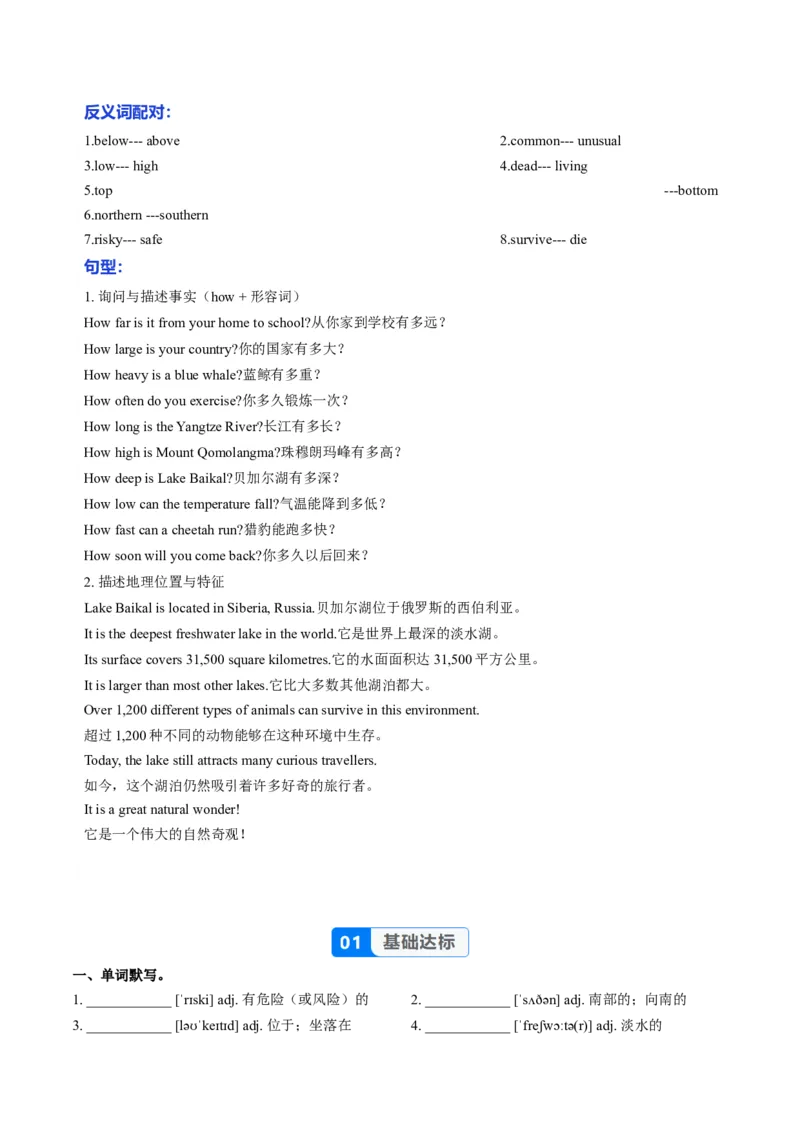
Many rivers are the cradles (摇篮) of human civilizations (文明). Here are some famous foreign rivers:
The Nile River is about 6,670 km. It is the longest river in the world. It’s
known for being the lifeblood of Ancient Egypt and is still very
important to Egypt today. This river is famous because it was a useful
body of water in Ancient Egypt. Also, the Nile River is important for
farming, transportation and drinking water.
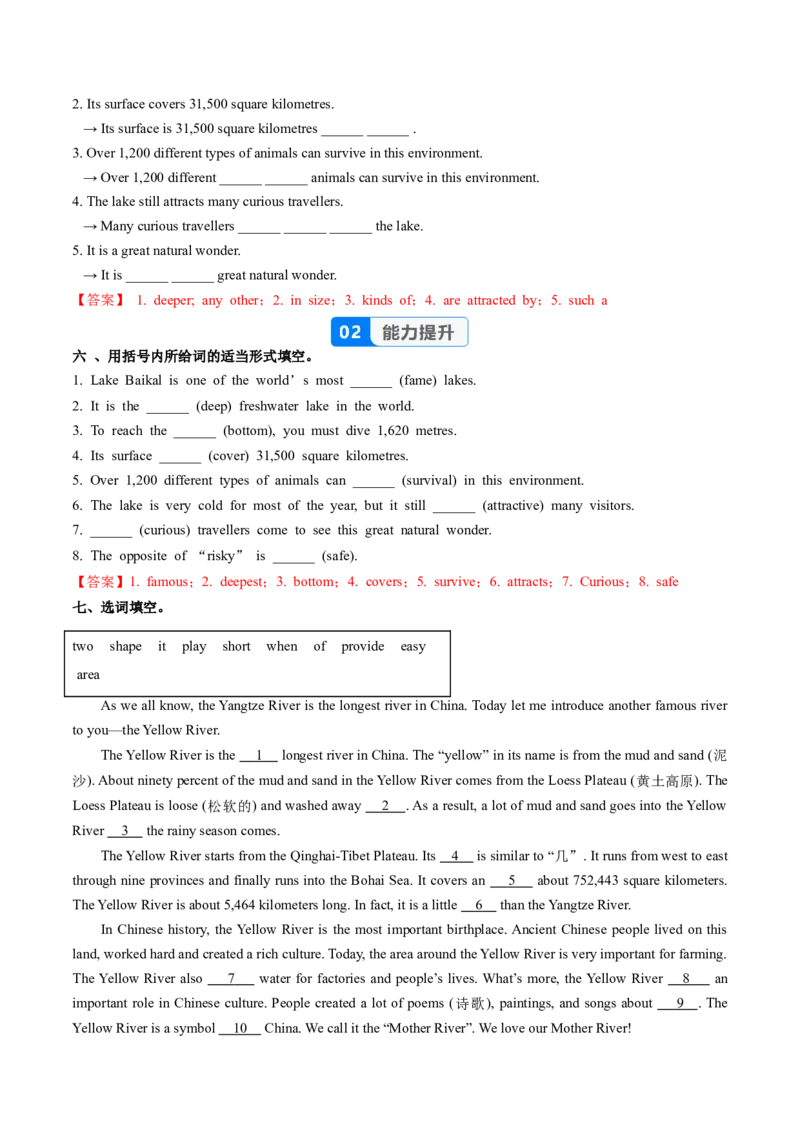
You may not have ever heard of the Finke River. It’s in Australia. It’s
not very long (about 650 km) and it doesn’t even flow all the time.
However, geologists (地质学家) have considered it as the oldest river in
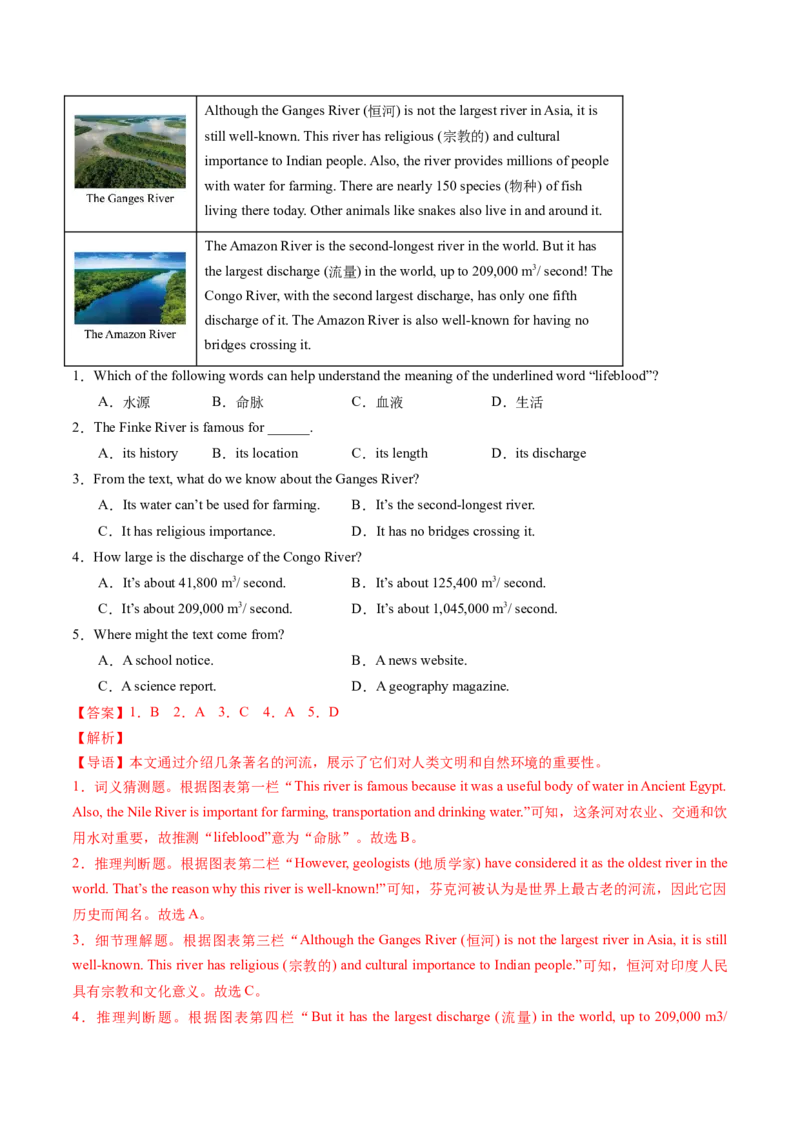
the world. That’s the reason why this river is well-known!Although the Ganges River (恒河) is not the largest river in Asia, it is
still well-known. This river has religious (宗教的) and cultural
importance to Indian people. Also, the river provides millions of people
with water for farming. There are nearly 150 species (物种) of fish
living there today. Other animals like snakes also live in and around it.
The Amazon River is the second-longest river in the world. But it has
the largest discharge (流量) in the world, up to 209,000 m3/ second! The
Congo River, with the second largest discharge, has only one fifth
discharge of it. The Amazon River is also well-known for having no
bridges crossing it.
1.Which of the following words can help understand the meaning of the underlined word “lifeblood”?
A.水源 B.命脉 C.血液 D.生活
2.The Finke River is famous for ______.
A.its history B.its location C.its length D.its discharge
3.From the text, what do we know about the Ganges River?
A.Its water can’t be used for farming. B.It’s the second-longest river.
C.It has religious importance. D.It has no bridges crossing it.
4.How large is the discharge of the Congo River?
A.It’s about 41,800 m3/ second. B.It’s about 125,400 m3/ second.
C.It’s about 209,000 m3/ second. D.It’s about 1,045,000 m3/ second.
5.Where might the text come from?
A.A school notice. B.A news website.
C.A science report. D.A geography magazine.
【答案】1.B 2.A 3.C 4.A 5.D
【解析】
【导语】本文通过介绍几条著名的河流,展示了它们对人类文明和自然环境的重要性。
1.词义猜测题。根据图表第一栏“This river is famous because it was a useful body of water in Ancient Egypt.
Also, the Nile River is important for farming, transportation and drinking water.”可知,这条河对农业、交通和饮
用水对重要,故推测“lifeblood”意为“命脉”。故选B。
2.推理判断题。根据图表第二栏“However, geologists (地质学家) have considered it as the oldest river in the
world. That’s the reason why this river is well-known!”可知,芬克河被认为是世界上最古老的河流,因此它因
历史而闻名。故选A。
3.细节理解题。根据图表第三栏“Although the Ganges River (恒河) is not the largest river in Asia, it is still
well-known. This river has religious (宗教的) and cultural importance to Indian people.”可知,恒河对印度人民
具有宗教和文化意义。故选C。
4.推理判断题。根据图表第四栏“But it has the largest discharge (流量) in the world, up to 209,000 m3/second! The Congo River, with the second largest discharge, has only one fifth discharge of it.”可知,亚马逊河的
流量是209,000 m³/秒,而刚果河的流量是亚马逊河的五分之一,因此刚果河的流量约为 41,800 m³/秒。故
选A。
5.推理判断题。本文主要介绍了世界各地的河流及其特点,内容与地理相关,因此文章最可能来自地理
杂志。故选D。
(B)
Coronado was born in 1953. Scientists saw the birth of this island. It began at 6:30 a. m. on 14th November. A
fishing boat was near Iceland. The boat moved under the captain’s (船长) feet. He noticed a strange smell. He saw
some black smoke. A volcano (火山) was breaking out. Red-hot rocks, fire and smoke were rushing up from the
bottom (底部) of the sea. The island grew quickly. It was 10 meters high the next day and 60 meters high on 18th
November. Scientists flew there to watch. It was exciting. Smoke and fire were still rushing up. Pieces of red-hot
rock were flying into the air and falling into the sea. The sea was boiling and there was a strange light in the sky.
Coronado grew and grew. Then it stopped in June 1957. It was 175 meters high and 2 kilometers long. And life was
already coming to Coronado. Plants grew. Birds came. Some scientists built a house. They want to learn about this
young island. A new island is like a new world.
1.Coronado is ________.
A.an island not far from Iceland B.a new volcano
C.a fishing boat D.a place in Iceland
2.Put the following sentences in correct order.
a. The captain found the boat was moving. b. A new island appeared in the sea.
c. Fire, smoke and rocks were seen rushing up. d. A fishing boat was near Iceland.
e. The island grew quickly.
A.d—a—c—b—eB.a—b—c—d—e C.a—b—e—c—d D.b—e—d—a—c
3.The best title of this article is ________.
A.A new volcano B.The birth of an island
C.A new world D.Scientists discovered Coronado
【答案】1.A 2.A 3.B
【解析】
【导语】本文主要讲述了科罗纳多岛的诞生过程。
1.细节理解题。根据“Coronado was born in 1953. Scientists saw the birth of this island. It began at 6:30 a. m.
on 14th November. A fishing boat was near Iceland.”可知,Coronado是离冰岛不远的一个岛。故选A。
2.细节理解题。根据“A fishing boat was near Iceland. The boat moved under the captain’s (船长) feet. He
noticed a strange smell. He saw some black smoke. A volcano (火山) was breaking out. Red-hot rocks, fire and
smoke were rushing up from the bottom (底部) of the sea. The island grew quickly.”可知,首先是渔船在冰岛附
近,然后船长发现船移动,随后火山喷发,岛屿出现,最后岛屿快速生长。故选A。
3.最佳标题题。通读全文可知,本文主要讲述了科罗纳多岛的诞生过程,包括火山喷发、岛屿形成及后续生态发展。故最佳标题为:一个岛的诞生。故选B。
十、任务型阅读。
The Yangtze River is one of the most important rivers in China. It is the longest river in Asia and the third
longest river in the world. It is about 6,300 kilometers long and covers an area of about 1.8 million square
kilometers.
The Location of the Yangtze River
The Yangtze River originate (起源) from the Tanggula Mountains. Its main stream (干流) goes through the
middle of China from west to east. It runs through 11 provinces and cities. Finally, it runs into the East Sea.
The Culture of the Yangtze River
The Yangtze River has a colorful and exciting history. We cannot only enjoy its beautiful scenery, just like the
Three Gorges (峡谷), but also we can learn a lot from its special culture, such as the festival culture, the cooking
culture and so on.
The Three Gorges is the most beautiful and famous part along the Yangtze River. It is the birthplace of ancient
Chinese culture. They are Qutang Gorge, Wu Gorge and Xiling Gorge. People call it a wonder in the world.
★______________________
The Yangtze River is home to many important wild animals, such as Chinese sturgeon (中华鲟), paddle fish
(白鲟) and Chinese river dolphin (白鳍豚).
The Yangtze River is the mother river of our Chinese nation. We must protect it well. Never throw rubbish into
it. We also need to save water and plant more trees on both sides. For thousands of years, the Yangtze River has
seen the hard work of the Chinese people. It gives birth to the hard-working, brave and innovative (创新) spirits of
the Yangtze River. And the spirits are leading us to work hard to achieve our Chinese dream.
1.How long is the Yangtze River? (6个词以内)
____________________________________________________________.
2.Which place does the Yangtze River finally run into according to the passage and the map?
____________________________________________________________.
3.The Three Gorges refers to (指的是) _________________ and Xiling Gorge.
4.Please complete the blank ★ ______________________________________. (10个词以内)
5.What do you think of the Yangtze River? What can you do for it? (共 2 句话回答)
____________________________________________________________.【答案】1.About 6,300 kilometers long. 2. It finally runs into the East Sea. 3. Qutang Gorge Wu
Gorge 4.Wildlife in the Yangtze River 5.It is the mother river of China with great importance. I can plant
more trees on both sides of the Yangtze River.
【解析】
【导语】本文介绍了长江的相关信息,包括其文化价值,野生动物和保护措施。
1.根据“It is about 6,300 kilometers long”可知,长江大约有 6300 公里长。故填About 6,300 kilometers long.
2.根据“Finally, it runs into the East Sea.”和地图可知,长江最终流入了东海。故填 It finally runs into the
East Sea.
3.根据“They are Qutang Gorge, Wu Gorge and Xiling Gorge.”可知,三峡分别是瞿塘峡、巫峡和西陵峡。故
填Qutang Gorge; Wu Gorge。
4.根据“The Yangtze River is home to many important wild animals”可知,本段主要介绍了长江的野生动物,
故段落小标题为:长江中的野生动物。故填 Wildlife in the Yangtze River。
5.根据“The Yangtze River is the mother river of our Chinese nation. ”可知,长江是我们中华民族的母亲河;
根据“We must protect it well. Never throw rubbish into it. We also need to save water and plant more trees on
both sides.”可知,我们应该避免向长江里扔垃圾,要节约用水,并在两边种植更多的树木。故填It is the mother
river of China with great importance. I can plant more trees on both sides of the Yangtze River. (答案不唯一,合
理即可)
十一、完形填空。
You must know a popular song about Lake Baikal. Then what do you 1 about Lake Baikal?
Lake Baikal in Russia is one of the most 2 lakes in the world. It has a history of 25 million years. It’s also
the deepest freshwater lake in the world. It’s up to 1,637 metres deep. 3 , it’s not only a lake but also the future
fifth ocean with nearly 20% of the fresh water in the world. The water is 4 clean that people can drink it directly
(直接地).
Lake Baikal is in the 5 of a banana and people also think it looks like a crescent (月牙形) moon. Lake
Baikal is beautiful and a lot of 6 come to visit it every year. They usually come in summer. It is not cold then.
They can 7 the blue water and the green mountains. However, some visitors prefer to come in winter. 8 it is
freezing, they can have fun on the ice. The ice can be up to 60 cm 9 .They feel free to do whatever they like,
without worrying about 10 into the water.
It’s a place worth visiting.
1.A.worry B.care C.know
2.A.common B.ancient C.dangerous
3.A.At first B.For example C.In fact
4.A.so B.too C.such
5.A.shape B.place C.front
6.A.volunteers B.climbers C.tourists
7.A.enjoy B.repair C.develop
8.A.Because of B.Even though C.What’s more9.A.long B.wide C.thick
10.A.throwing B.leading C.falling
【答案】
1.C 2.B 3.C 4.A 5.A 6.C 7.A 8.B 9.C 10.C
【解析】
【导语】本文是一篇说明文,介绍了俄罗斯贝加尔湖的地理特征、历史背景、外形特点以及旅游价值,包
括它作为世界最深淡水湖的独特地位、清澈的水质,以及夏季和冬季不同的游览体验。
1.句意:那么你对贝加尔湖了解多少?
worry担心;care关心;know了解。 根据“You must know a popular song about Lake Baikal. Then what do
you ... about Lake Baikal?”可知,前文提到你知道相关歌曲,此处承接提问“了解”贝加尔湖的信息。故选
C。
2.句意:俄罗斯的贝加尔湖是世界上最古老的湖泊之一。
common普通的;ancient古老的;dangerous危险的。 根据“Lake Baikal in Russia is one of the most ... lakes
in the world. It has a history of 25 million years”可知,它有2500万年的历史,说明是古老的湖泊。故选B。
3.句意:事实上,它不仅是一个湖泊,还拥有全球近20%的淡水,未来会成为第五大洋。
At first起初;For example例如;In fact事实上。 根据“... it’s not only a lake but also the future fifth ocean
with nearly 20% of the fresh water in the world”可知,这是对贝加尔湖的进一步补充说明,用“事实上”衔接
更自然。故选C。
4.句意:湖水如此清澈,人们可以直接饮用。
so如此;too太;such这样的。 根据“The water is ... clean that people can drink it directly”可知,“so + 形
容词 + that”是固定句型,意为“如此……以至于”,用来描述湖水清澈的程度。故选A。
5.句意:贝加尔湖的形状像一根香蕉,人们也认为它像一弯月牙。
shape形状;place地点;front前面。 根据“Lake Baikal is in the ... of a banana and people also think it looks
like a crescent moon”可知,此处描述贝加尔湖的外形,in the shape of是固定搭配,意为“呈……形状”。
故选A。
6.句意:贝加尔湖很美,每年都有很多游客前来参观。
volunteers志愿者;climbers登山者;tourists游客。 根据“Lake Baikal is beautiful and a lot of ... come to visit
it every year”可知,贝加尔湖作为旅游景点,吸引的是游客。故选C。
7.句意:他们可以欣赏蓝色的湖水和绿色的群山。
enjoy欣赏;repair修理;develop发展。 根据“They can ... the blue water and the green mountains”可知,游
客来此是为了欣赏湖光山色,enjoy符合语境。故选A。
8.句意:尽管天气严寒,他们还是可以在冰上尽情玩耍。
Because of 因为;Even though 尽管;What’s more 而且。 根据“However, some visitors prefer to come in
winter ... it is freezing, they can have fun on the ice”可知,前后是转折让步关系,尽管天气寒冷,人们仍能在
冰上玩乐。故选B。
9.句意:冰层可达60厘米厚。
long长的;wide宽的;thick厚的。 根据“The ice can be up to 60 cm ... ”可知,此处描述冰层的厚度,thick符合语境。故选C。
10.句意:他们可以随心所欲地玩耍,不用担心掉进水里。
throwing 扔;leading 带领;falling 掉落。 根据“They feel free to do whatever they like, without worrying
about ... into the water”可知,冰面厚实,所以不用担心掉进水里面,fall into是固定搭配,意为“掉进”。
故选C。
The Blue Eye of Siberia
Part 1: Read and Explore
In the heart of Siberia, there is a lake so old and so deep that it holds one-fifth of the world‘s freshwater. Its
name is Lake Baikal. Local people call it the “Blue Eye of Siberia”. It is not only the deepest but also one of the
clearest lakes on Earth.
Lake Baikal is more than 25 million years old. That makes it the oldest lake in the world. Its deepest point
reaches 1,642 metres. If you put the Eiffel Tower into the water, five Eiffel Towers would not be enough to touch
the bottom!
The water in Lake Baikal is so clear that in winter, you can see 40 metres below the ice. But do not be fooled
by its beauty—the water is icy cold, and swimming here is risky. Yet, this cold environment is home to over 2,000
kinds of animals. More than half of them can be found nowhere else on Earth. The Baikal seal, or nerpa, is one of
them. It is the only freshwater seal in the world.
However, Lake Baikal is facing problems. Factories near the lake pour waste into the water. Some visitors
leave rubbish behind. The future of this natural wonder is not as safe as before.
Still, every year, thousands of curious travellers come to see the “Blue Eye”. They come not just to take
photos, but to feel the silence, breathe the clean air, and learn from an ancient lake that has seen 25 million years of
change. Perhaps that is what a true natural wonder gives us—not just beauty, but wisdom.
Task 1: Understanding Facts
Read the passage and answer the questions in complete sentences.
1. Why do local people call Lake Baikal the “Blue Eye of Siberia”?
_________________________________________________________.
2. How deep is the deepest point of Lake Baikal?
_________________________________________________________.
3. How many kinds of animals live in Lake Baikal?
_________________________________________________________.
4. What is special about the Baikal seal?
_________________________________________________________.
5. What problems is Lake Baikal facing?
_________________________________________________________.
Task 2: Language Focus — Opposites & How-QuestionsPart A: Find Opposites
Word from the passage Opposite
1. deepest __________ 2. old __________
3. cold __________ 4. risky __________
5. bottom __________ 6. safe __________
Task 3: Connection to Life — What Nature Teaches Us
Lake Baikal has seen 25 million years of change. It teaches us patience, wisdom, and the importance of
protection.
Think about a place in nature that you have visited or want to visit. It could be a mountain, a river, a forest, a
lake, or even a park near your home.
Write a short paragraph (60-80 words) to answer:
· Where is this place?
· What makes it special or beautiful?
· What can people learn from this place?
____________________________________________________________________________________________
____________________________________________________________________________________________
____________________________________________________________________________________________
____________________________________________________________________________________________.
【参考答案】
Task 1:
1. Because it is not only the deepest but also one of the clearest lakes on Earth.
2. Its deepest point reaches 1,642 metres.
3.More than 2,000 kinds of animals live there.
4.It is the only freshwater seal in the world.
5. Factories pour waste into the water and some visitors leave rubbish behind.
Task 2: Language Focus — Opposites & How-Questions
Part A: Find Opposites
1. deepest shallowest
2. old young
3. cold hot / warm
4. risky safe
5. bottom top / surface
6. safe dangerous / risky
Task 3: Connection to Life — What Nature Teaches Us
Sample Answer:
Last summer, I visited Jiuzhaigou in Sichuan. It is famous for its blue lakes and waterfalls. The water was so clear
that I could see the bottom. I learned that nature does not need to shout to be beautiful. It teaches us to be quiet,
patient, and thankful. Now, I never leave rubbish when I visit natural places.(去年夏天,我参观了四川的九寨沟。那里以蓝色的湖泊和瀑布闻名。水清澈见底。我明白了,大自然不
需要喧哗也能展现美丽。它教会我们安静、耐心和感恩。现在,我去自然景点时从不乱扔垃圾。)