听力专题 高考英语听力满分对策(测试)解析版
目录
2025年浙江1月卷听力 P 1
2025年八省联考卷听力 P 6
2025年新课标仿真卷听力 P1 1
2025 年浙江 1 月卷听力试题
第一部分 听力(共两节,满分30分)
做题时,先将答案标在试卷上。录音内容结束后,你将有两分钟的时间将试卷上的答案转涂到答题纸
上。
第一节(共5小题;每小题1.5分,满分7.5分)
听下面5段对话。每段对话后有一个小题,从题中所给的A、B、C三个选项中选出最佳选项。听完每段对
话后,你都有10秒钟的时间来回答有关小题和阅读下一小题。每段对话仅读一遍。
例:How much is the shirt?
A. £19.15. B. £9.18. C. £9.15.
答案是C。
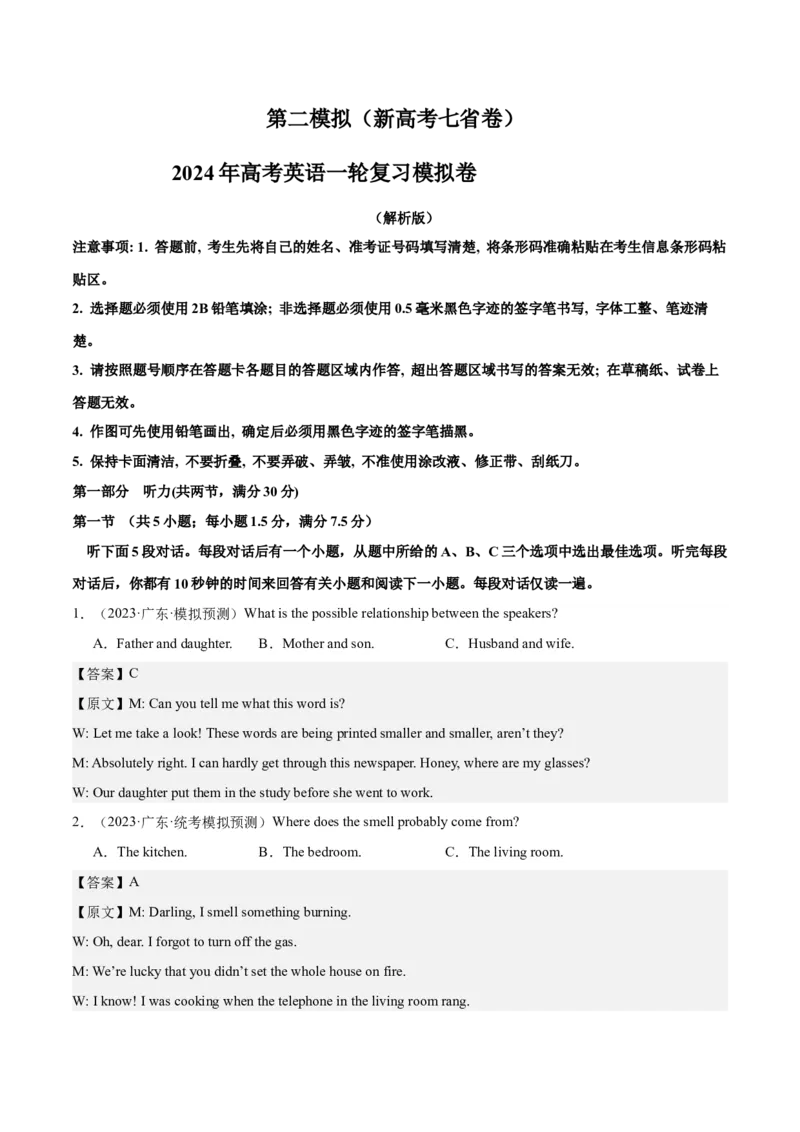
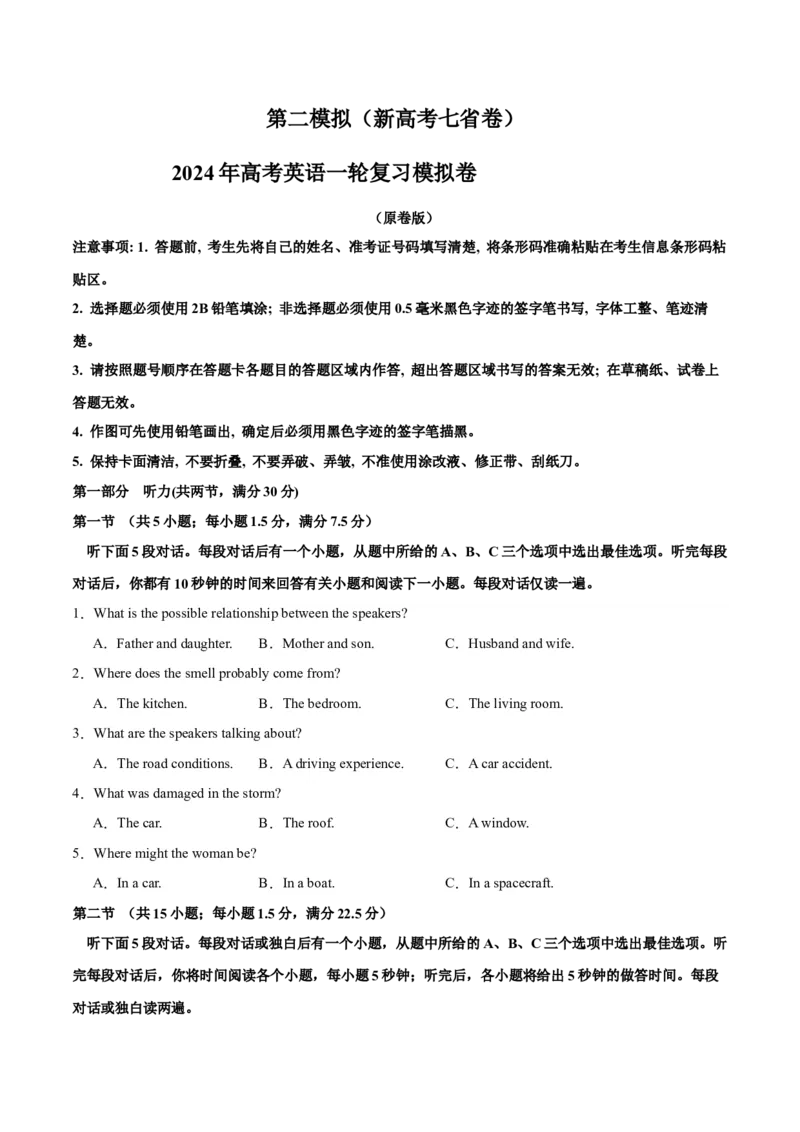
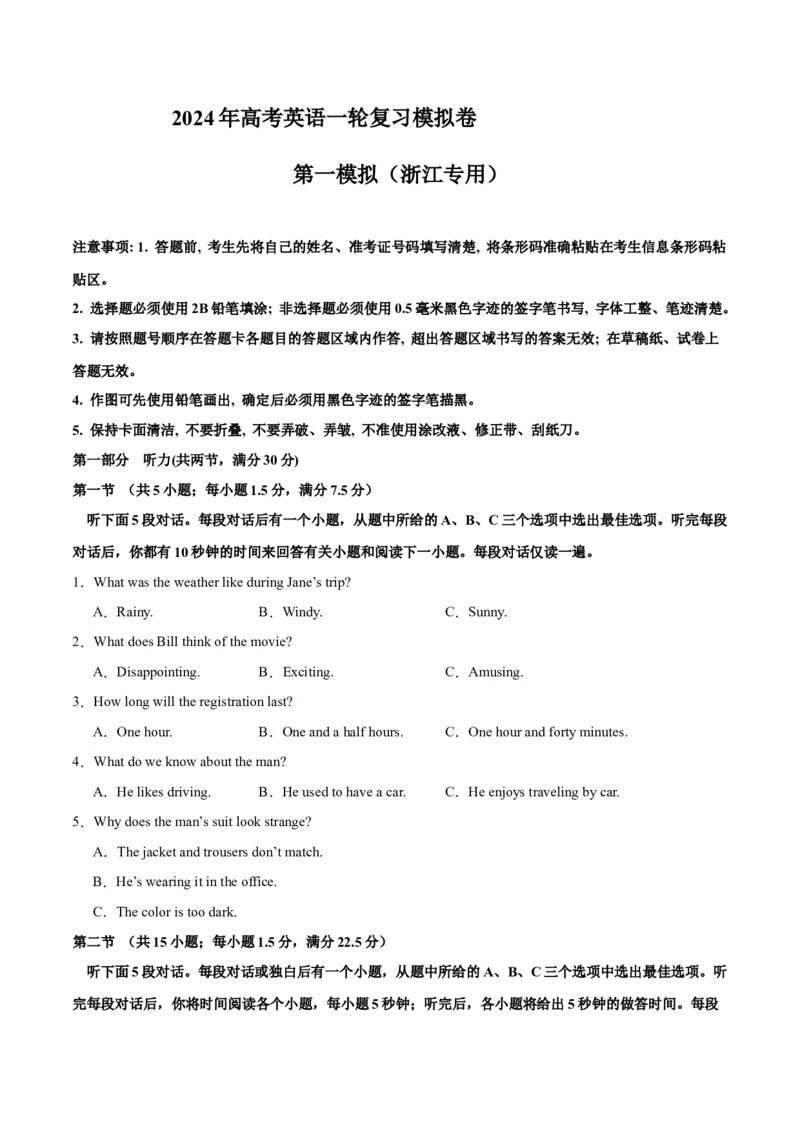
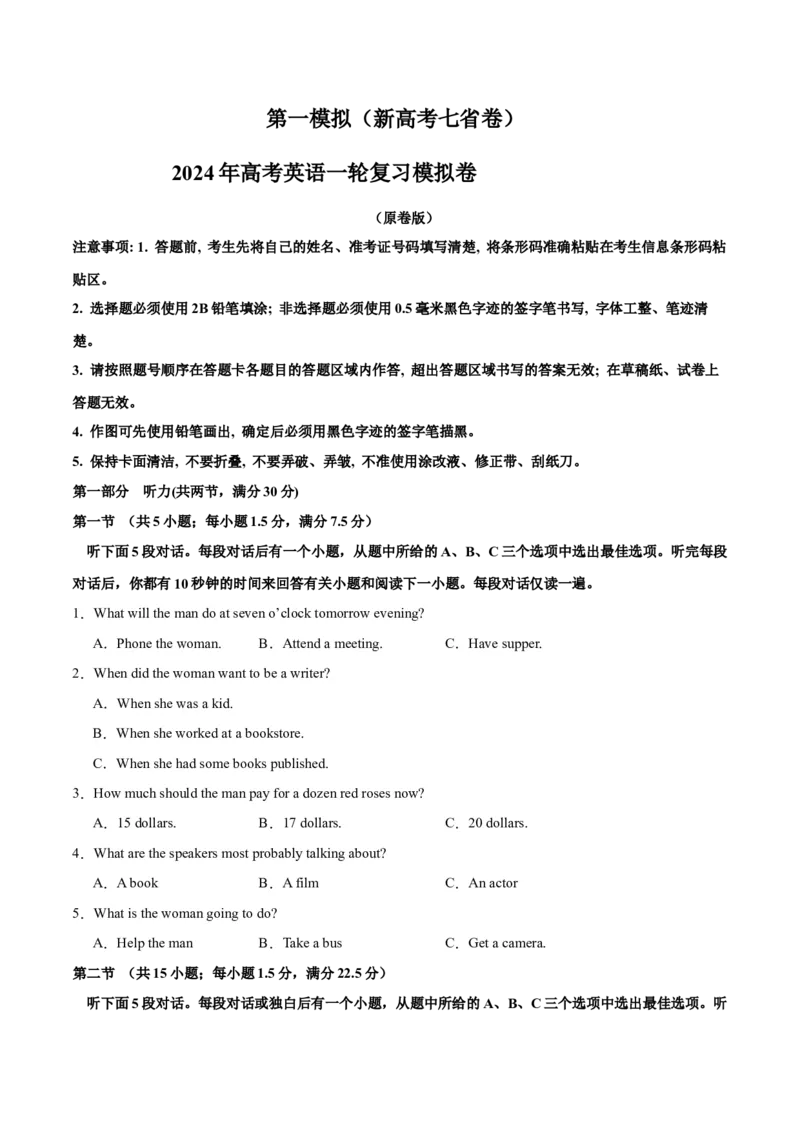
1. What does the man plan to do?
A. Look for a job. B. Move to a new place. C. Rearrange the furniture.
2. What are the speakers talking about?
A. A new book. B. A morning paper. C. An African teacher.
3. How does the woman probably feel now?
A. Regretful. B. Anxious. C. Confused.
4. Where does the conversation take place?
A. In a restaurant. B. In a police station. C. In a car.
5. What is the man going to do tomorrow?
A. Pay the bill. B. Check the mailbox. C. Fix the gas cooker.
第二节 (共15小题;每小题1.5分,满分22.5分)
听下面5段对话或独白。每段对话或独白后有几个小题,从题中所给的A、B、C三个选项中选出最佳
选项。听每段对话或独白前,你将有时间阅读各个小题,每小题5秒钟;听完后,各小题将给出5秒钟的
作答时间。每段对话或独白读两遍。
听第6段材料,回答第6、7题。
6. What does Steve think of his training?
A. Disappointing. B. Acceptable. C. Excellent.
7. How long does Steve train each day?
A. Three hours. B. Five hours. C. Ten hours.
听第7段材料,回答第8至10题。
8. What does Mark say about live drawing?A. It’s enjoyable. B. It’s stressful. C. It’s creative.
9. What is the new thing that Mark wants to draw on?
A. Magazines. B. Diaries. C. Maps.
10. Where do Mark’s inspirations come from?
A. His dreams. B. His parents. C. His travels.
听第8段材料,回答第11至13题。
11. What position is the man interested in?
A. Window cleaner. B. Shop assistant. C. Fitness coach.
12. What will be provided for the job?
A. A company car. B. A smartphone. C. A video recorder.
13. What is needed to do the job?
A. Computer skills. B. Physical strength. C. Work experience.
听第9段材料,回答第14至17题。
14. What does the man do?
A. He’s a receptionist. B. He’s a secretary. C. He’s a waiter.
15. Why does the man say sorry to the woman?
A. He showed her the wrong way.
B. There is no reservation for her.
C. Her name has been misspelled.
16. What is the man’s advice for the woman?
A. Come back later. B. Talk to the manager. C. Postpone the meeting.
17. What will the woman probably do next?
A. Tidy up a room. B. Make a phone call. C. Go for a coffee.
听第10段材料,回答第18至20题。
18. Why do many birds live in the city?
A. They can obtain food easily.
B. They enjoy human company.
C. They lost their natural habitat.
19. What does Christina find surprising?
A. The birds are facing serious dangers.
B. Different kinds of birds live together.
C. Some birds are attracted to the poles.
20. What is Christina’s suggestion concerning the birds?
A. Drive them away. B. Feed them regularly. C. Do research on them.
2025 年浙江 1 月卷听力答案
1-5 BABCA 6-10 CBABC11-15 AABAB 16-20 ACCBC
2025 年浙江 1 月卷听力材料(Text 1)
W: What are all these boxes for?
M: I’m looking for a new apartment.
W: Why?
M: Well, just for a change, and the rent is too high.
(Text 2)
W: Wow, Jennifer got her new book published last month. I learned it from the morning paper today.
M: Yes, I know. It’s based on her teaching experience in Africa last year.
(Text 3)
W: Jim, have you seen Bob?
M: Not since he left my office an hour ago. Why?
W: He’s supposed to be at the airport now to pick up Mr. Anderson, but he’s nowhere to be found.
(Text 4)
W: Slow down a bit, John. Keep it under 65. We don’t want to be pulled over by the police.
M: OK. I just wanted to get to the service station sooner — I’m kind of hungry.
(Text 5)
W: I found the gas bill in the mailbox.
M: How much is it?
W: About 150. Oh, it was due last Friday.
M: Don’t worry. I’ll take care of it tomorrow.
(Text 6)
W: Hello, Steve. How’s your training going?
M: Great! My coach has a really good swim program for me and I think I’m in first-class condition.
W: Do you have to get up very early?
M: Well, I don’t like training early in the morning, so I start at 10:00.
W: I see. What about lunch then?
M: I don’t have lunch. Lunch makes me sleepy. I train all through the day until 3:00.
(Text 7)
W: Good evening everyone. I’m Fiona. With us tonight is Mark, a famous local artist. Thanks for joining us,
Mark.
M: Thank you, Fiona.
W: Have you done live drawing before? Is there more pressure to draw in front of an audience?M: Yes, I have done live drawing before. It’s always fun. I often draw pictures in pubs, and people always come
over for a look and a chat.
W: I know that you’ve drawn pictures on many things, including maps and the covers of books and magazines.
What’s something you haven’t drawn on yet, but really want to?
M: I’d like to draw on personal diaries people have kept over the years and draw the owner on it.
W: Fantastic. Could you also tell us where your inspirations come from?
M: Most are from the people I’ve met and talked to when I was traveling. I always dreamed of traveling around
the world and creating a series of drawings about different cities in the world.
(Text 8)
W: Hello, this is Carl’s Commercial Cleaning. May I help you?
M: Yes. I’m calling to ask about the cleaner position. Is it still available?
W: Yes, it is. We mainly work with small stores in the area and the job is to clean the storefront windows.
M: I know. You said that in the ad. Do I need work experience?
W: No, we offer on-the-job paid training. As a company car is provided, you must have a driver’s license and a
good driving record. You also need to have a smartphone for communication.
M: Sure thing. Can I ask about the pay?
W: Certainly. It’s 10 to 12 dollars per hour plus tips.
M: Okay. Do you have other requirements?
W: Our employees must be dependable and be able to lift heavy things and stand long hours at a time.
M: No problem.
W: Good. Can you come tomorrow afternoon at two for an interview?
M: Okay.
(Text 9)
M: Good morning, can I help you?
W: Yes, I’ve got a reservation. My name is Hillary Langley.
M: Just a moment, please. How do you spell your last name?
W: L-A-N-G-L-E-Y. Langley.
M: Well, I’m sorry, but we don’t seem to have a reservation for you.
W: There must be some mistake. I’m attending a conference in the city and my secretary told me that the
conference organizer made the reservation for me.
M: I see. No, I’m sorry. You are not booked in here.
W: Well, but can you find me a single room anyway?M: I’m afraid there’s nothing available at the moment.
W: Look, I really need a room here. Can I talk to your manager?
M: The manager is away on business. But, well, I may be able to help you if you could wait and prepare to check
in after two in the afternoon. We’ll have some rooms at that time.
W: That’d be very kind of you. Could you give me a call when you have a room available? I’ll just wander
around and have some coffee.
M: Certainly. Would you please give me your phone number?
W: Sure, here’s my card, thanks.
(Text 10)
W: Good evening. I’m honored to have my voice heard to make a difference in the lives of those little birds that
share our city. My name is Christina. I’m an enthusiastic bird-watcher. Because we cut down too many trees in
the nearby areas, many birds now find places within the city to live. The most common is the area behind the
large advertisement boards on the poles. It’s a natural choice for the birds because the poles are similar to trees,
tall and far from dangers on the ground. The surprising thing is that there are likely more than five or six kinds of
birds living together at each place. While trying to learn more about these birds, I find that there have not been
any consistent studies or monitoring of them. Their eating habits, adaptation to life in the city, diseases, death
rate, and such other information are not available. I’d like to suggest that a program be started to study these
birds. It could be convenient to employ bird-watchers to do the initial studies.
2025 年八省联考卷听力试题
第一部分 听力(共两节,满分30分)
做题时,先将答案标在试卷上。录音内容结束后,你将有两分钟的时间将试卷上的答案转涂到答题卡
上。
第一节(共5小题;每小题1. 5分,满分7. 5分)
听下面5段对话。每段对话后有一个小题,从题中所给的A、B、C三个选项中选出最佳选项。听完每
段对话后,你都有10秒钟的时间来回答有关小题和阅读下一小题。每段对话仅读一遍。
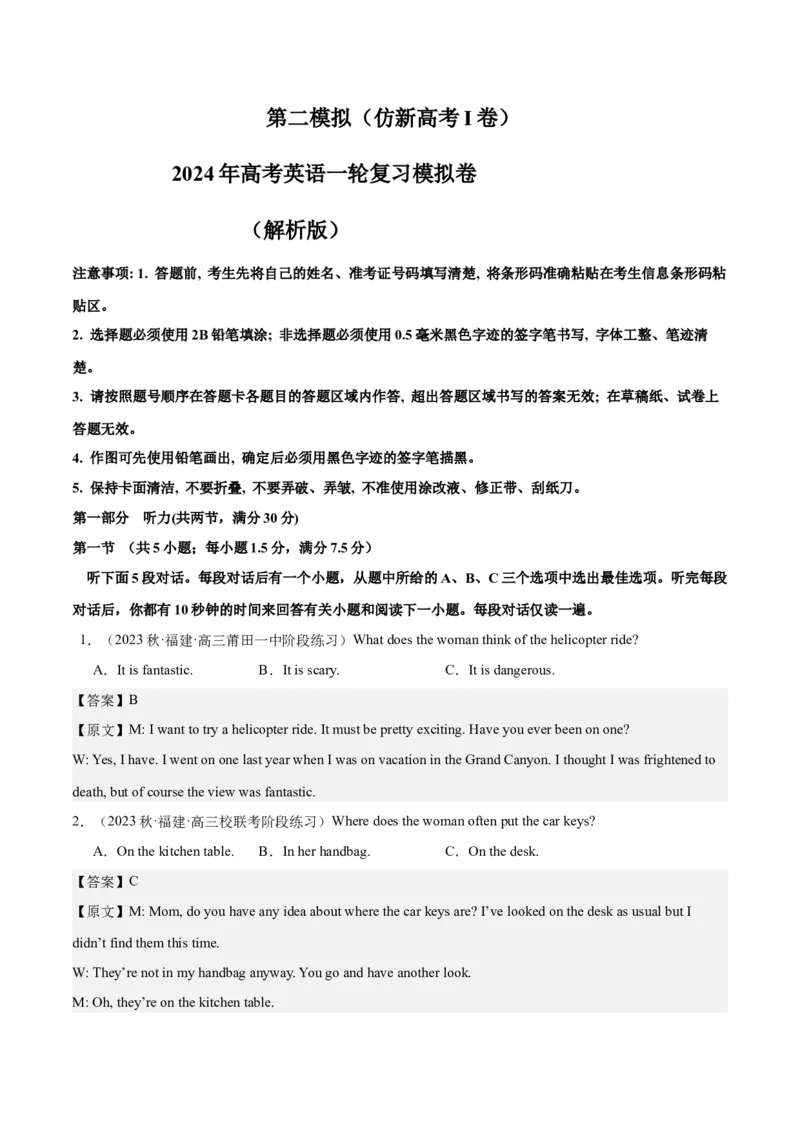
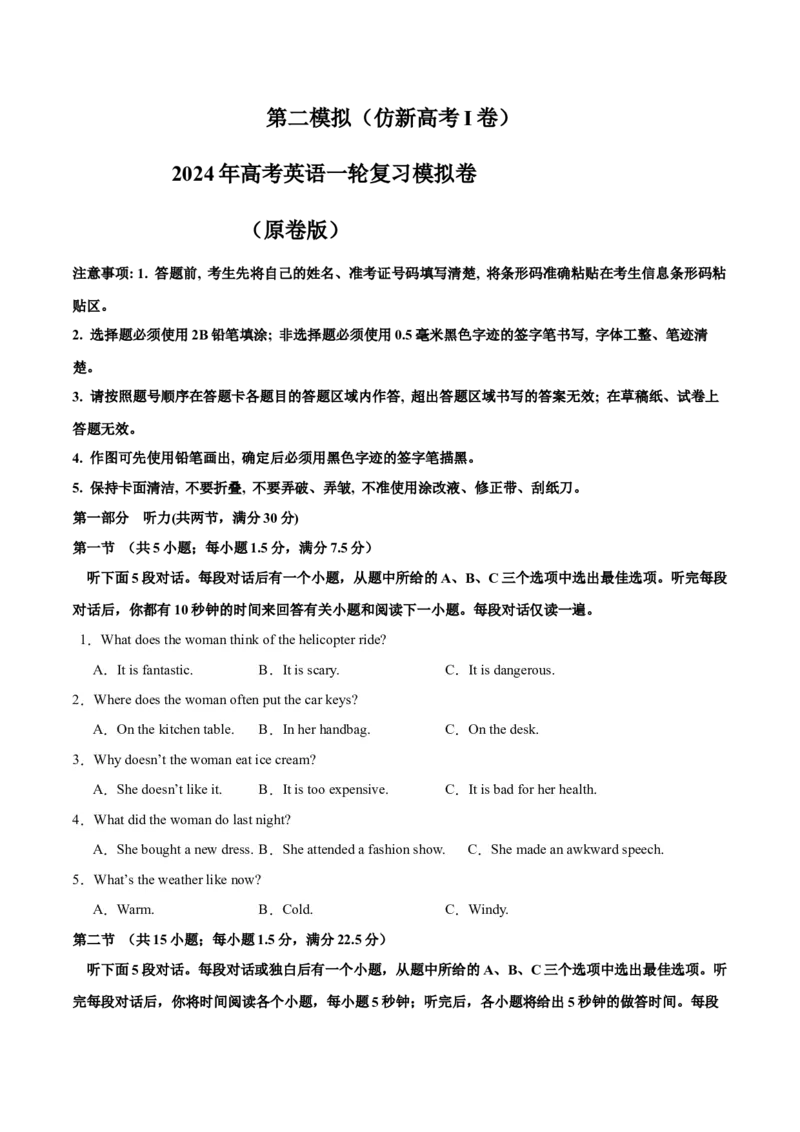
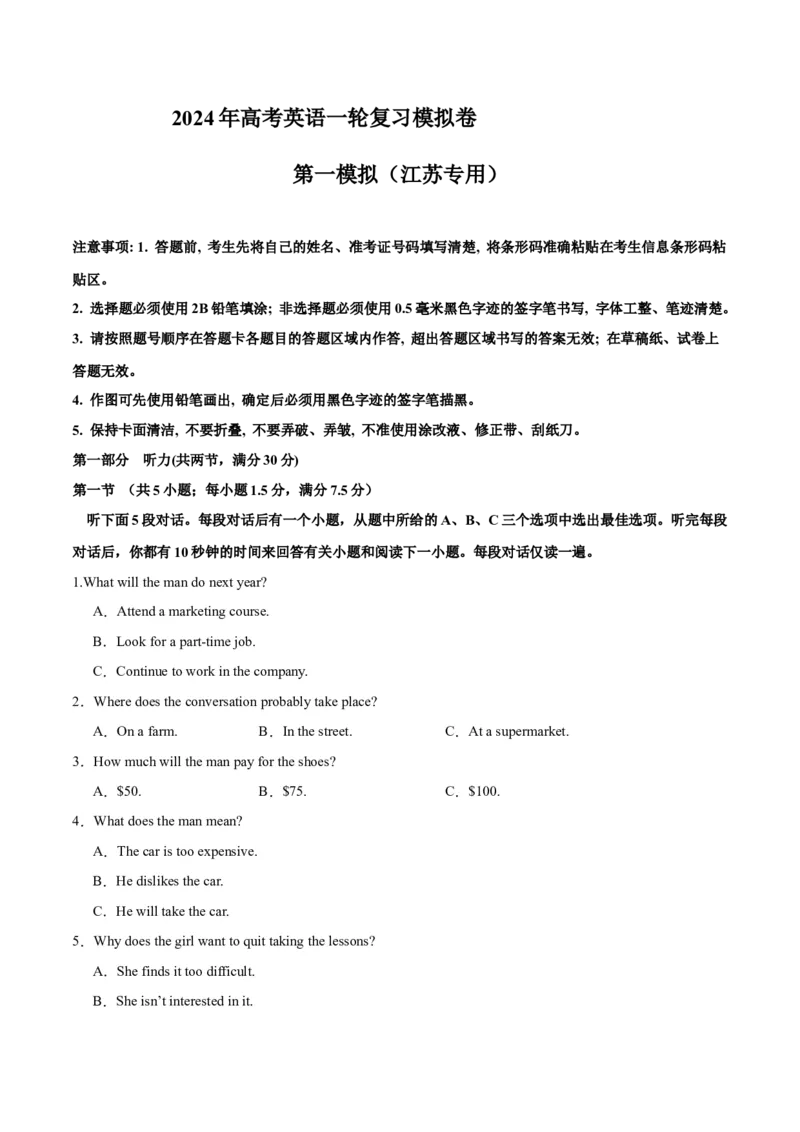
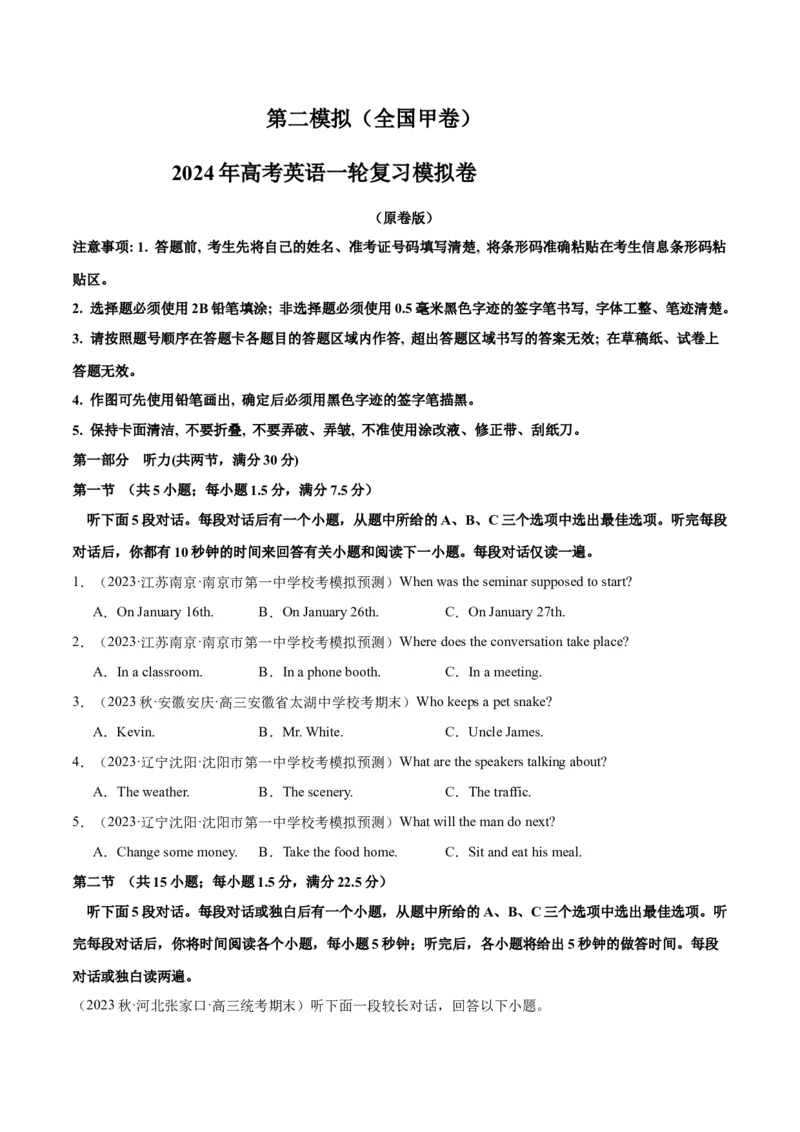
1. What will Luke do next?A. Cook a meal. B. Go to the office. C. Hand in a report.
2. What are the speakers talking about?
A. Two fellow workers. B. The man's job. C. A marketing project.
3. How will the woman go to Melbourne?
A. By car. B. By train. C. By air.
4. Where are probably the speakers?
A. At a store. B. At home. C. At a cinema.
5. What does the woman plan to do?
A. Set up a family. B. Join a new company. C. Open a restaurant.
第二节(共15小题;每小题1. 5分,满分22. 5分)
听下面 5 段对话或独白。每段对话或独白后有几个小题,从题中所给的 A、B、C三个选项中选出最
佳选项。听每段对话或独白前,你将有时间阅读各个小题,每小题5秒钟;听完后,各小题给出5秒钟的
作答时间。每段对话或独白读两遍。
6. Who is the package from?
A. Betty. B. Mary. C. Jason.
7. Where will the speakers place the gift just received?
A. In the kitchen. B. In the bedroom. C. In the living room.
听第7段材料,回答第8、9题。
8. What does Kate think of writing letters?
A. It's convenient. B. It's enjoyable. C. It's old-fashioned.
9. What will the man probably do?
A. Pay the bill. B. Send a postcard. C. Check his mailbox.
听第8段材料,回答第10至12题。
10. What is the woman doing?
A. Giving a lecture. B. Hosting a program. C. Chairing a meeting.
11. What made Robert want to become an astronomer?
A. His parents' encouragement.
B. His experiences in big cities.
C. His curiosity about the stars.
12. Why does Robert put forward the suggestion?
A. To reduce light pollution. B. To keep the ground clean. C. To cut energy consumption.
听第9段材料,回答第13 至 16题。13. Who influenced Elena greatly in her career choice?
A. Her brother. B. Her father. C. Her teacher.
14. Why did Elena quit her first job?
A. She found it boring. B. She was poorly paid. C. She felt stressed.
15. What difficulty did Elena face as an assistant coach?
A. Balancing study and training.
B. Writing technical instructions.
C. Handling doubts over her ability.
16. What does Elena plan to do next?
A. Start a training program.
B. Work with a team in England.
C. Look for promising soccer players.
听第10段材料,回答第17至20题。
17. What did Monica love doing when she was a child?
A. Reading storybooks. B. Playing baseball. C. Taking dance lessons.
18. What was Monica's major in college?
A. Journalism. B. History. C. English.
19. What did Monica do right after graduation?
A. She began travelling. B. She became a teacher. C. She launched a newspaper.
20. Where does Monica work now?
A. In China. B. In Australia. C. In Canada.
2025 年八省联考卷听力答案
1-5 BACBC 6-10 ACBCB 11-15 CABAC 16-20 BACBA
2025 年八省联考卷听力材料
(Text 1)
M: Thanks for the wonderful meal, Mom. I think I’d better go back to my office. I’ve got a report to write.
W: Okay. Bye, Luke. Drive with care.
(Text 2)
W: Jill and Patty are very close. They seem to get on very well with each other.M: Yes, they entered our company the same year and are now working on the same marketing project.
(Text 3)
W: Bob, I’m going to Melbourne with Lisa tomorrow.
M: Great. Are you going by train? I can drive you to the station.
W: No thanks. We decided to fly.
(Text 4)
W: You asked Stella to come around 6:30, didn’t you?
M: No, I asked her to come over at 7 to give you more time to prepare the food.
W: Okay, it’s 6:50. She’ll be here any minutes.
(Text 5)
M: Hey, Susan. It’s so good to see you again. Did you come back to visit your family?
W: Yes and no. In fact, I’ve quit my job. I’m planning to stay and start my own restaurant business here.
(Text 6)
M: Here’s a package.
W: I wonder what this is.
M: ⑥Who is it from? Uncle Jason? Aunt Mary?
W: ⑥Let me see... it’s from Granny Betty.
M: Oh, She’s always so generous. Remember the table lamp she sent us last year and the dinner plates.
W: Look, Steve! This is just what we’ve been wanting, a beautiful vase.
M: Fantastic.
W: ⑦It’ll be perfect on the coffee table in the living room.
M: ⑦Yes, perfect.
(Text 7)
M: Kate, what are you writing?
W: A letter to my sister.
M: Why not send an email to her? It’s faster.
W: ⑧Well, I love email for the convenience, but I tend to write letters for pleasure, especially for holiday
greetings.
M: You’re right. I prefer handwritten birthday cards too.
W: And I love getting letters too. Hearing a letter drop through the mailbox is much more exciting than getting
an email, even though it’s usually a bill or advertisement in my case.
M: ⑨Oh, that reminds me. I haven’t checked my mailbox for ages.(Text 8)
W: ⑩Dear listeners, I have with me today, Robert Jents of the International Dark Sky Association. Robert,
Welcome to our program.
M: Thank you. I’m glad to be here.
W: Would you please tell our listeners why you became an astronomer?
M: ⑪When I was a little boy, I loved the night sky. I remember I looked up at the stars in the sky and
asked: “How many are there? How far away are they? Can we visit them?”. I became an astronomer because I was
amazed by the beauty, but now in most big cities, kids can’t see the stars like I did.
W: So, have you already come up with a solution to this problem?
M: Yeah, actually there is a method that is inexpensive and has immediate benefits. ⑫If we shine lights down at
the ground instead of up into the sky, and use lower brightness levels, we can preserve the beauty of the night sky.
(Text 9)
M: ⑬Elena, who had a great influence on your career?
W: ⑬I would say it’s my father. He began to run soccer schools when I was a teenager, so I played soccer with
my brother and his friends, but a life in the game was not my plan. ⑭So after graduation, I took a job writing
technical instructions. It was my first job.
M: ⑭What was that like?
W: ⑭It paid well, but was not very interesting. So when offered a coaching role, I seized it.
M: Did you have to overcome any challenges to get where you are today?
W: Well, where to start? I enjoyed a successful college life. Then I progressed through the college system
to become an assistant coach to the national team. ⑮I’ve encountered a lot of challenges through the ups and
downs of being a coach. It’s particularly hard to face the doubts after losing games.
M: What achievement are you most proud of?
W: I’m most proud of helping my team to win all the last seven matches in Italy and Brazil.
M: ⑯What are you planning to do next?
W: ⑯I’ll take on another challenge, possibly coaching in England.
(Text 10)
W: Good morning, everyone. I’m Monica from Canada, and I’ll teach you English writing this term. Before
we start, I’d like to take a few minutes to let you know something about me. ⑰When I was small, I enjoyed
spending my summers reading story books instead of playing baseball or taking dance lessons. After I went to
school, I took reading time seriously, once I tied one end of a string around a book and the other end around mywaist, climbed a tree and sat in the branches reading until dinner time. ⑱In college, I thought I might major in
journalism or history, but when I took my first literature class, I was deeply attracted to it. The calling to be an
English major was in my heart, and I couldn’t imagine spending my study hours without Shakespeare, Chaucer or
Lewis by my side. I learned the art of making connections between literature and life and developed a love for
writing. ⑲After graduation, I taught English in a primary school in Canada for five years. Then I went to
Australia and worked as a book editor. ⑳Three years ago, I came to China. I’ve been teaching English in middle
schools. I love my job, and I’m thankful for the gift of words for the life connection beauty and learning that come
from language.
2025 年新课标仿真卷听力材料
第一部分 听力(共两节,满分30分)
做题时,先将答案标在试卷上。录音内容结束后,你将有两分钟的时间将试卷上的答案转涂到答题卡
上。
第一节(共5小题;每小题1. 5分,满分7. 5分)
听下面5段对话。每段对话后有一个小题,从题中所给的A、B、C三个选项中选出最佳选项。听完每
段对话后,你都有10秒钟的时间来回答有关小题和阅读下一小题。每段对话仅读一遍。
1. What will the man do?
A. Keep the key. B. Give back the key. C. Deliver a message.
2. Why won't the woman keep a pet dog?
A. She is frightened of dogs. B. She already has fish as a pet. C. She can't take good care of it.
3. What problem does the woman have?
A. The noise kept her awake. B. She didn't have fun in the day. C. She can't pay attention to her study.
4. Where does the conversation probably take place?
A. At an airport. B. In an office. C. In a restaurant.
5. What are the speakers talking about?A. A writer. B. A film. C. A book.
第二节 (共15小题;每小题1.5分,满分22.5分)
听下面5段对话或独白。每段对话或独白后有几个小题,从题中所给的A、B、C三个选项中选出最佳
选项。听每段对话或独白前,你将有时间阅读各个小题,每小题5秒钟;听完后,各小题将给出5秒钟的
作答时间。每段对话或独白读两遍。
听第6段材料,回答第6、7题。
6. Why does the man suggest leaving at 7:00?
A. There will be little traffic. B. There will be an earlier flight. C. They want to have tea at the airport.
7. How will the speakers go to the airport?
A. By train. B. By car. C. By bus.
听第7段材料,回答第8、9题。
8. Why does the woman look tired?
A. She hasn't got enough sleep.
B. She has been studying too hard.
C. She has cut back on food lately.
9. What does the man suggest the woman do?
A. Work out regularly. B. Avoid staying up late. C. Stop losing weight.
听第8段材料,回答第10至12题。
10. How does the man feel at first?
A. Scared. B. Surprised. C. Excited.
11. What made the man fail to see the clock tower clearly?
A. The fog, B. The sandstorm. C. His poor eyesight.
12. What do the experts advise people to do?
A. Stay inside. B. Cover their faces. C. Protect the forests.
听第9段材料,回答第13至16题。
13. What is the relationship between the speakers?
A. Teacher and student. B. Classmates. C. Brother and sister.
14. What is the man doing?
A. Taking a test. B. Doing a survey. C. Talking about his school life,
15. How does the woman feel about homework now?
A. She hates it. B. She is stressed about it. C. She is positive about it.
16. What kind of teacher does the woman prefer?
A. A strict teacher. B. An understanding teacher. C.A knowledgeable teacher.听第 10 段材料,回答第17至20题。
17. What does the speaker do first after arriving at the hotel?
A. He prepares for a meeting. B. He checks on breakfast. C. He reads some reports.
18. How long does the speaker work a day?
A.11.5 hours. B.10 hours. C.9 hours.
19. What do the hotel workers have to keep in mind?
A. Saying hello to every guest.
B. Offering all kinds of food.
C. Paying attention to cultural differences.
20. What is the talk mainly about?
A.A hotel manager's daily work.
B. Hotel service and improvement.
C. Meetings attended by a hotel manager.
2025 年新课标仿真卷听力答案
1-5 CAABC 6-10 ABCAB 11-15 BCABC 16-20 BCACA
2025 年新课标仿真卷听力材料
(Text 1)
W: Do you know where the key to the gate is?
M: I believe Nancy took it yesterday.
W: Would you remind her to give it back, please?
M:OK
(Text 2)
M: I think we should get a pet. What do you think?
W: You know I'm scared of dogs. I don't like keeping cats, because they need a lot of looking after.
M: I've always liked the idea of gold fish. They look nice. So, let's keep fish.
(Text 3)
W: They're shouting and dancing excitedly all day long.
M: Isn't it terrible? I can't focus on my studies.
W: Yes, they make too much noise. I even failed to fall into sleep.
all day long 整天(Text 4)
W: The airport is about ten miles away from our company, and I can't say for certain if Jim can arrive here before
2 pm.
M: In that case, we need to reschedule the meeting to be held in the afternoon. Anyway, let's go for lunch first.
(Text 5)
W: Many people say it's good. But I think it's boring!
M: I don't think 1 share your view. The author is writing about history, society, human nature and so on. It tells a
story of real life.
(Text 6)
W: It's about two hours' drive to St Louis Airport. When do you suppose we should leave?
M: When are we supposed to be there?
W: Let me wee. The plane is due to take off at 10:30, so we should be there before 10:00.
M: I think we ought to set off m 7:00. while the roads are empty.
W: OK. When we arrive, we can spend some time having lea at the airport.
(Text 7)
M: Lucy, you look tired. Have you stayed up late for study recently?
W: Well, I'm trying to lose weight. So I'm dieting. Ever since then. I always feel tired.
M: I'm a bit concerned about your health. You need to make in enough food. Your body needs a lot
of nutrition to function well.
W: Yeah, I know. But I have put on a lot of weight recently. M:You should do proper exercise. Just as
we should cat different kinds of foods. it's a good idea to do different kinds of exercises regularly. It will take
effect soon.
W: Yeah, I think you're right.
Take in 摄入: 吸收
nutrition 营养
put on weight 体重增加:
(Text 8)
M: Mum, why can't l see the clock tower clearly from here? I could see further yesterday.
W: Is there anything wrong with your eyes or with your memory? Let me have a look ... Oh, look! Do you know
what's unusual today?
M: I just can't see clearly. There seems to be some yellow fog in the air.
W: That's not fog. That is called a sandstorm. The storm keeps people from seeing things far away. This situationis very common in the west of the States.
M: Oh, I see. That's why people here have been warned not to go out without covering their faces today. But
what causes a sandstorm, Mum?
W: Many factors. But the loss of the balance in nature and a long drought are two main factors.
M:Then what can people do?
W: Well, the experts suggest that we protect the forests and plant more trees.
unusual 不寻常的
factor 因素,要素
(Text 9)
M: Tina, I know that you are a very good student and as a teacher I always want to know what students are
thinking. Would you mind my asking you some questions?
W: Of course not, go ahead.
M: OK, the first question: Do you like homework?
W: Well, yes. I used to hate it when I was small but being a university student. I'm more active towards
homework although I don't have much anymore.
M: OK. Next question: Do you prefer a strict teacher who has many rules or do you prefer an easy-going teacher
who has fewer rules over the class?
W: I would like the latter. You know, students should have their own lives. The teacher should respect different
ways of doing things for the students I think.
M: OK. Last one: Do you prefer studying with multimedia or printed materials?
W: I like to write on things that I read so I think 1 prefer printed materials where I can actually have a hands-on
feeling.
the later 刚提及的两者中后者
hands-on 亲身实践的;实际操作的
(Text 10)
M: Good morning, everyone. I'm pleased to give a talk. I am a hotel manager and I have to walk around and
smile all the time. Every day I arrive at the hotel at 7:30 am, Before I prepare for the staff meeting. I first review
the night manager's reports and catch up on the emails that come through overnight. Then I and walk through the
restaurant to say hello to guests. At 9 am there is the staff meeting, where workers report on what has
happened the night before and what needs to be cared for. At 9:45 1 am always around the hotel meeting and
greeting staff. I have to keep an eye on what is going on, everything from the temperature of the shower to the
variety of food. And we have to bear in mind cultural differences. For example, the Japanese want a runningbath and the Americans are fine just with a shower. At 1 pm I always cat with a different worker, as this is a
valuable way of finding out what is going on. From 2 pm to 7 pm there are different meetings concerning all the
details of hotel operation. I try to get through all the work by 7 pm.
catch up on 补做(未做的);赶做;补上
come through (信息等) 收到/传来
keep an eye on 留神;留意
check on超做:补上
bear in mind 在心中; 记住
get through 完成(工作)