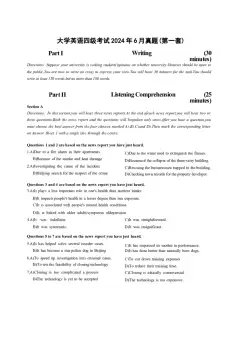
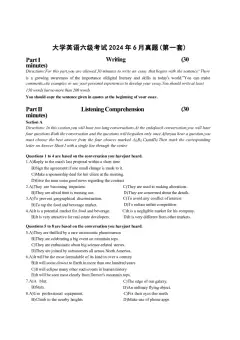
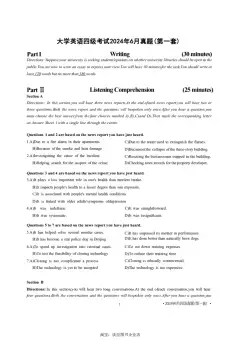
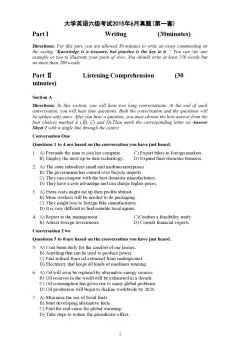
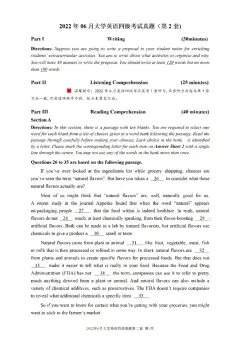
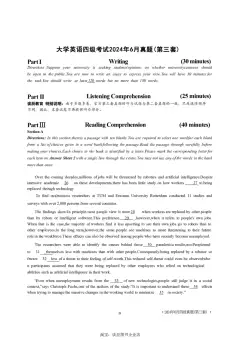
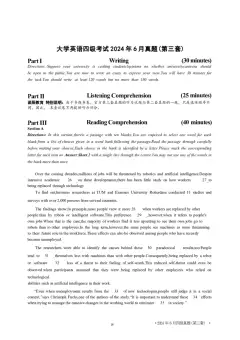
大学英语四级考试2024年6月真题(第一套)
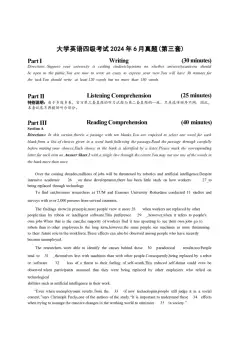
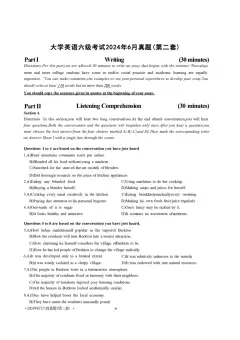
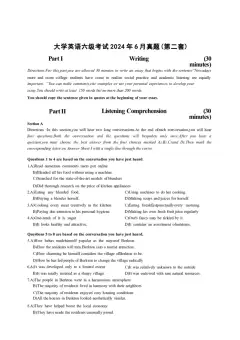
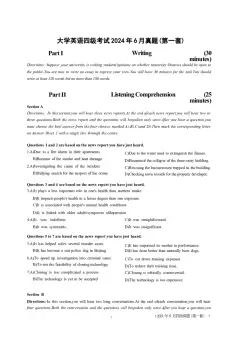
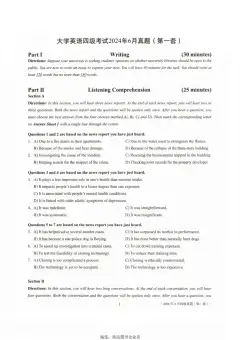
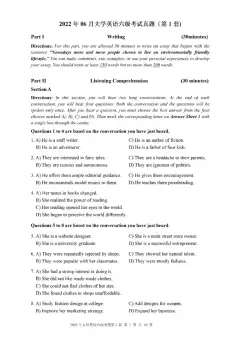
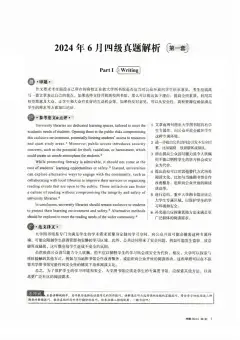
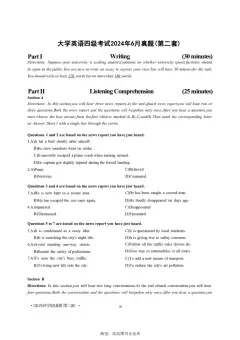
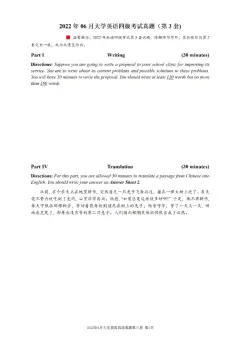
PartI Writing (30minutes)
Directions:Supposeyouruniversityisseekingstudents'opinionsonwhetheruniversitylibrariesshouldbeopentothe
public.Youarenowtowriteanessaytoexpressyourview.Youwillhave30minutesforthetask.Youshouldwriteat
least120wordsbutnomorethan180words.
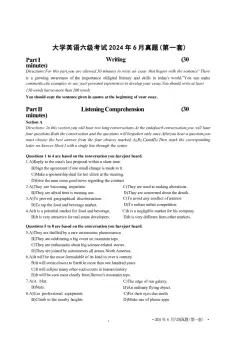
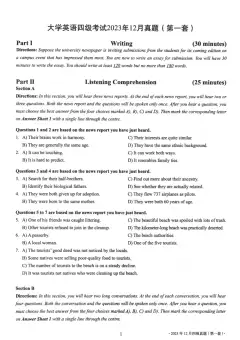
PartⅡ ListeningComprehension (25minutes)
SectionA
Directions: In thissection,you willhear three news reports.At the endofeach news report,you will hear two or
three questions.Both the news report and the questions will bespoken only once.Afieryou hear a question,you
must choose the best answerfrom thefour choices markedA),B),C)andD).Then mark the corresponding letter
onAnswer Sheet 1withasingleline through thecentre.
Questions 1and2arebasedonthenewsreportyouhavejustheard.
1.A)Due to a fire alarm in their apartments. C)Duetothe waterused to extinguish the flames.
B)Because ofthe smoke and heat damage D)Becauseofthecollapseofthethree-storybuilding.
2.A)Investigating the cause of the incident. C)Rescuingthebusinessmentrapped in thebuilding.
B)Helping search forthe suspect ofthe crime. D)Checkingtownrecordsforthepropertydeveloper.
Questions3 and4 arebasedonthenewsreportyouhavejustheard.
3.A)It plays a less important role in one's health than nutrient intake.
B)It impactspeople'shealthto a lesser degree than sun exposure.
C)It is associated with people's mental health conditions
D)It is linked with older adults'symptoms ofdepression
4.A)It was indefinite C)It was straightforward.
B)It was systematic. D)It was insignificant.
Questions5to7arebasedonthenewsreportyouhavejustheard.
5.A)It has helped solve several murder cases. C)It has surpassed its mother in performance.
B)It has become a star police dog in Beijing D)Ithas donebetterthan naturally born dogs.
6.A)To speed up investigation into criminal cases. C)To cut down training expenses
B)Totestthe feasibility ofcloningtechnology. D)Toreduce their training time.
7.A)Cloning is too complicated a process C)Cloning is ethically controversial.
B)The technology is yet to be accepted D)The technology is too expensive.
Section B
Directions:In this section,you will hear two long conversations.At the end ofeach conversation,you will hear
four questions.Both the conversation and the questions will bespoken only once.Afteryou hear a question,you
·2024年6月四级真题(第一套)·
1must choose the best answerfrom thefour choices markedA),B),C)andD).Then markthe corresponding letter
onAnswerSheetI withasinglelinethroughthecentre.
Questions8to 11arebasedontheconversationyouhavejustheard.
8.A)He read it somewhere online. C)He read an article reviewing it.
B)He heard about it from a coworker. D)Hewatched a TV seriesbased on it.
9.A)His publications. C)His address
B)His first book. D)His name.
10.A)Collect a lot more data. C)Clarify many new concepts
B)Relax a bit less often. D)Read more reference books.
11.A)Find out the show's most interesting episodes C)Getan e-Copyofthebooktoread.
B)Watch the series togetherwith thewoman. D)Check to see when the show starts.
Questions 12to 15 arebasedonthe conversationyouhavejustheard.
12.A)To check theprices ofhis farmproduce. C)To inquire aboutthevegetarian food festival.
B)ToaskthewaytotheNewcastle CityHall. D)Toseektheman'shelpwithherworkonthefarm.
13.A)Bakers. C)Vegetarians.
B)Vendors D)Organisers
14.A)The issuing ofcertificates to vendors. C)The festival they are organising.
B)The completion ofthe baking task. D)The deadline for application.
15.A)The closing date of submission. C)The details ofthe ceremony
B)The website ofhis company. D)The organiser'saddress
SectionC
Directions: In this section,you will hearthrepassages.At the end ofeachpassage,you will hear three orfour
questions.Both the passage and the questions will be spoken only once.Afteryou hear a question,you must
choose the bestanswerfrom thefour choices marked A),B),C)and D).Then mark the corresponding letter on
Answer Sheet Iwithasinglelinethroughthecentre
Questions 16to 18 arebased onthepassageyou havejust heard.
16.A)Most scenic sites have been closed. C)Health experts advise going outdoors.
B)Access to official campsites is limited D)Peoplehavemore time during the summer.
17.A)It is strongly opposed by nearby residents C)It has caused environmental concerns
B)It leads to muchwaste ofpublicmoney D)Ithas created conflicts among campers.
18.A)Look for open land in Scotland C)Avoid getting close to wilderness.
B)Leave no trace oftheir camping D)Ask forpermission from authorities.
Questions 19to21arebasedonthepassageyouhavejustheard.
19.A)They outcompete mythical creatures. C)They truly exist in the Amazonregion
B)Theyusuallymind their own business. D)They resemble alarmingly large snakes
·2024年6月四级真题(第一套)·
220.A)Scar tissue from dolphins'fighting. C)Unhealed wounds from snake bites.
B)Skin infection from water pollution. D)Swimming along in seasonal floods.
21.A)It has been shrinking at an astonishing pace.
B)Ithasbeenplacedunder internationalprotection.
C)It hasbeen appealing toboth freshwater and sea dolphins
D)Ithasbeen abandoned as abattleground formale dolphins.
Questions22to25arebasedonthepassageyouhavejustheard.
22.A)About 58%ofyoung adults call parental support the new normal.
B)Most adult children enjoy increasing sources offinancial support
C)A full 70%oftheyoung adults cannot affordtobuy a carbythemselves.
D)Most early adults cannot sustain their lifestyles withoutparental support
23.A)It renders them dependent. C)It makes them mentally immature.
B)It causesthemto lose dignity. D)It hinders them from getting ahead.
24.A)It challenges one's willpower C)It calls for due assistance.
B)It results from education. D)It defines adulthood.
25.A)Current lifestyles C)College loans
B)Poor budgeting. D)Emergency expenses
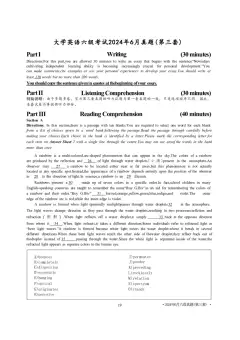
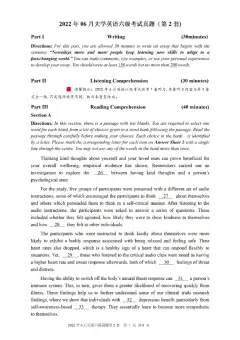
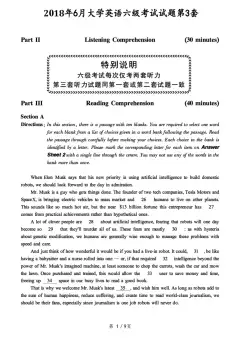
PartⅢ ReadingComprehension (40minutes)
SectionA
Directions: Inthissection,thereisapassagewith ten blanks.You are requiredtoselect onewordforeach blank
from a list ofchoices given in a word bankfollowing thepassage.Read thepassage through carefully before
makingyour choices.Each choice in the bank is identified by a letter:Please mark the corresponding letterfor
each item onAnswerSheet2withasingle line through thecentre.Youmaynot use any ofthe words in the bank
more thanonce.
It's well known that physical exercise is beneficial notjust to physical health but also to mental
health.Yetwhereasmostcountrieshave 26 evidence-backedguidelinesonthetype andintensityof
exercise 27 forvariousphysicalhealthbenefits,suchguidelinesdonotyetexistforexerciseandmood.
Thisis 28 duetoalackofnecessaryevidence.However,anewsystematicreviewbringsususefullyup-
to-dateonthecurrentfindingsinthisarea.
Before 29 into some of the key take-aways,an important 30 made in the review is between
aerobic exercise and anaerobic.The former31 such things as walking,jogging and cycling and means
exercising in such a way that your body is able to use oxygen to burn fat for energy.In contrast,anaerobic
exercise—such as lifting heavy weights—is of such 32 intensity that your body does not have time to
use oxygen to create energy and so instead it breaksdown glucose(葡萄糖)in your blood or muscles.
Beginning first with the influence of exercise intensity on the mood benefits of aerobic exercise,the
researchers,led by John Chan at Shenzhen University,found33 resultsfrom 19 relevant studies.Some
·2024年6月四级真题(第一套)·
3favoured higher intensity,others low,while seven studies found that intensity made no 34 _tomood
benefits.
In relation to the intensity of anaerobic exercise,however,the results were far clearer—the optimum
(最佳选择)for improving mood is 35 intensity,perhaps because low intensity is too dull while high
intensity is too unpleasant
A)constitutes I)involves
B)contradictory J)moderate
C)decision K)notified
D)detailed L)partly
E)difference M)required
F)dipping N)traditionally
G)distinction O)vigorous
H)falling
SectionB
Directions:Inthissection,youaregoingtoreadapassagewithtenstatementsattachedtoit.Eachstatement
contains information given in one ofthe paragraphs.Identify the paragraphfrom which the information is
derived.You may choose aparagraph more than once.Eachparagraph is markedwith a letter.Answer the
questionsbymarkingthecorrespondingletteronAnswerSheet2.
WhyDoAmericansWorkSoMuch?
A)Howwillweallkeepbusywhenweonlyhavetowork 15hoursaweek?Thatwasthequestionthatworried
theBritisheconomistJohnMaynardKeyneswhenhewrotehisshortessay“Economic PossibilitiesforOur
Grandchildren”in 1930.Overthenextcentury,hepredicted,theeconomywouldbecomesoproductivethat
peoplewouldbarelyneedtoworkat all.For a while,it looked like Keynes wasright.In 1930 the average
workingweekwas47hoursintheUnitedStates.Butby 1970,thenumberofhoursAmericansworkedon
averagehadfallentoslightlylessthan39.
B)Butthen something changed.Instead ofcontinuingto decline,the duration oftheworkingweekremained
stable.It has stayed atjust below 40 hours for nearly five decades.So what happened?Why are people
workingjustasmuchtodayasin 1970?
C)TherewouldbenomysteryinthisifKeyneshadbeenwrongaboutthepoweroftechnologytoincreasethe
economy'sproductivity,whichhethoughtwouldleadtoastandardofliving“betweenfourandeighttimesas
highasitistoday.”ButKeynesgotthatright:Technologyhasmadetheeconomymassivelymoreproductive.
AccordingtoBenjaminM.Friedman,aneconomistatHarvard,theU.S.economyisrightontracktoreachKeynes's
eight-fold(八倍)multipleby2029.ThatisacenturyafterthelastdataKeyneswouldhavehadaccessto.
D)Inanewpaper,Friedmantriestofigureoutwhythatincreasedproductivityhasnottranslatedintoincreased
leisuretime.Perhapspeoplejustneverfeelmateriallysatisfied,alwayswantingmoremoneytobuythenext
·2024年6月四级真题(第一套)·
4new thing.This is a theory that appeals to many economists.“This argument is,at best,far from sufficient,”
hewrites.Ifthatwerethe case,why didthe duration oftheworking week decline in the first place?
E)Another theory Friedman considers is that,in an era ofever fewer settings that provide effectiveopportunities
for personal connections and relationships,people may place more value on the socializing that happens
at work.There is support for this theory.Many people today consider colleagues as friends.But Friedman
argues that the evidence for this theory is far from conclusive.Many workers report that they would like to
spend more time with family,rather than at work.Furthermore,this theory cannot explain the change in trend
intheU.S.working week inthe 1970s.
F)A third possibility proves more convincing for Friedman.That is:American inequality means that the gains
ofincreasing productivity are not widely shared by everyone.In other words,most Americans are too poor
to work less.Unlike the other two explanations Friedman considers,this one fits chronologically(按年代).
Inequality declined in America during the period following World War II,along with the duration of the
workingweek.But sincethe early 1970sithasrisen dramatically.
G)Keynes's prediction ofa shorter working week rests on the idea that the standard ofliving would continue
rising for everyone.But Friedman says that this is not what has happened.Although Keynes's eight-fold
figure holds up for the economy as a whole,it is not at all the case for the median(中位数的)American
worker.For them,outputby 2029 is likely tobe around 3.5 times what it was when Keynes was writing.This
is a bit below his four-to eight-fold predicted range
H)This can be seen in the median worker's income over this time period,complete with a shift in 1973 that fits
in precisely with when the working week stopped shrinking.According to Friedman,between 1947 and 1973
the average hourly wage for normal workers (those who were not in management roles)in private industries
other than agriculture nearly doubled in terms of what their money could buy.But by 2013 the average
hourly wage for ordinary workers had fallen 5 percent from the 1973 level in terms of actual purchasing
power.Thus,though American incomes may have gone up since 1973,the amount that American workers
can actually buy with their money has gone down.For most Americans,then,the magic of increasing
productivity stoppedworking around 1973.Thus,they had to keep workingjust as much in orderto maintain
their standard ofliving
I)What Keynes predicted was a very optimistic version ofwhat economists call technological unemployment.
This is the idea that less labor will be necessary because machines can do somuch.In Keynes's vision,the
resulting unemployment would be distributed more or less evenly across society in the form of increased
leisure.But Friedman says that,for Americans,reality is much darker.Americans now have a labor market
in which millions ofpeople—those with fewer skills and less education—are seeking whatever poorly paid
work they can get.This is confirmed by a recent poll that found that,for half of hourly workers,their top
concern isnotthattheywork too much but that they work too little.This is most likely not because they like
theirjobs somuch.Rather,we can assume it isbecausetheyneedthe money.
J)This explanation leaves an important question.Ifthe very rich—the workers who have reaped above-average
gains from the increased productivity since Keynes's time—can afford to work less,why do they continue
to work so much?(Indeed,research has shown that the highest earners in America tend to work the most.)
·2024年6月四级真题(第一套)·
5Friedmanbelievesthatformanytopearners,workisalaboroflove.Theyaredoingworktheycareaboutand
areinterestedin,anddoingmoreofitisnotnecessarilyaburden.Forthem,itmayevenbeapleasure.These
topearnersderivemeaningfromtheirjobsandworkisanimportantpartofhowtheythinkofthemselves.
And,ofcourse,theyarecompensatedforitatalevelthatmakesitworththeirwhile.
K)Friedmanconcludesthattheprosperity(繁荣)Keynespredicted ishere.After all,the economy as awhole
hasgrownevenmorebrilliantlythanheexpected.ButformostAmericans,thatprosperityisnowheretobe
seen.And,asaresult,neitherarethoseshorterworkingweeks.
36.Somepeopleviewsocializingattheworkplaceasachancetodeveloppersonalrelationships.
37.AsordinaryAmericanworkers'averagehourlypayhaddecreaseddespiteincreasingproductivity,theyhadto
workjustasmanyhoursasbeforetokeeptheirlivingstandards.
38.Americanworkers'averageweeklyworkingtimehasnotchangedfornearlyhalfacentury.
39.Friedmanbelieves inequality intheU.S.largely explainswhy increasing productivity has not resulted in
reducedworkinghours.
40.Manyeconomistsassumepeople'sthirstformaterialthingshaspreventedthemfromenjoyingmoreleisure
time.
41.Aneconomist'spredictionaboutashorteraverageworkingweekseemedtobecorrectforatimeinthe20th
century.
42.IntheU.S.labormarket,theprimaryconcernofpeoplewithlessschoolingandfewerskillsistosecureany
employmentevenifitislow-paid.
43.Keyneswasrightinpredictingthattechnologywouldmaketheeconomymuchmoreproductive.
44.Manyofthehighestearnershaveakeeninterestinandloveforwhattheyaredoing
45.AccordingtoKeynes,therewouldbeashorterworkingweekwitheveryone'sstandardoflivingcontinuing
torise.
SectionC
Directions:There are 2 passages in this section.Eachpassage is followed by some questions or unfinished
statements.For each ofthem there arefour choices markedA),B),C)andD).Youshoulddecide on the best
choiceandmarkthecorrespondingletteronAnswerSheet2withasinglelinethroughthecentre.
PassageOne
Questions46to50arebasedonthefollowingpassage.
LaoZioncesaid,“Careaboutwhatotherpeoplethinkandyouwillalwaysbetheirprisoner.”
People-pleasing,or seeking self-worth through others'approval,is unproductive and an exhausting
way to go through life.Why do we allow what others think ofus to have so much power over how we
feel about ourselves?If it's true that you can't please all people all of the time,wouldn't it make sense
to stop trying?
Unfortunately,sense often isn't driving our behavior.For social beings who desire love and belonging,
wantingtobeliked,andcaringabouttheeffectwehaveon others,ishealthyandallowsustomakeconnections.
·2024年6月四级真题(第一套)·
6However,where we get into trouble is when our self-worth is dependent upon whether we win someone's
approvalornot.
Thisneedtobelikedcanbe tracedbacktowhen we were children andwerecompletely dependent on others
totake care ofus:Small children arenotjust learninghowto walk and communicate,they are alsotrying to learn
how the world works.We learn about who we are and what is expected ofus based on interactions with others
so,to a four-year-old,if Mommy or Daddy doesn't like him or her,there is the danger that they will abandon
them.We need to understand that when we desperately want someone to approveofus,it's being driven by that
littlekidpartofusthatis stillterrified ofabandonment.
As you become more capable of providing yourself with the approval you seek,your need for external
validation will start to vanish,leaving you stronger,more confident,and yes,happier in your life.Imagine how
muchtimewelose eachmomentwerestrainour authentic selvesin an efforttobe liked.
Ifwe base our worth on the opinions ofothers,we cheat ourselves ofthe power to shape our experiences
and embrace life not only for others but also for ourselves,becauseultimately,there is no difference.So embrace
thecliché(老话)and loveyourselfas it's highly doubtful that you'll regret it.
46.What can we conclude from Lao Zi's quotation?
A)We should seethrough otherpeople's attempt to make a prisonerofus.
B)Wecanneverreallypleaseotherpeopleeven ifwe try ashard aswe can.
C)We can neverbe truly free iftaking to heart others'opinion ofus.
D)We shouldcareaboutotherpeople'sviewasmuch astheycare about ourown.
47.What will happen ifwe base our self-worth on other people's approval?
A)Our desire tobe lovedwillbe fulfilled. C)Our identity as socialbeingswillbe affected.
B)Our life will be unfruitful and exhausting D)Our sense ofselfwillbe sharpened and enhanced.
48.What may account for our need to be liked or approved of?
A)Our desperate longing for interactions with others.C)Our knowledge about the pain of abandonment.
B)Our understanding ofthe workings ofthe world. D)Our early childhood fear ofbeing deserted.
49.What canwe dowhenwebecome better able toprovide ourselves with the desired approval?
A)Enjoy a happier life. C)Receive more external validation.
B)Exercise self-restraint. D)Strengthen ourpower ofimagination.
50.What does the author advise us to do in the lastparagraph?
A)Embrace life for ourselves and for others. C)See our experiencesas assets.
B)Base our worth on others'opinions. D)Love ourselves as we are
PassageTwo
Questions51to55arebasedonthefollowingpassage.
Some people have said aging is more a slide into forgetfulness than ajourney towards wisdom.However,a
growing body ofresearch suggests that late-in-life learning is possible.In reality,education does an aging brain
good.
·2024年6月四级真题(第一套)·
7Throughout life,people's brains constantly renovate themselves.In the late 1960s,British brain
scientist Geoffrey Raisman spied growth in damaged brain regions ofrats through an electron microscope;
their brains were forging new connections.This meant brains may change every time a person learns
something new.
Of course,that doesn't mean the brain isn't affected by the effects oftime.Just as height usually declines
over the years,so does brain volume:Humans lose about 4 percent every decade starting in their 40s.But that
reduction doesn'tnecessarily makepeople think slower;as long aswe are alive and functioning,we can alter our
brainswithnewinformation and experiences.
In fact,scientists now suspect accumulating novel experiences,facts,and skills can keep people's minds
more flexible.Newpathways can strengthen our ever-changingmental structure,even asthebrain shrinks.
Conventional fixes like word puzzles and brain-training apps can contribute to mental durability.Even
something as simple as taking a different route to the grocery store or going somewhere new on vacation can
keepthebrainhealthy.
A desire for new life challenges can further boost brainpower.Research about aging adults who take on
new enterprises shows improved function and memory as well as a reduced risk ofmental disease.Openness—
a characteristic defined by curiosity and a desire for knowledge—may also help folks pass brain tests.Some
folks are born with this take-in-the-world atitude,but those who aren't as genetically gifted aren't necessarily
out ofluck.While genes can encourage an interest in doing new things,a 2012 study in thejournal Psychology
and Aging found completing reasoning tasks like puzzles and number games can enhance that desire for novel
experiences,which can,in turn,refresh the brain.That's why brain scientist Richard Kennedy says “It's not that
old dogs can't learn new tricks.It's that maybe old dogs don't realize why they should.”
51.What do some people think ofaging adults?
A)Theirwisdomgrows astimegoesby. C)They canbenefit from late-in-life learning.
B)Their memory gradually deteriorates D)They are likelytohave mental health issues.
52.What can we conclude from Geoffrey Raisman's finding?
A)Brain damage seriously hinders one'slearning. C)Brains can refresh and improve with learning.
B)Brain power weakens slower than we imagine D)Brains forge connections under new conditions
53.What is onethingthathelpsmaintain the health ofourbrain even as it shrinks?
A)Doing daily routines by conventional means. C)Imitating old dogs'way oflearning new tricks
B)Avoidingworrying aboutourmentaldurability. D)Approaching everyday tasks innovel ways.
54.What does the author say can contribute to the improvement ofbrain function?
A)Being curious and desiring knowledge. C)Rising to life's challenges and avoiding risks.
B)Being eagertopassbraintests at an old age. D)Boosting immunity to serious mental diseases
55.What isthe finding ofthe 2012 study inthejournal Psychology andAging?
A)Wishingto solvepuzzles enhances one'sreasoningpower.
B)Playingnumber games unexpectedly stimulates one's memory.
·2024年6月四级真题(第一套)·
8C)Desiring new experiences can help to renovate thebrain.
D)Learning new tricks shouldnot beconfined to old dogs only.
Part IV Translation (30 minutes)
Directions: For this part,you are allowed 30 minutes to translate a passagefrom Chinese into English.You
shouldwriteyouransweronAnswerSheet 2.
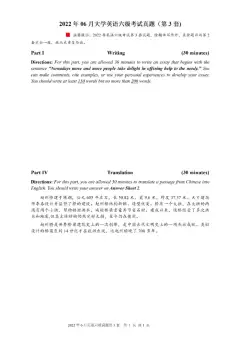
四合院(siheyuan) 是中国一种传统的住宅建筑,其特点是房屋建造在一个院子的四周,将院子合围
在中间。四合院通常冬暖夏凉,环境舒适,尤其适合大家庭居住。四合院在中国各地有多种类型,其中
以北京的四合院最为典型。如今,随着现代城市的发展,传统的四合院已逐渐减少,但因其独特的建筑
风格,四合院对中国文化的传承和中国历史的研究具有重要意义。
·2024年6月四级真题(第一套)·
9