07.语篇重难话题词汇
第一部分 语义巩固
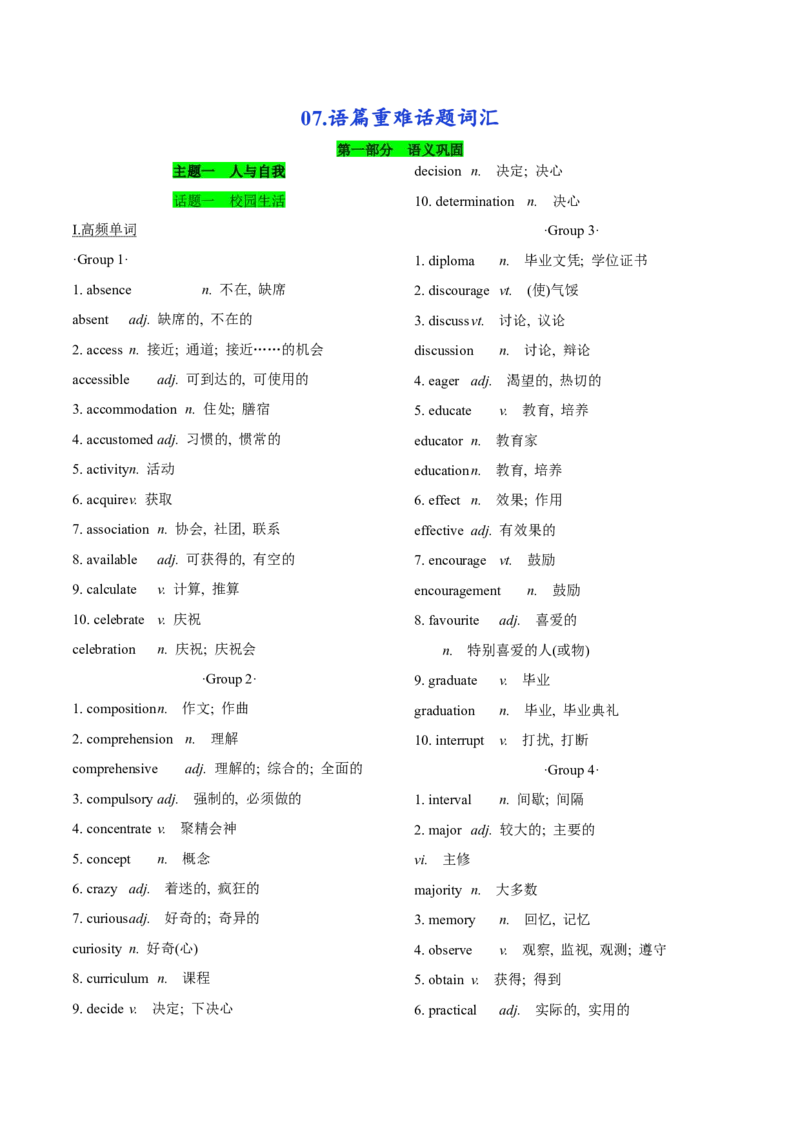
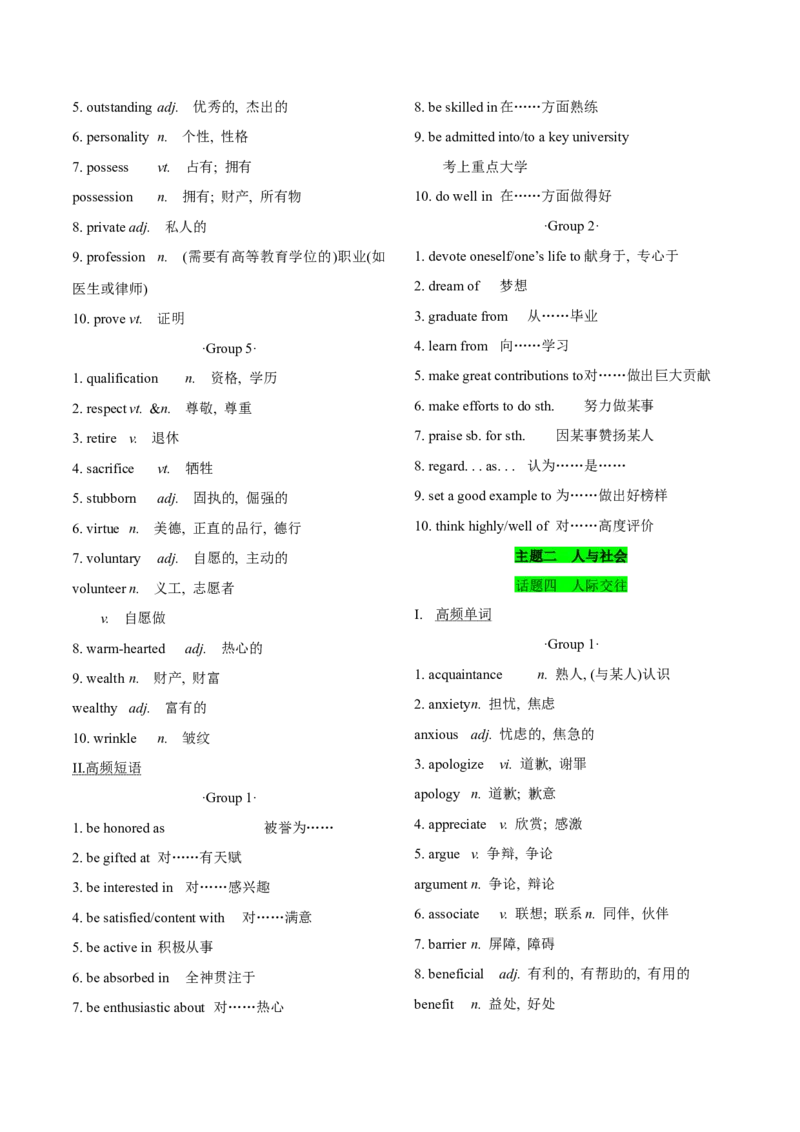
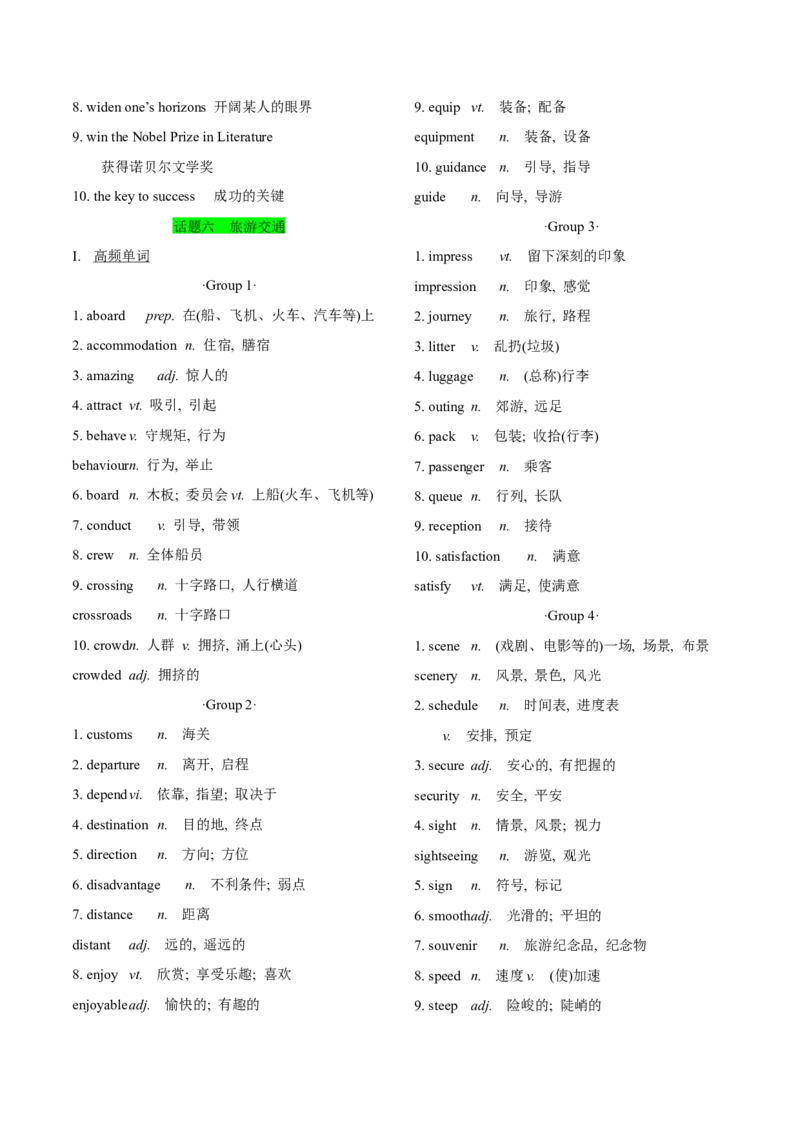
主题一 人与自我 decision n. 决定; 决心
话题一 校园生活 10. determination n. 决心
I . 高频单词 ·Group 3·
·Group 1· 1. diploma n. 毕业文凭; 学位证书
1. absence n. 不在, 缺席 2. discourage vt. (使)气馁
absent adj. 缺席的, 不在的 3. discussvt. 讨论, 议论
2. access n. 接近; 通道; 接近……的机会 discussion n. 讨论, 辩论
accessible adj. 可到达的, 可使用的 4. eager adj. 渴望的, 热切的
3. accommodation n. 住处; 膳宿 5. educate v. 教育, 培养
4. accustomedadj. 习惯的, 惯常的 educator n. 教育家
5. activityn. 活动 educationn. 教育, 培养
6. acquirev. 获取 6. effect n. 效果; 作用
7. association n. 协会, 社团, 联系 effective adj. 有效果的
8. available adj. 可获得的, 有空的 7. encourage vt. 鼓励
9. calculate v. 计算, 推算 encouragement n. 鼓励
10. celebrate v. 庆祝 8. favourite adj. 喜爱的
celebration n. 庆祝; 庆祝会 n. 特别喜爱的人(或物)
·Group 2· 9. graduate v. 毕业
1. compositionn. 作文; 作曲 graduation n. 毕业, 毕业典礼
2. comprehension n. 理解 10. interrupt v. 打扰, 打断
comprehensive adj. 理解的; 综合的; 全面的 ·Group 4·
3. compulsoryadj. 强制的, 必须做的 1. interval n. 间歇; 间隔
4. concentrate v. 聚精会神 2. major adj. 较大的; 主要的
5. concept n. 概念 vi. 主修
6. crazy adj. 着迷的, 疯狂的 majority n. 大多数
7. curiousadj. 好奇的; 奇异的 3. memory n. 回忆, 记忆
curiosity n. 好奇(心) 4. observe v. 观察, 监视, 观测; 遵守
8. curriculum n. 课程 5. obtain v. 获得; 得到
9. decide v. 决定; 下决心 6. practical adj. 实际的, 实用的practice n. 练习 10. inform sb. of sth. 通知某人某事
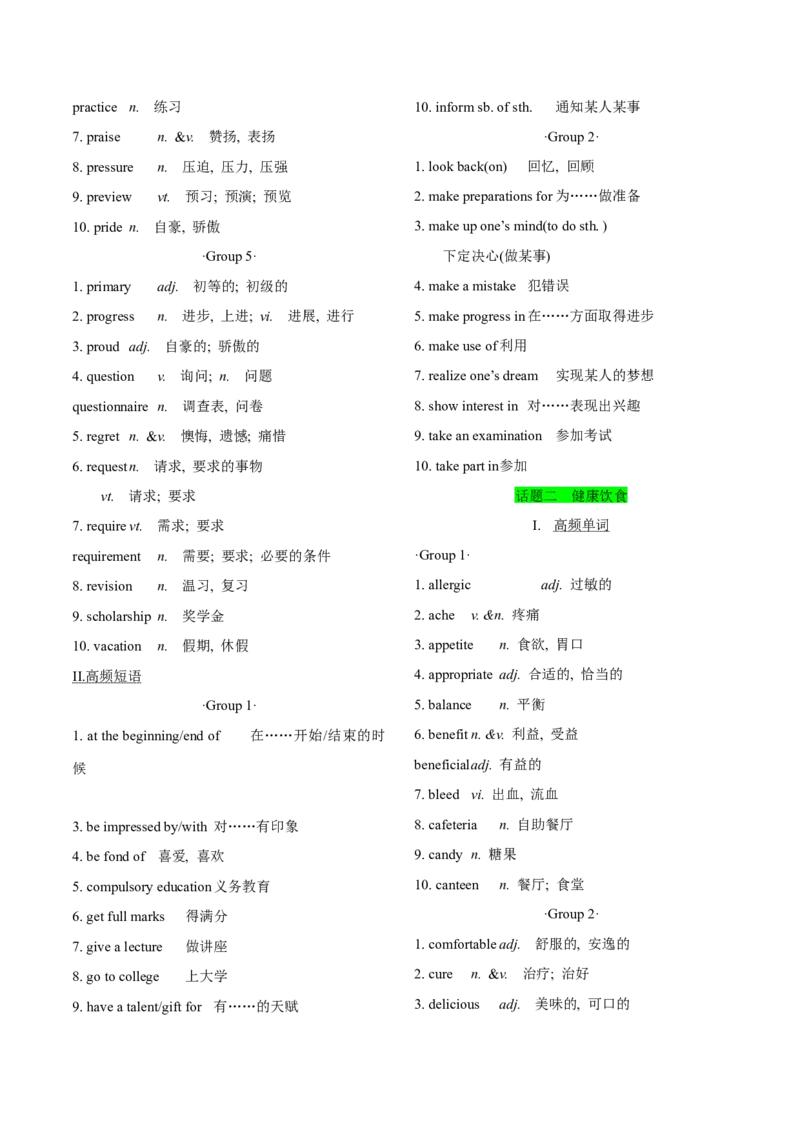
7. praise n. &v. 赞扬, 表扬 ·Group 2·
8. pressure n. 压迫, 压力, 压强 1. look back(on) 回忆, 回顾
9. preview vt. 预习; 预演; 预览 2. make preparations for为……做准备
10. pride n. 自豪, 骄傲 3. make up one’s mind(to do sth. )
·Group 5· 下定决心(做某事)
1. primary adj. 初等的; 初级的 4. make a mistake 犯错误
2. progress n. 进步, 上进; vi. 进展, 进行 5. make progress in在……方面取得进步
3. proud adj. 自豪的; 骄傲的 6. make use of利用
4. question v. 询问; n. 问题 7. realize one’s dream 实现某人的梦想
questionnaire n. 调查表, 问卷 8. show interest in 对……表现出兴趣
5. regret n. &v. 懊悔, 遗憾; 痛惜 9. take an examination 参加考试
6. requestn. 请求, 要求的事物 10. take part in参加
vt. 请求; 要求 话题二 健康饮食
7. requirevt. 需求; 要求 I. 高频单词
requirement n. 需要; 要求; 必要的条件 ·Group 1·
8. revision n. 温习, 复习 1. allergic adj. 过敏的
9. scholarship n. 奖学金 2. ache v. &n. 疼痛
10. vacation n. 假期, 休假 3. appetite n. 食欲, 胃口
II . 高频短语 4. appropriate adj. 合适的, 恰当的
·Group 1· 5. balance n. 平衡
1. at the beginning/end of 在……开始/结束的时 6. benefitn. &v. 利益, 受益
候 beneficialadj. 有益的
7. bleed vi. 出血, 流血
3. be impressed by/with 对……有印象 8. cafeteria n. 自助餐厅
4. be fond of 喜爱, 喜欢 9. candy n. 糖果
5. compulsory education义务教育 10. canteen n. 餐厅; 食堂
6. get full marks 得满分 ·Group 2·
7. give a lecture 做讲座 1. comfortableadj. 舒服的, 安逸的
8. go to college 上大学 2. cure n. &v. 治疗; 治好
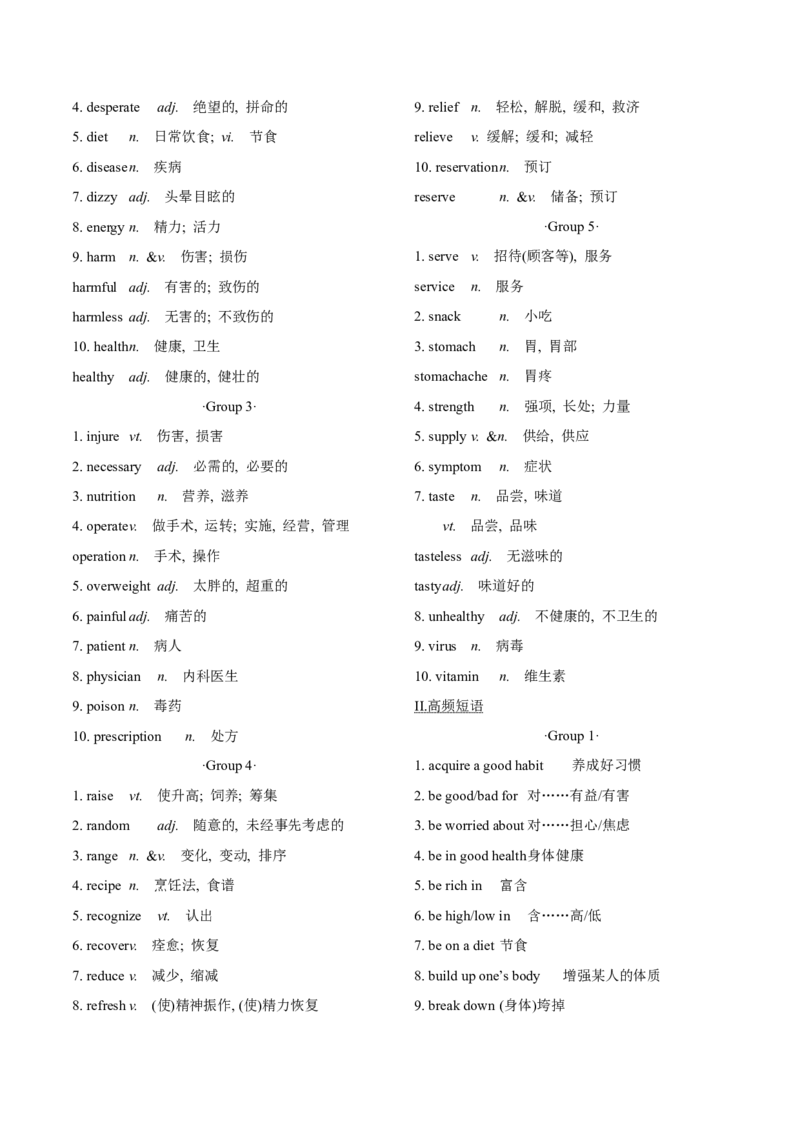
9. have a talent/gift for 有……的天赋 3. delicious adj. 美味的, 可口的4. desperate adj. 绝望的, 拼命的 9. relief n. 轻松, 解脱, 缓和, 救济
5. diet n. 日常饮食; vi. 节食 relieve v. 缓解; 缓和; 减轻
6. diseasen. 疾病 10. reservationn. 预订
7. dizzy adj. 头晕目眩的 reserve n. &v. 储备; 预订
8. energy n. 精力; 活力 ·Group 5·
9. harm n. &v. 伤害; 损伤 1. serve v. 招待(顾客等), 服务
harmful adj. 有害的; 致伤的 service n. 服务
harmless adj. 无害的; 不致伤的 2. snack n. 小吃
10. healthn. 健康, 卫生 3. stomach n. 胃, 胃部
healthy adj. 健康的, 健壮的 stomachache n. 胃疼
·Group 3· 4. strength n. 强项, 长处; 力量
1. injure vt. 伤害, 损害 5. supply v. &n. 供给, 供应
2. necessary adj. 必需的, 必要的 6. symptom n. 症状
3. nutrition n. 营养, 滋养 7. taste n. 品尝, 味道
4. operatev. 做手术, 运转; 实施, 经营, 管理 vt. 品尝, 品味
operationn. 手术, 操作 tasteless adj. 无滋味的
5. overweight adj. 太胖的, 超重的 tastyadj. 味道好的
6. painfuladj. 痛苦的 8. unhealthy adj. 不健康的, 不卫生的
7. patientn. 病人 9. virus n. 病毒
8. physician n. 内科医生 10. vitamin n. 维生素
9. poison n. 毒药 II . 高频短语
10. prescription n. 处方 ·Group 1·
·Group 4· 1. acquire a good habit 养成好习惯
1. raise vt. 使升高; 饲养; 筹集 2. be good/bad for 对……有益/有害
2. random adj. 随意的, 未经事先考虑的 3. be worried about对……担心/焦虑
3. range n. &v. 变化, 变动, 排序 4. be in good health身体健康
4. recipe n. 烹饪法, 食谱 5. be rich in 富含
5. recognize vt. 认出 6. be high/low in 含……高/低
6. recoverv. 痊愈; 恢复 7. be on a diet 节食
7. reduce v. 减少, 缩减 8. build up one’s body 增强某人的体质
8. refreshv. (使)精神振作, (使)精力恢复 9. break down (身体)垮掉10. cure sb. of. . . 治愈某人…… 2. contribute v. 贡献
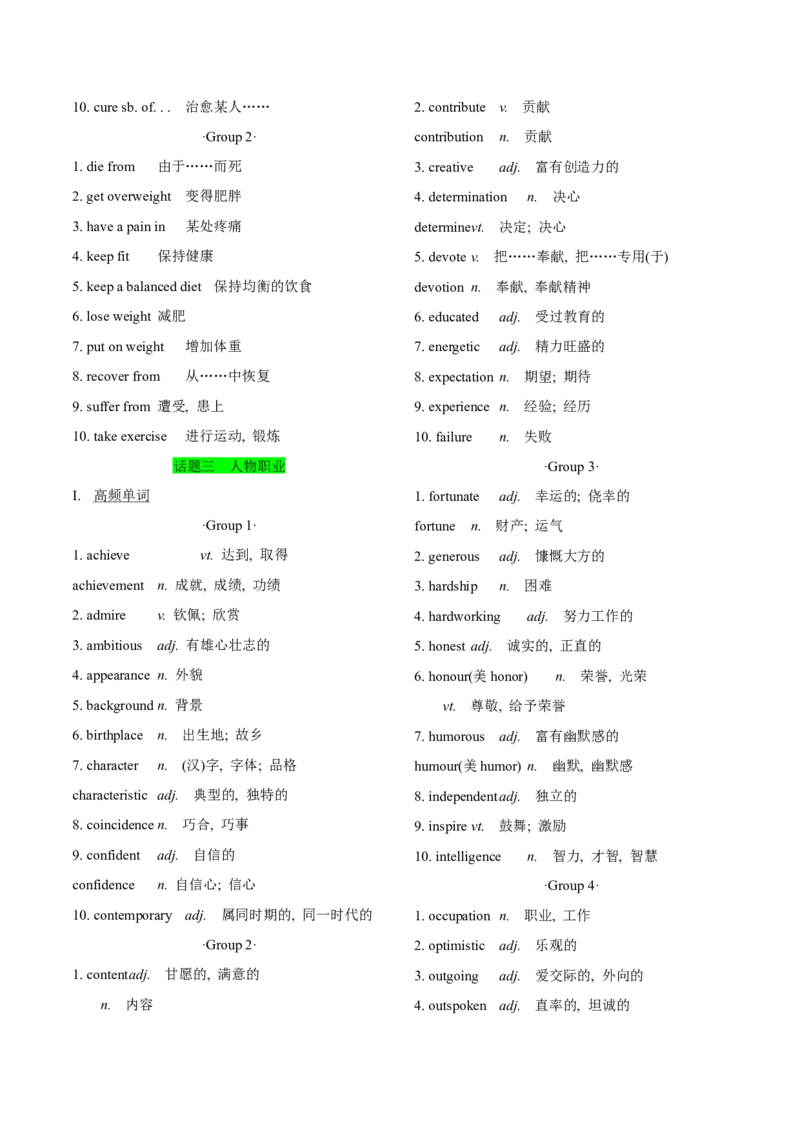
·Group 2· contribution n. 贡献
1. die from 由于……而死 3. creative adj. 富有创造力的
2. get overweight 变得肥胖 4. determination n. 决心
3. have a pain in 某处疼痛 determinevt. 决定; 决心
4. keep fit 保持健康 5. devote v. 把……奉献, 把……专用(于)
5. keep a balanced diet 保持均衡的饮食 devotion n. 奉献, 奉献精神
6. lose weight 减肥 6. educated adj. 受过教育的
7. put on weight 增加体重 7. energetic adj. 精力旺盛的
8. recover from 从……中恢复 8. expectation n. 期望; 期待
9. suffer from 遭受, 患上 9. experience n. 经验; 经历
10. take exercise 进行运动, 锻炼 10. failure n. 失败
话题三 人物职业 ·Group 3·
I. 高频单词 1. fortunate adj. 幸运的; 侥幸的
·Group 1· fortune n. 财产; 运气
1. achieve vt. 达到, 取得 2. generous adj. 慷慨大方的
achievement n. 成就, 成绩, 功绩 3. hardship n. 困难
2. admire v. 钦佩; 欣赏 4. hardworking adj. 努力工作的
3. ambitious adj. 有雄心壮志的 5. honest adj. 诚实的, 正直的
4. appearance n. 外貌 6. honour(美honor) n. 荣誉, 光荣
5. backgroundn. 背景 vt. 尊敬, 给予荣誉
6. birthplace n. 出生地; 故乡 7. humorous adj. 富有幽默感的
7. character n. (汉)字, 字体; 品格 humour(美humor) n. 幽默, 幽默感
characteristic adj. 典型的, 独特的 8. independentadj. 独立的
8. coincidencen. 巧合, 巧事 9. inspirevt. 鼓舞; 激励
9. confident adj. 自信的 10. intelligence n. 智力, 才智, 智慧
confidence n. 自信心; 信心 ·Group 4·
10. contemporary adj. 属同时期的, 同一时代的 1. occupation n. 职业, 工作
·Group 2· 2. optimistic adj. 乐观的
1. contentadj. 甘愿的, 满意的 3. outgoing adj. 爱交际的, 外向的
n. 内容 4. outspoken adj. 直率的, 坦诚的5. outstanding adj. 优秀的, 杰出的 8. be skilled in在……方面熟练
6. personality n. 个性, 性格 9. be admitted into/to a key university
7. possess vt. 占有; 拥有 考上重点大学
possession n. 拥有; 财产, 所有物 10. do well in 在……方面做得好
8. privateadj. 私人的 ·Group 2·
9. profession n. (需要有高等教育学位的)职业(如 1. devote oneself/one’s life to献身于, 专心于
医生或律师) 2. dream of 梦想
10. provevt. 证明 3. graduate from 从……毕业
·Group 5· 4. learn from 向……学习
1. qualification n. 资格, 学历 5. make great contributions to对……做出巨大贡献
2. respectvt. &n. 尊敬, 尊重 6. make efforts to do sth. 努力做某事
3. retire v. 退休 7. praise sb. for sth. 因某事赞扬某人
4. sacrifice vt. 牺牲 8. regard. . . as. . . 认为……是……
5. stubborn adj. 固执的, 倔强的 9. set a good example to为……做出好榜样
6. virtue n. 美德, 正直的品行, 德行 10. think highly/well of 对……高度评价
7. voluntary adj. 自愿的, 主动的 主题二 人与社会
volunteern. 义工, 志愿者 话题四 人际交往
v. 自愿做 I. 高频单词
8. warm-hearted adj. 热心的 ·Group 1·
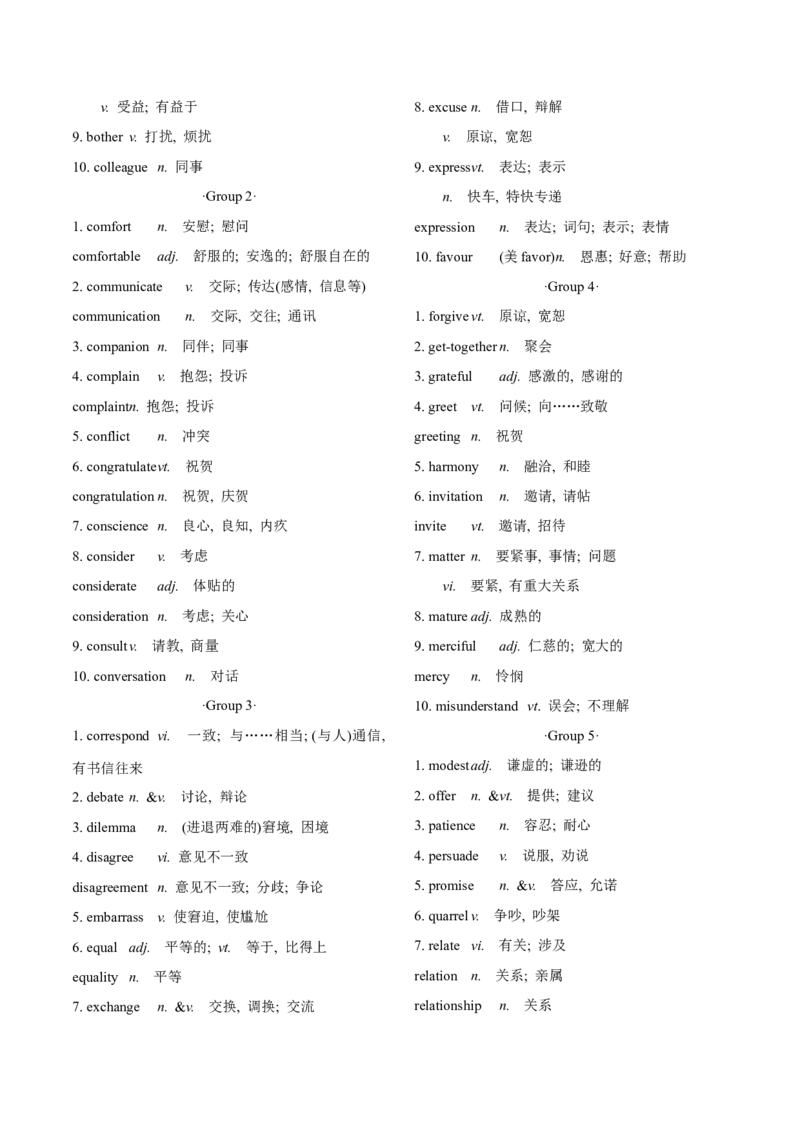
9. wealth n. 财产, 财富 1. acquaintance n. 熟人, (与某人)认识
wealthy adj. 富有的 2. anxietyn. 担忧, 焦虑
10. wrinkle n. 皱纹 anxious adj. 忧虑的, 焦急的
II . 高频短语 3. apologize vi. 道歉, 谢罪
·Group 1· apology n. 道歉; 歉意
1. be honored as 被誉为…… 4. appreciate v. 欣赏; 感激
2. be gifted at 对……有天赋 5. argue v. 争辩, 争论
3. be interested in 对……感兴趣 argumentn. 争论, 辩论
4. be satisfied/content with 对……满意 6. associate v. 联想; 联系n. 同伴, 伙伴
5. be active in 积极从事 7. barrier n. 屏障, 障碍
6. be absorbed in 全神贯注于 8. beneficial adj. 有利的, 有帮助的, 有用的
7. be enthusiastic about 对……热心 benefit n. 益处, 好处v. 受益; 有益于 8. excusen. 借口, 辩解
9. bother v. 打扰, 烦扰 v. 原谅, 宽恕
10. colleague n. 同事 9. expressvt. 表达; 表示
·Group 2· n. 快车, 特快专递
1. comfort n. 安慰; 慰问 expression n. 表达; 词句; 表示; 表情
comfortable adj. 舒服的; 安逸的; 舒服自在的 10. favour (美favor)n. 恩惠; 好意; 帮助
2. communicate v. 交际; 传达(感情, 信息等) ·Group 4·
communication n. 交际, 交往; 通讯 1. forgivevt. 原谅, 宽恕
3. companion n. 同伴; 同事 2. get-togethern. 聚会
4. complain v. 抱怨; 投诉 3. grateful adj. 感激的, 感谢的
complaintn. 抱怨; 投诉 4. greet vt. 问候; 向……致敬
5. conflict n. 冲突 greeting n. 祝贺
6. congratulatevt. 祝贺 5. harmony n. 融洽, 和睦
congratulationn. 祝贺, 庆贺 6. invitation n. 邀请, 请帖
7. conscience n. 良心, 良知, 内疚 invite vt. 邀请, 招待
8. consider v. 考虑 7. matter n. 要紧事, 事情; 问题
considerate adj. 体贴的 vi. 要紧, 有重大关系
consideration n. 考虑; 关心 8. matureadj. 成熟的
9. consultv. 请教, 商量 9. merciful adj. 仁慈的; 宽大的
10. conversation n. 对话 mercy n. 怜悯
·Group 3· 10. misunderstand vt. 误会; 不理解
1. correspond vi. 一致; 与……相当; (与人)通信, ·Group 5·
有书信往来 1. modestadj. 谦虚的; 谦逊的
2. debate n. &v. 讨论, 辩论 2. offer n. &vt. 提供; 建议
3. dilemma n. (进退两难的)窘境, 困境 3. patience n. 容忍; 耐心
4. disagree vi. 意见不一致 4. persuade v. 说服, 劝说
disagreement n. 意见不一致; 分歧; 争论 5. promise n. &v. 答应, 允诺
5. embarrass v. 使窘迫, 使尴尬 6. quarrelv. 争吵, 吵架
6. equal adj. 平等的; vt. 等于, 比得上 7. relate vi. 有关; 涉及
equality n. 平等 relation n. 关系; 亲属
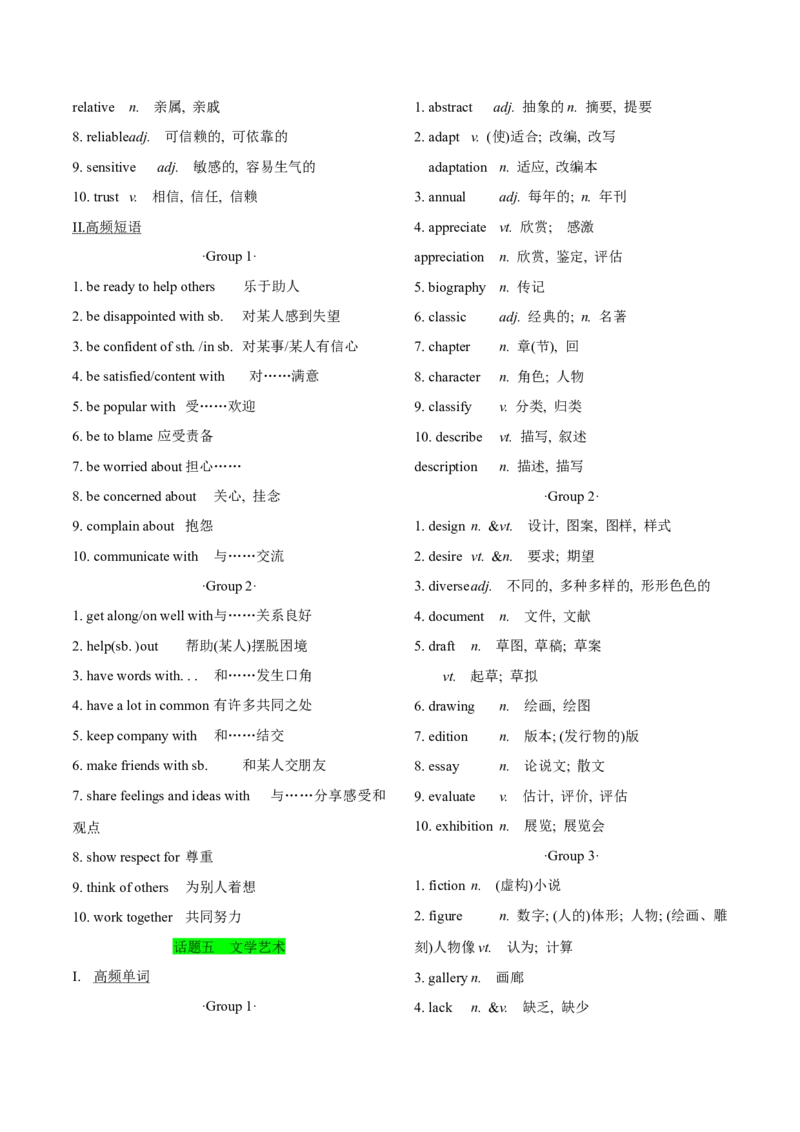
7. exchange n. &v. 交换, 调换; 交流 relationship n. 关系relative n. 亲属, 亲戚 1. abstract adj. 抽象的n. 摘要, 提要
8. reliableadj. 可信赖的, 可依靠的 2. adapt v. (使)适合; 改编, 改写
9. sensitive adj. 敏感的, 容易生气的 adaptation n. 适应, 改编本
10. trust v. 相信, 信任, 信赖 3. annual adj. 每年的; n. 年刊
II . 高频短语 4. appreciate vt. 欣赏; 感激
·Group 1· appreciation n. 欣赏, 鉴定, 评估
1. be ready to help others 乐于助人 5. biography n. 传记
2. be disappointed with sb. 对某人感到失望 6. classic adj. 经典的; n. 名著
3. be confident of sth. /in sb. 对某事/某人有信心 7. chapter n. 章(节), 回
4. be satisfied/content with 对……满意 8. character n. 角色; 人物
5. be popular with 受……欢迎 9. classify v. 分类, 归类
6. be to blame 应受责备 10. describe vt. 描写, 叙述
7. be worried about担心…… description n. 描述, 描写
8. be concerned about 关心, 挂念 ·Group 2·
9. complain about 抱怨 1. design n. &vt. 设计, 图案, 图样, 样式
10. communicate with 与……交流 2. desire vt. &n. 要求; 期望
·Group 2· 3. diverseadj. 不同的, 多种多样的, 形形色色的
1. get along/on well with与……关系良好 4. document n. 文件, 文献
2. help(sb. )out 帮助(某人)摆脱困境 5. draft n. 草图, 草稿; 草案
3. have words with. . . 和……发生口角 vt. 起草; 草拟
4. have a lot in common 有许多共同之处 6. drawing n. 绘画, 绘图
5. keep company with 和……结交 7. edition n. 版本; (发行物的)版
6. make friends with sb. 和某人交朋友 8. essay n. 论说文; 散文
7. share feelings and ideas with 与……分享感受和 9. evaluate v. 估计, 评价, 评估
观点 10. exhibition n. 展览; 展览会
8. show respect for 尊重 ·Group 3·
9. think of others 为别人着想 1. fiction n. (虚构)小说
10. work together 共同努力 2. figure n. 数字; (人的)体形; 人物; (绘画、雕
话题五 文学艺术 刻)人物像vt. 认为; 计算
I. 高频单词 3. galleryn. 画廊
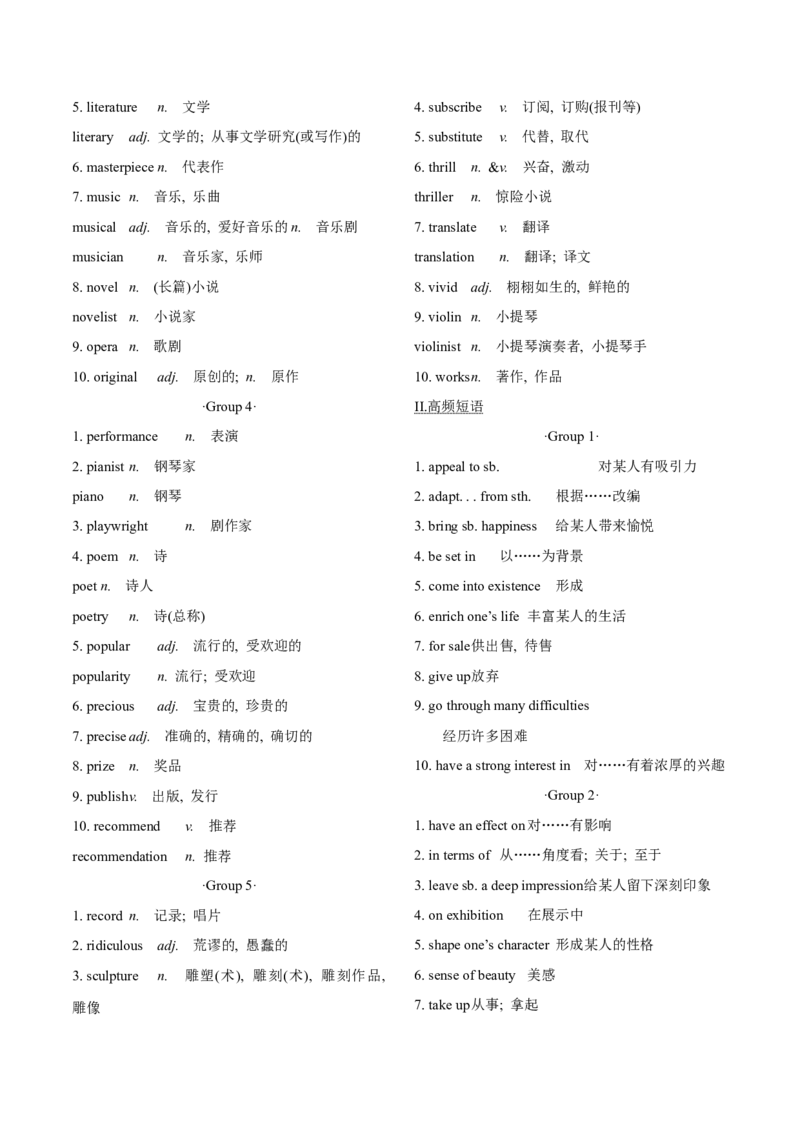
·Group 1· 4. lack n. &v. 缺乏, 缺少5. literature n. 文学 4. subscribe v. 订阅, 订购(报刊等)
literary adj. 文学的; 从事文学研究(或写作)的 5. substitute v. 代替, 取代
6. masterpiecen. 代表作 6. thrill n. &v. 兴奋, 激动
7. music n. 音乐, 乐曲 thriller n. 惊险小说
musical adj. 音乐的, 爱好音乐的n. 音乐剧 7. translate v. 翻译
musician n. 音乐家, 乐师 translation n. 翻译; 译文
8. novel n. (长篇)小说 8. vivid adj. 栩栩如生的, 鲜艳的
novelist n. 小说家 9. violin n. 小提琴
9. opera n. 歌剧 violinist n. 小提琴演奏者, 小提琴手
10. original adj. 原创的; n. 原作 10. worksn. 著作, 作品
·Group 4· II . 高频短语
1. performance n. 表演 ·Group 1·
2. pianist n. 钢琴家 1. appeal to sb. 对某人有吸引力
piano n. 钢琴 2. adapt. . . from sth. 根据……改编
3. playwright n. 剧作家 3. bring sb. happiness 给某人带来愉悦
4. poem n. 诗 4. be set in 以……为背景
poetn. 诗人 5. come into existence 形成
poetry n. 诗(总称) 6. enrich one’s life 丰富某人的生活
5. popular adj. 流行的, 受欢迎的 7. for sale供出售, 待售
popularity n. 流行; 受欢迎 8. give up放弃
6. precious adj. 宝贵的, 珍贵的 9. go through many difficulties
7. preciseadj. 准确的, 精确的, 确切的 经历许多困难
8. prize n. 奖品 10. have a strong interest in 对……有着浓厚的兴趣
9. publishv. 出版, 发行 ·Group 2·
10. recommend v. 推荐 1. have an effect on对……有影响
recommendation n. 推荐 2. in terms of 从……角度看; 关于; 至于
·Group 5· 3. leave sb. a deep impression给某人留下深刻印象
1. record n. 记录; 唱片 4. on exhibition 在展示中
2. ridiculous adj. 荒谬的, 愚蠢的 5. shape one’s character 形成某人的性格
3. sculpture n. 雕塑(术), 雕刻(术), 雕刻作品, 6. sense of beauty 美感
雕像 7. take up从事; 拿起8. widen one’s horizons 开阔某人的眼界 9. equip vt. 装备; 配备
9. win the Nobel Prize in Literature equipment n. 装备, 设备
获得诺贝尔文学奖 10. guidance n. 引导, 指导
10. the key to success 成功的关键 guide n. 向导, 导游
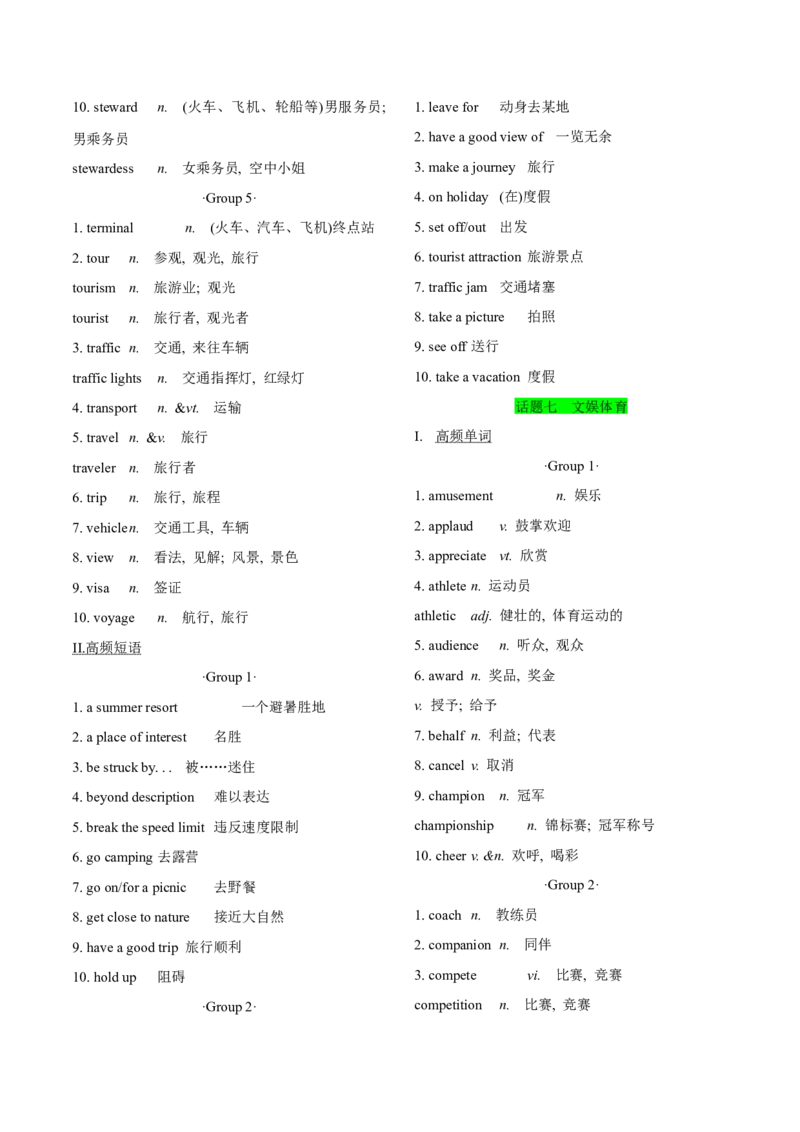
话题六 旅游交通 ·Group 3·
I. 高频单词 1. impress vt. 留下深刻的印象
·Group 1· impression n. 印象, 感觉
1. aboard prep. 在(船、飞机、火车、汽车等)上 2. journey n. 旅行, 路程
2. accommodation n. 住宿, 膳宿 3. litter v. 乱扔(垃圾)
3. amazing adj. 惊人的 4. luggage n. (总称)行李
4. attract vt. 吸引, 引起 5. outing n. 郊游, 远足
5. behavev. 守规矩, 行为 6. pack v. 包装; 收拾(行李)
behaviourn. 行为, 举止 7. passenger n. 乘客
6. board n. 木板; 委员会vt. 上船(火车、飞机等) 8. queue n. 行列, 长队
7. conduct v. 引导, 带领 9. reception n. 接待
8. crew n. 全体船员 10. satisfaction n. 满意
9. crossing n. 十字路口, 人行横道 satisfy vt. 满足, 使满意
crossroads n. 十字路口 ·Group 4·
10. crowdn. 人群 v. 拥挤, 涌上(心头) 1. scene n. (戏剧、电影等的)一场, 场景, 布景
crowded adj. 拥挤的 scenery n. 风景, 景色, 风光
·Group 2· 2. schedule n. 时间表, 进度表
1. customs n. 海关 v. 安排, 预定
2. departure n. 离开, 启程 3. secure adj. 安心的, 有把握的
3. dependvi. 依靠, 指望; 取决于 security n. 安全, 平安
4. destination n. 目的地, 终点 4. sight n. 情景, 风景; 视力
5. direction n. 方向; 方位 sightseeing n. 游览, 观光
6. disadvantage n. 不利条件; 弱点 5. sign n. 符号, 标记
7. distance n. 距离 6. smoothadj. 光滑的; 平坦的
distant adj. 远的, 遥远的 7. souvenir n. 旅游纪念品, 纪念物
8. enjoy vt. 欣赏; 享受乐趣; 喜欢 8. speed n. 速度v. (使)加速
enjoyableadj. 愉快的; 有趣的 9. steep adj. 险峻的; 陡峭的10. steward n. (火车、飞机、轮船等)男服务员; 1. leave for 动身去某地
男乘务员 2. have a good view of 一览无余
stewardess n. 女乘务员, 空中小姐 3. make a journey 旅行
·Group 5· 4. on holiday (在)度假
1. terminal n. (火车、汽车、飞机)终点站 5. set off/out 出发
2. tour n. 参观, 观光, 旅行 6. tourist attraction 旅游景点
tourism n. 旅游业; 观光 7. traffic jam 交通堵塞
tourist n. 旅行者, 观光者 8. take a picture 拍照
3. traffic n. 交通, 来往车辆 9. see off 送行
traffic lights n. 交通指挥灯, 红绿灯 10. take a vacation 度假
4. transport n. &vt. 运输 话题七 文娱体育
5. travel n. &v. 旅行 I. 高频单词
traveler n. 旅行者 ·Group 1·
6. trip n. 旅行, 旅程 1. amusement n. 娱乐
7. vehiclen. 交通工具, 车辆 2. applaud v. 鼓掌欢迎
8. view n. 看法, 见解; 风景, 景色 3. appreciate vt. 欣赏
9. visa n. 签证 4. athlete n. 运动员
10. voyage n. 航行, 旅行 athletic adj. 健壮的, 体育运动的
II . 高频短语 5. audience n. 听众, 观众
·Group 1· 6. award n. 奖品, 奖金
1. a summer resort 一个避暑胜地 v. 授予; 给予
2. a place of interest 名胜 7. behalf n. 利益; 代表
3. be struck by. . . 被……迷住 8. cancel v. 取消
4. beyond description 难以表达 9. champion n. 冠军
5. break the speed limit 违反速度限制 championship n. 锦标赛; 冠军称号
6. go camping 去露营 10. cheer v. &n. 欢呼, 喝彩
7. go on/for a picnic 去野餐 ·Group 2·
8. get close to nature 接近大自然 1. coach n. 教练员
9. have a good trip 旅行顺利 2. companion n. 同伴
10. hold up 阻碍 3. compete vi. 比赛, 竞赛
·Group 2· competition n. 比赛, 竞赛competitor n. 竞赛者, 比赛者 3. plot n. 剧情
4. concertn. 音乐会; 演奏会 4. preparevt. 准备, 预备
5. criterion n. 标准, 准则 preparation n. 准备
6. courage n. 勇气; 胆略 5. presentadj. 出现的, 出席的
7. defeat v. 击败; 战胜 n. 礼物, 赠品
8. delay v. &n. 延误, 延迟, 耽搁 v. 呈现, 奉送
9. director n. 导演 presentation n. 演示, 演出
10. enthusiastic adj. 热情的, 热心的 6. programme n. 节目; 项目
·Group 3· 7. recreation n. 娱乐, 消遣
1. event n. 事件; 大事 8. refreshv. 使恢复精力, 重新振作
2. fitness n. 健康 9. regularadj. 规则的, 惯常的
3. hit n. (演出等)成功; 打击; 打 regulation n. 规则, 规章
4. instructvt. 通知; 指示; 教 10. relax v. (使)放松, 轻松
instruction n. 说明; 教导 ·Group 5·
instrument n. 乐器; 工具, 器械 1. reputation n. 名誉; 名声
5. judge n. 裁判; 审判员; 法官 2. select v. 选择, 挑选, 选拔
v. 判断, 断定 3. shot n. 投篮; 射门
6. literature n. 文学(作品) 4. stadium n. (露天)体育场
7. match v. 使相配, 使成对 5. studio n. 工作室, 演播室
n. 比赛, 竞赛; 火柴 6. symphony n. 交响乐; 交响曲
8. medal n. 奖牌 7. tournament n. 锦标赛, 联赛
9. organise vt. 组织 8. track n. 轨道; 田径
organiser n. 组织者 9. winnern. 获胜者
organisation n. 组织, 机构 10. worthadj. 有……的价值, 值得……的
10. participate vi. 参加, 参与 worthlessadj. 没有价值的, 没有用的
participant n. 参与者, 参加者 worthwhile adj. 值得做的
·Group 4· worthy adj. 值得的
1. perfectadj. 完美的, 极好的 II. 高频短语
2. perform v. 表演, 履行; 行动 ·Group 1·
performance n. 演出, 表演 1. a close game 一场势均力敌的比赛
performern. 表演者, 执行者 2. be beneficial to 对……有益3. break the record 打破纪录 7. click v. 点击
4. become the pride of the nation 8. convenience n. 方便; 便利
成为国家的骄傲 9. criterion (pl. criteria)
5. classic/popular/folk music 经典/流行/民间音乐 n. 标准, 准则, 原则
6. contribute to 有助于 10. demand v. &n. 要求
7. compose a song 创作歌曲 ·Group 2·
8. cooperate with 与……合作 1. digital adj. 数字的, 数码的
9. compete in 在……方面竞争 2. download v. 下载
10. go all out 全力以赴 3. drawback n. 缺点, 不利条件
·Group 2· 4. electronic adj. 电子的
1. in good form 状态好 5. engine n. 发动机, 引擎
2. make a hit 流行 engineer n. 工程师; 技师
3. physical exercise体育锻炼 6. experiment n. 实验
4. physical development身体发育 7. explorev. 探索
5. participate in the bidding campaign 8. function n. &v. 作用, 功能, 运转
参加申办活动 fundamental adj. 基本的, 根本的
6. record holder 纪录保持者 9. guarantee vt. &n. 保证, 担保
7. strengthen friendship 增进友谊 10. intelligent adj. 智能的
8. set a new world record 创造新的世界纪录 ·Group 3·
9. stand for 代表 1. introduce vt. 介绍
10. sign up 报名; 与……签订合同 introduction n. 引进, 介绍
话题八 科技发明 2. invent vt. 发明, 创造
I. 高频单词 inventionn. 发明, 创造
·Group 1· inventor n. 发明者, 创造者
1. accessible adj. 易接近的, 可得到的 3. material n. 材料, 原料
2. advantage n. 优势 4. mobileadj. 移动的
3. artificial adj. 人造的 5. modemn. 调制解调器
4. automatic adj. 自动的 6. modern adj. 现代的
5. breakthrough n. 重大进展, 突破 7. patent n. 专利权, 专利证书
6. brilliant adj. 巧妙的, 使人印象深刻的, 技艺 8. personally adv. 就个人而言
高的 9. potential adj. 潜在的, 可能的10. predict v. 预言, 预告, 预报 II . 高频短语
·Group 4· ·Group 1·
1. privilege n. 特权, 特殊待遇 1. be used for 被用来
2. procedure n. 程序, 手续 2. benefit from从……获益
3. processn. 过程 v. 加工, 处理 3. be available可以利用的
4. progress n. &vi. 前进; 进步, 进展 4. be in the lead 领先
5. provide vt. 提供 5. come true 实现
6. replacevt. 取代 6. follow the fashion 追随时尚
7. research n. &v. 研究, 调查 7. improve the quality of life for humans
8. revolution n. 革命 提高人类的生活质量
9. sciencen. 科学, 自然科学 8. in the field of science 在科学领域
scientific adj. 科学的 9. live a/an. . . life 过……的生活
scientist n. 科学家 10. living standard 生活水平
10. significance n. 意义, 重要性 ·Group 2·
·Group 5· 1. lead to/contribute to/result in/bring about
1. simplify vt. 使简化, 使简易 导致
2. software n. 软件 2. negative effect 负面影响
3. spacecraft n. 宇宙飞船 3. shop on the Internet 网购
4. standard n. 标准 4. stand out 脱颖而出
adj. 标准的 5. scientific breakthrough 科学突破
5. succeed vi. 成功 6. side effects 副作用
success n. 成功 7. potential ability 潜能
successful adj. 成功的, 有成就的 8. surf the Internet 上网
6. systemn. 体系; 系统 9. with the development of. . . 随着……的发展
systematic adj. 系统的, 有条理的 10. change one’s life 改变某人的生活
7. technical adj. 技术的, 工艺的 话题九 文化习俗
techniquen. 技术; 技巧 I. 高频单词
technology n. 技术 ·Group 1·
8. transform v. 改造, 改革, 变换, 改变 1. adventure n. 冒险, 奇遇
9. update vt. 更新, 使现代化 2. ancestor n. 祖先
10. virus n. 病毒 3. ancient adj. 古代的4. anniversary n. 周年纪念日 7. moral adj. 道德的
5. awkward adj. 令人尴尬的, 使人难堪的 8. nationality n. 国籍
6. belief n. 信条, 信念 9. occasion n. 时刻; 场合
believe v. 相信, 认为 10. particular adj. 特殊的, 特别的
7. bless v. 保佑; 祈福 ·Group 4·
8. casual adj. 漫不经心的, 不经意的, 非正式的 1. pray v. 祈祷
9. cause n. 原因, 起因 2. public adj. 公共的, 公众的
vt. 促使, 引起, 使发生 3. race n. 种族
10. caution n. 谨慎, 小心, 警告 4. relevant adj. 紧密相关的, 有意义的
cautious adj. 小心的, 谨慎的 5. religion n. 宗教
·Group 2· 6. remind vt. 提醒, 使记起
1. ceremony n. 典礼, 仪式, 礼节 7. remove v. 移开, 拿走, 脱掉(衣服等)
2. chief adj. 主要的 8. restrict v. 限制
3. civilized adj. 文明的 restriction n. 限制, 约束
4. concern v. &n. 涉及, 关心 9. result n. 结果, 效果
5. cooperation n. 合作 10. ridiculous adj. 可笑的; 荒唐的
6. cultural adj. 文化的 ·Group 5·
7. custom n. 习惯, 习俗, 风俗 1. phenomenon n. 现象
8. decorate v. 装饰, 装潢, 修饰 2. sacred adj. 神圣的, 上帝的
9. expand v. 扩展 3. sacrifice n. &v. 牺牲; 供奉
10. familiar adj. 熟悉的 4. separate v. 使分开, 使分离 adj. 单独的, 分开的
·Group 3· separately adv. 单独地, 各自地
1. fascinating adj. 魅力无穷的 separation n. 分离, 隔离
2. imagination n. 想象(力) 5. silence n. 安静, 沉默
3. immigrant n. 移民 silent adj. 无声的, 沉默的
4. inform vt. 告诉; 通知 6. strange adj. 奇怪的, 奇特的, 陌生的
information n. 信息 stranger n. 陌生人, 异乡人
5. marriage n. 结婚, 婚姻 7. symbol n. 象征
married adj. 已婚的 8. templen. 庙宇; 寺庙
marry v. (使)成婚, 结婚 9. tradition n. 传统, 风俗
6. monument n. 纪念碑, 纪念馆 traditional adj. 传统的, 习俗的10. typical adj. 典型的, 有代表性的, 特有的 challenging adj. 具有挑战性的
II . 高频短语 3. circumstance n. 情况, 形势, 环境
·Group 1· 4. consequence n. 结果, 后果
1. add to 增添 5. conservation n. 保存; (自然资源的)保护, 管理
2. attend a ceremony 出席仪式 6. create vt. 创造; 造成
3. come into being 形成; 产生; 出现 creature n. 生物, 动物
4. culture shock 文化冲击 7. damage n. &v. 毁坏, 损害
5. crowd into 涌入 8. declinev. 减少, 下降, 衰退, 谢绝
6. cooperate with sb. 与某人合作 9. decorate v. 装饰……, 修饰……
7. dress up 穿上盛装; 乔装打扮 decoration n. 装饰, 修饰
8. date back to/date from追溯到 10. decrease v. 减少, 减小, 降低
9. follow a custom 遵循习俗
10. get together 聚集 ·Group 2·
·Group 2· 1. deliberatelyadv. 故意地, 蓄意地, 存心地
1. in memory of 为了纪念 2. disappearance n. 消失
2. in honour of为了纪念; 为向……表示敬意 3. destroyvt. 破坏, 毁坏
3. look forward to 盼望 4. disappoint vt. 使失望
4. mix sth. with sth. 将……与……混合 disappointment n. 失望; 沮丧
5. make it a rule to do sth. 使做某事成为规定 5. effort n. 努力, 艰难的尝试
6. on special occasions 在特殊的场合 6. environment n. 环境
7. originate from 起源于…… 7. expectation n. 预料; 期望
8. pass down from generation to generation 8. extinction n. 灭绝
一代一代传下来 9. forbid vt. 禁止, 不许
9. refer to涉及 10. harmony n. 和谐
10. the majority of 大多数 ·Group 3·
主题三 人与自然 1. influence n. 影响
话题十 世界环境 2. material n. 原料, 材料
I. 高频单词 3. naturaladj. 自然的
·Group 1· nature n. 自然, 性质, 种类
1. atmosphere n. 大气, 气氛 4. noisy adj. 喧闹的, 嘈杂的
2. challenge n. 挑战(性) 5. overlook vt. 忽略; 眺望6. permission n. 允许, 许可, 同意 7. transparent adj. 透明的, 清澈的
permit v. 许可, 允许; n. 许可证 8. unbearable adj. 难耐的, 无法接受的
7. pollutevt. 污染 9. unbelievable adj. 难以置信的
pollution n. 污染 10. uncertain adj. 不确定的
8. preserve vt. 保护, 保留, 保存 II . 高频短语 ·Group 1·
9. preventvt. 防止, 预防 1. attach great importance to 十分重视……
10. proper adj. 恰当的, 合适的 2. arouse people’s awareness of environmental
properly adv. 适当地 protection
·Group 4· 激起人们的环保意识
1. protectvt. 保护 3. bring. . . under control控制
protection n. 保护 4. be aware of 意识到
2. punish v. 惩罚, 处罚 5. be faced with 面临
punishment n. 惩罚 6. die out灭绝
3. purpose n. 目的, 意图 7. go from bad to worse 每况愈下
4. radiation n. 放射物; 辐射 8. in harmony with nature 与自然和谐相处
5. recyclev. 回收; 再循环 10. make a difference 有影响
6. responsibility n. 责任, 负责 ·Group 2·
7. rubbish n. 垃圾; 废物 1. on account of 因为, 由于
8. severe adj. 严重的, 严厉的 2. play an important part in 在……中起重要作用
9. situation n. 形势, 局面 3. protect. . . from. . . 保护……免受……
10. smell v. 嗅, 闻到; 发出气味 4. prevent. . . from. . . 阻止……发生……
n. 气味 5. realize the importance of the environment
smelly adj. 有臭味的, 发出臭味的 意识到环境的重要性
·Group 5· 6. reduce pollution 减少污染
1. speciesn. 物种 7. throw away 丢弃
2. suffer v. 受苦, 遭受 8. There is no denying that. . . 无可否认……
3. surround vt. 围绕; 包围 9. take measures/steps to do sth. 采取措施做某事
surrounding adj. 周围的 10. to make matters worse 使事情更糟糕的是
4. survival n. 幸存; 存活 话题十一 历史地理
5. threaten v. 威胁 I. 高频单词
6. toleratevt. 容许, 允许, 忍受 ·Group 1·1. abundant adj. 大量的, 丰盛的, 充裕的 5. history n. 历史
2. ambassador n. 大使 6. immigration n. 移居
3. bay n. 海湾 7. independence n. 独立
4. border n. 边(沿); 边界, 国界 independent adj. 独立的, 有主见的
5. capital n. 首都 8. landmark n. 地标性建筑
6. condition n. 条件, 状况 9. located adj. 位于
7. consist vi. 由……组成 10. measure v. 量
8. continent n. 大陆, 大洲 ·Group 4·
9. country n. 国家; 农村, 乡下 1. memorial n. 纪念碑
countryside n. 乡下, 农村 2. memory n. 回忆, 记忆
10. desert n. 沙漠 v. 舍弃; 遗弃 memorize v. 记忆
·Group 2· 3. mineral n. 矿物质, 矿物
1. deserve v. (不用于进行时态)应得, 应受 4. mountainous adj. 多山的
2. differ vi. 相异, 有区别 5. origin n. 起源, 由来
difference n. 不同 6. period n. 时期, 时代
3. dinosaur n. 恐龙 7. position n. 位置
4. disappear vi. 消失 8. primitive adj. 原始的, 远古的
5. disaster n. 灾难; 祸患 9. pyramid n. 金字塔
6. discover v. 发现 10. reflect v. 反映, 反射
discovery n. 发现 ·Group 5·
7. distance n. 距离 1. remain vi. 剩下; 保持, 仍是
8. disturb v. 扰乱; 打扰 2. remote adj. 偏远的, 偏僻的
disturbing adj. 令人不安的, 引起恐慌的 3. ruin v. (使)毁坏; (使) 毁灭
9. divide v. 分, 划分 n. (复) 废墟; 遗迹
10. frontier n. 边境, 国界; 前沿, 前线 4. slavery n. 奴隶制度
·Group 3· 5. stable adj. 稳固的, 牢固的
1. exploit vt. 开采, 开发, 利用, 剥削 6. unfortunate adj. 不幸的
2. explore v. 探险 unfortunately adv. 不幸地
explorer n. 探险者 7. widespread adj. 分布广的, 普遍的
3. framework n. (建筑物)框架, 结构 8. witness n. 目击者
4. geography n. 地理 v. 为……作证9. world-famous adj. 世界闻名的 2. pollutev. 弄脏, 污染
10. worldwide adj. 遍及全球的, 世界范围的 3. poverty n. 贫穷, 贫困
II . 高频短语 4. rural adj. 农村的, 乡下的
·Group 1· 5. shortage n. 缺乏, 短缺
1. be surrounded by/with. . . 被……环绕着/包围着 6. threaten v. 威胁, 预示凶兆
2. be located in. . . 坐落在…… 7. urban adj. 城市的, 都市的
3. be rich in 富含…… 8. advocate v. 提倡, 主张
4. be made up of 由……组成 9. eco-friendlyadj. 环保的
5. be famous/well-known for 以……闻名 10. harbour n. 海港, 港口
6. be known as作为……而出名 ·Group 2·
7. be separated from 与……分离 1. immigrant n. 移民
8. behind the times 落在时代后面 2. jungle n. 密林
9. date from (date back to) 追溯到; 始于 3. migration n. 迁移
10. have a population of 有……人口 4. mountainous adj. 多山的
·Group 2· 5. preserve v. 保护, 保存
1. have/cover an area of. . . square kilometers/meters 6. province n. 省份
占地面积为……平方千米/米 7. radiation n. 辐射
2. have a history of 有……的历史 8. renewable adj. 可再生的
3. in the course of 在……期间; 9. population n. 人口(数)
在……过程中 10. atmosphere n. 大气(层)
4. in the name of 以……的名义 ·Group 3·
5. in the early 1920s 在20世纪20年代初 1. balance v. 平衡, 均衡
6. in the long run 从长远来看, 最后 2. beach n. 海滩, 沙滩
7. lie in 位于; 在于 3. cave n. 山洞
8. natural resources自然资源 4. coast n. 海滨, 海岸
9. settle down 定居 5. range n. 山脉, 范围
10. take on a new look 呈现新面貌 6. recyclev. 再循环
话题十二 自然灾难 7. reservev. 保留, 预订
I. 高频单词 8. phenomenon n. 现象, 杰出的人
·Group 1· 9. litter v. 乱扔(垃圾)
1. plain n. 平原adj. 清楚的, 明白的adv. 绝对地 10. distract v. 分散; 使分心·Group 4· 1. apply for a job 申请一项工作
1. rainfalln. 降雨量 2. full of energy 充满精力
2. severe adj. 激烈的, 严重的, 严厉的 3. a mountain of/mountains of 大量; 大堆
3. showern. 阵雨; 淋浴(器) 4. prevent sb. /sth. (from) doing sth.
4. trap v. 使陷入困境, 夹住; 卡住 阻止某人/物做某事
n. 陷阱, 诡计 5. protect (sb. /sth. ) against sth. 保护(某人/某物)不
5. volcano n. 火山 受……
6. warmth n. 温暖 6. a waste of time 浪费时间
7. ash n. 灰烬, 骨灰, 废墟 7. waste sth. on sth. 把……浪费在……上
8. changeable adj. (气候等)多变的 waste sth. (in) doing sth. 在做某事上浪费……
9. damp adj. 有湿气的; 潮湿的 8. as a consequence of sth. 由于……
10. erupt v. (喷泉等)喷发; (感情等)爆发 9. clean up/clear up/pick up litter清理垃圾
·Group 5· 10. live in poverty 生活在贫困中
1. forecast v. 预测, 预报 ·Group 2·
2. frighten v. 使惊吓 1. in the shade of the tree 在树荫下
3. hurricane n. 飓风 2. in my present situation 在我目前的情况下
4. mild adj. 温和的; 轻微的 3. threaten to do 威胁要做
5. mist n. 雾; 水汽 4. on the coast在海岸上
6. breeze n. 微风; 轻而易举的事 5. off the coast离开海岸
7. centigrade n. 摄氏度 6. under the protection of 在……保护下
adj. 百分度的; 摄氏度的 7. in/within range (of) 在……范围内
8. muddyadj. 多泥的 8. out of range (of) 超出……范围
9. sandstorm n. 沙尘暴 9. a wide range of 各式各样的
10. typhoon n. 台风 10. wave sb. goodbye/wave goodbye to sb.
II . 高频短语 向某人挥手道别
·Group 1·
第二部分 运用强化
一、阅读理解
1.
Americans always attach great weight to the business of the country. President Coolidge’s statement, “the
business of America is business.” Still points to an important truth today—that business institutions have moreprestige(威望) in American society than any other kind of organization, including the government. Why do
business institutions possess this great prestige?
One reason is that Americans view business as being more firmly based on the ideal of competition than other
institutions in society. Since competition is seen as the major source of progress and prosperity by most Americans,
competitive business institutions are respected. Competition is not only good in itself, it is the means by which
other basic American values such as individual freedom, equality of opportunity, and hard work are protected.
Competition protects the freedom of the individual by ensuring that there is no monopoly (垄断、垄断者) of
power. In contrast to one, all-powerful government, many businesses compete against each other for profits.
Theoretically, if one business tries to take unfair advantage of its customers, it will lose to competing business
which treats its customers more fairly. Where many businesses compete for the customers’ dollar, they cannot
afford to treat them like inferiors(下属) or slaves.
A contrast is often made between business, which is competitive, and government, which is a monopoly.
Because is competitive, many Americans believe that it is more supportive of freedom than government, even
though government leaders are elected by the people and business leaders are not. Many Americans believes, then,
that competition is as important, or even more important, than democracy in preserving freedom.
Competition in business is also believed to strengthen the ideal of equality of opportunity. Competition is seen
as an open and fair where success goes to the swiftest person regardless of his or her social class background.
Competitive success is commonly seen as the American alternation to social rank based on family background.
Business is therefore world as an expression of the idea of equality of opportunity in America rather than the
aristocratic(贵族的) idea of inherited privilege in many other countries
1. The statement “The business of America is business” probably means “_______”.
A. the business institutions in American are concerned with commerce(商业)
B. business problems are of great importance to the American government
C. business is of primary concern to Americans
D. America is a great power in world business
2. Who can benefit from the business competition?
A. Honest businessmen.
B. People with ideas of equality and freedom.
C. Both businessmen and their customers.
D. Both business institutions and government.3. Government is believed to differ unusually from business because government is characterized by ________.
A. its absolute control of power
B. its function in preserving personal freedom
C. its role in protecting basic American values
D. its democratic way of exercising leadership
4. It can be concluded from the passage that the author believes ________.
A. Americans are more ambitious than people in other countries
B. in many countries, success often depends on one’s social status
C. American businesses are more democratic(民主的) than those in other countries
D. businesses in other countries are not as competitive as those in America
2
My wife and I were at a crowded grocery store not long ago. It was a weekday evening, cold and wet and
tense. People were carelessly blocking aisles, complaining and cutting one another off with their carts.
Things got worse at the checkout line. The cashier scanned a man’s discount card, but he misread the savings
on her screen as an additional charge. He decided she was acting deliberately and began to argue.
“She is being spiteful (恶意的) !” he yelled. “This is unbelievable.”
Other customers looked away as the cashier tried to reason with him. She called a manager, who accompanied
him to customer service. Shaken, she moved to the next customer in line.
We’ve all witnessed uncomfortable scenes like this in public places. The grocery scene was another example
of how our trust in others has eroded. But it was also a teachable moment on how we can rebuild our faith-starting
with just one person.
Back at the grocery store, my wife and I reached our uneasy cashier. I grabbed a bottle of water from a nearby
cooler and handed it to her. “We felt bad about how that man treated you and wanted to buy this for you.” I said.
Her face lit up, and we talked as she scanned our items. She told us she had been working that evening through
severe foot pain and would be having surgery later that week. We wished her well in her recovery, and she thanked
us as we left.
Those are the balancing acts, the moments of responding social and emotional pain with healing, which will
add up to restore trust among people. You can start that pattern in someone else’s life, even in a place as ordinary as
the neighborhood grocery store.
5. Why did the man at the checkout line argue with the cashier?
A. The cashier called a manager to help her.B. Someone jumped the queue waiting to check out.
C. There was something wrong with his discount card.
D. He believed the cashier charged him more on purpose.
6. The underlined word “eroded” in Paragraph 5 probably means ________.
A. added B. increased
C. faded D. formed
7. The author bought a bottle of water for the cashier because ________.
A. he thought the cashier might feel a little bit thirsty
B. he knew she had gone through much trouble recently
C. he wanted to restore the trust between her and the man
D. he wanted to comfort her after the terrible experience just now
3
Who needs guard dogs when you have wolves , right? That’s probably what Kazakh villagers in the Almaty
region though when they decided to replace their dogs with the fierce forest dwelling beasts. According to local
news reports, taming(驯化的) wolves is now the latest trend and a sort of hobby among rural Kazakhs.
Nurseit Zhylkyshybay, a farmer from the south-eastern Almaty region, told reporters that he purchased a wolf
cub from hunters three years ago, and the animal is now perfectly tamed.
Kurtka, Nurseit’s pet wolf, lives in the family’s yard and takes long walks through the village with his master.
“He’s never muzzled,” Nurseit insisted. “I rarely put him on a chain and do take him for regular walks around the
village. Our family and neighbors aren’t scared of him at all.”
But wolf expert Almas Zhaparov said that the animals are ‘far too dangerous’ to keep at home. “A wolf is like
a ticking bomb, it can go off at any moment,” he warned. “If nothing is done, the fashion could spread to the
wealthy Kazakhs, who might try to keep wolves in the grounds of their houses, with possibly deadly
consequences.” Social media users also expressed worry about the trend, accusing the government for failing to
limit the practice.
Nevertheless, the wolves don’t seem to be posing an immediate threat. If visuals from news reports are
anything to go by, the beasts look pretty happy with their new lifestyle, and appear quite fond of their new masters,
not unlike dogs.
8. The writer uses the example of Kurtka to show that____________.
A. wolves can be tamed.
B. wolves are like ticking bombsC. wolves like living with humans
D. keeping wolves at home is easy
9. The underlined word “muzzled” in Para 3 means___________.
A. puzzled B. beaten
C. got his mouth covered D. got changed
10. According to Almas Zhaparov, keeping wolves at home is___________.
A. a fashion B. a disaster
C. a necessity D. a hone
11. What can we learn from the text?
A. Wolves are easy to get tamed.
B. A pet wolf can become aggressive at any moment.
C. The government will prevent people taming wolves as pets.
D. Wolves are as loyal to their masters as dogs are.
4
I am in my 40s,but today I look more like a teenage girl. Not because I'm wearing the latest fashion or having
a wild hair day. It's because I have a pimple(青春痘) that looks like a volcano getting ready to erupt on my chin.
“Mom, what is that?” my 8-year-old daughter Lucy exclaimed, pointing at the ugly bump on my face.
My in-laws were visiting and brought me a box of chocolates-one of my favorite foods. Eating properly
seemed like a good idea until I was alone with that box of chocolates! I enjoyed them greatly, and my pimple
proved my enthusiasm clearly.
Food can be a large block for me. Broccoli(西蓝花)seldom appeals to me, but baked goods with sugar or
crispy chips certainly do. I have no problem dipping a large spoon into a jar of peanut butter or frosting to satisfy
my desires. But you won't catch me tasting a spoonful of cottage cheese for a late-night snack.
Please don't misunderstand me. There is certainly a place for celebration foods such as cake and ice cream. But
a regular serving of daily junk food robs me of the nutrition offered in the foods I eat.
I know I feel better after eating an apple than I do after eating a candy bar. It's so easy in our society to eat
processed food out of boxes, bags, and at the drive-thru. But that ease comes at a cost: We suffer physically. Our
taste buds may be very, lack nutrition, which opens the door to diseases, I'm trying to ask myself a few questions
before reaching for a snack or making a meal: Is this really food?
Is there something God made in it? Am I really hungry? Will I feel satisfied, but our bodies better after eating
this?12. What made the author feel she looked like a teenage girl?
A. Her wild hair. B. Her ugly face.
C. Her facial features. D. Her fashionable clothes.
13. What can be inferred from Paragraph 3?
A. The author eats chocolates as food.
B. Chocolates may cause her pimples.
C. The author's parents-in-law often visit her.
D. The author eats chocolates to cure pimples.
14. What do you think of the author's eating habit?
A. It lacks protein. B. It isn't delicious.
C. It makes her healthy. D. It isn't a balanced diet.
15. What is the author's attitude towards processed food?
A. Favorable. B. Optimistic.
C. Positive. D. Critical.
5
As is known to us all, reading books is good for children. Now, a new study suggests that just being around
books has its benefits (益处). A team of researchers in Australia finds that growing up with a large library at home
improves literacy (读写能力), number-sense, and even technological skills in later life. It appeared in Social
Science Research.
The researchers were exploring the advantages of scholarly culture. They were interested in an extra finding
that some call the “radiation effect”. “The radiation effect is a situation where children grow up around books, but
they don’t read books. But somehow books benefit them, even though they don’t read them as much as their parents
wish them to,” said Joanna Sikora, a scientist in Australia. Joanna and her workmates studied information collected
between 2015 and 2019 by the Organization for Economic Development. The survey tested the literacy, numeracy
(计算能力) and technological abilities of more than 160,000 adults from 31 countries. And it included a question
about how many books participants (参加者) had in their homes during adolescence (青春期). “What we were able
to make clear was that people growing up around books had better literacy, numeracy and technological problem-
solving skills than people who had fewer books growing up but had similar education levels, similar jobs, and even
similar adult habits in connection with reading or working at numeracy-improving activities,” she said.
In fact, teens who only made it through high school but were raised in a bookish environment did as well inadulthood as college graduates who grew up in a house without books. Now, how might a simple display lead to
intellectual (智力的) improvement? “If we grow up in a house, in a home where parents enjoy books, where books
are given as birthday presents and valued, this is something that becomes a wealth of knowledge and gives us this
lifelong driving force (驱动力) to always come close to books and read more than we would.”
So keep shelves filled with books. Your kids will not only be thankful, they’ll be more likely to be able to spell
“thankful” correctly as well.
16. What’s “the radiation effect” according to the text?
A. The terrible influence of radiation on men and things.
B. The negative influence of giving teens birthday presents which are not valued.
C. The beneficial influence of reading books on adolescents.
D. The good influence of the bookish environment on adolescents.
17. What can we learn about the participants from Paragraph 2?
A. They all graduated from college.
B. They had only one answer to the survey.
C. They had all been to a sizable library at least once.
D. They were brought up in different growth environments.
18. How does the display of books improve intellect?
A. Books help to provide a chance to come close to society.
B. Books are always given to adolescents as valuable presents.
C. Books will offer teens a drive to make great achievements.
D. Books bring a sense of being rich in knowledge and longing to read more.
19. What’s the best title for the text?
A. Reading More Helps Improve Children’s Abilities
B. Reading at Home Brings Children Many Advantages
C. Growing Up Around Books Benefits Children a Lot
D. Creating a Bookish Environment for Children Ts of Much Importance
6
Sports can help you keep fit and get in touch with nature. However, whether you are on the mountains, in the
waves, or on the grassland, you should be aware that your sport of choice might have great influence on the
environment.
Some sports are resource-hungry. Golf, as you may know, eats up not only large areas of countryside, but alsotons of water. Besides, all sorts of chemicals and huge amounts of energy are used to keep its courses (球场)in good
condition. This causes major environmental effects. For example, in the dry regions of Portugal and Spain, golf is
often held responsible for serious water shortage in some local areas.
There are many environment-friendly sports. Power walking is one of them that you could take up today. You
don’t need any special equipment except a good pair of shoes; and you don’t have to worry about resources and
your purse. Simple and free, power walking can also keep you fit. If you walk regularly, it will be good for your
heart and bones. Experts say that 20 minutes of power walking daily can make you feel less anxious, sleep well and
have better weight control.
Whatever sport you take up, you can make it greener by using environment-friendly equipment and buying
products made from recycled materials. But the final goal should be “green gyms”. They are better replacements for
traditional health clubs and modern sports centers. Members of green gyms play sports outdoors, in the countryside
or other open spaces. There is no special requirement for you to start your membership. And best of all, it's free.
20. Which of the following is resource-hungry sport?
A. Swimming in ocean. B. Cycling in a gym.
C. Running on a running machine. D. Playing golf outdoors.
21. Which of the following words can best show how to make our choice of sport?
A. Fit B. Friendly
C. Green D. Free
22. How does the author prove his idea?
A. By giving examples. B. By explaining reasons and results.
C. By experimenting. D. By analyzing data.
23. What does the passage mainly talk about?
A. Keep fit and get in touch with nature.
B. Go green while doing sports.
C. Power Walking--environment--friendly sport.
D. Effects of sports on environment.
7
“Inspector Sands to the control room, please.” If you ever hear that at a British train station, don’t panic. But
you might appreciate knowing that this is a codeword meant to inform staff that there is an emergency somewhere
in the building. The idea is to avoid causing alarm among commuters (通勤者), but still get the message out tothose trained to deal with the problem.
The subject of secret codewords like this was raised this week on Reddit, and the discussion has attracted
thousands of examples. But what codewords and signs are really out there in the wild?
A good place to start is hospital emergency codes. These are often colour-coded, and one health centre in
Canada has published its list online. “Code red” announces a fire, “code white” indicates a violent person while
“code black” means a bomb threat is active. It’s been reported that hospital staff sometimes refer to the morgue as
“Rose Cottage”, in order to avoid upsetting relatives of a patient who has recently died.
“I can see very good reasons for having these codes,” says Paul Baker, a linguist at the University of
Lancaster. “It may be that people are unsure when they’re giving the code so there’s no point upsetting members of
the public.”
Not all codes are alphanumeric (字母数字的). Some are visual, intended to be hidden in plain sight. As BBC
Future discovered earlier this year, many banknotes feature a specific pattern of dots placed there to prevent people
from photocopying money. Many copiers and scanners are programmed to spot it.
And finally, the spray-painted squiggles (波形曲线) you see on pavements in towns and cities all over the
world are codes understood by construction workers and engineers. For example, in the UK, different colours are
related to different types of cable or pipe. Blue meant a water system while yellow indicated gas lines and green
labelled CCTV or data wiring.
All of these codes have a purpose — to avoid causing panic, to transmit subtle signals in social groups, or to
provide technical information quickly and easily. “People don’t like secrets, do they?” says Baker. “There is a drive
to have as much information as possible — we do live in the information age,” he adds.
24. A secret code word is probably used when ________.
A. a patient or a non-staff member is violent in a hospital
B. some students are playing basketball on a subway
C. some young men are dancing on a ship
D. a passenger has a severe stomachache on a plane
25. The underlined word “morgue” in paragraph 3 refers to the room in a hospital ________.
A. where patients are treated
B. where dead bodies are kept
C. where patients are operated on
D. where patients are kept for observation26. How many kinds of secret codes are mentioned in the passage?
A. 5. B. 4. C. 3. D. 2.
27. Which of the following could be the best title for the passage?
A. Where to find the codes
B. Codes in the modern society
C. The origin of different codes
D. The secret codes you probably don’t know
8
Early in 2018, a mysterious press release landed in the inboxes of journalists. Black and white, stylized like
the “game over” screen from a computer game, it read: “CREATIVITY IS NOT ONLY FOR HUMANS.” The
makers were a French art group known as Obvious, and they announced that their artificial intelligence (AI) had
managed to “create” art. It was the first of a stream of publicity that announced the auction of a novel portrait.
Christie’s had been expecting less than $10,000. In the end, it fetched $430,000.
The portrait was the first piece of AI art to have been sold at auction. Panicked questions began to sound
throughout Internet media: Was this art? Who is the artist and the owner here? Are machines now creative too?
All valid questions — but premature. While the event laid bare how confused the public is concerning AI and
what it is capable of, today’s technology is nowhere near as advanced as Obvious is implying it is.
In fact, the portrait was just one of numerous similar artworks the AI could produce. It was the team behind
Obvious that chose this one because, for whatever reason, they believed it was appropriate. And they intervened at
other steps in the process, too. They first programmed the AI, and then they chose 15,000 existing portraits to train
it. Signing the painting with a algorithm was a clever bit of marketing, but in no sense did the AI produce the
painting on its own. At least, it is not what is called artificial general intelligence-the kind of machine we see in
science-fiction movies which is sentient, goal-driven and thinks for itself.
Dozens of artists are using the same techniques as Obvious, but none of the artists are worried about being
replaced. They build the machine and work with it every day. They know how limited it is. What interests them is
co-creation: the way an AI can allow for them to go beyond their native abilities.
Artists also laugh at the idea that AI is creative. It certainly creates things, sometimes in new and effective
ways, but it does so with no intention and with no sense of what is relevant. It is the human who interprets and
carefully examines its output. “You make a fire and it produces interesting shapes, but in the end the fire is not
creative. AI is a glorified campfire,” said one of the pioneers of using AI in art.Rather than ask whether a machine can be creative, perhaps we should ask: What would it take for us to
believe in the creativity of a machine? The more the machines achieve, the more we understand human creativity.
“In the end, competition always forces us to get better,” said the pioneer, “to see what still makes us special as
humans.”
28. What does the author think of the panicked questions that were being asked by Internet media?
A. They didn’t make any sense. B. They were too general to be helpful.
C. They were too complicated to answer. D. They might be meaningful in the future.
29. What can we infer from the article?
A. The auction house overestimated the worth of the portrait that was later sold at auction.
B. Some artists have long adopted AI technology to push the limits of their native abilities.
C. Obvious will soon produce an AI which is sentient, goal-driven and can think for itself.
D. Obvious chose just one artwork from among its 15,000 existing portraits to represent its first AI-created piece.
30. The example of a fire mentioned in the last but one paragraph was meant to show that ________.
A. a glorified campfire is creative and so is AI
B. it is the human who makes a fire that is creative
C. AI is nowhere near creative because it has no intention when “creating”
D. we have to interpret and carefully examine AI’s output to decide whether it is creative or not
31. What can we learn from the last paragraph?
A. Whether machines can be creative remains to be seen.
B. Competition between machines and humans does good to both.
C. Creativity is exactly what makes humans different from machines.
D. Advancements of AI in art will help us to better understand human creativity.
9
Widely known as a land of song and dance, melons and fruits, precious stones, and carpets, Xinjiang was not
only a key link on the Silk Road and a hub for east-west cultural exchanges in ancient times, but also a region with
beautiful lakes worth visiting.
Karakul Lake
The Karakul is a lake in Akto County along the highway, located 196 km from Kashgar City. Karakul is a very
unusual plateau lake. In fact, it is the highest lake of the Pamir Plateau, at an altitude of 3,600 m. The view is
breathtaking, thanks to the surrounding, snow-covered mountains and beautiful reflections in the crystal-clear
water. On a clear day, the scenery is rather picturesque. Besides the amazing water reflections, goats, yaks andsheep make the experience more attractive and real.
Tianchi (Heavenly) Lake
Tianchi Lake, also known as Heavenly Lake, is located on the northern side of the Bogeda Peak in the
Tianshan mountains. It is 120 km from Urumqi City and only a 90-minute drive, and the center of the Tianchi
scenic area of amazing contrasts - an alpine (高山的) lake at an altitude of 1,980 m with shiny glaciers on the
mountain peaks nearby when the sun is shining.
Kanas Lake
Kanas Lake is in the Kanas Geopark and is mainly made up of Crouching Dragon Bay, Moon Bay, Immortal
Bay and the interesting mystery of the legendary big red monster fish! The water, surrounded by snow-covered
mountains, decorates the world like a diamond. The best time to visit Immortal Bay is in the early morning when
the area is often covered by thin white mist, giving you a fairy world to enjoy. Walking along the river from Moon
Bay to Crouching Dragon Bay is another highlight and offers numerous photographic opportunities.
32. What is special about Karakul Lake?
A. It is a key link on the Silk Road in history.
B. It is very close to the capital city of Xinjiang.
C. It is the highest lake of the Pamir Plateau.
D. It is surrounded by snow-covered mountains.
33. What can tourists do at Tianchi Lake?
A. Enjoying the company of various animals.
B. Observing shining glaciers when the sun is out.
C. Getting to know interesting mysteries.
D. Walking along a river in the morning.
34. Which place provides an experience of fairy world in white mist?
A. Karakul Lake. B. Tianchi.
C. Moon Bay. D. Immortal Bay.
10
Hey, ladies! It’s summer again and it’s time for a new you! No more make-up, no more pretending! Yes, that’s
right! It’s time to stop making ourselves beautiful for the camera, and start posting confident pictures without all the
make-up and extra tricks we add onto ourselves in the hope of appearing more attractive and beautiful. Because
believe it or not, we already are!
After we wash our face and go to bed, it is not so perfect. You know it the face we should confidently beshowing to the world! Who cares if you have pimples (面痕) or your eyes look small, or if you have crow’s feet?
Guess what? Those are actually what make you such a beautifully grown woman. And any person who doesn’t
think so is just not as strong as you.
Nowadays we are so prone to do anything and everything to make us look as young and perfect as possible.
Yet the truth is, by doing this, we are actually making our tree skin get worse and badly affected by all the junk we
put on. We are making ourselves believe that by changing our appearance we will be more accepted and seem more
attractive to other people. And yet, our final goal is to find that without all of the make-up. What kind of twisted (扭
曲的) game are we really playing with ourselves?
So I would like to make a suggestion for all women out there to give yourself a break at least this summer.
Take a couple of pictures without all of that make-up on. You don’t need it every single day, especially not this hot
summer! You’ll be surprised that the more confident you are about showing the real side of you, the more attractive
you will be to everyone else.
Yes, the saying, “Beauty comes from within” is an old one, definitely still holds some troth today. So be brave,
carefree, and make-up free! Let the world see you for who you really are!
35. The author thinks that ladies should show others _______.
A. their crow’s feet
B. their beautiful pictures
C. their real face with confidence
D. their attractive appearance
36. What does the author think of adding make-up to our face?
A. It makes perfect images.
B. It’s really meaningless.
C. It makes true images go outdated.
D. It’s hard to achieve what we wish.
37. What is the author’s purpose of quoting the old saying?
A. To declare it’s what one really is that matters.
B. To show the importance of adding make-up
C. To give us some examples of adding make-up.
D. To tell us not to neglect those old sayings.
38. What is the topic of this text?
A. Spending more time being with families and friends.B. Not putting on any make-up on our face this summer.
C. Paying enough attention to ourselves in this summer.
D. Showing the beautiful side of ourselves to others.
二、七选五
11
When big news breaks, it’s easy to get caught up in following the story online. The Internet can be a place to
find useful information. 39 Helping kids understand the news and how to separate fact from fiction is an
important job for parents and educators.
Here’s some advice that parents can offer kids to help them be quicker to judge as they consume news online.
Remember, breaking news is often wrong. 40 Officials don’t always have correct information and
tidbits (八卦新闻) that sound reasonable often get passed around before anyone has checked them for accuracy.
Use social media wisely. Some say Twitter is a great source of news in the first few minutes of a tragedy. 41
On the other hand, Facebook can be a great way to connect with friends affected by events in the news and to
spread personal news within a more limited circle.
Be skeptical. If something sounds too good to be true, it probably is. After the Boston Marathon bombing,
NBC Sports reported that some runners kept running all the way to the hospital to donate blood for the victims. Not
true. There are plenty of websites devoted to exposing false news stories. The Washington Post also has a Fact
Checker column that delivers claims made by public officials and politicians. 42
43 . Kids aren’t always ready to digest big, tragic news-especially if the news is about kids, such as
school shootings or abuses. The constant repetition of information can be confusing for younger kids, and at the
beginning of a news event, parents might not be able to offer any correct answers. Kids who are eager to learn more
about certain events can check kid-guided news sources.
A. Be critical.
B. Keep it age-appropriate.
C. It’s also convenient to express your opinion.
D. Visit them to find out if a story is true.
E. It also can be the source of misinformation.
F. Reporters make mistakes in the rush to cover stories.
G. However, after that it just becomes messy and largely inaccurate.
12
Due to the Coronavirus, the world has changed in various aspects. Many members of the working world havehad to make major adjustments to their regular routine, by replacing regular in-person meetings with online video
conferences and Zoom meetings. 44 , meaning your job interview may take place in the form of a video
call. However, do keep in mind that this is still a job interview and should be taken just as seriously as an in-person
interview. Below are a few tips to help you get through your video job interview.
45 . Just because you are interviewing from the comfort of your own home, doesn’t mean that the
interview should not be taken as seriously as any other interview. The process may be different, but the purpose is
the same. You should be doing everything the same way you would be doing it at an in-person meeting. 46
!
Find a quiet room. In a virtual interview, it is important for there to be little or no distraction in the
background. In order to avoid distractions, find a quiet place, whether that is your office, bedroom, or living room,
where you can take a few minutes to yourself. 47 , then consider going to your local library or a quiet cafe
where you feel comfortable interviewing.
Go the extra mile. Since all the employer will be seeing is your face and upper body, try to take your time to
look your absolute best. 48 . Physical self-confidence is just as important as being knowledgeable in your
field, as this confidence will make you appear straightforward, approachable, and put together.
A. This also applies to the hiring process
B. The goal is to make a confident impression
C. You should dress professionally at any job interview
D. Treat it the same way you would treat any other interview
E. Most job interviews are carried out in a calm environment
F. Show your devotion and professionalism, and it will pay off
G. If you don’t have a good place inside your home to interview
13
Summer can be a challenging time to stay motivated, especially when it comes to running. 49
However, a few simple tips can help you stay on track and improve your running, even when the weather is less
than ideal. Here are five tips for running in the summer.
Stay hydrated
When it’s hot, your body perspires more and loses essential electrolytes (电解质) like sodium and potassium
(钾). To avoid cramps (痉挛), heat exhaustion, and other problems, drink plenty of fluids before, during, and after
your run. 50 Thus, you can take a quick break to drink when needed.Get an early start
While it may be tempting to sleep in when the sun is just starting to rise, getting out the door early can help
you beat the heat. By starting your run early, 51 In addition, getting an early start will help you make the
most of your day. It will also help you avoid the heat and crowds that often build up later in the day.
52
The heat and humidity during summer can make it difficult to get out the door and even more challenging to
stick with your usual pace once you’re on the road. One way to make summer running easier is to focus on cooling
down after your workout. A post-run cooldown helps to regulate your body temperature and prevent muscle
soreness.
Dress appropriately
As the weather gets warmer, it can be alluring to put on your shorts and tank top and head out for a run.
However, it’s essential to dress appropriately for summer running, or you may feel uncomfortable and overheated.
One tip is to choose light-colored clothing, as darker colors absorb more heat. 53
A. Cool down
B. Take a shower
C. you can burn more calories than any other time in the day.
D. You should also look for fabrics that are breathable and quick-drying.
E. you’ll be able to get in a few miles before the temperature begins to climb.
F. For best results, carry a water bottle with you or run near a water fountain.
G. The heat and humidity can make even the most dedicated runners want to hit the snooze button and stay in
bed.
14
Can your smartphone make moving easier?
Moving to a new place—in my case, a new country—is always challenging. However, making the most of
your smartphone can make moving easier. 54 Whether waiting for the next “like”on Instagram or checking a
friend's latest tweet, I’m glued to social media. While this habit can be seen as a waste of time,I underestimated
(低估)how useful it would be when settling into a new country.
55 Local organizations and societies frequently keep their pages updated with events. For example, my
friend and I frequently attend a “language exchange” evening, which we learned about through Facebook. It's a fun
way to practise our French!I joined online groups for people in the same situation. 56 For example,when struggling with French
culture, it's reassuring (使人安心的)to hear that others have the same experiences. However, always follow safety
rules if you meet people you’ve met online in real life.
57 For example, try switching your phone's language setting, and certain phrases become second
nature. Apps like Duolingo are handy for learning grammar, and never underestimate the power of YouTube in
learning a new language. By watching videos,I’ve picked up plenty of new expressions.
Mobile phones are fantastic for keeping in touch with friends and family back home. For example, Skype calls
are perfect for overcoming homesickness. 58 It will cause you to miss home even more.
So, a smartphone really helped me to make the most of moving abroad.
A. It helps you explore the new surroundings.
B. It is really easy to feel left out in a new country.
C. Technology is also useful for learning languages.
D. Like many teenagers, my smartphone is never out of reach.
E. I discovered that Facebook is a great way to find out what's going on.
F. However, be careful not to spend too long looking at your friends' posts.
G. This helped me meet new people with similar interests and ask for advice.
15
The weather forecast calls for a slight chance of thunderstorms, but you can only see a few white clouds
overhead. 59 You spend a few minutes warming up and then wait! Is that thunder you hear? Was that a
lightning flash?
What do you do? Keep playing until the thunder and lightning get closer? Go sit on the metal bench(长
椅)under the trees to see what happens? Or get in your car and drive home?Correct answer: If no substantial, non-
concrete shelter is nearby, get in your car and wait out the storm. Why?
60 Although the odds of being struck by lightning in a given year are less than 1 in a million, some
factors can put you at greater risk. Lightning most often strikes people who work outside or engage in outdoor
recreational activities. 61 Florida is considered the “lightning capital” of the country, with more than
2,000 lightning injuries over the past 50 years. From 2009 to 2018,lightning caused an average of 27 deaths per
year in the United States. 62
·If the weather forecast calls for thunderstorms, postpone your trip or activity.
·When thunder rolls, go indoors. Find a safe, enclosed shelter. Safe shelters include homes, offices, shoppingcenters, and hard-top vehicles with the windows rolled up.
· 63 After you see lightning, start counting to 30. If you hear thunder before you reach 30, go indoors.
Suspend activities for at least 30 minutes after the last clap of thunder.
·If you are caught outside with no safe shelter nearby,crouch(蹲下)down in a ball-like position with your
head tucked(收拢)and hands over your ears.
A. Don’t forget the 30-30 rule.
B. Avoid using electronic equipment of all types.
C. So you and your tennis partner head for the tennis court.
D. Here are some tips to reduce your risk of being struck by lightning.
E. Perform the following actions if you are accidentally caught in an open area.
F. Because being outside when lightning is present is not something to take lightly.
G. Regional differences can also affect your risk of being injured by lightning.
三、完形填空
16
There were times when I wanted to be a fashion designer, a model, or a rock star but I gave up all of them
halfway. The one thing I stuck with was drawing. That’s why this “100 Days of Self Love” project was both a joy
and a 64 .
The rule I 65 for myself was simple: one self- portrait (自画像) a day for 100 days. 66
my own advice, I wanted to achieve something outside of my job. In our culture of selfie (自拍) 67 , we
take pictures of our faces all the time without a second 68 . I wanted to 69 the meaning of “self
” and see what I could learn. I quickly 70 that I never looked at my face so 71 .
By about Day 20, I had got a good 72 of what I look like—I could draw myself pretty well. My face
was familiar to me — instead of just being the 73 in the mirror. I also got tired of looking at myself
and I wanted to draw something else other than my face. The last 40 days were very hard. All I could do was tell
myself never to give up. Finally I carried on to the last day and I 74 to myself that I could do it.
Drawing my face every day for 100 days was difficult, but I made it! I’m proud that I finished this 75
. This experience served as a good 76 : If I set my mind on something—and if I’m 77
crazy about it—I can do it. And if I can do this, what else can’t I 78 ?
64. A. chance B. challenge C. gift D. sorrow
65. A. joked B. dreamt C. set D. decided
66. A. Following B. Seeking C. Making D. Considering67. A. skill B. addiction C. hobby D. practice
68. A. pause B. decision C. attention D. thought
69. A. come out B. give out C. figure out D. pick out
70. A. realized B. understood C. convinced D. expected
71. A. confidently B. carefully C. gratefully D. curiously
72. A. prediction B. taste C. feeling D. sense
73. A. picture B. image C. sight D. shadow
74. A. proved B. explained C. presented D. expressed
75. A. work B. task C. project D. game
76. A. reminder B. practice C. test D. effort
77. A. probably B. actually C. naturally D. finally
78. A. prefer B. adopt C. take D. achieve
17
Having a clear picture in mind of what their future will look like can motivate students to keep going despite
the challenges of college life. This 79 seems to be particularly effective for female students from relatively
low socioeconomic status (SES) backgrounds says Mesmin Destin of Northwestern University in the US. College
is a time of great opportunity for some, but can be 80 for others. It is often the first time that many students
are away from the regular and familiar support of their family and friends. Weak students from lower SES
backgrounds often encounter greater financial and psychological challenges than others, and this can lead to 81
and even withdrawal from difficult situations, such as when interacting with their lecturers or taking tests and
exams.
Destin and his colleagues wanted to understand if students' 82 to academic challenges improve when
they look forward to the future. This idea is built around the theory of identity-based motivation. It holds that
people can take positive action during times of unfavorable conditions when they 83 a successful future for
themselves.
"The theory of identity-based motivation proposes that stimulating a focus on a successful future identity may
be especially 84 in motivating students who are weak during challenging academic situations to develop a
sense of action readiness," explains Destin. "This involves feeling ready and able to take appropriate action when
85 difficulty.
In two almost identical laboratory experiments -- one involving 93 female students, the other 185 students(including 101 women) -- participants were first asked either to write about their past or their future 86 .
After their deep thoughts, the participants were filmed during an imitated interview with a so-called lecturer, and
then had to 87 a difficult academic test. The research team noted whether participants' body language was
bold and confident, and measured the amount of effort participants' 88 the academic test.
The results were in agreement with the theory of identity-based motivation. Destin and his team found that
having a successful future identity can prevent especially female students from lower SES backgrounds from 89
during challenging academic situations. Specifically, lower SES women who wrote about their future identities
displayed greater action 90 compared to those who considered their past. They showed more confident
body language. It helped them to make more effort to tackle the test, and had an indirect effect on their 91 .
"Stimulating imagined successful future identities appears to provide a 92 pathway to enable weak
students to effectively navigate everyday stressors," says Destin. "The findings 93 suggest that certain
students may benefit from strategies that remind them to image their successful futures before any difficult and
important task that they might otherwise be likely to avoid."
79. A. instruction B. strategy C. challenge D. psychology
80. A. disgraceful B. shameful C. harmful D. stressful
81. A. hesitation B. intention C. depression D. decision
82. A. willingness B. options C. responses D. applications
83. A. destroy B. imagine C. abandon D. substitute
84. A. powerful B. upright C. unique D. ambitious
85. A. avoiding B. overcoming C. surrendering D. encountering
86. A. experience B. suffering C. success D. failure
87. A. design B. complete C. comment D. revise
88. A. put away B. put on C. put out D. put into
89. A. withdrawing B. transforming C. advancing D. engaging
90. A. quantity B. dullness C. readiness D. inability
91. A. fascination B. ignorance C. dilemma D. performance
92. A. tolerable B. potential C. straight D. academic
93. A. therefore B. however C. otherwise D. meanwhile
18
Everyone in business has been told that success is all about attracting and retaining (留住) customers. Itsounds simple and achievable. But, 94 , words of wisdom are soon forgotten. Once companies have attracted
customers they often 95 the second half of the story. In the excitement of beating off the competition,
negotiating prices, securing orders, and delivering the product, managers tend to become carried away. They forget
what they regard as the boring side of business— 96 that the customer remains a customer. 97 to
concentrate on retaining as well as attracting customers costs business huge amounts of money annually. It has been
estimated that the average company loses between 10 and 30 per cent of its customers every years. In constantly
changing 98 , this is not surprising. What is surprising is the fact that few companies have any idea how
many customers they have lost.
Only now are organizations beginning to wake up to those lost opportunities and calculate the 99
implications. Cutting down the number of customers a company loses can make a big 100 in its performance.
Research in the US found that a five per cent decrease in the number of defecting (流失的) customers led to 101
increases of between 25 and 85 per cent.
In the US, Domino’s Pizza estimates that a regular customer is worth more than $5,000 over ten years. A
customer who receives a poor quality product or service on their first visit and 102 never returns, is losing the
company thousands of dollars in 103 profits (more if you consider how many people they are likely to
tell about their bad experience).
The logic behind cultivating customer 104 is impossible to deny. “In practice most companies’
marketing effort is focused on getting customers, with little attention paid to 105 them”, says Adrian
Payne of Cornfield University’ School of Management. “Research suggests that there is a close relationship
between retaining customers and making profits. 106 customers tend to buy more, are predictable and
usually cost less to service than new customers. Furthermore, they tend to be less price 107 , and may
provide free word-of-mouth advertising. Retaining customers also makes it 108 for competitors to enter
a market or increase their share of a market.
94. A. in particular B. in reality C. at least D. first of all
95. A. emphasize B. doubt C. overlook D. believe
96. A. denying B. ensuring C. arguing D. proving
97. A. Moving B. Hoping C. Starting D. Failing
98. A. markets B. tastes C. prices D. expenses
99. A. culture B. social C. financial D. economical
100. A. promise B. plan C. mistake D. difference101. A. cost B. opportunity C. profit D. budget
102. A. as a result B. on the whole C. in conclusion D. on the contrary
103. A. huge B. potential C. extra D. reasonable
104. A. beliefs B. loyalty C. habits D. interest
105. A. altering B. understanding C. keeping D. attracting
106. A. Assumed B. Respected C. Established D. Unexpected
107. A. agreeable B. flexible C. friendly D. sensitive
108. A. unfair B. difficult C. essential D. convenient
19
An American teacher walked up and down in a classroom while she was teaching stress management to her
students. As she 109 a glass of water, everyone 110 they would be asked the “half empty or
half-full” question.
111 , with a smile on her face, she asked, “how 112 is this glass of water?”
Answers called out 113 from eight to twenty ounces(盎司).
She quieted the students down and then replied, “The absolute weight doesn't 114 . It all depends
on how long I hold it. If I hold it for a minute, it's not a 115 . If I hold it for an hour, I'll have an ache in
my 116 . If I hold it for a day, my arm will feel 117 and paralyzed. In each case, the 118
of the glass of water doesn't change, but the longer I hold it, the heavier it becomes. Do you know why? ”
All the students kept silent and listened carefully, lost in thought.
She continued, “Our 119 and worries in life are like that glass of water. Think about them for a
while and 120 happens. Think about them a bit longer and they begin to 121 . And if
you think about them all day long, you will feel paralyzed— 122 to do anything.”
It's important to remember to 123 your stresses. As early in the evening as possible, put all your
124 down. Don't carry them through the evening and into the night. Remember to put the glass down!
More often than not life gets terrible 125 we think too much. And the moment you remove your
burden, you’ll find yourself feeling so much more 126 .
So rather than moping around(闲逛) and feeling sorry for yourself, 127 doing something about
it. After all, life is too short to 128 yourself to anything that's not making you happy.
109. A. rose B. raised C. drank D. demanded
110. A. argued B. wondered C. agreed D. expected
111. A. Meanwhile B. Anyhow C. Instead D. Therefore112. A. heavy B. much C. full D. little
113. A. replied B. ranged C. read D. remained
114. A. affect B. drop C. work D. matter
115. A. success B. point C. problem D. skill
116. A. arm B. hand C. neck D. back
117. A. steady B. sensitive C. numb D. isolated
118. A. weight B. shape C. function D. size
119. A. surprises B. stresses C. joys D. doubts
120. A. everything B. anything C. something D. nothing
121. A. improve B. hurt C. change D. adjust
122. A. uncertain B. afraid C. unable D. available
123. A. catch up with B. take charge of C. put up with D. let go of
124. A. burdens B. thoughts C. hardships D. feelings
125. A. till B. when C. unless D. though
126. A. excited B. worried C. satisfied D. relaxed
127. A. keep B. start C. finish D. risk
128. A. help B. throw C. abandon D. commit
20
Job stress has been known to cause heart problems in people who already have cardiovascular(心血管)
disease. Now Finnish scientists have shown that 129 in healthy people the pressure of work can cause
damage.
High blood pressure, lack of 130 , smoking and being overweight 131 to heart disease—a 132
killer in many industrialized countries.
But Mika Kivimaki, of the Finnish Institute of Occupational Health, and his colleagues, who studied the 133
histories of 812 healthy Finnish men and women in a metal industry company over 25 years, said job stress also
plays an important role.
Workers who had the highest job-related stress levels at the start of the study were more than twice as 134
to die of heart disease, 135 the study published in The British Medical Journal.
Work stress 136 too much work as well as a lack of satisfaction and feeling undervalued and 137 .
Many people work long hours but if the effort is 138 , the stress is minimized. Kivimaki said job
pressure is damaging when being overworked is 139 with little or no control, unfair supervision and fewcareer opportunities.
The British Heart Foundation said the results 140 earlier research showing that people in jobs with
low control, such as manual workers, could be at greater 141 of heart disease than other employees.
“It is 142 for people to try to minimize levels of stress at work and for employers to 143
people to have more control at work and to be rewarded for their success,” the foundation said in a statement.
129. A. though B. seldom C. even D. thereby
130. A. exercise B. patience C. enthusiasm D. interest
131. A. add B. propose C. introduce D. contribute
132. A. leading B. plain C. moderate D. heavy
133. A. personal B. professional C. medical D. family
134. A. much B. likely C. equal D. stable
135. A. due to B. owing to C. according to D. contrary to
136. A. contains B. brings C. proceeds D. involves
137. A. isolated B. unappreciated C. disconcerted D. stimulated
138. A. rewarding B. improved C. increasing D. neglected
139. A. sponsored B. responded C. threatened D. combined
140. A. indicate B. simplify C. support D. overflow
141. A. portion B. chance C. danger D. risk
142. A. advisable B. predictable C. profitable D. comfortable
143. A. persuade B. transfer C. allow D. rescue
参考答案
一、
1
1. C 2. C 3. A 4. B
【解析】本文属于议论文,文章首先提出在美国企业机构的威望及其重要性,接着告诉我们这其中的原因
是企业机构存在着公平竞争,而政府机构却垄断专权,最后告诉我们这种竞争力促进了机会平等。
1. 推理判断题。根据此句话的后一句“Still points to an important truth today—that business institutions have
more prestige(威望)in American society than any other kind of organization(在美国社会,企业机构比其他任何
一种组织都有威望)可知,对于美国人来说,商业是要考虑的头等大事,故选C。
2. 细节理解题。根据第三段“Theoretically, if one business tries to take unfair advantage of its customers, it will
lose to competing business which treats its customers more fairly(从理论上来说,如果一个企业不公平地利用它的顾客们,它就会与对待顾客更加公平的企业竞争失败。)可知,商业竞争对于企业和顾客都有好处,
故选C。
3. 细节理解题。根据第三段“In contrast to one, all-powerful government”可知,政府是独揽大权的,所以它
和企业的不同之处就是它拥有绝对权力,故选A。
4. 推理判断题。根据最后一段“Business is therefore world as an expression of the idea of equality of
opportunity in America rather than the aristocratic(贵族的) idea of inherited privilege in many other countries(因
此在美国,商业就表达了机会平等的理念,而并非是在很多其他国家的继承特权的贵族理念)可推断,作
者认为在其他很多国家,一个人的成功往往依赖于他的社会地位,故选B。
2
5. D 6. C 7. D
【解析】本文是一篇记叙文。文章讲述了作者和妻子在一个杂货店中遇到了一位男士与收银员争吵,从而
发觉人与人之间缺乏信任,而作者和妻子买水安慰收银员,以期重新建立人与人之间的信任。
5. 细节理解题。根据第二段中的“The cashier scanned a man’s discount card, but he misread the savings on her
screen as an additional charge. He decided she was acting deliberately and began to argue.(收银员扫了一名男子
的折扣卡,但他误把省下来的钱当成了额外的收费,他认为收银员是故意的,并和她吵了起来。)”可知,
他认为收银员是故意多收他的钱。故选D。
6. 词义猜测题。根据第五段划线词前句“We've all witnessed uncomfortable scenes like this in public places.
(我们都在公共场所目睹过这些不愉快的场面。)”可知,而这些不愉快也说明了人与人之间缺乏信任,即彼
此之间的信任削弱了。因此,erode与fade同义,意为“逐渐削弱;消失”。故选C。
7. 推理判断题。根据倒数第二段中的“We felt bad about how that man treated you and wanted to buy this for
you.( 我们对那个人那样对待你感到很抱歉,所以想买这个给你。)”可知,作者和妻子对于那个男人对待收
银员的方式感到难过,因此给收银员买了一瓶水。由此可推断,他们是想要安慰收银员。故选D。
3
8. A 9. C 10. B 11. B
【解析】试题分析:如果你有一匹狼做看门的,你觉得你还会需要狗吗?哈萨克斯坦阿拉木图的居民们最近
与狼建立了和谐的关系,似乎代替了狗的作用。但也有人担心,狼是一枚定时炸弹,可能会随时发生意外。
8. A 细节理解题。 由“Kurtka, Nurseit’s pet wolf, lives in the family’s yard and takes long walks through the
village with his master..“可知,阿拉木图的例子可以表明,狼也是可以驯化的。故选A。
9. C 词义推测题。 Kurtka作为一条宠物狼,它的主人从来没给它套过缰绳。. Puzzled困惑的,迷茫的;
beaten被打败的; got his mouth covered让他的嘴闭住 ,got changed做出改变。故选C。10. B 细节理解题。由“But wolf expert Almas Zhaparov said that the animals are ‘far too dangerous’ to keep at
home.”可知,他认为留一条狼在家里是很危险的。a fashion时尚;a disaster不幸;a necessity必要; a hone
抱怨。故选B。
11. B 推理判断题。由倒数第二段专家的观点来看,狼随时都可能造成危害。故选B。
考点:考查新闻类短文阅读。
4
12. C 13. B 14. D 15. D
【解析】这是一篇说明文。本文由巧克力导致的痘痘展开,主要讲述了作者的饮食习惯。
12. 细节理解题。根据第一段中It's because I have a pimple(青春痘) that looks like a volcano getting ready to
erupt on my chin.可知那是因为我的下巴上长了个青春痘,看起来就像一座即将喷发的火山。由此可知,作
者的下巴上长了青春痘,这种面部特征使她看上去像十几岁的小姑娘。故选C。
13. 推理判断题。根据每三段中I enjoyed them greatly, and my pimple proved my enthusiasm clearly.可知我非
常喜欢它们,我的痘痘清楚地证明了我的热情。由此可推知,巧克力会引起青春痘。故选B。
14. 细节理解题。根据第五段中But a regular serving of daily junk food robs me of the nutrition offered in the
foods I eat.可知但是每天定期吃垃圾食品会使我失去我所吃的食物所提供的营养。由此可知,作者吃的垃
圾食品没有营养, 其饮食习惯不是一个均衡的饮食。故选D。
15. 推理判断题。根据第六段中But that ease comes at a cost: We suffer physically. Our taste buds may be very,
lack nutrition, which opens the door to diseases.可知但这种放松是有代价的:我们身体上承受着痛苦。我们的
味蕾可能非常缺乏营养,这为疾病打开了大门。由此可推知,作者对加工过的食品持批评态度。故选D。
5
16. D 17. D 18. D 19. C
【解析】本文为议论文。文章介绍一项研究发现:孩子从小生活在有书的环境中,即使不读书也对孩子有
好的影响。
16. 细节理解题。根据第二段中的““The radiation effect is a situation where children grow up around books,
but they don’t read books. But somehow books benefit them, even though they don’t read them as much as their
parents wish them to,” said Joanna Sikora, a scientist in Australia. (“辐射效应是一种情况,孩子们在书中长大,
但他们不读书。但不知怎的,书对他们有好处,即使他们没有像父母希望的那样多读书,”澳大利亚科学
家乔安娜·西科拉说)”可知,“辐射效应”指的是有书的环境对青少年好的影响。故选D。
17. 推理判断题。根据第二段中的“What we were able to make clear was that people growing up around books
had better literacy, numeracy and technological problem-solving skills than people who had fewer books growingup but had similar education levels, similar jobs, and even similar adult habits in connection with reading or
working at numeracy-improving activities (我们能够明确的是,与那些在成长过程中拥有较少书籍,但在阅读
或从事提高计算能力活动方面有着相似教育水平、相似工作,甚至相似成人习惯的人相比,在书籍周围成
长的人具有更好的读写能力、计算能力和解决技术问题的能力)”可推知,参与者在不同的成长环境中长大。
故选D。
18. 细节理解题。根据第三段中的“If we grow up in a house, in a home where parents enjoy books, where
books are given as birthday presents and valued, this is something that becomes a wealth of knowledge and gives us
this lifelong driving force (驱动力) to always come close to books and read more than we would. (如果我们在一
个父母喜欢读书的家庭中长大,在一个书被当作生日礼物并受到重视的家庭中长大,这就会成为知识的财
富,并给予我们终生的动力,让我们总是接近书籍,比我们平时读得更多)”可知,书籍带来了一种丰富知
识和渴望阅读的感觉。故选D。
19. 主旨大意题。根据全文的大意,尤其是第一段中的“As is known to us all, reading books is good for
children. Now, a new study suggests that just being around books has its benefits (益处). (众所周知,读书对孩子
有好处。现在,一项新的研究表明,仅仅是在书的周围就有好处)”可知,文章主要讲述了书香环境对孩子
成长的好处。由此可知,C. Growing Up Around Books Benefits Children a Lot(围绕书籍成长对孩子们有很大
好处)适合作本文最佳标题。故选C。
6
20. D 21. C 22. A 23. B
【解析】这是一篇议论文。文章介绍了一些资源耗费多的运动和一些环保运动,以此对比说明绿色运动的
重要性。
20. 细节理解题。根据第二段“Some sports are resource-hungry. Golf, as you may know, eats up not only large
areas of countryside, but also tons of water.”( 有些体育项目需要大量的资源。你可能知道,高尔夫不仅消耗
了大片的乡村地区,还消耗成吨的水)可知,高尔夫是资源消耗比较多的运动。故选D项。
21. 细节理解题。根据第四段“Whatever sport you take up, you can make it greener by using environment-
friendly equipment and buying products made from recycled materials.”( 无论你从事什么样的运动,你都可以
通过使用环保设备和购买由回收材料制成的产品使之更环保)可知,不论选择哪种运动,耗费能源少,更
加环保是关键,可以使用green来表达。故选C项。
22. 推理判断题。根据第二段“Some sports are resource-hungry.”( 有些体育项目需要大量的资源)以及第
三段“There are many environment-friendly sports.”( 有许多环保运动)可知,作者是通过举例说明的方式
来证明自己观点的。故选A项。23. 主旨大意题。根据文章的主要内容,由其最后一段“But the final goal should be “green gyms”.”( 但最
终目标应该是“绿色健身房”)可知,本文的核心理念是绿色运动,即在做运动的时候保持环保。故选B
项。
7
24. A 25. B 26. C 27. D
【解析】本文是一篇说明文。文章主要介绍了一些在特殊场合所使用的密码。
24. 推理判断题。根据文章第三段““Code red” announces a fire, “code white” indicates a violent person while
“code black” means a bomb threat is active. (“红色密码”表示火灾,“白色密码”表示有暴力分子,“黑色
密码”表示有炸弹威胁)”可推知,当患者或非工作人员在医院内使用暴力时,可能会使用密码。故选A项。
25. 词句猜测题。根据画线词上文“hospital staff (医院工作人员)”以及下文“as “Rose Cottage”, in order to
avoid upsetting relatives of a patient who has recently died (称为“玫瑰小屋”,以避免让最近去世的病人的亲
属感到不安)”可知,医院工作人员将“morgue”称为“玫瑰小屋”是为了照顾死者亲属的情绪,从而推知,
画线词“morgue”指的是“医院内停放尸体的房间”。故选B项。
26. 细节理解题。根据文章第三段“A good place to start is hospital emergency codes. These are often colour-
coded (一个很好的开始是医院的紧急密码。这些通常是用颜色编码的)”和第五段“Some are visual, intended
to be hidden in plain sight. (有些密码是视觉上的,目的是隐藏在显而易见的地方)”以及倒数第二段“And
finally, the spray-painted squiggles you see on pavements in towns and cities all over the world are codes
understood by construction workers and engineers. (最后,你在世界各地的城镇和城市的人行道上看到的喷绘
的波形曲线是建筑工人和工程师理解的密码)”可知,文章中总共提到了3种类型的密码,分别是“colour-
coded (以颜色区分的密码)”、“visual code (视觉密码)”以及“spray-painted squiggles (喷绘的波形曲线)”。
故选C项。
27. 主旨大意题。通读全文,再根据文章第一段“but still get the message out to those trained to deal with the
problem (但还是要把信息传达给那些训练有素的、会处理问题的人)”以及最后一段“All of these codes have
a purpose — to avoid causing panic, to transmit subtle signals in social groups, or to provide technical information
quickly and easily. (所有这些密码都有一个目的——避免引起恐慌,在社会群体中传递微妙的信号,或者快
速方便地提供技术信息)”可推知,本文主要介绍了一些在特殊场合所使用的密码。D项“The secret codes
you probably don’t know (你可能不知道的密码)”符合文意,最适合作为本文标题。故选D项。
8
28. D 29. B 30. C 31. D
【解析】这是一篇说明文。文章主要说明了机器人是否具有创造力并能取代人类的问题。28. 推理判断题。根据第三段“All valid questions — but premature.(这些问题都是正确的,但为时过早)”可
知,作者认为网络媒体提出的恐慌问题在未来可能是有意义的。故选D。
29. 推理判断题。根据倒数第三段“Dozens of artists are using the same techniques as Obvious, but none of the
artists are worried about being replaced. They build the machine and work with it every day. They know how
limited it is. What interests them is co-creation: the way an AI can allow for them to go beyond their native
abilities.(数十位艺术家正在使用与Obvious相同的技术,但没有一位艺术家担心被取代。他们制造了这台
机器,每天都在用它工作。他们知道这是多么有限。他们感兴趣的是共同创造:人工智能可以让他们超越
自己的能力)”可推知,一些艺术家长期以来一直采用人工智能技术来突破他们天生能力的极限。故选B。
30. 推理判断题。根据倒数第二段“Artists also laugh at the idea that AI is creative. It certainly creates things,
sometimes in new and effective ways, but it does so with no intention and with no sense of what is relevant. It is the
human who interprets and carefully examines its output. “You make a fire and it produces interesting shapes, but in
the end the fire is not creative. AI is a glorified campfire,” said one of the pioneers of using Al in art.(艺术家们也
嘲笑人工智能有创造力的想法。它确实创造了一些东西,有时是以新的和有效的方式,但它这样做是没有
意图的,也没有意识到什么是相关的。是人解释并仔细检查它的输出。“你生火,它会产生有趣的形状,
但最终火没有创造力。人工智能是一个美化的营火,”一位在艺术中使用人工智能的先驱说)”推知,提到
火的例子是为了表明AI一点也不具有创造性,因为它在“创造”时没有意图。故选C。
31. 细节理解题。根据最后一段“Rather than ask whether a machine can be creative, perhaps we should ask:
What would it take for us to believe in the creativity of a machine? The more the machines achieve, the more we
understand human creativity. “In the end, competition always forces us to get better,” said the pioneer, “to see what
still makes us special as humans.”(与其问机器是否有创造力,或许我们应该问:我们要怎样才能相信机器有
创造力?机器取得的成就越多,我们就越了解人类的创造力。“最终,竞争总是迫使我们变得更好,”这
位先驱说,“去发现我们作为人类的特殊之处。”)”可知,人工智能在艺术领域的进步将帮助我们更好地
理解人类的创造力。故选D。
9
32. C 33. B 34. D
【解析】这是一篇应用文。文章介绍了新疆三个值得一游的美丽湖泊。
32. 细节理解题。根据Karakul Lake中“Karakul is a very unusual plateau lake. In fact, it is the highest lake of
the Pamir Plateau, at an altitude of 3,600 m. (卡拉库尔湖是一个非常不寻常的高原湖泊。事实上,它是帕米尔
高原最高的湖泊,海拔3600米)”可知,卡拉库尔湖是帕米尔高原最高的湖。故选C项。
33. 细节理解题。根据Tianchi (Heavenly) Lake中“and the center of the Tianchi scenic area of amazingcontrasts - an alpine (高山的) lake at an altitude of 1,980 m with shiny glaciers on the mountain peaks nearby when
the sun is shining. (天池湖风景名胜区的中心形成了令人惊叹的对比——一个1980米高的高山湖泊,当太阳
照耀时,附近的山峰上会有闪闪发光的冰川)”可知,游客在天池湖可以在太阳出来的时候观看闪光的冰川。
故选B项。
34. 细节理解题。根据Kanas Lake中“ The best time to visit Immortal Bay is in the early morning when the
area is often covered by thin white mist, giving you a fairy world to enjoy. (参观仙人湾的最佳时间是在清晨,这
一地区经常被薄薄的白雾覆盖,给你一个童话般的世界去享受)”可知,在仙人湾可以体验到白雾中的童话
世界。故选D项。
10
35. C 36. D 37. A 38. B
【解析】本文是议论文。文章论述了敢于以真面孔示人的女士才是自信的女人这一话题。
35. 细节理解题。根据第二段的“You know it the face we should confidently be showing to the world.(你知道
的,这是我们应该自信地向世界展示的一张脸)”以及前两段内容可知,作者认为女士们应当自信地以真面
孔示人。故选C项。
36. 推理判断题。根据第三段的“Yet the truth is, by doing this, we are actually making our tree skin get worse
and badly affected by all the junk we put on. We are making ourselves believe that by changing our appearance we
will be more accepted and seem more attractive to other people. And yet, our final goal is to find that without all of
the make-up. What kind of twisted(扭曲的)game are we really playing with ourselves?(然而,事实是,通过这样
做,我们实际上是在让我们的树皮变得更糟,并受到我们放上的所有垃圾的严重影响。我们让自己相信,
通过改变我们的外表,我们会更被接受,对其他人更有吸引力。然而,我们的最终目标是在没有所有化妆
的情况下找到那些。我们真正在玩的是什么样的扭曲游戏?)”可知,作者认为化妆实际上是一个扭曲的游
戏,带来的效果可能会与我们的初衷相反,结果很难实现我们的愿望。故选D项。
37. 推理判断题。作者最后一段中的“Yes, the saying, “ Beauty comes from within” is an old one, definitely
still holds some troth today(是的,“美来自内在”这句话是古老的,今天肯定仍然有一些道理)”可知,作者
以一句谚语结束本文,是为了说明我们的真实面孔才更重要。故选A项。
38. 主旨大意题。根据第一段的“Hey, ladies! It’s summer again and it’s time for a new you! No more make-up,
no more pretending! Yes, that’s right!( 嘿,女士们!又到了夏天了,是时候换个新的你了!不再化妆,不再
假装!是的,没错!)”和最后一段的“So be brave, carefree, and make-up free! Let the world see you for who
you really are!( 所以要勇敢,要无忧无虑,不化妆!让全世界都看到你的真实面目吧!)”可知,文章首段和
末段都出现了作者在本文的论点,即“今年夏天女士不要化妆了”。故选B项。二、
11
39. E 40. F 41. G 42. D 43. B
【解析】这是一篇应用文。文章就如何教孩子们正确合理地阅读、甄别新闻,向家长们提供了一些建议。
39. 根据上文“The Internet can be a place to find useful information. (互联网可以是一个找到有用信息的地
方)”和下文“Helping kids understand the news and how to separate fact from fiction is an important job for
parents and educators. (帮助孩子理解新闻以及如何区分事实和虚构是父母和教育工作者的一项重要工作)”可
知,上文指出网络是获取信息的好地方,下文让父母和教育者帮助孩子区分信息的真伪。由此推知,空处
内容指出网络也是错误信息的来源。E项“它也可能是错误信息的来源”符合题意,与上文句式一致且引
出下文内容。故选E。
40. 根据主旨句“Remember, breaking news is often wrong. (记住,突发新闻往往是错误的)”和下文
“Officials don’t always have correct information and tidbits (八卦新闻) that sound reasonable often get passed
around before anyone has checked them for accuracy. (官方并不总是掌握正确的信息和听起来合理的八卦新闻,
往往在任何人检查其准确性之前就被传开了)”可知是,上文指出突发新闻往往都有错,下文则陈述了原因。
由此推知,空处也陈述为什么突发新闻总是有错。F项“记者在匆忙报道新闻时会犯错误”符合题意,与
下文并列,都陈述突发新闻往往有错的原因。故选F。
41. 根据上文“Some say Twitter is a great source of news in the first few minutes of a tragedy. (有人说,在悲
剧发生的前几分钟,Twitter是一个很好的新闻来源)”和下文“On the other hand, Facebook can be a great way
to connect with friends affected by events in the news and to spread personal news within a more limited circle. (另
一方面,Facebook可以是联系受新闻事件影响的朋友的好方法,并在一个更有限的圈子内传播个人新闻)”
可知,上文指出事故刚发生时Twitter是一个很好的新闻来源,下文又指出Facebook是一个联系受新闻事
件影响的朋友的好地方。由此推知,空处内容与上文形成转折关系,指出Twitter的新闻过不了多久会变得
不真实。G项“然而,在那之后,它就变得混乱和很大程度上的不准确”符合语境,“that”指代上文的
“in the first few minutes of a tragedy”故选G。
42. 空处位于段末,应承接上文。根据上文“There are plenty of websites devoted to exposing false news
stories. The Washington Post also has a Fact Checker column that delivers claims made by public officials and
politicians. (有很多网站致力于揭露虚假新闻。《华盛顿邮报》也有一个“事实核查”专栏,报道政府官员
和政界人士的言论)”可知,包括《华盛顿邮报》在内的很多网站都有可以核查事实的专栏,因此人们可以
去该专栏查询新闻的真伪。D项“访问它们,看看一个故事是否真实”符合题意,选项中的“them”指代上
文的“websites”。故选D。43. 空处为本段主旨句。根据下文“Kids aren’t always ready to digest big, tragic news-especially if the news is
about kids, such as school shootings or abuses. The constant repetition of information can be confusing for younger
kids, and at the beginning of a news event, parents might not be able to offer any correct answers. Kids who are
eager to learn more about certain events can check kid-guided news sources. (孩子们并不总是准备好接受重大的、
悲剧性的新闻,尤其是关于孩子的新闻,比如校园枪击或虐待。不断重复的信息可能会让年幼的孩子感到
困惑,在新闻事件的开始,父母可能无法提供任何正确的答案。想要了解更多特定事件的孩子可以查看儿
童指导的新闻来源)”可知,孩子们获取的新闻应该适合他们的年龄。B项“适合孩子年龄”符合本段主旨。
故选B。
12
44. A 45. D 46. F 47. G 48. B
【解析】本文是一篇说明文。文章主要介绍了疫情下,面试也有可能以视频电话的形式进行。文章给出一
些建议帮助人们通过视频面试。
44. 空处后为逗号,其后用非谓语动词给出解释。下文“meaning your job interview may take place in the
form of a video call.(这意味着你的面试可能会以视频电话的形式进行。)”可知,空处讲的是和应聘相关的内
容。选项A“This also applies to the hiring process (这也适用于招聘过程)”与下文内容一致。故选A。
45. 根据下文“Just because you are interviewing from the comfort of your own home, doesn’t mean that the
interview should not be taken as seriously as any other interview.(仅仅因为你是在自己舒适的家里面试,并不意
味着面试不应该像其他面试一样被认真对待。)”可知,空处指的应该是要认真对待在家面试。选项D“Treat
it the same way you would treat any other interview(就像对待其他面试一样对待它)”正是此意。故选D。
46. 根据上文“The process may be different, but the purpose is the same. You should be doing everything the
same way you would be doing it at an in-person meeting.(过程可能不同,但目的是相同的。你应该像在面对面
面试时那样做每件事。)”可知,本段讲的是要认真对待网上面试。选项F“Show your devotion and
professionalism, and it will pay off(表现出你的奉献精神和专业精神,你会得到回报的)”是上文的延伸,符合
上文大意。故选F。
47. 根据上文“In order to avoid distractions, find a quiet place, whether that is your office, bedroom, or living
room, where you can take a few minutes to yourself.(为了避免分心,找一个安静的地方,无论是你的办公室,
卧室,还是客厅,在那里你可以有几分钟自己的时间。)”可知,本段建议找一个安静的地方。空处后为逗
号,其后内容“then consider going to your local library or a quiet cafe where you feel comfortable interviewing.
(考虑去当地的图书馆或一个安静的咖啡馆,在那里你觉得面试很舒服。)”指的是家里没有安静的地方该咋
办。选项G“If you don’t have a good place inside your home to interview(如果你家里没有一个适合面试的地方)”正是此意。故选G。
48. 根据下文“”Since all the employer will be seeing is your face and upper body, try to take your time to look
your absolute best.(因为雇主看到的都是你的脸和上身,所以尽量花点时间让自己呈现最佳状态。)以及下文
“Physical self-confidence is just as important as being knowledgeable in your field, as this confidence will make
you appear straightforward, approachable, and put together.(身体上的自信和在你专业知识一样重要,因为这种
自信会让你看起来直截了当,平易近人,很有条理)”可知,空处以及其后内容是解释了空前之所以那样做
的原因。选项B“The goal is to make a confident impression(目的是给人留下自信的印象)”承上启下,符合文
意。故选B。
13
49. G 50. F 51. E 52. A 53. D
【解析】本文是一篇说明文。文章主要介绍了在夏天跑步的五个小技巧。
49. 根据空格后“However, a few simple tips can help you stay on track and improve your running, even when the
weather is less than ideal.(然而,一些简单的技巧可以帮助你保持在轨道上,提高你的跑步,即使天气不太
理想)”可知,空格前应该与此句构成转折关系,即在夏天跑步者并不想去跑步。所以G项The heat and
humidity can make even the most dedicated runners want to hit the snooze button and stay in bed.(高温和潮湿会
让最专注的跑步者也想睡在床上)与下文构成转折关系。故选G。
50. 根据空格前一句“To avoid cramps (痉挛), heat exhaustion, and other problems, drink plenty of fluids before,
during, and after your run.(为了避免抽筋、中暑和其他问题,跑步前、中、后都要多喝水)”可知,空格处应
该讲述在夏季跑步时需要随身携带水。所以F项For best results, carry a water bottle with you or run near a
water fountain.(为了达到最好的效果,随身携带水瓶或在饮水机附近跑步)承接上文。故选F。
51. 根据空格前一部分“By starting your run early(早点开始跑步)”可知,此处应该讲述早点跑步的好处,即
温度升高前就可以跑一段距离了。所以E项you’ll be able to get in a few miles before the temperature begins to
climb.(在温度开始上升之前,你就可以进入几英里了)承接上文。故选E。
52. 根据下文“One way to make summer running easier is to focus on cooling down after your workout.(让夏季
跑步更容易的一种方法是在锻炼后集中精力冷静下来)”可知,本段所讲述的方法就是需要跑步者冷静下来。
所以A项Cool down(冷静下来)符合本段大意。故选A。
53. 根据小标题“Dress appropriately(穿着得体)”以及空格前一句“One tip is to choose light-colored clothing,
as darker colors absorb more heat.(一个建议是选择浅色的衣服,因为深色吸收更多的热量)”可知,空格处应
该讲述跑步时所选择的衣服。所以D项You should also look for fabrics that are breathable and quick-drying.
(你还应该找透气快干的面料)承接上文。故选D。14
54. D 55. E 56. G 57. C 58. F
【解析】本文是一篇议论文。作者论述了手机是如何帮助他更好地适应国外生活的。
54. 根据下文“Whether waiting for the next ‘like’ on Instagram or checking a friend’s latest tweet, I’m glued to
social media.(无论是在Instagram上等待下一个赞,还是查看朋友的最新推特,我都会关注社交媒体)”
可知,作者和许多年轻人一样,从来不会让手机离开自己的视线。设空处与下文构成递进关系。D项
“Like many teenagers, my smartphone is never out of reach.(像许多青少年一样,我的智能手机从来都是触
手可及的)”与下文一致。故选D。
55. 根据下文“Local organizations and societies…I frequently attend a ‘language exchange’ evening, which we
learned about through Facebook.(当地组织以及社团……,我经常参加一个“语言交流”晚会,这是我们通
过Facebook了解到的)” 可知,很多机构和团体会时常在它们的Facebook上更新一些活动,所以
Facebook可以帮助人们查找到适合自己的活动。设空处是对该段的总结,起到总领下文的作用。E项“I
discovered that Facebook is a great way to find out what's going on.(我发现Facebook是一个很好的方式来了
解正在发生什么)”与下文一致。故选E。
56. 根据上文“I joined online groups for people in the same situation.(我加入了为处境相同的人设立的网络
团体)”及下文“For example, when struggling with French culture, it’s reassuring to hear that others have the
same experiences.(例如,当你在与法国文化作斗争时,听到别人有同样的经历会让你感到安心)”可知,
作者加入了许多网络团体,这些团体中的人与他有着共同的境遇,所以他可以结识志同道合的人并向他们
寻求建议。设空处在此起承上启下的作用。G项“This helped me meet new people with similar interests and
ask for advice.(这帮助我认识了和我有相似兴趣的新朋友,并向他们寻求建议)”与上文及下文一致,this
指代上文提到的“加入网络团体”。故选G。
57. 根据下文“For example, try switching your phone's language setting, and certain phrases become second
nature. Apps like Duolingo are handy for learning grammar, and never underestimate the power of YouTube in
learning a new language. By watching videos, I’ve picked up plenty of new expressions.(例如,试着切换手机的
语言设置,某些短语就会成为你的第二天性。像Duolingo这样的应用对于学习语法来说很方便,永远不要
低估YouTube在学习一门新语言方面的力量。通过看视频,我学到了很多新的表达方式)”可知,介绍的
科技帮助人们学习语言的不同方式可知,科技可以帮助人们学习语言,设空处应与下文构成例证关系,且
是对该段的总结。C项Technology is also useful for learning languages.(网络也有助于语言学习)与下文一
致。故选C。
58. 上文“overcoming homesickness(克服思乡)”,下文“It will cause you to miss home even more.(这会使你更加想家)” 可知,设空处和上文之间构成转折关系,和下文构成因果关系。F项“However, be
careful not to spend too long looking at your friends' posts.(但是,要注意不要花太多时间看你朋友的帖
子)”与上文及下文一致,下文的it指代选项的“花太多时间看朋友的帖子”。故选F。
15
59. C 60. F 61. G 62. D 63. A
【解析】这是一篇说明文。主要介绍了遇到雷暴天气该怎么做。
59. 下文“You spend a few minutes warming up and then wait!”(你花几分钟热身,然后等等!)说明,此时
热身是因为要准备开始运动,与选项C. So you and your tennis partner head for the tennis court.(所以你和你
的网球伙伴前往网球场。)相一致。故选C。
60. 上文“Correct answer: If no substantial, non-concrete shelter is nearby, get in your car and wait out the storm.
Why?”(正确答案:如果附近没有实质性的非混凝土避难所,请上车等待暴风雨来临。为什么?)提到了
为什么上车等待,下文要给出原因,与选项F. Because being outside when lightning is present is not something
to take lightly.(因为当闪电发生时,在外面是一件不能掉以轻心的事情。)相一致。故选F。
61. 下文“Florida is considered the “lightning capital” of the country, with more than 2,000 lightning injuries over
the past 50 years.”(佛罗里达州被认为是该国的“闪电之都”,在过去50年中发生了2000多起雷击伤事
件。)举了佛罗里达州的例子说明该地区是发生雷击最多的地方之一,说明不同地区雷击发生的概率不同,
与选项G. Regional differences can also affect your risk of being injured by lightning.(地区差异也会影响你被
闪电伤害的风险。)相一致。故选G。
62. 下文“If the weather forecast calls for thunderstorms, postpone your trip or activity.”(如果天气预报说有雷
暴,请推迟你的旅行或活动。)以及之后的几段都在讲遇到雷暴天气该怎么做,与选项D. Here are some
tips to reduce your risk of being struck by lightning.(这里有一些提示可以降低被闪电击中的风险。)相一致。
故选D。
63. 下文“After you see lightning, start counting to 30. If you hear thunder before you reach 30, go indoors.
Suspend activities for at least 30 minutes after the last clap of thunder.”(看到闪电后,开始数到30。如果你在
数到30之前听到雷声,请进入室内。在最后一声雷声响起后暂停活动至少30分钟。)解释了两个30的数
字,与选项A. Don’t forget the 30-30 rule.(不要忘记30-30法则)相一致。故选A。
三、
16
64. B 65. C 66. A 67. B 68. D 69. C 70. A 71. B 72. D 73. B 74.
A 75. C 76. A 77. B 78. D【解析】这是一篇夹叙夹议文。作者通过自己坚持自画像100天的计划,考验自己的毅力和决心,最后作
者取得成功,得到的启示是:如果坚持并全身心投入一件事,没有什么事是做不到的。
64. 考查名词词义辨析。句意:这就是为什么这个“自爱100天”计划既是一种乐趣,也是一种挑战。A.
chance机会;B. challenge挑战;C. gift礼物;D. sorrow遗憾,悲痛。根据前文“There were times when I
wanted to be a fashion designer, a model, or a rock star but I gave up all of them halfway.”可知,作者好几件事都
是半途而废,所以制定计划,完成目标,对自己来说,是个挑战。故选B项。
65. 考查动词词义辨析。句意:我给自己设置的规定很简单:每天一幅自画像,坚持100天。A. joked开玩
笑;B. dreamt做梦;C. set设置,设定;D. decided决定。根据前文“The rule”和后文“ one self- portrait
(自画像) a day for 100 days”可知,此处指作者为自己设置的规定。故选C项。
66. 考查动词词义辨析。句意:按照我自己的建议,我想在工作之外有所成就。A. Following跟随;B.
Seeking寻求;C. Making制定;D. Considering考虑。根据前文“The rule I 2 for myself was
simple: one self- portrait (自画像) a day for 100 days.”和后文“I wanted to achieve something outside of my job”
可知,作者是按着自己给自己设定的目标,想有所成就。故选A项。
67. 考查名词词义辨析。句意:在我们沉迷于自拍的文化中,我们总是不假思索地给自己的脸拍照。A.
skill技能;B. addiction嗜好,入迷;C. hobby爱好;D. practice练习,实践。根据语境和后文“we take
pictures of our faces all the time without a second 5 .”和“I wanted to 6 the meaning of ‘self ’
and see what I could learn.”可知,对应于作者想了解“自我”来说,许多人沉迷于自拍文化。故选B项。
68. 考查名词词义辨析。句意:在我们沉迷于自拍的文化中,我们总是不假思索地给自己的脸拍照。A.
pause暂停;B. decision决定;C. attention注意力;D. thought思考。根据语境和前文“In our culture of
selfie”及“we take pictures of our faces all the time”可知,许多人沉迷自拍,不假思索地给自己拍照。故选D
项。
69. 考查动词短语词义辨析。句意:我想弄清楚“自我”的含义,看看我能了解到什么。A. come out出来;
B. give out分发,放出;C. figure out想出,算出,理解;D. pick out挑选。根据后文“the meaning of ‘self ’
and see what I could learn”可知,作者想要弄清楚“自我”的含义,看看对自己能了解到什么。故选C项。
70. 考查动词词义辨析。句意:我很快意识到我从来没有这么仔细地看自己的脸。A. realized意识到;B.
understood理解;C. convinced确信;D. expected预期。根据前文“I wanted to 6 the meaning of
‘self ’ and see what I could learn.”和后文“I never looked at my face so 8 .”可知,作者想要弄清楚
“自我”,在完成“每天一幅自画像”计划时,很快意识到自己没有这么仔细看过自己的脸。故选A项。
71. 考查副词词义辨析。句意:我很快意识到我从来没有这么仔细地看自己的脸。A. confidently自信地;
B. carefully小心地;C. gratefully感激地;D. curiously好奇地。根据前文“one self- portrait (自画像) a dayfor 100 days”可知,作者要完成自画像,需要仔细观察自己的面部。故选B项。
72. 考查名词词义辨析。句意:到第20天左右,我已经对自己的长相有了很好的认识——我自己也能画得
很好。A. prediction预测;B. taste味道;C. feeling情感,(身体上的)感觉;D. sense感觉。根据常识和前
文“By about Day 20”可知,经过20天的自画像实践,作者对自己的长相有了很好的认识,a sense of“一
种……的感觉(意识或观念)”符合句意;feeling主要指身体上的感觉,不符合句意。故选D项。
73. 考查名词词义辨析。句意:我的脸对我来说很熟悉——而不仅仅是镜子里的影像。A. picture图片;B.
image影像,图像,形象;C. sight视觉;D. shadow阴影。根据语境和后文“in the mirror”可知,此处指镜
子里的影像。故选B项。
74. 考查动词词义辨析。句意:最后,我坚持到了最后一天,我向自己证明了我可以做到。A. proved证明;
B. explained解释;C. presented颁发,提交;D. expressed表达。根据前文“Finally I carried on to the last
day”可知,作者已经证明,自己做到了。故选A项。
75. 考查名词词义辨析。句意:我很自豪我完成了这个计划。A. work工作;B. task任务;C. project项目,
计划;D. game游戏。根据前文“That’s why this ‘100 Days of Self Love’ project was both a joy and a 1
.”可知,作者完成了这项计划。故选C项。
76. 考查名词词义辨析。句意:这段经历很好地提醒了我们:如果我下定决心做一件事——如果我真的为
之疯狂——我就能做到。A. reminder提醒,引起回忆的事物;B. practice实践,惯例;C. test测试;D.
effort努力。根据后文“If I set my mind on something—and if I’m 1 4 crazy about it—I can do it”可知,
这是作者通过这件事得出的结论,作者的这段经历是一个很好的提醒,提醒自己,下定决心,为之痴迷,
走向成功。故选A项。
77. 考查副词词义辨析。句意:这段经历很好地提醒了我们:如果我下定决心做一件事——如果我真的为
之痴迷——我就能做到。A. probably可能;B. actually确实,实际上;C. naturally自然地;D. finally最后。
基于前文的分析可知,作者成功完成了计划。根据常识和前文“If I set my mind on something”及后文“I
can do it”可知,如果决心做一件事,一定要坚持到底,确实要为之疯狂,为之痴迷,最终就会成功。故选
B项。
78. 考查动词词义辨析。句意:如果我能做到这一点,还有什么是我做不到的?A. prefer偏好;B. adopt收
养;C. take拿走;D. achieve实现。根据语境和前文“And if I can do this”可知,如果能做到这一点,还有
什么目标不能实现呢?故选D项。
17
79. B 80. D 81. A 82. C 83. B 84. A 85. D 86. C 87. B 88. D 89.
A 90. C 91. D 92. B 93. A【解析】本文是一篇说明文,介绍了研究发现想象自己的成功未来这一策略会让大学生受益。
79. 考查名词词义辨析。句意:这一策略似乎对社会经济地位相对较低的女学生特别有效。A. instruction
指令;B. strategy策略、战略;C. challenge挑战;D. psychology心理。空前说对自己的未来有一个清晰的
认识可以激励学生在大学生活的挑战中继续前进,此处指的就是这个策略,文章最后一句话中的
“strategies”也是提示,故B项正确。
80. 考查形容词词义辨析。句意:大学对一些人来说是一个很好的机会,但对另一些人来说可能会有压力。
A. disgraceful可耻的;B. shameful不体面的;C. harmful有害的;D. stressful有压力的、紧张的。空后说这
往往是许多学生第一次远离家人和朋友经常和熟悉的支持,社会地位较低的弱势学生往往比其他人遇到更
大的经济和心理挑战,这可能导致犹豫,甚至从困难的情况下退缩,这说明大学对一些人来说可能是有压
力的,故D项正确。
81. 考查名词词义辨析。句意:这可能导致犹豫,甚至从困难的情况下退缩。A. hesitation犹豫;B.
intention目的;C. depression沮丧;D. decision决定。空前说社会地位较低的弱势学生往往比其他人遇到更
大的经济和心理挑战,因此这可能导致他们犹豫,甚至从困难的情况下退缩,故A项正确。
82. 考查名词词义辨析。句意:Destin和他的同事们希望了解学生在展望未来时,对学术挑战的反应是否
有所改善。A. willingness乐意;B. options选择;C. responses反应、回应;D. applications应用。根据空后
的“to academic challenges improve when they look forward to the future.”可知,他们想知道学生在展望未来
时,对学术挑战的反应是否有所改善,故C项正确。
83. 考查动词词义辨析。句意:它认为,当人们为自己设想一个成功的未来时,他们可以在不利的条件下
采取积极的行动。A. destroy破坏;B. imagine想象、憧憬;C. abandon放弃;D. substitute替代。空前说这
个想法是建立在基于身份的动机理论的基础上的,此处是对这个理论的解释,即:当人们为自己设想一个
成功的未来时,他们可以在不利的条件下采取积极的行动,故B项正确。
84. 考查形容词词义辨析。句意:基于身份的动机理论认为,激发对成功的未来身份的关注可能特别有助
于激励那些在挑战性学习环境中表现不佳的学生培养行动准备意识。A. powerful强大的、有力量的;B.
upright正直的;C. unique独特的;D. ambitious有抱负的。上文说这个理论认为当人们为自己设想一个成
功的未来时,他们可以在不利的条件下采取积极的行动,所以激发对成功的未来身份的关注会特别有助于
激励那些在挑战性学习环境中表现不佳的学生培养行动准备意识,be powerful in表示“在……方面是有力
的”,故A项正确。
85. 考查动词词义辨析。句意:这包括在遇到困难时感到准备好并能够采取适当的行动。
A. avoiding避免;B. overcoming克服;C. surrendering投降;D. encountering遇到。根据空前的“feeling
ready and able to take appropriate action”可知,感到准备好并能够采取适当的行动是遇到困难时的反应,故D项正确。
86. 考查名词词义辨析。句意:参与者首先被要求写下他们的过去或未来的成功。A. experience经历、经
验;B. suffering苦难;C. success成功;D. failure失败。上文说基于身份的动机理论认为,激发对成功的未
来身份的关注可能特别有助于激励那些在挑战性学习环境中表现不佳的学生培养行动准备意识,这个理论
的核心就是“成功的身份”,所以参与者被要求写下他们的过去或未来的成功,故C项正确。
87. 考查动词词义辨析。句意:经过深思熟虑后,参与者在模拟采访一位所谓讲师的过程中被拍摄下来,
然后完成一次困难的学术测试。A. design设计;B. complete 完成;C. comment 评论;D. revise修正。
根据空后说的研究团队衡量了参与者在学术测试中投入的努力程度可知,参与者需要完成一次困难的学术
测试,故B项正确。
88. 考查动词短语辨析。句意:研究团队记录了参与者的肢体语言是否大胆自信,并衡量了参与者在学术
测试中投入的努力程度。A. put away放好;B. put on穿上;C. put out熄灭;D. put into放进、放到。根据
空前的“measured the amount of effort”可知,研究团队衡量了参与者在学术测试中投入的努力程度,故D
项正确。
89. 考查动词词义辨析。句意:Destin和他的团队发现,拥有一个成功的未来身份可以防止特别是来自较
低社会地位背景的女学生在充满挑战的学习环境中退缩。A. withdrawing退缩、撤离;B. transforming转换;
C. advancing推动;D. engaging从事。上文说基于身份的动机理论认为当人们为自己设想一个成功的未来
时,他们可以在不利的条件下采取积极的行动,所以此处是说拥有一个成功的未来身份可以防止特别是来
自较低社会地位背景的女学生在充满挑战的学习环境中退缩,故A项正确。
90. 考查名词词义辨析。句意:具体来说,社会经济地位较低的女性在写自己未来身份时,比那些考虑过
去身份的女性表现出更强的行动准备。A. quantity数量;B. dullness迟钝;C. readiness准备就绪、愿意;D.
inability无能。上文说基于身份的动机理论认为,激发对成功的未来身份的关注可能特别有助于激励那些
在挑战性学习环境中表现不佳的学生培养行动准备意识,所以社会经济地位较低的女性在写自己未来身份
时,比那些考虑过去身份的女性表现出更强的行动准备,故C项正确。
91. 考查名词词义辨析。句意:这帮助她们更加努力地应对考试,并对她们的表现产生了间接影响。A.
fascination魅力;B. ignorance无知;C. dilemma 困境;D. performance表现。空前说她们表现出更加自信
的肢体语言,这间接影响了她们的表现,故D项正确、
92. 考查形容词词义辨析。句意:激发想象中的成功的未来身份似乎提供了一条潜在的途径,使弱势学生
能够有效应对日常压力。A. tolerable可容忍的;B. potential潜在的;C. straight直的;D. academic学术的。
根据空后的“___ pathway to enable weak students to effectively navigate everyday stressors”可知,激发想象中
的成功的未来身份提供了一条使弱势学生能够有效应对日常压力的潜在途径,故B项正确。93. 考查副词词义辨析。句意:因此,研究结果表明,某些学生可能会从一些策略中受益,这些策略提醒
他们在完成任何困难而重要的任务之前,先想象自己成功的未来,否则他们可能会逃避这些任务。A.
therefore因此;B. however然而;C. otherwise否则;D. meanwhile同时。此处总结上文,说的是这个研究
结果的意义,前后是因果关系,此处表示结果,故A项正确。
18
94. B 95. C 96. B 97. D 98. A 99. C 100. D 101. D 102. A 103. B
104. B 105. C 106. C 107. D 108. B
【解析】这是一篇说明文。主要介绍了很多公司把很多精力放在了吸引顾客的方面,而很少去关注如何留
住老顾客,并说明留住老顾客的重要性。
94. 考查介词短语辨析。句意:但事实上,智慧的话语很快就会被遗忘。A. in particular特别地;B. in
reality事实上;C. at least至少;D. first of all首先。根据上文“It sounds simple and achievable. But”可知,
此处表示事实上这并不那么简单。故选B。
95. 考查动词词义辨析。句意:公司一旦吸引了顾客,他们常常忽略故事的另一部分。A. emphasize强调;
B. doubt怀疑;C. overlook忽略;D. believe相信。根据下文“the second half of the story”以及“They forget
what they regard as the boring side of business— ___3___ that the customer remains a customer.”可知,在成功吸
引顾客之后,公司常常会忽略另一部分。故选C。
96. 考查动词词义辨析。句意:他们忘记了他们认为业务中令人厌烦的一面——确保顾客仍然是顾客。A.
denying拒绝;B. ensuring确保;C. arguing争吵;D. proving 证明。根据下文“that the customer remains a
customer.”可知,此处表示确保顾客不会流失,顾客仍然是顾客。故选B。
97. 考查动词词义辨析。句意:未能像吸引顾客那样留住顾客每年都会使企业花费巨额成本。A. Moving移
动;B. Hoping希望;C. Starting开始;D. Failing未能。根据下文“costs business huge amounts of money
annually.”可知,此处表示未能像吸引顾客那样留住顾客,fail to do sth.表示“未能做某事”。故选D。
98. 考查名词词义辨析。句意:在持续变化的市场中,这并不令人吃惊。A. markets市场;B. tastes味道;
C. prices价格;D. expenses花费。根据上文“It has been estimated that the average company loses between 10
and 30 per cent of its customers every years.”以及常识可知,此处表示公司所处的持续变化的市场。故选A。
99. 考查形容词词义辨析。句意:直到现在,组织才开始意识到那些失去的机会,并计算其对财务的影响。
A. culture文化的;B. social社会的;C. financial财务的;D. economical经济的。根据下文“Research in the
US found that a five per cent decrease in the number of defecting customers led to ___8___ increases of between
25 and 85 per cent.”可知,组织意识到失去的机会对于财务的影响。故选C。
100. 考查名词词义辨析。句意:减少一个公司失去的顾客数量会对它的业绩产生重大影响。A. promise承诺;B. plan计划;C. mistake错误;D. difference区别。根据上文“Cutting down the number of customers a
company loses”可知,减少失去的顾客数量会对公司业绩产生重大影响,make a difference表示“有影响”,
符合语境。故选D。
101. 考查名词词义辨析。句意:美国的研究发现,流失的顾客数量减少5%,会导致预算增加25%至
85%。A. cost费用;B. opportunity机会;C. profit利润;D. budget预算。根据下文“____13____ customers
tend to buy more, are predictable and usually cost less to service than new customers.”可知,原有顾客的服务成
本更低,所以顾客流失会导致预算增加。故选D。
102. 考查介词短语辨析。句意:一个顾客在第一次访问时收到了质量较差的产品或服务,结果再也没有回
来,这将使公司损失数千美元的潜在利润(如果你考虑到他们可能会告诉多少人他们的糟糕经历,这会更
多)。A. as a result结果;B. on the whole总体来讲;C. in conclusion总之;D. on the contrary相反。根据上
文“A customer who receives a poor quality product or service on their first visit”可知,此处表示结果是顾客再
也不会回来。故选A。
103. 考查形容词词义辨析。句意:一个顾客在第一次访问时收到了质量较差的产品或服务,结果再也没有
回来,这将使公司损失数千美元的潜在利润(如果你考虑到他们可能会告诉多少人他们的糟糕经历,这会
更多)。A. huge巨大的;B. potential潜在的;C. extra额外的;D. reasonable合情合理的。根据下文“more
if you consider how many people they are likely to tell about their bad experience”以及常识可知,此处表示公司
会失去潜在的顾客,损失潜在的利润。故选B。
104. 考查名词词义辨析。句意:培养顾客忠诚度背后的逻辑是不可否认的。A. beliefs相信;B. loyalty忠
诚;C. habits习惯;D. interest兴趣。根据下文“Research suggests that there is a close relationship between
retaining customers and making profits.”可知,此处表示留住顾客,培养顾客的忠诚度。故选B。
105. 考查动词词义辨析。句意:实际上,大多数公司的营销努力都集中在吸引顾客上,而很少注意到如何
留住顾客。A. altering改变;B. understanding理解;C. keeping留下;D. attracting吸引。根据上文“most
companies’ marketing effort is focused on getting customers, with little attention paid to”可知,公司会努力吸引
顾客,但是很少注意到如何留住顾客。故选C。
106. 考查形容词词义辨析。句意:与新顾客相比,老顾客倾向于购买更多、可预测且通常服务成本更低。
A. Assumed假定的;B. Respected受尊重的;C. Established已建立的;D. Unexpected意想不到的。根据下
文“than new customers”可知,此处表示已经建立的顾客,即老顾客。故选C。
107. 考查形容词词义辨析。句意:此外,他们往往对价格不太敏感,可能会提供免费的口碑广告。A.
agreeable一致的;B. flexible灵活的;C. friendly友好的;D. sensitive敏感的。根据上文“____13____
customers tend to buy more, are predictable and usually cost less to service than new customers. Furthermore, theytend to be less price”可知,此处介绍老顾客的优势,他们对价格敏感度不高。故选D。
108. 考查形容词词义辨析。句意:留住顾客也使得竞争对手很难进入一个市场或增加他们的市场份额。A.
unfair不公平的;B. difficult困难的;C. essential重要的;D. convenient方便的。根据下文“for competitors
to enter a market or increase their share of a market.”以及语境可知,此处表示留住顾客会使得竞争对手进入市
场增加市场份额很困难。故选B。
19
109. B 110. D 111. C 112. A 113. B 114. D 115. C 116. A 117. C 118.
A 119. B 120. D 121. B 122. C 123. D 124. A 125. B 126. D 127. B
128. C
【解析】本文是一篇夹叙夹议文,教授通过一杯水的故事给学生讲述了压力的危害和处理方式,一杯水端
的时间越长,你就会越感觉到疲惫,麻木,但是重量却没有变,压力同样如此,压力在你的心里待的越久,
你就会感觉越烦恼。所以记得在晚上睡觉前放下所有的压力,人生很短,要开心过好每一天。
109. 考查动词词义辨析。句意:当她举起一杯水时,每个人都以为会被问到“半空半满”的问题。A. rose
升起;B. raised举起;C. drank喝;D. demanded要求。教授在给学生上课,为了让学生看清楚,应是举起
一杯水,故选B。
110. 考查动词词义辨析。句意同上。A. argued争论;B. wondered想知道;C. agreed同意;D. expected以
为、预料。教授举起一杯水,接下来应该是要问学生问题,所以每个人都以为教授问的问题是杯子是半空
的还是半满的。故选D。
111. 考查副词词义辨析。句意:相反,她面带微笑地问:“这杯水有多重?”A. Meanwhile同时; B.
Anyhow无论如何;C. Instead相反、反而D. Therefore因此。上一句说每个人都以为教授问的问题是杯子是
半空的还是半满的,教授却问了别的问题,这是相反的一种情况,故选C。
112. 考查形容词词义辨析。句意同上。A. heavy重的;B. much多的;C. full满的;D. little少的。由下面
学生的回答“from eight to twenty ounces(盎司).”可知,此处问的是重量,故选A。
113. 考查动词词义辨析。句意:回答从8盎司到20盎司不等。A. replied回复;B. ranged变动;C. read读;
D. remained保持。下文“from eight to twenty ounces”给出了变动区间,故选B。
114. 考查动词词义辨析。句意:杯子本身的重量并不重要。这完全取决于我端多久。A. affect影响;B.
drop下降;C. work起作用;D. matter有关系、要紧。空后一句说这完全取决于举多久,这说明杯子本身的
重量并不重要,故选D。
115. 考查名词词义辨析。句意:如果我举一分钟,这不是问题。如果端一个小时,我的胳膊就会疼。A.
success成功;B. point关键;C. problem问题;D. skill技能。根据常识可知,一杯水举一分钟轻而易举,并不是什么问题,故选C。
116. 考查名词词义辨析。句意同上。A. arm胳膊;B. hand手;C. neck脖子; D. back后背。根据常识可
知,举东西时胳膊是主要受力点,时间久了会痛,下文的arm也是提示,故选A。
117. 考查形容词词义辨析。句意:如果我举一天,我的胳膊就会感到麻木。A. steady稳定的;B. sensitive
敏感的;C. numb麻木的;D. isolated孤寂的。根据常识以及“ paralyzed”可知,如果举东西时间久了胳膊
会有麻木感,故选C。
118. 考查名词词义辨析。句意:在每种情况下,水的重量都没有改变,但我举得越久,水就越重。A.
weight重量;B. shape形状;C. function功能;D. size尺寸。教授用实验表明杯子里水的重量并没有改变,
举得越久就会感觉越沉,上文的“weight”也是提示。故选A。
119. 考查名词词义辨析。句意:我们生活中的压力和忧虑就像那杯水。A. surprises惊喜;B. stresses压力;
C. joys欢乐;D. doubts疑虑。此处与worries并列,表示“压力和忧虑”,故选B。
120. 考查不定代词词义辨析。句意:只想一会儿压力和忧虑,不会发生什么事。A. everything一切;B.
anything任何事情;C. something某物;D. nothing没有什么。就像那半杯水只举一会不会感觉有多沉一样,
只想一会儿压力和忧虑,也不会发生什么事,故选D。
121. 考查动词词义辨析。句意:想得时间长一些,人们就会受到伤害。A. improve改进;B. hurt受伤、疼
痛;C. change改变;D. adjust调整。就像那半杯水举的时间越久胳膊就会越疼一样,压力和忧虑想得时间
越长对人们的伤害就越大,故选B。
122. 考查形容词词义辨析。句意:如果你整天想着它们,你会觉得全身麻痹,什么都做不了。A. uncertain
不确定的;B. afraid害怕的;C. unable不能的;D. available可得到的。根据“And if you think about them all
day long, you will feel paralyzed”可知,整天想着压力和忧虑的结果就是你会觉得全身麻痹,什么都做不了,
故选C。
123. 考查动词短语词义辨析。句意:重要的是要记住释放压力。尽可能早地在晚上放下所有的负担。
A. catch up with赶上;B. take charge of负责;C. put up with忍受;D. let go of放开、放手。根据宾语your
stresses可知此处是说“释放压力”,故选D。
124. 考查名词词义辨析。句意同上。A. burdens负担、压力;B. thoughts想法;C. hardships困难;D.
feelings感觉。与上文提到的“压力和忧虑”对应的自然是“压力”,指“在晚上放下所有的负担”,故选
A。
125. 考查连词词义辨析。句意:当我们压力和忧虑想得太多时,生活往往会变得糟糕。A. till直到;B.
when当……的时候;C. unless除非;D. though尽管。根据“we think too much”可知此处指“当我们压力和
忧虑想得太多时”,故选B。126. 考查形容词词义辨析。句意:当你卸下负担的那一刻,你会发现自己感觉轻松多了。A. excited兴奋
的;B. worried担心的;C. satisfied满意的;D. relaxed放松的。根据“And the moment you remove your
burden”可知,当你卸下负担的那一刻,你会感到轻松许多,故选D。
127. 考查动词词义辨析。句意:所以,与其闷闷不乐,自怨自艾,不如开始做点什么。A. keep保持;B.
start开始;C. finish完成;D. risk冒险。与“moping around and feeling sorry for yourself”(闷闷不乐,自怨
自艾)相反的做法是开始做点什么,指积极面对压力,故选B。
128. 考查动词词义辨析。句意:毕竟,生命太短暂了,不要让自己沉溺于那些让你不开心的事情中。A.
help帮助;B. throw扔;C. abandon放弃;D. commit投入。根据“life is too short”可知,生命太短暂了,不
要让自己沉溺于那些让你不开心的事情中。abandon oneself to、沉溺于、使自己陷入,故选C。
20
129. C 130. A 131. D 132. A 133. C 134. B 135. C 136. D 137. B 138.
A 139. D 140. C 141. D 142. A 143. C
【解析】这是一篇说明文。文章讲述了工作压力给人们带来的危害。
129. 考查副词词义辨析。句意:现在芬兰科学家已经证明,甚至是健康的人,工作压力也会造成损害。A.
though然而;B. seldom很少;C. even甚至;D. thereby因此。根据上文“Job stress has been known to cause
heart problems in people who already have cardiovascular(心血管) disease.”可知,此处把健康的人和已经患有
疾病的人进行对比,表示递进关系,说明甚至对于健康人来说,工作压力也会造成危害。故选C。
130. 考查名词词义辨析。句意:高血压、缺乏锻炼、吸烟和超重都会导致心脏病,这是许多工业化国家的
头号杀手。A. exercise锻炼;B. patience耐心;C. enthusiasm热情;D. interest兴趣。根据“High blood
pressure”、“smoking and being overweight”可知,此处在介绍导致心脏病的原因,应该是缺乏锻炼。故选
A。
131. 考查动词短语辨析。句意同上。A. add (to)增加;B. propose (to)提议;C. introduce (to)介绍;D.
contribute (to)导致,引起。根据“heart disease”可知,上述提到的原因导致了心脏病。故选D。
132. 考查形容词词义辨析。句意同上。A. leading领先的,主要的;B. plain普通的;C. moderate适度的,
温和的;D. heavy重的。根据“heart disease”可知,心脏病是许多工业化国家的头号杀手。故选A。
133. 考查形容词词义辨析。句意:但是芬兰职业健康研究所的Mika Kivimaki和他的同事们研究了一家金
属工业公司的812名健康芬兰男性和女性25年来的病史,他们说工作压力也是一个重要因素。A. personal
个人的;B. professional专业的;C. medical医疗的;D. family家庭的。根据“of the Finnish Institute of
Occupational Health,”可知,他们研究的是812名健康芬兰男性和女性25年来的病史。故选C。
134. 考查形容词词义辨析。句意:根据发表在《英国医学杂志》上的研究,在研究开始时与工作相关的压力水平最高的员工死于心脏病的可能性是其他员工的两倍多。A. much许多的;B. likely可能的;C. equal
平等的;D. stable稳定的。根据“job stress also plays an important role.”可知,在研究开始时与工作相关的
压力水平最高的员工死于心脏病的可能性是其他员工的两倍多。故选B。
135. 考查固定短语辨析。句意同上。A. due to因为;B. owning to由于;C. according to根据;D. contrary
to跟……相反。根据“the study published in The British Medical Journal.”可知,上述结果是根据发表在《英
国医学杂志》上的研究得出的。故选C。
136. 考查动词词义辨析。句意:工作压力包括太多的工作,以及缺乏满足感和感觉被低估和不被赏识。A.
contains包含;B. brings带来;C. proceeds进行;D. involves涉及。根据“too much work as well as a lack of
satisfaction”可知,此处表示工作压力涉及到的具体内容。故选D。
137. 考查形容词词义辨析。句意同上。A. isolated孤立的;B. unappreciated未被欣赏的;C. disconcerted不
安的;D. stimulated受到刺激的。空处和“undervalued”并列,unappreciated未被欣赏的,符合语境。故选
B。
138. 考查形容词词义辨析。句意:许多人工作很长时间,但如果努力是有回报的,压力就会最小化。A.
rewarding值得的;B. improved提高的;C. increasing增长的;D. neglected被忽略的。根据下文“Kivimaki
said job pressure is damaging when being overworked is 1 1 with little or no control, unfair supervision and
few career opportunities.”可知,如果努力是有回报的,压力就会最小化。故选A。
139. 考查动词词义辨析。句意:基维马基说,当过度工作与很少或没有控制、不公平的监督和很少的职业
机会结合在一起时,工作压力是有害的。A. sponsored资助;B. responded回应;C. threatened威胁;D.
combined结合。根据“little or no control, unfair supervision and few career opportunities.”可知,此处指将过
度工作与很少或没有控制、不公平的监督和很少的职业机会结合在一起。Be combined with为固定短语,
表示“与……结合”故选D。
140. 考查动词词义辨析。句意:英国心脏基金会表示,这一研究结果支持了此前的一项研究,即从事控制
能力较低的工作的人,如体力劳动者,比其他员工患心脏病的风险更大。A. indicate表明;B. simplify简化;
C. support支持;D. overflow溢出。根据“earlier research”可知,这项研究结果支持了此前的一项研究。故
选C。
141. 考查名词词义辨析。句意同上。A. portion部分;B. chance机会;C. danger危险;D. risk风险。根据
“people in jobs with low control”和“heart disease than other employees.”可知,从事控制能力较低的工作的
人,如体力劳动者,比其他员工患心脏病的风险更大。故选D。
142. 考查形容词词义辨析。句意:该基金会在一份声明中说:“人们应该尽量减少工作压力,雇主应该允
许员工在工作中有更多的控制权,并对他们的成功给予奖励。”A. advisable明智的;B. predictable可预测的;C. profitable有利可图的;D. comfortable舒服的。根据“people to try to minimize levels of stress at
work”可知,人们尽量减少工作压力是明智的。故选A。