1
Unit 8 词汇篇
__________________________________________________________________________________
__________________________________________________________________________________
熟练掌握本单元重点词组句型。
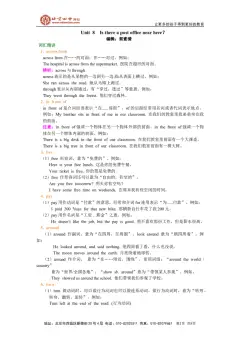
1.方位介词on, over, above 的用法辨析
A.介词on 表示一物放在另一物上面,两者紧贴在一起,如:The book is on the table.
B.介词over 表示一种垂直悬空的上下关系,即“在…上方”,如:Is there any bridge over the river?
C.介词above 表示一般的“高于…”,“在…之上”,如:There was an electric clock above his bed.
2.方位介词under 与below 的用法辨析
介词under 是over 的反义词即“在…下方”,如:They were seen under the tree.
A.介词below 是above 的反义词即“低于…”,“在…之下”,如:They live below us.
3.方位介词across,、through、over,、past 的用法辨析
介词across 着重于“从一头或一边到另一头或另一边”,强调从表面穿过。
如:She went across the street to make some purchases.
A.词through 着重于“穿越”,强调从一定的空间内穿过。
如:The sunlight was coming in through the window.
B.介词over 多表示从“上方越过”,如:He failed to go over the mountain; he had to go round it.
C.介词past 表示从“面前经过”,如:Someone has just gone past the window.
4.方位介词in、on、at 的用法辨析
5.介词in 表示“排、行、组”,如:We are in Team One.
A.介词on 表示“左、右”,如:Li Ping is on my left.
B.介词at 表示“前、后”,如:I sit at the front of the classroom.
6.方位介词to、for 的用法辨析
7.介词to 表示目的地或去的目的,如:Wil you take a train to Tianjian.
A.介词for 表示动身去某地,如:He got on a train for Shanghai.
8. 地点介词at 与in 的用法辨析
介词at 表示较小的地方,如家、村、乡村等,如:He lives at a small village.
2
A.介词in 表示较大的地方,如大城市、国家、洲等,如:He lives in Beijing.
9.地点介词at 与on 的用法辨析
介词at 用于门牌号,如:He lives at No.200, Nanjing Road.
A.介词on 用于路名,如:He lives on Nanjing Road.
10.地点介词in、on、to 的用法辨析
介词in 表示“包含”如:Beijing is in the north of China.
A.介词on 表示“紧邻”如:Canada lies on the north of the U.S.
B.介词to 表示“没接触”如:France lies to the south of England.
1. A ship from South Korea sank into the sea ________ April 16, 2014.
A. in
B. on
C. at
D. for
2. You don't want to visit any other mountain if you have seen wu yue,but you won't wish to see even wu
yue ________ returning from Mount Huangshan.
A. about
B. before
C. since
D. after
3. Michael Jordan is a great American basketball player. He was born ________ 1963.
A. on

B. at
C. in
4. —The charity walk begins ________ 9:00 a. m. Don't be late.
  —No problem.
A. in
B. at
C. on           D. to
5. Cambridge is a small city ________ the east of England.
A. between
B. with
C. in
D. under
6. They arrived ________ Shanghai ________ a cold morning.
A. in; in
B. in; on
C. at; on
D. at; in
基础演练
一、单项选择(共5 小题;共5.0 分)
 1. ---

    your father

   ?
--- He's tall, straight hair.
A.
 How is; like
B.
 What does; look like
C.
 What does; like
D.
 How is; /
 2. My friend Bob is

    medium build.
A.
 with
B.
 for
C.
 of
D.
 to
 3. --- Is he heavy?
3
--- No, he is a little bit

   .
A.
 tall
B.
 thin
C.
 short
D.
 quiet
 4. That

    with short hair is Mr. Brown.
A.
 people
B.
 person
C.
 woman
D.
 boy
 5. She is good-looking

    long, black hair; she is

    a red dress.
A.
 has; has
B.
 with; on
C.
 has; wear
D.
 with; wearing
二、单词拼写(单句首字母填空)(共5 小题;共5.0 分)
 6. E

    of us has a dictionary.
 7. I don't like this cap. Please show me a

    one.
 8. Sally is going to study for her exam t

   . I mean this evening.
 9. The girl is beautiful, and her brother also looks very h

   .
10. The box is so h

    that I can't carry it.
三、适当形式填空(单句适当形式)(共5 小题;共5.0 分)
11. Qi Baishi is a great Chinese

   (art). He is well-known in the world.
12. Sometimes people describe the same thing

   (different).
13. Her sister wants to be an

   (act) in the future.
14. Look! The boy

   (put) on his sweater by himself.
15. He always wears a pair of heavy

   (glass).
巩固提高
四、翻译(根据中文提示完成句子)(共5 小题;共5.0 分)
16. 你认识汤姆吗? 他长什么样?
Do you know Tom?


    he


   ?
17. 这个人中等身高,他长着一头直发。
This man is


   . He has

    hair.
18. 萨莉的头发有点儿卷曲。
Sally's hair is


   .
19. 最后他到达了那个小村庄。
He gets to the small village


   .
4
20. 萨莉长着一张圆脸且有一头金发。
Sally has a


    and


   .
一、单项选择(共10 小题;共10.0 分)
 1. --- Do you speak Japanese or English?
---

   .
A.
 Yes,I do
B.
 Only a little
C.
 English
D.
 What about you
 2. --- Is it cool or hot in June in Beijing?
---
A.
 Yes, it is.
B.
 No, it isn't.
C.
 It's cool.
D.
 Yes, it is cool.
 3. ---

    does your brother look like?
--- He is tall with straight and black hair.
A.
 Who
B.
 How
C.
 Which
D.
 What
 4. —

    do you usually go to school?
— I usually go to school at 7:00.
A.
 What
B.
 How
C.
 Where
D.
 What time
 5.

    do you want to have, eggs or fish?
A.
 Which
B.
 What
C.
 How
D.
 Who
 6. --- What does your sister like?
---

   .
A.
 She is of medium build
B.
 She is tall
C.
 Math
D.
 She wears glasses
 7. His English teacher is

    of medium build ,and she has

    short
hair.
A.
 a;a
B.
 the;the
C.
 a;/
D.
 /;/
 8. They're in

    classes, but they're in

    school.
A.
 different; the same
B.
 the same; different
C.
 different; different
D.
 the same; the same
 9.

    she/She is kind,

    we all like her.
A.
 Because; so
B.
 So; because
C.
 /; because
D.
 /; so
5
10. --- My name is Jerry. I'm glad to be your new classmate.
---
A.
 Welcome to our class!
B.
 It doesn't matter.
C.
 Don't talk to me about that!
D.
 I don't believe it!
二、单词拼写(根据中文提示拼写单词)(共10 小题;共10.0 分)
11. The weather report says it will be sunny

   (以后) on.
12. That girl has shoulder-length

   (笔直的) hair.
13. Yao Chen is a famous

   (女演员) in China. She acts very well.
14. I can't go to the concert with you tonight. Maybe

   (另一个) time.
15.

   (每个) of the students has a new school uniform.
16. Can you

   (描述) the life in the small village in the past?
17. We will have a party

   (今晚).
18. That box is too

   (重的). I can't carry it.
19. His grandmother looks very

   (瘦的).
20. He is not so tall or short, just

   (中等) height.
三、完形填空(共10 小题;共15.0 分)
    When we watch kung fu movies, we often see people run on the walls(墙) or fly. Do you want to be a
person like         21

   ? You may say, "I can do that only in my         22

   ."
    But the students at kung fu schools are hoping(希望) to         23

    their dreams come
true. Anhui Xuanlong Wushu School is just one         24

    these schools. Many children from
4 to 16 years old go there to         25

    kung fu.
    The students have to         26

    at 6:00 a.m. In the morning, the students learn English
27

    math. They learn kung fu in the afternoon. There are more         28

    in the
evening. They usually go to bed after 10:00 p.m.
    The kung fu exercise is         29

    easy. The students have to work hard. After many
years' hard work, these children will         30

    kung fu stars. They can jump high and act well
in kung fu games.
21.
A.
 her
B.
 him
C.
 us
D.
 them
22.
A.
 movie
B.
 dream
C.
 idea
D.
 house
23.
A.
 help
B.
 keep
C.
 make
D.
 turn
6
24.
A.
 for
B.
 at
C.
 of
D.
 with
25.
A.
 watch
B.
 learn
C.
 teach
D.
 follow
26.
A.
 go out
B.
 go back
C.
 get lost
D.
 get up
27.
A.
 and
B.
 so
C.
 but
D.
 as
28.
A.
 hours
B.
 languages
C.
 students
D.
 classes
29.
A.
 never
B.
 sometimes
C.
 usually
D.
 often
30.
A.
 look at
B.
 look like
C.
 look for
D.
 look after
_________________________________________________________________________________
_________________________________________________________________________________
四、阅读理解(共15 小题;共30.0 分)
A
    Johnson is my best friend. We live in the same building. We study in the same school but not in the
same class. We often chat, play football together after school. I knew him long ago and we have been good
friends for two years.
    Johnson is tall and strong with black hair. He has a round face, a small nose and big, brown eyes. I like
his eyes because they are always bright and smiling. I think he is good-looking. Many of us want to be his
friends.
    Johnson is always friendly and helpful. When I feel bored or unhappy, he tells me funny jokes and
makes me laugh. He'll give me help when I need. He is also very generous(慷慨的). He is always willing to
share things with his friends.
    Johnson is very smart. He reads a lot of books. He is good at singing and acts very well. He would like
to make people happy with his songs and performances(表演) when he grows up. I believe that he can
become as popular as Jackie Chan and travel around the world in the future.
31. The writer and Johnson are

   .
A.
 classmates
B.
 brothers
C.
 friends
D.
 sisters
32. When did the writer get to know Johnson?
A.
 Long ago.
B.
 Two years ago.
C.
 In 2008.
D.
 In 2007.
33. What is Johnson like?
7
A.
 He's musical and sporty.
B.
 He's very happy.
C.
 He's helpful and polite.
D.
 He's friendly and helpful.
34. What may Johnson want to be when he grows up?
A.
 An actor.
B.
 An English teacher.
C.
 A doctor.
D.
 A policeman.
35. What's the main idea of the short story?
A.
 A great student.
B.
 A good young man.
C.
 My friend Johnson.
D.
 My friend Jackie Chan.
B
    Many people say that they are working too many hours. They don't have enough time to relax or to
stay with their family.
    Work hours are different from one country to another. In France, people spend about 1,646 hours a
year at work. In Japan, however, people work about 2,159 hours a year.
    Why do people work so many hours? Some people work extra hours because they want to make
more  money. However, many companies don't pay overtime. Their workers don't get more pay for more
work. Some people think it's their duty to work more hours. Some are afraid of losing their jobs if they
don't work more hours.
    Many people say that their vacations are too short. In France, people get five weeks of paid vacation a
year. In Germany, they get four to six weeks, and in the United States, two weeks. One study shows fewer
than half of workers used all their vacation days. In Great Britain, there is a saying, "All work and no play
makes Jack a dull(迟钝的) boy." If that is true, there must be a lot of dull people in the world.
36. A Japanese worker works

    more hours a year than a French one.
A.
 513
B.
 1,646
C.
 2,159
D.
 3,805
37. The word "extra" in Paragraph 3 means "

   ".
A.
 正常的
B.
 额外的
C.
 有用的
D.
 少量的
38. People in

    get only two weeks of paid vacation a year.
A.
 France
B.
 Germany
C.
 the United States
D.
 Great Britain
39. Which of the following is true according to the passage?
A.
 No companies offer vacations to their workers.
B.
 Many people say they have enough time to relax.
C.
 Not all companies pay their workers for more work.
D.
 More than half of workers use all their vacation days.
40. What can we infer from the passage?
8
A.
 Many workers have to work long hours.
B.
 Many people have vacations long enough.
C.
 Work hours are the same around the world.
D.
 There are a lot of dull people in the world.
C
    My name is Betty Sanders. I'm a telephone operator, and I work for Universal Telephone Company
(UTC). My job at UTC is an interesting one. I work five days a week, and my hours are from 9 a.m. to 5
p.m. I do a lot of things—I place long-distance calls for people, I answer questions, and I help people when
they are in trouble.
    Today, for example, I had an interesting experience. At eleven o'clock this morning, I got a call from a
man. I didn't know who he was. He was in trouble and I could tell that he was worried about something. He
gave me his address and asked me to send an ambulance(救护车) right away. I asked him if somebody was
hurt, but he didn't answer my question. He told me he needed a doctor at once, so I said I'd call an
ambulance for him. I still wanted to know what was wrong. Then he said, "Our keys are gone!" I didn't
understand that! Why would he need an ambulance just because he couldn't find his keys? Then I found out
what the trouble was. The man and his wife left the car keys on a coffee table, and later they couldn't find
them. Their little boy John was playing in the room, and they thought he swallowed(吞下) them. But before
I could help him, he told me he wouldn't need an ambulance any longer. His wife found the keys in her bag.
They were there all the time.
41. Betty Sanders works

   .
A.
 in a factory
B.
 in a shop
C.
 in a company
D.
 in a hospital
42. She works

   .
A.
 forty hours a week
B.
 seven days a week
C.
 from Monday to Saturday
D.
 from 9 o'clock to 16 o'clock every day
43. The man called Betty Sanders because

   .
A.
 he thought Betty was a doctor
B.
 his son swallowed the keys
C.
 his son was ill
D.
 he wanted an ambulance
44. In fact, his keys were

   .
A.
 swallowed by his little son
B.
 on a coffee table
C.
 in his wife's bag
D.
 left in his car
45. According to the passage, we can see

   .
9
A.
 Betty Sanders likes her work
B.
 Betty's job is to place long-distance calls only
C.
 the man's little boy likes playing with keys
D.
 doctors can help people find keys
课程顾问签字:                        教学主管签字: