1
Unit 4 语法篇
__________________________________________________________________________________
__________________________________________________________________________________
学生通过本讲学习,能够掌握本单元的重点语法,并在综合能力上有一定的拓展。
祈使句
一、祈使句指的是表示命令、请求、建议或劝告的句子。其主语you 常省略,谓语动词用原形,句
末用感叹号或句号,读降调。
二、祈使句的肯定句式一般分为以下三种类型:
  1.行为动词原形+其它成分。例如:
  Make sentences after the model.根据例句造句。
  2. Be 动词+其它成分(形容词、名词或介词短语等)。例如:
  Be careful when crossing the street.过马路时要小心。
  3. Let+宾语+动词原形+其它成分。例如:
  Let him go back now.让他现在回去吧。
三.祈使句的否定句式
祈使句的否定句式,通常情况下在句首加上Don’t 或Never,一般分为以下四种类型:
  1.在祈使句的肯定句式前加Do’t,构成『Don’t+行为动词原形+其它成分』。例如:
2
  Don’t say that again!别再那样说了!
  2.在Be 动词引起的肯定祈使句前加Don’t,构成『Don’t be+其它成分(形容词、名词或介词短
语等)』。例如:Don’t be careless.不要粗心。
  注意:在这种句型中be 不能省略;否定副词not 不可置于be 之后。
3. Let 引起的祈使句的否定形式有两种:
(1)Let 开头的祈使句,如果后面跟第一、第三人称名词或代词的宾格,可在Let 前加Don’t,也
可在Let 后宾格的名词或代词后面加not。
(2)如果以Let’s 开头的祈使句,必须在Let’s 后加not。例如:
  Don’t let me go with her tomorrow. =Let me not go with her tomorrow.
  不要让我明天跟她一起去。
  Let’s not tell her the truth whenever we meet her.
  无论什么时候我们碰到她,都不要告诉她真相。
  4.在公共场合的提示语中,否定祈使句常用『No+名词/V-ing 形式』结构,表示『禁止做某
事』。例如:
  NO PHOTOS! 禁止拍照!
四.祈使句的反意问句
祈使句的反意疑问句须按其句子结构及讲话人的语气来决定其疑问部分。通常有以下三种形式:
  1.祈使句为肯定句式,其反意疑问句表示请求时,通常用will you;表示邀请、劝说时,用
won」t you。例如:
  Be sure to write to us, will you? 你一定要给我们写信,好吗?
  Come to have dinner with us this evening, won’t you?
  今晚来和我们一起吃饭,好吗?
  2.祈使句为否定句式,其反意疑问句通常只用will you。例如:
3
  Don’t smoke in the meeting room, will you?
  不要在会议室抽烟,好吗?
  3. Let 开头的祈使句构成反意疑问句时,除Let’s 用shall we 外,其它均用will you。例如:
  Let the boy go first, will you? 让个那男孩先走,好吗?
  Let’s take a walk after supper, shall we?
晚饭后我们去散步,好吗?
情态动词
must 和have to
情态动词
用法
例句
must
表示“ 必须,应该” 之意,语气比
should ,ought to 强烈。其否定形式
mustn’t 表示“不准,不应该,禁止”等
意
1.You must come to school on time.
2.Everybody must obey the law.
3.You mustn’t drive so fast in the street.
4.We mustn’t waste any more time.
在回答带有must 的问句时,否定回答常
用needn’t 或don’t have to ,表示“ 不
必”,而不用mustn’t
1.—Must I come back before ten?
   —Yes,you must.(No, you needn’t)
表示有把握的推测,意为“一定、准是、
相必”,只用于肯定句中
1.It must be my mother.
2.You must be hungry after a walk.
3.There must be a hole in the wall.
have to
have to
“必须,不得不”,意义与must 相近。
但must 表示的是说话人的主观看法,而
have to 则往往强调客观需要。
1.The film is not interesting. I really
must go now.
2.I have to go now, because my mother
is in hospital.
must 只有一种形式,即现在式与过去式
都是一种形式,而have to 则涉及各种人
称、时态等方面的变化形式。
1.I had to work hard when I was your
age.
2 .I will have to learn how to use a
computer.
3.In order to take the exam, we’ll have
to finish the whole book by the end of
this month .
两者的否定意义不同,mustn’t 表示“禁
止,不许”,don’t have to 表示不必。
1.You mustn’t go there.
2.You don’t have to go there.
1. 【2015 年广东省初中毕业生学业考试英语试题】Look! The traffic light has turned red. We _____
stop our car.
4

A. can
B. can’t
C. must
D. mustn’t
2. 【山东省泰安市2015 年中考英语试题】Nowadays .all passengers       go through safety check
before take a train.
  A. can
B. may
C. must
D. will
3. 【德州市二O 一五年初中学业水平考试英语试题】 —Mr. Wang, must I come again to clean the
classroom on Sunday?
—No, you____ . I have asked Kate to do it.
A. can’t
B. mustn’t
C. needn’t
D. shouldn’t
4. 【江苏省盐城市2015 年中考英语试题】Daniel, ___ play with the mobile phone while you're walking
in the street.
A. don't
B. doesn't
C. won't
D. can't
5. 【河南省2015 年中考英语试题】        kind and helpful to the people around us, and we will
make the world a nicer place to live in.
 A. Be
B. Being
C. To be
D. Been
6.  ________ in bed. It’s bad for your eyes.
A.  Not to read      B.  Don’t read
C.  Don’t to read
D.  Not read
基础演练
一、单项选择
 1.

    picture books in class, please.
A.
 Not read
B.
 No read
C.
 Not reading
D.
 Don't read
 2. Ssh!

    talk loudly. The baby is sleeping right now.
A.
 Do
B.
 Does
C.
 Don't
D.
 Doesn't
 3. Do you

    wear a uniform at school?
A.
 must
B.
 have to
C.
 may
D.
 can
 4. You

    stop when the traffic light turns red.
A.
 can
B.
 had better
C.
 need
D.
 must
 5. ---

    you give your seat to this old man?
--- Of course.
A.
 Can
B.
 Shall
C.
 Need
D.
 Must
5
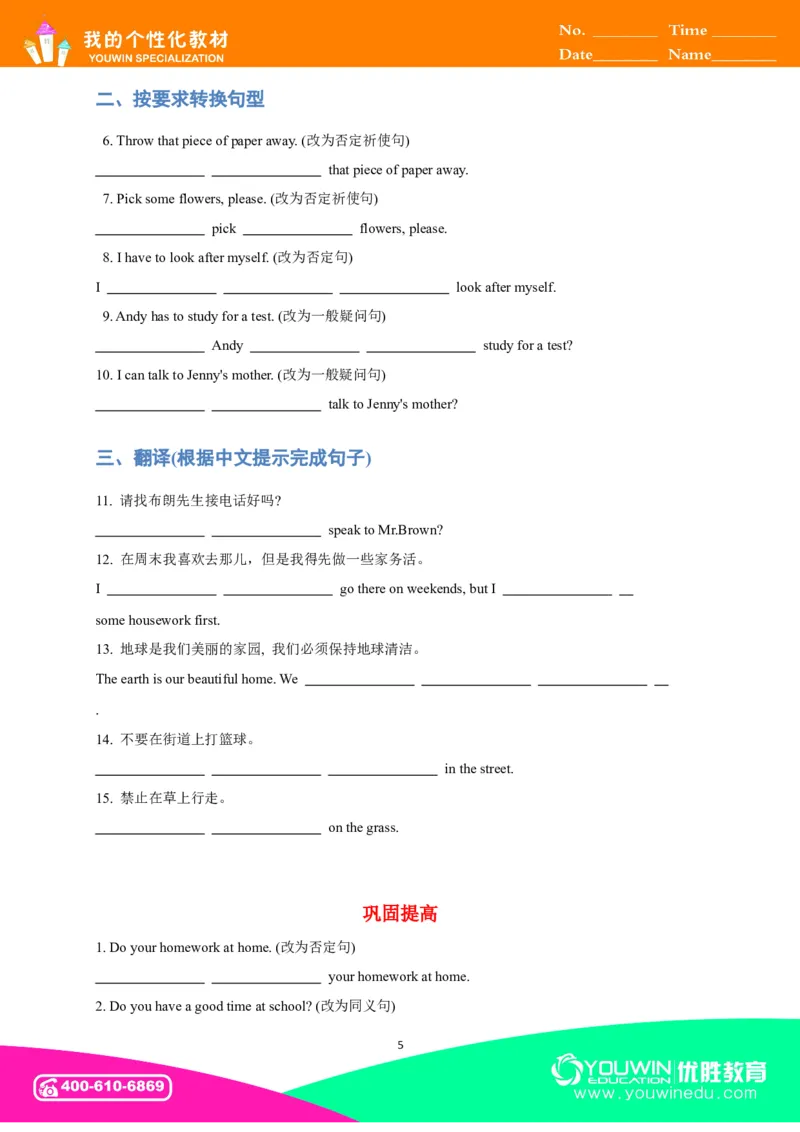
二、按要求转换句型
 6. Throw that piece of paper away. (改为否定祈使句)


    that piece of paper away.
 7. Pick some flowers, please. (改为否定祈使句)


    pick

    flowers, please.
 8. I have to look after myself. (改为否定句)
I


    look after myself.
 9. Andy has to study for a test. (改为一般疑问句)


    Andy


    study for a test?
10. I can talk to Jenny's mother. (改为一般疑问句)


    talk to Jenny's mother?
三、翻译(根据中文提示完成句子)
11. 请找布朗先生接电话好吗?


    speak to Mr.Brown?
12. 在周末我喜欢去那儿,但是我得先做一些家务活。
I


    go there on weekends, but I


some housework first.
13. 地球是我们美丽的家园, 我们必须保持地球清洁。
The earth is our beautiful home. We


.
14. 不要在街道上打篮球。


    in the street.
15. 禁止在草上行走。


    on the grass.
巩固提高
1. Do your homework at home. (改为否定句)


    your homework at home.
2. Do you have a good time at school? (改为同义句)
6
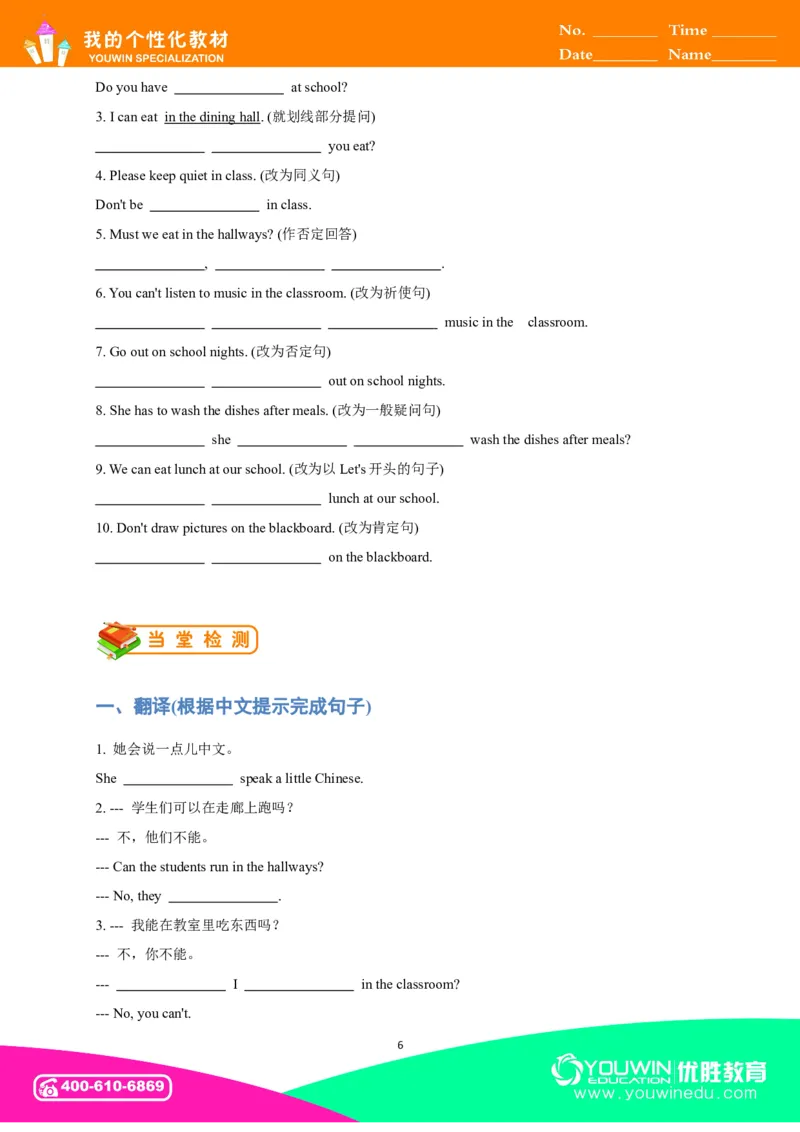
Do you have

    at school?
3. I can eat in the dining hall. (就划线部分提问)


    you eat?
4. Please keep quiet in class. (改为同义句)
Don't be

    in class.
5. Must we eat in the hallways? (作否定回答)


   ,


   .
6. You can't listen to music in the classroom. (改为祈使句)


    music in the  classroom.
7. Go out on school nights. (改为否定句)


    out on school nights.
8. She has to wash the dishes after meals. (改为一般疑问句)


    she


    wash the dishes after meals?
9. We can eat lunch at our school. (改为以Let's 开头的句子)


    lunch at our school.
10. Don't draw pictures on the blackboard. (改为肯定句)


    on the blackboard.
一、翻译(根据中文提示完成句子)
1. 她会说一点儿中文。
She

    speak a little Chinese.
2. --- 学生们可以在走廊上跑吗?
--- 不,他们不能。
--- Can the students run in the hallways?
--- No, they

   .
3. --- 我能在教室里吃东西吗?
--- 不,你不能。
---

    I

    in the classroom?
--- No, you can't.
7
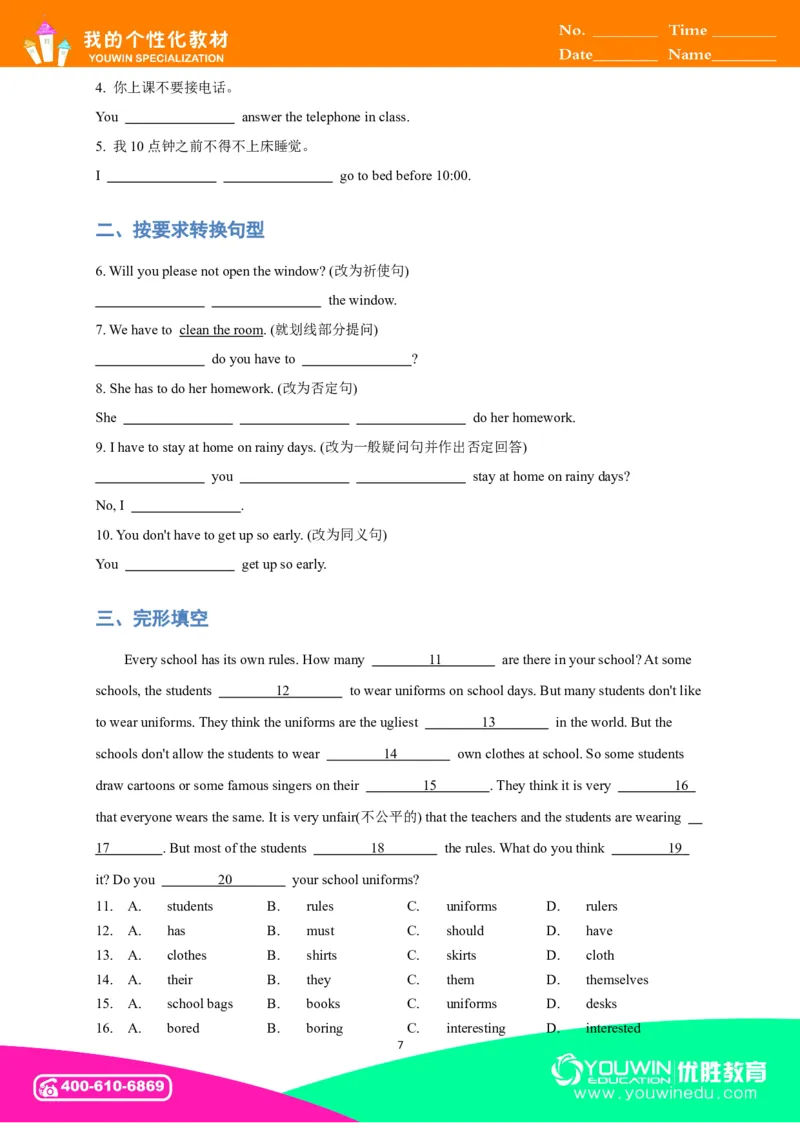
4. 你上课不要接电话。
You

    answer the telephone in class.
5. 我10 点钟之前不得不上床睡觉。
I


    go to bed before 10:00.
二、按要求转换句型
6. Will you please not open the window? (改为祈使句)


    the window.
7. We have to clean the room. (就划线部分提问)


    do you have to

   ?
8. She has to do her homework. (改为否定句)
She


    do her homework.
9. I have to stay at home on rainy days. (改为一般疑问句并作出否定回答)


    you


    stay at home on rainy days?
No, I

   .
10. You don't have to get up so early. (改为同义句)
You

    get up so early.
三、完形填空
    Every school has its own rules. How many         11

    are there in your school? At some
schools, the students         12

    to wear uniforms on school days. But many students don't like
to wear uniforms. They think the uniforms are the ugliest         13

    in the world. But the
schools don't allow the students to wear         14

    own clothes at school. So some students
draw cartoons or some famous singers on their         15

   . They think it is very         16
that everyone wears the same. It is very unfair(不公平的) that the teachers and the students are wearing
17

   . But most of the students         18

    the rules. What do you think         19

it? Do you         20

    your school uniforms?
11.
A.
 students
B.
 rules
C.
 uniforms
D.
 rulers
12.
A.
 has
B.
 must
C.
 should
D.
 have
13.
A.
 clothes
B.
 shirts
C.
 skirts
D.
 cloth
14.
A.
 their
B.
 they
C.
 them
D.
 themselves
15.
A.
 school bags
B.
 books
C.
 uniforms
D.
 desks
16.
A.
 bored
B.
 boring
C.
 interesting
D.
 interested
8
17.
A.
 same
B.
 differently
C.
 different
D.
 the same
18.
A.
 obey
B.
 agree
C.
 listen
D.
 listen to
19.
A.
 of
B.
 about
C.
 by
D.
 for
20.
A.
 like
B.
 make
C.
 wash
D.
 put on
_________________________________________________________________________________
_________________________________________________________________________________
一、单项选择
 1. --- What's your teacher like?
--- She is always strict

    us.
A.
 in
B.
 with
C.
 to
 2. Mr. Black always goes to work

    time. He is never late.
A.
 at
B.
 on
C.
 in
D.
 with
 3. ---

    I go out with my friends, Mom?
--- No, you can't. You must do your homework first.
A.
 Must
B.
 Have to
C.
 Do
D.
 Can
 4. On Sunday I have to go to the farm

    my parents.
A.
 to help
B.
 help
C.
 helping
D.
 helped
 5. --- What are the rules at your school?
--- Don't run in the hallways and

    arrive late for class.
A.
 not to
B.
 won't
C.
 don't
D.
 no
 6. There are

    people in the hall and there are

    noise(噪音) in it.
A.
 too many; too much
B.
 too many; much too
C.
 too much; too many
D.
 too much; much too
 7. Our classroom is

   . We must clean it.
A.
 dirty
B.
 sorry
C.
 quiet
D.
 noisy
 8. --- What do you do after dinner?
--- I

   .
9
A.
 have breakfast
B.
 have lunch
C.
 get up early
D.
 watch TV
 9. --- What are your rules at home?
--- I have to go to bed

    ten.
A.
 after
B.
 before
C.
 in
D.
 on
10. --- Are you happy?
---

   . I have a lot of rules.
A.
 Yes, I am
B.
 Yes, I do
C.
 No, I'm not
D.
 No, I don't
二、完形填空
    My name is Li Xia. I am a middle school student. As a student, I have many rules. I can't be late

11

    class. I must         12

    on time. I can't run in the hallways. I can't         13
in the classroom. I must eat in the dining hall.
    I         14

    listen to music in the classroom, but I can listen to it outside. I have to wear
my school         15

    every day. I can't wear a hat. In the school library, we must be quiet. We
can't talk loudly or laugh loudly.
    At home, I have to get up early and help my mom         16

    breakfast. I have to make
the bed and         17

    my bedroom every morning. I can't watch TV         18


play computer games         19

    school nights. On weekends, I have to practice the guitar and
the piano. I can't play         20

    on school days. I am not happy. What can I do?
11.
A.
 to
B.
 with
C.
 for
D.
 in
12.
A.
 am
B.
 is
C.
 are
D.
 be
13.
A.
 fight
B.
 eat
C.
 sing
D.
 dance
14.
A.
 can't
B.
 can
C.
 do
D.
 don't
15.
A.
 book
B.
 shoe
C.
 uniform
D.
 rules
16.
A.
 do
B.
 make
C.
 to does
D.
 to makes
17.
A.
 make
B.
 eat
C.
 clean
D.
 follow
18.
A.
 or
B.
 and
C.
 with
D.
 for
19.
A.
 in
B.
 at
C.
 on
D.
 with
20.
A.
 the basketball
B.
 the soccer
C.
 volleyball
D.
 piano
10
三、阅读理解
    Today is Sunday, and there will be a concert(音乐会) at Hong He Concert Hall at 7:00 p.m. Mr. Smith
arrives there early, and he is reading the "Notice to the Audience (听众须知)".
Notice to the Audience
1. Dress neatly(整洁) and don't wear slippers(拖鞋) into the concert hall.
2. Don't take food or drink into the hall.
3. Don't take children under 1.2m in height into the concert hall.
4. Keep off all beepers and mobile phones (手机) during the concert.
5. Don't take photos during the concert.
6. Don't smoke in the concert hall.
21. What day is it today?
A.
 It's Saturday.
B.
 It's Sunday.
C.
 It's Monday.
D.
 It's Friday.
22. What time is it now?
A.
 7:00 a.m.
B.
 Before 7:00 in the morning.
C.
 7:00 p.m.
D.
 Before 7:00 p.m.
23. Mr. Smith is

   .
A.
 listening to the concert
B.
 waiting for his friends
C.
 reading the notice
D.
 watching a movie
24. The audience have to

   .
A.
 wear slippers
B.
 make phone calls
C.
 eat or drink something
D.
 dress neatly
25. Which is RIGHT?
A.
 Children under 1.2m can't come into the hall.
B.
 People with no beepers or mobile phones can't come into the hall.
C.
 If you want, you can smoke in the hall.
D.
 You can take some photos during the concert.
四、单词拼写(单句首字母填空)
26. I think students should follow the school r

   .
27. We have to be q

    in the library.
28. Don't go out b

    you finish your homework.
29. The room is too small. Let's go o

   .
30. I learn how to use the computer and I f

    very happy.
11
五、适当形式填空(单句适当形式)
31. Don't be

   (noise) in the classroom.
32. I feel very

   (relax) after having a good rest.
33. I have to do the

   (dish) after dinner.
34. I have many storybooks, but Tom has

   (many).
35. Please keep your eyes

   (close).
六、对话7 选5
A: Hello, Li Lei. 36.
B: We can't arrive late for class.
A: 37.
B: No, we can't. But we can eat in the dining hall.
A: Can you listen to music in the hallways?
B: No, we can't. 38.
A: Do you have to wear uniforms?
B: 39.
A: 40.
B: Yes, I do, or my parents will be angry(生气).
A: I have to do my homework first when I get home.
A.
 Can you eat in the classroom?
B.
 Do you have to finish your homework after school?
C.
 What are your school rules?
D.
 Yes, we do.
E.
 And we can't wear hats at school.
七、选词填空(短文选词填空)
 late
 first
 parents
 strict
 leaving
 say
 our
 follow
 early
 after
Our Class Rules
    Our head teacher is very 41.

    with us. He makes many rules for us and asks us to
42.

    them.
12
    We have to get up 43.

    in the morning. All of us must be on time for class. We can't
arrive 44.

   . We can't fight in or out of class. If we fight, he will call our 45.

. We can't eat or talk loudly in class. We must listen to the teacher carefully(认真地). 46.

class, we can't run or listen to music in the hallway. We have to wear 47.

    uniforms at
school. We can't wear a hat in class. When we get home, we must do homework 48.

   .
We have to finish our homework on time. When we get to school every morning, we must 49.

"hello" to all the teachers and say "Goodbye" when 50.

    school.
八、阅读与表达(问答式) (101 中学初一下期中考试)
    Have you ever had problems in your life and don't know how to be happy? If so, you will find the
book Being a Happy Teenager is very useful, which is written by an Australian writer Andrew Matthews.
    Andrew Matthews works as a writer, cartoonist(卡通画家) and speaker. His books have been
translated into 20 languages. He has been on over 2000 radios and TV programs.
    In this book, Matthews tells us how to have a happy life and answers the questions of teenagers.
    There are many topics such as parents and friends, and the book says we should stop being angry and
learn to forgive(原谅). The book tells us of useful skills such as how to put what you have learned into
pictures of your mind to make your memory better. Many teenagers think that happiness comes from a
good exam marks or praise from other people. But you can still be happy when there are no such "good"
things.
    Success comes from a good attitude(态度). If you learn from problems, you will have success in the
future.
    Some school boys have problems such as being too tall or too short. But Matthews tells us happiness
comes from thinking about things in a positive(积极的) way.
    If you are tall, people notice you and you can get a better view(视线) at the movie; if you are short,
your clothes and shoes take less room in your bedroom! This is Matthews' most important lesson: You
choose to be happy!
 根据短文内容,完成下列小题。
51. Is Matthews Australian?
52. What does Matthews do?
53. Does success come from a good attitude or not?
54. How should you think about things if you are too tall or too short? (no more than 10 words)
13
55. What's the title of the passage?
九、作文
51.     假如你是赵楠,得知Mary 下周要来你们学校学习,你准备给她发一封e-mail,向她介绍你
们学校的一些规章制度。要求:词数70 个左右。内容包括:
    1. 上课不要迟到;
    2. 向老师问好(say hello to);
    3. 教室保持干净、整洁(tidy);
    4. 不允许在教室里吃东西;
    5. 不允许在教室里听音乐、大声讲话;
    6. 不允许把手机带到学校;
    7. 放学后按时回家。
Dear Mary,
    How's it going? I'm glad to hear you are coming to our school.
______________________________________________________________________________________
______________________________________________________________________________________
_______________________________________
    I hope I can see you soon.
Yours,
Zhao Nan
课程顾问签字:                        教学主管签字: