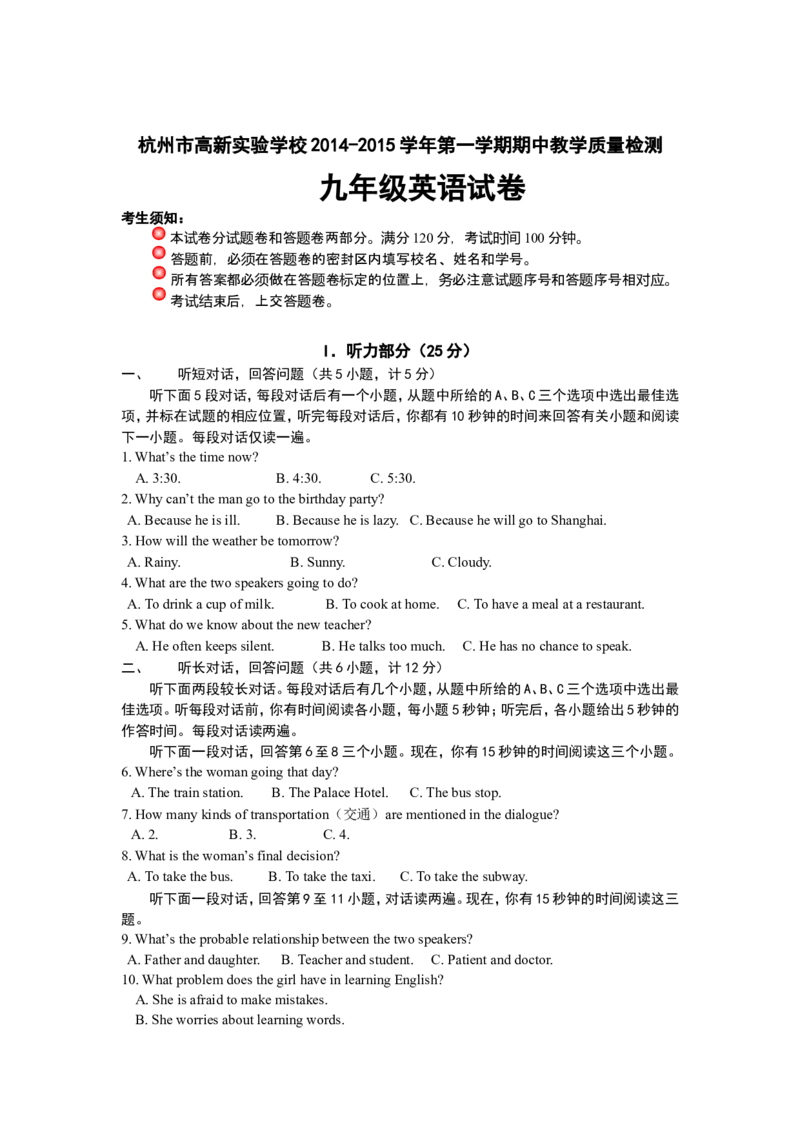
杭州市高新实验学校2014-2015 学年第一学期期中教学质量检测
   九年级英语试卷
考生须知:
本
卷分
卷和答
卷两部分。
分
试
试题
题
满
120 分,考试时间100 分
。
钟
答
前,必
在答
卷的密封区内填写校名、姓名和学号。
题
须
题
所有答案都必
做在答
卷
定的位置上,
必注意
序号和答
序号相
。
须
题
标
务
试题
题
对应
考
束后,上交答
卷。
试结
题
I.听力部分(25 分)
一、
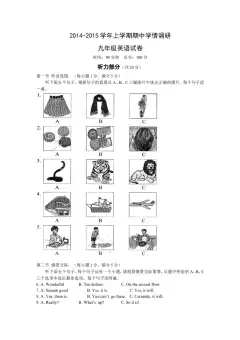
听短对话,回答问题(共5 小题,计5 分)
听下面5 段对话,每段对话后有一个小题,从题中所给的A、B、C 三个选项中选出最佳选
项,并标在试题的相应位置,听完每段对话后,你都有10 秒钟的时间来回答有关小题和阅读
下一小题。每段对话仅读一遍。
1. What’s the time now?
A. 3:30.
    B. 4:30.              C. 5:30.
2. Why can’t the man go to the birthday party?
  A. Because he is ill.
    B. Because he is lazy.   C. Because he will go to Shanghai.
3. How will the weather be tomorrow?
  A. Rainy.
B. Sunny.
C. Cloudy.
4. What are the two speakers going to do?
  A. To drink a cup of milk.
  B. To cook at home.     C. To have a meal at a restaurant.
5. What do we know about the new teacher?
A. He often keeps silent.
 B. He talks too much.     C. He has no chance to speak.
二、
听长对话,回答问题(共6 小题,计12 分)
听下面两段较长对话。每段对话后有几个小题,从题中所给的A、B、C 三个选项中选出最
佳选项。听每段对话前,你有时间阅读各小题,每小题5 秒钟;听完后,各小题给出5 秒钟的
作答时间。每段对话读两遍。
听下面一段对话,回答第6 至8 三个小题。现在,你有15 秒钟的时间阅读这三个小题。
6. Where’s the woman going that day?
   A. The train station.        B. The Palace Hotel.      C. The bus stop.
7. How many kinds of transportation(交通)are mentioned in the dialogue?
   A. 2.                    B. 3.                   C. 4.
8. What is the woman’s final decision?
  A. To take the bus.          B. To take the taxi.       C. To take the subway.
听下面一段对话,回答第9 至11 小题,对话读两遍。现在,你有15 秒钟的时间阅读这三
题。
9. What’s the probable relationship between the two speakers?
  A. Father and daughter.      B. Teacher and student.     C. Patient and doctor.
10. What problem does the girl have in learning English?
A. She is afraid to make mistakes.
B. She worries about learning words.
C. She simply says ‘Yes” or “No”.
11. When does the conversation take place?
A. At the end of the term.       B. In the middle of the term.    C. At the beginning of the term.
三、听独白,回答问题(共4 小题,计8 分)
    听下面一段独白,听独白前,你有20 秒钟的时间阅读有关材料和4 个小题。听完独白后,
你有20 秒钟的时间来选择有关选项。独白连读两遍。
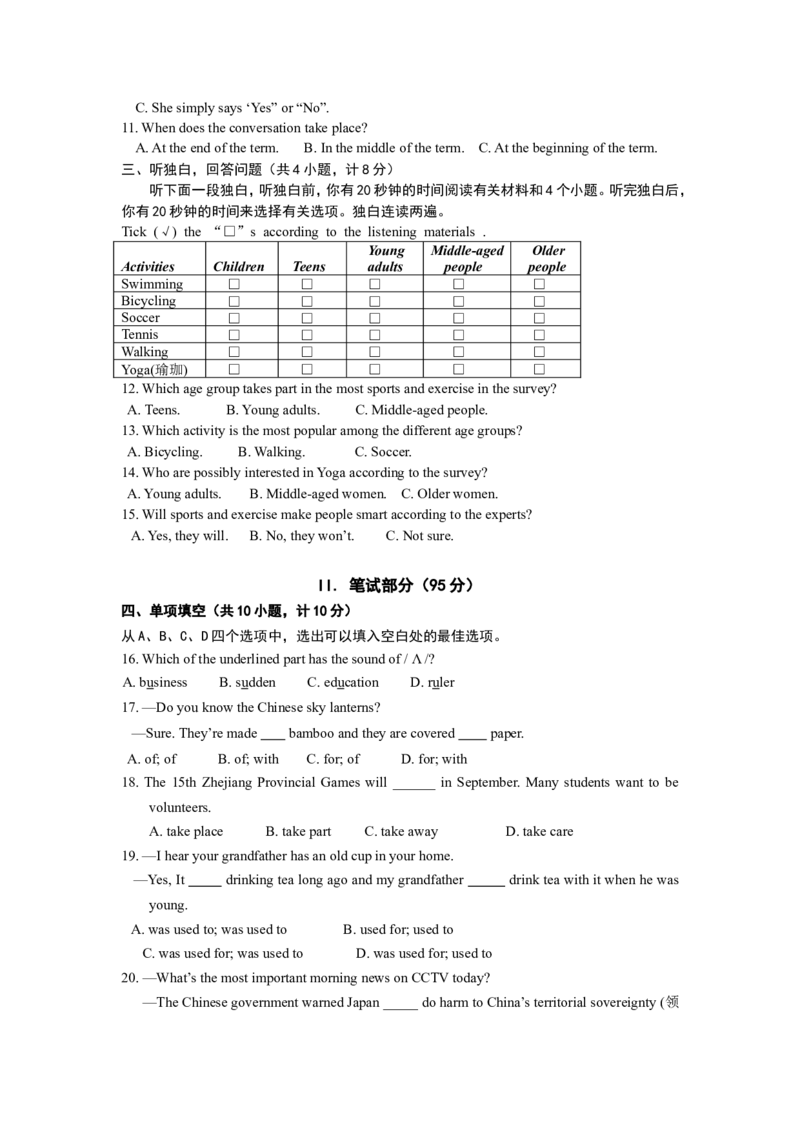
Tick (√) the “□”s according to the listening materials .
Activities
Children
Teens
Young
adults
Middle-aged
people
Older
 people
Swimming
  □
  □
  □
   □
  □
Bicycling
  □
  □
  □
   □
  □
Soccer
  □
  □
  □
   □
  □
Tennis
  □
  □
  □
   □
  □
Walking
  □
  □
  □
   □
  □
Yoga(瑜珈)
  □
  □
  □
   □
  □
12. Which age group takes part in the most sports and exercise in the survey?
  A. Teens.             B. Young adults.          C. Middle-aged people.
13. Which activity is the most popular among the different age groups?
  A. Bicycling.          B. Walking.              C. Soccer.
14. Who are possibly interested in Yoga according to the survey?
  A. Young adults.        B. Middle-aged women.    C. Older women.
15. Will sports and exercise make people smart according to the experts?
   A. Yes, they will.      B. No, they won’t.         C. Not sure.
II. 笔试部分(95 分)
四、单项填空(共10 小题,计10 分)
从A、B、C、D 四个选项中,选出可以填入空白处的最佳选项。
16. Which of the underlined part has the sound of / Λ /?
    A. business         B. sudden         C. education         D. ruler
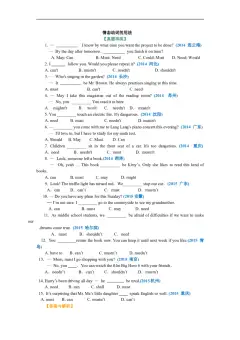
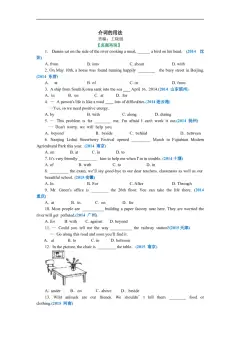
17. —Do you know the Chinese sky lanterns?
   —Sure. They’re made         bamboo and they are covered          paper.
  A. of; of            B. of; with        C. for; of            D. for; with
18. The 15th Zhejiang Provincial Games will ______ in September. Many students want to be
volunteers.
A. take place
 B. take part
     C. take away
     D. take care
19. —I hear your grandfather has an old cup in your home.
   —Yes, It          drinking tea long ago and my grandfather           drink tea with it when he was
young.
   A. was used to; was used to                B. used for; used to
C. was used for; was used to               D. was used for; used to
20. —What’s the most important morning news on CCTV today?
—The Chinese government warned Japan _____ do harm to China’s territorial sovereignty (领
土主权) again and again.
A.to not         B.didn’t         C.not to         D.do not
21. —Which of the two magazines will you take?
—I’ll take______ though I find ______ of them are very useful to me.
A. all; both         B. either; either     C. either; neither     D. either; both
22. —Your brother is an excellent basketball player.
   —So he is. He          on the basketball team since three years ago.
   A. has been
 B. is
C. was         D. will be
23. —Are you going to tomorrow’s party?
— I won’t go         I am invited.
   A. if
B. unless
    C. When          D. after
24. —Do you know _________ the meeting?
—Tomorrow morning.
A. when they had
B. when they are going to have
C. when did they have
D. when are they going to have
25. —Excuse me. Could you please show me how to use this MP4 player?
   —            .
A. Certainly. It’s here    B. Sure, with pleasure    C. Yes, you can   D. Not at all
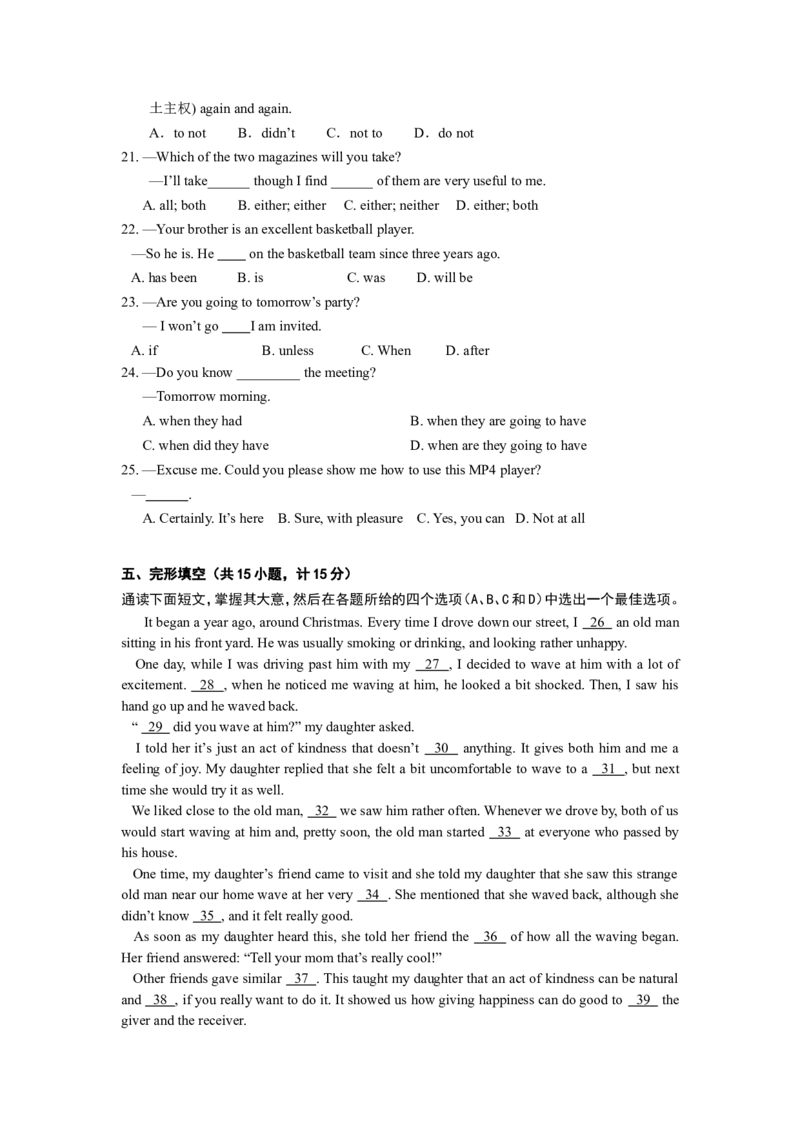
五、完形填空(共15 小题,计15 分)
通读下面短文,掌握其大意,然后在各题所给的四个选项(A、B、C 和D)中选出一个最佳选项。
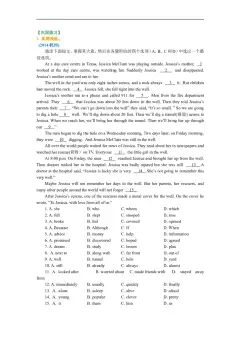
It began a year ago, around Christmas. Every time I drove down our street, I   26   an old man
sitting in his front yard. He was usually smoking or drinking, and looking rather unhappy.
   One day, while I was driving past him with my   27  , I decided to wave at him with a lot of
excitement.   28  , when he noticed me waving at him, he looked a bit shocked. Then, I saw his
hand go up and he waved back.
   “   29   did you wave at him?” my daughter asked.
   I told her it’s just an act of kindness that doesn’t   30   anything. It gives both him and me a
feeling of joy. My daughter replied that she felt a bit uncomfortable to wave to a   31  , but next
time she would try it as well.
   We liked close to the old man,   32   we saw him rather often. Whenever we drove by, both of us
would start waving at him and, pretty soon, the old man started   33   at everyone who passed by
his house.
   One time, my daughter’s friend came to visit and she told my daughter that she saw this strange
old man near our home wave at her very   34  . She mentioned that she waved back, although she
didn’t know   35  , and it felt really good.
   As soon as my daughter heard this, she told her friend the   36   of how all the waving began.
Her friend answered: “Tell your mom that’s really cool!”
   Other friends gave similar   37  . This taught my daughter that an act of kindness can be natural
and   38  , if you really want to do it. It showed us how giving happiness can do good to   39   the
giver and the receiver.
   Moved by the old man’s actions, we’re planning to give our waving neighbor a thank-you card
to express our   40   for his exciting waves. We are really thankful for him sharing his simple joy
with all who pass by his house.
26. A. noticed           B. felt           C. heard           D. kept
27. A. husband          B. son           C. daughter        D. friend
28. A. Just now          B. On time       C. In the end       D. At the beginning
29. A. Why             B. How          C. When          D. Where
30. A. buy              B. cost           C. hide           D. guess
31. A. friend            B. driver         C. classmate       D. stranger
32. A. or               B. but           C. so             D. yet
33. A. shouting          B. waving        C. laughing        D. looking
34. A. angrily           B. excitedly       C. loudly          D. carefully
35. A. him              B. me           C. her            D. us
36. A. lesson            B. accident       C. news           D. story
37. A. gifts             B. notes          C. opinions        D. books
38. A. easy             B. funny         C. usual           D. special
39. A. past             B. between       C. all             D. both
40. A. attention         B. thanks         C. suggestions     D. interests

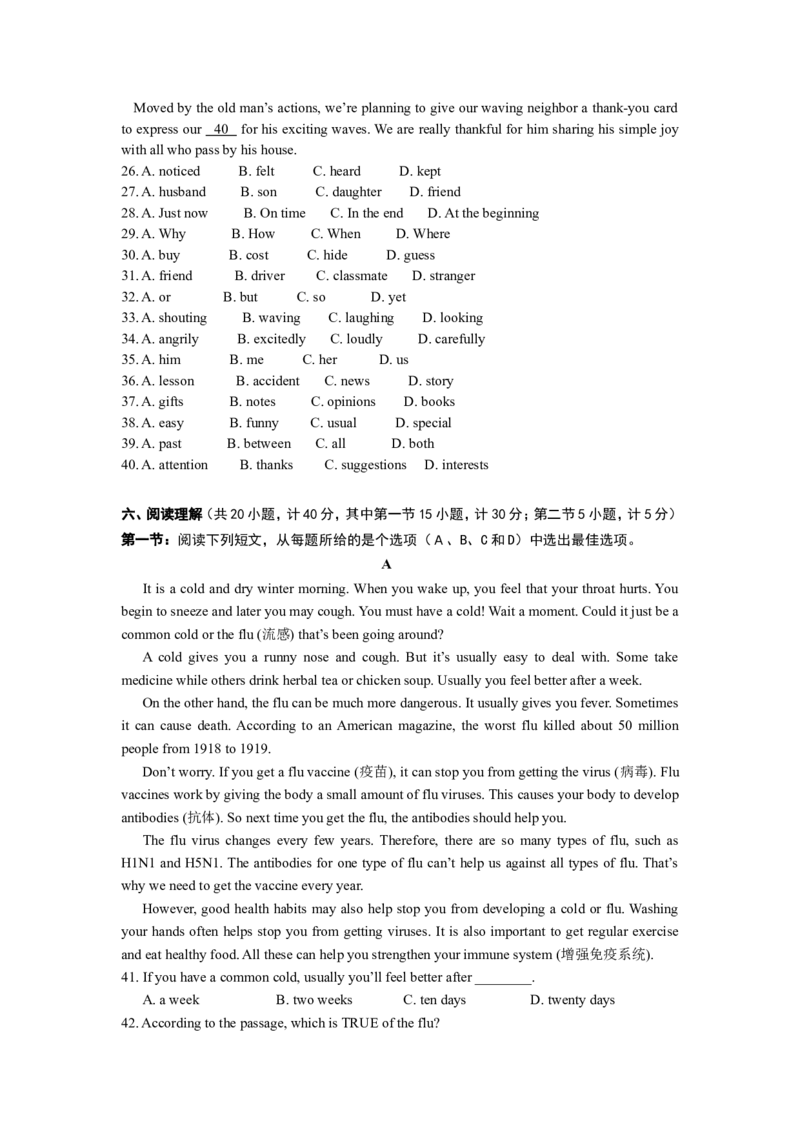
六、阅读理解(共20 小题,计40 分,其中第一节15 小题,计30 分;第二节5 小题,计5 分)
第一节:阅读下列短文,从每题所给的是个选项(A、B、C 和D)中选出最佳选项。
  A
It is a cold and dry winter morning. When you wake up, you feel that your throat hurts. You
begin to sneeze and later you may cough. You must have a cold! Wait a moment. Could it just be a
common cold or the flu (流感) that’s been going around?
A cold gives you a runny nose and cough. But it’s usually easy to deal with. Some take
medicine while others drink herbal tea or chicken soup. Usually you feel better after a week.
On the other hand, the flu can be much more dangerous. It usually gives you fever. Sometimes
it can cause death. According to an American magazine, the worst flu killed about 50 million
people from 1918 to 1919.
Don’t worry. If you get a flu vaccine (疫苗), it can stop you from getting the virus (病毒). Flu
vaccines work by giving the body a small amount of flu viruses. This causes your body to develop
antibodies (抗体). So next time you get the flu, the antibodies should help you.
The flu virus changes every few years. Therefore, there are so many types of flu, such as
H1N1 and H5N1. The antibodies for one type of flu can’t help us against all types of flu. That’s
why we need to get the vaccine every year.
However, good health habits may also help stop you from developing a cold or flu. Washing
your hands often helps stop you from getting viruses. It is also important to get regular exercise
and eat healthy food. All these can help you strengthen your immune system (增强免疫系统).
41. If you have a common cold, usually you’ll feel better after ________.
A. a week
B. two weeks
C. ten days
D. twenty days
42. According to the passage, which is TRUE of the flu?
A. It first happened in 1919.
B. It usually doesn’t give you fever.
C. It is easy to deal with.
D. It can kill people sometimes.
43. If you get a flu vaccine, ________.
A. it can’t stop you from getting the flu virus
B. it won’t cause your body to develop antibodies
C. your body will develop antibodies
D. your body will get a large amount of flu viruses
44. We need to get a flu vaccine every year because ________.
A. we probably have a cold in winter
B. the flu virus changes every few years
C. the flu is very dangerous
D. you don’t need to take any medicine after that
45. The following ways can help stop the flu EXCEPT ________.
A. staying indoors
B. getting regular exercise
C. eating healthy food             D. washing our hands often
B
Once upon a time all feelings went to an island for a vacation, and each was having a
goodtime. Suddenly, a warning of a strong storm was announced, so all rushed to their boats. Yet,
Love did not wish to run away quickly. There was so much to do. But as the clouds darkened,
Love realized it was time to leave. But there were no boats to use. Love looked around with hope.
Just then Richness was passing by Love in a large boat. Love shouted, “Richness, can you take
me with you?” Richness answered, “No, I can't. There is a lot of gold and silver in my boat. There
is no place here for you. ”
Love decided to ask Vanity(虚荣) who was also passing by in a beautiful boat for help, But
Vanity said with a cold voice, “No, I can’t take you with me. My boat will get dirty with your
mummy feet.”
Sorrow passed by after some time. Again, Love asked for help. But it was useless. “No, I can’t
take you with me. I am so sad. I want to be by myself.”
When Happiness passed by a few minutes later, Love again called for help. But Happiness was
so happy that it hardly cared about anyone else.
Love was growing worried and hopeless. Just then somebody called out, “Come, Love, I will
take you with me.” Love did not know who was being so kind, but jumped onto the boat happily.
After getting off the boat, Love met Knowledge. Love asked, “Knowledge, do you know who
was so kind to give me a lift when no one else wished to help?”
Knowledge smiled, “Oh, that was Time.”
“Time?” asked Love. “But why did Time help me?” Knowledge smiled with deep wisdom and
answered, “Because only Time is able to understand how valuable Love is.”
46. According to the passage, which one did not go to an island for a vacation?
A. Love.           B. Richness.
C. Vanity
D. Knowledge
47. Which word has the same meaning as “Sorrow”?
A. Worry
B. Anger
C. Sadness
D. Smile
48. Other feelings passed by Love in their boats one by one. Which is the right order according to
the passage?
A. Richness→ Vanity→ Sorrow→ Happiness→ Time
B. Richness→ Happiness→ Sorrow→ Vanity→ Time
C. Time → Richness→ Vanity→ Sorrow→ Happiness
D. Richness→ Happiness→ Vanity→ Sorrow→ Time
49. Why didn’t Vanity take Love with him in his boat?
A .Because there was no place for Love in his boat.
B. Because he thought Love would make his boat dirty.
C. Because he wanted to stay alone.
D. Because he didn’t care about anyone else.
50. What can we learn from the passage?
A. When we are rich, we may pay more attention to Love.
B. All the feelings are important in our life except Love.
C. As time goes by, we can realize the importance of Love.
D. When we are in happiness and sorrow, we shouldn’t remember Love.
C
Decisions, decisions! Our lives are full of them, from the small ones to the life-changing. The
right to choose is central to everyone. Yet sometimes we make bad decisions that leave us unhappy
or full of regret. Can science help?
Most of us know little about the mental processes(心理历程)that lie behind our decisions.
Luckily, what psychologists are finding may help us all make better choices. Here are some of
their amazing discoveries to help you make up your mind. Consider your emotions(情感). You
might think that emotions are the enemy of decision-making, but in fact they are a part of it.
Whenever you make up your mind, your brain’s emotional centre is active. University of Southern
California scientist, Antonio Damasia, has studied people with damage (损伤) to only the
emotional parts of their brains, and found that they were unable to make basic choices about what
to wear or eat. Damasia thinks this may be because our brains store emotional memories of past
choice, which we use to help the present decision-making.
However, making choices under the influence of an emotion can greatly affect the result. Take
anger for example. A study by Nitika Garg of the University of Mississippi and other scientists
found the angry shoppers were more likely to choose the first thing they were offered rather than
considering other choices. It seems that anger can lead us to make quick decisions without much
thinking.
All emotions affect our thinking and motivation(动机),so it may be best to avoid making
important decisions under their influence. Yet strangely there is one emotion that seems to help us
make good choices. The American researchers found that sad people took time to consider the
various choices on offer, and ended up making the best choices. In fact many studies show that
people who feel unhappy have the most reasonable view of the world.
51. What does the underlined word “central” mean?
   A. in the middle            B. easy to reach
   C. important               D. having power
52. Damasia’s study suggests that ________.
   A. emotions are the enemy of decision-making.
   B. our brain has nothing to do with decision-making.
   C. people with physical damage find it hard to make up their minds.
   D.our emotional memories of past choices can affect present decisions.
53. According to the text, what may help us make better decisions?
   A. To think about happy times.
   B. To make many decisions at a time.
   C. To stop feeling regretful about the past.
   D. To learn about the process of decision-making.
54. Why are angry shoppers more likely to choose the first thing they are offered?
   A. They often forget their past choices.
   B. They make decisions without much thinking.
   C. They tend to save time when shopping.
   D. They are too angry to bargain.
55. What do we learn from the text?
   A. Emotions are a part of decision-making.
B. Sad people always make worse choices.
   C. No emotion seems to help us make good choices.
   D. Only sad feelings affect our thinking and motivation.
第二节:根据短文内容, 从方框中选出五个句子填入文中空缺处, 使短文内容完整正
确。
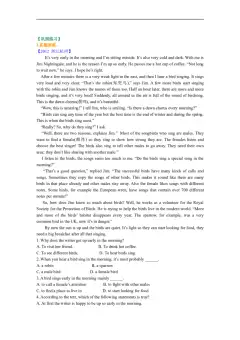
Having a cheetah as a pet in the house? Does it sound scary to you? But for a family in South
Africa, one cheetah is treated as a VIP (Very Important Person) in the house.
The big cheetah is named Jolie.      56      She can often be found eating from the kitchen table,
taking a short sleep on the sofa, or even sleeping on Lucy and Jeff’s bed. The big cat also sleeps
and plays with the Browns’ other pet, the more usual one — a sheepdog (牧羊犬).      57
Having a cheetah as a pet is unusual. At first, Mrs Brown wasn’t willing to keep a cheetah as a
pet. She said, “     58      But we are now happy that we did it — she is part of the family.”
Just like her name, four-year-old Jolie has achieved a celebrity status ( 名人地位) in the
Browns’ hometown. Fans often come to their home to take pictures of her.      59
However, a cheetah is always a cheetah.      60      “She makes a lot of mess in the house,
urinating (小便) everywhere and chewing everything. It’s her wild instincts ( 本能),” said Mrs
Brown.
There might be some problems of having a cheetah as a pet in the house, but some unusual fun
must also be waiting ahead.
A. Interestingly, Jolie enjoys all the special attention that is paid to her.
B. I was really pleased to have a cheetah as a pet at the beginning.
C. Though Jolie is now a pet in the house, she still has some wild habits.
D. She is surely the VIP at Lucy and Jeff Brown’s home.
E. I was really against the idea of getting a cheetah as a pet.
F. An impossible friendship has happened between these two animals.

七. 词语填空(共10 小题,计10 分)
用方框内所给单词的适当形式填空, 使短文通顺、正确、连贯(每个单词限用一次)。
   China is a country with many   61   festivals. The Dragon Head Raising Day is one of them.
This special day is on the   62   day of the second month in the Chinese lunar calendar. It stands
for the start of spring and farming.
   The dragon is important in Chinese. We Chinese people call   63   the “descendants (传人)of
the dragon”. So people   64   the Dragon Head Raising Day with many customs about dragon. On
the day in   65   times, people put ashes in the kitchen. This was to “lead the dragon into the house
”. People believed that with the   66   of the dragon ,they could have a good harvest(收获)in
autumn.
   Also, people eat special foods on that day. The foods are usually named   67   dragon. For
example ,people eat “dragon whisker ” noodles and   68   called “dragon teeth ”.
   Today ,many customs have disappeared. But one that has   69   is the cutting of hair. It is
 70   that a haircut during the first lunar month may bring luck to the uncles of a family –mother’s
brothers. So many people have their hair cut on the Dragon Head Raising Day.
八.单词拼写. (共10 小题,计10 分)
  根据下列句子及所给单词的首字母,在答题卷上按题号写出各单词的完全形式(每空限填
一词)。
71. The word OK is one of the most w_______spoken expressions in the world.
72. It’s usually considered impolite to ask p________  questions about others.
73. I plan to travel to several E          countries this summer vacation, like France,England and
Germany.
74. Withou d        , Yao Ming is one of the greatest basketball players in the world.
75. If you want to make good friends with your children, you must be p        with them.
76.We are r         to do some cleaning after class by our head teacher.
77. The girl eats too much these days. She has put on five p        .
78. Don’t forget to t          the story into English. They don’t know Chinese.
79. His hen has l         several eggs since last week.
80. Sit down b         me. I’ll tell you a secret.
two,  say,  we,  tradition,  help,  celebration,  ancient,  dumpling,  remain,  after
九、书面表达(共1 题,计15 分)
假设你是李华,已报名参加学校英语俱乐部。根据俱乐部活动安排,你需要准备一份关
于英语阅读的发言稿。具体要求如下:
1.对英语阅读重要性的认识;
2.个人开展英语阅读的情况(1~2 点具体做法)及感悟;
3.将来的打算。
参考词语:play an important part, in the past, borrow books, at the beginning, something
easy and interesting, become interested in, in the future, form a good habit of,
read every day, be helpful for
书写要求:1.词数:100 词左右。(开头已给出,不计入总词数);

      2.可根据具体要求及参考词语适当发挥;
3.文中不得出现真实姓名。
Good afternoon, everybody,
I’m very pleased to be here to talk about my English reading. As we all know, …
…
Thanks for listening!
答题卷
听力部分(25 分)
一、听对话,回答问题(每小题1 分, 共5 分)
1.________
2.________
3.________
4.________
5.________
二、听较长对话,回答问题(每小题2 分,共12 分)
6._________ 7.________
8.________
9.________
10._______
11._______
三、听独白,回答问题。(每小题2 分,共8 分)
12.________ 13._______
14.________ 15._______
笔试部分(95 分)
四、单项选择  (每小题1 分,共10 分)
16.________ 17.________ 18.________ 19.________ 20.________
21._________ 22.________ 23.________ 24.________ 25._______
五、完形填空  (每小题1 分,共15 分)
26._______         27.________ 28._______
  29.________ 30._______
31._________ 32.________ 33.________   34.________ 35._______
36._______     37.________ 38._______     39.________ 40._______
六、阅读理解  (其中第一节每小题2 分,共30 分;第二节每小题1 分,共5 分)
41._______     42.________ 43._______     44.________ 45._______
46._______     47.________ 48._______     49.________ 50._______
51._______     52.________ 53._______     54.________ 55._______
56._______     57.________ 58._______     59.________ 60._______
七、选词填空 (每小题1 分,共10 分)
61.________   62.________   63.________  64.________  65.________
66._________  67.________   68.________  69.________  70._______
八、单词拼写 (每小题1 分,共10 分)
71.________   72.________   73.________  74.________  75.________
76._________  77.________   78.________  79.________  80._______
九、书面表达(15 分)
Good afternoon, everybody, I’m very pleased to be here to talk about my English
reading. As we all know,
___________________________________________________________________
___________________________________________________________________
___________________________________________________________________
___________________________________________________________________
___________________________________________________________________
___________________________________________________________________
___________________________________________________________________
___________________________________________________________________
___________________________________________________________________
___________________________________________________________________
_______________________________________________________

_
___________________________________________________________________
___________________________________________________________________
_____________________________________________

_
___________________________________________________________________
___________________________________________________________________
______________________
Thanks for listening.

听力材料及参考答案
一、听短对话,回答问题
听下面5 段对话,每段对话后有一个小题。从题中所给的 A、B、C 三个选项中选出最佳选项,
并标在试题的相应位置。听完每段对话后,你都有10 秒钟的时间来回答有关小题和阅读下
一小题。每段对话仅读一遍。
1. W: Excuse me. What’s the time, please?
  M: It’s half past three.
  W: Thank you.
2. W: Would you like to come to my birthday party tomorrow evening?
  M: I’m sorry, I will be in Shanghai then.
3. W: What will the weather be like tomorrow?
  M: The radio says there will be a heavy rain.
4. M: Shall we go to the restaurant to have dinner?
  W: It’s a good idea. Let’s go.
5. W: Do you like your new teacher?
   M: He’s all right. The only problem is that he never stops talking.
(停10 秒)
二、听较长对话,回答问题
  听下面两段较长对话。每段对话后有几个小题,从题中所给的A、B、C 三个选项中选出最
佳选项。每段对话读两遍。
听下面一段对话,回答第6 至8 三个小题。现在,你有15 秒钟的时间阅读这三题。
W: Excuse me. What’s the best way for me to get to the Palace Hotel? Subway, bus or taxi?
M: Oh, I’d take the bus if I were you.
W: Why’s that?
M: There’s a bus that stops near the hotel. If you take the subway, you’ll have to walk a long
time to find the station. And the taxi is kind of expensive.
W: Oh, OK. So, how long will it take?
M: About thirty minutes, I guess.
W: That’s not so bad.
(停5 秒后第2 遍开始)
听下面一段对话,回答第9 至11 三个小题。现在,你有15 秒的时间阅读这三题。
W: Good morning, sir.
M: Good morning. Did you have a good time during the holidays? Are you glad to be at school?
W: Yes, I’m very glad to be back and begin my lessons again. I want to improve my English. How
can I do it, sir?
M: You must try to talk in English as much as possible. Don’t simply say “Yes” or “No” and then
stop. You can’t learn to talk if you never talk, can you?
W: No, but I always worry about making mistakes.
M: Don’t worry about mistakes. First of all, learn the new words by heart. Learn the whole
sentence, not just single words. Another thing, don’t be afraid to talk. Just try to say what you
want to say, and don’t be afraid that people will laugh at you. The more you talk, the fewer
mistakes you will make.
W: Thank you, I’ll do as you say.
(停5 秒后第2 遍开始)
三、听独白,回答问题
听下面一段独白,并按独白要求在试卷上完成任务。你可以边听边完成任务,然后你会
看到与独白相关的四个问题和相关选项。请从每个问题的A、B、C 三个选项中选出最佳选项。
听独白前,你有20 秒钟的时间阅读有关材料和四个小题。听完独白后,你有20 秒钟的时间来
选择有关选项。独白连读两遍。
Nowadays more and more people like sports and exercise. But different age groups will have
their own ways. Here’s the result of a survey from a city in the USA .
In the survey, there are six activities: swimming, bicycling, soccer, tennis, walking and yoga.
And there are five different age groups: children, teens, young adults, middle-aged people and
older people. Got it?
Listen carefully and tick the squares according to the listening materials.
Children like to play with water in hot days. So swimming has been one of their favorite
sports in summer. And so do the teens. Also, most of the teens and young adults rush off to school
and work every day, so that bicycling is a convenient choice to them. And also the teens and
young adults like soccer and tennis to keep them strong. Except children, the other four groups
like walking, especially the older people. They regard walking as their daily exercise. Besides,
some of the middle-aged women take great pleasure in yoga. They believe that yoga can lift spirits
and build confidence.
Experts are sure that sports and exercise give people fitness and make them feel good. But
they still don’t know if sports and exercise can make people smart.
(停5 秒后第2 遍开始)
听力部分到此结束, 请同学们继续完成笔试部分。
参考答案
一、听短对话,回答问题(共5 小题,计5 分)
1. A   2. C  3. A  4. C  5. B
二、听较长对话,回答问题(共6 小题,计12 分)
6.B   7. B  8. A     9.B    10.A    11. C
三、听独白,回答问题(共4 小题,计8 分)
12. A  13. B  14. B  15. C
四、单项填空(共10 小题,计10 分)
16-20 BBADC      21-25 DABBB
五、完形填空(共15 小题,计15 分)
26-30 ACDAB  31-35  DCBBA       36-40 DCADB

六、阅读理解
(共20 小题,计40 分,其中第一节15 小题,计30 分;第二节5 小题,计5 分)
41-45 ADCBA   46-50 DCABC     51-55 CDDBA     56-60 DFEAC
七、词语填空(共10 小题,计10 分)
61.traditional    62.second    63.ourselves    64.celebrate    65.ancient
66.help         67. after     68. dumplings   69. remained    70. said
八、单词拼写(共10 小题,计10 分)
71.widely     72.private/personal    73.European   74. doubt    75.patient
76.required    77. pounds          78. translate   79.laid      80. beside