2026 年高考第二次模拟考试(广东专用)
高三英语
(考试时间:120 分钟  试卷满分:150 分)
注意事项:
1.答卷前,考生务必将自己的姓名、准考证号等填写在答题卡和试卷指定位置上。
2.回答选择题时,选出每小题答案后,用铅笔把答题卡上对应题目的答案标号涂黑。如需改动,用
橡皮擦干净后,再选涂其他答案标号。回答非选择题时,将答案写在答题卡上。写在本试卷上无效。
3.考试结束后,将本试卷和答题卡一并交回
第一部分 听力(略)
第二部分  阅读(共两节, 满分50 分)
第一节(共15 小题;每小题2.5 分, 满分37.5 分)
阅读下列短文, 从每题所给的A、B、C 和D 四个选项中选出最佳选项。
A
A recent survey conducted by an online magazine sought to measure public perception on the potential impact
of artificial intelligence on the job market. The questionnaire gathered insights from diverse groups, including high
school students, office professionals, assembly line workers, educators, etc.
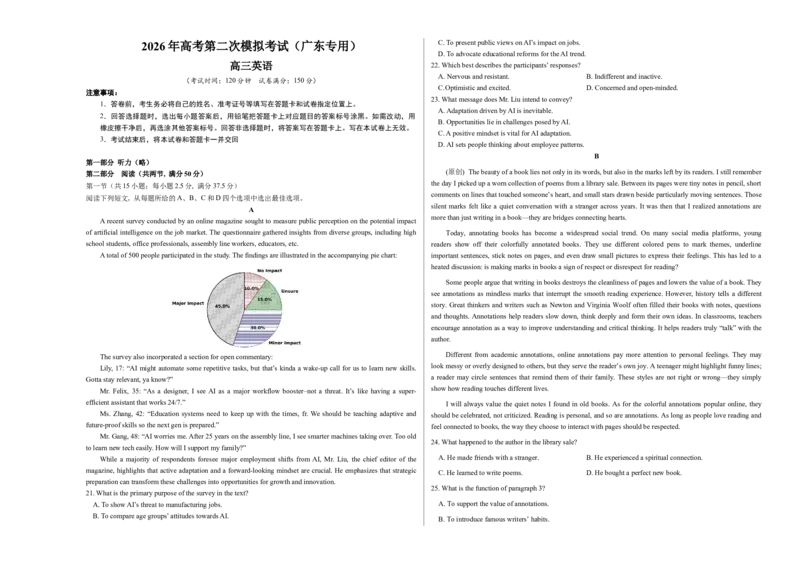
A total of 500 people participated in the study. The findings are illustrated in the accompanying pie chart:
The survey also incorporated a section for open commentary:
Lily, 17: “AI might automate some repetitive tasks, but that’s kinda a wake-up call for us to learn new skills.
Gotta stay relevant, ya know?”
Mr. Felix, 35: “As a designer, I see AI as a major workflow booster–not a threat. It’s like having a super-
efficient assistant that works 24/7.”
Ms. Zhang, 42: “Education systems need to keep up with the times, fr. We should be teaching adaptive and
future-proof skills so the next gen is prepared.”
Mr. Gang, 48: “AI worries me. After 25 years on the assembly line, I see smarter machines taking over. Too old
to learn new tech easily. How will I support my family?”
While a majority of respondents foresee major employment shifts from AI, Mr. Liu, the chief editor of the
magazine, highlights that active adaptation and a forward-looking mindset are crucial. He emphasizes that strategic
preparation can transform these challenges into opportunities for growth and innovation.
21. What is the primary purpose of the survey in the text?
A. To show AI’s threat to manufacturing jobs.
B. To compare age groups’ attitudes towards AI.
C. To present public views on AI’s impact on jobs.
D. To advocate educational reforms for the AI trend.
22. Which best describes the participants’ responses?
A. Nervous and resistant.
B. Indifferent and inactive.
C.Optimistic and excited.
D. Concerned and open-minded.
23. What message does Mr. Liu intend to convey?
A. Adaptation driven by AI is inevitable.
B. Opportunities lie in challenges posed by AI.
C. A positive mindset is vital for AI adaptation.
D. AI sets people thinking about employee patterns.
B
(原创) The beauty of a book lies not only in its words, but also in the marks left by its readers. I still remember
the day I picked up a worn collection of poems from a library sale. Between its pages were tiny notes in pencil, short
comments on lines that touched someone’s heart, and small stars drawn beside particularly moving sentences. Those
silent marks felt like a quiet conversation with a stranger across years. It was then that I realized annotations are
more than just writing in a book—they are bridges connecting hearts.
Today, annotating books has become a widespread social trend. On many social media platforms, young
readers show off their colorfully annotated books. They use different colored pens to mark themes, underline
important sentences, stick notes on pages, and even draw small pictures to express their feelings. This has led to a
heated discussion: is making marks in books a sign of respect or disrespect for reading?
Some people argue that writing in books destroys the cleanliness of pages and lowers the value of a book. They
see annotations as mindless marks that interrupt the smooth reading experience. However, history tells a different
story. Great thinkers and writers such as Newton and Virginia Woolf often filled their books with notes, questions
and thoughts. Annotations help readers slow down, think deeply and form their own ideas. In classrooms, teachers
encourage annotation as a way to improve understanding and critical thinking. It helps readers truly “talk” with the
author.
Different from academic annotations, online annotations pay more attention to personal feelings. They may
look messy or overly designed to others, but they serve the reader’s own joy. A teenager might highlight funny lines;
a reader may circle sentences that remind them of their family. These styles are not right or wrong—they simply
show how reading touches different lives.
I will always value the quiet notes I found in old books. As for the colorful annotations popular online, they
should be celebrated, not criticized. Reading is personal, and so are annotations. As long as people love reading and
feel connected to books, the way they choose to interact with pages should be respected.
24. What happened to the author in the library sale?
A. He made friends with a stranger.
B. He experienced a spiritual connection.
C. He learned to write poems.
D. He bought a perfect new book.
25. What is the function of paragraph 3?
A. To support the value of annotations.
B. To introduce famous writers’ habits.
C. To blame improper reading behaviors.
D. To explain how to annotate academically.
26. Which word best describes online annotations?
A. Traditional.
B. Standard.
C. Formal.
D. Personal.
27. What does the author want to express in the last paragraph?
A. Old books are more valuable than new ones.
B. People should keep books clean and tidy.
C. Young readers spend too much time online.
D. Different annotation styles deserve respect.
C
(原创) We often hear the same advice from parents, teachers and self-help books: “Think positive, and
everything will get better.” For years, I guided my students and friends with this idea. I told them that a positive
mind is the key to solving life’s difficulties and that they should never give in to negative feelings. I truly believed
that positive thinking could magically fix any problem.
Then I started to dig deeper into this so-called “positive thinking culture” as a psychologist. I studied different
social groups and interviewed hundreds of people about how they dealt with stress and failure. What I discovered
completely changed my mind.
Many people nowadays treat positive thinking as a necessary life skill. Especially in difficult times, people are
told to focus only on the bright side and avoid sad or angry thoughts. Supporters argue that positive thinking builds
confidence, reduces stress, and helps people move on quickly from hard experiences. It has become such a popular
idea that we seldom question whether it actually works for everyone.
However, my research shows that forcing positivity often does more harm than good. It can exacerbate
people’s mental stress and deepen feelings of loneliness. When people are told to “just cheer up” during serious
difficulties, they may hide their true feelings and refuse to seek help. Worse still, this culture unfairly blames the
victims. If someone remains sad or fails to improve, society often thinks it is their own fault for “not being positive
enough”. This creates hidden unfairness toward people who are already struggling in life.
What’s more, the “positive thinking only” culture benefits certain groups more. Companies and social media
influencers often promote this idea because it makes people accept their difficulties passively instead of asking for
real changes. Workers who keep “thinking positive” may silently stand low pay and heavy work without
complaining. In this way, the blind positivity that is widely celebrated actually serves the needs of those in power.
28. What did the author advise people to do for years?
A. Develop life skills actively.
B. Focus on positive thinking.
C. Solve problems independently.
D. Ask for help when feeling down.
29. How did the author feel after his research on positive thinking?
A. Doubtful about further study.
B. Satisfied with its wide influence.
C. Surprised by its hidden harm.
D. Confident of its practical value.
30. What does the underlined word “exacerbate” in Paragraph 4 most probably mean?
A. Reduce.

B. Worsen.

C. Relieve.
 D. Cause.
31. What does the author say about the “positive thinking only” culture?
A. It helps workers improve their living standards.
B. It encourages people to fight for social changes.
C. It equally supports every group in modern society.
D. It makes people passively accept unfair situations..
D
The effects of high altitude (海拔) on the human body could protect against obesity (肥胖), according
to a study of more than 4 million children across Colombia. The findings support the theory that low
oxygen levels drive increased energy consumption, though prior evidence comes mainly from adults.
To understand the potential impact on children, Lizcano Losada at the University of La Sabana analysed data
on 4.16 million children aged up to 5 years old from 1123 cities. The children were separated into four groups
relating to the height above sea level at which they lived: up to 1000 metres, 1001 to 2000 metres, 2001 to 3000
metres or above 3000 metres.
In the two lower-altitude regions, around 80 out of every 10,000 children had obesity. However, at
altitudes of 2001 to 3000 metres, the prevalence (发生率) of obesity fell to 40 in 10,000. At altitudes
above 3000 metres, the prevalence was higher again: 86 out of 10,000. However, the team says this may be a
statistical accident, as this data set included fewer cities and children than the other three altitude ranges.
“That’s a fair comment,” says David Stensel at Loughborough University. But he also emphasises the study is
observational, so it doesn’t prove high altitude prevents obesity. “They’ve tried to make sure they’ve adjusted for the
other potential influencing factors,” he says. These include measures of poverty and low income. But “you can’t
account for everything”, says Stensel. Assuming high altitude really does make obesity less likely, Stensel says it
isn’t clear how this knowledge could be of practical use in reducing the condition.
However, Losada argues the findings support the creation of geographically tailored public health strategies.
He suggests further studies are needed to better understand the biological pathways linking altitude to childhood
obesity, which could lead to more precise health advice for different regions.
32. What was the analysis in Losada’s study mainly based on?
A. Grouped data.
B. Sample size.
C. Children’s age.
D. City type.
33. What is the team’s view on the unexpected result of the study?
A. It’s a definite trend.
B. It’s a misleading signal.
C. It’s a chance occurrence.
D. It’s a measurement error.
34. What does the author try to illustrate by mentioning Stensel in paragraph 4?
A. The importance of health knowledge.
B. The necessity of actionable strategies.
C. The limitation of the research method.
D. The complexity of the influencing factors.
35. Which of the following is the best title for the text?
A. Altitude’s Role in Childhood Weight
B. Less Oxygen, Healthier Children?
C. A New Approach to Fighting Obesity
D. Why the Weight Gap in Colombia?
第二节(共5 小题;每小题2.5 分, 满分12.5 分)
阅读下面短文, 从短文后的选项中选出可以填入空白处的最佳选项。选项中有两项为多余选项。
According to a 2024 attention study by King’s College London, 49% of the UK public are
experiencing “popcorn (爆米花) brain”, a mental state featuring divided attention and wandering thoughts.
____36____ In response to the findings, psychologist Tina Chummun gives her top tips.
Adopt the mind map method. To manage a distracted (分心的) mind, write down everything, like
appointments, worries and to - dos, without organizing it initially. Once everything is on paper, group these
into life areas like work or emotional wellbeing. ____37____ This creates order and gives your brain
permission to concentrate.
Every time you feel your thoughts wandering, give yourself three seconds — breathe in, name what you’re
feeling, and redirect your focus. ____38____ By doing so, you may turn down the heat when your brain is working
overtime.
Minimizing tech is also the key to getting back on track in your daily life. A full digital withdrawal is
unrealistic. ____39____ Then it could be followed by a five-minute screen time reward. It teaches your brain to
tolerate stillness without feeling punished.
____40____ At first, you may feel bored, as popcorn brain likes being ‘go go go’ to feel safe. “Go for a walk
without music, or simply stare out your window,” suggests Tina. “Sit in silence and observe your thoughts. Let your
brain breathe. It is sometimes exactly what your nervous system needs.”
So, are you ready to quiet the mental popcorn and get your focus back?
A. Allow space in your day for doing nothing.
B. So, what’s making our brains pop like popcorn?
C. Instead, go totally screen-free for 25-30 minutes.
D. Starving distractions and feeding focus is a nice idea.
E. Then ask yourself: what matters now and what can wait?
F. They feel their attention less focused and deep thinking rarer.
G. This practice enables you to slow down and manage emotions.
第三部分 语言运用(共两节,满分30 分)
第一节(共15 小题,每小题1 分,满分15 分)
阅读下面短文, 从每题所给的A、B、C 和D 四个选项中选出可以填入空白处的最佳选项。
原创(改编自2024 年《The Guardian》真实新闻)
It was a cold winter morning in St. Louis. A 10-year-old boy named Andy stood     41
     at the therapy
center’s door, his small hands clutching a teddy bear — his only comfort.
Born with a developmental disorder, Andy could barely walk without support and only     42
       a few simple
words, repeating others’ words like an echo. Every morning, his mom hugged him tightly, her eyes filled with
worry, as she     43
       him to the therapists promising to help him.
At first, Andy     4  4       the therapy fiercely. He cried when his mom left, kicked equipment and refused to
cooperate, feeling scared and alone. His therapist, Ms. Davis, never lost patience. Instead of pushing him, she sat
beside him, spoke in a     4  5       voice, and slowly gained his trust. “You’re stronger than you think,” she said softly.
That gentle encouragement     4  6       Andy’s world entirely. He began looking forward to therapy, working
hard even when muscles ached. He practiced walking daily, from holding the wall to taking small steps alone. When
he     4  7       said his first complete sentence—“I can do it”—Ms. Davis and his mom cried for joy.
Months later, Andy’s progress was     4  8       . He could walk freely, speak clearly, and join classmates in
simple games. More importantly, he gained a strong sense of     4  9       , no longer feeling like a burden.
Today, 15-year-old Andy often visits the center to help kids in the same     50
       he once faced. “Ms. Davis
gave me courage,” he says. “Now I want to be that courage for others.”
Andy’s journey teaches us adversity is not a dead end, but a     51
       to grow. The     52
       of one person — a
kind word, a patient smile — can spark lifelong change. When we     5  3       for those struggling, we help them and
find our own strength.
Andy has     54
       many people like Ms. Davis, whose quiet kindness reminds us strength lies in small, steady
choices. In the end, what connects us is our willingness to     55
       each other’s weaknesses and grow stronger
together.
41. A. hesitating
B. wandering
C. hiding
D. resting
42. A. wrote
B. spoke
C. copied
D. remembered
43. A. sent
B. pushed
C. led
D. carried
44. A. accepted
B. avoided
C. ignored
D. feared
45. A. soft
B. loud
C. firm
D. sharp
46. A. entered
B. widened
C. brightened
D. transformed
47. A. finally
B. suddenly
C. quietly
D. quickly
48. A. slow
B. steady
C. amazing
D. slight
49. A. pride
B. confidence
C. humor
D. curiosity
50. A. pain
B. difficulty
C. journey
D. struggle
51. A. chance
B. challenge
C. barrier
D. path
52. A. words
B. actions
C. presence
D. influence
53. A. reach out
B. look out
C. stand out
D. turn out
54. A. met
B. noticed
C. recognized
D. helped
55. A. share
B. bear
C. embrace
D. overcome
第二节(共10 小题;每小题1.5 分,满分15 分)
阅读下面短文,在空白处填入1 个适当的单词或括号内单词的正确形式。
(原创) Chinese tea culture, dating back to more than 5,000 years, is an important part of traditional Chinese
civilization. In 2022, traditional Chinese tea-making techniques and associated social practices
  56

   (add) to the
UNESCO Intangible Cultural Heritage List.
Originally
  5 7
   (use) as a medicinal drink, tea gradually evolved into a daily beverage. The process of
making tea is far more than a simple action; it reflects people’s pursuit of
  5 8
   (relax) and elegance. Different
regions in China have developed distinct tea varieties, such as green tea, black tea, and oolong tea, each with
  5 9
(it) unique flavor and preparation methods.
Tea drinking is closely connected
  60

   Chinese people’s daily life. It appears in almost every kind of social
occasion, from family gatherings to business meetings. Serving tea to guests is considered
  61

   polite manner in
Chinese culture.
Today,
  62

   modern lifestyles are changing rapidly, the tradition of tea drinking is being preserved and
promoted. Many young people are keen
  63

   (learn) tea art and tea ceremonies, helping bring the ancient culture
closer to modern society. Some creative designers combine tea culture with modern design, making it
  64


(wide) accepted.
Chinese tea culture,
  65

   connects the past and the present, is not only a treasure of China but also a shared
wealth of the world.
第四部分 写作(共两节, 满分40 分)
第一节(满分15 分)
假定你是李华,你校将为国际留学生组织一日研学活动。现向全校征集研学方案,主题是“传统与现
代”(Tradition and Modernity)。请给负责人Mr. Smith 写一封邮件,内容包括:
1. 活动方案;
2. 阐明理由。
注意:
1. 词数80 左右;
2. 可适当增加细节,以使行文连贯。
Dear Mr. Smith,
_____________________________________________________________________________________________
_____________________________________________________________________________________________
_____________________________________________________________________________________________
_____________________________________________________________________________________________
_____________________________________________________________________________________________
Yours,
Li Hua
第二节(满分25 分)
阅读下面材料,根据其内容和所给段落开头语续写两段,使之构成一篇完整的短文。
注意:
1.续写词数应为150 个左右;
2.请按如下格式在答题纸的相应位置作答。
Tom placed the newspaper on the table but the action felt as heavy as a burden. Mary watched her father’s
shoulders sink. She took a quick look at the headline: Go for the City Marathon.
Tom had run every City Marathon for twenty-three years in a row. This year, after a routine health check, his
doctor’s quiet “No marathons” changed everything.
When Mary asked why skipping just one race hurt so much, Tom shook his head and said it wasn’t just the
race. He didn’t explain further.
Mary thought she knew why. For as long as she could remember, her father had trained hard for the event each
year. When she was old enough, Tom took her along, always encouraging her: “You can do it.” As she grew older,
she stopped running, and those shared moments slipped away. Yet she still remembered the look of
accomplishment (成就) on his face after every finish. The marathon was like an annual ritual that kept
fueling his ordinary life.
The next morning at the table, Mary told Tom she would join the City Marathon. When she added, “And maybe
you can coach me,” she caught a flash of brightness in his eyes.
“Deal,” he said.
Training began the next day. Since Tom was not allowed to run, he brought out his old red motorcycle and
became Mary’s moving guide. He planned routes through the quiet roads near their home: first five kilometers, then
ten, then fifteen. He shouted numbers over the engine’s noise, threw her water bottles like in a relay, and
stuck paper flags on mailboxes: I am strong. I am fast. I am determined. These were the same slogans
(口号) he once used to encourage himself. Now, they cheered Mary on.
注意:
1. 所续写短文的词数应为150 左右;
2.续写部分分为两段,每段的开头语已为你写好;
Paragraph 1:
The training was tough.


Paragraph 2:
Finally, the big day came.