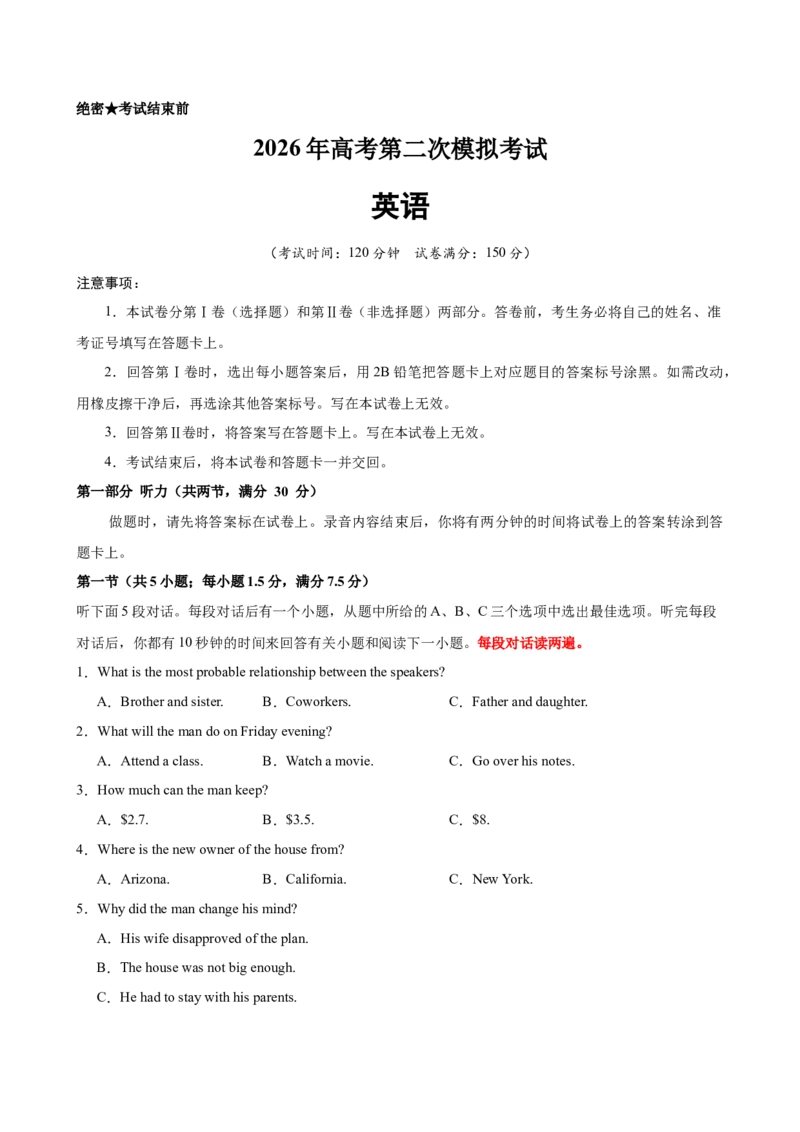
绝密★考试结束前
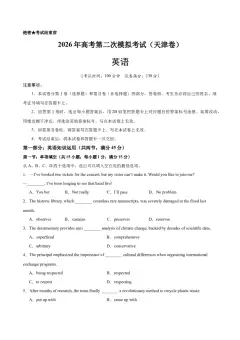
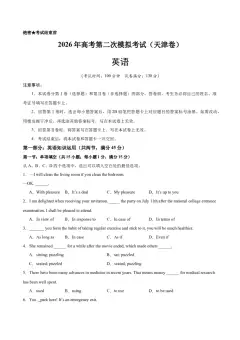
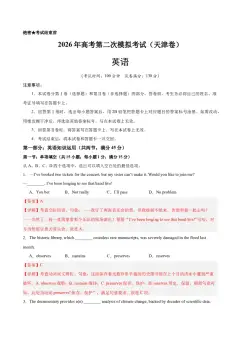
2026 年高考第二次模拟考试
英语
(考试时间:120 分钟  试卷满分:150 分)
注意事项:
1.本试卷分第Ⅰ卷(选择题)和第Ⅱ卷(非选择题)两部分。答卷前,考生务必将自己的姓名、准
考证号填写在答题卡上。
2.回答第Ⅰ卷时,选出每小题答案后,用2B 铅笔把答题卡上对应题目的答案标号涂黑。如需改动,
用橡皮擦干净后,再选涂其他答案标号。写在本试卷上无效。
3.回答第Ⅱ卷时,将答案写在答题卡上。写在本试卷上无效。
4.考试结束后,将本试卷和答题卡一并交回。
第一部分 听力(共两节,满分 30 分)
做题时,请先将答案标在试卷上。录音内容结束后,你将有两分钟的时间将试卷上的答案转涂到答
题卡上。
第一节(共5 小题;每小题1.5 分,满分7.5 分)
听下面5 段对话。每段对话后有一个小题,从题中所给的A、B、C 三个选项中选出最佳选项。听完每段
对话后,你都有10 秒钟的时间来回答有关小题和阅读下一小题。每段对话读两遍。
1.What is the most probable relationship between the speakers?
A.Brother and sister.
B.Coworkers.
C.Father and daughter.
2.What will the man do on Friday evening?
A.Attend a class.
B.Watch a movie.
C.Go over his notes.
3.How much can the man keep?
A.$2.7.
B.$3.5.
C.$8.
4.Where is the new owner of the house from?
A.Arizona.
B.California.
C.New York.
5.Why did the man change his mind?
A.His wife disapproved of the plan.
B.The house was not big enough.
C.He had to stay with his parents.
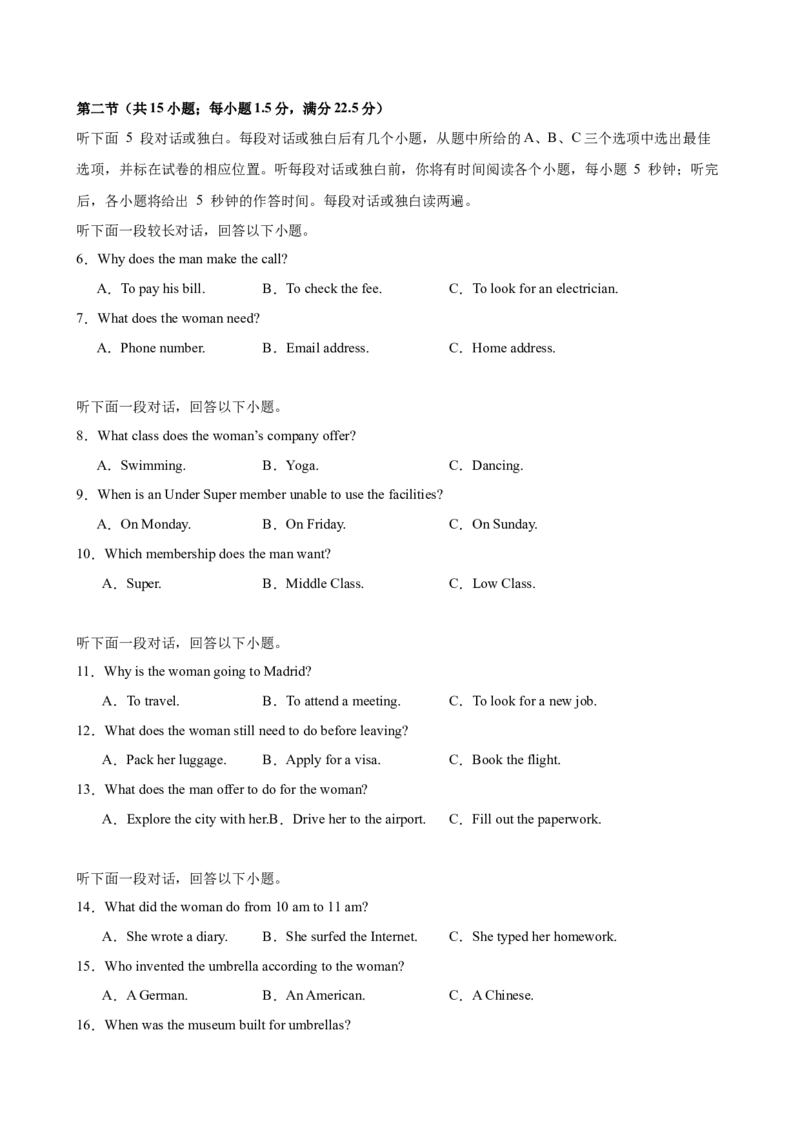
第二节(共15 小题;每小题1.5 分,满分22.5 分)
听下面 5 段对话或独白。每段对话或独白后有几个小题,从题中所给的A、B、C 三个选项中选出最佳
选项,并标在试卷的相应位置。听每段对话或独白前,你将有时间阅读各个小题,每小题 5 秒钟;听完
后,各小题将给出 5 秒钟的作答时间。每段对话或独白读两遍。
听下面一段较长对话,回答以下小题。
6.Why does the man make the call?
A.To pay his bill.
B.To check the fee.
C.To look for an electrician.
7.What does the woman need?
A.Phone number.
B.Email address.
C.Home address.
听下面一段对话,回答以下小题。
8.What class does the woman’s company offer?
A.Swimming.
B.Yoga.
C.Dancing.
9.When is an Under Super member unable to use the facilities?
A.On Monday.
B.On Friday.
C.On Sunday.
10.Which membership does the man want?
A.Super.
B.Middle Class.
C.Low Class.
听下面一段对话,回答以下小题。
11.Why is the woman going to Madrid?
A.To travel.
B.To attend a meeting.
C.To look for a new job.
12.What does the woman still need to do before leaving?
A.Pack her luggage.
B.Apply for a visa.
C.Book the flight.
13.What does the man offer to do for the woman?
A.Explore the city with her.B.Drive her to the airport.
C.Fill out the paperwork.
听下面一段对话,回答以下小题。
14.What did the woman do from 10 am to 11 am?
A.She wrote a diary.
B.She surfed the Internet.
C.She typed her homework.
15.Who invented the umbrella according to the woman?
A.A German.
B.An American.
C.A Chinese.
16.When was the museum built for umbrellas?
A.In the 20th century.
B.In the 19th century.
C.In the 18th century.
17.What is the man?
A.A teacher.
B.A reporter.
C.A historian.
听下面一段独白,回答以下小题。
18.What will David talk about?
A.Birds.
B.Movies.
C.Ants.
19.What can the visitors learn from the demonstration?
A.Birds’ seasonal travels.
B.Teaching insects how to fly.
C.How to attract wildlife to gardens.
20.Who will host the last event?
A.Tasha.
B.The speaker.
C.Monica.
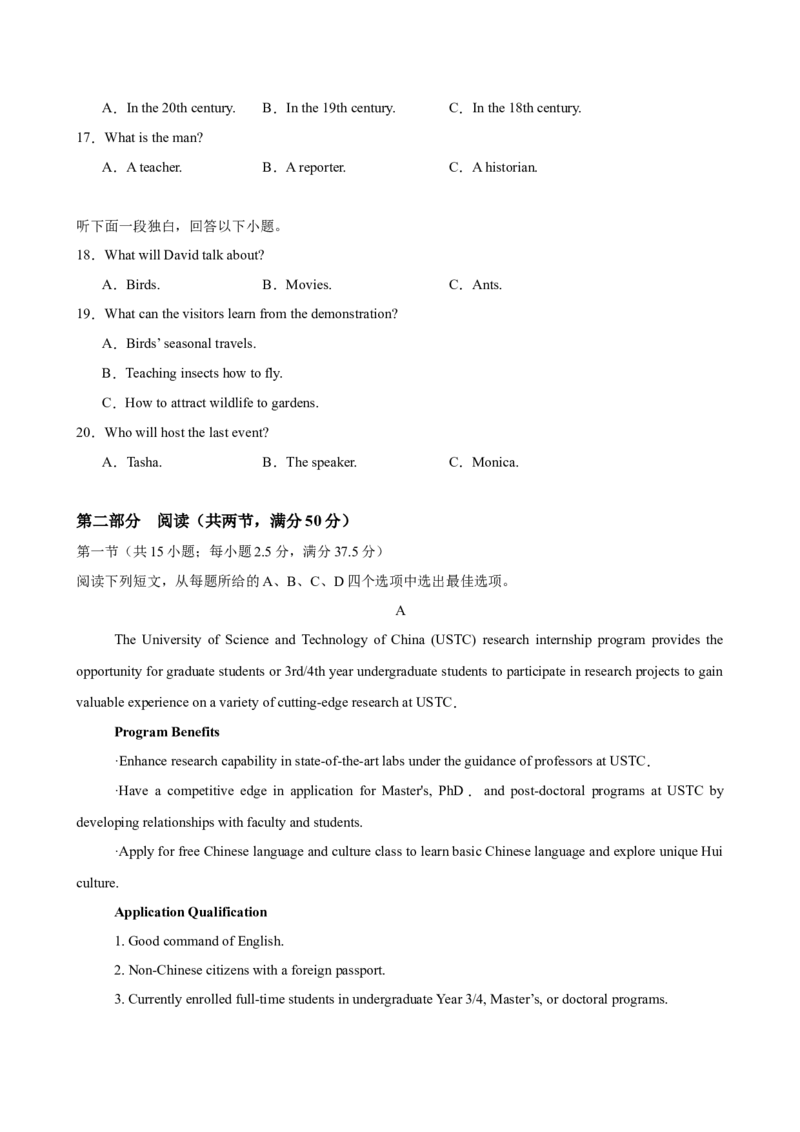
第二部分  阅读(共两节,满分50 分)
第一节(共15 小题;每小题2.5 分,满分37.5 分)
阅读下列短文,从每题所给的A、B、C、D 四个选项中选出最佳选项。
A
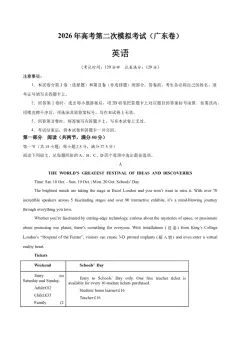
The University of Science and Technology of China (USTC) research internship program provides the
opportunity for graduate students or 3rd/4th year undergraduate students to participate in research projects to gain
valuable experience on a variety of cutting-edge research at USTC.
Program Benefits
·Enhance research capability in state-of-the-art labs under the guidance of professors at USTC.
·Have a competitive edge in application for Master's, PhD .and post-doctoral programs at USTC by
developing relationships with faculty and students.
·Apply for free Chinese language and culture class to learn basic Chinese language and explore unique Hui
culture.
Application Qualification
1. Good command of English.
2. Non-Chinese citizens with a foreign passport.
3. Currently enrolled full-time students in undergraduate Year 3/4, Master’s, or doctoral programs.
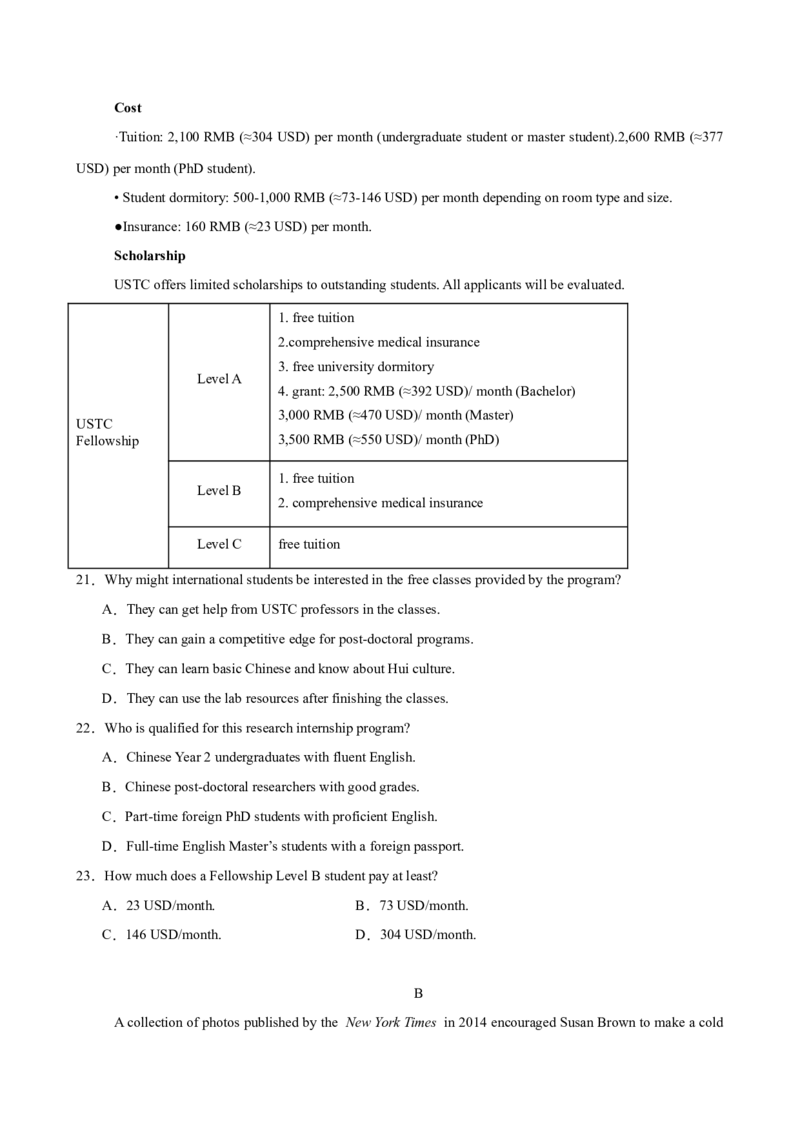
Cost
·Tuition: 2,100 RMB (≈304 USD) per month (undergraduate student or master student).2,600 RMB (≈377
USD) per month (PhD student).
• Student dormitory: 500-1,000 RMB (≈73-146 USD) per month depending on room type and size.
●Insurance: 160 RMB (≈23 USD) per month.
Scholarship
USTC offers limited scholarships to outstanding students. All applicants will be evaluated.
USTC
Fellowship
Level A
1. free tuition
2.comprehensive medical insurance
3. free university dormitory
4. grant: 2,500 RMB (≈392 USD)/ month (Bachelor)
3,000 RMB (≈470 USD)/ month (Master)
3,500 RMB (≈550 USD)/ month (PhD)
Level B
1. free tuition
2. comprehensive medical insurance
Level C
free tuition
21.Why might international students be interested in the free classes provided by the program?
A.They can get help from USTC professors in the classes.
B.They can gain a competitive edge for post-doctoral programs.
C.They can learn basic Chinese and know about Hui culture.
D.They can use the lab resources after finishing the classes.
22.Who is qualified for this research internship program?
A.Chinese Year 2 undergraduates with fluent English.
B.Chinese post-doctoral researchers with good grades.
C.Part-time foreign PhD students with proficient English.
D.Full-time English Master’s students with a foreign passport.
23.How much does a Fellowship Level B student pay at least?
A.23 USD/month.
B.73 USD/month.
C.146 USD/month.
D.304 USD/month.
B
A collection of photos published by the New York Times in 2014 encouraged Susan Brown to make a cold
call. It wasn’t usually her style, but the pictures delighted her, and she felt an urge to get in touch with the
photographer.
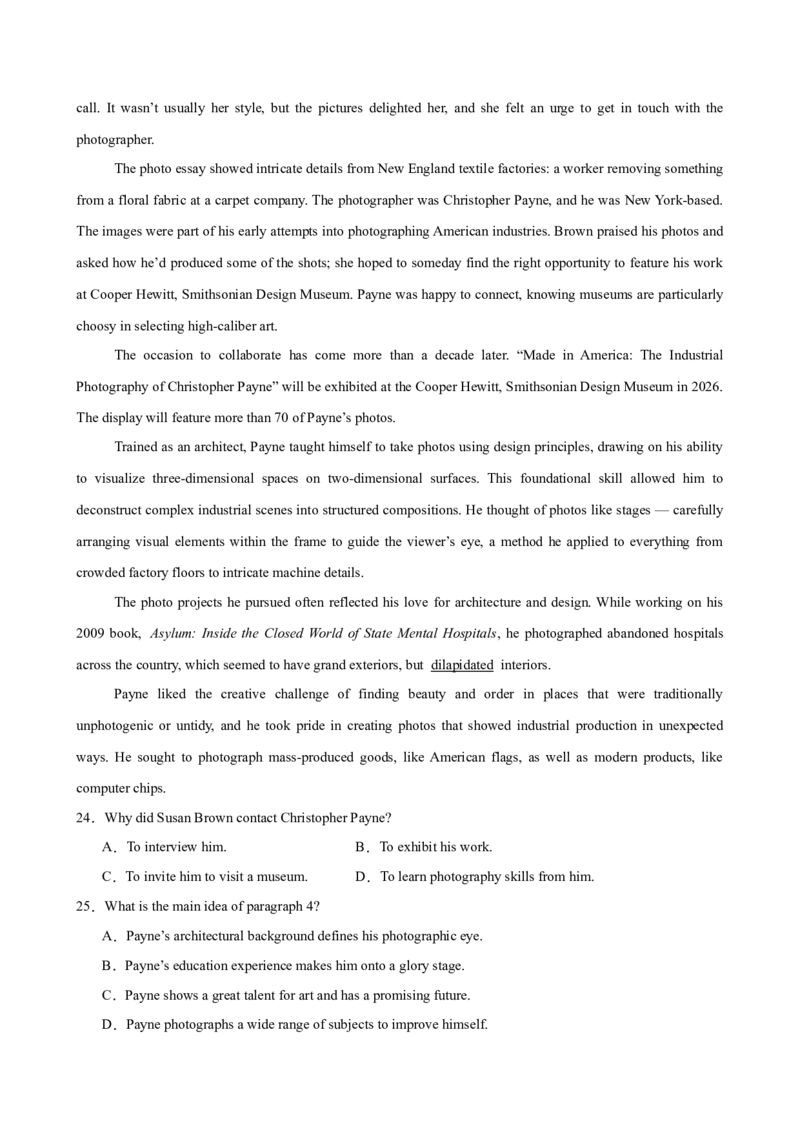
The photo essay showed intricate details from New England textile factories: a worker removing something
from a floral fabric at a carpet company. The photographer was Christopher Payne, and he was New York-based.
The images were part of his early attempts into photographing American industries. Brown praised his photos and
asked how he’d produced some of the shots; she hoped to someday find the right opportunity to feature his work
at Cooper Hewitt, Smithsonian Design Museum. Payne was happy to connect, knowing museums are particularly
choosy in selecting high-caliber art.
The occasion to collaborate has come more than a decade later. “Made in America: The Industrial
Photography of Christopher Payne” will be exhibited at the Cooper Hewitt, Smithsonian Design Museum in 2026.
The display will feature more than 70 of Payne’s photos.
Trained as an architect, Payne taught himself to take photos using design principles, drawing on his ability
to visualize three-dimensional spaces on two-dimensional surfaces. This foundational skill allowed him to
deconstruct complex industrial scenes into structured compositions. He thought of photos like stages — carefully
arranging visual elements within the frame to guide the viewer’s eye, a method he applied to everything from
crowded factory floors to intricate machine details.
The photo projects he pursued often reflected his love for architecture and design. While working on his
2009 book, Asylum: Inside the Closed World of State Mental Hospitals, he photographed abandoned hospitals
across the country, which seemed to have grand exteriors, but dilapidated interiors.
Payne liked the creative challenge of finding beauty and order in places that were traditionally
unphotogenic or untidy, and he took pride in creating photos that showed industrial production in unexpected
ways. He sought to photograph mass-produced goods, like American flags, as well as modern products, like
computer chips.
24.Why did Susan Brown contact Christopher Payne?
A.To interview him.
B.To exhibit his work.
C.To invite him to visit a museum.
D.To learn photography skills from him.
25.What is the main idea of paragraph 4?
A.Payne’s architectural background defines his photographic eye.
B.Payne’s education experience makes him onto a glory stage.
C.Payne shows a great talent for art and has a promising future.
D.Payne photographs a wide range of subjects to improve himself.
26.What does the underlined word “dilapidated” in paragraph 5 probably mean?
A.Beautifully decorated.
B.Well preserved.
C.Badly damaged. D.Brightly lit.
27.How does Payne show industrial production?
A.By highlighting natural disorder.
B.By focusing on modern computer chips.
C.By revealing beauty in common products.
D.By following traditional photographic techniques.
C
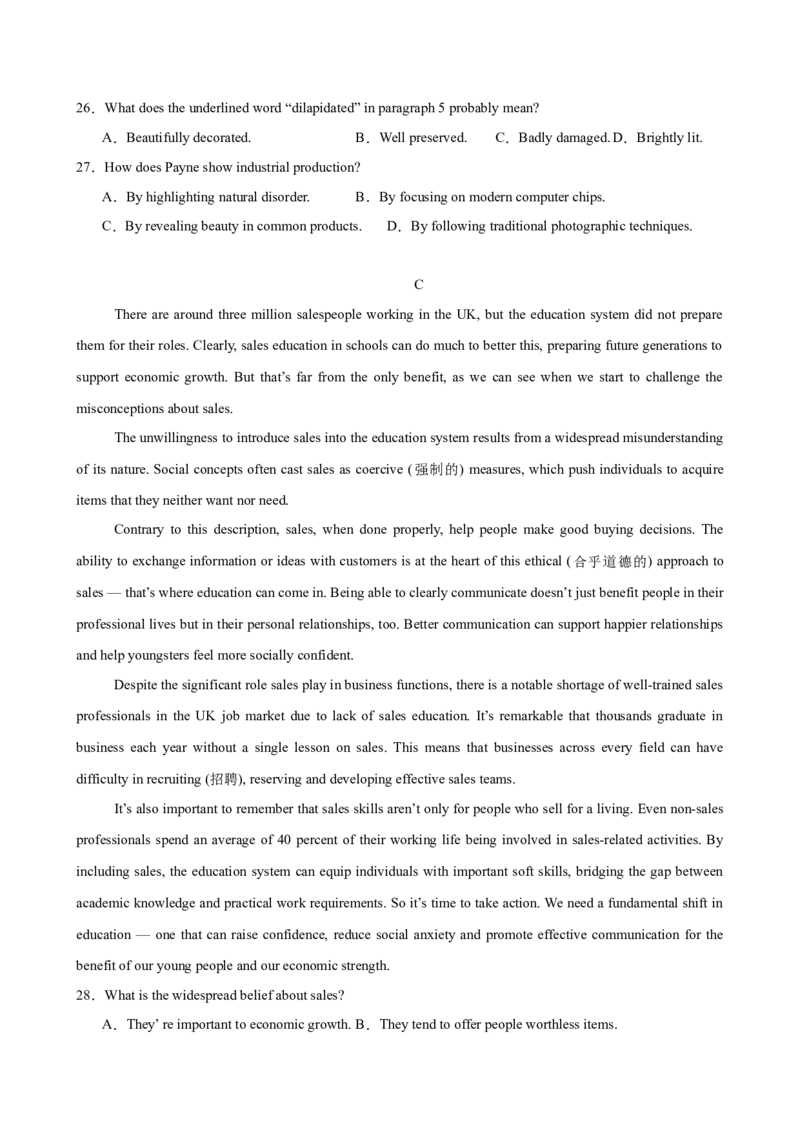
There are around three million salespeople working in the UK, but the education system did not prepare
them for their roles. Clearly, sales education in schools can do much to better this, preparing future generations to
support economic growth. But that’s far from the only benefit, as we can see when we start to challenge the
misconceptions about sales.
The unwillingness to introduce sales into the education system results from a widespread misunderstanding
of its nature. Social concepts often cast sales as coercive (强制的) measures, which push individuals to acquire
items that they neither want nor need.
Contrary to this description, sales, when done properly, help people make good buying decisions. The
ability to exchange information or ideas with customers is at the heart of this ethical (合乎道德的) approach to
sales — that’s where education can come in. Being able to clearly communicate doesn’t just benefit people in their
professional lives but in their personal relationships, too. Better communication can support happier relationships
and help youngsters feel more socially confident.
Despite the significant role sales play in business functions, there is a notable shortage of well-trained sales
professionals in the UK job market due to lack of sales education. It’s remarkable that thousands graduate in
business each year without a single lesson on sales. This means that businesses across every field can have
difficulty in recruiting (招聘), reserving and developing effective sales teams.
It’s also important to remember that sales skills aren’t only for people who sell for a living. Even non-sales
professionals spend an average of 40 percent of their working life being involved in sales-related activities. By
including sales, the education system can equip individuals with important soft skills, bridging the gap between
academic knowledge and practical work requirements. So it’s time to take action. We need a fundamental shift in
education — one that can raise confidence, reduce social anxiety and promote effective communication for the
benefit of our young people and our economic strength.
28.What is the widespread belief about sales?
A.They’ re important to economic growth. B.They tend to offer people worthless items.
C.They often go against people’s will.
D.They help with decision-making about purchases.
29.Which is the key to selling properly?
A.Overall education on sales.
B.Effective communication.
C.A rise in social confidence.
D.A well-trained sales team.
30.What does paragraph 4 mainly talk about?
A.Sales-related challenges for businesses. B.Workforce needs in the UK job market.
C.The current situation of sales education. D.The value of sales in business functions.
31.What message is conveyed in the last part of the text?
A.It’s time to expand the young workforce.
B.Sales-related activities make up 40% of one’s life.
C.Theory and practice should be tied closely in education.
D.Sales skills benefit professionals and non-professionals.
D
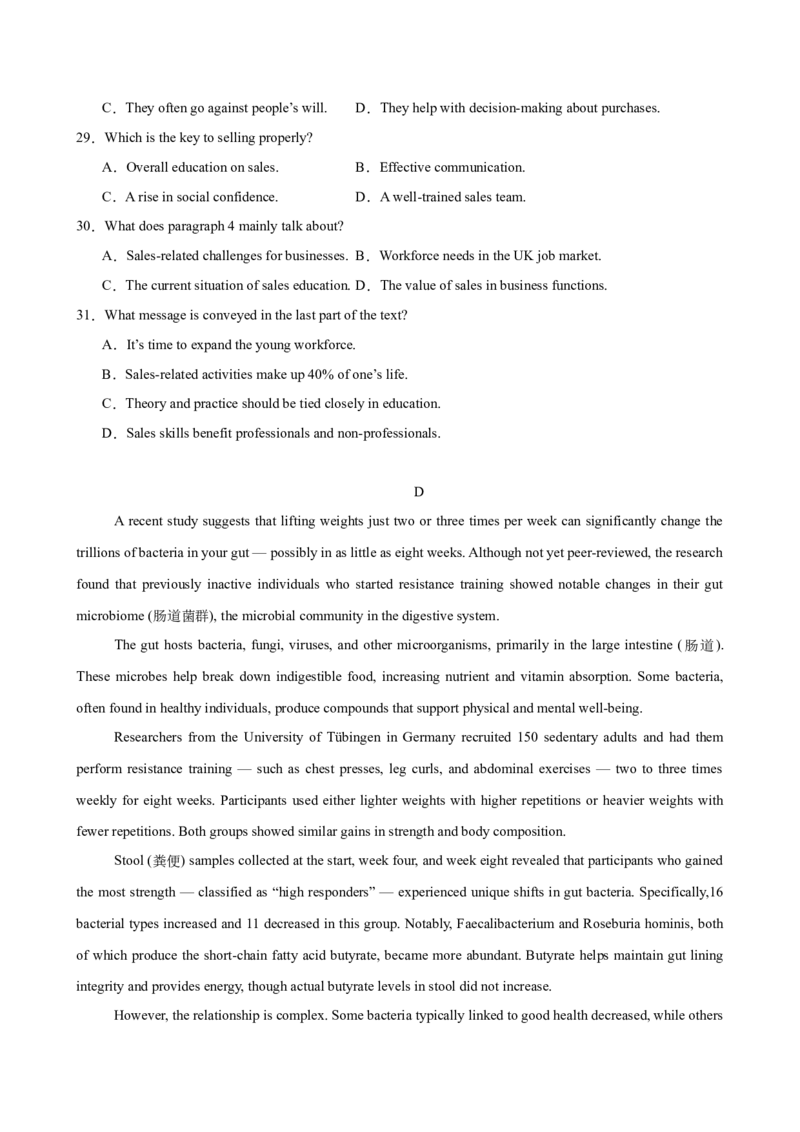
A recent study suggests that lifting weights just two or three times per week can significantly change the
trillions of bacteria in your gut — possibly in as little as eight weeks. Although not yet peer-reviewed, the research
found that previously inactive individuals who started resistance training showed notable changes in their gut
microbiome (肠道菌群), the microbial community in the digestive system.
The gut hosts bacteria, fungi, viruses, and other microorganisms, primarily in the large intestine ( 肠道).
These microbes help break down indigestible food, increasing nutrient and vitamin absorption. Some bacteria,
often found in healthy individuals, produce compounds that support physical and mental well-being.
Researchers from the University of Tübingen in Germany recruited 150 sedentary adults and had them
perform resistance training — such as chest presses, leg curls, and abdominal exercises — two to three times
weekly for eight weeks. Participants used either lighter weights with higher repetitions or heavier weights with
fewer repetitions. Both groups showed similar gains in strength and body composition.
Stool (粪便) samples collected at the start, week four, and week eight revealed that participants who gained
the most strength — classified as “high responders” — experienced unique shifts in gut bacteria. Specifically,16
bacterial types increased and 11 decreased in this group. Notably, Faecalibacterium and Roseburia hominis, both
of which produce the short-chain fatty acid butyrate, became more abundant. Butyrate helps maintain gut lining
integrity and provides energy, though actual butyrate levels in stool did not increase.
However, the relationship is complex. Some bacteria typically linked to good health decreased, while others
associated with poor health increased, underscoring the uniqueness of each person’s microbiome. The study
cannot confirm whether gut changes caused strength improvements or vice versa. Diet, though participants were
instructed not to change it, may also have influenced results.
While this small-scale study awaits peer review, it reinforces the idea that lifestyle choices — including
exercise — can shape our inner microbial world. Regardless of its specific impact on gut bacteria, exercise
remains a key component of physical and mental health.
32.What is the main finding of the study?
A.Weightlifting is best for physical health.
B.Resistance training changes gut bacteria.
C.Doing exercise increases microbiome.
D.Changing diet benefits the digestive system.
33.What was noticeable about the gut bacteria changes in “high responders”?
A.The decrease in types of bacteria.
B.The growth of identical bacteria.
C.The boost of butyrate-producing bacteria.
D.The removal of bacteria linked to poor health.
34.What does the author mean by stating “the relationship is complex” in the fifth paragraph?
A.Study results are contradictory and unreliable.
B.The gut-exercise link is not straightforward.
C.Weightlifting is too complicated to understand.
D.Resistance training benefits highly trained athletes.
35.What is the author’s conclusion about exercise?
A.It should await further research findings.
B.It may benefit from gut bacteria changes.
C.It remains important despite gut effects.
D.It helps high responders specifically.
第二节(共5 小题;每小题2.5 分,满分12.5 分)
阅读下面短文,从短文后的选项中选出可以填入空白处的最佳选项。选项中有两项为多余选项。
The Chinese market remains highly attractive to Swiss watch executives (高管).     36     “We are far
away and cannot physically experience new developments in the market,” Antoine Pin, CEO of Bulgari (宝格丽),
noted. “Sometimes we feel we are lagging behind. We have to maintain constant attention and take every
occurrence seriously.”
    37     Julien Tornare, CEO of another watch brand, Zenith (真力时), said they experienced this
firsthand. Initially, they relied on global marketing themes, which led to disappointing sales and weak online
engagement for the brand in China, exposing the risk of a one-size-fits-all approach.     38     They appointed
a Chinese star as the brand ambassador, which triggered an unprecedented consumer response. Social media
further amplified this response and translated the online buzz into immediate offline purchases.
“When we announced the star at the beginning of July, we got 342 million views on Weibo,” one of China’s
most popular social media platforms, said Mr. Tornare on a recent phone call. “Then, within a few hours, we got
nine million views of our announcement video. And we sold more watches in 24 hours than in a whole month.”
39
Across all sales channels, retail grew 450% year-on-year. “People literally left home to buy watches after
hearing the news,” Tornare observed. Customers purchased various models, not just the Defy Extreme worn by
the brand ambassador.     40
A.They tried launching commerce on Weibo.
B.Then they decided to change their approach.
C.However, physical distance creates challenges.
D.No brand can afford a relaxed strategy in the Chinese market.
E.This success proved the effectiveness of their localized strategy.
F.Conclusively, China attracts Swiss watches with immense potential.
G.This move demonstrated the power of celebrities in the Chinese market.
第三部分  语言运用(共两节,满分30 分)
第一节  (共15 小题;每小题1 分,满分15 分)
阅读下面短文,从每题所给的A、B、C、D 四个选项中选出可以填入空白处的最佳选项。
Former Olympic cyclist Mia Carter shares a heartfelt story of a 12-year-old boy named Leo who dreamed
of joining the town’s cycling club. Leo lived with his grandma, and they could barely    41    daily necessities,
let alone a proper racing bike. He only had a rusty (生锈的) old bicycle, its wheels    42    and chain often
stuck.
Every afternoon, Leo would observe the club    43    train at the park, practicing on his own shaky bike
afterward until dusk. The club coach, Mr. Hale,    44    his persistence (坚持不懈) but knew the old bike
would never let him keep up. Still, Leo never    45    a single practice session. He fixed the bike himself
whenever it    46    with parts he collected from junkyards.
One week before the town’s youth cycling race, Leo’s bike’s frame    47    completely.    48    , he
thought his dream was over. But the next morning, he    49    a restored racing bike outside his door, with a
note from Mr. Hale: “Your     50     is worth more than any fancy bike.” It turned out the coach had asked
club members to     51     parts and repair the old frame into a solid racer.
On race day, Leo didn’t win first place, but he finished the     52     competition without a single
mechanical issue. More importantly, Mr. Hale invited him to join the club     53     . Leo later said, “That old
bike taught me to never give up, and the new one showed me     54     is the best prize of all.”
Leo kept that note in his bike bag for years, and whenever he faced     55     in his cycling career, he
would take it out and read it. It became his most precious treasure, reminding him of what changed his life.
41.A.check
B.waste
C.supply
D.afford
42.A.polished
B.bent
C.cast
D.painted
43.A.owners
B.founders
C.managers
D.members
44.A.admired
B.doubted
C.ignored
D.forgot
45.A.delayed
B.missed
C.regretted
D.canceled
46.A.turned up
B.went off
C.broke down
D.fell over
47.A.formed
B.split
C.shook
D.faded
48.A.Heart-broken
B.Fear-frozen
C.Conscience-strickenD.Joy-filled
49.A.borrowed
B.designed
C.spotted
D.returned
50.A.patience
B.talent
C.honesty
D.determination
51.A.select
B.invent
C.donate
D.preserve
52.A.easy
B.fair
C.tough
D.weak
53.A.officially
B.temporarily
C.casually
D.constantly
54.A.kindness
B.fame
C.wealth
D.pride
55.A.messages
B.choices
C.rewards
D.difficulties
第二节(共10 小题;每小题1. 5 分, 满分15 分)
阅读下面材料,在空白处填入适当的内容(1 个单词)或所给单词的正确形式。
On December 15th, China’s Ministry of Industry and Information Technology announced some exciting
news. Two new car models, developed by Chinese companies and     56    (equip) with Level 3(L3)
autonomous driving technology, have been approved for road use. This is a key step for China’s smart car
industry,     57     pushes the country closer to the era of practical self-driving travel.
What is L3 autonomous driving? It is also called “conditional automation”. This means the car can
complete most driving tasks in specific situations. On highways or fast city roads, the car can drive by     58

(it). It can handle steering, accelerating, slowing down and even avoiding small obstacles. The driver does not
need to watch the road all the time. However, he or she must stay ready to take over. For example, if an animal
suddenly     59    (cross) the road, the car will warn the driver.     60     driver then has 10 seconds to
take back control.
This     61    (aprove) is a significant milestone for the commercial use of autonomous driving
technology in China. Now, L3 cars can take full control in specific areas. This means China has     62

(official ) entered the stage of “conditional self-driving” commercial trials. It also shows that China’s smart car
technology is now     63     the world’s leading levels.
Experts say we should remember that L3 is not “full self-driving”. The driver must always     64

(prepare) to take control! As the technology improves, self-driving cars may one day make our trips more
convenient and secure,     65    (change) the way people travel in the future.
第四部分 写作(共两节, 满分40 分)
第一节(满分15 分)
66.假定你是李华,你的交换生好友Michael 在你校举办的中文书法大赛中荣获留学生组一等奖。请你代
表你所在的中文书法社团给他写封邮件,邀请他线下分享学习心得。内容包括:
1. 表示祝贺;
2. 发出邀请。
注意:1. 写作词数应为80 个左右;
2. 请按如下格式在答题卡的相应位置作答。
Dear Michael,
___________________________________________________________________________________________
___________________________________________________________________________________________
___________________________________________________________________________________________
___________________________________________________________________________________________
___________________________________________________________________________________________
___________________________________________________________________________________________
___________________________________________________________________________________________
___________________________________________________________________________________________
________________________________________________________________________________
Yours,
Li Hua
第二节(满分25 分)
67.阅读下面材料,根据其内容和所给段落开头语续写两段,使之构成一篇完整的短文。
One sunny afternoon, Max was exploring his backyard. With bright eyes full of curiosity, Max loved
discovering new things. Today, he found an old soccer ball half-buried under the large oak tree. Excitedly, he
dusted it off and kicked it, watching as it rolled across the grass.
“Whoa, Max! Nice kick!” called his mom. Max smiled at the praise and kicked the ball again, harder this
time, sending it bouncing off the fence.
At dinner that evening, Max announced, “Mom, Dad, I want to play soccer like the big kids at school.” His
parents exchanged a glance and smiled. “That sounds like a great idea, Max,” said his dad. “There’s a soccer club
starting next week. We can sign you up.”
Max was thrilled. All week he practiced in the yard. His little sister, Lily, would clap her hands and cheer,
“Go Max, go!”
But when the first day of soccer practice came, Max felt nervous. The other kids seemed so skilled and
confident. He watched as they easily dribbled ( 运球) the ball around markers. When it was Max’s turn, he
stumbled (绊倒) and fell. Some of the kids laughed. Max’s cheeks burned with embarrassment.
“Don’t worry, Max,” Coach Tom smiled. “Everyone starts somewhere. The important thing is to keep
trying.”
Max nodded, though his heart felt heavy. He wondered if he’d ever be as good as the other children.
As the days passed, Max’s confidence weakened. Each mistake on the field felt bigger than the last. He
wanted to improve but feared the others’ laughter. During lunch breaks, he would sit alone, practicing moves in
his head.
One day, as he sat quietly on the swing after school, his friend Emma joined him. “Why so sad, chum?” she
asked. Max sighed and told her about his soccer struggles. Emma listened carefully and then said, “You know, the
best way to get better at something is to practice a lot. Maybe we could practice together after school?”
注意:
1.续写短文词数应为150 左右;
2.请按如下格式作答。
Max cheered up at the idea.
___________________________________________________________________________________________
___________________________________________________________________________________________
___________________________________________________________________________________________
___________________________________________________________________________________________
___________________________________________________________________________________________
___________________________________________________________________________________________
___________________________________________________________________________________________
_______________________________________________________________________________
Soon, it was time for Max’s first soccer game.
___________________________________________________________________________________________
___________________________________________________________________________________________
___________________________________________________________________________________________
___________________________________________________________________________________________
___________________________________________________________________________________________
___________________________________________________________________________________________
___________________________________________________________________________________________
_______________________________________________________________________________