压轴题 06 阅读理解 C、D 篇
分析近几年高考阅读理解C、D篇可知,高考命题中科普说明文一直都是以压轴题的形
式存在,着重考查考生对于语篇的理解能力以及信息处理能力。 题材多样,语篇主要来源于
英美主流报刊、杂志和网站。内容涉及科技创新发明、人工智能类、医疗健身健康类、社会
与文化研究报告、观念事理类、环境与保护类、动植物研究等多种领域,具有较强的思想
性、趣味性、实际功用性和较强的时代感。
命题预测
从近年全国卷和各地高考试卷中科普类阅读命题的统计来看,高考阅读理解科普类文章
的理论性和逻辑性强、生词多、句式结构复杂。六种命题类型都有所体现。命题尊重语篇的
文体特征和行文特点,考查了考生理解说明文语篇的能力,以及灵活运用各种阅读策略提
取、归纳所读信息的能力,尤其加大了对概括能力和推断能力等高阶思维能力的考查。预测
2024年高考对于科普说明文的考查仍然是重点。
1. 推理判断题
2. 标题归纳题
高频考法
3. 细节理解题
4. 词义猜测题
一、说明文基本规律及解题要领
高考中科普类阅读理解一般不给标题,反而经常要求考生选择最佳标题。说明文一般采用如下四部分:
首段:一般即是文章的主题段,开门见山点明新发明或研究对象。
背景 : 交代问题的现状或研究的起因。
主干 : 部分介绍研究所取得的突破,作者往往会详细介绍研究对象、研究方法、研究理论或具体的实
验、统计等过程。
结尾 : 通常会再次对中心进行概括、重述研究成果、预计的市场未来等与主题呼应。
二、说明文的解题技巧1 . 运用语篇结构( text structure ),了解文章大意
科普说明文主题鲜明、脉络清晰,行文结构模式较为固定。弄清文本结构有助于把握文章主旨和阅读
重点。人工智能类说明文通过对人工智能AI的说明,介绍人工智能的发展、运用及可能的市场。 结构上
一般采用上述四个部分,说明手法上常使用以下说明方法:描述法(包括举例子、下定义、列数据等)、
因果法、问题与比较法。
实验研究型文章一般会以实验的过程进展为线索,多用描述法、问题与对策法等方法,通过列数据、
做对比等来说明新的科学研究发现及其产生的影响。
阅读时,首先用略读法快速浏览每段的首尾句,根据英语说明文思维模式特征,作者一般都会开门见
山,直奔主题。结尾通常也是中心思想的概括,并与导语相呼应。因此在做主旨大意、写作意图和最佳标
题等题目时,需要重点关注首尾段落里面高频复现的词汇和内容。
2 . 定位标志词,分析长难句,进行逻辑推理判断
每一个问题,在原文中,都要有一个定位。然后精读,找出那个标志词或者中心句。根据题干要求,
用查读法快速定位到相关段落。再利用标志词所提供的逻辑关系找到细节信息,如列数据、举例子、原因
和结果等。如果句子成分复杂,有生词,也不要烦躁退缩,分析主句和从句或非谓语动词之间的关系,一
些出现在术语、抽象概念、长难句前后的同义词、近义词等,都是用以理解文章的语境线索。通过这些对
长句进行层层剖析,露出主干部分,就能明晰句意,弄懂作者的真实意图。
3. 关注某人说到或推断观点态度题
某人说过的话,有时并不是题眼,但可以从侧面或某个角度来反映作者的观点,也就是作者想表达的,正
确答案都是和这样的观点相一致的。要把握关键词,有感情色彩的词。
4 . 关注转折关系的逻辑词
说明文中常会出现表示转折意义的词,如however, but, yet,while等。这些词后面才是作者真正想表达的
意思,常常会在此处命题。
5 . 熟悉选项设置规律,关注细节
正确选项:文中内容的“同义替换”或者“归纳概括”。
干扰项:“张冠李戴”、“偷梁换柱”、“无中生有”和“以偏概全”四种类型。02 人工智能类
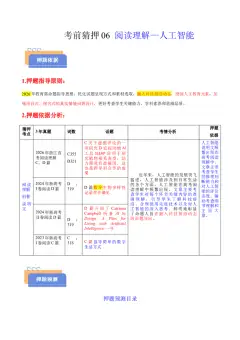
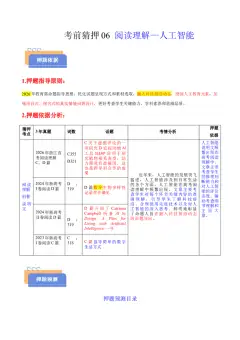
1.(2024·浙江·二模)
The maker of ChatGPT recently announced its next move into generative artificial intelligence. San Francisco-
based OpenAI’s new text-to-video generator, called Sora, is a tool that instantly makes short videos based on
written commands, called prompts.
Sora is not the first of its kind. Google, Meta and Runway ML are among the other companies to have
developed similar technology. But the high quality of videos displayed by OpenAI — some released after CEO
Sam Altman asked social media users to send in ideas for written prompts-surprised observers.
A photographer from New Hampshire posted one suggestion, or prompt, on X. The prompt gave details about
a kind of food to be cooked, gnocchi (意大利团子), as well as the setting — an old Italian country kitchen. The
prompt said: “An instructional cooking session for homemade gnocchi, hosted by a grandmother — a social media
influencer, set in a rustic (土气的) Tuscan country kitchen.” Altman answered a short time later with a realistic
video that showed what the prompt described.
The tool is not yet publicly available. OpenAI has given limited information about how it was built. The
company also has not stated what imagery and video sources were used to train Sora. At the same time, the video
results led to fears about the possible ethical and societal effects.
The New York Times and some writers have taken legal actions against OpenAI for its use of copyrighted
works of writing to train ChatGPT. And OpenAI pays a fee to The Associated Press, the source of this report, to
license its text news archive (档案) . OpenAI said in a blog post that it is communicating with artists, policymakers
and others before releasing the new tool to the public.
The company added that it is working with “red teamers” — people who try to find problems and give helpful
suggestions — to develop Sora. “We are working with red teamers-express in areas like misinformation, hateful
content, and bias — who will be adversarially testing the model,” the company said. “We’re also building tools to
help detect misleading content such as a detection classifier that can tell when a video was generated by Sora.”
1.What makes Sora impressive?
A.Its extraordinary video quality. B.Its ethical and societal influence.
C.Its artificial intelligence history. D.Its written commands and prompts.
2.What can we infer from the text?
A.Some disagreements over Sora have arisen.
B.Sora is the first text-to-video generator in history.
C.OpenAI CEO Altman wrote a prompt as an example.D.All the details about how Sora was built have been shared.
3.What is the main idea of Paragraph 6?
A.The company’s current challenge.
B.The company’s advanced technology.
C.The company’s problems in management.
D.The company’s efforts for Sora’s improvement.
4.What is the author’s attitude towards Sora?
A.Neutral. B.Optimistic. C.Pessimistic. D.Cautious.
2.(2024·河北·一模)
Many parents confused by how their children shop or socialize, would feel undisturbed by how they are taught
— this sector remains digitally behind. Can artificial intelligence boost the digital sector of classroom? ChatGPT-
like generative AI is generating excitement for providing personalized tutoring to students. By May, New York had
let the bot back into classrooms.
Learners are accepting the technology. Two-fifths of undergraduates surveyed last y car by online tutoring
company Chegg reported using an AI chatbot to help them with their studies, with half of those using it daily.
Chegg’s chief executive told investors it was losing customers to ChatGPT as a result of the technology’s
popularity. Yet there are good reasons to believe that education specialists who harness AI will eventually win over
generalists such as Open AI and other tech firms eyeing the education business.
For one, AI chat bots have a bad habit of producing nonsense. “Students want content from trusted providers,”
argues Kate Edwards from a textbook publisher. Her company hasn’t allowed ChatGPT and other AIs to use its
material, but has instead used the content to train its own models into its learning apps. Besides, teaching isn’t
merely about giving students an answer, but about presenting it in a way that helps them learn. Charbots must also
be tailored to different age groups to avoid either cheating or infantilizing (使婴儿化) students.
Bringing AI to education won’t be easy. Many teachers are behind the learning curve. Less than a fifth of
British educators surveyed by Pearson last year reported receiving training on digital learning tools. Tight budgets
at many institutions will make selling new technology an uphill battle. Teachers’ attention may need to shift
towards motivating students and instructing them on how to best work with AI tools. If those answers can be
provided, it’s not just companies that stand to benefit. An influent in l paper from 1984 found that one-to-one
tutoring improved the average academic performance of students. With the learning of students, especially thosefrom poorer households, held back, such a development would certainly deserve top marks.
5.What do many parents think remains untouched by AI about their children?
A.Their shopping habits. B.Their social behavior.
C.Their classroom learning. D.Their interest in digital devices.
6.What does the underlined word “harness” in paragraph 2 mean?
A.Develop. B.Use. C.Prohibit. D.Blame.
7.What mainly prevents AI from entering the classroom at present?
A.Many teachers aren’t prepared technically.
B.Tailored chatbots can’t satisfy different needs.
C.AI has no right to copy textbooks for teaching.
D.It can be tricked to produce nonsense answers.
8.Where is the text most probably taken from?
A.An introduction to AI. B.A product advertisement.
C.A guidebook to AI application. D.A review of AI in education.
3.(2024·北京西城·一模)
Evan Selinger, professor in RIT’s Department of Philosophy, has taken an interest in the ethics (伦理标准) of
Al and the policy gaps that need to be filled in. Through a humanities viewpoint, Selinger asks the questions, “How
can AI cause harm, and what can governments and companies creating Al programs do to address and manage it?”
Answering them, he explained, requires an interdisciplinary approach.
“AI ethics go beyond technical fixes. Philosophers and other humanities experts are uniquely skilled to
address the nuanced (微妙的) principles, value conflicts, and power dynamics. These skills aren’t just crucial for
addressing current issues. We desperately need them to promote anticipatory (先行的) governance, ” said Selinger.
One example that illustrates how philosophy and humanities experts can help guide these new, rapidly
growing technologies is Selinger’s work collaborating with a special AI project. “One of the skills I bring to the
table is identifying core ethical issues in emerging technologies that haven’t been built or used by the public. We
can take preventative steps to limit risk, including changing how the technology is designed, ”said Selinger.
Taking these preventative steps and regularly reassessing what risks need addressing is part of the ongoing
journey in pursuit of creating responsible AI. Selinger explains that there isn’t a step-by-step approach for good
governance. “AI ethics have core values and principles, but there’s endless disagreement about interpreting and
applying them and creating meaningful accountability mechanisms, ” said Selinger. “Some people are rightlyworried that AI can become integrated into ‘ethics washing’-weak checklists, flowery mission statements, and
empty rhetoric that covers over abuses of power. Fortunately, I’ve had great conversations about this issue,
including with some experts, on why it is important to consider a range of positions. ”
Some of Selinger’s recent research has focused on the back-end issues with developing AI, such as the human
impact that comes with testing AI chatbots before they’re released to the public. Other issues focus on policy, such
as what to do about the dangers posed by facial recognition and other automated surveillance(监视) approaches.
Selinger is making sure his students are informed about the ongoing industry conversations on AI ethics and
responsible AI. “Students are going to be future tech leaders. Now is the time to help them think about what goals
their companies should have and the costs of minimizing ethical concerns. Beyond social costs, downplaying ethics
can negatively impact corporate culture and hiring, ” said Selinger. “To attract top talent, you need to consider
whether your company matches their interests and hopes for the future. ”
9.Selinger advocates an interdisciplinary approach because ________.
A.humanities experts possess skills essential for AI ethics
B.it demonstrates the power of anticipatory governance
C.AI ethics heavily depends on technological solutions
D.it can avoid social conflicts and pressing issues
10.To promote responsible AI, Selinger believes we should ________.
A.adopt a systematic approach B.apply innovative technologies
C.anticipate ethical risks beforehand D.establish accountability mechanisms
11.What can be inferred from the last two paragraphs?
A.More companies will use AI to attract top talent.
B.Understanding AI ethics will help students in the future.
C.Selinger favors companies that match his students’ values.
D.Selinger is likely to focus on back-end issues such as policy.
4.(23-24高三·浙江·阶段练习)
Users of Google Gemini, the tech giant’s artificial-intelligence model, recently noticed that asking it to create
images of Vikings, or German soldiers from 1943 produced surprising results: hardly any of the people depicted
were white. Other image-generation tools have been criticized because they tend to show white men when asked
for images of entrepreneurs or doctors. Google wanted Gemini to avoid this trap; instead, it fell into another one,
depicting George Washington as black. Now attention has moved on to the chatbot’s text responses, which turnedout to be just as surprising.
Gemini happily provided arguments in favor of positive action in higher education, but refused to provide
arguments against. It declined to write a job ad for a fossil-fuel lobby group (游说团体), because fossil fuels are
bad and lobby groups prioritize “the interests of corporations over public well-being”. Asked if Hamas is a terrorist
organization, it replied that the conflict in Gaza is “complex”; asked if Elon Musk’s tweeting of memes had done
more harm than Hitler, it said it was “difficult to say”. You do not have to be a critic to perceive its progressive bias.
Inadequate testing may be partly to blame. Google lags behind OpenAI, maker of the better-known ChatGPT.
As it races to catch up, Google may have cut corners. Other chatbots have also had controversial launches.
Releasing chatbots and letting users uncover odd behaviors, which can be swiftly addressed, lets firms move faster,
provided they are prepared to weather (经受住) the potential risks and bad publicity, observes Eth an Mollick, a
professor at Wharton Business School.
But Gemini has clearly been deliberately adjusted, or “fine-tuned”, to produce these responses. This raises
questions about Google’s culture. Is the firm so financially secure, with vast profits from internet advertising, that it
feels free to try its hand at social engineering? Do some employees think it has not just an opportunity, but a
responsibility, to use its reach and power to promote a particular agenda? All eyes are now on Google’s boss,
Sundar Pichai. He says Gemini is being fixed. But does Google need fixing too?
12.What do the words “this trap” underlined in the first paragraph refer to?
A.Having a racial bias. B.Responding to wrong texts.
C.Criticizing political figures. D.Going against historical facts.
13.What is Paragraph 2 mainly about?
A.Gemini’s refusal to make progress. B.Gemini’s failure to give definite answers.
C.Gemini’s prejudice in text responses. D.Gemini’s avoidance of political conflicts.
14.What does Eth an Mollick think of Gemini’s early launch?
A.Creative. B.Promising. C.Illegal. D.Controversial.
15.What can we infer about Google from the last paragraph?
A.Its security is doubted. B.It lacks financial support.
C.It needs further improvement. D.Its employees are irresponsible.
5.(2024·山东·模拟预测)
Traditionally, people have been forced to reduce complex choices to a small handful of options that don’t do
justice to their true desires. For example, in a restaurant, the limitations of the kitchen, the way supplies have to beordered and the realities of restaurant cooking make you get a menu of a few dozen standardized options, with the
possibility of some modifications (修改) around the edges. We are so used to these bottlenecks that we don’t even
notice them. And when we do, we tend to assume they are the unavoidable cost of scale (规模) and efficiency. And
they are. Or, at least, they were.
Artificial intelligence (AI) has the potential to overcome this limitation. By storing rich representations of
people’s preferences and histories on the demand side, along with equally rich representations of capabilities, costs
and creative possibilities on the supply side, AI systems enable complex customization at large scale and low cost.
Imagine walking into a restaurant and knowing that the kitchen has already started working on a meal optimized
(优化) for your tastes, or being presented with a personalized list of choices.
There have been some early attempts at this. People have used ChatGPT to design meals based on dietary
restrictions and what they have in the fridge. It’s still early days for these technologies, but once they get working,
the possibilities are nearly endless.
Recommendation systems for digital media have reduced their reliance on traditional intermediaries. Radio
stations are like menu items: Regardless of how nuanced (微妙) your taste in music is, you have to pick from a
handful of options. Early digital platforms were only a little better: “This person likes jazz, so we’ll suggest more
Jazz.” Today’s streaming platforms use listener histories and a broad set of characters describing each track to
provide each user with personalized music recommendations.
A world without artificial bottlenecks comes with risks — loss of jobs in the bottlenecks, for example — but
italso has the potential to free people from the straightjackets that have long limited large-scale human
decision-’making. In some cases — restaurants, for example — the effect on most people might be minor. But in
others, likepolitics and hiring, the effects could be great.
16.What does the underlined word “bottlenecks” in paragraph 1 refer to?
A.Facing too many choices. B.Choosing from limited options.
C.Avoiding the cost of choosing. D.Having too many desires to satisfy.
17.How can AI meet everyone’s needs?
A.By meeting both ends of supply and demand.
B.By decreasing representations on the supply side.
C.By disconnecting the sides of supply and demand.
D.By reducing people’s preferences on the demand side.
18.What’s the similarity between radio stations and menu items?
A.They are a necessary part in people’s life. B.They offer limited choices.C.They depend on digital platforms. D.They provide reasonable suggestions.
19.What does the text mainly talk about?
A.The variety of human’s choices. B.Standardized optrarts in daily life.
C.AI settlements to the option bottlenecks.D.Recommendation systems for digital media.
6.(2024·福建·模拟预测)
Our species’ incredible capacity to quickly acquire words from 300 by age 2 to over 1, 000 by age 4 isn’t fully
understood. Some cognitive scientists and linguists have theorized that people are born with built-in expectations
and logical constraints (约束) that make this possible. Now, however, machine-learning research is showing that
preprogrammed assumptions aren’t necessary to swiftly pick up word meanings from minimal data.
A team of scientists has successfully trained a basic artificial intelligence model to match images to words
using just 61 hours of naturalistic footage (镜头) and sound-previously collected from a child named Sam in 2013
and 2014. Although it’s a small slice of a child’s life, it was apparently enough to prompt the AI to figure out what
certain words mean.
The findings suggest that language acquisition could be simpler than previously thought. Maybe children
“don’t need a custom-built, high-class language-specific mechanism” to efficiently grasp word meanings, says
Jessica Sullivan, an associate professor of psychology at Skidmore College. “This is a really beautiful study, ” she
says, because it offers evidence that simple information from a child’s worldview is rich enough to kick-start
pattern recognition and word comprehension.
The new study also demonstrates that it’s possible for machines to learn similarly to the way that humans do.
Large language models are trained on enormous amounts of data that can include billions and sometimes trillions of
word combinations. Humans get by on orders of magnitude less information, says the paper’s lead author Wai Keen
Vong. With the right type of data, that gap between machine and human learning could narrow dramatically.
Yet additional study is necessary in certain aspects of the new research. For one, the scientists acknowledge
that their findings don’t prove how children acquire words. Moreover, the study only focused on recognizing the
words for physical objects.
Still, it’s a step toward a deeper understanding of our own mind, which can ultimately help us improve human
education, says Eva Portelance, a computational linguistics researcher. She notes that AI research can also bring
clarity to long-unanswered questions about ourselves. “We can use these models in a good way, to benefit science
and society, ” Portelance adds.20.What is a significant finding of machine-learning research?
A.Vocabulary increases gradually with age.
B.Vocabulary can be acquired from minimal data.
C.Language acquisition is tied to built-in expectations.
D.Language acquisition is as complex as formerly assumed.
21.What does the underlined word “prompt” in paragraph 2 mean?
A.Facilitate. B.Persuade. C.Advise. D.Expect.
22.What is discussed about the new research in paragraph 5?
A.Its limitations. B.Its strengths. C.Its uniqueness. D.Its process.
23.What is Eva Portelance’s attitude to the AI research?
A.Doubtful. B.Cautious. C.Dismissive. D.Positive.