FREE ⾼考英语⼀轮复习课程教材阅读理解记叙⽂部分
1
STORY 1
A Writing Fool
In the seventh grade I realized I was dyslexic, which made it difficult
for me to read and spell. I did really badly in my history course, so my
mother said to me, “I’ll work with you for a full week. I’m going to show you
what you can do if you put in the right amount of effort.” So we did. We
worked on history for a full week, an extra hour every day. Then I went to
school and failed the test, as always. It was really upsetting.
By the time I got to college I came to know that I couldn’t spell no
matter how hard I tried. So I would sign up for extra courses. I’d be in
registration lines all day. Then I would go around the first day of class and
ask each professor: “What’s your policy on misspelling?” If he said, “Three
misspellings is a fail,” I’d drop it.
Although I was an academic failure, I had a great time. I had many
friends and I was always popular. I was a good football player, which was
important in those years because I could read my name in the newspaper.
I never had a day when I would think, “People don’t like me.”
In spite of my obvious weaknesses, I became successful in my career,
so much so that people say to me, “So you’ve overcome dyslexia.” No. I
don’t overcome it. I just learn to compensate for it. Some easy things are
hard for me. Most people read 500 words a minute. I only read 200. I try
not to dial a phone because I sometimes have to dial three times to get the
number right. I owe my successful career to my writing instructor, Ralph
Salisbury. He looked past my misspellings and gave me encouragement.
So I always feel confident. When I write my books, I’m seeing everything in
my imagination. I write quickly and go like the wind.
The real fear that I have for dyslexic people is not that they have to
struggle with their reading skills or that they can’t spell correctly, but that
they will quit on themselves before they get out of school.
31. When the author did badly in the course, his mother thought that
__________.
A. he needed a better teacher
B. he did not work hard enough
C. he was probably too ill to study
D. he was not as smart as other children
32. In college, the author was in registration lines all day to __________.
A. choose most interesting courses
B. become friends with new classmates
C. stay distance from language teachers
D. avoid courses that require correct spelling
33. Which of the following best describes the author in college?
A. Happy and active.
B. Shy and unhappy.
C. Successful and funny.
D. Quiet and unsuccessful.
34. According to the author, it is important for dyslexic people
__________.
A. not to get out of school
B. not to give up so easily
C. to learn to spell correctly
D. to develop reading skills
FREE ⾼考英语⼀轮复习课程教材阅读理解记叙⽂部分

2
STORY 2
Three months after Hurricane Katrina in 2005, Rebecca Sell, then 24,
a photojournalist for Fredericksburg photographed a New Orleans couple
worriedly examining water-spotted photo albums. As she took the photo,
something within her clicked. “I told them I could take the ruined pictures,
copy them and give them digitally restored (修复) photos,” she recalls.
Although a bit skeptical, the couple agreed. Rebecca took their photos
home, restored them and took them to the couple at their temporary
home. “It felt so good to be able to do that for them,” says Rebecca.
When her editor, Dave Ellis, saw the photo of the couple, he
suggested they go back and restore damaged photos for even more
people. So in January 2006, with paid time off from the paper, the two set
up shop in Pass Christian. After posting a notice in the community
newsletter, Rebecca and Dave received 500 photos in four days. For each,
the pair took a new digital picture, then used high-tech software to erase
water spots and restore colors. It just so happened that a popular website
linked to Dave’s blog about the experience, and soon Operation Photo
Rescue, as it came to be known, had emails from hundreds of volunteers,
including photographers and restoration experts, eager to help.
Though digital restoration is a painstaking process, mending
irreplaceable family pictures means the world to victims like Emily
Lancaster, 71, who took out piles of ruined photo albums after Katrina,
never thinking the mess could be saved. But she just couldn’t bear to part
with a few treasured pictures, including a portrait of her father, who had
passed away, and a photo of her husband as a boy. Then she heard about
Operation Photo Rescue. “I didn’t have a whole lot of hope they could fix
them, but they did,” Emily says. “Almost every day I think about all the
pictures I’ve lost. I’m so happy to have these two.”
In the five years since Katrina, Operation Photo Rescue has collected
thousands of pictures ruined by floods, hurricanes and tornadoes.
Volunteers make “copy runs” to disaster areas across the country to gather
damaged photos from survivors; operating costs are covered by donations.

“It’s great to be able to give people some of their history back,” says
Rebecca. “One person told me that thanks to us, her grandmother got to
see her photos again before she passed away. Moments like that remind
me why I do this.”

34. When Rebecca took the picture of the New Orleans couple, she
decided to __________.

A. take them to their temporary home

B. help with their damaged photos

C. set up shop in Pass Christian

D. cover Hurricane Katrina

35. From Paragraph 2, we know that Dave and Rebecca __________.

A. quit their jobs in 2006

B. inspired volunteers to join them

C. spent four days mending the photos

D. make their work known in their newspaper

36.  How did Emily Lancaster feel when she first heard Operation Photo
Rescue?

A. Excited.

B. Hopeless.

C. Satisfied.

D. Skeptical.

37. What is the best title for the passage?

A. Surviving Hurricanes.

B. An Act of Generosity.

C. Saving Memories.

D. A Lucky Couple.


FREE ⾼考英语⼀轮复习课程教材阅读理解记叙⽂部分

3
STORY 3
In the short time Steve and Zach had been inside their tent packing
their tools, wind-blown flame had skipped from the top of one tree to
another. The long dry summer had turned the forest into a tinderbox.
“Let’s go! We can make it back to the river we crossed today!” Steve
kept Brady on the lead and their heads down against the fire-wind. But
Brady barked a sharp warning. Ahead of them lay a thick curtain of smoke
across the track. They would never make it through that. The dog was
pulling at his lead trying to draw them away from the smoke, and yet Steve
was uneasy. It seemed to him that they were moving away from the river.
Suddenly, Zach cried. “Zach!” Steve shouted. “Are you OK? Where
are you?” Then Brady pulled Steve down a sharp slope (坡). At its base,
Zach was rubbing his ankle.
As Steve helped his friend to his feet, Brady lifted his head and
snuffed (嗅) the smoke-laden wind. Next moment, the dog bounded away
and disappeared. The boys shouted for him, but he didn’t come back.
Steve couldn’t blame Brady for panicking. He himself wanted to run even
though he didn’t have a clue which way.
Steve and Zach hadn’t gone far when there was a familiar bark, and
Brady came bounding, stopped directly in front of Steve and hit him with
his head, pushing him back toward the slope they’d just climbed. But Steve
didn’t get it. Then Brady grabbed the boy’s jeans and started pulling. The
message was clear, but Steve hesitated. Of course he remembered Brady
saving his uncle’s life when the dog was much younger. Was he still sharp
enough to get them through this?
Nearby, a pine went up in a whoosh of smoke. Brady pulled again,
urgently. “OK, big guy,” Steve gritted (咬紧⽛关). Brady led them back
down the slope and into the trees. Not far from them fire was touching
underbrush. Several times the big dog stopped. Often he changed
directions. Steve was so tired that he just wanted to rest, but Brady

wouldn’t have it. The dog bullied both boys to go on. How long they’d
walked Steve had no idea. He was almost numb when he heard it—the
wonderful sound of rushing water!

34. What happened to Steve and Zach at first?

A. They got injured.

B. They lost their dog.

C. They were trapped.

D. They became separated.

35. Brady ran away to __________.

A. seek help


B. find a way out

C. rescue Zach


D. escape for life

36. How did Steve feel after Brady pulled his jeans?

A. Uneasy.


B. Impatient.

C. Numb.


D. Uncertain.

37. The passage basically describes __________.

A. an adventure


B. an exploration

C. an escape game


D. a training program


FREE ⾼考英语⼀轮复习课程教材阅读理解记叙⽂部分

4
STORY 4
On March 25, 2010, Kate and David heard the words every parent
dreads: Their newborn wasn’t going to make it. Their twins—a girl and a
boy—were born two minutes apart and 14 weeks premature, weighing
just over two pounds each. Doctors had tried to save the boy for 20
minutes but saw no improvement. His heartbeat was nearly gone, and
he’d stopped breathing. The baby had just moments to live.
“I saw him gasp (喘息), but the doctor said it was no use,” Kate told
the Daily Mail five years later. “I know it sounds stupid, but if he was still
gasping, that was a sign of life. I wasn’t going to give up easily.”
Still, the couple knew this was likely a goodbye. In an effort to cherish
her last minutes with the tiny boy, Kate asked to hold him.
“I wanted to meet him, and for him to know us,” Kate told Today.
“We’d resigned ourselves to the fact that we were going to lose him, and
we were just trying to make the most of those last, precious moments.”
Kate unwrapped the boy, whom the couple had already named
Jamie, from his hospital blanket and asked David to take his shirt off and
join them in bed. The first-time parents wanted their son to be as warm as
possible and hoped the skin-to-skin contact would improve his condition.
They also talked to him.
“We were trying to persuade him to stay,” Kate told the Daily Mail.
“We explained his name and that he had a twin that he had to look out for
and how hard we had tried to have him.”
Then something miraculous happened. Jamie gasped again—and
then he started breathing. Finally, he reached for his father’s finger.
The couple’s lost boy had made it.

“We’re the luckiest people in the world,” David told Today.
Eight years later, Jamie and his sister, Emily, are happy and healthy.
The couple only recently told the kids the story of their birth. “Emily burst
into tears,” Kate said. “She was really upset, and she kept hugging Jamie.
This whole experience makes you cherish them more.”

35. What can we learn about the newborn babies?

A. The boy’s heart had stopped beating.

B. The boy was 2 minutes older than the girl.

C. The twins were born 14 weeks before the due date.

D. The twins were expected to live for only 20 minutes.

36. When the couple knew they would lose the boy, they __________.

A. begged the doctor to save him

B. took his shirt off and then put him in bed

C. wrapped him with his blanket to keep him warm

D. talked to him and made close physical contact with him

37. What would be the best title for the passage?

A. The Power of Hug.

B. The Miracle of Love.

C. The Bond Between Twins.

D. The Responsibility of Parents.


FREE ⾼考英语⼀轮复习课程教材阅读理解记叙⽂部分

5
STORY 5
As the Camp Fire continued, killing at least 85 people and displacing
thousands more in Northern California, Madison waited there.
Gaylord, the Anatolian shepherd mix’s owner, was not able to get to
her home in Paradise, when the fire began to spread, meaning Madison
was left behind. For weeks, all Gaylord could do was pray for Madison’s
safety, according to California-based animal rescue organization Paw Print
Rescue.
Sullivan, a volunteer with the organization, had already helped
locate Madison’s brother Miguel in a different city. But Madison was even
more difficult to find. Sullivan spotted Madison a few times in a canyon (峡
⾕), apparently guarding his land, and put out fresh food and water
regularly in hopes that the dog would turn up, according to a Facebook
post by Sullivan. She even placed an article of clothing that smelled like
Gaylord near the home “to keep Madison’s hope alive until his people
could return,” Sullivan wrote.
When the evacuation (疏散) order was lifted last week and Gaylord
went back to her home—which had been ruined by the fire—her prayers
were answered: Madison was there, seemingly protecting what little
remained of his family’s home. “Well, I’m so happy to report that Gaylord
was allowed to return to her home today and THERE MADISON WAS!!!! He
had stayed to protect what was left of his home, and never gave up on his
people!” Sullivan wrote in the comment on her Facebook post. “I’m so
happy I’m crying as I write this! He didn’t give up through the storms or the
fire!” she added.
Soon afterward, Madison was reunited with Miguel for the first time
since the fire broke out. An emotional Gaylord said in an interview with the
network that she was overcome with joy to see Madison waiting for her.

She also expressed how grateful she was to Sullivan. Gaylord said fighting
through tears, “You could never ask for better animals. He is the best dog.”

34. What did Madison do during the Camp Fire?

A. He rescued Sullivan.

B. He waited for Gaylord.

C. He stayed with Miguel.

D. He ran away from Paradise.

35. Why did Sullivan place an article of clothing smelling like Gaylord near
the home?

A. To keep Madison warm.

B. To get Madison to turn up.

C. To help Madison remember his owner.

D. To encourage Madison not to give up.

36. Where was Madison finally found?

A. In a different city.

B. In a canyon.

C. At a camp.

D. At his home.

37. What quality is emphasized in this story?

A. Patience.

B. Unity.

C. Devotion.

D. Wisdom.


FREE ⾼考英语⼀轮复习课程教材阅读理解记叙⽂部分

6
STORY 6
Preschool Girl Lifts Old Man’s Spirits
When Tara Wood brought her daughter to a grocery store to buy the
four-year-old some cupcakes, she had no idea that would be a life-
changing experience.
As Tara pushed her daughter Norah around the store last month, she
passed an old man who was by himself. The old man looked cold, until
Norah shouted to him, “Hi! It’s my birthday today!” The man stopped and
his demeanor changed from distant and serious to warm and friendly.
“How old are you today?” the man asked. After some time talking together,
Norah asked her mom to take a picture of her with her new friend “Mr. Dan”,
Dan Peterson, 82. They hugged and after ten minutes went their separate
ways. That could have been the end of the story. But it is actually the
beginning of a special relationship.
Tara posted the picture of her daughter and Mr. Dan on Facebook
and someone who recognized him reached out to her with his contact
information. It turned out that Mr. Dan’s wife died in March and he had
been suffering from depression and anxiety ever since. The person on
Facebook told Tara that it was the first time they had seen Mr. Dan smile
since the death of his wife. Knowing that, Tara contacted Mr. Dan, and ever
since Norah and the 82-year-old have developed a friendship unlike any
other. “She has shown me a depth of love, a depth that I didn’t know
existed,” Mr. Dan told the reporter.
Mr. Dan told Tara that before meeting Norah, he hadn’t had one
night of uninterrupted sleep. Anxiety kept him up at all hours and made
him restless. After meeting Norah, he said he now sleeps soundly. For Mr.
Dan’s 82nd birthday on October 20, the mother and the daughter brought
balloons and presents—and, of course, cupcakes. Mr. Dan will also spend
a day around Thanksgiving with Norah and her family. “If you don’t take
the time to notice people, you will never know how you can positively
impact a life,” Tara Wood said.


31. Mr. Dan looked cold because __________.

A. he felt lonely

B. he disliked little kids

C. nobody had hugged him

D. he knew little about Norah

32. The underlined word “demeanor” in Paragraph 2 probably means
__________.

A. words

B. body

C. thoughts

D. attitude

33. How did Tara know more about Mr. Dan?

A. From a news reporter.

B. From a stranger.

C. From a shop assistant.

D. From his neighbor.

34. What can we learn from the story?

A. Giving makes a real difference.

B. It is important to respect each other.

C. We should not judge a person at first sight.

D. Good things will happen if one keeps trying.


FREE ⾼考英语⼀轮复习课程教材阅读理解记叙⽂部分

7
STORY 7
Open Water Swimming
I had only swum in open water a few times, and always in gentle lakes,
so I wasn’t prepared for how rough Lake Windermere appeared on a cold
day. A swimmer told me the water felt colder than it had been measured,
and that the water was a bit rough. But I, along with 10,000 others, was
about to complete the challenge.
Most of the people taking part were doing a one-mile race, and 10
races were planned over the weekend. There seemed to be a mix of
open—water enthusiasts alongside complete beginners—which is
precisely the aim of the swims, to get as many people as possible
completing their own challenge. The oldest woman competing was 77,
taking part in the two-mile race, alongside a man who last year had swum
in every one-mile race.
I had chosen the third one-mile race of the day. There were over 600
people in my race. We were taken through an acclimatization area, a
children’s paddling pool-sized part of the lake where we moved in to feel
how cold the water was. “Not too bad” was everyone’s thought! Then we
headed out towards the middle of the lake.
We’d been warned that the first 100 metres would be really rough.
However, somewhere near the 750m mark I was still waiting for the calm;
it felt more like swimming in the sea than a lake. I tried to focus on my
breathing and technique, and just keep going. As I approached the 400m-
to-go mark my lower right leg became painful. I recalled overhearing
people talking about how they kept swimming through the pain, so I tried.
But it didn’t work. I began to feel the entire leg tight and painful. I didn’t
want to stop, so I bent my right knee and just kicked with the left leg.
Finally I saw the finishing post, and I just concentrated on getting
there—still one-legged. My finishing time was 38 minutes 25 seconds but
that didn’t matter—the atmosphere was fantastic and everyone felt a

sense of achievement, whatever their time. I’m hooked, and want to give
it another go. I’ve already signed up for my next open-water swim.

34. How did the author feel before the race?

A. Scared of the most challenging race.

B. Disappointed by the difficult conditions.

C. Concerned about the other swimmers in the race.

D. Determined to be as tough as the people around her.

35. Why does the author mention the two people in Paragraph 2?

A. To stress the importance of the race.

B. To praise the experienced swimmers.

C. To show the wide range of the participants.

D. To introduce the various events of the race.

36. The author suggests in Paragraph 4 that __________.

A. the race would cause breathing problems

B. the race became harder than she had expected

C. it was really necessary to prepare for tough swims

D. it would have been easier if she had taken others’ advice

37. What does the author talk about in the last paragraph?

A. Her confidence in her own ability.

B. Her pride in having swum so quickly.

C. Her eagerness to repeat the experience.

D. Her surprise at having managed to finish.


FREE ⾼考英语⼀轮复习课程教材阅读理解记叙⽂部分

8
STORY 8
Sweat rolled off my forehead as my younger brother and I sat under
the tree.
“Hi, Jason,” said my brother, Chad. “Do you hear the train?” I listened,
but I heard only thunder in the distance. It was still miles away, but I heard
it. It grew stronger and louder as it gained speed and got closer. How could
that be? I wondered.
We were about to grab our bikes to see what it actually was when we
stopped. What looked like a flock of birds darkened the sky overhead.
When I looked at it closer, I realized it wasn’t birds. It was a tornado (⻰卷
⻛). The hairs on the back of my neck stood up as the air turned green and
heavy. The sun disappeared. The wind strengthened and roared. I grabbed
Chad’s arm and pulled him toward the house.
I tried to open the door, but it was as if an invisible force pushed
against me. The door refused to open. When we finally managed to get
inside, we found it was as dark as night. Our family had practiced a tornado
safety plan many times. But I had never imagined that it would be just
Chad and me at home the first time we needed to use it.
“Inside the closet!” I yelled. It was small and crowded, but we got in
it anyway. Chad began to cry. “It’s going to be all right.” I told him. But I
was worried about Mom. I hope she’d found a safe place to wait out the
storm.
The storm continued to rage. I heard a thud on the roof. The whole
house creaked and groaned. Then it was quiet. I opened the door and we
inched our way out of the closet. Rain had got in through the open window
and wet the carpets. A kitchen window had shattered, its screen blown
away. I looked at the backyard. The tree was uprooted, and broken
branches lay on the ground.

“Jason, I can’t get service,” Chad said as he held the phone in his hand.
We had no electricity, either. I glanced at the wall clock. Had it been only
20 minutes since we’d first heard the thunder? Then I heard footsteps
toward the house. Mom had made it home safety. “Boys!” She yelled. “Are
you all right?”
We ran out and hugged her. The sun came out, and this time it shone
bright and clear.

56. When the tornado struck, __________.

A. the boys felt terrified and asked for help

B. a flock of birds darkened the sky overhead

C. the boys protected themselves in a safe place

D. the sound of the train grew stronger and louder

57. What can we learn from the passage?

A. Mom had trouble in finding the boys.

B. Jason knew how to deal with a tornado.

C. The tornado lasted for over half an hour.

D. Their house was flooded by the heavy rain.

58. Which of the following words can best describe Jason?

A. Calm and thoughtful.

B. Cautious and curious.

C. Dependent and sensitive.

D. Creative and active.


FREE ⾼考英语⼀轮复习课程教材阅读理解记叙⽂部分

9
STORY 9
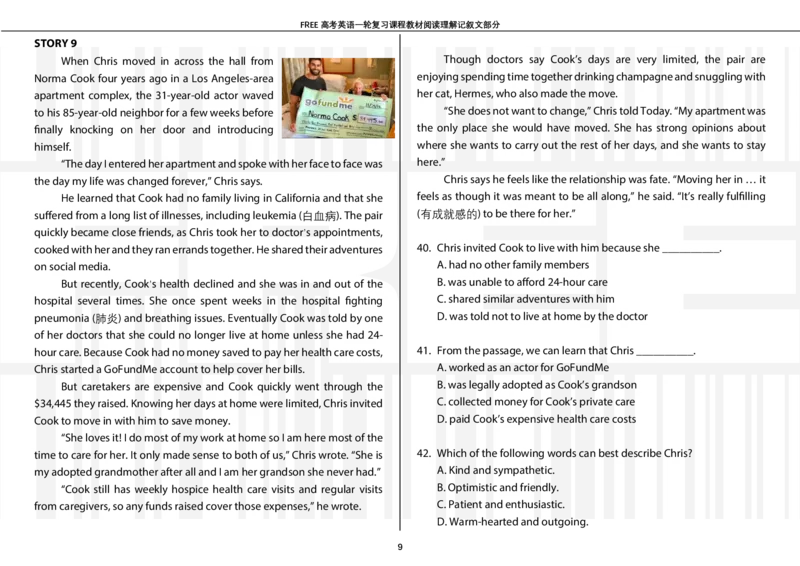
When Chris moved in across the hall from
Norma Cook four years ago in a Los Angeles-area
apartment complex, the 31-year-old actor waved
to his 85-year-old neighbor for a few weeks before
finally knocking on her door and introducing
himself.
“The day I entered her apartment and spoke with her face to face was
the day my life was changed forever,” Chris says.
He learned that Cook had no family living in California and that she
suffered from a long list of illnesses, including leukemia (⽩⾎病). The pair
quickly became close friends, as Chris took her to doctor’s appointments,
cooked with her and they ran errands together. He shared their adventures
on social media.
But recently, Cook’s health declined and she was in and out of the
hospital several times. She once spent weeks in the hospital fighting
pneumonia (肺炎) and breathing issues. Eventually Cook was told by one
of her doctors that she could no longer live at home unless she had 24-
hour care. Because Cook had no money saved to pay her health care costs,
Chris started a GoFundMe account to help cover her bills.
But caretakers are expensive and Cook quickly went through the
$34,445 they raised. Knowing her days at home were limited, Chris invited
Cook to move in with him to save money.
“She loves it! I do most of my work at home so I am here most of the
time to care for her. It only made sense to both of us,” Chris wrote. “She is
my adopted grandmother after all and I am her grandson she never had.”
“Cook still has weekly hospice health care visits and regular visits
from caregivers, so any funds raised cover those expenses,” he wrote.

Though doctors say Cook’s days are very limited, the pair are
enjoying spending time together drinking champagne and snuggling with
her cat, Hermes, who also made the move.
“She does not want to change,” Chris told Today. “My apartment was
the only place she would have moved. She has strong opinions about
where she wants to carry out the rest of her days, and she wants to stay
here.”
Chris says he feels like the relationship was fate. “Moving her in … it
feels as though it was meant to be all along,” he said. “It’s really fulfilling
(有成就感的) to be there for her.”

40. Chris invited Cook to live with him because she __________.

A. had no other family members

B. was unable to afford 24-hour care

C. shared similar adventures with him

D. was told not to live at home by the doctor

41. From the passage, we can learn that Chris __________.

A. worked as an actor for GoFundMe

B. was legally adopted as Cook’s grandson

C. collected money for Cook’s private care

D. paid Cook’s expensive health care costs

42. Which of the following words can best describe Chris?

A. Kind and sympathetic.

B. Optimistic and friendly.

C. Patient and enthusiastic.

D. Warm-hearted and outgoing.
FREE ⾼考英语⼀轮复习课程教材阅读理解记叙⽂部分

10
STORY 10
My First Day of School
Fear started taking over. I was walking into my first school in America.
I had traveled a long distance from India in order to join my mother, who
had been here for three years, hoping America would help my future. My
father decided that I would be better off going to school here, so I enrolled
(登记) in the local high school in my new town.
I was afraid how I would do. On the first day, I went to my second
period class after I had missed my first. With anxiety, I reached for the door,
opening it slowly. Without paying attention to my classmates, I went
straight to the teacher and asked if this was the right class. With a soft voice
he answered, “Yes.” His voice comforted me a little. He gave me a sheet
called Course Requirements, which I would never get in India because we
didn’t have anything like that. Then he asked me to choose where I would
sit. I didn’t actually want to pick a seat. In India we had fixed seats, so I never
needed to worry about that. I spent the rest of the class taking notes from
the image produced by the overhead projector. In Indian schools, we
didn’t use the technology we had. We had to take notes as the teacher
spoke.
It was noon. I was very confused about when I would have lunch. I
went to my next class and the bell rang as I entered. I went through the
regular process of asking the teacher if I was in the right class. She said, “It’s
still fourth period.”
“But the bell just rang,” I said.
Changing from a gentle tone to a harsher (刺⽿的) one, she said,
“That is the lunch bell, young man.”

I apologized. Without another word I headed for the cafeteria. I felt
lucky because we didn’t have this in India. Every confusion seemed like a
barrier I had to get through to reach my goal. At the end of the day, I was
on my way to the bus which we didn’t have in India either. I spotted my
bus and sat down inside happily. I was thinking, today wasn’t so bad.

36. The author attended an American high school because __________.

A. his father preferred American schools

B. his family wanted him to have a bright future

C. his mother had worked in it for 3 years

D. he had been longing to leave his homeland

37. What do we know about the author’s first day of school?

A. He went to the wrong class for the second period.

B. He met some enthusiastic teachers and classmates.

C. He got the Course Requirements sheet from his classmate.

D. He experienced differences from the Indian schools in many ways.

38. How did the author feel at the end of the day?

A. Worried.

B. Puzzled.

C. Relieved.

D. Excited.


FREE ⾼考英语⼀轮复习课程教材阅读理解记叙⽂部分

11
STORY 11
Traveling on an airplane can be a very tiring task even in the best of
circumstances, which is why when Sophie Murphy boarded a recent flight
from Sydney to Melbourne and noticed an “awful tension” in the cabin, she
first thought it was caused by typical bad-tempered passengers. But as the
flight neared its end, it became obvious that something was very wrong.
A teenage boy with Down syndrome ( 唐⽒综合征) who was
traveling with his family had become upset and would not return to his
seat, regardless of the cabin crew’s warnings over the loudspeaker that it
was almost time to land. The pilot was forced to circle above the airport,
delaying the landing—and angering people on the already tense flight.
“If it was a cartoon,” remembered Murphy, “there would have been
smoke coming out of people’s ears.”
As the boy’s elderly parents and adult brothers and sisters tried to
persuade him to get off the floor and back into his seat, but in vain, Murphy,
42—who had been a teacher for more than 20 years—stood up and
quickly headed to the back of the plane.
She found the boy in the passage between rows of seats, lying on his
belly, and lay down on her stomach to face him. She began chatting calmly
with him, asking his name, his favorite book, and his favorite characters. He
told her he felt sick and she tried to comfort him.
Minutes later, he allowed her to hold his hand—and then together
they got properly back into airplane seats. Murphy asked for sick bags, and
held them as the boy threw up several times, including on her. As she
helped him clean up, she repeatedly told him everything would be okay
and that they’d get through it together.
After the plane was finally able to land, no one was impatient to step
off the flight as one might expect. Instead, calmed passengers—obviously
following Murphy’s amazing example—allowed the boy and his family to
depart first, smiling at them as they passed. His parents tearfully thanked

Murphy for what she had done, and a doctor sitting nearby also let her
know he had even taken notes on her expert way of handling the situation.

59. The landing was delayed because __________.

A. a family ignored the warnings

B. a boy refused to sit in his seat

C. smoke was coming out of the engine

D. the pilot was forced to change the destination

60. Murphy successfully handled the “awful tension” by __________.

A. fighting against unfair treatment

B. calling on other passengers to join her

C. communicating with the boy

D. asking an experienced doctor to help

61. What changed the angry passengers’ attitude at last?

A. The boy’s improvement.


B. The plane’s safe landing.

C. The crew’s behavior.


D. The teacher’s efforts.

62. Which of the following words can best describe Murphy?

A. Generous and cautious.

B. Patient and enthusiastic.

C. Wise and cooperative.

D. Kind and cool-headed.


FREE ⾼考英语⼀轮复习课程教材阅读理解记叙⽂部分

12
STORY 12
“I wish we hadn’t come on this trip!” Jeff’s voice echoed across the
narrow canyon (峡⾕). His father stopped, breathing heavily. “This is hard
on you, but you’ve got to come through with courage!” He gently placed
his hand on the boy’s shoulder. “Now, I don’t know if I can make it without
stopping every so often. You’re young, but you’re strong and fast. Do you
remember the way back from here to the road, if you had to go alone?”
Jeff flashed back to the painful scene of Mark, his seventeen-year-old
brother at their campsite. He was bitten by a snake yesterday. This
morning he couldn’t move, and the pain got worse. He needed medical
attention right away. They had left their phone in the car, and it must have
been out of power by then. Leaving Mark at the campsite and seeking help
was their only choice.
“Jeff, could you do it?”
Jeff looked to the end of the canyon, several miles away. He nodded
and a plan began to take hold in his mind. “What is the name of that little
town we stopped, Dad?” There must be a hospital there.
“Flint. We parked at the side of the road a few miles out of Flint.”
Jeff nodded. Then they continued climbing. Stone by stone, they
made their way up the canyon. Gradually, Jeff’s father grew smaller and
smaller in the distance. Jeff waved to him and then climbed toward the
road. Two hours later, he finally reached the road and struggled toward
the town, almost exhausted.
“Can’t stop.” he thought. “Mark’s in big trouble. Keep going.”
Suddenly, he saw a truck heading toward him. “Hey, mister!” he shouted,
waving both arms. He began to jog toward the truck, and then broke into
a full-speed run.
His chest was burning with every breath when the truck driver
stopped by him. Jeff explained breathlessly. The driver reached for his
cellphone as soon as he heard about Mark. “Better get the helicopter in

there,” he said immediately. But Jeff wasn’t sure about that because
everything got unclear and then went black and quiet.
Hours later, Jeff opened his eyes to find his father on a chair nearby.
“You’re a hero, son.” his father said with a smile. “You had the helicopter
sent into the canyon after Mark. I can’t tell you how happy I was when I saw
it overhead. They got him to the hospital. He’s going to be fine soon. I’m
so proud of you!”

39. Why did Jeff and his father climb up the canyon?

A. They were going for rescue.

B. They were doing physical exercise.

C. They were meeting Jeff’s brother.

D. They were searching for their campsite.

40. What happened to Mark?

A. He lost his way.


B. He lost his phone.

C. He was hit by a truck.

D. He was bitten by a snake.

41. Why did Jeff’s father let him go alone?

A. Jeff was faster than him.


B. Jeff knew the way better.

C. Jeff needed more exercise.

D. Jeff preferred going by himself.

42. What can be the best words to describe Jeff?

A. Humorous and ambitious.
B. Determined and caring.

C. Cautions and sensitive.

D. Generous and kind.


FREE ⾼考英语⼀轮复习课程教材阅读理解记叙⽂部分

13
STORY 13
It probably won’t surprise you that teens are texting more than ever
before. Experts show great concern for teen texting. Students might not
learn correct grammar and spelling if they write a lot of text messages. Also
all that texting takes away from hours that could be spent studying,
exercising, pursuing hobbies, or talking with others face to face. Some kids
even sleep with their phones beneath their pillows and wake up several
times during the night to text.
Dr. Elizabeth Dowdell points out teens need to learn that they can—
and should—turn off their phones sometimes. She and her team had two
teenagers, Kenny and Franchesca, carry out an experiment. They should
obey the rules: No phone for 48 hours. No computer or Internet either,
unless it was for schoolwork. Would these two teenagers be able to do it?
“I think I’m going to feel really alone,” Kenny worried. Franchesca was
nervous but brave. “I’m excited for the challenge,” she said. “I don’t know
what’s going to happen.” They handed their phones to their mothers for
safekeeping. The challenge was on.
The team caught up with Kenny and Franchesca after 48 phone-free
hours. “Wow, it was pure suffering,” Kenny joked. “Though life with no
phone wasn’t easy,” he admitted, “it had benefits. I felt less stressed
because I didn’t have to be involved.” Sure, Kenny missed his friends, and
he was sad at times. But he also felt relief from the constant texting. Instead
of texting, Kenny went to the gym and caught up on schoolwork. He said
that the first night he slept 10 hours. He also spent time sitting with his
family and talking. “I felt closer to my parents,” said Kenny.
Franchesca had an even happier result when she put away her phone.
“I loved it!” she said. “I was going to the gym and hanging out with friends
and playing basketball. I had a wonderful experience.” She slept better too,
and she decided to continue the experiment for a while. “I think I’ll be so
much smarter and healthier,” she explained. “Everybody in the world

should try it.”
Kenny doesn’t plan to give up his phone again. But he now knows
that he can live without it. “It was a reality check,” said the teen.

39. Experts are concerned about teens’ texting because it __________.

A. leads to learning disabilities

B. takes up their learning time

C. develops the habit of staying up late

D. causes misunderstandings with each other

40. What can be inferred from the passage?

A. Teens will live a healthier life without phones.

B. Expecting teens to live without phones is not realistic.

C. Experimenting with phone use is popular among teens.

D. Teens don’t realize how different their lives are without phones.

41. How were the two teens’ reactions to the 48-hour challenge different?

A. Only Kenny participated in physical activities.

B. Only Kenny spent time talking with his parents.

C. Only Franchesca benefited from a really good sleep.

D. Only Franchesca appreciated the freedom of having no phone.

42. Which is the best title for the passage?

A. Giving up Texting.


B. Rules for Using Phones.

C. Two Days with No Phone.


D. Problems Caused by Texting.


FREE ⾼考英语⼀轮复习课程教材阅读理解记叙⽂部分

14
STORY 14
Dear Koko,
I’ve learned about you from my amazing teacher. I think it’s fun that
you can communicate with us humans by using the sign language. I’ve
spent a lot of time watching you in different videos and love you from the
bottom of my heart.
It’s heartbreaking to learn about all of the cruel things done to
gorillas (⼤猩猩). In Africa, for example, the killers use guns to kill your
fellows for meat. They don’t understand the influence their actions are
having on gorillas. Another thing is the loss of gorillas’ natural home, which
is caused by the improved infrastructure such as building roads and
airports. When we cut down trees, you become homeless. We take away
your shelter and sources of food, leaving you with very little chance of
survival.
Some of my classmates are writing to the relevant departments
about these serious problems. Hopefully these letters will make a
difference during your lifetime. Over the past three months, my class has
been researching on gorillas, and I’ve learned so many things. For example,
I’ve learned that you have a lot of feelings similar to mine and you are
always so careful with everything you do. I think that you are really worth
saving.
We’ve come up with many ideas to help you and your fellows. One
of the best ideas is to communicate with the President of the World Bank
and have him give more financial support to the organizations for gorillas.
Another idea is to make public laws on the killers. I also think we need to
keep educating people about gorillas.
I love writing to you and hope you can understand how important
you’ve become to our class. Would it be too much to ask for a return letter?
Mike


36. According to the passage, Koko is probably __________.

A. a killer of gorillas

B. a member of the gorilla family

C. an expert on gorillas

D. a governor in charge of gorillas

37. What is mainly talked about in the second paragraph?

A. The problems gorillas face at present.

B. The danger gorillas cause for humans.

C. The unique characteristic gorillas have.

D. The natural environment gorillas live in.

38. The author suggests that __________.

A. gorillas should be protected in nature reserves

B. killers for gorillas should be legally responsible

C. organizations should be set up to protect gorillas

D. people should make donations to gorilla protection


FREE ⾼考英语⼀轮复习课程教材阅读理解记叙⽂部分

15
STORY 15
The Handshake
I don’t remember the exact date I met Marty for the first time. Like a
lot of people who want to get through a checkout line, I found my
thoughts on speed, nothing more. The line I was standing in wasn’t
moving as quickly as I wanted, and I glanced toward the cashier, who was
busy receiving money from customers.
He was an old man in his sixties. I thought, well, it probably took him
a little longer to get the jobs done. For the next few minutes I watched him.
He greeted every customer before he began scanning the goods they were
purchasing. Sure, his words were the usual, “How’s it going?” But he did
something different—he actually listened to people. Then he would
respond to what they had said and talk with them briefly.
I thought it was strange, but I guessed I had grown accustomed to
people asking me how I was doing simply out of a conversation without
thinking. Usually, after a while, you don’t give any thought to the question
and just say something back quietly.
This old cashier seemed sincere about wanting to know how people
were feeling. Meanwhile, the high-tech cash register rang up their
purchases and he announced what they owed. When customers handed
money to him, he pushed the appropriate keys, the cash drawer popped
open, and he counted out their change.
Then magic happened.
He placed the change in his left hand, walked around the counter to
the customers, and extended his right hand in an act of friendship. As their
hands met, the old cashier looked the customers in the eyes. “I want to
thank you for shopping here today,” he told them. “You have a great day.
Bye-bye.” The looks on the faces of the customers were priceless.
Now it was my turn. I glanced down at the name tag on his red
waistcoat, the kind experienced Wal-Mart cashier wore. It read, “Marty.”

Marty told me how much I owed and I handed him some money. The
next thing I knew he was standing beside me, offering his right hand and
holding my change in his left hand. His kind eyes locked onto mine.
Smiling, and with a firm handshake …

39. While the author stood in the checkout line, she felt __________.

A. comfortable


B. enthusiastic

C. impatient


D. embarrassed

40. In the opinion of the author, people tended to __________.

A. remain calm while having a talk

B. talk about unimportant topics

C. develop a mindless conversation

D. face communication problems

41. The author thought Marty special because __________.

A. he spent as much time as possible serving customers

B. he was patient with all the questions from customers

C. he showed particular interest in customers’ personal life

D. he expressed his sincerity while giving back the change

42. What can we infer from the passage?

A. Marty was a talkative man.

B. Marty cared a lot about what he did.

C. The author failed to get along well with others.

D. The author was dissatisfied with such a waste of time.


FREE ⾼考英语⼀轮复习课程教材阅读理解记叙⽂部分

16
STORY 16
In December 2017, I attended a conference. Five successful women
delivered speeches on the topic “Bouncing Back after Setbacks.” As I sat
there listening to their many personal and professional mistakes and
setbacks, I felt fortunate that I hadn’t made that many mistakes in my own
life.
Those women had lost thousands in investments, started companies
but failed, sold companies that later ended up being worth millions, and
lost partners in the name of business. Despite knowing that they had, in
fact, bounced back and were again doing very well, I was starting to feel
sorry for them.
Then, as if someone whispered in my ear, I heard the words: “Don’t
be so proud of yourself. You haven’t made any mistakes because you
haven’t lived at all. Look how boring your life is.” Whose voice was this, and
how dare it speak to me like that?
I think, for the first time, I heard my own heart speak. It shook me to
my core, and it took all I had to keep from crying. I started thinking of the
mistakes I had made. The voice was right. There weren’t many at all. I had
followed a straight path for 38 years. I went to school, earned bachelor’s
and master’s degrees with honors, and stayed at every job I’d had far
longer than it was professionally beneficial for me to do so. In fact, at 38, I
had only had three jobs. “The devil (魔⻤) you know is better than the one
you don’t” was my motto.
A quick review of my life made me realize that it was the actions I
hadn’t taken that I was suddenly regretting. I hadn’t studied abroad. I
hadn’t risked love. In fact, I was perpetually single. I hadn’t started a
business. I hadn’t traveled enough. I had said “no” far more than “yes”.
The voice that whispered to me continued to the New Year. It was
like it laughed at me. The thought of turning forty frightened me. It’s one
thing to be unhappy and unsettled in your twenties, and perhaps even in

one’s thirties. But was I going to start a new decade with the same
boredom? I needed something to pick me up, some activity I could look
forward to.

51. How did the author feel when first hearing stories from the 5 speakers?

A. Regretful.

B. Surprised.

C. Lucky.

D. Guilty.

52. The author felt like crying during the conference because she realized
__________.

A. she hadn’t lived her life to the fullest

B. she was deeply touched by the women

C. she had nothing to be proud of in her life

D. she had made a lot of mistakes in her life

53. What does the underlined sentence in Paragraph 4 probably mean?

A. The familiar devil is more frightening.

B. Saying “no” is better than saying “yes”.

C. It’s better to stay within the comfort zone.

D. You’d better change your jobs more frequently.

54. From the passage, we can learn that the author __________.

A. felt afraid of ageing

B. traveled abroad a lot

C. was married in her thirties

D. decided to do something new


FREE ⾼考英语⼀轮复习课程教材阅读理解记叙⽂部分

17
STORY 17
It’s the green wall of her school swimming pool that Jill Craven
remembers best, as she felt her teacher’s hand on her head, guiding her
underwater. “You know how time slows? Going under. Watching …” she
says.
This was in Palmerston North, when she was five. While her three
older siblings could swim half a mile or more, she would do anything to
avoid swimming lessons. In her 20s, she moved to London to pursue a
career in journalism. She insisted she had never feared for her career, but
she still had this lifelong fear of being underwater.
However, when she retired, Craven was diagnosed with breast
cancer, and was advised to swim as part of her recovery. Still finding the
fear undefeatable, she took up water jogging instead—like treading water
(踩⽔), but moving—with a floatation aid around her middle. She could
get her feet off the bottom of the pool for a quick doggy paddle, but
anything more was beyond her.
One day at the pool, she saw a group of children having a lesson. It
was an indoor pool, nice and warm, and the children were five or six. “I just
thought, it’s time to do this,” she says. “Who knows what I looked like. An
egg beater,” she continues. “I did five strokes, or six. I was so proud of
myself”. Then a lifeguard encouraged her to continue and told her how to
breathe. A friend gave her goggles. Her niece Justine walked beside the
pool clapping, and Craven felt as if she had won a gold medal. Justine
bought Craven lessons for her 69th birthday. Before long, Craven had
swum a length with her face in the water.
When her instructor told her to sit on the bottom of the pool, Craven

felt like going back to being a five-year-old. She hung on to the stairs as
she went down. But she did it! She stayed there for a few seconds!
Now Craven swims twice a week: five lengths, sometimes 10, with a
rest after each. “I just think you need to do things if you can. If you can, you
must.” She says.

24. Why did Craven choose water jogging instead of swimming?

A. She hated losing face.


B. She liked treading water.

C. She was afraid to swim.


D. She was fond of floating.

25.  What inspired Craven to try swimming again?

A. The sight of kids learning swimming.

B. The support of her niece Justine.

C. The encouragement from a lifeguard.

D. The doctor’s advice on her recovery.

26.  What is the passage trying to tell us?

A. Once bitten, twice shy.

B. You can never teach an old dog new tricks.

C. Practice makes perfect.

D. Nothing is impossible for a willing heart.


FREE ⾼考英语⼀轮复习课程教材阅读理解记叙⽂部分

18
STORY 18
A few days ago my husband, Russ, and I lost our house of 28 years to
a California wild fire.
On that night, we had to leave our house and sleep in the back seat
of our Ford. The next morning, we had to drive three and a half hours to
find a hotel that had an available room. Only later, in the local newspaper,
did we see photographs of the destruction. Our house had been
consumed by the fire along with most of our neighborhood.
How are we going to rebuild after this? I thought, rounding a corner
in the sidewalk on my walk back to the hotel. Is it even possible?
I noticed something up ahead—a pair of nickels, shining like
precious jewels. They were just nickels, but they somehow felt special I
bent down and picked them up. If these were lucky coins, I could use all
the luck I could get.
A few days later, I made a trip to the store to buy essentials. The
enormous task of replacing everything we’d lost put a heavy weight on me.
I was about to leave when I felt the urge to stop and turn my head to the
right. I could hardly believe it—there on a shelf was a nickel! Okay, maybe
this is more than luck, I thought and put the nickel in my pocket.
I told myself that I had found the nickels just by chance. Then I found
one next to my plate at a restaurant—on Thanksgiving, no less, when I was
missing our house more than ever. It seemed that a nickel appeared
whenever my spirits plummeted.
Whenever I reached my breaking point, I’d find another nickel. In the
grass at the park, or near the tire of my car in a parking lot. Once, my
change for a quick lunch was given entirely in nickels. “I’m sorry,” the
cashier said. “It’s all we have.”
It’s all I needed!
One day, I was sitting at the desk when my phone rang. It was a real-
estate agent I’d been working with.
“I have a new listing,” she said.
“When can we see it?”

A few hours later, Russ and I were following the agent down the
driveway toward the house.
I didn’t think long. Because there, in the driveway, …

24.  After the wild fire, the couple __________.

A. lived in their car for one night

B. took some photos of the destruction

C. could hardly afford their Thanksgiving dinner

D. saved precious items from the burned down house

25.  What does the underlined word “plummeted” in Paragraph 6 probably
mean?

A. Remained.


B. Changed.

C. Strengthened.

D. Sank.

26.  What did the found nickels mean to the author?

A. Luck for the foreseeable future.

B. Hope during challenging times.

C. Signs of a huge fortune to come.

D. Reminders of what had happened.

27.  Which would be the best ending for the passage?

A. I spotted a flash of silver in the sun, two nickels. both heads up.

B. I found an old nickel, which seemed to tell a story from the past.

C. I saw a mysterious locked box, and thought perhaps it was full of
nickels.

D. I looked up and imagined something on a cloud, a giant nickel, just
for me.


FREE ⾼考英语⼀轮复习课程教材阅读理解记叙⽂部分

19
STORY 19
Ever since I was a young boy. I’ve had a taste for adventure, but I
never imagined this would lead to my chosen career.
My work as an expedition doctor has taken me all over the world,
from mosquito-infested wet land in Africa to the untouched wilderness of
Antarctica. However, my favourite trips, and the ones in which I now
specialise, are those involving mountains. Never do I feel more inspired by
nature than when I look up at their towering peaks and begin to prepare
myself mentally for the challenges ahead.
I trained as a doctor in the UK, but there was little in that training to
prepare me to deal with a broken leg during a storm on the side of a
mountain! In fact, I’d say that medical skills come some way down the list
of job requirements, after stamina ( 耐⼒) problem-solving and
communication.
This kind of medicine is a million miles away from the controlled,
clean environment of a hospital, and your medical kit basically consists of
whatever you can carry, so you sometimes have to use whatever is
available. For example, I’ve learned that some drugs can be used for
several conditions, and I’ve even had to cut branches off a small tree to
make a piece of wood to support a broken arm.
Now I do most of my work for adventure holiday companies,
travelling to remote places. When I started out, these holidays were quite
rare, but they have become much more mainstream now that we’ve all
seen celebrities climbing Kilimanjaro or watched reality shows about
people exploring jungles.
I do have mixed feelings about all these people with large amounts

of income coming to poor areas just for their own enjoyment, so I try to
make
sure that the companies I work for have high moral standards and
bring advantages to the local communities. And of course, tourism
provides employment, and also opens the eyes of visitors to the hardship
that many people are forced to go through.

24. What made the author choose his career?

A. His love of nature.


B. His desire for adventure.

C. His talent for medicine.


D. His sense of responsibility.

25. What is the biggest challenge for the author during the trips?

A. Reducing potential risks.


B. Surviving in the wild.

C. Adapting to local customs.


D. Dealing with emergencies.

26. According to the author, the companies he now works for should
__________.

A. satisfy tourists and make profits

B. offer tourists challenges and security

C. benefit local people as well as tourists

D. build tourists’ mental and physical well-being
FREE ⾼考英语⼀轮复习课程教材阅读理解记叙⽂部分

20
STORY 20
As a Ph.D. student in a new country, lockdown and homesickness
combined to leave me feeling lonely and desperate to meet people. To
find the connections I was missing, I searched for opportunities that would
involve teamwork as a volunteer on the Internet. A position matching
graduate students with jobs drew my attention. It needed someone who
would lead teams of graduate student volunteers to help bring in industry
partners, and work with the university administration and student
applicants. The chances to interact with all these different groups were
appealing. I had no relevant experience and worried a disturbance to my
study, but I still decided I might as well go for it and apply.
The first few weeks in my new role were challenging. Along with my
routine study, I was suddenly managing a team of four volunteers and
meetings with industry professionals. At first, I was nervous in meetings
with them, feeling I wasn’t prepared enough. But as I gained experience,
the interactions became truly enjoyable and rewarding. Sometimes the
conversations went beyond regular business to touch on career paths,
personal challenges, and more. I began to enjoy the daily mix of activities.
I also learned about leadership. At the start, things seemed to go well
until one of my team members told me I wasn’t including her fully in
decision-making. I was upset; didn’t she trust my leadership? But after I
calmed down, I saw that maybe she had a point. So I began to ask team
members to lead some of our meetings and encouraged them to express
their views. This new approach allowed us to meet our targets while
helping everyone feel more content and connected—as colleagues, but
also as friends.
Beyond building relationships and skills, this experience expanded

my horizons about my own professional future. Before I joined, I had only
been exposed to academic career paths, and I assumed that was my future.
Now I’ve realized I particularly enjoy feeling part of a team and affecting
the lives of others. As I get closer to completing my Ph.D., I’m approaching
job searches with a good idea of what I want.

24. What made the author decide to apply for the volunteer work?

A. The relevance to her study.

B. The longing for a family.

C. The desire for social contact.

D. The previous work experience.

25. What can we learn about the author’s volunteer work?

A. It drives her away from her study.

B. It teaches her how to conduct business.

C. It allows her to adjust her attitude to life.

D. It helps her identify the professional paths.

26. From the passage, we can learn that the author is __________.

A. open to new challenges

B. proud of academic success

C. brave to overcome prejudice

D. demanding of group members


FREE ⾼考英语⼀轮复习课程教材阅读理解记叙⽂部分

21
STORY 21
“I can’t connect with your characters.”
I kept hearing the same feedback and was unable to understand why
and not sure what to do. I was a character-driven writer. How could I mess
up the one thing I was supposed to be good at? I was determined to
convince my agent that these characters were real. After all, I knew they
were real. My main character Lotus had lived inside me for years. I just
needed to clarify her on the page.
I wrote and edited for a year, trying to respond to this agent’s
feedback. But Lotus’ personality began to disappear. I tried to have her
make “better” decisions, wear smarter fashion, and have more friends, as
my agent said she acted “immature” and was “isolated”. And when this
agent ultimately parted ways with me, I felt like I had failed. Now with time
and distance, I realize I tried to fit Lotus into a neurotypical style to please
my agent. And as a result, Lotus lost her Lotus-ness.
When that agent discouraged me from writing Lotus as autistic (⾃
闭的), he said that would make Lotus seem more “vulnerable (脆弱的)”
or an “obvious victim”. I didn’t want Lotus to seem vulnerable. Lotus’
autism is what makes her powerful, I tried to explain. But from a
neurotypical perspective, Lotus’ autism could only be seen as a weakness.
Unsure of how to convince my agent of the strength and power
autistic women hold, I began to write Lotus as “neurotypical”. And I failed
miserably. After all, what do I know about being neurotypical? My whole
life, autism was my default. Not being diagnosed until 2020, I assumed the
way I saw the world was “normal”.
My current agent encourages me to write from my neurodivergent
(神经多样性的) experience. With this invitation, I revisited Lotus and saw
her the way I first wrote her. And when I did, the characters and the entire
narrative began to make more sense.
Identifying my characters as neurodivergent not only gives me joy as

a writer, but it has produced my strongest writing. For so long, I’ve
combatted the advice to “write what I know”, in part because I didn’t know
what I actually knew. I didn’t know I was neurodivergent. But as I mine the
specificity of my lived experience, my writing is stronger. There is a power
to our lived experience. It’s not a limitation on our craft, but a swinging
open of the gates.

24.  How did the author feel when receiving the repeated response from
the first agent?

A. Confused.


B. Convinced.


C. Determined


D. Disappointed.

25.  Lotus’ personality got lost because __________.

A. Lotus no longer lived inside the author

B. the author attempted to please the agent

C. the agent failed to sympathize with Lotus

D. Lotus was considered childish and lonely

26.  What do we know about the author?

A. She regretted parting with the agent.

B. She owned her success in life to autism.

C. She was aware of her autism in the early years.

D. She was empowered by her autistic experience.

27. What has the author learned from her own experience?

A. Stick to your dream despite discouragement.

B. Be true to yourself and write from your heart.

C. Giving in to authority is the barrier to success.

D. Everyone is born an original instead of a copy.
FREE ⾼考英语⼀轮复习课程教材阅读理解记叙⽂部分

22
STORY 22
I was sitting in a chemistry lab class during my first year of university,
nervous about the experiment we were to perform. I grabbed a pipette (吸
液管) and, as I feared, my hand started to shake. The experience was
disheartening: I was hoping to pursue a career in science, but I started to
wonder whether that would be possible. I thought my dreams had crashed
to the ground.
I was a boy born with brain damage. My family managed to find good
doctors where we lived, in Leningrad (now St. Petersburg), Russia, and I
took part in clinical trials testing new treatments. Shortly after my first
birthday, I started walking and it became clear my intelligence function
was unaffected. So, in some sense, I was lucky. Still, I couldn’t do some
things growing up. Both hands shook, especially when I was nervous or
embarrassed. My left hand was much worse than my right, so I learned to
write and do simple tasks with my right hand, but it wasn’t easy to do
anything precisely.
As a teenager, I faced a lot of bullying at school. Feeling alone, I
joined a study group called “The natural world”. I thought that getting into
the world of animals would keep me away from people. That’s how I came
into the field of biology. At university, I enjoyed the lectures in my science
classes. Many lab tasks proved impossible, however. As I struggled with my
mood, I read a book about depression. From then on, the physiology of
mental disorders became my scientific passion. I looked into what was
being done locally and was excited to discover a lab that did behavioral
experiments in rats to study depression.
At the end of my second year, I approached the professor of the lab
to see whether I could work with her. I was afraid to admit I couldn’t do
some lab tasks. To my relief, she was completely supportive. She set me to
work performing behavioral experiments for others in the lab with the
help of colleagues. I loved the supportive atmosphere and stayed there to
complete my master’s and Ph.D.
I’ve come to realize that my hands aren’t the barrier I thought they

were. By making use of my abilities and working as part of a team, I’ve been
able to follow my passions. I’ve also realized that there’s much more to
being a scientist than performing the physical labor. I may not collect all
the data in my papers, but I’m fully capable of designing experiments and
interpreting results, which, to me, is the most exciting part of science.

24. What was the author’s dream?

A. To live a normal life.

B. To become a scientist.

C. To get a master’s degree.

D. To recover from depression.

25.  The author said he was lucky in Paragraph 2 because __________.

A. he didn’t lose the function of both hands

B. he learned how to walk at the age of one

C. his family could afford to see good doctors

D. his brain damage didn’t affect his intellectual capacity

26.  From the passage, it is clear that __________.

A. the author’s own depression inspired him to help others with
mental disorders

B. the author was surrounded by a team who urged him to further his
study

C. the author’s loneliness moved him towards the world of biology

D. the author finally finished the lab tasks on his own

27.  What message does the author want to express?

A. Loving yourself makes a difference.

B. Opportunity follows prepared people.

C. A bright future begins with a small dream.

D. The sun somehow shines through the storm.
FREE ⾼考英语⼀轮复习课程教材阅读理解记叙⽂部分

23
STORY 23
The sign on the librarian’s desk read: “Readers Wanted for Project
Read Aloud.” Sherene stared at it as the librarian stamped the book that
she had selected for her weekly reading fare with a return by date.
“What is Project Read Aloud?” Sherene asked.
“Here’s the brochure about it. There’s a form inside to fill out if you
want to become a reader. There is no pay, by the way,” the librarian said
with a smile.
Sherene walked home. She loved living within walking distance of
her town’s public library. She loved to sit in one of the overstuffed reading
chairs in the reading room with the smell of books all around her and lose
herself in a book. She had moved away after high school and had recently
moved back. The library and fond memories of her childhood had drawn
her back to this small town.
Once home, she sat down to read the brochure, which said, “Project
Read Aloud seeks to provide the opportunity of hearing stories read aloud
in a comfortable setting.” That is a fine goal, she thought.
Sherene filled out the form. She loved reading aloud. When she was
a child, she read aloud to her teddy bear. Later, when she grew up and
became a teacher, she read aloud to her students many times throughout
the day. Since her retirement, she read aloud only to herself and Boots, her
cat. It would feel so good to have a human audience once again to share
stories with.
A couple of days later, Sherene sat in the now empty small theatre in
the library, preparing the first story she was going to read. Soon, the
audience began to wander in and find their seats. The theatre was half full
in half an hour. Sherene stepped to the edge of the stage and introduced

herself. She explained the origin of the story, opened the book and began
to read. She wove the tale masterfully creating voices for the characters,
pausing for emphasis, and taking the listeners into another world.
When she read the last words of the story, there was a momentary
silence as it all sank into the listeners and then a burst of enthusiastic
applause. At that moment, understanding did grow in the town through
the sharing of stories.

24.  What can we learn about Sherene?


A. She used to be a teacher.


B. She lived far from the library.

C. She liked hearing stories read aloud.

D. She was involved in many social activities.


25.  Why did Sherene join in Project Read Aloud?

A. She wanted to make new friends.

B. The project’s goal suited her interest.

C. The project brought her extra income.

D. She needed to improve her reading ability.

26.  Which of the following words can best describe Sherene’s first
performance?

A. Meaningful and humorous.


B. Novel and amusing.

C. Impressive and conventional.


D. Vivid and absorbing.
FREE ⾼考英语⼀轮复习课程教材阅读理解记叙⽂部分

24
STORY 24
I was four when Dad first showed me how to skim stones, a game in
which one throws smooth flat stones into a river to make them jump across
the surface. I’d pass hours on beaches with my brother, picking up muddy
stones and skimming them. It was satisfying making them dance on the
surface. That perfect skim, where the stone glided (滑⾏), brought me
fantastic feelings—and still does. I was a competitive child and good at
throwing. I enjoyed javelin ( 标枪) and was on a baseball team, but
skimming stones was just for fun.
In adulthood, things changed. In August 2017, an advertisement for
the All England Open Stone Skimming Championships drew my attention.
I signed up and paid £2 for three stones. I skimmed 28 metres and tried
again and again, buying more stones to feed my desire, finally reaching 37
metres—which won me third place. I drove home excitedly, and £20
lighter.
I returned to the 2018 championship, hoping for a champion.
Walking on to the small throwing platform in my trainers, I threw a decent
44 metres and won. I spotted someone wearing a competition sweater
with “World” written across it. “Where’s that?” I asked and he told me about
the annual World Stone Skimming Championships in Scotland.
It was a month away and a six-hour drive. I thought about the cost
and distance for weeks until, the day before the contest, the feeling of
winning made a decision for me. “I’m going.” I arrived at a hotel at 10 pm,
but couldn’t sleep for nerves and excitement. Early the next morning, I
drove to the crossing where the competitors had begun waiting. Ropes
and buoys (浮标) marked a 63-metre course. I had no idea if my best score
was good enough to win. When my name was called at the prize-giving
ceremony that afternoon, I was overjoyed. I was the women’s world
champion.

I’m a big believer in giving things a go. I’m 42, and to become a world
champion at this stage is pretty left-field. It showed me it was worth
jumping in the car that day—and proof that a childhood spent throwing
muddy stones from beaches wasn’t wasted.

24.  What did the author enjoy about the stone skimming as a child?

A. The competitiveness of the sport.

B. The outstanding ability at throwing.

C. The satisfaction the glide of the stone brings.

D. The fun time she spent with her dad at the beach.

25.  What mainly helped the author all the way through every
championship?

A. Her discipline.


B. Her desire to win.

C. Her confidence.

D. Her efforts on training.

26.  What can we conclude from the passage?

A. Take it easy in face of challenges.

B. Change the world by being yourself.

C. A bigger stage is ready for those who try.

D. Either I will find a way, or I will make one.


FREE ⾼考英语⼀轮复习课程教材阅读理解记叙⽂部分

25
STORY 25
I wrestled her to the ground for the keys, literally. Indeed, when she
opened the door to leave the house at 11 pm for the movies despite my
words, I actually wrestled my 16-year-old daughter to the ground.
I did not know how to deal with a rebellious (叛逆的) teenager. We
are a family of strong wills, from the top down. All my kids had pushed and
argued. Everyone “ kind of ” followed the rules. As they got older,
especially when they hit high school, I saw the power shifting, but it hadn’t
been so obvious. I had not seen much in-your-face rebellion.
Until this happened.
I called Amy Speidel, a wise and practical parenting expert. She
stayed on the phone with me and listened to my wild complaint about my
disrespectful kid. She listened for almost two hours and then gave me
some suggestions.
Amy told me that my daughter’s behavior was “developmentally
appropriate”—she was supposed to test the boundaries. Amy also said
that it was great that my daughter would be able to stand up for herself in
a relationship that wasn’t working.
Those comments really made me feel awful. I hadn’t considered
anything positive about her behavior—but outside of our mother-
daughter relationship, I would never want to devalue my daughter’s
strong will.
After talking with Amy, I realized that I was the one who needed help
understanding discipline vs control. Honestly, I did hate that the
responsibility was on me. I wanted permission to scream and punish. But I
listened to Amy and here’s what I learned.
1.My daughter’s behavior was normal. That eased my fears that I had
raised a terrible human and failed as a mother.
2.My daughter’s strong personality was a strength. That revelation
was a huge gift. I value her qualities but don’t want them used against me.
I will soften my response and listen to her.


2.I went crazy. In fact, I crossed a line. And that happens. But I learned
to apologize and reset so that we could move forward.
My job, therefore, is to learn new responses that offer my daughter
options and realistic consequences, not empty threats. And hopefully, this
will change my relationship with my daughter.

24.  What is the actual reason the author had a fight with her daughter?

A. The daughter wouldn’t give her the keys.

B. The daughter didn’t come back until 11 pm.

C. The daughter insisted on going out late at night.

D. The daughter wanted to go to the movies with friends.

25.  The comments made the author feel “awful” because __________.

A. she had helped her daughter to test boundaries

B. she didn’t treasure the mother-daughter relationship

C. she thought Amy was criticizing her daughter’s upbringing

D. she hadn’t noticed the desirable aspects of her daughter’s behavior

26.  After the phone call, the author learned that __________.

A. her daughter’s strong character should be softened

B. she should constructively deal with conflict

C. her daughter should control her behavior

D. she should admit her failure as a mother

27.  According to Amy, what should the author say if the same situation
happens again?

A. “Do you really think you can just walk out the door like that?”

B. “It’s not safe to be out so late. What about tomorrow afternoon?”

C. “It doesn’t matter whether you go out or not. I will support you.”

D. “You have been disrespectful and can’t go out tonight. Is that clear?”


FREE ⾼考英语⼀轮复习课程教材阅读理解记叙⽂部分

26
STORY 26
I lost my leg to cancer at 30. My first trip out of the house as a one-
legged woman would be to see a sick friend in hospital with my mom.
As I made my way through the hospital. I was prepared for looks of
curiosity, sympathy, and even shock. But one thing shook me to a depth I
had never experienced before. Two kids were playing in the hallway. As I
passed by on my crutches (拐杖), they looked up at me, and suddenly, the
little boy pointed at me. “Look at that lady!” It seemed that he was shouting
loud enough for the entire hospital to hear. “She only has one leg! Doesn’
t that look funny?”
Both of the kids burst into laughter. Heads turned, and I felt the blood
rush to my face. I put my head down and rushed out as fast as I dared on
my crutches. I held my tears back until the car door closed. As I fell into the
seats, I cried, “How could they think this is funny?”
My mom tried her best to comfort me, “Honey, they are just kids.
They don’ t know any better.” They were just kids, but that did not excuse
their rude behavior. I felt a wave of belief flood through me. I knew what I
had to do. “Well, someone has to teach them!” I said. And l knew that
someone would be me.
When I was well enough, I started to visit elementary schools and talk
to children about being different. I was teaching children to be respectful
of people who are different, and teaching them people come in all shapes,
colors and sizes and we are each special and unique.
Speaking to children was just the beginning for me. I became an
inspirational speaker and author and learned that being grateful for all the
remaining parts of me was the only way to start and end my day. I shared

my story in my book called I Am Choosing to Smile. I do, indeed, choose to
smile. Waking up every morning, I look down at my one foot and say with
all sincerity, “Good morning, five toes. I’ m very glad to see you!”

24. What shocked the author in the hospital?

A. The curious look a boy had.

B. The words a boy shouted out.

C. The game the boys were playing.

D. The sympathy the boys expressed.

25. How did the experience in the hospital change the author?

A. She found the purpose of her life.

B. She began to realize her difference.

C. She understood kids’ characteristics.

D. She learned the importance of respect.

26. Which of the following words can best describe the author?

A. Patient.

B. Brave.

C. Intelligent.

D. Caring.


FREE ⾼考英语⼀轮复习课程教材阅读理解记叙⽂部分

27
STORY 27
“No”, Mama Lil said it plain and simple. “I ain’t never heard of no girls
to be doing that. Bebe, you need to be getting yourself a real summer job,
something civilized.”
I’d been living with Mama Lil since I was six, when my own mama and
daddy were killed in an apartment building fire. Lillian Johns was my
mom’s mother. Everybody on our street called her Mama Lil, and that was
what I called her too. I had been butting heads with her ever since I could
remember. And the older I got, the more at odds we were and the more
conflicts we experienced.
For weeks I ’ d been asking Mama Lil to let me join the youth
renovation (修缮) team. It was a group of kids who had been chosen by
city officials to work with engineers to help repair the Brooklyn Bridge. The
project would last the summer and pay good money. It would help me get
to college, where I wanted to study engineering.
But for Mama Lil, the thing that made her the most stubborn this
time, was exactly my dream of becoming an engineer. In some respects,
Mama Lil was right. It was true that there weren’t many black women
engineers. But I wanted to build bridges more than anything.
“Let me go, Mama Lil,” I begged softly.
Mama Lil sat as still as a statue. “Mama Lil,” I said carefully, “if you
don’t sign the bridge project permission form, I will sign it myself. Nobody
will know the difference.”
The next morning, Mama Lil’s eyes looked red-tired. “I’m going to the
bridge,” I said firmly. “I know, Bebe,” she said. From her housedress pocket,
she took out a pen and signed the form. “Bebe, that bridge is lucky to have
you,” she said.
I hugged Mama Lil good and hard, smiling big, right at her.
…
Ahead, in the distance, stood the Brooklyn Bridge. This was the best
spot to see the bridge. I’d come to this corner and studied the bridge a
million times. And on every one of those times, I was taken with what I’d
come to call Brooklyn Belle.
At night, Belle was dressed in tiny light. On a cloudless night like this
one, she was a sight like no other in the whole city. Jeweled in light.
Beautiful.


I had drawn Belle in the high-noon light, at sunset, on snowy days,
and on foggy twilight mornings … I was proud of my drawings, but with
each page they showed a sad truth about Belle: She needed repair. That
bridge renovation project needed me; and I needed it, in more ways than
I could count.

21. Mama Lil refused to sign the permission form mainly because
__________.

A. she had become stubborn in her old age

B. she wouldn’t allow Bebe to have a summer job

C. she thought the bridge project was too dangerous

D. she didn’t support Bebe’s desire to be an engineer

22. What can we learn from the story?

A. Bebe lost her parents in the bridge project.

B. Bebe liked to draw the bridge on winter mornings.

C. Bebe and Mama Lil often got into arguments with each other.

D. Bebe called her grandma Mama Lil because she was her mom’s
mother.

23.  By mentioning the name “Brooklyn Belle”, the author intends to help
readers __________.
    A. recall the history of the bridge

B. appreciate the bridge’s beauty

C. ignore the damage to the bridge


D. imagine the bridge’s future look

24.  Which of the following could be the theme of this story?

A. Dreams know no color or gender.

B. Elders always make the best decisions.

C. Conflict usually resolves itself in the end.

D. Pride wins out but makes things more difficult.


FREE ⾼考英语⼀轮复习课程教材阅读理解记叙⽂部分

28
STORY 28
Cards from Reese
When 9-year-old Reese Osterberg lost her home in
Fresno County, California, in Creek Fire, one of the largest
wildfires in state history early last fall, she had a very
pressing concern: did anyone grab her baseball cards?
No one had. With a houseful of kids and dogs and a
farm’s worth of horses to evacuate (疏散), the family forgot the cards in a
hurry to leave. Naturally, the faithful San Francisco Giants fan and Little
League baseball player was upset. When she watched the Giants on TV,
she would lay out each player’s card on the floor in his corresponding field
position. “I like baseball cards because they are pictures of people doing
happy stuff—doing what they love, and what I love,” says Reese.
Reese’s loss touched the hearts of the Fresno County fire department,
which posted her story on its Facebook page. They put out a call for people
to help Reese rebuild her baseball card collection. Among those to
respond was Kevin Ashford of San Jose, who knew exactly where Reese
could find replacement cards: in his garage. He had more than 25,000 in
his collection, which is worth about $50,000. Ashford had been thinking
about selling them when he saw the fire department’s post. “I wasn’t really
doing anything with them,” says Ashford. “I thought I could take care of
this problem rather quickly.”
First responders transported the cards from Ashford’s garage to the
Fresno County fire department and then surprised Reese during a tour of
the firehouse. Towers of Ashford’s cards were put in front of the fire engine.
After thanking Ashford, Reese was quick to share the thousands of
baseball cards she received from Ashford and other donors around the
country with other kids affected by California’s Creek Fire.


She’s gotten so many, in fact, that she started Cards from Reese, an
organization that collects cards and donates them to those in need. She
knows firsthand of the simple power of a card and she’d like to lift other
children up as others have lifted her up.

24.  What happened to Reese’s baseball cards?

A. Someone took them away.

B. They were left in the garage.

C. Her family threw them away.

D. They were destroyed in a fire.

25.  How did Ashford help Reese?

A. He donated his cards to her.

B. He called on others to help her.

C. He shared her story on Facebook.

D. He exchanged his cards with her.

26.  From the story, we can learn that __________.

A. ups and downs make one strong


B. nothing is difficult to a willing heart

C. love can be sent from one to another

D. accepting what you have makes you happy


FREE ⾼考英语⼀轮复习课程教材阅读理解记叙⽂部分

29
STORY 29
To the untrained eye, a pingpong ball is just a pingpong ball. To a
Beverly Cleary fan, it’s two motorcycle helmets for mice.
Ever since I read Cleary’s series about Ralph, the motorcycle-riding
mouse, I’ve never looked at a pingpong ball—or the world—the same way.
Amazing to think that it’s been more than forty years since I checked out
The Mouse and the Motorcycle from my school library in Northport, and
yet that one particular image is as clear to me as ever.
And why shouldn’t it be? It’s perfect.
How I wanted a mouse of my own to ride a toy motorcycle around
my house! Thanks to Cleary’s genius, a talking mouse friend seemed not
only possible but probable.
While much of children’s literature attempted to explain the world
from the point of view of a wise and gentle adult, Cleary created characters
who saw the world as only children can. With great interest, I read every
book that bore Beverly Cleary’s name. She seemed like a friend who
understood me in ways I didn’t yet understand myself.
I’ve written eight children’s books and have always kept Beverly’s
sense of wonder in mind. I don’t remember at exactly what age I decided I
wanted to write books, but I know that by second or third grade, my
teacher assigned a project that allowed us to focus on whatever we
wanted. My best friend picked dolphins; I chose children’s authors, with a
large chunk of my project being about who else? Beverly Cleary!
I told that story recently to a school group. One of the students said,
“That’s fantastic! You did your project on children’s authors and then you
became one!”
“Yes,”I said. “And my best friend who did her project on dolphins—
became a dolphin!”
“Really?” the students said in chorus.

And that perfectly sums up why I love writing for children: the belief
that fantastic, magical things can happen. Best friends can become
dolphins; mice can ride toy motorcycles and become our friends.
That’s what Beverly Cleary taught me. In the hands of a gifted
storyteller, anything is possible … and so very funny.

24. The Mouse and the Motorcycle impressed the author mainly because
__________.

A. it recorded animals’ life

B. it revealed the wisdom of life

C. it encouraged children to raise pets

D. it described the world from children’s eyes

25.  When learning the author’s friend became a dolphin, the students felt
__________.

A. amazed

B. doubtful

C. scared

D. confused

26.  What is the passage mainly about?

A. What the author created to attract children.

B. What the author did to turn impossible into possible.

C. How Beverly Cleary aroused children’s interest in reading.

D. How the author was inspired to be a writer by Beverly Cleary.


FREE ⾼考英语⼀轮复习课程教材阅读理解记叙⽂部分

30
STORY 30
Every summer he came to our village on his cycle. The cycle was full
of coconuts and on the handle was his small red money purse and the
machete that he used to cut the coconuts. He always wore a blue and black
checkered lungi and was known for his toothless smile that tended to turn
into a slight laugh.
He often announced the arrival of summer by standing under our
village’s Gulmohar tree. During the first touch of summer, red flowers fell
on the ground and welcomed him to our village; soon the red flowers
turned into long sword-like fruits which hung above his head as he cut the
coconuts.
He never ate anything except paan (a kind of leaf), which he always
could be seen chewing, and he just sat under the tree until someone
approached him. Then he would choose the best coconut, and with expert
skill, carve it so that the person could drink the satisfying liquid.
For me he was an artist who knew how to carve the green coconut
into an oasis (绿洲) of relief. He was the coconut whisperer, who knew
which one had more water. Nobody ever talked about him, for he was of
no significance to the busy people of our village. His existence will forever
be tied to the shadow of the Gulmohar tree.
Nowadays, he doesn’t do much business. Kids no longer care for
coconut water; they want soft drinks. I know his weak body will fail him in
the coming years. He will not visit our village, and with him, all my
memories of summer will disappear. No one will miss him apart from the
Gulmohar tree, his only friend.
My friends and I have stayed in the same village our whole life. Now,
in our mid-thirties, we don’t have time to talk about our childhood and the
life beyond the chains of society.


I’ve made up my mind. Tomorrow I will talk with him. I will listen to
him and preserve him in my memory. I will tell him how important he was
for me, how he defined summer for me, and, during every summer, how
he nurtured (滋养) me with the coconut water, which was filled with his
love. I will take in his smile one last time—a remembrance of my childhood
innocence. I will hug him until my tears mix with his.

25.  What did the kids of the village receive from the coconut seller?

A. Amusing toothless smiles.

B. Refreshment in summer.

C. Coconut carving skills.

D. Invaluable experience.

26.  In the eyes of the author, the coconut seller is __________.

A. a magician in his childhood

B. a hero during changing times

C. a survivor of a forgotten minority

D. a protector of a precious tradition

27.  What message does the author want to express?

A. Pass on what is yours to the next generation.

B. Free yourself from the pressure of society.

C. Enjoy the simple things in your busy life.

D. Appreciate something before it’s gone.


FREE ⾼考英语⼀轮复习课程教材阅读理解记叙⽂部分

31
STORY 31
Rene Compean was no stranger to Angeles National Forest. He’d
hiked the park numerous times. But when hiking along a new path, the 45-
year-old was lost.
As the day faded into darkness, his concern turned to fear. With only
a little water in his backpack and 10% battery remaining on his cellphone,
Compean was unprepared for anything more than the two-hour trip he’d
planned.
Compean climbed to a spot where he found one bar of signal. “SOS.
My phone is going to die. I’m lost,” he texted a friend, attaching a photo
showing where he was. The shot showed his legs hanging over a rock face.
All Compean could do then was wait. The temperature was dropping fast.
Dressed only in shorts, and a sweatshirt, the hiker was chilled to the bone.
He hugged himself into a tight ball. And after spotting two mountain lions,
he spent the night on high alert.
Sixty miles away, Ben Kuo was working at home when he read a
posting from the police, showing an image of a man’s legs. The search-
and-rescue teams had spent the previous night unsuccessfully looking for
Compean, so they released the photo, hoping someone might recognize
the location.
“I’ve always loved looking for where photos are taken,” Kuo says. He
frequently tries to identify where movie scenes or commercials were
filmed. He’s often successful. When he saw the image, he automatically
pulled up a satellite map on his laptop. “There’s an amazing amount of
information you can get from satellites,” he says. The first thing he noticed
in Compean’s photo was plenty of greenery. After comparing it to the
satellite map, Kuo realized something: “He’s got to be on the south side
because there’re not any green valleys on the north side.”


That finding led him to an area that looked like the territory in the
image. The final step was cross-referencing the original photo with 3-D
images of the area. The locations matched!
After spending 27 hours in the wilderness, Compean was found.
Compean’s story probably would have ended differently had it not
been for the man with strong satellite skills and a sharp eye for detail.

24. What caused Compean to get lost on the hike?

A. The thick forest.

B. The unfamiliar route.

C. The coming of nightfall.

D. Low battery on the phone.

25.  Kuo was able to offer help because of __________.

A. his photo reading ability


B. his sense of responsibility

C. his professional experience


D. his familiarity with the area

26.  What can we learn from this story?

A. One good turn deserves another.

B. Chance favors the prepared mind.

C. Nothing is impossible to a willing heart.

D. There’s no such thing as useless knowledge.


FREE ⾼考英语⼀轮复习课程教材阅读理解记叙⽂部分

32
STORY 32
I first discovered the Little Free Library concept while being on a 2015
vacation in Santa Barbara, California. I fell in love with the idea of free
literature-sharing boxes posted at the edges of parks and along sidewalks
in neighbourhoods. And because our home was already filled with
mountainous piles of books, my husband wasn’t the least bit surprised
when I suggested starting a Little Free Library of our own. In our garden
shed (棚), we filled the shelves with books from our personal collection.
Over the next two months, strangers discovered our Little Free Library and
began their regular visit.
My love of reading dates back to 1970,when I studied in a three-room
primary schoolhouse on a dirt road. One day, I accidentally came to the
basement library and I was fascinated by the picture books. Unfortunately,
the books were later thrown away when the school discovered the
basements was full of mould (霉). Happily, weeks later, a truck arrived with
a trailer—which, with the help of our country’s public library, had been
transformed into a paradise (乐⼟) for those who enjoyed reading. Now I
still remember the floor-to-ceiling shelves and the carpeted benches in it.
Every time I left, I wrote my name on several sign-out cards, which were
filled with names of children from neighbouring schools. We liked the
same books and, although we never met, I considered them friends.
At the beginning of the first COVID-19 lockdown, our Little Free
Library began to include children’s stories. I witnessed mothers lifting their
children for a look into the library. Walkers included our street in their route
so they could check for new offerings. Some folks routinely drove from
several blocks away to visit. From time to time, visitors filled shelves with
literary fiction, romances, poetry and a range of non-fiction. I smiled when
people met me in the yard and commented that our Little Free Library was
like a bird feeder.

We remain grateful that we have kept our Little Free Library open.It
has become an alternative means of creating a community of people with
mutual regard for humanity and the written word. We are together even
when apart.

24. What inspired the author to start the Little Free Library?

A. Her large collection of books.

B. An experience during a vacation.

C. Her husband’s encouragement.

D. Strangers’ visit to her garden shed.

25. From the passage, we can learn that __________.

A. neighbouring schools donated books to the Little Free Library

B. the author’s enthusiasm for reading started from her childhood

C. children wrote their names on the sign-out cards to meet friends

D. the county’s public library became a perfect place for book lovers

26. People considered the Little Free Library a bird feeder because
__________.

A. it provided food for thought

B. it attracted birds for shelter

C. visitors could feed birds here

D. people could exchange books here


FREE ⾼考英语⼀轮复习课程教材阅读理解记叙⽂部分

33
STORY 33
My name is Stella Young. I grew up in a very small country town in
Victoria. I had a very normal, low-key kind of upbringing. I went to school;
I hung out with my friends; I fought with my younger sisters. It was all very
normal. And when I was 15, a member of my local community approached
my parents and wanted to submit my name for a community achievement
award. My parents said, “Hmm, that’s really nice, but there’s kind of one
obvious problem with that. She hasn’t actually achieved anything.” And
they were right. You know I went to school, I got good marks, and I had a
very low-key after-school job in my mum’s hairdressing salon.
Years later, I was on my second teaching round in a Melbourne high
school, and I was about 20 minutes into a year-11 Legal Studies class when
a boy put up his hand and said, “Hey Miss, when are you going to start your
speech?”
And I said, “What speech?”
And he said, “You know, like, your motivational speaking. You know,
when people in wheelchairs come to school, they usually say, like,
inspirational stuff. It’s usually in the big hall.”
And that was the moment I realized that this kid had only ever
experienced disabled people as objects of inspiration.
For lots of us, disabled people are not our teachers or our doctors.
We’re not real people. We are there to inspire. Yeah, we’ve been sold the
lie that disability is a bad thing, and to live with a disability makes you
exceptional.
It’s not a bad thing, and it doesn’t make you exceptional. And in the
past few years, we’ve been able to spread this lie even further through
social media.
Life as a disabled person is actually somewhat difficult. We do
overcome somethings. But they have nothing to do with our bodies. I use
the term “disabled people” purposely, because I subscribe to what’s called
the social model of disability. This model tells us that we are more disabled
by the society that we live in than by our bodies and our diagnoses (诊断).
I want to live in a world where we don’t have such low expectations
of disabled people that we are congratulated for getting out of bed and

remembering our own names in the morning. I want to live in a world
where we value disabled people’s real achievement. And I want to live in a
world where a year-11 kid in a Melbourne high school is not one bit
surprised that his new teacher is a wheelchair user.

24. What can we learn from Stella Young in the first paragraph?

A. She couldn’t get along well with her friends and sisters.

B. She played a key role at her mum’s hairdressing salon.

C. She received an award for a great achievement.

D. She lived an ordinary life in a country town.

25. What can we infer from the dialogue between Stella Young and the
boy?

A. The boy didn’t have much life experience.

B. People have fixed ideas about the disabled.

C. The disabled can’t find decent jobs because they are incapable.

D. Stella Young felt uncomfortable because of the boy’s impoliteness.

26. According to the passage,Stella Young may agree that __________.

A. social media offends the public by spreading lies about the disabled

B. the disabled are less likely to be successful in their careers

C. society’s attitude makes disabled people’s life difficult

D. people’s expectations of the disabled are too high

27. Which would be the best title for this passage?

A. On the journey to becoming exceptional.

B. The secret behind my disability.

C. Show sympathy to the disabled.

D. I’m not your inspiration.


FREE ⾼考英语⼀轮复习课程教材阅读理解记叙⽂部分

34
STORY 34
Tabby walked on her way to school. She felt a sense of anticipation
because this year she would be one of the graduates being honored at the
town festival.
These days, she was waiting to hear back about an admission
application she sent to her top-choice college. It had the program that she
was most excited about. Today she stayed late at school to get feedback
on another college essay from Ms. Mueller, her high school teacher. Ms.
Mueller told Tabby that her essay was very moving and that she knew
Tabby would miss her hometown, but her degree would be worth it. Tabby
responded gratefully.
On the way home, the sight of the festival decorations made her feel
guilty. She knew that most of her classmates could happily enjoy the
festival knowing that they would be going on to do exactly what was
expected of them—carrying on the town’s traditions by staying close to
family and farm. Spending many years at a large university in a city
somewhere far from home wasn’t supposed to be part of their plan.
When Tabby got home, her family was preparing packages with
homemade cookies to sell at the festival.
“Let’s make an assembly line (流⽔线),” said Tabby.
“Always trying to improve the process, aren’t you?” her brother
laughed. Tabby knew what he was referring to. Last summer, Tabby
discovered a technique for improving grain storage without costly
equipment, which was adopted by local farmers.
After completing packing, Tabby went to her room. On her bed, she
saw a large envelope from the college she was waiting to hear from. She
had been accepted into the famous college—the one with the world-
renowned agricultural science program!


The first person Tabby shared the news with was her grandfather. He
gave her a big hug. “I guess my scientist girl still has farming in the blood,”
he said. “Yes! And I will come back and do some research right here in a
few years,” she said. “Well, this old farm could certainly use some
improvements! I’m proud of you, Tabby!” he said.

24.  Why did Tabby stay late at school?

A. To get advice on her college essay.


B. To say goodbye to her teacher.

C. To express her thanks to her high school.


D. To wait for her admission letter.

25.  Tabby felt guilty because she __________.

A. failed to live up to her teacher’s expectations

B. skipped out on helping set up the decorations

C. planned on leaving to pursue a higher education

D. could not assist her classmates to get into college

26.  According to the passage, Tabby will probably __________.

A. contribute to the farming in her hometown

B. choose a famous college close to her home

C. adopt her grandfather’s advice to be a scientist

D. apply her knowledge to college agriculture projects


FREE ⾼考英语⼀轮复习课程教材阅读理解记叙⽂部分

35
STORY 35
Craig Foster, bare-chested, was diving in bitterly cold waters off the
southern-most tip of Africa when he saw her—an octopus hiding under a
coat of shells and stones.
Deeply attracted, he began following this incredibly shy creature. He
kept coming back every day to the same place where he first met her,
trying to stay very still in her presence. For weeks she refused him: hiding
in her home, or pushing her liquid body into the nearest crack to escape.
And then, after Foster’s dogged persistence for 26 days, she reached out
and touched him.
 In the documentary “My Octopus Teacher”, this tender moment
moves you in a way you never thought an octopus tentacle ( 触⼿)
wrapped around a human hand could. The nature documentary won Best
Feature at the EarthxFilm Festival 2020.
“If you gain the trust of that animal over a period of months, it will
actually ignore you to a certain degree and carry on with its normal life,
and allow you to step inside its secret world,” Foster says in his
documentary.
We see her outsmarting a shark by riding on its back, growing a new
tentacle after surviving a shark attack, and finally wasting away after laying
her eggs. “The octopus showed me many behaviors that were completely
new to science,” Foster says.
After years of filming some of the planet’s most dangerous animals,
Foster was burnt out, depressed, and disconnected. “I was struggling. My
only way to heal felt like I needed to be in the ocean, my go-to happy place
as a child,” he says.
Completely involving himself in the underwater world has calmed
his mind. Over the years other animals have reached out to make contact,


including dolphins, whales and even sharks. “But nothing has compared
to this ‘once-in-a-lifetime’ bond with the octopus,” Foster says.
The octopus changed Foster’s life forever. Foster says the octopus
taught him that humans are part of the natural world, and not simply
visitors. “Your own role and place in the natural world is the most precious
gift we humans have received,” he says.

24. Foster followed the octopus with __________.

A. great patience


B. a professional goal

C. scientific curiosity


D. an adventurous spirit

25. According to “My Octopus Teacher”, the octopus __________.

A. enjoyed Foster’s attention

B. taught Foster surviving skills

C. placed trust in Foster gradually

D. benefited from Foster’s company

26. What did Foster learn from the experience?

A. The natural world offers many gifts.

B. Humans belong to the natural world.

C. The natural world never fails to impress.

D. Humans should protect the natural world.


FREE ⾼考英语⼀轮复习课程教材阅读理解记叙⽂部分

36
STORY 36
Ida Nelson and her sister were relaxing and
enjoying themselves in the sauna (桑拿室) when she
heard a series of long low sounds from a small
airplane circling the nearby airport.
It was 11:30 at night in the Alaskan village of
Igiugig, population 70, and, as she told the reporter, “Any time a plane flies
over that late, you know something is wrong.”
Nelson and her sister leaped out of the sauna, ran to the window, and
saw the problem: The airport’s runway lights were out.
Nelson threw on some clothes, jumped into her ATV, and floored it
to the airport, where she found a local pilot trying to turn on the lights
manually.
“Normally, if you push the button 10 or 15 times, the lights will just
light up,” Nelson told KTOO out of Juneau. Not this time. Meanwhile, she
and the pilot learned of the plane’s urgent mission: It was a medevac (医
疗救护直升机), there to transport a seriously ill local girl to the nearest
hospital, 280 miles away in Anchorage.
Nelson had a plan. Driving her ATV to the end of the runway, she
shone her headlights for the plane to follow. Great idea, but it wasn’t
enough. More light was needed, so a neighbor called nearly every home
in the village—32 of them.
Within 20 minutes, 20 vehicles arrived at the airport, many of the
drivers still in pajamas (睡⾐). Following directions from the medevac pilot,
the cars lined up on one side of the runway.
The medevac made its final approach and, guided by the headlights,
landed safely. The young patient was loaded onto the aircraft, and the

plane immediately took off again. Her illness was never publicly revealed,
but she has since been released from the hospital.
In a world filled with uncertainty, the little community’s positive
activism was a big deal. Not so much for Nelson. As she told the reporter,
in Igiugig, coming together “is kind of a normal deal.”

24.  What problem did the medevac have?

A. It arrived late.

B. Its lights were broken.

C. It couldn’t land safely.

D. It needed a local pilot.

25.  What was Nelson’s plan to help?

A. Helping the pilot to repair the lights.

B. Calling her neighbors to help together.

C. Shining the headlights for the plane to follow.

D. Sending the seriously ill girl to the hospital in her ATV.

26.  What does the story intend to tell us?

A. Knowledge starts with practice.

B. A friend in need is a friend indeed.

C. Nothing is impossible to the man who will try.

D. A small act of kindness can make a big difference.


FREE ⾼考英语⼀轮复习课程教材阅读理解记叙⽂部分

37
STORY 37
Nick Torrance, a junior in high school, suffers from muscular
dystrophy (肌⾁萎缩症), and attends school in a specialized wheelchair.
The muscle disease prevents him from accomplishing many everyday
tasks, such as carrying his books and putting things away in his locker. So
he had a fellow student assigned to help him. But Amy Smith, the school’s
occupational therapist (治疗师), thought that being able to do something
simple like opening his locker on his own would be empowering.
Amy initially thought they would be able to buy a device to help. But
searching online turned up nothing that could meet their needs—
everything needed a keycode or some other physical action, things her
disabled student couldn’t do. After the outside search for a method came
up short, she looked within the school itself for an answer. Amy turned to
the school’s robotics instructor.
The instructor, in turn, suggested that two of his most capable
students take on the project: Micah Stuhldreher and Wyatt Smrcka. They
took first place in a national robotics competition, so they were a natural
choice to tackle the locker door problem with a robotics solution. Micah
and Wyatt wasted no time getting down to work and for an hour each
school day, the boys brainstormed, built, and rebuilt various versions of
the device until they landed on the perfect solution one year later.
Like in any device development, it took a lot of trial and error for
Micah and Wyatt to make something that would work for their target
audience. For example, they initially built a locker-opening button, but
Nick wasn’t strong enough to push it, so they replaced it with a sensor.
Now, between classes Nick steers his electric wheelchair to his locker
and waves his hand over a sensor on the arm of the wheelchair. A few
seconds later, the locker door swings open. Another wave closes the door.
Nick can make it with ease—it may be a small thing, but it gives him a
sense of independence.

24.  Why did Amy Smith want a device?

A. To increase her student’s confidence.

B. To encourage cooperation at school.

C. To inspire a robotics invention.

D. To help treat a muscle disease.

25.  With a sensor in his wheelchair, Nick can __________.

A. move around easily

B. put his things away

C. continue his schooling

D. open and close his locker

26.  According to the passage, which words can best describe Micah and
Wyatt?

A. Caring and passionate.

B. Talented and ambitious.

C. Sensitive and insightful.


D. Humble and warmhearted.


FREE ⾼考英语⼀轮复习课程教材阅读理解记叙⽂部分

38
STORY 38
Aubrey is a FedEx driver who has made regular delivery stops in a
rural neighborhood in Indiana. During her stops there, she would see an
11-year-old boy, Elijah, playing basketball with an old and rusty bent hoop.
“It was crazy to me how happy he was with the broken hoop. Every
time I saw him, he was so joyful playing basketball. Seeing him so happy
stuck with me,” said Aubrey.
The FedEx driver thought about Elijah many times over the months,
and decided that she wanted to bless him in a special way. “I just wouldn’t
stop thinking about it. I really wanted to get him a hoop. He deserves it.”
Aubrey went out and bought a new basketball hoop and installed it
when the family wasn’t home. She left a note that read: “Just wanted you
and your son to have the best hoop that’ll grow with him and all his friends.”
She signed herself “just one of the FedEx drivers in the area”. “I read the
note, and the moment I realized who it was from, I started to cry,” said
Coledo, Elijah’s mom. “When Elijah came home and I showed it to him, he
got really emotional. He got teary-eyed but he’s an 11-year-old boy, so he
really didn’t want to admit he was crying,” laughed Coledo. “He just sat
there for 10 minutes staring at the hoop until it really touched him that she
went out of her way to do something just for him.”
Aubrey had no idea how much her surprise gift had impacted Elijah
and his family. They all had gone through a difficult year with Coledo’s
husband suffering a serious injury, and Coledo crashing her car. “It’s just
been a hard year. We’re so humbled and grateful she would do this for us.
This has been a huge thing for us,” said Coledo.
When Aubrey made another FedEx delivery to their neighborhood,
Elijah saw her, ran to her and hugged her. Elijah also gave Aubrey a card

he made for her. And he invited her to play a game of basketball with him
and his younger brother.
“It was almost like we’d always known each other. I really bonded
with the boys,” said Aubrey. “I’m just really happy they know that someone
is out there for them.”

21. Aubrey bought Elijah a new basketball hoop because __________.
    A. she wanted to make a friend using a surprise gift
    B. she was eager to donate to children in the rural area
    C. she was impressed by Elijah’s passion for basketball

D. she thought Elijah was unhappy with the broken hoop

22. How did the family feel when they saw the new hoop?

A. Touched.

B. Satisfied.

C. Relaxed.

D. Honored.

23. What influence did Aubrey’s gift have on Elijah and his family?
    A. It helped Elijah achieve his dream.
    B. It reduced the family’s financial burden.
    C. It gave the family warmth at a difficult time.
    D. It encouraged Elijah to bond with the other boys.


FREE ⾼考英语⼀轮复习课程教材阅读理解记叙⽂部分

39
STORY 39
My Biggest Challenge
As a writer on an adventure sports magazine, I’d always fought shy
of doing the adventurous stuff myself, preferring instead to observe the
experts from a safe distance and relay their experiences to readers in the
form of written language. Thus, when I was challenged to take part in a
mountain climb in aid of raising money for charity—and to write about it
afterwards—I was unwilling, to say the least.
I was lucky enough to have a brilliant climbing coach called Keith,
who put me through my paces after my daily work. He gave me knowledge
about everything from the importance of building muscle groups to how
to avoid tiredness through nutrition. It quickly became apparent that
mechanics of climbing were more complex than I had imagined. There was
the equipment and techniques I’d never even heard of, all of which would
come in handy on the snow-capped peak I’d be climbing.
Aware of the challenge, Keith made a detailed action plan and I
forced myself to stick to it, doing a daily workout at the gym and going on
hikes with a heavy pack. I perfected my technique on the climbing wall and
even went to climb the mountains to get vital experience. My self-belief
increased alongside my muscle power and I became confident about
finishing the climb.
All too soon I was on a plane to my destination. On that day, when I
looked up at the mountain, I thought of abandoning it. But then I
remembered all the hard work I’d done and how disappointed Keith would
be if I gave up at the last minute—not to mention letting down the charity
and a sense of failure I’d experience myself. With a deep breath I gathered
my equipment and headed out into the sunshine to meet the rest of the
group.


And as I sit here now, tapping away on my laptop, I’m amazed at de
details in which I can recall every second of the climb: the burning muscles,
the tiredness, the minor problems along the way. Could I have been better
prepared? Possibly , Would I be back for another go? Thankfully not. The
feeling of being excited when I stood on top of the world is a never-to-be
repeated experience but one I will enjoy forever nevertheless.

24. At the beginning of the activity, the author revealed his __________.

A. disappointment in the coming adventure

B. expectation of writing about his experience

C. lack of enthusiasm for the challenge he’d been offered

D. curiosity about taking part in the mountain club for charity

25. What did the author realize during his climb training?

A. The knowledge about climbing was really confusing.

B. The equipment was the key factor to reach the peak.

C. Climbing was much more complicated than expected.

D. Hard training was far more important than making plans.

26. How did the author feel after he succeed in climbing the mountain?

A. He was relieved that he would not have to do it again.

B. He was well satisfied that he had done his best for it.

C. He was surprised that he had managed to complete it.

D. He was regretful that it wasn’t as smooth as imagined.


FREE ⾼考英语⼀轮复习课程教材阅读理解记叙⽂部分

40
FIGURE 1
Adam Zibluk is a 15-year-old Life Scout (童⼦军)
in Troop 70 in Newtown, CT. He was also recently the
Troop’s Senior Patrol Leader, the highest ranking boy
in the troop!
Last summer, he, along with 15 other boys from the Troop
completed scouting’s greatest adventure, backpacking over 50 miles in 7
days in the wilderness at the Philmont Scout Ranch in New Mexico!
While Adam’s Scouting achievements are impressive on their own,
his time in Scouts has not always been so easy. Adam has hemophilia, a
medical condition that can cause severe bleeding from even a slight injury.
And as a Boy Scout, spending much time out in the wilderness, it is quite
common to get minor injuries. Because of his condition, Adam has had to
miss some Scouting activities over the years.
The first few days of Adam’s backpacking in Philmont went smooth.
But on the 3rd day, while unloading his gear at a remote campsite, he felt
a sharp pain in his back. Adam told the adult leaders about his back and
that he was starting to not feel well. They made the decision to call
Philmont base camp to seek medical attention.
It was getting dark and rain threatened. Two doctors set out into the
night on backcountry roads and then hiked in the last 1/2 mile to find
Adam. They did some tests and decided to take him back with them to
base camp. It was a tough moment for Adam and for the rest of the scout
crew. While Adam returned to base camp, the rest of the boys backpacked
on. To encourage Adam, they took one of his shirts with them and took
photos of it along the way, which they sent to him.
A few days passed and Adam was feeling better. The doctors cleared
him to return to the backcountry! Finally, Adam finished the trek with his
crew. He is now one of the only Boy Scouts with hemophilia to have ever
participated in and completed a Philmont Trek.

What encouraged Adam to take on this challenge despite the risk? “I
thought it would be fun and a good thing to do as long as I was prepared.
And my parents have always encouraged me to not let hemophilia be the
only factor in ANY decision.”

34. What has stopped Adam from participating in some Scouting
activities over the years?

A. Inadequate trek experience.


B. His fear of the wilderness.

C. Lack of camping skills.


D. His health condition.

35. On the 3rd day of the Philmont Trek, __________.

A. Adam needed medical attention

B. the team was caught in the heavy rain

C. two doctors hiked all the way to find Adam

D. the rest of the boys backpacked on with Adam’s shirt

36. Why did Adam participate in this challenging activity?

A. He had a love for it.

B. He was eager to be a leader.

C. He wanted to set a record.

D. His parents decided for him.

37. Which of the following words can best describe Adam?

A. Athletic and ambitious.


B. Considerate and fearless.

C. Courageous and determined.


D. Confident and knowledgeable.
FREE ⾼考英语⼀轮复习课程教材阅读理解记叙⽂部分

41
FIGURE 2
Every year, 1.5 million kids around the world die as a result of not
getting vaccines (疫苗). This is partly because transporting and storing
medicines can be a huge challenge in some countries.
Anurudh Ganesan, 17, knows this firsthand. When he was a baby in
India, his grandparents carried him 10 miles to a health clinic in a remote
village to receive a vaccine. But by the time they arrived, the vaccines were
no longer usable because they had been overheated.
Vaccines, Anurudh later learned, must be kept cool to stay effective.
But refrigerating them requires electricity or ice—precious resource that
many developing countries lack.
Although Anurudh eventually received the vaccine he needed, his
experience as a baby and the sad reality that so many other children aren’t
as lucky motivated him to take action. The high school student invented
Vaxxwagon, a portable vaccine-carrying device that generates its own
power to keep lifesaving medicines cool as they’re delivered to remote
areas around the world.
Anurudh first got his idea for Vaxxwagon in 2014. He read several
textbooks to learn everything he could about refrigeration, and then he
did research online to learn more about vaccines. Rather than relying on
electricity or ice, Anurudh figured out a way to use wheels to power a
refrigeration system for about eight hours. The entire rechargeable
cooling system can be pulled to areas in need of vaccines by a bicycle, a
car, or an animal. Eventually, Anurudh took his design to professors at
Johns Hopkins University for advice. Not only did they confirm Vaxxwagon
could work, but they offered him funding to help build it.
Anurudh was rewarded with the 2015 Google Science Fair LEGO
Education Builder Award for his invention. Anurudh says his final goal is to
start selling Vaxxwagon to relief organizations, so it can be used to help
people around the world.

Anurudh, who plans to pursue engineering degree in college, says,
“Don’t give up on your ideas. But always try to help others with your
projects. That’s the point of engineering—to help people.”

34. Why do many children die every year?

A. They lack qualified medical teams.

B. They cannot afford usable medicines.

C. They don’t have an electricity system.

D. They have no access to effective vaccines.

35. What is special about Vaxxwagon?

A. It can serve as a fridge.

B. It can produce safe vaccines.

C. It can detect deadly diseases.

D. It can be a means of transport.

36. Which of the following words can best describe Anurudh?

A. Caring and creative.

B. Modest and sympathetic.

C. Loyal and determined.

D. Honest and hard-working.

37. What can we learn from the story?

A. Practice makes perfect.

B. One good turn deserves another.

C. Motivation is the mother of success.

D. All things are difficult before they are easy.


FREE ⾼考英语⼀轮复习课程教材阅读理解记叙⽂部分

42
FIGURE 3
Ray
Tokuda,
a
54-year-old
Japanese
American, is proud of the title his school has given
him. He is a Shifu, a Chinese word literally
meaning a master, mentor or senior practitioner
of martial arts.
Tokuda has reason to be proud. He has been involved with Chinese
martial arts for almost four decades. After learning them at the martial arts
school in New Mexico State, today he is among the most experienced kung
fu teachers of the school.
Practicing martial arts two to three hours and helping students
improve their skills have become Tokuda’s daily routine. He expects to
practice and teach martial arts for the rest of his life. “I’m still learning. It’s
worth more than a lifetime to learn Chinese martial arts,” he said. “Once I
started, I just couldn’t stop. I think it’s also the magic of Chinese culture.”
Tokuda was sent to the martial arts school when he was 10. He still
remembers how unwilling he was when starting out. “My father had
always wanted to learn Chinese martial arts but never got the chance, so
he put his kid in,” he said. “I was so afraid at that time because I thought
kung fu was all about fighting.”
But things changed after he learned that martial arts were more than
punching and kicking.
“One of the things martial arts teach me is overcoming adversity,”
Tokuda said. “As a little kid, my first lesson was like, oh, look, this is a thing
that I can get through by diligence, perseverance (毅⼒) and dedication,
and that was priceless for my life.”
Learning Chinese martial arts opened a gateway for him to better
understand Chinese culture because he could hear a lot of ancient Chinese
kung fu-related stories.

“It is like in America, where we hear stories about knights in shining
armor and King Arthur and noble deeds done,” he said. “I feel martial arts
preserve something of ancient China that can’t be found in books. They
are sort of an oral history.”
Tokuda has also been invited to various events in his home state to
showcase traditional Chinese culture, including the dragon dance and lion
dance, which he also learnt at the martial arts school. Because of this, he is
now considered a cultural envoy (使者) in the eyes of the public.

31. Tokuda didn’t want to learn kung fu because he had thought it was
__________.

A. practical


B. magical

C. violent


D. difficult

32. From the passage, what can we learn about Tokuda?

A. He learnt martial arts from his father.

B. He is the founder of the kung fu school.

C. He learnt from martial arts how to deal with difficulties.

D. He is the most experienced kung fu teacher of his state.

33. Which of the following words can best describe Tokuda?

A. Modest and friendly.

B. Devoted and persevering.

C. Talented and humorous.

D. Motivated and considerate.


FREE ⾼考英语⼀轮复习课程教材阅读理解记叙⽂部分

43
FIGURE 4
Flying High
Barrington Irving made his historic flight and founded an
educational non-profit-making organization. His message for kids: “The
only thing that separates you from scientists is determination, hard work
and a strong liking for what you want to achieve.” The secret, he believes,
is having a dream in the first place, and that starts with learning
experiences that inspire kids to build careers.
The moment of inspiration for Irving came at the age of 15 in his
parents’ bookstore. One customer, a professional pilot, asked Irving if he’d
thought about becoming a pilot. “I told him I didn’t think I was smart
enough; but the next day he took me to the cockpit (驾驶舱) of the
commercial airplane he flew, and just like that I was hooked.”
To follow his dream, Irving turned down a football scholarship to the
University of Florida. He washed airplanes to earn money for a flight school
and increased his flying skills by practicing at home on a $40 flight
simulator (模拟) video game. Then another dream took hold: flying alone
around the world. He faced more than 50 rejections for sponsorship before
convincing some companies to donate aircraft components. He took off
with no weather radar, no de-icing system, and just $30 in his pocket. “I like
to do things people say I can’t do.”
After 97 days, 26 stops and dozens of thunderstorms, he touched
down to a cheering crowd in Miami. “It was seeing so many young people
watching and listening that pushed me into giving back with my
knowledge and experience.” Irving has been doing it ever since. He set up
his non-profit-making organization, Experience Aviation (航空), aiming to
increase the numbers of youth in aviation and science-related careers. Kids
attend programmes dealing with hands-on robotics projects and flight
simulator challenges.


“We want to create chances for students to accomplish something
amazing,” he notes. Perhaps Irving’s most powerful educational tool is the
example his own life provides. After handing his record-breaking flight at
age 23, he said, “Everyone told me I was too young, that I didn’t have
enough experience, strength, or knowledge. They told me it would take
forever and I’d never come home. Well … guess what?”

34. According to Irving, what is the most important in achieving success?

A. Meeting people who provide unexpected help.

B. Getting a chance to study technical knowledge.

C. Having something specific that you want to accomplish.

D. Developing communication with different organizations.

35. What Irving replied to the pilot in the bookstore suggested that
__________.

A. he felt embarrassed to refuse the offer

B. he was doubtful about his own abilities

C. he knew his efforts would be rewarded

D. he realized immediately how lucky he was

36. What can we learn about Irving in Paragraph 3?

A. He chose to reduce his budget as low as possible.

B. He was finally given enough money to keep going.

C. He got the most useful flying tips from his video game.

D. He took on a further challenge after he knew how to fly.

37. Irving set up his non-profit-making organization because __________.

A. he hoped to become a public figure

B. he expected to start a business in other fields

C. he saw there was great interest in what he was doing

D. he thought he could teach more than flight schools could


FREE ⾼考英语⼀轮复习课程教材阅读理解记叙⽂部分

44
FIGURE 5
Most heroes are not super. They don’t appear in comic books, on
television, or in movies. They just do what they believe needs to be done
to make their world a better place. Bike Batman is one of them.
Bike Batman is a 30-year-old married engineer who lives in Seattle,
Washington. He’s a cyclist who also buys and sells bikes as a hobby.
About three years ago, he was looking for a bike for his wife. He
found one on Craigslist, a website where people list things they want to
sell. As he often does, he also looked at Bike Index, a popular website that
allows users to register their bikes and post reports when they’re taken.
The bike, which he was considering purchasing, clearly matched one
reported stolen on Bike Index. Then he called the person who claimed to
be the bike’s owner and arranged to meet him—supposedly to complete
the sale. When the two men met, Bike Batman told the thief, “You’ve got
two options. You can wait until a police officer gets here, or you can just
get out of here.” You can imagine what the thief did.
After that first success, Bike Batman developed a safer routine.
When he sees questionable bike ads on Craigslist, he cross-
references the image with bikes reported on Bike Index. Once he has
confirmed it with the owner, he arranges a meet-up with the thief and will
call the Seattle police department so that officers can participate in the
action. In more than half of the 22 cases in which he has got back and
returned bikes, the thieves have been arrested. In one case, Bike Batman
even helped a family recover a wide range of prized possessions that
suspects had stolen during a home burglary.
His nickname came from a discussion with a police officer who
suggested he be called “Robin Hood”. Since he wasn’t exactly stealing
from the rich and giving to the poor, “Batman” seemed a better fit. The
idea of a superhero punishing criminals feels pretty silly to him, but the
main reason he continues his work is to keep up Seattle’s reputation as a
friendly city.


39. Bike Batman is __________.

A. a superhero


B. a website manager

C. a Seattle citizen


D. a police officer

40. When Bike Batman discovers a questionable bike, he will first
__________.

A. contact the owner of the stolen bike

B. look up the bike’s information

C. call the police department

D. arrange to meet the thief

41. Bike Batman helps find the lost bikes to __________.

A. become famous

B. help poor people

C. punish bike thieves

D. build a friendly city

42. From the passage, we can learn that __________.

A. Bike Batman felt relieved to see the thieves arrested

B. Bike Batman began his good deeds by accident

C. the police failed to perform their duties

D. the thieves refused to return the bikes


FREE ⾼考英语⼀轮复习课程教材阅读理解记叙⽂部分

45
FIGURE 6
Indian-origin Anvitha Vijay has given a new meaning to the phrase
“age is just a number”; she has proved that achievements and knowledge
follow passion and not just age and experience.
Vijay, who lives with her parents in Melbourne, Australia, at the age
of seven realized that her piggy bank did not have enough money to hire
a developer to make her an app, so she decided to teach herself how to
code. With the help of YouTube videos, the young techie learned to code.
For one entire year, she watched multiple coding tutorials on the web and
became a programmer herself.
Vijay’s inspiration for developing the apps was her little sister, who
was still learning to talk. Therefore, Vijay developed an educational app for
children that were her sister’s age. The app is called Smartkins, which uses
about 100 sounds and flashcards of different animals that help children
learn and identify. Later, Vijay developed a similar iOS app for children to
identify and learn colors. Each app has been downloaded thousands of
times.
Anvitha’s skills won her a scholarship to attend a big tech conference
hosted by Apple in San Francisco, California. There, she got tips from the
pros. She went to workshops where she learned about the latest software
for app building.
All that training led to an idea for a third app. This one, called GoalsHi,
inspires kids to practice good habits. Users are rewarded for achieving
goals, such as eating their vegetables or practicing piano. Anvitha says the
rewards are like getting a sticker for a job well done.
Anvitha’s goal is to continue creating technology that helps kids
learn while having fun. But even more important to her is that the world
sees the power of technology in kid’s hands. “The more training we get in
tech at an early age,” she says, “the better chance we have of becoming
creativity champions who will one day change the world.”

39. Vijay taught herself how to code because __________.

A. she couldn’t afford a developer

B. her sister begged her

C. she valued her savings very much

D. her parents encouraged her

40. Vijay’s app GoalsHi intends to help kids __________.

A. identify colors

B. practice good habits

C. learn different animals

D. get in tech at an early age

41. What is the right order of the events?

a. Learning the latest software for app building.

b. Teaching herself how to code.

c. Developing Smartkins app.

d. Building iOS app.

A. cbad

B. bacd

C. bcda

D. cdab

42. Vijay’s story indicates that __________.

A. one head cannot hold all wisdom

B. passion fuels the young to achieve

C. from small beginnings come great things

D. all things are difficult before they are easy


FREE ⾼考英语⼀轮复习课程教材阅读理解记叙⽂部分

46
FIGURE 7
Five days a week, 28-year-old Ebony Smith arrives at Changing Gears
Bike Shop at 10:50 a.m., ten minutes before opening. Walking into the
shop, she turns on the lights, opens the register, and reviews the repair
orders. For the next several hours she will repair bikes with professional
skill and care, and guide customers through bike choices like an
experienced rider, learning about their needs and preferences, and
helping them to find the perfect fit.
Although Smith had almost no experience riding a bike and didn’t
even enjoy riding one when she first came to Changing Gears, she has
stayed in the position for nearly a decade now, and her customers are
thankful to her heartfelt assistance. What’s more, many of the shop visitors
are youth from families living in low-income housing named Alameda
Point. Smith lived in this neighborhood throughout her childhood, and to
these youngsters and families she is a positive role model—someone
determined to succeed in spite of educational and financial struggles.
When she first began at Changing Gears at 19 years old, Smith was
living with her parents, who struggled to make a living. She had failed to
earn a high school diploma when she didn’t pass California’s high school
exit exam. However, when a three-month job training position opened at
the bike shop in 2008, Smith took a chance to, as she says, “turn her life
around”. She signed up and was quickly hired.
Smith is just one of the thousands of Changing Gears’ employees
around the world, and her continued success at Changing Gears embodies
the shop’s duty to “operate a bicycle-based social enterprise that meets
the needs of the underprivileged of our local area”.
In addition, the shop has a strong environmental focus, which
includes bicycle reuse and recycling. Throughout the years Changing
Gears has also engaged youth and families in bicycle field trips and
provided free bicycle parking and repair service at local farmers’ markets
in order to encourage bike riding as a practical and green form of
transportation.

Through its blending (协调) of effective small business practices with
a social and environmental duty, Changing Gears stays inspired to use
bicycles as a vehicle for social change.

39. What can we learn about Ebony Smith?

A. She is a bike shop owner.

B. She is a professional rider.

C. She has a good knowledge of bikes.

D. She has a lot of shopping experience.

40. What helped Ebony Smith get into the career?

A. Family support.


B. Personal interest.

C. Training opportunity.


D. High school education.

41. What does the underlined word “embodies” in Paragraph 4 probably
mean?

A. Be an example of.


B. Be the reason for.

C. Be similar to.


D. Be modeled after.

42. Which of the following is Changing Gears’ duty?

A. Making bike donations.

B. Offering help to the poor people.

C. Improving bike-riding techniques.

D. Drawing people’s attention to bike enterprises.


FREE ⾼考英语⼀轮复习课程教材阅读理解记叙⽂部分

47
FIGURE 8
Dream in Heart
On the first day of school our professor introduced a new
classmate—a wrinkled little old lady—to us. Her name was Rose, and she
was eighty-seven years old.
After class Rose and I walked to the Student Union Building and
shared a chocolate milk-shake. She told me she always dreamed of having
a college education and now she was getting one. We became instant
friends. Every day for the following months, we would leave class together
and talk nonstop. I was always attracted, listening to this “time machine”
as she shared her wisdom and experience with me.
Rose became famous and easily made friends wherever she went.
She tended to be highly motivated, responsible, and deeply involved in
class participation. In spare time she had someone hang out or go to bars
with. She even participated in some form of athletic activity. She said that
extra-curricular activities can form a vital part of her experience, creating
unique chances for friendship and learning.
At the end of the term we invited Rose to speak at our football meal.
A little embarrassed, she leaned into the microphone and simply said. “I’m
sorry I’m so nervous.” As we laughed, she cleared her throat and began,
“We do not stop playing because we are old; we grow old because we stop
playing. There is a huge difference between growing older and growing
up. If you’re nineteen years old and lie in bed for one full year, you will turn
twenty. If I’m eighty-seven years old and stay in bed for a year, I will turn
eighty-eight. Anybody can grow older. It’s non-optional but that doesn’t
take any talent or ability. The idea is to grow up by always finding the
chance in change. In this way the elderly don’t have regrets for what they
did, but rather for things they did not do.” Rose concluded her speech by
courageously singing “The Rose”. She challenged us to study the words of
the song and lived them out in daily lives.
At the year’s end Rose finished the college degree she had begun all
those years ago. One week after graduation Rose died peacefully in her

sleep. Over two thousand college students attended her funeral in honor
of the wonderful woman who taught by example that it’s never too late to
be all you can possibly be.

39. Why does the author compare Rose to “time machine” in Paragraph 2?

A. To stress her old age and knowledge of life.

B. To describe the close friendship between them.

C. To show that she always enjoyed her active life.

D. To explain why she took on a challenge in college.

40. Rose was invited to speak at the football meal most probably because
__________.

A. she was a great football fan

B. she was the smartest student

C. she tried hard to achieve her dream

D. she became more educated than the others

41. We can learn that Rose agreed with the idea that __________.

A. growing older means growing up

B. it takes talent and ability to grow up

C. receiving high education helps to be courageous

D. one grows older at the same time when he grows up

42. The passage is intended to __________.

A. provide an example for the elderly

B. discuss how to grow up quickly

C. tell the importance of attending college

D. inspire the readers to live up to lives


FREE ⾼考英语⼀轮复习课程教材阅读理解记叙⽂部分

48
FIGURE 9
When the need for information technology service arises, it can be a
stressful moment—the user is locked out of their computer, or a program
isn’t working properly. But if you ask anyone in the MIT departments of
Chemistry and Physics, or the News Office—the Institute divisions that are
fortunate enough to have Greg Walton as their IT service provider, they’ll
acknowledge that not only is Walton the best, but whatever the issue is,
he will see it through until all involved are satisfied with the outcome.
Walton usually arrives on the scene with endless positive energy that
transforms a technical annoyance into an enjoyable interaction, regardless
of how many other IT fires he has already put out that day.
The qualities that make him a star employee extend far beyond the
campus. After spending his early years in foster care, Walton lived with his
great-grandmother, but mostly, he was left to support himself. While many
children might, understandably, lie flat under such unsupervised
circumstances, Walton excelled academically and athletically at high
school. He became the first person in his family to graduate from high
school, and enrolled in college.
Walton seized the chance to enroll in Year Up, a program aiming to
close the “opportunity divide” by providing young adults with the skills,
experience, and support that will empower them to reach their potential
through professional careers and higher education. Walton remains an
active ambassador for the organization.
In June of 2007, armed with shining recommendations, Walton was
hired as a temp (临时⼯) at MIT. He eventually worked his way up to where
he is today—an invaluable asset (不可或缺的⼈) to three departments. “I
do feel lucky to work at MIT,” he says. “I’ve had the ability to tour the
country sharing my story in hopes that some people may be inspired and
employers may see young adults with tough backgrounds differently.”
In addition to Year Up, he is involved with a number of organizations
committed to helping young adults overcome their troubled pasts. This
desire to have a positive impact on people’s lives extends seamlessly into

his work at MIT. “Giving back is very important to me,” Walton says. “So
many people have invested their time and energy into helping me, so I feel
it would be an injustice not to do so.”

24. Staff members in MIT sing high praise for Walton mainly because
__________.

A. he enjoys interacting with his clients

B. he knows how to put out fires for others

C. he solves problems with a positive attitude

D. he is good at developing computer programs

25. What do we know about Walton before he went to college?

A. He depended on his great-grandma for a living.

B. He stood out in study and sports in high school.

C. He lay flat just like other unsupervised children.

D. He was supported by foster care for better education.

26. Why did Walton get involved with a lot of organizations?

A. To share his troubled past with young adults.

B. To pay back to society by helping young adults.

C. To advise businesses to treat young adults fairly.

D. To promote education equality among young adults.

27. What can we conclude from Walton’s story?

A. One good turn deserves another.

B. Opportunities favor the prepared mind.

C. Education is a powerful weapon to change the world.

D. One’s future is defined by his efforts, not by his origin.


FREE ⾼考英语⼀轮复习课程教材阅读理解记叙⽂部分

49
FIGURE 10
Run by Society for Science, Regeneron Science Talent Search is a
premier science and math competition for high-school seniors. One of the
winners of this year is 17-year-old Ethan Wong, who tries to improve
existing technology. His focus: airplanes.
Nearly all planes have a tail. The tail keeps the plane’s nose from
suddenly changing direction during a turn. The structure adds stability but
weighs the plane down. Tailless-designed airplane wings could serve the
same function as the tail, as well as cutting the environmental cost of air
travel. But there’s a catch. Those wings must twist (弯曲) in a very precise
way that makes them hard to produce.
Ethan became fascinated by this kind of airplane design when he saw
a video of NASA’s Prandtl-D aircraft gliding gracefully through the air
without a tail. “I just thought that was really cool,” says Ethan. He
wondered if he could find a simpler way to achieve the same tailless flight.
“Essentially what I did was just trial and error,” Ethan says. Using a
computer model of an airplane wing, he adjusted the angle of twist along
the wing until it could achieve tailless flight. Usually, such a wing requires
a continuous distribution of wing twist. But he could achieve a similar
effect with wings that had just a few sections of twist. “It’s super easy to
make,” Ethan says.
In his garage, Ethan built model airplanes using rubber materials and
packing tape to test his design. “Seeing the plane in the air was pretty cool,”
Ethan says. “It just flew really, really well.”
Lighter, more efficient planes could open the door to other air travel
innovations. “It’s been a long-term goal of mine to build a solar plane that
can fly through the day powered by solar panels on its wings,” Ethan says.
“It is absolutely possible for a really efficient plane.”


To other teens who have big engineering ideas to explore, Ethan
always says, “Don’t ever give up.” Even when some machinery feels
impossible to understand, it helps to remember that the world’s greatest
inventors are only human, too. “Also, just make sure you love whatever you
do,” Ethan adds. “That’ll make pursuing everything a lot easier.”

24.  What is one advantage of the tailless airplane?

A. It makes aircraft design easier.

B. It is environmentally friendly.

C. It reduces production costs.

D. It promotes flight stability.

25.  What drew Ethan’s attention to the tailless airplane design?

A. The breakthrough in aircraft materials.

B. The flight of an aircraft in a video.

C. The prize for original design.

D. The desire for innovation.

26.  In Ethan’s opinion, what help inventors realize their dreams?

A. Ambition and efficiency.

B. Enthusiasm and responsibility.

C. Passion and determination.

D. Confidence and independence.


FREE ⾼考英语⼀轮复习课程教材阅读理解记叙⽂部分

50
FIGURE 11
For eight-year-old Toby, who is deaf, watching films or TV can
sometimes be a bit pointless, because so many of them don’t have sign
language versions. “We have subtitles but it goes too fast,” his dad Jarod
Mills said. But now, Toby has some help thanks to an app developed by a
17-year-old student, Mariella Satow, who created a signing app called
SignUp.
She got the idea when she was teaching herself American Sign
Language (ASL)—one of hundreds of sign languages used across the
world. Mariella wanted to watch TV shows to help her learn, and she was
disappointed to discover how few had signed versions. It’s taken a year for
Mariella to develop the technology, with lots of help from ASL teachers
and the deaf community.
The app is available in the US as a browser extension—with an
interpreter appearing in a box once the film starts playing. It only works on
Disney Plus films at the moment, because that’s where Mariella thought
she could help the most children. Jarod, who works at a school for deaf
children, says it was “exciting” watching Toby use Mariella’s invention. He
says, “Kids are getting information like any hearing child does.”
Deaf people in the UK face many of the same barriers when it comes
to cinema and TV. “A hearing person can go to the cinema any time,
whereas deaf people have to make sure there’s a suitable viewing at a time
we’re free,” says 27-year-old Stacey Worboys from Cardiff. She has learned
British Sign Language (BSL), and is comfortable using subtitles when
watching TV shows and films. But she feels having an interpreter would
make things “more inclusive”, especially for someone who might struggle
with subtitles. Stacey and Toby aren’t the only people to be welcoming
Mariella’s app. It’s now got thousands of uses.


Stacey says a UK version of an app like SignUp would make films and
TV “more accessible” for the deaf community. Mariella is up for the
challenge—and hopes to make a British Sign Language version of her app
for other streaming platforms such as Netflix and Amazon Prime. “There
are more than 300 sign languages used worldwide, so it’ll take a long time
to get all of those versions out,” she says.

24. Mariella created SignUp because of __________.

A. her awareness of Toby’s frustration

B. lack of signed TV shows for the deaf

C. her childhood memories in a cinema

D. the encouragement from her teachers

25. What will be Mariella’s next challenge?

A. To update the app for cinemas.

B. To design a BSL version of the app.

C. To launch a universal version of the app.

D. To promote the use of her app worldwide.

26. Which of the following words can best describe Mariella?

A. Creative and caring.

B. Talented and humorous.

C. Curious and fearless.

D. Knowledgeable and humble.


FREE ⾼考英语⼀轮复习课程教材阅读理解记叙⽂部分

51
FIGURE 12
Is it funny to pull a person’s chair away just as he or she is about to
sit down? Some people would say yes. Anyone who has ever had it
happened to him or her would definitely disagree.
Isabella “Izzy” Sementilli was in fifth grade when a classmate pulled
her chair out from under her. As a result of the incident, Isabella suffered
neck and back injuries. She also began experiencing sensitivity to light and
noise, and severe headaches. The once-active tap dancer was banned from
participating in all physical activities.
Unfortunately, her health did not improve with time. By eighth grade,
her headaches were so severe that she was no longer able to attend school.
She receives homeschooling, which is cancelled on days when her
headaches are unbearable.
Isabella has managed to remain positive despite her struggles. “I
choose not to sit around doing nothing and feeling sorry for myself,” she
says. She finds strength from her faith as well as from the support of her
family. She says, “I’ve missed out on everything.” Isabella has not been able
to engage in any of the activities she used to enjoy, but she has discovered
a passion for baking. In 2014, she began baking cookies she calls Iznettes.
The cookies were so good that she began selling them. Isabella
donates all of the profits from the sale of the cookies to anti-bullying and
brain injury charities.
Isabella wants people to understand what life is like for someone
with a brain injury. “It’s an invisible injury,” she says. “No one sees the pain
you are in. It’s hard for people to understand. Everyone says that I look fine.”
In 2017, she was chosen as a youth honoree by the Brain Injury
Association of New York State. She has even had the opportunity to speak
with elected officials about challenges faced by those with brain injuries.


Isabella also hopes to educate people on the potentially disastrous
impact of bullying. By sharing her story, she hopes to make a difference in
the lives of others. It is her hope that no one else will suffer in the way that
she has. “If I could help just one person, that would be amazing.” she says.

24. What happened to Isabella after the incident?

A. She could not socialize.

B. She had to stop studying.

C. She received unfair treatment.

D. She suffered unimaginable pains.

25.  Why did Isabella start making cookies?

A. To realize her potential.

B. To live life to the full.

C. To support her family.

D. To donate to charities.

26.  Which words can best describe Isabella?

A. Friendly and committed.

B. Optimistic and outgoing.

C. Determined and caring.

D. Ambitious and frank.


FREE ⾼考英语⼀轮复习课程教材阅读理解记叙⽂部分

52
FIGURE 13
About 20 years ago, Daniel Hoffman, a classically trained violinist met
a young musician playing in the town square in Marrakech, an ancient city
in Morocco. They communicated in the little French they both knew, but
their main common language was music. On the back of a motorbike of
the fellow violinist, Hoffman weaved through the back streets of the city
and then learned his first lessons in Andalusian music, the classical music
of North Africa.
That experience gave birth to an idea: What would it be like to try to
learn how to play different violin styles around the world in just one week?
Oh yes, and at the end of that week, play a concert. He even got a name for
the concept “musical extreme sports”.
It took him almost two decades to launch that dream with a friend,
who introduced him to the wonders of Kickstarter, a funding platform for
creative projects. Up to now, the dream has taken the form of a new
documentary currently airing on American public television stations called
“Otherwise It’s Just Firewood.”
In the documentary, Hoffman travels to County Clare, Ireland, where
he takes lessons with James Kelly, a master Irish violin player, for less than
a week and then performs together with him in front of an audience, many
of whom are star Irish musicians.
The film is what Hoffman hopes will be the first of an eventual series
of short documentaries, showing him learning to play the violin in a variety
of styles, including the folk music of south India, Sweden, Greece, Romania,
and West Virginia.
That would add to his extensive repertoire (全部曲⽬), which already
includes Balkan, Middle Eastern, and Turkish styles. “The big joke is what’
s the difference between the fiddle and the violin? It’s the person who
plays it,” says Niall Keegan, a traditional flute player. “It’s the music you
make on it that makes it Irish or English or French or classical or jazz or

whatever else. It’s how we imagine it and how we create through it that
make it and give it character.”
“Otherwise, it’s just firewood,”  he says, words that became the
film’s title.

24.  Where does Hoffman’s idea of musical extreme sports come from?

A. His exploration of the local music.

B. His cooperation with the young violinist.

C. His sightseeing tour on a motorbike seat.

D. His constantly changing taste in violin styles.

25.  According to the passage, the series of documentaries __________.

A. help Hoffman to become a master violin player

B. are funded by American public television stations

C. introduce different styles of musicians around the world

D. record Hoffman’s experience in learning various violin styles

26.  The title of the documentary “Otherwise, It’s Just Firewood” is used to
emphasize _________.

A. the power of diversified artistic expression.

B. the pleasure in learning traditional music.

C. the technique of instrument playing.

D. the importance of famous artists.


FREE ⾼考英语⼀轮复习课程教材阅读理解记叙⽂部分

53
FIGURE 14
American Jake Pinnick comes from a small town called Kewanee.
Pinnick said when he told friends and family he wanted to go to the
Wudang Kungfu Academy in China, the response was typical. “It’s not a
usual thing to say, but it is pretty normal for kids to want to get out of a
place like Kewanee. Most kids say something like they want to move to
Hollywood and become an actor,” said the 30-year-old. “When I first
thought about it, it was daydreaming for myself, too.”
Once he found himself at the academy, Pinnick said fitting in was
softened by other foreigners who were in the area and a part of the school.
Getting used to the way of life was surprisingly easy given the peaceful
nature to it. Pinnick said after a while, he found himself more at home in
Wudang than he ever felt back home in Kewanee. Locals were more than
welcoming and willing to engage.
“The culture shock wasn’t that bad. Surprisingly, I find I have more of
that going back to America now … learning the language did take some
time, but everyone around the school was familiar with foreigners, so we
had a lot of fun speaking broken English and Chinese back and forth at the
start.”
After he settled into a routine, Pinnick set about engaging himself in
Chinese culture, including Kungfu training. He was also attracted by the
philosophical tradition most well-known for the idea of living in harmony
with the universe.
Pinnick said he had to go home after the first six months and
immediately wanted to return to China, feeling as if it had now become his
home more than America, and he had begun a process of rewriting himself
as a person overseas.
His life now goes around training, teaching and studying. He
graduated from the academy in 2014 and still helps teach there.

Pinnick said the goal is to one day return to America and teach what
he has learned. Looking back on his amazing journey, Pinnick said he has
grown by leaps and bounds from a small-town American kid who had a
daydream he could not shake.

24.  What did Pinnick’s family think of his idea of learning Kungfu?

A. Unrealistic.


B. Creative.

C. Challenging.


D. Disappointing.

25.  What mainly helped Pinnick get used to the life in China?

A. His fluent Chinese.


B. The friendly local culture.

C. His peaceful nature.


D. Other foreign teachers there.

26.  What did Pinnick gain from his experience in China?

A. A career choice.


B. A large fortune.

C. A Kungfu certificate.


D. A good reputation.


FREE ⾼考英语⼀轮复习课程教材阅读理解记叙⽂部分

54
FIGURE 15
Many people have felt isolated and afraid during the pandemic this
year, and the Weber family is no different. But 11-year-old Emerson Weber
has a hobby that has turned into a remarkable antidote. Emerson writes
letters—lots of letters. One day last spring, she even wrote to Doug, her
mail carrier. “I want to thank you for taking my letters and delivering them,”
she said. “You are very important to me.”
In no time at all, Emerson’s simple thank-you note was shared around
the United States Postal Service (USPS). Many of the workers who read it
wrote her back. Her father was so moved by the response that he took to
Twitter to share his appreciation for the outpouring of love.
“Emerson, my 11-year-old, is on a bit of a wild ride with the USPS and
our local mail carrier, Doug.” The next day after Emerson gave Doug the
letter, a package arrived with two letters. Doug had shared Emerson’s
letter with his supervisor, Sara, and they both wanted to share how
touched they were.
The next week, they got a letter addressed to “Mr. and Mrs. Weber”.
It seemed that Sara had shared Emerson’s note as a “Token of Thanks” in
the internal USPS newsletter, and there were postal folks that wanted to
thank her.
That day, the family saw Doug getting out of the truck with two
BOXES of letters from around the country. These letters were so deeply
human. They were filled with family, pets, hobbies, community, and an
overwhelming sense of kindness.
But there was something more in these letters. People felt seen—
some for the first time in a long time. “I work alone in a small rural post
office …” “My kids all live far away …” “Not a lot of people think about how
hard we work …”
One wrote, “I can’t tell you how much it means to read your letter …”
With dozens of new pen pals, Emerson did what she does best.

She wrote.
She acknowledged that there WERE a lot of letters, but she read them
all.
“I’m not sharing this because I’m a proud dad,” her father wrote on
Twitter. “I’m sharing it because it is relatively easy, if we take the time, to
give others the one thing they need to be well—human connection.
Emerson does this boldly. Her lesson to me was simple: It’s the small things
that matter most.”
Send a letter. Make a call. Take a step of boldness. For yourself or for
others.

24. Mr. Weber shared Emerson’s story on Twitter because __________.

A. he was moved by the readers’ response

B. he wanted more people to read the letter

C. he took great pride in being Emerson’s father

D. he was thankful to Doug for delivering letters

25. What do the letters in the passage symbolize?

A. A sense of community.

B. The company of family.

C. A bond between people.

D. The outpouring of courage.

26. Which of the following words can best describe Emerson?

A. Selfless and patient.

B. Smart and mature.

C. Determined and proud.

D. Loving and grateful.


FREE ⾼考英语⼀轮复习课程教材阅读理解记叙⽂部分

55
FIGURE 16
Kajal moved to the United States in February 2017. Having previously
volunteered for two years as an assistant yoga teacher in her home country,
Kajal was enthusiastic about volunteering and began looking for volunteer
opportunities that match her interests on VolunteerMatch. “I enjoy
volunteering and it’s a way to make an impact in my new community,” says
Kajal.
Kajal was drawn to a volunteer opportunity with the Meridian
International Center to review applications on behalf of the Young Leaders
of the Americas Initiative (YLAI). Kajal had previous experience, and the
position also afforded her the opportunity to work remotely. After
connecting with the opportunity on VolunteerMatch and successfully
completing the application process, Kajal got to work. Her role involved
reviewing applications from potential candidates for a four-week
fellowship in the U.S. She was responsible for describing the business ideas
presented by these candidates, assessing the social impact of their
businesses, and determining the strength of candidates to carry out their
plans.
With almost 4,000 applicants in 2017, Meridian International Center
considers volunteers like Kajal to be integral (必要的) members of the
team. With help from volunteers, 250 candidates have now been selected
to take part in the program and will travel to the U.S. this fall.
Kajal says that this volunteer opportunity super-charged her existing
skills, while helping her build new ones such as time management,
business analysis, decision-making, planning, and presenting.


She is now looking for her next volunteer opportunity and reflects
positively on her experience with Meridian International Center, “A new
country brings in a lot of new experiences and volunteering helped me to
settle into a new environment,” adds Kajal. “By helping others, I felt
needed in society. Not only did it improve my self-esteem (⾃尊), other
people benefited too. Volunteering is a great opportunity to improve
yourself, others, and the whole society”.

24.  Why did Kajal look for a volunteering opportunity in the U.S.?

A. She wanted to do something for her new community.

B. She needed a chance to meet new people.

C. She wanted to remember her yoga class.

D. She needed to improve her social skills.

25.  One of Kajal’s jobs in YLAI is __________.

A. raising the candidates’ self-esteem

B. building the candidates’ existing skills

C. helping the candidates do some volunteer work

D. judging the social impact of candidates’ businesses

26.  How does Kajal feel about her experience with Meridian International
Center?

A. Rewarding.

B. Tiring.


C. Relaxing.


D. Challenging.


FREE ⾼考英语⼀轮复习课程教材阅读理解记叙⽂部分

56
FIGURE 17
The Wrestler Who Became an Author
Pete Watson looks like the biggest, sweetest teddy bear you ever saw.
It is only when he opens his mouth that you notice his missing front teeth.
He is a three-time world champion wrestler and now an author who has
written several novels. However, what impresses people most is not his
status as a champion or an author, but his unique understanding of
wrestling.
Watson does not come from a traditional wrestling family. His father
was an athletics director with a PhD, while his mother was a physical
education teacher. He was a big boy, who was often bullied (欺侮) for his
size. One day his neighbor had a go at him, and for the first time Watson
realized that he could use his weight and size instead of feeling awkward
about it. It was a turning point.
At college, he did a degree in communication studies. Meanwhile, he
was learning the ropes of professional wrestling. His parents did not object
to his learning to wrestle. They were just really insistent that he finished
college. “I am pretty sure that they thought I’d get hurt and quit, but I
didn’t,” he said. Watson insisted on the training and enjoyed every game.
Once he said to his fans, “The process of the games is the most enjoyable
thing for me. It’s good to have a lot of cheers during the games. They
encourage me to do it better.”
Some fans asked him what he thought of wrestling, for they wanted
to know if he had to be a good actor to become a good wrestler. Watson
gave a definite answer. “I used to really dislike the acting label (标签),” he
said. “But it is acting. When it’s really good, when you’re feeling it and
letting that real emotion fly, it comes closer to being real.”

Now Watson has retired and devoted the time to his family and
books—his next novel is about boy wrestlers living on the same block. He
does not think this life is so different from wrestling. “Wrestling is all about
characters,” he says. “So when my fans hear I’ve written a novel, I don’t get
the sense that they feel I’ve abandoned them.”

24. According to Paragraph 2, what was the turning point for Watson?

A. He became annoyed at his weight and size.

B. He decided to become an athletics director.

C. He dreamed to come from a wrestling family.

D. He began to fight back at those who hurt him.

25. How does Watson regard the idea that wrestling is like acting?

A. He has come to accept it.

B. He doesn’t like the suggestion.

C. He believes good actors come from wrestlers.

D. He doesn’t think wrestling can compare to acting.

26. Watson’s present life is not so different from his past profession
because __________.

A. his books are all about his past profession

B. his work is still connected with characters

C. his fans still follow his career with interest

D. his family gives him the same support as before


FREE ⾼考英语⼀轮复习课程教材阅读理解记叙⽂部分

57
FIGURE 18
It was a reading class. While all her classmates were flying through
the 2nd and 3rd books in the Harry Potter series, Skye Malik, only on page
four of the first book, got impossibly stuck on the word “doughnut”.
Her unexpected difficulty with reading is called dyslexia. Skye got a
professional diagnosis at the end of the 2nd grade. Knowing that other
kids were going through the same thing made it easier on her somehow.
What wasn’t easy, even after all the help she got from special tutors and
reading programs, was fluent reading. What many people do without
thinking—reading—she had to struggle with word by word, sometimes
letter by letter. In class, she would hear the other kids flip through the
pages on assignments and go on to the questions while she was still doing
battle with the first paragraph.
She was as frustrated as she was discouraged. But she didn’t know of
any other way until her 4th grade teacher, Miss Pollock, told her about
something called Learning Ally.
Learning Ally is a non-profit organization that offers audio versions
of books. A crew of volunteer readers has recorded 75,000 classic novels,
children’s books, and school textbooks that help more than 300,000
students and adults with learning differences or who are blind. Now Skye
could listen to the books with her ears and follow the words with her eyes
on the page. Instead of having her mother read her textbooks to her, she
could independently do her work. “With Learning Ally, I feel confident and
capable and can easily keep up with my classmates,” Skye explains, “and I
want other kids to feel empowered, just the way I did.”
So Skye, now aged 16, created The Paco Project which was named
after her grandfather, whose nickname was “Paco”. The Paco Project is a
fundraiser and educational initiative focusing on giving students with
dyslexia access to the same Learning Ally technology that changed her life.
Skye has realized that she is one of the lucky kids who have been
diagnosed. She knows that educating teachers about dyslexia and giving
students with the learning challenge the tools they need is a great first step

in meeting dyslexia head on, and helping them be confident, capable
students.
“Right now they feel stuck—ashamed, unsure and insecure about
their school work. If I could help stop these students feeling this way, that
would mean the world to me.”

24.  According to the passage, Skye __________.

A. found a way out with the help of Miss Pollock

B. felt annoyed at being teased by her classmates

C. preferred reading the first book of Harry Potter

D. was diagnosed with dyslexia in her fourth grade

25.  The Paco Project was created __________.

A. to promote Learning Ally technology

B. to empower those with reading difficulty

C. with inspiration from Skye’s grandfather

D. in response to the growing demands of teachers

26.  The passage is mainly about __________.

A. what people with dyslexia are suffering

B. what measures are needed to beat dyslexia

C. how Learning Ally influenced people with dyslexia

D. how Skye battled against dyslexia and helped others


FREE ⾼考英语⼀轮复习课程教材阅读理解记叙⽂部分

58
FIGURE 19
What animal pulls at your heartstrings—a panda or a toad (蟾蜍)?
Zoologist Lucy Cooke draws attention to some of the world ’ s least
attractive animals. She hopes to show the world why some of the most
unlovable animals are actually the most interesting and deserving of our
attention and protection.
Cooke’s blogs and online videos bring her unusual storytelling style
to a serious message: If we only care for the best loved animals, other
important parts of the web of life could be ignored. There are so many
television shows about lovely animals like koala bears and kittens, she
observes. All the attention seems focused on “celebrity” animals. “Those
unusual creatures attract me because they tell an amazing evolutionary
(进化) story,” Cooke said. “I’m interested in all of nature, not just the shiny
bits.”
Amphibians—animals like frogs that live both on land and in
water—top Cooke’s list. Over a third of amphibians are going extinct; it’s
the worst extinction crisis since the dinosaurs were wiped off the planet.
“Amphibians occupy a crucial spot in the middle of food chain. If you
remove them, everything else will be lost as well,” she noted. “That
motivated me to start my blog, the Amphibian Avenger. When amphibians
go extinct, birds and snakes that eat them also disappear. And since they
breathe through their skin, they are easily attacked by pollution and
climate change. That makes them fantastic instruments for measuring the
health of ecosystems.”
One of Cooke ’ s most popular online videos is about sloths —
extremely slow-moving animals that live in trees. They’ve always had a
reputation for being lazy and stupid. In fact, “slothfulness” is the key to
the animal’s success, allowing the sloth’s liver (肝脏) to process poisonous
substances found in the leaves it eats. Moving slowly also keeps it hidden


from enemies. “My video showed the world how interesting they are,”
Cooke said.
The bats, dung beetles and more get their moment in the sun thanks
to Cooke. “I just want people to share my sense of amazement and love for
these creatures.” Cooke stated. “Once you understand why they’re ugly or
odd, you’ll appreciate them and want to save them as much as I do.”

24. Cooke started The Amphibian Avenger in order to __________.

A. make the animal popular with people

B. show her unique appreciation of beauty

C. introduce the research on a new species

D. explain the importance of this kind of animal

25. Cooke’s vodeo about sloths is an example of __________.

A. why some animals deserve their reputation

B. why she thinks it necessary to save animals

C. how people focus on some specific animal

D. how she is trying to change people’s minds

26. What is the best title of the passage?

A. Animal Defender.


B. Intelligent Animals.

C. Cooke’s Storytelling Blogs.

D. The Secret of Extinct Creatures.


FREE ⾼考英语⼀轮复习课程教材阅读理解记叙⽂部分

59
FIGURE 20
Sawyer Current’s first visit to Isla Mujeres, a small island off the coast
of Cancun, Mexico, was meant to be a getaway. But instead of relaxing on
white sand beaches, Current was disappointed at the number of
unwanted animals wandering the streets. “Dogs were everywhere, coming
out of the bushes and along the sides of the road,” she recalls of that trip
25 years ago. “They were dirty and covered with fleas (跳蚤) and scars.”
“It was sad,” she says. “I just couldn’t stand to watch it.”
Current decided to help fix it. She built a second home on Isla
Mujeres in 2000, and beginning with a skinny, toothless cat she rescued
from the streets, she went on to find homes for more than 2,000 dogs and
cats. Today, thanks to Current’s efforts, the island no longer has a wild-dog
problem, and “ people are more aware of their pets ’ needs, ” says
Marcelino Velazquez, 34, a property manager from Isla Mujeres. “They
vaccinate (打疫苗) them and don’t abandon them on the streets. The way
of thinking has changed.”
For Current, it was a hard-fought transformation. “At first I was angry
and thought it was horrible,” Current says of the conditions on the island
when she began her work. “But these weren’t bad people. They were
people without resources.” When she first arrived, the community had no
small-animal vet ( 兽医), and animal control consisted of a team of
government workers who’d round up street dogs in a truck and kill them.
“I used to follow the truck, and when they’d go for lunch, I’d let the dogs
out,” she says. “One time I let the air out of their tires (轮胎).”
At one point she was caring for more than 65 rescued dogs in her
home, and she estimates she has spent about $1 million of her own savings
on her efforts. “It was exhausting,” she admits. Now Isla Animals has an on-

site shelter with a small staff, and many volunteers and donors among the
island’s tourists. Each year the group re-homes more than 170 pets, many
of which fly with volunteers to families in the U.S. and Canada.
“There’s nothing in the world like finding a starving dog, nursing it
back to good health and finding it a loving home,” Current says.

24.  What made Current feel disappointed with the island?

A. Insects biting people.

B. People without resources.

C. Houses in poor conditions.

D. Animals abandoned in the streets.

25.  Why did Current follow the truck and let the air out of its tires?

A. To show the local people how to solve their problems.

B. To draw public attention to what she was doing.

C. To stop the workers from killing the animals.

D. To help the government punish bad people.

26.  Which of the following words can best describe Current?

A. Loving.


B. Ambitious.


C. Intelligent.


D. Cautious.


FREE ⾼考英语⼀轮复习课程教材阅读理解记叙⽂部分

60
FIGURE 21
Liu Jichen, founder and CEO of Clear Plate, designed a mini-program
that recognizes empty plates and rewards users with points. These points
can be exchanged for gifts like books and cellphones, or better yet, they
can be used to purchase charity meals donated to poor children in rural
areas of China.
In 2016, Liu, a then student of Tsinghua University, noticed a popular
campaign called “Leftover Party”, where people brought their leftovers to
eat together, intending to raise awareness of food waste. Liu and his
classmates organized one such event, which was attended by hundreds of
people. The success encouraged him to spread the concept of reducing
food waste to a wider audience.
The idea of a mini-program struck him at a dinner in 2017 when Liu
dined at a restaurant, which rewarded diners who finished off their food.
Liu found restaurant would give these diners a card every time and offer
them small gifts when they collected a certain number of cards. “Everyone
who values food can enjoy a sense of gain at a lower cost,” Liu said, noting
that such an idea could be realized online.
He formed a team to work on the project. Yet it was quite a challenge
for the AI system to identify the uploaded photos. Liu and his team,
assisted by more than 1,000 others, spent half a year collecting over
100,000 samples across the country to train the digital brain.
“There were so many uncertainties in research and development. For
our team members, the biggest challenge was whether we were confident
enough to complete it,” Liu said. They not only achieved their goal, but
now, the mini-program has more than five million registered users. “We
hope to inspire everyone to take action against food waste and to
contribute Chinese wisdom and solutions to global food security
challenges,” he added.

21. What inspired Liu Jichen to create the mini-program?

A. A restaurant’s practice.

B. His interest in high tech.

C. A campaign concept.

D. His classmates’ advice.

22. What is the main aim of the mini-program?

A. To increase awareness of charity.

B. To encourage people to save food.

C. To collect photos of empty plates.

D. To promote books and other gifts.

23. Which of the following words can best describe Liu Jichen?

A. Generous and optimistic.

B. Loving and easy-going.

C. Determined and responsible.

D. Grateful and considerate.