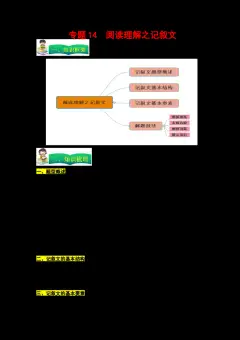
题型06 阅读理解记叙文
题型简介
记叙文类文章描述的是一件具体事情的发生、发展和结局,通常有时间、地点、人物、事件
等。有些文章是按事件发展的经过为主线叙述的,在叙述的过程中有详有略;有些文章是按时间
的顺序叙述的,有顺叙、倒叙等。从总体上来讲,文章的难度通常不大,在阅读过程中,我们一
直在某个线索的引导下,随着作者的思路去了解一个故事或一件事情的始末,因此会感到比较轻
松。命题往往从故事的情节、人物或事件之间的关系、作者的意图和态度、故事的前因和后果等
方面入手,考查学生对细节的辨认能力以及推理判断能力。阅读此类文章应特别注意:(1)若是
一般故事性文章,应读懂故事的发生、发展、高潮和结局;(2)若是"哲理故事",要理解故事
所蕴含的哲理意义;(3)若是 "逸闻趣事",应体会对话的风趣性,进而才能感受幽默的精髓。
记叙文的目的在于:讲述故事:交代事件的起因、经过、发展和结果。塑造人物:通过人物的言
行、心理活动来展现其性格与情感。表达情感/阐明道理:故事背后往往蕴含着深刻的人生哲理、
情感体验或社会价值。
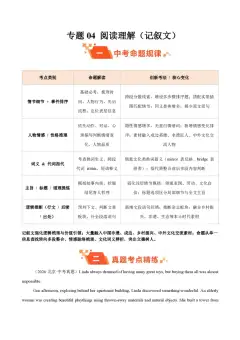
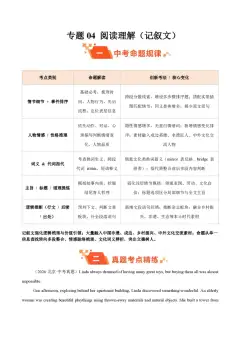
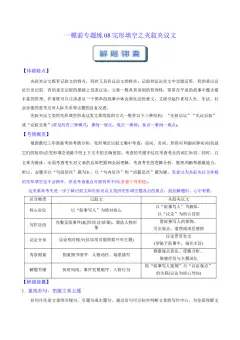
设题类型&命题方式
目录
第一部分 题型解码 高屋建瓴,掌握全局
第二部分 考向破译
解
微观
剖,精细教学
典例引领
方法透视
变式演练
考向01 人物类记叙文【常考】
考向02 叙事类记叙文【常考】
考向03 状物类记叙文
第三部分 综合巩固
合
整
应用,模拟实战
专题01 高考真题练
专题02 优秀模拟题
考向1:人物类记叙文
这类文章以塑造人物形象为核心,通过具体事例展现人物的性格、品质、情感和贡献。
1)细节理解题
命题方式:直接询问人物的具体信息,如:人物的某个行为、所说的话、取得的成就、生平背景
等。常见问法:
What did the person do when...?
According to the passage, how did he achieve...?
2)推理判断题(重点)
命题方式:要求根据人物的言行、选择以及他人评价,推断其内在的性格特征、情感态度、动机
或品质。
常见问法:
What can we infer about the person's character from Paragraph X?
How did the person probably feel after the event?
Why did the person make such a decision? (考查动机)
What kind of person is...?
3)主旨大意题
命题方式:考查对人物形象的整体把握,或概括文章主要目的是为了展现人物的哪个方面。
常见问法:
What is the main purpose of the passage?
What is the best title for the passage? (通常包含人物名称或其核心品质)
What does the author mainly want to tell us about the person?
4)观点态度题
命题方式:考查作者或文中其他人物对主人公的态度是钦佩、同情、批评还是中立。
常见问法:
What is the author's attitude towards the person?
考向2:叙事类记叙文
这类文章以叙述事件为核心,强调情节的发展、转折和结果,并从中引出教训、感悟或启示。
1)细节理解题
命题方式:考查对事件发生的时间、地点、原因、经过、结果等具体信息的把握,有时会要求对
事件发展过程进行排序。
常见问法:
What caused the event to happen?
What was the turning point of the story?
2)推理判断题(重点)
命题方式:要求根据情节发展,推测事件的后续影响、人物的命运,或分析事件之间的因果关系。
常见问法:
What would probably happen next?
What can be inferred from the end of the story?
Why did the event end in such a way? (考查深层因果)
3)主旨大意题(高频)
命题方式:考查对事件背后深层寓意、人生教训或作者写作意图的理解。这是叙事文的必考点。
常见问法:
What is the main idea of the passage?
What does the story want to tell us?
What lesson did the author learn from the experience?
4)词义猜测题
命题方式:文中的生词或短语往往与关键情节或人物动作相关,需要根据上下文语境进行推断。
常见问法:
The underlined word "..." in Paragraph 2 probably means ______.
What does the phrase "..." refer to in the context?
考向3:状物类记叙文
这类文章以一个具体的“物”(如旧物、动物、地点)为核心,通过对它的描述,抒发情感、寄
托思念或象征某种精神。
1)写作目的与主旨题(核心)
命题方式:直接考查作者描写该“物”的深层意图,即“借物抒情”或“托物言志”中的“情”
和“志”是什么。
常见问法:
What is the author's main purpose in writing this passage?
Why does the author describe the ... in such detail?
What is the best title for the passage? (标题通常会体现“物”与“情”的联系)
2)含义理解与推断题
命题方式:考查对“物”的象征意义、情感价值或它作为线索所连接的记忆与人物的理解。
常见问法:
What does the ... symbolize in the author's heart?
What can we learn about the author's grandfather from the description of the watch?
What does the author really mean by mentioning the old tree?
3)细节理解题
命题方式:询问关于“物”本身的外观、来源、功能等细节,但这些细节通常是为表达情感服务
的。
常见问法:
How did the author get the ...?
What is special about the ... according to the passage?
4)观点态度题
命题方式:考查作者对该“物”所怀有的情感,如珍爱、怀念、感激、遗憾等。
常见问法:
How does the author feel towards the ...?
What is the tone of the passage?
解题思路
第一部分:通用解题法 —— 应对所有记叙文的四大步骤
无论遇到哪种类型的记叙文,遵循以下四个步骤,能保证你思路清晰,不遗漏关键信息。
步骤1:速读全文,抓住要素,把握主线
目标:不要在第一遍阅读时就纠结于生词或细节。你的任务是搞懂“谁,在何时何地,做了什么
事,结果如何,有何感悟”。
解题步骤:
圈出主要人物(Who)。
划出故事发生的时间、地点(When & Where)。
用一句话在心里概括核心事件或人物特征(What)。
特别关注首段和尾段,这里往往是主旨的所在。
步骤2:审读题干,定位关键词
目标:明确题目在问什么,并带着问题回到文中寻找答案。
解题步骤:
仔细阅读题干和每个选项。
找出题干中的关键词,如:人名、地名、动词、名词短语、引号内的词等。
判断题型(是细节题、推理题还是主旨题)。
步骤3:精读定位,分析判断
目标:根据关键词,回到原文中找到相关的句子或段落(定位),并进行深入分析。
行动:
“地毯式”搜索:在原文中找到与题干关键词对应或同义替换的句子。
“语境式”理解:精读定位句及其前后句,确保理解准确。
对于不同题型:
细节题:直接比对选项与原文,注意同义替换。
推理/词义题:分析上下文逻辑关系(因果、转折、举例、定义等)。
主旨/目的题:回顾文章整体结构和首尾段。
步骤4:比对选项,排除干扰
目标:选出最符合原文的答案。
核心:熟知错误选项的常见陷阱:无中生有:选项内容原文未提及。偷换概念:对原文信息进行
细微的曲解。以偏概全:用局部信息代替整体主旨。过度绝对:使用如 always, never, all 等绝对化
词汇。正反混淆:与原文信息完全相反。
第二部分:专项技巧 —— 针对三大考向的解题重心
在运用通用心法的基础上,针对不同考向,你的思考重心应有所侧重。
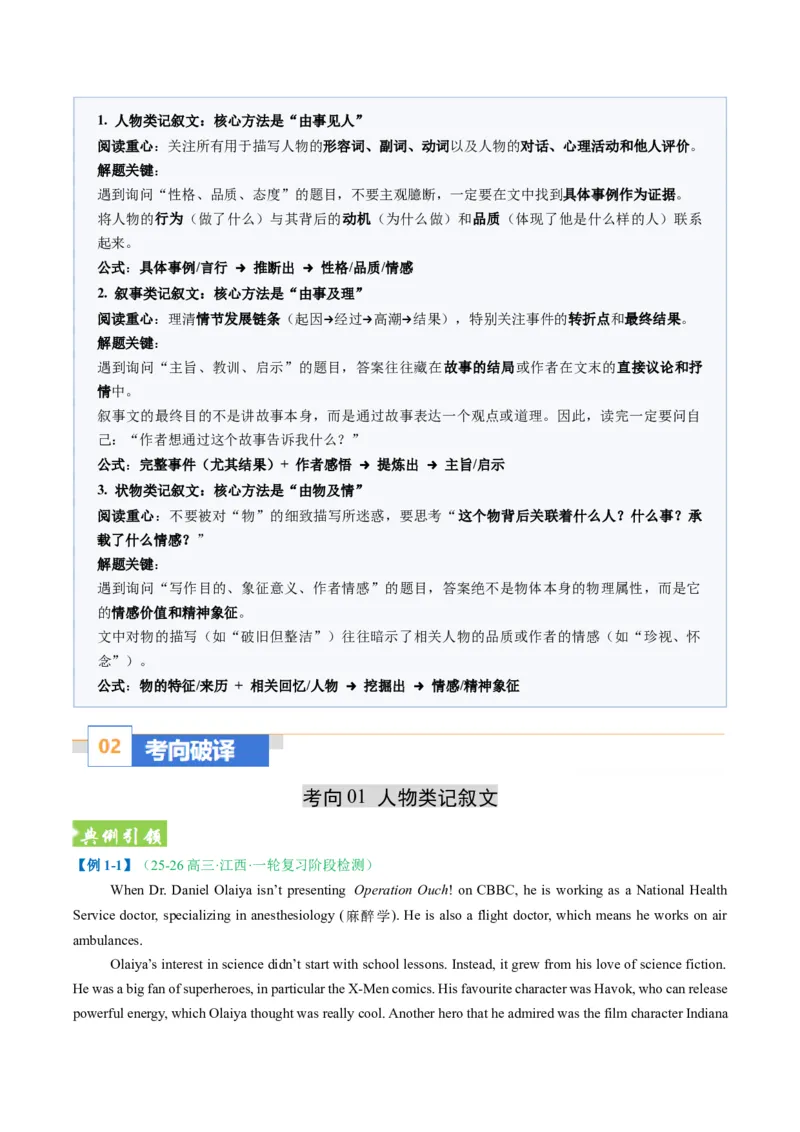
1. 人物类记叙文:核心方法是“由事见人”
阅读重心:关注所有用于描写人物的形容词、副词、动词以及人物的对话、心理活动和他人评价。
解题关键:
遇到询问“性格、品质、态度”的题目,不要主观臆断,一定要在文中找到具体事例作为证据。
将人物的行为(做了什么)与其背后的动机(为什么做)和品质(体现了他是什么样的人)联系
起来。
公式:具体事例/言行 推断出 性格
→
→
/品质/情感
2. 叙事类记叙文:核心方法是“由事及理”
阅读重心:理清情节发展链条(起因经过高潮结果),特别关注事件的
→
→
→
转折点和最终结果。
解题关键:
遇到询问“主旨、教训、启示”的题目,答案往往藏在故事的结局或作者在文末的直接议论和抒
情中。
叙事文的最终目的不是讲故事本身,而是通过故事表达一个观点或道理。因此,读完一定要问自
己:“作者想通过这个故事告诉我什么?”
公式:完整事件(尤其结果)+ 作者感悟 提炼出 主旨
→
→
/启示
3. 状物类记叙文:核心方法是“由物及情”
阅读重心:不要被对“物”的细致描写所迷惑,要思考“这个物背后关联着什么人?什么事?承
载了什么情感?”
解题关键:
遇到询问“写作目的、象征意义、作者情感”的题目,答案绝不是物体本身的物理属性,而是它
的情感价值和精神象征。
文中对物的描写(如“破旧但整洁”)往往暗示了相关人物的品质或作者的情感(如“珍视、怀
念”)。
公式:物的特征/来历 + 相关回忆/人物 挖掘出 情感
→
→
/精神象征
考向01 人物类记叙文
【例1-1】(25-26 高三·江西·一轮复习阶段检测)
When Dr. Daniel Olaiya isn’t presenting Operation Ouch! on CBBC, he is working as a National Health
Service doctor, specializing in anesthesiology (麻醉学). He is also a flight doctor, which means he works on air
ambulances.
Olaiya’s interest in science didn’t start with school lessons. Instead, it grew from his love of science fiction.
He was a big fan of superheroes, in particular the X-Men comics. His favourite character was Havok, who can release
powerful energy, which Olaiya thought was really cool. Another hero that he admired was the film character Indiana
Jones, an adventurous archaeologist and professor at a university. He used to dream of becoming “Indiana Jones” in
his own way.
Becoming a doctor wasn’t always Olaiya’s dream, but by the end of secondary school, he viewed it as a career
where he would deal with people, go on adventures and use his scientific knowledge, which was both enjoyable and
challenging. Pre-medical studies were really difficult because there was a lot to study. He struggled with it, but when
he started his degree at the University of Exeter, he says, “That was when the fun began.” He loved outdoor adventures
and activities while he was studying there.
In 2016, Olaiya joined FameLab, a global science communication competition, to share scientific ideas with
audience. He delivered a creative three-minute talk on the science of happiness. The next year, he participated again,
despite arriving an hour late due to heavy traffic. The talk ended up being a success and Olaiya made it through to
FameLab’s national final.
Science communication is still an important part of Olaiya’s job — he is now one of the presenters on
Operation Ouch! on CBBC. His most important advice for any young doctor is to work really hard at school and
“dive as deep as you can into the science and the human aspect, because you can’t have one without the other in
medicine.”
1. What initially sparked Olaiya’s scientific interest?
A.Characters in science fiction.
B.A global speech competition.
C.Formal classroom education.
D.Medical training in university.
2. Why did Olaiya take part in FameLab?
A.To win its final prize.
B.To better spread science.
C.To be a TV presenter.
D.To show his medical skills.
3. Which of the following words can best describe Olaiya?
A.Reserved and talented.
B.Independent and ambitious.
C.Warm-hearted and creative.
D.Adventurous and determined.
4. What does Olaiya’s advice highlight?
A.All efforts will pay off one day.
B.It is never too late to learn science.
C.Medicine needs humanity and science.
D.Caring for patients overweighs skills.
【答案】1.A 2.B 3.D 4.C
【导语】本文是一篇记叙文。文章讲述了医生兼科学传播者Daniel Olaiya 的职业生涯,分享了他如何从科
幻迷成长为医学专家,并通过FameLab 和电视节目推动科学普及,还强调医学需兼顾科学与人道精神。
1.细节理解题。根据第二段中“Olaiya’s interest in science didn’t start with school lessons. Instead, it grew
from his love of science fiction. He was a big fan of superheroes, in particular the X-Men comics. (Olaiya 的科学
兴趣并非始于学校课程,而是源于他对科幻小说的热爱。他特别喜欢超级英雄,尤其是《X 战警》漫
画。)”可知,最初激发Olaiya 科学兴趣的是科幻小说中的角色。故选A 项。
2.细节理解题。根据第四段中“In 2016, Olaiya joined FameLab, a global science communication competition,
to share scientific ideas with audience. (2016 年,Olaiya 参加了一项全球科学传播比赛FameLab,旨在向观众
分享科学理念。)”可知,Olaiya 参加FameLab 的目的是更好地传播科学。故选B 项。
3.推理判断题。根据第一段中“He is also a flight doctor, which means he works on air ambulances. (他也是一
名飞行医生,这意味着他在空中救护车上工作。)”和第三段中“He loved outdoor adventures and activities
while he was studying there. (当他在那里学习时,他喜欢户外冒险和活动。)”可知,Olaiya 热爱户外探险活
动,且从事飞行医生这样高挑战性的职业,表明他具有冒险精神;根据第三段中“Pre-medical studies were
really difficult because there was a lot to study. He struggled with it, but when he started his degree at the
University of Exeter, he says, “That was when the fun began.” (医学预科学习真的很难,因为要学的东西太多
了。他曾为此挣扎过,但当他开始在埃克塞特大学攻读学位时,他说:“那就是乐趣开始的时候。”)”可
知,Olaiya 克服医学预科困难,表明他有坚定决心。故选D 项。
4.细节理解题。根据最后一段中“His most important advice for any young doctor is to work really hard at
school and “dive as deep as you can into the science and the human aspect, because you can’t have one without the
other in medicine.” (他对年轻医生最重要的建议是在学校努力学习,“尽可能深入地研究科学和人文方面,
因为在医学上,两者缺一不可。”)”可知,Olaiya 的建议强调医学必须结合科学与人文。故选C 项。
【例1-2】(25-26 高三上·四川广安中学·月考)
At first sight, Easthope doesn’t seem much like a Cassandra. She smiles a lot. Her manner is kind and motherly;
pushed to name her profession, you might guess at nurse or teacher. But look closer.
Easthope is an emergency planner whose job is to support the survivors of major disasters, in which capacity
she acted following the 2004 Indian Ocean tsunami and the fire at Grenfell Tower. For two decades, the public knew
nothing about this vital work, which went on behind the scenes, though she was hugely admired in what we might
call professional disaster circles: a voice of calm and a fountain of wisdom. But in 2023, she published a best-selling
book about her career, When the Dust Settles, and that changed. People became very interested in what she did.
“At literary festivals, most authors get questions about their writing process,” Easthope says. “But I wouldn’t
get those. What people wanted from me was to know how I lived with the knowledge that I have. Wasn’t I afraid?
How did I handle? I would tell them that I didn’t live afraid, and I would give them basic advice. But this wasn’t
enough.” In the end, she felt she had no choice but to write a second book, one in which she would try to distill (浓
缩) all that she has learned for the benefit of each individual.
While her publisher describes Come What May as a roadmap for resilience (韧性), the word is one Easthope
dislikes. Ready, she suggests, is a better one. Easthope also reminds people that small things, like losing hair during
illness or consuming too much food after someone dies, still matter. She encourages people to remember, not to
forget, what happened during disasters, because such events leave a long-lasting effect.
1. What might a Cassandra be like according to paragraph 1?
A.Serious and unapproachable.
B.Competent and cautious.
C.Friendly and energetic.
D.Cheerful and easy-going.
2.What led to increased public awareness of Easthope’s work in 2023?
A.The publication of a bestseller.
B.The growth of professional disaster circles.
C.Her involvement in 2004 tsunami relief. D.Her sudden rise to fame through media.
3.Why are readers’ questions cited (引用) in paragraph 3?
A.To reveal Easthope’s personal fears.
B.To explain Easthope’s writing process.
C.To show Easthope’s writing motivation. D.To present public doubts about Easthope’s work.
4. What does Easthope agree on handling disasters?
A.Resilience matters most.
B.Forgetting aids recovery.
C.Positive thinking takes the lead.
D.Minor sufferings deserve attention.
【答案】1.A 2.A 3.C 4.D
【导语】本文是一篇记叙文。主要讲述应急规划师伊斯特霍普的职业经历、著作出版后受到的关注,以及
她关于人们应对灾难的观点和建议。
1.推理判断题。根据第一段中的“At first sight, Easthope doesn’t seem much like a Cassandra. She smiles a
lot. Her manner is kind and motherly; pushed to name her profession, you might guess at nurse or teacher. But look
closer. (乍一看,伊斯特霍普不太像卡桑德拉。她经常微笑。她的举止和蔼可亲,像母亲一样;如果非要说
出她的职业,你可能会猜是护士或老师。但再仔细看看。)”可知,伊斯特霍普的“笑容满面、亲切有母
性”与卡桑德拉的特质相反,由此可推知卡桑德拉应是严肃且难以接近的。故选A 项。
2.细节理解题。根据第二段中的“But in 2023, she published a best-selling book about her career, When the
Dust Settles, and that changed. People became very interested in what she did.(但在2023 年,她出版了一本关于
自己职业生涯的畅销书《尘埃落定之时》,一切都变了。人们开始对她的工作产生浓厚兴趣)”可知,2023
年一本畅销书的出版让公众对伊斯特霍普的工作有了更多了解。故选A 项。
3.推理判断题。根据第三段中““At literary festivals, most authors get questions about their writing process,”
Easthope says. “But I wouldn’t get those. What people wanted from me was to know how I lived with the
knowledge that I have. Wasn’t I afraid? How did I handle? I would tell them that I didn’t live afraid, and I would
give them basic advice. But this wasn’t enough.”(伊斯特霍普坦言:“文学节上,大多数作家都会被问及创作
过程,但没人问我这些。人们想了解的是,我如何背负着这些认知继续生活。难道不害怕吗?如何应对?
我会告诉他们我从不活在恐惧中,并给出基本建议。但这远远不够。”)”和“In the end, she felt she had no
choice but to write a second book, one in which she would try to distill all that she has learned for the benefit of
each individual.(最终,她觉得自己别无选择,只能写第二本书,一本试图浓缩她所学一切、造福每个人的
书)”可知,引用读者的问题是为了说明这些问题让伊斯特霍普意识到需要通过写书分享更多经验,即体现
她写第二本书的动机。故选C 项。
4.细节理解题。根据第四段中的“Easthope also reminds people that small things, like losing hair during
illness or consuming too much food after someone dies, still matter.(伊斯特霍普还提醒人们,一些小事仍然重
要,比如生病时脱发或有人去世后暴饮暴食。)”可知,伊斯特霍普认为生病时脱发或有人去世后暴饮暴食
这样的小事也很重要,即微小的痛苦也值得关注。故选D 项。
【变式1-1】(25-26 高三上·安徽·期中)
Even the strongest of swimmers get tears in their goggles ( 护目镜). Just ask Rylee Sayer, whose list of
achievements has become even longer after being selected to compete as an Aquablack at her first-ever World Para
解|题|技|巧
人物类记叙文的核心是 “由事见人” ,即通过具体事件、言行举止来展现人物的品质、性格与
情感。解题时需遵循以下步骤与方法:
第一步:快速浏览,抓住主线
在阅读前,先快速扫读文章首段、尾段以及各段首句,迅速把握文章主旨和人物身份。例如,在
例1-1 中,首段就点明了Dr. Daniel Olaiya 的多重身份;例1-2 则通过对比手法引出Easthope 的独特
职业特点。
关注人物特征:注意描述人物性格、品质或情感的关键词,
如"adventurous"、"determined"、"calm"。
第二步:分析题干,精准定位
仔细阅读题目和选项,确定题型(细节题、推理题或主旨题)。
根据题干中的关键词(如人名、地名、特定事件)迅速定位到原文相关段落。例如,例1-1 的第1
题通过"initially sparked scientific interest"定位到第二段。
第三步:深度解读,推理判断
细节理解题:在定位区间寻找直接对应信息,注意同义替换。如例1-1 第1 题中,"love of science
fiction"与选项A 中的"characters in science fiction"形成对应。
推理判断题:
o
性格品质题:将人物的行为与品质关联。如例1-1 第3 题,通过Olaiya 选择飞行医生职业和克服学
业困难的行为,推断出他"adventurous and determined"的品质。
写作目的题:结合全文主旨,分析人物行为背后的深层动机。如例1-1 第2 题,通过"to share
scientific ideas"推断参与FameLab 的目的是传播科学。
注|意|事|项
1.
严格遵循"文本证据"原则:所有答案必须基于原文,避免主观臆断。如例1-1 第3 题,必须找
到Olaiya 具体的行为证据来推断其品质。
2.
把握人物塑造的多元手法:注意通过人物言行、他人评价、对比衬托等手法来理解人物特征。
例1-2 中通过"doesn't seem much like a Cassandra"的对比,突出Easthope 的独特形象。
3.
区分事实与观点:事实是文中明确陈述的信息,观点则需要通过推理得出。如例1-2
中"Easthope is an emergency planner"是事实,而她对"resilience"一词的态度是观点。
4.
领会深层主旨:人物类文章往往通过个人经历传达普遍价值观。如例1-1 通过Olaiya 的经历强
调医学中科学与人文并重。
Swimming Championships(WPSC).
The Hauraki Plains College student was born with a rare condition, and later, she suffered from an aggressive
form of bone cancer. Within a month of the diagnosis (诊断), she had to have a forequarter amputation (截肢) of her
right arm.
But with all her courage and determination, Rylee has taken the suffering and turned it into a positive. Despite
her limb loss, Rylee held on firmly to her passion for swimming. Training six to seven times weekly at Matamata
Swim Club under coach Graeme Laing, she rebuilt her strength and technique. “All the training and hard work has
paid off,” she told The Profile. “I have had a lot of tears in my goggles, but my motivation always wipes them away.
Her efforts led to a historic moment: selection for the 2023 World Para Swimming Championships in Manchester,
Great Britain. She said she cried with excitement alongside her mum and a close friend who gave her “a big hug”.
“I am more than grateful to have the opportunity,” she said. Being her first WPSC, she said it was hard to know
what to expect, but she aimed to reach finals and set personal bests. Her pre-race routine included hype music for
mental focus and careful stretching.
She said her motivation is rooted in how far she has come from the start of her cancer journey. “Little me
would be so proud of how far I have come now,” she said. “I’m grateful to everyone who has been helping me on
this journey, especially my family.”
1.What directly contributes to Rylee’s amputation?
A.A serious athletic injury.
B.The delay in treatment.
C.A severe bone condition.
D.The after-effects of previous surgery.
2.How did Rylee feel when selected to compete in the WPSC?
A.Anxious but proud.
B.Stressed but confident.
C.Calm and responsible.
D.Overjoyed and appreciative.
3.Where does Rylee’s motivation mainly come from?
A.The desire to win the championships.
B.Her pride in participating in the WPSC.
C.Her progress in fighting against the disease.
D.The support from her family and friends.
4.What does Rylee’s story tell us?
A.It’s never too old to learn.
B.Well begun is half done.
C.Actions speak louder than words.
D.Nothing is impossible for a willing heart.
【答案】1.C 2.D 3.C 4.D
【导语】这是一篇记叙文,文章主要讲述Rylee Sayer 面对骨癌和截肢的逆境,凭借勇气、决心和努力最终
入选世界残疾人游泳锦标赛。
1.细节理解题。根据第二段“The Hauraki Plains College student was born with a rare condition, and later, she
suffered from an aggressive form of bone cancer. Within a month of the diagnosis (诊断), she had to have a
forequarter amputation (截肢) of her right arm.(这位Hauraki Plains 学院的学生生来就患有一种罕见的疾病,
后来,她患上了一种侵袭性骨癌。在确诊后的一个月内,她不得不接受右上肢高位截肢)”可知,因为患上
了一种侵袭性骨癌,所以Rylee 不得不截肢,故选C。
2.推理判断题。根据第三段中“She said she cried with excitement alongside her mum and a close friend who
gave her “a big hug”.(她说她激动地哭了,妈妈和一个好朋友给了她一个大大的拥抱)”和第四段中“I am
more than grateful to have the opportunity(我非常感激能有这个机会)”可知,入选WPSC 时她非常高兴并心怀
感激,故选D。
3.细节理解题。根据最后一段中“She said her motivation is rooted in how far she has come from the start of
her cancer journey.(她说,她的动力源于她从癌症之旅开始到现在已经走了多远)”可知,Rylee 的动力主要来
源于和疾病斗争所取得的进步,故选C。
4.推理判断题。根据全文内容,结合第三段中“But with all her courage and determination, Rylee has taken
the suffering and turned it into a positive.(但凭借她所有的勇气和决心,Rylee 已经把痛苦变成了积极的一面)”
可知,文章主要讲述Rylee Sayer 面对骨癌和截肢的逆境,凭借勇气、决心和努力最终在入选世界残疾人游
泳锦标赛。这体现了坚强的意志能克服不可能,选项D“心之所愿,无所不成”符合题意,故选D。
【变式1-2】(25-26 高三上·江苏泰州靖江·期中)
Chinese Nobel Prize-winning physicist Zhen Ning Yang, one of the most influential scientists in modern
physics, passed away in Beijing on October 18 due to illness at the age of 103.
Born in 1922, Yang was brought up surrounded by the Tsinghua campus, where his father was a math professor.
After finishing his undergraduate degree, he obtained his master’s degree from Tsinghua. He enrolled in the University
of Chicago in the United States to pursue a doctorate in 1946 and was strongly influenced by Italian-American
physicist Enrico Fermi, who had won the same Nobel Prize in 1938. He later became a professor at the Institute for
Advanced Study in Princeton.
Yang won the Nobel Prize in 1957 with Tsung-Dao Lee for their investigation of the so-called parity laws that
led to “important discoveries regarding the elementary particles,” according to the Nobel Prize website. They were
the first Chinese-born Nobel Prize winners in physics.
Professor Yang was deeply devoted to his homeland, making remarkable contributions to China’s scientific
and educational developments. His visit to China in 1971 led to a wave of visits by overseas scholars, earning him
recognition as the pioneer in building the bridge of academic exchange between China and the United States. He later
proposed the restoration and strengthening of basic scientific research to China’s central leadership. He also raised
funds to establish the “Committee on Educational Exchange with China”, which has continuously sponsored nearly
100Chinese scholars for advanced studies in the United States. These scholars later became the backbone of China’
s scientific and technological development. He undertook extensive work to promote China’s scientific and
technological exchange and progress, offering advice and exercising significant influence on major Chinese scientific
projects and the formulation (制定) of science and education policies.
After returning to Tsinghua University in 1999, he took on developing the Institute for Advanced Study as his
new mission. He poured enormous effort into advancing fundamental disciplines like physics and cultivating talents
at Tsinghua, making remarkable contributions that greatly impacted the reform and development of Chinese higher
education.
Professor Yang’s life stands as a timeless chapter in human history — one that shines not only for China but
for the global community of thinkers and innovators.
1.What is the article mainly about?
A.Yang’s lifelong contributions to China.
B.Yang’s research on elementary particles.
C.Yang’s influence on global science policy.
D.Yang’s educational background in America.
2.Why was Yang’s 1971 visit significant?
A.It focused on political dialogue.
B.It promoted cultural activities in China.
C.It aimed to win a Nobel Prize for China.
D.It initiated academic exchanges with the US.
3.What did Yang do for Chinese scholars?
A.He funded their advanced studies abroad.
B.He helped them win international awards.
C.He taught them advanced physics personally. D.He offered them jobs in American universities.
4.How does the author view Yang’s contributions?
A.It is primarily for Chinese scientists.
B.It belongs to the whole world.
C.It lies in his Nobel Prize achievement.
D.It is mainly about educational reform.
【答案】1.A 2.D 3.A 4.B
【导语】本文是一篇记叙文。文章记述了诺贝尔奖得主物理学家杨振宁的生平事迹及其对中外科学界与教
育事业作出的卓越贡献。
1.主旨大意题。通读全文,特别是根据第四段中心句“Professor Yang was deeply devoted to his homeland,
making remarkable contributions to China’s scientific and educational developments.(杨教授对祖国深怀热爱,
为中国的科学和教育事业作出了卓越的贡献。)”和第五段中心句“After returning to Tsinghua University in
1999, he took on developing the Institute for Advanced Study as his new mission. (1999 年回到清华大学后,他
把发展高等研究院作为自己的新使命。)”可知,文章重点展现杨振宁教授毕生对祖国的奉献。故选A。
2.细节理解题。根据第四段中“His visit to China in 1971 led to a wave of visits by overseas scholars, earning
him recognition as the pioneer in building the bridge of academic exchange between China and the United States.
(1971 年,他对中国的访问引发了一波海外学者的访问浪潮,他被公认为建立中美学术交流桥梁的先驱。)”
可知,此次访问开创了中美学术交流。故选D。
3.细节理解题。根据第四段“ He also raised funds to establish the “Committee on Educational Exchange with
China”, which has continuously sponsored nearly 100Chinese scholars for advanced studies in the United States.
(他还筹集资金成立了“中美教育交流委员会”,该委员会已连续资助了近100 名中国学者前往美国深造)”
可知,他为学者提供海外研修资助。故选A。
4.推理判断题。根据末段作者评价“Professor Yang’s life stands as a timeless chapter in human history—one
that shines not only for China but for the global community of thinkers and innovators.(杨教授的一生是人类历史
上永恒的篇章,不仅为中国,也为全球的思想家和创新者闪耀着光辉。)”可知,其贡献具有世界意义。故
选B。
考向02 叙事类记叙文
【例2-1】(24-25 高三下·广西来宾高级中学·)
Holding my hands, my grandparents boarded a green-skinned train in Hangzhou, which rocked and swayed
for twenty-five hours straight to Ulanqab (乌兰察布市), Inner Mongolia. This is my childhood memory of returning
home.
As the train journeyed north, the scenery outside the window gradually transformed from the gentle charm of
the south to the vast openness of the north. Everything felt so beautiful, even the clamor (喧闹) inside the carriage
carried a warmth. Before dawn the next day, I pressed my forehead against the fogged glass, watching the distant
sunrise break through the horizon. It seemed as though the morning sun had risen solely to welcome our return.
After starting elementary school, trips back to my hometown grew sparse, and that direct train quietly closed
down. The rails rusted into dotted lines in memory, and my hometown became a faint shadow on a photographic
negative (照相底片).
Then, last year, Grandpa passed away, and the frequency of returning home suddenly surged. Yet, the journey
no longer held the leisurely comfort of childhood it became a long, exhausting journey. We rushed to the airport
before daybreak, weighed down by luggage check-ins. The cramped cabin and turbulent air currents added discomfort,
while navigating the maze-like airport and enduring hours of road travel left us arriving under completely dark skies.
There was no time to admire the scenery, let alone the endless sea of clouds outside the airplane window.
This year, upon hearing that the long-suspended train had resumed operation, an indescribable excitement
welled up in my heart. A month ago, I finally boarded this long-missed train again. As night fell, the train slowly set
off. The familiar voices in the carriage, mingling with the rhythmic clatter of wheels against tracks, blended into a
nostalgic lullaby (怀旧的摇篮曲). Lying on the bunk, I felt the gentle sway of the train, as though cradled in the arms
of Mother Earth...Years have blurred the details of my memory, and I have sketched it one by one with my
imagination.
Finally, the train arrived at my hometown. The moment I met my grandma, the long-accumulated yearning in
my heart burst out like a tidal stream now...
1.Why does the author describe the train journey in her childhood?
A.To compare the train journey with air travel.
B.To show the inconvenience of traveling by train.
C.To emphasize the long distance to her hometown.
D.To highlight the beauty and warmth of the train journey.
2.What does the underlined word “sparse” in paragraph 3 most probably mean?
A.Rare.
B.Frequent.
C.Regular.
D.Complex.
3.What is the author’s attitude towards modern travel by air?
A.Indifferent.
B.Grateful.
C.Dissatisfied.
D.Enthusiastic.
4.What can be a suitable title for the text?
A.Memories of My Hometown
B.Old tracks Back Home
C.The Change of Transportation
D.The Beauty of Air Travel
【答案】1.D 2.A 3.C 4.B
【导语】本文是一篇记叙文,主要讲述了作者通过停运后又恢复的火车路线回到家乡的怀旧之旅。
1.推理判断题。根据文章第二段“As the train journeyed north, the scenery outside the window gradually
transformed from the gentle charm of the south to the vast openness of the north. Everything felt so beautiful, even
the clamor (喧闹) inside the carriage carried a warmth.(随着火车向北行驶,窗外的景色逐渐由南方的温婉妩媚
变成了北方的广阔开阔。一切都是那么美好,就连车厢里的喧闹声也带着一种温暖)”可知,作者描写她童
年的火车之旅是为了突出火车之旅的美丽和温暖。故选D。
2.词句猜测题。根据文章第三段“that direct train quietly closed down. The rails rusted into dotted lines in
memory, and my hometown became a faint shadow on a photographic negative(那列直达列车悄悄停运了。铁轨
在记忆中锈迹斑斑,我的家乡成了底片上模糊的影子)”可知,在文章的上下文中作者开始上小学后,那列
直达列车悄然停运了。铁轨在记忆中锈蚀成了点点痕迹,说明回故乡的旅行变得稀少、罕见,sparse 的意
思是“稀少”,和rare 意思相近。故选A。
3.推理判断题。根据文章第四段“Yet, the journey no longer held the leisurely comfort of childhood it became
a long, exhausting journey. We rushed to the airport before daybreak, weighed down by luggage check-ins. The
cramped cabin and turbulent air currents added discomfort, while navigating the maze-like airport and enduring
hours of road travel left us arriving under completely dark skies. There was no time to admire the scenery, let alone
the endless sea of clouds outside the airplane window.(然而,这段旅程不再有童年的悠闲舒适,它变成了一段
漫长而疲惫的旅程。我们在黎明前赶到机场,行李托运工作压得我们喘不过气来。狭窄的机舱和汹涌的气
流增加了我们的不适,而在迷宫般的机场穿行和长时间的公路旅行让我们在完全黑暗的天空下到达。没有
时间欣赏风景,更不用说飞机窗外无尽的云海了)”可知,作者将现代航空旅行描述为“漫长而疲惫的跋
涉”,有“狭窄的客舱”和“颠簸的气流”。她还提到没有时间欣赏风景,这表明与童年时更悠闲、风景
更美的火车旅行相比,她有一种不满意的感觉。故选C。
4.主旨大意题。通读全文,尤其是第一段“Holding my hands, my grandparents boarded a green-skinned train
in Hangzhou, which rocked and swayed for twenty-five hours straight to Ulanqab (乌兰察布市), Inner Mongolia.
This is my childhood memory of returning home.(我的祖父母牵着我的手,在杭州登上了一列绿皮火车,火车
摇晃了25 个小时,直达内蒙古乌兰察布。这是我童年回家的记忆)”和倒数第二段“This year, upon hearing
that the long-suspended train had resumed operation, an indescribable excitement welled up in my heart. A month
ago, I finally boarded this long-missed train again. As night fell, the train slowly set off. The familiar voices in the
carriage, mingling with the rhythmic clatter of wheels against tracks, blended into a nostalgic lullaby (怀旧的摇篮
曲). Lying on the bunk, I felt the gentle sway of the train, as though cradled in the arms of Mother Earth...Years
have blurred the details of my memory, and I have sketched it one by one with my imagination.(今年,当我听到
停运已久的火车恢复运行的消息时,一种说不出的兴奋涌上心头。一个月前,我终于再次登上了这趟久违
的列车。夜幕降临,火车慢慢地开动了。车厢里熟悉的声音,加上车轮有节奏地撞击轨道的声音,混成了
一首怀旧的摇篮曲。躺在铺位上,我感觉到火车的轻柔摇晃,仿佛被大地母亲抱在怀里
岁月模糊了我
……
记忆中的细节,我用想象把它一一勾勒出来)”可知,本文主要讲述了作者通过停运后又恢复的火车路线回
到家乡的怀旧之旅。它突出了与过去的情感联系,以及火车之旅在她记忆中的重要性,因此最恰当的题目
是B 选项“Old tracks Back Home(家乡的旧轨道)”。故选B。
【例2-2】(2025·浙江宁波海曙&4 地·一模)
Last spring, my neighbor Donna and I, both in our seventies, spent several hours in the glorious sunshine
enjoying the new season. When it was time to sit down and relax, Donna pulled out her red metal chair from her
garage (车库), and I sat on an overturned plastic bucket (桶). It was fun to catch up on the news that we had missed
during the long winter indoors.
However, over the next few days, it turned out that we needed more than a chair and a bucket which were not
quite comfortable. Donna decided we needed a bench. After dismissing unsuitable options from local stores, she
found a perfect one online. The next day it arrived. Excitedly, she opened the box and started putting it together. We
proudly high-fived each other as the pieces joined up and the bench started to look like one. After a few minutes’
assistance from a neighbour, it was complete. What’s more, it was the perfect fit for two 70-somethings to carry on
late afternoon chats.
Soon, the bench attracted other neighbors. One day, someone called out from the sidewalk, “What do you do
on that bench?” Quick-thinking Donna called back, “It’s our ‘Thinking Bench’! We think about important things
happening in our lives.” Then, the name gradually evolved—after one neighbor sat alone deep in thought, he declared
it a “Decision-Making Bench”; another time, when Donna was caught napping, she insisted she was “meditating (冥
想) ”, adding yet another name.
Last fall, with the temperature falling, we came to the end of sitting outdoors. We were faced with one dilemma-
what to do about it in the winter? Well, we sat down and thought and meditated and decided to put it in Donna’s
garage for the winter.
When I glimpsed it a few times over the next months, the bench sat lonely, holding empty flower pots, and
some flat, old boxes. But now after a long winter, spring flowers are ready to bloom in the warm sunshine, and we
neighbours are ready to welcome “The Bench” back into our lives.
1. Donna decided to replace the chair and bucket to _________.
A.lighten the carrying load
B.attract more neighbours
C.get better seating for chats
D.adapt to warmer weather
2. How did the bench get its various names?
A.From items placed on it.
B.From seasonal discussions.
C.From users’ activities on it.
D.From Donna’s creative ideas.
3. Why are pots and boxes mentioned in the last paragraph?
A.To suggest the flowers would soon be planted.
B.To show the bench was not serving its purpose.
C.To describe the bench’s practical use in winter.
D.To explain why the bench needed winter storage.
4. What does “The Bench” represent by the story’s end?
A.A symbol of community bonds.
B.A solution to the aging problem.
C.A reminder of the past summer.
D.A memory of a valued online order.
【答案】1.C 2.C 3.B 4.A
【导语】本文是一篇记叙文,讲述了作者和邻居唐娜在户外放置长椅,长椅吸引邻居们一起聊天、思考、
做决定,最终成为邻里情谊象征的故事。
1.细节理解题。根据第二段中的“However, over the next few days, it turned out that we needed more than a
chair and a bucket which were not quite comfortable. Donna decided we needed a bench.(然而,在接下来的几天
里,事实证明,我们需要的不仅仅是一把椅子和一只不太舒服的水桶。唐娜决定我们需要一条长凳。)”以
及“What’s more, it was the perfect fit for two 70-somethings to carry on late afternoon chats.(更重要的是,它非
常适合两位70 多岁的老人进行傍晚的聊天。)”可知,唐娜决定把椅子和桶换成长凳是为了让聊天时有更好
的座位。故选C。
2.细节理解题。根据第三段中的“Then, the name gradually evolved — after one neighbor sat alone deep in
thought, he declared it a ‘Decision-Making Bench’; another time, when Donna was caught napping, she insisted she
was ‘meditating’, adding yet another name.(然后,这个名字逐渐演变——一位邻居独自坐着沉思后,他宣称
这是一个决策长椅;还有一次,当唐娜被发现打盹时,她坚持说自己在冥想,于是又加了一个名字。
‘
’
‘
’
)”
可知,长凳的名字来源于使用者在长凳上的活动。故选C。
3.推理判断题。根据最后一段“When I glimpsed it a few times over the next months, the bench sat lonely,
holding empty flower pots, and some flat, old boxes. But now after a long winter, spring flowers are ready to bloom
in the warm sunshine, and we neighbours are ready to welcome “The Bench” back into our lives.(在接下来的几个
月里,当我瞥见它几次时,长凳孤零零地立着,上面放着空花盆和一些扁平的旧盒子。但是现在,经过一
个漫长的冬天,春天的花朵已经准备好在温暖的阳光下绽放,我们邻居们也准备好欢迎长凳回到我们的
‘
’
生活中。)”可知,长凳上放着空花盆和旧盒子,说明长凳在冬天没有发挥它的作用,即让邻居们一起聊天、
思考、做决定。故选B。
4.推理判断题。根据第三段中的“Soon, the bench attracted other neighbors.(很快,长凳吸引了其他邻
居。)”以及最后一段中的“But now after a long winter, spring flowers are ready to bloom in the warm sunshine,
and we neighbours are ready to welcome ‘The Bench’ back into our lives.(但是现在,经过一个漫长的冬天,春
天的花朵已经准备好在温暖的阳光下绽放,我们邻居们也准备好欢迎长凳回到我们的生活中。
‘
’
)”可知,长
凳吸引了邻居们一起聊天、思考、做决定,它最终象征着邻里间的情谊联结。故选A。
【变式2-1】(25-26 高三上·河南·期中)
For hundreds of years, my town has been having a commemoration (纪念) day to honor late heroes making a
big difference in our town. The event has always been organized by a team of volunteers until they age and pass the
task onto the next generation.
We always close our ceremony by reading the names of the late heroes over a soft drumming (击鼓). As the
解|题|技|巧
解题核心思路:看懂故事,悟出道理。
一、解题核心:抓准“故事线”和“情感线”
1.
先理清“故事线”——弄明白到底发生了什么
就像看电视剧,你得先把剧情捋顺。谁?在哪儿?发生了什么事?结果怎么样?
比如例2-1,故事线就是:童年坐绿皮火车回家(温馨美好) 长大后火车停运,改坐飞机(疲惫
→
不堪) 火车恢复,再次乘坐(重拾感动)。
→
2.
再抓住“情感线”——体会作者的心情变化
故事里的人是什么心情?这条线往往直接指向文章主旨。
例2-1 里,作者的情感从童年的“美好温暖”,变成坐飞机时的“疲惫不满”,最后是重坐火车时
的“激动怀念”。这一对比,作者想表达什么?(显然是更珍视从前那种有温度的慢生活)
例2-2 里,情感从“想要更舒服”到长椅带来“邻里相聚的快乐”,最后长椅成了大家生活中期待
的一部分。这说明什么?(长椅不只是椅子,更是邻里感情的联结)
二、不同题型的解题方法
细节题:老老实实回原文找!题干里的时间、地点、人名都是路标,帮你快速定位。
推理题:别自己瞎猜!答案藏在人物的行为、对话和感受里。比如,作者为什么不喜欢坐飞机
了?(因为文章里详细描写了赶飞机的狼狈和机舱的不适)。
主旨题:答案往往藏在三个地方——故事的结果、作者在结尾的抒情、或者那个最触动你的情
节里。多问自己一句:“作者讲这个故事,最想告诉我什么?”
注|意|事|项
1.
勿陷情节表面:不能只满足于读懂故事本身。高考考的是你能否透过故事,看到它背后的情感
和道理。
2.
情感转折点是题眼:故事里人物心情发生明显变化的地方,往往就会出题。比如从喜欢到不喜
欢,从失落到开心。
3.
留意“有深意的物件”:文中的某个东西往往不只是东西。比如例2-1 的“绿皮火车”代表的
是情怀和回忆;例2-2 的“长椅”代表的是邻里友情。它们通常是理解主旨的关键。
4.
答案必须在文中有证据:相信自己的第一感觉,但那个感觉必须能从文章里找到句子支撑。
years passed and memories faded, the names of the dead were becoming a blur (模糊的记忆) and in some cases
meaningless. More townspeople had difficulty appreciating the significance of the day and fewer were willing to join
the team to continue the tradition, there being one volunteer taking charge for a twenty-year period. Attendance was
suffering as well. Eventually, the celebration had become boring and uninspired.
Our senior volunteers were worried that if townspeople continued to lose sight of heroes’ contribution, our
commemoration day would evolve into something unrecognizable. Something needed to be done. Specially selected
volunteers were sought to help ease the team’s burden. It was an honor for me to be asked to assist.
I volunteered to give a speech for the coming commemoration day. The focus of my planned speech would be
to change the reading of the names and honorable title of our late heroes from something routine into something that
would make it clear that these were genuine heroes who once walked among us. I tried contacting their family
members, distant relatives, and old friends. Amazed, everyone was so thrilled to share so many fond stories and old
photos of their loved ones that I felt as if I knew each hero personally.
I integrated all those into my speech, which turned out well received, acting as the catalyst (催化剂) that got
our commemoration day observance back on track. Townspeople, once reminded, were happy to dive in and show
their respect.
1. Why was the commemoration day becoming less popular in the town?
A.The number of late heroes there was decreasing.
B.The volunteers of the event were not well organized.
C.Drumming made the atmosphere too sad for the public.
D.People were gradually forgetting the meaning behind it.
2. What specific change did the author make to the ceremony?
A.He replaced reading names with drumming.
B.He made it to bring the heroes’ names to life.
C.He organized a new team of young volunteers.
D.He invited family members to read the names.
3. How did townspeople respond to commemoration day after the speech?
A.They became more involved.
B.They lost interest in the event.
C.They preferred to be new heroes.
D.They provided financial support.
4. What can be the best title for the text?
A.The Story of a Town’s Holiday
B.The Life Stories of Late Heroes
C.A Speech That Saved a Tradition
D.Honoring Heroes: A Fading Faith
【答案】1.D 2.B 3.A 4.C
【导语】这是一篇记叙文。小镇纪念英雄的传统日因人们淡忘其意义渐失人气,作者受邀助力,通过收集
英雄事迹并融入演讲让仪式鲜活,成功唤起镇民敬意,让这一传统重回正轨。
1.细节理解题。根据第二段“As the years passed and memories faded, the names of the dead were becoming a
blur (模糊的记忆) and in some cases meaningless.(随着时间的流逝,记忆逐渐模糊,一些逝者的姓名甚至变
得模糊不清,有些甚至已经失去了意义)”可知,这个纪念日在该镇的受欢迎程度逐渐下降是因为人们逐渐
淡忘了其背后的含义。故选D。
2.细节理解题。根据第四段“The focus of my planned speech would be to change the reading of the names and
honorable title of our late heroes from something routine into something that would make it clear that these were
genuine heroes who once walked among us.(我计划演讲的重点在于改变对我们已故英雄的名字和尊称的表述
方式,将其从一种常规的表述转变为一种更能凸显出他们是真正英雄、曾与我们共处一地的表述方式)”可
知,作者成功地让这些英雄的形象鲜活了起来。故选B。
3.细节理解题。根据最后一段“Townspeople, once reminded, were happy to dive in and show their respect.(镇
上的居民们在被提醒之后,都非常乐意参与进来,表达自己的敬意)”可知,在那次演讲结束后,市民们对
纪念日的活动参与度更高了。故选A。
4.主旨大意题。根据第一段“For hundreds of years, my town has been having a commemoration (纪念) day to
honor late heroes making a big difference in our town. The event has always been organized by a team of
volunteers until they age and pass the task onto the next generation.(数百年来,我们这个小镇一直会举行一个纪
念日活动,以纪念那些对我们的小镇产生重大影响的已故英雄。这项活动一直由一群志愿者组织举办,直
到他们年老力衰,将任务交由下一代接手)”和最后一段“I integrated all those into my speech, which turned
out well received, acting as the catalyst (
催化剂
) that got our commemoration day observance back on track.
Townspeople, once reminded, were happy to dive in and show their respect.(我将所有这些都融入了我的演讲中,
演讲反响良好,起到了催化剂的作用,使我们的纪念日活动重回正轨。镇上的居民们在被提醒之后,都非
常乐意参与进来,表达自己的敬意)”并结合文章可知,小镇纪念英雄的传统日因人们淡忘其意义渐失人气,
作者受邀助力,通过收集英雄事迹并融入演讲让仪式鲜活,成功唤起镇民敬意,让这一传统重回正轨。可
知,C 选项“一场拯救了一项传统的演讲”最符合文章标题。故选C。
【变式2-2】(24-25 高三上·广东部分学校·十月联考)
In Hazelwood, a group called Seedlings (幼苗) for Tomorrow gives every child three plants to grow in their
own garden. Unlike a public park, these plants are theirs to keep forever. Kids “check out” at the city’s greenhouse
not with money, but by joining the group’s Garden Buddy project. This project pairs each young gardener with an
adult guide. They have a 45-minute virtual meeting each week to learn about gardening and nature. “Every kid should
feel the joy of growing something with their own hands,” said Orson Pike, the project director.
Orson started the non-profit organization Seedlings for Tomorrow in 2022. Soon he realized that just giving
away plants wasn’t enough. “Some groups think dropping off supplies is helping. But if people don’t know how to
use them, it’s like giving them a stone,” he explained. That’s why the program focuses on teaching skills — like how
to water plants properly, what seasons are best for planting, and how to protect flowers from insects. At the greenhouse,
children can pick from sunflowers, strawberries, lavender, and even small vegetable kits. There are guidebooks in
both English and Welsh.
Orson is already 70, but he’s always been enthusiastic about the growth of the next generation. He believes
that by letting kids choose what they love, they’ll grow into passionate gardeners. Many kids even share their progress
with classmates, making gardening a social activity.
To attract more families, Seedlings for Tomorrow visits local primary schools and community centers. Orson
also hopes to build small green stations around town where people can exchange seeds and gardening tips. The project
has received $20,000 from the UK-based Ecology Fund. The fund manager Elara Vane said, “Such programs are
essential— they teach patience, responsibility and love for the environment, which helps kids both in and out of
school,” adding that parents have noticed their children becoming more confident since joining the project.
1. What can a kid do by joining Garden Buddy project?
A.Volunteer at the city’s greenhouse.
B.Acquire gardening knowledge online.
C.Sell garden plants to the adult guide.
D.Receive free three plants every week.
2. What philosophy does Orson’s project demonstrate?
A.Hard work is the mother of success.
B.Guide others, and you will learn twice.
C.Teach a man to fish, not give him a fish. D.Creative activities involve being confident.
3. How does the author highlight the project’s value in the last paragraph?
A.By quoting an official.
B.By giving examples.
C.By providing statistics.
D.By making a comparison.
4. Which word best describes Orson?
A.Adventurous.
B.Determined.
C.Caring.
D.Flexible.
【答案】1.B 2.C 3.A 4.C
【导语】本文是一篇记叙文。在黑泽尔伍德镇(Hazelwood), Seedlings for Tomorrow 组织为每个孩子免费提
供三株植物,让他们在自己的花园中种植。孩子们通过加入Garden Buddy 项目,与成年导师配对,每周学
习园艺和自然知识。
1.细节理解题。根据第一段“This project pairs each young gardener with an adult guide. They have a 45-
minute virtual meeting each week to learn about gardening and nature.(该项目为每位年轻园丁配备一位成人导
师。每周他们都会进行45 分钟的线上交流,以学习园艺和自然知识)”可知,通过加入Garden Buddy 项目,
孩子们可以学习园艺和自然知识。故选B。
2.推理判断题。根据第二段““Some groups think dropping off supplies is helping. But if people don’t know
how to use them, it’s like giving them a stone,” he explained. That’s why the program focuses on teaching skills —
like how to water plants properly, what seasons are best for planting, and how to protect flowers from insects.(“有
些团体认为发放物资是有帮助的。但要是人们不知道如何使用这些物资,那就好比给他们一块石头。”他
解释道。这就是为什么这个项目侧重于传授技能——比如如何正确给植物浇水、哪些季节最适合种植、以
及如何保护花卉免受昆虫侵害)”可知,Orson 认为仅仅提供植物是不够的,更重要的是教会人们如何种植、
照顾它们。这与“授人以鱼不如授人以渔”的理念相符合。故选C。
3.推理判断题。根据最后一段“The fund manager Elara Vane said, “Such programs are essential— they teach
patience, responsibility and love for the environment, which helps kids both in and out of school,” adding that
parents have noticed their children becoming more confident since joining the project.(基金经理埃拉拉·瓦恩说:
“这类项目非常重要——它们能培养孩子们的耐心、责任感以及对环境的关爱,这对他们在校内外都有所
裨益。”她还表示,家长们注意到自从参与该项目后,孩子们变得更加自信了)”可知,作者通过引用
Ecology Fund 的基金经理Elara Vane 的话来强调该项目的价值。故选A。
4.推理判断题。根据第一段“Every kid should feel the joy of growing something with their own hands,” said
Orson Pike, the project director.(项目负责人奥森·派克说道:“每个孩子都应该体验亲手种植作物所带来的
快乐。”)”以及第三段“Orson is already 70, but he’s always been enthusiastic about the growth of the next
generation. He believes that by letting kids choose what they love, they’ll grow into passionate gardeners. Many
kids even share their progress with classmates, making gardening a social activity.(奥森已经70 岁了,但他一直
对下一代的成长充满热情。他认为,只要让孩子们选择自己喜爱的事物,他们就会成长为充满热情的园丁。
许多孩子还会向同学分享自己的成长过程,这使得园艺成为了一项社交活动)”可知,Orson 创办了非营利
组织Seedlings for Tomorrow,并致力于通过该项目教会孩子们园艺技能和对环境的热爱。他相信通过让孩
子们选择自己喜欢的植物,他们会成长为热情的园丁。此外,他还希望建立小型绿色站点,让人们可以交
换种子和园艺技巧。这些行为都表明Orson 是一个关心他人、尤其是关心下一代成长的人。故选C。
考向03 状物类记叙文
【例3-1】(2021 全国甲卷C 篇)
When I was 9, we packed up our home in Los Angeles and arrived at Heathrow, London on a gray January
morning. Everyone in the family settled quickly into the city except me. Without my beloved beaches and endless
blue-sky days, I felt at a loss and out of place. Until I made a discovery.
Southbank, at an eastern bend in the Thames, is the center of British skateboarding, where the continuous
crashing of skateboards left your head ringing .I loved it. I soon made friends with the local skaters. We spoke our
own language. And my favorite: Safe. Safe meant cool. It meant hello. It meant don't worry about it. Once, when
trying a certain trick on the beam(横杆), I fell onto the stones, damaging a nerve in my hand, and Toby came over,
helping me up: Safe, man. Safe. A few minutes later, when I landed the trick, my friends beat their boards loud,
shouting: “ Safe! Safe! Safe!” And that's what mattered — landing tricks, being a good skater.
When I was 15, my family moved to Washington. I tried skateboarding there, but the locals were far less
welcoming. Within a couple of years, I'd given it up.
When I returned to London in 2004, I found myself wandering down to Southbank, spending hours there. I've
traveled back several times since, most recently this past spring. The day was cold but clear: tourists and Londoners
stopped to watch the skaters. Weaving(穿梭)among the kids who rushed by on their boards, I found my way to
the beam. Then a rail-thin teenager, in a baggy white T-shirt, skidded(滑)up to the beam. He sat next to me. He
seemed not to notice the man next to him. But soon I caught a few of his glances. “I was a local here 20 years ago,”
I told him. Then, slowly, he began to nod his head. “Safe, man. Safe.”
“Yeah,” I said. “Safe.”
1. What can we learn about the author soon after he moved to London?
A. He felt disappointed.
B. He gave up his hobby.
C. He liked the weather there.
D. He had disagreements with his family.
2. What do the underlined words “Safe! Safe! Safe!” probably mean?
A. Be careful!
B. Well done!
C. No way!
D. Don't worry!
3. Why did the author like to spend time in Southbank when he returned to London?
A. To join the skateboarding.
B. To make new friends.
C. To learn more tricks.
D. To relive his childhood days
4. What message does the author seem to convey in the text?
A. Children should learn a second language.
B. Sport is necessary for children's health.
C. Children need a sense of belonging
D. Seeing the world is a must for children.
【答案】1. A 2. B 3. D 4. C
【解析】【分析】本文属于记叙文。本文讲述作者自己的经历,起初搬到伦敦很不适应,但是由于找
到了玩滑板的地方,结识了玩滑板的朋友,因此很好的适应了。作者回到伦敦之后,经常去之前玩滑板的
地方寻找自己的回忆,在与一个玩滑板的孩子打招呼的时候,终于找到了自己久违的熟悉感。
【1 题详解】推理判断题。根据第一段“Everyone in the family settled quickly into the city except
me. Without my beloved beaches and endless blue -sky days, I felt at a loss and out of place.(除了我之
外的家里人都很快适应这个城市,没有了我喜爱的沙滩和蓝天,我感到迷茫和无措)”可知,作者刚到伦敦
的时候因为没有喜爱的沙滩,不能很好的融入到新的城市,感到很沮丧,故选A。
【2 题详解】词义猜测题。根据画线词后文“And that's what mattered—landing tricks, being a good
skater. (那才是真正重要的——滑板的落地技巧掌握了才是一名好的滑板玩家)”可知,作者掌握了滑板落
地技巧,因此他的朋友大声欢呼,因此可以推出本句的Safe 是赞美的含义,结合选项,故选B。
【3 题详解】推理判断题。根据第四段““I was a local here 20 years ago," I told him. Then,
slowly, he began to nod his head. “Safe, man. Safe.””(我告诉他:“我20 年前经常在这里玩滑板,”
他缓慢地开始向我点头:“嗨,你好!”)”可推知,作者去Southbank 这个地方是为了寻找自己玩滑板的
回忆,故选D。
【4 题详解】推理判断题。根据全文可知,作者起初搬到伦敦很不适应,但是由于找到了玩滑板的地
方,结识了玩滑板的朋友,因此很好的适应了。但是搬去华盛顿,因为没有遇到很好的玩滑板的朋友,几
年之后就不再玩滑板,作者回到伦敦之后,经常去之前玩滑板的地方寻找自己的回忆,在于一个孩子打招
呼的时候,终于找到了自己久违的回忆。通过作者的经历,作者要表达的是,归属感对于孩子是很重要的,
故选C。
【例3-2】(25-26 高三上·辽宁大连育明高级中学·期中)
Thirty-two-year-old Ethan had spent a decade building his career as a software engineer in the city, but burnout
and loneliness had left him feeling lost. When his favorite childhood watch — gifted by his father who passed away
when he was 12 — stopped working, he didn’t just see a broken timepiece; he saw the last real link to the man who’d
taught him to fix things with patience.
Desperate to repair it, Ethan searched online and found “Maggie’s Repair Shop,” a tiny store in a quiet
neighborhood on the city’s outskirts. Unlike the modern tech shops he was used to, Maggie’s was filled with tools,
old-fashioned clocks, and photos of strangers’ cherished items. Maggie, a silver-haired woman in her 60s, smiled as
she took the watch. “This one has stories,” she said, turning it over in her hands. “Give me a week.”
Ethan visited every evening after work, not just to check on the watch, but to escape his stressful job. He
watched Maggie repair a faded quilt, a chipped ceramic mug, and a rusted bicycle, listening as customers shared
stories of their items — gifts from loved ones, mementos of important moments. “Fixing things isn’t just about parts,”
Maggie told him one night. “It’s about honoring what they mean to people.”
On the seventh day, Maggie handed him the watch. It ticked steadily, its leather strap polished. “I added a tiny
engraving on the back,” she said. Ethan flipped it over — there was his father’s favorite quote: “Patience mends more
than metal.” As he thanked her, a couple came in with a broken music box, and Ethan found himself offering to help
Maggie sand its wooden case.
Weeks later, Ethan quit his high-pressure job and became Maggie’s part-time assistant. He learned to repair
small items, listened to customers’ stories, and slowly rediscovered joy in the quiet, meaningful work. The watch
hadn’t just been fixed-it had led him to a life that felt rooted, not rushed. Sometimes, he realized, the things we try to
repair end up repairing us.
1. Why was the watch so important to him?
A.It was an expensive antique timepiece.
B.It was a precious gift from his late father.
C.It had helped him get through hard workdays.
D.It was the only thing left from his childhood home.
2. What can we infer about Maggie from the passage?
A.She began to fix the watch a week later.
B.She used to run a modern technology store.
C.She understands the emotional value of objects.
D.She repairs items only for close friends and family.
3. Why did Ethan start visiting Maggie’s Repair Shop every evening?
A.He hoped to learn repair skills from Maggie.
B.He needed to finish his work in a quiet place.
C.He was asked to help Maggie with daily operations.
D.He wanted to ask about the watch and relax himself.
4. What is the best title for the passage?
A.A Broken Watch and a Mended Heart
B.An Experience of Repairing Valuable Items
C.A Father’s Quote That Changed Everything
D.Leaving a Hig-Pressure Job for Friendship
【答案】1.B 2.C 3.D 4.A
【导语】本文是一篇记叙文。文章主要讲述了软件工程师Ethan 因职业倦怠和孤独感到迷茫,为修复已故
父亲赠予的珍贵手表,结识了修理店老板Maggie,在见证Maggie 修复物品背后情感价值的过程中,Ethan
不仅修复了手表,更找回了生活的意义,最终改变人生轨迹的故事。
1.细节理解题。根据第一段“When his favorite childhood watch — gifted by his father who passed away when
he was 12 — stopped working, he didn’t just see a broken timepiece; he saw the last real link to the man who’d
taught him to fix things with patience. (他最珍爱的童年手表——那是12 岁时去世的父亲送给他的——突然罢
工了。他看到的不只是个坏掉的手表,更是与那位教会他耐心修理东西的父亲之间最后的纽带)”可知,这
块手表是Ethan 12 岁时去世的父亲送给他的,对他来说非常重要,因为它是已故父亲送给他的珍贵礼物。
故选B 项。
2.推理判断题。根据第三段中玛姬说的话“Fixing things isn’t just about parts,” Maggie told him one night.
“It’s about honoring what they mean to people.” (“修理东西不仅仅是关于零件,”一天晚上Maggie 告诉他,
“而是关于尊重它们对人们的意义。”)”可知,Maggie 认为修理物品不仅仅是关于零件,更重要的是尊重
物品对人们的意义。由此推知,Maggie 理解物品的情感价值。故选C 项。
3.细节理解题。根据第三段“Ethan visited every evening after work, not just to check on the watch, but to
escape his stressful job. (Ethan 每天下班后都去,不仅仅是为了查看手表,也是为了逃避他压力大的工作)”可
知Ethan 开始每晚都去Maggie 的修理店,不仅仅是为了查看手表的修理情况,更是为了逃避他压力大的工
作,放松自己。故选D 项。
4.主旨大意题。文章主要讲述了软件工程师Ethan 因职业倦怠和孤独感到迷茫,为修复已故父亲赠予的珍
贵手表,结识了修理店老板Maggie,在见证Maggie 修复物品背后情感价值的过程中,Ethan 不仅修复了手
表,更找回了生活的意义。由此可知,A 项“一块坏了的手表和一颗被修复的心”最符合文章主旨,既体
现了手表的修理,又体现了Ethan 内心的修复和转变。故选A 项。
解|题|技|巧
核心原则:由物及情:别被物品的表面描述迷惑,要看到它背后的人和情。就像修手表那篇文
章,表面是修表,实际是修心。
解题三步走:
第一步:找到“物”,弄清它的来历:快速锁定文章核心物品是什么
例3-1 的核心是Southbank 这个滑板场地;例3-2 的核心是父亲留下的手表
关键问题:这物品对主人公为什么特别?
第二步:抓住“事”,理清物品背后的故事
物品只是一个引子,真正重要的是它串联起来的人和事
例3-1:通过滑板场地,讲的是“我”从孤独到找到归属感的故事
例3-2:通过修手表,讲的是“我”从迷茫到找回人生意义的故事
第三步:悟出“情”,理解深层情感
这是最关键的一步!要问自己:作者到底想通过这个物品表达什么?
例3-1 表达“归属感”的重要;例3-2 表达的是“有些东西看似我们在修它,其实是它在修我
们”
注|意|事|项
1.
别光盯着物品本身:手表不只是手表,它是父爱的象征;滑板场不只是场地,它是心灵的归宿。
2.
情感线索最重要:注意作者心情的变化,这往往是解题钥匙。从失落找到慰藉感悟人生。
→
→
3.
物品的象征意义是考点:出题人最爱考这个!要多想想“这个物品代表了什么?”
4.
结尾段落是宝藏:像“有些东西看似我们在修它,其实是它在修我们”这种句子,往往直接揭
示了主旨。
【变式3-1】(25-26 高三上·河北保定四县六校·期中)
Last September, I drove to a protected wetland near my home in Oakland, California. It was the first time that I
had gone somewhere merely to watch birds. Since this unique journey, I’ve seen 452 species, including 307 this year
alone.
In some birding circles, people claim anyone who looks at birds is a birder. I’ve cared about birds and other
animals for my entire life, and I’ve written about them throughout my two decades as a science writer, but I mark the
moment when I specifically chose to devote time and energy to them as the moment I became a birder.
Birding has significantly increased the time spent outdoors. It has motivated me to explore Oakland in ways I
never would have. While birding, I seem impervious to heat, cold, hunger and thirst. My senses focus only on the
present, and my head becomes extremely untroubled. I also feel a much deeper connection to the natural world, which
I have long written about but always remained slightly distant from.
These recent years have taught me that I’m smaller when I’m not actively looking after myself, that I have
value for my world and my community beyond ceaseless production, and that pursuits like birding that encourage
joy, wonder and bond with places are not sidebars to a fulfilled life but the essence.
It’s easy to perceive birding as something you do when you’re not working, not being productive, and even an
escape from reality. Instead, for me, birding means absorbing myself in the present moment: my thoughts quiet, my
senses heightened, and I respond to real, observable events in nature with focused awareness without being
distracted (使分心) by small, unimportant matters. I don’t need to know who the main characters are on social media
and what everyone is commenting on them, when I can instead spend an hour trying to locate a rare bird.
1. Why did the author think the journey to the wetland special?
A.He protected bird species there.
B.He fell in love with birding again.
C.He made his true start as a birder.
D.He completed his writing during it.
2. What does the underlined word “impervious” in paragraph 3 mean?
A.Attentive.
B.Subject.
C.Resistant.
D.Sensitive.
3. What lesson does the author probably learn?
A.Outdoor pursuits are a must-have.
B.Self-care can help fuel self-worth.
C.Happiness serves as the core of life.
D.Productivity defines personal value.
4. How does the author view birding according to the last paragraph?
A.A complete engagement with reality.
B.A temporary escape from busy life.
C.A training in focus and observation.
D.A substitute for online activities.
【答案】1.C 2.C 3.C 4.A
【导语】这是一篇记叙文,讲述了作者去年九月一次偶然的观鸟之旅让他正式成为观鸟者,此后观鸟不仅
增加了他的户外时间、让他更亲近自然,还让他领悟到生活的本质,重新认识了观鸟的意义。
1.细节理解题。根据第一段“It was the first time that I had gone somewhere merely to watch birds. Since this
unique journey, I’ve seen 452 species, including 307 this year alone. (这是我第一次专门去某个地方观鸟。自从
这次特别的旅行后,我已经见过452 种鸟类,仅今年就有307 种)”及第二段“I’ve cared about birds and other
animals for my entire life, and I’ve written about them throughout my two decades as a science writer, but I mark
the moment when I specifically chose to devote time and energy to them as the moment I became a birder. (我一生
都在关心鸟类和其他动物,在我作为一名科学作家的二十年里,我一直在写关于它们的文章,但我把我特
别选择为它们投入时间和精力的那一刻标记为我成为观鸟者的那一时刻)”可知,作者认为这次湿地之旅特
别,是因为它让自己真正开启了观鸟者的身份。故选C。
2.词义猜测题。根据第三段“While birding, I seem impervious to heat, cold, hunger and thirst. My senses
focus only on the present, and my head becomes extremely untroubled (观鸟时,我似乎对冷热饥渴都
impervious。我的感官只专注于当下,内心变得异常平静)”可知,观鸟时作者专注于当下,不受冷热饥渴的
影响,因此“impervious”意为“抵抗的、不受影响的”。故选C。
3.推理判断题。根据第四段“These recent years have taught me that I'm smaller when I'm not actively looking
after myself, that I have value for my world and my community beyond ceaseless production, and that pursuits like
birding that encourage joy, wonder and bond with places are not sidebars to a fulfilled life but the essence (这些年
我明白了,当我不积极关爱自己时,我会变得渺小;除了无休止的工作产出,我对自己的世界和社区也有
价值;而像观鸟这样能带来喜悦、惊奇并与周遭建立联结的追求,并非充实生活的点缀,而是其本质)”可
知,作者领悟到能带来快乐的追求是生活的核心,即幸福是生活的核心。故选C。
4.推理判断题。根据最后一段“Instead, for me, birding means absorbing myself in the present moment: my
thoughts quiet, my senses heightened, and I respond to real, observable events in nature with focused awareness
without being distracted by small, unimportant matters (相反,对我来说,观鸟意味着全身心投入当下:思绪
沉静,感官敏锐,我以专注的意识回应自然界中真实可观察的事物,不会被琐碎小事分心)”可知,作者认
为观鸟是对现实的全身心投入。故选A。
【变式3-2】(25-26 高三上·海南部分学校·月考)
My parents did not bat an eye when I was still playing with Barbies in sixth grade. My classmates were not so
understanding. 12-year-old girls weren’t supposed to play with Barbies and baby dolls anymore. Due to all the
teases (取笑), I started playing with the dolls less and less and put them in a large storage bin under my twin bed. It
was so full that I couldn’t even attach a lid to it.
My cat, Strawberry, would sleep with me each night and greet me every day when I got home from school.
When we found out that Strawberry was pregnant (怀孕的), I couldn’t have been more excited. I got a big basket and
as many old sheets as I could find, so Strawberry and her kittens would be comfortable. As Strawberry got bigger,
she began to sleep in my bed less and less and in her basket more and more.
Two days before Strawberry’s due date, I was playing at a friend’s house. My mom came to get me early
because she hadn’t seen Strawberry all afternoon and was worried about her. I immediately jumped in the car, knowing
that she was probably hiding somewhere having kittens. As we drove home, my mom explained that my brothers had
their friends over and were being awfully loud, so Strawberry probably didn’t feel safe in the basket I made for her.
When I ran into my room, I heard the cries of tiny kittens. I looked all over my room, but I couldn’t find where
the cries were coming from. Finally, I searched under my bed, and the cries got louder. I managed to pull out my
Barbie bin and found sweet, tiny kittens surrounded by a sea of blood-covered Barbies.
I wasn’t as upset as I thought I would be. It was time to let go of my Barbie dolls. Sometimes, childhood slips
away without you realizing it, and other times it ends with something really important, like a bin filled with bloody
Barbies.
1. Why did the author stop playing with Barbies as much?
A.She lost interest in them.
B.Her parents asked her to.
C.She had no time to spare.
D.Her classmates laughed at her.
2. What can we know about Strawberry after she was pregnant?
A.She was feeling unwell.
B.She wanted to be alone.
C.She preferred her basket.
D.She disliked playing outside.
3. Why did the author rush home?
A.To search for lost Strawberry.
B.To keep an appointment with her friends.
C.To check on kittens’ condition.
D.To ask her brother for help quickly.
4. What does the author try to express through the text?
A.Humans and animals can live in harmony.
B.Time is the best medicine for wounds.
C.Nothing is more important than friends.
D.Childhood ends in unexpected ways.
【答案】1.D 2.C 3.A 4.D
【导语】这是一篇记叙文。作者六年级时因同学嘲笑减少玩芭比,将其收进储物箱。后家中猫咪草莓怀孕,
最终在芭比储物箱中产仔,这让作者领悟到童年有时会以意外方式结束。
1.细节理解题。根据第一段“Due to all the teases (取笑), I started playing with the dolls less and less and put
them in a large storage bin under my twin bed. (由于所有的取笑,我开始越来越少地玩这些娃娃,并把它们放
进了我双人床下面的一个大储物箱里。)”可知,作者减少玩芭比娃娃是因为受到了同学的嘲笑。故选D 项。
2.细节理解题。根据第二段“As Strawberry got bigger, she began to sleep in my bed less and less and in her
basket more and more. (随着草莓的肚子越来越大,它开始越来越少地睡在我的床上,越来越多地睡在它的
篮子里。)”可知,草莓怀孕后更偏爱自己的篮子。故选C 项。
3.推理判断题。根据第三段“My mom came to get me early because she hadn’t seen Strawberry all afternoon
and was worried about her. I immediately jumped in the car, knowing that she was probably hiding somewhere
having kittens. (妈妈早早来接我,因为她整个下午都没见到草莓,很担心它。我立刻跳上车,知道它可能
躲在某个地方生小猫了。)”可知,作者赶回家是为了寻找失踪的草莓。故选A 项。
4.推理判断题。根据最后一段“Sometimes, childhood slips away without you realizing it, and other times it
ends with something really important, like a bin filled with bloody Barbies. (有时候,童年会在你不知不觉中溜
走,而有时候,它会以一些非常重要的事情结束,比如一个装满沾血芭比娃娃的箱子。)”以及上文可知,
作者通过自身经历想表达“童年会以意想不到的方式结束”。故选D 项。
专题01 高考真题练
A
(2025·全国二卷·高考)
Kathy Ho teaches high school inside Lucile Packard Children’s Hospital Stanford (LPCH). “Sometimes I don’t
like saying that I’m a teacher,” says Ho. “People get in their minds an idea of what teachers do, but that’s not really
what it is here.”
“Here” is room 386, where each year, about 500 LPCH patients also become students. The hospital school is
free of parents, doctors, and medical procedures. It’s a place of learning. About half of Ho’s students stay for a week
or less; others are there for more than a year. Most of Ho’s students will recover, which means that preparing them to
return to school is an increasingly important component of care.
Still, in room 386, academics don’t come first. Physical health and mental health are the priority. “If you’re
scared about something and thinking only about that, there’s no way you’re going to be able to learn,” Ho says. “I’m a
coach, an adviser, and a comforter, and that’s what it means to be a hospital teacher.”
There are up to 30 students at any given time in Ho’s class. She generally works with their regular teachers to
get lessons and tests being used at their home schools. Some teachers don’t give the kids any assignments; they
express sympathy instead. “I feel like it is a disservice to the kids,” Ho says. “They think their teachers don’t care
about their schoolwork.”
Ho recognizes the psychological benefit of helping kids keep up with their peers (同龄人) outside the hospital.
“I actually think the medicine is only a small piece for some problems,” says Julie Good, director of pain management
services at LPCH. “It’s about problem-solving around what it means to have a full life. Those kids have dreams.
School can keep those dreams alive by giving kids a way to learn and grow.”
1. Who does Ho teach at LPCH?
A.Sick children.
B.Young nurses.
C.Medical students.
D.Patients’ parents.
2. What is a characteristic of Ho’s job?
A.Prioritizing academics.
B.Encouraging innovation.
C.Treating various diseases.
D.Playing multiple roles.
3. What does the underlined word “it” refer to in paragraph 4?
A.Offering regular lessons.
B.Paying extra attention.
C.Assigning no schoolwork.
D.Showing no sympathy.
4. How does the hospital school benefit the students according to Good?
A.It eases peer pressure.
B.It helps them live in hope.
C.It frees them from aches.
D.It entertains them with stories.
【答案】1.A 2.D 3.C 4.B
【导语】本文是一篇记叙文,主要讲述了Kathy Ho 在斯坦福露西尔・帕卡德儿童医院(LPCH)担任教师
的工作情况,介绍了医院学校学生的情况、她工作的特点以及医院学校对学生的益处。
1.细节理解题。根据文章第二段中““Here” is room 386, where each year, about 500 LPCH patients also
become students. The hospital school is free of parents, doctors, and medical procedures. It’s a place of learning.
About half of Ho’s students stay for a week or less; others are there for more than a year. Most of Ho’s students will
recover, which means that preparing them to return to school is an increasingly important component of care. (“这
里”指的是386 室,每年约有500 名露西尔・帕卡德儿童医院(LPCH)的患者在这里成为学生。这所医
院学校里没有家长、医生,也没有医疗程序。它是一个学习的地方。Ho 老师的学生中,约有一半只待一
周或更短时间,其他人则会待一年以上。大多数学生最终会康复,这意味着,帮助他们做好重返学校的准
备正成为护理工作中日益重要的组成部分)” 可知,Ho 在露西尔・帕卡德儿童医院(LPCH)教生病的孩子。
故选A。
2.细节理解题。根据文章第三段中“I’m a coach, an adviser, and a comforter, and that’s what it means to be a
hospital teacher. (我是一名教练、一名顾问和一名安慰者,这就是作为一名医院教师的意义)”可知,Ho 工作
的一个特点是扮演多种角色。故选D。
3.词句猜测题。根据文章第四段划线词所在句“Some teachers don’t give the kids any assignments; they
express sympathy instead. “I feel like it is a disservice to the kids,” Ho says. (一些老师不给孩子们布置任何作业,
而是表达同情。Ho 说:“我觉得这对孩子们是一种伤害”)” 可推知,其中的“it”指的是不给孩子们布置
作业这件事。故选C。
4.推理判断题。根据文章最后一段中Julie Good 所说的“It’s about problem-solving around what it means to
have a full life. Those kids have dreams. School can keep those dreams alive by giving kids a way to learn and
grow. (这关乎围绕 “何为充实人生” 展开的问题解决。那些孩子拥有梦想,而学校能通过为他们提供学
习与成长的途径,让这些梦想得以延续)”可推知,Good 认为医院学校通过让孩子保持学习和成长,帮助他
们维系梦想,即帮助他们生活在希望中。故选B。
B
(2024·新课标Ⅰ·高考)
“I am not crazy,” says Dr. William Farber, shortly after performing acupuncture (针灸) on a rabbit. “I am ahead
of my time.” If he seems a little defensive, it might be because even some of his coworkers occasionally laugh at his
unusual methods. But Farber is certain he’ll have the last laugh. He’s one of a small but growing number of American
veterinarians (兽医) now practicing “holistic” medicine-combining traditional Western treatments with acupuncture,
chiropractic (按摩疗法) and herbal medicine.
Farber, a graduate of Colorado State University, started out as a more conventional veterinarian. He became
interested in alternative treatments 20 years ago when he suffered from terrible back pain. He tried muscle-relaxing
drugs but found little relief. Then he tried acupuncture, an ancient Chinese practice, and was amazed that he improved
after two or three treatments. What worked on a veterinarian seemed likely to work on his patients. So, after studying
the techniques for a couple of years, he began offering them to pets.
Leigh Tindale’s dog Charlie had a serious heart condition. After Charlie had a heart attack, Tindale says, she
was prepared to put him to sleep, but Farber’s treatments eased her dog’s suffering so much that she was able to keep
him alive for an additional five months. And Priscilla Dewing reports that her horse, Nappy, “moves more easily and
rides more comfortably” after a chiropractic adjustment.
Farber is certain that the holistic approach will grow more popular with time, and if the past is any indication, he
may be right: Since 1982, membership in the American Holistic Veterinary Medical Association has grown from 30
to over 700. “Sometimes it surprises me that it works so well,” he says. “I will do anything to help an animal. That’s
my job.”
1. What do some of Farber’s coworkers think of him?
A.He’s odd.
B.He’s strict.
C.He’s brave.
D.He’s rude.
2. Why did Farber decide to try acupuncture on pets?
A.He was trained in it at university.
B.He was inspired by another veterinarian.
C.He benefited from it as a patient.
D.He wanted to save money for pet owners.
3. What does paragraph 3 mainly talk about?
A.Steps of a chiropractic treatment.
B.The complexity of veterinarians’ work.
C.Examples of rare animal diseases.
D.The effectiveness of holistic medicine.
4. Why does the author mention the American Holistic Veterinary Medical Association?
A.To prove Farber’s point.
B.To emphasize its importance.
C.To praise veterinarians.
D.To advocate animal protection.
【答案】1.A 2.C 3.D 4.A
【导语】本文是记叙文。文章讲述兽医威廉·法伯(William Farber)博士在从针灸中受益后,将综合医疗应用
于动物,并取得了初步成效。
1.细节理解题。根据第一段的“If he seems a little defensive, it might be because even some of his coworkers
occasionally laugh at his unusual methods.( 如果他看起来有点戒备的姿态,那可能是因为他的一些同事偶尔
会嘲笑他不寻常的方法。) ”可知,Farber 的同事们有时会嘲笑他不寻常的方法,他们认为他很奇怪。故选
A。
2.细节理解题。根据第二段的“Then he tried acupuncture, an ancient Chinese practice, and was amazed that he
improved after two or three treatments. What worked on a veterinarian seemed likely to work on his patients. So,
after studying the techniques for a couple of years, he began offering them to pets.(然后,他尝试了针灸,这是一
种古老的中国疗法,并惊讶地发现,经过两三次治疗,他的病情有所好转。对兽医有效的方法似乎对他的
病人也有效。因此,在研究了这些技术几年后,他开始把它们提供给宠物。)”可知,Farber 作为患者从针
灸中受益,这促使他决定尝试在宠物上使用针灸。故选C。
3.主旨大意题。根据第三段内容“Leigh Tindale’s dog Charlie had a serious heart condition. After Charlie had a
heart attack, Tindale says, she was prepared to put him to sleep, but Farber’s treatments eased her dog’s suffering so
much that she was able to keep him alive for an additional five months. And Priscilla Dewing reports that her horse,
Nappy, “moves more easily and rides more comfortably” after a chiropractic adjustment.(利·廷代尔的狗查理患有
严重的心脏病。廷代尔说,查理心脏病发作后,她准备让他进入睡眠状态,但法伯的治疗大大减轻了她的
狗的痛苦,她能够让它多活五个月。普里西拉·杜因(Priscilla Dewing)报告说,她的马纳皮(Nappy)经过脊椎
按摩调整后,“行动更容易,乘车更舒服”。) ”可知,本段主要讲述了两个例子,一个是Farber 通过整体
医学方法帮助了患有严重心脏病的狗Charlie,另一个是马Nappy 在接受脊椎按摩治疗后移动和骑行更为舒
适。这些例子都是为了说明整体医学的有效性。故选D。
4.推理判断题。根据最后一段的内容“Farber is certain that the holistic approach will grow more popular with
time, and if the past is any indication, he may be right: Since 1982, membership in the American Holistic Veterinary
Medical Association has grown from 30 to over 700. ( 法伯确信,随着时间的推移,综合疗法会越来越受欢迎,
如果过去有任何迹象的话,他可能是对的:自1982 年以来,美国综合兽医协会的会员已经从30 个增加到
700 多个。)”可知,法伯认为综合疗法会越来越受欢迎,随后作者列举了美国综合兽医协会的会员已经从
30 个增加到700 多个的例子,因此推断美国整体兽医协会是为证明法伯的观点。故选A。
C
(2024·浙江·首考)
When was the last time you used a telephone box? I mean to make an actual phone call — not to shelter from
the rain. Ages ago, right? The last time I used a phone box for its intended purpose was…2006. I was conducting
auditions (试演) for my play in my tiny old shared house in London. Hoping to impress some talented actors to come
and work for me for nothing, I spread some throws over the sofas and lit candles to make it seem a bit more ”young
professional”.
As I rushed outdoors to empty the wastepaper baskets, the door swung shut behind me. Suddenly I was locked
outside. My mobile phone was inside, but luckily there was a telephone box across the street. So, I called Directory
Assistance, got put through to our landlady’s managing agent, and had a spare key sent to me with just enough time
to get back in before the actors arrived.
As it has been many years since I last used one, I should hardly be surprised that then are no longer any public
telephones near my house. The last one standing has just been turn into a “mini community library”: any passer-by
can “borrow” a book from its shelves return it later, or replace it with another title from their own collection.
For a few months after the “library” opened, I didn’t bother taking a look, as I had assumed that it would be
stuffed full of cheese love stories. Then I noticed folk conducting spring cleans dropping boxes of voluminous books
on various subjects there. And these books were free. This unbeatable price-point encouraged me to experiment with
dozens of titles that I would never normally consider buying. And I’ve discovered some great books!
If I ever get trapped outside my house again, my local telephone box will, sadly no longer be able to connect
me with my keys. But it can certainly keep me entertained while I wait for my wife to rescue me.
1. What does the underlined word “it” in the first paragraph refer to?
A.The play.
B.The shared house.
C.The sofa.
D.The telephone box.
2. Why did the author use the telephone box in 2006?
A.To place an urgent call.
B.To put up a notice.
C.To shelter from the rain.
D.To hold an audition.
3. What do we know about the “mini community library”?
A.It provides phone service for free.
B.Anyone can contribute to its collection.
C.It is popular among young readers.
D.Books must be returned within a month.
4. Why did the author start to use the “library”?
A.He wanted to borrow some love stories.
B.He was encouraged by a close neighbour.
C.He found there were excellent free books.
D.He thought it was an ideal place for reading.
【答案】1.B 2.A 3.B 4.C
【导语】这是一篇记叙文。随着手机的普及,电话亭渐渐地被人们遗忘,作者家附近的最后一个电话亭被
改造成了“迷你图书馆”,作者偶然发现那里有很多不错的免费书籍,这让作者觉得很棒。
1.词句猜测题。根据第一段第五句“I was conducting auditions (试演) for my play in my tiny old shared house
in London.(我当时在伦敦我那狭小的合租房子里为我的剧本进行试演。)”可知,此处是指使“我”的合租
房看起来更“年轻专业”一点,所以it 代指“合租房”。故选B。
2.细节理解题。根据第二段第四句“So, I called Directory Assistance, got put through to our landlady’s
managing agent, and had a spare key sent to me with just enough time to get back in before the actors arrived.(所以,
我打电话给电话查号台,接通了女房东的经纪人,他们给了我一把备用钥匙,刚好来得及在演员们到来之
前回去。)”可知,作者在2006 年使用电话亭是为了拨打紧急电话。故选A。
3.细节理解题。根据第三段第二句“The last one standing has just been turn into a “mini community library”:
any passer-by can “borrow” a book from its shelves return it later, or replace it with another title from their own
collection.(最后一个被改造成了一个“迷你社区图书馆”:任何路过的人都可以从它的书架上“借”书,
以后还回来,或者用自己收藏的另一本书来替换。)”可知,任何人都可以为“迷你社区图书馆”的捐赠图
书。故选B。
4.细节理解题。根据第四段最后四句“Then I noticed fork conducting spring cleans dropping boxes of
voluminous books on various subjects there. And these books were free. This unbeatable price-point encouraged
me to experiment with dozens of titles that I would never normally consider buying. And I’ve discovered some
great books!(然后我注意到福克正在进行春季大扫除,把各种主题的大书一箱箱地扔到那里。而且这些书是
免费的。这个无与伦比的价格点鼓励我尝试许多我通常不会考虑购买的标题。我还发现了一些很棒的
书!)”可知,作者发现“迷你图书馆”里有很多免费的很棒的书,所以开始使用。故选C。
专题02 优秀模拟题
A
(2025·云南民大附中·第三次模拟预测)
When Dr. Daniel Olaiya isn’t presenting Operation Ouch! on CBBC, he is working as a National Health
Service doctor, specializing in anesthesiology (麻醉学). He is also a flight doctor, which means he works on air
ambulances.
Olaiya’s interest in science didn’t start with school lessons. Instead, it grew from his love of science fiction.
He was a big fan of superheroes, in particular the X-Men comics. His favourite character was Havok, who can release
powerful energy, which Olaiya thought was really cool. Another hero that he admired was the film character Indiana
Jones, an adventurous archaeologist and professor at a university. He used to dream of becoming “Indiana Jones” in
his own way.
Becoming a doctor wasn’t always Olaiya’s dream, but by the end of secondary school, he viewed it as a career
where he would deal with people, go on adventures and use his scientific knowledge, which was both enjoyable and
challenging. Pre-medical studies were really difficult because there was a lot to study. He struggled with it, but when
he started his degree at the University of Exeter, he says, “That was when the fun began.” He loved outdoor adventures
and activities while he was studying there.
In 2016, Olaiya joined FameLab, a global science communication competition, to share scientific ideas with
audience. He delivered a creative three-minute talk on the science of happiness. The next year, he participated again,
despite arriving an hour late due to heavy traffic. The talk ended up being a success and Olaiya made it through to
FameLab’s national final.
Science communication is still an important part of Olaiya’s job—he is now one of the presenters on Operation
Ouch! on CBBC. His most important advice for any young doctor is to work really hard at school and “dive as
deep as you can into the science and the human aspect, because you can’t have one without the other in medicine.”
1. What initially sparked Olaiya’s scientific interest?
A.Characters in science fiction.
B.A global speech competition.
C.Formal classroom education.
D.Medical training in university.
2. Why did Olaiya take part in FameLab?
A.To win its final prize.
B.To better spread science.
C.To be a TV presenter.
D.To show his medical skills.
3. Which of the following words can best describe Olaiya?
A.Reserved and talented.
B.Independent and ambitious.
C.Warm-hearted and creative.
D.Adventurous and determined.
4. What does Olaiya’s advice highlight?
A.All efforts will pay off one day.
B.It is never too late to learn science.
C.Medicine needs humanity and science.
D.Caring for patients overweighs skills.
【答案】1.A 2.B 3.D 4.C
【导语】本文是一篇记叙文。文章介绍了医生兼科学节目主持人丹尼尔·奥拉亚(Daniel Olaiya)的职业经
历、兴趣起源及其对医学与科学传播的看法。
1.细节理解题。根据第二段“Olaiya’s interest in science didn’t start with school lessons. Instead, it grew from
his love of science fiction. He was a big fan of superheroes, in particular the X-Men comics. (奥拉亚对科学的兴
趣并非始于学校课程。相反,它源于他对科幻小说的热爱。他是超级英雄的忠实粉丝,尤其是《X 战警》
漫画。)”可知,科幻作品中的角色最初激发了奥拉亚的科学兴趣。故选A 项。
2.细节理解题。根据第四段“In 2016, Olaiya joined FameLab, a global science communication competition, to
share scientific ideas with audience. (2016 年,奥拉亚参加了全球科学传播竞赛FameLab,旨在与观众分享科
学理念。)”可知,奥拉亚参加FameLab 是为了更好地传播科学。故选B 项。
3.推理判断题。根据第二段“He used to dream of becoming “Indiana Jones” in his own way.(他曾梦想以自己
的方式成为“印第安纳・琼斯”)”、第三段“He loved outdoor adventures and activities while he was studying
there.(他在那里学习时喜欢户外探险和活动。)”体现其是“爱冒险的(Adventurous)”;第三段“Pre-
medical studies were really difficult because there was a lot to study. He struggled with it, but when he started his
degree at the University of Exeter, he says, “That was when the fun began.” (医学预科学习非常困难,因为要学
习的内容很多。他对此很挣扎,但当他开始在埃克塞特大学攻读学位时,他说:“这就是乐趣开始的时
候。”)”、第四段“The next year, he participated again, despite arriving an hour late due to heavy traffic. The
talk ended up being a success and Olaiya made it through to FameLab’s national final.(第二年,尽管由于交通堵
塞迟到了一个小时,他还是再次参加了比赛。这次谈话最终取得了成功,奥拉亚进入了FameLab 的全国决
赛。)”体现其是“坚定的(determined)”。故选D 项。
4.细节理解题。根据最后一段“His most important advice for any young doctor is to work really hard at school
and “dive as deep as you can into the science and the human aspect, because you can’t have one without the other
in medicine.”(他给年轻医生最重要的建议是:在学校刻苦学习,“尽可能深入钻研医学科学与人文关怀
——因为在医学领域,二者缺一不可”。)”可知,奥拉亚的建议强调医学需要人文关怀和科学知识。故选
C 项。
B
(25-26 高三上·海南·学业水平诊断一)
Need a ride to the doctor? I’ll be glad to take you. Does your dog need to be walked while you’re on vacation?
No problem.
Relatives, colleagues, neighbors, and even casual acquaintances all seemed to have my number. In my opinion,
doing good for others could not only benefit those in need but also make me feel good. And I was OK with that until
one afternoon when I received a call from an acquaintance of my dad’s.
This man I barely knew phoned to inform me that I was to drive him to a medical appointment the following
Tuesday. I checked my calendar. Then I told him as nicely as possible that I couldn’t help him that day because of
my tight schedule. His reaction wasn’t very kind.
At that moment, I checked my calendar carefully. I was averaging 14 good deeds a month. I stepped away
from the calendar, eyes finally opened, and took a closer look at myself in the mirror. Dark circles shadowed my
eyes. I didn’t feel like my usual energetic self. Clearly, it was time for me to change.
I brought my concerns to my friend Lucille. Though she was another busy woman, she still had time to socialize
and get a good night’s rest. How did she manage all that? She gave me her secret in one word: limits. She told me
not to run every time someone calls. Instead, ask the person some key questions: Is this an emergency? Is someone
else available to help you? Is this something that can wait? And, the question I knew I should have been considering all
along: Is this something you could do for yourself?
Now I consider those questions before rushing to another’s aid. Thanks to cutting down the favors I do for
others, I have more energy and sleep better at night. Though I was fearful cutting back on my kindness would have
met with disapproval, those friends and relatives started showing some real appreciation for my help. Now, sometimes,
they even help me when I’m in need. And that may be the greatest benefit of all.
1. What initially motivated the author to help others frequently?
A.Her desire to expand her social circle.
B.Her belief that it was a win-win approach.
C.The favor that others had done for her before.
D.The encouragement from relatives and neighbors.
2. What’s the primary turning point for the author?
A.Physical tiredness became unbearable.
B.Her friend directly pointed out her problem.
C.A stranger’s unkind response shocked her.
D.She was too busy to take care of her family.
3. What can we infer about Lucille’s approach to helping others?
A.She always put her own needs ahead of others’ requests.
B.She never helped anyone unless it was an emergency.
C.She turned certain tasks over to others systematically.
D.She practiced selective assistance with boundaries.
4. What is the main lesson the author has learned from her experience?
A.Helping others is meaningless unless you benefit too.
B.Sometimes saying no is a choice beneficial to both sides.
C.Refusing others’ requests tends to result in dissatisfaction.
D.Good time management is crucial to interpersonal relationships.
【答案】1.B 2.C 3.D 4.B
【导语】本文是一篇记叙文。文章讲述了作者过度助人导致身心俱疲,学会拒绝后反而获得了更好的人际
关系。
1.细节理解题。根据第二段中“In my opinion, doing good for others could not only benefit those in need but
also make me feel good.(在我看来,为他人做好事不仅能让那些需要帮助的人受益,也能让我感觉良好)”可
知,作者最初频繁帮助他人是出于认为这是一种双赢的做法,既帮助了别人,自己又感觉良好。故选B。
2.细节理解题。根据第三段中“This man I barely knew phoned to inform me that I was to drive him to a
medical appointment the following Tuesday. I checked my calendar. Then I told him as nicely as possible that I
couldn’t help him that day because of my tight schedule. His reaction wasn’t very kind.(这个我几乎不认识的人打
电话告诉我,下周二我要开车送他去看医生。我查看了日程表。然后我尽可能礼貌地告诉他,那天我因为
日程安排很紧,帮不了他。他的反应不太友好)”以及第四段中“At that moment, I checked my calendar
carefully. I was averaging 14 good deeds a month. I stepped away from the calendar, eyes finally opened, and took
a closer look at myself in the mirror. Dark circles shadowed my eyes. I didn’t feel like my usual energetic self.
Clearly, it was time for me to change.(那一刻,我仔细查看了日程表。我平均每月做14 件好事。我离开日程
表,终于睁开了眼睛,对着镜子仔细端详自己。黑眼圈笼罩着我的眼睛。我感觉不像平时那样精力充沛。
显然,是时候做出改变了)”可知,作者在因为日程紧无法帮助一个几乎不认识的人,而这个人反应不友好
后,意识到自己需要改变,这是作者的主要转折点。故选C。
3.推理判断题。根据第五段中“She gave me her secret in one word: limits. She told me not to run every time
someone calls. Instead, ask the person some key questions: Is this an emergency? Is someone else available to help
you? Is this something that can wait? And, the question I knew I should have been considering all along: Is this
something you could do for yourself?(她用一个词告诉了我她的秘诀:界限。她告诉我不要每次有人打电话就
跑去帮忙。相反,问对方一些关键问题:这是紧急情况吗?还有其他人可以帮你吗?这是可以等待的事情
吗?还有,我知道我一直应该考虑的问题:这是你自己能做的事情吗?)”可推知,Lucille 帮助别人的方式
是有界限的,会进行选择性帮助。故选D。
4.推理判断题。根据最后一段中“Now I consider those questions before rushing to another’s aid. Thanks to
cutting down the favors I do for others, I have more energy and sleep better at night. Though I was fearful cutting
back on my kindness would have met with disapproval, those friends and relatives started showing some real
appreciation for my help. Now, sometimes, they even help me when I’m in need. And that may be the greatest
benefit of all.(现在,在匆忙去帮助别人之前,我会考虑这些问题。由于减少了为别人做的帮助,我有了更
多的精力,晚上也睡得更好。虽然我担心减少我的善意会遭到反对,但那些朋友和亲戚开始对我的帮助表
示真正的感激。现在,有时候,他们甚至在我需要的时候帮助我。这可能是最大的好处)”可推知,作者从
自己的经历中学到的最主要教训是有时候拒绝别人对双方都有好处。故选B。
C
(25-26 高三上·广东·11 月联考)
It was my first trip to Paris, a city I’d dreamed of visiting since childhood. I wandered along the Seine River,
snapped photos of the Eiffel Tower, and soaked in the charming atmosphere. However, disaster struck on the third
day: when I reached for my bag at a crowded metro station, I found it empty — my phone, wallet, and passport were
all gone. Panic surged through me as I realized I had no way to contact anyone or pay for food and accommodation.
Desperate and lost, I wandered aimlessly down a quiet street, trying to hold back tears. A kind-looking elderly
man noticed my distress (困境) and approached me. “Are you in trouble, young lady?” he asked in broken English.
I explained my situation, and his eyes filled with sympathy. Without hesitation, he offered to take me to the local
police station to report the theft. On the way, he bought me a cup of hot coffee and reassured me, “Everything will
be okay. Parisians are not as cold as people say.”
At the police station, the officer was patient and helpful, taking down my details and promising to contact me
if there was any news. As I left, feeling still anxious, the elderly man insisted on driving me to a nearby youth hostel
where he helped me negotiate a discounted rate. He even pressed some euros into my hand, saying, “Buy yourself a
proper meal.” I tried to refuse, but he smiled and said, “Pass the kindness on someday.”
A week later, I received a call from the police, my wallet and passport had been found by a tourist who handed
them in. Though my phone was never recovered, I had already experienced something far more valuable. That trip
taught me that kindness is universal, and even in the darkest moments, strangers can bring light. I left Paris not just
with memories of beautiful landmarks, but with a warm heart full of gratitude.
1. What was stolen from the author at the metro station?
A.Her flight ticket and credit cards.
B.Her phone, wallet and passport.
C.Her camera and travel guide.
D.Her cash and hotel reservation.
2. What does the underlined word “reassured” in Paragraph 2 probably mean?
A.Comforted
B.Warned
C.Criticized
D.Challenged
3. We can infer from the passage that the elderly man ________.
A.was a staff member of the youth hostel
B.could speak fluent English with the author
C.cared about the author’s basic needs.
D.had known the author before the trip
4. What is the best title for the passage?
A.A Terrible Theft in Paris
B.The Beautiful Landmarks of Paris
C.A Trip Full of Surprises and Regrets
D.Kindness from a stranger in Paris
【答案】1.B 2.A 3.C 4.D
【导语】本文是一篇记叙文。讲述了作者在巴黎旅行时丢失手机、钱包和护照的遭遇。一位善良的老人提
供了帮助,带她去警察局、买咖啡、联系旅社并给予食物。最终钱包和护照被找回,作者深刻体会到陌生
人的善意,并对此充满感激。这次经历让她明白,即使在困境中,人性中的善良也是普遍存在的。
1.细节理解题。根据文章第一段“However, disaster struck on the third day: when I reached for my bag at a
crowded metro station, I found it empty—my phone, wallet, and passport were all gone.(然而,灾难在第三天降
临了:当我在一个拥挤的地铁站伸手去拿我的包时,却发现包空了——我的手机、钱包和护照都不见
了。)”可知,作者在地铁站伸手拿包时,发现包是空的,手机、钱包和护照都不见了。所以被偷的是作者
的手机、钱包和护照。故选B。
2.词句猜测题。根据文章第二段“On the way, he bought me a cup of hot coffee and reassured me,
‘Everything will be okay. Parisians are not as cold as people say.’(在路上,他给我买了一杯热咖啡,并
我说
……
:
“一切都会好起来的。巴黎人可不像人们说的那么冷漠。”)”可知,在去警察局的路上,老人说了一些话
目的是来安慰作者,让作者放心。因此划线词意为“安慰”,选项A“Comforted(安慰)”与划线词意思相近。
故选A。
3.推理判断题。根据文章第三段“As I left, feeling still anxious, the elderly man insisted on driving me to a
nearby youth hostel where he helped me negotiate a discounted rate. He even pressed some euros into my hand,
saying, ‘Buy yourself a proper meal.’(当我离开时,心里仍感到有些不安。那位老人坚持开车送我到附近的一
家青年旅社,并帮我谈妥了优惠价格。他还特意把一些欧元塞到我手里,说道:“给自己买顿像样的饭吃
吧。”)”可知,老人很关心作者的基本需求。故选C。
4.主旨大意题。根据文章最后一段“That trip taught me that kindness is universal, and even in the darkest
moments, strangers can bring light. (那次旅行让我明白,善良是普世的,即便在最黑暗的时刻,陌生人也能
带来光明。)”以及通读全文,文章讲述了作者在巴黎旅行时丢失手机、钱包和护照的遭遇。一位善良的老
人提供了帮助,带她去警察局、买咖啡、联系旅社并给予食物。最终钱包和护照被找回,作者深刻体会到
陌生人的善意,并对此充满感激。这次经历让她明白,即使在困境中,人性中的善良也是普遍存在的。因
此,选项D“Kindness from a stranger in Paris(来自巴黎一个陌生人的善良)”最能概括文章的主旨。故选D。
D
(25-26 高三上·浙江绍兴·一模)
I packed my family into our old car and set off on a 3,000 km trip from Sydney to the outback, hoping to create
lasting memories for the kids. My plan seemed ambitious — covering such distances with two young kids in the back
might sound crazy to a sensible person.
For most of the journey, we often felt annoyed, arguing about the remaining distance and the discomfort in the
car. I’d had outback road trip memories as a kid and wanted my city-raised children to see the vast open spaces.
At a bird-hide near Forbes, we watched a swamp with bright green water and dead trees. Eager to share
Australian folk stories, I confidently told the kids that a mysterious creature lived there — but stumbled when they
asked me follow-up questions. Their enthusiasm for the smallest joy knocked me for six. At a roadside motel that
looked like a movie set, the kids loved being woken by the night trains, cheering each time.
After three days, we reached Broken Hill — a town dominated by a big slag heap (矿渣堆), just as remarkable as
I remembered. Surrounded by kilometers of mineral-rich land, its streets imply its mining roots. I feared the mineral
museum would bore the kids, but they yelled with joy, thinking it was real-life Minecraft.
The trip wasn’t fantastic — I even complained about hard mattresses on the bed and small towels. But on
Easter morning, the kids went wild for a simple egg hunt in our cheap motel room, thrilled to search every corner. I
set out to teach the kids about the far reaches of our state, when in fact the kids were the best perspective I could ask
for all along.
1. Why did the author organize the trip?
A.To explore the locals’ unique lifestyle.
B.To make shared memories for the family.
C.To document the kids’ exposure to nature.
D.To relive the special outback experiences.
2. What does the underlined word “stumbled” in paragraph 3 probably mean?
A.Tripped over my words.
B.Argued about the stories.
C.Subscribed to their views.
D.Reflected on the memories.
3. What does the author think of the trip?
A.It well fulfills its original purpose.
B.It is worthwhile despite inconveniences.
C.It leaves the family an unpleasant memory.
D.It is an ambitious but disappointing attempt.
4. What key message does the author try to convey through the passage?
A.Travel joy lies in overcoming challenges.
B.City-raised kids can easily adapt to the outback.
C.We gain unexpected insights through kids’ eyes.
D.The outback offers more unique sights than cities.
【答案】1.B 2.A 3.B 4.C
【导语】本文是一篇记叙文。文章主要讲述了作者带着家人从悉尼到内陆进行3000 公里旅行,途中虽有烦
恼但也有惊喜,孩子们给作者带来新视角。
1.细节理解题。根据第一段中“I packed my family into our old car and set off on a 3,000 km trip from Sydney
to the outback, hoping to create lasting memories for the kids. (我把家人塞进我们的旧车里,从悉尼出发,踏上
了3000 公里的内陆之旅,希望能给孩子们留下永恒的回忆。)”可知,作者组织这次旅行是为了给家人创造
共同的回忆。故选B。
2.词句猜测题。根据第三段中“Eager to share Australian folk stories, I confidently told the kids that a
mysterious creature lived there — but stumbled when they asked me follow-up questions. (我迫不及待地想和孩
子们分享澳大利亚的民间故事,自信地告诉他们那里住着一个神秘的生物——但当他们问我后续问题时,
我却stumbled。)”可知,作者自信地给孩子们讲故事,但是当孩子们问后续问题的时候,作者却回答不上
来,由此可知,stumbled 意思是“说话结结巴巴,不流畅”,与“Tripped over my words. (说话结结巴
巴。)”意思相近。故选A。
3.推理判断题。根据最后一段中“The trip wasn’t fantastic — I even complained about hard mattresses on the
bed and small towels. But on Easter morning, the kids went wild for a simple egg hunt in our cheap motel room,
thrilled to search every corner. I set out to teach the kids about the far reaches of our state, when in fact the kids
were the best perspective I could ask for all along. (这次旅行并不精彩——我甚至抱怨床上的硬床垫和小毛巾。
但在复活节早晨,孩子们在我们便宜的汽车旅馆房间里疯狂地寻找鸡蛋,兴奋地搜遍了每一个角落。我本
想教孩子们了解我们州遥远的地方,但实际上,孩子们一直是我能要求的最好的视角。)”可推知,作者认
为这次旅行尽管有不便之处,但还是值得的。故选B。
4.推理判断题。根据最后一段中“I set out to teach the kids about the far reaches of our state, when in fact the
kids were the best perspective I could ask for all along. (我本想教孩子们了解我们州遥远的地方,但实际上,
孩子们一直是我能要求的最好的视角。)”可知,作者想通过文章传达的关键信息是“我们通过孩子的眼睛
获得了意想不到的见解”。故选C。
E
(2025·浙江ZDB 联盟·一模)
Amalia Garcia Lopez and Carlos Lafuente Picazo, two final-year university students from Spain, have just
wrapped up a nine-day trip to Shanghai—a city they might one day consider calling home.
They were participants in the Young Explorer Program, a program designed to bring international members of
Gen Z (Z 世代) to China and introduce them to Shanghai. The program offers overseas youth the opportunity to
experience Chinese culture firsthand and foster people-to-people exchange and mutual understanding.
Twenty-two young people from different cultural backgrounds took part in the immersive journey. Their route
included guided city walks and visits to companies and neighborhoods, offering a deep dive into Shanghai’s society
and culture. The group explored museums and heritage sites to learn about the city’s history, visited iconic tourist
attractions to experience its modern vibe, engaged with traditional Chinese culture in local communities, and
discovered thriving business hubs and revitalized (焕发活力的) historic neighborhoods.
All participants described the trip as both enjoyable and rewarding. During the trip, they were particularly
impressed by Shanghai’s diversity — describing the city as “cosmopolitan (国际性的) ” and “dynamic”.
“I was coming to Shanghai with the impression that it’s like a city of the future, and so far, I feel like I’m
seeing it for real,” said Picazo. “I think Shanghai is a city made for everyone. I’ve seen people from all over the world
here, and you can find whatever you need. It has so much to offer to make whoever comes feel comfortable.”
“One thing that surprised me is that Shanghai has a lot of nature, and it is so green,” Lopez said. “It’s the
perfect mix between society and nature, and it’s a city that’s growing every day. So, for me it was quite shocking
because I think when cities expand, they tend to just get rid of the trees and the nature.”
1. What does the underlined phrase “wrapped up” in the first paragraph mean?
A.ended successfully.
B.Packed carefully.
C.Cover ed completely.
D.Celebrated joyfully.
2. What is the Young Explorer Program for?
A.Training Gen Z in global business.
B.Exploring Shanghai’s natural scenery.
C.recruiting overseas talent for Shanghai. D.Promoting cultural exchange with China.
3. What impressed the participants most about Shanghai?
A.Its affordable living costs.
B.Its harmonious diversity.
C.Its advanced transportation.
D.Its traditional architecture.
4. How did Lopez’s perception of Shanghai change?
A.From skeptical to confident.
B.From simple to complex.
C.From doubtful to appreciative.
D.From abstract to concrete.
【答案】1.A 2.D 3.B 4.C
【导语】本文是一篇记叙文。两位西班牙学生通过青年探险计划体验了上海的文化,被其多样性、未来感
与自然融合所吸引,体验了中西方文化的交流与融合,收获颇丰。
1.词句猜测题。根据文章第一段“Amalia Garcia Lopez and Carlos Lafuente Picazo, two final-year university
students from Spain, have just wrapped up a nine-day trip to Shanghai—a city they might one day consider calling
home.( Amalia Garcia Lopez 和Carlos Lafuente Picazo 是来自西班牙的两名即将毕业的大学生,他们刚
刚
为期九天的上海之行。这座城市或许有一天会成为他们心中的理想家园。
……
)”可知,来自西班牙的两
名即将毕业的大学生,未来某一天他们会把上海称之为家的地方,是因为他们刚刚完成了为期九天的上海
之行。结合语境,“wrapped up”在这里应表示“圆满结束”的意思,与选项A“ended successfully(成功地结
束)”意思相符。故选A。
2.细节理解题。根据文章第二段“They were participants in the Young Explorer Program, a program designed
to bring international members of Gen Z (Z 世代) to China and introduce them to Shanghai. The program offers
overseas youth the opportunity to experience Chinese culture firsthand and foster people-to-people exchange and
mutual understanding.(他们是“青年探索者计划”的参与者,该计划旨在将 Z 世代(即当今的年轻人一
代)的国际成员带到中国,并让他们了解上海。该计划为海外青年提供了亲身体验中国文化的机遇,促进
了人与人之间的交流与相互理解。)”可知,他们参加了“青年探险者计划”,该计划主要目的是促进与中
国的文化交流,选项D“Promoting cultural exchange with China(促进与中国的文化交流)”符合题意。故选
D。
3.细节理解题。根据文章第四段“All participants described the trip as both enjoyable and rewarding. During
the trip, they were particularly impressed by Shanghai’s diversity—describing the city as “cosmopolitan (国际性
的) ” and “dynamic”.(所有参与者都称这次旅行既令人愉快又收获颇丰。在旅行期间,他们对上海的多样性
印象深刻——将这座城市描述为“国际化”的和“充满活力的”。)”可知,上海的多元融合最令人印象深
刻,选项B“Its harmonious diversity(其和谐的多样性)”符合题意。故选B。
4.推理判断题。根据文章最后一段“One thing that surprised me is that Shanghai has a lot of nature, and it is
so green(让我感到惊讶的一点是,上海拥有大量的自然景观,而且这里非常绿意盎然。)”以及“It’s the
perfect mix between society and nature, and it’s a city that’s growing every day. So, for me it was quite shocking
because I think when cities expand, they tend to just get rid of the trees and the nature.(这是社会与自然的完美结
合,而且这是一座每天都在发展的城市。所以,这对我来说相当震惊,因为我认为当城市扩张时,它们往
往会摆脱树木和自然。)”可知,Lopez 原本对上海的印象可能并不深刻或存在误解,但在实际体验后,他
对上海的自然景观和城市发展表示了赞赏和欣赏。因此,他的看法从怀疑或不确定转变为欣赏和赞赏,选
项C“From doubtful to appreciative(从怀疑到欣赏)”符合题意。故选C。
F
(2026·广东广州天河区·一模)
Lynn’s world fell apart in 2018. Her son, James, a navy flight surgeon, was fatally injured in a mission and
passed away. It was time for Lynn to honour the spirit of a man who had switched from studying commerce engineering
to medicine because he wanted to help people. Lynn instructed the hospital to begin the organ donation process. These
few words, as hard as they were to say, would soon ripple outward, allowing a man to return to work, a veteran to
regain his health, and a cyclist to get back on his bike.
Mike was diagnosed with leukemia in 2004. Six years of treatment and exercise paid off. To celebrate his sixth
year without cancer, Mike decided to ride his bike to New York. Unfortunately, his health deteriorated and one
evening in 2017, he started having chest pains.
That was when a mother’s very worst day became a stranger’s best. James’ heart was beating in the cancer
survivor’s chest now. The morning he woke up from the transplant, Mike found himself recharged.
Of the four letters Lynn had sent to the recipients, one reached Mike. Lynn described her son’s devotion to his
country, the fact that he considered everyone a friend, and his love for scuba diving, snowboarding, and motorcycling.
These pages painted a picture of just how special his new heart was. Mike carefully composed a response, accurately
expressing his gratitude and communicating his desire to stay in touch with James’ family. It was a balm (药膏) for
a wound that Lynn felt would never heal. And so began the emails and texts. She even began following Mike’s
Instagram posts. “Knowing he was doing well really helped,” she says.
During his recovery, Mike had hatched a plan to cycle cross-country again, from the hospital that treated him
to James’ grave. When he began the 1,430-mile journey in 2019, Lynn followed anxiously on his Instagram. Despite
setbacks—steep climbs, wrong turns, flat tires—Mike pressed on. On November 20, he arrived at James’ grave,
where Lynn waited. They hugged. Then came the tears—not of sorrow, but relief. A part of James lived on, and two
strangers connected by loss and hope became family.
1. What does the underlined word “deteriorated” mean in paragraph 2?
A.declined.
B.Improved.
C.Recovered.
D.Stabilized.
2. What is the main idea of paragraph 4?
A.Mother’s love for her son.
B.James’ amazing personalities.
C.Mike’s thoughtful response.
D.Interaction between Lynn and Mike.
3. Why did Mike cycle cross-country in 2019?
A.To test his physical strength
B.To show his great gratitude.
C.To raise fund for organ donation.
D.To pick up his former hobby.
4. What is the best title for the text?
A.Organ donation matters.
B.A great heart beats on.
C.A cross-country cyclist survives.
D.Social media connects people.
【答案】1.A 2.D 3.B 4.B
【导语】这是一篇记叙文。2018 年琳恩之子詹姆斯牺牲后捐器官,其心脏救了迈克。二人通过书信等互动
迈克2019 年骑行至詹姆斯墓前致谢,二人因爱与希望相连。
1.词句猜测题。根据第二段“Six years of treatment and exercise paid off. To celebrate his sixth year without
cancer, Mike decided to ride his bike to New York. Unfortunately, his health deteriorated and one evening in 2017,
he started having chest pains. (六年的治疗和锻炼有了成效。为了庆祝自己抗癌成功六周年,迈克决定骑自行
车去纽约。不幸的是,他的健康状况 deteriorated,2017 年的一个晚上,他开始胸痛。)”可知,
unfortunately 表转折,说明健康状况从“好转”转向糟糕,最终引发胸痛,deteriorated 应意为“恶化、下
降”,与 A 选项“declined(衰退、恶化)” 一致。故选A 项。
2.主旨大意题。根据第四段“Of the four letters Lynn had sent to the recipients, one reached Mike. Lynn described
her son’s devotion to his country, the fact that he considered everyone a friend, and his love for scuba diving,
snowboarding, and motorcycling. These pages painted a picture of just how special his new heart was. Mike carefully
composed a response, accurately expressing his gratitude and communicating his desire to stay in touch with James’
family. It was a balm (药膏) for a wound that Lynn felt would never heal. And so began the emails and texts. She
even began following Mike’s Instagram posts.(琳恩寄给四位收件人的信中,有一封送到了迈克手里。信里,
她讲述了儿子对国家的忠诚、视所有人为朋友的待人之道,以及他对水肺潜水、单板滑雪和摩托车运动的
热爱。这些文字生动勾勒出那颗新心脏的主人曾是多么特别。迈克精心写了回信,既真切表达了感激之情,
也提出希望与詹姆斯一家保持联系。这封信就像一剂药膏,抚慰着琳恩那道本以为永远无法愈合的伤口。
自此,两人开始互通邮件与信息,琳恩甚至还关注了迈克的照片墙动态。)”可知,该段核心围绕琳恩与迈
克的互动展开,包括发信、回信及后续线上关注。故选D 项。
3.细节理解题。根据第五段“During his recovery, Mike had hatched a plan to cycle cross-country again, from
the hospital that treated him to James’ grave. When he began the 1,430-mile journey in 2019, Lynn followed anxiously
on his Instagram. Despite setbacks—steep climbs, wrong turns, flat tires—Mike pressed on. On November 20, he
arrived at James’ grave, where Lynn waited. They hugged. Then came the tears—not of sorrow, but relief. A part of
James lived on, and two strangers connected by loss and hope became family.(康复期间,迈克酝酿了一个计划:
再次骑行穿越全国,从救治他的医院出发,前往詹姆斯的墓地。2019 年,当他开启这段1430 英里的旅程
时,琳恩在照片墙上焦急地关注着他的动态。尽管遭遇不少挫折 —— 陡峭的爬坡、走错的路线、漏气的
轮胎 —— 迈克仍坚持前行。11 月20 日,他终于抵达詹姆斯的墓地,琳恩已在那里等候。两人相拥而泣,
这泪水无关悲伤,满是释然。詹姆斯的一部分以这样的方式继续存在,而这两位因失去与希望相连的陌生
人,也成了家人。)”可知,迈克骑行到詹姆斯墓前,是为了向捐赠心脏的詹姆斯及其家人表达感激。故选
B 项。
4.主旨大意题。通读全文特别是第五段“During his recovery, Mike had hatched a plan to cycle cross-country
again, from the hospital that treated him to James’ grave. When he began the 1,430-mile journey in 2019, Lynn
followed anxiously on his Instagram. Despite setbacks—steep climbs, wrong turns, flat tires—Mike pressed on. On
November 20, he arrived at James’ grave, where Lynn waited. They hugged. Then came the tears—not of sorrow, but
relief. A part of James lived on, and two strangers connected by loss and hope became family.(康复期间,迈克酝
酿了一个计划:再次骑行穿越全国,从救治他的医院出发,前往詹姆斯的墓地。2019 年,当他开启这段
1430 英里的旅程时,琳恩在 Instagram 上焦急地关注着他的动态。尽管遭遇不少挫折 —— 陡峭的爬坡、
走错的路线、漏气的轮胎 —— 迈克仍坚持前行。11 月20 日,他终于抵达詹姆斯的墓地,琳恩已在那里等
候。两人相拥而泣,这泪水无关悲伤,满是释然。詹姆斯的一部分以这样的方式继续存在,而这两位因失
去与希望相连的陌生人,也成了家人。)”可知,文章围绕“詹姆斯的心脏在迈克体内跳动,生命以另一种
形式延续”展开,“A great heart beats on(一颗伟大的心脏继续跳动)”既指物理上的心脏跳动,也暗指詹姆
斯的精神传承,契合主旨。故选B 项。
G
(25-26 高三上·湖北武汉·九月调研)
At first sight, Easthope doesn’t seem much like a Cassandra (希腊神话人物). She smiles a lot. Her manner is
kind and motherly; pushed to name her profession, you might guess at nurse or teacher. But look closer.
Easthope is an emergency planner whose job is to support the survivors of major disasters, in which capacity
she acted following the 2004 Indian Ocean tsunami and the fire at Grenfell Tower. For two decades, the public knew
nothing about this vital work, which went on behind the scenes, though she was hugely admired in what we might
call professional disaster circles: a voice of calm and a fountain of wisdom. But in 2023, she published a best-selling
book about her career, When the Dust Settles, and that changed. People became very interested in what she did.
“At literary festivals, most authors get questions about their writing process,” Easthope says. “But I wouldn’t
get those. What people wanted from me was to know how I lived with the knowledge that I have. Wasn’t I afraid?
How did I handle it? I would tell them that I didn’t live afraid, and I would give them basic advice. But this wasn’t
enough.” In the end, she felt she had no choice but to write a second book, one in which she would try to distill (浓
缩) all that she has learned for the benefit of each individual.
While her publisher describes Come What May as a road map for resilience (韧性), the word is one Easthope
dislikes. Ready, she suggests, is a better one. Easthope also reminds people that small things, like losing hair during
illness or consuming too much food after someone dies, still matter. She encourages people to remember, not to
forget, what happened during disasters, because such events leave a long-lasting effect.
1. What might a Cassandra be like according to paragraph 1?
A.Reserved and cautious.
B.Severe and forbidding.
C.Sincere and energetic.
D.Cheerful and approachable.
2. What led to increased public awareness of Easthope’s work in 2023?
A.The publication of a best seller.
B.The growth of professional disaster circles.
C.Her involvement in 2004 tsunami relief.
D.Her sudden rise to fame through media.
3. Why are readers’ questions cited in paragraph 3?
A.To reveal Easthope’s personal fears.
B.To explain Easthope’s writing process.
C.To present public doubts about Easthope’s work.
D.To show Easthope’s writing motivation.
4. What does Easthope agree on handling disasters?
A.Resilience matters most.
B.Forgetting aids recovery.
C.Minor sufferings deserve attention.
D.Positive thinking takes the lead.
【答案】1.B 2.A 3.D 4.C
【导语】本文是一篇记叙文。文章主要讲述了紧急计划员Easthope 的职业生涯、其畅销书如何提升公众对
灾难应对工作的认知,以及她对灾难处理中细节关注和记忆重要性的见解。
1.推理判断题。根据文章第一段中的描述“At first sight, Easthope doesn’t seem much like a Cassandra. She
smiles a lot. Her manner is kind and motherly; pushed to name her profession, you might guess at nurse or teacher.
But look closer. (乍一看,Easthope 不太像Cassandra。她经常微笑。她的举止和蔼可亲,像母亲一样;如果
非要说出她的职业,你可能会猜是护士或老师。但再仔细看看。)”以及Cassandra 是希腊神话中的人物,通
常被描绘为具有先见之明但往往不被听信的形象,且性格多较为严肃。由此可推断,与Easthope 给人的初
步印象相比,Cassandra 可能更显得“严厉且令人敬畏”。因此,B 项“Severe and forbidding. (严厉且令人
敬畏的)”符合根据文本对Cassandra 性格的推测。故选B 项。
2.细节理解题。根据文章第二段中的“But in 2023, she published a best-selling book about her career, When
the Dust Settles, and that changed. People became very interested in what she did. (但在2023 年,她出版了一本
关于自己职业生涯的畅销书《尘埃落定》,这改变了现状。人们开始对她所做的事情非常感兴趣。)”可知,
是Easthope 出版的畅销书使得公众对她的工作有了更多的了解。因此,A 项“The publication of a best seller.
(一本畅销书的出版)”符合题意。故选A 项。
3.推理判断题。根据文章第三段中“At literary festivals, most authors get questions about their writing process,”
Easthope says. “But I wouldn’t get those. What people wanted from me was to know how I lived with the knowledge
that I have. Wasn’t I afraid? How did I handle? I would tell them that I didn’t live afraid, and I would give them basic
advice. But this wasn’t enough. (“在文学节上,大多数作者都会被问到他们的写作过程,”Easthope 说。“但
我不会得到这些问题。人们想从我这里知道的是,我是如何带着我所拥有的知识生活的。我不害怕吗?我
是如何处理的?我会告诉他们,我并不是活在恐惧中,我会给他们基本的建议。但这还不够。” )”可知,
作者提到读者的这些问题是为了展示她写作第二本书的动机,即为了更深入地解答公众的疑问,分享她的
经验和智慧。因此,D 项“To show Easthope’s writing motivation. (为了展示Easthope 的写作动机)”符合题意。
故选D 项。
4.细节理解题。根据文章最后一段中的“Easthope also reminds people that small things, like losing hair during
illness or consuming too much food after someone dies, still matter. (Easthope 还提醒人们,一些小事,比如生
病时掉头发,或者有人去世后自己暴饮暴食,仍然很重要。)”可知,Easthope 认为像生病期间掉头发或有
人去世后自己暴饮暴食这样的小事也很重要,即微小的痛苦也值得关注。因此,C 项“Minor sufferings
deserve attention. (微小的痛苦也值得关注)”是正确答案。故选C 项。
H
(2025·河北NT 名校联合体·一调)
In the summer of 2015, Emily Parker, a young environmental enthusiast, traveled to the coast of California
with her family to enjoy a relaxing beach vacation. She was excited to spend time by the ocean, swimming and
basking in the sun. However, as she walked along the shore, she was astonished to see piles of plastic bottles, broken
fishing nets, and discarded wrappers along the sand. The once beautiful beach was now littered with trash, and this
made Emily’s heart sink.
Emily had always cared about the environment, but seeing the pollution up close made her realize just how
serious the problem had become. It was not only ruining her vacation but also endangering the marine life she loved.
She thought of the turtles that might mistake plastic for food, or the seabirds that could get trapped in the nets. She
knew she had to do something about it.
After returning home, Emily decided to take action. She began volunteering at local beach cleanups every
weekend, picking up trash and raising awareness about the dangers of ocean pollution. She encouraged her friends,
family, and classmates to join her, and soon, a small group of dedicated volunteers formed. They organized monthly
cleanups and started educating the community about reducing plastic waste.
But Emily didn’t stop there. Realizing that the problem was far too big for just a small group to handle, she
created a non-profit organization called “Ocean’s Hope.” The organization’s mission was to raise awareness about
plastic pollution, organize global beach cleanups, and collaborate with businesses to reduce plastic packaging. Emily’s
passion for the ocean grew stronger, and she worked tirelessly to inspire others.
By 2020, “Ocean’s Hope” had become a global movement. Volunteers from all over the world participated in
cleanups, and companies began adopting more sustainable practices. Emily’s dream of a cleaner, safer ocean was
becoming a reality.
1. What does the underlined word “this” in paragraph 1 probably refer to?
A.The endangered wildlife.
B.Emily’s expectation.
C.The beach’s transformation.
D.The weather conditions.
2. What led Emily to take action?
A.Her love for rare sea animals.
B.The desire to enjoy her vacation.
C.Her family’s concern for marine life.
D.The realization of pollution’s impact.
3. What did Emily do to get others involved?
A.She sought advice from experts.
B.She motivated those around her.
C.She created a profitable organization.
D.She traveled abroad to give speeches.
4. Which words can best describe the personality of Emily?
A.Ambitious and strong-willed.
B.Committed and open-minded.
C.Generous and well-educated.
D.Determined and hard-hearted.
【答案】1.C 2.D 3.B 4.A
【导语】本文是一篇记叙文。文章讲述了年轻的环保爱好者艾米丽·帕克在 2015 年加利福尼亚海岸度假时,
目睹海滩污染后,从个人参与海滩清理,到成立非营利组织 “海洋的希望”,最终使其发展为全球运动,
逐步实现让海洋更清洁、更安全的梦想的故事。
1.词句猜测题。根据第一段中“However, as she walked along the shore, she was astonished to see piles of
plastic bottles, broken fishing nets, and discarded wrappers along the sand. The once beautiful beach was now
littered with trash, and this made Emily’s heart sink. (然而,当她沿着海岸行走时,她惊讶地看到沙滩上堆满
了塑料瓶、破渔网和丢弃的包装纸。曾经美丽的海滩现在布满了垃圾,这让艾米丽的心沉了下去。)”可知,
“this”指代的是前文描述的海滩从美丽到布满垃圾的转变。故选C。
2.细节理解题。根据第二段中“Emily had always cared about the environment, but seeing the pollution up
close made her realize just how serious the problem had become. It was not only ruining her vacation but also
endangering the marine life she loved. (艾米丽一直关心环境,但近距离看到污染让她意识到问题有多严重。
这不仅毁了她的假期,还危及她所热爱的海洋生物。)”可知,是意识到污染的严重影响让艾米丽决定采取
行动。故选D。
3.细节理解题。根据第三段中“She encouraged her friends, family, and classmates to join her, and soon, a
small group of dedicated volunteers formed. (她鼓励朋友、家人和同学加入她,很快,一小群热心的志愿者就
组成了。)”可知,艾米丽通过激励身边的人来让他们参与进来。故选B。
4.推理判断题。根据全文内容,尤其是第四段中“But Emily didn’t stop there. Realizing that the problem was
far too big for just a small group to handle, she created a non-profit organization called “Ocean’s Hope.” (但艾米丽
并没有止步于此。她意识到这个问题太大了,不是一个小团体能解决的,于是她创建了一个名为“海洋之
希望”的非营利组织。)”以及最后一段中“By 2020, “Ocean’s Hope” had become a global movement. Emily’s
dream of a cleaner, safer ocean was becoming a reality. (到2020 年,“海洋之希望”已经成为一场全球运动。
艾米丽梦想中的更清洁、更安全的海洋正在成为现实。)”可知,艾米丽是一个有雄心壮志且意志坚强的人,
她不仅自己行动,还激励他人,最终将保护海洋的行动发展成了全球运动。故选A。
I
(2026·四川绵阳南山中学·零诊)
When Ma Jiancheng took up his post as a forest ranger (护林员) at Sidalong nature conservation station in
1999, he knew the Qilian Mountains would be his lifelong home. Fresh from military service, he followed in his
father’s footsteps — a decision rooted in two deep influences: his love for the mountains and his father’s 30-year
dedication to protecting them.
“My father rarely came home, even for Spring Festival, because of fire prevention duties,” Ma recalled. This
sacrifice planted a seed in him: to safeguard the land his father venerated.
Life at 2,600 meters above sea level proved harsher than expected. “No electricity, just kerosene (煤油) lamps.
Water came from a river 800 meters away, and supplies arrived by truck only three times a month,” he said. Once, he
learned of his eldest daughter’s birth three days late — no phones connected the station to the outside.
Covering 20,000 hectares, Ma’s team patrols 20 days monthly, engaging in fire prevention, wildlife monitoring,
and educating herders on regulations. Over 26 years, his patrols totaled 100,000 km—2.5 times around Earth—filling
70 notebooks. “Shoes wear out fastest,” he joked, noting 80-km daily treks.
Dangers are constant: wolves, landslides, -30°C winters, and summer mudslides. Once, a mudslide destroyed
their station; they sheltered in a sheep pen. Yet technology now eases burdens — drones and cameras monitor remote
areas.
Tragedy struck in 2008 when his wife died of lung cancer. He’d rushed down the mountain too late, after a
herder relayed news of her emergency. “She asked me to care for our daughter,” he said, voice trembling.
Today, his daughter studies landscape architecture, inspired by his work. “City life feels strange now,” Ma
said. “The mountains calm me —this is where I belong.”
1. What does the word “venerated” in Paragraph 2 probably mean?
A.Honored
B.Neglected
C.Exploited
D.Concealed
2. Which of the following is NOT a duty of Ma’s team?
A.Keeping records of patrols
B.Preventing grassland fires
C.Training herders to use drones
D.Monitoring wetland resources
3. We can infer from the passage that ________.
A.Ma’s work has eliminated wildlife dangers
B.the daughter’s career choice reflects family influence
C.modern technology has replaced traditional patrols
D.Ma’s wife supported his career unconditionally
4. The best title for the passage would be ________.
A.A Legacy of Mountain Protection
B.The Hardships of a Forest Ranger
C.Technological Advances in Conservation
D.From Military Service to Mountain Life
【答案】1.A 2.C 3.B 4.A
【导语】这是一篇记叙文。主要讲述了马建成1999 年起继承父业,在祁连山当护林员,26 年巡护10 万公
里,历经艰辛与变故,其女受其影响学景观建筑的故事。
1.词义猜测题。根据第二段中“My father rarely came home, even for Spring Festival, because of fire
prevention duties(我父亲因为防火职责很少回家,甚至春节也不回)”可知,父亲对这片土地付出了很多心血
去保护,马建成决心守护父亲敬重的这片土地。所以这里“venerated”应该是“尊敬,敬重”的意思,与A
选项“honored(尊敬)”意思相近。故选A 项。
2.细节理解题。根据第四段中“Covering 20,000 hectares, Ma’s team patrols 20 days monthly, engaging in fire
prevention, wildlife monitoring, and educating herders on regulations. Over 26 years, his patrols totaled 100,000
km — 2.5 times around Earth—filling 70 notebooks.( 马的团队负责土地面积2 万公顷,每月巡逻20 天,从事
防火、野生动物监测和对牧民进行法规教育。在26 年的时间里,他总共巡逻10 万公里,绕地球2.5 圈,
填满了70 本笔记本)”可知,他们的职责有防火(Preventing grassland fires )、记录巡逻情况(Keeping
records of patrols )、监测野生动物(这里可理解为广义的对自然资源的监测,包含湿地资源等,
Monitoring wetland resources 也可算在内),文中未提及训练牧民使用无人机。故选C 项。
3.推理判断题。根据最后一段中“Today, his daughter studies landscape architecture, inspired by his work.( 如
今,他的女儿受到他工作的启发,学习景观建筑学)”可知,女儿的职业选择受到了父亲工作的影响,由此
可推知,女儿的职业选择反映了家庭的影响。故选B 项。
4.主旨大意题。通读全文可知,文章主要讲述了马建成继承父亲的事业,成为一名护林员,守护祁连山
的故事,这是一种对山林保护事业的传承,A 选项“A Legacy of Mountain Protection”(山林保护的传承)
能很好地概括文章主旨,适合作为文章的标题。故选A 项。
J
(25-26 高三·广东惠州·调研考)
Kristin Kimball, a travel writer, drove from New York studio to Pennsylvania to write about a young sustainable
farmer she’d heard of. When she arrived at the farm, the farmer said he was too busy to be interviewed, even though
they had previously scheduled it.
“Instead,” Kimball remembers,“ he handed me a garden tool and said, ‘There’s the vegetable land.’ That was
the first time that I actually did any farm work, and yet when I started doing the work, I was shocked at how viscerally I
responded.”
“And something happened that day. I just fell in love with the work.” she adds. “I think that human beings are
in some way born to be farmers. This is what most people in the history of the world have focused their energy on.”
In a way, Kristin Kimball was lucky. When she decided to move to a farm in upstate New York, she had no
idea what she was getting into. Seven years after her life-changing move from Manhattan to Essex Farm, Kimball
has documented her adjustment to rural living in her new book, The Dirty Life. The title of her book, Kimball says,
comes from the fact that farm work is consistently dirty. “I had no idea you could be dirty in so many different ways,”
she says. “There’s dirt. There’s blood. There’s sweat. There’s your own sweat, and the sweat of the animals.”
In spite of the constant hard work, Kimball’s farm still has its quiet, romantic moments. The first year she
planted potatoes, the yield (收获) was enormous — around 10,000 pounds. Friends were called to help. “It was truly
fall,” Kimball writes:
The air was still cold at noon despite the bright sun. We boiled potatoes in their skins in the field, and served
them steaming in napkins (餐巾纸). We all warmed our chilled fingers on them, popped them open, invested them
with quantities of butter and salt. If there is a more perfect way to celebrate the potato’s earthy, sustaining essence
(本质), I have not discovered it yet.
1. Which of the following can best describe Kimball’s path to farming?
A.Well-planned. B.Interest-based.
C.Unexpectedly-taken. D.Curiosity-driven.
2. What does the underlined word “viscerally” in paragraph 2 mean?
A.Naturally.
B.Patiently.
C.Passively.
D.Hesitantly.
3. Why did Kimball write the book?
A.To share the joy of harvest.
B.To promote the benefits of farming.
C.To record her adaptation to country life.
D.To introduce the farming skills she learned.
4. What does Kimball intend to express in the last paragraph?
A.The happiness in cooking potatoes.
B.The satisfaction gained from farm life.
C.The significance of teamwork in farming.
D.The challenges of farming in cold weather.
【答案】1.C 2.A 3.C 4.B
【导语】本文是一篇记叙文。主要讲述旅行作家Kristin Kimball 意外投身农耕并记录乡村生活适应过程的
故事。
1.推理判断题。根据第一段中的“Kristin Kimball, a travel writer, drove from New York studio to
Pennsylvania to write about a young sustainable farmer she’d heard of.(旅行作家克里斯汀·金博尔从纽约的工作
室驱车前往宾夕法尼亚州,想要报道一位她听说过的年轻的可持续发展农民。)”及第四段中的“In a way,
Kristin Kimball was lucky. When she decided to move to a farm in upstate New York, she had no idea what she was
getting into.(在某种程度上,克里斯汀·金博尔是幸运的。当她决定搬到纽约州北部的一个农场时,她根本
不知道自己会陷入什么样的境地。)”可知,Kimball 走上农耕之路是出乎意料的。故选C 项。
2.词句猜测题。根据第二段中的“That was the first time that I actually did any farm work, and yet when I
started doing the work, I was shocked at how viscerally I responded.(那是我第一次真正做农活,但当我开始做
的时候,我惊讶于自己的反应是如此
。
……
)”及第三段中的“And something happened that day. I just fell in
love with the work.(那天发生了一些事情。我只是爱上了这份工作。)”可知,Kimball 第一次干农活,却爱上
了这份工作,这是发自内心、未经刻意思考的,由此可知,作者惊讶于自己的反应是自然的,所以,划线
单词的意思与“自然地、本能地”意义相近。故选A 项。
3.细节理解题。根据第四段中的“Seven years after her life-changing move from Manhattan to Essex Farm,
Kimball has documented her adjustment to rural living in her new book, The Dirty Life.(在她从曼哈顿搬到埃塞
克斯农场,改变了生活的七年后,金博尔在她的新书《肮脏的生活》中记录了自己对乡村生活的适应过
程。)”可知,Kimball 写这本书是为了记录她对乡村生活的适应。故选C 项。
4.推理判断题。根据最后一段中的“We boiled potatoes in their skins in the field, and served them steaming in
napkins. We all warmed our chilled fingers on them, popped them open, invested them with quantities of butter and
salt. If there is a more perfect way to celebrate the potato’s earthy, sustaining essence, I have not discovered it yet.
(我们在田里煮带皮的土豆,用餐巾纸包着热气腾腾地端上来。我们都用它们来暖冻僵的手指,把它们剥开,
涂上大量的黄油和盐。如果有更完美的方式来庆祝土豆朴实而持久的本质,我还没有发现。)”可知,
Kimball 想在最后一段表达从农场生活中获得的满足感。故选B 项。
K
(24-25 高三·湖南长沙·新高考适应性)
Like other cities in New Jersey’s Rust Belt (铁锈地带), Paterson has fallen on hard times, with its once-famous
textile (纺织品) industry in disrepair and its schools abandoned.
Strickland, an expert in school design and instructor at MIT in Boston, had been hired as a consultant to help
Paterson find sites for new schools. The architect hatched a grand plan to help revitalize (复兴) Paterson’s schools
and the city itself.
Six career academies are holding classes at old sites. These small changes have not gone unnoticed. The city,
as the residents expected, has the potential to shine.
A nearly unoccupied three-story shopping mall houses two schools, one focused on medical careers, the other
on media arts and urban planning. English and math teachers for the two schools lead classes in storefronts that were
empty just a year ago. Across town, under the thick wooden beams (横梁) of an old textile factory and a train engine
plant, students with disabilities will learn about careers with the region’s transportation systems.
Strickland requires his graduate students at MIT to help Paterson construct models for new building projects
in the city. Jane Riesman, one of Strickland’s students, has been working with her kids on an educational park that
would replace a wasteland of lifeless asphalt (沥青) and grass that stretches between two downtown schools. The
surrounding neighborhood is hardly inspiring; pulling-down of a high-rise housing project is underway, showering
dust everywhere. But Riesman’s students envision a very different place. One of the student models includes a
swimming pool, skating court, climbing wall, sandbox, and a pond with a fountain and lots of trees. “It’s fun, and it
makes us feel like we’re in charge and helping the community,” says 15-year-old Marilyn Medina, one of the model’s
creators.
Strickland says it’s important for the students to dream. “They’re setting a tone for the town,” he says. “The
kids can push the envelope and change the culture.”
1. What was Paterson like in the past according to Paragraph 1?
A.It fell into severe disrepair.
B.It rarely produced any iron.
C.Its textile industry was well-known.
D.Its schools were completely deserted.
2. What was the residents’ attitude towards Strickland’s plan?
A.Opposed.
B.Favorable.
C.Dismissive.
D.Uncaring.
3. What can we infer about Riesman’s students?
A.Diligent and innocent.
B.Funny and responsible.
C.Honest and trustworthy.
D.Imaginative and helpful.
4. What does the text focus on?
A.Transforming old buildings to shine.
B.Revitalizing the city’s shopping mall.
C.Developing students’ logical thinking.
D.Witnessing the rise and fall of Paterson.
【答案】1.C 2.B 3.D 4.A
【导语】本文是一篇记叙文。文章讲述了建筑师Strickland 及其团队通过改造废弃建筑建设新学校,激发
社区活力,并让学生参与城市规划,帮助衰落的帕特森市重焕生机的故事。
1.细节理解题。根据第一段“Like other cities in New Jersey’s Rust Belt (铁锈地带), Paterson has fallen on hard
times, with its once-famous textile (纺织品) industry in disrepair and its schools abandoned. (与新泽西州铁锈地
带的其他城市一样,帕特森已陷入困境,其曾经著名的纺织业破败不堪,学校也被废弃)”可知,帕特森的
纺织业曾经很著名。故选C 项。
2.推理判断题。根据第三段中“These small changes have not gone unnoticed. The city, as the residents expected,
has the potential to shine. (这些细微的改变并未被忽视。正如居民们所期待的那样,这座城市蕴藏着重焕光
彩的潜力)”可知,居民对城市的复兴抱有期待,这表明他们对此持赞成的态度。故选B 项。
3.推理判断题。根据第五段中“But Riesman’s students envision a very different place. One of the student models
includes a swimming pool, skating court, climbing wall, sandbox, and a pond with a fountain and lots of trees. “It’s
fun, and it makes us feel like we’re in charge and helping the community,” says 15-year-old Marilyn Medina, one of
the model’s creators. (但Riesman 的学生们构想出了一个截然不同的地方。其中一个学生设计方案包含游泳
池、滑冰场、攀岩墙、沙坑,以及带有喷泉和绿树成荫的景观池。15 岁的Marilyn Medina 是该模型的创造
者之一,她说:“这很有趣,让我们觉得自己在负责并帮助社区。”)”可知,Riesman 的学生们能设想出
一个截然不同的地方,这体现出他们富有想象力;他们想帮助社区,这说明他们乐于助人。故选D 项。
4.主旨大意题。通读全文,尤其是第二段中“The architect hatched a grand plan to help revitalize (复兴)
Paterson’s schools and the city itself. (这位建筑师策划了一个宏伟的计划,以帮助振兴帕特森的学校和城市本
身)”可知,文章围绕通过改造旧建筑来振兴城市展开,讲述了建筑师Strickland 及其团队通过改造废弃建筑
建设新学校,激发社区活力,并让学生参与城市规划,帮助衰落的帕特森市重焕生机的故事。故选A 项。
L
(2025·湖南长沙长郡中学·高考押题一)
In the 2010s, 34-year-old Brianne Miller travelled around the world as a marine biologist. No matter how
remote the location, she made the same alarming discovery: large amounts of plastic littering the water and threatening
marine life. Miller knew she needed to do something.
Canadians throw out three million tons of plastic waste each year and approximately one third of all food
produced worldwide goes to waste, too. Miller, determined to fix the problem at the source, planned to open a shop
that went further than banning plastic bags and the bad habit of wasting food .
In 2015, she convinced a Vancouver Patagonia store to host her first pop-up by highlighting their shared focus
on sustainability. With just 10 jars of dried mangoes, local chocolate, nuts, and pasta, she sold out in an afternoon,
realizing she was onto a promising idea. In June 2018, after 18 months of successful pop-ups, Miller opened Nada,
one of Canada’s first zero-waste grocery stores. Designed for easy zero-waste shopping, it offers free and upcycled
containers at the entrance, so customers can choose to bring their own or use the provided ones.
Nada sells the food items you’d expect — all 100 per cent package-free. Miller also turned to online ordering
and delivery. Everything from olive oil to fresh eggs (and you can purchase just one, if you’d like) comes delivered
in upcycled containers, which are collected (and reused again, of course) with the next round of deliveries.
Those containers do much more than just reduce waste. They get people thinking big, just as Miller had hoped
they would. “They’re tagged with Nada stickers, so you can see how many times the container has been used,” she
says, and then smiles. “If you open someone’s pantry and see all of these Nada-branded packages, it’s bound to start a
conversation.”
1. What inspired Brianne Miller to take action?
A.Her dream of running a business.
B.The serious problem of plastic pollution and food waste.
C.Her love for marine life.
D.The support from the Vancouver Patagonia store.
2. The success of Miller’s first pop-up in 2015 can be mainly resulted from ________.
A.the insufficiency of the 10 food items she provided
B.the strong promotion from the Vancouver Patagonia store
C.the connection with consumers on environmental sustainability
D.the freshness of the zero-waste shopping concept in Canada at that time
3. What is special about Nada?
A.It only sells local products.
B.It offers free food to customers.
C.It aims at zero-waste shopping.
D.It has the largest number of containers.
4. What can we infer from the last paragraph?
A.Consumers prefer to buy food in large quantities with packaging.
B.There is an increasing demand for environmentally-friendly shopping methods.
C.Online ordering and delivery services are replacing traditional shopping.
D.The market for package-free food items is still in its initial stage.
【答案】1.B 2.C 3.C 4.B
【导语】这是一篇记叙文。本文讲述了海洋生物学家Brianne Miller 在发现塑料污染和食物浪费问题后,决
定开设一家零浪费杂货店Nada 的故事。
1.细节理解题。根据第一段“No matter how remote the location, she made the same alarming discovery: large
amounts of plastic littering the water and threatening marine life. Miller knew she needed to do something.(无论地
点多么偏远,她都有同样的惊人发现:大量的塑料垃圾漂浮在水中,威胁着海洋生物。米勒知道她需要做
点什么。)”和第二段“Canadians throw out three million tons of plastic waste each year and approximately one
third of all food produced worldwide goes to waste, too. Miller, determined to fix the problem at the source, planned to
open a shop that went further than banning plastic bags and the bad habit of wasting food.(加拿大人每年扔掉300万吨
塑料垃圾,全球生产的食物中约有三分之一也被浪费掉。米勒决心从源头上解决这个问题,她计划开一家
商店,不仅要禁止使用塑料袋,还要改变浪费食物的坏习惯。)”可知,是塑料污染和食物浪费的严重问题
激发了Brianne Miller 采取行动。故选B。
2.细节理解题。根据第三段“In 2015, she convinced a Vancouver Patagonia store to host her first pop-up by
highlighting their shared focus on sustainability. With just 10 jars of dried mangoes, local chocolate, nuts, and pasta,
she sold out in an afternoon, realizing she was onto a promising idea.(2015 年,她通过强调与温哥华Patagonia 商店
对可持续发展的共同关注,说服该店举办了她的第一次快闪活动。只有10 罐芒果干、当地巧克力、坚果和
意大利面,她在一个下午就卖光了,意识到这是一个有前途的想法。)”可知,Miller 在2015 年的第一次快
闪店的成功主要归因于她与消费者在环境可持续性方面的联系,使消费者对她的产品产生了兴趣。故选
C。
3.细节理解题。根据第三段“In June 2018, after 18 months of successful pop-ups, Miller opened Nada, one of
Canada’s first zero-waste grocery stores. Designed for easy zero-waste shopping, it offers free and upcycled containers
at the entrance, so customers can choose to bring their own or use the provided ones.(2018 年6 月,在成功举办了
18 个月的快闪活动后,米勒开设了Nada,这是加拿大第一家零废弃杂货店之一。专为便捷的零废弃购物
而设计,它在入口处提供免费和升级再造的容器,这样顾客可以选择自带容器或使用提供的容器。)”和第
四段“Nada sells the food items you’d expect — all 100 per cent package-free.(Nada 出售你期望的食品——所
有产品都是100%无包装的。)”可知,Nada 的特别之处在于它的目标是零废弃购物。故选C。
4.推理判断题。根据最后一段“Those containers do much more than just reduce waste. They get people thinking
big, just as Miller had hoped they would. “They’re tagged with Nada stickers, so you can see how many times the
container has been used,” she says, and then smiles. “If you open some- one’s pantry and see all of these Nada-
branded packages, it’s bound to start a conversation.”(这些容器的作用不仅仅是减少浪费。正如米勒所希望的那
样,它们让人们有了更大的思考空间。它们贴有
‘
Nada 的标签,所以你可以看到这个容器被使用了多少
次,她笑着说。如果你打开别人的食品储藏室,看到所有这些
’
‘
Nada 品牌的包装,一定会引发一场对
话。’)”可知,人们开始关注环保购物方式,对环保购物方式的需求正在增加。故选B。
M
(2025·山东潍坊·三模)
Samantha Hess has spent more than 130,000 minutes cuddling (拥抱) over the past four years — and that’s
just at work! As the owner of Cuddle Up to Me in Portland, the Certified Cuddler has been at the forefront of the
professional cuddling movement since it began. The goal of her service is to provide people a safe space to feel
worthy for exactly who they are.
Hess came across an article about a man giving away free hugs at a Saturday market. It hit her that she longed
for an unconditional hug — and that others likely felt the same. She decided that everyone deserved a place to go
when these moments strike, where they can feel like they matter.
When asked who is her client, she says who is not her client would be quicker to answer! Touch is a human
need. She has moms who don’t know how to take from the families they are always giving to, those in need of self-
care who have disabilities or deadly diseases and so much more. She customizes each meeting to individual needs.
Some people will talk only about novelty things, while others will tell her their deepest secrets. It’s nice for people
to know that everything they say is held in the strictest of confidences.
Hess has taken extensive measures to ensure the safety of both parties. She starts by obtaining a copy of each
person’s ID, and they fill out a body map and questionnaire. She asks questions to ensure they know why each person
is seeking the service to determine if they are appropriate for what she offers, and she also has a third party who
monitors security footage (镜头) during all meetings.
“I would never get tired of cuddling!” she said. It’s an unusual job, she knows, one that allows her to spread
acceptance and form connections with people who may not otherwise have a close support system.
1. What does the author intend to do in paragraph 2?
A.Highlight some memorable moments.
B.Explain the conditions for free hugs.
C.Illustrate the purpose of Hess’s service.
D.Introduce the inspiration for Hess’s business.
2. What can we know about Hess’s clients?
A.Their social position is valued.
B.They cover wide-ranging groups.
C.Their demands are hard to meet.
D.They possess self-confident quality.
3. What does paragraph 4 mainly talk about?
A.Questions inquired.
B.Parties involved.
C.Security measures.
D.Consulting procedures.
4. Which of the following best describes Hess?
A.Patient and humorous.
B.Ambitious and creative.
C.Considerate and skilled.
D.Generous and responsible.
【答案】1.D 2.B 3.C 4.C
【导语】本文是一篇记叙文。文章主要讲述了专业拥抱师Samantha Hess 通过定制化服务为多样化客户提供
情感支持,并严格保障安全,传递接纳与联结。
1.推理判断题。根据第二段“Hess came across an article about a man giving away free hugs at a Saturday market.
It hit her that she longed for an unconditional hug — and that others likely felt the same. She decided that everyone
deserved a place to go when these moments strike, where they can feel like they matter. (Hess 偶然看到一篇文章,
讲的是一个男人在周六的集市上给人免费拥抱。她突然意识到自己渴望得到一个无条件的拥抱——其他人
可能也有同样的感受。她认为当这些时刻到来时,每个人都应该有一个地方去,在那里他们可以感受到自
己的重要性)”可知,该段描述了Hess 创业是受一篇关于免费拥抱的文章启发,因此作者是为了介绍其业务
的灵感来源。故选D 项。
2.细节理解题。根据第三段中“She has moms who don’t know how to take from the families they are always
giving to, those in need of self-care who have disabilities or deadly diseases and so much more. (她的客户包括那
些总是为家庭付出却不知如何获得关爱的母亲们,那些身患残疾或绝症需要自我关爱的人士,以及其他形
形色色的群体)”可知,Hess 的客户覆盖了从母亲到残障人士等群体,范围广泛。故选B 项。
3.主旨大意题。根据第四段“Hess has taken extensive measures to ensure the safety of both parties. She starts
by obtaining a copy of each person’s ID, and they fill out a body map and questionnaire. She asks questions to ensure
they know why each person is seeking the service to determine if they are appropriate for what she offers, and she
also has a third party who monitors security footage (镜头) during all meetings. (Hess 采取了一系列严格措施来
确保双方的安全。首先,她会留存每位客户的身份证明复印件,并要求他们填写身体接触界限表和问卷。
通过详细询问,她会确认客户寻求这项服务的具体原因,以判断是否适合接受她的服务。此外,所有会面
期间都有第三方全程监控安保录像)”可知,该段介绍了Hess 采取身份证明存档、身体接触界限表和问卷填
写、服务原因问询、第三方监控等措施来保护客户的隐私,即她采取的安全措施。故选C 项。
4.推理判断题。根据第三段中“She customizes each meeting to individual needs. Some people will talk only
about novelty things, while others will tell her their deepest secrets. It’s nice for people to know that everything they
say is held in the strictest of confidences. (她会根据每个人的具体需求定制每次会面。有些人可能只想聊些新
鲜趣事,而另一些人则会向她倾诉内心最深的秘密。让人安心的是,他们知道在这里说的每句话都将受到
最严格的保密)”可知,Hess 为每个客户定制服务,并为之保密,说明她是体贴的;再根据第一段中“As
the owner of Cuddle Up to Me in Portland, the Certified Cuddler has been at the forefront of the professional cuddling
movement since it began. (作为波特兰“拥抱我吧”的经营者,这位持证拥抱师自专业拥抱服务兴起之初就
一直处于该运动的最前沿)”和第四段中“Hess has taken extensive measures to ensure the safety of both parties.
(Hess 采取了一系列严格措施来确保双方的安全)”可知,Hess 具有专业资质,采取安全管控措施,说明她是
专业熟练的。故选C 项。