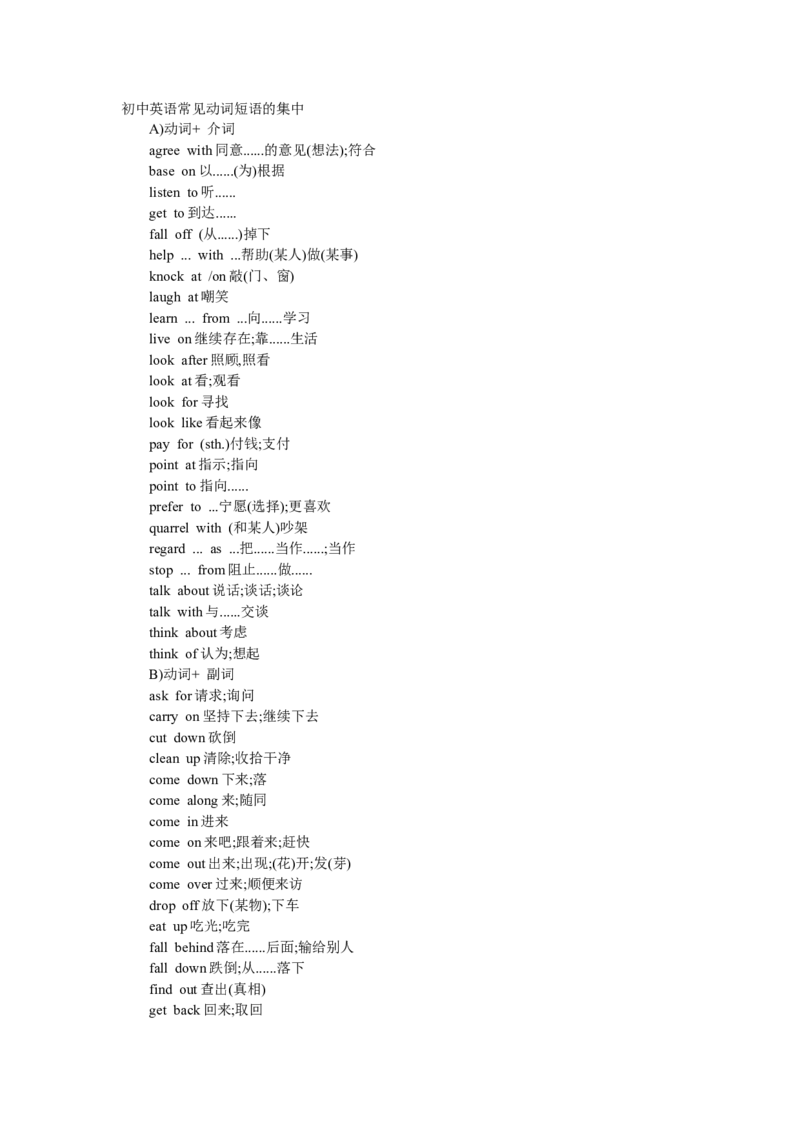
初中英语常见动词短语的集中
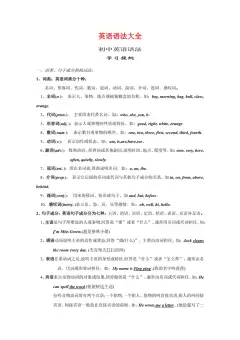
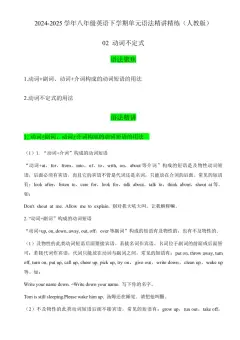
A)动词+ 介词
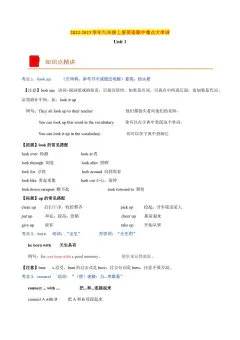
agree with 同意......的意见(想法);符合
base on 以......(为)根据
listen to 听......
get to 到达......
fall off (从......)掉下
help ... with ...帮助(某人)做(某事)
knock at /on 敲(门、窗)
laugh at 嘲笑
learn ... from ...向......学习
live on 继续存在;靠......生活
look after 照顾,照看
look at 看;观看
look for 寻找
look like 看起来像
pay for (sth.)付钱;支付
point at 指示;指向
point to 指向......
prefer to ...宁愿(选择);更喜欢
quarrel with (和某人)吵架
regard ... as ...把......当作......;当作
stop ... from 阻止......做......
talk about 说话;谈话;谈论
talk with 与......交谈
think about 考虑
think of 认为;想起
B)动词+ 副词
ask for 请求;询问
carry on 坚持下去;继续下去
cut down 砍倒
clean up 清除;收拾干净
come down 下来;落
come along 来;随同
come in 进来
come on 来吧;跟着来;赶快
come out 出来;出现;(花)开;发(芽)
come over 过来;顺便来访
drop off 放下(某物);下车
eat up 吃光;吃完
fall behind 落在......后面;输给别人
fall down 跌倒;从......落下
find out 查出(真相)
get back 回来;取回
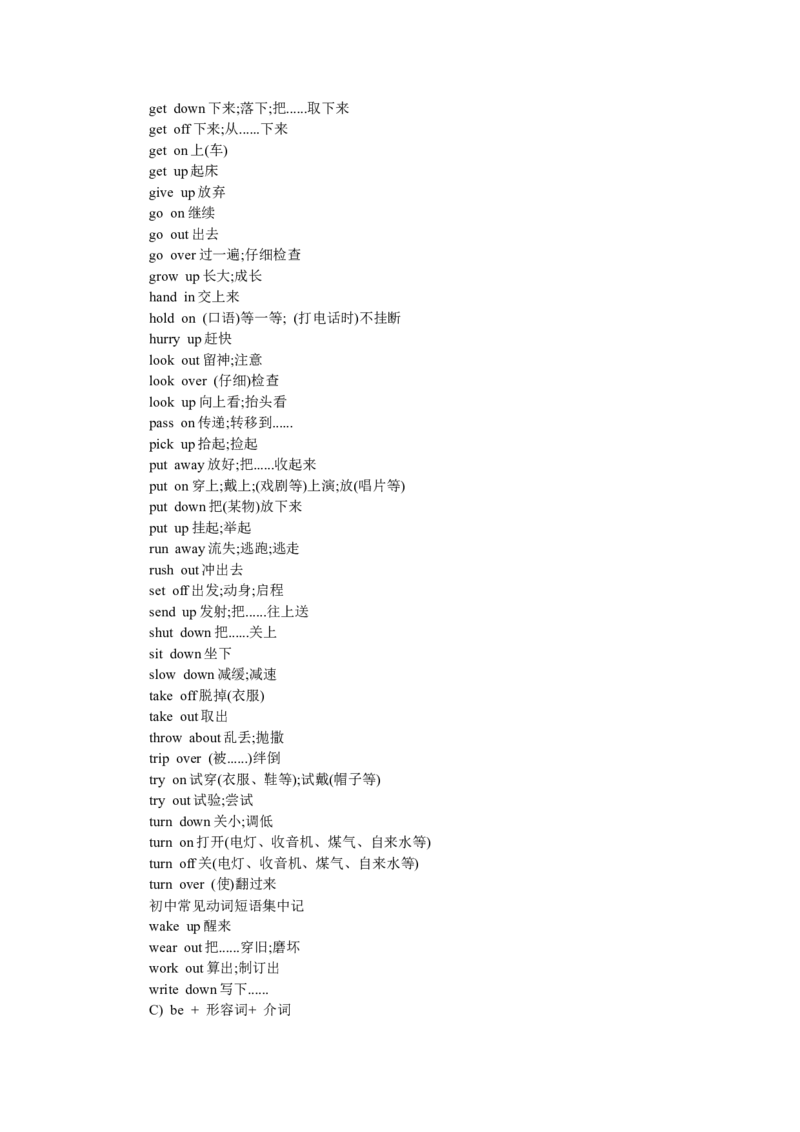
get down 下来;落下;把......取下来
get off 下来;从......下来
get on 上(车)
get up 起床
give up 放弃
go on 继续
go out 出去
go over 过一遍;仔细检查
grow up 长大;成长
hand in 交上来
hold on (口语)等一等; (打电话时)不挂断
hurry up 赶快
look out 留神;注意
look over (仔细)检查
look up 向上看;抬头看
pass on 传递;转移到......
pick up 拾起;捡起
put away 放好;把......收起来
put on 穿上;戴上;(戏剧等)上演;放(唱片等)
put down 把(某物)放下来
put up 挂起;举起
run away 流失;逃跑;逃走
rush out 冲出去
set off 出发;动身;启程
send up 发射;把......往上送
shut down 把......关上
sit down 坐下
slow down 减缓;减速
take off 脱掉(衣服)
take out 取出
throw about 乱丢;抛撒
trip over (被......)绊倒
try on 试穿(衣服、鞋等);试戴(帽子等)
try out 试验;尝试
turn down 关小;调低
turn on 打开(电灯、收音机、煤气、自来水等)
turn off 关(电灯、收音机、煤气、自来水等)
turn over (使)翻过来
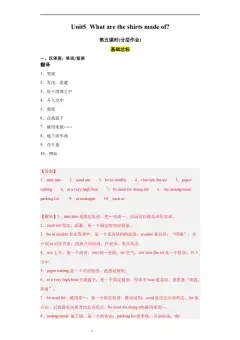
初中常见动词短语集中记
wake up 醒来
wear out 把......穿旧;磨坏
work out 算出;制订出
write down 写下......
C) be + 形容词+ 介词
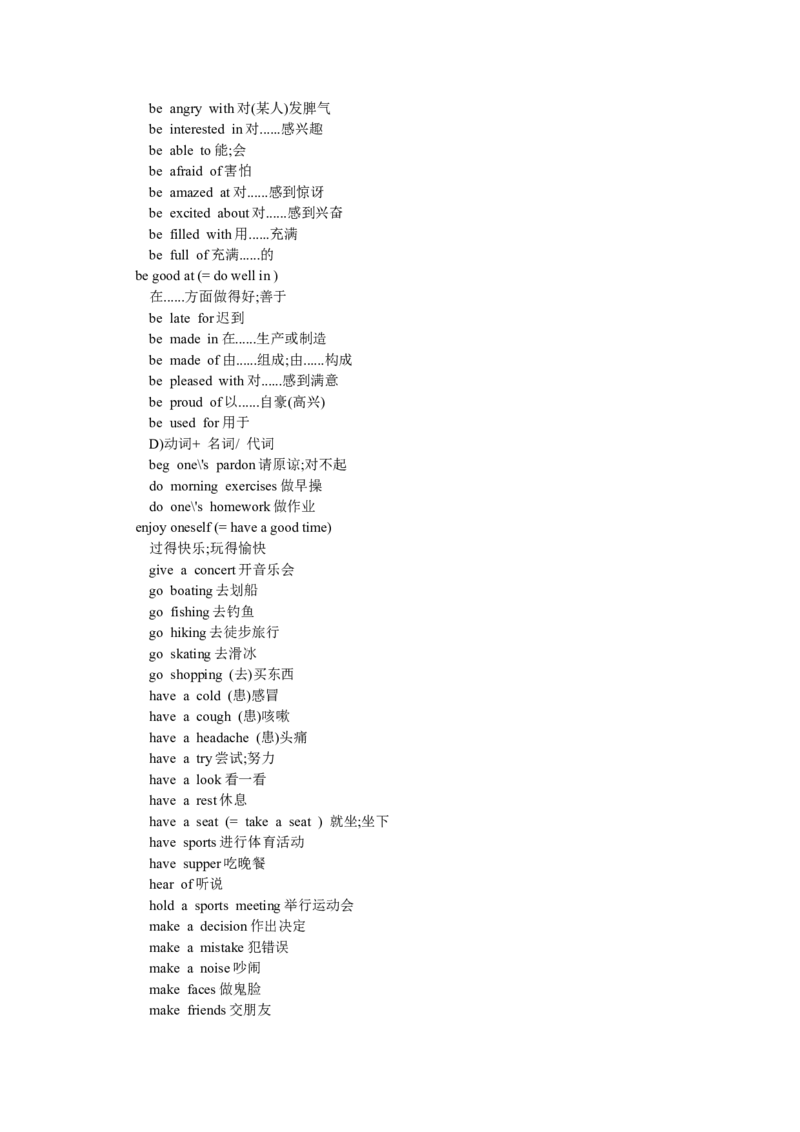
be angry with 对(某人)发脾气
be interested in 对......感兴趣
be able to 能;会
be afraid of 害怕
be amazed at 对......感到惊讶
be excited about 对......感到兴奋
be filled with 用......充满
be full of 充满......的
be good at (= do well in )
在......方面做得好;善于
be late for 迟到
be made in 在......生产或制造
be made of 由......组成;由......构成
be pleased with 对......感到满意
be proud of 以......自豪(高兴)
be used for 用于
D)动词+ 名词/ 代词
beg one\'s pardon 请原谅;对不起
do morning exercises 做早操
do one\'s homework 做作业
enjoy oneself (= have a good time)
过得快乐;玩得愉快
give a concert 开音乐会
go boating 去划船
go fishing 去钓鱼
go hiking 去徒步旅行
go skating 去滑冰
go shopping (去)买东西
have a cold (患)感冒
have a cough (患)咳嗽
have a headache (患)头痛
have a try 尝试;努力
have a look 看一看
have a rest 休息
have a seat (= take a seat ) 就坐;坐下
have sports 进行体育活动
have supper 吃晚餐
hear of 听说
hold a sports meeting 举行运动会
make a decision 作出决定
make a mistake 犯错误
make a noise 吵闹
make faces 做鬼脸
make friends 交朋友
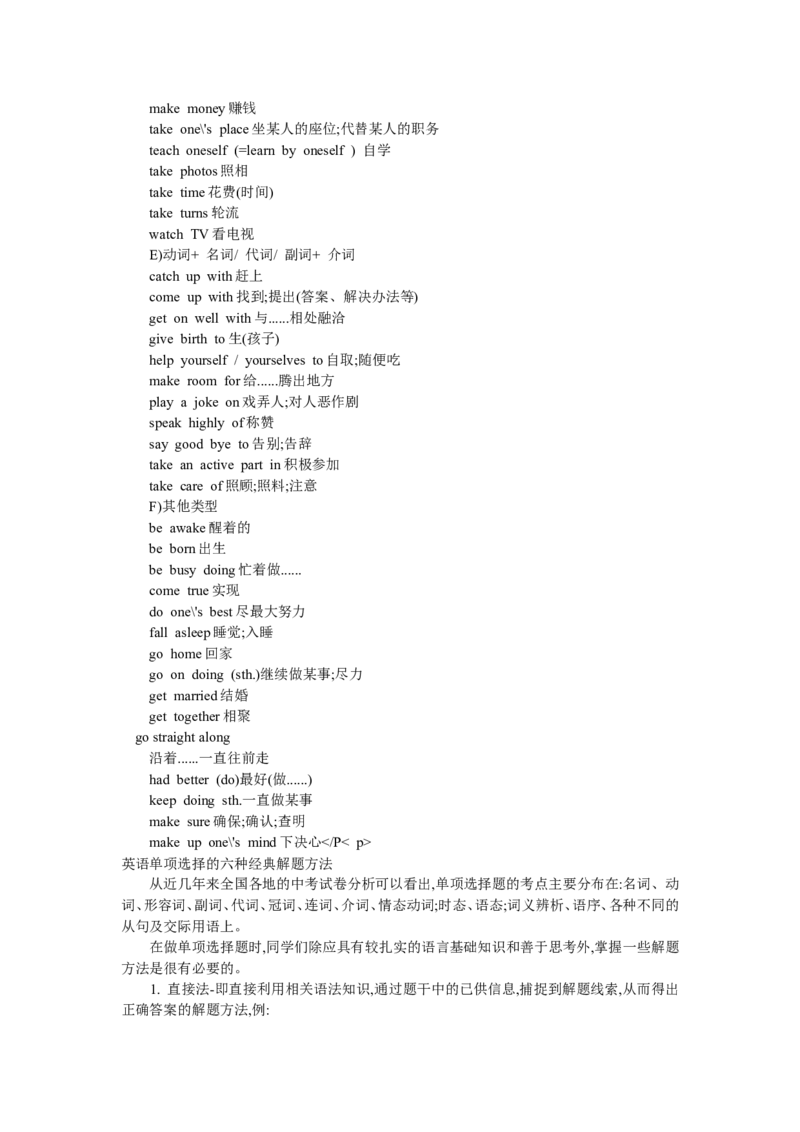
make money 赚钱
take one\'s place 坐某人的座位;代替某人的职务
teach oneself (=learn by oneself ) 自学
take photos 照相
take time 花费(时间)
take turns 轮流
watch TV 看电视
E)动词+ 名词/ 代词/ 副词+ 介词
catch up with 赶上
come up with 找到;提出(答案、解决办法等)
get on well with 与......相处融洽
give birth to 生(孩子)
help yourself / yourselves to 自取;随便吃
make room for 给......腾出地方
play a joke on 戏弄人;对人恶作剧
speak highly of 称赞
say good bye to 告别;告辞
take an active part in 积极参加
take care of 照顾;照料;注意
F)其他类型
be awake 醒着的
be born 出生
be busy doing 忙着做......
come true 实现
do one\'s best 尽最大努力
fall asleep 睡觉;入睡
go home 回家
go on doing (sth.)继续做某事;尽力
get married 结婚
get together 相聚
go straight along
沿着......一直往前走
had better (do)最好(做......)
keep doing sth.一直做某事
make sure 确保;确认;查明
make up one\'s mind 下决心</P< p>
英语单项选择的六种经典解题方法
从近几年来全国各地的中考试卷分析可以看出,单项选择题的考点主要分布在:名词、动
词、形容词、副词、代词、冠词、连词、介词、情态动词;时态、语态;词义辨析、语序、各种不同的
从句及交际用语上。
在做单项选择题时,同学们除应具有较扎实的语言基础知识和善于思考外,掌握一些解题
方法是很有必要的。
1. 直接法-即直接利用相关语法知识,通过题干中的已供信息,捕捉到解题线索,从而得出
正确答案的解题方法,例:
--- Will you come to the net bars(网吧)with me?
--- Sorry. My mother always tells me______ there.
A. not go B. go C. not to go D. to go
根据句意可知此题考查动词不定式的否定形式,即tell sb. not to do sth.,故此题应选C。
2. 关键词法-许多题目中都有这样一些词,它们对于快速而准确地判定答案起着至关重
要的作用。我们称这些词为关键词(key words)。找到句中的关键词,也就找到了解题的突破口,
例:
He hardly hurt himself in the accident, ______?
A. doesn’t he B. didn’t he C. did he D. does he
该题中hardly 与hurt 是起关键词作用的。凡陈述部分含有hardly, never, little, few 等否
定意义的词时,反意疑问句用肯定形式;而hurt 一词的过去式与原形相同,此处hurt 未加s,应
为过去式。因此本题答案C 是正确的。
3. 类推法-如果对题目的备选答案没有十分把握或把握很小,不妨利用“如果A 对,那么
B 也对”的类推法,从而可将A、B 予以否定,例:
--- Who’s the man at the door?
---______ .
A. He is a doctor B. He is a friend of mine
C. He is a famous singer D. He is twenty
仔细分析备选答案就可发现:A、C 选项针对的是“职业”。若A 是对的,那么C 也会是对
的。D 回答的是年龄。故惟有B 才是正确的。
4. 前后照应法-此方法多用于两个以上句子或对话形式命题的题目。解题前,透彻理解,
然后联系上下文,捕捉隐含信息,方能准确找出答案,例:
--- He isn’t a teacher, is he?
--- ______. He works in a hospital.
A. Yes, he is B. No, he isn’t C. Yes, He isn’t D. No, he is
本题考查否定句的反意疑问句的回答。由后半句的回答,我们知道“他”的身份不是教
师;否定反意疑问句回答中的Yes 其实际含义为“不”,No 的实际含义为“是”。因此应选择
的是B。
5. 排除法-根据题干提供的信息,先把一眼就看出的干扰项排除,缩小选择范围,然后将剩
余的选项填入空白处进行检验,辨别真伪,例:
The girl asked the teacher ______.
A. what does the museum looks like B. what did the museum look like
C. what the museum looks like D. what the museum looked like
本题主要考查宾语从句中的语序及时态的对应关系。主句动词是过去时,从句的谓语动
词也应是过去时的某种时态,故A、C 被排除。而B 中有词序错误,所以D 为正确答案。
6. 交际法-此方法可用30 个交际用语,联系上下文直接解题,例:
--- Would you like to have another cup of tea?
--- ______.
A. Yes, I do B. Not al all C. No, thanks D. Help yourself
本题主要考查简答交际用语的应答。对别人的邀请,如果表示不接受时,应委婉说出,不能
断然拒绝。因此,选C 是最佳答案。
以上六种方法,大家要在具备扎实的基础知识条件下,灵活运用。
名词的数语法练习
初中英语 更新:2008-12-2 阅读: 511 百度搜藏-新浪ViVi-365Key-天极网摘-和讯网
摘-发给好友
名词的数语法练习
内 容 提 要
名词分为专有名词和普通名词两大类。普通名词又分为个体名词和集体名词。在句子中
可数名词要么前边加冠词,要么用其复数形式。名词的复数通常加s,但以s,x,ch,sh 结尾的词
es;以"辅音字母+y"结尾的词把"y"变成"i",再加es。不规则名词的复数有其特殊形式。物质名
词和抽象名词为不可数名词。名词有主格(作主语)、宾格(作宾语)和属格(表示所属关系)。冠
词分为不定冠词和定冠词,它们有其基本用法和特殊用法。数词分为基数词、序数词和分数词,
数词与名词在实际运用中要呼应。
第一节 名 词 的 数
一、可数名词
1. 可数名词有单复数之分。在句中,名词的单数形式前边要有冠词或表示单数的限定词,
否则就要用其复数形式。名词的复数形式通常是在单数形式后加词尾s、es,或将y 改为i 再加
es。但如果名词前边有表示单数的冠词或表示单数的限定词,就不能用其复数形式
2. 有少数名词的复数形式是不规则的,child→children, man→men, woman→women,
foot→feet, tooth→teeth, goose→geese, mouse→mice, ox→oxen
3. 英语里还有些名词的单复数变化较为特殊,需特别注意
analysis→analyses, bacterium→bacteria, basis→bases, crisis→crises, criterion→criteria,
datum→
data,
formula→
formulae(
或
formulas),
fungus
真
菌
→
fungi,
phenomenon→phenomena,syllabus 讲义等的)摘要, 提纲; 课程提纲, 教程提纲→syllabi,
thesis→theses
4. 有些名词的单复数是一样的:aircraft, spacecraft, Chinese, deer, fish, Japanese,
means, series, species 等。
5. 如果前边有表示复数的限定词时名词用其复数形式
6. 在形容词最高级中,表示范围的of 后要用名词复数形式
7. 有些集体名词在形式上是单数如people(人民,人们),police(警察),cattle(牲畜),staff(全
体人员,全体职员),但它们表达复数的含意。如果这些词做主语,其谓语须用复数形式。
8. hair 和fruit 一般情况下用单数,表示总体。但如果我们要表示若干根头发或几种水果
时,就要用这两个词的复数形式
eg: He bought apples, oranges and other fruits. ("fruits"在此处意为"多种水果")
另外还要注意:police 和cattle 的谓语形式总是用复数形式。
9. 名词做定语时,不能用作复数
二、不可数名词
1. 不可数名词为物质名词和抽象名词,如information, proverty, advice, anger, applause,
baggage, cake, chalk, chocolate, cloth(布), bread, damage(损害), equipment, fruit, furniture,
gold, information, ink, jewellery, luggage, mail(邮件), money, news, paper, protection, soap,
sugar, weaponry, machinery, scenery, personnel, work 等
注:不可数名词可以与表示量的可数名词连用,借以表示"可数"的概念,我们可以加 a(n)
piece [sheet( 张), suit( 套), tube( 管), packet( 包), item( 条, 则), bar( 条), basket( 篮子),
glass(杯),bunch(束), pair(双,对), bowl(碗), portion(份), herd(群), series(系列), shower(阵)
etc. ],如:a piece of advice(一条建议) /a basket of fruit(一篮水果) /an item of information
(一则信息)/a kind of protection(一种保护)等。
2. 有些抽象名词的意思可以转变成为具体名词,这时要用其复数形式
The insurance company paid $10000 in damages for the accident. ("damage"本来为不
可数名词"损害",变复数后意思是"损失赔偿费"。)
单复数含义不同的名词还有:communication(通讯)--communications(通讯系统,通讯工具);
cloth(布)--clothes(衣服);content(内容)--contents(目录);convenience(便利)--conveniences(便利
设备);humanity(人类)--humanities(人文科学);necessity(需要)--necessities(必需品);pain(疼痛)--
pains(辛劳);ruin(毁灭)--ruins(废墟,遗迹);sand(沙子)--sands(沙地,沙滩);wood(木材)--woods(树
林);work(工作)--works(工厂,着作)。
另外,有些名词通常只用复数形式,如:fundamentals(基本原则),goods(货物), means(方法),
rapids(急流),shorts(短裤), sweets(欢乐), valuables (贵重物品)。
三、同步练习(Correct errors, if any,in the following sentences:)
1. The scholars met once a year to exchange esperiences.
2. Foreign ship are not allowed to fish in our territoral water.
3. I went to the doctor for an advice about my health.
4.The letter contained important information.
5.In the afternoon I did some baby-sittings,for it is a fun looking after children.
6.The congregation 宗教的集会[会众]was not numerous that night,but they seemed to
be listening attentively to my lecture.
7.Poultries are dear in the city.
8.The board of director is shaking heads at the chairman's speech.
9.The merchandises have arrived undamaged.
四、答案
1. The scholars met once a year to exchange esperience.
2. Foreign ship are not allowed to fish in our territoral waters.
3. I went to the doctor for an advice about my health.
4.The letter contained an important piece of information.
5.In the afternoon I did some baby-sittings,for it is fun looking after children.
6.The congregation were not numerous that night,but they seemed to be listening attentively to
my lecture.
7.Poultry 家禽(鸡、火鸡、鹅、鸭等); 鸡类are dear in the city.
8.The board of directors are shaking heads at the chairman's speech.
9.The merchandise have arrived undamaged.
名词所有格语法讲解
初中英语 更新:2008-12-2 阅读: 385 百度搜藏-新浪ViVi-365Key-天极网摘-和讯网
摘-发给好友
名词所有格语法讲解
第二节 名词所有格
名词有三个格:主格、宾格和所属格。这里我们只讲属格,属格表示所有关系,它有两种不
同的形式。
一、一是在名词尾加's
(如 my brother's toy 我弟弟的玩具,the hostes's living room 女主人的起居室),如果原名
词已经有复数词尾s,或es,只加' (如:soldiers' training ground 士兵的训练场,teachers'
readingeoom 教师阅览室)。注意,如果名词虽然是复数,但不是以s 结尾,则仍加's (the
children's mother 孩子的妈妈)
1) It is widely believed that the pull of gravity on a falling raindrop changes round shape into a
teardrop shape.
[A] of the drop [B] the drop's [C] drop of [D] drops their
2) The winner [A] photograph was of [B] an old barn(仓库) window covered with
[C] a [D] delicate, lacy frost(带花边的霜).
二、另外一种属格是由介词of 加名词构成名词短语
3) At [A] birth, the [B] head of a bady is extremely large in [C] relation to a [D] rest of the
body.
三、例题解析
1) B 为正确答案。"It"是形式主语。"that…"引导的是主从句。主从句的谓语是"changes…
into…""把……变成……"。其中"…into…"的前后应是对应的平行结构。很明显A 和D 都不行,
不能把"changes"误作名词。C 改变了"…into…"的平行关系。只有B 既能与前边的动
词"changes"衔接,又能保持"…into…"的平行关系。
2) A 错。 改为winner's。
3) D 错。 改为the。
动词+up 和动词+out 用法大观园
一、“动词+up”短语 1.catch up with 意为“跟上;赶上”。如: If you
study hard, you’ll catch up with other students. 如果你努力学习的话,你将会赶上其他同
学。 2.cheer up 意为“使……振奋;使……高兴起来”。如: He sings for many
people at the city hospital to cheer them up. 他在城市医院里为很多人唱歌,使他们振作起
来。 3.clean up 意为“清除;收拾干净”。如: We should not litter the seas, and
should clean up the dirty parts.我们不应该向海洋乱丢杂物,而应清除那些污染的区域。
4.come up with 意为“找到(答案、解决方法等)”。如: He couldn’t come up with
an answer when I asked him why he was late.当我问他为什么迟到的时候,他答不出来。
5.dress up 意为“穿上盛装;乔装打扮”。如: Mrs White dressed up and went to
Tom’s birthday party.怀特夫人打扮得漂漂亮亮去参加汤姆的生日聚会。 6.eat up 意
为“吃完;吃光”。如: He was so hungry that he ate up all the food on the table.他
是如此的饥饿以至于吃完了桌子上的所有食物。 7.fix up 意为“修理;修补”。如:
I fixed my bicycle up yesterday.昨天我修理了我的自行车。 8.get up 意为“起床”。
如: What time do you usually get up? 你通常什么时候起床? 9.give up 意为
“放弃”。如: Smoking is bad for your health. You’d better give it up.吸烟有害健
康,你最好不要吸烟。 10.go up 意为“(价格、水平、数量等)上升、上涨”如: The
price of pork is going up. 猪肉的价格正在上涨。 11.grow up 意为“成长;长大”。如:
What do you want to be when you grow up? 你长大了想干什么? 12.hurry up 意为
“赶快”。如: Hurry up, or you’ll be late for the meeting. 快点,否则你开会将会迟
到。 13.look up 意为“仰望;查找”。如: I looked up into the sky, but saw
nothing.我抬头看天空,但什么也没看到。 You should often look up words in a
dictionary, especially learning English by yourself.你应当经常在词典里查单词,特别是自学
英语。 14.make up one’s mind 意为“下决心”。如: She make up her mind
to study hard.她下决心努力学习。 15.open up 意为“开设;开业;开放”。如:
Edison opened up his own lab in New Jersey.爱迪生在新泽西开办了自己的实验室。
16.pick up 意为“拾起;捡起”。如: On her way home, Kate found a wallet lying on
the ground and picked it up.在回家的路上,凯特发现一个钱包在地上,并捡起了它。
17.put up 意为“建起;举起;张贴”。如: Please put up your hands if you have any
questions to ask.如果你有问题要问的话,请举手。 Here are some mew pictures.
Please put them up on the wall.这儿有几张新画,请把它们挂到墙上去。 18.ring
up/call up 意为“打电话”。如: Will you please ring/call me up when you reach
Beijing? 当你到达北京的时候,请给我打个电话好吗? 19.stand up 意为“起立;站立”。
如: We all stood up and gave Mr Wang a warm welcome.我们都站起来,热烈欢迎王
先生。 20.turn up 意为“开大、调大(声音)”。如: There is something wrong
with the old man’s ears. Please turn up the radio.这个老人的耳朵有点聋,请把收音机的
声音调大。 21.think up 意为“想出”。如: We need to think up some ideas.我
们需要提出一些想法。 22.wake up 意为“唤醒;醒来”。如: At midnight, he
woke up and fell asleep again.半夜,他醒来了又睡着了。 1.give out 意为“分发;发
放”。如: You could give out food at a food bank. 你可以在食品站分发食品。
2.hand out 意为“分发;发放”。如 He even handed out advertisements at a local
supermarket.他甚至在当地的一个超市分发广告。 3.work out 意为“得出(结果、总数
等)”。如: This math problem is too difficult. I can’t work it out.这道数学题太难,
我算不出来。 4.run out of 意为“用光;耗尽”。如: It is very important that
this organization does not run out of money. 这个组织没有用光钱, 这是很重要的。
5.go out 意为“出去;熄灭”。如: What about going out for a walk? 出去散步怎么
样? I was doing my homework when the lights went out.我正在做家庭作业时,灯突
然灭了。 6.find out 意为“查明;弄清”。如: We must find out who broke the
window.我们必须查明是谁打碎了窗户。 7.look out 意为“当心”。如: Look
out! A bus is coming!当心!一辆巴士来了!