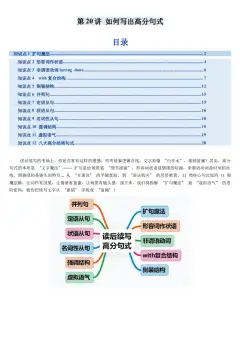
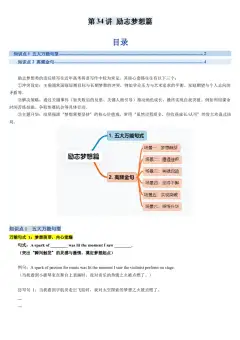
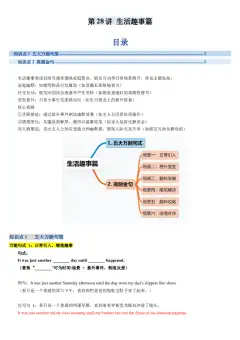
专题 08 如何写出高分句式
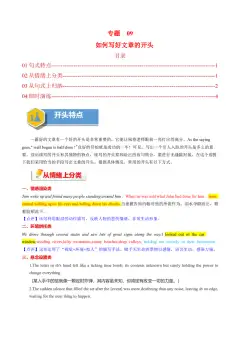
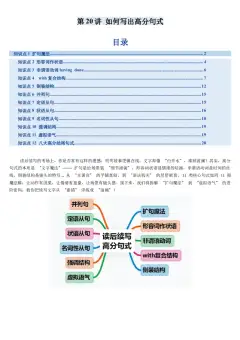
“读后续写”第一要真正读懂原文,第二写出恰当又正确的句子,第三才是写作技巧。读懂原
文之后写出恰当而正确的句子很重要,否则你的“读懂”只是在做无用功。只有写出符合故事情
节恰当、正确的句子才说明你真正读懂了。作文的高分关键是“规范的书写+整洁的卷面+正确流
畅的语言+丰富的句式”,其中读后续写还要注重情节的逻辑性、衔接性、合理性。写作中,有好
句,才有亮点,有亮点,就容易拿高分。
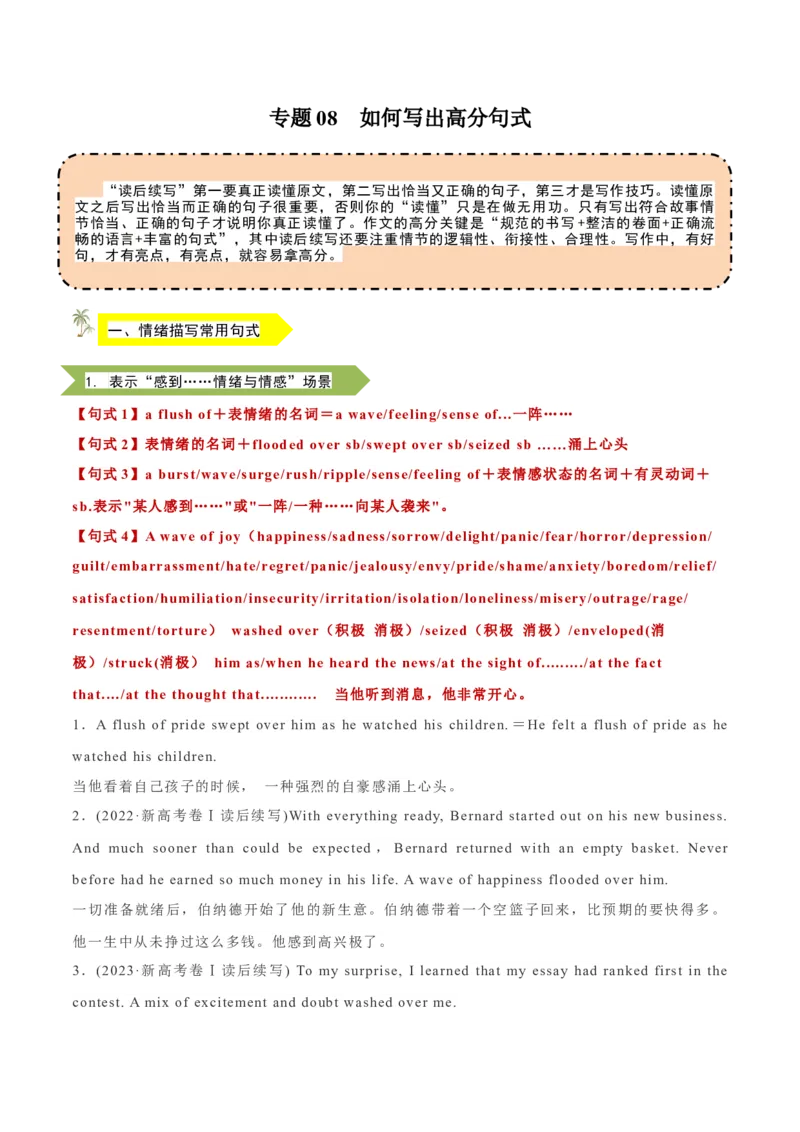
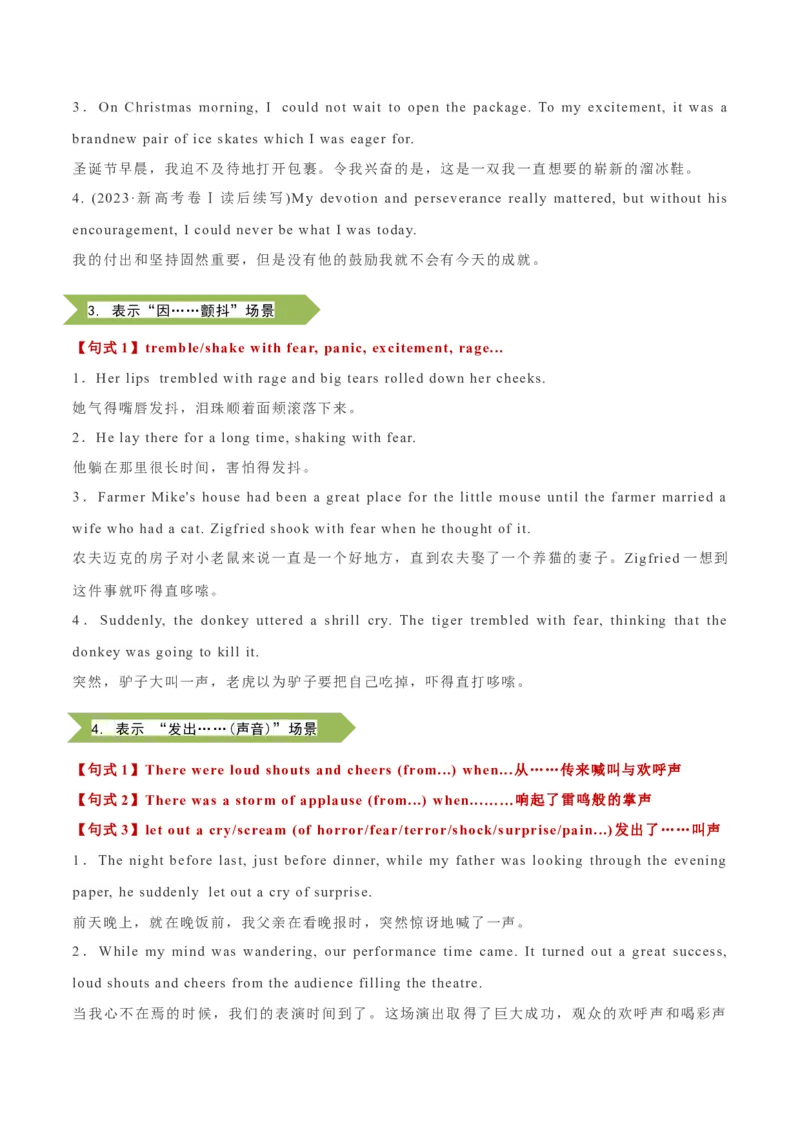
一、情绪描写常用句式
1. 表示“感到……情绪与情感”场景
【句式 1】a flush of+表情绪的名词=a wave/feeling/sense of...一阵……
【句式 2】表情绪的名词+flooded over sb/swept over sb/seized sb ……涌上心头
【句式 3】a burst/wave/surge/rush/ripple/sense/feeling of+表情感状态的名词+有灵动词+
sb.表示"某人感到……"或"一阵/一种……向某人袭来"。
【句式 4】A wave of joy(happiness/sadness/sorrow/delight/panic/fear/horror/depression/
guilt/embarrassment/hate/regret/panic/jealousy/envy/pride/shame/anxiety/boredom/relief/
satisfaction/humiliation/insecurity/irritation/isolation/loneliness/misery/outrage/rage/
resentment/torture) washed over(积极 消极)/seized(积极 消极)/enveloped(消
极)/struck(消极) him as/when he heard the news/at the sight of........./at the fact
that..../at the thought that............ 当他听到消息,他非常开心。
1.A flush of pride swept over him as he watched his children.=He felt a flush of pride as he
watched his children.
当他看着自己孩子的时候, 一种强烈的自豪感涌上心头。
2.(2022·新高考卷Ⅰ读后续写)With everything ready, Bernard started out on his new business.
And much sooner than could be expected , Bernard returned with an empty basket. Never
before had he earned so much money in his life. A wave of happiness flooded over him.
一切准备就绪后,伯纳德开始了他的新生意。伯纳德带着一个空篮子回来,比预期的要快得多。
他一生中从未挣过这么多钱。他感到高兴极了。
3.(2023·新高考卷Ⅰ读后续写) To my surprise, I learned that my essay had ranked first in the
contest. A mix of excitement and doubt washed over me.令我吃惊的是,我得知我的作品在比赛中排名第一。兴奋和怀疑涌上心头。
4.Suffering and despair defeated me, and I fell sobbing on the doorstep. (《简·爱》)
痛苦和绝望击垮了我,我倒在门阶上哭泣。
5.(2021·新高考 I 卷)Mother felt a wave of pride and warmth sweep over her.
妈妈感到一阵自豪和温暖。
6.(2020· 浙 江 卷 ) The polar bear came near. Horror slowly crept on/flooded over/rushed
over/swept over us.
北极熊走近了。恐惧慢慢向我们袭来。
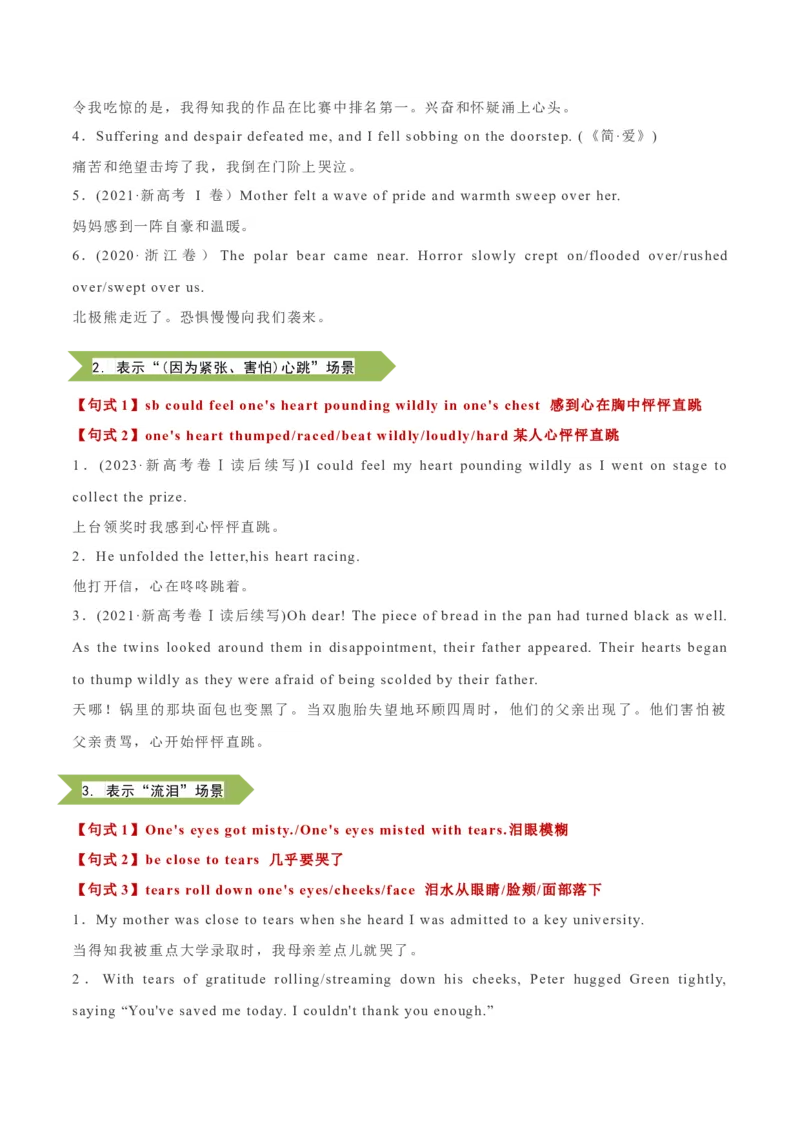
2. 表示“(因为紧张、害怕)心跳”场景
【句式 1】sb could feel one's heart pounding wildly in one's chest 感到心在胸中怦怦直跳
【句式 2】one's heart thumped/raced/beat wildly/loudly/hard 某人心怦怦直跳
1.(2023·新高考卷Ⅰ读后续写)I could feel my heart pounding wildly as I went on stage to
collect the prize.
上台领奖时我感到心怦怦直跳。
2.He unfolded the letter,his heart racing.
他打开信,心在咚咚跳着。
3.(2021·新高考卷Ⅰ读后续写)Oh dear! The piece of bread in the pan had turned black as well.
As the twins looked around them in disappointment, their father appeared. Their hearts began
to thump wildly as they were afraid of being scolded by their father.
天哪!锅里的那块面包也变黑了。当双胞胎失望地环顾四周时,他们的父亲出现了。他们害怕被
父亲责骂,心开始怦怦直跳。
3. 表示“流泪”场景
【句式 1】One's eyes got misty./One's eyes misted with tears.泪眼模糊
【句式 2】be close to tears 几乎要哭了
【句式 3】tears roll down one's eyes/cheeks/face 泪水从眼睛/脸颊/面部落下
1.My mother was close to tears when she heard I was admitted to a key university.
当得知我被重点大学录取时,我母亲差点儿就哭了。
2 . With tears of gratitude rolling/streaming down his cheeks, Peter hugged Green tightly,
saying “You've saved me today. I couldn't thank you enough.”感激的泪水顺着他的脸颊流下,彼得紧紧地拥抱着格林,说:“今天你救了我。我对你感激不
尽。”
7.The day he left hospital, he hugged me,his eyes misting with tears, saying,“You are a
truly good nurse, thank you.”
出院那天,他泪眼模糊地拥抱着我说,“你是个真正的好护士,谢谢你。”
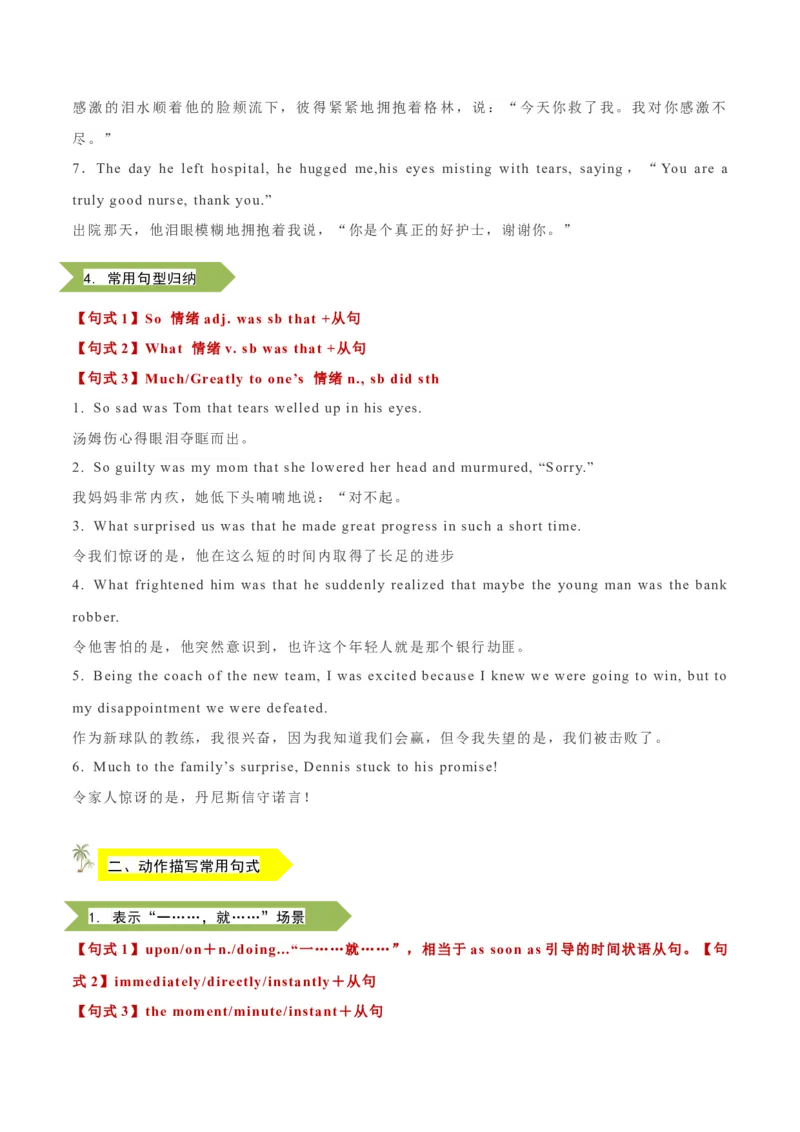
4. 常用句型归纳
【句式 1】So 情绪 adj. was sb that +从句
【句式 2】What 情绪 v. sb was that +从句
【句式 3】Much/Greatly to one’s 情绪 n., sb did sth
1. So sad was Tom that tears welled up in his eyes.
汤姆伤心得眼泪夺眶而出。
2. So guilty was my mom that she lowered her head and murmured, “Sorry.”
我妈妈非常内疚,她低下头喃喃地说:“对不起。
3. What surprised us was that he made great progress in such a short time.
令我们惊讶的是,他在这么短的时间内取得了长足的进步
4. What frightened him was that he suddenly realized that maybe the young man was the bank
robber.
令他害怕的是,他突然意识到,也许这个年轻人就是那个银行劫匪。
5. Being the coach of the new team, I was excited because I knew we were going to win, but to
my disappointment we were defeated.
作为新球队的教练,我很兴奋,因为我知道我们会赢,但令我失望的是,我们被击败了。
6. Much to the family’s surprise, Dennis stuck to his promise!
令家人惊讶的是,丹尼斯信守诺言!
二、动作描写常用句式
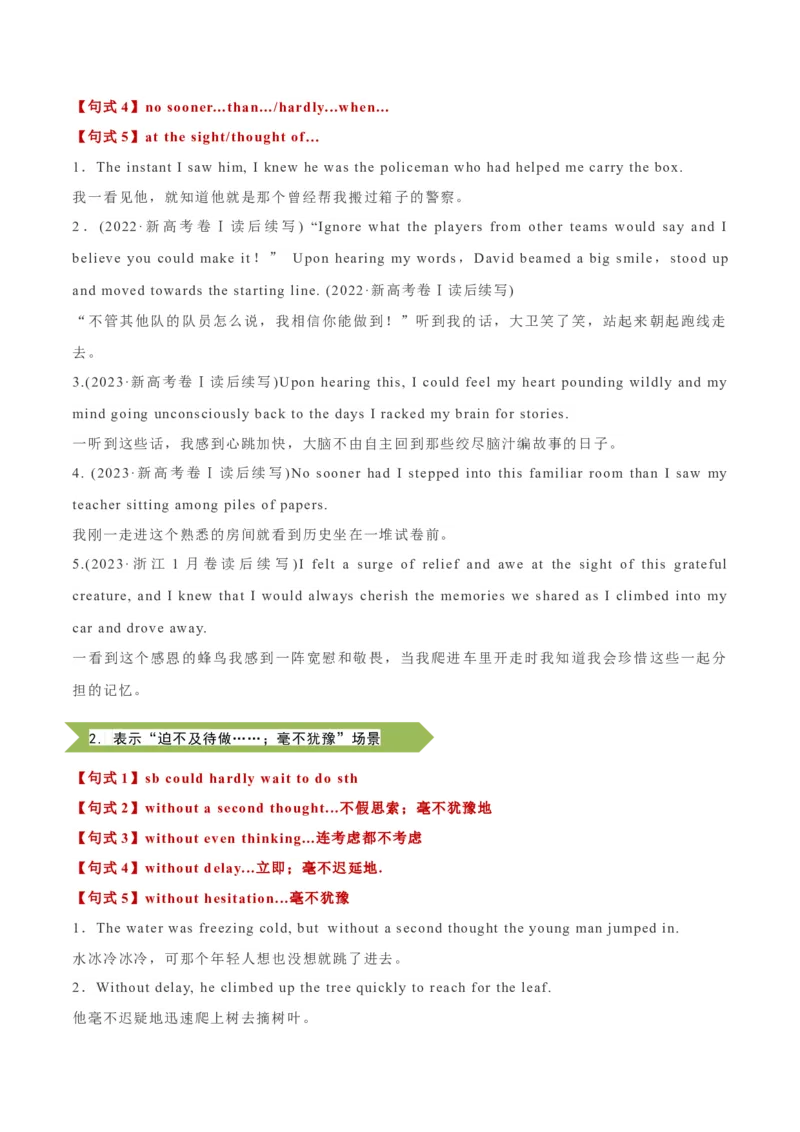
1. 表示“一……,就……”场景
【句式 1】upon/on+n./doing...“一……就……”,相当于as soon as 引导的时间状语从句。【句
式2】immediately/directly/instantly+从句
【句式 3】the moment/minute/instant+从句【句式 4】no sooner...than.../hardly...when...
【句式 5】at the sight/thought of…
1.The instant I saw him, I knew he was the policeman who had helped me carry the box.
我一看见他,就知道他就是那个曾经帮我搬过箱子的警察。
2.(2022·新高考卷Ⅰ读后续写) “Ignore what the players from other teams would say and I
believe you could make it!” Upon hearing my words,David beamed a big smile,stood up
and moved towards the starting line. (2022·新高考卷Ⅰ读后续写)
“不管其他队的队员怎么说,我相信你能做到!”听到我的话,大卫笑了笑,站起来朝起跑线走
去。
3.(2023·新高考卷Ⅰ读后续写)Upon hearing this, I could feel my heart pounding wildly and my
mind going unconsciously back to the days I racked my brain for stories.
一听到这些话,我感到心跳加快,大脑不由自主回到那些绞尽脑汁编故事的日子。
4. (2023·新高考卷Ⅰ读后续写)No sooner had I stepped into this familiar room than I saw my
teacher sitting among piles of papers.
我刚一走进这个熟悉的房间就看到历史坐在一堆试卷前。
5.(2023·浙江 1 月卷读后续写 )I felt a surge of relief and awe at the sight of this grateful
creature, and I knew that I would always cherish the memories we shared as I climbed into my
car and drove away.
一看到这个感恩的蜂鸟我感到一阵宽慰和敬畏,当我爬进车里开走时我知道我会珍惜这些一起分
担的记忆。
2. 表示“迫不及待做……;毫不犹豫”场景
【句式 1】sb could hardly wait to do sth
【句式 2】without a second thought...不假思索;毫不犹豫地
【句式 3】without even thinking...连考虑都不考虑
【句式 4】without delay...立即;毫不迟延地.
【句式 5】without hesitation...毫不犹豫
1.The water was freezing cold, but without a second thought the young man jumped in.
水冰冷冰冷,可那个年轻人想也没想就跳了进去。
2.Without delay, he climbed up the tree quickly to reach for the leaf.
他毫不迟疑地迅速爬上树去摘树叶。3.On Christmas morning, I could not wait to open the package. To my excitement, it was a
brandnew pair of ice skates which I was eager for.
圣诞节早晨,我迫不及待地打开包裹。令我兴奋的是,这是一双我一直想要的崭新的溜冰鞋。
4. (2023·新高考卷Ⅰ读后续写)My devotion and perseverance really mattered, but without his
encouragement, I could never be what I was today.
我的付出和坚持固然重要,但是没有他的鼓励我就不会有今天的成就。
3. 表示“因……颤抖”场景
【句式 1】tremble/shake with fear, panic, excitement, rage...
1.Her lips trembled with rage and big tears rolled down her cheeks.
她气得嘴唇发抖,泪珠顺着面颊滚落下来。
2.He lay there for a long time, shaking with fear.
他躺在那里很长时间,害怕得发抖。
3.Farmer Mike's house had been a great place for the little mouse until the farmer married a
wife who had a cat. Zigfried shook with fear when he thought of it.
农夫迈克的房子对小老鼠来说一直是一个好地方,直到农夫娶了一个养猫的妻子。Zigfried 一想到
这件事就吓得直哆嗦。
4.Suddenly, the donkey uttered a shrill cry. The tiger trembled with fear, thinking that the
donkey was going to kill it.
突然,驴子大叫一声,老虎以为驴子要把自己吃掉,吓得直打哆嗦。
4. 表示 “发出……(声音)”场景
【句式 1】There were loud shouts and cheers (from...) when...从……传来喊叫与欢呼声
【句式 2】There was a storm of applause (from...) when...……响起了雷鸣般的掌声
【句式 3】let out a cry/scream (of horror/fear/terror/shock/surprise/pain...)发出了……叫声
1.The night before last, just before dinner, while my father was looking through the evening
paper, he suddenly let out a cry of surprise.
前天晚上,就在晚饭前,我父亲在看晚报时,突然惊讶地喊了一声。
2.While my mind was wandering, our performance time came. It turned out a great success,
loud shouts and cheers from the audience filling the theatre.
当我心不在焉的时候,我们的表演时间到了。这场演出取得了巨大成功,观众的欢呼声和喝彩声响彻了整个剧场。
5. 表示 “带着情绪做某事”场景
【句式 1】情绪 adj., sb did sth
【句式 2】Sb did sth, adj(短语)
【句式 3】Adj. as 主+谓, sb did sth
1. Suddenly something inside me began saying, “Try it! Try it!” Shy and scared, I
watched them, trying not to look too eager. 突然间,我内心的某个东西开始说:“试试吧!
试试吧!我又害羞又害怕,看着他们,尽量不让自己看起来太急切。
2. Exhausted and scared, Jane lay down near a stone, missing her family. 疲惫和害怕的
简躺在一块石头旁边,想念她的家人。
3. She stood there in shock, unsure of what to do next. 她震惊地站在那里,不知道下一步该怎
么做。
4. He ran out again, unaware that I was following him.他又跑了出去,不知道我在跟着他。
5. Weak as Jane was, she picked up speed along the stream to find the way back. 虽然简很虚
弱,但她加快了沿着溪流的速度,找到了回去的路。
6. 常用句型归纳
【句式 1】adv., sb did sth
【句式 2】With growing +情绪 n, Sb did sth
【句式 3】Sb did sth, with/in +抽象名词
with +抽象名词(care, confidence, ease, patience, pride, eagerness, interest, caution,
attention, seriousness, kindness, calmness, determination, anxiety, curiosity, courage, joy,
devotion, fear, sadness, satisfaction) 关心、自信、轻松、耐心、骄傲、渴望、兴趣、谨慎、注
意、严肃、善良、冷静、决心、焦虑、好奇心、勇气、喜悦、奉献、恐惧、悲伤、满足
in + 抽象名词 (peace, excitement, anger, amazement, relief, confusion, excitement,
admiration, puzzlement, shock, secret, anger, terror, horror) (和平、兴奋、愤怒、惊奇、
解脱、困惑、兴奋、钦佩、困惑、震惊、秘密、愤怒、恐怖、恐怖)
1.Tenderly, grandma placed her hand on Susan’s head and comforted, “as long as you
realize your fault, you will still my little girl!” 奶奶温柔地把手放在苏珊的头上,安慰
道:“只要你意识到自己的过错,你还是我的小女儿!2.Carefully, I cleaned up the broken pieces of the ball, wishing I could stick them
together. 我小心翼翼地清理了球的碎片,希望我能把它们粘在一起。
3.With growing fear, Elli and I packed up our camp as quickly as possible. 随着恐惧的增加,艾
莉和我以最快的速度收拾了我们的营地。
4.With growing anxiety, I shouted at the top of my lung, “Help!” 随着焦虑的增加,我大声喊
道:“救命!
5.My father drove in silence. 我父亲默默地开车。
6.I took out the folded paper with great care, and opened it. 我小心翼翼地拿出折叠好的纸,打
开了它。
三、心理描写常用句式
1. 表示“不知道做……”场景
【句式 1】sb did sth, wondering what to do next
【句式 2】sb did sth, not knowing what to do next
【句式 3】sb did sth, unsure of what to do next
【句式 4】sb was at a loss what to do
1.(2023·浙江 1 月卷读后续写)Leaving the house, I couldn’t help wondering how it was getting
on now.
离开家,我禁不住想现在进展如何呢。
2.(2021·新高考卷Ⅰ读后续写)David sat still with a deep breath, wondering what to do next. I
said gently and quietly,“No one can change your mind, except yourself. If you desire to
challenge yourself, there is nothing to do with others' thoughts.”
大卫静静地坐着,深呼吸,不知道下一步该做什么。我轻轻地说:“除了你自己,没有人能改变
你的想法。如果你想挑战自己,那与别人的想法无关。”
3.Facing the situation,Ruth felt her heart was pounding,and chest pains almost took her
breath away. She started to sob,totally at a loss what to do.
面对这种情况,露丝感到心跳加速,胸痛几乎让她喘不过气来。她开始哭泣,完全不知该怎么
办。
2. 表示“心里想”场景【句式 1】An inner voice told sb that...内心的声音告诉某人……
【句式 2】An inner voice whispered, “…”/ Sb thought / said to oneself, “…”
【句式 3】Doing sth, sb felt as if sb did sth / sb had done sth
1.An inner voice whispered, “Stay clear-headed. I can make it.” 一个内心的声音低声
说:“保持清醒的头脑。我能做到。
2.An inner whispered, “You can do this.” 一个内在的人低声说:“你可以做到。
3.Looking at the man, she felt as if she had known him for years. 看着这个男人,她觉得自己好
像认识他很多年了。
4.Talking about pyramids, he felt as if he had seen them himself. 说起金字塔,他觉得自己好像
亲眼见过金字塔。
3. 表示“虚拟语气”场景
【句式 1】Had it not been for / Without / But for +n, sb would not have done sth
【句式 2】情态动词+did/have done
【句式 3】 if only+did/had done
1.But for your guidance, we would not have settled the problem. 如果没有您的指导,我们
无法解决问题。
2.Had it not been for the experience, we would not have made a new friend. 如果不是这
次经历,我们就不会结交新朋友。
4. 表示“某人想到”场景
【句式 1】idea, thought ...+ hit/struck/occurred to + sb.t
【句式 2】sth. crossed/flashed through/sprang to/came to/popped into/jumped out of sb.'s
mind
【句式 3】one's mind began to race/one's mind raced 某人开始转动脑筋/某人拼命地转动脑
筋
1.(2021 新高考 I 卷) It hit/struck/occurred to/dawned on them that they could make breakfast
for mother to celebrate Mother's Day.
他们突然想到他们可以给妈妈做早餐庆祝母亲节。
2.(2021· 浙 江 卷 ) I was struck/hit by the thought that I should have my own money and
planned how to spend it.我突然想到我应该有自己的钱,并计划如何使用它。
3.The thought sprang to her mind that maybe she had left the door open when she left home. 她
突然想起也许她离开家时没把门关上。
4.A memory of yesterday crossed her mind, and she laughed herself to death.
回想起昨天的事,她笑得要死。
5.My mind raced as I tried to work out what was happening.
我拼命地转动脑筋,想要搞清楚发生了什么事儿。
6.My mind raced, trying to think of a place to have a picnic.
我的脑子飞快地转着,努力想一个野餐的地方。
四、情节发展常用句式
1. 表示“直到……才意识到……”场景
【句式 1】Not until+时间状语+did sb realize/notice that...
【句式 2】It was only+时间状语+that sb realized that...
1.Not until then did he realize that something was wrong.=It was only then that he realized
that something was wrong.
直到那时他才意识到有什么不对劲。
2.(2022·新高考卷Ⅰ读后续写)I watched as David moved up to the starting line with the other
runners. The race started. It was only then that I realized that the runway was extremely long
for young children, not to mention a child with a heart disease.
我看着大卫和其他赛跑者一起向起跑线上移动。比赛开始了。就在那时,我才意识到跑道对小孩
子来说太长了,更不用说一个患有心脏病的孩子了。
3.(2023·新高考卷Ⅰ读后续写) Eager and delighted, I held up the championship trophy, and It
was not until then that I realized the journey of writing was not only filled with disbelief and
self-doubt but also support and self-approval.
我急切又高兴地举起奖杯。指导那时我才意识到写作的历程不仅充满着不相信和自我怀疑,而且
还充满着支持和自我肯定。
2. 表示“某人想到/明白……;有了主意”场景
【句式 1】It suddenly occurred to sb that...=It hit/struck sb that...【句式 2】(idea, thought...) occurred/came to sb=...came/flashed into one's mind
=...crowded into one's mind
【句式 3】one's mind began to race 头脑开始快速转动
1.Suddenly a brilliant idea flashed into his mind.
突然他想到一个好主意。
2.His mind began to race, trying to think of a way out.
他的头脑开始快速转动,试图想出办法。
3.There was no meal on the table.“Let's prepare for the party together this time ,”Aunt
Beatrice said gladly dressed in the same outfit. It suddenly occurred to Mya that the theme this
year was supposed to be “Sweet Labor, Sweet Sixteen”.
桌上没有饭菜。“这次让我们一起准备聚会吧,”Beatrice 阿姨穿着同样的衣服高兴地说。Mya
突然想到,今年的主题应该是“甜蜜的劳动,甜蜜的十六岁”。
3. 表示“转折”场景
【句式 1】But bad luck for sb...但是某人真不走运
【句式 2】To one's surprise (delight)/Strangely enough, it turned out that...让人惊讶(高
兴)/奇怪的是,原来……
【句式 3】..., but in vain ……, 但徒劳
【句式 4】.., but without success……,但没有成功
【句式 5】But on second thoughts,...但是转而一想,……
1.But bad luck for Jack, he tripped and fell to the ground.
Jack 真不走运,他绊了一脚,摔在地上。
2.Her friend tried to persuade her to go back home with him,but in vain.
她朋友想劝她和他一起回家,可只是白费唇舌。
3.When I got up and looked out of the bedroom window, I found,to my great surprise, it was
snowing heavily.
当我站起来,从卧室的窗户往外看时,我惊奇地发现,天正在下大雪。
4. 常用句型归纳
【句式 1】Sb did sth, only to find…
【句式 2】地点状语(in the box...) lay / was / were +主语【句式 3】out of +地点/out/into +地点/in/away/off +walked (rushed /stormed...) +主语
【句式 4】At the thought/sight/sound of sth, sb did sth
【句式 5】On /Upon doing sth, sb did sth
on/upon 后面的动名词多为:go, arrive, leave, reach, return, step, enter 等。
1.I turned back to the tractor, only to find it move suddenly away from me. 我转身走向拖拉
机,却发现它突然从我身边移开了。
2.I stopped teaching and open it up. In the box were a shirt and a note from Freddy’s mother.
停止了教学,打开了它。盒子里有一件衬衫和一张弗雷迪母亲的纸条。
3.Inside the bottle was a piece of paper. 瓶子里有一张纸。
4.Out of the house rushed a dog, followed by a puppy. 从屋子里冲出一只狗,后面跟着一只小
狗。
5.Out dashed Mary, crying all the way. 玛丽冲了出来,一路哭泣。
6.At the sight of the ferocious wolf, I was seized by a strong sense of horror with my palms
sweating. 一看到凶猛的狼,我被一股强烈的恐惧感抓住,手心出汗。
7.At the sound of the alarm, the wolf fled into the thick woods 警报声响起,狼逃进了茂密的树
林中.
8.On arriving at the village, we were warmly welcomed by the villagers. 到达村子后,我们受到
了村民的热烈欢迎。
9.Upon going out of the room, Jack heard the telephone ringing. 走出房间后,杰克听到电话铃
声。