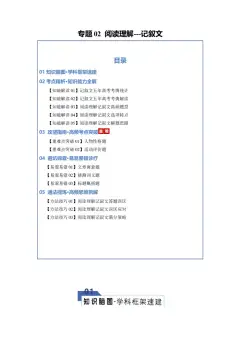
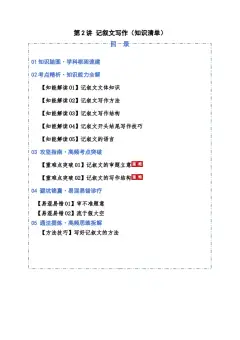
清单 02 阅读理解之记叙文
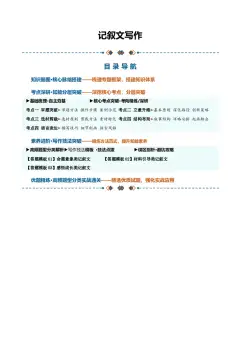
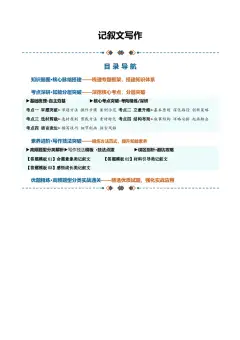
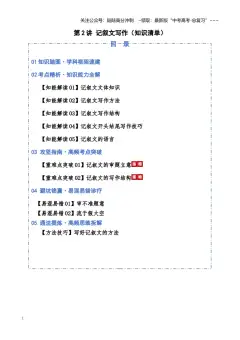
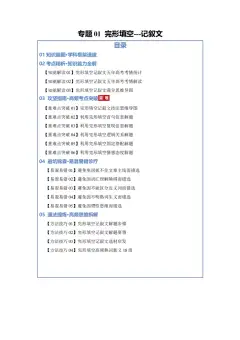
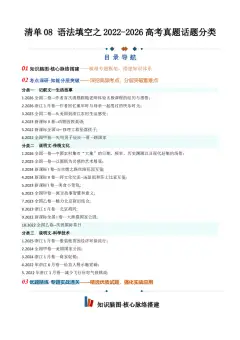
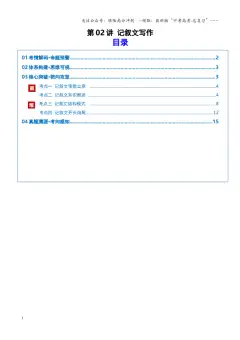
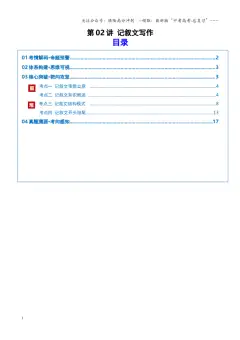
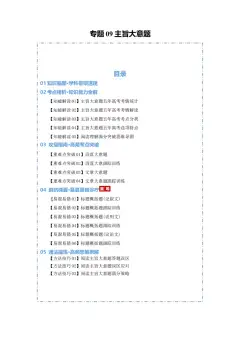
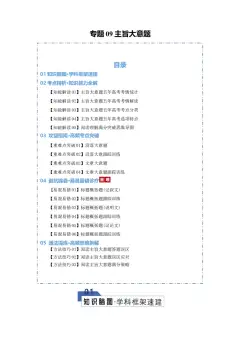
目 录 导 航
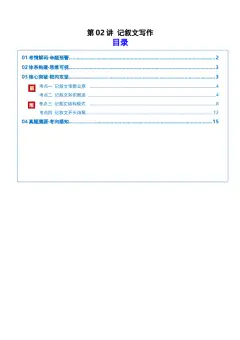
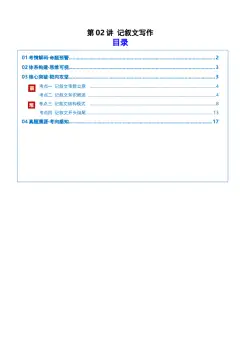
01知识脑图·核心脉络搭建——梳理专题框架,搭建知识体系
02 考点深研·知能分层突破——深挖高频考点,分层突破重难点
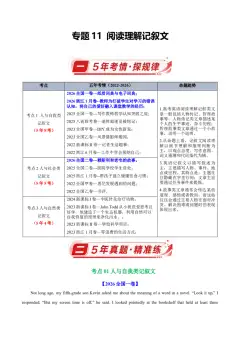
考点一 简述
考点二 特点
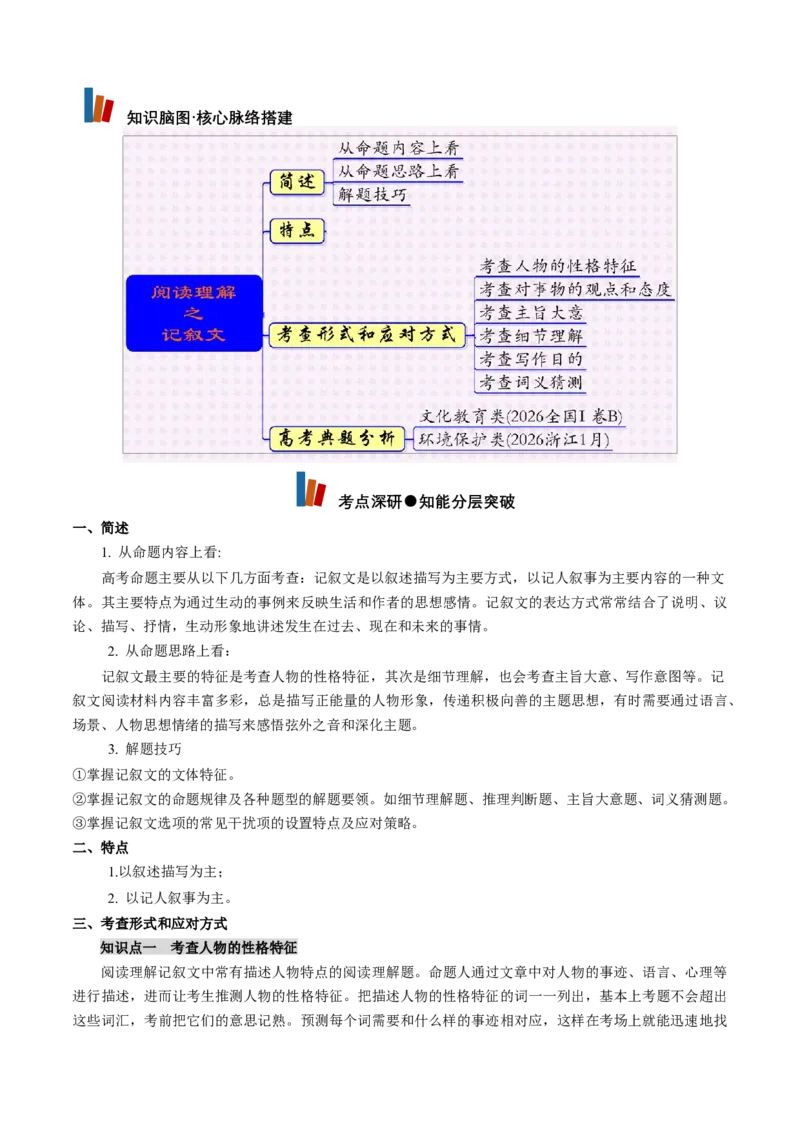
考点三 考查形式和应对方式
知识点一 考查人物的性格特征;
知识点二 考查对事物的观点和态度;
知识点三 考查主旨大意
知识点四 考查细节理解
知识点五 考查写作目的
知识点六 考查词义猜测
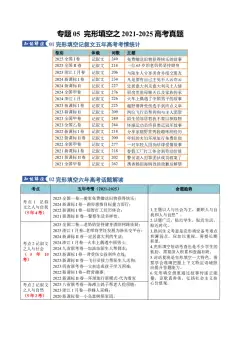
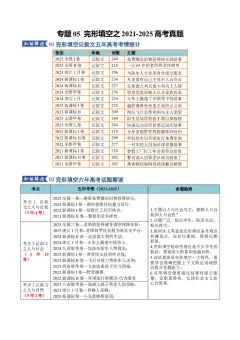
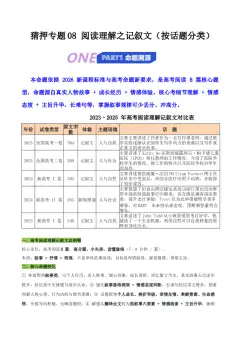
四. 高考典题分析
1. 文化教育类(2026全国I 卷B)
2. 环境保护类(2026全国Ⅱ卷B)
03优题精练·专题实战通关——精选优质试题,强化实战应用知识脑图·核心脉络搭建
考点深研●知能分层突破
一、简述
1. 从命题内容上看:
高考命题主要从以下几方面考查:记叙文是以叙述描写为主要方式,以记人叙事为主要内容的一种文
体。其主要特点为通过生动的事例来反映生活和作者的思想感情。记叙文的表达方式常常结合了说明、议
论、描写、抒情,生动形象地讲述发生在过去、现在和未来的事情。
2. 从命题思路上看:
记叙文最主要的特征是考查人物的性格特征,其次是细节理解,也会考查主旨大意、写作意图等。记
叙文阅读材料内容丰富多彩,总是描写正能量的人物形象,传递积极向善的主题思想,有时需要通过语言、
场景、人物思想情绪的描写来感悟弦外之音和深化主题。
3. 解题技巧
①掌握记叙文的文体特征。
②掌握记叙文的命题规律及各种题型的解题要领。如细节理解题、推理判断题、主旨大意题、词义猜测题。
③掌握记叙文选项的常见干扰项的设置特点及应对策略。
二、特点
1.以叙述描写为主;
2. 以记人叙事为主。
三、考查形式和应对方式
知识点一 考查人物的性格特征
阅读理解记叙文中常有描述人物特点的阅读理解题。命题人通过文章中对人物的事迹、语言、心理等
进行描述,进而让考生推测人物的性格特征。把描述人物的性格特征的词一一列出,基本上考题不会超出
这些词汇,考前把它们的意思记熟。预测每个词需要和什么样的事迹相对应,这样在考场上就能迅速地找到答案。对这种题要迅速解决,以给其他试题提供做题时间。
关于人物的性质特征的描述,在试题题有时出现两个并列的词。例如:Determined and adaptable这时要注
意,考生一定要从文章找到两个词的相关依据,不要看到一个词依据就做出判断,这样容易出错。
例1: (2026全国II B)
The house has signature Wright features. It is made with local materials, has a flat roof, wood paneling,
concrete floors and custom-made furniture. Over the decades, Reisley has opened his doors to visitors. The house is
now listed on the National Register of Historic Places. Reisley said he’s tried his best to be a good steward (管家)
not just of the Wright creation he lives in, but all others as well. He co-founded the Frank Lloyd Wright Building
Conservancy, an organization engaged in the preservation of all of Wright’s remaining buildings. Reisley believes
that his devotion to the home and the community are what have kept him in such good health all of these years.
27. What can be inferred about Reisley from the last paragraph?
A. He is very attached to Wright buildings.
B. He is devoted to health education.
C. He is an expert in home decoration.
D. He is passionate about tourism.
知识点二 考查对事物的观点和态度
把描述作者态度的词一一列出,基本上考题不会超出这些词汇,考前把它们的意思记熟。预测每个词
需要和什么样的事实相对应,这样在考场上就能迅速地找到答案。对这种题要迅速解决,以给其他试题提
供做题时间。熟记这些作者态度的形容词,深刻理解每个词的含义。设想每个词可能的描述事实。这样我
们在考试上,就能迅速找到正确答案。
例2: (2026全国II B)
Roland Reisley turned 101 years old in May and is in remarkable health. But that’s not the thing he prides
himself on. “I am the last original client of Frank Lloyd Wright, still living in the home he designed for me,”
Reisley said, sitting in the bright open living room of the home designed by the famous architect.
….
24. How does Reisley feel about having Wright as his house designer?
A. Honored. B. Amused. C. Stressed. D. Inspired.
知识点三 考查主旨大意
在阅读理解记叙文的阅读过程中,要注意把握人物的情感发展过程;事件的发展线索;作者思想感情的
变化过程以及时间、空间的变化。阅读时做到不漏细节,把准寓意,方能成功。
在阅读过程中,按照线索弄清事情的来龙去脉,理解了文章的脉络,理解整个故事。记叙文需要事件
的发展过程作支撑,一半以上的题目都会用来检测考生对故事的了解,因此,我们必须弄明白整件事情的
发展脉络。而其余像主旨大意、作者意图之类的题目,集中考查对作者所发的感触的理解。依附原文,切
忌主观臆断答题时把握文章的线索,结合文章的主旨大意,切勿主观臆断;
1.通览全局2.关注首尾段落:70%的记叙文在开头点题,结尾升华
3.勾画重复出现的关键词(人物行为/情感变化/象征物)
4.分析结构情节发展:开端发展高潮结局感悟
5.情感曲线:通过形容词/副词捕捉情绪变化(如:frustrated,determined, relieved)
6.定位核心要素
①主人公的关键抉择或顿悟时刻;
②人物关系转折点(如:从冲突到和解)
③象征物的深层含义(如:broken watch象征时间珍贵)
④排除干扰项错误选项特征:仅概括某个细节(出现具体人名/数字)包含未提及的推论(出现 must/only等绝对
词)与作者情感基调相悖(如文章悲伤却选乐观选项)。
1.避免主观臆断:在阅读原文基础上,仔细甄别选项是否与文章主题有密切联系
2.涵盖性强:看选项对文章的概括性或覆盖面如何。避免以偏概全,范围过大或过小。
例3:(2026·福建南平市·二模)When Lila Martinez moved to Maple Street, she was struck by a marked
contrast. The houses were well-kept, with flowers blooming in most yards, but at the corner of her block sat a
1,200-square-foot parking lot — a dumping ground for old tires, broken furniture, and overgrown weeds. To Lila, it
looked like a “wound” that the neighborhood had simply learned to ignore.
Instead of complaining, the 17-year-old decided to take action. She began knocking on doors, a clipboard in
hand, asking her neighbors, “What would you do with that lot if you could?”
Mrs. Henderson, an 82-year-old resident living alone, teared up as she said, “I used to have a garden, but I
can’t bend down anymore. I’d love to smell fresh flowers again.” Mr. Torres, the owner of the local grocery store,
offered to donate tools and soil. Even the teenagers were interested, suggesting a place to play basketball.
Lila realized the project was bigger than just cleaning up rubbish. She named it the “Maple Community
Garden” and launched a crowdfunding campaign. With the raised money, she hired a local construction company to
level the ground. The first Saturday was backbreaking. Lila and twenty volunteers filled 40 garbage bags with
rubbish. As the weeks passed, the lot began to breathe again. Sunflowers towered over the fence, attracting bees and
butterflies. Tomatoes ripened on the vine.
More importantly, the people began to bloom. The teens who helped build the basketball court started
assisting Mrs. Henderson to carry her groceries. Mr. Torres began hosting weekly barbecues using vegetables from
the garden. Neighbors who had lived next to each other for decades but never spoken were now exchanging recipes
and gardening tips.
Lila said, “I thought I was just building a garden, but what I really built was a bridge. That empty lot used to
divide us; now it connects us.”
27. What is the best title for the text?
A. Ways to Build a Better Block
B. The Garden that Heals a Neighborhood
C. Cares for the Old in the CommunityD. A Teenager’s Dream of a Lovely Garden
知识点四 考查细节理解
阅读理解记叙文是以叙述描写为主要方式,以记人叙事为主要内容的一种文体。其主要特点为通过生
动的事例来反映生活和作者的思想感情。记叙文的表达方式常常结合了说明、议论、描写、抒情,生动形
象地讲述发生在过去、现在和未来的事情。常见的记叙文有小说、戏剧、传记、新闻报道和日记等类型。
无论哪种记叙文,都囊括了事件的时间、地点、人物、事情的起因、经过和结果。记叙的手法写作顺序往
往以时间顺序或按照事件的发展顺序来展开。
最后升华总结作者的感悟。
在解答细节理解题时,可采取“关键词定位法”,即“带着问题找答案”。先从题干中提取关键词(题
眼),然后以此为线索,运用略读及寻读的技巧快速在文章中寻找与此关键词相关的段落、语句,快速定位
该题与哪一段、哪一句有关,然后仔细推敲,仔细比对所给选项与文中细节的细微区别,在准确理解细节
的前提下,最后确定答案
例4(2026·全国一卷·B)Not long ago, my fifth-grade son Kevin asked me about the meaning of a word in a
novel. “Look it up,” I responded. “But my screen time is off,” he said. I looked pointedly at the bookshelf that held
at least three dictionaries, and Kevin sighed dramatically. “Can’t you just use your phone?” he asked. Suddenly it
occurred to me that he did not even know how to use a dictionary.
24. What does Kevin usually do to get the meaning of a word?
A. Use electronic devices. B. Consult a paper dictionary.
C. Guess from the context. D. Turn to his English teacher.
知识点五 考查写作目的
记叙文很重要的特征进行人物描写、环境描写、心理描写,作者总是通过这些手段达到通过描写抒发
情感和感慨的作用,所以,记叙文写作目的是被考查的重要特色。
写作意图推断题要求考生根据文章的论述,揣测作者的写作意图及作者运用某种写作手法的目的。作
者一般不直接表明自己的意图,而是通过文章所提供的事实,客观地使读者信服某种想法或观点。这种题
型要求考生不但能理解文章的大意,同时还要具备对作者阐述问题的方法进行分析和归纳总结的能力。
一般来说,我们可以通过分析文章的文体特点,理解作者的词句选择和识别文章的语气来推断出作者
的写作意图。
目的意图题的设问方式
What is the main purpose of the author writing the text?
The purpose of the text is to get more people to ________.
The writer of the story wants to tell us that ________.
The fact…is mentioned by the author to show ________.
The author writers the last paragraph in order to ________.
例5(2024·全国一卷·B)…
Farber is certain that the holistic approach will grow more popular with time, and if the past is any indication,
he may be right: Since 1982, membership in the American Holistic Veterinary Medical Association has grown from
30 to over 700. “Sometimes it surprises me that it works so well," he says. "I will do anything to help an animal.That's my job."
27. Why does the author mention the American Holistic Veterinary Medical Association?
A. To prove Farber's point. B. To emphasize its importance.
C. To praise veterinarians. D. To advocate animal protection.
知识点六 考查词义猜测
1. 根据定义或上下文解释进行猜测
有时短文中出现一个需要猜测其意义的词或短语,下面接着出现其定义或解释。标点符号,如逗号后
的解释(名词同位语)、破折号后的解释、括号内的解释等。这都是判断该词或短语意义的主要依据。
2. 根据同位关系进行猜测
阅读中出现的难词有时后面紧跟一个同位语,对前面的词进行解释,因此可利用同位关系对前面的词
义或句意进行猜测。
3. 根据构词法(前缀、后缀、派生等)进行猜测
在英语中,有很多词可以通过增加前缀和后缀的方式,构成新词。乍看起来,这个词可能是新词,但
在掌握了一定的构词知识之后,就不难猜出它的词义。
4. 根据因果关系进行猜测
在一篇阅读文章中,根据原因可以预测结果,根据结果也可以找出原因。
5. 根据上下文的指代关系进行猜测
文章中的代词it, that, he, him或them可以指代上文提到的人或物,其中it和that还可以指代一件事。有时
代词指代的对象相隔较远,要认真查找;有时也需要对前面提到的内容进行总结,才能得出代词所指代的
事物。
6. 根据同义或近义关系进行猜测
在同一句、同一段或同一篇文章中,作者为了避免语言的单调、重复,有时会使用意思相同或相近的词。
因此,考生只要读懂上下文,知道其中一个词的意思,就能猜出另外一个词的意思。
7. 根据转折或对比关系进行猜测
根据上下句的连接词,如but, however, otherwise等可以推断上下文之间的逻辑关系,从而可以依据某
一句的含义,来确定另一句的含义。另外,分号也可以表示转折、对比或不相干的意义。
例6(2025·全国一卷·B)As a new unit started, I asked everyone to write a persuasive piece on a health-related
topic of their choice. This time they found the exercise much more interesting. For the next two assignments, a
personal-narrative unit followed by a creative-writing workshop, I only required that the piece meet the
specifications of its genre (体裁) and that it contain a thesis. The results were staggering. The students took on
diverse topics and turned in stories, 10 to 20 pages each, with characters that broadened my view and touched my
heart.
26. What does the underlined word “staggering” in paragraph 3 mean?
A. Mixed. B. Amazing. C. Similar. D. Disturbing.
三、高考典题分析
(2026·全国二卷·B)--环境保护Roland Reisley turned 101 years old in May and is in remarkable health. But that’s not the thing he prides
himself on. “I am the last original client of Frank Lloyd Wright, still living in the home he designed for me,”
Reisley said, sitting in the bright open living room of the home designed by the famous architect.
The house where Reisley has lived for 73 years is located in the woods of Westchester County, New York,
just 30 miles north of Manhattan. It’s one of 47 that make up the peaceful mid-20th-century modern village of
Usonia.
Back in 1951, Reisley was just 26, newly married and ready to put down roots. He and his wife began
looking for a place in Manhattan. But what they liked, they couldn’t afford on his sound engineer’s salary and what
they could, they didn’t like. Then they heard about Usonia. On their first trip out, they were greeted with such
enthusiasm from the 10 families who’d already established homes there that they decided to join.
The house has signature Wright features. It is made with local materials, has a flat roof, wood paneling,
concrete floors and custom-made furniture. Over the decades, Reisley has opened his doors to visitors. The house is
now listed on the National Register of Historic Places. Reisley said he’s tried his best to be a good steward (管家)
not just of the Wright creation he lives in, but all others as well. He co-founded the Frank Lloyd Wright Building
Conservancy, an organization engaged in the preservation of all of Wright’s remaining buildings. Reisley believes
that his devotion to the home and the community are what have kept him in such good health all of these years.
24. How does Reisley feel about having Wright as his house designer?
A. Honored. B. Amused. C. Stressed. D. Inspired.
25. What made Reisley finally decide to settle down in Usonia?
A. Its natural environment. B. Its large-sized houses.
C. The convenience of its location. D. The warmth of its residents.
26. What can we learn about Reisley’s house?
A. It is older than its owner. B. It uses local materials.
C. It has a pointed roof. D. It is put up for sale.
27. What can be inferred about Reisley from the last paragraph?
A. He is very attached to Wright buildings.
B. He is devoted to health education.
C. He is an expert in home decoration.
D. He is passionate about tourism.
【高频词汇积累】
1. ________n. 客户,主顾
2. ________n. 建筑师
3. ________v. 建立
4. paneling n. ________
5. creation n. ________
6. conservancy n. ________
【派生(合成)词汇】1. remark v. 谈论,说起;注意到 →________ adj. 显著的,非凡的
2. origin n. 起源,起因;出身→________ adj. 最初的,最早的
3. found v. 建立→________ v. 共同创立
4. preserve v. 保护,维护;保持,维持→________ n. 保护,保存
5. remain v. 逗留,留下;剩余,遗留;保持不变→________ adj. 留下的,剩余的
6. devote v. 献身,致力;用于→________ n. (身心、时间等的)投入,奉献,热爱
7.organize v. 组织→________ n. 组织
8. point v. 指,指向;对准,瞄准;朝向,对着;指路;引导→________ adj. 尖的
9. custom+ make= custom-made adj. ________
10. large+ size= large- sized adj. ________
【熟词生义】
1. signature adj. ________
2. concrete adj. ________
【高频短语】
1. (be) in good/remarkable /poor health ________________
2. pride oneself on (doing) sth. ________________
3. ________________组成,构成
4. ________________定居,扎根
5. be greeted with enthusiasm ________________
6. be engaged in ________________
7. settle down ________________
8. be put up for sale ________________
9. be attached to sb./sth. ________________
10. be devoted to ________________
11. be passionate about ________________
优题精练●专题实战通关
Passage 1
(2026·安徽省临泉田家炳实验中学·模拟预测)--文化教育
To write about food, we can be reporting on deforestation for palm oil production, the animal welfare
conditions in industrial meat-processing, etc. But for readers, it will all come back to the grocery store, the kitchen,
and the menu they’re faced with at a restaurant. How do we navigate this field which includes loss of biodiversity,
greedy businessmen, climate change — without overwhelming but instead empowering and encouraging readers?
As an essayist, a cultural critic and food writer, at the end of the day, I am trying to attract my readers toconsider what they eat. It requires that I involve and insert myself into this human dilemma. After all, I have to eat
too.
I once wrote that in order to trust someone on the subject of food, I need to know about their eating history and
appetites. This isn’t because I want to measure my own appetite against theirs to ensure we line up, but because it
provides significant context: What purpose does food serve in your life? I want to know, so that I can understand
why you’re choosing to take it as a focus, whether in a writing career or just one essay.
I grew up on Long Island, spent years in Brooklyn, and now live in San Juan, Puerto Rico. My upbringing
consisted of all the Italian, Chinese, Japanese, and Greek food one might imagine a kid just outside New York City
would eat, plus Puerto Rican food influenced by my paternal grandmother’s heritage.
My eating biography includes a lot of experiences — as eater, as server, as cook — and a commitment to what
tastes good. All of these are useful knowledge for my perspective, and it’s why there is a touch of memoir threaded
throughout what is seemingly a cultural history: If I could grow up eating everything, how did I end up with all
these ethical concerns and commitments around the food system?
I take the ordinary, the everyday and the ancestral (祖先的) with me when I write about how we have eaten for
the past 50 years, and how we could eat in the future. How do I eat and what do I cook when I feel the weight of all
these on my shoulders?
1. What does the author’s writing mainly focus on?
A. The influence of human diet.
B. The nutritional value of food.
C. The economic impact of food production.
D. The effectiveness of the actions of the local government.
2. Why does the author need to know her readers’ appetites?
A. To make comparisons. B. To list examples.
C. To understand their background. D. To better know herself.
3. What is the author mainly discussing in paragraph 4?
A. Her multicultural identity. B. Her rich experiences with food.
C. Her fascination with special foods. D. Her understanding of foreign foods.
4. What does the author convey about the future diet?
A. It will empower humans.
B. It will be influenced by the past.
C. It will become less diverse.
D. It will be mainly based on personal preference.
Passage 2
(2026·湖北黄冈市黄州区湖北省黄冈中学·二模)-哲理感悟
I remember perfectly the day I applied for the math preparatory position at the School of Mechanical
Engineering.
The written exam went well, so we moved onto the second stage of the competition, which consisted of
explaining an exercise in front of a panel of professors. Honestly, I was very tense. To make matters worse, myhands were sweating a lot. When I was assigned the exercise and started solving it on the board, I tried to stay calm.
It was going pretty well, actually, until I said something ridiculous. I said something like: “The area of the triangle
is the base (底) times the height divided by 4.” As soon as I realized my mistake, I corrected myself aloud while
trying to erase the board with my hand, but my sweat made the blackboard look like a crime scene. An old
professor noticed my struggle and said, “I think we’ve seen enough. Thank you.” I left the room with my head
down.
Days later, I found out that I had passed the competition and secured a position. My grade gave me the
opportunity to choose which professor I wanted to work with and I chose the one who had saved me at that
moment, professor Martin!
Before my first tutoring session, some colleagues told me that, in their advanced calculus class, a professor
had shared the story of a girl who had gotten so nervous that she “flooded” the board with sweat and didn’t even
know the area of a triangle.
I felt extremely angry and confronted the professor immediately. I told him how unprofessional it was for
him to mock a student who was just trying her best and if I were truly incompetent, the hiring committee —
including him — was at fault. The professor, surprised, felt very sorry and apologized. I accepted his apology.
No matter how much effort you put in or how well you do, some will focus on your mistakes. What matters
is how you respond. That experience taught me to express my thoughts bravely, to communicate my concerns, and
to set boundaries when I consider something to be unprofessional or unacceptable.
1. How did the author feel when she left the interview room?
A. Extremely nervous. B. Deeply frustrated.
C. Slightly regretful. D. Surprisingly calm.
2. Why did the author choose Professor Martin?
A. He offered her a flexible tutoring schedule.
B. He was known for his strict teaching methods.
C. He had helped her during the difficult moment.
D. He was the only professor who gave her a high grade.
3. Which of the following best describes the author?
A. Capable but overly sensitive. B. Courageous and straightforward.
C. Hardworking but easily discouraged. D. Remarkably quick but deeply unforgiving.
4. Which of the following is the best title?
A. Sweat, Tears, and a Triangle Mistake.
B. I Made a Mistake — and Got an Apology.
C. I Divided by 4 — and Got the Last Laugh.
D. A Flooded Board, a Divided Formula, and a Job Offer.
Passage 3
(2026·浙江绍兴市诸暨市·5月高三适应性考试)--人物传记
Alia Bhatt grew up in Mumbai surrounded by animals, largely because her sister Shaheen kept bringing
home stray kittens. These strays often arrived in poor condition — starving or sick. When their mother tried to stopthe parade of kittens, the girls hid them in their room until they recovered. “It was compulsive, almost,” Bhatt says.
“My heart opened up very young.”
This love of animals stayed with her into adulthood. Today, as one of India’s most recognizable actresses
with nearly 90 million Instagram followers, she uses her reach to highlight animal welfare and environmental issues
through films, children’s books, and campaigns. “I started to question if my voice had quality,” she says. “I decided
to focus on something I’m passionate about — and that’s animals.”
Bhatt’s tactics(策略) are creative and varied. Her 2021-founded production company, Eternal Sunshine, has a
logo featuring two cats. She executive produced Poacher, a 2024 hit miniseries based on a real elephant poaching
investigation in India. Eternal Sunshine also partners with an eco-film festival to encourage filmmakers to focus on
the environment.
“Stories have an amazing way to impact our minds,” Bhatt says. “Once you tell a story, it’s there forever.”
Stories can profoundly impact children, and Bhatt is the author of The Adventures of Ed-a-Mamma, a children’s
book series following a girl and her adopted dog on animal-helping adventures. Inspired by her daughter’s love for
animals, she aims to foster children’s passion for wildlife. Bhatt also launched MiSu, a resale platform for pre-loved
celebrity clothes, extending garment lifespans, cutting waste, and boosting India’s circular fashion.
Bhatt doesn’t consider herself an environmental expert. Her partner Dorita D’ Souza notes she makes
conservation accessible, driven by the deep empathy for animals she developed in childhood.
1. What drives Alia Bhatt to engage in animal and environmental protection?
A. Fame seeking. B. Family pressure. C. Childhood passion. D. Expertise pursuit.
2. What is a practical measure taken by Alia Bhatt for public welfare?
A. Keeping stray animals at home. B. Producing related films and books.
C. Launching a new clothing brand. D. Reducing entertainment activities.
3. Which of the following can best describe Alia Bhatt according to the text?
A. Cautious and ambitious. B. Humorous and diligent.
C. Compassionate and committed. D. Generous and innovative.
4. What message does the passage mainly convey?
A. Childhood experiences shape lifelong deeds.
B. Small acts of kindness make a great difference.
C. Media raises public awareness of welfare issues.
D. Celebrities should bear more social responsibilities.
Passage 4
(2026·福建南平市·二模)--人物传记
When Lila Martinez moved to Maple Street, she was struck by a marked contrast. The houses were well-
kept, with flowers blooming in most yards, but at the corner of her block sat a 1,200-square-foot parking lot — a
dumping ground for old tires, broken furniture, and overgrown weeds. To Lila, it looked like a “wound” that the
neighborhood had simply learned to ignore.
Instead of complaining, the 17-year-old decided to take action. She began knocking on doors, a clipboard in
hand, asking her neighbors, “What would you do with that lot if you could?”
Mrs. Henderson, an 82-year-old resident living alone, teared up as she said, “I used to have a garden, but Ican’t bend down anymore. I’d love to smell fresh flowers again.” Mr. Torres, the owner of the local grocery store,
offered to donate tools and soil. Even the teenagers were interested, suggesting a place to play basketball.
Lila realized the project was bigger than just cleaning up rubbish. She named it the “Maple Community
Garden” and launched a crowdfunding campaign. With the raised money, she hired a local construction company to
level the ground. The first Saturday was backbreaking. Lila and twenty volunteers filled 40 garbage bags with
rubbish. As the weeks passed, the lot began to breathe again. Sunflowers towered over the fence, attracting bees and
butterflies. Tomatoes ripened on the vine.
More importantly, the people began to bloom. The teens who helped build the basketball court started
assisting Mrs. Henderson to carry her groceries. Mr. Torres began hosting weekly barbecues using vegetables from
the garden. Neighbors who had lived next to each other for decades but never spoken were now exchanging recipes
and gardening tips.
Lila said, “I thought I was just building a garden, but what I really built was a bridge. That empty lot used to
divide us; now it connects us.”
1. Why did Lila view the lot as a “wound”?
A. It ruined the street’s beauty.
B. It took up much space.
C. It caused conflicts in neighbors.
D. It reminded her of an injury.
2. Which of the following best describes the residents’ response?
A. Surprised. B. Supportive.
C. Cautious. D. Emotional.
3. What did Lila do for the community project?
A. She offered tools and soil.
B. She raised money door to door.
C. She secured support to transform the lot.
D. She encouraged neighbors to grow vegetables.
4. What is the best title for the text?
A. Ways to Build a Better Block
B. The Garden that Heals a Neighborhood
C. Cares for the Old in the Community
D. A Teenager’s Dream of a Lovely Garden
Passage 5
(2026·河北衡水中学·二模)--人物传记
Maya Martinez, a high school senior living in a fog-covered coastal village in North California, noticed that
the community garden was gradually drying up during the driest summer on record. While the villagers remained
helpless, Maya chose to spend her afternoons carefully observing the thick mist that rolled in from the sea.
Maya had already identified a critical fault in traditional fog-collecting mesh nets(网状网): they frequently
became blocked by the very water drops they caught, which severely reduced their effectiveness. Digging deeperinto solutions, Maya found a novel device designed by two scientists — the “Fog Harp(竖琴)”.
Maya decided to use the handy materials to create her own “Fog Harp”. At first, neighbors watched the
process with doubt as she strung hundreds of thin, upright wires across a solid wooden frame. To them, the setup
looked no more than “a giant musical instrument” that only produced useless sounds in the cold coastal wind. Little
did they know this simple-looking setup would soon prove surprisingly effective.
The remarkable efficiency of Maya’s Fog Harp lies in its clever use of gravity. In a traditional mesh net, tiny
water drops get easily trapped within the small square gaps, which stop further collection. This occurs because the
surface tension — the invisible, stretchy “skin” of liquid water — is too strong for the small drops to overcome. In
Maya’s Fog Harp, by contrast, water drops hit the wires and slowly combine into larger drops. Most importantly,
with no cross wires to hold these larger drops in place, gravity easily overcomes surface tension, allowing the water
to slide effortlessly down the wires and collect in a tank below.
Of course, the project faced its share of setbacks. During one severe coastal storm, the extreme wind tore
through the wooden frame. Yet, instead of giving in to despair, she immediately set out to fix the problem by
reinforcing the entire structure with durable steel wires. By the time autumn arrived, Maya’s “Fog Harps” were
reliably producing plenty of fresh water every day, partly meeting the daily water needs of the village.
1. Why did Maya observe the thick mist in her afternoons?
A. To predict the weather conditions.
B. To clarify the reasons for drought.
C. To check the efficiency of the mesh nets.
D. To work out a solution to water shortage.
2. What can we know about Maya’s “Fog Harp”?
A. It was a musical instrument. B. It invited villagers’ acid words.
C. It presented an inborn fault. D. It featured a solid metal frame.
3. What is the key for Maya’s Fog Harp to function well?
A. Its use of cross wires.
B. Its mesh-net structure.
C. Its weak surface tension.
D. Its unique design and use of gravity.
4. What can we learn from Maya’s story?
A. Look before you leap. B. Better late than never.
C. Think outside the box. D. Time waits for no man.
Passage 6
(2026届安徽省省十教育高三最后一卷)—环境保护
Near Vihaan and Nav Agarwal’s home, a big garbage dump(垃圾场) caved in, releasing poisonous chemicals
into the surrounding streets, which caused a fire to erupt.
Following this event, Vihaan and Nav decided to take action to improve their city’s waste collection to
ultimately improve their own health and that of their neighbors. Vihaan struggled with a persistent cough and
shortness of breath. He knew his symptoms would not likely improve until his local community improved its wastemanagement solutions.
In 2018, at ages 14 and 11, respectively, the brothers created a home recycling program called One Step
Greener that managed recycling for 15 households within their community. Their goal: prevent toxic chemical
waste from seeping(渗透) into the environment and creating dangerous health conditions for residents.
At first, the boys felt empowered by taking the action of separating waste into distinct categories. When local
officials then informed them that the local garbage collection crew would not pick up their separated bags, they felt
momentarily defeated, but persisted in their efforts.
The boys then created a neighborhood coalition to create a unified recycling program, which 15 households
took part in. Local authorities adjusted their stance, and the recycling program spread throughout the community
with a growing number of households starting to participate.
“The main issue in waste management is that everybody thinks it’s not their job, or if the waste is out of their
house, it’s out of their mind,” Vihaan said.
Vihaan and Nav’s program grew from managing 15 households to 3,000 throughout 14 Indian cities. The
program offers families involved free door-to-door dry waste pickups. The separated waste is then delivered to
warehouses where it is further divided to ensure proper recycling. Newspapers are separated from A4 printing
paper, PET plastic from polypropylene, and computer screens from keyboards.
One Step Greener’s goal reads, “One Step Greener’s mission is to transform environmental action into
everyday practice by mobilizing youth, building green communities, and designing scalable solutions in waste
management, afforestation, and education — starting at the grassroots, and growing toward systems change.”
“It’s an old saying, but collective effort does actually make a difference,” said Vihaan.
1. What inspired Vihaan and Nav to start One Step Greener?
A. The locals’ waste collection failure. B. A project on waste management.
C. A landfill collapse near their home. D. The city’s campaign for recycling.
2. What was local authorities’ attitude to the program after the neighborhood’s participation?
A. Unclear. B. Doubtful. C. Dismissive. D. Approving.
3. What did One Step Greener do for the participating households?
A. It picked up dry waste for free. B. It educated them online about recycling.
C. It delivered newspapers to them. D. It paid them for their recyclable materials.
4. What does Vihaan and Nav’s program show?
A. Better late than never. B. Teamwork makes the dream work.
C. Knowledge is power. D. Actions speak louder than words.
Passage 7
(2026届福建名校联盟高中毕业班月考)—环境保护
Carrying his “sound hunter’s” backpack with a headset, a recorder, and fifteen specialized microphones,
Charles Rose sets out to explore Lyon’s Tête d’Or Park. He places his microphone against a rock as if taking its
pulse(脉搏). He is focused, listening to a language only he seems to understand.
Charles Rose is an audio naturalist. In his ears, trees whisper with human-like voices, queen bees cry, and ant
nests crackle(噼啪作响) like campfires.His journey began in 2019 during a trip to Norway. While searching for sounds to sample for his musical
compositions, he found himself attracted by the natural soundscapes. That trip became the turning point: he started
recording flowing rivers, wooden churches, and animal calls. These recordings soon became albums of their own.
From them, he builds a “sound library” that reflects the richness of ecosystems worldwide.
Months ago, he traveled to the Tuvalu islands in the South Pacific where 95% of the area could be
submerged by the end of the century. He recorded everything: the wind, the waves, the birds, the trees, the silence
between sounds. These sounds now live in a sound bank that will immortalize the island’s memory and keep it
long after the land disappears.
Today, over 40,000 species are threatened by climate change, according to the latest report by the
International Union for Conservation of Nature. For Rose, recording nature is a form of conservation. “By
capturing the sound of an insect moving under our feet,” he says, “I want to make the living being more alive in the
eyes of humans. I believe the more we listen, the more we respect.”
Night is about to fall on the park as the rain arrives. While Sunday walkers rush for cover, Charles Rose
smiles and excitedly heads to the pond. He kneels at the water’s edge, lowers a microphone beneath the surface,
puts on his headset, and closes his eyes.
1. Why did Charles Rose go to Norway?
A. He planned to build a sound library.
B. He wanted to study local ecosystems.
C. He intended to look for musical inspiration.
D. He hoped to photograph natural landscapes.
2. What does the underlined word “immortalize” in paragraph 4 mean?
A. Recall. B. Replace. C. Update. D. Safeguard.
3. What is Charles Rose’s purpose in recording nature?
A. To teach people listening skills. B. To do research on climate change.
C. To raise environmental awareness. D. To learn animals’ special language.
4. Which words best describe Charles Rose?
A. Devoted and far-sighted. B. Creative and carefree.
C. Curious and cool-headed. D. Humorous and easygoing.
Passage 8
(2026届湖北省武昌实验中学高考适应性考试)--人物传记
In Qingdao, a guesthouse named “Yameng’s Home” is marked by a Barbie doll in a wheelchair at its entrance.
Operated by 29-year-old Cui Yameng, it embodies her mission to create a barrier-free environment for people with
disabilities.
Cui’s dedication began in high school through volunteer work, leading her to study special education. Her
travels with physically-challenged friends during university revealed how everyday obstacles like small steps
became significant barriers. This inspired her long-term goal of an accessible hotel. As a practical start, she
transformed her apartment’s first floor into this inclusive guesthouse in 2023. Every detail is designed for
accessibility: a low entrance ramp, lowered kitchen counters, an adjustable bathroom mirror, and customized bedheights. Cui offers free stays to guests with disabilities, requesting only a personal story in return. Her aim is to
provide dignified and comfortable accommodation.
Her first guest was a young woman who had lost both legs. Cui arranged a tandem (双人自行车) bicycle ride
along the coast for her — a first-time experience the guest later shared online. The post inspired many followers,
including one man who embarked on his first solo trip in twenty years. Cui points out that the core issue is not an
absence of accessible facilities, but rather a lack of public awareness about disabilities. Besides the guesthouse, she
works at a local welfare center, organizing activities where children wear blindfolds to experience daily life without
sight to foster public understanding.
Her initiative has created a ripple effect. After gaining online attention, she began receiving requests from
local businesses for accessible design advice. Cui hopes her story empowers others to contribute according to their
capacities. To date, her guesthouse has hosted 28 guests and received international bookings. Cui acknowledges
China’s progress in accessibility, citing supportive laws and improved services. Yet, her ultimate wish is for a future
where such specialized accommodations become unnecessary, as affordable, accessible options are available
everywhere. She sincerely looks forward to that day.
1. What inspired Cui to design the guesthouse?
A. Her work at a welfare center.
B. Volunteer service in her youth.
C. Her academic pursuit of special education.
D. Her travel experiences with disabled friends.
2. What can be inferred about Cui’s influence?
A. She has built business partnerships.
B. She has motivated disabled travelers.
C. She has absorbed government funding.
D. She has transformed traditional hotels.
3. Which of the following best describes Cui?
A. Traditional and cautious. B. Humorous and ambitious.
C. Romantic and adventurous. D. Pioneering and compassionate.
4. What can be a suitable title for the text?
A. A Home Without Barriers B. A Chance for New Business
C. A Hero of Online Campaign D. A Center for Special Education
Passage 9
(2026安徽皖南八校第三次联考高三4月教学质量检测)--人物传记
In the world of quantum(量子) information, precision is everything. For 29-year-old doctoral candidate Wang
Haigang, that precision doesn’t come from his hands, but from his feet. Sitting in a quiet laboratory at Taiyuan
University of Technology, Wang runs complex simulations and drafts research papers with his right foot on the
mouse and his left on the keyboard. It is a scene of intense focus that recently earned him the university’s highest
honor: the President’s Scholarship.
Wang’s journey began with a childhood tragedy. At age 8, an accident with a high-voltage wire resulted in theloss of both arms. While the suffering was immense, Wang chose a path of independence. By the end of his first
summer without arms, with the support of his family, he had mastered writing neat characters with his toes.
Wang often studied until the early hours, enduring leg cramps(抽筋) and stomach pain from sitting bent over
for too long. Gradually, he discovered a passion for mathematics, which gave him joy and direction in learning. In
2015, Wang was admitted to Shandong University of Science and Technology. In 2020, he pursued a master’s
degree at the School of Mathematics at Taiyuan University of Technology, embarking on a combined master’s and
doctoral program. That same year, he was named “a star of self-reliant Chinese college students”.
The six years Wang spent at the university in Taiyuan marked a period of rapid growth. He achieved
breakthroughs in research, built valuable relationships and embraced independence. Rejecting his parents’ offer to
accompany him, he traveled alone to the university, completing all the admission procedures by himself. “I’ve
grown up. I can’t rely on my parents forever. If they were always by my side, I would never truly become
independent,” Wang said.
Wang published his research findings in the field of quantum information as the first author in the journal
Communications Physics, showcasing his exceptional research potential.
1. What did Wang do soon after losing his arms?
A. He learned to write neatly with his toes.
B. He started independent academic research.
C. He was admitted to a university right away.
D. He developed a great love for mathematics.
2. What brought Wang joy and clear learning direction?
A. His honors from the university.
B. His family’s continuous support.
C. His quantum research achievements.
D. His deep passion for mathematics.
3. Why did Wang refuse his parents’ company to university?
A. To avoid prejudice from his classmates.
B. To reduce financial burden on his family.
C. To achieve true independence in his growth.
D. To get special accommodation from the school.
4. Which of the following best describes Wang Haigang’s personality?
A. Outgoing and quiet.
B. Self-reliant and determined.
C. Honest and tolerant.
D. Generous and responsible.
Passage 10
(2026·江苏省天一中学·二模)--文化艺术
When I was a child, I drew a face. A grown-up corrected me quickly with a circle, round eyes, a seven-
shaped nose and a curved mouth. I stood confused, for this cold, mechanical pattern felt nothing like the livelyfaces I knew in real life.
As I grew up, I kept wondering how to draw a real face. Once, I got a chance to ask people to draw each
other following two rules: never lift the pencil, and never look down at the paper. They could only look at their
partner. After a minute, the drawings were terrible but wonderful. Why? Because they had drawn what they truly
saw, not what they thought a face should look like. They also did something rare: they made eye-to-eye, face-to-
face contact for almost a full minute without looking away. They slowed down, focused fully, and truly noticed
another person. That was the secret to drawing “a real face.”
Later, as an illustrated journalist, I planned a drawn story about how public libraries served the people. I
explored every corner of the library and genuinely connected with the staff. I found with their intentional, public-
spirited help, those seemingly ordinary facilities served people in far more meaningful ways. Computers that I
assumed were for checking out books or emails were actually lifelines for people searching for jobs and housing.
The sinks in the public restroom served as a laundromat (洗衣房) and showers for the homeless. The entirely new
and rich truth contributed to my series of breathing drawings.
I do not hope everyone becomes an artist, but everyone can learn to see deeply. Slow down, pay attention,
and truly observe; you will rediscover love for the world and all people around you. We urgently need this courage
— to see each other and ourselves clearly, and to honor the real truth hidden in plain sight.
1. What confused the author in the first paragraph?
A. The adult’s serious criticism. B. The lack of clear drawing rules.
C. The adult’s fixed way of drawing. D. The strangeness of the adult’s face.
2. Why were the drawings described as “terrible but wonderful” in paragraph 2?
A. They were messy but detailed. B. They were rough but lively.
C. They appeared ugly but organized. D. They seemed simple but friendly.
3. What do the underlined words “The entirely new and rich truth” refer to in paragraph 3?
A. The library’s hidden social service. B. Better maintenance of facilities.
C. The intention to help the homeless. D. The discovery of good stories.
4. What can be a suitable title for the text?
A. Drawing a Magic. B. Discovering the Art.
C. Seeing the Real Face. D. Creating Fine Works.
Passage 11
(2026·河北黄骅中学·二模)--人与动植物
The conventional perception of cattle’s intelligence has been challenged by the first scientifically
documented instance of tool use in cattle. Veronika, a pet cow in Austria, was observed purposefully using a tool to
scratch(挠) different parts of her body. This behavior provides convincing evidence that cows may possess mental
abilities far beyond what was previously assumed.
Veronika's unique status as a pet, rather than a farm animal, allows her the autonomy to do what she wants
when she wants to. She frequently has itchy(发痒的) spots on her skin from horsefly bites, leading her to
independently think up a solution. Her owner says, “For years,Veronika has picked up sticks with her mouth and
used them to scratch herself. She wasn’t taught to do this — she just figured it out. ”Dr. Alice Auersperg, an expert in animal problem-solving, was attracted upon seeing a video of Veronika in
action. Tool use, though documented in select species like chimpanzees, elephants, and crows, had never been
reported in cows. This motivated her team to design an experiment, presenting Veronika with a broom(扫帚).
Veronika skillfully handled the broom, using her tongue and teeth to lift it, and then applied it to scratch herself.
She strategically employed the hard end for her tough back skin, and the stick end for softer, more sensitive areas
like the areas underneath her body. The fact that Veronika was using two different parts of the broom for different
reasons is important. The scientists describe it as “multi-purpose tool use”. That’s a skill that, until now, has only
been seen in chimpanzees.
Even so, the researchers believe that most cows likely possess similar intelligence, but never get a chance to
show it due to their shortened lifespans for meat or milk production. The researchers say Veronika’s long and
interesting life may have helped her develop. Veronika is 13 years old. And, as a pet, she’s had many chances to
learn and grow.
1. What can we learn about Veronika from the first two paragraphs?
A. She suffers from skin diseases easily.
B. She was taught to use sticks by her owner.
C. She shows higher intelligence than other animals.
D. She is the first recorded tool-using cow.
2. What does the author intend to show in paragraph 3?
A. Cows’ unexpected mental abilities.
B. The uniqueness of Veronika’s pet status.
C. Specific methods of Veronika’s tool handling.
D. Scientific significance of tool use across species.
3. What is the researchers’ attitude toward the possibility of tool use in other cows?
A. Doubtful. B. Indifferent. C. Positive. D. Curious.
4. What is the best title of the text?
A. Veronika:A Different Pet Cow.
B. Tool-Using Cow Surprises Scientists.
C. Pet Cows:Unlocking Hidden Intelligence.
D. The Experimental Design for Veronika’s Test.
Passage 12
(2026届湖北黄冈市黄梅县第一中学高考模拟)—人与动植物
Teenage star Kyle Thomas, who was popular on a short-video sharing platform, thought it was just a bit of
harmless fun when he started posting videos of his growing collection of exotic(由外国引进的) pets alongside
food reviews and funny moments. His meerkats(猫鼬) and three rescue foxes became popular, but the negative
reactions began when Kyle shared images of his pet capybara(水豚), Queen Elizabeth, wearing a pumpkin hat for
Halloween. He soon realized his home was not a suitable environment for his unusual group of animals.
The turning point for Kyle came when the capybara passed away from natural causes, which resulted in his
mother Zena being charged with illegally bringing her from England to Northern Ireland, where they live. So he
turned the whole hoo-ha on its head and decided to open his own exotic animal rescue centre, which is featured inthe new BBC documentary We Built A Zoo. “While bringing food to Queen Elizabeth before bed, I found her in a
critical state. I tried to give her mouth-to-mouth and we drove her to the animal hospital but when we got there
she’d passed away,” Kyle explains.
Kyle reflects on previous misunderstandings, stating, “We bought Queen Elizabeth from someone who
claimed to be trustworthy. They said we didn’t need a license.” He stresses the importance of people doing their
research before getting exotic pets. “The capybara incident was an eye-opener. I want people to understand that
exotic animals aren’t pets.”
The documentary follows Kyle as he buys a 14-acre piece of land to create a safe space for animals but faces
objections from neighbors. His fortunes turn when local farmer Phil Hughes steps in to help him transform Phil’s
petting farm into a world-class animal center.
“I learned that meerkats don’t make good pets,” Kyle shares. He breaks down in tears upon discovering the
reality of the illegal pet trade. “I want to change it and raise awareness.” Now, the wildlife park is open to the
public. “We’re turning a petting zoo into something with a greater mission. It’s a long road ahead, but it’s exciting.”
1. What did Kyle do after sharing his exotic pets online?
A. He focused more on making videos. B. He recognized the need for proper care.
C. He wanted to adopt more exotic animals. D. He stopped caring about their wellbeing.
2. What does the phrase “turned the whole hoo-ha on its head” in paragraph 2 probably mean?
A. Ignored the situation. B. Created more problems.
C. Inspired others to take action. D. Turned a problem into an opportunity.
3. How did the community initially react to Kyle’s idea for a rescue center?
A. They had many concerns. B. They asked a local farmer for help.
C. They tried to help him with resources. D. They offered useful suggestions for his plan.
4. What does Kyle aim to do with the wildlife park?
A. To create a facility specifically for meerkats.
B. To offer a variety of exotic animals for adoption.
C. To provide a fun petting zoo experience for children.
D. To educate the public about responsible pet ownership.